Disclosure of Invention
The invention provides a pole tower reverse-breaking detection model training method based on a high-resolution remote sensing satellite image, which can achieve the purposes of simultaneously realizing feature learning and classification detection without manually designing features, is more intelligent and reduces manual operation.
The invention provides a pole tower reverse detection model training method based on a high-resolution remote sensing satellite image, which comprises the following steps of:
s1, acquiring a plurality of input images;
s2, after obtaining the candidate area of each input image through a selective search method, calculating the overlapping degree between each candidate area and the corresponding detection target on each input image, marking the candidate area with the overlapping degree larger than a first preset value as a first positive sample, marking the candidate area with the overlapping degree smaller than the preset value as a first negative sample, and storing the first negative sample in the area of each type of detection target in the list;
s3, extracting a first positive sample and a first negative sample from the list by adopting a list traversal strategy to form a neural network training set;
s4, pre-training the convolutional neural network through an ILSCRC2012 data set, and finely adjusting the convolutional neural network by using the neural network training set until the convolutional neural network is converged to obtain a trained convolutional neural network;
s5, marking the candidate area, of which the overlapping degree between the candidate area and the detection target is greater than a second preset value, on the input image corresponding to each type of detection target as a second positive sample, marking the candidate area of which the overlapping degree is less than the second preset value as a second negative sample, and storing the second negative sample in a training set of each type of detection target;
s6, extracting feature vectors of a second positive sample and a second negative sample in a training set of each type of detection target by using the trained convolutional neural network, taking the feature vectors of the second positive sample and the second negative sample as input quantities of a classifier of each type of detection target, and training the classifier of each type of detection target to obtain the trained classifier of each type of detection target.
Optionally, the labeling the candidate region with the overlap degree greater than the first preset value as a first positive sample, and labeling the candidate region with the overlap degree less than the preset value as a first negative sample further includes:
and determining the information weight value of the first positive sample or the first negative sample according to the overlapping degree of the candidate region.
Optionally, step S3 specifically includes:
randomly extracting a class of detection targets and corresponding areas thereof in the list, and shuffling all the class of detection targets in the list if all the class of detection targets in the list are traversed;
randomly extracting a first positive sample or a first negative sample in the area corresponding to the first class of detection targets until all the first positive samples and the first negative samples in the area corresponding to the first class of detection targets are extracted, forming a neural network training set, and shuffling the area corresponding to the first class of detection targets.
Optionally, step S4 specifically includes:
standardizing the candidate area of each input image to a preset size;
pre-training the convolutional neural network through an ILSCRC2012 data set, and adjusting a loss function value of sample data in the ILSCRC2012 data set by using an information weight value corresponding to the extracted first positive sample or first negative sample in the pre-training process;
and finely adjusting the pre-trained convolutional neural network by using a neural network training set by adopting an SGD method until the pre-trained convolutional neural network is converged to obtain the trained convolutional neural network.
Optionally, step S6 is followed by:
acquiring a plurality of input images marked with a real frame of a detection target;
obtaining an output image marked with a detection target output frame by using the trained convolutional neural network and the trained classifier;
and mapping the output image marked with the detection target output frame to the input image marked with the detection target real frame to generate a frame regression device of the detection target.
The invention provides a tower reverse-off detection model training device based on a high-resolution remote sensing satellite image, which comprises:
a first acquisition unit for acquiring a plurality of input images;
the overlapping degree calculating unit is used for calculating the overlapping degree between each candidate region and the corresponding detection target on each input image after the candidate region of each input image is obtained through a selective search method, marking the candidate region with the overlapping degree larger than a first preset value as a first positive sample, marking the candidate region with the overlapping degree smaller than the preset value as a first negative sample, and storing the first negative sample into the region of each type of detection target in the list;
the first training set constructing unit is used for extracting a first positive sample and a first negative sample from the list by adopting a list traversal strategy to form a neural network training set;
the first training unit is used for pre-training the convolutional neural network through an ILSCRC2012 data set, and finely adjusting the convolutional neural network by using the neural network training set until the convolutional neural network is converged to obtain a trained convolutional neural network;
the second training set construction unit is used for marking the candidate area, corresponding to each type of detection target, of the input image, of which the overlapping degree between the candidate area and the detection target is greater than a second preset value, as a second positive sample, and marking the candidate area of which the overlapping degree is less than the second preset value as a second negative sample, and storing the second negative sample into the training set of each type of detection target;
and the second training unit is used for extracting the feature vectors of a second positive sample and a second negative sample in the training set of each type of detection target by using the trained convolutional neural network, taking the feature vectors of the second positive sample and the second negative sample as the input quantity of the classifier of each type of detection target, and training the classifier of each type of detection target to obtain the trained classifier of each type of detection target.
Optionally, the overlap degree calculation unit is further configured to determine an information weight value of the first positive sample or the first negative sample according to the overlap degree of the candidate region.
Optionally, the first training set constructing unit specifically includes:
the first extraction subunit is used for randomly extracting one type of detection target and the corresponding area thereof in the list, and shuffling all types of detection targets in the list if all types of detection targets in the list are traversed;
and the second extraction subunit is used for randomly extracting one first positive sample or one first negative sample in the region corresponding to the first class of detection targets until all the first positive samples and the first negative samples in the region corresponding to the first class of detection targets are extracted, forming a neural network training set, and shuffling the region corresponding to the first class of detection targets.
Optionally, the first training unit specifically includes:
a normalization size subunit for normalizing the candidate region of each input image to a preset size;
the pre-training subunit is used for pre-training the convolutional neural network through the ILSCRC2012 data set, and adjusting a loss function value of sample data in the ILSCRC2012 data set by using an information weight value corresponding to the extracted first positive sample or first negative sample in the pre-training process;
and the fine tuning subunit is used for fine tuning the pre-trained convolutional neural network by using the neural network training set by adopting an SGD method until the pre-trained convolutional neural network converges to obtain the trained convolutional neural network.
Optionally, the method further comprises:
a second acquisition unit configured to acquire a plurality of input images in which a detection target real frame is marked;
the test unit is used for obtaining an output image marked with a detection target output frame by using the trained convolutional neural network and the trained classifier;
and the regression unit is used for mapping the output image marked with the detection target output frame to the input image marked with the detection target real frame to generate a frame regressor of the detection target.
According to the technical scheme, the embodiment of the invention has the following advantages:
the invention utilizes the fault-tolerant capability, the parallel processing capability and the self-learning capability of the convolutional neural network, so that the inherent multi-level features of the image data can be automatically learned and depicted and abstracted step by step without manually designing the features, the purposes of simultaneously realizing feature learning and classification detection can be achieved, the self-adaption performance is good, the recognition rate is higher, the method is more intelligent, and the manual operation is reduced.
Detailed Description
The embodiment of the invention provides a pole tower reverse-breaking detection model training method based on a high-resolution remote sensing satellite image, which can achieve the purposes of simultaneously realizing feature learning and classification detection without manually designing features, is more intelligent and reduces manual operation.
In order to make the objects, features and advantages of the present invention more obvious and understandable, the technical solutions in the embodiments of the present invention will be clearly and completely described below with reference to the accompanying drawings in the embodiments of the present invention, and it is obvious that the embodiments described below are only a part of the embodiments of the present invention, and not all of the embodiments. All other embodiments, which can be derived by a person skilled in the art from the embodiments given herein without making any creative effort, shall fall within the protection scope of the present invention.
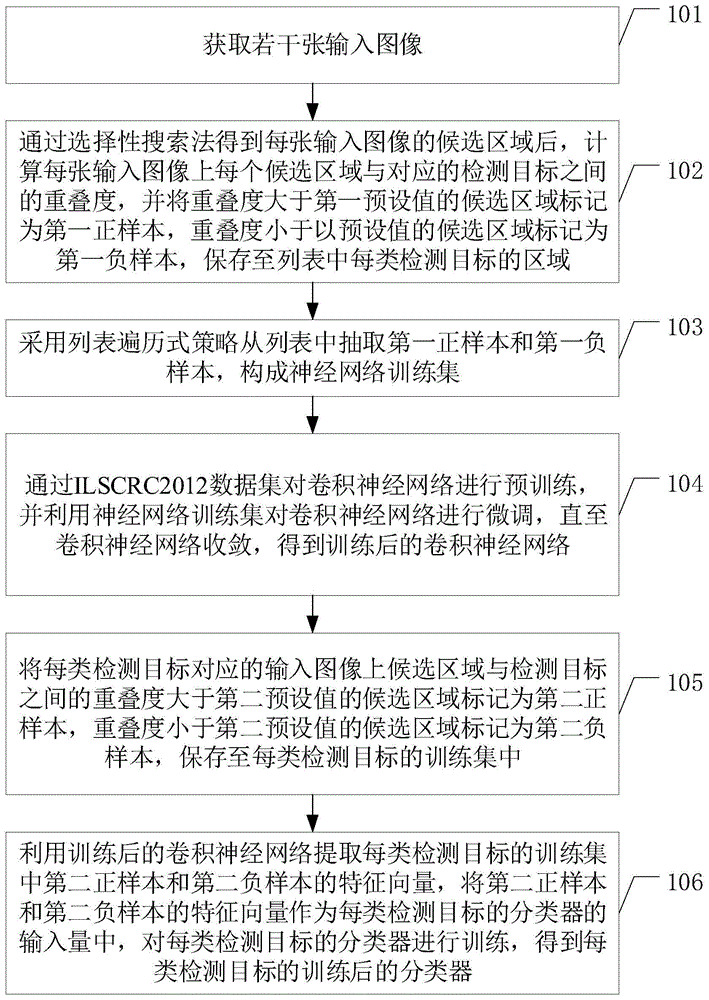
Referring to fig. 1, the present invention provides an embodiment of a tower disconnection detection model training method based on a high-resolution remote sensing satellite image, including:
101. acquiring a plurality of input images;
it should be noted that the input image may be a shot photo, and one input image may include a plurality of detection targets, such as a tower, a violation building, and the like.
102. After obtaining a candidate area of each input image through a selective search method, calculating the overlapping degree between each candidate area and the corresponding detection target on each input image, marking the candidate area with the overlapping degree larger than a first preset value as a first positive sample, marking the candidate area with the overlapping degree smaller than the preset value as a first negative sample, and storing the first negative sample in the area of each type of detection target in the list;
it should be noted that, for a plurality of acquired input images, 1k to 2k candidate regions are generated on each input image by using a Selective Search method (Selective Search), then, the overlapping degree between each candidate region and the detection target in the input image is sequentially calculated on each input image (IoU), if the overlapping degree is greater than a first preset value, the candidate region is marked as a first positive sample, if the overlapping degree is less than the first preset value, the candidate region is marked as a first negative sample, and all the candidate regions are stored in the region of each type of detection target in the list, that is, the overlapping degree of the candidate regions related to the tower is stored in the first column of the list.
103. Extracting a first positive sample and a first negative sample from the list by adopting a list traversal strategy to form a neural network training set;
it should be noted that, a list traversal strategy based on information balance improvement is adopted to randomly extract a first positive sample or a first negative sample from the list, and finally a neural network training set is formed.
104. Pre-training the convolutional neural network through an ILSCRC2012 data set, and finely adjusting the convolutional neural network by using a neural network training set until the convolutional neural network is converged to obtain a trained convolutional neural network;
it should be noted that, firstly, supervised pre-training is performed on the convolutional neural network through the ILSCRC2012 data set, and the parameters of the pre-trained convolutional neural network are used to replace the random initialization parameters, so that the convolutional neural network has good initial values before formal training, and the phenomenon of overfitting of small sample data by random initialization is effectively avoided; and then, fine tuning the pre-trained convolutional neural network by utilizing a neural network training set until the convolutional neural network is converged, thereby obtaining the trained convolutional neural network.
105. Marking the candidate area, corresponding to each type of detection target, of which the overlapping degree between the candidate area and the detection target is greater than a second preset value, on the input image as a second positive sample, marking the candidate area, of which the overlapping degree is less than the second preset value, as a second negative sample, and storing the second negative sample in a training set of each type of detection target;
it should be noted that after the convolutional neural network is trained, a classifier needs to be trained for each type of detection target, a training set needs to be prepared for each type of detection target, taking the detection target as a tower as an example, a tower is taken as a detection target in each input image, the overlap degree between a candidate area and the tower on the input image is calculated, if the overlap degree is smaller than a second preset value, the candidate area is marked as a second negative sample, and the candidate area with the overlap degree larger than the second preset value is marked as a second positive sample.
106. Extracting feature vectors of a second positive sample and a second negative sample in a training set of each type of detection target by using the trained convolutional neural network, taking the feature vectors of the second positive sample and the second negative sample as input quantities of a classifier of each type of detection target, and training the classifier of each type of detection target to obtain the trained classifier of each type of detection target;
after a training set of each type of detection target is prepared, the classifier of each type of detection target is trained by using the constructed training set of each type of detection target, firstly, the feature vectors of the second positive sample and the second negative sample in the training set of each type of detection target are extracted through the trained convolutional neural network, and the extracted feature vectors of the second positive sample and the second negative sample are used as the input quantity of the classifier of each type of detection target, so that the classifier of each type of detection target is trained, and the trained classifier of each type of detection target is obtained.
The trained convolutional neural network is combined with the trained classifier of each type of detection target, intelligent detection of tower disconnection in the input image is achieved, meanwhile, a list traversal strategy based on information balance improvement is adopted for sample extraction, the effect of fewer types of samples is enhanced, and the adverse effect of imbalance of positive and negative samples on classification effect is overcome.
The embodiment of the invention utilizes the fault-tolerant capability, the parallel processing capability and the self-learning capability of the convolutional neural network, so that the inherent multi-level features of the image data can be automatically learned and depicted and are abstracted step by step, the features are not required to be manually designed, the purposes of simultaneously realizing feature learning and classification detection can be achieved, the self-adaption performance is good, the recognition rate is higher, the intelligence is higher, and the manual operation is reduced.
The above is a description of a flow of an embodiment of the tower disconnection detection model training method based on the high-resolution remote sensing satellite image, and the following is a description of a flow of another embodiment of the tower disconnection detection model training method based on the high-resolution remote sensing satellite image.
Referring to fig. 2, another embodiment of the invention provides a tower disconnection detection model training method based on a high-resolution remote sensing satellite image, including:
201. acquiring a plurality of input images;
it should be noted that the input image may be a shot photo, and one input image may include a plurality of detection targets, such as a tower, a violation building, and the like.
202. After a candidate area of each input image is obtained through a selective search method, the overlapping degree between each candidate area and the corresponding detection target on each input image is calculated, the candidate area with the overlapping degree larger than a first preset value is marked as a first positive sample, the candidate area with the overlapping degree smaller than the preset value is marked as a first negative sample, the information weight value of the first positive sample or the first negative sample is determined according to the overlapping degree of the candidate areas, and the information weight value is stored in the area of each type of detection target in the list;
it should be noted that, for a plurality of acquired input images, 1k to 2k candidate regions are generated on each input image by using a Selective Search method (Selective Search), then the overlapping degree between each candidate region and the detection target in the input image is sequentially calculated on each input image (IoU), if the overlapping degree is greater than a first preset value, the candidate region is marked as a first positive sample, if the overlapping degree is less than the first preset value, the candidate region is marked as a first negative sample, and all the candidate regions are stored in the region of each type of detection target in the list, that is, the overlapping degree of the candidate regions related to the tower is stored in a first column of the list;
in order to balance the influence of the first positive sample and the first negative sample on the training result, information weight values are added to the first positive sample and the first negative sample respectively according to the overlapping values, and the sum of the weight values of the first positive sample and the first negative sample is equal. For a few first positive samples, the first positive samples contain relatively more information and set larger information weight values, and for a few first negative samples, the first negative samples contain relatively less information and set smaller information weight values.
203. Randomly extracting a class of detection targets and corresponding areas thereof in the list, and shuffling all the class of detection targets in the list if all the class of detection targets in the list are traversed;
204. randomly extracting a first positive sample or a first negative sample in the region corresponding to the first class of detection targets until all the first positive samples and the first negative samples in the region corresponding to the first class of detection targets are extracted, forming a neural network training set, and shuffling the region corresponding to the first class of detection targets;
it should be noted that each row in the list T1 includes a class detection target, a table T2(n) in m (n) row 2 column is prepared for each class detection target, m (n) is the number of samples of each class detection target, the first column stores a first positive sample and a first negative sample in each row, and the second column stores an information weight value corresponding to the first column sample in each row. During each extraction, a class i is taken from the list T1, then an image is taken from the first column of the corresponding T2(i), the information weight value corresponding to the second column is recorded, and after the T2(i) is traversed, the images are shuffled and taken from a new table next time. When the list T1 is traversed, it is shuffled and taken from a new table next time until the convolutional neural network training is finished.
205. Standardizing the candidate area of each input image to a preset size;
it should be noted that, by normalizing the candidate region of each input image to a preset size, the dimension of the depth feature extracted from each candidate region is also fixed.
206. Pre-training the convolutional neural network through an ILSCRC2012 data set, and adjusting a loss function value of sample data in the ILSCRC2012 data set by using an information weight value corresponding to the extracted first positive sample or first negative sample in the pre-training process;
it should be noted that, firstly, supervised pre-training is performed on the convolutional neural network through the ILSCRC2012 data set, and in the pre-training process, the loss function value of each sample is adjusted according to the information weight value corresponding to the extracted first positive sample or first negative sample, so as to enhance the influence of the sample with the larger information weight value on the loss value.
207. Fine-tuning the pre-trained convolutional neural network by using a neural network training set by adopting an SGD method until the pre-trained convolutional neural network is converged to obtain a trained convolutional neural network;
it should be noted that, by using the SGD method, the pre-trained convolutional neural network is finely tuned by using the neural network training set until the pre-trained convolutional neural network converges to obtain the trained convolutional neural network, and the pre-trained model parameters are used to replace the random initialization parameters, so that the convolutional neural network has good initial values before training, and the phenomenon of fitting small sample data by random initialization is effectively avoided.
208. Marking the candidate area, corresponding to each type of detection target, of which the overlapping degree between the candidate area and the detection target is greater than a second preset value, on the input image as a second positive sample, marking the candidate area, of which the overlapping degree is less than the second preset value, as a second negative sample, and storing the second negative sample in a training set of each type of detection target;
it should be noted that after the convolutional neural network is trained, a classifier needs to be trained for each type of detection target, a training set needs to be prepared for each type of detection target, taking the detection target as a tower as an example, a tower is taken as a detection target in each input image, the overlap degree between a candidate area and the tower on the input image is calculated, if the overlap degree is smaller than a second preset value, the candidate area is marked as a second negative sample, and the candidate area with the overlap degree larger than the second preset value is marked as a second positive sample.
209. Extracting feature vectors of a second positive sample and a second negative sample in a training set of each type of detection target by using the trained convolutional neural network, taking the feature vectors of the second positive sample and the second negative sample as input quantities of a classifier of each type of detection target, and training the classifier of each type of detection target to obtain the trained classifier of each type of detection target;
after a training set of each type of detection target is prepared, the classifier of each type of detection target is trained by using the constructed training set of each type of detection target, firstly, the feature vectors of the second positive sample and the second negative sample in the training set of each type of detection target are extracted through the trained convolutional neural network, and the extracted feature vectors of the second positive sample and the second negative sample are used as the input quantity of the classifier of each type of detection target, so that the classifier of each type of detection target is trained, and the trained classifier of each type of detection target is obtained.
210. Acquiring a plurality of input images marked with a real frame of a detection target;
it should be noted that, in addition to training the convolutional neural network and the classifier for each type of detection target, a frame regressor may be trained for each type of detection target to improve the accuracy of detection. Firstly, a plurality of input images marked with a real frame of a detection target are acquired, wherein the real frame is represented by G, and G ═ G (G)x,Gy,Gw,Gh) The center abscissa, center ordinate, frame width, and frame height of this frame are respectively indicated.
211. Obtaining an output image marked with a detection target output frame by using the trained convolutional neural network and the trained classifier;
an output image in which a detection target output frame is marked is obtained by using the trained convolutional neural network and the trained classifier, the output frame is denoted by P, and P ═ is (Px, Py, Pw, Ph), and the meaning of each element is the same as that of G.
212. A frame regressor for mapping the output image marked with the detection target output frame to the input image marked with the detection target real frame to generate a detection target;
it should be noted that, mapping the output image marked with the detection target output frame to the input image marked with the detection target real frame by using the following transformation relationship, specifically:
the function optimization objective is:
tx=(Gx-Px)/Pw
ty=(Gy-Py)/Ph
tw=log(Gw/Pw)
th=log(Gh/Ph);
in the formula (I), the compound is shown in the specification,
computing pool of regions for trained convolutional neural networks
5The characteristics of the layer.
The embodiment of the invention utilizes the fault-tolerant capability, the parallel processing capability and the self-learning capability of the convolutional neural network, so that the inherent multi-level features of the image data can be automatically learned and depicted and are abstracted step by step, the features are not required to be manually designed, the purposes of simultaneously realizing feature learning and classification detection can be achieved, the self-adaption performance is good, the recognition rate is higher, the intelligence is higher, and the manual operation is reduced.
The above is a description of a flow of another embodiment of the tower disconnection detection model training method based on the high-resolution remote sensing satellite image, and a structure of an embodiment of the tower disconnection detection model training device based on the high-resolution remote sensing satellite image provided by the invention is described below.
Referring to fig. 3, the present invention provides an embodiment of a tower disconnection detection model training device based on a high-resolution remote sensing satellite image, including:
a first acquisition unit 301 for acquiring a plurality of input images;
the overlap calculation unit 302 is configured to calculate an overlap degree between each candidate region and a corresponding detection target on each input image after obtaining the candidate region of each input image through a selective search method, mark the candidate region with the overlap degree larger than a first preset value as a first positive sample, mark the candidate region with the overlap degree smaller than the preset value as a first negative sample, and store the first negative sample in the region of each type of detection target in the list;
a first training set constructing unit 303, configured to extract a first positive sample and a first negative sample from the list by using a list traversal strategy to form a neural network training set;
the first training unit 304 is configured to pre-train the convolutional neural network through an ILSCRC2012 data set, and perform fine tuning on the convolutional neural network by using the neural network training set until the convolutional neural network converges, so as to obtain a trained convolutional neural network;
a second training set constructing unit 305, configured to mark, as a second positive sample, a candidate region, where the overlap degree between the candidate region and the detection target on the input image corresponding to each type of detection target is greater than a second preset value, and mark, as a second negative sample, a candidate region, where the overlap degree is less than the second preset value, and store the second negative sample in the training set of each type of detection target;
the second training unit 306 is configured to extract feature vectors of a second positive sample and a second negative sample in the training set of each type of detection target by using the trained convolutional neural network, use the feature vectors of the second positive sample and the second negative sample as input quantities of the classifier of each type of detection target, train the classifier of each type of detection target, and obtain the trained classifier of each type of detection target.
The structure of an embodiment of the tower disconnection detection model training device based on the high-resolution remote sensing satellite image provided by the invention is described above, and the structure of another embodiment of the tower disconnection detection model training device based on the high-resolution remote sensing satellite image provided by the invention is described below.
Referring to fig. 4, another embodiment of the tower disconnection detection model training device based on the high-resolution remote sensing satellite image according to the present invention includes:
a first acquisition unit 401 for acquiring a plurality of input images;
the overlap calculation unit 402 is configured to calculate an overlap degree between each candidate region and a corresponding detection target on each input image after obtaining the candidate region of each input image through a selective search method, mark the candidate region with the overlap degree larger than a first preset value as a first positive sample, mark the candidate region with the overlap degree smaller than the preset value as a first negative sample, and store the first negative sample in the region of each type of detection target in the list;
the overlap calculation unit 402 is further configured to determine an information weight value of the first positive sample or the first negative sample according to the overlap of the candidate region;
a first training set constructing unit 403, configured to extract a first positive sample and a first negative sample from the list by using a list traversal strategy to form a neural network training set;
the first training set constructing unit 403 specifically includes:
a first extraction subunit 4031, configured to randomly extract one type of detection target and a corresponding area in the list, and shuffle all types of detection targets in the list if all types of detection targets in the list are traversed;
a second extraction subunit 4032, configured to randomly extract one first positive sample or one first negative sample in the region corresponding to one type of detection target until all the first positive samples and the first negative samples in the region corresponding to one type of detection target are extracted, to form a neural network training set, and shuffle the regions corresponding to one type of detection target;
the first training unit 404 is configured to pre-train the convolutional neural network through an ILSCRC2012 data set, and perform fine tuning on the convolutional neural network by using the neural network training set until the convolutional neural network converges, so as to obtain a trained convolutional neural network;
the first training unit 404 specifically includes:
a normalization size sub-unit 4041 for normalizing the candidate region of each input image to a preset size;
the pre-training subunit 4042 is configured to pre-train the convolutional neural network through the ILSCRC2012 data set, and adjust a loss function value of sample data in the ILSCRC2012 data set by using an information weight value corresponding to the extracted first positive sample or first negative sample in the pre-training process;
a fine tuning sub-unit 4043, configured to perform fine tuning on the pre-trained convolutional neural network by using a neural network training set through an SGD method until the pre-trained convolutional neural network converges, so as to obtain a trained convolutional neural network;
a second training set constructing unit 405, configured to mark, as a second positive sample, a candidate region, where an overlap degree between the candidate region and the detection target on the input image corresponding to each type of detection target is greater than a second preset value, and mark, as a second negative sample, a candidate region, where the overlap degree is less than the second preset value, and store the second negative sample in the training set of each type of detection target;
the second training unit 406 is configured to extract feature vectors of a second positive sample and a second negative sample in a training set of each type of detection target by using the trained convolutional neural network, use the feature vectors of the second positive sample and the second negative sample as input quantities of a classifier of each type of detection target, train the classifier of each type of detection target, and obtain the trained classifier of each type of detection target;
a second acquiring unit 407 for acquiring a plurality of input images marked with a detection target real frame;
the test unit 408 is configured to obtain an output image labeled with a detection target output frame by using the trained convolutional neural network and the trained classifier;
a regression unit 409, configured to map the output image marked with the detection target output frame onto the input image marked with the detection target real frame to generate a frame regressor of the detection target.
It is clear to those skilled in the art that, for convenience and brevity of description, the specific working processes of the above-described systems, apparatuses and units may refer to the corresponding processes in the foregoing method embodiments, and are not described herein again.
In the several embodiments provided in the present application, it should be understood that the disclosed system, apparatus and method may be implemented in other manners. For example, the above-described apparatus embodiments are merely illustrative, and for example, the division of the units is only one logical division, and other divisions may be realized in practice, for example, a plurality of units or components may be combined or integrated into another system, or some features may be omitted, or not executed. In addition, the shown or discussed mutual coupling or direct coupling or communication connection may be an indirect coupling or communication connection through some interfaces, devices or units, and may be in an electrical, mechanical or other form.
The units described as separate parts may or may not be physically separate, and parts displayed as units may or may not be physical units, may be located in one place, or may be distributed on a plurality of network units. Some or all of the units can be selected according to actual needs to achieve the purpose of the solution of the embodiment.
In addition, functional units in the embodiments of the present invention may be integrated into one processing unit, or each unit may exist alone physically, or two or more units are integrated into one unit. The integrated unit can be realized in a form of hardware, and can also be realized in a form of a software functional unit.
The integrated unit, if implemented in the form of a software functional unit and sold or used as a stand-alone product, may be stored in a computer readable storage medium. Based on such understanding, the technical solution of the present invention may be embodied in the form of a software product, which is stored in a storage medium and includes instructions for causing a computer device (which may be a personal computer, a server, or a network device) to execute all or part of the steps of the method according to the embodiments of the present invention. And the aforementioned storage medium includes: a U-disk, a removable hard disk, a Read-Only Memory (ROM), a Random Access Memory (RAM), a magnetic disk or an optical disk, and other various media capable of storing program codes.
The above-mentioned embodiments are only used for illustrating the technical solutions of the present invention, and not for limiting the same; although the present invention has been described in detail with reference to the foregoing embodiments, it will be understood by those of ordinary skill in the art that: the technical solutions described in the foregoing embodiments may still be modified, or some technical features may be equivalently replaced; and such modifications or substitutions do not depart from the spirit and scope of the corresponding technical solutions of the embodiments of the present invention.