Background
The phosphonic (phosphoric) acid derivative of alkyl tin has stronger biological activities of killing insects, killing bacteria, weeding and the like, and is greatly concerned by people. The research on the hydrocarbyl tin complex of alkynyl phosphonic acid has been reported in documents (synthesis and properties of Wangshanhua, O-triphenyl tin unsaturated hydrocarbyl phosphonic acid, chemical reagent, 23(3), 141-143; synthesis and structural characterization of Yi Han Dong, O-tributyl tin alkynyl or alkenyl phosphonic acid, chemical reagent, 22(6), 133-334; synthesis and structural characterization of Yi Han Dong, phenyl tin alkynyl phosphonate, chemical notification, 7, 44-46; synthesis and structural characterization of Yi Han Dong, tribenzyl tin (IV) alkynyl (alkenyl) phosphonic acid derivative, inorganic chemical report, 1,127-130), but these documents mostly focus on the synthesis and structural research stage, and have less research on pharmacological activity, and mostly test the activity of sterilization, acaricidal and the like, and have less research on the antitumor activity of the complex.
Based on the consideration that tin complexes also have certain antitumor activity (CN102775449A and CN102424639A), in order to search for new anticancer drugs, proper structural improvement and screening are carried out on the existing dialkyl tin complexes of alkynyl phosphonic acid on the basis of the existing documents. Preliminary tests on biological activity show that the bisaryl tin complex of the alkynyl phosphonic acid has certain anticancer activity, and especially, the complexes with a plurality of specific structures show excellent activity.
Disclosure of Invention
On the basis of fully researching the prior art, the application screens a novel alkyl diaryl tin complex of alkynyl phosphonic acid with anticancer activity, thereby providing a novel antitumor candidate compound.
In order to achieve the purpose, the technical scheme of the invention is realized as follows:
an alkynylphosphonic acid bisaryl tin complex with anti-tumor activity, characterized by having the following structure: (Ar)
3SnO)
2P (O) R; wherein Ar is optionally substituted phenyl;
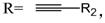
and R is
2Is optionally substituted alkyl, aryl, heteroaryl.
The alkynyl phosphonic acid diaryl tin complex is characterized in that: ar is phenyl, halogen or alkyl or alkoxy or nitro substituted phenyl; r2Is optionally substituted C1-C6 alkyl, C6-C10 aryl, C6-C10 heteroaryl.
The alkynyl phosphonic acid diaryl tin complex is characterized in that: ar is phenyl, 4-chlorphenyl, 2, 4-dichlorophenyl, preferably 2, 4-dichlorophenyl; r2Is a butyl group, preferably a tert-butyl group.
The alkynyl phosphonic acid diaryl tin complex is used for preparing anti-cancer drugs, wherein the cancers comprise cervical cancer, breast cancer, lung adenocarcinoma, liver cancer, prostatic cancer, colon cancer and the like.
The complex of the invention has the following beneficial effects:
the invention carries out structural modification on the alkynyl phosphonic acid diaryl tin complex, screens out a compound with anticancer activity, embodies stronger activity than cisplatin, and is a potential clinical antitumor drug.
Detailed Description
In order to make the objects, technical solutions and advantages of the present invention more apparent, the following detailed description of representative embodiments of the present invention is given without being limited thereto.
EXAMPLE 1 Synthesis of Compound 1
The structural formula of the product is:
adding 3mmol of tris (2, 4-dichlorophenyl) tin chloride and 35mL of anhydrous methanol into a 100mL round-bottom flask, stirring, completely dissolving, adding 1.5mmol of tert-butyl ethynyl disodium phosphate, stirring under reflux for reacting for 6 hours, cooling, filtering, concentrating the filtrate under reduced pressure, adding a proper amount of petroleum ether, filtering, and concentrating in vacuum to obtain the product with the yield of 78%.
Elemental analysis data: anal, calcd, for C42H27Cl12O3PSn2(%): c39.61, H2.14, Sn 18.64; found (%): c39.68, H2.29, Sn 18.73. Nuclear magnetic hydrogen spectrum data:1H NMR/δ1.34-1.68(9H),7.13-7.48(18H)。
example 2
Adding 3.5mmol of tris (2, 4-dichlorophenyl) tin chloride and 35mL of anhydrous methanol into a 100mL round-bottom flask, stirring, completely dissolving, adding 1.5mmol of tert-butyl ethynyl disodium phosphate, stirring under reflux for reaction for 5.5 hours, cooling, filtering, concentrating the filtrate under reduced pressure, adding a proper amount of petroleum ether, filtering, and concentrating in vacuum to obtain the product with the yield of 80%.
Elemental analysis data: anal, calcd, for C42H27Cl12O3PSn2(%): c39.61, H2.14, Sn 18.64; found (%): c39.68, H2.29, Sn 18.73. Nuclear magnetic hydrogen spectrum data:1H NMR/δ1.34-1.68(9H),7.13-7.48(18H)。
example 3
Adding 3mmol of tris (2, 4-dichlorophenyl) tin chloride and 39mL of anhydrous acetonitrile into a 100mL round-bottom flask, stirring, completely dissolving, adding 1.5mmol of tert-butyl ethynyl disodium phosphate, stirring under reflux for reacting for 4 hours, cooling, filtering, concentrating the filtrate under reduced pressure, adding a proper amount of petroleum ether, filtering, and concentrating in vacuum to obtain the product with the yield of 77%.
Elemental analysis data: anal, calcd, for C42H27Cl12O3PSn2(%): c39.61, H2.14, Sn 18.64; found (%): c39.68, H2.29, Sn 18.73. Nuclear magnetic hydrogen spectrum data:1H NMR/δ1.34-1.68(9H),7.13-7.48(18H)。
example 4
Adding 3mmol of tris (2, 4-dichlorophenyl) tin chloride and 35mL of anhydrous toluene into a 100mL round bottom flask, stirring, completely dissolving, adding 1.5mmol of tert-butyl ethynyl disodium phosphate, stirring under reflux for reaction for 10 hours, cooling, filtering, concentrating the filtrate under reduced pressure, adding a proper amount of petroleum ether, filtering, and concentrating in vacuum to obtain the product with the yield of 58%.
Elemental analysis data: anal, calcd, for C42H27Cl12O3PSn2(%): c39.61, H2.14, Sn 18.64; found (%): c39.68, H2.29, Sn 18.73. Nuclear magnetic hydrogen spectrum data:1H NMR/δ1.34-1.68(9H),7.13-7.48(18H)。
example 5
Adding 3mmol of tris (2, 4-dichlorophenyl) tin chloride and 35mL of anhydrous methanol into a 100mL round-bottom flask, stirring, adding 1.5mmol of n-butyl ethynyl disodium phosphate after complete dissolution, stirring for reaction for 6 hours under reflux, cooling, filtering, concentrating the filtrate under reduced pressure, adding a proper amount of petroleum ether, filtering, and concentrating in vacuum to obtain a product, namely an n-butyl alkynyl substituted product, with the yield of 81%.
Example 6
Adding 3mmol of triphenyltin chloride and 35mL of anhydrous methanol into a 100mL round-bottom flask, stirring, completely dissolving, adding 1.5mmol of n-butyl ethynyl disodium phosphate, stirring under reflux for reacting for 6 hours, cooling, filtering, concentrating the filtrate under reduced pressure, adding a proper amount of petroleum ether, filtering, and concentrating in vacuum to obtain a product, namely a corresponding product of the triphenyltin, wherein the yield is 85%.
EXAMPLE 7 antitumor Activity test of Compounds
MCF-7, HT-29, A549 and HepG2 cells were obtained from American tissue culture Bank by culturing in culture medium containing 10% fetal bovine serum in the presence of CO2The culture was carried out at 37 ℃. The MTT method is used for detecting the proliferation and growth inhibition of the cells. The number of experimental cells was adjusted to obtain an absorbance at 570nm, the test drug solution (0.1nmol/L to 10. mu. mol/L) of the compound prepared in example 1 was set at 6 concentrations, and the cells were treated for 72 hours at each concentration for at least 3 parallel experiments and 3 replicatesVerification, determination of IC by statistical analysis50The value is obtained.
The compound prepared in example 1 was tested against tumor cells with cisplatin as a control: the in vitro growth inhibitory activity of MCF7 (human breast cancer cells), HT-29 (human colon cancer cells), A549 (human lung cancer cells) and HepG2 (liver cancer cells) is shown in Table 1 below. The compound is found to show stronger anticancer activity on the researched cells than cisplatin, especially has more obvious inhibition effect on A549, and can be used as a candidate anticancer compound.
TABLE 1