CN110494792B - Visual tracking of peripheral devices - Google Patents

Visual tracking of peripheral devices Download PDF

Info

Publication number
CN110494792B
CN110494792B CN201980001863.1A CN201980001863A CN110494792B CN 110494792 B CN110494792 B CN 110494792B CN 201980001863 A CN201980001863 A CN 201980001863A CN 110494792 B CN110494792 B CN 110494792B
Authority
CN
China
Prior art keywords
handheld
handheld device
data
fiducial
orientation
Prior art date
Legal status (The legal status is an assumption and is not a legal conclusion. Google has not performed a legal analysis and makes no representation as to the accuracy of the status listed.)
Active
Application number
CN201980001863.1A
Other languages
Chinese (zh)
Other versions
CN110494792A (en
Inventor
R·利拉兹利德吉
Z·C·尼恩斯泰特
S·A·米勒
B·费雷德曼
L·E·埃德温
E·C·布洛伊
W·H·韦尔奇
Current Assignee (The listed assignees may be inaccurate. Google has not performed a legal analysis and makes no representation or warranty as to the accuracy of the list.)
Magic Leap Inc
Original Assignee
Magic Leap Inc
Priority date (The priority date is an assumption and is not a legal conclusion. Google has not performed a legal analysis and makes no representation as to the accuracy of the date listed.)
Filing date
Publication date
Application filed by Magic Leap Inc filed Critical Magic Leap Inc
Priority to CN202510698997.0A priority Critical patent/CN120502084A/en
Priority to CN202110689396.5A priority patent/CN113426098B/en
Publication of CN110494792A publication Critical patent/CN110494792A/en
Application granted granted Critical
Publication of CN110494792B publication Critical patent/CN110494792B/en
Active legal-status Critical Current
Anticipated expiration legal-status Critical

Links

Images

Classifications

    • AHUMAN NECESSITIES
    • A63SPORTS; GAMES; AMUSEMENTS
    • A63FCARD, BOARD, OR ROULETTE GAMES; INDOOR GAMES USING SMALL MOVING PLAYING BODIES; VIDEO GAMES; GAMES NOT OTHERWISE PROVIDED FOR
    • A63F13/00Video games, i.e. games using an electronically generated display having two or more dimensions
    • A63F13/20Input arrangements for video game devices
    • A63F13/21Input arrangements for video game devices characterised by their sensors, purposes or types
    • A63F13/213Input arrangements for video game devices characterised by their sensors, purposes or types comprising photodetecting means, e.g. cameras, photodiodes or infrared cells
    • GPHYSICS
    • G02OPTICS
    • G02BOPTICAL ELEMENTS, SYSTEMS OR APPARATUS
    • G02B27/00Optical systems or apparatus not provided for by any of the groups G02B1/00 - G02B26/00, G02B30/00
    • G02B27/01Head-up displays
    • AHUMAN NECESSITIES
    • A63SPORTS; GAMES; AMUSEMENTS
    • A63FCARD, BOARD, OR ROULETTE GAMES; INDOOR GAMES USING SMALL MOVING PLAYING BODIES; VIDEO GAMES; GAMES NOT OTHERWISE PROVIDED FOR
    • A63F13/00Video games, i.e. games using an electronically generated display having two or more dimensions
    • A63F13/25Output arrangements for video game devices
    • AHUMAN NECESSITIES
    • A63SPORTS; GAMES; AMUSEMENTS
    • A63FCARD, BOARD, OR ROULETTE GAMES; INDOOR GAMES USING SMALL MOVING PLAYING BODIES; VIDEO GAMES; GAMES NOT OTHERWISE PROVIDED FOR
    • A63F13/00Video games, i.e. games using an electronically generated display having two or more dimensions
    • A63F13/60Generating or modifying game content before or while executing the game program, e.g. authoring tools specially adapted for game development or game-integrated level editor
    • A63F13/65Generating or modifying game content before or while executing the game program, e.g. authoring tools specially adapted for game development or game-integrated level editor automatically by game devices or servers from real world data, e.g. measurement in live racing competition
    • GPHYSICS
    • G02OPTICS
    • G02BOPTICAL ELEMENTS, SYSTEMS OR APPARATUS
    • G02B27/00Optical systems or apparatus not provided for by any of the groups G02B1/00 - G02B26/00, G02B30/00
    • G02B27/01Head-up displays
    • G02B27/017Head mounted
    • GPHYSICS
    • G06COMPUTING OR CALCULATING; COUNTING
    • G06FELECTRIC DIGITAL DATA PROCESSING
    • G06F1/00Details not covered by groups G06F3/00 - G06F13/00 and G06F21/00
    • G06F1/16Constructional details or arrangements
    • G06F1/1613Constructional details or arrangements for portable computers
    • G06F1/163Wearable computers, e.g. on a belt
    • GPHYSICS
    • G06COMPUTING OR CALCULATING; COUNTING
    • G06FELECTRIC DIGITAL DATA PROCESSING
    • G06F1/00Details not covered by groups G06F3/00 - G06F13/00 and G06F21/00
    • G06F1/16Constructional details or arrangements
    • G06F1/1613Constructional details or arrangements for portable computers
    • G06F1/1633Constructional details or arrangements of portable computers not specific to the type of enclosures covered by groups G06F1/1615 - G06F1/1626
    • G06F1/1684Constructional details or arrangements related to integrated I/O peripherals not covered by groups G06F1/1635 - G06F1/1675
    • G06F1/1686Constructional details or arrangements related to integrated I/O peripherals not covered by groups G06F1/1635 - G06F1/1675 the I/O peripheral being an integrated camera
    • GPHYSICS
    • G06COMPUTING OR CALCULATING; COUNTING
    • G06FELECTRIC DIGITAL DATA PROCESSING
    • G06F1/00Details not covered by groups G06F3/00 - G06F13/00 and G06F21/00
    • G06F1/16Constructional details or arrangements
    • G06F1/1613Constructional details or arrangements for portable computers
    • G06F1/1633Constructional details or arrangements of portable computers not specific to the type of enclosures covered by groups G06F1/1615 - G06F1/1626
    • G06F1/1684Constructional details or arrangements related to integrated I/O peripherals not covered by groups G06F1/1635 - G06F1/1675
    • G06F1/1694Constructional details or arrangements related to integrated I/O peripherals not covered by groups G06F1/1635 - G06F1/1675 the I/O peripheral being a single or a set of motion sensors for pointer control or gesture input obtained by sensing movements of the portable computer
    • GPHYSICS
    • G06COMPUTING OR CALCULATING; COUNTING
    • G06FELECTRIC DIGITAL DATA PROCESSING
    • G06F3/00Input arrangements for transferring data to be processed into a form capable of being handled by the computer; Output arrangements for transferring data from processing unit to output unit, e.g. interface arrangements
    • G06F3/01Input arrangements or combined input and output arrangements for interaction between user and computer
    • G06F3/011Arrangements for interaction with the human body, e.g. for user immersion in virtual reality
    • GPHYSICS
    • G06COMPUTING OR CALCULATING; COUNTING
    • G06FELECTRIC DIGITAL DATA PROCESSING
    • G06F3/00Input arrangements for transferring data to be processed into a form capable of being handled by the computer; Output arrangements for transferring data from processing unit to output unit, e.g. interface arrangements
    • G06F3/01Input arrangements or combined input and output arrangements for interaction between user and computer
    • G06F3/03Arrangements for converting the position or the displacement of a member into a coded form
    • G06F3/0304Detection arrangements using opto-electronic means
    • G06F3/0325Detection arrangements using opto-electronic means using a plurality of light emitters or reflectors or a plurality of detectors forming a reference frame from which to derive the orientation of the object, e.g. by triangulation or on the basis of reference deformation in the picked up image
    • GPHYSICS
    • G06COMPUTING OR CALCULATING; COUNTING
    • G06FELECTRIC DIGITAL DATA PROCESSING
    • G06F3/00Input arrangements for transferring data to be processed into a form capable of being handled by the computer; Output arrangements for transferring data from processing unit to output unit, e.g. interface arrangements
    • G06F3/01Input arrangements or combined input and output arrangements for interaction between user and computer
    • G06F3/03Arrangements for converting the position or the displacement of a member into a coded form
    • G06F3/033Pointing devices displaced or positioned by the user, e.g. mice, trackballs, pens or joysticks; Accessories therefor
    • G06F3/0346Pointing devices displaced or positioned by the user, e.g. mice, trackballs, pens or joysticks; Accessories therefor with detection of the device orientation or free movement in a three-dimensional [3D] space, e.g. 3D mice, 6-DOF [six degrees of freedom] pointers using gyroscopes, accelerometers or tilt-sensors
    • GPHYSICS
    • G06COMPUTING OR CALCULATING; COUNTING
    • G06FELECTRIC DIGITAL DATA PROCESSING
    • G06F3/00Input arrangements for transferring data to be processed into a form capable of being handled by the computer; Output arrangements for transferring data from processing unit to output unit, e.g. interface arrangements
    • G06F3/01Input arrangements or combined input and output arrangements for interaction between user and computer
    • G06F3/03Arrangements for converting the position or the displacement of a member into a coded form
    • G06F3/033Pointing devices displaced or positioned by the user, e.g. mice, trackballs, pens or joysticks; Accessories therefor
    • G06F3/038Control and interface arrangements therefor, e.g. drivers or device-embedded control circuitry
    • G06F3/0383Signal control means within the pointing device
    • GPHYSICS
    • G06COMPUTING OR CALCULATING; COUNTING
    • G06FELECTRIC DIGITAL DATA PROCESSING
    • G06F30/00Computer-aided design [CAD]
    • AHUMAN NECESSITIES
    • A63SPORTS; GAMES; AMUSEMENTS
    • A63FCARD, BOARD, OR ROULETTE GAMES; INDOOR GAMES USING SMALL MOVING PLAYING BODIES; VIDEO GAMES; GAMES NOT OTHERWISE PROVIDED FOR
    • A63F2300/00Features of games using an electronically generated display having two or more dimensions, e.g. on a television screen, showing representations related to the game
    • A63F2300/30Features of games using an electronically generated display having two or more dimensions, e.g. on a television screen, showing representations related to the game characterized by output arrangements for receiving control signals generated by the game device
    • A63F2300/303Features of games using an electronically generated display having two or more dimensions, e.g. on a television screen, showing representations related to the game characterized by output arrangements for receiving control signals generated by the game device for displaying additional data, e.g. simulating a Head Up Display
    • GPHYSICS
    • G02OPTICS
    • G02BOPTICAL ELEMENTS, SYSTEMS OR APPARATUS
    • G02B27/00Optical systems or apparatus not provided for by any of the groups G02B1/00 - G02B26/00, G02B30/00
    • G02B27/01Head-up displays
    • G02B27/0179Display position adjusting means not related to the information to be displayed
    • G02B2027/0187Display position adjusting means not related to the information to be displayed slaved to motion of at least a part of the body of the user, e.g. head, eye

Landscapes

  • Engineering & Computer Science (AREA)
  • Theoretical Computer Science (AREA)
  • Multimedia (AREA)
  • Physics & Mathematics (AREA)
  • General Engineering & Computer Science (AREA)
  • Human Computer Interaction (AREA)
  • General Physics & Mathematics (AREA)
  • Computer Hardware Design (AREA)
  • Optics & Photonics (AREA)
  • Evolutionary Computation (AREA)
  • Geometry (AREA)
  • Studio Devices (AREA)
  • User Interface Of Digital Computer (AREA)
  • Image Analysis (AREA)
  • Length Measuring Devices By Optical Means (AREA)
  • Fittings On The Vehicle Exterior For Carrying Loads, And Devices For Holding Or Mounting Articles (AREA)
  • Image Input (AREA)

Abstract

公开了用于执行手持设备相对于可穿戴设备的定位的技术。诸如惯性测量单元(IMU)之类的被安装在手持设备上的至少一个传感器可以获得指示手持设备相对于世界的运动的手持数据。被安装在手持设备或可穿戴设备上的成像设备可以捕获包含被固定到另一设备的若干基准点的基准点图像。确定图像中包含的基准点数量。基于基准点数量,根据第一操作状态、第二操作状态或第三操作状态基于图像和手持数据而更新手持设备相对于可穿戴设备的位置和取向中的至少一者。

Figure 201980001863

Techniques are disclosed for performing positioning of a handheld device relative to a wearable device. At least one sensor mounted on the handheld device, such as an inertial measurement unit (IMU), can obtain handheld data indicative of the movement of the handheld device relative to the world. An imaging device mounted on a handheld or wearable device can capture fiducial images containing several fiducials affixed to another device. Determines the number of fiducials included in the image. Based on the number of fiducials, at least one of the position and orientation of the handheld device relative to the wearable device is updated based on the image and the handheld data according to the first operational state, the second operational state, or the third operational state.

Figure 201980001863

Description

Visual tracking of peripheral devices
Cross Reference to Related Applications
The present application claims priority from us provisional patent application No.62/640,009 entitled "VISUAL TRACKING OF PERIPHERAL DEVICES" (VISUAL TRACKING OF peripheral device) filed on 7.3.2018 and us provisional patent application No.62/640,299 entitled "VISUAL TRACKING OF PERIPHERAL DEVICES" (VISUAL TRACKING OF peripheral device) filed on 7.3.2018, the entire disclosures OF which are hereby incorporated by reference as if fully set forth herein for all purposes.
Background
Modern computing and display technologies have facilitated the development of systems for so-called "virtual reality" or "augmented reality" experiences, in which digitally reproduced images, or portions thereof, are presented to a user in a manner that looks or can be perceived as real. Virtual reality or "VR" scenes typically involve the presentation of digital or virtual image information and are opaque to other actual real-world visual inputs; augmented reality or "AR" scenes typically involve the presentation of digital or virtual image information as an enhancement to the visualization of the real world around the user.
Despite the advances made in these display technologies, there remains a need in the art for improved methods, systems, and apparatus related to augmented reality systems, and in particular display systems.
Disclosure of Invention
The present invention relates generally to the location (position, orientation and/or distance) of a peripheral device. More specifically, embodiments of the present invention provide systems, devices, and methods for positioning a handheld device relative to a wearable device. Although portions of the present invention are described with reference to augmented reality (AR systems), the present disclosure is applicable to a variety of applications.
According to a first aspect of the invention, a method of performing positioning of a handheld device relative to a wearable device is provided. The method includes obtaining, by at least one sensor mounted on the handheld device, handheld data indicative of motion of the handheld device relative to the world. In some embodiments, obtaining the handheld data includes detecting a linear acceleration and a rotational velocity of the handheld device by an Inertial Measurement Unit (IMU) mounted on the handheld device. In some embodiments, obtaining the handheld data comprises capturing, by a handheld camera mounted on the handheld device, a world image containing one or more features located around the handheld device. The method may further include obtaining, by a wearable camera mounted on the wearable device, baseline data (fiducial data) indicative of motion of the handheld device relative to the wearable device. In some embodiments, obtaining the baseline data includes capturing, by the wearable camera, a baseline image (fiduciary image) containing a number of Light Emitting Diodes (LEDs) secured to a handheld device of a plurality of LEDs secured on the handheld device.
The method may further include determining a number of LEDs included in the fiducial point image. The method may further include, in response to determining that the number of LEDs is equal to or greater than 3, updating the position and orientation of the handheld device relative to the wearable device based only on the baseline data according to a first operating state. The method may further include, in response to determining that the number of LEDs is equal to 1 or 2, updating a position and orientation of the handheld device relative to the wearable device based on the baseline data and the handheld data according to a second operating state. The method may further include, in response to determining that the number of LEDs is equal to 0, updating the position and orientation of the handheld device relative to the wearable device based only on the handheld data according to a third operating state.
According to a second aspect of the invention, a method of performing positioning of a handheld device relative to a wearable device. The method may include obtaining, by at least one sensor mounted on the handheld device, handheld data indicative of motion of the handheld device relative to the world. The method may also include obtaining, by an imaging device mounted on the first device, baseline data indicative of motion of the handheld device relative to the wearable device. In some embodiments, the first device is the handheld device or the wearable device. In some embodiments, obtaining the fiducial data comprises capturing, by the imaging device, a fiducial image containing a number of fiducials (fiducials) fixed to a second device different from the first device. In some embodiments, the second device is the handheld device or the wearable device. The method may further include determining a number of fiducial points included in the fiducial point image. The method may further include updating a position and orientation of the handheld device relative to the wearable device based on the fiducial data and the handheld data according to a first operating state or a second operating state based on a number of fiducial points included in the fiducial point image.
In some embodiments, obtaining the handheld data includes detecting rotational movement of the handheld device by an IMU mounted on the handheld device. In some embodiments, the imaging device is mounted on the handheld device and a plurality of fiducials including the number of fiducials are secured to the wearable device. In some embodiments, the imaging device is mounted on the wearable device, and a plurality of fiducials including the number of fiducials are secured to the handheld device. In some embodiments, the imaging device is mounted on the handheld device and a plurality of fiducials including the number of fiducials are secured to the wearable device. In some embodiments, obtaining the handheld data includes capturing, by a second handheld imaging device mounted on the handheld device, a world image containing one or more features located around the handheld device. In some embodiments, the imaging device is mounted on the wearable device and a single fiducial point comprising the number of fiducial points is affixed to the handheld device. In such embodiments, obtaining the handheld data includes capturing, by a second handheld imaging device mounted on the handheld device, a world image containing one or more features located around the handheld device.
In some embodiments, the imaging device is mounted on the wearable device, and a plurality of fiducials including the number of fiducials are secured to the handheld device. In such embodiments, obtaining the handheld data includes capturing, by a second handheld imaging device mounted on the handheld device, a world image containing one or more features located around the handheld device. The method may further include, in response to determining that the number of fiducial points is equal to or greater than 3, updating a position and orientation of the handheld device relative to the wearable device based on the fiducial data in accordance with a first operational state. The method may further include, in response to determining that the number of fiducial points is equal to 1 or 2, updating a position and orientation of the handheld device relative to the wearable device based on the fiducial data and the handheld data according to a second operational state. The method may further include, in response to determining that the number of fiducial points is equal to 0, updating a position and orientation of the handheld device relative to the wearable device based on the handheld data according to a third operational state. In some embodiments, the position and orientation of the handheld device relative to the wearable device is updated based only on the baseline data according to the first operating state. In some embodiments, the position and orientation of the handheld device relative to the wearable device is updated based only on the handheld data according to the third operating state.
According to a third aspect of the invention, a system for performing positioning of a handheld device relative to a wearable device is provided. The system may include the wearable device. The system may also include the handheld device. The system may further include one or more processors communicatively coupled with the wearable device and the handheld device. In some embodiments, the one or more processors are configured to perform operations comprising: obtaining, by at least one sensor mounted on the handheld device, handheld data indicative of motion of the handheld device relative to the world. The operations may also include obtaining, by an imaging device mounted on the first device, baseline data indicative of motion of the handheld device relative to the wearable device. In some embodiments, the first device is the handheld device or the wearable device. In some embodiments, obtaining the fiducial data comprises capturing, by the imaging device, a fiducial image containing a number of fiducial points fixed to a second device different from the first device. In some embodiments, the second device is the handheld device or the wearable device. The operations may further include determining a number of fiducial points included in the fiducial point image. The operations may further include updating a position and an orientation of the handheld device relative to the wearable device based on the fiducial data and the handheld data according to a first operational state or a second operational state based on a number of fiducial points included in the fiducial point image.
In some embodiments, obtaining the handheld data includes detecting rotational movement of the handheld device by an IMU mounted on the handheld device. In some embodiments, the imaging device is mounted on the handheld device and a plurality of fiducials including the number of fiducials are secured to the wearable device. In some embodiments, the imaging device is mounted on the wearable device, and a plurality of fiducials including the number of fiducials are secured to the handheld device. In some embodiments, the imaging device is mounted on the handheld device and a plurality of fiducials including the number of fiducials are secured to the wearable device. In such embodiments, obtaining the handheld data includes capturing, by a second handheld imaging device mounted on the handheld device, a world image containing one or more features located around the handheld device. In some embodiments, the imaging device is mounted on the wearable device and a single fiducial point comprising the number of fiducial points is affixed to the handheld device. In such embodiments, obtaining the handheld data includes capturing, by a second handheld imaging device mounted on the handheld device, a world image containing one or more features located around the handheld device. In some embodiments, the imaging device is mounted on the wearable device, and a plurality of fiducials including the number of fiducials are secured to the handheld device. In such embodiments, obtaining the handheld data includes capturing, by a second handheld imaging device mounted on the handheld device, a world image containing one or more features located around the handheld device.
In some embodiments, the operations further comprise, in response to determining that the number of reference points is equal to or greater than 3, updating a position and orientation of the handheld device relative to the wearable device based on the reference data in accordance with a first operational state. In some embodiments, the operations further comprise, in response to determining that the number of fiducial points is equal to 1 or 2, updating a position and orientation of the handheld device relative to the wearable device based on the fiducial data and the handheld data according to a second operational state. In some embodiments, the operations further comprise, in response to determining that the number of reference points is equal to 0, updating a position and an orientation of the handheld device relative to the wearable device based on the handheld data according to a third operational state.
Various benefits over conventional techniques are realized with the present invention. For example, embodiments of the present invention provide more accurate handheld device localization than conventional techniques, such as electromagnetic tracking systems that employ a series of magnetic coils. Embodiments of the present invention may also utilize hardware already employed in AR systems, such as forward or side world cameras equipped on a headset. Embodiments may extend beyond AR systems and to any application where the positioning of one device relative to another is important. Other benefits of the present invention will be apparent to those skilled in the art.
Drawings
Fig. 1 illustrates an Augmented Reality (AR) scene viewed by a wearable AR device according to embodiments described herein.
Figure 2 shows various possible components of an AR system.
Fig. 3 shows an example of how a visual tracking system incorporates an AR system with a wearable device and a handheld device.
Fig. 4 shows a diagram of the positioning task.
Fig. 5 shows an example configuration of an AR system.
Fig. 6 illustrates a method of performing positioning using the example configuration illustrated in fig. 5.
Fig. 7 shows an example configuration of an AR system.
Fig. 8 illustrates a method of performing positioning using the example configuration illustrated in fig. 7.
Fig. 9 shows an example configuration of an AR system.
Fig. 10 illustrates a method of performing positioning using the example configuration illustrated in fig. 9.
Fig. 11A shows an example configuration of an AR system.
Fig. 11B shows an example configuration of an AR system.
Fig. 12 illustrates a method of performing positioning using the example configuration illustrated in fig. 11A and 11B.
Fig. 13 illustrates a method of performing positioning using any of the previously illustrated example configurations.
FIG. 14 illustrates a simplified computer system according to some embodiments described herein.
Detailed Description
In conventional Virtual Reality (VR) or Augmented Reality (AR) systems, six degrees of freedom tracking of peripherals is achieved by including a series of electromagnetic sensors and emitters strategically placed on the user's AR headset, belt pack, and/or other auxiliary devices (e.g., totems, haptic devices, game tools, etc.). Typically, an electromagnetic tracking system includes at least one electromagnetic field emitter and at least one electromagnetic field sensor. Since the emitted electromagnetic field has a known distribution, the detected field can be analyzed to determine the location and/or orientation of the peripheral device. While such systems provide a simple solution to the positioning problem, there is a need for additional solutions that provide higher accuracy positioning. Embodiments of the present invention may replace or supplement electromagnetic tracking systems.
Embodiments of the present invention provide a visual tracking system for performing high precision positioning of a handheld device (e.g., totem) relative to a wearable device (e.g., a head-mounted device). An imaging device is mounted on one of the devices and can capture images of one or more fiducials fixed to the other device. Additional imaging devices may be mounted on the handheld device to capture various environmental markers. Based on the number of fiducials in the captured image, different data processing schemes may be implemented that utilize the fiducial data (i.e., data with local references based on the fiducial image) and the handheld data (data with world references collected from sensors mounted on the handheld device) differently. Each data processing scheme, referred to herein as an operating state, enables accurate estimation of the position and/or orientation of the handheld device relative to the wearable device. The tracking system may inform the AR system of the estimated location, and the AR system may use the location information to generate virtual content that is comfortable for the user.
Fig. 1 shows an AR scene viewed by a wearable AR device according to embodiments described herein. An AR scene 100 is depicted in which a user of AR technology sees a real-world park-like setting 106 featuring people, trees, buildings in the background, and a concrete platform 120. In addition to these items, the user of AR technology also perceives that he "sees" a robotic statue 110 standing on a real world platform 120, as well as a flying cartoon-style avatar character 102 that appears to be the avatar of bumblebee, even though these elements (character 102 and statue 110) are not present in the real world. Because the human visual perception and nervous system are extremely complex, it is challenging to produce VR or AR techniques that facilitate comfortable, natural-feeling, rich presentation of virtual image elements in addition to other virtual or real-world image elements.
Figure 2 shows various possible components of an AR system. In the illustrated embodiment, an AR system user 260 is shown wearing a head-mounted component 258 featuring a frame 264 structure coupled to a display system 262 positioned in front of the user's eyes. Speaker 266 is coupled to frame 264 in the configuration shown and is positioned near the ear canal of the user (in one embodiment, another speaker, not shown, is positioned near another ear canal of the user to provide stereo/shapeable sound control). The display 262 is operatively coupled (as shown at 268) to a local processing and data module 270, such as by a wired lead or wireless connection, and the local processing and data module 270 may be mounted in various configurations, such as fixedly attached to the frame 264, fixedly attached to a helmet or hat, removably attached to the torso of the user 260 in a backpack configuration, or removably attached to the hip of the user 260 in a belt-coupled configuration.
The local processing and data module 270 may include a power efficient processor or controller, and digital memory (such as flash memory), both of which may be used to assist in processing, caching, and storing the following data: a) data captured from sensors operatively coupled to the frame 264, including, for example, an image capture device (such as a camera), a microphone, an inertial measurement unit, an accelerometer, a compass, a GPS unit, a radio, and/or a gyroscope; and/or b) data acquired and/or processed using remote processing module 272 and/or remote data repository 274, which may be transferred to display 262 after such processing or retrieval.
Local processing and data module 270 is operatively coupled (as shown by wired or wireless communication links) to remote processing module 272 and remote data repository 274, such as by wired or wireless communication links, so that these remote modules 272, 274 are operatively coupled to each other and available as resources to local processing and data module 270. In one embodiment, remote processing module 272 may include one or more relatively powerful processors or controllers configured to analyze and process data and/or image information. In one embodiment, remote data repository 274 may include a relatively large-scale digital data storage facility, which may be available through the internet or other network configuration in a "cloud" resource configuration. In one embodiment, all data is stored and all calculations are performed in the local processing and data module, allowing for fully autonomous use from any remote module.
Fig. 3 shows an example of how a visual tracking system may be incorporated into an AR system having a wearable device 302 (e.g., a headset) and a handheld device 304 (e.g., a controller). In some embodiments, the handheld device 304 may be a handheld controller that allows a user to provide input to the AR system. For example, the handheld device 304 may be a totem used in a game scene. The handheld device 304 may be a haptic device and may include one or more haptic surfaces that utilize various sensor types. During operation of the AR system, the user may hold the handheld device 304 in his/her left or right hand by actively gripping the handheld device 304 and/or by securing an attachment means (e.g., a wrap strap) to the user's hand.
The handheld device 304 may include one or more fiducials (referred to herein as handheld fiducials 322) positioned along one or more external surfaces of the handheld device 304 such that the fiducials may be located within a field of view of the imaging device external to the handheld device. The handheld fiducial points 322 may have a known relationship to each other such that the imaging device may determine its position and/or orientation relative to the handheld device 304 by capturing images of one or more of the handheld fiducial points 322. The hand held reference points 322 may be dynamic, static, powered, unpowered, and in some embodiments may be distinguished from one another. For example, the first reference point may be a Light Emitting Diode (LED) having a first wavelength, and the second reference point may be an LED having a second wavelength. Alternatively or additionally, different reference points may have different brightness and/or may pulse at different frequencies (e.g., a first reference point may pulse at 100Hz and a second reference point may pulse at 150 Hz).
The handheld device 304 may include one or more imaging devices (referred to herein as handheld imaging devices 326) positioned such that when the handheld device 304 is held by a user, certain features around the handheld device 304 and/or the wearable device 302 are within the field of view of the imaging devices. For example, the front handheld imaging device 326A may be positioned such that its field of view is oriented away from the user toward one or more features in the surrounding environment of the handheld device 304, and the rear handheld imaging device 326B may be positioned such that its field of view is oriented toward the wearable device 302. The handheld imaging device 326 may include one or more forward facing imaging devices and/or one or more rearward facing imaging devices to produce the desired cumulative field of view. In some embodiments, the handheld imaging device 326 may be an optical device such as a camera, and may capture still or moving images.
The handheld device 304 may include an Inertial Measurement Unit (IMU) (referred to herein as the handheld IMU324) that is rigidly fixed within the handheld device 304 such that rotational and linear motions of the handheld device 304 are similarly experienced by the handheld IMU 324. In some cases, the handheld IMU324 may include one or more accelerometers (e.g., three), one or more gyroscopes (e.g., three), one or more magnetometers (e.g., three), and/or digital signal processing hardware and software to convert raw measurements into processed data. For example, the handheld IMU324 may include an accelerometer, a gyroscope, and a magnetometer for each of the three axes. For each axis, the handheld IMU324 may output one or more of: linear position, linear velocity, linear acceleration, rotational position, rotational velocity, and/or rotational acceleration. Alternatively or additionally, the handheld IMU324 may output raw data from which any of the forms of processed data described above may be calculated.
The handheld device 304 may include a rechargeable and/or replaceable battery 328 or other power source to power the handheld reference point 322, the handheld imaging device 326, the handheld IMU324, and any other components of the handheld device 304. Although not shown in fig. 3, the handheld device 304 may include circuitry for enabling wireless communication with the wearable device 302 and/or the belt pack 340. For example, upon detecting or capturing data using the handheld imaging device 326 and the handheld IMU324, the handheld device 304 may transmit the raw or processed data to the wearable device 302 and/or the belt pack 340.
The wearable device 302 may include one or more fiducials (referred to herein as wearable fiducials 306) positioned along one or more external surfaces of the wearable device 302 such that the fiducials may be located within the field of view of the rear handheld imaging device 326B. The wearable fiducials 306 may have a known relationship with respect to each other such that the imaging device may determine its position and/or orientation with respect to the wearable device 302 by capturing images of one or more wearable fiducials 306. In some embodiments, the wearable fiducials 306 may be dynamic, static, electrical, unpowered, and may be distinguished from one another. For example, the first reference point may be an LED having a first wavelength, and the second reference point may be an LED having a second wavelength. Alternatively or additionally, different reference points may have different brightness and/or may pulse at different frequencies.
The wearable device 302 may include one or more imaging devices (referred to herein as wearable imaging devices 310) positioned such that when the user holds the handheld device 304, and in particular the handheld fiducial point 322, is within the field of view of the imaging device. For example, one or more wearable imaging devices 310 may be positioned on the wearable device 302 facing forward, above, below, and/or to the side of the optical see-through component of the wearable device 302. In one embodiment, two wearable imaging devices 310 may be positioned on opposite sides of the optical see-through component of wearable device 302. In some embodiments, wearable imaging device 310 may be an optical device such as a camera, and may capture still or moving images.
The wearable device 302 may include an IMU (referred to herein as a wearable IMU 308) that is rigidly secured within the wearable device 302 such that rotational and linear motions of the wearable device 302 are similarly experienced by the wearable IMU 308. In some cases, the wearable IMU308 may include one or more accelerometers (e.g., three), one or more gyroscopes (e.g., three), one or more magnetometers (e.g., three), and/or digital signal processing hardware and software to convert raw measurements into processed data. For example, the wearable IMU308 may include an accelerometer, a gyroscope, and a magnetometer for each of the three axes. For each axis, the wearable IMU308 may output one or more of: linear position, linear velocity, linear acceleration, rotational position, rotational velocity, and/or rotational acceleration. Alternatively or additionally, wearable IMU308 may output raw data from which any of the forms of processing data described above may be calculated.
In some embodiments, the AR system may include a belt pack 340, which may include a computing device (e.g., one or more processors and associated memory) for performing positioning of the handheld device 304 relative to the wearable device 302. Alternatively or additionally, the computing apparatus may reside in the wearable device 302 itself, or even in the handheld device 304. The computing apparatus may receive raw or processed data from each of the wearable IMU308, the wearable imaging device 310, the handheld IMU324, and the handheld imaging device 326 (via wired and/or wireless connections), and may compute a geospatial location of the handheld device 304 (relative to a geospatial location of the wearable device 302) and an orientation of the handheld device 304 (relative to an orientation of the wearable device 302). In one or more embodiments, the computing device may, in turn, include a mapping database 342 (e.g., a transferable world model, coordinate space, etc.) to detect gestures, determine coordinates of real and virtual objects, and may even be connected to cloud resources and the transferable world model. In some embodiments, images captured using the wearable imaging device 310 and/or the handheld imaging device 326 may be used to build a transferable world model. For example, features may be detected in the captured images, and the collected data (e.g., sparse points) may be used to construct a deliverable world model or environmental map.
Fig. 4 shows a diagram of a positioning task performed by an AR system, in which the position and orientation of a handheld device 304 relative to a wearable device 302 is determined. In the illustrated diagram, wearable device 302 has a geospatial location ("wearable location") and an orientation ("wearable orientation") defined as (X) relative to a world referenceWP,YWP,ZWP) The orientation is defined relative to the world reference as (X)WO,YWO,ZWO). In some cases, the geospatial location of wearable device 302 is represented in longitude, latitude, and elevation values, and the orientation of wearable device 302 is represented in pitch, yaw, and roll values.
As shown, the handheld device 304 has a geospatial position (X) relative to the wearable device 302WP,YWP,ZWP) Is defined as (X'HP,Y'HP,Z'HP) And an orientation (X) relative to the wearable device 302 (a "handheld location")WO,YWO,ZWO) Is defined as (X'HO,Y'HO,Z'HO) Is "hand-held orientation"). In some cases, the geospatial position of the handheld device 304 is represented in X, Y, and Z cartesian values, and the orientation of the handheld device 304 is represented in pitch, yaw, and roll values. As one particular example, when the user holds the handheld device 304, the geospatial position of the handheld device 304 may be equal to (0.7m, -0.5m, 0.1m) and the orientation of the handheld device 304 may be equal to (10.2 °, -46.2 °, 15.2 °).
Fig. 5 shows an example configuration of an AR system 500 in which wearable device 302 includes one or more wearable fiducials 306 and handheld device 304 includes one or more rearward handheld imaging devices 326, the field of view of rearward handheld imaging devices 326 at least partially and at least temporarily including wearable fiducials 306 when the user is holding handheld device 304 in normal operation. The AR system 500 may include additional sensors, such as a handheld IMU324, mounted on the handheld device 304. One advantage of this configuration may be that the handheld device 304 has all the data needed to perform its own positioning with respect to the wearable device 302, thereby reducing the processing load on the wearable device 302. AR system 500 may include additional sensors mounted on wearable device 302, such as wearable IMU 308.
Fig. 6 illustrates a method 600 of performing positioning of a handheld device 304 relative to a wearable device 302 using AR system 500. One or more steps of the method 600 may be omitted or may be performed in a different order than the illustrated embodiment, and one or more steps of the method 600 may be performed at one or more processing devices located within the wearable device 302, the handheld device 304, and/or the belt pack 340.
At step 602, an image ("fiducial image") is captured by the handheld imaging device 326. The fiducial image may contain several of the wearable fiducials 306. For example, if there are three wearable fiducials 306, the fiducial image may be analyzed to determine whether it contains zero, one, two, or three fiducials.
At step 604, the position and/or orientation of the handheld device 304 relative to the wearable device 302 is calculated, for example, based on the fiducial point image. For example, the fiducial image may be analyzed to determine the location of any of the wearable fiducials 306, and the location and/or orientation may be determined based on the locations of the fiducials within the fiducial image and the known physical relationship between the wearable fiducials 306. The position and/or orientation of the handheld device 304 may be used to determine the pose of the handheld device 304 with respect to the wearable device 302. The output of step 604 is referred to as reference data 630.
At step 610, data indicative of at least rotational motion of the handheld device 304 relative to the world (and/or relative to the wearable device 302) ("IMU data") is detected by the handheld IMU 324. The IMU data may include the rotational speed or raw data from which the rotational speed is calculated. In some embodiments, the IMU data is also indicative of linear motion of the handheld device 304, and may include linear acceleration or raw data from which linear acceleration is calculated.
At step 612, the position and/or orientation of the handheld device 304 is calculated based on the IMU data. In some embodiments, the position and/or orientation of the handheld device 304 relative to the world is calculated (using a previously known and/or estimated orientation relative to the world), and/or in some other embodiments, the position and/or orientation of the handheld device 304 relative to the wearable device 302 is calculated (using a previously known and/or estimated orientation relative to the wearable device 302).
At step 614, a position and/or orientation of the handheld device 304 relative to the wearable device 302 is calculated based on the baseline data 630 and/or the handheld data 632. The fiducial data 630 may include the fiducial point image and/or the position and/or orientation calculations performed in step 604 based on the fiducial point image. The handheld data 632 may include IMU data and/or position and/or orientation calculations based on IMU data performed in step 612. The position and orientation calculation at step 614 may be performed according to one of various operating states based on the number of fiducial points found in the fiducial point image. Each operating state may process the baseline data 630 and the handheld data 632 differently and may emphasize one type of data over another. These operating states will be described in more detail with reference to fig. 13.
At step 616, the position and/or orientation of the handheld device 304 relative to the wearable device 302 is output to, for example, an external device and/or a process for operating the AR system 500. For example, the position and/or orientation may be output to the AR system 500 to generate and display virtual content.
Fig. 7 shows an example configuration of an AR system 700 in which wearable device 302 includes one or more wearable imaging devices 310, the field of view of wearable imaging devices 310 at least partially and at least temporarily includes a handheld fiducial point 322 and handheld device 304 includes one or more handheld fiducial points 322 when the user holds handheld device 304 in normal operation. The AR system 700 may include additional sensors, such as a handheld IMU324, mounted on the handheld device 304. One advantage of this configuration may be the simplicity and low power consumption of the handheld device 304. The AR system 700 may include additional sensors mounted on the wearable device 302, such as the wearable IMU 308.
Fig. 8 illustrates a method 800 of performing positioning of a handheld device 304 relative to a wearable device 302 using an AR system 700. One or more steps of the method 800 may be omitted or may be performed in a different order than the illustrated embodiment, and one or more steps of the method 800 may be performed at one or more processing devices located within the wearable device 302, the handheld device 304, and/or the belt pack 340.
At step 802, an image ("fiducial point image") is captured by wearable imaging device 310. The fiducial image may contain several of the handheld fiducials 322. For example, if there are three handheld fiducial points 322, the fiducial point image can be analyzed to determine that it contains zero, one, two, or three fiducial points.
At step 804, the position and/or orientation of the handheld device 304 relative to the wearable device 302 is calculated, for example, based on the fiducial point image. For example, the fiducial point images may be analyzed to determine the location of any of the handheld fiducial points 322, and the location and/or orientation may be determined based on the location of the fiducial points within the fiducial point images and the known physical relationship between the handheld fiducial points 322. The position and/or orientation of the handheld device 304 may be used to determine the pose of the handheld device 304 with respect to the wearable device 302. The output of step 804 is referred to as reference data 830.
At step 810, data indicative of at least rotational movement of the handheld device 304 relative to the world ("IMU data") is detected by the handheld IMU 324. The IMU data may include the rotational speed or raw data from which the rotational speed is calculated. In some embodiments, the IMU data is also indicative of linear motion of the handheld device 304, and may include linear acceleration or raw data from which linear acceleration is calculated.
At step 812, the position and/or orientation of the handheld device 304 is calculated based on the IMU data. In some embodiments, the position and/or orientation of the handheld device 304 relative to the world is calculated (using a previously known and/or estimated orientation relative to the world), and/or in some embodiments, the position and/or orientation of the handheld device 304 relative to the wearable device 302 is calculated (using a previously known and/or estimated orientation relative to the wearable device 302). The output of step 812 may be referred to as handheld data 832.
At step 814, the position and/or orientation of the handheld device 304 relative to the wearable device 302 is calculated based on the baseline data 830 and/or the handheld data 832. The fiducial data 830 may include the fiducial point image and/or the position and/or orientation calculations performed in step 804 based on the fiducial point image. The handheld data 832 may include IMU data and/or position and/or orientation calculations performed in step 812 based on the IMU data. The position and/or orientation calculation at step 814 may be performed according to one of various operating states based on the number of fiducial points found in the fiducial point image. Each operating state may process the baseline data 830 and the handheld data 832 differently and may emphasize one type of data more than the other. These operating states will be described in more detail with reference to fig. 13.
At step 816, the position and/or orientation of the handheld device 304 relative to the wearable device 302 is output to, for example, an external device and/or a process for operating the AR system 700. For example, the position and/or orientation may be output to the AR system 700 to generate and display virtual content.
Fig. 9 illustrates an example configuration of an AR system 900, wherein the handheld device 326 includes a front handheld imaging device 326A and a rear handheld imaging device 326B, the field of view of the front handheld imaging device 326A at least partially and at least temporarily including one or more surrounding features 344 when the user is holding the handheld device 304, and the field of view of the rear handheld imaging device 326B at least partially and at least temporarily including one or more wearable fiducials 306 when the user is holding the handheld device 304 in normal operation. In an example configuration, a plurality of wearable fiducials 322 are secured to the wearable device 302. The AR system 900 may include additional sensors, such as handheld IMU324, mounted on the handheld device 304. One advantage of this configuration may be the increased accuracy provided by multiple imaging devices. The AR system 900 may include additional sensors mounted on the wearable device 302, such as the wearable IMU 308.
Fig. 10 shows a method 1000 of performing positioning of a handheld device 304 relative to a wearable device 302 using an AR system 900. One or more steps of the method 1000 may be omitted or may be performed in a different order than the illustrated embodiment, and one or more steps of the method 1000 may be performed at one or more processing devices located within the wearable device 302, the handheld device 304, and/or the belt pack 340.
At step 1002, an image ("fiducial image") is captured by the rear handheld imaging device 326B. The fiducial image may contain several of the wearable fiducials 306. For example, if there are three wearable fiducials 306, the fiducial image may be analyzed to determine that it contains zero, one, two, or three fiducials.
At step 1004, the position and/or orientation of the handheld device 304 relative to the wearable device 302 is calculated, for example, based on the fiducial point image. For example, the fiducial image may be analyzed to determine the location of any of the wearable fiducials 306, and the location and/or orientation may be determined based on the locations of the fiducials within the fiducial image and the known physical relationship between the wearable fiducials 306. The position and/or orientation of the handheld device 304 may be used to determine the pose of the handheld device 304 with respect to the wearable device 302. The output of step 1004 is referred to as reference data 1030.
At step 1006, an image ("world image") is captured by the front handheld imaging device 326A. The world image may contain surrounding features 344.
At step 1008, the position and/or orientation of the handheld device 304 relative to the world is calculated based on the world image. In some cases, the world images are compared to previous world images to estimate motion of the handheld device 304 using visual ranging techniques, which may include performing feature detection in each world image to establish correspondence between the world images. The motion vector of the handheld device 304 that most closely corresponds to the motion of the detected feature in the world image may then be calculated. The output of step 1008 is referred to as handheld data 1032.
At step 1010, data indicative of at least rotational motion of the handheld device 304 relative to the world ("IMU data") is detected by the handheld IMU 324. The IMU data may include the rotational speed or raw data from which the rotational speed may be calculated. In some embodiments, the IMU data is also indicative of linear motion of the handheld device 304, and may include linear acceleration or raw data from which linear acceleration may be calculated.
At step 1012, the position and/or orientation of the handheld device 304 is calculated based on the IMU data. In some embodiments, the position and/or orientation of the handheld device 304 relative to the world is calculated (using a previously known and/or estimated orientation relative to the world), and/or in some embodiments, the position and/or orientation of the handheld device 304 relative to the wearable device 302 is calculated (using a previously known and/or estimated orientation relative to the wearable device 302). The output of step 1012 is referred to as handheld data 1032.
At step 1014, a position and/or orientation of the handheld device 304 relative to the wearable device 302 is calculated based on the fiducial data 1030 and/or the handheld data 1032. The fiducial data 1030 may include the fiducial point image and/or the position and/or orientation calculations performed in step 1004 based on the fiducial point image. The handheld data 1032 may include world images, world image based position and/or orientation calculations performed in step 1008, IMU data, and/or IMU data based position and/or orientation calculations performed in step 1012. The position and orientation calculation at step 1014 may be performed according to one of various operating states based on the number of fiducial points found in the fiducial point image. Each operating state may process the reference data 1030 and the handheld data 1032 differently and may emphasize one type of data over another. These operating states will be described in more detail with reference to fig. 13.
At step 1016, the position and/or orientation of handheld device 304 relative to wearable device 302 is output to, for example, an external device and/or a process for operating AR system 900. For example, the position and/or orientation may be output to the AR system 900 to generate and display virtual content.
Fig. 11A illustrates an example configuration of an AR system 1100A, wherein the wearable device 302 includes one or more wearable imaging devices 310, the field of view of the wearable imaging devices 310 at least partially and at least temporarily including the handheld reference point 322 when the user holds the handheld device 304 in normal operation, and wherein the handheld device 304 includes one or more handheld imaging devices 326, the field of view of the handheld imaging devices 326 at least partially and at least temporarily including the one or more surrounding features 344 when the user holds the handheld device 304 in normal operation. In the example configuration shown in FIG. 11A, a single handheld reference point 322 is affixed to the handheld device 304. The AR system 1100 may include additional sensors, such as handheld IMU324, mounted on the handheld device 304. Advantages of the configuration shown in FIG. 11A include increased accuracy provided by multiple imaging devices, and computational efficiency in calculating position and orientation while constrained by a single fiducial point position. AR system 1100A may include additional sensors mounted on wearable device 302, such as wearable IMU 308.
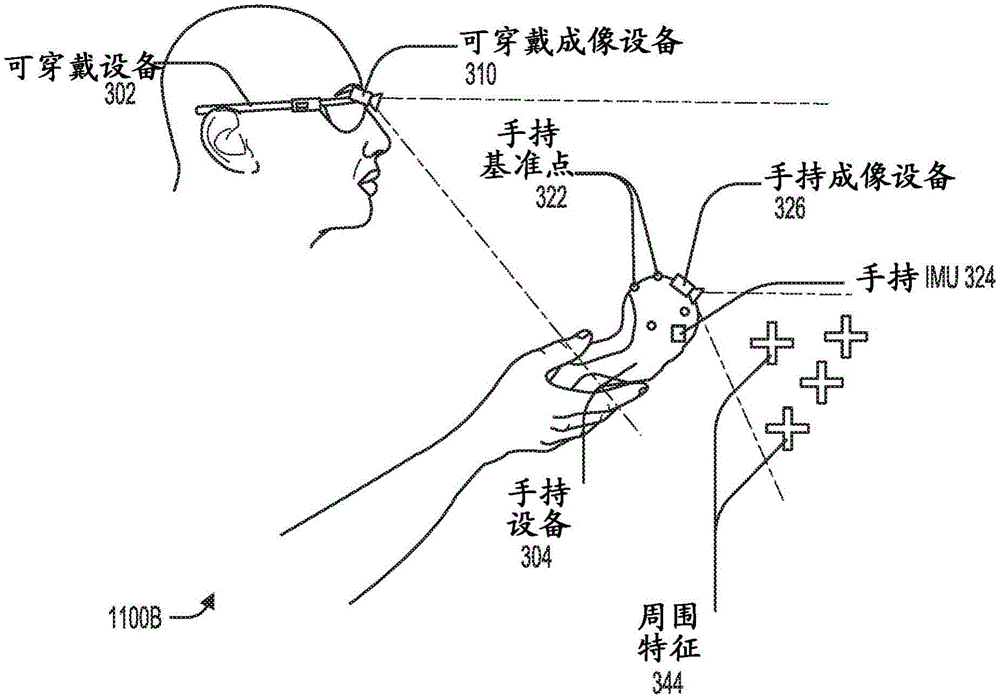
Fig. 11B shows an example configuration of an AR system 1100B, where the wearable device 302 includes one or more wearable imaging devices 310, the field of view of the wearable imaging devices 310 at least partially and at least temporarily including the handheld reference point 322 when the user holds the handheld device 304 in normal operation, and where the handheld device 304 includes one or more handheld imaging devices 326, the field of view of the handheld imaging devices 326 at least partially and at least temporarily including the one or more surrounding features 344 when the user holds the handheld device 304 in normal operation. In the example configuration shown in FIG. 11B, a plurality of handheld fiducials 322 are affixed to the handheld device 304. The AR system 1100B may include additional sensors, such as handheld IMU324, mounted on the handheld device 304. Advantages of such a configuration include increased accuracy provided by multiple imaging devices, and increased robustness through the combination of fiducial-based tracking and visual ranging techniques. AR system 1100B may include additional sensors, such as wearable IMUs, mounted on wearable device 302.
Fig. 12 illustrates a method 1200 of performing positioning of handheld device 304 relative to wearable device 302 using AR system 1100A of fig. 11A or AR system 1100B of fig. 11B. One or more steps of the method 1200 may be omitted or may be performed in a different order than the illustrated embodiment, and one or more steps of the method 1200 may be performed at one or more processing devices located within the wearable device 302, the handheld device 304, and/or the belt pack 340.
At step 1202, an image ("fiducial point image") is captured by wearable imaging device 310. The fiducial image may contain a number of handheld fiducials 322. For example, with respect to FIG. 11A, if there is one handheld fiducial 322, the fiducial image may be analyzed to determine that it contains zero or one fiducial. For example, with respect to FIG. 11B, if there are three handheld fiducial points 322, the fiducial point image can be analyzed to determine that it contains zero, one, two, or three fiducial points.
At step 1204, a position and/or orientation of the handheld device 304 relative to the wearable device 302 is calculated, for example, based on the fiducial point image. For example, with respect to fig. 11A, the fiducial point image may be analyzed to determine the location of the fiducial point, and the constraints on the location and/or orientation may be determined based on the fiducial point location within the fiducial point image. For example, with respect to fig. 11B, the fiducial image may be analyzed to determine the location of any fiducial, and the location and/or orientation may be determined based on the location of the fiducial within the fiducial image and the known physical relationship between the wearable fiducials 306.
At step 1206, an image ("world image") is captured by the handheld imaging device 326. The world image may contain surrounding features 344.
At step 1208, the position and/or orientation of the handheld device 304 relative to the world is calculated based on the world image. In some cases, the world images are compared to previous world images to estimate motion of the handheld device 304 using visual ranging techniques, which may include performing feature detection in each world image to establish correspondence between the world images. The motion vector of the handheld device 304 that most closely corresponds to the motion of the detected feature in the world image may then be calculated. The output of step 1208 is referred to as handheld data 1232.
At step 1210, data indicative of at least rotational motion of the handheld device 304 relative to the world ("IMU data") is detected by the handheld IMU 324. The IMU data may include the rotational speed or raw data from which the rotational speed may be calculated. In some embodiments, the IMU data is also indicative of linear motion of the handheld device 304, and may include linear acceleration or raw data from which linear acceleration may be calculated.
At step 1212, the position and/or orientation of the handheld device 304 is calculated based on the IMU data. In some embodiments, the position and/or orientation of the handheld device 304 relative to the world is calculated (using a previously known and/or estimated orientation relative to the world), and/or in some embodiments, the position and/or orientation of the handheld device 304 relative to the wearable device 302 is calculated (using a previously known and/or estimated orientation relative to the wearable device 302). The output of step 1212 is referred to as handheld data 1232.
At step 1214, the position and/or orientation of the handheld device 304 relative to the wearable device 302 is calculated based on the fiducial data 1230 and/or the handheld data 1232. For example, with respect to FIG. 11A, fiducial data 1230 may include the fiducial point image and/or constraints calculated based on the location and/or orientation of the fiducial point image performed in step 1204. For example, with respect to FIG. 11B, fiducial data 1230 may include a fiducial image and/or the position and/or orientation calculations performed in step 1204 based on the fiducial image. The handheld data 1232 may include the world image, the world image based position and/or orientation calculations performed in step 1208, the IMU data, and/or the IMU data based position and/or orientation calculations performed in step 1212. The position and orientation calculation at step 1214 may be performed according to one of various operating states based on the number of fiducial points found in the fiducial point image. Each operating state may process the reference data 1230 and the handheld data 1232 differently and may emphasize one type of data over another. These operating states will be described in more detail with reference to fig. 13.
At step 1216, the position and/or orientation of handheld device 304 relative to wearable device 302 is output to, for example, an external device and/or a process for operating AR system 1100. For example, the location and/or orientation may be output to the AR system 1100 to generate and display virtual content.
Fig. 13 shows a method 1300 of performing positioning of a handheld device 304 relative to a wearable device 302 using any one of AR systems 500, 700, 900, 1100, or any combination thereof. One or more steps of the method 1300 may be omitted or may be performed in a different order than the illustrated embodiment, and one or more steps of the method 1300 may be performed at one or more processing devices located within the wearable device 302, the handheld device 304, and/or the belt pack 340.
In step 1302, data indicative of motion of the handheld device 304 relative to the wearable device 302 is obtained using the imaging device ("baseline data"). Performing step 1302 may include performing one or both of steps 1304, 1306. At step 1304, an image containing a number of wearable fiducials 306 ("fiducial image") is captured by the rear handheld imaging device 326B. At step 1306, an image containing a number of handheld fiducials 322 ("fiducial image") is captured by wearable imaging device 310.
At step 1308, data indicative of at least rotational movement of the handheld device 304 relative to the world ("handheld data") is detected. Performing step 1308 may include performing one or both of steps 1310, 1312.
At step 1310, an image containing the surrounding feature 344 ("world image") is captured by the front handheld imaging device 326A. At step 1312, data indicative of at least rotational motion of the handheld device 304 relative to the world ("IMU data") is detected by the handheld IMU 324. The IMU data may include the rotational speed or raw data from which the rotational speed may be calculated. In some embodiments, the IMU data is also indicative of linear motion of the handheld device 304, and may include linear acceleration or raw data from which linear acceleration may be calculated.
At step 1314, the number of fiducial points included in the fiducial point image and the location (e.g., pixel location) of the observed fiducial point are determined.
At step 1316, the position and/or orientation of the handheld device 304 relative to the wearable device 302 is calculated/estimated/updated according to one of the three operating states. The operation state is selected based on the number of reference points observed in the reference point image. In the illustrated embodiment, a first operating state ("state 1") is selected when three or more fiducial points are observed in the fiducial point image, a second operating state ("state 2") is selected when one or two fiducial points are observed in the fiducial point image, and a third operating state ("state 3") is selected when zero fiducial points are observed in the fiducial point image. The switching between the states may occur each time a new fiducial point image is captured or at predetermined time intervals. For example, step 1316 may be performed at each camera frame based on one or both of fiducial data (e.g., fiducial point images) and handheld data (e.g., world images and IMU orientations). Step 1316 may further include prior position and/or orientation calculations to improve estimation accuracy.
From the first operating state ("state 1"), the position and/or orientation (full six degrees of freedom) can be calculated with high accuracy, for example, based on the reference data only. When four or more fiducials are observed, the position can be fully resolved. When exactly three fiducial points are observed, there are two possible position solutions, one of which may be discarded based on additional processing and/or comparison with previously calculated positions. In some embodiments, handheld data may be used to supplement and improve computational accuracy. In some embodiments, an extended kalman filter may be employed to improve accuracy based on previous position and/or orientation calculations.
From the second operational state ("state 2"), for example, both the reference data and the hand held data may be used to calculate the position and/or orientation. When two fiducial points are observed, the fiducial data enables computation of constrained position and/or orientation, and the handheld data can be used to complete the computation with the constraints imposed by the fiducial data. In some embodiments, an extended kalman filter may be employed to improve accuracy based on previous position and/or orientation calculations. The calculations performed in the second operating state may be less accurate overall than the calculations performed in the first operating state.
According to the third operational state ("state 3"), the position and orientation may be calculated, for example, based only on hand-held data (i.e., dead reckoning). In some embodiments, an extended kalman filter may be employed to improve accuracy based on previous position and/or orientation calculations. The calculations performed in the third operating state may be less accurate overall than the calculations performed in the first or second operating state.
At step 1318, IMU bias correction is performed to increase the accuracy of the IMU data provided as input at step 1316. Since IMU data may drift over time, periodic updates may recalibrate IMU data. In some embodiments, the bias update is provided only when the first operating state is selected, and a high accuracy bias update may be provided. In some embodiments, a bias update is provided when selecting either the first operating state or the second operating state, since both states utilize the reference data in their calculations. The offset update may be provided at each camera frame or at predetermined time intervals.
Fig. 14 illustrates a simplified computer system 1400 according to some embodiments described herein. FIG. 14 provides a schematic diagram of one example of a computer system 1400 that may perform some or all of the steps of the methods provided by various embodiments. It should be noted that FIG. 14 is intended merely to provide a general illustration of the various components, any or all of which may be suitably employed. Thus, fig. 14 broadly illustrates how various system elements may be implemented in a relatively separated or relatively more integrated manner.
Computer system 1400 is shown as including hardware elements that may be electrically coupled via bus 1405, or that may otherwise communicate as appropriate. These hardware elements may include: one or more processors 1410, including but not limited to one or more general purpose processors and/or one or more special purpose processors, such as digital signal processing chips, graphics acceleration processors, and/or the like; one or more input devices 1415, which may include, but are not limited to, a mouse, a keyboard, a camera, and/or the like; one or more output devices 1420, which may include, but are not limited to, a display device, a printer, and/or the like.
The computer system 1400 may further include and/or communicate with one or more non-transitory storage devices 1425, which storage devices 1425 may include, but are not limited to, local and/or network accessible memory, and/or may include, but is not limited to, disk drives, arrays of drives, optical storage devices, solid state storage devices, such as programmable, flash-updateable random access memory ("RAM") and/or read-only memory ("ROM"), and/or the like. Such storage devices may be configured to implement any suitable data storage, including but not limited to various file systems, database structures, and/or the like.
Computer system 1400 may also include a communication subsystem 1419, which may include, but is not limited to, a modem, a network card (wireless or wired), an infrared communication device, a wireless communication device, and/or a chipset, such as BluetoothTMDevices, 802.11 devices, WiFi devices, WiMax devices, cellular communications facilities, and the like. The communication subsystem 1419 may include one or more input and/or output communication interfaces to allow data to be exchanged with a network, such as the network described by way of example below, other computer systems, televisions, and/or any other devices described herein. Depending on the desired functionality and/or other implementation issues, a portable electronic device or the like may communicate images and/or other information via the communication subsystem 1419. In other embodiments, a portable electronic device, such as the first electronic device, may be incorporated into the computer system 1400, such as the electronic device that is the input device 1415. In some embodiments, computer system 1400 also includes a working memory 1435, which may include a RAM or ROM device as described above.
Computer system 1400 can also include software elements that are shown as being currently located within working memory 1435, working memory 1435 including operating system 1440, device drivers, executable libraries, and/or other code, such as one or more application programs 1445, which application programs 1445 can include computer programs provided by the various embodiments and/or can be designed to implement methods and/or configuration systems provided by other embodiments, as described herein. Merely by way of example, one or more of the procedures described with reference to the above-described methods may be embodied as code and/or instructions executable by a computer and/or a processor within a computer; in an aspect, then, such code and/or instructions may be used to configure and/or adapt a general purpose computer or other device to perform one or more operations in accordance with the described methods.
A set of these instructions and/or code may be stored on a non-transitory computer readable storage medium, such as the storage device 1425 described above. In some cases, the storage medium may be incorporated into a computer system, such as computer system 1400. In other embodiments, the storage medium may be separate from the computer system, e.g., a removable medium such as an optical disk, and/or provided in an installation package, such that the storage medium can be used to program, configure, and/or adapt a general purpose computer having the instructions/code stored thereon. These instructions may take the form of executable code that may be executed by computer system 1400, and/or may take the form of source code and/or installable code, which may then take the form of executable code when compiled and/or installed on computer system 1400, for example, using various commonly available compilers, installation programs, compression/decompression utilities, and so forth.
It will be apparent to those skilled in the art that substantial variations may be made in accordance with specific requirements. For example, customized hardware might also be used, and/or particular elements might be implemented in hardware and/or software including portable software (e.g., applets, etc.). In addition, connections to other computing devices, such as network input/output devices, may be employed.
As described above, in an aspect, some embodiments may employ a computer system, such as computer system 1400, to perform methods in accordance with various embodiments of the present technology. According to one set of embodiments, some or all of the processes of these methods are performed by computer system 1400 in response to processor 1410 executing one or more sequences of one or more instructions, which may be incorporated into operating system 1440 and/or other code contained in working memory 1435, such as application programs 1445. Such instructions may be read into working memory 1435 from another computer-readable medium, such as one or more storage devices 1425. By way of example only, execution of the sequences of instructions contained in the working memory 1435 may cause the processor 1410 to perform one or more processes of the methods described herein. Additionally or alternatively, portions of the methods described herein may be performed by dedicated hardware.
As used herein, the terms "machine-readable medium" and "computer-readable medium" refer to any medium that participates in providing data that causes a machine to operation in a specific fashion. In an embodiment implemented using computer system 1400, various computer-readable media may be involved in providing instructions/code to processor 1410 for execution and/or may be used to store and/or carry such instructions/code. In many implementations, the computer-readable medium is a physical and/or tangible storage medium. Such a medium may take the form of a non-volatile medium or a volatile medium. Non-volatile media includes, for example, optical and/or magnetic disks, such as the storage device 1425. Volatile media includes, but is not limited to, dynamic memory, such as the working memory 1435.
Common forms of physical and/or tangible computer-readable media include, for example, a floppy disk, a flexible disk, hard disk, magnetic tape, or any other magnetic medium, a CD-ROM, any other optical medium, punch cards, paper tape, any other physical medium with patterns of holes, a RAM, a PROM, an EPROM, a FLASH-EPROM, any other memory chip or cartridge, or any other medium from which a computer can read instructions and/or code.
Various forms of computer readable media may be involved in carrying one or more sequences of one or more instructions to processor 1410 for execution. By way of example only, the instructions may initially be carried on a magnetic and/or optical disk of a remote computer. The remote computer can load the instructions into its dynamic memory and send the instructions as signals over a transmission medium to be received and/or executed by the computer system 1400.
The communication subsystem 1419 and/or its components typically will receive signals, which the bus 1405 may then transfer to the working memory 1435, the processor 1410 retrieves and executes the instructions from the working memory 1435, and/or the data, instructions, etc., carried by the signals. The instructions received by the working memory 1435 may optionally be stored on the non-transitory storage device 1425 either before or after execution by the processor 1410.
The methods, systems, and devices discussed above are examples. Various configurations may omit, substitute, or add various procedures or components as appropriate. For example, in alternative configurations, the methods may be performed in an order different than that described, and/or various stages may be added, omitted, and/or combined. Also, features described for particular configurations may be combined in various other configurations. Different aspects and elements of the configuration may be combined in a similar manner. In addition, technology is being developed and thus many elements are examples and do not limit the scope of the disclosure or claims.
Specific details are given in the description to provide a thorough understanding of example configurations including embodiments. However, configurations may be practiced without these specific details. For example, well-known circuits, processes, algorithms, structures, and techniques have been shown without unnecessary detail in order to avoid obscuring the configurations. This description provides example configurations only, and does not limit the scope, applicability, or configuration of the claims. Rather, the foregoing description of the configurations will provide those skilled in the art with an enabling description for implementing the described techniques. Various changes may be made in the function and arrangement of elements without departing from the spirit or scope of the disclosure.
Further, the configuration may be described as a process, which can be depicted as a schematic flow chart diagram or a block diagram. Although each process may describe the operations as a sequential process, many of the operations can be performed in parallel or concurrently. In addition, the order of the operations may be rearranged. A process may have additional steps not included in the figures. Furthermore, examples of the methods may be implemented by hardware, software, firmware, middleware, microcode, hardware description languages, or any combination thereof. When implemented in software, firmware, middleware or microcode, the program code or code segments to perform the necessary tasks may be stored in a non-transitory computer-readable medium such as a storage medium. The processor may perform the described tasks.
Having described several example configurations, various modifications, alternative constructions, and equivalents may be used without departing from the spirit of the disclosure. For example, the above-described elements may be components of a larger system, where other rules may take precedence over or otherwise modify the application of the present technology. Also, many of the steps can be performed before, during, or after considering the above-described elements. Accordingly, the above description does not limit the scope of the claims.
As used herein and in the appended claims, the singular forms "a," "an," and "the" include plural referents unless the context clearly dictates otherwise. Thus, for example, reference to "a user" includes a plurality of such users, and reference to "the processor" includes reference to one or more processors and equivalents thereof known to those skilled in the art, and so forth.
Furthermore, the words "comprise," "comprising," "include," "including," "have," "contain," and "with" when used in this specification and the appended claims are intended to specify the presence of stated features, integers, components, or steps, but they do not preclude the presence or addition of one or more other features, integers, components, steps, acts, or groups thereof.
It is also understood that the examples and embodiments described herein are for illustrative purposes only and that various modifications or changes in light thereof will be suggested to persons skilled in the art and are to be included within the spirit and purview of this application and scope of the appended claims.

Claims (20)

1. A method of performing positioning of a handheld device relative to a wearable device, the method comprising:
obtaining handheld data indicative of motion of the handheld device via at least one sensor mounted on the handheld device, wherein obtaining the handheld data comprises:
detecting linear acceleration and rotational velocity of the handheld device by an Inertial Measurement Unit (IMU) mounted on the handheld device; and
capturing, by a handheld camera mounted on the handheld device, a world image containing one or more features located around the handheld device;
obtaining, by a wearable camera mounted on the wearable device, baseline data indicative of motion of the handheld device, wherein obtaining the baseline data comprises:
capturing, by the wearable camera, a fiducial image including a number of fiducial points of a plurality of fiducial points secured to the handheld device;
determining a number of fiducial points in the fiducial point image;
in response to determining that the number of fiducial points is equal to or greater than 3, updating at least one of a position and an orientation of the handheld device based only on the fiducial data in accordance with a first operational state;
in response to determining that the number of fiducial points is equal to 1 or 2, updating at least one of a position and an orientation of the handheld device based on the fiducial data and the handheld data in accordance with a second operational state; and
in response to determining that the number of fiducial points is equal to 0, updating at least one of a position and an orientation of the handheld device based only on the handheld data according to a third operational state.
2. The method of claim 1, wherein the plurality of fiducial points comprise Light Emitting Diodes (LEDs).
3. A method of performing positioning of a handheld device relative to a wearable device, the method comprising:
obtaining, by an Inertial Measurement Unit (IMU) mounted on the handheld device, handheld data indicative of motion of the handheld device;
obtaining, by an imaging device mounted on a first device, baseline data indicative of motion of the handheld device, wherein the first device is the handheld device or the wearable device, and wherein obtaining the baseline data comprises:
capturing, by the imaging device, a fiducial point image containing a number of fiducial points affixed to a second device different from the first device, wherein the second device is the handheld device or the wearable device; determining the number of reference points contained in the reference point image; and
based on the number of fiducial points included in the fiducial point image, updating the position and orientation of the handheld device based on the fiducial data and the handheld data according to a first operational state or a second operational state.
4. The method of claim 3, wherein the plurality of fiducial points comprise Light Emitting Diodes (LEDs).
5. The method of claim 3, wherein the imaging device is mounted on the handheld device and a plurality of fiducials including the number of fiducials are secured to the wearable device.
6. The method of claim 3, wherein the imaging device is mounted on the wearable device and a plurality of fiducials including the number of fiducials are secured to the handheld device.
7. The method of claim 3, wherein the imaging device is mounted on the handheld device and one or more fiducials including the number of fiducials are secured to the wearable device, and wherein obtaining the handheld data comprises:
a world image containing one or more features located around the handheld device is captured by a second handheld imaging device mounted on the handheld device.
8. The method of claim 3, wherein the imaging device is mounted on the wearable device and a plurality of fiducials including the number of fiducials are secured to the handheld device, and wherein obtaining the handheld data comprises:
a world image containing one or more features located around the handheld device is captured by a second handheld imaging device mounted on the handheld device.
9. The method of claim 3, further comprising:
in response to determining that the number of fiducial points is equal to or greater than 3, updating at least one of a position and an orientation of the handheld device based on the fiducial data in accordance with the first operational state; and
in response to determining that the number of fiducial points is equal to 1 or 2, updating at least one of a position and an orientation of the handheld device based on the fiducial data and the handheld data in accordance with the second operational state.
10. The method of claim 9, further comprising:
in response to determining that the number of fiducial points is equal to 0, updating at least one of a position and an orientation of the handheld device based on the handheld data according to a third operational state.
11. The method of claim 10, wherein:
updating at least one of a position and an orientation of the handheld device based only on the baseline data in accordance with the first operational state; and
updating at least one of a position and an orientation of the handheld device based only on the handheld data according to the third operational state.
12. A system for performing positioning of a handheld device relative to a wearable device, the system comprising:
the wearable device;
the handheld device; and
one or more processors communicatively coupled with the wearable device and the handheld device, wherein the one or more processors are configured to perform operations comprising:
obtaining, by an Inertial Measurement Unit (IMU) mounted on the handheld device, handheld data indicative of motion of the handheld device;
obtaining, by an imaging device mounted on a first device, baseline data indicative of motion of the handheld device, wherein the first device is the handheld device or the wearable device, and wherein obtaining the baseline data comprises:
capturing, by the imaging device, a fiducial point image containing a number of fiducial points affixed to a second device different from the first device, wherein the second device is the handheld device or the wearable device;
determining the number of reference points contained in the reference point image; and
updating at least one of a position and an orientation of the handheld device based on the fiducial data and the handheld data according to a first operational state or a second operational state based on a number of fiducial points included in the fiducial point image.
13. The system of claim 12, wherein the plurality of fiducial points comprise Light Emitting Diodes (LEDs).
14. The system of claim 12, wherein the imaging device is mounted on the handheld device and a plurality of fiducials including the number of fiducials are secured to the wearable device.
15. The system of claim 12, wherein the imaging device is mounted on the wearable device and a plurality of fiducials including the number of fiducials are secured to the handheld device.
16. The system of claim 12, wherein the imaging device is mounted on the handheld device and a plurality of fiducials including the number of fiducials are secured to the wearable device, and wherein obtaining the handheld data comprises:
a world image containing one or more features located around the handheld device is captured by a second handheld imaging device mounted on the handheld device.
17. The system of claim 12, wherein the imaging device is mounted on the wearable device and one or more fiducials including the number of fiducials are secured to the handheld device, and wherein obtaining the handheld data comprises:
a world image containing one or more features located around the handheld device is captured by a second handheld imaging device mounted on the handheld device.
18. The system of claim 12, wherein the operations further comprise:
in response to determining that the number of fiducial points is equal to or greater than 3, updating at least one of a position and an orientation of the handheld device based on the fiducial data in accordance with the first operational state; and
in response to determining that the number of fiducial points is equal to 1 or 2, updating at least one of a position and an orientation of the handheld device based on the fiducial data and the handheld data in accordance with the second operational state.
19. The system of claim 18, wherein the operations further comprise:
in response to determining that the number of fiducial points is equal to 0, updating at least one of a position and an orientation of the handheld device based on the handheld data according to a third operational state.
20. The system of claim 19, wherein:
updating at least one of a position and an orientation of the handheld device based only on the baseline data in accordance with the first operational state; and
updating at least one of a position and an orientation of the handheld device based only on the handheld data according to the third operational state.
CN201980001863.1A 2018-03-07 2019-03-06 Visual tracking of peripheral devices Active CN110494792B (en)

Priority Applications (2)

Application Number Priority Date Filing Date Title
CN202510698997.0A CN120502084A (en) 2018-03-07 2019-03-06 Visual tracking of peripheral devices
CN202110689396.5A CN113426098B (en) 2018-03-07 2019-03-06 Visual tracking of peripheral devices

Applications Claiming Priority (5)

Application Number Priority Date Filing Date Title
US201862640009P 2018-03-07 2018-03-07
US62/640,009 2018-03-07
US201862640299P 2018-03-08 2018-03-08
US62/640,299 2018-03-08
PCT/US2019/021025 WO2019173524A1 (en) 2018-03-07 2019-03-06 Visual tracking of peripheral devices

Related Child Applications (2)

Application Number Title Priority Date Filing Date
CN202110689396.5A Division CN113426098B (en) 2018-03-07 2019-03-06 Visual tracking of peripheral devices
CN202510698997.0A Division CN120502084A (en) 2018-03-07 2019-03-06 Visual tracking of peripheral devices

Publications (2)

Publication Number Publication Date
CN110494792A CN110494792A (en) 2019-11-22
CN110494792B true CN110494792B (en) 2021-07-09

Family

ID=67847404

Family Applications (3)

Application Number Title Priority Date Filing Date
CN201980001863.1A Active CN110494792B (en) 2018-03-07 2019-03-06 Visual tracking of peripheral devices
CN202110689396.5A Active CN113426098B (en) 2018-03-07 2019-03-06 Visual tracking of peripheral devices
CN202510698997.0A Pending CN120502084A (en) 2018-03-07 2019-03-06 Visual tracking of peripheral devices

Family Applications After (2)

Application Number Title Priority Date Filing Date
CN202110689396.5A Active CN113426098B (en) 2018-03-07 2019-03-06 Visual tracking of peripheral devices
CN202510698997.0A Pending CN120502084A (en) 2018-03-07 2019-03-06 Visual tracking of peripheral devices

Country Status (10)

Country Link
US (6) US10860090B2 (en)
EP (3) EP4212222B1 (en)
JP (1) JP6785385B2 (en)
KR (2) KR102122600B1 (en)
CN (3) CN110494792B (en)
AU (2) AU2019231697B2 (en)
CA (2) CA3059064C (en)
IL (2) IL269587B (en)
NZ (1) NZ757418A (en)
WO (1) WO2019173524A1 (en)

Families Citing this family (17)

* Cited by examiner, † Cited by third party
Publication number Priority date Publication date Assignee Title
CN110494792B (en) 2018-03-07 2021-07-09 奇跃公司 Visual tracking of peripheral devices
US11265387B2 (en) * 2019-11-13 2022-03-01 At&T Intellectual Property I, L.P. Synchronizing multiple user devices in an immersive media environment using time-of-flight light patterns
JP2021077262A (en) * 2019-11-13 2021-05-20 セイコーエプソン株式会社 Head-mounted type display device, switching method for input system, and switching program for the same
US11128636B1 (en) 2020-05-13 2021-09-21 Science House LLC Systems, methods, and apparatus for enhanced headsets
EP3916522A1 (en) * 2020-05-26 2021-12-01 Inter Ikea Systems B.V. System, method, device and computer program product for connecting users to a persistent ar environment
US12039749B2 (en) * 2020-06-17 2024-07-16 Qualcomm Incorporated Low power visual tracking systems
US11954268B2 (en) * 2020-06-30 2024-04-09 Snap Inc. Augmented reality eyewear 3D painting
US11320896B2 (en) 2020-08-03 2022-05-03 Facebook Technologies, Llc. Systems and methods for object tracking using fused data
US20230132644A1 (en) * 2021-10-28 2023-05-04 Meta Platforms Technologies, Llc Tracking a handheld device
CN117289850A (en) * 2022-06-16 2023-12-26 北京字跳网络技术有限公司 Display control methods, devices, electronic equipment, media and program products
US12079383B2 (en) * 2022-08-16 2024-09-03 Lenovo (Singapore) Pte. Ltd. Headset wire tracking and notification
US12182343B2 (en) * 2022-08-30 2024-12-31 Htc Corporation Virtual reality tracker and tracker correction position method
US12530854B2 (en) * 2022-09-30 2026-01-20 Fu-Hao Chen System and method of object tracking for extended reality environment
US20240126381A1 (en) * 2022-10-14 2024-04-18 Meta Platforms Technologies, Llc Tracking a handheld device
GB2624929B (en) * 2022-12-01 2025-03-12 Sony Interactive Entertainment Inc Systems and methods for mapping and localisation
CN116225215B (en) * 2022-12-26 2026-02-06 歌尔科技有限公司 Handle positioning method and device, handle and medium
US12511763B2 (en) * 2023-09-28 2025-12-30 Htc Corporation Coordinate system offset calculating apparatus, method, and non-transitory computer readable storage medium thereof

Citations (4)

* Cited by examiner, † Cited by third party
Publication number Priority date Publication date Assignee Title
CN103105926A (en) * 2011-10-17 2013-05-15 微软公司 Multi-sensor posture recognition
WO2014199154A1 (en) * 2013-06-11 2014-12-18 Sony Computer Entertainment Europe Limited Head-mountable apparatus and systems
KR20160066451A (en) * 2014-12-02 2016-06-10 경북대학교 산학협력단 Head mounted display device and control method thereof
CN107646098A (en) * 2015-07-07 2018-01-30 谷歌有限责任公司 System for tracking portable equipment in virtual reality

Family Cites Families (183)

* Cited by examiner, † Cited by third party
Publication number Priority date Publication date Assignee Title
US6222525B1 (en) 1992-03-05 2001-04-24 Brad A. Armstrong Image controllers with sheet connected sensors
US5704151A (en) 1995-03-24 1998-01-06 James Paul West Portable battery-powered safety lock
US5670988A (en) 1995-09-05 1997-09-23 Interlink Electronics, Inc. Trigger operated electronic device
US6577738B2 (en) 1996-07-17 2003-06-10 American Technology Corporation Parametric virtual speaker and surround-sound system
WO1999023524A1 (en) 1997-10-30 1999-05-14 The Microoptical Corporation Eyeglass interface system
US6757068B2 (en) 2000-01-28 2004-06-29 Intersense, Inc. Self-referenced tracking
US8019121B2 (en) 2002-07-27 2011-09-13 Sony Computer Entertainment Inc. Method and system for processing intensity from input devices for interfacing with a computer program
US8287373B2 (en) * 2008-12-05 2012-10-16 Sony Computer Entertainment Inc. Control device for communicating visual information
JP4292927B2 (en) 2003-09-16 2009-07-08 カシオ計算機株式会社 Pen-type data input device and program
JP4364002B2 (en) 2004-02-06 2009-11-11 オリンパス株式会社 Head-mounted camera and photographing method using head-mounted camera
JP2005252732A (en) 2004-03-04 2005-09-15 Olympus Corp Imaging device
JP4373286B2 (en) 2004-05-06 2009-11-25 オリンパス株式会社 Head-mounted display device
US20060103633A1 (en) 2004-11-17 2006-05-18 Atrua Technologies, Inc. Customizable touch input module for an electronic device
US20060181521A1 (en) 2005-02-14 2006-08-17 Atrua Technologies, Inc. Systems for dynamically illuminating touch sensors
US7548230B2 (en) 2005-05-27 2009-06-16 Sony Computer Entertainment Inc. Remote input device
KR100811160B1 (en) 2005-06-02 2008-03-07 삼성전자주식회사 Electronic device for inputting command 3-dimensionally
KR100538572B1 (en) 2005-06-14 2005-12-23 (주)멜파스 Apparatus for controlling digital device based on touch input interface capable of visual input feedback and method for the same
JP4682927B2 (en) 2005-08-03 2011-05-11 セイコーエプソン株式会社 Electrostatic ultrasonic transducer, ultrasonic speaker, audio signal reproduction method, ultrasonic transducer electrode manufacturing method, ultrasonic transducer manufacturing method, superdirective acoustic system, and display device
JP4793109B2 (en) * 2005-12-05 2011-10-12 株式会社安川電機 Object detection method and robot
JP4914124B2 (en) 2006-06-14 2012-04-11 パナソニック株式会社 Sound image control apparatus and sound image control method
DE102006037545B4 (en) 2006-08-10 2015-05-28 Ferton Holding S.A. Operating element and method for entering values on a medical device
US20100020229A1 (en) 2007-04-30 2010-01-28 General Electric Company Wearable personal video/audio device method and system
JP4857196B2 (en) 2007-05-31 2012-01-18 キヤノン株式会社 Head-mounted display device and control method thereof
US20090002218A1 (en) 2007-06-28 2009-01-01 Matsushita Electric Industrial Co., Ltd. Direction and holding-style invariant, symmetric design, touch and button based remote user interaction device
US8696458B2 (en) * 2008-02-15 2014-04-15 Thales Visionix, Inc. Motion tracking system and method using camera and non-camera sensors
JP4626671B2 (en) 2008-04-24 2011-02-09 ソニー株式会社 Input device and control system
TWI360068B (en) 2008-05-30 2012-03-11 Asustek Comp Inc Pointing device and method for determining rotatio
JP2010015535A (en) 2008-06-02 2010-01-21 Sony Corp Input device, control system, handheld device, and calibration method
US8620009B2 (en) 2008-06-17 2013-12-31 Microsoft Corporation Virtual sound source positioning
DK2746719T3 (en) * 2008-07-24 2017-12-11 Massachusetts Inst Technology SYSTEMS AND PROCEDURES FOR IMAGE IMPACT WITH USE OF ABSORPTION
US20100045701A1 (en) * 2008-08-22 2010-02-25 Cybernet Systems Corporation Automatic mapping of augmented reality fiducials
US8957835B2 (en) 2008-09-30 2015-02-17 Apple Inc. Head-mounted display apparatus for retaining a portable electronic device with display
US8138938B2 (en) 2008-10-28 2012-03-20 The Boeing Company Hand-held positioning interface for spatial query
US8721444B2 (en) 2009-07-21 2014-05-13 Sony Corporation Game device for performing operation object control and non-operation object control
JP5453006B2 (en) 2009-07-21 2014-03-26 株式会社ソニー・コンピュータエンタテインメント Game device
CN103182183B (en) 2009-12-24 2015-10-28 索尼电脑娱乐公司 Wireless device matching method and system
WO2011097564A1 (en) 2010-02-05 2011-08-11 Kopin Corporation Touch sensor for controlling eyewear
AU2011220382A1 (en) 2010-02-28 2012-10-18 Microsoft Corporation Local advertising content on an interactive head-mounted eyepiece
WO2011156195A2 (en) 2010-06-09 2011-12-15 Dynavox Systems Llc Speech generation device with a head mounted display unit
US8854298B2 (en) * 2010-10-12 2014-10-07 Sony Computer Entertainment Inc. System for enabling a handheld device to capture video of an interactive application
US9304319B2 (en) 2010-11-18 2016-04-05 Microsoft Technology Licensing, Llc Automatic focus improvement for augmented reality displays
US10156722B2 (en) 2010-12-24 2018-12-18 Magic Leap, Inc. Methods and systems for displaying stereoscopy with a freeform optical system with addressable focus for virtual and augmented reality
AU2011348122A1 (en) 2010-12-24 2013-07-11 Magic Leap Inc. An ergonomic head mounted display device and optical system
US9217867B2 (en) 2011-03-24 2015-12-22 Seiko Epson Corporation Head-mounted display device and control method for the head-mounted display device
JP6316186B2 (en) 2011-05-06 2018-04-25 マジック リープ, インコーポレイテッドMagic Leap,Inc. Wide-area simultaneous remote digital presentation world
US8179604B1 (en) 2011-07-13 2012-05-15 Google Inc. Wearable marker for passive interaction
US9897805B2 (en) 2013-06-07 2018-02-20 Sony Interactive Entertainment Inc. Image rendering responsive to user actions in head mounted display
EP2760363A4 (en) 2011-09-29 2015-06-24 Magic Leap Inc TOUCH GLOVE FOR MAN-COMPUTER INTERACTION
US20130083018A1 (en) 2011-09-30 2013-04-04 Kevin A. Geisner Personal audio/visual system with holographic objects
US20130104085A1 (en) 2011-10-21 2013-04-25 Digital Artforms, Inc. Systems and methods for human-computer interaction using a two handed interface
US9215293B2 (en) * 2011-10-28 2015-12-15 Magic Leap, Inc. System and method for augmented and virtual reality
US8950867B2 (en) 2011-11-23 2015-02-10 Magic Leap, Inc. Three dimensional virtual and augmented reality display system
US9497501B2 (en) 2011-12-06 2016-11-15 Microsoft Technology Licensing, Llc Augmented reality virtual monitor
EP2618564A1 (en) 2012-01-18 2013-07-24 Harman Becker Automotive Systems GmbH Method for operating a conference system and device for a conference system
JP6044079B2 (en) 2012-02-06 2016-12-14 ソニー株式会社 Information processing apparatus, information processing method, and program
WO2013124741A1 (en) 2012-02-21 2013-08-29 Comsa Radu Mircea Augmented reality system
JP5970872B2 (en) 2012-03-07 2016-08-17 セイコーエプソン株式会社 Head-mounted display device and method for controlling head-mounted display device
US8831255B2 (en) 2012-03-08 2014-09-09 Disney Enterprises, Inc. Augmented reality (AR) audio with position and action triggered virtual sound effects
US9096920B1 (en) 2012-03-22 2015-08-04 Google Inc. User interface method
WO2013152205A1 (en) 2012-04-05 2013-10-10 Augmented Vision Inc. Wide-field of view (fov) imaging devices with active foveation capability
WO2013188464A1 (en) 2012-06-11 2013-12-19 Magic Leap, Inc. Multiple depth plane three-dimensional display using a wave guide reflector array projector
US9671566B2 (en) 2012-06-11 2017-06-06 Magic Leap, Inc. Planar waveguide apparatus with diffraction element(s) and system employing same
US9041622B2 (en) 2012-06-12 2015-05-26 Microsoft Technology Licensing, Llc Controlling a virtual object with a real controller device
US9152226B2 (en) 2012-06-15 2015-10-06 Qualcomm Incorporated Input method designed for augmented reality goggles
US9384737B2 (en) 2012-06-29 2016-07-05 Microsoft Technology Licensing, Llc Method and device for adjusting sound levels of sources based on sound source priority
KR20150054967A (en) 2012-09-11 2015-05-20 매직 립, 인코포레이티드 Ergonomic head mounted display device and optical system
EP2936829A4 (en) 2012-12-18 2016-08-10 Nokia Technologies Oy SPACE AUDIO DEVICE
US9880728B2 (en) 2013-01-08 2018-01-30 Ayotle Sas Methods and systems for controlling a virtual interactive surface and interactive display systems
KR102141992B1 (en) 2013-01-15 2020-08-06 매직 립, 인코포레이티드 Ultra-high resolution scanning fiber display
JP6079268B2 (en) 2013-01-29 2017-02-15 セイコーエプソン株式会社 Image display device
IL308285B2 (en) 2013-03-11 2024-11-01 Magic Leap Inc System and method for augmented and virtual reality
US9417452B2 (en) 2013-03-15 2016-08-16 Magic Leap, Inc. Display system and method
EP2797313A1 (en) 2013-04-26 2014-10-29 Elvesjö, John Computer graphics presentation system and method
US20140328505A1 (en) 2013-05-02 2014-11-06 Microsoft Corporation Sound field adaptation based upon user tracking
JPWO2014188798A1 (en) * 2013-05-21 2017-02-23 ソニー株式会社 Display control device, display control method, and recording medium
US10019057B2 (en) 2013-06-07 2018-07-10 Sony Interactive Entertainment Inc. Switching mode of operation in a head mounted display
US20140362110A1 (en) 2013-06-08 2014-12-11 Sony Computer Entertainment Inc. Systems and methods for customizing optical representation of views provided by a head mounted display based on optical prescription of a user
US9908048B2 (en) 2013-06-08 2018-03-06 Sony Interactive Entertainment Inc. Systems and methods for transitioning between transparent mode and non-transparent mode in a head mounted display
US9874749B2 (en) 2013-11-27 2018-01-23 Magic Leap, Inc. Virtual and augmented reality systems and methods
GB201310364D0 (en) 2013-06-11 2013-07-24 Sony Comp Entertainment Europe Head-mountable apparatus and systems
US10262462B2 (en) 2014-04-18 2019-04-16 Magic Leap, Inc. Systems and methods for augmented and virtual reality
KR20150026336A (en) 2013-09-02 2015-03-11 엘지전자 주식회사 Wearable display device and method of outputting content thereof
US9630105B2 (en) 2013-09-30 2017-04-25 Sony Interactive Entertainment Inc. Camera based safety mechanisms for users of head mounted displays
JP6200756B2 (en) 2013-10-02 2017-09-20 三星電子株式会社Samsung Electronics Co.,Ltd. Pointing device, pointing method, and program for pointing device
JP6479785B2 (en) 2013-10-16 2019-03-06 マジック リープ, インコーポレイテッドMagic Leap,Inc. Virtual or augmented reality headset with adjustable interpupillary distance
WO2015065494A1 (en) 2013-11-04 2015-05-07 Bodhi Technology Ventures Llc Detecting stowing or unstowing of a mobile device
US9111076B2 (en) 2013-11-20 2015-08-18 Lg Electronics Inc. Mobile terminal and control method thereof
US20150138065A1 (en) 2013-11-21 2015-05-21 Nvidia Corporation Head-mounted integrated interface
JP2017505933A (en) * 2013-11-26 2017-02-23 シェフィ,ヨァヴ Method and system for generating a virtual image fixed on a real object
CN107272199B (en) 2013-11-27 2023-04-07 奇跃公司 Virtual and augmented reality systems and methods
US9857591B2 (en) 2014-05-30 2018-01-02 Magic Leap, Inc. Methods and system for creating focal planes in virtual and augmented reality
JP6553052B2 (en) 2014-01-03 2019-07-31 ハーマン インターナショナル インダストリーズ インコーポレイテッド Gesture-interactive wearable spatial audio system
JP6424432B2 (en) * 2014-01-23 2018-11-21 セイコーエプソン株式会社 Control device, robot system, robot and robot control method
KR102177133B1 (en) 2014-01-31 2020-11-10 매직 립, 인코포레이티드 Multi-focal display system and method
CN106233189B (en) 2014-01-31 2020-06-26 奇跃公司 Multi-focus display system and method
CA2841371A1 (en) 2014-01-31 2015-07-31 Usquare Soft Inc. Devices and methods for portable processing and application execution
WO2015123771A1 (en) 2014-02-18 2015-08-27 Sulon Technologies Inc. Gesture tracking and control in augmented and virtual reality
WO2015126987A1 (en) 2014-02-18 2015-08-27 Merge Labs, Inc. Head mounted display goggles for use with mobile computing devices
US10203762B2 (en) * 2014-03-11 2019-02-12 Magic Leap, Inc. Methods and systems for creating virtual and augmented reality
EP3117263B1 (en) * 2014-03-14 2018-05-09 Sony Interactive Entertainment Inc. Methods and systems tracking head mounted display (hmd) and calibrations for hmd headband adjustments
EP3116616B1 (en) * 2014-03-14 2019-01-30 Sony Interactive Entertainment Inc. Gaming device with volumetric sensing
US9163933B1 (en) 2014-03-28 2015-10-20 Rockwell Collins, Inc. Wearable head tracking system
US9542011B2 (en) * 2014-04-08 2017-01-10 Eon Reality, Inc. Interactive virtual reality systems and methods
WO2015157862A1 (en) 2014-04-14 2015-10-22 Tremolant Inc. Augmented reality communications
US9495801B2 (en) 2014-05-01 2016-11-15 Microsoft Technology Licensing, Llc Pose tracking an augmented reality device
EP3228986B1 (en) * 2014-05-05 2024-03-13 Hexagon Technology Center GmbH Surveying system
EP3140780B1 (en) 2014-05-09 2020-11-04 Google LLC Systems and methods for discerning eye signals and continuous biometric identification
CA2926861C (en) * 2014-05-21 2017-03-07 Millennium Three Technologies Inc Fiducial marker patterns, their automatic detection in images, and applications thereof
NZ727350A (en) 2014-05-30 2020-08-28 Magic Leap Inc Methods and systems for generating virtual content display with a virtual or augmented reality apparatus
JP2015228009A (en) 2014-06-03 2015-12-17 セイコーエプソン株式会社 Head-mounted display device, head-mounted display device control method, information transmission / reception system, and computer program
JP6355978B2 (en) 2014-06-09 2018-07-11 株式会社バンダイナムコエンターテインメント Program and image generation apparatus
AU2015274283B2 (en) 2014-06-14 2020-09-10 Magic Leap, Inc. Methods and systems for creating virtual and augmented reality
DE102014009298B4 (en) 2014-06-26 2025-05-22 Audi Ag Method for operating a virtual reality system and virtual reality system
US20150382130A1 (en) 2014-06-27 2015-12-31 Patrick Connor Camera based adjustments to 3d soundscapes
GB2528699B (en) 2014-07-29 2017-05-03 Sony Computer Entertainment Europe Ltd Image processing
US10444849B2 (en) 2014-09-01 2019-10-15 Yinbo Li Multi-surface controller
US10509865B2 (en) * 2014-09-18 2019-12-17 Google Llc Dress form for three-dimensional drawing inside virtual reality environment
US9984505B2 (en) 2014-09-30 2018-05-29 Sony Interactive Entertainment Inc. Display of text information on a head-mounted display
CA2962502A1 (en) 2014-10-14 2016-04-21 Arsil Nayyar Hussain Systems, devices, and methods for capturing and outputting data regarding a bodily characteristic
WO2016079774A1 (en) * 2014-11-21 2016-05-26 Johri Abhishek System and method for data and command input
US10599327B2 (en) 2014-12-24 2020-03-24 Korea Electronics Technology Institute Wearable electronic device
US10571696B2 (en) 2014-12-26 2020-02-25 Cy Vision Inc. Near-to-eye display device
US10265621B2 (en) 2015-01-20 2019-04-23 Disney Enterprises, Inc. Tracking specific gestures relative to user movement
US9787846B2 (en) 2015-01-21 2017-10-10 Microsoft Technology Licensing, Llc Spatial audio signal processing for objects with associated audio content
JP6465672B2 (en) * 2015-01-29 2019-02-06 株式会社ソニー・インタラクティブエンタテインメント Information processing apparatus and information processing method
US9602947B2 (en) 2015-01-30 2017-03-21 Gaudi Audio Lab, Inc. Apparatus and a method for processing audio signal to perform binaural rendering
US10180734B2 (en) * 2015-03-05 2019-01-15 Magic Leap, Inc. Systems and methods for augmented reality
AU2016225963B2 (en) 2015-03-05 2021-05-13 Magic Leap, Inc. Systems and methods for augmented reality
GB2536650A (en) 2015-03-24 2016-09-28 Augmedics Ltd Method and system for combining video-based and optic-based augmented reality in a near eye display
US10412173B2 (en) 2015-04-22 2019-09-10 Panasonic Avionics Corporation Passenger seat pairing system
EP3289430B1 (en) 2015-04-27 2019-10-23 Snap-Aid Patents Ltd. Estimating and using relative head pose and camera field-of-view
USD758367S1 (en) 2015-05-14 2016-06-07 Magic Leap, Inc. Virtual reality headset
US20160378204A1 (en) * 2015-06-24 2016-12-29 Google Inc. System for tracking a handheld device in an augmented and/or virtual reality environment
CN105117016A (en) 2015-09-07 2015-12-02 众景视界(北京)科技有限公司 Interaction handle used in interaction control of virtual reality and augmented reality
CN108351700B (en) 2015-09-16 2022-08-12 奇跃公司 Head pose mix for audio files
US10338673B2 (en) 2015-09-16 2019-07-02 Google Llc Touchscreen hover detection in an augmented and/or virtual reality environment
JP6684559B2 (en) 2015-09-16 2020-04-22 株式会社バンダイナムコエンターテインメント Program and image generation device
FR3046489B1 (en) 2016-01-05 2018-01-12 Mimi Hearing Technologies GmbH IMPROVED AMBASSIC ENCODER OF SOUND SOURCE WITH A PLURALITY OF REFLECTIONS
US10324293B2 (en) * 2016-02-23 2019-06-18 Compedia Software and Hardware Development Ltd. Vision-assisted input within a virtual world
US9774979B1 (en) 2016-03-03 2017-09-26 Google Inc. Systems and methods for spatial audio adjustment
JP2017163432A (en) 2016-03-10 2017-09-14 ソニー株式会社 Information processor, information processing method and program
EP3429193A4 (en) 2016-03-10 2019-04-17 Sony Corporation INFORMATION PROCESSING DEVICE, INFORMATION PROCESSING METHOD, AND PROGRAM
NZ747815A (en) * 2016-04-26 2023-05-26 Magic Leap Inc Electromagnetic tracking with augmented reality systems
CN105975082B (en) 2016-05-27 2019-01-15 北京小鸟看看科技有限公司 A kind of handle controller applied to virtual reality helmet
US20170352184A1 (en) * 2016-06-06 2017-12-07 Adam G. Poulos Optically augmenting electromagnetic tracking in mixed reality
US10254546B2 (en) * 2016-06-06 2019-04-09 Microsoft Technology Licensing, Llc Optically augmenting electromagnetic tracking in mixed reality
US10146334B2 (en) 2016-06-09 2018-12-04 Microsoft Technology Licensing, Llc Passive optical and inertial tracking in slim form-factor
US10146335B2 (en) 2016-06-09 2018-12-04 Microsoft Technology Licensing, Llc Modular extension of inertial controller for six DOF mixed reality input
US20170354864A1 (en) 2016-06-11 2017-12-14 Sony Interactive Entertainment Inc. Directional Interface Object
US10037626B2 (en) * 2016-06-30 2018-07-31 Microsoft Technology Licensing, Llc Interaction with virtual objects based on determined restrictions
US10620717B2 (en) * 2016-06-30 2020-04-14 Microsoft Technology Licensing, Llc Position-determining input device
US9972119B2 (en) 2016-08-11 2018-05-15 Microsoft Technology Licensing, Llc Virtual object hand-off and manipulation
KR102246836B1 (en) 2016-08-22 2021-04-29 매직 립, 인코포레이티드 Virtual, Augmented, and Mixed Reality Systems and Methods
USD797743S1 (en) 2016-08-22 2017-09-19 Magic Leap, Inc. Totem controller
KR102334821B1 (en) 2016-09-26 2021-12-07 스냅 인코포레이티드 Device pairing by optical cords
US10440240B2 (en) * 2016-09-30 2019-10-08 Sony Interactive Entertainment Inc. Systems and methods for reducing an effect of occlusion of a tracker by people
US10088902B2 (en) * 2016-11-01 2018-10-02 Oculus Vr, Llc Fiducial rings in virtual reality
DK3545385T3 (en) 2016-11-25 2021-10-04 Sensoryx AG PORTABLE MOTION TRACKING SYSTEM
US10452133B2 (en) * 2016-12-12 2019-10-22 Microsoft Technology Licensing, Llc Interacting with an environment using a parent device and at least one companion device
US10451439B2 (en) 2016-12-22 2019-10-22 Microsoft Technology Licensing, Llc Dynamic transmitter power control for magnetic tracker
US10650552B2 (en) * 2016-12-29 2020-05-12 Magic Leap, Inc. Systems and methods for augmented reality
US10553036B1 (en) * 2017-01-10 2020-02-04 Lucasfilm Entertainment Company Ltd. Manipulating objects within an immersive environment
CN106815859B (en) * 2017-01-13 2019-07-16 大连理工大学 Target Tracking Algorithm Based on Scale Adaptive Correlation Filtering and Feature Point Matching
US10843068B2 (en) * 2017-01-18 2020-11-24 Xvisio Technology Corp. 6DoF inside-out tracking game controller
US11740690B2 (en) * 2017-01-27 2023-08-29 Qualcomm Incorporated Systems and methods for tracking a controller
US10433094B2 (en) 2017-02-27 2019-10-01 Philip Scott Lyren Computer performance of executing binaural sound
KR102502383B1 (en) 2017-03-27 2023-02-23 가우디오랩 주식회사 Audio signal processing method and apparatus
CN110476139B (en) 2017-03-28 2024-01-02 奇跃公司 Augmented reality system with spatialized audio linked to user-manipulated virtual objects
US10726574B2 (en) * 2017-04-11 2020-07-28 Dolby Laboratories Licensing Corporation Passive multi-wearable-devices tracking
JP7231556B2 (en) 2017-04-27 2023-03-01 マジック リープ, インコーポレイテッド Luminous user input device
US10705598B2 (en) * 2017-05-09 2020-07-07 Microsoft Technology Licensing, Llc Tracking wearable device and handheld object poses
US10817128B2 (en) * 2017-07-11 2020-10-27 Logitech Europe S.A. Input device for VR/AR applications
US10152141B1 (en) * 2017-08-18 2018-12-11 Osterhout Group, Inc. Controller movement tracking with light emitters
US10409392B1 (en) * 2017-10-11 2019-09-10 Facebook Technologies, Llc Hand-held controller tracked by LED mounted under a concaved dome
CN107767450B (en) * 2017-10-31 2021-05-28 南京维睛视空信息科技有限公司 Spark-slam-based real-time graph establishing method
US10816334B2 (en) * 2017-12-04 2020-10-27 Microsoft Technology Licensing, Llc Augmented reality measurement and schematic system including tool having relatively movable fiducial markers
US10514545B2 (en) * 2017-12-08 2019-12-24 Facebook Technologies, Llc Selective tracking of a head-mounted display
US10325411B1 (en) * 2017-12-13 2019-06-18 The Charles Stark Draper Laboratory, Inc. Egocentric odometry system for maintaining pose alignment between real and virtual worlds
US10558260B2 (en) * 2017-12-15 2020-02-11 Microsoft Technology Licensing, Llc Detecting the pose of an out-of-range controller
US10773169B2 (en) * 2018-01-22 2020-09-15 Google Llc Providing multiplayer augmented reality experiences
CN110494792B (en) 2018-03-07 2021-07-09 奇跃公司 Visual tracking of peripheral devices
US10628711B2 (en) * 2018-04-24 2020-04-21 Microsoft Technology Licensing, Llc Determining pose of handheld object in environment
US10535199B1 (en) * 2018-06-18 2020-01-14 Facebook Technologies, Llc Systems and methods for determining a safety boundary for a mobile artificial reality user

Patent Citations (4)

* Cited by examiner, † Cited by third party
Publication number Priority date Publication date Assignee Title
CN103105926A (en) * 2011-10-17 2013-05-15 微软公司 Multi-sensor posture recognition
WO2014199154A1 (en) * 2013-06-11 2014-12-18 Sony Computer Entertainment Europe Limited Head-mountable apparatus and systems
KR20160066451A (en) * 2014-12-02 2016-06-10 경북대학교 산학협력단 Head mounted display device and control method thereof
CN107646098A (en) * 2015-07-07 2018-01-30 谷歌有限责任公司 System for tracking portable equipment in virtual reality

Also Published As

Publication number Publication date
EP3593198B1 (en) 2023-03-08
EP3593198A1 (en) 2020-01-15
US10860090B2 (en) 2020-12-08
KR20190122266A (en) 2019-10-29
EP4600717A3 (en) 2025-09-17
CN110494792A (en) 2019-11-22
US20240256029A1 (en) 2024-08-01
AU2020202820A1 (en) 2020-05-21
AU2020202820B2 (en) 2020-10-15
NZ757418A (en) 2020-06-26
JP2020518909A (en) 2020-06-25
US11989339B2 (en) 2024-05-21
CN113426098A (en) 2021-09-24
EP4212222B1 (en) 2025-07-09
AU2019231697A1 (en) 2019-10-10
CA3059064C (en) 2022-01-04
EP3593198A4 (en) 2020-03-18
JP6785385B2 (en) 2020-11-18
KR102122600B1 (en) 2020-06-12
WO2019173524A1 (en) 2019-09-12
CA3139648A1 (en) 2019-09-12
CA3059064A1 (en) 2019-09-12
CN113426098B (en) 2025-05-23
EP4212222A1 (en) 2023-07-19
US20210116991A1 (en) 2021-04-22
IL269587B (en) 2021-07-29
KR102345492B1 (en) 2021-12-29
EP4600717A2 (en) 2025-08-13
KR20200067959A (en) 2020-06-12
CN120502084A (en) 2025-08-19
US20230195212A1 (en) 2023-06-22
US11625090B2 (en) 2023-04-11
US20250172992A1 (en) 2025-05-29
US20220113792A1 (en) 2022-04-14
US11181974B2 (en) 2021-11-23
AU2019231697B2 (en) 2020-01-30
IL284819B (en) 2022-05-01
US20200026348A1 (en) 2020-01-23
IL284819A (en) 2021-08-31

Similar Documents

Publication Publication Date Title
CN110494792B (en) Visual tracking of peripheral devices
US12061743B2 (en) Hand and totem input fusion for wearable systems
EP3188128A1 (en) Information-processing device, information processing method, and program
KR20210093866A (en) Information processing devices, information processing methods and programs
US20250086824A1 (en) Wearable system with headset and controller inside-out tracking
US11300783B2 (en) Method and system for resolving hemisphere ambiguity in six degree of freedom pose measurements

Legal Events

Date Code Title Description
PB01 Publication
PB01 Publication
SE01 Entry into force of request for substantive examination
GR01 Patent grant
GR01 Patent grant