CN1110366C - non-pyrophoric solid - Google Patents
non-pyrophoric solid Download PDFInfo
- Publication number
- CN1110366C CN1110366C CN98803537A CN98803537A CN1110366C CN 1110366 C CN1110366 C CN 1110366C CN 98803537 A CN98803537 A CN 98803537A CN 98803537 A CN98803537 A CN 98803537A CN 1110366 C CN1110366 C CN 1110366C
- Authority
- CN
- China
- Prior art keywords
- solid
- component
- purposes
- zirconium
- alkyl
- Prior art date
- Legal status (The legal status is an assumption and is not a legal conclusion. Google has not performed a legal analysis and makes no representation as to the accuracy of the status listed.)
- Expired - Fee Related
Links
Classifications
-
- B—PERFORMING OPERATIONS; TRANSPORTING
- B01—PHYSICAL OR CHEMICAL PROCESSES OR APPARATUS IN GENERAL
- B01J—CHEMICAL OR PHYSICAL PROCESSES, e.g. CATALYSIS OR COLLOID CHEMISTRY; THEIR RELEVANT APPARATUS
- B01J31/00—Catalysts comprising hydrides, coordination complexes or organic compounds
- B01J31/02—Catalysts comprising hydrides, coordination complexes or organic compounds containing organic compounds or metal hydrides
- B01J31/12—Catalysts comprising hydrides, coordination complexes or organic compounds containing organic compounds or metal hydrides containing organo-metallic compounds or metal hydrides
- B01J31/14—Catalysts comprising hydrides, coordination complexes or organic compounds containing organic compounds or metal hydrides containing organo-metallic compounds or metal hydrides of aluminium or boron
- B01J31/143—Catalysts comprising hydrides, coordination complexes or organic compounds containing organic compounds or metal hydrides containing organo-metallic compounds or metal hydrides of aluminium or boron of aluminium
-
- B—PERFORMING OPERATIONS; TRANSPORTING
- B01—PHYSICAL OR CHEMICAL PROCESSES OR APPARATUS IN GENERAL
- B01J—CHEMICAL OR PHYSICAL PROCESSES, e.g. CATALYSIS OR COLLOID CHEMISTRY; THEIR RELEVANT APPARATUS
- B01J31/00—Catalysts comprising hydrides, coordination complexes or organic compounds
- B01J31/16—Catalysts comprising hydrides, coordination complexes or organic compounds containing coordination complexes
- B01J31/22—Organic complexes
-
- B—PERFORMING OPERATIONS; TRANSPORTING
- B01—PHYSICAL OR CHEMICAL PROCESSES OR APPARATUS IN GENERAL
- B01D—SEPARATION
- B01D53/00—Separation of gases or vapours; Recovering vapours of volatile solvents from gases; Chemical or biological purification of waste gases, e.g. engine exhaust gases, smoke, fumes, flue gases, aerosols
- B01D53/26—Drying gases or vapours
- B01D53/28—Selection of materials for use as drying agents
-
- B—PERFORMING OPERATIONS; TRANSPORTING
- B01—PHYSICAL OR CHEMICAL PROCESSES OR APPARATUS IN GENERAL
- B01J—CHEMICAL OR PHYSICAL PROCESSES, e.g. CATALYSIS OR COLLOID CHEMISTRY; THEIR RELEVANT APPARATUS
- B01J31/00—Catalysts comprising hydrides, coordination complexes or organic compounds
- B01J31/02—Catalysts comprising hydrides, coordination complexes or organic compounds containing organic compounds or metal hydrides
- B01J31/12—Catalysts comprising hydrides, coordination complexes or organic compounds containing organic compounds or metal hydrides containing organo-metallic compounds or metal hydrides
-
- B—PERFORMING OPERATIONS; TRANSPORTING
- B01—PHYSICAL OR CHEMICAL PROCESSES OR APPARATUS IN GENERAL
- B01J—CHEMICAL OR PHYSICAL PROCESSES, e.g. CATALYSIS OR COLLOID CHEMISTRY; THEIR RELEVANT APPARATUS
- B01J31/00—Catalysts comprising hydrides, coordination complexes or organic compounds
- B01J31/16—Catalysts comprising hydrides, coordination complexes or organic compounds containing coordination complexes
- B01J31/1616—Coordination complexes, e.g. organometallic complexes, immobilised on an inorganic support, e.g. ship-in-a-bottle type catalysts
-
- B—PERFORMING OPERATIONS; TRANSPORTING
- B01—PHYSICAL OR CHEMICAL PROCESSES OR APPARATUS IN GENERAL
- B01J—CHEMICAL OR PHYSICAL PROCESSES, e.g. CATALYSIS OR COLLOID CHEMISTRY; THEIR RELEVANT APPARATUS
- B01J31/00—Catalysts comprising hydrides, coordination complexes or organic compounds
- B01J31/16—Catalysts comprising hydrides, coordination complexes or organic compounds containing coordination complexes
- B01J31/22—Organic complexes
- B01J31/2282—Unsaturated compounds used as ligands
- B01J31/2295—Cyclic compounds, e.g. cyclopentadienyls
-
- C—CHEMISTRY; METALLURGY
- C08—ORGANIC MACROMOLECULAR COMPOUNDS; THEIR PREPARATION OR CHEMICAL WORKING-UP; COMPOSITIONS BASED THEREON
- C08F—MACROMOLECULAR COMPOUNDS OBTAINED BY REACTIONS ONLY INVOLVING CARBON-TO-CARBON UNSATURATED BONDS
- C08F10/00—Homopolymers and copolymers of unsaturated aliphatic hydrocarbons having only one carbon-to-carbon double bond
-
- B—PERFORMING OPERATIONS; TRANSPORTING
- B01—PHYSICAL OR CHEMICAL PROCESSES OR APPARATUS IN GENERAL
- B01J—CHEMICAL OR PHYSICAL PROCESSES, e.g. CATALYSIS OR COLLOID CHEMISTRY; THEIR RELEVANT APPARATUS
- B01J2531/00—Additional information regarding catalytic systems classified in B01J31/00
- B01J2531/40—Complexes comprising metals of Group IV (IVA or IVB) as the central metal
- B01J2531/48—Zirconium
-
- B—PERFORMING OPERATIONS; TRANSPORTING
- B01—PHYSICAL OR CHEMICAL PROCESSES OR APPARATUS IN GENERAL
- B01J—CHEMICAL OR PHYSICAL PROCESSES, e.g. CATALYSIS OR COLLOID CHEMISTRY; THEIR RELEVANT APPARATUS
- B01J31/00—Catalysts comprising hydrides, coordination complexes or organic compounds
- B01J31/16—Catalysts comprising hydrides, coordination complexes or organic compounds containing coordination complexes
- B01J31/165—Polymer immobilised coordination complexes, e.g. organometallic complexes
-
- C—CHEMISTRY; METALLURGY
- C08—ORGANIC MACROMOLECULAR COMPOUNDS; THEIR PREPARATION OR CHEMICAL WORKING-UP; COMPOSITIONS BASED THEREON
- C08F—MACROMOLECULAR COMPOUNDS OBTAINED BY REACTIONS ONLY INVOLVING CARBON-TO-CARBON UNSATURATED BONDS
- C08F110/00—Homopolymers of unsaturated aliphatic hydrocarbons having only one carbon-to-carbon double bond
- C08F110/02—Ethene
-
- C—CHEMISTRY; METALLURGY
- C08—ORGANIC MACROMOLECULAR COMPOUNDS; THEIR PREPARATION OR CHEMICAL WORKING-UP; COMPOSITIONS BASED THEREON
- C08F—MACROMOLECULAR COMPOUNDS OBTAINED BY REACTIONS ONLY INVOLVING CARBON-TO-CARBON UNSATURATED BONDS
- C08F4/00—Polymerisation catalysts
- C08F4/42—Metals; Metal hydrides; Metallo-organic compounds; Use thereof as catalyst precursors
- C08F4/44—Metals; Metal hydrides; Metallo-organic compounds; Use thereof as catalyst precursors selected from light metals, zinc, cadmium, mercury, copper, silver, gold, boron, gallium, indium, thallium, rare earths or actinides
- C08F4/60—Metals; Metal hydrides; Metallo-organic compounds; Use thereof as catalyst precursors selected from light metals, zinc, cadmium, mercury, copper, silver, gold, boron, gallium, indium, thallium, rare earths or actinides together with refractory metals, iron group metals, platinum group metals, manganese, rhenium technetium or compounds thereof
- C08F4/62—Refractory metals or compounds thereof
- C08F4/64—Titanium, zirconium, hafnium or compounds thereof
- C08F4/659—Component covered by group C08F4/64 containing a transition metal-carbon bond
- C08F4/65912—Component covered by group C08F4/64 containing a transition metal-carbon bond in combination with an organoaluminium compound
-
- C—CHEMISTRY; METALLURGY
- C08—ORGANIC MACROMOLECULAR COMPOUNDS; THEIR PREPARATION OR CHEMICAL WORKING-UP; COMPOSITIONS BASED THEREON
- C08F—MACROMOLECULAR COMPOUNDS OBTAINED BY REACTIONS ONLY INVOLVING CARBON-TO-CARBON UNSATURATED BONDS
- C08F4/00—Polymerisation catalysts
- C08F4/42—Metals; Metal hydrides; Metallo-organic compounds; Use thereof as catalyst precursors
- C08F4/44—Metals; Metal hydrides; Metallo-organic compounds; Use thereof as catalyst precursors selected from light metals, zinc, cadmium, mercury, copper, silver, gold, boron, gallium, indium, thallium, rare earths or actinides
- C08F4/60—Metals; Metal hydrides; Metallo-organic compounds; Use thereof as catalyst precursors selected from light metals, zinc, cadmium, mercury, copper, silver, gold, boron, gallium, indium, thallium, rare earths or actinides together with refractory metals, iron group metals, platinum group metals, manganese, rhenium technetium or compounds thereof
- C08F4/62—Refractory metals or compounds thereof
- C08F4/64—Titanium, zirconium, hafnium or compounds thereof
- C08F4/659—Component covered by group C08F4/64 containing a transition metal-carbon bond
- C08F4/6592—Component covered by group C08F4/64 containing a transition metal-carbon bond containing at least one cyclopentadienyl ring, condensed or not, e.g. an indenyl or a fluorenyl ring
-
- Y—GENERAL TAGGING OF NEW TECHNOLOGICAL DEVELOPMENTS; GENERAL TAGGING OF CROSS-SECTIONAL TECHNOLOGIES SPANNING OVER SEVERAL SECTIONS OF THE IPC; TECHNICAL SUBJECTS COVERED BY FORMER USPC CROSS-REFERENCE ART COLLECTIONS [XRACs] AND DIGESTS
- Y10—TECHNICAL SUBJECTS COVERED BY FORMER USPC
- Y10S—TECHNICAL SUBJECTS COVERED BY FORMER USPC CROSS-REFERENCE ART COLLECTIONS [XRACs] AND DIGESTS
- Y10S526/00—Synthetic resins or natural rubbers -- part of the class 520 series
- Y10S526/943—Polymerization with metallocene catalysts
Landscapes
- Chemical & Material Sciences (AREA)
- Organic Chemistry (AREA)
- Chemical Kinetics & Catalysis (AREA)
- Engineering & Computer Science (AREA)
- Materials Engineering (AREA)
- Inorganic Chemistry (AREA)
- Analytical Chemistry (AREA)
- General Chemical & Material Sciences (AREA)
- Oil, Petroleum & Natural Gas (AREA)
- Health & Medical Sciences (AREA)
- Medicinal Chemistry (AREA)
- Polymers & Plastics (AREA)
- Transition And Organic Metals Composition Catalysts For Addition Polymerization (AREA)
- Air Bags (AREA)
- Ignition Installations For Internal Combustion Engines (AREA)
- Crystals, And After-Treatments Of Crystals (AREA)
- Fats And Perfumes (AREA)
- Pyrane Compounds (AREA)
- Gas-Filled Discharge Tubes (AREA)
- Luminescent Compositions (AREA)
- Glass Compositions (AREA)
- Drying Of Gases (AREA)
- Immobilizing And Processing Of Enzymes And Microorganisms (AREA)
- Carbon And Carbon Compounds (AREA)
- Detergent Compositions (AREA)
- Agricultural Chemicals And Associated Chemicals (AREA)
Abstract
Description
本发明涉及一种非自燃固体,包含:The present invention relates to a non-pyrophoric solid comprising:
a)至少一种载体组分,a) at least one carrier component,
b)至少一种本身自燃的化合物,b) at least one compound which is spontaneously combustible,
c)至少一种惰性液体和c) at least one inert liquid and
d)其它组分,如果需要。d) Other components, if desired.
本发明另外涉及了制备非自燃固体的方法和这样一种固体用于催化或化学计量式碳-碳键接或用于氢化的用途。The invention additionally relates to a process for the preparation of a non-pyrophoric solid and the use of such a solid for catalytic or stoichiometric carbon-carbon bonding or for hydrogenation.
很久以前就知道,而且常常希望,将具有反应活性的化合物以化学或物理方式固定在载体材料上,由此提高它们对于特定化学过程的适应性。重要的工业规模的化学过程的实例为聚合,氢化或流体(例如液体或气体)的干燥。It has been known for a long time, and often desired, to immobilize reactive compounds chemically or physically on support materials, thereby increasing their suitability for specific chemical processes. Examples of important industrial-scale chemical processes are polymerisation, hydrogenation or drying of fluids such as liquids or gases.
在聚合方法中,例如,特别是在聚烯烃的生产中,使用了固体的、载体结合的齐格勒,菲利普或金属茂催化剂系统。这些催化剂的共同特征是它们一般包含引火的组分,结果催化剂可以自发地燃烧,尤其在氧化条件下,例如在空气的进口处。In polymerization processes, for example, especially in the production of polyolefins, solid, support-bound Ziegler, Phillips or metallocene catalyst systems are used. A common feature of these catalysts is that they generally contain pyrophoric components, with the result that the catalyst can burn spontaneously, especially under oxidizing conditions, for example at the inlet of air.
这些固体(以聚烯烃催化剂为例来说明)的可自燃性妨碍或甚至完全阻止了它们在大规模工业方法中的使用。因为为了安全操作,必需采用通常花费昂贵且技术上复杂的特殊性保护措施。The pyrophoric nature of these solids, exemplified by polyolefin catalysts, hampers or even completely prevents their use in large-scale industrial processes. This is because special protective measures, which are often costly and technically complex, are necessary for safe operation.
还有,这些分类为自燃性物质的固体(尤其是聚烯烃催化剂)的运输也受到了很大地限制;例如,快件空运是不允许的。Also, the transportation of these solids classified as pyrophoric substances (especially polyolefin catalysts) is also severely restricted; for example, express air shipments are not permitted.
WO95/07939,WO87/03889,WO93/23439和WO94/28034公开了在悬浮液中制备载体结合的金属茂催化剂,随后除去溶剂和干燥固体得到自由流动的催化剂。WO93/23439规定干燥作为获得具有有利特性的催化剂的必需步骤。现有技术的干燥催化剂具有自燃的缺点。WO 95/07939, WO 87/03889, WO 93/23439 and WO 94/28034 disclose the preparation of support bound metallocene catalysts in suspension followed by removal of the solvent and drying of the solid to give a free flowing catalyst. WO 93/23439 specifies drying as an essential step in obtaining catalysts with favorable properties. Dry catalysts of the prior art have the disadvantage of spontaneous combustion.
干燥固体尤其是聚合催化剂的润湿,通常会导致催化剂具有不需要的性能,例如催化活性减低或形成很难计量的块状物。Wetting of dry solids, especially of polymerization catalysts, often leads to undesired properties of the catalyst, such as reduced catalytic activity or the formation of lumps that are difficult to quantify.
因此,本发明的一个目的是提供各种固体,尤其是可流动的聚烯烃催化剂,它们是非自燃的,而且事实上没有减弱它们的其它相关性能。It is therefore an object of the present invention to provide solid, especially flowable, polyolefin catalysts which are non-pyrophoric and which in fact do not impair their other relevant properties.
我们已经发现这个目的可通过一种含有以下组分的非自燃固体来达到,We have found that this object is achieved by a non-pyrophoric solid comprising,
a)至少一种载体组分,a) at least one carrier component,
b)至少一种本身自燃的化合物,b) at least one compound which is spontaneously combustible,
c)至少一种惰性液体和c) at least one inert liquid and
d)其它组分,如果需要。d) Other components, if desired.
这种固体以下称之为“新型固体”。我们已经发现制备新型固体的一种方法,其中混合组分a)-d),和然后除去一些组分c)。我们也发现制备新型固体的一种方法,其中混合组分a)-d),然后实际上除去所有的组分c),再然后组分c)又一次被加入到干燥固体中,其添加量以使得这种固体不自燃。我们还已经发现这种新型固体能用作为催化或化学计量式碳-碳键接或用于氢化或液体的干燥。This solid is hereinafter referred to as "novel solid". We have discovered a method of preparing a novel solid in which components a)-d) are mixed, and then some component c) is removed. We have also discovered a method of preparing a novel solid in which components a)-d) are mixed, then virtually all of component c) is removed, and then component c) is added again to the dry solid in an amount so that the solid does not spontaneously combust. We have also found that this novel solid can be used for catalytic or stoichiometric carbon-carbon bonding or for hydrogenation or drying of liquids.
载体组分a)的变化范围很宽。所有的有机或无机固体一般都是适合的,特别是那些多孔的团体。特别适合的无机载体组分a)的实例为粒状氧化物或盐类。特别适合的有机载体组分a)为粒状聚合物。The carrier component a) can vary widely. All organic or inorganic solids are generally suitable, especially those that are porous. Examples of particularly suitable inorganic carrier components a) are particulate oxides or salts. Particularly suitable organic vehicle components a) are particulate polymers.
粒状有机载体材料a)的实例为聚烯烃,例如聚乙烯,聚丙烯,聚-1-丁烯和聚甲基-1-戊烯,和作为这些聚合物的基础的那些单体的共聚物,以及聚酯,聚酰胺,聚氯乙烯,聚丙烯酸酯,聚甲基丙烯酸酯和聚苯乙烯。尽管如此,优选粒状无机载体材料a),如多孔的氧化物,实例为SiO2,Al2O3,MgO,ZrO2,TiO2,B2O3,CaO和ZnO。金属卤化物(如MgCl2)是其它的适合载体。优选载体材料a)具有粒径1-300μm,尤其是30-70μm。特别优选的载体的实例为硅胶,最好是结构式SiO2·aAl2O3的那些,其中a为0-2范围内的数字,优选0-0.5,即硅铝酸盐或二氧化硅。这类产品例如能从Grace以Slica Gel 332购得。Examples of particulate organic carrier materials a) are polyolefins, such as polyethylene, polypropylene, poly-1-butene and polymethyl-1-pentene, and copolymers of those monomers on which these polymers are based, As well as polyester, polyamide, polyvinyl chloride, polyacrylate, polymethacrylate, and polystyrene. Nevertheless, preference is given to particulate inorganic support materials a), such as porous oxides, examples being SiO 2 , Al 2 O 3 , MgO, ZrO 2 , TiO 2 , B 2 O 3 , CaO and ZnO. Metal halides such as MgCl2 are other suitable supports. Preferably, the support material a) has a particle size of 1-300 μm, especially 30-70 μm. Examples of particularly preferred supports are silica gels, preferably those of the formula SiO 2 ·aAl 2 O 3 , where a is a number in the range 0-2, preferably 0-0.5, ie aluminosilicates or silicon dioxide. Such a product is commercially available, for example, as Slica Gel 332 from Grace.
组分b)同样具有广泛的变化范围,它本身是自燃的且以它的自燃特性来定义。自燃是根据UN推荐技术标准14.3部分和EEC技术规范92/69,A13来定义,这将在实例中有长篇幅的论述。本定义范围内的化合物实例为有机金属化合物,金属氢化物或有机金属氢化物,主要为元素周期表中1,2,3,4,5,6,12,123,13,14和15族的那些(根据1985 IUPAC建议编号的族)。特别适合的组分b)的实例为有机锂,有机铝和有机硼。优选开链的和环状的铝氧烷化合物(根据US-A 4,794,096它们可以通过将三烷基铝与水反应获得)。它们由5-30个以链的形式或环状形式连接的结构单元-[-O-Al(R1)-]-组成,其中每个R1为C1-C4烷基,优选甲基或乙基、铝氧烷化合物也可以与另外的烷基金属以混合物的形式存在,优选与烷基铝。Component b) likewise has a wide range of variations, is itself pyrophoric and is defined by its pyrophoric properties. Spontaneous combustion is defined according to the UN recommended technical standard part 14.3 and the EEC technical specification 92/69, A13, which will be discussed at length in the examples. Examples of compounds within the scope of this definition are organometallic compounds, metal hydrides or organometallic hydrides, mainly of groups 1, 2, 3, 4, 5, 6, 12, 123, 13, 14 and 15 of the periodic table those (family numbered according to the 1985 IUPAC recommendations). Examples of particularly suitable components b) are organolithium, organoaluminum and organoboron. Preference is given to open-chain and cyclic aluminoxane compounds (which are obtainable according to US Pat. No. 4,794,096 by reacting trialkylaluminums with water). They consist of 5-30 structural units -[-O-Al(R 1 )-]- connected in chain or ring form, wherein each R 1 is C 1 -C 4 alkyl, preferably methyl Alternatively, the ethyl, aluminoxane compound may also be present in admixture with another metal alkyl, preferably with an aluminum alkyl.
也使用结构式Al(R’)3的有机铝,其中R’为氢,C1-C10-烷基,优选C1-C4-烷基,特别是甲基,乙基或丁基。R’也可以是各在烷基中具有1-10个碳和在芳基中具有6-20个碳的芳烷基或烷芳基。烷基铝Al(R’)3在其中R’为氟,氯,溴或碘时也是适合的,条件是至少一个R’基为C-有机基或氢。特别优选的化合物为三甲基铝,三乙基铝,三异丁基铝,氢化二异丁基铝和氯化二乙基铝。Organoaluminums of the formula Al(R′) 3 , where R′ is hydrogen, C 1 -C 10 -alkyl, preferably C 1 -C 4 -alkyl, in particular methyl, ethyl or butyl, are also used. R' can also be an aralkyl or alkaryl group each having 1-10 carbons in the alkyl group and 6-20 carbons in the aryl group. Aluminum alkyls Al(R') 3 are also suitable where R' is fluorine, chlorine, bromine or iodine, provided that at least one R' group is C-organic or hydrogen. Particularly preferred compounds are trimethylaluminum, triethylaluminum, triisobutylaluminum, diisobutylaluminum hydride and diethylaluminum chloride.
组分b)可以单独或作为混合物用于新型固体中,混合物的比例不是严格要求的。Component b) can be used in the novel solids alone or as a mixture, the ratio of the mixture being not critical.
组分b)一般是通过用液体和/或溶解的组分b)浸渍载体固体而被担载。适合于此目的的溶剂大体是构成组分c)的那些。Component b) is generally supported by impregnating the carrier solid with liquid and/or dissolved component b). Solvents suitable for this purpose are generally those which constitute component c).
组分c)为惰性液体,换言之,是这样一种化合物,即在标准条件下为液体且在标准条件下与组分b)不进行或进行非常缓慢的化学反应,附带部分的或完全的组分b)的化学转化,一般为分解,或附带它本身的部分或完全的化学转化。部分化学转化一般是指所用纯物质c)约10mol%以下,优选3mol%尤其是1mol%被转化。Component c) is an inert liquid, in other words a compound which is liquid under standard conditions and undergoes no or very slow chemical reactions with component b) under standard conditions, with partial or complete composition The chemical transformation of subsection b) is generally decomposition, or with its own partial or complete chemical transformation. Partial chemical conversion generally means that less than about 10 mol %, preferably 3 mol %, especially 1 mol %, of the pure substance c) used is converted.
用作组分c)的高度适合的化合物为惰性有机化合物,诸如脂族的,碳环的或芳族的烃。实例为正己烷,正庚烷,正辛烷,异十二烷,环己烷,甲苯,乙苯,1-己烯,1-戊烯,1-庚烯和1-辛烯,优选正庚烷。当然也可以使用这些化合物的混合物或异构体作为组分c),尤其是市场上提供的那些,例如来自Shell的EC 180或来自Exxon的Isopar。Highly suitable compounds for use as component c) are inert organic compounds such as aliphatic, carbocyclic or aromatic hydrocarbons. Examples are n-hexane, n-heptane, n-octane, isododecane, cyclohexane, toluene, ethylbenzene, 1-hexene, 1-pentene, 1-heptene and 1-octene, preferably n-heptene alkyl. It is of course also possible to use mixtures or isomers of these compounds as component c), especially those available on the market, eg EC 180 from Shell or Isopar from Exxon.
液体c)在包含a)-c)和选择性使用的d)的新型固体中的含量恰好使得c)不再自燃但仍然是可流动的,即实质上不含有粗糙组分。根据目前的常识,液体c)的含量尤其取决于组分b)的自燃倾向。The content of liquid c) in the novel solid comprising a) to c) and optionally d) is such that c) is no longer spontaneously combustible but still flowable, ie substantially free of harsh components. According to current common knowledge, the content of liquid c) depends inter alia on the propensity for spontaneous combustion of component b).
新型固体通常包含10-70wt%的c),优选25-60wt%和特别是30-40wt%的c),基于不合有c)的固体,这通过气相色谱法来测定。The novel solids generally comprise 10-70% by weight of c), preferably 25-60% by weight and in particular 30-40% by weight of c), based on the solid without c), as determined by gas chromatography.
基于新型固体,聚合催化剂,优选烯烃聚合催化剂,正常还包含一种过渡金属组分d)。Based on the novel solids, the polymerization catalysts, preferably olefin polymerization catalysts, normally also comprise a transition metal component d).
特别适合的过渡金属组分d)的实例为过渡金属钛、锆、铪、钒、铌、钽、铬、钼和钨的卤化物,优选氯化物,或它们的烷氧基化物,优选甲氧基化物,乙氧基化物或异丙氧基化物。更尤其优选的组分d)为金属茂配合物,即具有至少一个环戊二烯基配体或至少一个从环戊二烯基结构单元得到的配体的过渡金属化合物。Examples of particularly suitable transition metal components d) are the halides, preferably chlorides, or their alkoxylates, preferably methoxide, of the transition metals titanium, zirconium, hafnium, vanadium, niobium, tantalum, chromium, molybdenum and tungsten oxylate, ethoxylate or isopropoxylate. A very particularly preferred component d) is a metallocene complex, ie a transition metal compound having at least one cyclopentadienyl ligand or at least one ligand derived from a cyclopentadienyl structural unit.
特别适合的金属茂配合物为具有结构式I的那些
其中in
M为钛、锆、铪、钒、铌或钽M is titanium, zirconium, hafnium, vanadium, niobium or tantalum
X为氟、氯、溴、碘、氢、C1-C10烷基、C6-C15芳基,在烷基中具有1-10个碳和芳基中具有6-20个碳的烷芳基,-OR7或-NR7R8,X is fluorine, chlorine, bromine, iodine, hydrogen, C 1 -C 10 alkyl, C 6 -C 15 aryl, an alkane having 1-10 carbons in the alkyl group and 6-20 carbons in the aryl group Aryl, -OR 7 or -NR 7 R 8 ,
其中in
R7和R8为C1-C10烷基,C6-C15芳基,烷芳基,芳烷基,氟代烷基或氟代芳基,其各在烷基中具有1-10个碳和芳基中具有6-20个碳原子,R 7 and R 8 are C 1 -C 10 alkyl, C 6 -C 15 aryl, alkaryl, aralkyl, fluoroalkyl or fluoroaryl, each of which has 1-10 in the alkyl carbons and 6-20 carbon atoms in the aryl group,
R2-R6为氢,C1-C10烷基,五到七元环烷基,后者进而可携带C1-C10烷基作为取代基,C6-C15芳基或芳烷基,其中两个相邻基团可以一起是饱和或不饱和的4-15个碳的环状基团,或为Si(R9)3,其中R 2 -R 6 are hydrogen, C 1 -C 10 alkyl, five to seven membered cycloalkyl, which in turn can carry C 1 -C 10 alkyl as a substituent, C 6 -C 15 aryl or aralkyl group, wherein two adjacent groups can be together a saturated or unsaturated 4-15 carbon ring group, or Si(R 9 ) 3 , where
R9为C1-C10烷基,C3-C10环烷基,C6-C15芳基,R 9 is C 1 -C 10 alkyl, C 3 -C 10 cycloalkyl, C 6 -C 15 aryl,
Z为X或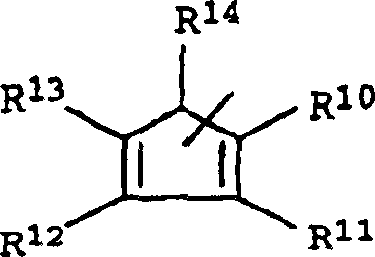
其中in
R10-R14为氢,C1-C10烷基,五到七元环烷基,后者进而可携带C1-C10烷基作为取代基,C6-C15芳基或芳烷基和其中两个相邻基团可以都是饱和或不饱和的4-15个碳的环状基团,或为Si(R15)3,其中R 10 -R 14 are hydrogen, C 1 -C 10 alkyl, five to seven membered cycloalkyl, which in turn can carry C 1 -C 10 alkyl as substituent, C 6 -C 15 aryl or aralkyl The group and two of the adjacent groups can be saturated or unsaturated 4-15 carbon cyclic groups, or Si(R 15 ) 3 , where
R15为C1-C10烷基,C6-C15芳基或C3-C10环烷基,或其中R5基团和Z一起形成-R16-A-基,其中R 15 is a C 1 -C 10 alkyl group, a C 6 -C 15 aryl group or a C 3 -C 10 cycloalkyl group, or wherein the R 5 group and Z together form a -R 16 -A- group, wherein
R16为
其中in
R17、R18和R19可以相同或不同并且为氢,卤素,C1-C10烷基,C1-C10氟代烷基,C6-C10氟代芳基,C6-C10芳基,C1-C10烷氧基,C2-C10链烯基,C7-C40芳烷基,C8-C40芳基链烯基或C7-C40烷芳基,或其中两个相邻基团在每种情况下与连接它们的原子形成一个环,和R 17 , R 18 and R 19 may be the same or different and are hydrogen, halogen, C 1 -C 10 alkyl, C 1 -C 10 fluoroalkyl, C 6 -C 10 fluoroaryl, C 6 -C 10 aryl, C 1 -C 10 alkoxy, C 2 -C 10 alkenyl, C 7 -C 40 aralkyl, C 8 -C 40 aryl alkenyl or C 7 -C 40 alkaryl , or where two adjacent groups in each case form a ring with the atoms connecting them, and
M2为硅,锗或锡, M2 is silicon, germanium or tin,
A为-O-,-S-,>NR20或>PR20,其中A is -O-, -S-, >NR 20 or >PR 20 , wherein
R20为C1-C10烷基,C6-C15芳基,C3-C10环烷基,烷芳基或Si(R21)3,R 20 is C 1 -C 10 alkyl, C 6 -C 15 aryl, C 3 -C 10 cycloalkyl, alkaryl or Si(R 21 ) 3 ,
R21为氢,C1-C10烷基,C6-C15芳基,该芳基进而可被C1-C4烷基1取代,或为C3-C10环烷基,或其中基团R5和R13一起形成-R16-基团。在结构式I的金属茂化合物中,优选以下这些:IaIb,

基团X可以是相同或不同的,但优选是相同的。The groups X can be the same or different, but are preferably the same.
在结构式Ia的化合物中,优选满足以下条件的那些:Among the compounds of formula Ia, those satisfying the following conditions are preferred:
M为钛,锆或铪,M is titanium, zirconium or hafnium,
X为氯,C1-C4-烷基或苯基,和X is chlorine, C 1 -C 4 -alkyl or phenyl, and
R2-R6为氢或C1-C4-烷基。R 2 -R 6 are hydrogen or C 1 -C 4 -alkyl.
在结构式Ib的化合物中,优选满足以下条件的那些:Among the compounds of formula Ib, those satisfying the following conditions are preferred:
M为钛,锆或铪,M is titanium, zirconium or hafnium,
X为氯,C1-C4-烷基或苯基,X is chlorine, C 1 -C 4 -alkyl or phenyl,
R2-R6为氢,C1-C4-烷基或Si(R9)3和R 2 -R 6 are hydrogen, C 1 -C 4 -alkyl or Si(R 9 ) 3 and
R10-R14为氢,C1-C4-烷基或Si(R15)3。R 10 -R 14 are hydrogen, C 1 -C 4 -alkyl or Si(R 15 ) 3 .
特别适合的化合物是结构式Ib中环戊二烯基相同的那些。Particularly suitable compounds are those in formula Ib in which the cyclopentadienyl group is identical.
特别适合的化合物的实例包含:Examples of particularly suitable compounds include:
二氯·双(环戊二烯基)合锆,Dichlorobis(cyclopentadienyl)zirconium,
二氯·双(戊基甲基环戊二烯基)合锆,Dichlorobis(pentylmethylcyclopentadienyl)zirconium,
二氯·双(甲基环戊二烯基)合锆,Dichlorobis(methylcyclopentadienyl)zirconium,
二氯·双(乙基环戊二烯基)合锆,Dichlorobis(ethylcyclopentadienyl)zirconium,
二氯·双(正丁基环戊二烯基)合锆,Dichlorobis(n-butylcyclopentadienyl)zirconium,
二氯·双(三甲基甲硅烷基环戊二烯基)合锆,Dichlorobis(trimethylsilylcyclopentadienyl)zirconium,
以及相应的二甲基合锆化合物。And the corresponding dimethyl zirconium compound.
在结构式Ic的化合物中,特别适合的是满足以下条件的那些:Among the compounds of formula Ic, those which satisfy the following conditions are particularly suitable:
R2和R10是相同的而且是氢或C1-C10-烷基,R 2 and R 10 are identical and are hydrogen or C 1 -C 10 -alkyl,
R6和R14是相同的而且是氢,甲基,乙基,异丙基或叔丁基, R6 and R14 are the same and are hydrogen, methyl, ethyl, isopropyl or tert-butyl,
R3,R4,R11和R12定义如下:R 3 , R 4 , R 11 and R 12 are defined as follows:
R4和R12为C1-C4烷基,R 4 and R 12 are C 1 -C 4 alkyl,
R3和R11为氢,R 3 and R 11 are hydrogen,
或两个相邻基团R3和R4及R11和R12一起为4-12个碳的环状基团,Or two adjacent groups R 3 and R 4 and R 11 and R 12 are together a cyclic group of 4-12 carbons,
R16为或 R 16 is or
M为钛,锆或铪和M is titanium, zirconium or hafnium and
X为氯,C1-C4-烷基或苯基。X is chlorine, C 1 -C 4 -alkyl or phenyl.
特别适合的配合物化合物的实例包含:Examples of particularly suitable complex compounds include:
二氯·二甲基甲硅烷二基双(环戊二烯基)合锆,Dichlorodimethylsilanediylbis(cyclopentadienyl)zirconium,
二氯·二甲基甲硅烷二基双(茚基)合锆,Dichlorodimethylsilyldiylbis(indenyl)zirconium,
二氯·二甲基甲硅烷二基双(四氢茚基)合锆,Dichlorodimethylsilanediylbis(tetrahydroindenyl)zirconium,
二氯·亚乙基双(环戊二烯基)合锆,Dichloroethylenebis(cyclopentadienyl)zirconium,
二氯·亚乙基双(茚基)合锆,Dichloroethylenebis(indenyl)zirconium,
二氯·亚乙基双(四氢茚基)合锆,Dichloroethylenebis(tetrahydroindenyl)zirconium,
二氯·四甲基亚乙基-9-芴基环戊二烯基合锆,Dichlorotetramethylethylene-9-fluorenylcyclopentadienyl zirconium,
二氯·二甲基甲硅烷二基双(3-叔丁基-5-甲基环戊二烯基)合锆,Dichlorodimethylsilyldiylbis(3-tert-butyl-5-methylcyclopentadienyl)zirconium,
二氯·二甲基甲硅烷二基双(3-叔丁基-5-乙基环戊二烯基)合锆,Dichlorodimethylsilanediylbis(3-tert-butyl-5-ethylcyclopentadienyl)zirconium,
二氯·二甲基甲硅烷二基双(2-甲基茚基)合锆,Dichlorodimethylsilyldiylbis(2-methylindenyl)zirconium,
二氯·二甲基甲硅烷二基双(2-异丙基茚基)合锆,Dichlorodimethylsilyldiylbis(2-isopropylindenyl)zirconium,
二氯·二甲基甲硅烷二基双(2-叔丁基茚基)合锆,Dichlorodimethylsilyldiylbis(2-tert-butylindenyl)zirconium,
二氯·二乙基甲硅烷二基双(2-甲基茚基)合锆,Dichlorodiethylsilanediylbis(2-methylindenyl)zirconium,
二氯·二甲基甲硅烷二基双(3-甲基-5-甲基环戊二烯基)合锆,Dichlorodimethylsilyldiylbis(3-methyl-5-methylcyclopentadienyl)zirconium,
二氯·二甲基甲硅烷二基双(3-乙基-5-异丙基环戊二烯基)合锆,Dichlorodimethylsilyldiylbis(3-ethyl-5-isopropylcyclopentadienyl)zirconium,
二氯·二甲基甲硅烷二基双(2-甲基茚基)合锆,Dichlorodimethylsilyldiylbis(2-methylindenyl)zirconium,
二氯·二甲基甲硅烷二基双(2-甲基苯并茚基)合锆,Dichlorodimethylsilanediylbis(2-methylbenzindenyl)zirconium,
二氯·二甲基甲硅烷二基双(2-乙基苯并茚基)合锆,Dichlorodimethylsilanediylbis(2-ethylbenzindenyl)zirconium,
二氯·甲基苯基甲硅烷二基双(2-乙基苯并茚基)合锆,Dichloromethylphenylsilyldiylbis(2-ethylbenzindenyl)zirconium,
二氯·甲基苯基甲硅烷二基双(2-甲基苯并茚基)合锆,Dichloromethylphenylsilyldiylbis(2-methylbenzindenyl)zirconium,
二氯·二苯基甲硅烷二基双(2-甲基苯并茚基)合锆,Dichlorodiphenylsilyldiylbis(2-methylbenzindenyl)zirconium,
二氯·二苯基甲硅烷二基双(2-乙基苯并茚基)合锆,和dichlorodiphenylsilyldiylbis(2-ethylbenzindenyl)zirconium, and
二氯·二甲基甲硅烷二基双(2-甲基茚基)合铪,以及相应的二甲基合锆化合物。Dichlorodimethylsilanediylbis(2-methylindenyl)hafnium, and the corresponding dimethylzirconium compound.
在结构式Id的化合物中,被提及为特别适合的是满足以下条件的那些:Among the compounds of formula Id mentioned as being particularly suitable are those which satisfy the following conditions:
M为钛或锆,M is titanium or zirconium,
X为氯,C1-C4-烷基或苯基,X is chlorine, C 1 -C 4 -alkyl or phenyl,
R16为或 R 16 is or
A为-O-,-S-,>NR20 A is -O-, -S-, >NR 20
和and
R2-R4和R6为氢,C1-C10-烷基,C3-C10-环烷基,C6-C15-芳基或Si(R9)3,或其中两个相邻基团为4-12个碳的环状基团。R 2 -R 4 and R 6 are hydrogen, C 1 -C 10 -alkyl, C 3 -C 10 -cycloalkyl, C 6 -C 15 -aryl or Si(R 9 ) 3 , or two of them The adjacent group is a cyclic group with 4-12 carbons.
这类配合物化合物能通过本身已知的方式合成,优选用将适当取代的环烃阴离子与钛、锆、铪、钒、铌或钽的卤化物反应的方法。Such complex compounds can be synthesized in a manner known per se, preferably by reacting an appropriately substituted cyclic hydrocarbon anion with a halide of titanium, zirconium, hafnium, vanadium, niobium or tantalum.
尤其,相应的制备技术的实例描述在“有机化学杂志”,369(1989),359-370中。Examples of corresponding preparation techniques are described, inter alia, in "Journal of Organic Chemistry", 369 (1989), 359-370.
使用不同的金属茂配合物的混合物也是可行的。It is also possible to use mixtures of different metallocene complexes.
新型固体,尤其是以它为基础的聚合催化剂,可另外包含一种形成金属茂离子的化合物作为组分d)。这个组分既可从化合物b)中选择,优选铝氧烷,尤其是甲基铝氧烷,如果需要,除了b)以外,也可从以下化合物中选择。The novel solids, in particular the polymerization catalysts based thereon, can additionally comprise a metallocene ion-forming compound as component d). This component can be selected either from compounds b), preferably aluminoxanes, especially methylaluminoxane, and, if desired, in addition to b), from the following compounds.
形成金属茂离子的适合的化合物为强、中性路易斯酸,具有路易斯酸阳离子的离子化合物,以及有布朗斯台德酸作为阳离子的离子化合物。Suitable compounds that form metallocene ions are strong and neutral Lewis acids, ionic compounds with Lewis acid cations, and ionic compounds with Bronsted acids as cations.
优选的强、中性路易斯酸为具有结构式II的化合物:Preferred strong, neutral Lewis acids are compounds of formula II:
M3X1X2X3 IIM 3 X 1 X 2 X 3 II
其中in
M3为元素周期表第III主族元素,尤其是B,Al,Ga,优选B,和 M3 is an element of the main group III of the periodic table, especially B, Al, Ga, preferably B, and
X1,X2和X3 X1 , X2 and X3
为氢,C1-C10-烷基,C6-C15-芳基,烷芳基,芳烷基,卤代烷基或卤代芳基,各在烷基中有1-10个碳和在芳基中有6-20个碳,或者为氟,氯,溴或碘,尤其是卤代芳基,优选五氟苯基。is hydrogen, C 1 -C 10 -alkyl, C 6 -C 15 -aryl, alkaryl, aralkyl, haloalkyl or haloaryl, each having 1 to 10 carbons in the alkyl and in Aryl has 6-20 carbons, or is fluorine, chlorine, bromine or iodine, especially haloaryl, preferably pentafluorophenyl.
特别优选的具有结构式II的化合物是其中X1,X2和X3相同的那些,优选三(五氟苯基)甲硼烷。Particularly preferred compounds of formula II are those in which X 1 , X 2 and X 3 are identical, preferably tris(pentafluorophenyl)borane.
适合的具有路易斯酸阳离子的离子化合物是具有结构式III的化合物:Suitable ionic compounds with Lewis acid cations are compounds of formula III:
[(Ya+)Q1Q2…Qz]d+ III[(Y a+ )Q 1 Q 2 …Q z ] d+ III
其中in
Y为元素周期表中I-VI主族元素或I-VIII副族元素,Y is the I-VI main group element or I-VIII sub-group element in the periodic table of elements,
Q1-Qz为具有单价负电荷的基团,例如C1-C28-烷基,C6-C15-芳基,烷芳基,芳烷基,卤代烷基或卤代芳基,其各在芳基中具有6-20个碳和在烷基中具有1-28个碳,或为任选被C1-C10-烷基取代的C1-C10-环烷基,或者为卤素,C1-C28-烷氧基,C6-C15-芳氧基,甲硅烷基或巯基,Q 1 -Q z are radicals with a monovalent negative charge, for example C 1 -C 28 -alkyl, C 6 -C 15 -aryl, alkaryl, aralkyl, haloalkyl or haloaryl, which each having 6-20 carbons in aryl and 1-28 carbons in alkyl, or C 1 -C 10 -cycloalkyl optionally substituted by C 1 -C 10 -alkyl, or Halogen, C 1 -C 28 -alkoxy, C 6 -C 15 -aryloxy, silyl or mercapto,
a为1-6的整数,a is an integer of 1-6,
z为0-5的整数,和z is an integer from 0-5, and
d相当于a-z之差值但大于或等于1。d is equivalent to the difference between a-z but greater than or equal to 1.
碳鎓阳离子,氧鎓阳离子和锍阳离子,以及阳离子过渡金属配合物是特别适合的。特别提及三苯基甲基阳离子,银阳离子和1,1’-二甲基二茂铁基阳离子。优选它们具有非配位反离子,尤其在WO91/09882规定的硼化合物,优选四(五氟代苯基)硼酸酯。Carbonium cations, oxonium cations and sulfonium cations, as well as cationic transition metal complexes are particularly suitable. Particular mention is made of the triphenylmethyl cation, the silver cation and the 1,1'-dimethylferrocenyl cation. Preferably they have non-coordinating counterions, especially the boron compounds specified in WO 91/09882, preferably tetrakis(pentafluorophenyl) borate.
有布朗斯台德酸作为阳离子和优选同样有非配位反离子的离子化合物在WO 91/09882中进行了说明,优选的阳离子为N,N-二甲基苯铵。Ionic compounds having Bronsted acids as cations and preferably also non-coordinating counterions are described in WO 91/09882, the preferred cation being N,N-dimethylanilinium.
以下是制备新型固体的合适方法。The following are suitable methods for preparing the novel solids.
载体固体a),优选多孔的无机氧化物,尤其硅胶,被悬浮在惰性液体c)中,惰性液体优选脂族的、碳环的或芳族的烃,尤其是庚烷和/或甲苯。组分b)-优选元素周期表中第3族的有机金属化合物或以上定义的铝氧烷,优选甲基铝氧烷,或为其它的可以相互产生化学反应的组分b)和d)的混合物-被加入悬浮液中。组分b)和,如果需要的话,d)两者也可以作为溶液存在,在惰性有机溶剂中优选例如脂族的,碳环的烃或芳族的烃,即正己烷,正庚烷,异十二烷,甲苯或乙基苯。反应的温度不是严格要求的。组分a),b)和c),以及d)(如果使用)通常在-70-120℃下反应,优选0-50℃。A carrier solid a), preferably a porous inorganic oxide, especially silica gel, is suspended in an inert liquid c), preferably an aliphatic, carbocyclic or aromatic hydrocarbon, especially heptane and/or toluene. Component b) - preferably an organometallic compound of Group 3 of the Periodic Table of the Elements or an aluminoxane as defined above, preferably methylalumoxane, or other components b) and d) that can chemically react with each other Mixture - is added to the suspension. Both components b) and, if desired, d) can also be present as solutions, preferably in inert organic solvents such as aliphatic, carbocyclic or aromatic hydrocarbons, i.e. n-hexane, n-heptane, iso dodecane, toluene or ethylbenzene. The temperature of the reaction is not critical. Components a), b) and c), and d) (if used) are usually reacted at -70-120°C, preferably 0-50°C.
随后,基本上所有的溶剂c)都被除去,剩下的固体通常在20-120℃下干燥,再加入定量的组分c)(变化方法A),或在新型固体中组分c)的量通过不完全脱除确定在所需要的水平上(变化方法B)。在变化方法A中加入的液体c)可以但不必在化学性质上等同于最初存在于混合物中的液体c)。Subsequently, substantially all of the solvent c) is removed, the remaining solid is usually dried at 20-120°C, and a quantitative amount of component c) is added (variation method A), or in new solids, of component c) The amount is determined at the desired level by incomplete removal (variation method B). The liquid c) added in variant A may but need not be chemically identical to the liquid c) originally present in the mixture.
制备非自燃性固体聚合催化剂(优选用于烯烃聚合)的高度适合的方法如下。A highly suitable method for preparing non-pyrophoric solid polymerization catalysts, preferably for olefin polymerization, is as follows.
载体固体a),优选多孔的无机氧化物,尤其是硅胶,被悬浮在惰性液体中,该惰性液体优选为脂族的,碳环的或芳族的烃,尤其是庚烷和/或甲苯。组分b)-优选元素周期表中第3族的有机金属氧化物,如三C1-C10烷基铝化合物,尤其三甲基铝或以上定义的铝氧烷,优选甲基铝氧烷-被加入到悬浮液中。组分b)也可以作为溶液存在,优选存在于惰性有机溶剂中,例如脂族的,碳环的或芳族的烃,即正己烷,正庚烷,异十二烷,甲苯或乙苯。反应的温度不是严格要求的。组分a),b)和c)通常在-70-120℃下、优选0-50℃下反应。在该浸渍过程之后,通常基本上除去所有的溶剂,优选在20-120℃下,尤其在40-80℃下干燥任何剩下的固体。干燥时间一般不严格要求,通常在0.1-24小时的范围内,根据每批的量来决定。The carrier solid a), preferably a porous inorganic oxide, especially silica gel, is suspended in an inert liquid, preferably an aliphatic, carbocyclic or aromatic hydrocarbon, especially heptane and/or toluene. Component b) - preferably organometallic oxides of Group 3 of the Periodic Table of the Elements, such as tri- C1 - C10- alkylaluminum compounds, especially trimethylaluminum or an aluminoxane as defined above, preferably methylaluminoxane - is added to the suspension. Component b) can also be present as a solution, preferably in an inert organic solvent, such as an aliphatic, carbocyclic or aromatic hydrocarbon, ie n-hexane, n-heptane, isododecane, toluene or ethylbenzene. The temperature of the reaction is not critical. Components a), b) and c) are usually reacted at -70-120°C, preferably at 0-50°C. After this impregnation process, generally substantially all solvent is removed and any remaining solids are preferably dried at 20-120°C, especially at 40-80°C. The drying time is generally not strictly required, usually in the range of 0.1-24 hours, determined according to the quantity of each batch.
然后以这种方式获得的固体通常与金属茂的溶液,优选以上定义的双环戊二烯基化合物Ib、Ic的溶液,尤其二氯·双(正丁基环戊二烯基)合锆,二氯·双(异丁基环戊二烯基)合锆,二氯·二甲基硅烷二基双(茚基)合锆,二氯·二甲基硅烷二基双(苯并茚基)合锆的溶液混合,以及与形成金属茂离子的化合物,优选甲基铝氧烷混合。随后,溶剂c)通常几乎被完全除去,剩下的固体,优选在20-120℃下,尤其是40-80℃下干燥,再加入定量的组分c)(变化方法A),或在新型固体中组分c)的量通过不完全脱除组分c)确定在所需要的水平上(变化方法B)。在变化方法A中加入的液体c)可以但不必在化学性质上等同于最初存在于混合物中的液体c)。The solid obtained in this way is then usually in solution with a metallocene, preferably a solution of the biscyclopentadienyl compounds Ib, Ic defined above, especially dichlorobis(n-butylcyclopentadienyl)zirconium, dichlorobis(n-butylcyclopentadienyl)zirconium, dichloro Solution mixing of bis(isobutylcyclopentadienyl)zirconium, dichloro-dimethylsilanediylbis(indenyl)zirconium, dichloro-dimethylsilanediylbis(benzindenyl)zirconium , and mixed with a metallocene ion-forming compound, preferably methylaluminoxane. Subsequently, the solvent c) is usually almost completely removed, and the remaining solid, preferably dried at 20-120° C., especially 40-80° C., is added quantitatively to component c) (variation A), or in the novel The amount of component c) in the solid is determined at the desired level by incomplete removal of component c) (variation method B). The liquid c) added in variant A may but need not be chemically identical to the liquid c) originally present in the mixture.
这样获得的固体催化剂对于在0.5-5000巴压力范围和在-50-300℃下聚合C2-C12烷-1-烯是高度适合的。The solid catalyst thus obtained is highly suitable for the polymerization of C 2 -C 12 alk-1-enes in the pressure range 0.5-5000 bar and at -50-300°C.
在C2-C12烷-1-烯中,优选乙烯,丙烯,1-丁烯,1-戊烯,4-甲基-1-戊烯,1-己烯,1-庚烯,和1-辛烯以及这些C2-C12烷-1-烯的混合物。特别优选丙烯的均或共聚物,丙烯在共聚物中的比例至少为50mol-%。在共聚物当中,优选的那些包含乙烯或1-丁烯或它们的混合物作为附加单体。优选的乙烯聚合物为50-99.9mol-%的乙烯和0.1-50mol-%的C3-C10烷-1-烯如丙烯,1-丁烯,1-己烯,1-辛烯,1-癸烯或这些C3-C10烷-1-烯的混合物的共聚物,混合物中的比例不是严格要求的。Among C 2 -C 12 alk-1-enes, ethylene, propylene, 1-butene, 1-pentene, 4-methyl-1-pentene, 1-hexene, 1-heptene, and 1 -octene and mixtures of these C 2 -C 12 alk-1-enes. Particular preference is given to homo- or copolymers of propylene, the proportion of propylene in the copolymer being at least 50 mol-%. Among the copolymers, preferred ones contain ethylene or 1-butene or mixtures thereof as additional monomers. Preferred ethylene polymers are 50-99.9 mol-% ethylene and 0.1-50 mol-% C 3 -C 10 alk-1-enes such as propylene, 1-butene, 1-hexene, 1-octene, 1 -copolymers of decene or mixtures of these C 3 -C 10 alk-1-enes, the proportions in the mixture being not critical.
制备聚合物的方法通常在-50-300℃下,优选0-150℃下,和在0.5-5000巴,优选1-80巴的压力范围下进行。The process for preparing polymers is generally carried out at a temperature of -50-300°C, preferably 0-150°C, and at a pressure range of 0.5-5000 bar, preferably 1-80 bar.
聚合能够在溶液,悬浮液,液体单体或气相中完成。聚合反应优选在液体单体中、在悬浮液中或在气相中进行,其中优选搅拌的气相或气相流化床技术。Polymerization can be done in solution, suspension, liquid monomer or gas phase. The polymerization is preferably carried out in liquid monomer, in suspension or in the gas phase, preference being given to stirred gas phase or gas phase fluidized bed technology.
该方法能以连续或间歇方式进行。适合的反应器包含连续运转的搅拌釜或流化床反应器;此外,如果需要,能使用-排串联的反应器(反应器串联组)。The process can be carried out in continuous or batch mode. Suitable reactors include continuously operated stirred tanks or fluidized bed reactors; moreover, if desired, reactors in series (reactor series) can be used.
新型固体以缺乏自燃性而著称,自燃性已经根据UN推荐技术标准14.3部分和EEC技术规范92/69,A13进行了定义。然后将小量的本发明固体存放在空气中。如果它在5分钟内不自燃,那么被划分为非自燃。The new solids are notable for their lack of pyrophoric properties, which have been defined according to UN Recommended Technical Standard Part 14.3 and EEC Technical Specification 92/69, A13. A small amount of the solid of the invention is then stored in air. If it does not spontaneously ignite within 5 minutes, it is classified as non-pyrophoric.
新型固体(优选由组分a),b)和c)组成的)能用于干燥流体。这些流体的实例为单体,如以上定义的C2-C12烷-1-烯,例如乙烯,丙烯,1-丁烯和1-己烯,以及有机溶剂,如构成组分c)的那些,例如正庚烷和甲苯。气体流体为惰性气体,优选氩,以及氮和气态烃,例如丙烷和丁烷。Novel solids (preferably composed of components a), b) and c) can be used for drying fluids. Examples of such fluids are monomers, such as C2 - C12 alk-1-enes as defined above, such as ethylene, propylene, 1-butene and 1-hexene, and organic solvents, such as those constituting component c) , such as n-heptane and toluene. Gaseous fluids are inert gases, preferably argon, as well as nitrogen and gaseous hydrocarbons, such as propane and butane.
实施例Example
实施例1Example 1
制备干燥、担载的催化剂Preparation of Dry, Supported Catalysts
在一个用氮气吹扫过的干燥反应器中,将12.1Kg硅胶(Grace,SG332,50μm)悬浮在90L庚烷中,在恒温控制下调节到20℃。在90分钟的期间内,加入33.9L的1M三甲基铝(TMA)的庚烷溶液,在这个过程中温度不超过40℃。加完TMA后,连续搅拌4小时。悬浮液被过滤,固体产物用20L庚烷洗涤两次。在50℃下干燥后,改性载体最后成为铝含量为12wt%的流动性粉末。In a dry reactor purged with nitrogen, 12.1 Kg of silica gel (Grace, SG332, 50 μm) was suspended in 90 L of heptane, regulated to 20° C. under thermostatic control. Over a period of 90 minutes, 33.9 L of a 1 M solution of trimethylaluminum (TMA) in heptane were added, during which time the temperature did not exceed 40°C. After the TMA addition was complete, stirring was continued for 4 hours. The suspension was filtered and the solid product was washed twice with 20 L of heptane. After drying at 50°C, the modified support finally becomes a flowable powder with an aluminum content of 12 wt%.
在20℃下将12.6kg改性载体加入到搅拌了20分钟后的131.3g由二氯·双(正丁基环戊二烯基)合锆和56L的1.53M甲基铝氧烷/甲苯溶液组成的溶液中,混合物再搅拌45分钟。然后过滤,固体产物随后用20L庚烷洗涤两次。在50℃下干燥后,可获得铝含量为12.7wt%和锆含量为0.078wt%的流动性粉末(15.1kg)。因此,Al与Zr的总摩尔比为550∶1。At 20°C, 12.6 kg of modified support was added to 131.3 g of dichlorobis(n-butylcyclopentadienyl) zirconium and 56 L of 1.53M methylalumoxane/toluene solution after stirring for 20 minutes. solution, and the mixture was stirred for an additional 45 minutes. It was then filtered and the solid product was then washed twice with 20 L of heptane. After drying at 50° C., a flowable powder (15.1 kg) with an aluminum content of 12.7 wt % and a zirconium content of 0.078 wt % was obtained. Therefore, the total molar ratio of Al to Zr is 550:1.
实施例2Example 2
制备庚烷-湿润的催化剂Preparation of heptane-wet catalyst
a)添加庚烷a) Add heptane
适量的庚烷(见表1)在搅拌下被加入到10g如实施例1中制备的催化剂中。随后搅拌混合物2小时。An appropriate amount of heptane (see Table 1) was added to 10 g of the catalyst prepared as in Example 1 under stirring. The mixture was then stirred for 2 hours.
b)催化剂的控制干燥b) Controlled drying of the catalyst
重复实施例1的工序,只是催化剂干燥不完全,而是含有达38wt%的庚烷。The procedure of Example 1 was repeated, except that the catalyst was not completely dried, but contained up to 38% by weight of heptane.
担载催化剂中的庚烷含量通过以下方法测定:将样品和甲苯混合,加入乙苯作为内标准,再用甲醇分解混合物和用冰冷却。庚烷随后通过气相色谱法测定。The heptane content in the supported catalyst was determined by mixing the sample with toluene, adding ethylbenzene as an internal standard, methanolizing the mixture and cooling with ice. Heptane was subsequently determined by gas chromatography.
实施例3Example 3
可燃性测试Flammability Test
大约2g担载催化剂(见表1)被快速倒入竖立有温度计的玻璃烧杯中。观察催化剂分解影响的温度变化;最高温度在大约1分钟后达到。表1温度变化对担载催化剂的影响
实施例4Example 4
根据UN推荐技术标准14.3部分和EEC技术规范92/69/EWG,A13,以及UN专家委员会关于危险物品运输的推荐技术标准,对于具有38wt%庚烷含量的催化剂的分类进行测试:The classification of catalysts with a heptane content of 38 wt % was tested according to the UN recommended technical standard part 14.3 and the EEC technical specification 92/69/EWG, A13, as well as the recommended technical standard of the UN expert committee on the transport of dangerous goods:
a)对于自燃性的测试a) Test for spontaneous combustion
小量催化剂在空气中5分钟不自燃,所以它不是引火物质。A small amount of catalyst does not spontaneously ignite in air for 5 minutes, so it is not a pyrophoric substance.
b)通过UNO方法对于在金属丝篮中可自燃性的测试b) Test for pyrophoric resistance in a wire basket by the UNO method
催化剂被存放在140℃的对流炉中的具有a)10cm和b)2.5cm边长的两个立方形金属丝篮中。它在两个实验中都自燃。The catalyst was stored in a convection oven at 140° C. in two cubic wire baskets having sides of a) 10 cm and b) 2.5 cm. It ignited spontaneously in both experiments.
根据测试结果4a和4b,催化剂被分在如UN专家委员会关于危险物品运输的推荐技术标准所定义的4.2类中,并分类为II类包装物品。结果,空运是允许的。Based on test results 4a and 4b, the catalyst is classified in class 4.2 as defined by the UN Committee of Experts on the Recommended Technical Standards for the Transport of Dangerous Goods and classified as a packing group II. As a result, air freight is allowed.
对比实施例4VComparative Example 4V
根据UN推荐技术标准14.3部分和EEC技术规范92/69,A13以及UN专家委员会关于危险物品运输的推荐技术标准,对于有0wt%的庚烷含量的催化剂的分类进行测试:According to the UN recommended technical standard part 14.3 and the EEC technical specification 92/69, A13 and the recommended technical standard of the UN expert committee on the transport of dangerous goods, the classification of the catalyst with a heptane content of 0 wt% is tested:
对于自燃性测试For flammability test
小量催化剂在空气中5分钟内自燃。因此它为引火物质,那么空运是禁止的。A small amount of catalyst spontaneously ignites within 5 minutes in air. Therefore it is a pyrophoric substance and air transport is prohibited.
实施例5Example 5
搅拌式10L钢制高压釜用氮气仔细吹扫,并调节到70℃的聚合温度,然后加入4.5L异丁烷。再然后,567mg具有38wt%庚烷含量的担载催化剂(来自实施例2)用另外0.5L异丁烷吹扫进去,注入乙烯达到38巴的总压力。釜中的压力通过补充加入乙烯来保持恒定。90分钟后,通过冷却高压釜来终止聚合反应。1230g聚合物以易流动粉末形式获得。实验数据在表2给出。A stirred 10 L steel autoclave was carefully purged with nitrogen and adjusted to a polymerization temperature of 70°C before adding 4.5 L of isobutane. Then, 567 mg of supported catalyst (from Example 2) with a heptane content of 38 wt. % was swept in with another 0.5 L of isobutane and ethylene was injected to achieve a total pressure of 38 bar. The pressure in the kettle was kept constant by supplementary feeding of ethylene. After 90 minutes, the polymerization was terminated by cooling the autoclave. 1230 g of polymer was obtained as a free flowing powder. The experimental data are given in Table 2.
对比实施例5VComparative Example 5V
重复实施例5的工序,只是使用402mg的庚烷含量为0wt%的担载催化剂(来自实施例1)。产物重量为1380g。其它数据参见表2。The procedure of Example 5 was repeated, except that 402 mg of the supported catalyst (from Example 1) with a heptane content of 0 wt. % was used. Product weight was 1380 g. See Table 2 for other data.
实施例6-8Example 6-8
重复实施例5的工序,只是使用庚烷含量为9-23wt%的载体催化剂。数据在表2列出。表2用于的或庚烷湿润的担载催化剂来聚合乙烯
Claims (10)
Applications Claiming Priority (2)
| Application Number | Priority Date | Filing Date | Title |
|---|---|---|---|
| DE19703502.7 | 1997-01-31 | ||
| DE19703502A DE19703502A1 (en) | 1997-01-31 | 1997-01-31 | Non-flammable solid |
Publications (2)
| Publication Number | Publication Date |
|---|---|
| CN1251057A CN1251057A (en) | 2000-04-19 |
| CN1110366C true CN1110366C (en) | 2003-06-04 |
Family
ID=7818861
Family Applications (1)
| Application Number | Title | Priority Date | Filing Date |
|---|---|---|---|
| CN98803537A Expired - Fee Related CN1110366C (en) | 1997-01-31 | 1998-01-15 | non-pyrophoric solid |
Country Status (15)
| Country | Link |
|---|---|
| US (1) | US6359086B1 (en) |
| EP (1) | EP0968056B1 (en) |
| JP (1) | JP2001511199A (en) |
| KR (1) | KR20000070632A (en) |
| CN (1) | CN1110366C (en) |
| AT (1) | ATE216633T1 (en) |
| AU (1) | AU6614298A (en) |
| BR (1) | BR9806804A (en) |
| CA (1) | CA2278705A1 (en) |
| DE (2) | DE19703502A1 (en) |
| ES (1) | ES2176975T3 (en) |
| NO (1) | NO993711L (en) |
| TW (1) | TW495519B (en) |
| WO (1) | WO1998033591A1 (en) |
| ZA (1) | ZA98777B (en) |
Families Citing this family (3)
| Publication number | Priority date | Publication date | Assignee | Title |
|---|---|---|---|---|
| US7119153B2 (en) * | 2004-01-21 | 2006-10-10 | Jensen Michael D | Dual metallocene catalyst for producing film resins with good machine direction (MD) elmendorf tear strength |
| US20070271808A9 (en) * | 2004-09-21 | 2007-11-29 | Eastman Kodak Company | Lewis acid organometallic desiccant |
| CN111514935B (en) * | 2020-04-30 | 2022-11-15 | 中国工程物理研究院化工材料研究所 | Self-ignition catalyst for energetic ionic liquid-hydrogen peroxide and preparation method thereof |
Citations (1)
| Publication number | Priority date | Publication date | Assignee | Title |
|---|---|---|---|---|
| WO1995007939A1 (en) * | 1993-09-17 | 1995-03-23 | Exxon Chemical Patents Inc. | Polymerization catalyst systems, their production and use |
Family Cites Families (8)
| Publication number | Priority date | Publication date | Assignee | Title |
|---|---|---|---|---|
| WO1987003889A1 (en) | 1985-12-24 | 1987-07-02 | Mitsui Petrochemical Industries, Ltd. | Process for polymerization of alpha-olefins |
| DE3620275A1 (en) * | 1986-06-16 | 1987-12-17 | Henkel Kgaa | METHOD FOR STABILIZING ACTIVATED CATALYST MATERIALS |
| US5324638A (en) | 1992-05-13 | 1994-06-28 | Sloan-Kettering Institute For Cancer Research | Brain transcription factor, nucleic acids encoding same and uses thereof |
| US5240894A (en) * | 1992-05-18 | 1993-08-31 | Exxon Chemical Patents Inc. | Method for making and using a supported metallocene catalyst system |
| US5602067A (en) * | 1992-12-28 | 1997-02-11 | Mobil Oil Corporation | Process and a catalyst for preventing reactor fouling |
| JP3626186B2 (en) | 1993-05-25 | 2005-03-02 | エクソンモービル・ケミカル・パテンツ・インク | Supported metallocene catalyst systems for the polymerization of olefins, their preparation and use |
| US5422325A (en) * | 1993-09-17 | 1995-06-06 | Exxon Chemical Patents Inc. | Supported polymerization catalysts, their production and use |
| DE19606166A1 (en) | 1996-02-20 | 1997-08-21 | Basf Ag | Process for the preparation of polymers of alkenes by suspension polymerization |
-
1997
- 1997-01-31 DE DE19703502A patent/DE19703502A1/en not_active Withdrawn
-
1998
- 1998-01-14 TW TW087100436A patent/TW495519B/en active
- 1998-01-15 JP JP53248698A patent/JP2001511199A/en active Pending
- 1998-01-15 EP EP98907947A patent/EP0968056B1/en not_active Expired - Lifetime
- 1998-01-15 CA CA002278705A patent/CA2278705A1/en not_active Abandoned
- 1998-01-15 BR BR9806804-0A patent/BR9806804A/en not_active Application Discontinuation
- 1998-01-15 US US09/341,517 patent/US6359086B1/en not_active Expired - Fee Related
- 1998-01-15 DE DE59803919T patent/DE59803919D1/en not_active Expired - Lifetime
- 1998-01-15 CN CN98803537A patent/CN1110366C/en not_active Expired - Fee Related
- 1998-01-15 KR KR1019997006881A patent/KR20000070632A/en not_active Ceased
- 1998-01-15 AU AU66142/98A patent/AU6614298A/en not_active Abandoned
- 1998-01-15 AT AT98907947T patent/ATE216633T1/en not_active IP Right Cessation
- 1998-01-15 WO PCT/EP1998/000200 patent/WO1998033591A1/en not_active Ceased
- 1998-01-15 ES ES98907947T patent/ES2176975T3/en not_active Expired - Lifetime
- 1998-01-30 ZA ZA9800777A patent/ZA98777B/en unknown
-
1999
- 1999-07-30 NO NO993711A patent/NO993711L/en not_active Application Discontinuation
Patent Citations (1)
| Publication number | Priority date | Publication date | Assignee | Title |
|---|---|---|---|---|
| WO1995007939A1 (en) * | 1993-09-17 | 1995-03-23 | Exxon Chemical Patents Inc. | Polymerization catalyst systems, their production and use |
Also Published As
| Publication number | Publication date |
|---|---|
| DE59803919D1 (en) | 2002-05-29 |
| ES2176975T3 (en) | 2002-12-01 |
| CA2278705A1 (en) | 1998-08-06 |
| ATE216633T1 (en) | 2002-05-15 |
| BR9806804A (en) | 2000-05-02 |
| JP2001511199A (en) | 2001-08-07 |
| CN1251057A (en) | 2000-04-19 |
| KR20000070632A (en) | 2000-11-25 |
| TW495519B (en) | 2002-07-21 |
| EP0968056B1 (en) | 2002-04-24 |
| ZA98777B (en) | 1999-07-30 |
| DE19703502A1 (en) | 1998-08-06 |
| EP0968056A1 (en) | 2000-01-05 |
| US6359086B1 (en) | 2002-03-19 |
| WO1998033591A1 (en) | 1998-08-06 |
| NO993711L (en) | 1999-09-30 |
| AU6614298A (en) | 1998-08-25 |
| NO993711D0 (en) | 1999-07-30 |
Similar Documents
| Publication | Publication Date | Title |
|---|---|---|
| CN1112370C (en) | Polymerization catalyst systems, their preparation and use | |
| CN1138792C (en) | Two-reactor ethylene polymerization process | |
| CN1188431C (en) | Organometal compound catalyst | |
| CN1092206C (en) | Process and catalyst for preventing reactor fouling | |
| CN1691979A (en) | Bimetallic catalysts with higher activity | |
| CN1133661C (en) | Catalyst composition, method for its preparation and use thereof in a polymerization process | |
| CN1281634C (en) | Loaded method of Non-metallocene catalyst loaded by composite carrier and polymerizing application | |
| CN1426326A (en) | organometallic catalyst composition | |
| CN1414978A (en) | Organometal catalyst compositions | |
| HK1049174A1 (en) | Organometal catalyst compositions | |
| CN1871264A (en) | Production of olefin polymerisation catalysts | |
| CN1307594A (en) | Supported olefin polymerization catalyst composition | |
| CN1692129A (en) | Catalyst system and its use in a polymerization process | |
| CN1596271A (en) | Ethylene/alpha-olefin copolymer made with a non-single-site/single-site catalyst combination, its preparation and use | |
| CN1489602A (en) | Dual-site olefin polymerization catalyst composition | |
| CN1145530C (en) | Ziegler-Natta catalyst for ethylene polymerization or copolymerization | |
| CN1561349A (en) | Supported phosphinimine polymerization catalyst | |
| CN1128814C (en) | Process for producing polymers of alkenes by suspension polymerisation | |
| CN1035297A (en) | Olefin polymerization catalysis and polymerization process thereof | |
| CN1539855A (en) | Supporting method and polymerization application of supported non-metallocene catalyst | |
| CN1789292A (en) | Application of supported non-metallocene catalyst in ethene polymerization process by slurry method | |
| CN1625440A (en) | Bimetallic catalyst with high activity | |
| CN1513002A (en) | polyethylene resin | |
| CN1128815C (en) | Process for producing alkene polymers by gas phase polymerization | |
| CN1131245C (en) | Process |
Legal Events
| Date | Code | Title | Description |
|---|---|---|---|
| C06 | Publication | ||
| PB01 | Publication | ||
| C10 | Entry into substantive examination | ||
| SE01 | Entry into force of request for substantive examination | ||
| C14 | Grant of patent or utility model | ||
| GR01 | Patent grant | ||
| C19 | Lapse of patent right due to non-payment of the annual fee | ||
| CF01 | Termination of patent right due to non-payment of annual fee |