CN113330102A - Laundry detergent - Google Patents
Laundry detergent Download PDFInfo
- Publication number
- CN113330102A CN113330102A CN202080010550.5A CN202080010550A CN113330102A CN 113330102 A CN113330102 A CN 113330102A CN 202080010550 A CN202080010550 A CN 202080010550A CN 113330102 A CN113330102 A CN 113330102A
- Authority
- CN
- China
- Prior art keywords
- laundry detergent
- dye
- alkoxy
- ch2cho
- detergent composition
- Prior art date
- Legal status (The legal status is an assumption and is not a legal conclusion. Google has not performed a legal analysis and makes no representation as to the accuracy of the status listed.)
- Granted
Links
Classifications
-
- C—CHEMISTRY; METALLURGY
- C11—ANIMAL OR VEGETABLE OILS, FATS, FATTY SUBSTANCES OR WAXES; FATTY ACIDS THEREFROM; DETERGENTS; CANDLES
- C11D—DETERGENT COMPOSITIONS; USE OF SINGLE SUBSTANCES AS DETERGENTS; SOAP OR SOAP-MAKING; RESIN SOAPS; RECOVERY OF GLYCEROL
- C11D3/00—Other compounding ingredients of detergent compositions covered in group C11D1/00
- C11D3/16—Organic compounds
- C11D3/34—Organic compounds containing sulfur
- C11D3/349—Organic compounds containing sulfur additionally containing nitrogen atoms, e.g. nitro, nitroso, amino, imino, nitrilo, nitrile groups containing compounds or their derivatives or thio urea
-
- C—CHEMISTRY; METALLURGY
- C09—DYES; PAINTS; POLISHES; NATURAL RESINS; ADHESIVES; COMPOSITIONS NOT OTHERWISE PROVIDED FOR; APPLICATIONS OF MATERIALS NOT OTHERWISE PROVIDED FOR
- C09B—ORGANIC DYES OR CLOSELY-RELATED COMPOUNDS FOR PRODUCING DYES, e.g. PIGMENTS; MORDANTS; LAKES
- C09B29/00—Monoazo dyes prepared by diazotising and coupling
- C09B29/0025—Monoazo dyes prepared by diazotising and coupling from diazotized amino heterocyclic compounds
- C09B29/0029—Monoazo dyes prepared by diazotising and coupling from diazotized amino heterocyclic compounds the heterocyclic ring containing only nitrogen as heteroatom
- C09B29/0033—Monoazo dyes prepared by diazotising and coupling from diazotized amino heterocyclic compounds the heterocyclic ring containing only nitrogen as heteroatom containing a five-membered heterocyclic ring with one nitrogen atom
-
- C—CHEMISTRY; METALLURGY
- C09—DYES; PAINTS; POLISHES; NATURAL RESINS; ADHESIVES; COMPOSITIONS NOT OTHERWISE PROVIDED FOR; APPLICATIONS OF MATERIALS NOT OTHERWISE PROVIDED FOR
- C09B—ORGANIC DYES OR CLOSELY-RELATED COMPOUNDS FOR PRODUCING DYES, e.g. PIGMENTS; MORDANTS; LAKES
- C09B29/00—Monoazo dyes prepared by diazotising and coupling
- C09B29/0025—Monoazo dyes prepared by diazotising and coupling from diazotized amino heterocyclic compounds
- C09B29/0059—Monoazo dyes prepared by diazotising and coupling from diazotized amino heterocyclic compounds the heterocyclic ring containing only sulfur as heteroatom
-
- C—CHEMISTRY; METALLURGY
- C09—DYES; PAINTS; POLISHES; NATURAL RESINS; ADHESIVES; COMPOSITIONS NOT OTHERWISE PROVIDED FOR; APPLICATIONS OF MATERIALS NOT OTHERWISE PROVIDED FOR
- C09B—ORGANIC DYES OR CLOSELY-RELATED COMPOUNDS FOR PRODUCING DYES, e.g. PIGMENTS; MORDANTS; LAKES
- C09B29/00—Monoazo dyes prepared by diazotising and coupling
- C09B29/06—Monoazo dyes prepared by diazotising and coupling from coupling components containing amino as the only directing group
- C09B29/08—Amino benzenes
- C09B29/0805—Amino benzenes free of acid groups
- C09B29/0807—Amino benzenes free of acid groups characterised by the amino group
- C09B29/0808—Amino benzenes free of acid groups characterised by the amino group unsubstituted amino group
-
- C—CHEMISTRY; METALLURGY
- C09—DYES; PAINTS; POLISHES; NATURAL RESINS; ADHESIVES; COMPOSITIONS NOT OTHERWISE PROVIDED FOR; APPLICATIONS OF MATERIALS NOT OTHERWISE PROVIDED FOR
- C09B—ORGANIC DYES OR CLOSELY-RELATED COMPOUNDS FOR PRODUCING DYES, e.g. PIGMENTS; MORDANTS; LAKES
- C09B31/00—Disazo and polyazo dyes of the type A->B->C, A->B->C->D, or the like, prepared by diazotising and coupling
- C09B31/02—Disazo dyes
- C09B31/10—Disazo dyes from a coupling component "C" containing reactive methylene groups
- C09B31/105—Disazo dyes from a coupling component "C" containing reactive methylene groups containing acid groups, e.g. -CO2H, -SO3H, -PO3H2, -OSO3H, -OPO2H2; Salts thereof
-
- C—CHEMISTRY; METALLURGY
- C09—DYES; PAINTS; POLISHES; NATURAL RESINS; ADHESIVES; COMPOSITIONS NOT OTHERWISE PROVIDED FOR; APPLICATIONS OF MATERIALS NOT OTHERWISE PROVIDED FOR
- C09B—ORGANIC DYES OR CLOSELY-RELATED COMPOUNDS FOR PRODUCING DYES, e.g. PIGMENTS; MORDANTS; LAKES
- C09B62/00—Reactive dyes, i.e. dyes which form covalent bonds with the substrates or which polymerise with themselves
- C09B62/002—Reactive dyes, i.e. dyes which form covalent bonds with the substrates or which polymerise with themselves with the linkage of the reactive group being alternatively specified
- C09B62/006—Azodyes
- C09B62/008—Monoazo dyes
- C09B62/0086—Monoazo dyes with coupling component containing a reactive methylene group
-
- C—CHEMISTRY; METALLURGY
- C09—DYES; PAINTS; POLISHES; NATURAL RESINS; ADHESIVES; COMPOSITIONS NOT OTHERWISE PROVIDED FOR; APPLICATIONS OF MATERIALS NOT OTHERWISE PROVIDED FOR
- C09B—ORGANIC DYES OR CLOSELY-RELATED COMPOUNDS FOR PRODUCING DYES, e.g. PIGMENTS; MORDANTS; LAKES
- C09B69/00—Dyes not provided for by a single group of this subclass
-
- C—CHEMISTRY; METALLURGY
- C11—ANIMAL OR VEGETABLE OILS, FATS, FATTY SUBSTANCES OR WAXES; FATTY ACIDS THEREFROM; DETERGENTS; CANDLES
- C11D—DETERGENT COMPOSITIONS; USE OF SINGLE SUBSTANCES AS DETERGENTS; SOAP OR SOAP-MAKING; RESIN SOAPS; RECOVERY OF GLYCEROL
- C11D1/00—Detergent compositions based essentially on surface-active compounds; Use of these compounds as a detergent
- C11D1/66—Non-ionic compounds
- C11D1/83—Mixtures of non-ionic with anionic compounds
-
- C—CHEMISTRY; METALLURGY
- C11—ANIMAL OR VEGETABLE OILS, FATS, FATTY SUBSTANCES OR WAXES; FATTY ACIDS THEREFROM; DETERGENTS; CANDLES
- C11D—DETERGENT COMPOSITIONS; USE OF SINGLE SUBSTANCES AS DETERGENTS; SOAP OR SOAP-MAKING; RESIN SOAPS; RECOVERY OF GLYCEROL
- C11D3/00—Other compounding ingredients of detergent compositions covered in group C11D1/00
- C11D3/40—Dyes ; Pigments
-
- C—CHEMISTRY; METALLURGY
- C11—ANIMAL OR VEGETABLE OILS, FATS, FATTY SUBSTANCES OR WAXES; FATTY ACIDS THEREFROM; DETERGENTS; CANDLES
- C11D—DETERGENT COMPOSITIONS; USE OF SINGLE SUBSTANCES AS DETERGENTS; SOAP OR SOAP-MAKING; RESIN SOAPS; RECOVERY OF GLYCEROL
- C11D1/00—Detergent compositions based essentially on surface-active compounds; Use of these compounds as a detergent
- C11D1/02—Anionic compounds
- C11D1/12—Sulfonic acids or sulfuric acid esters; Salts thereof
- C11D1/22—Sulfonic acids or sulfuric acid esters; Salts thereof derived from aromatic compounds
-
- C—CHEMISTRY; METALLURGY
- C11—ANIMAL OR VEGETABLE OILS, FATS, FATTY SUBSTANCES OR WAXES; FATTY ACIDS THEREFROM; DETERGENTS; CANDLES
- C11D—DETERGENT COMPOSITIONS; USE OF SINGLE SUBSTANCES AS DETERGENTS; SOAP OR SOAP-MAKING; RESIN SOAPS; RECOVERY OF GLYCEROL
- C11D1/00—Detergent compositions based essentially on surface-active compounds; Use of these compounds as a detergent
- C11D1/66—Non-ionic compounds
- C11D1/72—Ethers of polyoxyalkylene glycols
-
- C—CHEMISTRY; METALLURGY
- C11—ANIMAL OR VEGETABLE OILS, FATS, FATTY SUBSTANCES OR WAXES; FATTY ACIDS THEREFROM; DETERGENTS; CANDLES
- C11D—DETERGENT COMPOSITIONS; USE OF SINGLE SUBSTANCES AS DETERGENTS; SOAP OR SOAP-MAKING; RESIN SOAPS; RECOVERY OF GLYCEROL
- C11D2111/00—Cleaning compositions characterised by the objects to be cleaned; Cleaning compositions characterised by non-standard cleaning or washing processes
- C11D2111/10—Objects to be cleaned
- C11D2111/12—Soft surfaces, e.g. textile
Landscapes
- Chemical & Material Sciences (AREA)
- Organic Chemistry (AREA)
- Life Sciences & Earth Sciences (AREA)
- Engineering & Computer Science (AREA)
- Chemical Kinetics & Catalysis (AREA)
- Oil, Petroleum & Natural Gas (AREA)
- Wood Science & Technology (AREA)
- Detergent Compositions (AREA)
Abstract
A laundry detergent composition comprising: (i)2 to 70 wt% of a surfactant; and (ii)0.00001 to 0.1 wt% of a hueing dye covalently bound to at least one alkoxy-CH2CHO or-CH2CHO-capped polyalkoxy group.
Description
Technical Field
The present invention relates to laundry detergent compositions comprising shading dyes (shading dye). The invention also relates to a domestic method of treating fabrics using a laundry detergent composition comprising the hueing dye.
Background
It is desirable to maintain the white appearance of the fabric so that the aesthetic value is maintained for as long as possible. Many fabrics are white, but during the life of these fabrics, the white color fades or yellows, reducing the aesthetic value of the fabric. To counteract this, laundry detergent manufacturers may incorporate hueing dyes into their products. The purpose of the hueing dye is to counteract the fading or yellowing of white fabrics, typically by providing hues, preferably blue or violet hues, to the laundered fabrics. Hueing dyes need to be able to deposit onto fabrics from surfactant-containing laundry wash liquor during a domestic laundry process, while being present in relatively low amounts.
Polyalkoxylated hueing dyes are discussed in WO 2011/098356(Unilever) and WO2012/054835(Procter and Gamble). WO2013/189615(Unilever) discloses alkoxylated shading dyes having a terminal-COOH group.
It is an object of the present invention to provide a laundry detergent composition comprising a hueing dye, wherein the hueing dye has good deposition on cellulose-and/or synthetic-based fabrics during domestic laundry washing and/or more equivalent deposition on cellulose-and synthetic-based fabrics during domestic laundry washing. It is highly advantageous that the hueing dye has improved compatibility with both liquid and powder laundry detergents, for example low precipitation during storage when in a liquid laundry detergent product and/or efficient dissolution from a powder laundry product when preparing a wash liquid.
Cellulosic fibers include cotton, Tencel (Tencel), viscose and flax. Nylon and polyester are examples of synthetic fibers. Nylon fibers include, for example, nylon 6 and nylon 6, 6.
Disclosure of Invention
In a first aspect, the present invention provides a laundry detergent composition comprising:
(i)2 to 70 wt% of a surfactant; and
(ii)0.00001 to 0.1 wt% of a hueing dye covalently bound to at least one alkoxy-CH2CHO or-CH2CHO-capped polyalkoxy group.
At least one group is covalently bound to the hueing dye. A linking group may be present. If a linking group is present, it is an aliphatic linking group. More preferably, however, no linking group is present. The (poly) alkoxy chain is preferably not further substituted.
Examples of alkoxy groups include those derived from butylene oxide, glycidyl oxide, ethylene oxide and/or propylene oxide.
In a second aspect, the present invention provides a domestic method of treating a fabric, the method comprising the steps of:
a. treating the fabric with from 0.5 to 20g/L, more preferably from 1 to 10g/L, of an aqueous solution of the laundry detergent composition according to the first aspect of the invention;
b. preferably, the fabric is rinsed and dried.
The following benefits may be provided by the use of the hueing dye according to the present invention:
substantivity on cellulose fibres and fabrics based thereon during the domestic washing process (substantivity); and/or
Substantivity on synthetic fibers and fabrics based thereon (preferably nylon and/or polyester) during the household washing process; and/or
More balanced deposition on cellulose and one or more synthetic fiber types, such as nylon and polyester and/or fabrics based thereon, during a domestic washing process; and/or
Reduced sedimentation when used as a liquid laundry detergent and improved dispersion from a powder laundry detergent.
Without wishing to be bound by theory, it is believed that this is due to the-CH, with respect to the benefits of the above notations2The CHO moiety provides improved dispersion properties, as well as reduced interaction with cations during storage. Surprisingly, once in the home laundering process periodIndirectly onto the fabric and exposed to fresh air during wear, it is believed that the hueing dye according to the present invention at least partially oxidizes to promote cationic interactions, thereby improving adhesion to the fabric. This in turn increases the long-term presence of the benefit of the hueing dyes, making them more resistant to washing off during fabric rinsing or exposure to water (e.g. rain).
In a third aspect, the present invention relates to certain hueing dyes which covalently bind at least one alkoxy-CH2CHO or-CH2CHO-capped polyalkoxy group as claimed.
Detailed Description
Definition of
Weight percent (wt%) is based on the total weight of the laundry detergent composition, unless otherwise indicated. It is understood that the total weight of the ingredients is not more than 100% by weight. Whenever an amount or concentration of a component is quantified herein, unless otherwise indicated, the quantified amount or concentration refers to the component by itself, even though such component may conventionally be added in solution or in a blend with one or more other ingredients. Furthermore, it will be understood that the verb "to comprise" and its conjugations are used in its non-limiting sense to mean that items following the word are included, but items not specifically mentioned are not excluded. Finally, reference to an element by the indefinite article "a" does not exclude the possibility that more than one of the element is present, unless the context clearly requires that there be one of the element and only one of the element. Thus, the indefinite article "a" or "an" generally means "at least one". All measurements were made under standard conditions, unless otherwise indicated. Whenever a parameter such as concentration or ratio is considered to be less than a certain upper limit, it is understood that in the absence of a specified lower limit, the lower limit of the parameter is 0.
Dye material
Dyes are described in Industrial Dyes (k.hunter ed, Wiley VCH 2003) and Color Chemistry (h.zollinger, 3 rd edition, Wiley VCH 2003). A number of dyes are listed in colour index (Society of Dyers and Colourists and American Association of Textile Chemists and Colourists). Leuco dyes (Leuco dye) are described in WO2018/085315(Procter and Gamble).
The dye has an absorption coefficient of more than 4000, preferably more than 10000 mol at any wavelength in the range of 400-700nm, preferably 540-640nm-1L cm-1The organic molecule of (1). The molar absorption coefficient is preferably measured in an organic solvent, preferably propan-2-ol, using a1, 5 or 10cm cell.
Leuco dyes
Leuco dyes are organic molecules that exhibit a change from a colorless or slightly colored state to a colored state upon exposure to a particular chemical or physical trigger, such as oxidation, reduction, protonation, or deprotonation. The change in color depth is visually perceptible to the human eye. The triggered leuco dye color change resulted in a change in the molar extinction coefficient in the range of 400-750 nm. The increase in molar extinction coefficient when triggered should be greater than 50%, preferably greater than 200%, and even more preferably greater than 500%. Such leuco dyes are described in the prior art, such as WO2018/085300, WO2018/085301, WO2018/085302, WO2018/085303, WO2018/085304, WO2018/085305, WO2018/085306, WO2018/085308, WO2018/085309, WO2018/085310, WO2018/085311, WO2018/085312, WO2018/085313, WO2018/085314, WO 2018/085315.
Preferred leuco shading dyes are according to claim 5 of WO2018/085300, more preferably according to claims 6 to 12 of WO2018/085302, wherein more preferred leuco shading dyes are having increasing claim numbers of claim 6 to claim 12. The leuco shading dye of claim 12 of WO2018/085302 thus represents the most preferred leuco shading dye. The subject matter of these claims of WO2018/085302 is considered to be repeated herein in respect of the specified leuco dye.
Unless otherwise indicated, the term hueing dye as used in this specification includes leuco dyes. Preferably, however, the hueing dye used in the present invention is a non-leuco hueing dye (non-leuco shading dye).
Shading dye
The shading dyes (leuco or non-leuco shading dyes) used in the present invention provide shade to white fabrics and preferably provide blue or violet shade to white fabrics. In this regard, the hueing dye imparts a blue or violet color to the white cloth, having a hue angle of 240 to 330, more preferably 260 to 320, most preferably 265 to 300. The white cloth used was a bleached non-mercerized woven cotton sheet. Preferably, a piece of 10cm x 10cm white bleached non-mercerised woven cotton cloth is agitated for 30 minutes at room temperature in a 2g/L aqueous solution (6 ° french hard water, liquid 298K: cloth 30:1) of a base detergent (10 wt% linear alkylbenzene sulphonate, 5 wt% primary alcohol ethoxylate (C12-15, with 7 moles of ethoxylation), pH 8). The cloth was removed, rinsed and drum dried. The experiment was repeated with and without the addition of a hueing dye. The color of the cloth was measured using a reflectometer and expressed as CIE L a b values. The experiment was repeated with 0.001 wt% dye added to the formulation.
The total color added to the cloth is calculated as Δ E value such that
ΔE=(ΔL2+Δa2+Δb2)0.5
Wherein Δ L ═ L (control) -L (dye); Δ a ═ a (control) -a (dye); Δ b ═ b (control) -b (dye)
The actual color of the cloth is calculated as the hue angle, and the hue angle of the current color range is given by:
hue angle 270+ 180/. pi.times atan (-Delta a/Delta b)
360/0 has a hue angle of red, 270 blue and 180 green.
The dye according to the invention is a hueing dye, which means that it is capable of depositing on fabrics during domestic washing conditions in the presence of a wash liquor containing a surfactant. This can be evaluated using the test described above, where the hueing dye will give a non-zero Δ E value.
Sulfonated and neutral shading dyes are preferred. Neutral shading dyes are shading dyes that are charge neutral in an aqueous solution, wherein the aqueous solution has a pH of 3 to 10.
The hueing dye used in the present invention covalently binds at least one alkoxy-CH2CHO or-CH2CHO-capped polyalkoxy group. The hueing dye may be covalently bound to multiple such groups of the same type (e.g., covalently bound to two alkoxy-CH groups2CHO or-CH2CHO groups) or mixtures of different such groups (e.g. covalently bound to a-CH)2CHO-capped Polyalkoxy group and one alkoxy-CH2CHO group).
Preferably, the hueing dye used in the present invention is covalently bound to one or two-alkoxy-CH2CHO or-CH2CHO-terminated polyalkoxy group, and more preferably covalently bound to only one alkoxy-CH2CHO or-CH2CHO-capped polyalkoxy group.
Most preferred groups are those corresponding to the formula: - ([ CH)2]mO)nCH2CHO, wherein n is 1-20, and wherein m is 2-4. Preferably m is 2 or 3, more preferably m is 2. Preferably n is 1 to 10, more preferably n is 2 to 5.
Preferably, the hueing dye binds at least one- (CH)2CH2O)nCH2A CHO group wherein n is 1-20. In this sense, the (poly) alkoxy moiety, if present, is preferably a (poly) ethoxy moiety. Advantageously, n is from 1 to 10, more preferably from 2 to 5.
In the case of mixtures of different (poly) alkoxylate lengths, "n" refers to the molar average alkoxylate length.
Preferably, the hueing dye is covalently bound to at least one alkoxy-CH via a heteroatom2CHO or-CH2A CHO-capped polyalkoxy group, wherein said heteroatom is more preferably O or N, and wherein said heteroatom is even more preferably N.
The non-leuco shading dye preferably contains a chromophore selected from the following chromophore classes: anthraquinone, azo, oxazine, azine, triphendioxazine, triphenylmethane, xanthene and phthalocyanine, more preferably azo and anthraquinone, most preferably monoazo or disazo.
Preferably, the non-leuco shading dye chromophore is a monoazo or disazo dye, and even more preferably a monoazo dye.
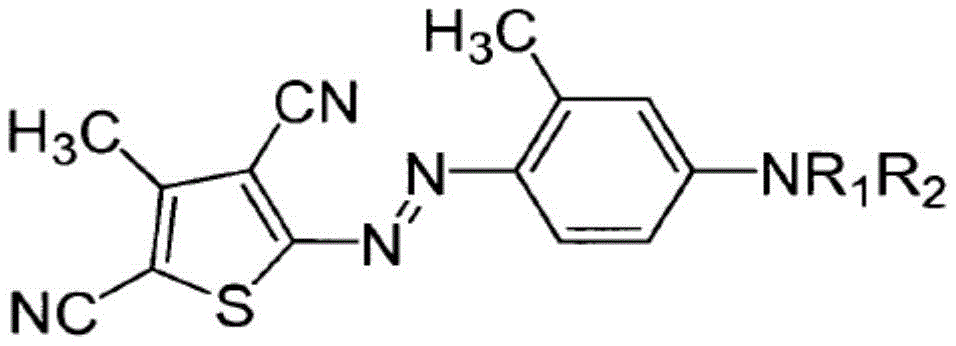
A highly preferred non-leuco monoazo dye has the structure (I):

wherein D represents an aromatic group or a heteroaromatic group. Preferably, D is selected from: azothiophenes, azobenzothiazoles, and azopyridones. The aromatic ring may be further substituted, for example and preferably by methyl. Most preferably, the dye is azothiophene.
More preferably, the non-leuco monoazo dye has the structure (II):

in structures (I) and (II), R1And R2At least one of them represents an alkoxy-CH2CHO or-CH2CHO-capped polyalkoxy group. In structures (I) and (II), preferably R1And R2One of them represents an alkoxy group-CH2CHO or-CH2A CHO-capped polyalkoxy group; and, R1And R2The remaining one of them represents-H, -alkoxy or-polyalkoxy, more preferably-ethoxy or-polyethoxy.
Even further preferred non-leuco monoazo dyes have the structure (III):

wherein r + q is 1-10, preferably 1-10, more preferably 2-5, and even more preferably, r ═ 1 and q ═ 1. Provided that r is at least 1.
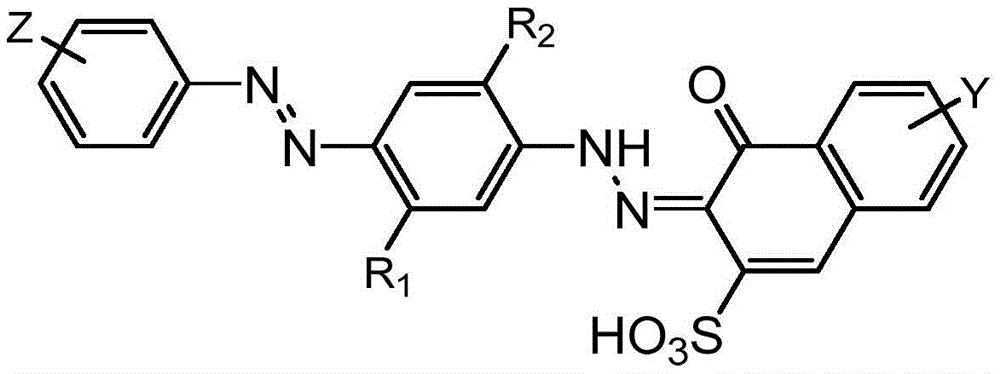
Preferred non-leuco disazo dyes have the structure (IV):

wherein:
R1and R2Independently H, alkyl, alkoxy, alkyleneoxy, alkyl-terminated alkyleneoxy, polyalkyleneoxy, alkyl-terminated polyalkyleneoxy, urea, amido, or acetamido;
z is oxygen, nitrogen or a sulfonamido group (sulfonamido), which is further substituted by at least one and preferably one alkoxy-CH2CHO or-CH2CHO-capped polyalkoxy substitution;
y is a substituted or unsubstituted amino group.
More preferred non-leuco disazo dyes have the structure (V):

wherein n is 1-10.
Structures (IV) and (V) describe disazo dye structures in which one of the azo groups is described as the hydrazone form. These structures should be construed to also cover disazo dyes in which both azo groups are in the-N ═ N-form. Preferably, one of the azo groups is in the hydrazone form and one is in the azo form when dissolved in water. Azo-hydrazone tautomerism is discussed in Organic Chemistry in Colour (Springer-Verlag 1983) by p.f. gordon and p.group. The azo and hydrazone forms of dye direct violet 9 are shown below:

the non-leuco disazo dye may be present as a salt of an alkali metal, alkaline earth metal or quaternary amine, most preferably the counterion is the sodium salt. Structures (IV) and (V) are also to be construed as including such salt forms and free acid forms.
Preparation of shading dyes
Disazo dyes can be synthesized via the well-known azo coupling reactions, for example

Wherein Is composed of
WO2012/054058 describes a compound having at least one other than-CH2Synthesis of various disazo dyes of CHO group terminated polyalkoxy chains.
The synthesis of alkoxylated monoazo thiophene dyes is described in US4912203 and WO 2011/017719. The main coupling reactions are:

wherein R is1And/or R2Is an alkoxylated moiety.
through-CH2The blocking by the CHO moiety can be obtained by (partial) oxidation of the corresponding alkoxylated material, as follows:

typically, -CH2CH2Partial oxidation of OH to-CH2The CHO moiety can be achieved by using acidified sodium dichromate, preferably followed by purification of the resulting shading dye according to the present invention.
Typically, at least one alkoxy-CH2CHO or-CH2Covalent attachment of the CHO-capped polyalkoxy group to the hueing dye may be carried out by techniques known in the art of organic chemistry.
Surface active agent
The laundry detergent compositions of the present invention comprise from 2 to 70 wt% surfactant, most preferably from 10 to 30 wt%. In general, the nonionic and anionic surfactants of the surfactant system may be selected from "Surface Active Agents", Vol.1, Schwartz & Perry, Interscience 1949; surfactants described in volume 2, Schwartz, Perry & Berch, Interscience 1958, the current version "McCutcheon's Emulsifiers and Detergents" or "Tenside-Taschenbuch", H.Stache, 2 nd edition, Carl Hauser Verlag,1981 published by Manufacturing conditioners Company. Preferably, the surfactant used is saturated.
Suitable nonionic surfactants can include, inter alia, the reaction product of a compound having a hydrophobic group and a reactive hydrogen atom (e.g., a fatty alcohol, an acid, an amide) with an alkylene oxide, particularly ethylene oxide alone or together with propylene oxide. Specific nonionic surfactants are aliphatic C8To C18The condensation products of linear or branched primary or secondary alcohols with ethylene oxide are generally from 5 to 40EO, preferably from 7EO to 9 EO.
Suitable anionic surfactants which may be used are generally water-soluble alkali metal salts of organic sulfuric and sulfonic acids having an alkyl group containing from about 8 to about 22 carbon atoms, the term alkyl being used to include the alkyl portion of higher acyl groups. Examples of suitable synthetic anionic surfactants are sodium and potassium alkyl sulfates, in particular by reacting higher C's, for example, derived from tallow or coconut oil8To C18Those obtained by sulfation of alcohols; alkyl radical C9To C20Sodium and potassium benzene-sulphonates, especially linear secondary alkyl C10To C15Sodium benzenesulfonate; and sodium alkyl glyceryl ether sulfates, particularly those of the higher alcohols derived from tallow or coconut oil and synthetic alcohols derived from petroleum. Preferred anionic surfactants are C11To C15Sodium alkyl benzene sulfonate and C12To C18Sodium alkyl sulfate. Highly preferred is anionic alkylbenzene sulphonate, which more advantageously is linear alkylbenzene sulphonate. Also suitable are surfactants such as those described in EP-A-328177 (Unilever), which exhibit resistance to salting-out, EP-Alkyl polyglycoside surfactants as described in A-070074, and alkyl monoglycosides.
Preferred surfactant systems are mixtures of anionic and nonionic surfactants, in particular the groups and examples of anionic and nonionic surfactants indicated in EP-A-346995 (Unilever). Particularly preferred is as C16To C18Alkali metal salts of primary alcohol sulfates with C12To C15A surfactant system of a mixture of primary alcohols 3 to 7EO ethoxylates together. The nonionic surfactant is preferably present in an amount of less than 50 wt%, most preferably less than 20 wt%, based on the total weight of the surfactant system. The anionic surfactant may be present, for example, in an amount ranging from about 50% to 100% by weight, based on the total weight of the surfactant system. Thus, highly advantageous surfactants comprise from 50 to 100 wt% linear alkylbenzene sulphonate, based on the total weight of the surfactant.
Builders or complexing agents
The builder material may be selected from 1) calcium sequestrant materials, 2) precipitation materials, 3) calcium ion exchange materials, and 4) mixtures thereof.
Examples of calcium sequestrant builder materials include alkali metal polyphosphates, such as sodium tripolyphosphate, and organic sequestrants, such as ethylenediaminetetraacetic acid.
Examples of precipitating builder materials include sodium orthophosphate and sodium carbonate.
Examples of calcium ion exchange builder materials include various types of water-insoluble crystalline or amorphous aluminosilicates, of which zeolites are the best known representatives, for example zeolite cA, zeolite B (also known as zeolite P), zeolite C, zeolite X, zeolite Y and the zeolite P type described in EP- cA-0,384,070.
The laundry detergent compositions of the present invention may also contain 0-65 wt% of a builder or complexing agent such as ethylenediaminetetraacetic acid, diethylenetriaminepentaacetic acid, alkyl or alkenylsuccinic acid, nitrilotriacetic acid, or other builders as described below. Many builders are also bleach stabilizers due to their ability to complex metal ions.
Zeolites and carbonates (including bicarbonates and sesquicarbonates)) are preferred builders, with carbonates being more preferred.
The composition may contain as builder a crystalline aluminosilicate, preferably an alkali metal aluminosilicate, more preferably a sodium aluminosilicate. This is typically present at a level of less than 15 wt%. Aluminosilicates are materials having the general formula:
0.8-1.5M2O·Al2O3·0.8-6SiO2
wherein M is a monovalent cation, preferably sodium. These materials contain some bound water and need to have a calcium ion exchange capacity of at least 50mg CaO/g. Preferred sodium aluminosilicates contain 1.5-3.5 SiO in the above formula2And (4) units. They can be easily prepared by reaction between sodium silicate and sodium aluminate, as fully described in the literature. The ratio of surfactant to aluminosilicate (when present) is preferably greater than 5:2, more preferably greater than 3: 1.
Alternatively, or in addition to aluminosilicate builders, phosphate builders may be used. The term "phosphate" in the art includes diphosphate, triphosphate and phosphonate species. Other forms of builders include silicates, such as soluble silicates, metasilicates, layered silicates (e.g., SKS-6 from Hoechst).
Preferably, the laundry detergent formulation is a non-phosphate built laundry detergent formulation, i.e. containing less than 1 wt% phosphate. Preferably, the laundry detergent formulation is carbonate built.
Fluorescent agent
The laundry detergent compositions of the present invention preferably comprise a fluorescer (optical brightener). Fluorescent agents are well known, and many such fluorescent agents are commercially available. Typically, these fluorescent agents are supplied and used in the form of their alkali metal salts, e.g., sodium salts. The total amount of fluorescer or fluorescers used in the laundry detergent compositions of the present invention is typically from 0.005 to 2 wt%, more preferably from 0.01 to 0.1 wt%. Preferred classes of fluorescers are: distyrylbiphenyl compounds such as Tinopal (trademark) CBS-X; diamine stilbene disulfonic acid compounds such as Tinopal DMS pure Xtra and Blankophor (trade Mark) HRH; and pyrazoline compounds such as Blankophor SN. Preferred fluorescent agents are: sodium 2 (4-styryl-3-sulfophenyl) -2H-naphthol [1,2-d ] triazole, disodium 4,4' -bis { [ (4-anilino-6- (N-methyl-N-2 hydroxyethyl) amino 1,3, 5-triazin-2-yl) ] amino } stilbene-2, 2' disulfonate, disodium 4,4' -bis { [ (4-anilino-6-morpholinyl-1, 3, 5-triazin-2-yl) ] amino } stilbene-2-2 ' disulfonate, and disodium 4,4' -bis (2-sulfostyryl) biphenyl.
It is preferred that the laundry detergent composition according to the present invention comprises a fluorescer. Similarly, it is preferred that the aqueous solution used in the domestic method of treating fabric comprises a fluorescer. When a fluorescent agent is present in the aqueous solution, it is preferably in the range of 0.0001 to 0.1g/l, more preferably 0.001 to 0.02 g/l.
Laundry detergent compositions may comprise mixtures of different hueing dyes according to the present invention as well as mixtures of hueing dyes according to the present invention and other hueing dyes not according to the present invention. Highly advantageously, the hueing dye according to the present invention (i.e., which comprises-CH)2CHO moiety) and a compound having a similar structure but in which-CH2CHO moiety by-CH2CH2Dyes with OH moieties replaced are used together.
Perfume
Preferably, the laundry detergent composition comprises a perfume. The perfume is preferably in the range of 0.001 to 3 wt%, most preferably 0.1 to 1 wt%. Many suitable examples of fragrances are provided in CTFA (Cosmetic, Toiletry and Fragrance Association)1992International layers Guide, published by CFTA Publication, and OPD 1993Chemicals layers Directory 80th annular Edition, published by Schnell Publishing Co.
It is common for a variety of perfume components to be present in laundry formulations. In the laundry detergent compositions of the present invention, it is envisaged that there will be four or more, preferably five or more, more preferably six or more or even seven or more different perfume components. In the perfume mixture, preferably 15 to 25% by weight is top notes. Top notes are defined by Poucher (Journal of Society of Cosmetic Chemists 6(2):80[1955 ]). Preferred top notes are selected from citrus oils, linalool, linalyl acetate, lavender, dihydromyrcenol, rose oxide and cis-3-hexanol. Perfumes and top notes are advantageously used to cue the whiteness benefits provided by the laundry detergent compositions of the present invention.
It is preferred that the laundry detergent compositions of the present invention are devoid of peroxygen bleach, such as sodium percarbonate, sodium perborate and peracids.
Polymer and method of making same
The laundry detergent compositions of the present invention may comprise one or more additional polymers. Examples are carboxymethylcellulose, poly (ethylene glycol), poly (vinyl alcohol), polycarboxylates such as polyacrylates, maleic/acrylic acid copolymers and lauryl methacrylate/acrylic acid copolymers.
Polymers present to prevent dye deposition, such as poly (vinylpyrrolidone), poly (vinylpyridine-N-oxide) and poly (vinylimidazole), are preferably not present in the formulation.
Enzyme
One or more enzymes are preferably present in the laundry detergent compositions of the present invention and when practicing the methods of the present invention. Preferably, each enzyme is present in the laundry detergent composition of the present invention at a level of from 0.0001 wt% to 0.1 wt% protein.
Particularly contemplated enzymes include proteases, alpha-amylases, cellulases, lipases, peroxidases/oxidases, pectate lyases and mannanases or mixtures thereof.
Suitable lipases include those of bacterial or fungal origin. Chemically modified or protein engineered mutants are included. Examples of useful lipases include those from: humicola (Humicola) (synonym thermophilic fungi (Thermomyces)), for example from h.lanuginosa (t.lanuginosus) as described in EP 258068 and EP 305216 or from h.insolens as described in WO 96/13580; pseudomonas lipases, for example from pseudomonas alcaligenes (p. alcaligenes) or pseudomonas pseudoalcaligenes (p. pseudoalcaligenes) (EP 218272), pseudomonas cepacia (p.cepacia) (EP 331376), pseudomonas stutzeri (GB 1,372,034), pseudomonas fluorescens (p. fluoroscens), pseudomonas strains SD 705(WO 95/06720 and WO 96/27002), p.wisconsinensis (WO 96/12012); bacillus lipases, for example from Bacillus subtilis (B.subtilis) (Dartois et al (1993), Biochemica et Biophysica Acta,1131,253-360), Bacillus stearothermophilus (B.stearothermophilus) (JP 64/744992) or Bacillus pumilus (B.pumilus) (WO 91/16422).
Further examples are lipase variants, such as those described in WO 92/05249, WO 94/01541, EP 407225, EP 260105, WO 95/35381, WO 96/00292, WO 95/30744, WO 94/25578, WO 95/14783, WO 95/22615, WO 97/04079 and WO 97/07202, WO 00/60063.
Preferred commercially available lipases include LipolaseTMAnd Lipolase UltraTM、LipexTMAnd lipocleanTM(Novozymes A/S)。
Preferred phospholipases are classified as EC 3.1.1.4 and/or EC 3.1.1.32. The term phospholipase as used herein is an enzyme that is active on phospholipids.
Phospholipids, such as lecithin or phosphatidylcholine, consist of glycerol esterified at the outer (sn-1) and middle (sn-2) positions with two fatty acids and phosphorylated at the third position; phosphoric acid, in turn, can be esterified to an amino alcohol. Phospholipases are enzymes involved in phospholipid hydrolysis. Various types of phospholipase activity can be distinguished, including phospholipase a1 and a2, which hydrolyze one fatty acyl group (at the sn-1 and sn-2 positions, respectively) to form lysophospholipids; and lysophospholipase (or phospholipase B), which can hydrolyze the remaining fatty acyl groups in lysophospholipid. Phospholipase C and phospholipase D (phosphodiesterases) release diacyl glycerol or phosphatidic acid, respectively.
The enzyme and the photo-bleach may show some interaction and should be chosen such that this interaction is not negative. By encapsulating one or the other enzyme or photo-bleach and/or other barrier within the product, certain negative interactions can be avoided.
Suitable proteases include those with animals, plantsOf biological or microbial origin. Microbial sources are preferred. Chemically modified or protein engineered mutants are included. The protease may be a serine protease or a metalloprotease, preferably an alkaline microbial protease or a trypsin-like protease. Preferred commercially available proteases include AlcalaseTM、SavinaseTM、PrimaseTM、DuralaseTM、DyrazymTM、EsperaseTM、EverlaseTM、PolarzymeTM、and KannaseTM、(Novozymes A/S)、MaxataseTM、MaxacalTM、MaxapemTM、ProperaseTM、PurafectTM、Purafect OxPTM、FN2TMAnd FN3TM(Genencor International Inc.)。
Preferred cutinases are classified as EC 3.1.1.74. The cutinase may be of any origin.
Preferably, the cutinase is of microbial origin, in particular of bacterial, fungal or yeast origin.
Suitable amylases (alpha and/or beta) include those of bacterial or fungal origin. Chemically modified or protein engineered mutants are included. Amylases include, for example, alpha-amylases obtained from Bacillus, such as particular strains of Bacillus licheniformis described in more detail in GB 1,296,839, or strains of Bacillus as disclosed in WO95/026397 or WO 00/060060. A commercially available amylase is DuramylTM、TermamylTM、Termamyl UltraTM、NatalaseTM、StainzymeTM、FungamylTMAnd BANTM(Novozymes A/S),RapidaseTMAnd PurastarTM(from Genencor International Inc.)。
Suitable cellulases include those of bacterial or fungal origin. Chemically modified or protein engineered mutants are included. Suitable cellulases include cellulases from: bacillus, Pseudomonas, Humicola, Fusarium, Thielavia, Acremonium, for example from the specific disclosure in U.S. Pat. No. 4,435,307, U.S. Pat. No. 5,648,263, U.S. Pat. No. 5,691,178, U.S. Pat. No. 5,776,757, WO 89/09259, WO 96/029397 and WO 98/012307Fungal cellulases produced by Humicola insolens, Thielavia terrestris, myceliophthora thermophila and Fusarium oxysporum. Commercially available cellulases include CelluzymeTM、CarezymeTM、Celluclean TM、EndolaseTM、RenozymeTM(Novozymes A/S)、ClazinaseTMAnd Puradax HATM(Genencor International Inc.) and KAC-500(B)TM(Kao Corporation)。
Suitable peroxidases/oxidases include those of plant, bacterial or fungal origin. Chemically modified or protein engineered mutants are included. Examples of useful peroxidases include peroxidases from Coprinus, e.g., Coprinus cinereus, and variants thereof, such as those described in WO 93/24618, WO 95/10602, and WO 98/15257. Commercially available peroxidases include GuardzymeTMAnd NovozymTM 51004(Novozymes A/S)。
Further suitable enzymes are discussed in WO2009/087524, WO2009/090576, WO2009/107091, WO2009/111258 and WO 2009/148983.
Preferred enzymes are proteases, lipases, amylases and cellulases, most advantageously the serine protease is comprised by the laundry detergent composition of the invention.
Enzyme stabilizer
Any enzyme present in the composition may be stabilized using conventional stabilizers, for example polyols such as propylene glycol or glycerol; a sugar or sugar alcohol; lactic acid; boric acid or a boric acid derivative, for example an aromatic borate ester, or a phenyl boronic acid derivative, for example 4-formylphenyl boronic acid, and the compositions may be formulated as described, for example, in WO 92/19709 and WO 92/19708.
When the alkyl group is long enough to form a branched or cyclic chain, the alkyl group includes branched, cyclic, and linear alkyl chains. The alkyl group is preferably linear or branched, most preferably linear.
Laundry detergent compositions in the form of
The laundry detergent compositions of the present invention may be liquid or powder.
To reduce the coloring of the powder as a whole by the hueing dye, the hueing dye of the present invention is advantageously present in post-dosed particles (post-dosed granules) comprising less than 5 wt% of hueing dye. It has also been found that limiting the amount of the shading dye of the present invention in post dosing dye granules to at most 5 wt% reduces staining (e.g. as a powder on wet fabrics) after neat application (neat application) of the product. Preferably, an additional non-hueing dye is added to the post dosing particles to impart a blue colour to the particles.
Preferably, the post dosed dye granule comprises a total amount of hueing dye of from 0.1 to 2 wt%, based on the total weight of the post dosed dye granule.
The hueing dye may be premixed with a water soluble salt (e.g., sodium sulfate) to form a post-dosed dye particle. The post-dosed dye granules may be prepared by techniques known in the art, such as granulation, fluid bed agglomeration, and the like. The post dosed dye granules of the present invention may be subsequently mixed with base detergent granules.
The post dosing dye particle size may be in the range of 50 to 3000 μm. Most preferably, the particles have a particle size in the range of 100 to 2000 μm, most preferably 180 μm to 1000 μm. The dimensions given are the maximum length of the particles in any one direction, such that the particles pass through a standard sieve of the desired size.
In case the laundry detergent composition is a powder, the composition preferably comprises a combination of linear alkylbenzene sulphonate, carbonate and sodium sulphate and a post dosing dye granule, wherein the post dosing dye granule comprises a polyalkoxylated shading dye according to the invention.
Where the laundry detergent composition is in the form of a bottled liquid detergent product, the bottle is preferably a1 to 5L bottle having a resealable screw cap, the largest dimension of the pouring neck of the bottle being at least 3 times smaller than the largest dimension of the bottle. At the time of first sale, the bottles should fill to greater than 95% of the bottle capacity by weight. Surprisingly, this reduces the oxidation of the hueing dye used in the present invention in the formulation during storage. Where the laundry detergent composition is a unit dose, it is preferably a liquid unit dose product. Advantageously, the unit dose laundry detergent product is contained in a reclosable plastic tank. The reclosable plastic box is a highly advantageous child resistant packaging. The requirements for child resistant unpacking are given in ISO 8317. Surprisingly, providing a laundry detergent composition according to the invention in liquid unit dose form, particularly when contained in a reclosable plastic box which meets the requirements for child resistant packaging, can reduce oxidation of the hueing dye in the formulation during storage.
Unless otherwise indicated, preferences in the context of one aspect of the invention (e.g. laundry detergent composition) may also apply mutatis mutandis to preferences in the context of one of the other aspects, (e.g. laundry detergent composition as used in the domestic aspect of treating fabrics).
The invention will now be illustrated by the following non-limiting examples.
Examples
Example 1
A liquid laundry detergent may be prepared having the following formulation:

the liquid laundry detergent contains 0.001 wt% of a hueing dye according to the following structure (example 1, according to the present invention):

where r is 1 and q is 1 (i.e., r + q is 2) (example 1). As a comparative example (not according to the invention), 0.001% by weight of a compound having the same structure, but in which-CH2CHO group by-CH2CH2OH-substituted shading dyesComparative example a, not according to the invention). As a reference, the liquid laundry detergent composition was used, but without any added hueing dye (reference liquid).
The wash liquor was prepared by dosing 4g/L of laundry detergent powder into 13 ° FH water in a tergitometer tank and adding a 10 x 10cm piece of woven cotton, knitted cotton, 65/35 poly cotton, microfiber polyester, or 80/20 nylon-elastic fabric such that the wash liquor to fabric ratio was 100: 1. The wash solution was stirred at 200rpm for 1 hour at room temperature, and the fabrics were rinsed in 13 ° FH water and dried.
The color of the fabric was measured using a reflectometer and expressed as CIE L a b. The colour change of fabrics washed with the laundry detergent powder according to example 1 or according to comparative example a is expressed relative to the colour change of fabrics washed with the reference liquid. The following expressions were used: Δ b ═ b (reference) -b (dye). Thus, the relative deposition of the dyes according to example 1 or according to comparative example a can be compared.
Example 2
A powder laundry detergent formulation can be prepared having the following formulation:


the hueing dye particles are as described in WO2006/053598, the formulation containing 0.0004 wt% hueing dye. The hueing dye was according to the following structure (i.e. example 2, according to the present invention).

Where r is 1 and q is 1 (i.e., r + q is 2) (example 2). As a comparative example (not according to the invention), a 0.001 wt.% tool may be usedHaving the same structure, but wherein-CH2CHO group by-CH2CH2OH instead of hueing dye (comparative example B, not according to the invention). As a reference, a powdered laundry detergent composition was used, without any added hueing dye (reference powder).
The wash liquor was prepared by dosing 4g/L of laundry detergent powder into 13 ° FH water in a tergitometer tank and adding a 10 x 10cm piece of woven cotton, knitted cotton, 65/35 poly cotton, microfiber polyester, or 80/20 nylon-elastic fabric such that the wash liquor to fabric ratio was 100: 1. The wash solution was stirred at 200rpm for 1 hour at room temperature, and the fabrics were rinsed in 13 ° FH water and dried.
The color of the fabric was measured using a reflectometer and expressed as CIE L a b. The colour change of fabrics washed with the laundry detergent powder according to example 2 or according to comparative example B is indicated relative to the colour change of fabrics washed with the reference powder. The following expressions were used: Δ b ═ b (reference) -b (dye). Thus, the relative deposition of the dyes according to example 2 or according to comparative example B can be compared.
Claims (15)




Applications Claiming Priority (3)
| Application Number | Priority Date | Filing Date | Title |
|---|---|---|---|
| EP19153073.2 | 2019-01-22 | ||
| EP19153073 | 2019-01-22 | ||
| PCT/EP2020/050754 WO2020151992A1 (en) | 2019-01-22 | 2020-01-14 | Laundry detergent |
Publications (2)
| Publication Number | Publication Date |
|---|---|
| CN113330102A true CN113330102A (en) | 2021-08-31 |
| CN113330102B CN113330102B (en) | 2023-06-02 |
Family
ID=65200645
Family Applications (1)
| Application Number | Title | Priority Date | Filing Date |
|---|---|---|---|
| CN202080010550.5A Active CN113330102B (en) | 2019-01-22 | 2020-01-14 | laundry detergent |
Country Status (4)
| Country | Link |
|---|---|
| US (1) | US20220098520A1 (en) |
| EP (1) | EP3914682B1 (en) |
| CN (1) | CN113330102B (en) |
| WO (1) | WO2020151992A1 (en) |
Families Citing this family (1)
| Publication number | Priority date | Publication date | Assignee | Title |
|---|---|---|---|---|
| US20220098525A1 (en) * | 2019-01-22 | 2022-03-31 | Conopco, Inc., D/B/A Unilever | Laundry detergent |
Citations (4)
| Publication number | Priority date | Publication date | Assignee | Title |
|---|---|---|---|---|
| CN101370925A (en) * | 2006-01-23 | 2009-02-18 | 美利肯公司 | Laundry care compositions with thiazolium dye |
| CN101583704A (en) * | 2007-01-19 | 2009-11-18 | 宝洁公司 | Laundry care composition comprising a whitening agent for cellulosic substrates |
| CN102741387A (en) * | 2010-02-12 | 2012-10-17 | 荷兰联合利华有限公司 | Laundry treatment composition comprising bis-azo shading dyes |
| CN105555934A (en) * | 2013-09-18 | 2016-05-04 | 宝洁公司 | Laundry care compositions containing thiophene azo carboxylate dyes |
Family Cites Families (77)
| Publication number | Priority date | Publication date | Assignee | Title |
|---|---|---|---|---|
| GB1296839A (en) | 1969-05-29 | 1972-11-22 | ||
| GB1372034A (en) | 1970-12-31 | 1974-10-30 | Unilever Ltd | Detergent compositions |
| DK187280A (en) | 1980-04-30 | 1981-10-31 | Novo Industri As | RUIT REDUCING AGENT FOR A COMPLETE LAUNDRY |
| GR76189B (en) | 1981-07-13 | 1984-08-03 | Procter & Gamble | |
| US4507407A (en) * | 1984-06-25 | 1985-03-26 | Milliken Research Corporation | Process for in situ coloration of thermosetting resins |
| CA1243669A (en) | 1984-06-25 | 1988-10-25 | Edward W. Kluger | Reactive colorants |
| US4601725A (en) * | 1984-08-27 | 1986-07-22 | Milliken Research Corporation | Thiophene based fugitive colorants |
| JPH0697997B2 (en) | 1985-08-09 | 1994-12-07 | ギスト ブロカデス ナ−ムロ−ゼ フエンノ−トチヤツプ | New enzymatic detergent additive |
| US4732570A (en) * | 1985-09-13 | 1988-03-22 | Milliken Research Corporation | Colored thermoplastic resin |
| ATE110768T1 (en) | 1986-08-29 | 1994-09-15 | Novo Nordisk As | ENZYMATIC DETERGENT ADDITIVE. |
| NZ221627A (en) | 1986-09-09 | 1993-04-28 | Genencor Inc | Preparation of enzymes, modifications, catalytic triads to alter ratios or transesterification/hydrolysis ratios |
| DE3854249T2 (en) | 1987-08-28 | 1996-02-29 | Novonordisk As | Recombinant Humicola Lipase and Process for the Production of Recombinant Humicola Lipases. |
| GB8803036D0 (en) | 1988-02-10 | 1988-03-09 | Unilever Plc | Liquid detergents |
| JP3079276B2 (en) | 1988-02-28 | 2000-08-21 | 天野製薬株式会社 | Recombinant DNA, Pseudomonas sp. Containing the same, and method for producing lipase using the same |
| WO1989009259A1 (en) | 1988-03-24 | 1989-10-05 | Novo-Nordisk A/S | A cellulase preparation |
| US5776757A (en) | 1988-03-24 | 1998-07-07 | Novo Nordisk A/S | Fungal cellulase composition containing alkaline CMC-endoglucanase and essentially no cellobiohydrolase and method of making thereof |
| GB8813978D0 (en) | 1988-06-13 | 1988-07-20 | Unilever Plc | Liquid detergents |
| CA2001927C (en) | 1988-11-03 | 1999-12-21 | Graham Thomas Brown | Aluminosilicates and detergent compositions |
| GB8915658D0 (en) | 1989-07-07 | 1989-08-23 | Unilever Plc | Enzymes,their production and use |
| EP0528828B2 (en) | 1990-04-14 | 1997-12-03 | Genencor International GmbH | Alkaline bacillus lipases, coding dna sequences therefor and bacilli which produce these lipases |
| DE69129988T2 (en) | 1990-09-13 | 1999-03-18 | Novo Nordisk A/S, Bagsvaerd | LIPASE VARIANTS |
| DK0583420T3 (en) | 1991-04-30 | 1996-07-29 | Procter & Gamble | Builder-containing liquid detergents with boric-polyol complex to inhibit proteolytic enzyme |
| EP0511456A1 (en) | 1991-04-30 | 1992-11-04 | The Procter & Gamble Company | Liquid detergents with aromatic borate ester to inhibit proteolytic enzyme |
| DK72992D0 (en) | 1992-06-01 | 1992-06-01 | Novo Nordisk As | ENZYME |
| DK88892D0 (en) | 1992-07-06 | 1992-07-06 | Novo Nordisk As | CONNECTION |
| ATE287946T1 (en) | 1993-04-27 | 2005-02-15 | Genencor Int | NEW LIPASE VARIANTS FOR USE IN CLEANING PRODUCTS |
| JP2859520B2 (en) | 1993-08-30 | 1999-02-17 | ノボ ノルディスク アクティーゼルスカブ | Lipase, microorganism producing the same, method for producing lipase, and detergent composition containing lipase |
| EP0724631A1 (en) | 1993-10-13 | 1996-08-07 | Novo Nordisk A/S | H 2?o 2?-stable peroxidase variants |
| JPH07143883A (en) | 1993-11-24 | 1995-06-06 | Showa Denko Kk | Lipase gene and mutant lipase |
| EP0746618B1 (en) | 1994-02-22 | 2002-08-21 | Novozymes A/S | A method of preparing a variant of a lipolytic enzyme |
| DK0753057T3 (en) | 1994-03-29 | 2006-01-30 | Novozymes As | Alkaline Bacillus amylase |
| JP3851656B2 (en) | 1994-05-04 | 2006-11-29 | ジェネンコア インターナショナル インコーポレーテッド | Lipase with improved surfactant resistance |
| WO1995035381A1 (en) | 1994-06-20 | 1995-12-28 | Unilever N.V. | Modified pseudomonas lipases and their use |
| WO1996000292A1 (en) | 1994-06-23 | 1996-01-04 | Unilever N.V. | Modified pseudomonas lipases and their use |
| BE1008998A3 (en) | 1994-10-14 | 1996-10-01 | Solvay | Lipase, microorganism producing the preparation process for the lipase and uses thereof. |
| BR9509525A (en) | 1994-10-26 | 1995-10-26 | Novo Nordisk As | Construction of DNA vector of recombinant cell expression process to produce enzyme that exhibits lipolytic activity enzyme that exhibits lipolytic activity detergent additive preparation and detergent composition |
| JPH08228778A (en) | 1995-02-27 | 1996-09-10 | Showa Denko Kk | Novel lipase gene and method for producing lipase using the same |
| EP0815209B2 (en) | 1995-03-17 | 2015-02-25 | Novozymes A/S | Novel endoglucanases |
| WO1997007202A1 (en) | 1995-08-11 | 1997-02-27 | Novo Nordisk A/S | Novel lipolytic enzymes |
| AU6414196A (en) | 1995-07-14 | 1997-02-18 | Novo Nordisk A/S | A modified enzyme with lipolytic activity |
| BR9711479B1 (en) | 1996-09-17 | 2009-08-11 | cellulase variant having increased resistance to anion voltage. | |
| CA2265734A1 (en) | 1996-10-08 | 1998-04-16 | Novo Nordisk A/S | Diaminobenzoic acid derivatives as dye precursors |
| JP4745503B2 (en) | 1999-03-31 | 2011-08-10 | ノボザイムス アクティーゼルスカブ | Polypeptides having alkaline α-amylase activity and nucleic acids encoding them |
| US6939702B1 (en) | 1999-03-31 | 2005-09-06 | Novozymes A/S | Lipase variant |
| US20030136701A1 (en) * | 2001-12-14 | 2003-07-24 | Unilever Home And Personal Care Usa, | Laundry pouch |
| US6875811B2 (en) * | 2002-05-07 | 2005-04-05 | Milliken & Company | Single compound toners for use in polyesters |
| US20040044623A1 (en) * | 2002-08-28 | 2004-03-04 | Wake Susan L. | Billing system for wireless device activity |
| AR049538A1 (en) * | 2004-06-29 | 2006-08-09 | Procter & Gamble | DETERGENT COMPOSITIONS FOR LAUNDRY WITH EFFICIENT DYING COLOR |
| EP1814974B1 (en) | 2004-11-22 | 2010-11-10 | Unilever PLC | Laundry treatment compositions |
| US20080177089A1 (en) * | 2007-01-19 | 2008-07-24 | Eugene Steven Sadlowski | Novel whitening agents for cellulosic substrates |
| US7642282B2 (en) * | 2007-01-19 | 2010-01-05 | Milliken & Company | Whitening agents for cellulosic substrates |
| PL2242830T5 (en) | 2008-01-04 | 2021-08-16 | The Procter & Gamble Company | Enzyme and fabric hueing agent containing compositions |
| EP2085070A1 (en) | 2008-01-11 | 2009-08-05 | Procter & Gamble International Operations SA. | Cleaning and/or treatment compositions |
| WO2009107091A2 (en) | 2008-02-29 | 2009-09-03 | The Procter & Gamble Company | Detergent composition comprising lipase |
| MX2010009457A (en) | 2008-02-29 | 2010-09-24 | Procter & Gamble | Detergent composition comprising lipase. |
| MX2010013276A (en) | 2008-06-06 | 2010-12-21 | Procter & Gamble | DETERGENT COMPOSITION THAT INCLUDES A VARIANTE OF A FAMILY XYLOGLUCANASA 44. |
| US20120101018A1 (en) | 2010-10-22 | 2012-04-26 | Gregory Scot Miracle | Bis-azo colorants for use as bluing agents |
| WO2012054058A1 (en) | 2010-10-22 | 2012-04-26 | The Procter & Gamble Company | Bis-azo colorants for use as bluing agents |
| BR112013011604B1 (en) | 2010-11-12 | 2020-01-07 | Milliken & Company | Azo thiophene dyes |
| US9163146B2 (en) * | 2011-06-03 | 2015-10-20 | Milliken & Company | Thiophene azo carboxylate dyes and laundry care compositions containing the same |
| ES2800314T3 (en) * | 2011-06-03 | 2020-12-29 | Procter & Gamble | Method for the care of clothes with dyes |
| WO2013189615A1 (en) | 2012-06-21 | 2013-12-27 | Unilever Plc | Liquid laundry detergent |
| CN109844087A (en) | 2016-11-01 | 2019-06-04 | 宝洁公司 | Method for use of leuco colorants as bluing agents in laundry care compositions |
| US10377976B2 (en) | 2016-11-01 | 2019-08-13 | The Procter & Gamble Company | Leuco polymers as bluing agents in laundry care compositions |
| EP3535375B1 (en) | 2016-11-01 | 2022-08-31 | The Procter & Gamble Company | Leuco polymers as bluing agents in laundry care compositions |
| US10676699B2 (en) | 2016-11-01 | 2020-06-09 | The Procter & Gamble Company | Leuco colorants as bluing agents in laundry care compositions |
| WO2018085310A1 (en) | 2016-11-01 | 2018-05-11 | The Procter & Gamble Company | Leuco colorants as bluing agents in laundry care compositions |
| ES2827831T3 (en) | 2016-11-01 | 2021-05-24 | Procter & Gamble | Methods for using leuco dyes as blueing agents in laundry care compositions |
| US10377977B2 (en) | 2016-11-01 | 2019-08-13 | The Procter & Gamble Company | Leuco polymers as bluing agents in laundry care compositions |
| US10385294B2 (en) | 2016-11-01 | 2019-08-20 | The Procter & Gamble Company | Leuco polymers as bluing agents in laundry care compositions |
| WO2018085314A1 (en) | 2016-11-01 | 2018-05-11 | The Procter & Gamble Company | Reactive leuco compounds and compositions comprising the same |
| JP6790257B2 (en) | 2016-11-01 | 2020-11-25 | ザ プロクター アンド ギャンブル カンパニーThe Procter & Gamble Company | Leuco colorants as bluish agents in laundry care compositions, their packaging, kits and methods |
| JP6772375B2 (en) | 2016-11-01 | 2020-10-21 | ザ プロクター アンド ギャンブル カンパニーThe Procter & Gamble Company | Roy copolymer as a bluish agent in laundry care compositions |
| WO2018085311A1 (en) | 2016-11-01 | 2018-05-11 | The Procter & Gamble Company | Leuco polymers as bluing agents in laundry care compositions |
| WO2018085301A1 (en) | 2016-11-01 | 2018-05-11 | The Procter & Gamble Company | Leuco triphenylmethane colorants as bluing agents in laundry care compositions |
| EP3535371B1 (en) | 2016-11-01 | 2020-09-09 | The Procter & Gamble Company | Leuco polymers as bluing agents in laundry care compositions |
| WO2018085309A1 (en) | 2016-11-01 | 2018-05-11 | The Procter & Gamble Company | Leuco polymers as bluing agents in laundry care compositions |
-
2020
- 2020-01-14 US US17/424,150 patent/US20220098520A1/en not_active Abandoned
- 2020-01-14 CN CN202080010550.5A patent/CN113330102B/en active Active
- 2020-01-14 EP EP20700390.6A patent/EP3914682B1/en active Active
- 2020-01-14 WO PCT/EP2020/050754 patent/WO2020151992A1/en not_active Ceased
Patent Citations (4)
| Publication number | Priority date | Publication date | Assignee | Title |
|---|---|---|---|---|
| CN101370925A (en) * | 2006-01-23 | 2009-02-18 | 美利肯公司 | Laundry care compositions with thiazolium dye |
| CN101583704A (en) * | 2007-01-19 | 2009-11-18 | 宝洁公司 | Laundry care composition comprising a whitening agent for cellulosic substrates |
| CN102741387A (en) * | 2010-02-12 | 2012-10-17 | 荷兰联合利华有限公司 | Laundry treatment composition comprising bis-azo shading dyes |
| CN105555934A (en) * | 2013-09-18 | 2016-05-04 | 宝洁公司 | Laundry care compositions containing thiophene azo carboxylate dyes |
Also Published As
| Publication number | Publication date |
|---|---|
| US20220098520A1 (en) | 2022-03-31 |
| EP3914682B1 (en) | 2024-10-16 |
| BR112021014336A2 (en) | 2021-09-21 |
| CN113330102B (en) | 2023-06-02 |
| WO2020151992A1 (en) | 2020-07-30 |
| EP3914682A1 (en) | 2021-12-01 |
Similar Documents
| Publication | Publication Date | Title |
|---|---|---|
| ES2477518T3 (en) | Coloring polymers | |
| US9790453B2 (en) | Dye polymer | |
| EP2488622B1 (en) | Dye polymers | |
| WO2012126665A1 (en) | Dye polymer | |
| WO2012130492A1 (en) | Dye polymer | |
| CN102741387A (en) | Laundry treatment composition comprising bis-azo shading dyes | |
| CN106029790B (en) | Dye polymer | |
| EP3046973B1 (en) | Dye polymer | |
| CN106062163B (en) | Long alkyl chain azo dyes and laundry detergent compositions | |
| WO2012098046A1 (en) | Dye polymer for laundry treatment | |
| CN113330102B (en) | laundry detergent | |
| CN113330103B (en) | Laundry detergents | |
| EP2563893A1 (en) | Bis-heterocyclic azo dyes | |
| CN102549137B (en) | Shading composition | |
| CN102414307B (en) | masking composition | |
| EP3775137B1 (en) | Laundry detergent | |
| CN102575199A (en) | A dye polymer | |
| BR112021014336B1 (en) | COMPOSITION: Laundry detergent, household method for treating fabric, and non-leuco blue or violet tinting dye. |
Legal Events
| Date | Code | Title | Description |
|---|---|---|---|
| PB01 | Publication | ||
| PB01 | Publication | ||
| SE01 | Entry into force of request for substantive examination | ||
| SE01 | Entry into force of request for substantive examination | ||
| GR01 | Patent grant | ||
| GR01 | Patent grant |