The patent application is a divisional application of the same-subject Chinese patent application with the application number of 201680043258.7 and the application date of 2016, 7 and 15.
Disclosure of Invention
One of the most important cellular transport systems in mammalian cells is cyclic guanosine monophosphate (cGMP). It forms the NO/cGMP system together with Nitric Oxide (NO) which is released from the endothelium and transmits hormonal and mechanical signals. Guanylate cyclase catalyzes the biosynthesis of cGMP from Guanosine Triphosphate (GTP). The representatives of this family known to date can be divided into two groups, both according to structural features and according to the type of ligand: particulate guanylate cyclase excitable by natriuretic peptides and soluble guanylate cyclase excitable by NO. Soluble guanylate cyclase is composed of two subunits and it is highly likely that each heterodimer contains one heme, which is part of the regulatory center. This is critical to the activation mechanism. NO can bind to the iron atom of heme and thus significantly increase the activity of the enzyme. In contrast, a heme-free preparation cannot be stimulated by NO. Carbon monoxide (CO) can also bond to the central iron atom of heme, but stimulation by CO is much less than stimulation by NO. The membrane-bound (membrane ä ndig) particulate guanylate cyclase is composed of a cytoplasmic catalytic domain, a transmembrane region and an extracellular ligand-binding domain. Binding of the natriuretic peptide to the extracellular ligand binding domain results in activation of the catalytic domain and biosynthesis of cGMP from GTP. Neutral endopeptidase (enkephalinase) inactivates natriuretic peptides by proteolytic cleavage and thus has an inhibitory effect on particulate guanylate cyclase.
Guanylate cyclase plays an important role in various physiological processes, in particular in relaxation and proliferation of smooth muscle cells, platelet aggregation and adhesion, neuronal signaling and in diseases based on the destruction of these processes, through the formation of cGMP and the resulting modulation of phosphodiesterases, ion channels and protein kinases. Under pathophysiological conditions, the NO/cGMP system may be inhibited, which may lead to e.g. hypertension, platelet activation, increased cell proliferation, endothelial dysfunction, atherosclerosis, angina pectoris, heart failure, myocardial infarction, thrombosis, stroke and sexual dysfunction.
NO-independent therapies that might be useful for such diseases, targeting the effects of the cGMP signaling pathway in the organism, are promising approaches due to the expected high efficiency and low side effect levels.
To date, for the therapeutic stimulation of soluble guanylate cyclase, compounds whose action is based on the direct release of NO, such as organic nitrates, have been mainly used. NO is formed by biotransformation and soluble guanylate cyclase is activated by attacking the central iron atom of heme. In addition to side effects, the development of resistance is an important drawback of this mode of treatment.
The native form of the soluble guanylate cyclase as well as the heme-free form are directly activated or stimulated by sGC activators and stimulators.
By virtue of the sGC activator, it is also possible to stimulate the oxidized form of the soluble guanylate cyclase and finally the heme-free form of sGC directly, independently of NO. This oxidized/heme-free form may accumulate in higher concentrations in tissues exposed to oxidative stress, and therefore targeted treatment of tissues under oxidative stress should also occur through the use of sGC activators.
LCZ696 is ARNI (angiotensin-receptor-enkephalinase-inhibitor) and is therefore a dual active ingredient consisting of the angiotensin AII antagonist valsartan and the enkephalinase inhibitor sabotari (secubitril). Reduced degradation of natriuretic peptides is achieved by enkephalinase inhibition. These have diuretic and natriuretic effects, in particular due to their vasodilatory effect on the anterior glomerular vessels. In addition, they may also inhibit sodium reabsorption in the proximal small tube segment.
The combination of angiotensin receptor blockade and enkephalinase inhibition by LCZ696 (a combination of the angiotensin receptor antagonist valsartan and the NEP inhibitor sabotabizole) and resulting in a reduced risk of mortality and hospitalization was recently investigated in clinical trials (phase III) in heart failure patients (McMurray et al 2014 NEJM). In addition to the desired increase in ANP and cGMP, a compensatory increase in renin and angiotensin was measured in both healthy subjects and hypertensive patients at the time of LCZ696 administration (Gu J. et al J Clin Pharmacol. 2010 Apr; 50(4): 401-14).
One disadvantage of LCZ696 administration for lowering blood pressure is that compensatory effects on heart rate, such as reflex tachycardia, accompanied by a reduced blood pressure drop, can be observed.
It is therefore an object of the present invention to provide a combination of pharmaceutically active ingredients for the treatment of cardiovascular diseases which reduces the mean arterial blood pressure and affects as little or no as possible hemodynamic parameters, such as heart rate. This aims to overcome the above-mentioned drawback-the heart rate compensation effect associated with the blood pressure reduction.
To achieve this, sGC stimulators and/or sGC activators in combination with enkephalinase inhibitors and/or angiotensin AII antagonists were studied under acute, in particular chronic, applications, provided that the positive effects on blood pressure and heart rate caused by the plasma and tissue cGMP levels produced could be shown under experimental conditions. These experimental conditions consist of healthy animals or hypertensive animals (e.g. spontaneously hypertensive rats). In this case, experiments were performed with a single combination of sGC stimulators and/or activators with an enkephalinase inhibitor and an angiotensin AII antagonist, e.g., LCZ696 "head-to-head" comparison.
These experiments are intended to demonstrate whether enhancement of cGMP by stimulation of soluble guanylate cyclase with sGC stimulators and/or activators in combination with shakubara (membrane-bound particulate guanylate cyclase activated by inhibition of enkephalinase) and/or angiotensin AII antagonists has a beneficial effect on e.g. hemodynamic parameters such as heart rate and mean arterial blood pressure.
The solution to the above object and the subject of the present invention are the following combinations of sGC stimulators and/or sGC activators with enkephalinase inhibitors and/or angiotensin AII antagonists.
The combination of a stimulator and/or activator of soluble guanylate cyclase with an enkephalinase inhibitor and/or an angiotensin AII antagonist results in a controlled reduction of vasodilation and/or blood pressure. The combination is therefore suitable for the treatment and/or prophylaxis of diseases, preferably cardiovascular diseases, in particular for the treatment and/or prophylaxis of heart failure with preserved ejection fraction or heart failure with reduced ejection fraction, kidney diseases, lung diseases and for the treatment and/or prophylaxis of fibrotic diseases in humans and animals.
The angiotensin AII antagonist of the combination product according to the invention administered is for example and preferably valsartan, losartan, candesartan, telmisartan, irbesartan, olmesartan, eprosartan or azilsartan, preferably valsartan.
ValsartanIs an angiotensin AII antagonist of formula (30) ((S) -N- (1-carboxy-2-methylpropan-1-yl) -N-pentanoyl-N- [2' - (1H-tetrazol-5-yl) biphenyl-4-ylmethyl]Amines as pesticides
Or a salt, solvate or solvate of a salt thereof and has been described in EP 0443983 a and US 5399578A.
Of the combination according to the inventionNEP inhibitorsIs N- (3-carboxy-1-oxopropyl) - (4S) - (p-phenylphenylmethyl) -4-amino-2R-methylbutyric acid of formula (31)
Or an ester of the acid or in each case a salt, solvate or solvate of a salt of the acid or ester. The acids and esters of NEP inhibitors of the combination according to the invention are described in EP 0555175 a 1.
A preferred form of N- (3-carboxy-1-oxopropyl) - (4S) - (p-phenylphenylmethyl) -4-amino-2R-methylbutyric acid is the ethyl ester form, ethyl N- (3-carboxy-1-oxopropyl) - (4S) - (p-phenylphenylmethyl) -4-amino-2R-methylbutyrate.
With respect to ethyl N- (3-carboxy-1-oxopropyl) - (4S) - (p-phenylphenylmethyl) -4-amino-2R-methylbutyrate, preferred salts include the sodium, triethanolamine and tris (hydroxymethyl) aminomethane salts.
In the combination according to the invention, valineThe sartan and the NEP inhibitor may each be present independently or as a semi- (pentahydrate) (hemipentahydrat) [3- ((1)S,3R) -1-biphenyl-4-ylmethyl-3-ethoxycarbonyl-1-butylcarbamoyl) -propionic acid-, (S) -3' -methyl-2 ' - (pentanoyl {2"- (anionic tetrazol-5-yl (tetrazol-5-yl)) biphenyl-4 ' -ylmethyl } amino) butanoic acid]Trisodium is present.
Semi- (pentahydrate) [3- ((1)S,3R) -1-biphenyl-4-ylmethyl-3-ethoxycarbonyl-1-butylcarbamoyl) -propionic acid-, (S) -3' -methyl-2 ' - (pentanoyl {2"- (anionic tetrazol-5-yl) biphenyl-4 ' -ylmethyl } amino) butanoic acid]The trisodium complex, also known as LCZ696, is described in more detail in EP 1948158 a 1.
The sGC stimulators and activators in the combination according to the invention are compounds disclosed in the following publications: WO03/097063, WO03/09545, WO04/009589, WO03/004503, WO02/070462, WO2007/045366, WO2007/045369, WO2007/045370, WO2007/045433, WO2007/045367, WO2007/124854, WO2007/128454, WO2008/031513, WO2008/061657, WO2008/031513, WO 2009/031513, WO2010/102717, WO 2011/031513, WO 2011/362011/031513, WO 2011/031513, WO 2014/031513, WO2012/004259, WO 2012/031513, WO 201362012/362012, WO 2012/031513, WO 2012/36934, WO 2013672, WO 201201362013672, WO 201362012/031513, WO 201362014/031513, WO 201362012/362012/031513, WO 201362012/031513, WO 201362014/031513, WO 2013/031513, WO 201362012/031513, WO 2013672, WO 2013/360123/031513, WO 2013/031513, WO 2013672, WO 2013/362012/031513, WO 2013672, WO 201362012/031513, WO 2013672, WO 2013/36934/031513, WO 2013672, WO 2013/031513, WO 2013672, WO2014/068095, WO2014/195333, WO2015/018808, WO 2015/195333, WO 195333/16223, WO 195333/16507, WO 195333/195333, WO 195333/19780, WO 195333/195333, WO 195333/070461, WO 20152012/362012/201572, WO2014/195333, WO 2011/362012/195333, WO 2014/362012, WO2014/195333, WO 2011/362011/195333, WO 2011/195333, WO2014/195333, WO 2011/195333.
Preferred sGC stimulators and activators in the combination according to the invention are
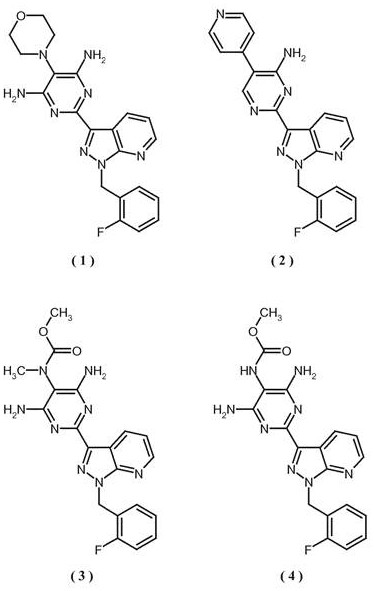
● 2- [1- (2-fluorobenzyl) -1H-pyrazolo [3,4-b ] pyridin-3-yl ] -5- (4-morpholinyl) -4, 6-pyrimidinediamine (1) disclosed as example 16 in WO00/06569,
● 2- [1- (2-fluorobenzyl) -1H-pyrazolo [3,4-b ] pyridin-3-yl ] -5- (4-pyridinyl) -4-pyrimidinamine (2) disclosed in example 1 in WO 02/42301,
● methyl 4, 6-diamino-2- [1- (2-fluorobenzyl) -1H-pyrazolo [3,4-b ] pyridin-3-yl ] -5-pyrimidinyl (methyl) carbamate disclosed in WO 03/095451 as example 8 (3),
● methyl 4, 6-diamino-2- [1- (2-fluorobenzyl) -1H-pyrazolo [3,4-b ] pyridin-3-yl ] -5-pyrimidinylcarbamate disclosed in WO 03/095451 as example 5 (4),
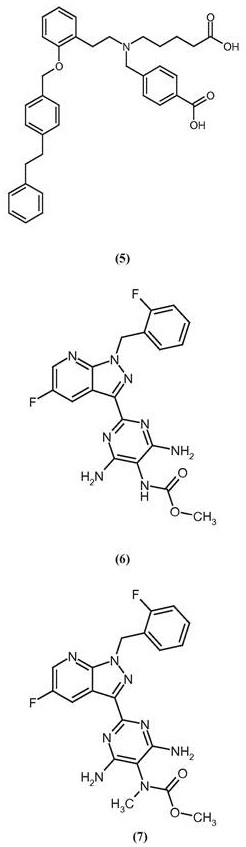
● as (5) 4- ({ (4-carboxybutyl) [2- (2- { [4- (2-phenylethyl) benzyl ] oxy } phenyl) ethyl ] amino } methyl) carboxylic acid disclosed in example 8a in WO 01/019780,
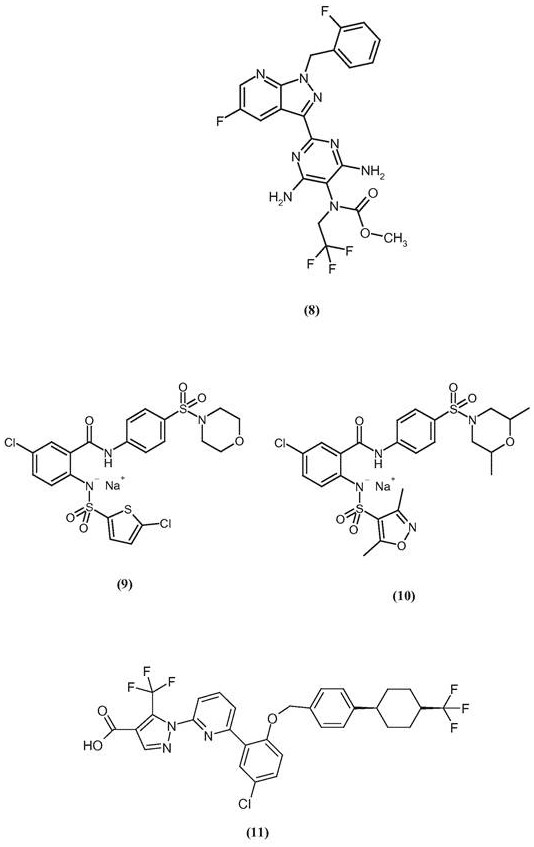
● methyl {4, 6-diamino-2- [ 5-fluoro-1- (2-fluorobenzyl) -1H-pyrazolo [3,4-b ] pyridin-3-yl ] pyrimidin-5-yl } carbamate (6), {4, 6-diamino-2- [ 5-fluoro-1- (2-fluorobenzyl) -1H-pyrazolo [3,4-b ] pyridin-3-yl ] pyrimidin-5-yl } methyl carbamate (7), {4, 6-diamino-2- [ 5-fluoro-1- (2-fluorobenzyl) -1H-pyrazolo [3,4-b ] pyridin-3-yl ] pyrimidin-5-yl } (2,2, 2-trifluoroethyl) carbamate (8),
● WO00/02851 discloses as sodium salt 5-chloro-2- (5-chlorothiophene-2-sulfonylamino-N- (4- (morpholine-4-sulfonyl) phenyl) benzamide (9),
● WO00/02851 discloses 2- (4-chlorophenylsulfonylamino) -4, 5-dimethoxy-N- (4- (thiomorpholine-4-sulfonyl) phenyl) benzamide (10),
● 1- {6- [ 5-chloro-2- ({ 4-trans-4- } trifluoromethyl) cyclohexyl ] benzyl } oxy) phenyl ] pyridin-2-yl } -5- (trifluoromethyl) -1H-pyrazole-4-carboxylic acid (11) disclosed in WO 2009/032249,
● 1- [6- (2- (2-methyl-4- (4-trifluoromethoxyphenyl) benzyloxy) phenyl) pyridin-2-yl ] -5-trifluoromethylpyrazole-4-carboxylic acid (12) disclosed in WO 2009/071504,
● [6- (3, 4-dichlorophenyl) -2-pyridinyl-5- (trifluoromethyl) -1H-pyrazole-4-carboxylic acid (13) disclosed in WO 2009/068652,
● 1- ({2- [ 3-chloro-5- (trifluoromethyl) phenyl ] -5-methyl-1, 3-thiazol-4-yl } methyl) -1H-pyrazole-4-carboxylic acid (14), 4- ({2- [3- (trifluoromethyl) phenyl ] -1, 3-thiazol-4-yl } methyl) benzoic acid (15) and 1- ({2- [ 2-fluoro-3- (trifluoromethyl) phenyl ] -5-methyl-1, 3-thiazol-4-yl } methyl) -1H-pyrazole-4-carboxylic acid (16) disclosed in WO 2009/123316,
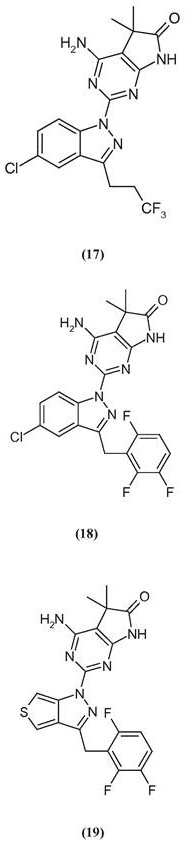
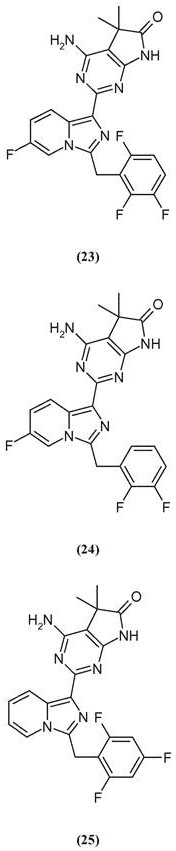
● WO2010/065275 discloses 4-amino-2- [ 5-chloro-3 (3,3, 3-trifluoropropyl) -1H-indazol-1-yl ] -5, 5-dimethyl-5, 7-dihydro-6H-pyrrolo [2,3-d ] pyrimidin-6-one (17), 4-amino-2 [ 5-chloro-3- (2,3, 6-trifluorobenzyl) -1H-indazol-1-yl ] -5, 5-dimethyl-5, 7-dihydro-6H-pyrrolo [2,3-d ] pyrimidin-6-one (18), 4-amino-5, 5-dimethyl-2- [3- (2,3, 6-trifluorobenzyl) 1H-thieno [3,4-c ] pyrazol-1-yl ] -5, 7-dihydro-6H-pyrrolo [2,3-d ] pyrimidin-6-one (19), 4-amino-5, 5-dimethyl-2- [3- (2,3, 6-trifluorobenzyl) -1H-thieno [2,3-d ] pyrazol-1-yl ] -5, 5-dimethyl-5, 7-dihydro-6H-pyrrolo [2,3-d ] pyrimidin-6-one (20), 4-amino-5, 5-dimethyl-2- [7- (2,3, 6-trifluorobenzyl) imidazo [1,5-b ] pyridazin-5-yl ] -5, 7-dihydro-6H-pyrrolo [2,3-d ] pyrimidin-6-one (21), 4-amino-2- [ 6-chloro-3- (2,3, 6-trifluorobenzyl) imidazo [1,5-a ] pyridin-1-yl ] ] -5, 5-dimethyl-5, 7-dihydro-6H-pyrrolo [2,3-d ] pyrimidin-6-one (22), 4-amino-2- [ 6-fluoro-3- (2,3, 6-trifluorobenzyl) imidazo [1,5-a ] pyridin-1-yl ] ] -5, 5-dimethyl-5, 7-dihydro-6H-pyrrolo [2,3-d ] pyrimidin-6-one (23), 4-amino-2- [ 6-fluoro-3- (2,3, 6-trifluorobenzyl) 6-fluoroimidazo [1,5-a ] pyridin-1-yl ] -5, 5-dimethyl-5, 7-dihydro-6H-pyrrolo [2,3-d ] pyrimidin-6-one (24), 4-amino-5, 5-dimethyl-2- [3- (2,4, 6-trifluorobenzyl) imidazo [1,5-a ] pyridin-1-yl ] ] -5, 7-dihydro-6H-pyrrolo [2,3-d ] pyrimidin-6-one (25), 4-amino-2- [3- (2-cyclopentylethyl) imidazo [1,5-a ] pyridin-1-yl ] -5, 5-dimethyl-5, 7-dihydro-6H-pyrrolo [2,3-d ] pyrimidin-6-one (26),
● 3- (4-amino-5-cyclopropylpyrimidin-2-yl) -1- (2-fluorobenzyl) -1 called BAY 41-2272 disclosed as example 1 in WO 00/06568HPyrazolo [3,4-b]A pyridine (27) which is a main component,
● 2- { 5-fluoro-1- [ (3-fluoropyridin-2-yl) methyl ] -1H-pyrazolo [3,4-b ] pyridin-3-yl } -5-methyl-5- (trifluoromethyl) -4- [ (3,3, 3-trifluoropropyl) amino ] -5, 7-dihydro-6H-pyrrolo [2,3-d ] pyrimidin-6-one (28) disclosed as example 1 in WO2014/131760,
● as disclosed in example 22 in WO2012/139888 as 3- (4-chloro-3- { [ (2S,3R) -2- (4-chlorophenyl) -4,4, 4-trifluoro-3-methylbutyryl ] amino } phenyl) -3-cyclopropylpropionic acid (29),
● 5- { [2- (4-carboxyphenyl) ethyl ] [2- (2- { [ 3-chloro-4 '- (trifluoromethyl) biphenyl-4-yl ] methoxy } phenyl) ethyl ] amino } -5,6,7, 8-tetrahydroquinoline-2-carboxylic acid of formula (32) and 5- { (4-carboxybutyl) [2- (2- { [ 3-chloro-4' - (trifluoromethyl) biphenyl-4-yl ] methoxy } phenyl) ethyl ] amino } -5,6,7, 8-tetrahydroquinoline-2-carboxylic acid of formula (33) which are disclosed as examples in WO2014/012934,
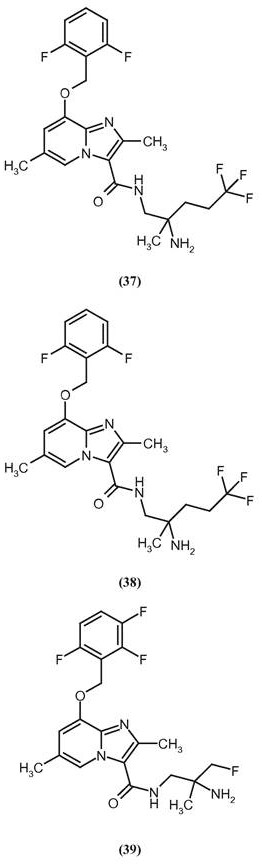
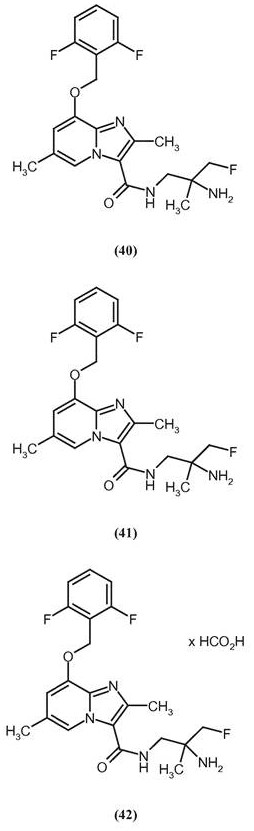
● formula (34) disclosed as an example in WO2014/068099ent-N- [ (2S) -amino-2-methylbutyl]-8- [ (2, 6-difluorobenzyl) oxy]-2, 6-dimethylimidazo [1,2-a [ ]]Pyridine-3-carboxamides (enantiomer A), of formula (35)ent-N- (2-amino-2-methylbutyl) -8- [ (2, 6-difluorobenzyl) oxy]-2, 6-dimethylimidazo [1,2-a [ ]]Pyridine-3-carboxamides (enantiomer B), of formula (36)ent-N- (2-amino-5, 5, 5-trifluoro-2-methylpentyl) -2, 6-dimethyl-8- [ (2,3, 6-trifluorobenzyl) oxy]Imidazo [1,2-a ]]Pyridine-3-carboxamides (enantiomer B), of formula (37)ent-N- (2-amino-5, 5, 5-trifluoro-2-methylpentyl) -8- [ (2, 6-difluorobenzyl) oxy]-2, 6-dimethylimidazo [1,2-a [ ]]Pyridine-3-carboxamides (enantiomer B), of formula (38)ent-N- (2-amino-5, 5, 5-trifluoro-2-methylpentyl) -8- [ (2, 6-difluorobenzyl) oxy]-2, 6-dimethylimidazo [1,2-a [ ]]Pyridine-3-carboxamides (enantiomer A), of formula (39)ent-N- (2-amino-3-fluoro-2-methylpropyl) -2, 6-dimethyl-8- [ (2,3, 6-trifluorobenzyl) oxy]Imidazo [1,2-a ]]Pyridine-3-carboxamides (enantiomer B), of formula (40)ent-N- (2-amino-3-fluoro-2-methylpropyl) -8- [ (2, 6-difluorobenzyl) oxy]-2, 6-dimethylimidazo [1,2-a [ ]]Pyridine-3-carboxamides (enantiomer B), of formula (41)ent-N- (2-amino-3-fluoro-2-methylpropyl) -8- [ (2, 6-difluorobenzyl) oxy]-2, 6-dimethyliminesAzolo [1,2-a ] s]Pyridine-3-carboxamides (enantiomer A), of formula (42)rac-N- (2-amino-3-fluoro-2-methylpropyl) -8- [ (2, 6-difluorobenzyl) oxy]-2, 6-dimethylimidazo [1,2-a [ ]]Pyridine-3-carboxamide formate of formula (43)ent-N- (2-amino-3-fluoro-2-methylpropyl) -2, 6-dimethyl-8- [ (2,3, 6-trifluorobenzyl) oxy]Imidazo [1,2-a ]]Pyridine-3-carboxamides (enantiomer A), of formula (44)ent-N- (2-amino-3-fluoro-2-methylpropyl) -8- [ (2, 6-difluorobenzyl) oxy]-6- (difluoromethyl) -2-methylimidazo [1,2-a]Pyridine-3-carboxamides (enantiomer B), of formula (45)ent-N- (2-amino-3-fluoro-2-methylpropyl) -8- [ (2, 6-difluorobenzyl) oxy]-6- (difluoromethyl) -2-methylimidazo [1,2-a]Pyridine-3-carboxamides (enantiomer A), of formula (46)ent-N- (2-amino-3-fluoro-2-methylpropyl) -8- [ (2, 6-difluorobenzyl) oxy]-6- (fluoromethyl) -2-methylimidazo [1,2-a]Pyridine-3-carboxamide.
The compounds of formulae (1), (2), (3), (4), (6) - (8), (17) - (27) and (34) - (46) are known as sGC stimulators.
The compounds of formulae (5) and (9) - (16), (29), (32) and (33) are known as sGC activators.
Preferred in the combination according to the invention are sGC stimulators of formulae (1), (2), (3), (4), (6) - (8) and (17) - (27) and activators of formulae (5) and (9) - (16) and (29).
Preferred sGC stimulators in the combination according to the invention are compounds of formulae (1), (2), (3), (4), (6), (7), (27) and (28).
Particularly preferred in the combination according to the invention are sGC stimulators of formulae (3), (4), (6), (7) and (28).
Particularly preferred in the combination according to the invention are sGC stimulators of the formulae (3) and (6).
Particularly preferred in the combination according to the invention are sGC stimulators of formula (6).
Particularly preferred in the combination according to the invention are sGC activators of the formula (29).
The combination product according to the invention is effective in the treatment of cardiovascular diseases by lowering the mean arterial blood pressure and affecting as little or no hemodynamic parameters as possible, such as heart rate. The above-mentioned disadvantages of the treatment modalities known in the prior art, such as the heart rate compensation effect with a reduction in blood pressure, can thus be overcome.
Furthermore, the combination according to the invention shows an unpredicted valuable spectrum of pharmacological and pharmacokinetic activity.
The combination according to the invention is suitable for the prevention and/or treatment of diseases due to its vasodilating effect (vasodilation) and the inhibition of platelet aggregation, and results in a reduction in blood pressure and an increase in coronary blood flow. These effects are mediated by stimulation of soluble and/or particulate guanylate cyclase and blockade of angiotensin receptors. Furthermore, the combination according to the invention potentiates the action of substances that increase the cGMP level, such as EDRF (endothelium derived relaxation factor), NO donors, protoporphyrin IX, arachidonic acid or phenylhydrazine derivatives.
The invention also relates to the use of sGC activators and/or sGC stimulators in combination with enkephalinase inhibitors and/or angiotensin AII antagonists for the treatment of cardiovascular diseases, such as heart failure with preserved ejection fraction or heart failure with reduced ejection fraction, renal diseases, such as chronic renal failure, urinary system diseases, lung diseases, diseases of the central nervous system, for example in the case of cerebrovascular dementia states, for the regulation of cerebral blood perfusion, for the treatment and/or prevention of fibrotic diseases and other disease symptoms (for example end organ damage involving the brain, kidneys or heart).
The invention also relates to sGC activators and/or sGC stimulators in combination with angiotensin AII antagonists and their use for the treatment of cardiovascular diseases, such as heart failure with preserved ejection fraction or heart failure with reduced ejection fraction, renal diseases, such as chronic renal failure, urinary system diseases, lung diseases, central nervous system diseases, for example in the case of cerebrovascular dementia states, for the regulation of cerebral blood perfusion, for the treatment and/or prevention of fibrotic diseases and other disease symptoms (for example end organ damage involving the brain, kidneys or heart).
Preferably, the present invention relates to the administration of sGC stimulators and/or activators in combination with an enkephalinase inhibitor, such as and preferably sabotazole and/or an angiotensin AII antagonist, such as and preferably valsartan, losartan, candesartan, telmisartan, irbesartan, olmesartan, eprosartan or azilsartan.
Preferably, the present invention relates to a combination comprising sGC stimulator and/or sGC activator, N- (3-carboxy-1-oxopropyl) - (4S) - (p-phenylphenylmethyl) -4-amino-2R-methylbutyric acid or ester thereof and/or valsartan and in each case sGC stimulator and/or sGC activator, N- (3-carboxy-1-oxopropyl) - (4S) - (p-phenylphenylmethyl) -4-amino-2R-methylbutyric acid or ester thereof and/or salt, solvate and solvate of salt.
The invention also relates to a combination comprising a sGC stimulator and/or a sGC activator and LCZ696 and in each case salts, solvates and solvates of salts thereof.
The invention particularly preferably relates to combinations comprising an sGC stimulator, sabotabiqu and/or an angiotensin AII antagonist and in each case salts, solvates and solvates of the salts.
The invention also particularly preferably relates to a combination comprising sGC stimulators, sabotabiqu and/or valsartan and in each case salts, solvates and solvates of the salts.
The invention also particularly preferably relates to a combination comprising sGC stimulator and LCZ696 and in each case salts, solvates and solvates of the salts.
The invention also particularly preferably relates to combinations comprising a compound of the formula (6), N- (3-carboxy-1-oxopropyl) - (4S) - (p-phenylphenylmethyl) -4-amino-2R-methylbutyric acid or esters thereof and/or valsartan and in each case a compound of the formula (6) and N- (3-carboxy-1-oxopropyl) - (4S) - (p-phenylphenylmethyl) -4-amino-2R-methylbutyric acid or esters thereof and/or salts, solvates and solvates of the salts.
The invention also particularly preferably relates to a combination comprising a compound of the formula (6) and LCZ696 and in each case salts, solvates and solvates of the salts.
The invention also relates to a combination product comprising sGC stimulator and/or sGC activator and valsartan and in each case salts, solvates and solvates of salts of sGC stimulator and/or sGC activator and valsartan.
The invention also relates to a combination comprising a compound of formula (6) and valsartan and in each case a compound of formula (6) and salts, solvates and solvates of the salts of valsartan.
The components to be combined may be present as salts. Preferred salts in the present invention are physiologically acceptable salts of the compounds to be combined. Also included are salts which are not suitable per se for pharmaceutical use but which can be used, for example, for the isolation or purification of the compounds to be combined.
The invention also relates to a combination product wherein the molar ratio of the compound of formula (6) to valsartan and N- (3-carboxy-1-oxopropyl) - (4S) - (p-phenylphenylmethyl) -4-amino-2R-methylbutyric acid or the ester thereof is from 0.01 to 1:1: 1.
The invention also relates to compounds of formula (6) and to hemi (pentahydrate) [3- ((1)S,3R) -1-biphenyl-4-ylmethyl-3-ethoxycarbonyl-1-butylcarbamoyl) -propionic acid-, (S) -3' -methyl-2 ' - (pentanoyl {2"- (anionic tetrazol-5-yl) biphenyl-4 ' -ylmethyl } amino) butanoic acid]A combination product having a molar ratio of trisodium of 0.01-1: 1.
The invention also relates to a combination product wherein the molar ratio of the compound of formula (6) to N- (3-carboxy-1-oxopropyl) - (4S) - (p-phenylphenylmethyl) -4-amino-2R-methylbutyric acid or the ester thereof is from 0.01 to 1: 1.
The invention also relates to a combination product wherein the molar ratio of the compound of formula (6) to valsartan is from 0.01 to 1: 1.
The invention also relates to a combination according to the invention for use in the treatment and/or prophylaxis of diseases, wherein the compound of formula (6) is administered once daily and valsartan and N- (3-carboxy-1-oxopropyl) - (4S) - (p-phenylphenylmethyl) -4-amino-2R-methylbutyric acid ethyl ester or N- (3-carboxy-1-oxopropyl) - (4S) - (p-phenylphenylmethyl) -4-amino-2R-methylbutyric acid or esters thereof are administered twice daily.
The invention also relates to a combination according to the invention for use in the treatment and/or prevention of a disease, wherein 1.25 to 20 mg of a compound of formula (6), 20 to 200 mg of valsartan and 20 to 200 mg of N- (3-carboxy-1-oxopropyl) - (4S) - (p-phenylphenylmethyl) -4-amino-2R-methylbutyric acid or an ester thereof are administered.
The invention also relates to a combination according to the invention for use in the treatment and/or prophylaxis of a disease, wherein 1.25 to 20 mg of a compound of formula (6) and 20 to 200 mg of N- (3-carboxy-1-oxopropyl) - (4S) - (p-phenylphenylmethyl) -4-amino-2R-methylbutyric acid or an ester thereof are administered.
The invention also relates to a combination according to the invention for the treatment and/or prophylaxis of diseases, wherein 1.25 to 20 mg of a compound of formula (6) and 20 to 200 mg of valsartan are administered.
The invention further relates to a combination product according to the invention for use in the treatment and/or prophylaxis of a disease, wherein a compound of formula (6) is administered once daily and the hemi- (pentahydrate) [3- ((1S,3R) -1-biphenyl-4-ylmethyl-3-ethoxycarbonyl-1-butylcarbamoyl) propionic acid- (S) -3' -methyl-2 ' - (pentanoyl {2"- (anionic tetrazol-5-yl) biphenyl-4 ' -ylmethyl } amino) butanoic acid ] trisodium is administered twice daily.
The invention further relates to a combination product according to the invention for use in the treatment and/or prevention of a disease, wherein 1.25 to 20 mg of a compound of formula (6) and 40 to 400 mg of trisodium [3- ((1S,3R) -1-biphenyl-4-ylmethyl-3-ethoxycarbonyl-1-butylcarbamoyl) propanoate- (S) -3' -methyl-2 ' - (pentanoyl {2"- (anionic tetrazol-5-yl) biphenyl-4 ' -ylmethyl } amino) butanoate ] hemihydrate are administered.
The invention also relates to a combination according to the invention wherein the molar ratio of valsartan to N- (3-carboxy-1-oxopropyl) - (4S) - (p-phenylphenylmethyl) -4-amino-2R-methylbutyric acid or the ester thereof of the compound of formula (6) is 0.001-1: 1:3, 0.001-1: 3:1, 0.001-1: 1:2, 0.001-1: 2:1 or 0.001-1: 1:1, preferably 0.005-0.75: 1:3, 0.005-0.75: 3:1, 0.005-0.75: 1:2, 0.005-0.75: 2:1 or 0.005-0.75: 1:1, most preferably 0.01-0.5: 1: 1.
The invention also relates to a combination according to the invention wherein the molar ratio of the compound of formula (6) to the trisodium hemi (pentahydrate) [3- ((1S,3R) -1-biphenyl-4-ylmethyl-3-ethoxycarbonyl-1-butylcarbamoyl) propanoate- (S) -3' -methyl-2 ' - (pentanoyl {2"- (anionic tetrazol-5-yl) biphenyl-4 ' -ylmethyl } amino) butanoate ] is in the range of from 0.001 to 1:1, preferably from 0.005 to 0.75:1, most preferably from 0.01 to 0.5: 1.
The invention also relates to a combination comprising a compound of formula (29), N- (3-carboxy-1-oxopropyl) - (4S) - (p-phenylphenylmethyl) -4-amino-2R-methylbutyric acid or esters thereof and/or valsartan and in each case a compound of formula (29), N- (3-carboxy-1-oxopropyl) - (4S) - (p-phenylphenylmethyl) -4-amino-2R-methylbutyric acid or esters thereof and/or salts, solvates and solvates of the salts.
The invention also relates to a combination comprising a compound of formula (29) and trisodium [3- ((1S,3R) -1-biphenyl-4-ylmethyl-3-ethoxycarbonyl-1-butylcarbamoyl) propanoate- (S) -3' -methyl-2 ' - (pentanoyl {2"- (anionic tetrazol-5-yl) biphenyl-4 ' -ylmethyl } amino) butanoate ] hemi (pentahydrate) and in each case salts, solvates and solvates of the salts.
The invention also relates to a combination comprising a compound of formula (29) and valsartan and in each case a compound of formula (29) and salts, solvates and solvates of the salts of valsartan.
The invention also relates to a combination product wherein the molar ratio of the compound of formula (29) to valsartan and N- (3-carboxy-1-oxopropyl) - (4S) - (p-phenylphenylmethyl) -4-amino-2R-methylbutyric acid or the ester thereof is from 0.02 to 1:1: 1.
The invention also relates to a combination product wherein the molar ratio of the compound of formula (29) to trisodium [3- ((1S,3R) -1-biphenyl-4-ylmethyl-3-ethoxycarbonyl-1-butylcarbamoyl) propanoate- (S) -3' -methyl-2 ' - (pentanoyl {2"- (anionic tetrazol-5-yl) biphenyl-4 ' -ylmethyl } amino) butanoate ] hemi (pentahydrate) is 0.02 to 1: 1.
The invention also relates to a combination wherein the molar ratio of the compound of formula (29) to N- (3-carboxy-1-oxopropyl) - (4S) - (p-phenylphenylmethyl) -4-amino-2R-methylbutyric acid or ester thereof is from 0.02 to 1: 1.
The invention also relates to a combination product wherein the molar ratio of the compound of formula (29) to valsartan is from 0.02 to 1: 1.
The invention also relates to a combination according to the invention for the treatment and/or prophylaxis of diseases in which the compound of formula (29) is administered once daily and valsartan and N- (3-carboxy-1-oxopropyl) - (4S) - (p-phenylphenylmethyl) -4-amino-2R-methylbutyric acid ethyl ester or N- (3-carboxy-1-oxopropyl) - (4S) - (p-phenylphenylmethyl) -4-amino-2R-methylbutyric acid are administered twice daily.
The invention also relates to a combination according to the invention for use in the treatment and/or prevention of a disease, wherein 2.5 to 20 mg of a compound of formula (29), 20 to 200 mg of valsartan and 20 to 200 mg of N- (3-carboxy-1-oxopropyl) - (4S) - (p-phenylphenylmethyl) -4-amino-2R-methylbutyric acid or an ester thereof are administered.
The invention also relates to a combination according to the invention for use in the treatment and/or prophylaxis of a disease, wherein 2.5 to 20 mg of a compound of formula (29) and 20 to 400 mg of N- (3-carboxy-1-oxopropyl) - (4S) - (p-phenylphenylmethyl) -4-amino-2R-methylbutyric acid or an ester thereof are administered.
The invention also relates to a combination according to the invention for use in the treatment and/or prevention of a disease, wherein 2.5 to 20 mg of a compound of formula (29), 20 to 400 mg of valsartan or an ester thereof are administered.
The invention further relates to a combination according to the invention for use in the treatment and/or prophylaxis of a disease, wherein a compound of formula (29) is administered once daily and the hemipentahydrated [3- ((1S,3R) -1-biphenyl-4-ylmethyl-3-ethoxycarbonyl-1-butylcarbamoyl) propionic acid- (S) -3' -methyl-2 ' - (pentanoyl {2"- (anionic tetrazol-5-yl) biphenyl-4 ' -ylmethyl } amino) butanoic acid ] trisodium is administered twice daily.
The invention further relates to a combination product according to the invention for use in the treatment and/or prevention of a disease, wherein 2.5 to 20 mg of a compound of formula (29) and 40 to 400 mg of trisodium [3- ((1S,3R) -1-biphenyl-4-ylmethyl-3-ethoxycarbonyl-1-butylcarbamoyl) propanoate- (S) -3' -methyl-2 ' - (pentanoyl {2"- (anionic tetrazol-5-yl) biphenyl-4 ' -ylmethyl } amino) butanoate ] hemihydrate are administered.
The invention also relates to a combination according to the invention wherein the molar ratio of the compound of formula (29) to valsartan and N- (3-carboxy-1-oxopropyl) - (4S) - (p-phenylphenylmethyl) -4-amino-2R-methylbutyric acid or ester thereof is 0.001-1: 1:3, 0.001-1: 3:1, 0.001-1: 1:2, 0.001-1: 2:1 or 0.001-1: 1:1, preferably 0.005-0.75: 1:3, 0.005-0.75: 3:1, 0.005-0.75: 1:2, 0.005-0.75: 2:1 or 0.005-0.75: 1:1, most preferably 0.02-0.5: 1: 1.
The invention also relates to a combination according to the invention wherein the molar ratio of the compound of formula (29) to the trisodium hemi (pentahydrate) [3- ((1S,3R) -1-biphenyl-4-ylmethyl-3-ethoxycarbonyl-1-butylcarbamoyl) propanoate- (S) -3' -methyl-2 ' - (pentanoyl {2"- (anionic tetrazol-5-yl) biphenyl-4 ' -ylmethyl } amino) butanoate ] is 0.001-1:1, preferably 0.005-0.75:1, most preferably 0.01-0.5: 1.
The invention also relates to a combination according to the invention for use in the treatment and/or prevention of a disease.
The invention also relates to a combination according to the invention for use in a method for the treatment and/or prevention of cardiovascular diseases, renal diseases, pulmonary diseases and for the treatment and/or prevention of fibrotic diseases.
The invention also relates to a medicament comprising at least one combination according to the invention together with inert, non-toxic and pharmaceutically suitable excipients.
The invention also relates to a medicament comprising at least one combination according to the invention and one or more additional active ingredients selected from the group consisting of ACE inhibitors, renin inhibitors, beta blockers, acetylsalicylic acid, diuretics, calcium antagonists, statins, digitalis drugs (digoxin), calcium sensitizers, nitrates and antithrombotic agents.
The invention also relates to medicaments comprising at least one combination according to the invention for the treatment and/or prophylaxis of cardiovascular diseases, kidney diseases, lung diseases and for the treatment and/or prophylaxis of fibrotic diseases.
The invention also relates to methods for the treatment and/or prophylaxis of cardiovascular diseases, kidney diseases, lung diseases and for the treatment and/or prophylaxis of fibrotic diseases in humans and animals using at least one combination according to the invention.
The invention also relates to a combination of the individual pharmaceutical compositions in the form of a Kit (Kit). This is a kit comprising two or three separate units: a pharmaceutical composition of a sGC stimulator and/or a sGC activator, a pharmaceutical NEP inhibitor composition and/or a pharmaceutical valsartan composition.
The invention also relates to a preferred kit form comprising two units: pharmaceutical compositions comprising sGC stimulators and/or sGC activators and pharmaceutical compositions comprising NEP inhibitors and/or valsartan.
The invention also relates to a preferred kit form comprising two units: pharmaceutical compositions comprising sGC stimulators and/or sGC activators and pharmaceutical compositions comprising LCZ 696.
The invention also relates to a preferred kit form comprising two units: pharmaceutical compositions comprising a compound of formula (6) and pharmaceutical compositions comprising LCZ 696.
The invention also relates to a preferred kit form comprising two units: pharmaceutical compositions comprising a compound of formula (29) and pharmaceutical compositions comprising LCZ 696.
The kit is particularly advantageous if the individual components have to be administered in different dosage forms or at different dosing intervals.
The invention also relates to a kit comprising: pharmaceutical compositions comprising an sGC stimulator and/or an sGC activator and pharmaceutical compositions comprising an angiotensin AII antagonist and N- (3-carboxy-1-oxopropyl) - (4S) - (p-phenylphenylmethyl) -4-amino-2R-methylbutyric acid or an ester thereof.
The invention also relates to a kit comprising: pharmaceutical compositions comprising a sGC stimulator and/or a sGC activator and pharmaceutical compositions comprising valsartan and N- (3-carboxy-1-oxopropyl) - (4S) - (p-phenylphenylmethyl) -4-amino-2R-methylbutyric acid or esters thereof.
The invention also relates to a kit comprising: pharmaceutical compositions comprising a sGC stimulator and/or a sGC activator and pharmaceutical compositions comprising [3- ((1S,3R) -1-biphenyl-4-ylmethyl-3-ethoxycarbonyl-1-butylcarbamoyl) propanoic acid- (S) -3' -methyl-2 ' - (pentanoyl {2"- (anionic tetrazol-5-yl) biphenyl-4 ' -ylmethyl } amino) butanoic acid ] trisodium hemi (pentahydrate).
The invention also relates to a kit comprising: pharmaceutical compositions comprising a compound of formula (6) and pharmaceutical compositions comprising valsartan and N- (3-carboxy-1-oxopropyl) - (4S) - (p-phenylphenylmethyl) -4-amino-2R-methylbutyric acid or esters thereof.
The invention also relates to a kit comprising: pharmaceutical compositions comprising a compound of formula (6) and pharmaceutical compositions comprising trisodium hemi (pentahydrate) [3- ((1S,3R) -1-biphenyl-4-ylmethyl-3-ethoxycarbonyl-1-butylcarbamoyl) propanoate- (S) -3' -methyl-2 ' - (pentanoyl {2"- (anionic tetrazol-5-yl) biphenyl-4 ' -ylmethyl } amino) butanoate ].
The invention also relates to a kit comprising: pharmaceutical compositions comprising a compound of formula (29) and pharmaceutical compositions comprising valsartan and N- (3-carboxy-1-oxopropyl) - (4S) - (p-phenylphenylmethyl) -4-amino-2R-methylbutyric acid or esters thereof.
The invention also relates to a kit comprising: pharmaceutical compositions comprising a compound of formula (29) and pharmaceutical compositions comprising trisodium hemi (pentahydrate) [3- ((1S,3R) -1-biphenyl-4-ylmethyl-3-ethoxycarbonyl-1-butylcarbamoyl) propanoate- (S) -3' -methyl-2 ' - (pentanoyl {2"- (anionic tetrazol-5-yl) biphenyl-4 ' -ylmethyl } amino) butanoate ].
Thus, the combination product according to the invention may be used in the treatment and/or prevention of cardiovascular diseases such as elevated blood pressure (hypertension), refractory hypertension, acute and chronic heart failure, heart failure with preserved ejection fraction (HFpEF) or heart failure with reduced ejection fraction (HFrEF), coronary heart disease, stable and unstable angina, peripheral vascular and cardiovascular diseases, cardiac arrhythmias, atrial and ventricular arrhythmias and impaired conduction, such as I-III atrioventricular conduction block (AB block I-III), supraventricular tachyarrhythmia, atrial fibrillation, atrial flutter, ventricular fibrillation, ventricular flutter, ventricular tachyarrhythmia, Torsade de pointes-Tachycradia, atrial and ventricular premature beats, atrioventricular nodal premature beats (AV-junonal extrasylestos), sick sinus syndrome, syncope, atrial Tachycardia, ventricular reentrant Tachycardia, atrial reentrant Tachycardia, Wolff-Parkinson-White syndrome, Acute Coronary Syndrome (ACS), autoimmune heart disease (pericarditis, endocarditis, heart valve inflammation (Valvolitis), aortic inflammation, cardiomyopathy), shock, such as cardiogenic shock, septic shock and anaphylactic shock, aneurysm, boxer's cardiomyopathy (premature ventricular contractions (PVC)), treatment and/or prevention of thromboembolic diseases and ischemia, such as myocardial ischemia, myocardial infarction, stroke, myocardial hypertrophy, transient and ischemic attacks, preeclampsia, inflammatory cardiovascular diseases, coronary and peripheral arterial spasm, oedema formation, such as pulmonary oedema, cerebral oedema, renal oedema or oedema resulting from heart failure, peripheral blood perfusion diseases, reperfusion injury, arterial and venous thrombosis, microalbuminuria, cardiac insufficiency, endothelial dysfunction, prevention of restenosis, such as in thrombolytic therapy, Percutaneous Transluminal Angioplasty (PTA), transluminal coronary angioplasty (PTCA), after heart transplantation and bypass surgery, as well as micro-and macrovascular injury (vasculitis), elevated fibrinogen and Low Density Lipoprotein (LDL) levels, and elevated plasminogen activator inhibitor 1 (PAI-1) concentrations, and agents for treating and/or preventing male erectile dysfunction and female sexual dysfunction.
In the present invention, the term "heart failure" includes acute and chronic manifestations of heart failure, and more specifically or related disease types, such as acute decompensated heart failure, right heart failure, left heart failure, total heart failure, ischemic cardiomyopathy, dilated cardiomyopathy, hypertrophic cardiomyopathy, idiopathic cardiomyopathy, congenital heart defects, heart failure associated with heart valve defects, mitral stenosis, mitral insufficiency, aortic stenosis, aortic insufficiency, tricuspid stenosis, tricuspid insufficiency, pulmonary stenosis, pulmonary insufficiency, combined heart valve defects, myocardial inflammation (myocarditis), chronic myocarditis, acute myocarditis, viral myocarditis, diabetic heart failure, alcoholic cardiomyopathy, heart storage disease (kardianle sphere normally), diastolic heart failure, and systolic heart failure, and the acute worsening stage of existing chronic heart failure (worsening heart failure).
Furthermore, the combination product according to the invention may also be used for the treatment and/or prevention of arteriosclerosis, impaired lipid metabolism, hypolipoproteinemia, dyslipidemia, hypertriglyceridemia, hyperlipidemia, hypercholesterolemia, betalipoproteinemia, sitosterolemia, xanthomatosis, Dangeil's disease, obesity (hyperlipidemia), obesity (obesity) and mixed hyperlipidemia and metabolic syndrome.
The combination according to the invention can also be used for the treatment and/or prevention of primary and secondary raynaud's phenomena, microcirculatory disturbances, lameness, peripheral and autonomic neuropathies, diabetic microangiopathies, diabetic retinopathy, diabetic foot ulcers, gangrene, CREST syndrome, lupus erythematosus (Erythematose), onychomycosis, rheumatism and for promoting wound healing. The combination according to the invention is also suitable for the treatment of muscular dystrophy, such as Becker-Kiener muscular dystrophy (BMD) and Duchenne Muscular Dystrophy (DMD).
The combination product according to the invention is also suitable for the treatment and/or prophylaxis of urological disorders, such as Benign Prostate Syndrome (BPS), Benign Prostatic Hyperplasia (BPH), Benign Prostatic Enlargement (BPE), Bladder Outlet Obstruction (BOO), lower urinary tract syndrome (LUTS, including Feline Urinary Syndrome (FUS)), urogenital disorders, including neurogenic overactive bladder (OAB) and (IC), Urinary Incontinence (UI), such as mixed urinary incontinence, urge urinary incontinence, stress urinary incontinence or overflow urinary incontinence (MUI, UUI, SUI, OUI), pelvic pain, benign and malignant disorders of the organs of the male and female urogenital system.
The combination according to the invention is also suitable for the treatment and/or prevention of renal diseases, in particular acute and chronic renal insufficiency and acute and chronic renal failure. In the context of the present invention, the term "renal insufficiency" includes acute and chronic manifestations of renal insufficiency, as well as underlying or associated renal diseases, such as hypoperfusion of the kidney, intradialytic hypotension, obstructive uropathy, glomerulopathy, glomerulonephritis, acute glomerulonephritis, glomerulosclerosis, tubulointerstitial diseases, renal diseases, such as primary and congenital renal diseases, nephritis, immunological renal diseases, such as renal transplant rejection, immune complex-induced renal diseases, toxicant-induced renal diseases, contrast-induced renal diseases, diabetic and non-diabetic renal diseases, pyelonephritis, renal cysts, nephrosclerosis, hypertensive nephrosclerosis and nephrotic syndrome, which may be diagnostically characterized, for example, by abnormally reduced creatinine and/or water excretion, abnormally increased blood concentrations of urea, nitrogen, potassium and/or creatinine, altered activity of renal enzymes, for example glutamyl synthetase, Altered urinary osmotic pressure or urine volume, elevated microalbuminuria, macroalbuminuria, glomerular and arteriolar lesions, tubular dilation, hyperphosphatemia, and/or the need for dialysis. The invention also comprises the use of a combination according to the invention for the treatment and/or prevention of the sequelae of renal insufficiency, such as pulmonary edema, heart failure, uremia, anemia, electrolyte disorders (e.g. hyperkalemia, hyponatremia) and disorders of bone and carbohydrate metabolism.
Furthermore, the combination according to the invention is also suitable for the treatment and/or prevention of asthma, lung diseases such as Pulmonary Arterial Hypertension (PAH) and other forms of Pulmonary Hypertension (PH), including pulmonary hypertension associated with left heart disease, HIV, sickle cell anemia, thromboembolism (CTEPH), sarcoidosis, COPD or pulmonary fibrosis, Chronic Obstructive Pulmonary Disease (COPD), Acute Respiratory Distress Syndrome (ARDS), Acute Lung Injury (ALI), alpha-1-antitrypsin deficiency (AATD), pulmonary fibrosis, pulmonary emphysema (e.g. cigarette smoke induced emphysema) and Cystic Fibrosis (CF). Furthermore, the combination mentioned according to the invention can be used as a bronchodilator.
The combination described in the present invention is also a combination for the treatment and/or prophylaxis of disorders of the central nervous system which are characterized by a disturbance of the NO/cGMP system. They are particularly useful for improving cognition in cognitive disorders such as occur in particular in association with accidents (Situationns)/diseases/syndromes, such as "mild cognitive disease", age-related learning and memory disorders, age-related memory loss, vascular dementia, brain injury, stroke, dementia occurring after stroke (post-stroke dementia), post-traumatic brain injury, general attention-concentration disorder, attention-concentration disorder in children with learning and memory problems, Alzheimer's disease, dementia with Lewy bodies, dementia with frontal lobe degeneration including pick's syndrome, Parkinson's disease, progressive nuclear palsy, dementia with corticobasal degeneration, Amyotrophic Lateral Sclerosis (ALS), Huntington's disease, demyelination, multiple sclerosis, thalamus degeneration, Creutzfeldt-Jakob dementia, HIV dementia, dementia with dementia-related schizophrenia or cognitive after Korsakoff's disease, Attention, learning, or memory. They are also suitable for the treatment and/or prophylaxis of disorders of the central nervous system, such as anxiety, stress and depression states, central nervous-related sexual dysfunction and sleep disorders, and also of pathological disorders for regulating the uptake of food, stimulants (genistein) and addictive substances.
Furthermore, the combination products according to the invention are also suitable for regulating cerebral blood perfusion and are effective control agents for, for example, cerebrovascular dementia and migraine. They are also useful in the prevention and control of the sequelae of cerebral infarction (stroke), such as stroke, cerebral ischemia and craniocerebral trauma. The combination product according to the invention can also be used for controlling pain states and tinnitus.
Furthermore, the combination product according to the invention has an anti-inflammatory effect and can therefore be used as an anti-inflammatory agent for the treatment and/or prevention of sepsis (SIRS), multiple organ failure (MODS, MOF), inflammatory kidney disease, chronic enteritis (IBD, crohn's disease, UC), pancreatitis, peritonitis, rheumatoid disease, inflammatory skin diseases and inflammatory eye diseases.
Furthermore, the combination according to the invention may also be used for the treatment and prevention of autoimmune diseases.
The combination according to the invention is also suitable for the treatment and/or prevention of fibrotic diseases of internal organs, such as the lung, the heart, the kidney, the skin, the bone marrow, in particular the liver, and also skin fibrosis and ocular fibrosis diseases. In the present invention, the term "fibrotic diseases" specifically includes the following terms: liver fibrosis, cirrhosis, lung fibrosis, endomyocardial fibrosis, nephropathy, glomerulonephritis, renal interstitial fibrosis, fibrotic damage caused by diabetes, myelofibrosis and similar fibrotic diseases, systemic sclerosis, scleroderma, digital ulcers, hard spots, keloids, hypertrophic scars (also after surgery), nevi, diabetic retinopathy, proliferative vitreoretinopathy and connective tissue disease (e.g. sarcoidosis).
The combination according to the invention is also suitable for controlling post-operative scarring, for example due to glaucoma surgery.
The combination according to the invention can also be used in cosmetics for aging and keratinizing skin.
Furthermore, the combination according to the invention is suitable for the treatment and/or prevention of hepatitis, tumors, osteoporosis, bone formation disorders, glaucoma and gastroparesis.
The combination according to the invention can be used on its own or, if desired, in combination with other active ingredients. The invention also provides medicaments comprising at least one combination according to the invention and one or more additional active ingredients, in particular for the treatment and/or prophylaxis of the abovementioned diseases. Suitable co-active ingredients include, for example and preferably:
● blood pressure lowering active ingredients, such as and preferably selected from angiotensin AII antagonists, ACE inhibitors, calcium antagonists, endothelin antagonists, renin inhibitors, alpha-receptor blockers, beta-receptor blockers, mineralocorticoid receptor antagonists and diuretics;
● organic nitrates and NO donors, such as sodium nitroprusside, nitroglycerin, isosorbide mononitrate, isosorbide dinitrate, molsidomine or SIN-1 and inhaled NO;
● compounds which inhibit the degradation of cyclic guanosine monophosphate (cGMP), for example inhibitors of Phosphodiesterase (PDE) 1,2, 5 and/or 9, in particular PDE 5 inhibitors, such as sildenafil, vardenafil and tadalafil;
● antithrombotic agent, such as and preferably selected from platelet aggregation inhibitor, anticoagulant and fibrinolytic (pro-fibrinolytic) substance;
● active ingredients which alter fat metabolism, for example and preferably selected from thyroid receptor agonists, cholesterol synthesis inhibitors, preferred examples being HMG-CoA reductase inhibitors or squalene synthesis inhibitors, ACAT inhibitors, CETP inhibitors, MTP inhibitors, PPAR-alpha, PPAR-gamma and/or PPAR-delta agonists, cholesterol absorption inhibitors, lipase inhibitors, polymeric bile acid adsorbents, bile acid resorption inhibitors and lipoprotein (a) antagonists.
An antithrombotic agent is preferably understood to mean a compound selected from platelet aggregation inhibitors, anticoagulants or fibrinolytic substances.
In a preferred embodiment of the invention, the combination according to the invention is administered in combination with a platelet aggregation inhibitor, for example and preferably aspirin, clopidogrel, ticlopidine or dipyridamole.
In a preferred embodiment of the invention, the combination according to the invention is administered in combination with a thrombin inhibitor, for example and preferably ximegadine, dabigatran, melagatran, bivalirudin or cricetera.
In a preferred embodiment, the combination according to the invention is administered in combination with a GPIIb/IIIa antagonist, for example and preferably tirofiban or abciximab.
In a preferred embodiment of the invention, the combination product according to the invention is administered in combination with a factor Xa inhibitor, such as, and preferably, rivaroxaban, DU-176b, apixaban, omixaban, Fidexaban, rizoxaban, fondaparinux sodium, epidoparin, PMD-3112, YM-150, KFA-1982, EMD-503982, MCM-17, MLN-1021, DX 9065a, DPC 906, JTV 803, SSR-126512 or SSR-128428.
In a preferred embodiment of the invention, the combination product according to the invention is administered in combination with heparin or with a Low Molecular Weight (LMW) heparin derivative.
In a preferred embodiment of the invention, the combination according to the invention is administered in combination with a vitamin K antagonist, for example and preferably coumarin.
By a hypotensive agent is preferably understood a compound selected from the group consisting of calcium antagonists, angiotensin AII antagonists, ACE inhibitors, endothelin antagonists, renin inhibitors, alpha-blockers, beta-blockers, mineralocorticoid receptor antagonists and diuretics.
In a preferred embodiment of the invention, the combination according to the invention is administered in combination with a calcium antagonist, such as, preferably, nifedipine, amlodipine, verapamil or diltiazem.
In a preferred embodiment of the invention, the combination according to the invention is administered in combination with an alpha-1-receptor blocker, for example and preferably prazosin.
In a preferred embodiment of the invention, the combination product according to the invention is administered in combination with a beta-blocker, such as, and preferably, propranolol, atenolol, timolol, pinolol, alprenolol, penbutolol, blanalol, metipranolol, nadolol, mepindolol, carabronolol, sotalol, metoprolol, betaxolol, celiprolol, bisoprolol, carteolol, esmolol, labetalol, carvedilol, adaprolol, lanelol, nebivolol, epaiprolol or bucindolol.
In a preferred embodiment of the invention the combination according to the invention is administered in combination with an angiotensin AII antagonist, for example and preferably losartan, candesartan, valsartan, telmisartan or Embusatan.
In a preferred embodiment of the present invention the combination product according to the present invention is administered in combination with an ACE inhibitor, such as and preferably enalapril, captopril, lisinopril, ramipril, delapril, fosinopril, quinapril, perindopril or trandolapril.
In a preferred embodiment of the invention, the combination according to the invention is administered in combination with an endothelin antagonist, such as and preferably bosentan, darussan, ambrisentan or sitaxentan.
In a preferred embodiment of the invention, the combination according to the invention is administered in combination with a renin inhibitor, for example and preferably aliskiren, SPP-600 or SPP-800.
In a preferred embodiment of the invention, the combination according to the invention is administered in combination with a mineralocorticoid receptor antagonist, for example and preferably with spironolactone or eplerenone.
In a preferred embodiment of the invention, the combination according to the invention is administered in combination with a loop diuretic such as furosemide, torasemide, bumetanide and piretanide, with a potassium sparing diuretic such as amiloride and triamterene, with aldosterone antagonists such as spironolactone, potassium canrenoate and eplerenone and thiazide diuretics such as hydrochlorothiazide, chlorothiadone, xipamide and indapamide.
Fat metabolism regulators are preferably understood as meaning compounds selected from the group consisting of CETP inhibitors, thyroid receptor agonists, cholesterol synthesis inhibitors, such as HMG-CoA reductase inhibitors or squalene synthesis inhibitors, ACAT inhibitors, MTP inhibitors, PPAR- α, PPAR- γ and/or PPAR- δ agonists, cholesterol absorption inhibitors, polymeric bile acid adsorbents, bile acid resorption inhibitors, lipase inhibitors and lipoprotein (a) antagonists.
In a preferred embodiment of the invention, the combination product according to the invention is administered in combination with a CETP inhibitor, such as and preferably Dazetimipid, BAY 60-5521, Anacetrapib or CETP-vaccine (CETi-1).
In a preferred embodiment of the invention, the combination according to the invention is administered in combination with a thyroid receptor agonist, for example and preferably D-thyroxine, 3,5,3' -triiodothyronine (T3), CGS 23425 or acitifrol (CGS 26214).
In a preferred embodiment of the invention, the combination according to the invention is administered in combination with an HMG-CoA reductase inhibitor selected from statins, for example and preferably lovastatin, simvastatin, pravastatin, fluvastatin, atorvastatin, rosuvastatin or pitavastatin.
In a preferred embodiment of the invention, the combination according to the invention is administered in combination with a squalene synthesis inhibitor, for example and preferably BMS-188494 or TAK-475.
In a preferred embodiment of the invention, the combination according to the invention is administered in combination with an ACAT inhibitor, for example and preferably avasimibe, melinamide, petibobu, Eflucimibe or SMP-797.
In a preferred embodiment of the invention, the combination according to the invention is administered in combination with an MTP inhibitor, e.g. and preferably Impliptalide, BMS-201038, R-103757 or JTT-130.
In a preferred embodiment of the invention, the combination according to the invention is administered in combination with a PPAR-gamma agonist, for example and preferably pioglitazone or rosiglitazone.
In a preferred embodiment of the invention, the combination according to the invention is administered in combination with a PPAR-delta agonist, for example and preferably GW 501516 or BAY 68-5042.
In a preferred embodiment of the invention, the combination according to the invention is administered in combination with a cholesterol absorption inhibitor, for example and preferably ezetimibe, tiquinan or pamabrin.
In a preferred embodiment of the invention, the combination according to the invention is administered in combination with a lipase inhibitor, e.g. with orlistat.
In a preferred embodiment of the invention, the combination product according to the invention is administered in combination with a polymeric bile acid adsorbent, for example and preferably cholestyramine, colestipol, Colesolvam, colestyril (CholestaGel) or Colestimid.
In a preferred embodiment of the invention, the combination according to the invention is administered in combination with a bile acid resorption inhibitor, e.g. and preferably an ASBT (= IBAT) inhibitor, e.g. AZD-7806, S-8921, AK-105, BARI-1741, SC-435 or SC-635.
In a preferred embodiment of the invention, the combination according to the invention is administered in combination with a lipoprotein (a) antagonist, for example with preferably Gemcabene calcium (CI-1027) or niacin.
In the combination according to the invention, the components may act systemically and/or locally. For this purpose, they can be administered in a suitable manner, for example orally, parenterally, pulmonarily, nasally, sublingually, lingually, buccally, rectally, dermally, transdermally, conjunctivally, otically or as implants or stents.
The combination according to the invention may be administered in a form of administration suitable for these routes of administration.
Administration forms suitable for oral administration are those which work according to the prior art and release the combination according to the invention rapidly and/or in a controlled manner and contain the compounds as constituents of the combination in crystalline and/or amorphous and/or dissolved form, for example tablets (uncoated or coated tablets, for example with a gastric juice-resistant or delayed-release or insoluble coating which controls the release of the compounds on which the combination according to the invention is based), tablets or films/wafers which disintegrate rapidly in the oral cavity, films/lyophilisates, capsules (for example hard or soft gelatine capsules), dragees, granules, pills, powders, emulsions, suspensions, aerosols or solutions.
Preferred forms of administration include tablet forms (uncoated or coated tablets, for example with a gastric resistant or delayed dissolution or insoluble coating controlling the release of the compound on which the combination according to the invention is based), tablets or films/discs disintegrating rapidly in the oral cavity, particularly preferred forms of administration are tablet forms (uncoated or coated tablets, for example with a gastric resistant or delayed dissolution or insoluble coating controlling the release of the component on which the combination according to the invention is based), tablets or films/discs disintegrating rapidly in the oral cavity.
Parenteral administration may be effected bypassing the resorption step (e.g. by intravenous, intra-arterial, intracardiac, intraspinal or intralumbar) or involving resorption (e.g. by intramuscular, subcutaneous, intradermal, transdermal or intraperitoneal administration). Administration forms suitable for parenteral administration include, in particular, solutions, suspensions, emulsions, lyophilisates or preparations for injection and infusion in the form of sterile powders.
For other routes of administration, suitable examples are inhalable dosage forms (including powder inhalers, nebulizers), nasal drops, nasal solutions or sprays, tablets for lingual, sublingual or buccal administration, films/wafers or capsules, suppositories, otic or ophthalmic preparations, vaginal capsules, aqueous suspensions (lotions, shaking mixtures), lipophilic suspensions, ointments, creams, transdermal therapeutic systems (e.g. patches), emulsions, pastes, foams, dusting powders, implants or stents.
Oral or parenteral administration is preferred, with oral administration being more preferred. Oral administration via tablet form is particularly preferred.
In the combination according to the invention, the components can be converted into the administration forms mentioned. This can be achieved in a manner known per se by mixing with inert, non-toxic and pharmaceutically suitable excipients. These excipients include, inter alia, carrier substances (e.g. microcrystalline cellulose, lactose, mannitol), solvents (e.g. liquid polyethylene glycols), emulsifiers and dispersants or wetting agents (e.g. sodium lauryl sulfate, polyoxysorbitan oleate), binders (e.g. polyvinylpyrrolidone), synthetic and natural polymers (e.g. albumin), stabilizers (e.g. antioxidants, e.g. ascorbic acid), colorants (e.g. inorganic pigments, e.g. iron oxide) and taste and/or odor correctors.
In the combination according to the invention, the components may be administered together or sequentially or separately in a combined unit dosage form, in two separate unit dosage forms or in three separate unit dosage forms. The unit dosage form may also be a fixed combination.
The therapeutically effective amounts of the components of the combination according to the invention may be administered simultaneously or sequentially and in any order.
In one embodiment, these components may be present in a so-called extended release formulation, wherein the release of the components according to the invention takes place at different times. For example, mention may be made of tablets with a delayed release dissolution coating, each containing one or more of the components of the combination product according to the invention.
In one embodiment of the present invention, in case of oral administration, the dose of sGC stimulator and/or sGC activator is about 1.25-20 mg, 1.25-5 mg once daily (od), about 5-10 mg once daily or 10-20 mg once daily.
In one embodiment of the invention, the dose of valsartan is about 20-110 mg twice daily (bid), 20-50 mg twice daily or 50-110 mg twice daily.
In one embodiment of the invention, the dose of the NEP inhibitor is about 20-100 mg twice daily, about 20-50 mg twice daily, or 50 to 100 mg twice daily.
In one embodiment of the invention, the dose of LCZ696 is about 40-400 mg, 50-200 mg twice daily, 50-100 mg twice daily or 100-200 mg twice daily.
In one embodiment of the invention, valsartan is provided in the form of a suitable unit dosage form, such as a capsule or tablet, and contains a therapeutically effective amount, such as 20 to 320 mg of valsartan which can be administered to a patient. The active ingredient may be administered three times a day, starting with a daily dose of e.g. 20 mg or 40 mg of valsartan, over 80 mg daily and further up to 160 mg daily to 320 mg daily. Preferably, valsartan is administered to a heart failure patient once daily or twice daily at a dose of 80 mg or 160 mg, respectively. The corresponding dose may be administered, for example, early, mid or late. In the case of heart failure, it is preferred to administer the drug once daily (q.d.) or twice daily (b.i.d.).
In one embodiment of the invention, the NEP inhibitor is administered in a unit dosage form, e.g. a tablet or capsule, containing e.g. 20 mg to 800 mg, preferably 50 mg to 700 mg, more preferably 100 mg to 600 mg, still more preferably 100 mg to 300 mg, which is administered once daily.
The above doses may be formulated in the present invention as a fixed dose combination, wherein the preferred unit dosage form may be a tablet or capsule.
In a preferred embodiment of the invention, the dose of sGC stimulator and/or sGC activator is about 2.5-20 mg once daily, the dose of valsartan is about 25 mg twice daily and the dose of NEP inhibitor is about 25 mg twice daily, also preferably the dose of sGC stimulator and/or sGC activator is about 2.5-20 mg once daily, the dose of valsartan is about 50 mg twice daily and the dose of NEP inhibitor is about 50 mg twice daily, also preferably the dose of sGC stimulator and/or sGC activator is about 2.5-20 mg once daily, the dose of valsartan is about 100 mg twice daily and the dose of NEP inhibitor is about 100 mg twice daily.
In a preferred embodiment of the invention, the dose of sGC stimulator and/or sGC activator is about 5-10 mg once daily, the dose of valsartan is about 25 mg twice daily and the dose of NEP inhibitor is about 25 mg twice daily, also preferably the dose of sGC stimulator and/or sGC activator is about 5-10 mg once daily, the dose of valsartan is about 50 mg twice daily and the dose of NEP inhibitor is about 50 mg twice daily, also preferably the dose of sGC stimulator and/or sGC activator is about 5-10 mg once daily, the dose of valsartan is about 100 mg twice daily and the dose of NEP inhibitor is about 100 mg twice daily.
In a preferred embodiment of the invention, the dose of sGC stimulator and/or sGC activator is about 2.5-5 mg once daily, the dose of valsartan is about 25 mg twice daily and the dose of NEP inhibitor is about 25 mg twice daily, also preferably the dose of sGC stimulator and/or sGC activator is about 2.5-5 mg once daily, the dose of valsartan is about 50 mg twice daily and the dose of NEP inhibitor is about 50 mg twice daily, also preferably the dose of sGC stimulator and/or sGC activator is about 2.5-5 mg once daily, the dose of valsartan is about 100 mg twice daily and the dose of NEP inhibitor is about 100 mg twice daily.
In a preferred embodiment of the invention, the dose of sGC stimulator and/or sGC activator is about 10-20 mg once daily, the dose of valsartan is about 25 mg twice daily and the dose of NEP inhibitor is about 25 mg twice daily, also preferably the dose of sGC stimulator and/or sGC activator is about 10-20 mg once daily, the dose of valsartan is about 50 mg twice daily and the dose of NEP inhibitor is about 50 mg twice daily, also preferably the dose of sGC stimulator and/or sGC activator is about 10-20 mg once daily, the dose of valsartan is about 100 mg twice daily and the dose of NEP inhibitor is about 100 mg twice daily.
In another preferred embodiment of the present invention, the dose of sGC stimulator and/or sGC activator is about 2.5-20 mg once daily and the dose of LCZ696 is about 50 mg twice daily, also preferably the dose of sGC stimulator and/or sGC activator is about 5-10 mg once daily and the dose of LCZ696 is about 100 mg twice daily, also preferably the dose of sGC stimulator or sGC activator is about 2.5-5 mg once daily and the dose of LCZ696 is about 200 mg twice daily.
In another preferred embodiment of the present invention, the dose of sGC stimulator and/or sGC activator is about 10-20 mg once daily and the dose of LCZ696 is about 50 mg twice daily, also preferably the dose of sGC stimulator and/or sGC activator is about 10-20 mg once daily and the dose of LCZ696 is about 100 mg twice daily, also preferably the dose of sGC stimulator and/or sGC activator is about 10-20 mg once daily and the dose of LCZ696 is about 200 mg twice daily.
In another preferred embodiment of the present invention, the dose of sGC stimulator and/or sGC activator is about 2.5-5 mg once daily and the dose of LCZ696 is about 50 mg twice daily, also preferably the dose of sGC stimulator and/or sGC activator is about 2.5-5 mg once daily and the dose of LCZ696 is about 100 mg twice daily, also preferably the dose of sGC stimulator and/or sGC activator is about 2.5-5 mg once daily and the dose of LCZ696 is about 200 mg twice daily.
In another preferred embodiment of the present invention, the dose of sGC stimulator and/or sGC activator is about 5-10 mg once daily and the dose of LCZ696 is about 50 mg twice daily, also preferably the dose of sGC stimulator and/or sGC activator is about 5-10 mg once daily and the dose of LCZ696 is about 100 mg twice daily, also preferably the dose of sGC stimulator and/or sGC activator is about 5-10 mg once daily and the dose of LCZ696 is about 200 mg twice daily.
However, it may optionally be necessary to deviate from the amounts mentioned, depending, inter alia, on the body weight, the route of administration, the individual response to the active ingredient, the nature of the formulation and the time or time interval of administration. Thus, in some cases less than the minimum amount mentioned above may be sufficient, while in other cases the upper limit mentioned must be exceeded. In the case of administering larger amounts, it may be desirable to divide them into several single doses within a day.