CN1685232A - New Fluorescent Labeling Compounds - Google Patents
New Fluorescent Labeling Compounds Download PDFInfo
- Publication number
- CN1685232A CN1685232A CNA038055236A CN03805523A CN1685232A CN 1685232 A CN1685232 A CN 1685232A CN A038055236 A CNA038055236 A CN A038055236A CN 03805523 A CN03805523 A CN 03805523A CN 1685232 A CN1685232 A CN 1685232A
- Authority
- CN
- China
- Prior art keywords
- compound
- reagent
- fluorescence
- complex
- earth metal
- Prior art date
- Legal status (The legal status is an assumption and is not a legal conclusion. Google has not performed a legal analysis and makes no representation as to the accuracy of the status listed.)
- Granted
Links
Images


Classifications
-
- C—CHEMISTRY; METALLURGY
- C07—ORGANIC CHEMISTRY
- C07D—HETEROCYCLIC COMPOUNDS
- C07D213/00—Heterocyclic compounds containing six-membered rings, not condensed with other rings, with one nitrogen atom as the only ring hetero atom and three or more double bonds between ring members or between ring members and non-ring members
- C07D213/02—Heterocyclic compounds containing six-membered rings, not condensed with other rings, with one nitrogen atom as the only ring hetero atom and three or more double bonds between ring members or between ring members and non-ring members having three double bonds between ring members or between ring members and non-ring members
- C07D213/04—Heterocyclic compounds containing six-membered rings, not condensed with other rings, with one nitrogen atom as the only ring hetero atom and three or more double bonds between ring members or between ring members and non-ring members having three double bonds between ring members or between ring members and non-ring members having no bond between the ring nitrogen atom and a non-ring member or having only hydrogen or carbon atoms directly attached to the ring nitrogen atom
- C07D213/24—Heterocyclic compounds containing six-membered rings, not condensed with other rings, with one nitrogen atom as the only ring hetero atom and three or more double bonds between ring members or between ring members and non-ring members having three double bonds between ring members or between ring members and non-ring members having no bond between the ring nitrogen atom and a non-ring member or having only hydrogen or carbon atoms directly attached to the ring nitrogen atom with substituted hydrocarbon radicals attached to ring carbon atoms
- C07D213/36—Radicals substituted by singly-bound nitrogen atoms
-
- C—CHEMISTRY; METALLURGY
- C07—ORGANIC CHEMISTRY
- C07D—HETEROCYCLIC COMPOUNDS
- C07D213/00—Heterocyclic compounds containing six-membered rings, not condensed with other rings, with one nitrogen atom as the only ring hetero atom and three or more double bonds between ring members or between ring members and non-ring members
- C07D213/02—Heterocyclic compounds containing six-membered rings, not condensed with other rings, with one nitrogen atom as the only ring hetero atom and three or more double bonds between ring members or between ring members and non-ring members having three double bonds between ring members or between ring members and non-ring members
- C07D213/04—Heterocyclic compounds containing six-membered rings, not condensed with other rings, with one nitrogen atom as the only ring hetero atom and three or more double bonds between ring members or between ring members and non-ring members having three double bonds between ring members or between ring members and non-ring members having no bond between the ring nitrogen atom and a non-ring member or having only hydrogen or carbon atoms directly attached to the ring nitrogen atom
- C07D213/24—Heterocyclic compounds containing six-membered rings, not condensed with other rings, with one nitrogen atom as the only ring hetero atom and three or more double bonds between ring members or between ring members and non-ring members having three double bonds between ring members or between ring members and non-ring members having no bond between the ring nitrogen atom and a non-ring member or having only hydrogen or carbon atoms directly attached to the ring nitrogen atom with substituted hydrocarbon radicals attached to ring carbon atoms
- C07D213/36—Radicals substituted by singly-bound nitrogen atoms
- C07D213/38—Radicals substituted by singly-bound nitrogen atoms having only hydrogen or hydrocarbon radicals attached to the substituent nitrogen atom
-
- C—CHEMISTRY; METALLURGY
- C07—ORGANIC CHEMISTRY
- C07D—HETEROCYCLIC COMPOUNDS
- C07D401/00—Heterocyclic compounds containing two or more hetero rings, having nitrogen atoms as the only ring hetero atoms, at least one ring being a six-membered ring with only one nitrogen atom
- C07D401/14—Heterocyclic compounds containing two or more hetero rings, having nitrogen atoms as the only ring hetero atoms, at least one ring being a six-membered ring with only one nitrogen atom containing three or more hetero rings
-
- C—CHEMISTRY; METALLURGY
- C07—ORGANIC CHEMISTRY
- C07D—HETEROCYCLIC COMPOUNDS
- C07D409/00—Heterocyclic compounds containing two or more hetero rings, at least one ring having sulfur atoms as the only ring hetero atoms
- C07D409/14—Heterocyclic compounds containing two or more hetero rings, at least one ring having sulfur atoms as the only ring hetero atoms containing three or more hetero rings
-
- G—PHYSICS
- G01—MEASURING; TESTING
- G01N—INVESTIGATING OR ANALYSING MATERIALS BY DETERMINING THEIR CHEMICAL OR PHYSICAL PROPERTIES
- G01N33/00—Investigating or analysing materials by specific methods not covered by groups G01N1/00 - G01N31/00
- G01N33/48—Biological material, e.g. blood, urine; Haemocytometers
- G01N33/50—Chemical analysis of biological material, e.g. blood, urine; Testing involving biospecific ligand binding methods; Immunological testing
- G01N33/53—Immunoassay; Biospecific binding assay; Materials therefor
- G01N33/531—Production of immunochemical test materials
- G01N33/532—Production of labelled immunochemicals
- G01N33/533—Production of labelled immunochemicals with fluorescent label
Landscapes
- Chemical & Material Sciences (AREA)
- Organic Chemistry (AREA)
- Health & Medical Sciences (AREA)
- Immunology (AREA)
- Life Sciences & Earth Sciences (AREA)
- Engineering & Computer Science (AREA)
- Molecular Biology (AREA)
- Biomedical Technology (AREA)
- Urology & Nephrology (AREA)
- Hematology (AREA)
- Medicinal Chemistry (AREA)
- General Physics & Mathematics (AREA)
- Cell Biology (AREA)
- Food Science & Technology (AREA)
- Biotechnology (AREA)
- Physics & Mathematics (AREA)
- Analytical Chemistry (AREA)
- Biochemistry (AREA)
- General Health & Medical Sciences (AREA)
- Microbiology (AREA)
- Pathology (AREA)
- Plural Heterocyclic Compounds (AREA)
- Investigating Or Analysing Materials By The Use Of Chemical Reactions (AREA)
- Measuring Or Testing Involving Enzymes Or Micro-Organisms (AREA)
- Investigating Or Analysing Biological Materials (AREA)
- Pyridine Compounds (AREA)
- Nitrogen And Oxygen Or Sulfur-Condensed Heterocyclic Ring Systems (AREA)
- Nitrogen Condensed Heterocyclic Rings (AREA)
Abstract
Description
技术领域technical field
本发明涉及新型标识试剂、该标识试剂与稀土类金属离子形成的络合物、包含该络合物的荧光标识剂,采用该络合物作为标识剂的荧光标识方法,采用该荧光标识剂的荧光测定方法以及萤光测定方法用试剂。The invention relates to a novel labeling reagent, a complex formed by the labeling reagent and rare earth metal ions, a fluorescent labeling agent containing the complex, a fluorescent labeling method using the complex as a labeling agent, and a fluorescent labeling agent using the fluorescent labeling agent A fluorescence measurement method and a reagent for a fluorescence measurement method.
背景技术Background technique
在现有技术中,作为生物试样中微量物质的分析方法,经常使用的是利用抗体-抗原反应的免疫测定和DNA杂交测定等。在这些分析方法中,需要使用标识抗体、抗原、DNA、DNA碱基衍生物、DNA寡核苷酸等用的标识剂,作为可高灵敏度进行检测的标识剂,经常使用的方式有利用荧光的标识、利用放射性同位素的标识或者利用酶的标识等。Conventionally, immunoassays using antibody-antigen reactions, DNA hybridization assays, and the like have been frequently used as analysis methods for trace substances in biological samples. In these analysis methods, it is necessary to use labeling agents for labeling antibodies, antigens, DNA, DNA base derivatives, DNA oligonucleotides, etc. As labeling agents that can be detected with high sensitivity, fluorescent methods are often used. Labeling, labeling with radioactive isotopes or labeling with enzymes, etc.
由放射性同位素进行标识的方式虽然具有高灵敏度,但是其缺点是在贮藏、使用和处理时伴有危险。此外,由酶进行的标识时,由于酶的分子量大,存在的问题是容易受温度等外部环境的影响,不稳定,并且再现性较低,由于酶标识剂与被标识物结合,存在酶和被标识物活性下降的问题。Labeling by radioactive isotopes, although highly sensitive, has the disadvantage of being associated with hazards during storage, use and handling. In addition, when marking by enzymes, due to the large molecular weight of the enzymes, there are problems that they are easily affected by external environments such as temperature, unstable, and have low reproducibility. The problem of decreased activity of the labeled substance.
作为由荧光进行的标识方法,已知采用有机荧光色素进行标识的方法(例如荧光素、罗丹明和丹磺酰氯等),但是由于激发光的散射光产生的背景噪音,以及来自试样中存在的其它共存物质的荧光产生的背景噪音,对有机荧光色素的荧光检测产生较大的影响,难以高灵敏度的进行检测。As a labeling method by fluorescence, a labeling method using organic fluorescent dyes (such as fluorescein, rhodamine, and dansyl chloride, etc.) is known, but background noise due to scattered light of excitation light, and from The background noise generated by the fluorescence of other coexisting substances has a great impact on the fluorescence detection of organic fluorochromes, making it difficult to detect with high sensitivity.
作为由荧光进行标识的方法,除此以外,还已知由稀土类荧光络合物进行标识的方法。稀土类荧光络合物具有的荧光特性包括:具有较长的荧光寿命(与普通荧光物质具有几个纳秒的荧光寿命相比,稀土类荧光络合物具有几十或几百微秒或其以上的荧光寿命),较大的斯托克斯频移(スト一クスシフト)、尖锐的荧光峰。通过活用这些特性,已经开发出将稀土类荧光络合物作为标识剂的时间分辨荧光测定法。由这些特性,通过采用时间分辨荧光测定法,可除去由激发光或生物试样中产生的短寿命的背景荧光产生的障碍,可进行高灵敏度的测定。As a labeling method using fluorescence, a labeling method using a rare earth fluorescent complex is also known. The fluorescent characteristics of rare earth fluorescent complexes include: longer fluorescent lifetime (compared with the fluorescent lifetime of several nanoseconds of ordinary fluorescent substances, rare earth fluorescent complexes have tens or hundreds of microseconds or above fluorescence lifetime), larger Stokes shift (Stokes shift), sharp fluorescence peak. By making use of these characteristics, a time-resolved fluorescence measurement method using a rare earth fluorescent complex as a labeling agent has been developed. Based on these characteristics, by employing time-resolved fluorescence measurement, it is possible to perform high-sensitivity measurement without the obstacle of excitation light or short-lived background fluorescence generated in a biological sample.
将稀土类络合物作为标识剂使用的时间分辨荧光测定系统的一个实例,为Perk in Elmer Life Sciences社(旧Wallac社)开发的“DELFIA”(Dissociation-Enhanced Lanthanide Fluoroimmunoassay)系统。该系统采用异硫代氰酸酯苯基-EDTA或者异硫代氰酸酯苯基-DTTA(DTTA=二亚乙基三胺4乙酸)和稀土类离子的络合物作为标识剂,标识蛋白质或核酸等,在测定荧光之前,添加包含β-二酮-三辛基膦氧化物(TOPO)-三酮X-100的所谓荧光增强溶液,使稀土类金属离子从非荧光性的络合物游离出来的同时,生成β-二酮-稀土类离子-TOPO三元络合物的微胶粒溶液,由此进行荧光测定的方法(E.Soini,T.Lovgren,CRC Crit.Rev.Anal.Chem.,1987, 18,105-154;E.P.Diamandis,T.K.Christopoulos,Anal.Chem.,1990, 62,1149A-1157A;I.Hemmila,J.Alloys Compd.,1995,225,480-485)。但是在该DELFIA系统中,由于在测定溶液中存在过量的β-二酮和TOPO,如果与环境中的稀土类金属离子发生反应的话,可发出较强的荧光,因此存在所谓非常容易受到稀土类金属离子的污染的较大缺点。此外,由于DELFIA系统需要添加荧光增强溶液,存在测定步 多,以及不能进行固相测定的缺点。An example of a time-resolved fluorescence measurement system using a rare earth complex as a labeling agent is the "DELFIA" (Dissociation-Enhanced Lanthanide Fluoroimmunoassay) system developed by Perk in Elmer Life Sciences (formerly Wallac). The system uses isothiocyanate phenyl-EDTA or isothiocyanate phenyl-DTTA (DTTA = diethylenetriamine 4 acetic acid) and rare earth ion complexes as labeling agents to label proteins Or nucleic acid, etc., before measuring the fluorescence, add the so-called fluorescence enhancement solution containing β-diketone-trioctylphosphine oxide (TOPO)-triketone X-100, so that the rare earth metal ions are separated from the non-fluorescent complex While dissociated, generate the micelle solution of β-diketone-rare earth ion-TOPO ternary complex, thus carry out the method of fluorescence measurement (E.Soini, T.Lovgren, CRC Crit.Rev.Anal. Chem., 1987, 18 , 105-154; EP Diamandis, TK Christopoulos, Anal. Chem., 1990, 62 , 1149A-1157A; I. Hemmila, J. Alloys Compd., 1995, 225 , 480-485). However, in the DELFIA system, due to the presence of excess β-diketone and TOPO in the measurement solution, if it reacts with rare earth metal ions in the environment, it can emit strong fluorescence, so there is a so-called very susceptible to rare earth metal ions. The biggest disadvantage of contamination by metal ions. In addition, since the DELFIA system needs to add a fluorescence enhancement solution, there are many measurement steps and the disadvantages that solid-phase measurement cannot be performed.
此外,另一采用稀土类络合物作为标识剂的时间分辨荧光测定系统,有加拿大的Diamandis等开发出的FIAgen系统。(E.P.Diamandis,Clin.Biochem.,1988, 21,139-150;E.F.G.Dickson,A,Pollak,E.P.Diamandis,Pharmac.Ther.,1995, 66,207-235)。FIAgen系统是采用可直接标识蛋白质的荧光性铕络合物(4,7-二(氯代磺苯基)-1,10-菲绕啉)-2,9-二羧酸(BCPDA)-Eu3+)。该系统不存在环境中铕污染的问题,在固相下也可进行测定。但是该系统的标识剂的荧光强度与上述DELFIA系统相比,弱2位数或其以上,存在检测灵敏度低,难以进行高灵敏度分析的问题。In addition, another time-resolved fluorescence measurement system using rare earth complexes as labeling agents is the FIAgen system developed by Diamandis et al. in Canada. (EP Diamandis, Clin. Biochem., 1988, 21 , 139-150; EFG Dickson, A, Pollak, EP Diamandis, Pharmac. Ther., 1995, 66 , 207-235). The FIAgen system uses a fluorescent europium complex (4,7-bis(chlorosulfophenyl)-1,10-phenanthroline)-2,9-dicarboxylic acid (BCPDA)-Eu that can directly label proteins 3+ ). The system does not have the problem of europium pollution in the environment, and it can also be measured in solid phase. However, the fluorescent intensity of the labeling agent of this system is weaker than that of the above-mentioned DELFIA system by 2 digits or more, and there is a problem that the detection sensitivity is low, and high-sensitivity analysis is difficult.
作为其它采用稀土类络合物作为标识剂的时间分辨荧光测定系统,有法国的CIS Bio International社的TRACE(time resolved amplifiedcryptate emission)测定系统(G.Mathis,Clin.Chem.,1995, 41,1391-1397;G.Mathis,J.Clin.Ligand Assay,1997, 20,141-147)。在该系统中,采用铕荧光标识剂三(联吡啶)穴状化合物-Eu3+和有机荧光标识剂别藻蓝蛋白作为荧光能量移动的供体和受体使用,其优点是在均匀的溶液中反应完成后,可直接进行时间分辨荧光测定,不使用固相材料,不用进行B/F分离和清洗操作,但是由于存在灵敏度低的缺点,因此不能应用于高灵敏度的测定。As other time-resolved fluorescence measurement systems using rare earth complexes as labeling agents, there is the TRACE (time resolved amplified cryptate emission) measurement system (G.Mathis, Clin.Chem., 1995, 41 , 1391 -1397; G. Mathis, J. Clin. Ligand Assay, 1997, 20 , 141-147). In this system, the europium fluorescent labeling agent tris(bipyridine) cryptate-Eu 3+ and the organic fluorescent labeling agent allophycocyanin are used as the donor and acceptor of fluorescence energy movement, and the advantage is that in a uniform solution After the middle reaction is completed, the time-resolved fluorescence measurement can be directly performed without using solid phase materials, without B/F separation and cleaning operations, but due to the disadvantage of low sensitivity, it cannot be applied to high-sensitivity determination.
为了克服上述稀土类荧光络合物标识剂以及采用这些标识剂的时间分辨荧光测定方法的缺点,本发明者等开发了一种具有氨基、可直接标识蛋白质的氯代磺酰化4座β-二酮型的标识剂,并研究了采用这些标识剂的时间分辨荧光测定方法的应用(特开平9-241233号公报;特开2000-111480号公报;J.Yuan,G.Wang,K.Majima,K.Matsumoto,Anal.Chem.,2001, 73,1869-1876;S.Sueda,J.Yuan,K.Matsumoto,Bioconjugate Chem.,2000, 11,827-831;K.Matsumoto,J.Yuan,G.Wang,H.Kimura,Anal.Biochem.,1999, 276,81-87;J.Yuan,K.Matsumoto,H.Kimura,Anal.Chem.,1998, 70,596-601;J.Yuan,G.Wang,K.Matsumoto,H.Kimura,Anal.Biochem.,1997, 254,283-287)。In order to overcome the shortcomings of the above-mentioned rare earth fluorescent complex labeling agents and the time-resolved fluorescence measurement method using these labeling agents, the inventors have developed a chlorosulfonylated 4-seat β- Diketone-type markers, and the application of time-resolved fluorescence measurement methods using these markers has been studied (Japanese Patent Application No. 9-241233; Japanese Patent Application No. 2000-111480; J.Yuan, G.Wang, K.Majima , K.Matsumoto, Anal.Chem., 2001, 73 , 1869-1876; S.Sueda, J.Yuan, K.Matsumoto, Bioconjugate Chem., 2000, 11 , 827-831; K.Matsumoto, J.Yuan, G.Wang, H.Kimura, Anal.Biochem., 1999, 276 , 81-87; J.Yuan, K.Matsumoto, H.Kimura, Anal.Chem., 1998, 70 , 596-601; J.Yuan, G. Wang, K. Matsumoto, H. Kimura, Anal. Biochem., 1997, 254 , 283-287).
但是,上述氯代磺酰化4座β-二酮型的标识剂一般水溶性差,因此在标识较小的生物体物质(例如具有氨基的分子量较小的核酸碱基或其它的有机化合物)时,所产生的问题是被标识的生物体水溶性低,从溶液中沉淀出来。此外,由于螯合力不足,因此可使用的缓冲剂的种类也受到限制。因此,将这些物质用于直接标识还存在困难。However, the above-mentioned chlorosulfonylated 4-seat β-diketone-type labeling agents generally have poor water solubility, so when labeling smaller biological substances (such as nucleic acid bases or other organic compounds with smaller molecular weights having amino groups), , the resulting problem is that the labeled organisms have low water solubility and precipitate out of solution. In addition, the types of buffers that can be used are also limited due to insufficient chelating power. Therefore, there are difficulties in using these substances for direct identification.
以下是与本申请的发明相关的在先技术文献信息。The following is prior art literature information related to the invention of the present application.
1 特开平9-241233号公报1 Japanese Patent Application Publication No. 9-241233
2 特开2000-111480号公报2 Japanese Patent Application Publication No. 2000-111480
3 E.Soini,T.Lovgren,CRC Crit.Rev.Anal.Chem.,1987, 18,105-154;3 E. Soini, T. Lovgren, CRC Crit. Rev. Anal. Chem., 1987, 18 , 105-154;
4 E.P.Diamandis,T.K.Christopoulos,Anal.Chem.,1990, 62,1149A-1157A;4 EP Diamandis, TK Christopoulos, Anal. Chem., 1990, 62 , 1149A-1157A;
5 I.Hemmila,J.Alloys Compd.,1995, 225,480-4855 I. Hemmila, J. Alloys Compd., 1995, 225 , 480-485
6 E.F.G.Dickson,A,Pollak,E.P.Diamandis,Pharmac.Ther.,1995,66,207-2356 EFG Dickson, A, Pollak, EP Diamandis, Pharmac. Ther., 1995, 66 , 207-235
7 E.P.Diamandis,Clin.Biochem.,1988, 21,139-150;7 EP Diamandis, Clin. Biochem., 1988, 21 , 139-150;
8 G.Mathis,Clin.Chem.,1995, 41,1391-1397;8 G. Mathis, Clin. Chem., 1995, 41 , 1391-1397;
9 G.Mathis,J.Clin.Ligand Assay,1997, 20,141-1479 G. Mathis, J. Clin. Ligand Assay, 1997, 20 , 141-147
10 J.Yuan,G.Wang,K.Majima,K.Matsumoto,Anal.Chem.,2001,73,1869-1876;10 J. Yuan, G. Wang, K. Majima, K. Matsumoto, Anal. Chem., 2001, 73 , 1869-1876;
11 S.Sueda,J.Yuan,K.Matsumoto,Bioconjugate Chem.,2000, 11,827-831;11 S. Sueda, J. Yuan, K. Matsumoto, Bioconjugate Chem., 2000, 11 , 827-831;
12 K.Matsumoto,J.Yuan,G.Wang,H.Kimura,Anal.Biochem.,1999,276,81-87;12 K. Matsumoto, J. Yuan, G. Wang, H. Kimura, Anal. Biochem., 1999, 276 , 81-87;
13 J.Yuan,K.Matsumoto,H.Kimura,Anal.Chem.,1998, 70,596-601;13 J. Yuan, K. Matsumoto, H. Kimura, Anal. Chem., 1998, 70 , 596-601;
14 J.Yuan,G.Wang,K.Matsumoto,H.Kimura,Anal.Biochem.,1997, 254,283-28714 J. Yuan, G. Wang, K. Matsumoto, H. Kimura, Anal. Biochem., 1997, 254 , 283-287
发明的公开disclosure of invention
本发明鉴于以上所述的现状,目的是提供一种新型标识试剂,其特征包括具有与被标识物质(例如来自生物体的物质、生理活性物质等)结合的基团,容易与稀土类离子形成络合物,并且该络合物在水溶液中足够稳定,与缓冲剂的种类无关,具有足够的荧光强度和长的荧光寿命。本发明还提供该标识试剂与稀土类金属离子形成的络合物、包含该络合物的荧光标识剂,以及采用该荧光标识剂的荧光测定方法等。In view of the present situation described above, the purpose of the present invention is to provide a new type of labeling reagent, which is characterized in that it has a group that combines with the substance to be labeled (such as a substance from a living body, a physiologically active substance, etc.), and is easy to form with a rare earth ion. complex, and the complex is stable enough in aqueous solution, regardless of the type of buffer, has sufficient fluorescence intensity and long fluorescence lifetime. The invention also provides a complex formed by the labeling reagent and rare earth metal ions, a fluorescent labeling agent containing the complex, a fluorescence measurement method using the fluorescent labeling agent, and the like.
附图的简要说明Brief description of the drawings
图1是表示本发明ATTTA-Eu3+溶液的荧光光谱的图。其中[ATTTA-Eu3+]=1.0×10⁻⁶M,在pH为9.1的0.05M的硼酸缓冲液中。Fig. 1 is a graph showing the fluorescence spectrum of the ATTTA-Eu 3+ solution of the present invention. Where [ATTTA-Eu 3+ ]=1.0×10 -6 M in 0.05M boric acid buffer solution with pH 9.1.
图2是表示本发明ATTTA-Eu3+稀释溶液的时间分辨荧光测定的结果的图。Fig. 2 is a graph showing the results of time-resolved fluorescence measurement of a diluted solution of ATTTA-Eu 3+ of the present invention.
图3是表示通过本发明时间分辨荧光免疫测定所得的检测量曲线的图。Fig. 3 is a graph showing a detection amount curve obtained by the time-resolved fluorescent immunoassay of the present invention.
图4是表示本发明的具有活性取代基的ATBTA-Eu3+络合物的荧光光谱的图。其中[ATBTA-Eu3+]=1.5×10⁻⁶M,在pH为9.1的0.05M的硼酸缓冲液中。Fig. 4 is a graph showing the fluorescence spectrum of the ATBTA-Eu 3+ complex having active substituents of the present invention. Where [ATBTA-Eu 3+ ]=1.5×10 -6 M in 0.05M boric acid buffer solution with pH 9.1.
图5是表示采用SA(DTBTA-Eu3+)26(□)以及SA(BSA)0.9(DTBTA-Eu3)42(○)的时间分辨荧光免疫测定所得的人PSA测定的检测量曲线的图。Fig. 5 is a graph showing detection amount curves of human PSA measured by time-resolved fluorescence immunoassays using SA(DTBTA-Eu 3+ ) 26 (□) and SA(BSA) 0.9 (DTBTA-Eu 3 ) 42 (○) .
图6是表示采用DTBTA-Eu3+标识的小鼠抗人PSA单克隆抗体的时间分辨荧光免疫测定所得的人PSA测定的检测量曲线的图。Fig. 6 is a graph showing the detection amount curve of human PSA measurement obtained by time-resolved fluorescence immunoassay using DTBTA-Eu 3+ -labeled mouse anti-human PSA monoclonal antibody.
实施发明的最佳形式Best form for carrying out the invention
本发明涉及一种标识试剂,其由具有2,2’:6’,2”-三吡啶骨架或者2,6-二吡唑吡啶骨架,与被标识物质结合的基团,以及与稀土类离子形成络合物用的结合基团的化合物形成,更详细地说,涉及荧光标识试剂。The present invention relates to a labeling reagent, which consists of a 2,2':6',2"-tripyridine skeleton or a 2,6-dipyrazolpyridine skeleton, a group combined with a marked substance, and a rare earth ion Compound formation of binding groups for complex formation, in more detail, involves fluorescent labeling reagents.
此外,本发明还涉及由上述标识试剂与稀土类金属离子形成的络合物、包含该络合物的荧光标识剂,以及以采用该络合物作为标识剂为特征的荧光标识方法等。In addition, the present invention also relates to a complex formed by the above-mentioned labeling reagent and rare earth metal ions, a fluorescent labeling agent containing the complex, and a fluorescent labeling method characterized by using the complex as a labeling agent.
本发明进一步涉及采用上述荧光标识剂标识的来自生物体的物质或生理活性物质。The present invention further relates to substances derived from organisms or physiologically active substances marked with the above-mentioned fluorescent labeling agent.
本发明进一步涉及以采用上述络合物作为标识剂为特征的荧光测定方法,包含该络合物作为荧光标识剂的荧光测定方法用试剂,以及包含该络合物作为荧光标识剂的试剂盒。The present invention further relates to a fluorescence measurement method characterized by using the complex as a labeling agent, a reagent for the fluorescence measurement method containing the complex as a fluorescent labeling agent, and a kit containing the complex as a fluorescent labeling agent.
此外,本发明还涉及以采用上述标识试剂和稀土类金属离子为特征的荧光标识方法。In addition, the present invention also relates to a fluorescent labeling method characterized by using the above-mentioned labeling reagent and rare earth metal ions.
此外,本发明还涉及采用上述标识试剂和稀土类金属离子进行了荧光标识的来自生物体的物质或生理活性物质。In addition, the present invention also relates to a substance from a living body or a physiologically active substance that is fluorescently labeled by using the above-mentioned labeling reagent and rare earth metal ions.
另外,本发明还涉及以采用上述标识试剂和稀土类金属离子为特征的荧光测定方法,包含上述标识试剂和稀土类金属离子的荧光测定方法用试剂,以及包含上述标识试剂和稀土类金属离子的试剂盒。In addition, the present invention also relates to a fluorescence measurement method characterized by using the above-mentioned labeling reagent and rare earth metal ions, a reagent for a fluorescence measurement method comprising the above-mentioned labeling reagent and rare earth metal ions, and a reagent containing the above-mentioned labeling reagent and rare earth metal ions. Reagent test kit.
此外,本发明涉及通式[1]所示的化合物或其盐。Moreover, this invention relates to the compound represented by General formula [1] or its salt.
(式中,R表示芳基、具有活性取代基的芳基、杂环基或具有活性取代基的杂环基)。(In the formula, R represents an aryl group, an aryl group having an active substituent, a heterocyclic group or a heterocyclic group having an active substituent).
此外,本发明涉及通式[2]所示的化合物或其盐。Moreover, this invention relates to the compound represented by General formula [2] or its salt.

(式中,R表示芳基、具有活性取代基的芳基、杂环基或具有活性取代基的杂环基)。(In the formula, R represents an aryl group, an aryl group having an active substituent, a heterocyclic group or a heterocyclic group having an active substituent).
此外,本发明涉及通式[3]所示的化合物或其盐。Moreover, this invention relates to the compound represented by General formula [3] or its salt.
(式中,R表示芳基、具有活性取代基的芳基、杂环基或具有活性取代基的杂环基)。(In the formula, R represents an aryl group, an aryl group having an active substituent, a heterocyclic group or a heterocyclic group having an active substituent).
此外,本发明涉及通式[4]所示的化合物或其盐。Moreover, this invention relates to the compound represented by General formula [4] or its salt.
(式中,R表示芳基、具有活性取代基的芳基、杂环基或具有活性取代基的杂环基)。(In the formula, R represents an aryl group, an aryl group having an active substituent, a heterocyclic group or a heterocyclic group having an active substituent).
即,本发明者们为解决上述课题进行了专心研究,结果发现有机配体分子中具有2,2’:6’,2”-三吡啶骨架或者2,6-二吡唑吡啶骨架,并且一并具有多个羧酸基或冠醚基的化合物容易溶解于水,并且与稀土类离子可容易地形成稳定的荧光络合物,此外,通过向该相同的有机配体分子中导入可与被标识的物质(被标识物质)容易结合的活性取代基,可在温和的条件下标识蛋白质等的生物体分子,由此完成了本发明。That is, the inventors of the present invention conducted intensive research to solve the above-mentioned problems, and found that the organic ligand molecule has a 2,2':6',2"-tripyridine skeleton or a 2,6-dipyrazolpyridine skeleton, and a Compounds with multiple carboxylic acid groups or crown ether groups are easily soluble in water, and can easily form stable fluorescent complexes with rare earth ions. In addition, by introducing into the same organic ligand molecules, they can be combined with the The present invention has been accomplished by providing an active substituent that is easily bound to a labeled substance (labeled substance) and can label biomolecules such as proteins under mild conditions.
可与被标识的物质(被标识物质)结合的活性取代基是这样的基团,其与这些被标识物质具有的特定取代基反应,可形成共价键。A reactive substituent capable of binding to a labeled substance (labeled substance) is a group that reacts with a specific substituent of the labeled substance to form a covalent bond.
此外,由于本发明的新型标识试剂容易溶解于水,因此即使被标识物质为小分子,在标识后也具有足够的水溶性。In addition, since the novel labeling reagent of the present invention is easily soluble in water, even if the labeled substance is a small molecule, it has sufficient water solubility after labeling.
作为本发明中具有2,2’:6’,2”-三吡啶骨架或者2,6-二吡唑吡啶骨架,与被标识物质结合的基团,以及与稀土类离子形成络合物用的结合基团的化合物的具体实例,例如为以下通式[1]所示的化合物或其盐,As a group with 2,2':6',2"-tripyridine skeleton or 2,6-dipyrazolpyridine skeleton in the present invention, which is combined with the marked substance, and used to form complexes with rare earth ions Specific examples of the compound that binds the group, for example, a compound represented by the following general formula [1] or a salt thereof,
(式中,R表示芳基、具有活性取代基的芳基、杂环基或具有活性取代基的杂环基)。(In the formula, R represents an aryl group, an aryl group having an active substituent, a heterocyclic group or a heterocyclic group having an active substituent).
以下通式[2]所示的化合物或其盐,A compound represented by the following general formula [2] or a salt thereof,

(式中,R表示芳基、具有活性取代基的芳基、杂环基或具有活性取代基的杂环基)。(In the formula, R represents an aryl group, an aryl group having an active substituent, a heterocyclic group or a heterocyclic group having an active substituent).
以下通式[3]所示的化合物或其盐,A compound represented by the following general formula [3] or a salt thereof,

(式中,R表示芳基、具有活性取代基的芳基、杂环基或具有活性取代基的杂环基)。(In the formula, R represents an aryl group, an aryl group having an active substituent, a heterocyclic group or a heterocyclic group having an active substituent).
以下通式[4]所示的化合物或其盐,A compound represented by the following general formula [4] or a salt thereof,
(式中,R表示芳基、具有活性取代基的芳基、杂环基或具有活性取代基的杂环基)。(In the formula, R represents an aryl group, an aryl group having an active substituent, a heterocyclic group or a heterocyclic group having an active substituent).
上述通式(1)-(4)所示的化合物均为新化合物。The compounds represented by the above general formulas (1)-(4) are all new compounds.
在上述通式(1)-(4)中,作为R所表示的芳基、具有活性取代基的芳基中的芳基,可例举出例如,碳原子数为6-30,优选为6-20,更优选为6-14的单环、多环或稠合环式的芳香族烃基,更具体地可例举出例如,苯基、甲苯基、二甲苯基、萘基、甲基萘基、蒽基、菲基、2-联苯基、3-联苯基、4-联苯基等。In the above-mentioned general formulas (1)-(4), as the aryl group represented by R and the aryl group in the aryl group having an active substituent, for example, carbon atoms of 6-30, preferably 6 -20, more preferably 6-14 monocyclic, polycyclic or condensed ring aromatic hydrocarbon groups, more specifically, for example, phenyl, tolyl, xylyl, naphthyl, methylnaphthalene Base, anthracenyl, phenanthrenyl, 2-biphenyl, 3-biphenyl, 4-biphenyl, etc.
另外,作为杂环基或具有活性取代基的杂环基中的杂环基,可列举其环中至少有一个或其以上氮原子、氧原子或硫原子、1个环的大小为5-20元,优选为5-10元,更优选为5-7元,可与环烷基、环烯基或芳基等的碳环式基缩合的饱和或不饱和单环、多环或稠合环式基团,更具体地可例举出例如,吡啶基、噻吩基、苯基噻吩基、噻唑基、呋喃基、哌啶基、哌嗪基、吡咯基、吗啉基、咪唑基、吲哚基、喹啉基、嘧啶基等。In addition, as the heterocyclic group or the heterocyclic group in the heterocyclic group with active substituents, there are at least one or more nitrogen atoms, oxygen atoms or sulfur atoms in the ring, and the size of one ring is 5-20 Yuan, preferably 5-10, more preferably 5-7, saturated or unsaturated monocyclic, polycyclic or fused rings that can be condensed with carbocyclic groups such as cycloalkyl, cycloalkenyl or aryl Formula groups, more specifically, for example, pyridyl, thienyl, phenylthienyl, thiazolyl, furyl, piperidinyl, piperazinyl, pyrrolyl, morpholinyl, imidazolyl, indole base, quinolinyl, pyrimidinyl, etc.
作为这些芳基和杂环基的活性取代基,为可与被标识的物质(被标识物质)结合的活性取代基,也可以为与这些被标识物质具有的特定取代基反应,可形成共价键的基团,作为优选的基团可例举出例如氨基、异硫代氰酸酯基、卤代乙酰基氨基、肼基、(4,6-二卤代-1,3,5-三氮烯-2-基)氨基、羧基等。As the active substituents of these aryl and heterocyclic groups, they are active substituents that can be combined with the marked substances (marked substances), or can react with specific substituents of these marked substances, and can form covalent As the group of the bond, for example, amino group, isothiocyanate group, haloacetylamino group, hydrazine group, (4,6-dihalo-1,3,5-tri Nitrogen-2-yl) amino group, carboxyl group, etc.
在此,作为卤代乙酰基氨基,(4,6-二卤代-1,3,5-三氮烯-2-基)氨基中的卤代基,可举出-Cl、-Br、-I等。Here, examples of the halogeno group in the haloacetylamino group and (4,6-dihalo-1,3,5-triazen-2-yl)amino group include -Cl, -Br, - I and so on.
作为上述通式(1)-(4)中优选的R基,可举出苯基,4-氨基苯基、2-吡啶基、6-氨基-2-吡啶基、2-噻吩基、5-氨基-2-噻吩基、4-联苯基、4’-氨基-4-联苯基等。Preferred R groups in the above general formulas (1)-(4) include phenyl, 4-aminophenyl, 2-pyridyl, 6-amino-2-pyridyl, 2-thienyl, 5- Amino-2-thienyl, 4-biphenylyl, 4'-amino-4-biphenylyl, etc.
作为上述通式(1)-(4)中所示化合物的盐,对于羧基等酸性基团可举出钠、钾等的碱金属的盐等,对于氨基等的碱性基可例示盐酸、硫酸等酸的盐。As salts of the compounds represented by the above general formulas (1) to (4), examples of acidic groups such as carboxyl groups include salts of alkali metals such as sodium and potassium, and examples of basic groups such as amino groups include hydrochloric acid and sulfuric acid. Acidic salts.
对于由如上所述的本发明化合物制成的标识试剂和稀土类金属离子形成的络合物,在其结构上没有限制。作为稀土类离子的种类,通过考虑所形成的络合物的荧光强度、荧光波长、荧光寿命等可容易进行选择。优选为与三价镧系离子的络合物,特别优选与三价铕离子、三价铽离子、三价钐离子和三价镝离子的络合物。There is no limitation on the structure of the complex formed by the labeling reagent and the rare earth metal ion made of the compound of the present invention as described above. The type of rare earth ion can be easily selected by considering the fluorescence intensity, fluorescence wavelength, fluorescence lifetime, etc. of the complex to be formed. Preference is given to complexes with trivalent lanthanoid ions, particularly preferably complexes with trivalent europium ions, trivalent terbium ions, trivalent samarium ions and trivalent dysprosium ions.
由稀土类金属离子和本发明的标识试剂络合形成的络合物为荧光络合物,因此,本发明的络合物可作为荧光标识剂使用。The complex formed by the rare earth metal ion and the labeling reagent of the present invention is a fluorescent complex, therefore, the complex of the present invention can be used as a fluorescent labeling agent.
作为本发明的荧光标识剂,其包含本发明的络合物,但是本发明的荧光标识剂,包含作为络合物单独分离的,包含该络合物的溶液,以及包含稀土类金属离子和本发明标识试剂形成的溶液中的任何一种。As the fluorescent labeling agent of the present invention, it contains the complex of the present invention, but the fluorescent labeling agent of the present invention contains a solution containing the complex that is separated as a complex, and contains rare earth metal ions and the present invention. Any of the solutions formed by the inventive labeling reagent.
本发明的荧光标识方法,其采用由本发明的标识试剂和稀土类金属离子形成的络合物作为标识剂,换言之,其通过使用上述本发明的荧光标识剂,或者采用上述本发明的标识试剂和稀土类金属离子,对各种被标识物质进行荧光标识来实施。The fluorescent labeling method of the present invention adopts the complex formed by the labeling reagent of the present invention and rare earth metal ions as the labeling agent, in other words, it adopts the above-mentioned fluorescent labeling agent of the present invention, or adopts the above-mentioned labeling reagent of the present invention and Rare earth metal ions are used for fluorescent labeling of various labeled substances.
在采用标识试剂和稀土类金属离子的情况下,可采用下述任何一种方法:(1)首先使被标识物质与标识试剂反应,此后使适当的稀土类金属离子作用,形成络合物,由此进行荧光标识的方法,(2)使标识试剂、稀土类金属离子和被标识物质同时反应,将络合物的形成和荧光标识同时实施的方法。In the case of using labeling reagents and rare earth metal ions, any of the following methods can be used: (1) first react the labeled substance with the labeling reagent, and then make appropriate rare earth metal ions act to form a complex, The method of carrying out fluorescent labeling in this way is (2) a method in which the labeling reagent, the rare earth metal ion and the substance to be labeled are reacted simultaneously, and the formation of the complex and the fluorescent labeling are performed simultaneously.
对由本发明标识试剂或荧光标识试剂标识的被标识物质没有特别限制,其可广泛地适用于来自生物体的物质,生理活性物质以及其它的化学物质等。此外,对被标识物质的分子尺寸,存在形态(溶液或固相)、为单独的物质还是组合物等没有特别限制。作为采用本发明的荧光标识剂标识的被标识物质的条件,只要该被标识物质的一部分上具有至少一个可与本发明荧光标识剂共价结合的反应基的话即可。或者可导入这种基团的话即可。There is no particular limitation on the substance to be labeled by the labeling reagent or the fluorescent labeling reagent of the present invention, which can be widely applied to substances from living organisms, physiologically active substances and other chemical substances. In addition, there are no particular limitations on the molecular size, existence form (solution or solid phase) of the substance to be labeled, whether it is a single substance or a composition, and the like. As a condition for the labeled substance to be marked with the fluorescent labeling agent of the present invention, it is sufficient as long as a part of the labeled substance has at least one reactive group that can be covalently bonded to the fluorescent labeling agent of the present invention. Alternatively, it is sufficient if such a group can be introduced.
由此,作为可由本发明的荧光标识剂标识的来自生物体的物质、生理活性物质,可例举出例如,酶、蛋白质、肽(寡肽、多肽)、糖、糖蛋白质、激素、脂质、核酸、核酸衍生物、核酸探针、寡核苷酸、细胞、脂肪类化合物、氨基酸、药物(包含抗生物质)等。Thus, examples of organism-derived substances and physiologically active substances that can be labeled with the fluorescent labeling agent of the present invention include enzymes, proteins, peptides (oligopeptides, polypeptides), sugars, glycoproteins, hormones, lipids, etc. , nucleic acid, nucleic acid derivatives, nucleic acid probes, oligonucleotides, cells, fatty compounds, amino acids, drugs (including antibiotics), etc.
此外,作为蛋白质的具体实例,可举出抗体及其衍生物,抗原及其衍生物、抗生物素蛋白(包含链霉抗生物素蛋白)、血清白蛋白、各种半抗原、激素、蛋白质A、蛋白质G等。In addition, specific examples of proteins include antibodies and derivatives thereof, antigens and derivatives thereof, avidin (including streptavidin), serum albumin, various haptens, hormones, protein A , Protein G, etc.
作为其它的化学物质,可例举出农药、日常化学品、化学试剂、工业化学品等。Examples of other chemical substances include agricultural chemicals, daily chemicals, chemical reagents, and industrial chemicals.
本发明的荧光测定法的特征为:通过采用以上本发明的标识试剂和稀土类金属离子形成的络合物作为荧光标识剂进行测定,或者通过采用以上本发明的标识试剂和稀土类金属离子,对各种被标识物质进行荧光标识来进行测定。The fluorescence measurement method of the present invention is characterized in that: by using the complex formed by the above labeling reagent of the present invention and rare earth metal ions as a fluorescent labeling agent, or by using the above labeling reagent of the present invention and rare earth metal ions, Various labeled substances are fluorescently labeled for measurement.
作为荧光测定法的代表例,可例举出时间分辨荧光测定法。As a representative example of the fluorescence measurement method, time-resolved fluorescence measurement method can be mentioned.
作为时间分辨荧光测定法的应用实例,可例举出时间分辨荧光免疫测定法、DNA杂交测定法、色谱法、荧光显微镜法等。Examples of applications of time-resolved fluorescence assays include time-resolved fluorescence immunoassays, DNA hybridization assays, chromatography, fluorescence microscopy, and the like.
本发明的荧光测定法用试剂,为上述本发明的荧光测定法中所用的试剂,其特征为包含由上述本发明的标识试剂和稀土类金属离子形成的络合物作为荧光标识剂,或者包含上述本发明的标识试剂和稀土类金属离子。The reagent for fluorescence measurement of the present invention is the reagent used in the above-mentioned fluorescence measurement of the present invention, and is characterized in that it contains a complex formed by the above-mentioned labeling reagent of the present invention and rare earth metal ions as a fluorescent labeling agent, or contains The above-mentioned labeling reagent and rare earth metal ion of the present invention.
本发明的荧光测定法用试剂可在测定来自生物体的物质、生理活性物质和其它化学物质等时使用,特别是在测定来自生物体的物质、生理活性物质时更加有效。The reagent for fluorescence measurement of the present invention can be used for measuring biologically derived substances, physiologically active substances, and other chemical substances, and is particularly effective in measuring biologically derived substances and physiologically active substances.
作为来自生物体的物质、生理活性物质的具体例,如上文所记载。Specific examples of living body-derived substances and physiologically active substances are as described above.
此外,作为本发明的试剂盒,为上述本发明的荧光测定法中所用的试剂盒,其特征为包含由上述本发明的标识试剂和稀土类金属离子形成的络合物作为荧光标识剂,或者包含上述本发明的标识试剂和稀土类金属离子的试剂盒。In addition, the kit of the present invention is the kit used in the above-mentioned fluorescence measurement method of the present invention, which is characterized by comprising a complex formed of the above-mentioned labeling reagent of the present invention and a rare earth metal ion as a fluorescent labeling agent, or A kit comprising the above-mentioned labeling reagent of the present invention and rare earth metal ions.
本发明的标识试剂的合成方法,对起始原料没有特别限制,任何标识试剂均可通过适宜地组合通常的有机合成方法合成得到。产物结构的确定可采用通常的有机化合物结构分析法,例如1H NMR、有机元素分析法等实施。The synthesis method of the labeling reagent of the present invention is not particularly limited to the starting materials, and any labeling reagent can be synthesized by appropriately combining common organic synthesis methods. The determination of the structure of the product can be carried out by common structural analysis methods of organic compounds, such as 1 H NMR, organic elemental analysis and the like.
以下以R为5-氨基-2-噻吩基的情形为例,示出了本发明的通式[1]所示的标识试剂的合成方法的反应流程。Taking the case where R is 5-amino-2-thienyl as an example, the reaction scheme of the synthesis method of the labeling reagent represented by the general formula [1] of the present invention is shown below.
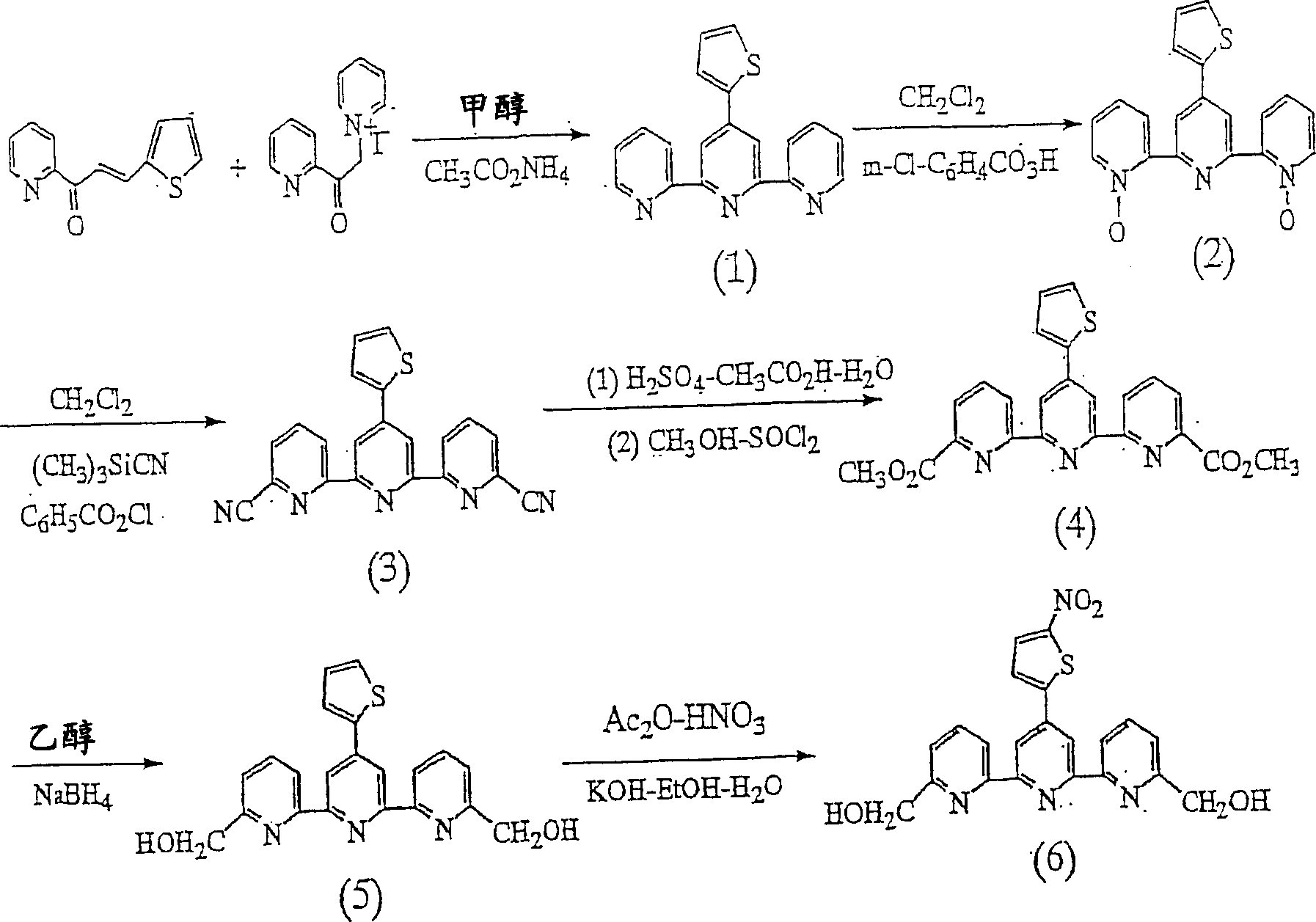
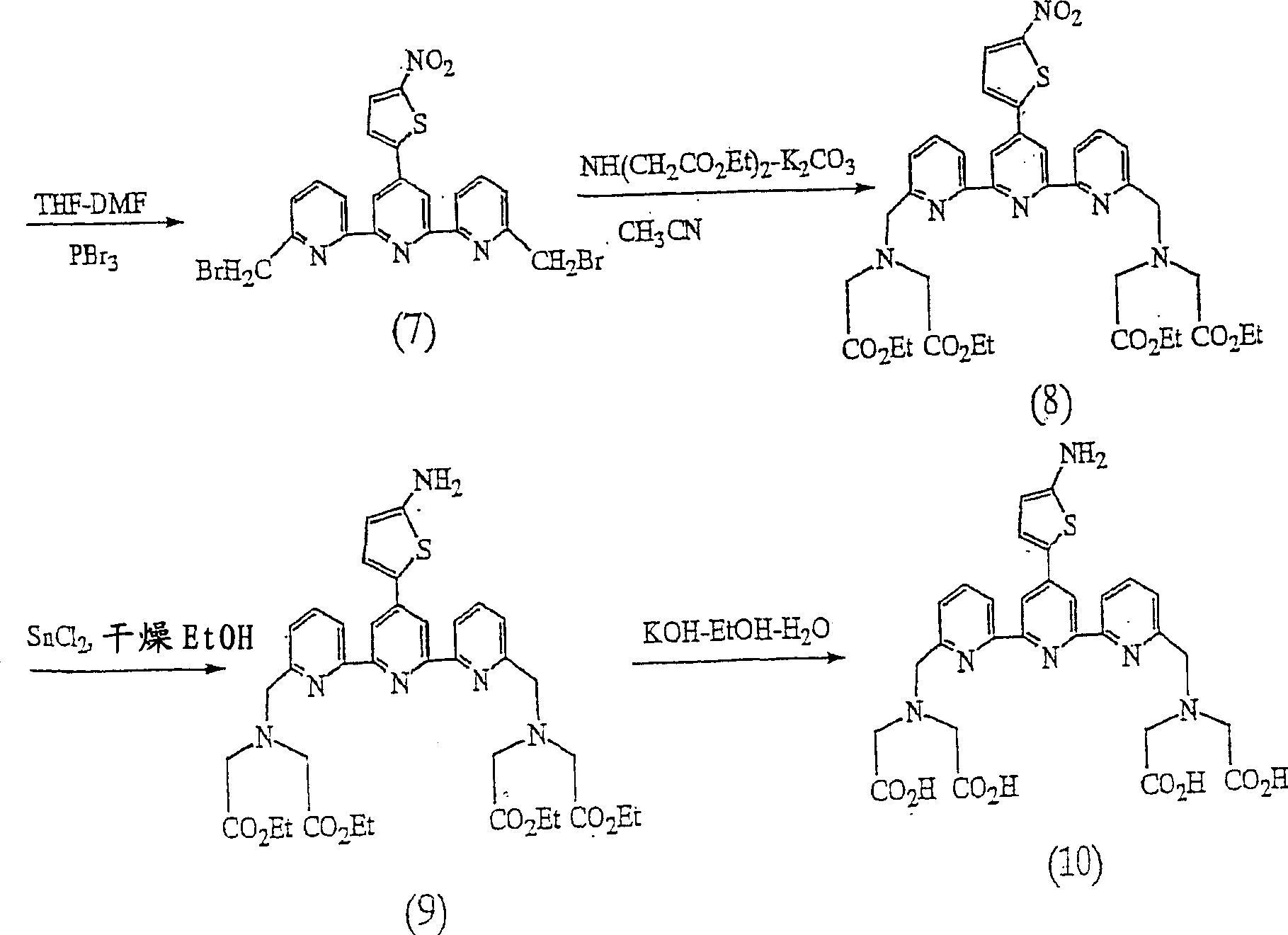
以下以R为5-氨基-2-噻吩基的情形为例,示出了本发明的通式[2]所示的标识试剂的合成方法的反应流程。Taking the case where R is 5-amino-2-thienyl as an example, the reaction scheme of the synthesis method of the labeling reagent represented by the general formula [2] of the present invention is shown below.

以下以R为5-氨基-2-噻吩基的情形为例,示出了本发明的通式[3]所示的标识试剂的合成方法的反应流程。Taking the case where R is 5-amino-2-thienyl as an example, the reaction scheme of the synthesis method of the labeling reagent represented by the general formula [3] of the present invention is shown below.

以下以R为5-氨基-2-噻吩基的情形为例,示出了本发明的通式[4]所示的标识试剂的合成方法的反应流程。Taking the case where R is 5-amino-2-thienyl as an example, the reaction scheme of the synthesis method of the labeling reagent represented by the general formula [4] of the present invention is shown below.

在本发明通式(1)-(4)所示的化合物或其盐中,优选的化合物的实例除了上述R基为5-氨基-2-噻吩基的化合物以外,还可举出R基为联苯基的化合物以及R基为4’-氨基-4-联苯基的化合物。作为R基为联苯基的化合物以及R基为4’-氨基-4-联苯基的化合物的更具体实例,可举出以下通式[1-1]所示的化合物,Among the compounds represented by the general formulas (1)-(4) of the present invention or their salts, examples of preferred compounds include compounds in which the R group is 5-amino-2-thienyl, and the R group is Biphenyl compounds and compounds whose R group is 4'-amino-4-biphenyl. As more specific examples of the compound in which the R group is a biphenyl group and the compound in which the R group is a 4'-amino-4-biphenyl group, compounds represented by the following general formula [1-1] can be enumerated,
作为更具体的实例可举出以下通式[1-2]所示的化合物,As a more specific example, compounds represented by the following general formula [1-2] can be mentioned,
以及以下通式[2-1]所示的化合物等。and compounds represented by the following general formula [2-1], etc.

此外,本发明还将日本专利申请2002-063961的说明书以及日本专利申请2002-271924的说明书中记载的内容全部引入本说明书中。In addition, the present invention incorporates all the contents described in the specification of Japanese Patent Application No. 2002-063961 and the specification of Japanese Patent Application No. 2002-271924 into this specification.
实施例Example
以下根据实施例对本发明进行更具体的说明,但是本发明不受这些实施例的限制。Hereinafter, the present invention will be described more specifically based on examples, but the present invention is not limited by these examples.
实施例1Example 1
N,N,N’,N’-[(4’-(5-氨基-2-噻吩基)-2,2’:6’,2”-三吡啶-6,6”-二基)二(亚甲基氮川)]四(乙酸)(简称为ATTTA)的合成N, N, N', N'-[(4'-(5-amino-2-thienyl)-2,2':6',2"-tripyridine-6,6"-diyl) Synthesis of bis(methylene nitrogen)]tetrakis(acetic acid) (abbreviated as ATTTA)
(1)4’-(2-噻吩基)-2,2’:6’,2”-三吡啶(化合物(1))的合成(1) Synthesis of 4'-(2'-thienyl)-2,2':6',2"-tripyridine (compound (1))
将N-[2-(吡啶-2’-基)2-氧代乙基]吡啶鎓碘化物(16.3g,50mmol)、(E)-3-(2”-噻吩基)-1-(吡啶-2’-基)-2-丙烯酮(10.76g,50mmol)和乙酸铵(23.1g)加入到500ml干燥的甲醇中,在搅拌下回流24小时。将反应液冷却,并将沉淀过滤,在冷甲醇中充分洗净后,从乙腈中重结晶,得到化合物(1)。真空干燥后的收率为43.8%。由1H NMR确认生成物为目标化合物。N-[2-(pyridin-2'-yl)2-oxoethyl]pyridinium iodide (16.3g, 50mmol), (E)-3-(2"-thienyl)-1-(pyridine -2'-yl)-2-propenone (10.76g, 50mmol) and ammonium acetate (23.1g) were added in 500ml of dry methanol, and refluxed under stirring for 24 hours.The reaction solution was cooled, and the precipitate was filtered, and the After sufficiently washing in cold methanol, recrystallization from acetonitrile gave compound (1). The yield after vacuum drying was 43.8%. It was confirmed by 1 H NMR that the product was the target compound.
1H NMR(CDCl3):δ8.74(d,J=7.9Hz,2H),8.69(s,2H),8.64(d,J=7.9Hz,2H),7.87(t,J=7.9Hz,2H),7.78(d,J=3.6Hz,1H),7.44(d,J=5.1Hz,1H),7.38-7.32(m,1H)。 1 H NMR (CDCl 3 ): δ8.74(d, J=7.9Hz, 2H), 8.69(s, 2H), 8.64(d, J=7.9Hz, 2H), 7.87(t, J=7.9Hz, 2H), 7.78(d, J=3.6Hz, 1H), 7.44(d, J=5.1Hz, 1H), 7.38-7.32(m, 1H).
(2)4’-(2-噻吩基)-2,2’:6’,2”-三吡啶-1,1”-二氧化物(化合物(2))的合成(2) Synthesis of 4'-(2'-thienyl)-2,2':6',2"-tripyridine-1,1"-dioxide (compound (2))
将化合物1(12.6g,40mmol)溶解在500ml的CH2Cl2中后,加入40g的3-氯代过氧化苯甲酸,在室温下搅拌20小时。将反应液用4×200ml的10%的Na2CO3水溶液洗净,用Na2SO4干燥有机层后,减压蒸馏除去溶剂。将生成物溶解在300ml的甲醇中,滤去微量的不溶物之后,减压蒸馏除去溶剂。将生成物用乙腈充分清洗,通过真空干燥获得化合物(2)。产率为61.4%。由1H NMR确认生成物为目标化合物。After compound 1 (12.6 g, 40 mmol) was dissolved in 500 ml of CH 2 Cl 2 , 40 g of 3-chloroperoxybenzoic acid was added and stirred at room temperature for 20 hours. The reaction liquid was washed with 4×200 ml of 10% Na 2 CO 3 aqueous solution, and the organic layer was dried with Na 2 SO 4 , and the solvent was distilled off under reduced pressure. The product was dissolved in 300 ml of methanol, and a small amount of insoluble matter was filtered off, and then the solvent was distilled off under reduced pressure. The product was sufficiently washed with acetonitrile, and vacuum-dried to obtain compound (2). The yield was 61.4%. The product was confirmed to be the target compound by 1 H NMR.
1H NMR(CDCl3):δ9.23(s,2H),8.35(d,J=6.6Hz,2H),8.23(d,J=7.9Hz,2H),7.70(d,J=3.6Hz,1H),7.45-7.28(m,5H),7.16-7.13(m,1H) 1 H NMR (CDCl 3 ): δ9.23(s, 2H), 8.35(d, J=6.6Hz, 2H), 8.23(d, J=7.9Hz, 2H), 7.70(d, J=3.6Hz, 1H), 7.45-7.28(m, 5H), 7.16-7.13(m, 1H)
(3)4’-(2-噻吩基)-2,2’:6’,2”-三吡啶-6,6”-二腈(化合物(3))的合成(3) Synthesis of 4'-(2'-thienyl)-2,2':6',2"-tripyridine-6,6"-dinitrile (compound (3))
向300ml的CH2Cl2中加入化合物(2)(8.69g,25mmol)和(CH3)3SiCN(24.8g,250mmol),在室温下搅拌20分钟后,花费大约20分钟慢慢滴加100mmol的氯化苯甲酰。在室温下将反应液搅拌20分钟后,减压下馏去溶剂,直至剩一半的量。向剩余的溶液中加入600ml 10%的K2CO3的水溶液,在室温下搅拌1小时后,将沉淀过滤,用水充分洗净,此后用冷的CH2Cl2洗净,之后真空干燥得到化合物(3)。产率为98.5%。由1HNMR确认生成物为目标化合物。Compound (2) (8.69 g, 25 mmol) and (CH 3 ) 3 SiCN (24.8 g, 250 mmol) were added to 300 ml of CH 2 Cl 2 , and after stirring at room temperature for 20 minutes, 100 mmol was slowly added dropwise for about 20 minutes of benzoyl chloride. After stirring the reaction liquid at room temperature for 20 minutes, the solvent was distilled off under reduced pressure until half of the amount remained. Add 600ml of 10% K 2 CO 3 aqueous solution to the remaining solution, stir at room temperature for 1 hour, filter the precipitate, wash it well with water, then wash it with cold CH 2 Cl 2 , and then dry it in vacuum to obtain the compound (3). The yield was 98.5%. The product was confirmed to be the target compound by 1 HNMR.
1H NMR(DMSO-d6):δ8.95(d,J=7.9Hz,2H),8.62(s,2H),8.32-8.26(m,2H),8.19(t,J=7.6Hz,2H),8.07(d,J=3.6Hz,1H),7.86(d,J=5.1Hz,1H),7.28-7.31(m,1H) 1 H NMR (DMSO-d 6 ): δ8.95(d, J=7.9Hz, 2H), 8.62(s, 2H), 8.32-8.26(m, 2H), 8.19(t, J=7.6Hz, 2H ), 8.07(d, J=3.6Hz, 1H), 7.86(d, J=5.1Hz, 1H), 7.28-7.31(m, 1H)
(4)4’-(2-噻吩基)-2,2’:6’,2”-三吡啶-6,6”-二羧酸二甲基酯(化合物(4))的合成(4) Synthesis of 4'-(2'-thienyl)-2,2':6',2"-tripyridine-6,6"-dicarboxylic acid dimethyl ester (compound (4))
向H2SO4 45ml/CH3COOH 45ml/H2O 12ml的混合溶剂中加入4.40g化合物(3),在75-80℃下搅拌48小时。向400g冰中加入反应液,搅拌后,将沉淀过滤,用水和乙醇充分洗净后,真空干燥得到4.85g水解产物。Add 4.40 g of compound (3) to a mixed solvent of H 2 SO 4 45 ml/CH 3 COOH 45 ml/H 2 O 12 ml, and stir at 75-80° C. for 48 hours. The reaction solution was added to 400 g of ice, and after stirring, the precipitate was filtered, thoroughly washed with water and ethanol, and vacuum-dried to obtain 4.85 g of a hydrolyzate.
向已用冰水冷却了的400ml干燥甲醇中加入8g SOCl2,搅拌15分钟后,加入如上所得的4.85g水解产物,在搅拌下回流20小时。减压蒸馏除去溶剂,将生成物溶解在350ml的CHCl3中,采用15%的NaHCO3水溶液将有机层充分洗净后,用Na2SO4干燥。减压蒸馏除去溶剂,将生成物在硅胶色谱柱(展开溶剂:CH2Cl2-CH3OH=99∶1w/w)上进行纯化。从甲苯中将该生成物进行重结晶,得到化合物(4)。产率为48.1%。Add 8 g of SOCl 2 to 400 ml of dry methanol cooled with ice water, stir for 15 minutes, add 4.85 g of the hydrolyzate obtained above, and reflux for 20 hours while stirring. The solvent was distilled off under reduced pressure, the product was dissolved in 350 ml of CHCl 3 , and the organic layer was sufficiently washed with a 15% NaHCO 3 aqueous solution, and dried over Na 2 SO 4 . The solvent was distilled off under reduced pressure, and the product was purified on a silica gel chromatography column (developing solvent: CH 2 Cl 2 -CH 3 OH=99:1 w/w). This product was recrystallized from toluene to obtain compound (4). The yield was 48.1%.
元素分析结果(C23H17N3O4S):Elemental analysis results (C 23 H 17 N 3 O 4 S):
计算值(%),C=64.03,H=3.97,N=9.74Calculated value (%), C=64.03, H=3.97, N=9.74
实测值(%),C=63.76,H=3.83,N=9.52Measured value (%), C=63.76, H=3.83, N=9.52
进一步由1H NMR确认生成物为目标化合物。Further, it was confirmed by 1 H NMR that the product was the target compound.
1H NMR(CDCl3):δ8.16(d,J=7.8Hz,2H),8.78(s,2H),8.20(d,J=7.6Hz,2H),8.03(t,J=7.8Hz,2H),7.82(d,J=3.6Hz,1H),7.49(d,J=5.1Hz,1H),7.22-7.19(m,1H),4.08(s,6H)。 1 H NMR (CDCl 3 ): δ8.16(d, J=7.8Hz, 2H), 8.78(s, 2H), 8.20(d, J=7.6Hz, 2H), 8.03(t, J=7.8Hz, 2H), 7.82(d, J=3.6Hz, 1H), 7.49(d, J=5.1Hz, 1H), 7.22-7.19(m, 1H), 4.08(s, 6H).
(5)4’-(2-噻吩基)-2,2’:6’,2”-三吡啶-6,6”-二羟基甲基(化合物(5))的合成(5) Synthesis of 4'-(2'-thienyl)-2,2':6',2"-tripyridine-6,6"-dihydroxymethyl (compound (5))
向200ml干燥的乙醇中加入化合物(4)(2.89g,6.7mmol)和1.05gNaBH4,在室温下搅拌3小时后,回流1小时,减压蒸馏除去溶剂,将生成物加入到100ml的饱和NaHCO3水溶液中,搅拌下加热直至沸腾。冷却后,将沉淀过滤,用水充分洗净后,进行真空干燥。将生成物溶解在200ml的THF中,过滤除去微量的不溶物后,减压蒸馏除去溶剂。将生成物用乙腈充分洗净,真空干燥获得化合物(5)。产率为72.2%。由1H NMR确认生成物为目标化合物。Add compound (4) (2.89g, 6.7mmol) and 1.05gNaBH 4 to 200ml of dry ethanol, stir at room temperature for 3 hours, reflux for 1 hour, remove the solvent by distillation under reduced pressure, and add the resultant to 100ml of saturated NaHCO 3 in aqueous solution, heated with stirring until boiling. After cooling, the precipitate was filtered, washed well with water, and then vacuum-dried. The product was dissolved in 200 ml of THF, and a small amount of insoluble matter was removed by filtration, and then the solvent was distilled off under reduced pressure. The product was sufficiently washed with acetonitrile, and dried in vacuo to obtain compound (5). The yield was 72.2%. The product was confirmed to be the target compound by 1 H NMR.
1H NMR(DMSO-d6):δ8.63(s,2H),8.50(d,J=7.3Hz,2H),8.03(t,J=7.3Hz,2H),7.93(d,J=3.6Hz,1H),7.82(d,J=5.1Hz,1H),7.61(d,J=7.1Hz,2H),7.28-7.31(m,1H),4.74(s,4H)。 1 H NMR (DMSO-d 6 ): δ8.63(s, 2H), 8.50(d, J=7.3Hz, 2H), 8.03(t, J=7.3Hz, 2H), 7.93(d, J=3.6 Hz, 1H), 7.82 (d, J = 5.1 Hz, 1H), 7.61 (d, J = 7.1 Hz, 2H), 7.28-7.31 (m, 1H), 4.74 (s, 4H).
(6)4’-(5-硝基-2-噻吩基)-2,2’:6’,2”-三吡啶-6,6”-二羟基甲基(化合物(6))的合成(6) 4'-(5-nitro-2-thienyl)-2,2': 6',2"-tripyridine-6,6"-dihydroxymethyl (compound (6)) synthesis
将化合物(5)(1.50g,4mmol)加入到15ml的乙酸酐中,在室温下搅拌1小时后,在60℃下进一步搅拌1小时。将反应液冷却至室温,加入2g发烟硝酸和20ml乙酸的混和溶液后,在室温下搅拌24小时。向反应液中加入200ml的水,搅拌1晚后,用4×50ml的CHCl3进行萃取。对CHCl3溶液进行水洗,用Na2SO4干燥后,减压蒸馏除去溶剂。将生成物溶解在100ml乙醇中,加入4gKOH和5ml水,在室温下搅拌24小时。减压蒸馏除去溶剂。将生成物用水洗后,真空干燥获得化合物(6)。产率为75.1%。由1H NMR确认生成物为目标化合物。Compound (5) (1.50 g, 4 mmol) was added to 15 ml of acetic anhydride, stirred at room temperature for 1 hour, and then further stirred at 60° C. for 1 hour. The reaction solution was cooled to room temperature, and a mixed solution of 2 g of fuming nitric acid and 20 ml of acetic acid was added, followed by stirring at room temperature for 24 hours. 200 ml of water was added to the reaction solution, and after stirring overnight, extraction was performed with 4×50 ml of CHCl 3 . The CHCl 3 solution was washed with water, dried over Na 2 SO 4 , and the solvent was distilled off under reduced pressure. The resultant was dissolved in 100 ml of ethanol, 4 g of KOH and 5 ml of water were added, and stirred at room temperature for 24 hours. The solvent was distilled off under reduced pressure. After the resultant was washed with water, it was vacuum-dried to obtain compound (6). The yield was 75.1%. The product was confirmed to be the target compound by 1 H NMR.
1H NMR(DMSO-d6):δ8.57(s,2H),8.40(d,J=7.3Hz,2H),8.15(d,J=3.6Hz,1H),7.96(t,J=7.5Hz,2H),7.89(d,J=5.1Hz,1H),7.57(d,J=7.1Hz,2H),5.50(sb,2H),4.72(s,4H)。 1 H NMR (DMSO-d 6 ): δ8.57(s, 2H), 8.40(d, J=7.3Hz, 2H), 8.15(d, J=3.6Hz, 1H), 7.96(t, J=7.5 Hz, 2H), 7.89 (d, J=5.1 Hz, 1H), 7.57 (d, J=7.1 Hz, 2H), 5.50 (sb, 2H), 4.72 (s, 4H).
(7)4’-(5-硝基-2-噻吩基)-2,2’:6’,2”-三吡啶-6,6”-二溴代甲基(化合物(7))的合成(7) 4'-(5-nitro-2-thienyl)-2,2':6',2"-tripyridine-6,6"-dibromomethyl (compound (7)) Synthesis
将化合物(6)(1.26g,3mmol)加入到120mlTHF-15mlDMF的混和溶剂中,使其溶解,加入2.40g的PBr3,在搅拌下回流54时。减压蒸馏除去溶剂后,向生成物中加入200ml的CHCl3,用4×80ml 10%的Na2CO3水溶液对CHCl3溶液进行清洗。有机层用Na2SO4干燥,减压蒸馏除去溶剂后,向所得的残渣用己烷充分洗净,真空干燥得到化合物(7)。产率为70.1%。由1H NMR确认生成物为目标化合物。Compound (6) (1.26g, 3mmol) was added into a mixed solvent of 120mlTHF-15mlDMF to dissolve it, 2.40g of PBr 3 was added, and the solution was refluxed for 54 hours under stirring. After the solvent was distilled off under reduced pressure, 200 ml of CHCl 3 was added to the product, and the CHCl 3 solution was washed with 4×80 ml of 10% Na 2 CO 3 aqueous solution. The organic layer was dried over Na 2 SO 4 , the solvent was distilled off under reduced pressure, and the resulting residue was washed well with hexane and dried in vacuo to obtain compound (7). The yield was 70.1%. The product was confirmed to be the target compound by 1 H NMR.
1H NMR(DMSO-d6):δ8.55(s,2H),8.46(d,J=7.3Hz,2H),8.16(d,J=4.4Hz,1H),7.97(t,J=7.5Hz,2H),7.88(d,J=5.1Hz,1H),7.65(d,J=7.1Hz,2H),4.80(s,4H)。 1 H NMR (DMSO-d 6 ): δ8.55(s, 2H), 8.46(d, J=7.3Hz, 2H), 8.16(d, J=4.4Hz, 1H), 7.97(t, J=7.5 Hz, 2H), 7.88 (d, J=5.1 Hz, 1H), 7.65 (d, J=7.1 Hz, 2H), 4.80 (s, 4H).
(8)N,N,N’,N’-[4’-(5-硝基-2-噻吩基)-2,2’:6’,2”-三吡啶-6,6”-二基]二(亚甲基氮川)]四乙酸四乙基酯(化合物(8))的合成(8) N, N, N', N'-[4'-(5-nitro-2-thienyl)-2,2': 6',2"-tripyridine-6,6"- Synthesis of Tetraethyl Diyl]bis(methylenenitrogen)]tetraacetate (Compound (8))
将化合物(7)(1.09g,2mmol)溶解在150ml的CH3CN中,并加入4.1mmol的亚胺二乙酸二乙酯和20mmol的K2CO3,搅拌下回流24小时。过滤除去不溶物,减压蒸馏除去溶剂后,向生成物中加入200ml的CHCl3,用4×100ml的饱和Na2SO4水溶液洗净CHCl3溶液。用Na2SO4对有机层进行干燥,减压蒸馏除去溶剂,获得油状产物,用硅胶色谱柱(展开溶剂:CH3COOEt-CH3OH-THF=90∶6∶4w/w/w)进行纯化,获得化合物(8)。产率为50.1%。由1H NMR确认生成物为目标化合物。Compound (7) (1.09g, 2mmol) was dissolved in 150ml of CH 3 CN, and 4.1mmol of diethyl iminodiacetate and 20mmol of K 2 CO 3 were added, and stirred and refluxed for 24 hours. Insoluble matter was removed by filtration, and the solvent was distilled off under reduced pressure. 200 ml of CHCl 3 was added to the product, and the CHCl 3 solution was washed with 4×100 ml of saturated Na 2 SO 4 aqueous solution. The organic layer was dried with Na 2 SO 4 , and the solvent was distilled off under reduced pressure to obtain an oily product. Purification affords compound (8). The yield was 50.1%. The product was confirmed to be the target compound by 1 H NMR.
1H NMR(CDCl3):δ8.70(s,2H),8.51(d,J=7.8Hz,2H),7.99(d,J=4.4Hz,1H),7.87(t,J=7.6Hz,2H),7.74(d,J=4.4Hz,1H),7.66(d,J=7.8Hz,2H),4.19(q,J=7.2Hz,8H),4.08(s,4H),3.71(s,8H),1.26(t,J=7.2Hz,12H) 1 H NMR (CDCl 3 ): δ8.70(s, 2H), 8.51(d, J=7.8Hz, 2H), 7.99(d, J=4.4Hz, 1H), 7.87(t, J=7.6Hz, 2H), 7.74(d, J=4.4Hz, 1H), 7.66(d, J=7.8Hz, 2H), 4.19(q, J=7.2Hz, 8H), 4.08(s, 4H), 3.71(s, 8H), 1.26(t, J=7.2Hz, 12H)
(9)N,N,N’,N’-[4’-(5-氨基-2-噻吩基)-2,2’:6’,2”-三吡啶-6,6”-二基]二(亚甲基氮川)]四乙酸四乙基酯(化合物(9))的合成(9) N, N, N', N'-[4'-(5-amino-2-thienyl)-2,2': 6',2"-tripyridine-6,6"-di Synthesis of di(methylene nitrogen)]tetraethyl tetraacetate (compound (9))
将化合物(8)(0.76g,1mmol)溶解在70ml的EtOH中,加入SnCl2·2H2O(1.32g,6mmol)后,在70-80℃下搅拌1小时。冷却至室温后,注入已经用冰水冷却了的100mlH2O-5gDTPA的溶液中,搅拌后,向该溶液中加入20ml的饱和NaHCO3水溶液。室温下搅拌30分钟后,用3×100ml的CHCl3萃取水溶液,用Na2SO4对有机层进行干燥。减压蒸馏除去溶剂,对残渣进行真空干燥,获得化合物(9)。产率为93.5%。由1H NMR确认生成物为目标化合物。Compound (8) (0.76 g, 1 mmol) was dissolved in 70 ml of EtOH, SnCl 2 ·2H 2 O (1.32 g, 6 mmol) was added, and stirred at 70-80° C. for 1 hour. After cooling to room temperature, it was poured into a solution of 100ml H 2 O-5g DTPA that had been cooled with ice water, and after stirring, 20ml of a saturated NaHCO 3 aqueous solution was added to the solution. After stirring at room temperature for 30 minutes, the aqueous solution was extracted with 3×100 ml of CHCl 3 , and the organic layer was dried with Na 2 SO 4 . The solvent was distilled off under reduced pressure, and the residue was vacuum-dried to obtain compound (9). The yield was 93.5%. The product was confirmed to be the target compound by 1 H NMR.
1H NMR(CDCl3):δ8.44(s,2H),8.41(d,J=7.2Hz,2H),7.78(t,J=7.6Hz,2H),7.56(d,J=7.2Hz,2H),7.38(d,J=4.2Hz,1H),6.17(d,J=4.2Hz,1H),4.19(q,J=7.2Hz,8H),4.08(s,4H),3.74(s,8H),1.26(t,J=7.2Hz,12H)。 1 H NMR (CDCl 3 ): δ8.44(s, 2H), 8.41(d, J=7.2Hz, 2H), 7.78(t, J=7.6Hz, 2H), 7.56(d, J=7.2Hz, 2H), 7.38(d, J=4.2Hz, 1H), 6.17(d, J=4.2Hz, 1H), 4.19(q, J=7.2Hz, 8H), 4.08(s, 4H), 3.74(s, 8H), 1.26 (t, J=7.2Hz, 12H).
(10)N,N,N’,N’-[4’-(5-氨基-2-噻吩基)-2,2’:6’,2”-三吡啶-6,6”-二基]二(亚甲基氮川)]四乙酸四乙基酯[ATTTA,(化合物(10)]的合成(10) N, N, N', N'-[4'-(5-amino-2-thienyl)-2,2': 6',2"-tripyridine-6,6"-di base] two (methylene nitrogen)] tetraethyl tetraacetate [ATTTA, (compound (10)] synthesis
将化合物(9)(586mg,0.8mmol)溶解在40mlEtOH-5mlH2O-1.2gKOH的溶液中,在室温下搅拌24小时后,减压蒸馏除去溶剂。将残渣溶解在60ml的水中,在搅拌下慢慢滴加1%的CF3COOH水溶液,将溶液的pH值调节至约1。在室温下搅拌3小时后,将沉淀过滤,用0.5%的CF3COOH水溶液充分洗净后,真空干燥获得化合物(10)。产率为90.0%。Compound (9) (586 mg, 0.8 mmol) was dissolved in a solution of 40 ml EtOH-5 ml H 2 O-1.2 g KOH, stirred at room temperature for 24 hours, and the solvent was distilled off under reduced pressure. The residue was dissolved in 60 ml of water, and a 1% CF 3 COOH aqueous solution was slowly added dropwise under stirring to adjust the pH of the solution to about 1. After stirring at room temperature for 3 hours, the precipitate was filtered, washed well with 0.5% CF 3 COOH aqueous solution, and dried in vacuo to obtain compound (10). The yield was 90.0%.
元素分析结果(C29H28N6O8S):Elemental analysis results (C 29 H 28 N 6 O 8 S):
计算值(%),C=56.13,H=4.55,N=13.54Calculated value (%), C=56.13, H=4.55, N=13.54
实测值(%),C=55.94,H=4.38,N=13.62Measured value (%), C=55.94, H=4.38, N=13.62
进一步由1H NMR确认生成物为目标化合物。Further, it was confirmed by 1 H NMR that the product was the target compound.
1H NMR(DMSO-d3):δ8.10(s,2H),8.04(d,J=7.2Hz,2H),7.45(t,J=7.2Hz,2H),7.31(d,J=7.2Hz,2H),7.25(d,J=4.2Hz,1H),6.14(d,J=4.2Hz,1H),4.00(s,4H),3.51(s,8H)。 1 H NMR (DMSO-d 3 ): δ8.10(s, 2H), 8.04(d, J=7.2Hz, 2H), 7.45(t, J=7.2Hz, 2H), 7.31(d, J=7.2 Hz, 2H), 7.25 (d, J = 4.2Hz, 1H), 6.14 (d, J = 4.2Hz, 1H), 4.00 (s, 4H), 3.51 (s, 8H).
实施例2 [(4’-(5-氨基-2-噻吩基)-2,2’:6’,2”-三吡啶-6,6”-二基)二(亚甲基氮川)]-N:N’,N:N’-二(3,6-二氧杂三亚乙基)(简称为ATTBB)的合成Example 2 [(4'-(5'-amino-2'-thienyl)-2,2':6',2"-tripyridine-6,6"-diyl) bis(methylene nitrogen) )]-N:N', N:N'-bis(3,6-dioxatriethylene) (abbreviated as ATTBB) synthesis
(1)[4’-(5-硝基-2-噻吩基)-2,2’:6’,2”-三吡啶-6,6”-二基]二(亚甲基氮川)]-N:N’,N:N’-二(3,6-二氧杂三亚乙基)的合成(1) [4'-(5-nitro-2-thienyl)-2,2':6',2"-tripyridine-6,6"-diyl]bis(methylene nitrogen )]-N: N', N: N'-bis(3,6-dioxatriethylene) synthesis
将4’-(5-氨基-2-噻吩基)-2,2’:6’,2”-三吡啶-6,6”-二溴代甲基(1.09g,2mmol)溶解在150ml的CH3CN中后,加入2.1mmol的4,13-二氮杂-18-冠6-醚和20mmol的K2CO3,搅拌下回流24小时。将不溶物过滤除去,减压蒸馏除去溶剂后,用硅胶色谱柱(展开溶剂:CH2Cl2-CH3OH=9∶1w/w)纯化生成物。产率为65.3%。通过FAB-MS确认生成物为目标化合物和KBr的络合物(1∶1,M.W.=765.727)。Dissolve 4'-(5'-amino-2'-thienyl)-2,2':6',2"-tripyridine-6,6"-dibromomethyl (1.09g, 2mmol) in 150ml After adding 2.1 mmol of 4,13-diaza-18-crown 6-ether and 20 mmol of K 2 CO 3 into CH 3 CN, reflux for 24 hours under stirring. The insoluble matter was filtered off, the solvent was distilled off under reduced pressure, and the product was purified by silica gel column chromatography (developing solvent: CH 2 Cl 2 -CH 3 OH=9:1 w/w). The yield was 65.3%. It was confirmed by FAB-MS that the product was a complex of the target compound and KBr (1:1, MW=765.727).
FAB-MS:测定值:766。FAB-MS: Found: 766.
(2)[4’-(5-氨基-2-噻吩基)-2,2’:6’,2”-三吡啶-6,6”-二基]二(亚甲基氮川)]-N:N’,N:N’-二(3,6-二氧杂三亚乙基)(简称为ATTBB)的合成(2) [4'-(5-amino-2-thienyl)-2,2':6',2"-tripyridine-6,6"-diyl]bis(methyleneazoline) Synthesis of ]-N:N', N:N'-bis(3,6-dioxatriethylene) (abbreviated as ATTBB)
将上述(1)所得的KBr络合物(765.7mg,1mmol)溶解在50ml干燥的甲醇中,加入150mg的10%的Pd/C催化剂后,加入40mg的NaBH4。在室温下搅拌2小时,将不溶物过滤除去后,减压蒸馏除去溶剂,将生成物溶解在30ml的水中。用4×50ml的CHCl3萃取水溶液,用Na2SO4干燥后,减压蒸馏除去溶剂,真空干燥。产率为40.3%。通过FAB-MS确认生成物为目标化合物和KBr的络合物(1∶1,M.W.=735.744)。The KBr complex (765.7 mg, 1 mmol) obtained in (1) above was dissolved in 50 ml of dry methanol, and after adding 150 mg of 10% Pd/C catalyst, 40 mg of NaBH 4 was added. After stirring at room temperature for 2 hours, the insoluble matter was removed by filtration, the solvent was distilled off under reduced pressure, and the product was dissolved in 30 ml of water. The aqueous solution was extracted with 4×50 ml of CHCl 3 , dried with Na 2 SO 4 , the solvent was distilled off under reduced pressure, and dried in vacuo. The yield was 40.3%. It was confirmed by FAB-MS that the product was a complex of the target compound and KBr (1:1, MW=735.744).
FAB-MS:测定值:736FAB-MS: measured value: 736
实施例3 N,N,N’,N’-[2,6-二(3’-氨基甲基-1’-吡唑基)-4-(5”-氨基-2”-噻吩基)吡啶]四乙酸(简称为BAPTA)的合成Example 3 N, N, N', N'-[2,6-bis(3'-aminomethyl-1'-pyrazolyl)-4-(5"-amino-2"-thienyl)pyridine ] tetraacetic acid (abbreviated as BAPTA) synthesis
(1)2,6-二溴代-4-(2’-噻吩基)吡啶(化合物11)的合成(1) Synthesis of 2,6-dibromo-4-(2'-thienyl)pyridine (compound 11)
在250ml的乙酸中溶解4-氨基-2,6-二溴代吡啶(3.25g,12.9mmol)和12.9g噻吩,搅拌下加入1.93g硝酸异戊酯,在室温下搅拌24小时后,进一步在大约45℃下搅拌3小时。减压蒸馏除去溶剂,将残渣在40ml的10%K2CO3水溶液中中和后,用4×60ml的CHCl3萃取。用Na2SO4干燥有机层后,减压蒸馏除去溶剂,残渣用硅胶色谱柱(展开溶剂:CH2Cl2-CH3OH=9∶1w/w)进行纯化,进一步用甲醇进行2次重结晶,得到化合物(11)。产率为47.9%Dissolve 4-amino-2,6-dibromopyridine (3.25g, 12.9mmol) and 12.9g thiophene in the acetic acid of 250ml, add 1.93g isoamyl nitrate under stirring, after stirring at room temperature for 24 hours, further in Stir at about 45°C for 3 hours. The solvent was distilled off under reduced pressure, and the residue was neutralized in 40 ml of 10% K 2 CO 3 aqueous solution, and then extracted with 4×60 ml of CHCl 3 . After drying the organic layer with Na 2 SO 4 , the solvent was distilled off under reduced pressure, and the residue was purified by silica gel column chromatography (developing solvent: CH 2 Cl 2 -CH 3 OH=9:1w/w), and repeated twice with methanol. Crystallization affords compound (11). The yield is 47.9%
元素分析结果(C9H5NBr2S):Elemental analysis results (C 9 H 5 NBr 2 S):
计算值(%),C=33.88,H=1.58,N=4.39。Calculated value (%), C=33.88, H=1.58, N=4.39.
实测值(%),C=33.46,H=1.46,N=4.23。Actual value (%), C=33.46, H=1.46, N=4.23.
进一步由1H NMR确认生成物为目标化合物。Further, it was confirmed by 1 H NMR that the product was the target compound.
1H NMR(CDCl3):δ7.60(s,2H),7.50-7.48(m,2H),7.16-7.13(m,1H) 1 H NMR (CDCl 3 ): δ7.60 (s, 2H), 7.50-7.48 (m, 2H), 7.16-7.13 (m, 1H)
(2)2,6-二(3’-甲氧基羰基-1’-吡唑基)-4-(2”-噻吩基)吡啶(化合物12)的合成(2) Synthesis of 2,6-bis(3'-methoxycarbonyl-1'-pyrazolyl)-4-(2"-thienyl)pyridine (compound 12)
向100ml干燥的THF中溶解10.1g 3-甲氧基羰基吡唑,向其中加入3.12g金属钾,在约60℃搅拌,直至金属全部溶解。向该溶液中加入化合物(11)(6.38g,20mmol),搅拌下回流1小时。减压蒸馏除去溶剂,将残渣用6×150ml的CHCl3萃取后,再次减压蒸馏除去溶剂。生成物用硅胶色谱柱(展开溶剂:CH2Cl2-CH3OH=9∶1w/w)进行纯化,进一步用苯重结晶,得到化合物(12)。产率为45.5%10.1 g of 3-methoxycarbonylpyrazole was dissolved in 100 ml of dry THF, 3.12 g of metal potassium was added thereto, and stirred at about 60° C. until the metal was completely dissolved. Compound (11) (6.38 g, 20 mmol) was added to the solution, and the mixture was stirred and refluxed for 1 hour. The solvent was distilled off under reduced pressure, and the residue was extracted with 6×150 ml of CHCl 3 , and the solvent was distilled off again under reduced pressure. The product was purified by silica gel column chromatography (developing solvent: CH 2 Cl 2 -CH 3 OH=9:1 w/w), and further recrystallized from benzene to obtain compound (12). The yield is 45.5%
元素分析结果(C19H15N5O4S):Elemental analysis results (C 19 H 15 N 5 O 4 S):
计算值(%),C=55.74,H=3.69,N=17.10Calculated value (%), C=55.74, H=3.69, N=17.10
实测值(%),C=55.47,H=3.62,N=16.82Measured value (%), C=55.47, H=3.62, N=16.82
进一步由1H NMR确认生成物为目标化合物。Further, it was confirmed by 1 H NMR that the product was the target compound.
1H NMR(CDCl3):δ8.60(d,J=2.7Hz,2H),8.22(s,2H),7.79(d,J=3.6Hz,1H),7.53(d,J=5.0Hz,1H),7.20-7.18(m,1H),7.03(d,J=2.7Hz,2H),4.01(s,6H)。 1 H NMR (CDCl 3 ): δ8.60(d, J=2.7Hz, 2H), 8.22(s, 2H), 7.79(d, J=3.6Hz, 1H), 7.53(d, J=5.0Hz, 1H), 7.20-7.18 (m, 1H), 7.03 (d, J=2.7Hz, 2H), 4.01 (s, 6H).
(3)2,6-二(3’-羟甲基-1’-吡唑基)-4-(2”-噻吩基)吡啶(化合物13)的合成(3) Synthesis of 2,6-bis(3'-hydroxymethyl-1'-pyrazolyl)-4-(2"-thienyl)pyridine (compound 13)
向300ml干燥的THF中加入1.30gLiAlH4和化合物(12)(2.72g,6.64mmol),在室温下搅拌4小时后,加入1.1ml水,此后慢慢滴加1.1ml15%的NaOH和4.5ml水。在室温下搅拌30分钟后,将沉淀过滤,进一步用少量THF清洗沉淀,将其与THF溶液合并。减压蒸馏除去溶剂,将残渣用乙腈充分洗净后,真空干燥获得化合物(13)。产率为71.3%。由1H NMR确认生成物为目标化合物。Add 1.30gLiAlH 4 and compound (12) (2.72g, 6.64mmol) to 300ml of dry THF, after stirring at room temperature for 4 hours, add 1.1ml of water, then slowly add 1.1ml of 15% NaOH and 4.5ml of water . After stirring at room temperature for 30 minutes, the precipitate was filtered, further washed with a small amount of THF, and combined with the THF solution. The solvent was distilled off under reduced pressure, and the residue was washed well with acetonitrile, followed by vacuum drying to obtain compound (13). The yield was 71.3%. The product was confirmed to be the target compound by 1 H NMR.
1H NMR(DMSO-d6):δ8.88(d,J=2.6Hz,2H),7.96(d,J=3.6Hz,1H),7.90(s,2H),7.85(d,J=5.1Hz,1H),7.29-7.26(m,1H),6.60(d,J=2.5Hz,2H),4.58(s,4H) 1 H NMR (DMSO-d 6 ): δ8.88(d, J=2.6Hz, 2H), 7.96(d, J=3.6Hz, 1H), 7.90(s, 2H), 7.85(d, J=5.1 Hz, 1H), 7.29-7.26(m, 1H), 6.60(d, J=2.5Hz, 2H), 4.58(s, 4H)
(4)2,6-二(3’-羟甲基-1’-吡唑基)-4-(5”-硝基-2”-噻吩基)吡啶(化合物14)的合成(4) Synthesis of 2,6-bis(3'-hydroxymethyl-1'-pyrazolyl)-4-(5"-nitro-2"-thienyl)pyridine (compound 14)
将化合物(13)(1.59g,4.5mmol)加入到20ml的乙酸酐中,室温下搅拌1小时后,在60℃下进一步搅拌1小时。将反应液冷却至室温,加入1.5g发烟硝酸和20ml乙酸的混和溶液后,在室温下搅拌24小时。向反应液中加入200ml的水,搅拌1晚后,用4×50ml的CHCl3进行萃取。对CHCl3溶液进行水洗,用Na2SO4干燥后,减压蒸馏除去溶剂。将残渣真空干燥后,用硅胶色谱柱(展开溶剂:CH2Cl2-CH3OH=9∶1w/w)进行纯化。将生成物溶解在100ml乙醇中,加入4gKOH和5ml水,在室温下搅拌24小时。减压蒸馏除去溶剂,将残渣用水洗后,真空干燥获得化合物(14)。产率为70.4%。由1H NMR确认生成物为目标化合物。Compound (13) (1.59 g, 4.5 mmol) was added to 20 ml of acetic anhydride, stirred at room temperature for 1 hour, and then further stirred at 60° C. for 1 hour. The reaction solution was cooled to room temperature, and a mixed solution of 1.5 g of fuming nitric acid and 20 ml of acetic acid was added, followed by stirring at room temperature for 24 hours. 200 ml of water was added to the reaction solution, and after stirring overnight, extraction was performed with 4×50 ml of CHCl 3 . The CHCl 3 solution was washed with water, dried over Na 2 SO 4 , and the solvent was distilled off under reduced pressure. After the residue was vacuum-dried, it was purified by silica gel column chromatography (developing solvent: CH 2 Cl 2 -CH 3 OH=9:1 w/w). The resultant was dissolved in 100 ml of ethanol, 4 g of KOH and 5 ml of water were added, and stirred at room temperature for 24 hours. The solvent was distilled off under reduced pressure, and the residue was washed with water and dried in vacuo to obtain compound (14). The yield was 70.4%. The product was confirmed to be the target compound by 1 H NMR.
1H NMR(DMSO-d6):δ9.01(d,J=2.6Hz,2H),8.15(d,J=3.6Hz,1H),7.89(s,2H),7.84(d,J=5.1Hz,1H),6.71(d,J=2.5Hz,2H)4.57(s,4H) 1 H NMR (DMSO-d 6 ): δ9.01(d, J=2.6Hz, 2H), 8.15(d, J=3.6Hz, 1H), 7.89(s, 2H), 7.84(d, J=5.1 Hz, 1H), 6.71(d, J=2.5Hz, 2H) 4.57(s, 4H)
(5)2,6-二(3’-溴代甲基-1’-吡唑基)-4-(5”-硝基-2”-噻吩基)吡啶(化合物15)的合成(5) Synthesis of 2,6-bis(3'-bromomethyl-1'-pyrazolyl)-4-(5"-nitro-2"-thienyl)pyridine (compound 15)
将化合物(14)(1.59g,4mmol)溶解在200mlTHF中,向其中加入3.20g的PBr3,在搅拌下回流4小时。减压蒸馏除去溶剂后,向残渣中加入200ml的CHCl3,用4×80ml 10%NaHCO3水溶液对CHCl3溶液进行清洗。有机层用Na2SO4干燥,减压蒸馏除去溶剂。所得的残渣用己烷充分洗净,真空干燥得到化合物(15)。产率为94.1%。由1H NMR确认生成物为目标化合物。Compound (14) (1.59 g, 4 mmol) was dissolved in 200 ml of THF, 3.20 g of PBr 3 was added thereto, and the mixture was refluxed for 4 hours with stirring. After the solvent was distilled off under reduced pressure, 200 ml of CHCl 3 was added to the residue, and the CHCl 3 solution was washed with 4×80 ml of 10% NaHCO 3 aqueous solution. The organic layer was dried over Na 2 SO 4 , and the solvent was distilled off under reduced pressure. The obtained residue was washed well with hexane, and dried in vacuo to obtain compound (15). The yield was 94.1%. The product was confirmed to be the target compound by 1 H NMR.
1H NMR(CDCl3):δ9.04(d,J=2.6Hz,2H),8.17(d,J=3.6Hz,1H),7.87(s,2H),7.81(d,J=5.1Hz,1H),6.73(d,J=2.5Hz,2H),4.66(s,4H)。 1 H NMR (CDCl 3 ): δ9.04(d, J=2.6Hz, 2H), 8.17(d, J=3.6Hz, 1H), 7.87(s, 2H), 7.81(d, J=5.1Hz, 1H), 6.73 (d, J=2.5Hz, 2H), 4.66 (s, 4H).
(6)N,N,N’,N’-[2,6-二(3’-氨基甲基-1’-吡唑基)-4-(5”-硝基-2”-噻吩基)吡啶]四乙酸四乙基酯(化合物(16))的合成(6) N, N, N', N'-[2,6-bis(3'-aminomethyl-1'-pyrazolyl)-4-(5"-nitro-2"-thienyl) Synthesis of tetraethylpyridine]tetraacetate (compound (16))
将化合物(15)(1.05g,2mmol)溶解在150ml的CH3CN中,并加入4.1mmol的亚胺二乙酸二乙酯和20mmol的K2CO3,搅拌下回流24小时。过滤除去不溶物,减压蒸馏除去溶剂后,向残渣中加入200ml的CHCl3,用4×100ml的饱和Na2SO4对CHCl3溶液进行清洗,用Na2SO4对有机层进行干燥,减压蒸馏除去溶剂后,获得油状产物,用硅胶色谱柱(展开溶剂:CH3COOEt-CH2Cl2=9∶1w/w)进行纯化,获得化合物(16)。产率为50.0%。由1H NMR确认生成物为目标化合物。Compound (15) (1.05g, 2mmol) was dissolved in 150ml of CH 3 CN, and 4.1mmol of diethyl iminodiacetate and 20mmol of K 2 CO 3 were added, and refluxed for 24 hours under stirring. Remove the insoluble matter by filtration, remove the solvent by distillation under reduced pressure, add 200ml of CHCl3 to the residue, wash the CHCl3 solution with 4 × 100ml of saturated Na2SO4 , and dry the organic layer with Na2SO4 . After distilling off the solvent under pressure, an oily product was obtained, which was purified by silica gel column chromatography (developing solvent: CH 3 COOEt-CH 2 Cl 2 =9:1 w/w) to obtain compound (16). The yield was 50.0%. The product was confirmed to be the target compound by 1 H NMR.
1H NMR(CDCl3):δ9.03(d,J=2.6Hz,2H),8.14(d,J=3.6Hz,1H),7.88(s,2H),7.81(d,J=5.1Hz,1H),6.72(d,J=2.5Hz,2H),4.18(q,J=7.2Hz,8H),4.08(s,4H),3.65(s,8H),1.26(t,J=7.2Hz,12H)。 1 H NMR (CDCl 3 ): δ9.03(d, J=2.6Hz, 2H), 8.14(d, J=3.6Hz, 1H), 7.88(s, 2H), 7.81(d, J=5.1Hz, 1H), 6.72(d, J=2.5Hz, 2H), 4.18(q, J=7.2Hz, 8H), 4.08(s, 4H), 3.65(s, 8H), 1.26(t, J=7.2Hz, 12H).
(7)N,N,N’,N’-[2,6-二(3’-氨基甲基-1’-吡唑基)-4-(5”-氨基-2”-噻吩基)吡啶]四乙酸四乙酯(化合物(17))的合成(7) N, N, N', N'-[2,6-bis(3'-aminomethyl-1'-pyrazolyl)-4-(5"-amino-2"-thienyl)pyridine ] Synthesis of tetraethyl tetraacetate (compound (17))
将化合物(16)(741mg,1mmol)溶解在70ml的EtOH中,向其中加入SnCl2·2H2O(1.32g,6mmol)后,在70-80℃下搅拌1小时。冷却至室温后,注入已经用冰水冷却了的100mlH2O-5gDTPA的溶液中,搅拌后,向该溶液中加入20ml的饱和NaHCO3水溶液。室温下搅拌30分钟后,用3×100ml的CHCl3萃取水溶液,用Na2SO4对有机层进行干燥。减压蒸馏除去溶剂后,对生成物进行真空干燥,获得化合物(17)。产率为91.7%。由1H NMR确认生成物为目标化合物。Compound (16) (741 mg, 1 mmol) was dissolved in 70 ml of EtOH, SnCl 2 ·2H 2 O (1.32 g, 6 mmol) was added thereto, and stirred at 70-80° C. for 1 hour. After cooling to room temperature, it was poured into a solution of 100ml H 2 O-5g DTPA that had been cooled with ice water, and after stirring, 20ml of a saturated NaHCO 3 aqueous solution was added to the solution. After stirring at room temperature for 30 minutes, the aqueous solution was extracted with 3×100 ml of CHCl 3 , and the organic layer was dried with Na 2 SO 4 . After distilling off the solvent under reduced pressure, the product was vacuum-dried to obtain compound (17). The yield was 91.7%. The product was confirmed to be the target compound by 1 H NMR.
1H NMR(CDCl3):δ8.81(d,J=2.6Hz,2H),7.58(s,2H),7.38(d,J=3.6Hz,1H),6.72(d,J=2.5Hz,2H),6.52(d,J=5.1Hz,1H),4.18(q,J=7.2Hz,8H),4.08(s,4H),3.65(s,8H),1.26(t,J=7.2Hz,12H)。 1 H NMR (CDCl 3 ): δ8.81(d, J=2.6Hz, 2H), 7.58(s, 2H), 7.38(d, J=3.6Hz, 1H), 6.72(d, J=2.5Hz, 2H), 6.52(d, J=5.1Hz, 1H), 4.18(q, J=7.2Hz, 8H), 4.08(s, 4H), 3.65(s, 8H), 1.26(t, J=7.2Hz, 12H).
(8)N,N,N’,N’-[2,6-二(3’-氨基甲基-1’-吡唑基)-4-(5”-氨基-2”-噻吩基)吡啶]四乙酸(BAPTA、化合物(18))的合成(8) N, N, N', N'-[2,6-bis(3'-aminomethyl-1'-pyrazolyl)-4-(5"-amino-2"-thienyl)pyridine ] Synthesis of tetraacetic acid (BAPTA, compound (18))
将化合物(17)(569mg,0.8mmol)溶解在40mlEtOH-5mlH2O-1.2gKOH的溶液中,在室温下搅拌24小时后,减压蒸馏除去溶剂。将残渣溶解在60ml水中,在搅拌下慢慢滴加1%的CF3COOH水溶液,将溶液的pH值调节至约1。在室温下搅拌3小时后,将沉淀过滤,用0.5%的CF3COOH水溶液充分洗净后,真空干燥获得化合物(18)。产率为91.3%。Compound (17) (569 mg, 0.8 mmol) was dissolved in a solution of 40 ml EtOH-5 ml H 2 O-1.2 g KOH, stirred at room temperature for 24 hours, and the solvent was distilled off under reduced pressure. The residue was dissolved in 60 ml of water, and 1% CF 3 COOH aqueous solution was slowly added dropwise under stirring to adjust the pH value of the solution to about 1. After stirring at room temperature for 3 hours, the precipitate was filtered, washed well with 0.5% CF 3 COOH aqueous solution, and dried in vacuo to obtain compound (18). The yield was 91.3%.
元素分析结果(C25H26N8O8S):Elemental analysis results (C 25 H 26 N 8 O 8 S):
计算值(%),C=50.17,H=4.38,N=18.71。Calculated value (%), C=50.17, H=4.38, N=18.71.
实测值(%),C=50.29,H=4.25,N=18.48。Found value (%), C=50.29, H=4.25, N=18.48.
进一步由1H NMR确认生成物为目标化合物。Further, it was confirmed by 1 H NMR that the product was the target compound.
1H NMR(DMSO-d6):δ9.16(d,J=2.6Hz,2H),7.72(s,2H),7.42(d,J=3.6Hz,1H),6.76(d,J=2.5Hz,2H),6.59(d,J=5.1Hz,1H),4.00(s,4H),3.55(s,8H)。 1 H NMR (DMSO-d 6 ): δ9.16(d, J=2.6Hz, 2H), 7.72(s, 2H), 7.42(d, J=3.6Hz, 1H), 6.76(d, J=2.5 Hz, 2H), 6.59 (d, J = 5.1 Hz, 1H), 4.00 (s, 4H), 3.55 (s, 8H).
实施例4 [2,6-二(3’-氨基甲基-1’-吡唑基)-4-(5”-氨基-2”-噻吩基)吡啶]-N:N’,N:N’-二(3,6-二氧杂三亚乙基)(简称为BAAPB)的合成Example 4 [2,6-bis(3'-aminomethyl-1'-pyrazolyl)-4-(5"-amino-2"-thienyl)pyridine]-N: N', N: N Synthesis of '-bis(3,6-dioxatriethylene) (abbreviated as BAAPB)
(1)[2,6-二(3’-氨基甲基-1’-吡唑基)-4-(5”-硝基-2”-噻吩基)吡啶]-N:N’,N:N’-二(3,6-二氧杂三亚乙基)的合成(1) [2,6-bis(3'-aminomethyl-1'-pyrazolyl)-4-(5"-nitro-2"-thienyl)pyridine]-N: N', N: Synthesis of N'-bis(3,6-dioxatriethylene)
将2,6-二(3’-溴代甲基-1’-吡唑基)-4-(5”-硝基-2”-噻吩基)吡啶(0.80g,2mmol)溶解在100ml的CH3CN中后,向其中加入2.1mmol的4,13-二氮杂-18-冠6-醚和20mmol的K2CO3,搅拌下回流24小时。将不溶物过滤除去,减压蒸馏除去溶剂后,生成物(残渣)用二氧化硅凝胶色谱柱(展开溶剂:CH2Cl2-CH3OH=9∶1w/w)进行纯化。产率为53.8%。通过FAB-MS确认生成物为目标化合物和KBr的络合物(1∶1,M.W.=743.667)。Dissolve 2,6-bis(3'-bromomethyl-1'-pyrazolyl)-4-(5"-nitro-2"-thienyl)pyridine (0.80 g, 2 mmol) in 100 ml of CH After 3 CN, 2.1 mmol of 4,13-diaza-18-crown 6-ether and 20 mmol of K 2 CO 3 were added thereto, and refluxed for 24 hours under stirring. The insoluble matter was filtered off, and the solvent was distilled off under reduced pressure, and the product (residue) was purified by silica gel column chromatography (developing solvent: CH 2 Cl 2 -CH 3 OH=9:1 w/w). The yield was 53.8%. It was confirmed by FAB-MS that the product was a complex of the target compound and KBr (1:1, MW=743.667).
FAB-MS:测定值:744FAB-MS: measured value: 744
(2)[2,6-二(3’-氨基甲基-1’-吡唑基)-4-(5”-氨基-2”-噻吩基)吡啶]-N:N’,N:N’-二(3,6-二氧杂三亚乙基)(BAAPB)的合成(2) [2,6-bis(3'-aminomethyl-1'-pyrazolyl)-4-(5"-amino-2"-thienyl)pyridine]-N: N', N: N Synthesis of '-bis(3,6-dioxatriethylene)(BAAPB)
将上述(1)所得的KBr络合物(743.7mg,1mmol)溶解在50ml干燥的甲醇中,向其中加入10%的Pd/C催化剂后,加入40mg的NaBH4。在室温下搅拌2小时,将不溶物过滤除去后,减压蒸馏除去溶剂,将残渣溶解在30ml的水中。用4×50ml的CHCl3萃取水溶液,用Na2SO4干燥后,减压蒸馏除去溶剂,将残渣真空干燥获得目标化合物(络合物)。产率为52.4%。通过FAB-MS确认生成物为BAAPB和KBr的络合物(1∶1,M.W.=713.684)。The KBr complex (743.7 mg, 1 mmol) obtained in (1) above was dissolved in 50 ml of dry methanol, and after adding 10% Pd/C catalyst thereto, 40 mg of NaBH 4 was added. After stirring at room temperature for 2 hours, the insoluble matter was removed by filtration, the solvent was distilled off under reduced pressure, and the residue was dissolved in 30 ml of water. The aqueous solution was extracted with 4×50 ml of CHCl 3 , dried over Na 2 SO 4 , the solvent was distilled off under reduced pressure, and the residue was vacuum-dried to obtain the target compound (complex). The yield was 52.4%. It was confirmed by FAB-MS that the product was a complex of BAAPB and KBr (1:1, MW=713.684).
FAB-MS:测定值:714。FAB-MS: Measured value: 714.
实施例5 各种配位体和铕的络合物的合成Example 5 Synthesis of complexes of various ligands and europium
实施例1-4所得的4种配体内的ATTTA和BAPTA的铕络合物的合成如下:The synthesis of the europium complexes of ATTTA and BAPTA in the 4 kinds of ligands obtained in Examples 1-4 is as follows:
首先将配体溶解在pH为9.1的0.05M的硼酸缓冲液中,接着加入相同摩尔量的EuCl3,在室温下搅拌1小时,获得ATTTA-Eu3+和BAPTA-Eu3+的溶液。Firstly, the ligand was dissolved in 0.05M boric acid buffer solution with pH 9.1, then the same molar amount of EuCl 3 was added, and stirred at room temperature for 1 hour to obtain ATTTA-Eu 3+ and BAPTA-Eu 3+ solutions.
而ATTBB和BAAPB的铕络合物的合成如下:And the synthesis of the europium complexes of ATTBB and BAAPB is as follows:
首先将ATTBB·KBr和BAAPB·KBr溶解在乙醇中,此后加入两倍摩尔量的EuCl3,在搅拌下回流2小时。减压蒸馏除去溶剂,将残渣溶解在CHCl3中,过滤除去不溶物后,减压蒸馏除去溶剂,将所得的残渣真空干燥,获得络合物ATTBB-Eu3+或BAAPB-Eu3+。Firstly, ATTBB·KBr and BAAPB·KBr were dissolved in ethanol, then EuCl 3 was added in twice the molar amount, and refluxed for 2 hours under stirring. The solvent was distilled off under reduced pressure, the residue was dissolved in CHCl 3 , the insoluble matter was removed by filtration, the solvent was distilled off under reduced pressure, and the obtained residue was vacuum-dried to obtain a complex ATTBB-Eu 3+ or BAAPB-Eu 3+ .
实施例6 4种铕络合物的荧光特性的评价Embodiment 6 Evaluation of the fluorescence properties of 4 kinds of europium complexes
将实施例5所得的4种络合物溶解在pH为9.1的0.05M的硼酸缓冲液中,配制成1.0×10⁻⁶M的溶液。采用这些溶液,分别对其UV光谱、荧光光谱、荧光量子产率、摩尔吸光系数和荧光寿命进行了测定。结果示于表1。另外,ATTTA-Eu3+的荧光光谱示于图1中。The four complexes obtained in Example 5 were dissolved in 0.05 M boric acid buffer solution with a pH of 9.1 to prepare a 1.0×10 −6 M solution. Using these solutions, their UV spectrum, fluorescence spectrum, fluorescence quantum yield, molar absorptivity and fluorescence lifetime were measured. The results are shown in Table 1. In addition, the fluorescence spectrum of ATTTA-Eu 3+ is shown in Fig. 1.
表1
从表1可知,4种络合物都具有较强的荧光和较长的荧光寿命,可有效地作为时间分辨荧光测定的标记试剂使用。It can be seen from Table 1 that the four complexes have strong fluorescence and long fluorescence lifetime, and can be effectively used as labeling reagents for time-resolved fluorescence assays.
实施例7 采用本发明的络合物的时间分辨荧光测定Example 7 Time-resolved fluorescence assay using complexes of the invention
采用ATTTA-Eu3+,通过时间分辨荧光测定对该络合物的测定灵敏度进行测定。络合物稀释用溶剂是pH为7.8的0.05M的Tris-盐酸缓冲液,测定装置为Victor 1420时间分辨荧光测定装置(Perkin Elmer Life Science社制造)。测定条件为:激励波长=340nm,测定波长=615nm,延迟时间(Delay time)=0.2ms,窗口时间(window time)=0.4ms、循环时间(Cycle time)=1.0ms。Using ATTTA-Eu 3+ , the detection sensitivity of the complex was determined by time-resolved fluorescence measurement. The solvent for complex dilution was 0.05M Tris-HCl buffer solution with pH 7.8, and the measuring device was Victor 1420 time-resolved fluorescence measuring device (manufactured by Perkin Elmer Life Science). The measurement conditions are: excitation wavelength=340nm, measurement wavelength=615nm, delay time (Delay time)=0.2ms, window time (window time)=0.4ms, cycle time (Cycle time)=1.0ms.
图2显示了ATTTA-Eu3+稀释溶液的时间分辨荧光测定结果。Figure 2 shows the results of time-resolved fluorescence measurements of diluted solutions of ATTTA-Eu 3+ .
通过采用背景信号的标准偏差的2倍进行计算,结果为采用ATTTA-Eu3+的时间分辨荧光测定的最低检测限度为8.0×10⁻¹³M。该结果表示采用ATTTA-Eu3+的时间分辨荧光测定具有非常高的灵敏度。Calculated by using 2 times the standard deviation of the background signal, the result was that the minimum detection limit of the time-resolved fluorescence assay using ATTTA-Eu 3+ was 8.0×10 −13 M. This result indicates a very high sensitivity of the time-resolved fluorescence measurement using ATTTA-Eu 3+ .
实施例8采用ATTTA-Eu3+对链霉抗生物素蛋白(SA)的标识Embodiment 8 adopts ATTTA-Eu 3+ to the mark of streptavidin (SA)
在进行标识前,首先采用2,4,6-三氯代-1,3,5-三嗪对ATTTA的氨基进行活化。该方法如下。Before labeling, the amino group of ATTTA was first activated with 2,4,6-trichloro-1,3,5-triazine. The method is as follows.
将ATTTA(124mg,0.2mmol)溶解在5ml pH为4.9的0.5M乙酸钠水溶液中,在搅拌下滴加1ml包含2,4,6-三氯代-1,3,5-三嗪(36mg,0.2mmol)的丙酮溶液,在室温下搅拌30分钟。用1MHCl将反应溶液的pH调整至约1后,通过离心分离将沉淀回收,采用稀释了100倍的HCl溶液进行清洗后,真空干燥。采用该方法获得具有活性取代基(4,6-二氯代-1,3,5-三嗪-2-基)的ATTTA衍生物。所得物质不需纯化,可直接用于蛋白质的标识。ATTTA (124mg, 0.2mmol) was dissolved in 5ml of 0.5M sodium acetate aqueous solution with pH 4.9, and 1ml containing 2,4,6-trichloro-1,3,5-triazine (36mg, 0.2 mmol) in acetone and stirred at room temperature for 30 minutes. After adjusting the pH of the reaction solution to about 1 with 1M HCl, the precipitate was collected by centrifugation, washed with a 100-fold diluted HCl solution, and dried in vacuo. This method was used to obtain ATTTA derivatives with active substituents (4,6-dichloro-1,3,5-triazin-2-yl). The obtained substance does not need to be purified and can be directly used for protein labeling.
将5mg的SA溶解在10ml pH为9.1的0.1M碳酸钠缓冲液中后,加入10mg具有(4,6-二氯代-1,3,5-三嗪-2-基)的ATTTA衍生物,直接在室温下搅拌1小时。将反应溶液进行凝胶过滤,将未反应的标识试剂和标识的蛋白质分离。使用1.0×40cm的交联葡聚糖G-50柱,采用0.05M的NH4HCO3的水溶液进行展开。获取少量的标识蛋白质溶液,通过采用标准EuCl3水溶液进行荧光滴定,对标识SA溶液中的ATTTA浓度进行测定,计算标识SA的标识率,获得SA(ATTTA)21的溶液。向SA(ATTTA)21溶液中加入摩尔量为ATTTA摩尔量的1.5倍的EuCl3,搅拌后,加入25mg作为防腐剂的NaN3,此后加入50mg防止标识蛋白质吸附在容器上用的BSA(牛血清白蛋白),此后,在-20℃下保存。在时间分辨荧光免疫测试中使用时,用包含0.2%BSA-0.9%NaCl-0.1%NaN3的、pH为7.8的0.05MTris-盐酸缓冲液稀释1000倍后进行使用。After 5 mg of SA was dissolved in 10 ml of 0.1 M sodium carbonate buffer at pH 9.1, 10 mg of ATTTA derivative with (4,6-dichloro-1,3,5-triazin-2-yl) was added, Stir directly at room temperature for 1 hour. The reaction solution is subjected to gel filtration to separate unreacted labeling reagent and labeled protein. A 1.0×40 cm Sephadex G-50 column was used for developing with a 0.05 M NH 4 HCO 3 aqueous solution. Obtain a small amount of labeled protein solution, measure the concentration of ATTTA in the labeled SA solution by using standard EuCl 3 aqueous solution for fluorescence titration, calculate the labeling rate of labeled SA, and obtain a solution of SA(ATTTA) 21 . In SA(ATTTA) 21 solution, add the EuCl 3 that molar quantity is 1.5 times of ATTTA molar quantity, after stirring, add the NaN 3 of 25mg as preservative, add the BSA (bovine serum of bovine serum) that 50mg prevents label protein to be adsorbed on the container after this albumin) and thereafter stored at -20°C. When used in a time-resolved fluorescent immunoassay, it was diluted 1000-fold with 0.05M Tris-HCl buffer at pH 7.8 containing 0.2% BSA-0.9% NaCl-0.1% NaN 3 .
实施例9 采用SA(ATTTA)21对人血清中的CEA(癌胎儿性抗原)的时间分辨荧光免疫测试Example 9 Time-resolved fluorescence immunoassay for CEA (cancer fetal antigen) in human serum using SA (ATTTA) 21
测试是采用96-孔微量滴定板实施。具体操作方法如下。Assays were performed using 96-well microtiter plates. The specific operation method is as follows.
(i)配制生物素化抗体:将0.5ml(2.4mg/ml)的兔抗人CEA抗体溶液(Dako-immunoglobulins,丹麦)对3L生理盐水在4℃下透析2次,每次24小时,之后加入纯水0.5ml,NaHCO38.4ml,和6mg磺基琥珀酰亚胺基-6-(生物素酰胺基)己酸酯(NHS-LC-生物素,Pierce Chem.Co.),在室温下搅拌1小时后,在4℃下进行24小时温育。将反应溶液对于包含0.25g NaN3的,3L 0.1M的NaHCO3溶液在4℃下透析2次,每次24小时,之后加入10mg的BSA,直至在免疫测试中使用时,一直在-20℃下保存。在免疫测试中使用时,用包含0.2%BSA-0.9%NaCl-0.1%NaN3的、pH为7.8的0.05M Tris-盐酸缓冲液中稀释1000倍后进行使用。(i) Preparation of biotinylated antibody: dialyze 0.5ml (2.4mg/ml) rabbit anti-human CEA antibody solution (Dako-immunoglobulins, Denmark) against 3L normal saline twice at 4°C for 24 hours each time, and then Add 0.5 ml of pure water, 8.4 ml of NaHCO 3 , and 6 mg of sulfosuccinimidyl-6-(biotinamido)hexanoate (NHS-LC-biotin, Pierce Chem.Co.), at room temperature After stirring for 1 hour, incubation was performed at 4°C for 24 hours. The reaction solution was dialyzed against 3 L of 0.1 M NaHCO 3 solution containing 0.25 g NaN 3 at 4 °C for 24 hours each, followed by the addition of 10 mg of BSA until used in the immunoassay at -20 °C Save it. When used in an immunoassay, it was diluted 1000-fold with 0.05M Tris-HCl buffer solution at pH 7.8 containing 0.2% BSA-0.9% NaCl-0.1% NaN 3 .
(ii)对96-孔微量滴定板的包被:用pH为9.6的0.1M碳酸缓冲液对山羊抗人CEA多克隆抗体稀释为8微克/ml后,在96孔的透明聚苯乙烯制得的微量滴定板(FluoroNunc plate)上每孔注入60μl,在4℃下温育24小时。此后,用包含0.05%的Tween 20、pH为7.8的0.05M Tris-盐酸缓冲液(缓冲液-1)清洗板两次,进一步用pH为7.8的0.05M Tris-盐酸缓冲液(缓冲液-2)清洗一次。(ii) Coating of 96-well microtiter plate: After diluting the goat anti-human CEA polyclonal antibody to 8 micrograms/ml with 0.1M carbonic acid buffer solution with a pH of 9.6, it was prepared in a 96-well transparent polystyrene Inject 60 μl per well on a FluoroNunc plate and incubate at 4°C for 24 hours. Thereafter, the plate was washed twice with 0.05M Tris-HCl buffer (buffer-1) at pH 7.8 containing 0.05% Tween 20, and further washed with 0.05M Tris-HCl buffer (buffer-2) at pH 7.8. ) to clean once.
(iii)CEA的免疫测试:向已包被的96-孔微量滴定板的孔中各注入50μl的CEA标准溶液(生化学工业株式会社),在37℃下温育1小时后,对板采用缓冲液-1清洗2次,采用缓冲液-2清洗1次。向各个孔中每次分别注入50μl生物素化的兔抗人CEA抗体,在37℃下温育1小时后,对板采用缓冲液-1清洗2次,采用缓冲液-2清洗1次。向各个孔中每次分别注入50μl的SA(ATTTA)21溶液,在37℃下温育1小时后,对板采用缓冲液-1清洗4次,直接在固相时间分辨荧光测定中使用。(iii) CEA immunoassay: Inject 50 μl of CEA standard solution (Seikagaku Kogyo Co., Ltd.) into each well of a coated 96-well microtiter plate, and incubate at 37° C. for 1 hour. Wash twice with buffer-1 and once with buffer-2. 50 μl of biotinylated rabbit anti-human CEA antibody was injected into each well, and after incubation at 37° C. for 1 hour, the plate was washed twice with buffer-1 and once with buffer-2. 50 μl of SA(ATTTA) 21 solution was injected into each well, incubated at 37° C. for 1 hour, the plate was washed 4 times with buffer-1, and directly used in solid-phase time-resolved fluorescence assay.
在本测定中使用的时间分辨荧光测定装置为Victor 1420时间分辨荧光测定装置(PerkinElmer Life Science社制造)。测定条件为:激励波长=340nm,测定波长=615nm,延迟时间(Delay time)=0.2ms,窗口时间(window time)=0.4ms、循环时间(Cycle time)=1.0ms。The time-resolved fluorescence measurement device used in this measurement was Victor 1420 time-resolved fluorescence measurement device (manufactured by PerkinElmer Life Science). The measurement conditions are: excitation wavelength = 340nm, measurement wavelength = 615nm, delay time (Delay time) = 0.2ms, window time (window time) = 0.4ms, cycle time (Cycle time) = 1.0ms.
以上免疫测试所得的检测线如图3所示。如果将背景信号+3SD(标准偏差)作为检测限度的话,该方法中的检测限度为60pg/ml。该值与市售的放射免疫测试或酶免疫测试相比,是约为其2倍的高灵敏度。The detection line obtained by the above immunoassay is shown in FIG. 3 . The detection limit in this method is 60 pg/ml if the background signal+3SD (standard deviation) is taken as the detection limit. This value is about twice as high in sensitivity as compared with commercially available radioimmunoassays or enzyme immunoassays.
实施例10 通式[1-1]所示化合物的制造The manufacture of the compound shown in
通过以下所示的反应流程,制造了R基为4’-氨基-联苯-4-基的通式[1-1]所示化合物。The compound represented by the general formula [1-1] whose R group is 4'-amino-biphenyl-4-yl was produced by the reaction scheme shown below.

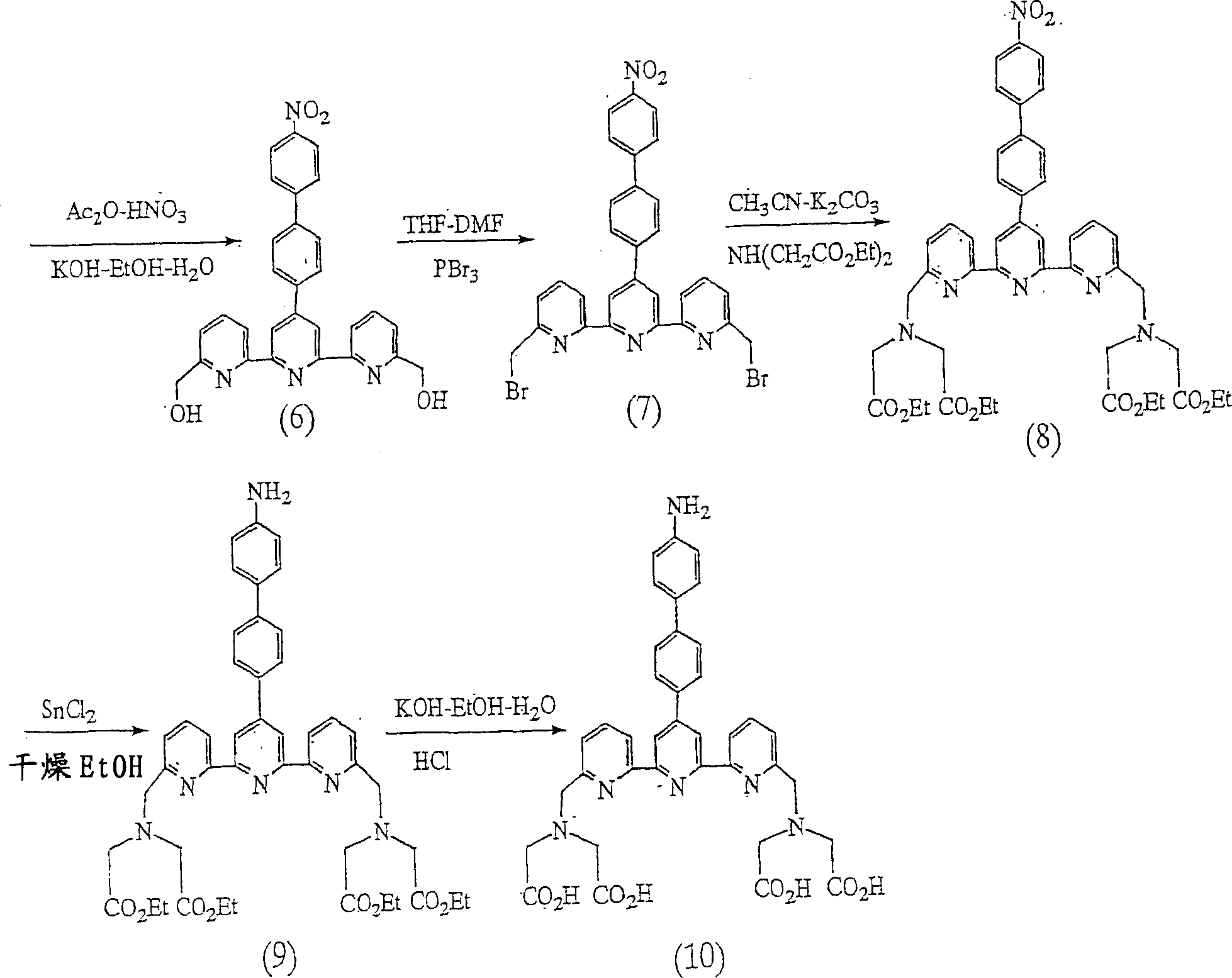
通式[1-1]所示化合物[(4’-(4””-氨基-联苯-4-基)-2,2’:6’,2”-三吡啶-6,6”-二基)二(亚甲基氮川)]四乙酸(以下简称为ATBTA))的合成The compound represented by the general formula [1-1] [(4'-(4""-amino-biphenyl-4''-yl)-2,2':6',2"-tripyridine-6,6"- Diyl) bis (methylene nitrogen)] tetraacetic acid (hereinafter referred to as ATBTA)) synthesis
(1)4’-(联苯-4-基)-2,2’:6’,2”-三吡啶)(上述反应流程中的化合物(1))的合成(1) Synthesis of 4'-(biphenyl-4''-yl)-2,2':6',2"-tripyridine) (compound (1) in the above reaction scheme)
将N-[2-(吡啶-2’-基)-2-氧代乙基]吡啶输碘化物(16.3g,50mmol)、(E)-3-(联苯-4”-基)-1-(吡啶-2’-基)-2-丙烯酮(14.26g,50mmol)和乙酸铵(23.1g)加入到500ml干燥的甲醇中,在搅拌下回流24小时。将反应液冷却,并将沉淀过滤,在冷甲醇中充分洗净后,从乙腈中重结晶,得到化合物(1)。真空干燥后收率为49.3%。N-[2-(pyridin-2'-yl)-2-oxoethyl]pyridine iodide (16.3g, 50mmol), (E)-3-(biphenyl-4"-yl)-1 -(pyridine-2'-yl)-2-propenone (14.26g, 50mmol) and ammonium acetate (23.1g) were added in 500ml of dry methanol, and refluxed for 24 hours under stirring.The reaction solution was cooled, and the precipitate was After filtering, fully washing in cold methanol, and recrystallizing from acetonitrile, compound (1) was obtained. The yield after vacuum drying was 49.3%.
元素分析结果(C27H19N3):Elemental analysis results (C 27 H 19 N 3 ):
计算值(%),C=84.13,H=4.97,N=10.90Calculated value (%), C=84.13, H=4.97, N=10.90
实测值(%),C=84.01,H=4.82,N=10.88Measured value (%), C=84.01, H=4.82, N=10.88
进一步由1H NMR确认生成物为目标化合物。Further, it was confirmed by 1 H NMR that the product was the target compound.
1H NMR(CDCl3):δ8.80(s,2H),8.75(d,J=4.6Hz,2H),8.69(d,J=7.8Hz,2H),8.01(d,J=8.6Hz,2H),7.89(t,J=7.6Hz,2H),7.75(d,J=8.2Hz,2H),7.68(d,J=6.9Hz,2H),7.48(t,J=6.9Hz,2H),7.41-7.33(m,3H)。 1 H NMR (CDCl 3 ): δ8.80(s, 2H), 8.75(d, J=4.6Hz, 2H), 8.69(d, J=7.8Hz, 2H), 8.01(d, J=8.6Hz, 2H), 7.89(t, J=7.6Hz, 2H), 7.75(d, J=8.2Hz, 2H), 7.68(d, J=6.9Hz, 2H), 7.48(t, J=6.9Hz, 2H) , 7.41-7.33 (m, 3H).
(2)4’-(联苯-4-基)-2,2’:6’,2”-三吡啶)-1,1”-二氧化物(上述反应流程中的化合物(2))的合成(2) 4'-(biphenyl-4-yl)-2,2':6',2"-tripyridine)-1,1"-dioxide (compound (2) in the above reaction scheme) Synthesis
将上述反应流程中的化合物(1)(19.27g,50mmol)溶解在700ml的CH2Cl2中,向其中加入50g的3-氯代过氧化苯甲酸,在室温下搅拌20小时。将反应液用3×300ml的10%Na2CO3水溶液洗净,用Na2SO4干燥有机相后,减压蒸馏除去溶剂。将生成物溶解在300ml的甲醇中,滤去微量的不溶物之后,减压蒸馏除去溶剂。将生成物用乙腈充分清洗,通过真空干燥获得化合物(2)。产率为91.4%。由1H NMR确认生成物为目标化合物。Compound (1) (19.27 g, 50 mmol) in the above reaction scheme was dissolved in 700 ml of CH 2 Cl 2 , 50 g of 3-chloroperoxybenzoic acid was added thereto, and stirred at room temperature for 20 hours. The reaction liquid was washed with 3×300 ml of 10% Na 2 CO 3 aqueous solution, and the organic phase was dried with Na 2 SO 4 , and the solvent was distilled off under reduced pressure. The product was dissolved in 300 ml of methanol, and a small amount of insoluble matter was filtered off, and then the solvent was distilled off under reduced pressure. The product was sufficiently washed with acetonitrile, and vacuum-dried to obtain compound (2). The yield was 91.4%. The product was confirmed to be the target compound by 1 H NMR.
1H NMR(CDCl3):δ9.29(s,2H),8.38(d,J=6.6Hz,2H),8.25(d,J=8.2Hz,2H),7.94(d,J=8.6Hz,2H),7.72(d,J=8.6Hz,2H),7.66(d,J=6.9Hz,2H),7.50-7.43(m,2H),7.41-7.29(m,5H)。 1 H NMR (CDCl 3 ): δ9.29(s, 2H), 8.38(d, J=6.6Hz, 2H), 8.25(d, J=8.2Hz, 2H), 7.94(d, J=8.6Hz, 2H), 7.72(d, J=8.6Hz, 2H), 7.66(d, J=6.9Hz, 2H), 7.50-7.43(m, 2H), 7.41-7.29(m, 5H).
(3)4’-(联苯-4-基)-2,2’:6’,2”-三吡啶-6,6”-二腈(上述反应流程中的化合物(3))的合成(3) Synthesis of 4'-(biphenyl-4''-yl)-2,2':6',2"-tripyridine-6,6"-dinitrile (compound (3) in the above reaction scheme)
向450ml的CH2Cl2中加入25mmol上述反应流程中的化合物(2)(15.65g,37.5mmol)和(CH3)3SiCN(37.2g,375mmol),在室温下搅拌20分钟后,花费大约20分钟慢慢滴加150mmol的氯化苯甲酰。在室温下将反应液搅拌24小时后,减压下馏去溶剂,直至一半量。向剩余的溶液中加入600ml 10%的K2CO3的水溶液,在室温下搅拌1小时后,将沉淀过滤,用水充分洗净,此后用冷的CH2Cl2洗净,之后真空干燥得到化合物(3)。产率为80.8%。由1H NMR确认生成物为目标化合物。To 450ml of CH 2 Cl 2 , add 25 mmol of compound (2) (15.65 g, 37.5 mmol) and (CH 3 ) 3 SiCN (37.2 g, 375 mmol) in the above reaction scheme in 25 mmol, after stirring at room temperature for 20 minutes, it takes about 150 mmol of benzoyl chloride was slowly added dropwise for 20 minutes. After the reaction liquid was stirred at room temperature for 24 hours, the solvent was distilled off under reduced pressure until half of the volume was obtained. Add 600ml of 10% K 2 CO 3 aqueous solution to the remaining solution, stir at room temperature for 1 hour, filter the precipitate, wash it well with water, then wash it with cold CH 2 Cl 2 , and then dry it in vacuum to obtain the compound (3). The yield was 80.8%. The product was confirmed to be the target compound by 1 H NMR.
1H NMR(DMSO-d6):δ8.99(d,J=7.6Hz,2H),8.75(s,2H),8.31(t,J=7.9Hz,2H),8.20(d,J=7.6Hz,2H),8.10(d,J=7.6Hz,2H),7.92(d,J=8.2Hz,2H),7.78(d,J=7.6Hz,2H),7.54-7.42(m,3H)。 1 H NMR (DMSO-d 6 ): δ8.99(d, J=7.6Hz, 2H), 8.75(s, 2H), 8.31(t, J=7.9Hz, 2H), 8.20(d, J=7.6 Hz, 2H), 8.10 (d, J=7.6Hz, 2H), 7.92 (d, J=8.2Hz, 2H), 7.78 (d, J=7.6Hz, 2H), 7.54-7.42 (m, 3H).
(4)4’-(联苯-4-基)-2,2’:6’,2”-三吡啶-6,6”-二羧酸二甲基酯(上述反应流程中的化合物(4))的合成(4) 4'-(biphenyl-4''-yl)-2,2':6',2"-tripyridine-6,6"-dicarboxylic acid dimethyl ester (the compound in the above reaction scheme ( 4) Synthesis of
向H2SO490ml/CH3COOH 90ml/H2O 20ml的混合溶剂中加入8.17g(20mmol)的上述反应流程中的化合物(3),在90-100℃下搅拌24小时。向800g冰中加入反应液,搅拌后,将沉淀过滤,用水和乙醇充分洗净后,真空干燥得到9.13g水解产物。8.17 g (20 mmol) of the compound (3) in the above reaction scheme was added to a mixed solvent of H 2 SO 4 90 ml/CH 3 COOH 90 ml/H 2 O 20 ml, and stirred at 90-100° C. for 24 hours. The reaction solution was added to 800 g of ice, and after stirring, the precipitate was filtered, thoroughly washed with water and ethanol, and vacuum-dried to obtain 9.13 g of a hydrolyzate.
向已用冰水冷却了的600ml干燥甲醇中加入24g亚硫酰氯SOCl2,搅拌15分钟后,加入如上所得的9.13g水解产物,在搅拌下回流24小时。减压蒸馏除去溶剂,将生成物溶解在1000ml的氯仿CHCl3中,采用15%的NaHCO3水溶液将有机层充分洗净后,用Na2SO4干燥。减压蒸馏除去溶剂,将生成物在硅胶色谱柱(展开溶剂:CH2Cl2-CH3OH=99∶1w/w)上进行纯化。从甲苯中将该生成物进行重结晶,得到化合物(4)。产率为48.5%。Add 24 g of thionyl chloride SOCl 2 to 600 ml of dry methanol cooled with ice water, stir for 15 minutes, add 9.13 g of the hydrolyzate obtained above, and reflux for 24 hours while stirring. The solvent was distilled off under reduced pressure, the product was dissolved in 1000 ml of chloroform CHCl 3 , the organic layer was sufficiently washed with 15% NaHCO 3 aqueous solution, and dried over Na 2 SO 4 . The solvent was distilled off under reduced pressure, and the product was purified on a silica gel chromatography column (developing solvent: CH 2 Cl 2 -CH 3 OH=99:1 w/w). This product was recrystallized from toluene to obtain compound (4). The yield was 48.5%.
元素分析结果(C31H23N3O4):Elemental analysis results (C 31 H 23 N 3 O 4 ):
计算值(%),C=74.24,H=4.62,N=8.38Calculated value (%), C=74.24, H=4.62, N=8.38
实测值(%),C=74.15,H=4.55,N=8.38Measured value (%), C=74.15, H=4.55, N=8.38
进一步由1H NMR确认生成物为目标化合物。Further, it was confirmed by 1 H NMR that the product was the target compound.
1H NMR(CDCl3):δ8.88(s,2H),8.86(d,J=7.9Hz,2H),8.20(t,J=7.6Hz,2H),8.06(d,J=7.9Hz,2H),8.00(d,J=7.2Hz,2H),7.78(d,J=6.6Hz,2H),7.70(d,J=6.9Hz,2H),7.52-7.30(m,3H)4.07(s,6H)。 1 H NMR (CDCl 3 ): δ8.88(s, 2H), 8.86(d, J=7.9Hz, 2H), 8.20(t, J=7.6Hz, 2H), 8.06(d, J=7.9Hz, 2H), 8.00(d, J=7.2Hz, 2H), 7.78(d, J=6.6Hz, 2H), 7.70(d, J=6.9Hz, 2H), 7.52-7.30(m, 3H)4.07(s , 6H).
(5)4’-(联苯-4-基)-2,2’:6’,2”-三吡啶-6,6”-二羟基甲基(上述反应流程中的化合物(5))的合成(5) 4'-(biphenyl-4-yl)-2,2':6',2"-tripyridine-6,6"-dihydroxymethyl (compound (5) in the above reaction scheme) Synthesis
向400ml干燥的乙醇中加入上述反应流程中的化合物(4)(7.02g,14mmol)和3.02gNaBH4,在室温下搅拌3小时后,回流1小时,减压蒸馏除去溶剂,将生成物加入到200ml的饱和NaHCO3水溶液中,搅拌下加热直至沸腾。冷却后,将沉淀过滤,用水充分洗净后,进行真空干燥,获得化合物(5)。产率为92.0%。由1H NMR确认生成物为目标化合物。Add compound (4) (7.02g, 14mmol) and 3.02gNaBH in 400ml dry ethanol in the above-mentioned reaction scheme 4 After stirring at room temperature for 3 hours, reflux for 1 hour, remove the solvent by distillation under reduced pressure, and add the product to 200ml of saturated NaHCO 3 aqueous solution, heated with stirring until boiling. After cooling, the precipitate was filtered, washed well with water, and dried in vacuo to obtain compound (5). The yield was 92.0%. The product was confirmed to be the target compound by 1 H NMR.
1H NMR(DMSO-d6):δ8.75(s,2H),8.55(d,J=7.9Hz,2H),8.07-8.00(m,4H),7.92(t,J=8.2Hz,2H),7.78(d,J=7.2Hz,2H),7.61(d,J=7.9Hz,2H),7.57-7.50(m,2H)7.46-7.40(m,1H)5.57(t,J=5.9Hz,2H),4.47(d,J=4.6Hz,4H)。 1 H NMR (DMSO-d 6 ): δ8.75(s, 2H), 8.55(d, J=7.9Hz, 2H), 8.07-8.00(m, 4H), 7.92(t, J=8.2Hz, 2H ), 7.78(d, J=7.2Hz, 2H), 7.61(d, J=7.9Hz, 2H), 7.57-7.50(m, 2H), 7.46-7.40(m, 1H) 5.57(t, J=5.9Hz , 2H), 4.47 (d, J=4.6Hz, 4H).
(6)4’-(4””-硝基-联苯-4-基)-2,2’:6’,2”-三吡啶-6,6”-二羟基甲基(上述反应流程中的化合物(6))的合成(6) 4'-(4""-nitro-biphenyl-4-yl)-2,2': 6', 2"-tripyridine-6,6"-dihydroxymethyl (the above reaction process Synthesis of compound (6)) in
将上述反应流程中的化合物(5)(1.78g,4mmol)加入到30ml的乙酸酐中,在60℃下搅拌15分钟。减压蒸馏除去溶剂,向生成物中加入20ml的乙酸酐,用冰水进行外部冷却的条件下,滴加3ml发烟硝酸和20ml乙酸的混和溶液后,用冰水进行外部冷却的条件下,搅拌2小时后,进一步在室温下搅拌24小时。向反应液中加入250ml的水,搅拌1小时后,用3×100ml的CHCl3进行萃取,用5%的NaHCO3水溶液对CHCl3溶液进行清洗,用Na2SO4干燥后,减压蒸馏除去溶剂。将生成物溶解在150ml乙醇中,加入10gKOH和15ml水,在室温下搅拌36小时。向反应液中加入300ml的水,通过离心分离收集沉淀,真空干燥5小时后,用水充分洗净。真空干燥获得化合物(6)。产率为90.7%。由1H NMR确认生成物为目标化合物和4’-(2””-硝基-联苯-4-基)-2,2’:6’,2”-三吡啶-6,6”-二羟基甲基的混合物。Compound (5) (1.78 g, 4 mmol) in the above reaction scheme was added to 30 ml of acetic anhydride, and stirred at 60° C. for 15 minutes. The solvent was distilled off under reduced pressure, 20 ml of acetic anhydride was added to the product, and under the condition of external cooling with ice water, a mixed solution of 3 ml of fuming nitric acid and 20 ml of acetic acid was added dropwise, and then under the condition of external cooling with ice water, After stirring for 2 hours, it was further stirred at room temperature for 24 hours. Add 250ml of water to the reaction solution, stir for 1 hour, extract with 3×100ml of CHCl 3 , wash the CHCl 3 solution with 5% NaHCO 3 aqueous solution, dry it with Na 2 SO 4 , and distill it off under reduced pressure solvent. The resultant was dissolved in 150 ml of ethanol, 10 g of KOH and 15 ml of water were added, and stirred at room temperature for 36 hours. 300 ml of water was added to the reaction solution, and the precipitate was collected by centrifugation, vacuum-dried for 5 hours, and washed with water sufficiently. Compound (6) was obtained by vacuum drying. The yield was 90.7%. It was confirmed by 1 H NMR that the product was the target compound and 4'-(2""-nitro-biphenyl-4''-yl)-2,2':6',2"-tripyridine-6,6"- Dihydroxymethyl mixture.
1H NMR(DMSO-d6):δ8.81-8.79(m,2H),8.61(d,J=7.9Hz,2H)8.37(d,J=7.2Hz,1H),8.17-8.03(m,6H),7.88-7.80(m,1H)7.75-7.58(m,4H),4.78(s,1H)。 1 H NMR (DMSO-d 6 ): δ8.81-8.79 (m, 2H), 8.61 (d, J=7.9Hz, 2H) 8.37 (d, J=7.2Hz, 1H), 8.17-8.03 (m, 6H), 7.88-7.80 (m, 1H), 7.75-7.58 (m, 4H), 4.78 (s, 1H).
(7)4’-(4””-硝基-联苯-4-基)-2,2’:6’,2”-三吡啶-6,6”-二溴代甲基(上述反应流程中的化合物(7))的合成(7) 4'-(4""-nitro-biphenyl-4''-yl)-2,2':6',2"-tripyridine-6,6"-dibromomethyl (the above reaction Synthesis of compound (7)) in the scheme
将上述反应流程中的化合物(6)(1.78g,3.63mmol)加入到200mlTHF-80mlDMF的混和溶剂中,使其溶解,加入3.52g的PBr3,在搅拌下回流6小时。减压蒸馏除去溶剂后,向生成物中加入300ml的CHCl3,用4×200ml饱和Na2SO4水溶液对有机层进行清洗后,进一步用200ml 10%的NaHCO3水溶液进行洗净。有机层用Na2SO4干燥,减压蒸馏除去溶剂后,用硅胶色谱柱(展开溶剂:CH2Cl2-CH3OH=99.5∶0.5v/v)对生成物进行纯化,减压蒸馏除去溶剂,并真空干燥获得化合物(7)。产率为56.3%。Compound (6) (1.78g, 3.63mmol) in the above reaction scheme was added into a mixed solvent of 200mlTHF-80mlDMF to dissolve, and 3.52g of PBr 3 was added, and refluxed for 6 hours under stirring. After distilling off the solvent under reduced pressure, 300 ml of CHCl 3 was added to the resultant, and the organic layer was washed with 4×200 ml of saturated Na 2 SO 4 aqueous solution, and further washed with 200 ml of 10% NaHCO 3 aqueous solution. The organic layer was dried over Na 2 SO 4 , and the solvent was distilled off under reduced pressure. The product was purified by silica gel column chromatography (developing solvent: CH 2 Cl 2 -CH 3 OH=99.5:0.5 v/v), and distilled off under reduced pressure. solvent, and vacuum drying to obtain compound (7). The yield was 56.3%.
元素分析结果(C29H20Br2N4O2):Elemental analysis results (C 29 H 20 Br 2 N 4 O 2 ):
计算值(%),C=56.52,H=3.27,N=9.09。Calculated value (%), C=56.52, H=3.27, N=9.09.
实测值(%),C=56.64,H=3.32,N=9.10。Found value (%), C=56.64, H=3.32, N=9.10.
质量分析结果(FAB-MS):Quality analysis results (FAB-MS):
m/e,617.3(M+H+),571.3(M-NO2)m/e, 617.3(M+H + ), 571.3(M-NO 2 )
进一步由1H NMR确认生成物为目标化合物和4’-(2””-硝基-联苯-4-基)-2,2’:6’,2”-三吡啶-6,6”-二溴代甲基的混合物。It was further confirmed by 1 H NMR that the product was the target compound and 4'-(2""-nitro-biphenyl-4-yl)-2,2':6',2"-tripyridine-6,6" - Mixtures of dibromomethyl.
1H NMR(CDCL3):δ8.70(s,1H),8.69(s,1H),8.57(d,J=7.9Hz,2H),8.33(d,J=8.8Hz,1H),8.10-8.00(m,6H),7.95(d,J=8.2Hz,1H),7.70-7.55(m,4H),4.84(s,4H) 1 H NMR (CDCL 3 ): δ8.70(s, 1H), 8.69(s, 1H), 8.57(d, J=7.9Hz, 2H), 8.33(d, J=8.8Hz, 1H), 8.10- 8.00(m, 6H), 7.95(d, J=8.2Hz, 1H), 7.70-7.55(m, 4H), 4.84(s, 4H)
(8)N,N,N’,N’[(4’-(4””-硝基-联苯-4-基)-2,2’:6’,2”-三吡啶-6,6”-二基)-二(亚甲基氮川)]四乙酸四乙酯(上述反应流程中的化合物(8))的合成(8) N, N, N', N'[(4'-(4""-nitro-biphenyl-4-yl)-2,2':6',2"-tripyridine-6, Synthesis of 6"-diyl)-bis(methylenenitrogen)]tetraethyl tetraacetate (compound (8) in the above reaction scheme)
将1.98mmol上述反应流程中的化合物(7)(1.22g,)溶解在250mlCH3CN-50mlTHF的混合溶剂中,并加入4.1mmol的亚胺二乙酸二乙酯和20mmol的K2CO3,搅拌下回流24小时。过滤除去不溶物,减压蒸馏除去溶剂后,向生成物中加入250ml的CHCl3,用2×200ml的饱和Na2SO4水溶液对CHCl3溶液进行清洗。用Na2SO4干燥有机相,减压蒸馏除去溶剂后,获得油状产物,用硅胶色谱柱(展开溶剂:CH3COOEt)进行纯化,减压蒸馏除去溶剂并真空干燥,获得化合物(8),产率为46.1%。由1H NMR确认生成物为目标化合物和4’-(2””-硝基-联苯-4-基)-2,2’:6’,2”-三吡啶-6,6”-二基)-二(亚甲基氮川)]四乙酸四乙酯的混和物。1.98mmol of compound (7) (1.22g) in the above reaction scheme was dissolved in a mixed solvent of 250mlCH 3 CN-50mlTHF, and 4.1mmol of diethyl iminodiacetate and 20mmol of K 2 CO 3 were added, and stirred Under reflux for 24 hours. Insoluble matter was removed by filtration, and the solvent was distilled off under reduced pressure. 250 ml of CHCl 3 was added to the product, and the CHCl 3 solution was washed with 2×200 ml of saturated Na 2 SO 4 aqueous solution. The organic phase was dried with Na 2 SO 4 , and the solvent was distilled off under reduced pressure to obtain an oily product, which was purified by silica gel chromatography (developing solvent: CH 3 COOEt), the solvent was distilled off under reduced pressure and dried in vacuo to obtain compound (8), The yield was 46.1%. It was confirmed by 1 H NMR that the product was the target compound and 4'-(2""-nitro-biphenyl-4''-yl)-2,2':6',2"-tripyridine-6,6"- Diyl) - two (methylene nitrogen Chuan)] tetraethyl tetraacetate mixture.
1H NMR(CDCl3):δ8.77(s,2H),8.57(d,J=7.9Hz,2H),8.36(d,J=8.6Hz,1H),8.05(d,J=7.9Hz,1H),7.98-7.79(m,6H),7.66(d,J=7.6Hz,2H),7.57-7.42(m,2H),4.21(s,4H),4.17(q,J=7.3Hz,8H),3.71(s,8H),1.24(t,J=7.3Hz,12H)。 1 H NMR (CDCl 3 ): δ8.77(s, 2H), 8.57(d, J=7.9Hz, 2H), 8.36(d, J=8.6Hz, 1H), 8.05(d, J=7.9Hz, 1H), 7.98-7.79(m, 6H), 7.66(d, J=7.6Hz, 2H), 7.57-7.42(m, 2H), 4.21(s, 4H), 4.17(q, J=7.3Hz, 8H ), 3.71 (s, 8H), 1.24 (t, J=7.3Hz, 12H).
(9)N,N,N’,N’[(4’-(4””-氨基-联苯-4-基)-2,2’:6’,2”-三吡啶-6,6”-二基)-二(亚甲基氮川)]四乙酸四乙酯(上述反应流程中的化合物(9))的合成(9) N, N, N', N'[(4'-(4""-amino-biphenyl-4-yl)-2,2':6',2"-tripyridine-6,6 "-diyl)-bis(methylene nitrogen)] tetraethyl tetraacetate (compound (9) in the above reaction scheme) synthetic
将0.91mmol上述反应流程中的化合物(8)(0.76g)溶解在60ml的EtOH中,加入SnCl2·2H2O(1.25g,5.7mmol)后,在70-80℃下搅拌1小时。冷却至室温后,注入已经用冰水冷却了的120mlH2O-7.85g DTPA的溶液中,搅拌后,向该溶液中加入20ml的饱和NaHCO3水溶液。室温下搅拌30分钟后,用4×100ml的CHCl3萃取水溶液,用Na2SO4对有机层进行干燥。减压蒸馏除去溶剂,生成物用硅胶色谱柱(展开溶剂:CH3COOEt-CH3OH=98∶2v/v)对生成物进行纯化,减压蒸馏除去溶剂,并真空干燥获得化合物(9)。产率为79.2%。由1H NMR确认生成物为目标化合物。Dissolve 0.91 mmol of compound (8) (0.76 g) in the above reaction scheme in 60 ml of EtOH, add SnCl 2 ·2H 2 O (1.25 g, 5.7 mmol), and stir at 70-80° C. for 1 hour. After cooling to room temperature, it was poured into a solution of 120ml H 2 O-7.85g DTPA that had been cooled with ice water, and after stirring, 20ml of saturated NaHCO 3 aqueous solution was added to the solution. After stirring at room temperature for 30 minutes, the aqueous solution was extracted with 4×100 ml of CHCl 3 , and the organic layer was dried with Na 2 SO 4 . The solvent was distilled off under reduced pressure, and the product was purified by silica gel column chromatography (developing solvent: CH 3 COOEt-CH 3 OH=98:2v/v), the solvent was distilled off under reduced pressure, and dried in vacuo to obtain compound (9) . The yield was 79.2%. The product was confirmed to be the target compound by 1 H NMR.
1H NMR(CDCl3):δ8.76(s,2H),8.55(d,J=7.3Hz,2H),8.00-7.84(m,4H),7.72-7.62(m,4H),7.51(d,J=8.6Hz,2H),6.81(d,J=8.6Hz,2H),4.21(s,4H),4.17(q,J=7.3Hz,8H)3.71(s,8H),1.24(t,J=7.3Hz,12H)。 1 H NMR (CDCl 3 ): δ8.76(s, 2H), 8.55(d, J=7.3Hz, 2H), 8.00-7.84(m, 4H), 7.72-7.62(m, 4H), 7.51(d , J=8.6Hz, 2H), 6.81(d, J=8.6Hz, 2H), 4.21(s, 4H), 4.17(q, J=7.3Hz, 8H), 3.71(s, 8H), 1.24(t, J=7.3Hz, 12H).
(10)[(4’-(4””-氨基-联苯-4-基)-2,2’:6’,2”-三吡啶-6,6”-二基)-二(亚甲基氮川)]四乙酸(ATBTA,上述反应流程中的化合物(10))的合成(10) [(4'-(4""-amino-biphenyl-4''-yl)-2,2':6',2"-tripyridine-6,6"-diyl)-bis( Synthesis of methylnitrogen)]tetraacetic acid (ATBTA, compound (10) in the above reaction scheme)
将上述反应流程中的化合物(9)(580mg,0.72mmol)溶解在100mlEtOH-5ml H2O-2.2gKOH的溶液中,在室温下搅拌20小时后,减压蒸馏除去溶剂。将生成物溶解在100ml的水中,在搅拌下慢慢滴加稀释了10倍的盐酸水溶液,将溶液的pH值调节至约1。在室温下搅拌3小时后,将沉淀离心收集,用稀释了100倍的盐酸水溶液充分洗净后,真空干燥获得化合物(10)。产率为65.9%。Compound (9) (580 mg, 0.72 mmol) in the above reaction scheme was dissolved in a solution of 100 ml EtOH-5 ml H 2 O-2.2 g KOH, stirred at room temperature for 20 hours, and the solvent was distilled off under reduced pressure. The resultant was dissolved in 100 ml of water, and a 10-fold diluted hydrochloric acid aqueous solution was slowly added dropwise with stirring to adjust the pH of the solution to about 1. After stirring at room temperature for 3 hours, the precipitate was collected by centrifugation, washed thoroughly with aqueous hydrochloric acid diluted 100 times, and dried in vacuo to obtain compound (10). The yield was 65.9%.
元素分析结果(ATBTA·3HCl·4H2O,C37H45N6O12Cl3):Elemental analysis results (ATBTA·3HCl·4H 2 O, C 37 H 45 N 6 O 12 Cl 3 ):
计算值(%),C=50.95,H=5.20,N=9.64。Calculated value (%), C=50.95, H=5.20, N=9.64.
实测值(%),C=51.05,H=5.36,N=9.65。Actual value (%), C=51.05, H=5.36, N=9.65.
进一步由1H NMR确认生成物为目标化合物。Further, it was confirmed by 1 H NMR that the product was the target compound.
1H NMR(DMSO-d6):δ 1 H NMR (DMSO-d 6 ): δ
8.89(s,2H),8.75(d,J=7.9Hz,2H),8.23-8.05(m,4H),7.96-7.80(m,2H),7.75(d,J=7.6Hz,2H),7.60-7.45(m,4H),4.68(s,4H),4.24(s,8H)。8.89(s, 2H), 8.75(d, J=7.9Hz, 2H), 8.23-8.05(m, 4H), 7.96-7.80(m, 2H), 7.75(d, J=7.6Hz, 2H), 7.60 -7.45 (m, 4H), 4.68 (s, 4H), 4.24 (s, 8H).
将上述ATBTA·3HCl·4H2O进一步用纯水和乙腈充分洗净后,真空干燥获得ATBTA。The above-mentioned ATBTA·3HCl·4H 2 O was further thoroughly washed with pure water and acetonitrile, and then vacuum-dried to obtain ATBTA.
元素分析结果(C37H34N6O8):Elemental analysis results (C 37 H 34 N 6 O 8 ):
计算值(%),C=64.34,H=4.96,N=12.17。Calculated value (%), C=64.34, H=4.96, N=12.17.
实测值(%),C=63.89,H=5.11,N=12.14。Found value (%), C=63.89, H=5.11, N=12.14.
进一步由1H NMR确认生成物为目标化合物。Further, it was confirmed by 1 H NMR that the product was the target compound.
1H NMR(DMSO-d6):δ8.75(s,2H),8.56(d,J=7.9Hz,2H),8.06-8.00(m,4H),7.93-7.71(m,2H),7.66(d,J=7.6Hz,2H),7.60-7.40(m,4H),4.13(s,4H),3.59(s,8H)。 1 H NMR (DMSO-d 6 ): δ8.75 (s, 2H), 8.56 (d, J=7.9Hz, 2H), 8.06-8.00 (m, 4H), 7.93-7.71 (m, 2H), 7.66 (d, J = 7.6 Hz, 2H), 7.60-7.40 (m, 4H), 4.13 (s, 4H), 3.59 (s, 8H).
实施例11 合成ATBTA和铕的络合物Example 11 Synthesis of complexes of ATBTA and europium
将所述实施例10制造出的ATBTA·3HCl·4H2O(0.2mmol,164.4mg)加入到4.0ml水中,采用固体NaHCO3将溶液的pH值调节至6.5后,加入EuCl3·6H2O(0.22mmol,80.6mg)-H2O1.5ml的溶液,采用NaHCO3使溶液的pH值保持为6.5,搅拌1.5小时。采用1M的NaOH溶液将反应液的pH值调节至8.5,此后,过滤除去沉淀,回收滤液。向滤液中加入80ml的丙酮,析出络合物。离心收集络合物,用丙酮充分洗净后,真空干燥获得ATBTA和铕的络合物。产量为180mg。Add ATBTA·3HCl·4H 2 O (0.2 mmol, 164.4 mg) produced in Example 10 into 4.0 ml of water, adjust the pH value of the solution to 6.5 with solid NaHCO 3 , then add EuCl 3 ·6H 2 O (0.22mmol, 80.6mg)-H 2 O 1.5ml solution, using NaHCO 3 to keep the pH value of the solution at 6.5, stirred for 1.5 hours. The pH value of the reaction solution was adjusted to 8.5 by using 1M NaOH solution, after that, the precipitate was removed by filtration, and the filtrate was recovered. Add the acetone of 80ml in the filtrate, separate out complex compound. The complex was collected by centrifugation, thoroughly washed with acetone, and vacuum-dried to obtain a complex of ATBTA and europium. Yield is 180mg.
元素分析结果[Na[C37H30N6O8Eu]·(NaHCO3)3·(NaCl)2·(H2O)4]:Elemental analysis results [Na[C 37 H 3 0N 6 O 8 Eu]·(NaHCO 3 ) 3 ·(NaCl) 2 ·(H 2 O) 4 ]:
计算值(%):C=36.88,H=3.17,N=6.45。Calculated values (%): C=36.88, H=3.17, N=6.45.
实测值(%):C=36.74,H=3.09,N=6.26。Found values (%): C=36.74, H=3.09, N=6.26.
实施例12 向ATBTA-Eu3+络合物中导入氨基反应活性取代基:Example 12 Introduction of amino reactive substituents into ATBTA-Eu 3+ complex:
将按照实施例11中记载的方法制得的ATBTA-Eu3+络合物溶解在3.0mlpH=4.9的0.1M乙酸钠缓冲溶液中,加入2,4,6-三氯代-1,3,5-三氮烯(36mg,0.2mmol),在搅拌下加入2ml丙酮和2ml水。在室温下搅拌30分钟后。加入120ml的丙酮,析出络合物。通过离心分离收集沉淀,用丙酮充分洗净后,真空干燥,获得具有活性取代基的络合物。产量为139mg。The ATBTA-Eu 3+ complex prepared according to the method described in Example 11 was dissolved in 3.0 ml of 0.1 M sodium acetate buffer solution with pH=4.9, 2,4,6-trichloro-1,3 was added, 5-Triazene (36mg, 0.2mmol), add 2ml acetone and 2ml water under stirring. After stirring at room temperature for 30 minutes. Add 120ml of acetone to precipitate the complex. The precipitate was collected by centrifugation, washed thoroughly with acetone, and dried in vacuum to obtain a complex with an active substituent. Yield was 139 mg.
实施例13 具有活性取代基的ATBTA-Eu3+络合物的荧光特性Example 13 Fluorescent properties of ATBTA-Eu 3+ complexes with active substituents
在1.5×10⁻⁶M、pH为9.1的0.05M的硼酸缓冲液中,测定实施例12制得的具有活性取代基的ATBTA-Eu3+络合物的荧光特性。In 1.5×10 -6 M, 0.05M boric acid buffer solution with pH 9.1, the fluorescence properties of the ATBTA-Eu 3+ complex with active substituents prepared in Example 12 were measured.
测定结果示于图4,图4的纵轴表示相对荧光强度,横轴表示波长(nm)。图4中的Ex表示激励光谱,Em表示发光光谱,Ex-TR表示时间分辨激励光谱,Em-TR表示时间分辨发光光谱。The measurement results are shown in Fig. 4, where the vertical axis in Fig. 4 represents the relative fluorescence intensity, and the horizontal axis represents the wavelength (nm). Ex in Fig. 4 represents the excitation spectrum, Em represents the emission spectrum, Ex-TR represents the time-resolved excitation spectrum, and Em-TR represents the time-resolved emission spectrum.
该物质的荧光特性为:最大吸收波长为335nm,摩尔吸光系数为3.11×10⁴M-1cm-1,最大荧光波长为616nm,荧光量子产率为0.091,荧光寿命为1.02ms。The fluorescence characteristics of the substance are: the maximum absorption wavelength is 335nm, the molar absorptivity coefficient is 3.11×10⁴M -1 cm -1 , the maximum fluorescence wavelength is 616nm, the fluorescence quantum yield is 0.091, and the fluorescence lifetime is 1.02ms.
实施例14 通式[2-1]所示化合物的制造The manufacture of the compound shown in embodiment 14 general formula [2-1]
通过以下所示的反应流程,制造R基为联苯-4-基的通式[2-1]所示的化合物。According to the reaction scheme shown below, the compound represented by the general formula [2-1] whose R group is a biphenyl-4-yl group is produced.
通式[2-1]所示化合物的合成Synthesis of compounds shown in general formula [2-1]
(1)4’-(联苯-4-基)-2,2’:6’,2”-三吡啶-6,6”-二溴代甲基的合成(1) Synthesis of 4'-(biphenyl-4-yl)-2,2':6',2"-tripyridine-6,6"-dibromomethyl
将4’-(联苯-4-基)-2,2’:6’,2”-三吡啶-6,6”-二羟基甲基(4.46g,10mmol)加入到400mlTHF-150mlDMF的混和溶剂中,使其溶解,加入8.1g的PBr3,在搅拌下回流16小时。减压蒸馏除去溶剂后,向生成物中加入400ml的CHCl3,用4×200ml饱和Na2SO4水溶液对有机层进行清洗后,进一步用200ml 10%的NaHCO3水溶液进行洗净。有机层用Na2SO4干燥,减压蒸馏除去溶剂后,用硅胶色谱柱(展开溶剂:CH2Cl2-CH3OH=99∶1v/v)对生成物进行纯化,减压蒸馏除去溶剂,并真空干燥获得4’-(联苯-4-基)-2,2’:6’,2”-三吡啶-6,6”-二溴代甲基。产率为80.6%。Add 4'-(biphenyl-4''-yl)-2,2':6',2"-tripyridine-6,6"-dihydroxymethyl (4.46g, 10mmol) to a mixture of 400mlTHF-150mlDMF It was dissolved in a solvent, 8.1 g of PBr 3 was added, and it was refluxed for 16 hours while stirring. After distilling off the solvent under reduced pressure, 400 ml of CHCl 3 was added to the product, and the organic layer was washed with 4×200 ml of saturated Na 2 SO 4 aqueous solution, and then washed with 200 ml of 10% NaHCO 3 aqueous solution. The organic layer was dried over Na 2 SO 4 , and the solvent was distilled off under reduced pressure. The product was purified by silica gel column chromatography (developing solvent: CH 2 Cl 2 -CH 3 OH=99:1 v/v), and the solvent was distilled off under reduced pressure. , and vacuum-dried to obtain 4'-(biphenyl-4''-yl)-2,2':6',2"-tripyridine-6,6"-dibromomethyl. The yield was 80.6%.
元素分析结果(C29H21Br2N3):Elemental analysis results (C 29 H 21 Br 2 N 3 ):
计算值(%),C=60.97,H=3.70,N=7.35Calculated value (%), C=60.97, H=3.70, N=7.35
实测值(%),C=60.94,H=3.54,N=7.33Measured value (%), C=60.94, H=3.54, N=7.33
进一步由1H NMR确认生成物为目标化合物。Further, it was confirmed by 1 H NMR that the product was the target compound.
1H NMR(CDCl3):δ8.81(s,2H),8.59(d,J=7.9Hz,2H),7.99(d,J=7.9Hz,2H),7.89(t,J=7.6Hz,2H),7.79(d,J=7.6Hz,2H),7.69(d,J=7.3Hz,2H),7.55-7.47(m,4H),7.50-7.35(m,1H)。 1 H NMR (CDCl 3 ): δ8.81(s, 2H), 8.59(d, J=7.9Hz, 2H), 7.99(d, J=7.9Hz, 2H), 7.89(t, J=7.6Hz, 2H), 7.79 (d, J = 7.6 Hz, 2H), 7.69 (d, J = 7.3 Hz, 2H), 7.55-7.47 (m, 4H), 7.50-7.35 (m, 1H).
(2)[(4-(联苯-4-基)-2,2’:6’,2”-三吡啶-6,6”-二基)二(亚甲基氮川)]-N:N’,N:N’-(3,6-二氧杂三亚乙基)的合成(2) [(4-(biphenyl-4-yl)-2,2':6',2"-tripyridine-6,6"-diyl)bis(methylene nitrogen)]-N : N', N: Synthesis of N'-(3,6-dioxatriethylene)
将0.50mmol 4’-(联苯-4-基)-2,2’:6’,2”-三吡啶-6,6”-二溴代甲基(0.29g)溶解在250ml的CH3CN中,并加入0.50mmol的4,13-二氮杂-18-冠-6-醚和5.0mmol的Na2CO3,搅拌下回流24小时。过滤除去不溶物,减压蒸馏除去溶剂后,生成物用铝柱(展开溶剂:CHCl3-CH3OH=97∶3w/w)进行纯化。产率为51%。由FAB-MS确定生成物为目标化合物和NaBr以1∶1的络合物(分子量694.7)。进一步由1H NMR确认为目标化合物。Dissolve 0.50 mmol 4'-(biphenyl-4''-yl)-2,2':6',2"-tripyridine-6,6"-dibromomethyl (0.29 g) in 250 ml of CH CN, and added 0.50 mmol of 4,13-diaza-18-crown-6-ether and 5.0 mmol of Na 2 CO 3 , and refluxed for 24 hours while stirring. Insoluble matter was removed by filtration, and the solvent was distilled off under reduced pressure, and the product was purified with an aluminum column (developing solvent: CHCl 3 -CH 3 OH=97:3 w/w). The yield was 51%. The product was confirmed by FAB-MS to be a 1:1 complex of the target compound and NaBr (molecular weight: 694.7). Further, it was confirmed as the target compound by 1 H NMR.
1H NMR(CDCl3):δ8.55(s,2H),8.39(d,J=7.9Hz,2H),8.15-8.09(m,4H),7.92(d,J=8.6Hz,2H),7.77(d,J=8.2Hz,2H),7.56-7.49(m,4H),7.47-7.40(m,1H),4.15(s,4H),3.70-3.40(m,16H);3.00-2.55(m,8H)。 1 H NMR (CDCl 3 ): δ8.55(s, 2H), 8.39(d, J=7.9Hz, 2H), 8.15-8.09(m, 4H), 7.92(d, J=8.6Hz, 2H), 7.77(d, J=8.2Hz, 2H), 7.56-7.49(m, 4H), 7.47-7.40(m, 1H), 4.15(s, 4H), 3.70-3.40(m, 16H); 3.00-2.55( m, 8H).
实施例15[(4-(联苯-4-基)-2,2’:6’,2”-三吡啶-6,6”-二基)二(亚甲基氮川)]-N:N’,N:N’-(3,6-二氧杂三亚乙基)和铕的络合物的合成Example 15 [(4-(biphenyl-4''-yl)-2,2':6',2"-tripyridine-6,6"-diyl)bis(methylene nitrogen)]-N : N', N: Synthesis of complexes of N'-(3,6-dioxatriethylene) and europium
将0.70mmol所述实施例14制造出的[(4-(联苯-4-基)-2,2’:6’,2”-三吡啶-6,6”-二基)二(亚甲基氮川)]-N:N’,N:N’-(3,6-二氧杂三亚乙基)-NaBr的络合物(0.54g)溶于160ml无水甲醇中,加入1mmol的EuCl3·6H2O,在搅拌下回流24小时。冷却至室温后,向反应液中加入80ml乙醚,使络合物析出。离心收集络合物,真空干燥获得目标化合物。产率为62%。0.70 mmol of the [(4-(biphenyl-4''-yl)-2,2':6',2"-tripyridine-6,6"-diyl)di(ylidene) produced in Example 14 Methylnitrogen)]-N:N', N:N'-(3,6-dioxatriethylene)-NaBr complex (0.54g) was dissolved in 160ml of anhydrous methanol, and 1mmol of EuCl 3 ·6H 2 O, refluxed with stirring for 24 hours. After cooling to room temperature, 80 ml of diethyl ether was added to the reaction solution to precipitate the complex. The complex was collected by centrifugation and dried in vacuum to obtain the target compound. The yield was 62%.
由FAB-MS确定生成物为目标化合物。The product was identified as the target compound by FAB-MS.
m/e:894.6[M+Eu+2Cl],m/e: 894.6 [M+Eu+2Cl],
859.7[M+Eu+Cl],859.7[M+Eu+Cl],
412.4[Crown+Eu+Cl]412.4[Crown+Eu+Cl]
实施例16采用具有氨基反应活性取代基的新型标记试剂{{4’-[4-(4,6-二氯代-1,3,5-三氮烯-2-基)氨基-联苯-4-基]-2,2’:6’,2”-三吡啶-6,6”-二基}二(亚甲基氮川)四(乙酸合)}铕(III)(简称为DTBTA-Eu3+),根据时间分辨荧光免疫测试测定人血清中的前列腺特异抗原(简称为PSA)Example 16 Using a novel labeling reagent {{4'-[4''-(4,6-dichloro-1,3,5-triazene-2-yl)amino-biphenyl) with an amino-reactive substituent -4-yl]-2,2':6',2"-tripyridine-6,6"-diyl}bis(methyleneazo)tetra(acetate)}europium(III) (referred to as DTBTA-Eu 3+ ), Determination of Prostate Specific Antigen (PSA) in Human Serum Based on Time-Resolved Fluorescent Immunoassay
1、采用DTBTA-Eu3+对链霉抗生物素蛋白(SA)的标识1. Use DTBTA-Eu 3+ to mark streptavidin (SA)
将2mg的SA溶解于1.5ml pH为9.1的0.1M碳酸钠缓冲溶液中,此后加入溶解于0.7ml pH为9.1的0.1M碳酸钠缓冲溶液中的2.8mg的DTBTA-Eu3+,直接在室温下搅拌3小时。将反应溶液进行凝胶过滤,将未反应的标识试剂和标识的蛋白质分离(使用1.0×40cm的交联葡聚糖G-50柱,采用0.05M的NH4HCO3溶液进行展开)。通过在335nm处测定标识SA溶液的吸光度,计算标识SA溶液中的DTBTA-Eu3+浓度(假设在标识前后标识试剂的摩尔吸光系数不发生变化的条件下),计算标识SA的标识率,获得SA(DTBTA-Eu3+)26的溶液。在SA(DTBTA-Eu3+)26的溶液中加入15mg作为防腐剂的NaN3,以及30mg防止标识蛋白质吸附在容器上用的BSA(牛血清白蛋白),此后在-20℃下保存。在时间分辨荧光免疫测试中使用时,用包含0.2%BSA-0.9%NaCl-0.1%NaN3的、pH为7.8的0.05M Tris-盐酸缓冲液稀释400倍后进行使用。Dissolve 2 mg of SA in 1.5 ml of 0.1 M sodium carbonate buffer solution with pH 9.1, thereafter add 2.8 mg of DTBTA-Eu 3+ dissolved in 0.7 ml of 0.1 M sodium carbonate buffer solution with pH 9.1, directly at room temperature Stirring was continued for 3 hours. The reaction solution was subjected to gel filtration to separate the unreacted labeling reagent from the labeled protein (use a 1.0×40 cm Sephadex G-50 column and use 0.05M NH 4 HCO 3 solution for development). By measuring the absorbance of the labeled SA solution at 335nm, calculate the DTBTA- Eu concentration in the labeled SA solution (assuming that the molar absorptivity of the labeled reagent does not change before and after the label), calculate the labeling rate of the labeled SA, and obtain A solution of SA(DTBTA-Eu 3+ ) 26 . 15 mg of NaN 3 as a preservative and 30 mg of BSA (bovine serum albumin) for preventing the label protein from adhering to the container were added to the solution of SA(DTBTA-Eu 3+ ) 26 , and then stored at -20°C. When used in a time-resolved fluorescent immunoassay, it was diluted 400-fold with 0.05M Tris-HCl buffer at pH 7.8 containing 0.2% BSA-0.9% NaCl-0.1% NaN 3 .
2、采用DTBTA-Eu3+对SA-BSA结合体的标识2. Using DTBTA-Eu 3+ to identify SA-BSA conjugates
将1mg的SA和1mg的BSA溶解于1.0ml的pH为7.1的0.1M磷酸钠缓冲溶液中后,加入0.03ml的1%的戊二醛,搅拌后,在4℃下放置24小时。加入2mg的NaBH4,搅拌后,在室温下放置2小时。在4℃下对所得的溶液用3L 0.9%的NaCl溶液透析2次后(每24小时一次),加入0.6mlpH为9.1的0.5M碳酸钠缓冲液,并加入溶解于0.82ml pH为9.1的0.1M碳酸钠缓冲液中的1.64mg DTBTA-Eu3+,直接在室温下搅拌3小时。通过对反应溶液进行凝胶过滤,将未反应的标识试剂和标识的蛋白质分离。通过在335nm处测定标识SA-BSA溶液的吸光度,计算标识SA-BSA溶液中的DTBTA-Eu3+浓度,计算标识SA-BSA的标识率,获得大致为SA(BSA)0.9(DTBTA-Eu3+)42的溶液。在SA(BSA)0.9(DTBTA-Eu3+)42的溶液中加入15mg作为防腐剂的NaN3,以及30mg防止标识蛋白质吸附在容器上用的BSA,此后在-20℃下保存。在时间分辨荧光免疫测试中使用时,用包含0.2%BSA-0.9%NaCl-0.1%NaN3的、pH为7.8的0.05MTris-盐酸缓冲液稀释400倍后进行使用。After dissolving 1 mg of SA and 1 mg of BSA in 1.0 ml of 0.1 M sodium phosphate buffer solution with pH 7.1, 0.03 ml of 1% glutaraldehyde was added, stirred, and left at 4° C. for 24 hours. Add 2 mg of NaBH 4 , stir and let stand at room temperature for 2 hours. After dialyzing the resulting solution twice with 3L of 0.9% NaCl solution at 4°C (once every 24 hours), 0.6ml of 0.5M sodium carbonate buffer solution with a pH of 9.1 was added, and 0.1 1.64 mg DTBTA-Eu 3+ in M sodium carbonate buffer, stirred directly at room temperature for 3 hours. Unreacted labeling reagent and labeled protein are separated by gel filtration of the reaction solution. By measuring the absorbance of the labeled SA-BSA solution at 335nm, calculating the DTBTA- Eu concentration in the labeled SA-BSA solution, and calculating the labeling rate of the labeled SA-BSA, it is approximately SA(BSA) 0.9 (DTBTA-Eu 3 + ) solution of 42 . To the solution of SA(BSA) 0.9 (DTBTA-Eu 3+ ) 42 , 15 mg of NaN 3 as a preservative and 30 mg of BSA for preventing the adsorption of the labeled protein on the container were added, and then stored at -20°C. When used in the time-resolved fluorescent immunoassay, it was diluted 400-fold with 0.05M Tris-HCl buffer solution at pH 7.8 containing 0.2%BSA-0.9%NaCl-0.1%NaN 3 .
3、采用DTBTA-Eu3+对小鼠抗人PSA单克隆抗体的标识3. Using DTBTA-Eu 3+ to label the mouse anti-human PSA monoclonal antibody
向0.6ml透析后的小鼠抗人PSA单克隆抗体(OEM Concepts,0.5mg/ml,克隆No:131-14234)中加入0.2ml pH为9.1的0.5M碳酸钠缓冲溶液,此后加入溶解于0.032ml pH为9.1的0.1M碳酸钠缓冲溶液中的0.117mg的DTBTA-Eu3+,直接在室温下搅拌2.5小时。对反应溶液进行凝胶过滤,将未反应的标识试剂和标识的蛋白质分离。通过在335nm处测定标识抗体溶液的吸光度,计算标识抗体溶液中的DTBTA-Eu3+浓度,计算标识抗体的标识率,获得标识率约为20的标识抗体溶液。在溶液中加入10mg作为防腐剂的NaN3,以及10mg防止标识蛋白质吸附在容器上用的BSA(牛血清白蛋白),此后在-20℃下保存。在时间分辨荧光免疫测试中使用时,用包含0.2%BSA-0.9%NaCl-0.1%NaN3的、pH为7.8的0.05M Tris-盐酸缓冲液稀释200倍后进行使用。To 0.6ml of dialyzed mouse anti-human PSA monoclonal antibody (OEM Concepts, 0.5mg/ml, clone No: 131-14234), add 0.2ml of 0.5M sodium carbonate buffer solution with pH of 9.1, and then add dissolved in 0.032 0.117 mg of DTBTA-Eu 3+ in ml 0.1 M sodium carbonate buffer solution, pH 9.1, was directly stirred at room temperature for 2.5 hours. The reaction solution is subjected to gel filtration to separate the unreacted labeling reagent and the labeled protein. By measuring the absorbance of the labeled antibody solution at 335nm, calculating the concentration of DTBTA-Eu 3+ in the labeled antibody solution, and calculating the labeling rate of the labeled antibody, a labeled antibody solution with a labeling rate of about 20 was obtained. 10 mg of NaN 3 as a preservative and 10 mg of BSA (bovine serum albumin) for preventing the label protein from being adsorbed to the container were added to the solution, and then stored at -20°C. When used in a time-resolved fluorescent immunoassay, it was diluted 200-fold with 0.05M Tris-HCl buffer at pH 7.8 containing 0.2% BSA-0.9% NaCl-0.1% NaN 3 .
4、采用SA(DTBTA-Eu3+)26和(BSA)0.9SA(DTBTA-Eu3+)42对人PSA的时间分辨荧光测定4. Time-resolved fluorescence measurement of human PSA using SA(DTBTA-Eu 3+ ) 26 and (BSA) 0.9 SA(DTBTA-Eu 3+ ) 42
在测试中使用96-孔微量滴定板。具体操作方法如下。A 96-well microtiter plate was used in the test. The specific operation method is as follows.
(1)配制生物素化抗体:向透析后的0.4ml(0.5mg/ml)的小鼠抗PSA单克隆抗体溶液(OEM Concepts,克隆No:131-14234)中加入0.6ml的纯水、8.4mg的NaHCO3和2mg的磺基琥珀酰亚胺基-6-(生物素酰胺基)己酸酯(NHS-LC-生物素,Pierce Chem.Co.),在室温下搅拌1小时后,在4℃下进行温育24小时。将反应溶液采用包含0.25g NaN3的、3L 0.1M的NaHCO3溶液在4℃下每24小时进行透析,并透析2次后,加入10mg的BSA,直至在免疫测试中使用之前,一直在-20℃下保存。在免疫测试中使用时,用包含0.2%BSA-0.9%NaCl-0.1%NaN3的、pH为7.8的0.05MTris-盐酸缓冲液中稀释1000倍后进行使用。(1) Preparation of biotinylated antibody: add 0.6ml of pure water, 8.4 mg of NaHCO 3 and 2 mg of sulfosuccinimidyl-6-(biotinamido)hexanoate (NHS-LC-biotin, Pierce Chem.Co.), after stirring at room temperature for 1 hour, in Incubation was performed at 4°C for 24 hours. The reaction solution was dialyzed against 3 L of 0.1 M NaHCO 3 solution containing 0.25 g NaN 3 at 4°C every 24 hours, and after 2 dialyses, 10 mg of BSA was added until used in the immunoassay at - Store at 20°C. When used in an immunoassay, it was diluted 1000-fold with 0.05M Tris-HCl buffer at pH 7.8 containing 0.2% BSA-0.9% NaCl-0.1% NaN 3 .
(2)对96-孔微量滴定板的包被:用pH为9.6的0.1M碳酸缓冲液对小鼠抗人PSA单克隆抗体溶液(OEM Concepts,克隆No:131-11214)稀释为12.5μg/ml后,在96孔的透明聚苯乙烯制得的微量滴定板(FluoroNunc plate)中每孔注入50μl,在4℃下温育24小时。此后,用包含0.05%的Tween 20、pH为7.8的0.05M Tris-盐酸缓冲液(缓冲液-1)清洗两次,进一步用pH为7.8的0.05M Tris-盐酸缓冲液(缓冲液-2)清洗一次。(2) Coating of 96-well microtiter plate: Dilute mouse anti-human PSA monoclonal antibody solution (OEM Concepts, clone No: 131-11214) to 12.5 μg/ After ml, 50 μl was injected into each well of a 96-well microtiter plate (FluoroNunc plate) made of transparent polystyrene, and incubated at 4° C. for 24 hours. Thereafter, wash twice with 0.05M Tris-HCl buffer (buffer-1) at pH 7.8 containing 0.05% Tween 20, and further wash with 0.05M Tris-HCl buffer (buffer-2) at pH 7.8 Wash once.
(3)PSA的免疫测试:向已包被的96-孔微量滴定板的孔中各孔分别注入45μl的PSA标准溶液(Biogenesis Inc.),在37℃下温育2小时后,对板用缓冲液-1清洗2次,用缓冲液-2清洗1次。向各个孔中各注入45μl生物素化抗PSA抗体,在37℃下温育1小时后,对板用缓冲液-1清洗2次,用缓冲液-2清洗1次。向各个孔中各注入45μl的SA(DTBTA-Eu3+)26或SA(BSA)0.9(DTBTA-Eu3+)42溶液,在37℃下温育1小时后,对板采用缓冲液-1清洗4次,直接在固相时间分辨荧光测定中使用。(3) Immunoassay for PSA: Inject 45 μl of PSA standard solution (Biogenesis Inc.) into each well of a coated 96-well microtiter plate, incubate at 37° C. for 2 hours, and use Wash 2 times with Buffer-1 and 1 time with Buffer-2. 45 μl of biotinylated anti-PSA antibody was injected into each well, and after incubation at 37° C. for 1 hour, the plate was washed twice with buffer-1 and once with buffer-2. Inject 45 μl of SA(DTBTA-Eu 3+ ) 26 or SA(BSA) 0.9 (DTBTA-Eu 3+ ) 42 solution into each well, and after incubating at 37°C for 1 hour, apply buffer-1 to the plate Wash 4 times and use directly in solid-phase time-resolved fluorescence assay.
在本测定中使用的时间分辨荧光测定装置为DELFIA 1234时间分辨荧光测定装置(Wallac社制造)。测定条件为:激励波长=340nm,测定波长=615nm,延迟时间(Delay time)=0.2ms,窗口时间(window time)=0.4ms、循环时间(Cycling time)=1.0ms。The time-resolved fluorescence measurement device used in this measurement was DELFIA 1234 time-resolved fluorescence measurement device (manufactured by Wallac). The measurement conditions are: excitation wavelength = 340nm, measurement wavelength = 615nm, delay time (Delay time) = 0.2ms, window time (window time) = 0.4ms, cycle time (Cycling time) = 1.0ms.
以上免疫测试所得的检测线如图5所示。如果将背景信号+3SD(标准偏差)作为检测限度的话,采用SA(DTBTA-Eu3+)26的方法中的检测限度为22pg/ml,采用SA(BSA)0.9(DTBTA-Eu3+)42的方法中的检测限度为8pg/ml。The detection line obtained by the above immunoassay is shown in FIG. 5 . If the background signal +3SD (standard deviation) is used as the detection limit, the detection limit in the method using SA(DTBTA-Eu 3+ ) 26 is 22pg/ml, and SA(BSA) 0.9 (DTBTA-Eu 3+ ) 42 The limit of detection in the method is 8pg/ml.
5、采用DTBTA-Eu3+标识的小鼠抗人PSA单克隆抗体的人PSA的时间分辨荧光免疫测试5. Time-resolved fluorescent immunoassay of human PSA using mouse anti-human PSA monoclonal antibody labeled with DTBTA-Eu 3+
向已经采用小鼠抗人PSA单克隆抗体(OEM Concepts,克隆No:131-11214)包被的96-孔微量滴定板的孔中各注入45μl的PSA标准溶液,在37℃下温育2小时后,对板用缓冲液-1清洗2次,用缓冲液-2清洗1次。向各个孔中各分别注入45μl DTBTA-Eu3+标识的小鼠抗人PSA单克隆抗体(OEM Concepts,克隆No:131-14234),在37℃下温育1小时后,对板采用缓冲液-1清洗4次,直接在固相时间分辨荧光测定中使用。测定条件同上。Inject 45 μl of PSA standard solution into each well of a 96-well microtiter plate coated with mouse anti-human PSA monoclonal antibody (OEM Concepts, clone No: 131-11214), and incubate at 37°C for 2 hours Afterwards, the plate was washed twice with buffer-1 and once with buffer-2. Inject 45 μl of DTBTA-Eu 3+ labeled mouse anti-human PSA monoclonal antibody (OEM Concepts, clone No: 131-14234) into each well, incubate at 37°C for 1 hour, and apply buffer to the plate -1 was washed 4 times and used directly in the solid-phase time-resolved fluorescence assay. The measurement conditions are the same as above.
以上免疫测试所得的检测线如图6所示。如果将背景信号+3SD(标准偏差)作为检测限度的话,该方法中的检测限度为41pg/ml。The detection line obtained by the above immunoassay is shown in FIG. 6 . The detection limit in this method is 41 pg/ml if the background signal+3SD (standard deviation) is taken as the detection limit.
产业上的可利用性Industrial availability
本发明提供一种具有与被标识物质(例如来自生物体的物质、生理活性物质等)的结合基,可与稀土类金属离子容易地形成络合物的新的标识试剂。该络合物在水溶液中非常稳定,具有足够的荧光强度和较长的荧光寿命。因此,通过使用该络合物,可直接在水溶液中标识具有氨基和巯基等官能基的酶、蛋白质、肽(寡肽、多肽)、激素、核酸探针、寡核苷酸、药物(包含抗生物质)以及其它的有机化合物等。The present invention provides a new labeling reagent that has a binding group with a substance to be labeled (such as a substance from a living body, a physiologically active substance, etc.), and can easily form a complex with a rare earth metal ion. The complex is very stable in aqueous solution, has sufficient fluorescence intensity and long fluorescence lifetime. Therefore, by using this complex, enzymes, proteins, peptides (oligopeptides, polypeptides), hormones, nucleic acid probes, oligonucleotides, drugs (including antibiotics, etc.) substances) and other organic compounds.
此外,本发明的新的标识试剂通过共价键,与被标识物质(具体为具有氨基和巯基等官能基的酶、蛋白质、肽(寡肽、多肽)、激素、核酸探针、寡核苷酸、药物(包含抗生物质)以及其它的有机化合物等)形成非常稳定的标识复合体,通过使其与稀土类离子反应,可获得非常稳定的稀土类荧光络合物标识复合体。该标识复合体同样具有非常长的荧光寿命和较强的荧光,可在时间分辨荧光免疫测试和DNA杂交测定等中直接应用。In addition, the new labeling reagent of the present invention is covalently bonded to the labeled substance (specifically, enzymes, proteins, peptides (oligopeptides, polypeptides), hormones, nucleic acid probes, oligonucleosides, etc. Acids, drugs (including antibiotics, and other organic compounds, etc.) form a very stable labeling complex, and by reacting with rare earth ions, a very stable rare earth fluorescent complex labeling complex can be obtained. The marker complex also has very long fluorescence lifetime and strong fluorescence, and can be directly applied in time-resolved fluorescence immunoassay and DNA hybridization assay.
Claims (31)

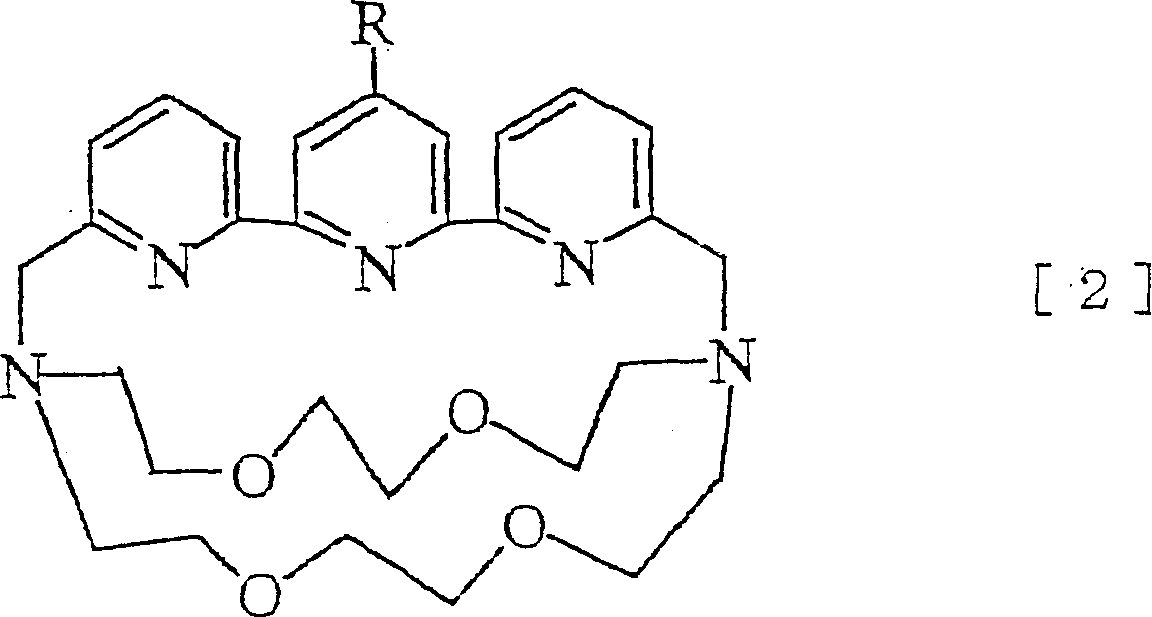


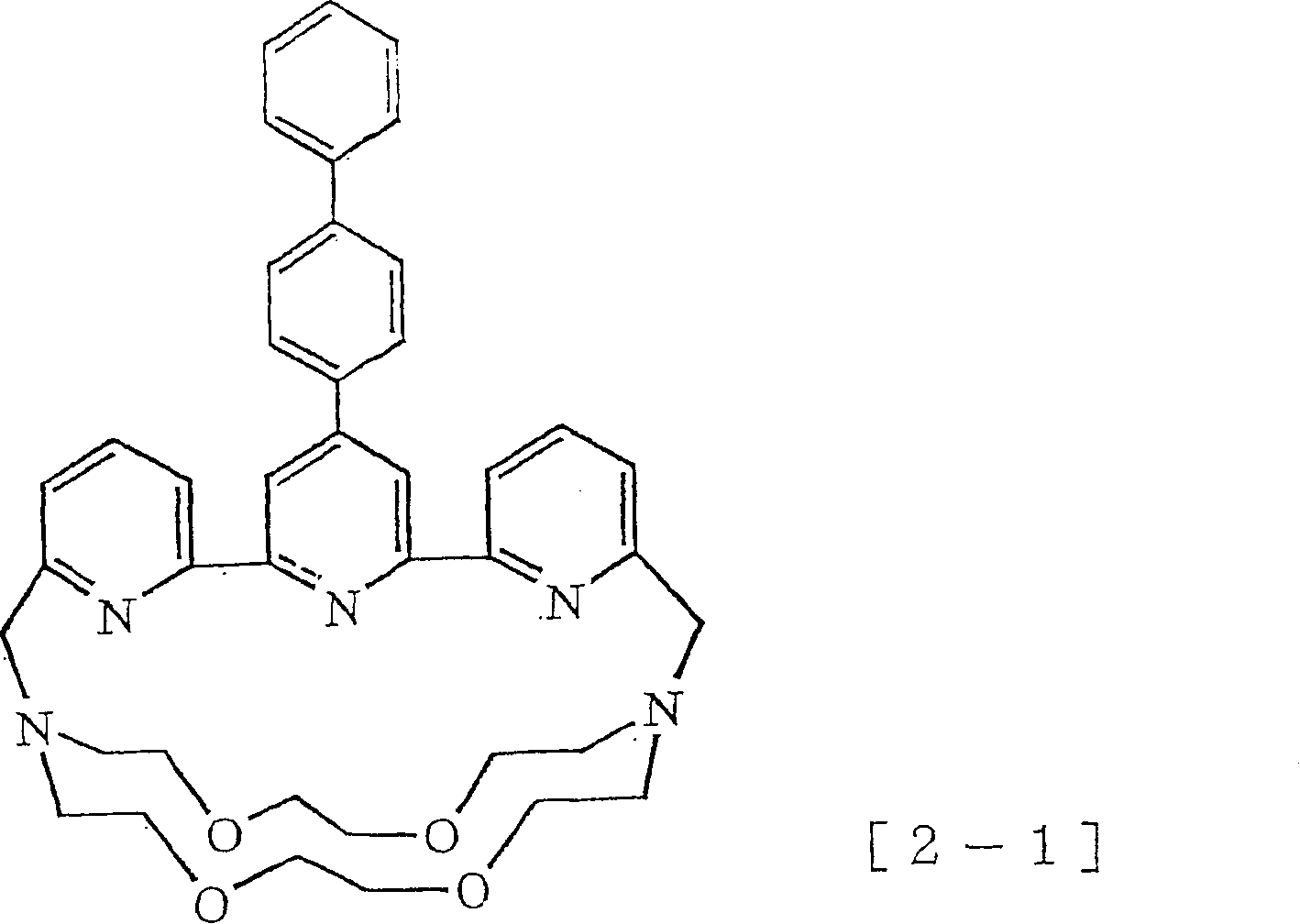

Applications Claiming Priority (4)
| Application Number | Priority Date | Filing Date | Title |
|---|---|---|---|
| JP63961/2002 | 2002-03-08 | ||
| JP2002063961 | 2002-03-08 | ||
| JP271924/2002 | 2002-09-18 | ||
| JP2002271924 | 2002-09-18 |
Publications (2)
| Publication Number | Publication Date |
|---|---|
| CN1685232A true CN1685232A (en) | 2005-10-19 |
| CN100343668C CN100343668C (en) | 2007-10-17 |
Family
ID=27806949
Family Applications (1)
| Application Number | Title | Priority Date | Filing Date |
|---|---|---|---|
| CNB038055236A Expired - Fee Related CN100343668C (en) | 2002-03-08 | 2003-03-10 | Novel fluorescent label compounds |
Country Status (9)
| Country | Link |
|---|---|
| US (1) | US7465747B2 (en) |
| EP (1) | EP1489418A4 (en) |
| JP (1) | JP4296097B2 (en) |
| KR (1) | KR20040105759A (en) |
| CN (1) | CN100343668C (en) |
| AU (1) | AU2003211865A1 (en) |
| CA (1) | CA2478110A1 (en) |
| IS (1) | IS7487A (en) |
| WO (1) | WO2003076938A1 (en) |
Cited By (5)
| Publication number | Priority date | Publication date | Assignee | Title |
|---|---|---|---|---|
| CN101921586A (en) * | 2010-07-15 | 2010-12-22 | 大连理工大学 | A nitric oxide fluorescent probe based on europium complex and its application |
| CN102277155A (en) * | 2011-06-28 | 2011-12-14 | 中国科学院福建物质结构研究所 | Preparation method and application of organic white light-emitting material L-COOH |
| CN105358980A (en) * | 2013-05-10 | 2016-02-24 | 电化生研株式会社 | Preparation of Insoluble Carrier Particles Colored with Fluorochrome-Labeled Visible Regions and Immunoassays Using Them |
| CN110283190A (en) * | 2019-07-10 | 2019-09-27 | 湖南艾科瑞生物工程有限公司 | Fluorescence complex and preparation method, fluorescence probe and preparation method and application |
| CN115286618A (en) * | 2022-07-25 | 2022-11-04 | 常州福洛森医疗科技有限公司 | Lanthanide complex, preparation method thereof, fluorescent labeling reagent and fluorescent labeling method |
Families Citing this family (16)
| Publication number | Priority date | Publication date | Assignee | Title |
|---|---|---|---|---|
| JP4602686B2 (en) * | 2004-04-15 | 2010-12-22 | 広栄化学工業株式会社 | Process for producing 2,6-dihalogeno-4-arylpyridines |
| JP4320342B2 (en) * | 2004-08-17 | 2009-08-26 | 独立行政法人科学技術振興機構 | Labeling method and analytical detection method using rare earth fluorescent complex |
| WO2007026808A1 (en) * | 2005-08-31 | 2007-03-08 | Japan Science And Technology Agency | Novel fluorescent labeling compound |
| FR2935973A1 (en) * | 2008-09-18 | 2010-03-19 | Centre Nat Rech Scient | New dipyrazol-1-yl-pyridine compounds useful for preparing complex, which is useful for e.g. the detection of metal cations in solutions, as a luminescent marker for the absorption of two-photons, and the recognition of e.g. neuravidin |
| EP2535390A1 (en) | 2011-06-15 | 2012-12-19 | Universidade De Santiago De Compostela | Luminescent nanosystems |
| CN102732246A (en) * | 2012-06-15 | 2012-10-17 | 大连理工大学 | Europium complex singlet oxygen fluorescent probe with cell membrane permeability and its application |
| KR102162581B1 (en) | 2012-12-12 | 2020-10-08 | 나노갭 서브-엔엠-파우더, 쏘시에다드 아노니마 | Luminescent nanocompounds |
| EP2743695A1 (en) | 2012-12-12 | 2014-06-18 | Nanogap Sub NM Powder, S.A. | Methods and reagents for the detection of biomolecules using luminescence |
| CN103374132B (en) * | 2013-07-12 | 2015-04-08 | 中科院广州化学有限公司 | Preparation and application of metal ion directly induced fluorescent supramolecular gel |
| CN104030974A (en) * | 2014-06-23 | 2014-09-10 | 南京工业大学 | Aryl-substituted terpyridyl compound and preparation method and application thereof |
| EP3405585B1 (en) | 2016-01-21 | 2021-03-03 | Selux Diagnostics, Inc. | Methods for rapid antimicrobial susceptibility testing |
| US9834808B2 (en) | 2016-01-21 | 2017-12-05 | SeLux Diagnostics, Inc. | Methods for rapid antibiotic susceptibility testing |
| JP7146765B2 (en) | 2016-12-23 | 2022-10-04 | セルックス・ダイアグノスティクス・インコーポレイテッド | Methods for improved rapid antimicrobial susceptibility testing |
| FR3092115B1 (en) | 2019-01-30 | 2021-11-12 | Cisbio Bioassays | fluorescent GTP analogues and use |
| US11959016B2 (en) * | 2021-06-15 | 2024-04-16 | Saudi Arabian Oil Company | Inhibiting corrosion in gas wells |
| US11549049B1 (en) | 2021-06-22 | 2023-01-10 | Saudi Arabian Oil Company | Inhibiting corrosion in gas wells |
Family Cites Families (8)
| Publication number | Priority date | Publication date | Assignee | Title |
|---|---|---|---|---|
| GB8622855D0 (en) * | 1986-09-23 | 1986-10-29 | Ekins R P | Determining biological substance |
| SE8802575D0 (en) * | 1988-07-08 | 1988-07-08 | Wallac Oy | TERPYRIDINE DERIVATIVES |
| WO1993011433A1 (en) | 1991-12-05 | 1993-06-10 | Wallac Oy | Luminescent lanthanide chelates |
| BR9207126A (en) | 1992-05-07 | 1995-08-29 | Sterling Winthrop Inc | Radioactive labeling immunoreagent, image-forming composition, therapeutic composition, process for forming diagnostic image at a site in a patient and for treating disease sites in a patient, and, composition of matter |
| JP3500297B2 (en) | 1998-03-04 | 2004-02-23 | 株式会社リコー | Digital copier system |
| JP2001335574A (en) * | 2000-05-26 | 2001-12-04 | Kazuko Matsumoto | New labeled compound |
| CN1181156C (en) | 2001-08-22 | 2004-12-22 | 中国科学院大连化学物理研究所 | Rare earth fluorescent markers and their applications |
| JP2003325200A (en) | 2002-03-08 | 2003-11-18 | Kazuko Matsumoto | New high-sensitive method for assaying nucleic acid |
-
2003
- 2003-03-10 EP EP03744031A patent/EP1489418A4/en not_active Withdrawn
- 2003-03-10 US US10/506,242 patent/US7465747B2/en not_active Expired - Fee Related
- 2003-03-10 AU AU2003211865A patent/AU2003211865A1/en not_active Abandoned
- 2003-03-10 KR KR10-2004-7014045A patent/KR20040105759A/en not_active Withdrawn
- 2003-03-10 WO PCT/JP2003/002774 patent/WO2003076938A1/en not_active Ceased
- 2003-03-10 CN CNB038055236A patent/CN100343668C/en not_active Expired - Fee Related
- 2003-03-10 JP JP2003575111A patent/JP4296097B2/en not_active Expired - Fee Related
- 2003-03-10 CA CA002478110A patent/CA2478110A1/en not_active Abandoned
-
2004
- 2004-10-04 IS IS7487A patent/IS7487A/en unknown
Cited By (7)
| Publication number | Priority date | Publication date | Assignee | Title |
|---|---|---|---|---|
| CN101921586A (en) * | 2010-07-15 | 2010-12-22 | 大连理工大学 | A nitric oxide fluorescent probe based on europium complex and its application |
| CN102277155A (en) * | 2011-06-28 | 2011-12-14 | 中国科学院福建物质结构研究所 | Preparation method and application of organic white light-emitting material L-COOH |
| CN102277155B (en) * | 2011-06-28 | 2014-10-15 | 中国科学院福建物质结构研究所 | Preparation method and application of organic white light-emitting material L-COOH |
| CN105358980A (en) * | 2013-05-10 | 2016-02-24 | 电化生研株式会社 | Preparation of Insoluble Carrier Particles Colored with Fluorochrome-Labeled Visible Regions and Immunoassays Using Them |
| CN105358980B (en) * | 2013-05-10 | 2018-04-27 | 电化生研株式会社 | Preparation of Insoluble Carrier Particles Colored with Fluorochrome-Labeled Visible Regions and Immunoassays Using Them |
| CN110283190A (en) * | 2019-07-10 | 2019-09-27 | 湖南艾科瑞生物工程有限公司 | Fluorescence complex and preparation method, fluorescence probe and preparation method and application |
| CN115286618A (en) * | 2022-07-25 | 2022-11-04 | 常州福洛森医疗科技有限公司 | Lanthanide complex, preparation method thereof, fluorescent labeling reagent and fluorescent labeling method |
Also Published As
| Publication number | Publication date |
|---|---|
| CN100343668C (en) | 2007-10-17 |
| EP1489418A4 (en) | 2006-05-03 |
| KR20040105759A (en) | 2004-12-16 |
| CA2478110A1 (en) | 2003-09-18 |
| WO2003076938A1 (en) | 2003-09-18 |
| JPWO2003076938A1 (en) | 2005-07-14 |
| AU2003211865A1 (en) | 2003-09-22 |
| US7465747B2 (en) | 2008-12-16 |
| US20050255465A1 (en) | 2005-11-17 |
| EP1489418A1 (en) | 2004-12-22 |
| JP4296097B2 (en) | 2009-07-15 |
| IS7487A (en) | 2004-10-04 |
Similar Documents
| Publication | Publication Date | Title |
|---|---|---|
| CN100343668C (en) | Novel fluorescent label compounds | |
| CN1875073A (en) | Cyanine dye labelling reagents | |
| CN1094593C (en) | Improved method and device for luminescence assay | |
| CN1249815A (en) | Electrochemical detector for detecting intermolecular interaction and for use in drug development | |
| CN1559006A (en) | Methods and compositions for analyzing proteins | |
| CN1902490A (en) | Biomolecular detection method and its used labeling dye and labeling kit | |
| CN1065339A (en) | Method and apparatus for magnetic particle-based luminescence assays containing composite magnets | |
| CN1665790A (en) | Compositions and methods for detection and isolation of phosphorylated molecules | |
| CN1529815A (en) | Analyte Detection | |
| CN1784600A (en) | Chromatographic analysis system | |
| CN1151209A (en) | Method of fluorescent detection of nucleic acids and cytoskeleton elements using bis-dicationic aryl furans | |
| CN1871233A (en) | Novel chelating agents and chelates and their use | |
| CN1639356A (en) | Method for labelling and fragmenting DNA | |
| CN1204327A (en) | Pharmaceutically active quinazoline compounds | |
| CN1906181A (en) | N-sulfonylaminocarbonyl containing compounds | |
| CN1526071A (en) | Two-photon absorption dipyrromethene boron difluoride dye and its application | |
| US8729276B2 (en) | Cyanine compound for labeling biomolecule and preparation method thereof | |
| CN1098745A (en) | Method for Colorimetric Determination of Analytes Using PQQ-Dependent Dehydrogenase | |
| CN1906161A (en) | N-sulfonyldicarboximide containing tethering compounds | |
| CN1518536A (en) | Labeling reagent, method for synthesizing the reagent and method for detecting biomolecules | |
| CN1452664A (en) | Improved binding interactions in dipstick assays | |
| HK1048258A1 (en) | Method of inhibiting amyloid protein aggregation and imaging amyloid deposits | |
| CN1650168A (en) | Reagents and methods for saturating labeled proteins | |
| CN1031532A (en) | Heterocyclic compound | |
| CN1696695A (en) | Microsphere composition or assembly for immunoassay and immunoassay method |
Legal Events
| Date | Code | Title | Description |
|---|---|---|---|
| C06 | Publication | ||
| PB01 | Publication | ||
| C10 | Entry into substantive examination | ||
| SE01 | Entry into force of request for substantive examination | ||
| C14 | Grant of patent or utility model | ||
| GR01 | Patent grant | ||
| CI03 | Correction of invention patent |
Correction item: Claims Correct: Reprint the right claim Book 1-5 pages False: Incorrect claim Book 1-5 Number: 42 Volume: 23 |
|
| COR | Change of bibliographic data |
Free format text: CORRECT: RIGHT-CLAIMING DOCUMENT; FROM: FALSE RIGHT-CLAIMING DOCUMENT PAGE1-5 TO: REPUBLISH THE CORRECT RIGHT-CLAIMING DOCUMENT PAGE1-5 |
|
| C19 | Lapse of patent right due to non-payment of the annual fee | ||
| CF01 | Termination of patent right due to non-payment of annual fee |