CN201733410U - Optical cross connecting device for optical burst switching network core node - Google Patents
Optical cross connecting device for optical burst switching network core node Download PDFInfo
- Publication number
- CN201733410U CN201733410U CN2010200500029U CN201020050002U CN201733410U CN 201733410 U CN201733410 U CN 201733410U CN 2010200500029 U CN2010200500029 U CN 2010200500029U CN 201020050002 U CN201020050002 U CN 201020050002U CN 201733410 U CN201733410 U CN 201733410U
- Authority
- CN
- China
- Prior art keywords
- optical
- wavelength
- module
- bdp
- channel
- Prior art date
- Legal status (The legal status is an assumption and is not a legal conclusion. Google has not performed a legal analysis and makes no representation as to the accuracy of the status listed.)
- Expired - Fee Related
Links
Images


Landscapes
- Optical Communication System (AREA)
- Use Of Switch Circuits For Exchanges And Methods Of Control Of Multiplex Exchanges (AREA)
Abstract
用于光突发交换网络核心节点的光交叉连接装置,包括业务源模块,业务源模块通过BCP信道与控制模块连接,业务源模块的通过光发射模块与光交叉连接模块连接;光交叉连接模块受控于控制模块;光交叉连接模块中设有第一解复用器,第一复用器,第一解复用器通过信道单元与第一复用器连接;信道单元由与BDP数据的波长一一对应的传输信道组成;控制模块包括辨识单元和分析单元;光交叉连接模块中波长转换单元,信道单元的其中一个输出端与波长转换单元的输入端连接,波长转换单元的输出端与信道单元的其中一个输出端连接;分析单元分别于信道单元和波长转换单元连接。本实用新型具有抗拥塞能力强,结构简单,成本低的优点。
An optical cross-connect device for the core node of the optical burst switching network, including a service source module, the service source module is connected to the control module through the BCP channel, and the service source module is connected to the optical cross-connect module through the optical transmission module; the optical cross-connect module Controlled by the control module; the optical cross-connect module is provided with a first demultiplexer, a first multiplexer, and the first demultiplexer is connected to the first multiplexer through a channel unit; the channel unit is connected with the BDP data The transmission channel is composed of one-to-one wavelength correspondence; the control module includes an identification unit and an analysis unit; in the optical cross-connect module, the wavelength conversion unit, one of the output terminals of the channel unit is connected to the input terminal of the wavelength conversion unit, and the output terminal of the wavelength conversion unit is connected to the input terminal of the wavelength conversion unit. One of the output ends of the channel unit is connected; the analysis unit is respectively connected to the channel unit and the wavelength conversion unit. The utility model has the advantages of strong anti-congestion ability, simple structure and low cost.
Description
技术领域technical field
本实用新型属于光突发交换(Optical Burst Switching,OBS)网络领域,尤其是OBS网络中的核心节点结构。具体涉及用于OBS网络核心节点中的光交叉连接(Optical Cross Connection,OXC)结构及OXC的控制方法。The utility model belongs to the field of optical burst switching (Optical Burst Switching, OBS) network, especially the core node structure in the OBS network. Specifically, it relates to an optical cross connection (Optical Cross Connection, OXC) structure used in a core node of an OBS network and a control method for the OXC.
技术背景technical background
随着密集波分复用(DWDM)技术的日渐成熟,通信网络的容量越来越大。目前,单根光纤能够承载十几个甚至上百个传输信道,而每个传输信道的传输容量可以达到40Gbps甚至更高。虽然通信网络的传输容量已经能够满足各种业务的需求,但同时带来的是对交换系统发展的压力。目前网络节点的交换能力不足,成为限制当前网络发展的一个瓶颈。为了增加交换能力、降低交换成本,发展光交换技术势在必行。光交换技术主要有3种:光线路交换(OCS)、光分组交换(OPS)和光突发交换(OBS)。OBS使用的带宽粒度介于OCS和OPS之间,与OCS相比,OBS的带宽利用率更高;与OPS相比,OBS对光器件的要求更低。可以说,OBS结合了两者的优点又克服两者的部分缺点,是两者之间的平衡选择。因此,OBS是下一代网络中最具潜力的交换技术之一,近年来OBS技术已成为光通信领域的研究热点。With the maturity of Dense Wavelength Division Multiplexing (DWDM) technology, the capacity of communication network is getting bigger and bigger. At present, a single optical fiber can carry dozens or even hundreds of transmission channels, and the transmission capacity of each transmission channel can reach 40Gbps or even higher. Although the transmission capacity of the communication network has been able to meet the needs of various services, it also brings pressure on the development of the switching system. At present, the switching capacity of network nodes is insufficient, which has become a bottleneck restricting the development of the current network. In order to increase switching capacity and reduce switching costs, it is imperative to develop optical switching technology. There are three main optical switching technologies: Optical Circuit Switching (OCS), Optical Packet Switching (OPS) and Optical Burst Switching (OBS). The bandwidth granularity used by OBS is between OCS and OPS. Compared with OCS, OBS has a higher bandwidth utilization rate; compared with OPS, OBS has lower requirements for optical devices. It can be said that OBS combines the advantages of the two and overcomes some of the shortcomings of the two. It is a balanced choice between the two. Therefore, OBS is one of the most potential switching technologies in the next generation network. In recent years, OBS technology has become a research hotspot in the field of optical communication.
OBS网络由边缘节点和核心节点两个部分组成。其中核心节点主要负责路由交换功能。光交叉连接(OXC)系统是OBS核心节点的关键部分,其性能优劣直接决定了OBS核心节点的性能,甚至整个OBS网络的性能。因此,设计一个性能优异、操作可靠的OXC系统作为核心节点,对于OBS网络的实用化具有非常重要的意义。The OBS network consists of edge nodes and core nodes. Among them, the core node is mainly responsible for routing and switching functions. The optical cross-connect (OXC) system is a key part of the OBS core node, and its performance directly determines the performance of the OBS core node, and even the performance of the entire OBS network. Therefore, designing an OXC system with excellent performance and reliable operation as the core node is of great significance for the practical application of the OBS network.
根据OXC波长转换能力的强弱,OXC结构可以分为两种:图1所示的是一种不能转换输入波长,即不具备波长转换能力的OXC,被称作波长选择交叉连接器(WSXC)。例如文献(S.Okamoto,A.Watanabe,K.-I.Sato,Optical path cross-connect node architectures forphotonic transport network,Journal of Lightwave Technology,vol.14,issue 6,pp1410-1422,1996)中提及的OXC即为WSXC。它具有p个输入/输出链路,每个链路内传输n个波长。本实用新型假定p为3,n为4。图1中的WSXC是由解复用器,3×3光开关,复用器组成的一个简单的WSXC型的OXC。各个链路里的采用波分复用方式进行传输的一组波长分别由解复用器进行解复用功能,然后相同波长的信道成为一组,进入对应波长的光开关,由对应的光开关执行交换功能。虽然WSXC提供了强大的交换连接功能,但是当一个新的连接请求需要占用一条已经连接的繁忙通道时,拥塞就出现了。According to the strength of the OXC wavelength conversion capability, the OXC structure can be divided into two types: Figure 1 shows an OXC that cannot convert the input wavelength, that is, does not have the wavelength conversion capability, and is called a wavelength selective cross-connector (WSXC) . For example, mentioned in the literature (S.Okamoto, A.Watanabe, K.-I.Sato, Optical path cross-connect node architectures for photonic transport network, Journal of Lightwave Technology, vol.14, issue 6, pp1410-1422, 1996) The OXC is WSXC. It has p input/output links, and n wavelengths are transmitted in each link. The utility model assumes that p is 3 and n is 4. The WSXC in Fig. 1 is a simple WSXC type OXC composed of a demultiplexer, a 3×3 optical switch and a multiplexer. A group of wavelengths transmitted by wavelength division multiplexing in each link is demultiplexed by a demultiplexer, and then the channels of the same wavelength form a group and enter the optical switch of the corresponding wavelength, and the corresponding optical switch Execute the swap function. Although WSXC provides a powerful switching connection function, congestion occurs when a new connection request needs to occupy an already connected busy channel.
图2所示的是一种具有波长转换(Wavelength Conversion,WC)能力的OXC,称作波长内部可变交叉连接器(WIXC),WIXC能够把任意输入光纤的一个任意传输信道交换到任意输出光纤的一个任意传输信道上去。例如文献(E.Karasan,E.Ayanoglu,Performance ofWDM transport networks,IEEE Journal on Selected Areas inCommunications,vol.16,issue 7,pp1081-1096,1998)中提及的OXC即为WIXC,它具有p个输入/输出链路,每个链路内传输n个波长。本实用新型假定p为3,n为4。图中的WIXC由解复用器,光开关矩阵,波长转换器和复用器组成。光开关矩阵能够将输入链路中的任意波长信号交换到任意输出链路中去。每个波长转换器都有能力将输入波长转换成其它任意波长。因此在WIXC中,如果一个新的信号连接与已经建立的信号连接相冲突,那么它可以将冲突波长转换成其它空闲波长。很明显,与WSXC相比,WIXC具有更强的应对拥塞的能力。只有在输出光纤中的所有波长都有被占用的情况下,拥塞才会发生。Figure 2 shows an OXC with wavelength conversion (Wavelength Conversion, WC) capability, called a wavelength internal variable cross-connector (WIXC), WIXC can switch any transmission channel of any input fiber to any output fiber An arbitrary transmission channel of . For example, the OXC mentioned in the literature (E.Karasan, E.Ayanoglu, Performance of WDM transport networks, IEEE Journal on Selected Areas in Communications, vol.16, issue 7, pp1081-1096, 1998) is WIXC, which has p inputs /Output link, each link transmits n wavelengths. The utility model assumes that p is 3 and n is 4. The WIXC in the figure is composed of a demultiplexer, an optical switch matrix, a wavelength converter and a multiplexer. The optical switch matrix can switch any wavelength signal in the input link to any output link. Each wavelength converter is capable of converting an input wavelength to any other wavelength. Therefore, in WIXC, if a new signal connection conflicts with an established signal connection, it can convert the conflicting wavelength into other idle wavelengths. Obviously, compared with WSXC, WIXC has a stronger ability to deal with congestion. Congestion will only occur if all wavelengths in the output fiber are occupied.
WIXC主要针对骨干网应用,承载业务一般是STM-16/OC-48或STM-64/OC-192甚至STM-256/OC-768。节点内使用O/E/O波长转换器,以实现大容量、长距离传输。交叉矩阵既可以由光交叉完成,也可用电交叉实现。WIXC的优点是可以实现严格无阻塞的波长交换,实现波长重用,提供虚波长路由(VWP)。缺点是系统透明性较差,并且由于大量使用O/E/O波长转换器,价格昂贵。WSXC主要针对本地网或城域网应用。节点内一般不使用或部分使用O/E/O波长转换器,以兼容多速率、多业务,节点内光交叉矩阵可由若干个较小规模的光开关构成。其优点是价格较低,缺点是波长交换能力差,很难实现波长重用。WIXC is mainly aimed at backbone network applications, and bearer services are generally STM-16/OC-48 or STM-64/OC-192 or even STM-256/OC-768. O/E/O wavelength converters are used in the nodes to achieve large-capacity, long-distance transmission. The crossover matrix can be completed by optical crossover or electrical crossover. The advantage of WIXC is that it can realize strictly non-blocking wavelength exchange, realize wavelength reuse, and provide virtual wavelength routing (VWP). The disadvantage is that the system has poor transparency and is expensive due to the extensive use of O/E/O wavelength converters. WSXC is mainly aimed at local network or metropolitan area network applications. O/E/O wavelength converters are generally not used or partially used in the node to be compatible with multi-rate and multi-service. The optical cross matrix in the node can be composed of several smaller-scale optical switches. The advantage is that the price is low, and the disadvantage is that the wavelength exchange capability is poor, and it is difficult to realize wavelength reuse.
发明内容Contents of the invention
为克服现有技术中WSXC的易出现拥塞,WIXC的系统透明性差,价格昂贵的缺点,本实用新型提供了一种抗拥塞能力强,结构简单,成本低的用于光突发交换网络核心节点的光交叉连接装置。In order to overcome the disadvantages of WSXC that is prone to congestion in the prior art, poor system transparency and high price of WIXC, the utility model provides a core node for optical burst switching network with strong anti-congestion ability, simple structure and low cost. optical cross-connect device.
用于光突发交换网络核心节点的光交叉连接装置,包括能循环地、先后产生BCP和与其对应的BDP的业务源模块,所述的业务源模块通过BCP信道与控制模块连接,所述的业务源模块通过光发射模块与光交叉连接模块连接,所述的光发射模块设有多根与所述的光交叉连接模块的输入端连接的输入光纤,所述的光交叉连接模块通过多根输出光纤与光接收模块连接;所述的光交叉连接模块受控于所述的控制模块;The optical cross-connect device used for the core node of the optical burst switching network includes a service source module capable of cyclically and sequentially generating BCP and its corresponding BDP, the service source module is connected to the control module through the BCP channel, and the The service source module is connected to the optical cross-connect module through the optical transmission module. The optical transmission module is provided with a plurality of input optical fibers connected to the input end of the optical cross-connect module. The output optical fiber is connected to the optical receiving module; the optical cross-connect module is controlled by the control module;
所述的光交叉连接模块中设有与输入光纤一一对应、将BDP解复用为多个波长有差异的BDP数据的第一解复用器,与输出光纤一一对应、将多个波长有差异的BDP数据复用为目标数据包的第一复用器,所述的第一解复用器通过信道单元与所述的第一复用器连接;所述的信道单元由与BDP数据的波长一一对应的传输信道组成;The optical cross-connect module is provided with a first demultiplexer corresponding to the input optical fiber one-to-one, demultiplexing the BDP into BDP data with differences in multiple wavelengths, corresponding to the output optical fiber one-to-one, and demultiplexing the multiple wavelengths Differential BDP data is multiplexed as the first multiplexer of the target data packet, and the first demultiplexer is connected with the first multiplexer through the channel unit; the channel unit is connected with the BDP data One-to-one correspondence of the wavelength of the transmission channel composition;
其特征在于:所述的控制模块包括与BCP信道连接、能根据当前BCP判断与其对应BDP是否发生传输拥塞的辨识单元和与所述的光交叉连接模块连接、寻找处于空闲状态的传输信道并获取空闲信道波长的分析单元;It is characterized in that: the control module includes an identification unit connected to the BCP channel, capable of judging whether transmission congestion occurs with its corresponding BDP according to the current BCP, connected with the optical cross-connect module, searching for an idle transmission channel and obtaining Analysis unit for idle channel wavelengths;
所述的光交叉连接模块中设有将拥塞BDP的波长转换为空闲信道波长的波长转换单元,所述的信道单元的其中一个输出端与所述的波长转换单元的输入端连接,所述的波长转换单元的输出端与所述的信道单元的其中一个输入端连接;The optical cross-connect module is provided with a wavelength conversion unit that converts the wavelength of the congested BDP into an idle channel wavelength, one of the output ends of the channel unit is connected to the input end of the wavelength conversion unit, and the The output end of the wavelength conversion unit is connected to one of the input ends of the channel unit;
所述的分析单元分别与所述的信道单元和波长转换单元连接。The analysis unit is respectively connected with the channel unit and the wavelength conversion unit.
进一步,所述的BCP中包括该控制包的类型信息,和与其对应的BDP的优先级、数据类型、光波长号、源地址、目的地址、BDP包长度、偏置时间和校验位;所述的BDP由多个以太网数据包组成,所述的BDP由保护字段、同步字段、突发包长度、分组个数、分组长度、IP分组、数据填充、校验字段、保护字段组成;所述的BCP的产生比所述的BDP早一个偏置时间。Further, the BCP includes the type information of the control packet, and the corresponding BDP priority, data type, optical wavelength number, source address, destination address, BDP packet length, offset time and check digit; Described BDP is made up of a plurality of Ethernet data packets, and described BDP is made up of protection field, synchronization field, burst packet length, grouping number, grouping length, IP grouping, data padding, check field, protection field; The aforementioned BCP is generated earlier than the aforementioned BDP by an offset time.
进一步,所述的传输信道为能将指定的输入端与所要求的输出端相连通的第一光开关;所述的波长转换单元包括输入端分别与所述的第一光开关的输出端连接的第二光开关,和输出端分别与所述的第一光开关的输入端连接的波长转换器,所述的第二光开关的输出端与所述的波长转换器一一对应。Further, the transmission channel is a first optical switch capable of connecting a specified input port with a required output port; the wavelength conversion unit includes an input port connected to an output port of the first optical switch respectively The second optical switch, and the wavelength converter whose output ends are respectively connected to the input ends of the first optical switch, and the output ends of the second optical switch correspond to the wavelength converters one by one.
进一步,所述光发射模块包括基于DFB的、能将输入的电信号转换成光信号发射出去的光发射机和第二复用器;所述光接收模块是由能将接收到的光信号转换成电信号的光接收机和第二解复用器构成。Further, the optical transmitting module includes an optical transmitter and a second multiplexer based on DFB, which can convert the input electrical signal into an optical signal and emit it; It is composed of an optical receiver and a second demultiplexer for generating electrical signals.
进一步,所述的光发射模块的光发射机和第二复用器分三组构成发射单元,每个发射单元通过一根输出光纤与所述的光交叉连接模块中的一个第一解复用器连接;所述的光接收模块的光接收机和第二解复用器分三组构成接收单元,每个接受单元通过一根输入光纤与所述的光交叉连接模块中的一个第一复用器连接;每根光纤具有4个数据波长信道;所述的光交叉连接模块中设有4个第一光开关和1个第二光开关,所述的光开关均为4×4光开关,所述的波长转换器为单路波长转换器。Further, the optical transmitter and the second multiplexer of the optical transmission module are divided into three groups to form transmission units, and each transmission unit is demultiplexed with a first demultiplexer in the optical cross-connect module through an output optical fiber. The optical receiver and the second demultiplexer of the optical receiving module are divided into three groups to form receiving units, and each receiving unit is connected to a first multiplexer in the optical cross-connect module through an input optical fiber each optical fiber has 4 data wavelength channels; the optical cross-connect module is provided with 4 first optical switches and 1 second optical switch, and the optical switches are all 4×4 optical switches , the wavelength converter is a single wavelength converter.
进一步,所述的业务源模块使用泊松模型来描述数据网络的流量模型,满足下列基本假设:Further, the described service source module uses the Poisson model to describe the traffic model of the data network, and satisfies the following basic assumptions:
(1)外部数据源产生流量的时间间隔为指数分布,即数据源到达过程为一泊松过程,令{G(i)|i=1,2,…,N},G(i)为数据包i和i+1的间隔时间;(1) The time interval of traffic generated by external data sources is exponentially distributed, that is, the arrival process of data sources is a Poisson process, let {G(i)|i=1, 2, ..., N}, G(i) is the data packet The interval between i and i+1;
(2)数据源一次产生流量的长度服从指数分布,令{H(i)|i=1,2,…,N},H(i)为数据包i的数据长度;(2) The length of the traffic generated by the data source at one time obeys the exponential distribution, let {H(i)|i=1, 2, ..., N}, H(i) is the data length of the data packet i;
(3)G(i)和H(i)相互独立。(3) G(i) and H(i) are independent of each other.
进一步,所述的业务源模块的传输控制协议为JET(Just EnoughTime)协议,所述JET协议使用延时预留(Delayed Reservation)方式预留带宽,即各个中间节点根据BCP中包含的BDP长度信息和偏置时间信息,自动地完成波长通路的选择、带宽资源的预留和释放以及交叉连接的建立与拆除;所述的BDP要等待一个偏置时间(OffsetTime)后才可以发送。Further, the transmission control protocol of the service source module is the JET (Just EnoughTime) protocol, and the JET protocol uses a delayed reservation (Delayed Reservation) mode to reserve bandwidth, that is, each intermediate node according to the BDP length information contained in the BCP and offset time information to automatically complete the selection of wavelength channels, the reservation and release of bandwidth resources, and the establishment and removal of cross-connections; the BDP can be sent after waiting for an offset time (OffsetTime).
所述的业务源模块产生的BCP和BDP均为电信号。Both the BCP and the BDP generated by the service source module are electrical signals.
本实用新型的光交叉连接方法,包括以下步骤:The optical cross connection method of the present utility model comprises the following steps:
1、由业务源模块循环产生突发控制包BCP和与该BCP对应的、携带有效信息的突发数据包BDP,所述的BCP中包括该控制包的类型信息,和与其对应的BDP的优先级、数据类型、光波长号、源地址、目的地址、BDP包长度、偏置时间和校验位;所述的BDP的光波长号表征传输该数据包的传输信道;将BCP通过BCP信道发送至控制模块,将BDP通过光发射模块分多条输入光纤传送至光交叉连接模块,所述的BDP为波分复用信号;1. The business source module cyclically generates the burst control packet BCP and the burst data packet BDP corresponding to the BCP and carrying valid information. The BCP includes the type information of the control packet and the priority of the corresponding BDP Level, data type, optical wavelength number, source address, destination address, BDP packet length, offset time and check digit; the optical wavelength number of the BDP represents the transmission channel for transmitting the data packet; the BCP is sent through the BCP channel To the control module, the BDP is transmitted to the optical cross-connect module by dividing the BDP into a plurality of input optical fibers through the optical transmission module, and the BDP is a wavelength division multiplexing signal;
2、光交叉连接模块将每条输入光纤中的BDP解复用为多个BDP数据,BDP数据的波长有差异,相同波长的BDP数据被传送至同一个第一光开关;2. The optical cross-connect module demultiplexes the BDP in each input optical fiber into multiple BDP data, the wavelength of the BDP data is different, and the BDP data of the same wavelength are transmitted to the same first optical switch;
3、由控制模块对各光开关的通路状态和命令值列表进行初始化,使各第一光开关的指定的输入端与要求的输出端连通、以形成传输信道,从而建立交叉连接;3. The control module initializes the path state and command value list of each optical switch, so that the designated input end of each first optical switch is connected with the required output end to form a transmission channel, thereby establishing a cross connection;
4、控制模块接受来自业务源模块的BCP,根据与该BCP对应的BDP的当前光波长信号选择与其对应的第一光开关为当前光开关;4. The control module accepts the BCP from the service source module, and selects the corresponding first optical switch as the current optical switch according to the current optical wavelength signal of the BDP corresponding to the BCP;
5、判断当前光开关是否已建立交叉连接,若当前光开关未建立连接,则查找该光开关的命令值列表、建立交叉连接,并设置当前光开关交叉连接的持续时间;若当前光开关已建立连接,则判断当前信道是否空闲,若信道空闲则认为无需将对应的BDP数据进行波长转换,若当前信道繁忙则认为需将对应的BDP数据进行波长转换;5. Determine whether the current optical switch has established a cross-connection. If the current optical switch has not established a connection, then search the command value list of the optical switch, establish a cross-connection, and set the duration of the current optical switch cross-connection; If the connection is established, it is judged whether the current channel is idle. If the channel is idle, it is considered that there is no need to perform wavelength conversion on the corresponding BDP data. If the current channel is busy, it is considered that the corresponding BDP data needs to be converted on wavelength;
6、若需要进行波长转换,则判断对应的BDP数据是否能进行波长转换,若该BDP数据能进行波长转换,则寻找空闲的传输信道光开关,以该空闲信道的波长为目的波长、以该空闲信道对应的光开关为当前光开关,将BDP由原波长转换为目的波长、并发送至当前光开关;若该BDP不能进行波长转换,则将此数据包抛弃;6. If wavelength conversion is required, determine whether the corresponding BDP data can perform wavelength conversion. If the BDP data can perform wavelength conversion, then search for an idle transmission channel optical switch, use the wavelength of the idle channel as the target wavelength, and use the wavelength of the idle channel as the target wavelength. The optical switch corresponding to the idle channel is the current optical switch, and the BDP is converted from the original wavelength to the destination wavelength and sent to the current optical switch; if the BDP cannot perform wavelength conversion, the data packet is discarded;
7、判断当前光开关是否已建立交叉连接,若当前光开关未建立连接,则查找该光开关的命令值列表、以建立交叉连接;设置当前光开关的交叉连接持续时间;7. Determine whether the current optical switch has established a cross-connection, if the current optical switch has not established a connection, then search the command value list of the optical switch to establish a cross-connection; set the cross-connection duration of the current optical switch;
8、将不同信道输出的BDP数据复用为目标数据包,将目标数据包在交叉连接持续时间内发送至光接收模块;8. Multiplex the BDP data output by different channels into the target data packet, and send the target data packet to the optical receiving module within the duration of the cross-connection;
9、控制模块等待接收下一个BCP,光交叉连接模块等待接收下一个BDP,重复执行步骤4-8。9. The control module waits to receive the next BCP, the optical cross-connect module waits to receive the next BDP, and repeats steps 4-8.
本实用新型通过辨识单元根据BCP中的偏置时间,和对应BDP的波长、源地址和目的地址,判断当前BDP是否会发生拥塞,若发生拥塞则通过分析单元控制波长转换单元将当前BDP的波长转换为空闲信道的波长,从而保证数据的通畅传输。The utility model judges whether the current BDP will be congested according to the offset time in the BCP, and the wavelength, source address and destination address of the corresponding BDP through the identification unit, and if congestion occurs, the analysis unit controls the wavelength conversion unit to convert the wavelength of the current BDP to Convert to the wavelength of the idle channel, so as to ensure the smooth transmission of data.
本实用新型的有益效果主要表现在:1、是一种结构简单可靠,基于成熟光学器件技术的OXC系统,可以用于OBS网络的核心节点;2、具有全光交叉连接功能;3、同时允许四个波长信号进行波长转换功能;4、采用FPGA控制业务源模块和控制模块,支持OXC控制算法的执行,进而能够有效地利用现有的网络资源,降低网络的拥塞概率,提高网络的性能;5、配备业务源模块和光收发模块后,就能够检测光交叉连接模块的性能,可以作为光网络教学实验设备;6、与不具备波长转换能力的OXC系统(即已有技术1所示的WSXC)相比具有很大的优势,对波长资源的利用更加地充分。与具有完全波长转换能力OXC系统(即已有技术2所示的WIXC)比较,提高波长转换器利用率,减少了波长转换器数量,因此降低了成本和控制难度,增加了可行性。The beneficial effects of the utility model are mainly manifested in: 1. It is a simple and reliable OXC system based on mature optical device technology, which can be used for the core node of the OBS network; 2. It has the function of all-optical cross-connection; 3. It allows Four wavelength signals perform wavelength conversion function; 4. Adopt FPGA to control the service source module and control module, support the execution of OXC control algorithm, and then can effectively use the existing network resources, reduce the congestion probability of the network, and improve the performance of the network; 5. After being equipped with a service source module and an optical transceiver module, the performance of the optical cross-connect module can be detected, which can be used as an optical network teaching experiment equipment; 6. With the OXC system (that is, the WSXC shown in prior art 1) that does not have wavelength conversion capability ) has a great advantage over the use of wavelength resources. Compared with the OXC system with full wavelength conversion capability (that is, the WIXC shown in prior art 2), the utilization rate of the wavelength converter is improved, the number of wavelength converters is reduced, and thus the cost and control difficulty are reduced, and the feasibility is increased.
附图说明Description of drawings
图1是已有技术WSXC结构Fig. 1 is prior art WSXC structure
图2是已有技术WISC结构Fig. 2 is prior art WISC structure
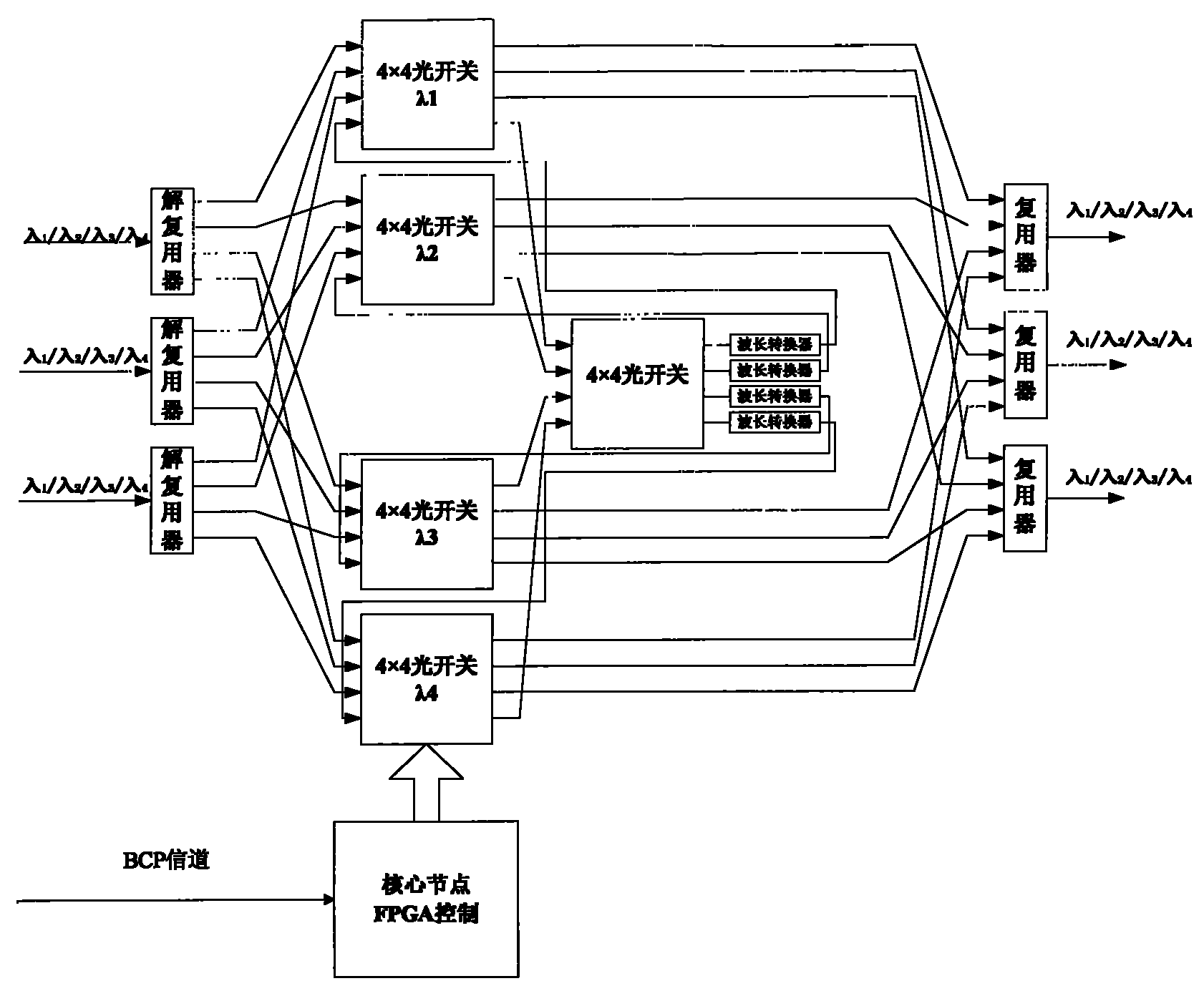
图3是本实用新型有限波长内部可变光交叉连接器(L-WIXC)结构示意图Fig. 3 is a structural schematic diagram of the limited-wavelength internal variable optical cross-connector (L-WIXC) of the present invention
图4是4×4光开关中6个2×2关开关的排列结构示意图Figure 4 is a schematic diagram of the arrangement structure of six 2×2 off switches in a 4×4 optical switch
图5是控制模块的主要端口示意图Figure 5 is a schematic diagram of the main ports of the control module
图6是交叉连接方法的流程图Figure 6 is a flowchart of the cross-connect method
图7是配备业务源模块、光发射模块和光接收模块后作为光网络教学实验设备的结构示意图Figure 7 is a schematic diagram of the structure of the optical network teaching experimental equipment equipped with a service source module, an optical transmitting module and an optical receiving module
图8是光发射模块结构示意图Figure 8 is a schematic diagram of the structure of the light emitting module
图9是光接收模块结构示意图Figure 9 is a schematic diagram of the structure of the light receiving module
图10是业务源模块的主要端口示意图Figure 10 is a schematic diagram of the main ports of the service source module
图11为光开关通路状态及命令值列表Figure 11 is a list of optical switch path status and command values
具体实施方式Detailed ways
实施例一Embodiment one
参照图3-6、11Refer to Figure 3-6, 11
用于光突发交换网络核心节点的光交叉连接装置,包括能循环地、先后产生BCP和与其对应的BDP的业务源模块,所述的业务源模块通过BCP信道与控制模块连接,所述的业务源模块通过光发射模块与光交叉连接模块连接,所述的光发射模块设有多根与所述的光交叉连接模块的输入端连接的输入光纤,所述的光交叉连接模块通过多根输出光纤与光接收模块连接;所述的光交叉连接模块受控于所述的控制模块;The optical cross-connect device used for the core node of the optical burst switching network includes a service source module capable of cyclically and sequentially generating BCP and its corresponding BDP, the service source module is connected to the control module through the BCP channel, and the The service source module is connected to the optical cross-connect module through the optical transmission module. The optical transmission module is provided with a plurality of input optical fibers connected to the input end of the optical cross-connect module. The output optical fiber is connected to the optical receiving module; the optical cross-connect module is controlled by the control module;
所述的光交叉连接模块中设有与输入光纤一一对应、将BDP解复用为多个波长有差异的BDP数据的第一解复用器,与输出光纤一一对应、将多个波长有差异的BDP数据复用为目标数据包的第一复用器,所述的第一解复用器通过信道单元与所述的第一复用器连接;所述的信道单元由与BDP数据的波长一一对应的传输信道组成;The optical cross-connect module is provided with a first demultiplexer corresponding to the input optical fiber one-to-one, demultiplexing the BDP into BDP data with differences in multiple wavelengths, corresponding to the output optical fiber one-to-one, and demultiplexing the multiple wavelengths Differential BDP data is multiplexed as the first multiplexer of the target data packet, and the first demultiplexer is connected with the first multiplexer through the channel unit; the channel unit is connected with the BDP data One-to-one correspondence of the wavelength of the transmission channel composition;
所述的控制模块包括与BCP信道连接、能根据当前BCP判断与其对应BDP是否发生传输拥塞的辨识单元和与所述的光交叉连接模块连接、寻找处于空闲状态的传输信道并获取空闲信道波长的分析单元;The control module includes an identification unit connected to the BCP channel, capable of judging whether transmission congestion occurs with its corresponding BDP according to the current BCP, and connected with the optical cross-connect module, searching for a transmission channel in an idle state and obtaining an idle channel wavelength analysis unit;
所述的光交叉连接模块中设有将拥塞BDP的波长转换为空闲信道波长的波长转换单元,所述的信道单元的其中一个输出端与所述的波长转换单元的输入端连接,所述的波长转换单元的输出端与所述的信道单元的其中一个输入端连接;The optical cross-connect module is provided with a wavelength conversion unit that converts the wavelength of the congested BDP into an idle channel wavelength, one of the output ends of the channel unit is connected to the input end of the wavelength conversion unit, and the The output end of the wavelength conversion unit is connected to one of the input ends of the channel unit;
所述的分析单元分别与所述的信道单元和波长转换单元连接。The analysis unit is respectively connected with the channel unit and the wavelength conversion unit.
所述的BCP中包括该控制包的类型信息,和与其对应的BDP的优先级、数据类型、光波长号、源地址、目的地址、BDP包长度、偏置时间和校验位;所述的BDP由多个以太网数据包组成,所述的BDP由保护字段、同步字段、突发包长度、分组个数、分组长度、IP分组、数据填充、校验字段、保护字段组成;所述的BCP的产生比所述的BDP早一个偏置时间。The BCP includes the type information of the control packet, and the priority, data type, optical wavelength number, source address, destination address, BDP packet length, offset time and parity bit of the BDP corresponding to it; BDP is made up of a plurality of Ethernet data packets, and described BDP is made up of protection field, synchronization field, burst packet length, grouping number, grouping length, IP grouping, data padding, check field, protection field; Described The BCP is generated one offset time earlier than the BDP.
所述的传输信道为能将指定的输入端与所要求的输出端相连通的第一光开关;所述的波长转换单元包括输入端分别与所述的第一光开关的输出端连接的第二光开关,和输出端分别与所述的第一光开关的输入端连接的波长转换器,所述的第二光开关的输出端与所述的波长转换器一一对应。The transmission channel is a first optical switch capable of connecting a specified input end to a required output end; the wavelength conversion unit includes a first optical switch whose input end is respectively connected to the output end of the first optical switch. Two optical switches, and a wavelength converter whose output ends are respectively connected to the input ends of the first optical switch, and the output ends of the second optical switch correspond to the wavelength converters one by one.
所述光发射模块包括基于DFB的、能将输入的电信号转换成光信号发射出去的光发射机和第二复用器;所述光接收模块是由能将接收到的光信号转换成电信号的光接收机和第二解复用器构成。The optical transmitting module includes a DFB-based optical transmitter and a second multiplexer that can convert input electrical signals into optical signals and emit them; The signal optical receiver and the second demultiplexer constitute.
所述的光发射模块的光发射机和第二复用器分三组构成发射单元,每个发射单元通过一根输出光纤与所述的光交叉连接模块中的一个第一解复用器连接;所述的光接收模块的光接收机和第二解复用器分三组构成接收单元,每个接受单元通过一根输入光纤与所述的光交叉连接模块中的一个第一复用器连接;每根光纤具有4个数据波长信道;所述的光交叉连接模块中设有4个第一光开关和1个第二光开关,所述的光开关均为4×4光开关,所述的波长转换器为单路波长转换器。The optical transmitter and the second multiplexer of the optical transmission module are divided into three groups to form transmission units, and each transmission unit is connected to a first demultiplexer in the optical cross-connect module through an output optical fiber The optical receiver and the second demultiplexer of the optical receiving module are divided into three groups to form receiving units, and each receiving unit is connected to a first multiplexer in the optical cross-connect module through an input optical fiber connection; each optical fiber has 4 data wavelength channels; the optical cross-connect module is provided with 4 first optical switches and 1 second optical switch, and the optical switches are all 4×4 optical switches, so The wavelength converter described above is a single-channel wavelength converter.
所述的业务源模块使用泊松模型来描述数据网络的流量模型,满足下列基本假设:The business source module uses a Poisson model to describe the traffic model of the data network, and satisfies the following basic assumptions:
(1)外部数据源产生流量的时间间隔为指数分布,即数据源到达过程为一泊松过程,令{G(i)|i=1,2,…,N},G(i)为数据包i和i+1的间隔时间;(1) The time interval of traffic generated by external data sources is exponentially distributed, that is, the arrival process of data sources is a Poisson process, let {G(i)|i=1, 2, ..., N}, G(i) is the data packet The interval between i and i+1;
(2)数据源一次产生流量的长度服从指数分布,令{H(i)|i=1,2,…,N},H(i)为数据包i的数据长度;(2) The length of the traffic generated by the data source at one time obeys the exponential distribution, let {H(i)|i=1, 2, ..., N}, H(i) is the data length of the data packet i;
(3)G(i)和H(i)相互独立。(3) G(i) and H(i) are independent of each other.
所述的业务源模块的传输控制协议为JET(Just Enough Time)协议,所述JET协议使用延时预留(Delayed Reservation)方式预留带宽,即各个中间节点根据BCP中包含的BDP长度信息和偏置时间信息,自动地完成波长通路的选择、带宽资源的预留和释放以及交叉连接的建立与拆除;所述的BDP要等待一个偏置时间(Offset Time)后才可以发送。The transmission control protocol of the business source module is the JET (Just Enough Time) protocol, and the JET protocol uses a delayed reservation (Delayed Reservation) mode to reserve bandwidth, that is, each intermediate node is based on the BDP length information contained in the BCP and The offset time information automatically completes the selection of wavelength channels, the reservation and release of bandwidth resources, and the establishment and removal of cross-connections; the BDP can only be sent after waiting for an offset time (Offset Time).
所述的业务源模块产生的BCP和BDP均为电信号。Both the BCP and the BDP generated by the service source module are electrical signals.
本实用新型的光交叉连接方法,包括以下步骤:The optical cross connection method of the present utility model comprises the following steps:
1、由业务源模块循环产生突发控制包BCP和与该BCP对应的、携带有效信息的突发数据包BDP,所述的BCP中包括该控制包的类型信息,和与其对应的BDP的优先级、数据类型、光波长号、源地址、目的地址、BDP包长度、偏置时间和校验位;所述的BDP的光波长号表征传输该数据包的传输信道;将BCP通过BCP信道发送至控制模块,将BDP通过光发射模块分多条输入光纤传送至光交叉连接模块,所述的BDP为波分复用信号;1. The business source module cyclically generates the burst control packet BCP and the burst data packet BDP corresponding to the BCP and carrying valid information. The BCP includes the type information of the control packet and the priority of the corresponding BDP Level, data type, optical wavelength number, source address, destination address, BDP packet length, offset time and check digit; the optical wavelength number of the BDP represents the transmission channel for transmitting the data packet; the BCP is sent through the BCP channel To the control module, the BDP is transmitted to the optical cross-connect module by dividing the BDP into a plurality of input optical fibers through the optical transmission module, and the BDP is a wavelength division multiplexing signal;
2、光交叉连接模块将每条输入光纤中的BDP解复用为多个BDP数据,BDP数据的波长有差异,相同波长的BDP数据被传送至同一个第一光开关;2. The optical cross-connect module demultiplexes the BDP in each input optical fiber into multiple BDP data, the wavelength of the BDP data is different, and the BDP data of the same wavelength are transmitted to the same first optical switch;
3、由控制模块对各光开关的通路状态和命令值列表进行初始化,使各第一光开关的指定的输入端与要求的输出端连通、以形成传输信道,从而建立交叉连接;3. The control module initializes the path state and command value list of each optical switch, so that the designated input end of each first optical switch is connected with the required output end to form a transmission channel, thereby establishing a cross connection;
4、控制模块接受来自业务源模块的BCP,根据与该BCP对应的BDP的当前光波长信号选择与其对应的第一光开关为当前光开关;4. The control module accepts the BCP from the service source module, and selects the corresponding first optical switch as the current optical switch according to the current optical wavelength signal of the BDP corresponding to the BCP;
5、判断当前光开关是否已建立交叉连接,若当前光开关未建立连接,则查找该光开关的命令值列表、建立交叉连接,并设置当前光开关交叉连接的持续时间;若当前光开关已建立连接,则判断当前信道是否空闲,若信道空闲则认为无需将对应的BDP数据进行波长转换,设置当前光开关交叉连接的持续时间,若当前信道繁忙则认为需将对应的BDP数据进行波长转换;5. Determine whether the current optical switch has established a cross-connection. If the current optical switch has not established a connection, then search the command value list of the optical switch, establish a cross-connection, and set the duration of the current optical switch cross-connection; When the connection is established, it is judged whether the current channel is idle. If the channel is idle, it is considered that the wavelength conversion of the corresponding BDP data is unnecessary, and the duration of the cross-connection of the current optical switch is set. If the current channel is busy, it is considered that the wavelength conversion of the corresponding BDP data is required. ;
6、若需要进行波长转换,则判断对应的BDP数据是否能进行波长转换,若该BDP数据能进行波长转换,则寻找空闲的传输信道光开关,以该空闲信道的波长为目的波长、以该空闲信道对应的光开关为当前光开关,将BDP由原波长转换为目的波长、并发送至当前光开关;若该BDP不能进行波长转换,则将此数据包抛弃;6. If wavelength conversion is required, determine whether the corresponding BDP data can perform wavelength conversion. If the BDP data can perform wavelength conversion, then search for an idle transmission channel optical switch, use the wavelength of the idle channel as the target wavelength, and use the wavelength of the idle channel as the target wavelength. The optical switch corresponding to the idle channel is the current optical switch, and the BDP is converted from the original wavelength to the destination wavelength and sent to the current optical switch; if the BDP cannot perform wavelength conversion, the data packet is discarded;
7、判断当前光开关是否已建立交叉连接,若当前光开关未建立连接,则查找该光开关的命令值列表、以建立交叉连接;设置当前光开关的交叉连接持续时间;7. Determine whether the current optical switch has established a cross-connection, if the current optical switch has not established a connection, then search the command value list of the optical switch to establish a cross-connection; set the cross-connection duration of the current optical switch;
8、将不同信道输出的BDP数据复用为目标数据包,将目标数据包在交叉连接持续时间内发送至光接收模块;8. Multiplex the BDP data output by different channels into the target data packet, and send the target data packet to the optical receiving module within the duration of the cross-connection;
9、控制模块等待接收下一个BCP,光交叉连接模块等待接收下一个BDP,重复执行步骤4-8。9. The control module waits to receive the next BCP, the optical cross-connect module waits to receive the next BDP, and repeats steps 4-8.
本实用新型通过辨识单元根据BCP中的偏置时间,和对应BDP的波长、源地址和目的地址,判断当前BDP是否会发生拥塞,若发生拥塞则通过分析单元控制波长转换单元将当前BDP的波长转换为空闲信道的波长,从而保证数据的通畅传输。The utility model judges whether the current BDP will be congested according to the offset time in the BCP, and the wavelength, source address and destination address of the corresponding BDP through the identification unit, and if congestion occurs, the analysis unit controls the wavelength conversion unit to convert the wavelength of the current BDP to Convert to the wavelength of the idle channel, so as to ensure the smooth transmission of data.
参照附图3,它表现为一个3链路4波长的单向传输系统,主要包括1个交叉连接模块(由3个复用器、3个解复用器、4个4×4的第一光开关、1个4×4的第二光开关和4个波长转换器组成)和1个控制模块。Referring to accompanying drawing 3, it shows as a unidirectional transmission system with 3 links and 4 wavelengths, mainly including 1 cross-connect module (composed of 3 multiplexers, 3 demultiplexers, 4 4×4 first Optical switch, a 4×4 second optical switch and 4 wavelength converters) and a control module.
所述的3条输入光纤和3条输出光纤均为标准单模光纤,每条光纤传送的4个波长,波长分别为1490nm、1510nm、1530nm、1550nm,承载BDP数据信号,而BCP控制信号则通过普通电线进行传送。The 3 input fibers and the 3 output fibers are all standard single-mode fibers, and each fiber transmits 4 wavelengths, the wavelengths are 1490nm, 1510nm, 1530nm, and 1550nm respectively, carrying BDP data signals, while BCP control signals pass through Ordinary wires for transmission.
所述的复用器/解复用器将在1490nm、1510nm、1530nm、1550nm四个波长信道中传输的BDP信号复用成一个复用信号并送入一根光纤链路中,或者将在一根光纤链路中传输的波分复用信号解复用到1490nm、1510nm、1530nm、1550nm四个波长信道,每一个波长信道连接到一个对应特定波长的4×4光开关。The multiplexer/demultiplexer multiplexes the BDP signals transmitted in the four wavelength channels of 1490nm, 1510nm, 1530nm, and 1550nm into a multiplexed signal and sends it into an optical fiber link, or will The wavelength division multiplexing signal transmitted in the root fiber link is demultiplexed into four wavelength channels of 1490nm, 1510nm, 1530nm, and 1550nm, and each wavelength channel is connected to a 4×4 optical switch corresponding to a specific wavelength.
所述的4×4光开关的功能是根据控制信号将指定的输入端与它所要求的输出端相连通,但不能同时有两路输入端选择同一输出端,这样的命令是非法命令。The function of the 4×4 optical switch is to connect the specified input terminal with the required output terminal according to the control signal, but two input terminals cannot select the same output terminal at the same time, such an order is an illegal order.
所述的4×4光开关内部结构是由6个2×2光开关构成,参照附图4,每个光开关有平行与交叉两个状态。一个4×4光开关共有24种通路状态,各种通路状态及对应的控制码在图11中详细列出。控制码由是8位长的二进制数,为D7D6D5D4D3D2D1D0。其中D1D0两位数控制输入端口1的输出方向,D2D3控制输入端2,以此类推。The internal structure of the 4×4 optical switch is composed of six 2×2 optical switches. Referring to FIG. 4 , each optical switch has two states of parallel and cross. A 4×4 optical switch has 24 channel states in total, and the various channel states and corresponding control codes are listed in detail in FIG. 11 . The control code is an 8-bit long binary number, which is D7D6D5D4D3D2D1D0. Among them, the two digits of D1D0 control the output direction of
所述的波长转换器用来完成单路波长转换,即输入1490nm或1510nm或1530nm或1550nm任意一路波长,将其转换成指定的1490nm或1510nm或1530nm或1550nm任意一个输出波长用于传输。The wavelength converter is used to complete single-channel wavelength conversion, that is, input any wavelength of 1490nm or 1510nm or 1530nm or 1550nm, and convert it into any specified output wavelength of 1490nm or 1510nm or 1530nm or 1550nm for transmission.
所述的控制模块以FPGA芯片为基础,嵌入一个优化的交叉连接算法,根据BCP控制信号来完成对交叉连接模块的控制。并且接收由光接收模块获得的数据信息,用以统计并分析整个系统传输数据的准确率。The control module is based on an FPGA chip, embedded with an optimized cross-connection algorithm, and controls the cross-connection module according to the BCP control signal. And receive the data information obtained by the optical receiving module to count and analyze the accuracy rate of the data transmitted by the whole system.
参照附图5,所述的控制模块包括15个信号输入端,其中3个输入的是BCP控制信号,另外12个是BDP传输结束后用以标示其性能的电信号;5个信号输出端,与5个光开关相连。With reference to accompanying drawing 5, described control module comprises 15 signal input ends, and what 3 of them input is BCP control signal, and other 12 are the electrical signals that are used to mark its performance after BDP transmission ends; 5 signal output ends, Connect with 5 optical switches.
实施例二Embodiment two
参照图7-11Refer to Figure 7-11
本实施例为将本实用新型用作于光突发交换网络课程的教学实验设备,参照附图7,包括光交叉连接模块、控制模块、业务源模块、光发射模块和光接收模块。This embodiment is to use the utility model as a teaching experiment equipment for optical burst switching network courses, referring to Figure 7, including an optical cross-connect module, a control module, a service source module, an optical transmitting module and an optical receiving module.
参照附图8,所述光发射模块由12个基于DFB光发射机和3个复用器分成三组构成,所述的光发射机的功能是将输入的电信号转换成光信号发射出去。所述的光发射模块将业务源传输来的电信号BDP数转换成光信号的BDP数据,并复用到3条光纤链路中去。Referring to accompanying drawing 8, described optical transmission module is divided into three groups by 12 DFB-based optical transmitters and 3 multiplexers, and the function of described optical transmitter is to convert the input electric signal into optical signal and transmit it out. The optical transmitting module converts the BDP data of the electrical signal transmitted by the service source into the BDP data of the optical signal, and multiplexes them into the three optical fiber links.
参照附图9,所述光接收模块是由12个光接收机和3个解复用器分成三组构成,所述光接收机的功能是将接收到的光信号转换成电信号。所述的光接收模块将从光交叉连接模块中输出的光信号BDP数据解复用,并转换成电信号的BDP数据回馈到控制模块。Referring to accompanying drawing 9, the optical receiving module is composed of 12 optical receivers and 3 demultiplexers divided into three groups, and the function of the optical receiver is to convert the received optical signal into an electrical signal. The optical receiving module demultiplexes the optical signal BDP data output from the optical cross-connect module, and converts the BDP data converted into electrical signals back to the control module.
参照附图10,所述业务源模块的主体芯片是FPGA,包括有3个信号输入端,分别是电源、接地和复位。另有15个输出端,其中3个输出端输出的是BCP电信号,12个输出端是输出的是BDP电信号,分属3条光纤链路,每条光纤链路包括4个波长信道。3路BCP电信号连接到控制模块上,12路BDP电信号端与光发射模块中的DFB相连接。Referring to accompanying drawing 10, the main chip of described service source module is FPGA, includes 3 signal input ends, is power supply, ground and reset respectively. There are also 15 output terminals, of which 3 output terminals output BCP electrical signals, and 12 output terminals output BDP electrical signals, which belong to 3 optical fiber links, and each optical fiber link includes 4 wavelength channels. The 3-way BCP electrical signal is connected to the control module, and the 12-way BDP electrical signal terminal is connected to the DFB in the optical transmitter module.
本说明书实施例所述的内容仅仅是对实用新型构思的实现形式的列举,本实用新型的保护范围不应当被视为仅限于实施例所陈述的具体形式,本实用新型的保护范围也及于本领域技术人员根据本实用新型构思所能够想到的等同技术手段。The content described in the embodiments of this specification is only an enumeration of the realization forms of the utility model concept, and the protection scope of the utility model should not be regarded as being limited to the specific forms stated in the embodiments, and the protection scope of the utility model also extends to Equivalent technical means that those skilled in the art can think of according to the concept of the utility model.
Claims (4)
Priority Applications (1)
| Application Number | Priority Date | Filing Date | Title |
|---|---|---|---|
| CN2010200500029U CN201733410U (en) | 2010-01-11 | 2010-01-11 | Optical cross connecting device for optical burst switching network core node |
Applications Claiming Priority (1)
| Application Number | Priority Date | Filing Date | Title |
|---|---|---|---|
| CN2010200500029U CN201733410U (en) | 2010-01-11 | 2010-01-11 | Optical cross connecting device for optical burst switching network core node |
Publications (1)
| Publication Number | Publication Date |
|---|---|
| CN201733410U true CN201733410U (en) | 2011-02-02 |
Family
ID=43524564
Family Applications (1)
| Application Number | Title | Priority Date | Filing Date |
|---|---|---|---|
| CN2010200500029U Expired - Fee Related CN201733410U (en) | 2010-01-11 | 2010-01-11 | Optical cross connecting device for optical burst switching network core node |
Country Status (1)
| Country | Link |
|---|---|
| CN (1) | CN201733410U (en) |
Cited By (5)
| Publication number | Priority date | Publication date | Assignee | Title |
|---|---|---|---|---|
| CN102868476A (en) * | 2012-09-12 | 2013-01-09 | 武汉邮电科学研究院 | ROADM (Reconfigurable Optical Add Drop Multiplexer) system for selecting cross-linking connection matrix based on wavelength |
| CN101720050B (en) * | 2010-01-11 | 2013-04-24 | 浙江工业大学 | Optical cross connection device for core nodes of optical burst switching network |
| CN105991455A (en) * | 2015-02-03 | 2016-10-05 | 华为技术有限公司 | Business exchange system and business exchange method |
| WO2016165053A1 (en) * | 2015-04-13 | 2016-10-20 | 华为技术有限公司 | Optical cross-connect node and optical signal exchange method |
| CN110208904A (en) * | 2018-02-28 | 2019-09-06 | 华为技术有限公司 | Optical waveguide device |
-
2010
- 2010-01-11 CN CN2010200500029U patent/CN201733410U/en not_active Expired - Fee Related
Cited By (8)
| Publication number | Priority date | Publication date | Assignee | Title |
|---|---|---|---|---|
| CN101720050B (en) * | 2010-01-11 | 2013-04-24 | 浙江工业大学 | Optical cross connection device for core nodes of optical burst switching network |
| CN102868476A (en) * | 2012-09-12 | 2013-01-09 | 武汉邮电科学研究院 | ROADM (Reconfigurable Optical Add Drop Multiplexer) system for selecting cross-linking connection matrix based on wavelength |
| CN102868476B (en) * | 2012-09-12 | 2015-05-27 | 武汉邮电科学研究院 | ROADM (Reconfigurable Optical Add Drop Multiplexer) system for selecting cross-linking connection matrix based on wavelength |
| CN105991455A (en) * | 2015-02-03 | 2016-10-05 | 华为技术有限公司 | Business exchange system and business exchange method |
| WO2016165053A1 (en) * | 2015-04-13 | 2016-10-20 | 华为技术有限公司 | Optical cross-connect node and optical signal exchange method |
| US10291971B2 (en) | 2015-04-13 | 2019-05-14 | Huawei Technologies Co., Ltd. | Optical cross-connect node and optical signal switching method |
| CN110208904A (en) * | 2018-02-28 | 2019-09-06 | 华为技术有限公司 | Optical waveguide device |
| CN110208904B (en) * | 2018-02-28 | 2022-02-18 | 华为技术有限公司 | Optical waveguide device |
Similar Documents
| Publication | Publication Date | Title |
|---|---|---|
| EP2665212B1 (en) | Optical data transmission system | |
| US7266296B2 (en) | Architecture and method for framing control and data bursts over 10 Gbit Ethernet with and without WAN interface sublayer support | |
| US7526202B2 (en) | Architecture and method for framing optical control and data bursts within optical transport unit structures in photonic burst-switched networks | |
| EP1600029B1 (en) | Architecture, method and system of wdm-based photonic burst switched networks | |
| KR100459572B1 (en) | Optical multi-ring network for burst data communication | |
| CN102301627A (en) | Optical communications network node and method of controlling data transmission between optical communications network nodes | |
| CN101720050B (en) | Optical cross connection device for core nodes of optical burst switching network | |
| CN105099560B (en) | Non-blocking expansion system and method based on multiple non-intersecting one-way optical fiber ring networks | |
| CN201733410U (en) | Optical cross connecting device for optical burst switching network core node | |
| Feuer et al. | Advanced ROADM networks | |
| US8665749B2 (en) | Method and apparatus for realizing source routing in a blocking cross network | |
| CN101466053B (en) | Apparatus and method for implementing optical network node | |
| Chatterjee et al. | Routing and wavelength assignment for wdm-based optical networks: quality-of-service and fault resilience | |
| CN100488083C (en) | Service scheduling device in optical communication network and method thereof | |
| CN101707730B (en) | Optical transport hierarchy node equipment and optical signal transport method | |
| CN100478720C (en) | Method for solving link configuration and wavelength allocation competed in OBS by using parallel light fiber | |
| Xu et al. | Optically interconnected data center networks | |
| CN102437879B (en) | Light rail network node structure with multiple fiber-optic inputs/outputs for light rail network of net-shaped topological structure | |
| CN1812304B (en) | Exchanging node with multifibre space division exchanging structure and method thereof | |
| CN101193050B (en) | A method for data receiving and transmitting of core node switching device in optical sudden network | |
| CN107333190B (en) | An optoelectronic hybrid exchange structure with variable particle size | |
| CN121924401A (en) | Photoelectric fusion switching system | |
| CN103428587A (en) | Optical burst add drop multiplexer | |
| Chatterjee et al. | Routing and Wavelength Assignment for WDM-based Optical Networks | |
| CN101656590A (en) | Novel coding way for reconfigurable optical add/drop multiplexer in GMPLS protocol family |
Legal Events
| Date | Code | Title | Description |
|---|---|---|---|
| C14 | Grant of patent or utility model | ||
| GR01 | Patent grant | ||
| C17 | Cessation of patent right | ||
| CF01 | Termination of patent right due to non-payment of annual fee |
Granted publication date: 20110202 Termination date: 20140111 |