EP0001004A1 - Polymeric acetal carboxylates, a method for their preparation and their use in a detergent composition - Google Patents
Polymeric acetal carboxylates, a method for their preparation and their use in a detergent composition Download PDFInfo
- Publication number
- EP0001004A1 EP0001004A1 EP78300298A EP78300298A EP0001004A1 EP 0001004 A1 EP0001004 A1 EP 0001004A1 EP 78300298 A EP78300298 A EP 78300298A EP 78300298 A EP78300298 A EP 78300298A EP 0001004 A1 EP0001004 A1 EP 0001004A1
- Authority
- EP
- European Patent Office
- Prior art keywords
- polymer
- group
- detergent composition
- alkyl
- averages
- Prior art date
- Legal status (The legal status is an assumption and is not a legal conclusion. Google has not performed a legal analysis and makes no representation as to the accuracy of the status listed.)
- Granted
Links
Classifications
-
- C—CHEMISTRY; METALLURGY
- C11—ANIMAL OR VEGETABLE OILS, FATS, FATTY SUBSTANCES OR WAXES; FATTY ACIDS THEREFROM; DETERGENTS; CANDLES
- C11D—DETERGENT COMPOSITIONS; USE OF SINGLE SUBSTANCES AS DETERGENTS; SOAP OR SOAP-MAKING; RESIN SOAPS; RECOVERY OF GLYCEROL
- C11D3/00—Other compounding ingredients of detergent compositions covered in group C11D1/00
- C11D3/16—Organic compounds
- C11D3/37—Polymers
- C11D3/3703—Macromolecular compounds obtained otherwise than by reactions only involving carbon-to-carbon unsaturated bonds
- C11D3/3711—Polyacetal carboxylates
-
- C—CHEMISTRY; METALLURGY
- C08—ORGANIC MACROMOLECULAR COMPOUNDS; THEIR PREPARATION OR CHEMICAL WORKING-UP; COMPOSITIONS BASED THEREON
- C08G—MACROMOLECULAR COMPOUNDS OBTAINED OTHERWISE THAN BY REACTIONS ONLY INVOLVING UNSATURATED CARBON-TO-CARBON BONDS
- C08G2/00—Addition polymers of aldehydes or cyclic oligomers thereof or of ketones; Addition copolymers thereof with less than 50 molar percent of other substances
- C08G2/14—Polymerisation of single aldehydes not provided for in groups C08G2/08 - C08G2/12
-
- C—CHEMISTRY; METALLURGY
- C08—ORGANIC MACROMOLECULAR COMPOUNDS; THEIR PREPARATION OR CHEMICAL WORKING-UP; COMPOSITIONS BASED THEREON
- C08G—MACROMOLECULAR COMPOUNDS OBTAINED OTHERWISE THAN BY REACTIONS ONLY INVOLVING UNSATURATED CARBON-TO-CARBON BONDS
- C08G2/00—Addition polymers of aldehydes or cyclic oligomers thereof or of ketones; Addition copolymers thereof with less than 50 molar percent of other substances
- C08G2/18—Copolymerisation of aldehydes or ketones
-
- C—CHEMISTRY; METALLURGY
- C08—ORGANIC MACROMOLECULAR COMPOUNDS; THEIR PREPARATION OR CHEMICAL WORKING-UP; COMPOSITIONS BASED THEREON
- C08G—MACROMOLECULAR COMPOUNDS OBTAINED OTHERWISE THAN BY REACTIONS ONLY INVOLVING UNSATURATED CARBON-TO-CARBON BONDS
- C08G2/00—Addition polymers of aldehydes or cyclic oligomers thereof or of ketones; Addition copolymers thereof with less than 50 molar percent of other substances
- C08G2/30—Chemical modification by after-treatment
Definitions
- This invention relates to novel polymeric acetal carboxylates useful as complexing agents and detergency builders.
- STP sodium tripolyphosphate
- U.S. Patent 3,692,685 discloses salts of oxydisuccinic acid and carboxymethyl oxysuccinic acid as detergent.builders and U.S. Patent 3,708,436 discloses a mixture of polymeric maleic anhydride with sodium nitrilotriacetate or STP.
- Sodium aluminum silicates commonly known as zeolites, have been proposed for use in detergent formulations since they are able to soften water by removing calcium ions; however, they are not very effective in removing magnesium ions from water. Moreover, it is clear that such water-insoluble, clay-like materials have the potential problem of producing a sediment in the cleaning solution and the resulting waste waters.
- a polymer having the following empirical formula: wherein Y is one or more comonomers; n averages at least 4; p is 0 to about 2; q is at least 1; R 1 and R 2 are individually any chemically stable group which stabilize the copolymer against rapid depolymerization in alkaline solution; and M is selected from the group consisting of" alkali metal, ammonium, alkyl groups having 1 to about 4 carbon atoms, and alkanol amine groups having from 1 to about 4 carbon atoms in the alkyl chain.
- the polymers of the present invention can be prepared by: (A) bringing together under polymerization conditions an ester of glyoxylic acid, optionally one or more materials capable of polymerizing with the ester of glyoxylic acid, and a polymerization initiator; and (B) stabilizing the resulting copolymer against rapid depolymerization in alkaline solution.
- the stabilized copolymer can be saponified.
- esters of glyoxylic acid can be used as one starting material to prepare the polymers of the present invention.
- Such esters can be made by the reaction of an alcohol containing from 1 to 4 carbon atoms with glyoxylic acid hydrate under conditions known to those skilled in the art.
- Suitable esters include those having from 1 to about 4 carbon atoms in the ester, such as methyl, ethyl, propyl, isopropyl, butyl, isobutyl and the like.
- esters of glyoxylic acid can also be used, provided that the particular ester does not interfere with the polymerization or interfere with the conversion of the hemiacetal ester of glyoxylic acid to the corresponding aldehyde ester or interfere with the saponification of the stabilized ester to the alkali metal salt, and such esters of glyoxylate are equivalent for purposes of this invention.
- Methyl and ethyl esters are preferred.
- the resulting hemiacetal ester of glyoxylic acid can be converted to the corresponding aldehyde ester by any number of techniques known to those skilled in the art, such as the reaction of the ester with phosphorus pentoxide according to the following general equation: where E is an alkyl group having 1 to 4 carbon atoms.
- the resulting aldehyde ester is then polymerized using a suitable initiator.
- comonomers any number of comonomers known to those skilled in the art optionally can be polymerized with the aldehyde ester to form a polymer of the present invention. It is only necessary that the comonomer has at least two reactive sites and does not inhibit polymerization or cause the polymer of the present invention to depolymerize in alkaline solution.
- Suitable comonomers include: epoxy compounds, such as ethylene oxide, propylene oxide, epihalohydrin epoxysuccinate and the like; aldehydes such as formaldehyde, acetaldehyde, as well as aldehydes containing up to 20 carbon atoms, and the like. It is particularly beneficial when the comonomer contains substituent carboxy groups. Comonomers having from 1 to 4 carbon atoms, such as ethylene oxide, formaldehyde or acetaldehyde are preferred.
- Mixtures of comonomers can be polymerized with the aldehyde ester to form a terpolymer, or even a more complex polymeric structure.
- mixtures of the same class of comonomers such as a mixture of epoxy compounds like ethylene oxide and propylene oxide, can be copolymerized with the aldehyde ester to form a terpolymer.
- Even comonomers that might inhibit polymerization when used alone can be mixed with a lower molecular weight aldehyde like formaldehyde or acetaldehyde and polymerized with the aldehyde ester to form a terpolymer wherein the comonomers are randomly dispersed along the polymeric chain. Numerous other examples will occur to those skilled in the art in view of the present disclosure, such as a mixture of ethylene oxide and formaldehyde.
- Nonionic or ionic initiators provide satisfactory results.
- Suitable initiators include: amines, such as triethyl amine, 2-hydroxy pyridine-H - 0 complex, and the like; strong Lewis acids, such as boron trifluoride or boron trifluoride diethyl etherate, phosphorus pentafluoride, stannic chloride and the like. Even traces of hydroxy ion or cyanide ion will trigger the polymerization. Sodio derivatives such as diethyl- sodiomalonate or sodiomethylmalonate esters and the like have been used with good results.
- the number of carboxylate groups in the polymer of the present invention is important since the number of carboxylate groups affect the usefulness of the corresponding polymer salt as a chelant, sequestrant and detergent builder.
- the nature of the comonomer or comonomers i.e., the nature of Y
- the mole ratio of comonomer to aldehyde ester i.e., the value of p and q
- the number of repeating units in the polymer of the present invention i.e., the average value of n
- the aldehyde ester can be polymerized with any number of comonomers, or even a mixture of comonomers, but as will occur to those skilled in the art, large comonomers (or mixtures) that disperse the carboxylate groups along the polymer chain too widely or inhibit chelation by steric hindrance of the carboxylate groups decrease the effectiveness of the corresponding polymer salt as a sequestrant, chelant and builder. This decrease in effectiveness may be partially offset if the comonomer, or one of the comonomers, contains a carboxylate group. It is preferred to use a relatively small comonomer that does not disperse the carboxylate groups too widely or inhibit chelation by steric hindrance, such as ethylene oxide or formaldehyde.
- the mole ratio of aldehyde ester to comonomer or comonomers is important. Although there is theoretically no upper limit to the moles of comonomer or comonomers to the moles of acetal carboxylate segments in the polymer, when the mole ratio of comonomer to acetal carboxylate segments exceeds about 2:1 (i.e., p is up to about 2 and q is 1) the polymer salt loses much of its effectiveness as a chelant, sequestrant and detergent builder.
- the mole ratio of acetal carboxylate to comonomer is about 1:1 (i.e., p and q are each about 1) or higher, say 5:1 or even 99:1 (i.e., p is 1 and q is at least about 5, e.g. . , 99).
- the polymer of the present invention is most effective as a chelant, sequestrant and detergent builder when a comonomer is not present, i.e., when p equals 0.
- the number of repeating units, i.e., the average value of n, in the polymer of the present invention is also important, since the effectiveness of the polymer salt as a chelant, sequestrant and cleaning and detergency builder is affected by the average chain length. Even when the polymer averages only four repeating units (i.e., n averages 4), the polymer shows some effectiveness as a sequestrant, chelating agent and builder. Although there is no upper limit to the desired number of repeating units, which may average as high as 400, or even higher, there does not seem to be an advantage to having a polymer with an average of more than about 200 repeating units.
- the polymer of the present invention contain an average between about 10 and about 20a units, and even more preferred that the polymer contains an average between about 50 and about 100 repeating units in the chain.
- the chain length of the polymer includes: (1) the initiator type and concentration, (2) the temperature of the polymerization, (3) the purity of the starting materials, and (4) the presence of solvents and their levels. As will occur to those skilled in the art, these factors are all interrelated and the desired chain length can easily be controlled by simple experimentation by controlling these variables. For exdmple, when the polymerization is initiated using 2-hydroxy pyridine-H 2 0 complex at a temperature of about -70°C., the resulting polymer has a greater chain length, as determined by Proton Magnetic Resonance (PMR), than when the polymerization is initiated at about 20°C., using the same initiator, solvent and starting materials.
- PMR Proton Magnetic Resonance
- any number of chemically reactive groups can be added to the polymer termini, preferably using an ionic catalyst such as boron trifluoride etherate, trifluoroacetic acid, sulfuric acid, potassium carbonate and the like. It is only necessary that the chemically reactive group stabilizes the polymer against rapid depolymerization in an alkaline solution, and the specific nature of the chemically reactive group is not important in the proper function of the polymer in its intended use.
- suitable chemically stable end groups include stable substituent moieties derived from otherwise stable compounds such as: alkanes, such as methane, ethane, propane, butane and higher alkanes such as decane, dodecane, octadecane and the like; alkenes such as ethylene, propylene, butylene, decene, dodecene and the like; branched chain hydrocarbons, both saturated and unsaturated, such as 2-methyl butane, 2-methyl butene, 4-butyl-2,3-dimethyl octane and the like; aromatic hydrocarbons such as benzene, toluene, xylene and the like; cycloalkanes such as cyclohexane and cyclohexene and the like; haloalkanes such as chloromethane, chlorobutane, dichloropentane and the like; alcohols such as methanol, ethanol, 2-propano
- Particularly suitable end groups include alkyl groups, alkyl groups containing oxygen and cyclic alkyl groups containing oxygen: such as oxyalkyl groups like methoxy, ethoxy and the like; carboxylic acids such as and the like; aldehydes, ethers and other oxygen- containing alkyl groups such as -OCHCH 3 OC 2 H 5 , and the like.
- M is alkali metal, ammonium, alkanol amine, alkyl group of 1 to 4 carbon atoms and R is hydrogen or alkyl group of 1 to 8 carbon atoms.
- the chemically stable end groups at the polymer termini can be alike or unlike.
- diethyl- sodiomalonate or sodiometh y lmalonate is used as an initiator to form the polymer.
- These compounds not only initiate the polymerization, but also the ester adds to the termini as one of the chemically stable end groups to stabilize that end of the polymer against rapid hydrolysis in an alkaline solution.
- These sodio compounds can be prepared from the corresponding esters using sodium hydride in a solvent, such as tetrahydrofuran, by techniques known to those skilled in the art.
- the stabilized polymer ester is useful as an intermediate to prepare the corresponding alkali metal, ammonium, or alkanol amine salts. It is only necessary to saponify the stabilized polymer ester with a base, such as lithium hydroxide, sodium hydroxide, potassium hydroxide, and the like, using conventional saponification techniques to make a salt suitable for use as a builder and as a sequestrant.
- a base such as lithium hydroxide, sodium hydroxide, potassium hydroxide, and the like
- the ammonium or alkanol amine salts can be prepared from the corresponding alkali metal salts using conventional ion exchange techniques.
- the amount of polymer salt required to effectively complex the ions in a given system will depend to some extent on the particular polymer salt being used and the particular metal or alkaline earth metal ion in the aqueous media. Because the polymer of the present invention tends to depolymerize in acid media, effective complexing is limited to neutral or preferably basic solution. Optimum conditions and amounts of the polymer salt to be used can readily be determined by routine experimentation.
- the polymer salts of the present invention are also useful as builders in detergent formulations. Since the pH of a detergent solution is usually between pH 9 and pH 10, the polymers of the present invention will not depolymerize rapidly when used as a detergent builder in aqueous solution at normal use concentrations ( ⁇ 250 ml./washer), temperatures (10°-60°C.) and times (i.e., about 15 minutes) typical of United States home laundry practices. Generally, the use of the alkali metal salts, particularly the sodium salt, is preferred. However, in some formulations where greater builder solubility is required, the use of ammonium or alkanol amine salts may be desirable.
- the detergent formulations will contain at least 1 percent by weight and preferably at least 5 percent by weight of the polymer salts of this invention. In order to obtain the maximum advantages of the polymers of this invention as builders, the detergent should preferably contain from about 5 percent to about 75 percent of these salts.
- the polymer salts of this invention can be the sole detergency builder, or the polymer salts can be utilized in combination with other detergency builders which may constitute from 0 to 95 percent by weight of the total builders in the formulation.
- builders which can be employed in combination with the polymer salts of this invention include either water insoluble materials, such as sodium alumino silicates, commonly known as zeolites, or water soluble inorganic builder salts such as alkali metal polyphosphates, i.e., the tripolyphosphates and pyrophosphates, alkali metal carbonates, borates, bicarbonates and silicates and water soluble organic builders, including amino polycarboxylic acids and salts, such as alkali metal nitrilotriacetates, cycloalkane polycarboxylic acids and salts, ether polycarboxylates, alkyl polycarboxylates, epoxy polycarboxylates, tetrahydrofuran polycarboxylates, such as 1,2,3,4 or 2,2,5,5 tetrahydrofuran tetracarboxylates, benzene polycarboxylates, oxidized starches, amino(trimethylene phosphates,
- the detergent formulations will generally contain from 5 percent to 95 percent by weight total builder (although greater or lesser quantities may be employed if desired).
- the total amount of builder employed will be dependent on the intended use of the detergent formulation, other ingredients of the formulation, pH conditions and the like.
- general laundry powder formulations will usually contain from about 20 percent to about 60 percent builder; and machine dishwashing formulations will usually contain from about 60 percent to about 90 percent builder.
- Optimum levels of builder content as well as optimum mixtures of polymer salts of this invention with other builders for various uses can be determined by routine tests in accordance with conventional detergent formulation practice.
- the detergent formulations will generally contain a water soluble detergent surfactant, although the surfactant ingredient may be omitted from machine dishwashing formulations. Any water soluble anionic, nonionic, zwitterionic or amphoteric surfactant can be employed.
- Suitable anionic surfactants include soaps such as the salts of fatty acids containing about 9 to 20 carbon atoms, e.g., salts of fatty acids derived from coconut oil and tallow; alkyl benzene sulfonates - particularly linear alkyl benzene sulfonates in which the alkyl group contains from 10 to 16 carbon atoms; alcohol sulfates; ethoxylated alcohol sulfates, hydroxy alkyl sulfonates; alkyl sulfates and sulfonates; monoglyceride sulfates, acid condensates of fatty acid chlorides with hydroxy alkyl sulfonates; and the like.
- soaps such as the salts of fatty acids containing about 9 to 20 carbon atoms, e.g., salts of fatty acids derived from coconut oil and tallow
- alkyl benzene sulfonates - particularly linear alkyl
- nonionic surfactants include alkylene oxide (e.g., ethylene oxide), condensates of mono- and polyhydroxy alcohols, alkyl phenols, fatty acid amides and fatty amines; amine oxides, sugar derivatives such as sucrose monopalmitate; long chain tertiary phosphine oxides; dialkyl sulfoxides; fatty acid amides (e.g., mono- or diethanol amides of fatty acids containing 10 to 18 carbon atoms); and the like.
- alkylene oxide e.g., ethylene oxide
- condensates of mono- and polyhydroxy alcohols alkyl phenols, fatty acid amides and fatty amines
- amine oxides e.g., sugar derivatives such as sucrose monopalmitate
- long chain tertiary phosphine oxides e.g., dialkyl sulfoxides
- fatty acid amides e.g., mono- or diethanol
- Suitable zwitterionic surfactants include derivatives of aliphatic quaternary ammonium compounds such as 3-(N,N-dimethyl-N-hexadecylammonio') propane-1-sulfonate and 3-(N,N-dimethyl-N-hexadecyl- ammonio)-2-hydroxy propane-1-sulfcnate.
- amphoteric surfactants include betains, sulfobetains and fatty acid imidazole carboxylates and sulfonates.
- surfactants are by no means comprehensive and that numerous other surfactants are known to those skilled in the art. It will be further understood that the choice and use of surfactants will be in accordance with well understood practices of detergent formulation. For example, anionic surfactants, particularly linear alkyl benzene sulfonates, are preferred for use in general laundry formulations, whereas low foaming nonionic surfactants are preferred for use in machine dishwashing formulations.
- the quantity of surfactant employed in the detergent formulations will depend on the surfactant chosen and the end use of the formulation. In general, the formulations will contain from 5 percent to 50 percent surfactant by weight, although as much as-95 percent or more surfactant may be employed if desired. For example, general laundry powder formulations normally contain 5 percent to 50 percent, preferably 15 percent to 25 percent surfactant. Machine dishwashing formulations normally contain about ' 0.5 percent to about 5 percent surfactant. Liquid dishwashing formulations normally contain about 20 percent to about 45 percent surfactant. The weight ratio of surfactant to builder will generally be in the range of from 1:12 to 2:1.
- detergent formulations may contain fillers such as sodium sulfate and minor amounts of bleaches, dyes, optical brighteners, soil anti-redeposition agents, perfumes and the like.
- the surfactant will be a low-foaming anionic surfactant which will constitute 0 to 5 percent of the formulation.
- alkali ammonium or alkanol ammonium salts of the present invention when used as builders, they will be used generally in an alkaline medium.
- the polymers of the present invention when used'at a pH of 7 or below, the polymer depolymerizes.
- the polymers of the present invention when used as builders will be effective for chelating, sequestering and as detergency and cleaning builders, but when an aqueous solution containing the polymer is discharged into a sewer or other waste water system, the polymer will ultimately depolymerize into small fragments which are readily biodegradable.
- This Example illustrates the preparation of the anhydrous aldehyde ester useful to prepare the polymers of the present invention.
- the mixture was stirred at room temperature overnight. About 2 milliliters of 1 molar NaOH solution was added to the mixture and the volatiles were removed under vacuum. Then 12 milliliters of 2.5 molar NaOH was added. The mixture was stirred at about 0°C. for about 5 hours and then heated to about 40°C. for about 24 hours. The methanol and residual solvents were removed by rotary evaporation. The solution was concentrated to about 15 percent, precipitated in about 100. milliliters of methanol and stirred for 30 minutes. The precipitate was recovered by filtration and dried. The precipitate was then redissolved in distilled water, precipitated into methanol, stirred and recovered by filtration. The yield was about 74.8 percent.
- Example II The procedure of Example II was repeated except that the temperature of initiation was varied. The result of this variation of the temperature of initiation on the chain length as determined by the average value of n is shown in the following tabulation:
- Example II The procedure of Example II was repeated except different initiation temperatures were used to provide a series of samples having different chain lengths, as measured by PMR. These samples were tested for sequestration function using the procedures described by Matzner et al ("Organic Builder Salts as Replacements for Sodium Tripolyphosphate", TENSIDE DETERGENTS, 10 No. 3, pages 119-125) 1973. The sequestration of calcium ions and magnesium ions (as a percent of STP performance) as 'a function of chain length is shown below:
- the biodegradation of three of the samples from Example VI was measured by diluting one part of an activated sewerage sludge with about 10 parts of river water, and adding a known amount of the polymer to the diluted sludge.
- the biodegradation is determined by measuring the CO 2 evolution from the diluted sludge. The results are presented in the following tabulation:
- Example VIII The procedure of Example VIII was repeated except that about 5 mole percent ethylene oxide was mixed with about 95 mole percent aldehyde ester from Example I.
- the copolymer was analyzed by PMR, and the composition is the same as in Example VIII except that the ratio of p to q was about 1:25.
- Example VIII The general procedure of Example VIII was repeated except that about 4.4 grams of aldehyde ester from Example I was diluted with about 1.5 milliliters of methylene chloride, the temperature was reduced to about -10°C., and then about 1.2 mole percent boron trifluoride diethyl etherate was added to the methyl glyoxylate solution. After about 30 minutes, 0.01 mole ethylene oxide was added and allowed to react at about 22°C. for about 34 hours. The resulting stabilized copolymer was hydrolyzed using 2.5 molar NaOH as in Example II. Analysis by PMR showed that the yield was' about 73 percent. The average mole ratio of acetal carboxylate segments to oxyethylene groups (i.e., the mole ratio of q to p) was about 8.4:1.
- Example VIII The general procedure of Example VIII is repeated except that about 5 grams of aldehyde ester from Example I was diluted with about 1.5 milliliters- of methylene chloride, the temperature is reduced to 0°C., and about 1 gram of a saturated aliphatic aldehyde having the empirical formula C12H25CHO in 4 milliliters of methylene chloride is added to the aldehyde ester. Then, about 1.2 mole percent boron trifluoride-diethyl etherate is added. After the polymerization is completed, about 0.2 milliliters trifluoroacetic acid is added and 0.2 gram ethylene oxide is added and allowed to react at 20°C. for 24 hours.
- the resulting stabilized copolymer is hydrolyzed using 10 molar NaOH.
- the copolymer precipitates and is recovered by filtration.
- Analysis of the product by PMR showed that the average ratio of acetal carboxylate segments to -C 12 H 25 CHO- groups is about 6:1.
- Example II Using the general procedure of Example II, about 50 grams of unstabilized polymer is prepared by polymerizing methyl glyoxylate using a trace of 10 normal sodium hydroxide as initiator. The resulting polymer is diluted with sufficient methylene chloride to permit stirring at 0°C. Then, 5 gram portions were taken and separately stabilized using a variety of chemically stable end groups. The reagent and the catalyst employed to provide chemically stable end groups, the time and temperature of adding the end groups, and the identification of the end groups are shown in Table I.
Landscapes
- Chemical & Material Sciences (AREA)
- Chemical Kinetics & Catalysis (AREA)
- Organic Chemistry (AREA)
- Health & Medical Sciences (AREA)
- Medicinal Chemistry (AREA)
- Polymers & Plastics (AREA)
- General Chemical & Material Sciences (AREA)
- Life Sciences & Earth Sciences (AREA)
- Engineering & Computer Science (AREA)
- Oil, Petroleum & Natural Gas (AREA)
- Wood Science & Technology (AREA)
- Detergent Compositions (AREA)
- Polyoxymethylene Polymers And Polymers With Carbon-To-Carbon Bonds (AREA)
- Organic Low-Molecular-Weight Compounds And Preparation Thereof (AREA)
Abstract
Description
- This invention relates to novel polymeric acetal carboxylates useful as complexing agents and detergency builders.
- The property possessed by some materials of improving detergency levels of soaps and synthetic detergents and the use of such materials in detergent compositions is known. Such cleaning boosters are called "builders" and such builders permit the attainment of better cleaning performance than is possible when so-called unbuilt compositions are used. The behavior and mechanisms by which builders perform their function are only partially understood. It is known that good builders must be able to sequester most of the calcium and/or magnesium ions in the wash water since these ions are detrimental to the detergency process. However, it is difficult to predict which class of compounds possess useful combinations of builder properties and which compounds do not because of the complex nature of detergency and the countless factors which contribute both to overall performance results and the requirements of environmental acceptability.
- Sodium tripolyphosphate (STP) has been found to be a highly efficient cleaning and detergent builder and this compound has been widely used for decades in cleaning and detergent formulations. Indeed, millions of pounds of STP are used each year in cleansing formulations because of its superior builder qualities. However, because of the recent emphasis on removing phosphates from detergent and cleaning compositions for environmental reasons, the detergent and cleaning industry is now looking for materials suitable for use as builders which do not contain phosphorus, and which are environmentally acceptable.
- A large number of materials which do not contain phosphorus have been evaluated for use in detergent and cleaning formulations as a builder, but all of these materials suffer one or more disadvantages, usually either poor builder properties or poor biodegradability. As an example, U.S. Patent 3,692,685 discloses salts of oxydisuccinic acid and carboxymethyl oxysuccinic acid as detergent.builders and U.S. Patent 3,708,436 discloses a mixture of polymeric maleic anhydride with sodium nitrilotriacetate or STP. Numerous U.S. Patents, such as U.S. 3,704,320, disclose ether carboxylates as detergency builders and several references, such as U.S. 3,764,586 and U.S. 3,308,067, disclose polymeric, aliphatic polycarboxylic acids having certain specific structural relationships useful as builders.
- Despite the advances taught in these and other references in the prior art to find a cleaning and detergency builder which does not contain phosphorus, all of these materials suffer from one or more disadvantages. Of the above-mentioned materials, those that are biodegradable are not equivalent to STP in builder performance, and of those that are equivalent to STP in builder performance, they are usually biodegradable only with great .difficulty. Inorganic builders other than STP are generally not satisfactory for use as a builder in - detergent formulations because of their poor builder properties. Sodium aluminum silicates, commonly known as zeolites, have been proposed for use in detergent formulations since they are able to soften water by removing calcium ions; however, they are not very effective in removing magnesium ions from water. Moreover, it is clear that such water-insoluble, clay-like materials have the potential problem of producing a sediment in the cleaning solution and the resulting waste waters.
- Thus, it can be seen that there is a need for a new class of materials with builder properties equivalent to STP, which does not contain phosphorus, which is water-soluble, and which achieves environmental acceptability by being readily biodegradable. Now, according to the present invention, there is provided a new class of polymeric acetal carboxylates which are equal to, if not superior to, STP and which will depolymerize rapidly in a non-alkaline medium to form low molecular weight components which are readily biodegradable.
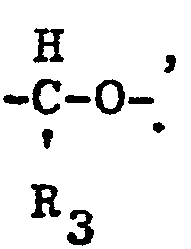
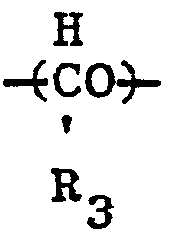
- These and other advantages are achieved by a polymer having the following empirical formula:

- For the-purposes of this invention, the term "rapid depolymerization in alkaline solution" as it is used in the specification and claims, shall mean that in an aqueous solution of 0.5 molar sodium hydroxide containing 10 grams per liter of the copolymer of the present invention, the average chain length of the copolymer will be reduced by more than 50 percent, as determined by Proton Magnetic Resonance, after 1 hour at 20°C.
- Broadly described, the polymers of the present invention can be prepared by: (A) bringing together under polymerization conditions an ester of glyoxylic acid, optionally one or more materials capable of polymerizing with the ester of glyoxylic acid, and a polymerization initiator; and (B) stabilizing the resulting copolymer against rapid depolymerization in alkaline solution. To form a salt of the copolymer, the stabilized copolymer can be saponified.
- Any number of esters of glyoxylic acid can be used as one starting material to prepare the polymers of the present invention. Such esters can be made by the reaction of an alcohol containing from 1 to 4 carbon atoms with glyoxylic acid hydrate under conditions known to those skilled in the art. Suitable esters include those having from 1 to about 4 carbon atoms in the ester, such as methyl, ethyl, propyl, isopropyl, butyl, isobutyl and the like. Other esters of glyoxylic acid can also be used, provided that the particular ester does not interfere with the polymerization or interfere with the conversion of the hemiacetal ester of glyoxylic acid to the corresponding aldehyde ester or interfere with the saponification of the stabilized ester to the alkali metal salt, and such esters of glyoxylate are equivalent for purposes of this invention. Methyl and ethyl esters are preferred.
- Thereafter, the resulting hemiacetal ester of glyoxylic acid can be converted to the corresponding aldehyde ester by any number of techniques known to those skilled in the art, such as the reaction of the ester with phosphorus pentoxide according to the following general equation:

- Any number of comonomers known to those skilled in the art optionally can be polymerized with the aldehyde ester to form a polymer of the present invention. It is only necessary that the comonomer has at least two reactive sites and does not inhibit polymerization or cause the polymer of the present invention to depolymerize in alkaline solution. Suitable comonomers include: epoxy compounds, such as ethylene oxide, propylene oxide, epihalohydrin epoxysuccinate and the like; aldehydes such as formaldehyde, acetaldehyde, as well as aldehydes containing up to 20 carbon atoms, and the like. It is particularly beneficial when the comonomer contains substituent carboxy groups. Comonomers having from 1 to 4 carbon atoms, such as ethylene oxide, formaldehyde or acetaldehyde are preferred.
- Mixtures of comonomers can be polymerized with the aldehyde ester to form a terpolymer, or even a more complex polymeric structure. For example, mixtures of the same class of comonomers, such as a mixture of epoxy compounds like ethylene oxide and propylene oxide, can be copolymerized with the aldehyde ester to form a terpolymer. Even comonomers that might inhibit polymerization when used alone can be mixed with a lower molecular weight aldehyde like formaldehyde or acetaldehyde and polymerized with the aldehyde ester to form a terpolymer wherein the comonomers are randomly dispersed along the polymeric chain. Numerous other examples will occur to those skilled in the art in view of the present disclosure, such as a mixture of ethylene oxide and formaldehyde.
- Any number of initiators can be used for the polymerization. Nonionic or ionic initiators provide satisfactory results. Suitable initiators include: amines, such as triethyl amine, 2-hydroxy pyridine-H-0 complex, and the like; strong Lewis acids, such as boron trifluoride or boron trifluoride diethyl etherate, phosphorus pentafluoride, stannic chloride and the like. Even traces of hydroxy ion or cyanide ion will trigger the polymerization. Sodio derivatives such as diethyl- sodiomalonate or sodiomethylmalonate esters and the like have been used with good results.
- As will occur to those skilled in the art in view of the present disclosure, the number of carboxylate groups in the polymer of the present invention is important since the number of carboxylate groups affect the usefulness of the corresponding polymer salt as a chelant, sequestrant and detergent builder. Hence, the nature of the comonomer or comonomers (i.e., the nature of Y), the mole ratio of comonomer to aldehyde ester (i.e., the value of p and q) and the number of repeating units in the polymer of the present invention (i.e., the average value of n) are each interrelated and important since they affect the number of carboxylate groups in the polymer.
- As noted above, the aldehyde ester can be polymerized with any number of comonomers, or even a mixture of comonomers, but as will occur to those skilled in the art, large comonomers (or mixtures) that disperse the carboxylate groups along the polymer chain too widely or inhibit chelation by steric hindrance of the carboxylate groups decrease the effectiveness of the corresponding polymer salt as a sequestrant, chelant and builder. This decrease in effectiveness may be partially offset if the comonomer, or one of the comonomers, contains a carboxylate group. It is preferred to use a relatively small comonomer that does not disperse the carboxylate groups too widely or inhibit chelation by steric hindrance, such as ethylene oxide or formaldehyde.
- The mole ratio of aldehyde ester to comonomer or comonomers (i.e., the value of q to p) is important. Although there is theoretically no upper limit to the moles of comonomer or comonomers to the moles of acetal carboxylate segments in the polymer, when the mole ratio of comonomer to acetal carboxylate segments exceeds about 2:1 (i.e., p is up to about 2 and q is 1) the polymer salt loses much of its effectiveness as a chelant, sequestrant and detergent builder. It is preferred that the mole ratio of acetal carboxylate to comonomer is about 1:1 (i.e., p and q are each about 1) or higher, say 5:1 or even 99:1 (i.e., p is 1 and q is at least about 5, e.g.., 99). Of course, the polymer of the present invention is most effective as a chelant, sequestrant and detergent builder when a comonomer is not present, i.e., when p equals 0.
- The number of repeating units, i.e., the average value of n, in the polymer of the present invention is also important, since the effectiveness of the polymer salt as a chelant, sequestrant and cleaning and detergency builder is affected by the average chain length. Even when the polymer averages only four repeating units (i.e., n averages 4), the polymer shows some effectiveness as a sequestrant, chelating agent and builder. Although there is no upper limit to the desired number of repeating units, which may average as high as 400, or even higher, there does not seem to be an advantage to having a polymer with an average of more than about 200 repeating units. When the average number of repeating units exceeds about 100, significant improvement in sequestration, chelation and builder properties is not observed. Thus, it is preferred that the polymer of the present invention contain an average between about 10 and about 20a units, and even more preferred that the polymer contains an average between about 50 and about 100 repeating units in the chain.
- Other important factors believed to control the chain length of the polymer include: (1) the initiator type and concentration, (2) the temperature of the polymerization, (3) the purity of the starting materials, and (4) the presence of solvents and their levels. As will occur to those skilled in the art, these factors are all interrelated and the desired chain length can easily be controlled by simple experimentation by controlling these variables. For exdmple, when the polymerization is initiated using 2-hydroxy pyridine-H20 complex at a temperature of about -70°C., the resulting polymer has a greater chain length, as determined by Proton Magnetic Resonance (PMR), than when the polymerization is initiated at about 20°C., using the same initiator, solvent and starting materials.
- After the aldehyde ester has been polymerized with or without a comonomer as discussed above, any number of chemically reactive groups can be added to the polymer termini, preferably using an ionic catalyst such as boron trifluoride etherate, trifluoroacetic acid, sulfuric acid, potassium carbonate and the like. It is only necessary that the chemically reactive group stabilizes the polymer against rapid depolymerization in an alkaline solution, and the specific nature of the chemically reactive group is not important in the proper function of the polymer in its intended use. As an example, suitable chemically stable end groups include stable substituent moieties derived from otherwise stable compounds such as: alkanes, such as methane, ethane, propane, butane and higher alkanes such as decane, dodecane, octadecane and the like; alkenes such as ethylene, propylene, butylene, decene, dodecene and the like; branched chain hydrocarbons, both saturated and unsaturated, such as 2-methyl butane, 2-methyl butene, 4-butyl-2,3-dimethyl octane and the like; aromatic hydrocarbons such as benzene, toluene, xylene and the like; cycloalkanes such as cyclohexane and cyclohexene and the like; haloalkanes such as chloromethane, chlorobutane, dichloropentane and the like; alcohols such as methanol, ethanol, 2-propanol, cyclohexanol, sodium phenate and the like; polyhydric alcohols such as 1,2-ethane diol, 1,4-benzene diol and the like; mercaptans such as methane thiol, 1,2-ethanedithiol and the like; ethers such as methoxyethane methyl ether, ethyl ether, ethoxy propane and cyclic ethers such as ethylene oxide, epichlorohydrin, tetramethylene oxide and the like; and carboxylate-containing compounds such as the alkali metal salts of carboxylic acids, the esters of carboxylic'acids and the anhydrides. The above listing is intended to be instructive and is not intended to be limited since chemically stable end groups that stabilize the polymer against rapid depolymerization in an alkaline solution include nitrilo groups and halides such as chlorides, bromides and the like.
- Particularly suitable end groups include alkyl groups, alkyl groups containing oxygen and cyclic alkyl groups containing oxygen: such as oxyalkyl groups like methoxy, ethoxy and the like; carboxylic acids such as


- In one embodiment of this invention, diethyl- sodiomalonate or sodiomethylmalonate is used as an initiator to form the polymer. These compounds not only initiate the polymerization, but also the ester adds to the termini as one of the chemically stable end groups to stabilize that end of the polymer against rapid hydrolysis in an alkaline solution. These sodio compounds can be prepared from the corresponding esters using sodium hydride in a solvent, such as tetrahydrofuran, by techniques known to those skilled in the art.
- The stabilized polymer ester is useful as an intermediate to prepare the corresponding alkali metal, ammonium, or alkanol amine salts. It is only necessary to saponify the stabilized polymer ester with a base, such as lithium hydroxide, sodium hydroxide, potassium hydroxide, and the like, using conventional saponification techniques to make a salt suitable for use as a builder and as a sequestrant. The ammonium or alkanol amine salts can be prepared from the corresponding alkali metal salts using conventional ion exchange techniques.
- The amount of polymer salt required to effectively complex the ions in a given system will depend to some extent on the particular polymer salt being used and the particular metal or alkaline earth metal ion in the aqueous media. Because the polymer of the present invention tends to depolymerize in acid media, effective complexing is limited to neutral or preferably basic solution. Optimum conditions and amounts of the polymer salt to be used can readily be determined by routine experimentation.
- The polymer salts of the present invention are also useful as builders in detergent formulations. Since the pH of a detergent solution is usually between pH 9 and pH 10, the polymers of the present invention will not depolymerize rapidly when used as a detergent builder in aqueous solution at normal use concentrations (~250 ml./washer), temperatures (10°-60°C.) and times (i.e., about 15 minutes) typical of United States home laundry practices. Generally, the use of the alkali metal salts, particularly the sodium salt, is preferred. However, in some formulations where greater builder solubility is required, the use of ammonium or alkanol amine salts may be desirable.
- The detergent formulations will contain at least 1 percent by weight and preferably at least 5 percent by weight of the polymer salts of this invention. In order to obtain the maximum advantages of the polymers of this invention as builders, the detergent should preferably contain from about 5 percent to about 75 percent of these salts. The polymer salts of this invention can be the sole detergency builder, or the polymer salts can be utilized in combination with other detergency builders which may constitute from 0 to 95 percent by weight of the total builders in the formulation. By way of example, builders which can be employed in combination with the polymer salts of this invention include either water insoluble materials, such as sodium alumino silicates, commonly known as zeolites, or water soluble inorganic builder salts such as alkali metal polyphosphates, i.e., the tripolyphosphates and pyrophosphates, alkali metal carbonates, borates, bicarbonates and silicates and water soluble organic builders, including amino polycarboxylic acids and salts, such as alkali metal nitrilotriacetates, cycloalkane polycarboxylic acids and salts, ether polycarboxylates, alkyl polycarboxylates, epoxy polycarboxylates, tetrahydrofuran polycarboxylates, such as 1,2,3,4 or 2,2,5,5 tetrahydrofuran tetracarboxylates, benzene polycarboxylates, oxidized starches, amino(trimethylene phosphonic acid) salts, diphosphonic acid salts (e.g., the sodium salts of methylene diphosphonic acid or 1-hydroxy ethylidene 1,1-dimethylene-phosphonic acid), and the.like.
- The detergent formulations will generally contain from 5 percent to 95 percent by weight total builder (although greater or lesser quantities may be employed if desired). The total amount of builder employed will be dependent on the intended use of the detergent formulation, other ingredients of the formulation, pH conditions and the like. For example, general laundry powder formulations will usually contain from about 20 percent to about 60 percent builder; and machine dishwashing formulations will usually contain from about 60 percent to about 90 percent builder. Optimum levels of builder content as well as optimum mixtures of polymer salts of this invention with other builders for various uses can be determined by routine tests in accordance with conventional detergent formulation practice.
- The detergent formulations will generally contain a water soluble detergent surfactant, although the surfactant ingredient may be omitted from machine dishwashing formulations. Any water soluble anionic, nonionic, zwitterionic or amphoteric surfactant can be employed.
- Examples of suitable anionic surfactants include soaps such as the salts of fatty acids containing about 9 to 20 carbon atoms, e.g., salts of fatty acids derived from coconut oil and tallow; alkyl benzene sulfonates - particularly linear alkyl benzene sulfonates in which the alkyl group contains from 10 to 16 carbon atoms; alcohol sulfates; ethoxylated alcohol sulfates, hydroxy alkyl sulfonates; alkyl sulfates and sulfonates; monoglyceride sulfates, acid condensates of fatty acid chlorides with hydroxy alkyl sulfonates; and the like.
- Examples of suitable nonionic surfactants include alkylene oxide (e.g., ethylene oxide), condensates of mono- and polyhydroxy alcohols, alkyl phenols, fatty acid amides and fatty amines; amine oxides, sugar derivatives such as sucrose monopalmitate; long chain tertiary phosphine oxides; dialkyl sulfoxides; fatty acid amides (e.g., mono- or diethanol amides of fatty acids containing 10 to 18 carbon atoms); and the like.
- Examples of suitable zwitterionic surfactants include derivatives of aliphatic quaternary ammonium compounds such as 3-(N,N-dimethyl-N-hexadecylammonio') propane-1-sulfonate and 3-(N,N-dimethyl-N-hexadecyl- ammonio)-2-hydroxy propane-1-sulfcnate.
- Examples of suitable amphoteric surfactants include betains, sulfobetains and fatty acid imidazole carboxylates and sulfonates.
- It will be understood that the above examples of surfactants are by no means comprehensive and that numerous other surfactants are known to those skilled in the art. It will be further understood that the choice and use of surfactants will be in accordance with well understood practices of detergent formulation. For example, anionic surfactants, particularly linear alkyl benzene sulfonates, are preferred for use in general laundry formulations, whereas low foaming nonionic surfactants are preferred for use in machine dishwashing formulations.
- The quantity of surfactant employed in the detergent formulations will depend on the surfactant chosen and the end use of the formulation. In general, the formulations will contain from 5 percent to 50 percent surfactant by weight, although as much as-95 percent or more surfactant may be employed if desired. For example, general laundry powder formulations normally contain 5 percent to 50 percent, preferably 15 percent to 25 percent surfactant. Machine dishwashing formulations normally contain about '0.5 percent to about 5 percent surfactant. Liquid dishwashing formulations normally contain about 20 percent to about 45 percent surfactant. The weight ratio of surfactant to builder will generally be in the range of from 1:12 to 2:1.
- In addition to builder and surfactant components, detergent formulations may contain fillers such as sodium sulfate and minor amounts of bleaches, dyes, optical brighteners, soil anti-redeposition agents, perfumes and the like.
- In machine dishwashing compositions, the surfactant will be a low-foaming anionic surfactant which will constitute 0 to 5 percent of the formulation.
- It is to be noted that when the alkali ammonium or alkanol ammonium salts of the present invention are used as builders, they will be used generally in an alkaline medium. When the polymers of the present invention are used'at a pH of 7 or below, the polymer depolymerizes. Thus, the polymers of the present invention when used as builders will be effective for chelating, sequestering and as detergency and cleaning builders, but when an aqueous solution containing the polymer is discharged into a sewer or other waste water system, the polymer will ultimately depolymerize into small fragments which are readily biodegradable.
- This invention is illustrated by, but not limited to, the following Examples wherein all-percentages are by weight unless otherwise noted.
- This Example illustrates the preparation of the anhydrous aldehyde ester useful to prepare the polymers of the present invention.
- To a 500 milliliter round-bottom flask equipped with an efficient stirrer and a heater is added 100 grams of methyl glyoxylate methyl hemiacetal and 160 grams of phosphorus pentoxide. The contents of the flask are heated to 100°C. with stirring for one hour and then allowed to cool to room temperature. The resulting aldehyde ester is recovered from the residual phosphorus pentoxide by distillation and stored in a glass stoppered bottle.
- To a 50 milliliter single-necked, roundbottomed reaction flask equipped with a magnetic stirrer was added 10 grams (0.114 .mole) of freshly distilled aldehyde ester from Example I and 4 milliliters of methylene chloride. The temperature of the flask and the contents was lowered to about 0°C., and 0.5 milliliters of 0.05 molar sodium diethyl methylmalonate was added to initiate polymerization. The flask was kept in an ice bath, and when the temperature returned to 0-2°C., (about 45 minutes) 0.18 milliliter trifluoroacetic acid (1.5 mole percent) and 3.5 milliliters of ethyl vinyl ether was added to the mixture. The mixture was stirred at room temperature overnight. About 2 milliliters of 1 molar NaOH solution was added to the mixture and the volatiles were removed under vacuum. Then 12 milliliters of 2.5 molar NaOH was added. The mixture was stirred at about 0°C. for about 5 hours and then heated to about 40°C. for about 24 hours. The methanol and residual solvents were removed by rotary evaporation. The solution was concentrated to about 15 percent, precipitated in about 100. milliliters of methanol and stirred for 30 minutes. The precipitate was recovered by filtration and dried. The precipitate was then redissolved in distilled water, precipitated into methanol, stirred and recovered by filtration. The yield was about 74.8 percent. Analysis of the product, including the chain length, by Proton Magnetic Resonance (PMR) Spectra Analysis, showed that the product was a mixture, mostly a polymer,having the following formula:


- The procedure of Example II was repeated except that the temperature of initiation was varied. The result of this variation of the temperature of initiation on the chain length as determined by the average value of n is shown in the following tabulation:

- The procedure of Example II was repeated except different initiation temperatures were used to provide a series of samples having different chain lengths, as measured by PMR. These samples were tested for sequestration function using the procedures described by Matzner et al ("Organic Builder Salts as Replacements for Sodium Tripolyphosphate", TENSIDE DETERGENTS, 10 No. 3, pages 119-125) 1973. The sequestration of calcium ions and magnesium ions (as a percent of STP performance) as 'a function of chain length is shown below:

- The biodegradation of three of the samples from Example VI was measured by diluting one part of an activated sewerage sludge with about 10 parts of river water, and adding a known amount of the polymer to the diluted sludge. The biodegradation is determined by measuring the CO2 evolution from the diluted sludge. The results are presented in the following tabulation:

- To a 100 milliliter single-necked, roundbottomed reaction flask equipped with a magnetic stirrer was added 10 grams of freshly distilled aldehyde ester from Example I and 4 milliliters of methylene chloride. The temperature of the flask and the contents were lowered to about OOC., 5.3 grams of ethylene oxide and 0.5 milliliters boron trifluoride diethyl etherate were added to initiate polymerization. The flask was kept in an ice bath until the temperature returned to 0-2°C., (about 45 minutes). The mixture was stirred at room temperature overnight. About 2 milliliters of 1 molar NaOH solution was added to the mixture and the volatiles were removed under vacuum. Then 12 milliliters of 2.5 molar NaOH were added. The mixture was stirred at about 0°C. for about 5 hours and then heated to about 40°C. for about 24 hours. The methanol and residual solvents were removed by rotary evaporation. The solution was concentrated to about 15 percent, precipitated in about 100 milliliters of methanol and stirred for 30 minutes. The precipitate was recovered by filtration and dried. The precipitate was then redissolved in distilled water, precipitated into methanol, stirred and recovered by filtration. The yield was about 74.8 percent. Analysis of the product, including the chain length, by Proton Magnetic Resonance (PMR) Spectra Analysis, showed that the product was a copolymer having the following empirical formula:

- The procedure of Example VIII was repeated except that about 5 mole percent ethylene oxide was mixed with about 95 mole percent aldehyde ester from Example I. The copolymer was analyzed by PMR, and the composition is the same as in Example VIII except that the ratio of p to q was about 1:25.
- The general procedure of Example VIII was repeated except that about 4.4 grams of aldehyde ester from Example I was diluted with about 1.5 milliliters of methylene chloride, the temperature was reduced to about -10°C., and then about 1.2 mole percent boron trifluoride diethyl etherate was added to the methyl glyoxylate solution. After about 30 minutes, 0.01 mole ethylene oxide was added and allowed to react at about 22°C. for about 34 hours. The resulting stabilized copolymer was hydrolyzed using 2.5 molar NaOH as in Example II. Analysis by PMR showed that the yield was' about 73 percent. The average mole ratio of acetal carboxylate segments to oxyethylene groups (i.e., the mole ratio of q to p) was about 8.4:1.
- A portion of the copolymer from Example X was tested for sequestration function using the procedures described by Matzner et al ("Organic Builder Salts as Replacements for Sodium Tripolyphosphate", TENSIDE DETERGENTS, 10 No. 3, pages 119-125) 1973. The sequestration of calcium ions and magnesium ions (as a percent of STP performance) shows that the copolymer salt was about 104 percent of STP performance.
- The general procedure of Example VIII is repeated except that about 5 grams of aldehyde ester from Example I was diluted with about 1.5 milliliters- of methylene chloride, the temperature is reduced to 0°C., and about 1 gram of a saturated aliphatic aldehyde having the empirical formula C12H25CHO in 4 milliliters of methylene chloride is added to the aldehyde ester. Then, about 1.2 mole percent boron trifluoride-diethyl etherate is added. After the polymerization is completed, about 0.2 milliliters trifluoroacetic acid is added and 0.2 gram ethylene oxide is added and allowed to react at 20°C. for 24 hours. The resulting stabilized copolymer is hydrolyzed using 10 molar NaOH. The copolymer precipitates and is recovered by filtration. Analysis of the product by PMR showed that the average ratio of acetal carboxylate segments to -C12H25CHO- groups is about 6:1.
- Using the general procedure of Example II, about 50 grams of unstabilized polymer is prepared by polymerizing methyl glyoxylate using a trace of 10 normal sodium hydroxide as initiator. The resulting polymer is diluted with sufficient methylene chloride to permit stirring at 0°C. Then, 5 gram portions were taken and separately stabilized using a variety of chemically stable end groups. The reagent and the catalyst employed to provide chemically stable end groups, the time and temperature of adding the end groups, and the identification of the end groups are shown in Table I.


- Although the invention has been described in terms of specified embodiments which are set forth in considerable detail, it should be understood that this is by way of illustration only and that the invention is not necessarily limited thereto since alternative embodiments and operating techniques will become apparent to those skilled in the art in view of the disclosure. Accordingly, modifications are contemplated which can be made without departing from the spirit of the described invention.
Claims (28)



Applications Claiming Priority (8)
| Application Number | Priority Date | Filing Date | Title |
|---|---|---|---|
| US82642477A | 1977-08-22 | 1977-08-22 | |
| US05/826,425 US4144226A (en) | 1977-08-22 | 1977-08-22 | Polymeric acetal carboxylates |
| US826426 | 1977-08-22 | ||
| US826425 | 1977-08-22 | ||
| US05/826,426 US4146495A (en) | 1977-08-22 | 1977-08-22 | Detergent compositions comprising polyacetal carboxylates |
| US826424 | 1977-08-22 | ||
| US90406778A | 1978-05-08 | 1978-05-08 | |
| US904067 | 1986-09-05 |
Publications (2)
| Publication Number | Publication Date |
|---|---|
| EP0001004A1 true EP0001004A1 (en) | 1979-03-07 |
| EP0001004B1 EP0001004B1 (en) | 1982-02-24 |
Family
ID=27505871
Family Applications (1)
| Application Number | Title | Priority Date | Filing Date |
|---|---|---|---|
| EP19780300298 Expired EP0001004B1 (en) | 1977-08-22 | 1978-08-18 | Polymeric acetal carboxylates, a method for their preparation and their use in a detergent composition |
Country Status (8)
| Country | Link |
|---|---|
| EP (1) | EP0001004B1 (en) |
| JP (1) | JPS5452196A (en) |
| BR (1) | BR7805391A (en) |
| CA (1) | CA1107746A (en) |
| DE (1) | DE2861643D1 (en) |
| DK (1) | DK369078A (en) |
| ES (1) | ES472603A1 (en) |
| MX (1) | MX149493A (en) |
Cited By (11)
| Publication number | Priority date | Publication date | Assignee | Title |
|---|---|---|---|---|
| EP0803521A1 (en) * | 1996-04-26 | 1997-10-29 | Nippon Shokubai Co., Ltd. | Block copolymer and its production process and use |
| EP1127903A1 (en) * | 2000-02-28 | 2001-08-29 | Nippon Shokubai Co., Ltd. | Production process for glyoxylic acid (salt)-based polymer |
| US7074749B2 (en) | 2000-06-16 | 2006-07-11 | Basf Aktiengesellschaft | Oxoalcohol-based detergent |
| US8232356B2 (en) | 2007-11-14 | 2012-07-31 | Basf Se | Method for producing a thickener dispersion |
| US8524649B2 (en) | 2007-08-03 | 2013-09-03 | Basf Se | Associative thickener dispersion |
| US8865639B2 (en) | 2010-02-12 | 2014-10-21 | Basf Se | Use of a copolymer as thickener in liquid detergents having lower graying tendency |
| US8951955B2 (en) | 2011-01-13 | 2015-02-10 | Basf Se | Use of optionally oxidized thioethers of alcohol alkoxylates in washing and cleaning compositions |
| US8987183B2 (en) | 2011-01-13 | 2015-03-24 | Basf Se | Use of optionally oxidized thioethers of polyalkylene oxides in washing and cleaning compositions |
| US9982222B2 (en) | 2013-06-12 | 2018-05-29 | Lion Corporation | Detergent composition |
| US10344249B2 (en) | 2013-07-03 | 2019-07-09 | Basf Se | Gel-like polymer composition obtained by polymerizing a monomer containing acid groups in the presence of a polyether compound |
| US10926029B2 (en) | 2015-03-26 | 2021-02-23 | Becton, Dickinson And Company | IV membrane attachment systems and methods |
Families Citing this family (37)
| Publication number | Priority date | Publication date | Assignee | Title |
|---|---|---|---|---|
| EP0015024A1 (en) * | 1979-02-16 | 1980-09-03 | THE PROCTER & GAMBLE COMPANY | Detergent compositions containing binary builder system |
| SE8502149L (en) * | 1984-06-01 | 1985-12-02 | Colgate Palmolive Co | ENHANCED SYNTHETIC DETERGENT COMPOSITION |
| US4725455A (en) * | 1984-06-01 | 1988-02-16 | Colgate-Palmolive Company | Process for manufacturing particulate built nonionic synthetic organic detergent composition comprising polyacetal carboxylate and polyphosphate builders |
| JPS621800A (en) * | 1985-06-28 | 1987-01-07 | ライオン株式会社 | Method for producing high bulk density detergent composition |
| NZ216987A (en) * | 1985-08-20 | 1988-09-29 | Colgate Palmolive Co | Nonaqueous liquid low phosphate laundry detergent |
| DE3706036A1 (en) * | 1987-02-25 | 1988-09-08 | Basf Ag | POLYACETALS, METHOD FOR THE PRODUCTION THEREOF FROM DIALDEHYDES AND POLYOLCARBONIC ACIDS AND USE OF THE POLYACETALS |
| WO1991001282A1 (en) * | 1989-07-25 | 1991-02-07 | Nippon Shokubai Kagaku Kogyo Co., Ltd. | Cement admixture, production thereof, and cement composition |
| JPH0364888U (en) * | 1989-10-31 | 1991-06-25 | ||
| DE4106354A1 (en) * | 1991-02-28 | 1992-09-03 | Basf Ag | POLYACETALS, METHOD FOR THEIR PRODUCTION AND THEIR USE IN DETERGENT AND CLEANING AGENTS |
| DE69208976T2 (en) * | 1991-08-23 | 1997-04-17 | Nippon Shokubai Co. Ltd., Osaka | Biodegradable, hydrophilic, cross-linked polymer, process for its preparation and its use |
| DE4142130A1 (en) * | 1991-12-20 | 1993-06-24 | Basf Ag | USE OF POLYACETALES BASED ON VINYL ETHERS AND DIHYDROXY COMPOUNDS IN WASHING AND CLEANING AGENTS AND POLYACETALES |
| DE4228159A1 (en) * | 1992-08-25 | 1994-03-03 | Basf Ag | Process for the preparation of polyacetals, their use and new polyacetals |
| US5756594A (en) * | 1993-03-06 | 1998-05-26 | Basf Aktiengesellschaft | Polymers containing polyacetal blocks, their preparation and their use |
| JP3768293B2 (en) * | 1996-06-17 | 2006-04-19 | 花王株式会社 | Anti-dulling composition for clothing |
| USD391361S (en) | 1996-12-06 | 1998-02-24 | Professional Dental Technologies, Inc. | Automated periodontal probe handpiece |
| EP1002046B1 (en) | 1997-07-30 | 2003-04-16 | Basf Aktiengesellschaft | Solid textile detergent formulation based on glycin-n,n-diacetic acid derivatives |
| EP0962475B1 (en) * | 1997-12-18 | 2004-08-11 | Nippon Shokubai Co., Ltd. | Amidated polyacetals, process for producing the same, and use thereof |
| CN100513543C (en) | 2002-01-29 | 2009-07-15 | 花王株式会社 | Anionic surfactant powder |
| JP4319133B2 (en) | 2003-12-26 | 2009-08-26 | 花王株式会社 | Method for producing granular anionic surfactant |
| EP2083067A1 (en) | 2008-01-25 | 2009-07-29 | Basf Aktiengesellschaft | Use of organic complexing agents and/or polymeric compounds containing carbonic acid groups in a liquid washing or cleaning agent compound |
| TW201031743A (en) | 2008-12-18 | 2010-09-01 | Basf Se | Surfactant mixture comprising branched short-chain and branched long-chain components |
| WO2011003904A1 (en) | 2009-07-10 | 2011-01-13 | Basf Se | Surfactant mixture having short- and long-chained components |
| WO2011117350A1 (en) | 2010-03-25 | 2011-09-29 | Basf Se | Electrochemical textile-washing method |
| US20110237484A1 (en) | 2010-03-25 | 2011-09-29 | Basf Se | Electrochemical textile-washing process |
| BR112012032218A2 (en) | 2010-06-17 | 2016-11-22 | Basf Se | "copolymer, use of a copolymer, and textile detergent composition" |
| JP6038806B2 (en) | 2011-01-13 | 2016-12-07 | ビーエーエスエフ ソシエタス・ヨーロピアBasf Se | Use of optionally oxidized thioethers of polyalkylene glycols in detergents and detergents |
| BR112013017438A2 (en) | 2011-01-13 | 2016-09-27 | Basf Se | use of compounds, and composition for cleaning or washing |
| US8846599B2 (en) | 2011-06-15 | 2014-09-30 | Basf Se | Branched polyesters with sulfonate groups |
| PL2721089T3 (en) | 2011-06-15 | 2016-01-29 | Basf Se | Branched polyesters with sulfonate groups |
| RU2018136215A (en) | 2016-03-16 | 2020-04-16 | Басф Се | POLYMER FILMS ACTIVE FOR WASHING AND CLEANING, METHOD FOR PRODUCING THEM AND THEIR APPLICATION |
| EP3555155B1 (en) | 2016-12-16 | 2020-10-28 | Basf Se | Washing and cleaning multi-layer films, method for their preparation and their use |
| CN110291120A (en) | 2016-12-16 | 2019-09-27 | 巴斯夫欧洲公司 | Multilayer film, method for its production and use |
| WO2019048474A1 (en) | 2017-09-06 | 2019-03-14 | Basf Se | Washing- and cleaning-active polymer films, process for their production and their use |
| WO2020011627A1 (en) | 2018-07-11 | 2020-01-16 | Basf Se | Process for preparing stable polymers containing vinylimidazole |
| WO2020035567A1 (en) | 2018-08-16 | 2020-02-20 | Basf Se | Water-soluble polymer films of ethylene oxide homo- or copolymers, calendering process for the production thereof and the use thereof |
| US20220306791A1 (en) | 2019-06-14 | 2022-09-29 | Basf Se | Aqueous polymer dispersions suitable as opacifiers in liquid formulations |
| WO2021191175A1 (en) | 2020-03-24 | 2021-09-30 | Basf Se | Detergent formulation in form of a three dimensional body |
Citations (2)
| Publication number | Priority date | Publication date | Assignee | Title |
|---|---|---|---|---|
| GB876956A (en) * | 1959-06-30 | 1961-09-06 | Consortium Elektrochem Ind | Process for the manufacture of highly polymeric copolymers of acetaldehyde |
| FR2233338A1 (en) * | 1973-06-14 | 1975-01-10 | Degussa |
-
1978
- 1978-08-16 ES ES472603A patent/ES472603A1/en not_active Expired
- 1978-08-18 DE DE7878300298T patent/DE2861643D1/en not_active Expired
- 1978-08-18 EP EP19780300298 patent/EP0001004B1/en not_active Expired
- 1978-08-21 BR BR7805391A patent/BR7805391A/en unknown
- 1978-08-21 CA CA309,758A patent/CA1107746A/en not_active Expired
- 1978-08-21 JP JP10225678A patent/JPS5452196A/en active Granted
- 1978-08-21 DK DK369078A patent/DK369078A/en not_active Application Discontinuation
- 1978-08-21 MX MX17459378A patent/MX149493A/en unknown
Patent Citations (2)
| Publication number | Priority date | Publication date | Assignee | Title |
|---|---|---|---|---|
| GB876956A (en) * | 1959-06-30 | 1961-09-06 | Consortium Elektrochem Ind | Process for the manufacture of highly polymeric copolymers of acetaldehyde |
| FR2233338A1 (en) * | 1973-06-14 | 1975-01-10 | Degussa |
Cited By (11)
| Publication number | Priority date | Publication date | Assignee | Title |
|---|---|---|---|---|
| EP0803521A1 (en) * | 1996-04-26 | 1997-10-29 | Nippon Shokubai Co., Ltd. | Block copolymer and its production process and use |
| EP1127903A1 (en) * | 2000-02-28 | 2001-08-29 | Nippon Shokubai Co., Ltd. | Production process for glyoxylic acid (salt)-based polymer |
| US7074749B2 (en) | 2000-06-16 | 2006-07-11 | Basf Aktiengesellschaft | Oxoalcohol-based detergent |
| US8524649B2 (en) | 2007-08-03 | 2013-09-03 | Basf Se | Associative thickener dispersion |
| US8232356B2 (en) | 2007-11-14 | 2012-07-31 | Basf Se | Method for producing a thickener dispersion |
| US8865639B2 (en) | 2010-02-12 | 2014-10-21 | Basf Se | Use of a copolymer as thickener in liquid detergents having lower graying tendency |
| US8951955B2 (en) | 2011-01-13 | 2015-02-10 | Basf Se | Use of optionally oxidized thioethers of alcohol alkoxylates in washing and cleaning compositions |
| US8987183B2 (en) | 2011-01-13 | 2015-03-24 | Basf Se | Use of optionally oxidized thioethers of polyalkylene oxides in washing and cleaning compositions |
| US9982222B2 (en) | 2013-06-12 | 2018-05-29 | Lion Corporation | Detergent composition |
| US10344249B2 (en) | 2013-07-03 | 2019-07-09 | Basf Se | Gel-like polymer composition obtained by polymerizing a monomer containing acid groups in the presence of a polyether compound |
| US10926029B2 (en) | 2015-03-26 | 2021-02-23 | Becton, Dickinson And Company | IV membrane attachment systems and methods |
Also Published As
| Publication number | Publication date |
|---|---|
| ES472603A1 (en) | 1979-10-16 |
| BR7805391A (en) | 1979-05-08 |
| JPS6237044B2 (en) | 1987-08-11 |
| DE2861643D1 (en) | 1982-03-25 |
| MX149493A (en) | 1983-11-15 |
| CA1107746A (en) | 1981-08-25 |
| EP0001004B1 (en) | 1982-02-24 |
| JPS5452196A (en) | 1979-04-24 |
| DK369078A (en) | 1979-02-23 |
Similar Documents
| Publication | Publication Date | Title |
|---|---|---|
| EP0001004B1 (en) | Polymeric acetal carboxylates, a method for their preparation and their use in a detergent composition | |
| US4146495A (en) | Detergent compositions comprising polyacetal carboxylates | |
| US4144226A (en) | Polymeric acetal carboxylates | |
| US4204052A (en) | Copolymers of acetal carboxylates | |
| US4315092A (en) | Polyacetal carboxylates | |
| US5506332A (en) | Preparation of polyacetals, use thereof and novel polyacetals | |
| US4654159A (en) | Ether hydroxypolycarboxylate detergency builders | |
| US5399286A (en) | Polyacetals, preparation thereof and use thereof in detergents | |
| CA1148831A (en) | Detergent compositions | |
| US5061396A (en) | Detergent compositions containing polyether polycarboxylates | |
| US4906397A (en) | Detergent compositions utilizing divinyl ether polymers as builders and novel divinyl ether polymers | |
| CA2054397A1 (en) | Polyesters with tartaric acid, preparation thereof and use thereof as detergent additives and polyesters of tartaric acid and tetracarboxylic acids | |
| CA2084930A1 (en) | Use of polyacetals based on vinyl ethers and dihydroxy compounds in detergents and cleaners and polyacetals | |
| US4140676A (en) | Process for preparing polymeric acetal carboxylate salts | |
| US4169934A (en) | Copolymers of keto dicarboxylates | |
| EP1020485B1 (en) | Polyether hydroxycarboxylate copolymers | |
| US4201858A (en) | Method of preparing polyacetal carboxylates | |
| US4219437A (en) | Copolymers of keto dicarboxylates | |
| US4225685A (en) | Preparation of polymeric acetal carboxylates using organoaluminum compounds | |
| US4260724A (en) | Preparation of polymaleic acids from maleic anhydride in the presence of acetic anhydride and of hydrogen peroxide | |
| JPS59187098A (en) | Detergent composition containing polyacetalcarboxylate-detergent builder | |
| JPH08502775A (en) | Block copolyacetal, process for its production and its use in detergents and cleaners | |
| US4179392A (en) | Biodegradable hard water detergents | |
| US4226960A (en) | Process for the preparation of polymeric acetal carboxylates | |
| US4224420A (en) | Preparation of polymeric acetal carboxylates using molecular sieves |
Legal Events
| Date | Code | Title | Description |
|---|---|---|---|
| PUAI | Public reference made under article 153(3) epc to a published international application that has entered the european phase |
Free format text: ORIGINAL CODE: 0009012 |
|
| AK | Designated contracting states |
Designated state(s): BE CH DE FR GB LU NL SE |
|
| 17P | Request for examination filed | ||
| GRAA | (expected) grant |
Free format text: ORIGINAL CODE: 0009210 |
|
| AK | Designated contracting states |
Designated state(s): BE CH DE FR GB LU NL SE |
|
| REF | Corresponds to: |
Ref document number: 2861643 Country of ref document: DE Date of ref document: 19820325 |
|
| PGFP | Annual fee paid to national office [announced via postgrant information from national office to epo] |
Ref country code: FR Payment date: 19910708 Year of fee payment: 14 |
|
| PGFP | Annual fee paid to national office [announced via postgrant information from national office to epo] |
Ref country code: SE Payment date: 19910712 Year of fee payment: 14 |
|
| PGFP | Annual fee paid to national office [announced via postgrant information from national office to epo] |
Ref country code: CH Payment date: 19910716 Year of fee payment: 14 |
|
| PGFP | Annual fee paid to national office [announced via postgrant information from national office to epo] |
Ref country code: LU Payment date: 19910729 Year of fee payment: 14 Ref country code: BE Payment date: 19910729 Year of fee payment: 14 |
|
| PGFP | Annual fee paid to national office [announced via postgrant information from national office to epo] |
Ref country code: NL Payment date: 19910831 Year of fee payment: 14 |
|
| EPTA | Lu: last paid annual fee | ||
| PG25 | Lapsed in a contracting state [announced via postgrant information from national office to epo] |
Ref country code: LU Free format text: LAPSE BECAUSE OF NON-PAYMENT OF DUE FEES Effective date: 19920818 |
|
| PG25 | Lapsed in a contracting state [announced via postgrant information from national office to epo] |
Ref country code: SE Effective date: 19920819 |
|
| PG25 | Lapsed in a contracting state [announced via postgrant information from national office to epo] |
Ref country code: CH Effective date: 19920831 Ref country code: BE Effective date: 19920831 |
|
| BERE | Be: lapsed |
Owner name: MONSANTO CY Effective date: 19920831 |
|
| PG25 | Lapsed in a contracting state [announced via postgrant information from national office to epo] |
Ref country code: NL Effective date: 19930301 |
|
| NLV4 | Nl: lapsed or anulled due to non-payment of the annual fee | ||
| PG25 | Lapsed in a contracting state [announced via postgrant information from national office to epo] |
Ref country code: FR Effective date: 19930430 |
|
| REG | Reference to a national code |
Ref country code: CH Ref legal event code: PL |
|
| REG | Reference to a national code |
Ref country code: FR Ref legal event code: ST |
|
| EUG | Se: european patent has lapsed |
Ref document number: 78300298.3 Effective date: 19930307 |
|
| PGFP | Annual fee paid to national office [announced via postgrant information from national office to epo] |
Ref country code: DE Payment date: 19970722 Year of fee payment: 20 |
|
| PGFP | Annual fee paid to national office [announced via postgrant information from national office to epo] |
Ref country code: GB Payment date: 19970728 Year of fee payment: 20 |
|
| PG25 | Lapsed in a contracting state [announced via postgrant information from national office to epo] |
Ref country code: GB Free format text: LAPSE BECAUSE OF EXPIRATION OF PROTECTION Effective date: 19980817 |
|
| REG | Reference to a national code |
Ref country code: GB Ref legal event code: PE20 Effective date: 19980817 |
|
| PLBE | No opposition filed within time limit |
Free format text: ORIGINAL CODE: 0009261 |
|
| STAA | Information on the status of an ep patent application or granted ep patent |
Free format text: STATUS: NO OPPOSITION FILED WITHIN TIME LIMIT |