EP0008139B1 - A process for preparing 1,7-octadiene - Google Patents
A process for preparing 1,7-octadiene Download PDFInfo
- Publication number
- EP0008139B1 EP0008139B1 EP79200392A EP79200392A EP0008139B1 EP 0008139 B1 EP0008139 B1 EP 0008139B1 EP 79200392 A EP79200392 A EP 79200392A EP 79200392 A EP79200392 A EP 79200392A EP 0008139 B1 EP0008139 B1 EP 0008139B1
- Authority
- EP
- European Patent Office
- Prior art keywords
- palladium
- carbon atoms
- butadiene
- octadiene
- phosphine
- Prior art date
- Legal status (The legal status is an assumption and is not a legal conclusion. Google has not performed a legal analysis and makes no representation as to the accuracy of the status listed.)
- Expired
Links
- XWJBRBSPAODJER-UHFFFAOYSA-N 1,7-octadiene Chemical compound C=CCCCCC=C XWJBRBSPAODJER-UHFFFAOYSA-N 0.000 title claims description 24
- 238000004519 manufacturing process Methods 0.000 title claims description 7
- KAKZBPTYRLMSJV-UHFFFAOYSA-N Butadiene Chemical compound C=CC=C KAKZBPTYRLMSJV-UHFFFAOYSA-N 0.000 claims description 36
- KDLHZDBZIXYQEI-UHFFFAOYSA-N Palladium Chemical compound [Pd] KDLHZDBZIXYQEI-UHFFFAOYSA-N 0.000 claims description 36
- XYFCBTPGUUZFHI-UHFFFAOYSA-N phosphine group Chemical group P XYFCBTPGUUZFHI-UHFFFAOYSA-N 0.000 claims description 36
- BDAGIHXWWSANSR-UHFFFAOYSA-N methanoic acid Chemical group OC=O BDAGIHXWWSANSR-UHFFFAOYSA-N 0.000 claims description 22
- 229910000073 phosphorus hydride Inorganic materials 0.000 claims description 18
- 125000004432 carbon atom Chemical group C* 0.000 claims description 16
- 229910052763 palladium Inorganic materials 0.000 claims description 16
- 238000000034 method Methods 0.000 claims description 13
- OSWFIVFLDKOXQC-UHFFFAOYSA-N 4-(3-methoxyphenyl)aniline Chemical group COC1=CC=CC(C=2C=CC(N)=CC=2)=C1 OSWFIVFLDKOXQC-UHFFFAOYSA-N 0.000 claims description 11
- 235000019253 formic acid Nutrition 0.000 claims description 11
- 239000002904 solvent Chemical group 0.000 claims description 11
- 125000000217 alkyl group Chemical group 0.000 claims description 9
- 239000003054 catalyst Substances 0.000 claims description 9
- IGNTWNVBGLNYDV-UHFFFAOYSA-N triisopropylphosphine Chemical group CC(C)P(C(C)C)C(C)C IGNTWNVBGLNYDV-UHFFFAOYSA-N 0.000 claims description 6
- 239000000203 mixture Substances 0.000 claims description 5
- 150000003003 phosphines Chemical class 0.000 claims description 5
- ATTZFSUZZUNHBP-UHFFFAOYSA-N Piperonyl sulfoxide Chemical compound CCCCCCCCS(=O)C(C)CC1=CC=C2OCOC2=C1 ATTZFSUZZUNHBP-UHFFFAOYSA-N 0.000 claims description 4
- 125000003342 alkenyl group Chemical group 0.000 claims description 4
- 125000003118 aryl group Chemical group 0.000 claims description 4
- 125000004437 phosphorous atom Chemical group 0.000 claims description 4
- 229910052698 phosphorus Inorganic materials 0.000 claims description 4
- 125000003710 aryl alkyl group Chemical group 0.000 claims description 3
- 229910052799 carbon Inorganic materials 0.000 claims description 3
- 125000000753 cycloalkyl group Chemical group 0.000 claims description 3
- NINIDFKCEFEMDL-UHFFFAOYSA-N Sulfur Chemical compound [S] NINIDFKCEFEMDL-UHFFFAOYSA-N 0.000 claims description 2
- 239000005864 Sulphur Substances 0.000 claims description 2
- 150000001875 compounds Chemical class 0.000 claims description 2
- 125000004433 nitrogen atom Chemical group N* 0.000 claims description 2
- BWHDROKFUHTORW-UHFFFAOYSA-N tritert-butylphosphane Chemical compound CC(C)(C)P(C(C)(C)C)C(C)(C)C BWHDROKFUHTORW-UHFFFAOYSA-N 0.000 claims description 2
- DZQQRNFLQBSVBN-UHFFFAOYSA-N tri(butan-2-yl)phosphane Chemical compound CCC(C)P(C(C)CC)C(C)CC DZQQRNFLQBSVBN-UHFFFAOYSA-N 0.000 claims 1
- 238000006243 chemical reaction Methods 0.000 description 12
- 150000002941 palladium compounds Chemical class 0.000 description 11
- CURLTUGMZLYLDI-UHFFFAOYSA-N Carbon dioxide Chemical compound O=C=O CURLTUGMZLYLDI-UHFFFAOYSA-N 0.000 description 8
- RIOQSEWOXXDEQQ-UHFFFAOYSA-N triphenylphosphine Chemical compound C1=CC=CC=C1P(C=1C=CC=CC=1)C1=CC=CC=C1 RIOQSEWOXXDEQQ-UHFFFAOYSA-N 0.000 description 8
- -1 palladium carboxylates Chemical class 0.000 description 7
- ZMXDDKWLCZADIW-UHFFFAOYSA-N N,N-Dimethylformamide Chemical compound CN(C)C=O ZMXDDKWLCZADIW-UHFFFAOYSA-N 0.000 description 6
- 229910002092 carbon dioxide Inorganic materials 0.000 description 5
- 239000000047 product Substances 0.000 description 5
- 239000001569 carbon dioxide Substances 0.000 description 4
- 230000000052 comparative effect Effects 0.000 description 4
- 238000002474 experimental method Methods 0.000 description 4
- 238000004817 gas chromatography Methods 0.000 description 4
- IAZDPXIOMUYVGZ-UHFFFAOYSA-N Dimethylsulphoxide Chemical compound CS(C)=O IAZDPXIOMUYVGZ-UHFFFAOYSA-N 0.000 description 3
- 239000003638 chemical reducing agent Substances 0.000 description 3
- 229960001760 dimethyl sulfoxide Drugs 0.000 description 3
- 238000011065 in-situ storage Methods 0.000 description 3
- QTYUSOHYEPOHLV-UHFFFAOYSA-N octadiene group Chemical group C=CC=CCCCC QTYUSOHYEPOHLV-UHFFFAOYSA-N 0.000 description 3
- YJVFFLUZDVXJQI-UHFFFAOYSA-L palladium(ii) acetate Chemical compound [Pd+2].CC([O-])=O.CC([O-])=O YJVFFLUZDVXJQI-UHFFFAOYSA-L 0.000 description 3
- JKDRQYIYVJVOPF-FDGPNNRMSA-L palladium(ii) acetylacetonate Chemical compound [Pd+2].C\C([O-])=C\C(C)=O.C\C([O-])=C\C(C)=O JKDRQYIYVJVOPF-FDGPNNRMSA-L 0.000 description 3
- OAKJQQAXSVQMHS-UHFFFAOYSA-N Hydrazine Chemical compound NN OAKJQQAXSVQMHS-UHFFFAOYSA-N 0.000 description 2
- VQTUBCCKSQIDNK-UHFFFAOYSA-N Isobutene Chemical compound CC(C)=C VQTUBCCKSQIDNK-UHFFFAOYSA-N 0.000 description 2
- SECXISVLQFMRJM-UHFFFAOYSA-N N-Methylpyrrolidone Chemical compound CN1CCCC1=O SECXISVLQFMRJM-UHFFFAOYSA-N 0.000 description 2
- NNPPMTNAJDCUHE-UHFFFAOYSA-N isobutane Chemical compound CC(C)C NNPPMTNAJDCUHE-UHFFFAOYSA-N 0.000 description 2
- 125000001449 isopropyl group Chemical group [H]C([H])([H])C([H])(*)C([H])([H])[H] 0.000 description 2
- 239000007788 liquid Substances 0.000 description 2
- 125000001971 neopentyl group Chemical group [H]C([*])([H])C(C([H])([H])[H])(C([H])([H])[H])C([H])([H])[H] 0.000 description 2
- PIBWKRNGBLPSSY-UHFFFAOYSA-L palladium(II) chloride Chemical compound Cl[Pd]Cl PIBWKRNGBLPSSY-UHFFFAOYSA-L 0.000 description 2
- GPNDARIEYHPYAY-UHFFFAOYSA-N palladium(ii) nitrate Chemical compound [Pd+2].[O-][N+]([O-])=O.[O-][N+]([O-])=O GPNDARIEYHPYAY-UHFFFAOYSA-N 0.000 description 2
- 238000002360 preparation method Methods 0.000 description 2
- 239000007787 solid Substances 0.000 description 2
- TUQOTMZNTHZOKS-UHFFFAOYSA-N tributylphosphine Chemical compound CCCCP(CCCC)CCCC TUQOTMZNTHZOKS-UHFFFAOYSA-N 0.000 description 2
- RXJKFRMDXUJTEX-UHFFFAOYSA-N triethylphosphine Chemical group CCP(CC)CC RXJKFRMDXUJTEX-UHFFFAOYSA-N 0.000 description 2
- VXNZUUAINFGPBY-UHFFFAOYSA-N 1-Butene Chemical class CCC=C VXNZUUAINFGPBY-UHFFFAOYSA-N 0.000 description 1
- 125000004493 2-methylbut-1-yl group Chemical group CC(C*)CC 0.000 description 1
- 125000003903 2-propenyl group Chemical group [H]C([*])([H])C([H])=C([H])[H] 0.000 description 1
- 239000004215 Carbon black (E152) Substances 0.000 description 1
- UGFAIRIUMAVXCW-UHFFFAOYSA-N Carbon monoxide Chemical compound [O+]#[C-] UGFAIRIUMAVXCW-UHFFFAOYSA-N 0.000 description 1
- UFHFLCQGNIYNRP-UHFFFAOYSA-N Hydrogen Chemical compound [H][H] UFHFLCQGNIYNRP-UHFFFAOYSA-N 0.000 description 1
- WHXSMMKQMYFTQS-UHFFFAOYSA-N Lithium Chemical compound [Li] WHXSMMKQMYFTQS-UHFFFAOYSA-N 0.000 description 1
- WQDUMFSSJAZKTM-UHFFFAOYSA-N Sodium methoxide Chemical compound [Na+].[O-]C WQDUMFSSJAZKTM-UHFFFAOYSA-N 0.000 description 1
- 239000002253 acid Substances 0.000 description 1
- 150000007513 acids Chemical class 0.000 description 1
- 125000002947 alkylene group Chemical group 0.000 description 1
- 150000001412 amines Chemical class 0.000 description 1
- 230000015572 biosynthetic process Effects 0.000 description 1
- 125000000484 butyl group Chemical group [H]C([*])([H])C([H])([H])C([H])([H])C([H])([H])[H] 0.000 description 1
- 239000006227 byproduct Substances 0.000 description 1
- 229910002091 carbon monoxide Inorganic materials 0.000 description 1
- 125000006297 carbonyl amino group Chemical group [H]N([*:2])C([*:1])=O 0.000 description 1
- 230000003197 catalytic effect Effects 0.000 description 1
- 239000003795 chemical substances by application Substances 0.000 description 1
- 125000002704 decyl group Chemical group [H]C([H])([H])C([H])([H])C([H])([H])C([H])([H])C([H])([H])C([H])([H])C([H])([H])C([H])([H])C([H])([H])C([H])([H])* 0.000 description 1
- 150000004985 diamines Chemical class 0.000 description 1
- 150000005690 diesters Chemical class 0.000 description 1
- 239000000539 dimer Substances 0.000 description 1
- 238000006471 dimerization reaction Methods 0.000 description 1
- 150000002009 diols Chemical class 0.000 description 1
- 125000001495 ethyl group Chemical group [H]C([H])([H])C([H])([H])* 0.000 description 1
- 125000000524 functional group Chemical group 0.000 description 1
- 125000004051 hexyl group Chemical group [H]C([H])([H])C([H])([H])C([H])([H])C([H])([H])C([H])([H])C([H])([H])* 0.000 description 1
- 229930195733 hydrocarbon Natural products 0.000 description 1
- 150000002430 hydrocarbons Chemical class 0.000 description 1
- 239000001257 hydrogen Substances 0.000 description 1
- 229910052739 hydrogen Inorganic materials 0.000 description 1
- 239000000543 intermediate Substances 0.000 description 1
- 239000001282 iso-butane Substances 0.000 description 1
- 125000000959 isobutyl group Chemical group [H]C([H])([H])C([H])(C([H])([H])[H])C([H])([H])* 0.000 description 1
- 229910052744 lithium Inorganic materials 0.000 description 1
- 125000005394 methallyl group Chemical group 0.000 description 1
- 125000002496 methyl group Chemical group [H]C([H])([H])* 0.000 description 1
- 150000002823 nitrates Chemical class 0.000 description 1
- 239000012454 non-polar solvent Substances 0.000 description 1
- 125000001400 nonyl group Chemical group [H]C([*])([H])C([H])([H])C([H])([H])C([H])([H])C([H])([H])C([H])([H])C([H])([H])C([H])([H])C([H])([H])[H] 0.000 description 1
- RFLFDJSIZCCYIP-UHFFFAOYSA-L palladium(2+);sulfate Chemical compound [Pd+2].[O-]S([O-])(=O)=O RFLFDJSIZCCYIP-UHFFFAOYSA-L 0.000 description 1
- ZOUWOGOTHLRRLS-UHFFFAOYSA-N palladium;phosphane Chemical class P.[Pd] ZOUWOGOTHLRRLS-UHFFFAOYSA-N 0.000 description 1
- 125000001147 pentyl group Chemical group C(CCCC)* 0.000 description 1
- 125000001997 phenyl group Chemical group [H]C1=C([H])C([H])=C(*)C([H])=C1[H] 0.000 description 1
- 229920001281 polyalkylene Polymers 0.000 description 1
- 125000001436 propyl group Chemical group [H]C([*])([H])C([H])([H])C([H])([H])[H] 0.000 description 1
- 238000000197 pyrolysis Methods 0.000 description 1
- 239000011541 reaction mixture Substances 0.000 description 1
- 230000009257 reactivity Effects 0.000 description 1
- 239000012279 sodium borohydride Substances 0.000 description 1
- 229910000033 sodium borohydride Inorganic materials 0.000 description 1
- 150000003467 sulfuric acid derivatives Chemical class 0.000 description 1
- 238000003786 synthesis reaction Methods 0.000 description 1
- ISXOBTBCNRIIQO-UHFFFAOYSA-N tetrahydrothiophene 1-oxide Chemical compound O=S1CCCC1 ISXOBTBCNRIIQO-UHFFFAOYSA-N 0.000 description 1
- 238000004227 thermal cracking Methods 0.000 description 1
- 125000003944 tolyl group Chemical group 0.000 description 1
- DAGQYUCAQQEEJD-UHFFFAOYSA-N tris(2-methylpropyl)phosphane Chemical compound CC(C)CP(CC(C)C)CC(C)C DAGQYUCAQQEEJD-UHFFFAOYSA-N 0.000 description 1
- 125000005023 xylyl group Chemical group 0.000 description 1
Classifications
-
- B—PERFORMING OPERATIONS; TRANSPORTING
- B01—PHYSICAL OR CHEMICAL PROCESSES OR APPARATUS IN GENERAL
- B01J—CHEMICAL OR PHYSICAL PROCESSES, e.g. CATALYSIS OR COLLOID CHEMISTRY; THEIR RELEVANT APPARATUS
- B01J31/00—Catalysts comprising hydrides, coordination complexes or organic compounds
- B01J31/16—Catalysts comprising hydrides, coordination complexes or organic compounds containing coordination complexes
- B01J31/24—Phosphines, i.e. phosphorus bonded to only carbon atoms, or to both carbon and hydrogen atoms, including e.g. sp2-hybridised phosphorus compounds such as phosphabenzene, phosphole or anionic phospholide ligands
- B01J31/2404—Cyclic ligands, including e.g. non-condensed polycyclic ligands, the phosphine-P atom being a ring member or a substituent on the ring
-
- B—PERFORMING OPERATIONS; TRANSPORTING
- B01—PHYSICAL OR CHEMICAL PROCESSES OR APPARATUS IN GENERAL
- B01J—CHEMICAL OR PHYSICAL PROCESSES, e.g. CATALYSIS OR COLLOID CHEMISTRY; THEIR RELEVANT APPARATUS
- B01J31/00—Catalysts comprising hydrides, coordination complexes or organic compounds
- B01J31/02—Catalysts comprising hydrides, coordination complexes or organic compounds containing organic compounds or metal hydrides
- B01J31/04—Catalysts comprising hydrides, coordination complexes or organic compounds containing organic compounds or metal hydrides containing carboxylic acids or their salts
-
- B—PERFORMING OPERATIONS; TRANSPORTING
- B01—PHYSICAL OR CHEMICAL PROCESSES OR APPARATUS IN GENERAL
- B01J—CHEMICAL OR PHYSICAL PROCESSES, e.g. CATALYSIS OR COLLOID CHEMISTRY; THEIR RELEVANT APPARATUS
- B01J31/00—Catalysts comprising hydrides, coordination complexes or organic compounds
- B01J31/16—Catalysts comprising hydrides, coordination complexes or organic compounds containing coordination complexes
- B01J31/24—Phosphines, i.e. phosphorus bonded to only carbon atoms, or to both carbon and hydrogen atoms, including e.g. sp2-hybridised phosphorus compounds such as phosphabenzene, phosphole or anionic phospholide ligands
-
- C—CHEMISTRY; METALLURGY
- C07—ORGANIC CHEMISTRY
- C07C—ACYCLIC OR CARBOCYCLIC COMPOUNDS
- C07C2/00—Preparation of hydrocarbons from hydrocarbons containing a smaller number of carbon atoms
- C07C2/74—Preparation of hydrocarbons from hydrocarbons containing a smaller number of carbon atoms by addition with simultaneous hydrogenation
-
- B—PERFORMING OPERATIONS; TRANSPORTING
- B01—PHYSICAL OR CHEMICAL PROCESSES OR APPARATUS IN GENERAL
- B01J—CHEMICAL OR PHYSICAL PROCESSES, e.g. CATALYSIS OR COLLOID CHEMISTRY; THEIR RELEVANT APPARATUS
- B01J2231/00—Catalytic reactions performed with catalysts classified in B01J31/00
- B01J2231/30—Addition reactions at carbon centres, i.e. to either C-C or C-X multiple bonds
- B01J2231/32—Addition reactions to C=C or C-C triple bonds
- B01J2231/323—Hydrometalation, e.g. bor-, alumin-, silyl-, zirconation or analoguous reactions like carbometalation, hydrocarbation
-
- B—PERFORMING OPERATIONS; TRANSPORTING
- B01—PHYSICAL OR CHEMICAL PROCESSES OR APPARATUS IN GENERAL
- B01J—CHEMICAL OR PHYSICAL PROCESSES, e.g. CATALYSIS OR COLLOID CHEMISTRY; THEIR RELEVANT APPARATUS
- B01J2531/00—Additional information regarding catalytic systems classified in B01J31/00
- B01J2531/80—Complexes comprising metals of Group VIII as the central metal
- B01J2531/82—Metals of the platinum group
- B01J2531/824—Palladium
-
- B—PERFORMING OPERATIONS; TRANSPORTING
- B01—PHYSICAL OR CHEMICAL PROCESSES OR APPARATUS IN GENERAL
- B01J—CHEMICAL OR PHYSICAL PROCESSES, e.g. CATALYSIS OR COLLOID CHEMISTRY; THEIR RELEVANT APPARATUS
- B01J31/00—Catalysts comprising hydrides, coordination complexes or organic compounds
- B01J31/16—Catalysts comprising hydrides, coordination complexes or organic compounds containing coordination complexes
- B01J31/22—Organic complexes
- B01J31/2204—Organic complexes the ligands containing oxygen or sulfur as complexing atoms
- B01J31/2208—Oxygen, e.g. acetylacetonates
- B01J31/2226—Anionic ligands, i.e. the overall ligand carries at least one formal negative charge
- B01J31/223—At least two oxygen atoms present in one at least bidentate or bridging ligand
- B01J31/2234—Beta-dicarbonyl ligands, e.g. acetylacetonates
-
- C—CHEMISTRY; METALLURGY
- C07—ORGANIC CHEMISTRY
- C07C—ACYCLIC OR CARBOCYCLIC COMPOUNDS
- C07C2527/00—Catalysts comprising the elements or compounds of halogens, sulfur, selenium, tellurium, phosphorus or nitrogen; Catalysts comprising carbon compounds
- C07C2527/02—Sulfur, selenium or tellurium; Compounds thereof
- C07C2527/053—Sulfates or other compounds comprising the anion (SnO3n+1)2-
-
- C—CHEMISTRY; METALLURGY
- C07—ORGANIC CHEMISTRY
- C07C—ACYCLIC OR CARBOCYCLIC COMPOUNDS
- C07C2531/00—Catalysts comprising hydrides, coordination complexes or organic compounds
- C07C2531/02—Catalysts comprising hydrides, coordination complexes or organic compounds containing organic compounds or metal hydrides
- C07C2531/04—Catalysts comprising hydrides, coordination complexes or organic compounds containing organic compounds or metal hydrides containing carboxylic acids or their salts
-
- C—CHEMISTRY; METALLURGY
- C07—ORGANIC CHEMISTRY
- C07C—ACYCLIC OR CARBOCYCLIC COMPOUNDS
- C07C2531/00—Catalysts comprising hydrides, coordination complexes or organic compounds
- C07C2531/16—Catalysts comprising hydrides, coordination complexes or organic compounds containing coordination complexes
- C07C2531/22—Organic complexes
-
- C—CHEMISTRY; METALLURGY
- C07—ORGANIC CHEMISTRY
- C07C—ACYCLIC OR CARBOCYCLIC COMPOUNDS
- C07C2531/00—Catalysts comprising hydrides, coordination complexes or organic compounds
- C07C2531/16—Catalysts comprising hydrides, coordination complexes or organic compounds containing coordination complexes
- C07C2531/24—Phosphines
Definitions
- the invention relates to a process for preparing 1,7-octadiene by hydrodimerizing 1,3-butadiene in the presence of a palladium catalyst, a tertiary phosphine, formic acid and a solvent which is a dialkyl sulphoxide and/or a dialkylformamide and in the absence of a base.
- Linear dimerization of butadiene (1,3-butadiene) provides a source of C s- unsaturated hydrocarbon intermediates useful for the synthesis of diacids, diesters, diols or diamines.
- a particularly preferred dimer is 1,7-octadiene which has terminal double bonds and allows the production of product having only terminal functional groups.
- U.S. patent specification No. 3,732,328 discloses a process of the type described in the beginning. Trialkyl-, mixed alkylaryl- or triarylphosphines are mentioned as useful, specifically noting triphenylphosphine. The yield of 1,7-octadiene is much lower than that of the present invention.
- British patent specification No. 1,341,324 discloses the preparation of mixtures of octadienes by reacting butadiene in the presence of a palladium compound, formic acid, an amine solvent and a tertiary phosphine.
- a palladium compound formic acid, an amine solvent and a tertiary phosphine.
- Trialkyl-, mixed alkylaryl- or triarylphosphines are mentioned as useful, specifically noting triphenylphosphine.
- the yield of 1,7-octadiene is very low.
- Tetrahedron Letters No. 2, pp. 163-164 discloses the production of mixtures of octadienes by reacting butadiene in the presence of palladium acetate, triphenylphosphine, formic acid and dimethylformamide. The yield of 1,7-octadiene is much lower than that of the present invention.
- U.S. patent specification No. 3,823,199 discloses the preparation of mixtures of octadienes by reacting butadiene in the presence of a palladium compound, formic acid, a non-polar solvent and a tertiary phosphine.
- Trialkylphosphines are mentioned as useful, specifically noting triethyl- and tributylphosphine. The applicants have found that carrying out the process described in the beginning using triethyl- or tributylphosphine gives a very low yield of 1,7-octadiene.
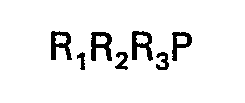
- the invention provides a process for preparing 1,7-octadiene by hydrodimerizing butadiene in the presence of a palladium catalyst, a tertiary phosphine, formic acid and a solvent which is a dialkyl sulphoxide and/or a dialkylformamide (by "dialkyl” it is meant that the sulphur and nitrogen atoms in the latter two groups of compounds are connected to two different carbon atoms) and in the absence of a base, characterized in that the tertiary phosphine is a phosphine of formula: wherein R, is a branched alkyl group having from 3 to 10 carbon atoms with branching occurring at a carbon atom no more than two carbon atoms from the phosphorus atom and R 2 and R 3 are R, or independently are alkyl, alkenyl, aralkyl, cycloalkyl or aryl having from 1 to 10 carbon atoms.
- R is
- European patent publication No. 4409 discloses the production of 1,7-octadiene by reacting butadiene in the presence of a palladium catalyst, triisopropylphosphine, formic acid, a base and optionally a solvent.
- the present invention in contradistinction operates without the presence of a base.
- the palladium compound added is a palladium tertiary phosphine complex then it is not necessary to add a separate tertiary phosphine.
- the use of the tertiary phosphine in combination with the solvents of this invention allows the hydrodimerization reaction to be carried out in high yield without a base being required.
- the catalyst used in the process of this invention is palladium or a palladium compound which may be complexed with a tris-organophosphine.
- the palladium may be in any of its possible valence states, e.g., 0, +2, etc.
- Suitable palladium compounds include the palladium carboxylates, particularly palladium carboxylates derived from alkanoic acids containing up to six carbon atoms per molecule, such as palladium acetate, complexes, such as palladium acetylacetonate, bis-benzonitrile palladium(ll) and lithium palladous chloride as well as the palladium halides, nitrates and sulphates, such as palladous chloride, palladium nitrate (Pd(N0 3 ) 2 (OH) 2 ) and palladium sulphate.
- Preferred catalysts are palladium acetylacetonate or palladium acetate.
- Suitable reduced palladium-phosphine complexes are Pd(R 3 P) Z or Pd(R 3 P) 3 .
- a preferred complex is Pd(0)-triisopropylphosphine.
- the palladium is present in the reaction mixture in catalytic amounts; preferably from about 1 to about 10- 6 molar and more preferably from about 10-' to about 10- 4 molar.
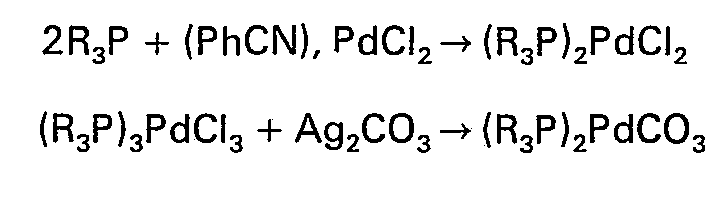
- the palladium compounds complexed with a tris-organophosphine are typically prepared by reacting the tertiary phosphine with the appropriate palladium compound as, for example, represented by the following equations: where R 3 P is the tris-organophosphine of the invention, or may be made in situ by adding the palladium compound and the phosphine directly to the reactor.
- the catalyst may be pretreated to enhance reactivity by contacting it with a reducing agent at a temperature of from about 20 to about 90°C for from about 0.1 to 5 hours.
- the reducing agent may be gaseous, solid or liquid. Examples of gaseous agents are hydrogen and carbon monoxide. Examples of liquid or solid reducing agents are hydrazine, NaBH 4 , NaOCH 3 , (isopropyl) 3 p , Cu, Na and alkyls, etc.
- the reduction may be carried out in a separate autoclave or preferably is carried out in the hydrodimerization reactor prior to the introduction of the butadiene.
- the palladium compound tri-organophosphine complex may be dissolved in the solvent used in this invention prior to reduction.
- the tris-organophosphine utilized in the process of this invention have the following general formula: wherein R, is a branched alkyl group having from 3 to 10 carbon atoms with branching occurring at a carbon atom no more than two carbon atoms from the phosphorus atom and R 2 and R 3 are R, or independently are alkyl, alkenyl, aralkyl, cycloalkyl or aryl groups having from 1 to 10 carbon atoms.
- branched is meant that the a- and A-carbon atoms, relative to the phosphorus atom, of the stated groups may not both be -CH 2 -linkages.
- R isopropyl, sec.-butyl, tert.-butyl, isobutyl, neopentyl, sec.-pentyl, tert.-pentyl, 2-methylbutyl, sec.-hexyl, tert.-hexyl and 2,2-dimethylpropyl.
- R 2 and R 3 are, for example, methyl, ethyl, propyl, butyl, pentyl, hexyl, actyl, nonyl and decyl for alkyl; allyl, crotyl and methallyl for alkenyl and phenyl, tolyl, xylyl, ethylphenyl, propylphenyl for aryl.
- Two or more of the instant phosphines may be used in the same reaction or another phosphine may be replaced by reacting in situ one of the instant phosphines.
- Preferred phosphines are triisopropylphosphine, tri-tert.-butylphosphine, tri-sec.-butylphosphine, di-tert.-butyl-normal-butylphosphine, tri-isobutylphosphine and tert.-butyl-dibenzylphosphine and mixtures thereof.
- the molar ratio of tris-organophosphine to palladium is at least 1.
- the molar ratio of phosphine to palladium ranges from about 1:1 to about 20:1 and more preferably from about 2:1 to about 5:1.
- the solvent needed to provide the high yields of this invention is a dialkyl sulphoxide and/or a dialkylformamide.
- the alkyl moieties have from 1 to 6 carbon atoms. Included within the above definition of dialkyl would be polyalkylene, e.g., an alkylene group doubly attached to the sulphinyl or carbonylamino group as, for example, tetrahydrothiophene 1-oxide or N-methylpyrrolidinone.
- Preferred solvents are dimethyl sulphoxide and dimethylformamide.
- the addition of carbon dioxide to the reaction system has been found to increase the extent of butadiene conversion, but does not affect the selectivity.
- the partial pressure of the C0 2 in the reaction system may be from about 0.5 to about 70 bars. Since the carbon dioxide is a by-product of the process, it is possible to generate sufficient carbon dioxide in situ to enhance the conversion rates.
- the process can be either continuous or batch.
- the reaction temperature of the process is not critical, however, it is preferred to maintain the reaction between about 0 to about 100°C, preferably between about 20 to about 70°C.
- the process is conducted at the reaction temperature. Typically the pressure is autogenous.
- BBB butadiene/isobutane/n- butenes
- a zero-valent palladium complex was prepared according to the teachings of W. Kuran and A. Musco, Inorganic Chimica Acta, Vol. 12, 1975, pp. 187-193.
- Pd(0)-(triisopropylphosphine) 3 complex (0.0068 mmol), formic acid (18.5 mmol), dimethylsulphoxide (10 ml) and butadiene (2 g) were charged to an 80 ml glass-lined autoclave.
- the stirred reactor was heated to 60°C for one hour, cooled and the product analyzed by gas chromatography. Conversion of butadiene to 1,7-octadiene was 80.4% in 97.3% selectivity.
Landscapes
- Chemical & Material Sciences (AREA)
- Organic Chemistry (AREA)
- Engineering & Computer Science (AREA)
- Materials Engineering (AREA)
- Chemical Kinetics & Catalysis (AREA)
- Inorganic Chemistry (AREA)
- Organic Low-Molecular-Weight Compounds And Preparation Thereof (AREA)
- Low-Molecular Organic Synthesis Reactions Using Catalysts (AREA)
- Catalysts (AREA)
Description
- The invention relates to a process for preparing 1,7-octadiene by hydrodimerizing 1,3-butadiene in the presence of a palladium catalyst, a tertiary phosphine, formic acid and a solvent which is a dialkyl sulphoxide and/or a dialkylformamide and in the absence of a base.
- Linear dimerization of butadiene (1,3-butadiene) provides a source of Cs-unsaturated hydrocarbon intermediates useful for the synthesis of diacids, diesters, diols or diamines. A particularly preferred dimer is 1,7-octadiene which has terminal double bonds and allows the production of product having only terminal functional groups.
- U.S. patent specification No. 3,732,328 discloses a process of the type described in the beginning. Trialkyl-, mixed alkylaryl- or triarylphosphines are mentioned as useful, specifically noting triphenylphosphine. The yield of 1,7-octadiene is much lower than that of the present invention.
- British patent specification No. 1,341,324 discloses the preparation of mixtures of octadienes by reacting butadiene in the presence of a palladium compound, formic acid, an amine solvent and a tertiary phosphine. Trialkyl-, mixed alkylaryl- or triarylphosphines are mentioned as useful, specifically noting triphenylphosphine. The yield of 1,7-octadiene is very low.
- Tetrahedron Letters No. 2, pp. 163-164 discloses the production of mixtures of octadienes by reacting butadiene in the presence of palladium acetate, triphenylphosphine, formic acid and dimethylformamide. The yield of 1,7-octadiene is much lower than that of the present invention.
- U.S. patent specification No. 3,823,199 discloses the preparation of mixtures of octadienes by reacting butadiene in the presence of a palladium compound, formic acid, a non-polar solvent and a tertiary phosphine. Trialkylphosphines are mentioned as useful, specifically noting triethyl- and tributylphosphine. The applicants have found that carrying out the process described in the beginning using triethyl- or tributylphosphine gives a very low yield of 1,7-octadiene.
- It has now been found that the use of members of a specific group of tertiary phosphines not only allows a very high selectivity to but also a very high yield of 1,7-octadiene.
- Accordingly, the invention provides a process for preparing 1,7-octadiene by hydrodimerizing butadiene in the presence of a palladium catalyst, a tertiary phosphine, formic acid and a solvent which is a dialkyl sulphoxide and/or a dialkylformamide (by "dialkyl" it is meant that the sulphur and nitrogen atoms in the latter two groups of compounds are connected to two different carbon atoms) and in the absence of a base, characterized in that the tertiary phosphine is a phosphine of formula:

- European patent publication No. 4409 discloses the production of 1,7-octadiene by reacting butadiene in the presence of a palladium catalyst, triisopropylphosphine, formic acid, a base and optionally a solvent. The present invention in contradistinction operates without the presence of a base.
- If the palladium compound added is a palladium tertiary phosphine complex then it is not necessary to add a separate tertiary phosphine. The use of the tertiary phosphine in combination with the solvents of this invention allows the hydrodimerization reaction to be carried out in high yield without a base being required.
- The catalyst used in the process of this invention is palladium or a palladium compound which may be complexed with a tris-organophosphine. The palladium may be in any of its possible valence states, e.g., 0, +2, etc. Suitable palladium compounds include the palladium carboxylates, particularly palladium carboxylates derived from alkanoic acids containing up to six carbon atoms per molecule, such as palladium acetate, complexes, such as palladium acetylacetonate, bis-benzonitrile palladium(ll) and lithium palladous chloride as well as the palladium halides, nitrates and sulphates, such as palladous chloride, palladium nitrate (Pd(N03)2(OH)2) and palladium sulphate. Preferred catalysts are palladium acetylacetonate or palladium acetate. Suitable reduced palladium-phosphine complexes are Pd(R3P)Z or Pd(R3P)3. A preferred complex is Pd(0)-triisopropylphosphine. The palladium is present in the reaction mixture in catalytic amounts; preferably from about 1 to about 10-6 molar and more preferably from about 10-' to about 10-4 molar.
- The palladium compounds complexed with a tris-organophosphine are typically prepared by reacting the tertiary phosphine with the appropriate palladium compound as, for example, represented by the following equations:


- The catalyst may be pretreated to enhance reactivity by contacting it with a reducing agent at a temperature of from about 20 to about 90°C for from about 0.1 to 5 hours. The reducing agent may be gaseous, solid or liquid. Examples of gaseous agents are hydrogen and carbon monoxide. Examples of liquid or solid reducing agents are hydrazine, NaBH4, NaOCH3, (isopropyl)3 p, Cu, Na and alkyls, etc. The reduction may be carried out in a separate autoclave or preferably is carried out in the hydrodimerization reactor prior to the introduction of the butadiene. The palladium compound tri-organophosphine complex may be dissolved in the solvent used in this invention prior to reduction.
- The tris-organophosphine utilized in the process of this invention have the following general formula:

- By branched is meant that the a- and A-carbon atoms, relative to the phosphorus atom, of the stated groups may not both be -CH2-linkages.
- Illustrative of the R, moiety are isopropyl, sec.-butyl, tert.-butyl, isobutyl, neopentyl, sec.-pentyl, tert.-pentyl, 2-methylbutyl, sec.-hexyl, tert.-hexyl and 2,2-dimethylpropyl.
- Illustrative of R2 and R3 are, for example, methyl, ethyl, propyl, butyl, pentyl, hexyl, actyl, nonyl and decyl for alkyl; allyl, crotyl and methallyl for alkenyl and phenyl, tolyl, xylyl, ethylphenyl, propylphenyl for aryl. Two or more of the instant phosphines may be used in the same reaction or another phosphine may be replaced by reacting in situ one of the instant phosphines. Preferred phosphines are triisopropylphosphine, tri-tert.-butylphosphine, tri-sec.-butylphosphine, di-tert.-butyl-normal-butylphosphine, tri-isobutylphosphine and tert.-butyl-dibenzylphosphine and mixtures thereof.
- The molar ratio of tris-organophosphine to palladium is at least 1. Preferably, the molar ratio of phosphine to palladium ranges from about 1:1 to about 20:1 and more preferably from about 2:1 to about 5:1.
- The solvent needed to provide the high yields of this invention is a dialkyl sulphoxide and/or a dialkylformamide. The alkyl moieties have from 1 to 6 carbon atoms. Included within the above definition of dialkyl would be polyalkylene, e.g., an alkylene group doubly attached to the sulphinyl or carbonylamino group as, for example, tetrahydrothiophene 1-oxide or N-methylpyrrolidinone. Preferred solvents are dimethyl sulphoxide and dimethylformamide.
- The addition of carbon dioxide to the reaction system has been found to increase the extent of butadiene conversion, but does not affect the selectivity. When it is desired to use carbon dioxide to increase the conversion rate, the partial pressure of the C02 in the reaction system may be from about 0.5 to about 70 bars. Since the carbon dioxide is a by-product of the process, it is possible to generate sufficient carbon dioxide in situ to enhance the conversion rates.
- The process can be either continuous or batch. The reaction temperature of the process is not critical, however, it is preferred to maintain the reaction between about 0 to about 100°C, preferably between about 20 to about 70°C. The process is conducted at the reaction temperature. Typically the pressure is autogenous.
- The process of this invention is particularly useful when applied to a butadiene/isobutane/n- butenes (BBB) stream from an oil pyrolysis unit. These BBB streams are the C4 cut from a thermal cracking unit typically containing 30-40% butadiene, 20-35% isobutene and 20-30% n-butenes and many other minor components.
- The process of this invention will now be illustrated by reference to the following Examples. The Examples and Comparative Experiments are indicated with figures and capitals, respectively.
- To an 80 ml glass-lined autoclave were charged the palladium compound (0.027 mmol) listed in column 2 of Table I triisopropylphosphine (0.054 mmol), formic acid (18.5 mmol), butadiene (2 g) and the solvent (10 ml) listed in column 3 of Table I. The stirred reactor was heated to 60°C for 1 hour. The reactor was then cooled and the product was analyzed by gas chromatography. The results are shown in column 4 of Table I.

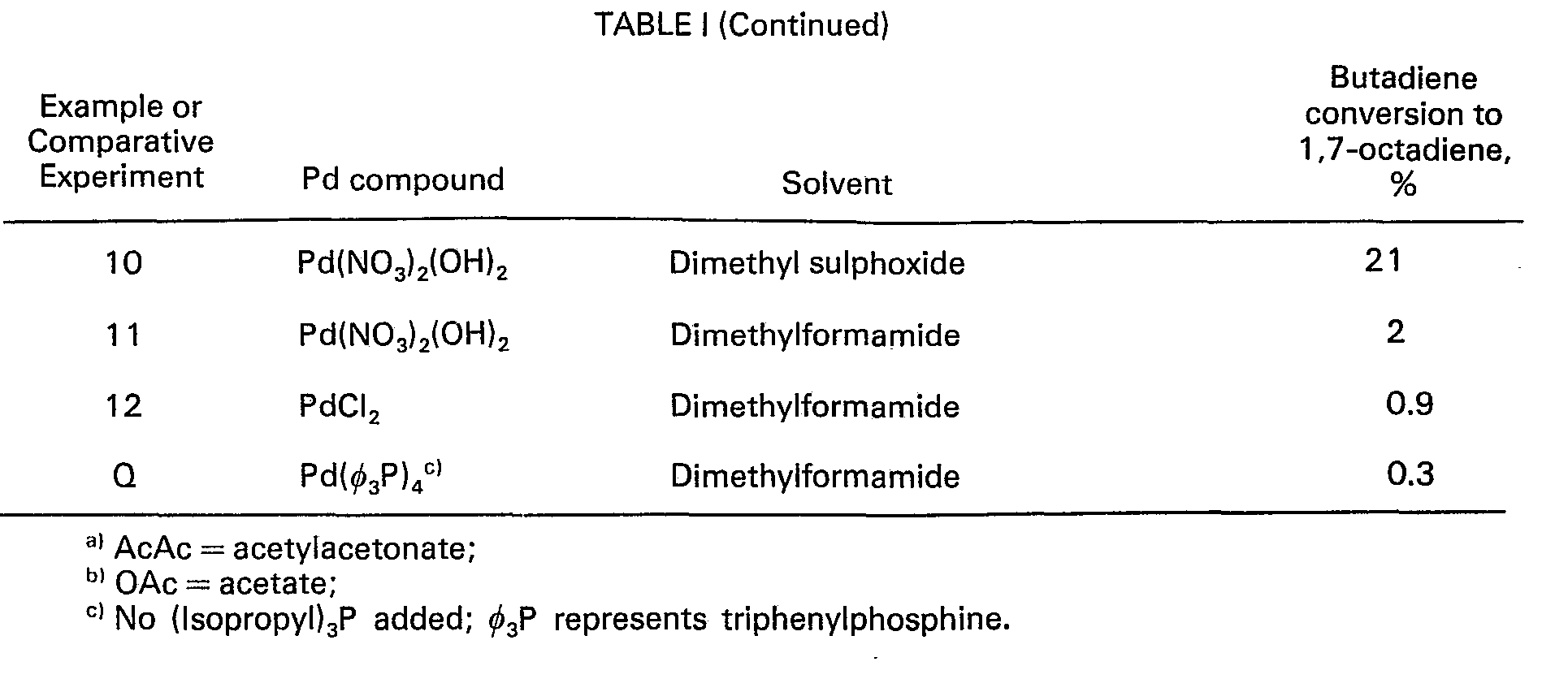
- To an 80 ml glass-lined autoclave were charged the palladium compound (0.025 mmol) listed in column 2 of Table II, triisopropylphosphine (0.054 mmol) formic acid (18.5 mmol), butadiene (2 g) and the solvent (10 ml) listed in column 3 of Table II. The stirred reactor was heated to 40°C for 2 hours. The reaction was then cooled and the product was analyzed by gas chromatography. The results are shown in columns 4 and 5 of Table II. Triisopropylphosphine and triphenylphosphine are abbreviated by i-Pr3P and φ3P.

- To an 80 ml glass-lined autoclave were charged palladium acetylacetonate (0.027 mmol), the phosphine listed below (0.054 mmol), dimethylsulphoxide (10 ml), formic acid (18.5 mmol) and butadiene (2 g). The stirred reactor was heated to 40°C for 2 hours. The reactor was then cooled and the product was analyzed by gas chromatography. The results are shown in Table III.

- A zero-valent palladium complex was prepared according to the teachings of W. Kuran and A. Musco, Inorganic Chimica Acta, Vol. 12, 1975, pp. 187-193. Pd(0)-(triisopropylphosphine)3 complex (0.0068 mmol), formic acid (18.5 mmol), dimethylsulphoxide (10 ml) and butadiene (2 g) were charged to an 80 ml glass-lined autoclave. The stirred reactor was heated to 60°C for one hour, cooled and the product analyzed by gas chromatography. Conversion of butadiene to 1,7-octadiene was 80.4% in 97.3% selectivity.
Claims (4)
Applications Claiming Priority (2)
| Application Number | Priority Date | Filing Date | Title |
|---|---|---|---|
| US92769378A | 1978-07-24 | 1978-07-24 | |
| US927693 | 1978-07-24 |
Publications (2)
| Publication Number | Publication Date |
|---|---|
| EP0008139A1 EP0008139A1 (en) | 1980-02-20 |
| EP0008139B1 true EP0008139B1 (en) | 1982-02-24 |
Family
ID=25455098
Family Applications (1)
| Application Number | Title | Priority Date | Filing Date |
|---|---|---|---|
| EP79200392A Expired EP0008139B1 (en) | 1978-07-24 | 1979-07-13 | A process for preparing 1,7-octadiene |
Country Status (3)
| Country | Link |
|---|---|
| EP (1) | EP0008139B1 (en) |
| JP (1) | JPS5519275A (en) |
| DE (1) | DE2962197D1 (en) |
Families Citing this family (9)
| Publication number | Priority date | Publication date | Assignee | Title |
|---|---|---|---|---|
| US4229605A (en) * | 1978-12-13 | 1980-10-21 | Shell Oil Company | 1,7-Octadiene process |
| US4229606A (en) * | 1978-12-13 | 1980-10-21 | Shell Oil Company | 1,7-Octadiene process |
| EP0043039A3 (en) * | 1980-07-01 | 1982-04-07 | Ec Erdölchemie Gmbh | Process for preparing 1,7-octadiene |
| CA1331173C (en) * | 1986-12-05 | 1994-08-02 | Eit Drent | Process for the carbonylation of acetylenically unsaturated compounds |
| US4943670A (en) * | 1989-11-22 | 1990-07-24 | Shell Oil Company | Preparation of conjugated dienes |
| ITMI20032084A1 (en) * | 2003-10-27 | 2005-04-28 | Polimeri Europa Spa | PROCEDURE FOR PRODUCING 1-GETS FROM BUTADIENE IN THE PRESENCE OF TITANIUM CATALYZERS. |
| ITMI20032085A1 (en) * | 2003-10-27 | 2005-04-28 | Polimeri Europa Spa | PROCEDURE FOR THE PREPARATION OF 1-OCTENE. |
| DE102007023515A1 (en) | 2006-07-05 | 2008-01-10 | Evonik Degussa Gmbh | Preparing 1,7-diolefin, useful to prepare alpha, omega-diamine, -diol and sebacic acid, comprises hydrodimerization of non-cyclic olefins with two conjugated double bonds in the presence of a reducing agent and a catalyst |
| US9511359B2 (en) * | 2014-11-14 | 2016-12-06 | Chevron Phillips Chemical Company Lp | Selective hydrogenation catalyst and methods of making and using same |
Family Cites Families (4)
| Publication number | Priority date | Publication date | Assignee | Title |
|---|---|---|---|---|
| US3732328A (en) * | 1969-10-17 | 1973-05-08 | Ici Ltd | Process for the production of octadienes |
| GB1344887A (en) * | 1971-08-18 | 1974-01-23 | Imp Chemical Ind Ld | Production of olefines |
| GB1341324A (en) * | 1972-06-28 | 1973-12-19 | Ici Ltd | Production of olefines |
| EP0004408B1 (en) * | 1978-03-27 | 1981-11-11 | Shell Internationale Researchmaatschappij B.V. | A process for preparing 1,7-octadiene and for activating a catalyst suitable for use in the process |
-
1979
- 1979-07-13 EP EP79200392A patent/EP0008139B1/en not_active Expired
- 1979-07-13 DE DE7979200392T patent/DE2962197D1/en not_active Expired
- 1979-07-23 JP JP9272379A patent/JPS5519275A/en active Pending
Also Published As
| Publication number | Publication date |
|---|---|
| JPS5519275A (en) | 1980-02-09 |
| EP0008139A1 (en) | 1980-02-20 |
| DE2962197D1 (en) | 1982-03-25 |
Similar Documents
| Publication | Publication Date | Title |
|---|---|---|
| JPH0152372B2 (en) | ||
| EP0008139B1 (en) | A process for preparing 1,7-octadiene | |
| US5254782A (en) | Continuous process for the telomerization of conjugated dienes | |
| EP0012472B1 (en) | A process for preparing 1,7-octadiene | |
| GB1600525A (en) | Process for preparing unsaturated aliphatic acids or esters from aliphatic dienes | |
| EP0007666B1 (en) | A process for preparing 1,7-octadiene | |
| EP0004408B1 (en) | A process for preparing 1,7-octadiene and for activating a catalyst suitable for use in the process | |
| EP0050445B1 (en) | Telomerization of butadiene and carbon dioxide | |
| EP0004410B1 (en) | A process for preparing 1,7-octadiene | |
| EP0004409B1 (en) | A process for preparing 1,7-octadiene | |
| US4337363A (en) | Process for the preparation of 3-(4-methyl-3-cyclohexen-1-yl) butyraldehyde | |
| US4687876A (en) | Production of 1,7-octadiene from butadiene | |
| CA1140160A (en) | Process for producing alkadienes | |
| US7057082B2 (en) | Process for the telomerization of a conjugated diene, catalyst and bidentate ligand useful therein | |
| US3732329A (en) | Hydrogenation process utilizing homogeneous copper catalysts | |
| EP0019961B1 (en) | Preparation of 2,7-dimethylocta-1,7-diene | |
| US3839459A (en) | Hydroformylation process utilizing homogeneous cuprous chloride complexes as catalysts | |
| EP0341773B1 (en) | Process for the preparation of lactones | |
| US4960906A (en) | Process for the preparation of lactones from higher alkenols | |
| EP0019960B1 (en) | Preparation of 3,7-dimethylocta-1,7-diene | |
| US3933884A (en) | Process for preparing thiol esters | |
| US4177220A (en) | 1-Octen-7-yne production | |
| US5171907A (en) | Preparation of hydrogenation catalyst and hydrogenation process therewith | |
| JPH0584292B2 (en) | ||
| JPH04208233A (en) | Method for subjecting allylic alcohol to allyl exchange reaction |
Legal Events
| Date | Code | Title | Description |
|---|---|---|---|
| PUAI | Public reference made under article 153(3) epc to a published international application that has entered the european phase |
Free format text: ORIGINAL CODE: 0009012 |
|
| AK | Designated contracting states |
Designated state(s): DE FR GB NL |
|
| 17P | Request for examination filed | ||
| GRAA | (expected) grant |
Free format text: ORIGINAL CODE: 0009210 |
|
| AK | Designated contracting states |
Designated state(s): DE FR GB NL |
|
| REF | Corresponds to: |
Ref document number: 2962197 Country of ref document: DE Date of ref document: 19820325 |
|
| PGFP | Annual fee paid to national office [announced via postgrant information from national office to epo] |
Ref country code: GB Payment date: 19910530 Year of fee payment: 13 |
|
| PGFP | Annual fee paid to national office [announced via postgrant information from national office to epo] |
Ref country code: FR Payment date: 19910606 Year of fee payment: 13 |
|
| PGFP | Annual fee paid to national office [announced via postgrant information from national office to epo] |
Ref country code: NL Payment date: 19910731 Year of fee payment: 13 |
|
| PGFP | Annual fee paid to national office [announced via postgrant information from national office to epo] |
Ref country code: DE Payment date: 19910812 Year of fee payment: 13 |
|
| PG25 | Lapsed in a contracting state [announced via postgrant information from national office to epo] |
Ref country code: GB Effective date: 19920713 |
|
| PG25 | Lapsed in a contracting state [announced via postgrant information from national office to epo] |
Ref country code: NL Effective date: 19930201 |
|
| GBPC | Gb: european patent ceased through non-payment of renewal fee |
Effective date: 19920713 |
|
| NLV4 | Nl: lapsed or anulled due to non-payment of the annual fee | ||
| PG25 | Lapsed in a contracting state [announced via postgrant information from national office to epo] |
Ref country code: FR Effective date: 19930331 |
|
| PG25 | Lapsed in a contracting state [announced via postgrant information from national office to epo] |
Ref country code: DE Effective date: 19930401 |
|
| REG | Reference to a national code |
Ref country code: FR Ref legal event code: ST |
|
| PLBE | No opposition filed within time limit |
Free format text: ORIGINAL CODE: 0009261 |
|
| STAA | Information on the status of an ep patent application or granted ep patent |
Free format text: STATUS: NO OPPOSITION FILED WITHIN TIME LIMIT |