EP0015385B1 - Verfahren zur Herstellung von n-Propylcyanessigsäureestern und n-Äthylcyanessigsäureestern - Google Patents
Verfahren zur Herstellung von n-Propylcyanessigsäureestern und n-Äthylcyanessigsäureestern Download PDFInfo
- Publication number
- EP0015385B1 EP0015385B1 EP80100511A EP80100511A EP0015385B1 EP 0015385 B1 EP0015385 B1 EP 0015385B1 EP 80100511 A EP80100511 A EP 80100511A EP 80100511 A EP80100511 A EP 80100511A EP 0015385 B1 EP0015385 B1 EP 0015385B1
- Authority
- EP
- European Patent Office
- Prior art keywords
- pentenenitrile
- acid esters
- preparation
- ethylcyanoacetic
- butenenitrile
- Prior art date
- Legal status (The legal status is an assumption and is not a legal conclusion. Google has not performed a legal analysis and makes no representation as to the accuracy of the status listed.)
- Expired
Links
- 238000000034 method Methods 0.000 title claims description 14
- 238000002360 preparation method Methods 0.000 title claims description 7
- 239000002253 acid Substances 0.000 title description 5
- 150000002148 esters Chemical class 0.000 title description 5
- CFEYBLWMNFZOPB-UHFFFAOYSA-N Allylacetonitrile Natural products C=CCCC#N CFEYBLWMNFZOPB-UHFFFAOYSA-N 0.000 claims description 37
- LFQSCWFLJHTTHZ-UHFFFAOYSA-N Ethanol Chemical compound CCO LFQSCWFLJHTTHZ-UHFFFAOYSA-N 0.000 claims description 16
- UVKXJAUUKPDDNW-NSCUHMNNSA-N (e)-pent-3-enenitrile Chemical compound C\C=C\CC#N UVKXJAUUKPDDNW-NSCUHMNNSA-N 0.000 claims description 15
- ISBHMJZRKAFTGE-ONEGZZNKSA-N (e)-pent-2-enenitrile Chemical compound CC\C=C\C#N ISBHMJZRKAFTGE-ONEGZZNKSA-N 0.000 claims description 14
- SJNALLRHIVGIBI-UHFFFAOYSA-N allyl cyanide Chemical compound C=CCC#N SJNALLRHIVGIBI-UHFFFAOYSA-N 0.000 claims description 14
- 150000003222 pyridines Chemical class 0.000 claims description 11
- UGFAIRIUMAVXCW-UHFFFAOYSA-N Carbon monoxide Chemical compound [O+]#[C-] UGFAIRIUMAVXCW-UHFFFAOYSA-N 0.000 claims description 10
- 229910002091 carbon monoxide Inorganic materials 0.000 claims description 10
- JUJWROOIHBZHMG-UHFFFAOYSA-N pyridine Substances C1=CC=NC=C1 JUJWROOIHBZHMG-UHFFFAOYSA-N 0.000 claims description 7
- UMJSCPRVCHMLSP-UHFFFAOYSA-N pyridine Natural products COC1=CC=CN=C1 UMJSCPRVCHMLSP-UHFFFAOYSA-N 0.000 claims description 6
- 239000000203 mixture Substances 0.000 claims description 5
- KAKZBPTYRLMSJV-UHFFFAOYSA-N Butadiene Chemical compound C=CC=C KAKZBPTYRLMSJV-UHFFFAOYSA-N 0.000 claims description 4
- LELOWRISYMNNSU-UHFFFAOYSA-N hydrogen cyanide Chemical compound N#C LELOWRISYMNNSU-UHFFFAOYSA-N 0.000 claims description 4
- 150000001875 compounds Chemical class 0.000 claims description 2
- 150000002168 ethanoic acid esters Chemical class 0.000 claims 2
- 229910021012 Co2(CO)8 Inorganic materials 0.000 claims 1
- 229910052739 hydrogen Inorganic materials 0.000 description 19
- 229910052757 nitrogen Inorganic materials 0.000 description 17
- 238000006243 chemical reaction Methods 0.000 description 16
- -1 propylcyanoacetic acid ester Chemical class 0.000 description 14
- BSKHPKMHTQYZBB-UHFFFAOYSA-N 2-methylpyridine Chemical compound CC1=CC=CC=N1 BSKHPKMHTQYZBB-UHFFFAOYSA-N 0.000 description 10
- 229910052799 carbon Inorganic materials 0.000 description 8
- OISVCGZHLKNMSJ-UHFFFAOYSA-N 2,6-dimethylpyridine Chemical compound CC1=CC=CC(C)=N1 OISVCGZHLKNMSJ-UHFFFAOYSA-N 0.000 description 6
- KFZMGEQAYNKOFK-UHFFFAOYSA-N Isopropanol Chemical compound CC(C)O KFZMGEQAYNKOFK-UHFFFAOYSA-N 0.000 description 6
- OKKJLVBELUTLKV-UHFFFAOYSA-N Methanol Chemical compound OC OKKJLVBELUTLKV-UHFFFAOYSA-N 0.000 description 6
- MLVRCZPSHCVRHN-UHFFFAOYSA-N ethyl 2-cyanopentanoate Chemical compound CCCC(C#N)C(=O)OCC MLVRCZPSHCVRHN-UHFFFAOYSA-N 0.000 description 6
- 150000002825 nitriles Chemical class 0.000 description 6
- NICLKHGIKDZZGV-UHFFFAOYSA-N 2-cyanopentanoic acid Chemical class CCCC(C#N)C(O)=O NICLKHGIKDZZGV-UHFFFAOYSA-N 0.000 description 5
- BWZVCCNYKMEVEX-UHFFFAOYSA-N 2,4,6-Trimethylpyridine Chemical compound CC1=CC(C)=NC(C)=C1 BWZVCCNYKMEVEX-UHFFFAOYSA-N 0.000 description 4
- JYYNAJVZFGKDEQ-UHFFFAOYSA-N 2,4-Dimethylpyridine Chemical compound CC1=CC=NC(C)=C1 JYYNAJVZFGKDEQ-UHFFFAOYSA-N 0.000 description 4
- 150000001298 alcohols Chemical class 0.000 description 4
- 125000004432 carbon atom Chemical group C* 0.000 description 4
- 239000007795 chemical reaction product Substances 0.000 description 4
- 239000000126 substance Substances 0.000 description 4
- 125000001424 substituent group Chemical group 0.000 description 4
- IHXNSHZBFXGOJM-HWKANZROSA-N (e)-2-methylbut-2-enenitrile Chemical compound C\C=C(/C)C#N IHXNSHZBFXGOJM-HWKANZROSA-N 0.000 description 3
- UFHFLCQGNIYNRP-UHFFFAOYSA-N Hydrogen Chemical compound [H][H] UFHFLCQGNIYNRP-UHFFFAOYSA-N 0.000 description 3
- LRHPLDYGYMQRHN-UHFFFAOYSA-N N-Butanol Chemical class CCCCO LRHPLDYGYMQRHN-UHFFFAOYSA-N 0.000 description 3
- 150000007514 bases Chemical class 0.000 description 3
- 238000004821 distillation Methods 0.000 description 3
- 239000001257 hydrogen Substances 0.000 description 3
- 229960004592 isopropanol Drugs 0.000 description 3
- BDERNNFJNOPAEC-UHFFFAOYSA-N propan-1-ol Chemical compound CCCO BDERNNFJNOPAEC-UHFFFAOYSA-N 0.000 description 3
- AUHZEENZYGFFBQ-UHFFFAOYSA-N 1,3,5-Me3C6H3 Natural products CC1=CC(C)=CC(C)=C1 AUHZEENZYGFFBQ-UHFFFAOYSA-N 0.000 description 2
- OKDGRDCXVWSXDC-UHFFFAOYSA-N 2-chloropyridine Chemical compound ClC1=CC=CC=N1 OKDGRDCXVWSXDC-UHFFFAOYSA-N 0.000 description 2
- YIWUKEYIRIRTPP-UHFFFAOYSA-N 2-ethylhexan-1-ol Chemical compound CCCCC(CC)CO YIWUKEYIRIRTPP-UHFFFAOYSA-N 0.000 description 2
- NRGGMCIBEHEAIL-UHFFFAOYSA-N 2-ethylpyridine Chemical compound CCC1=CC=CC=N1 NRGGMCIBEHEAIL-UHFFFAOYSA-N 0.000 description 2
- XWKFPIODWVPXLX-UHFFFAOYSA-N 2-methyl-5-methylpyridine Natural products CC1=CC=C(C)N=C1 XWKFPIODWVPXLX-UHFFFAOYSA-N 0.000 description 2
- WBAXCOMEMKANRN-UHFFFAOYSA-N 2-methylbut-3-enenitrile Chemical compound C=CC(C)C#N WBAXCOMEMKANRN-UHFFFAOYSA-N 0.000 description 2
- VQGHOUODWALEFC-UHFFFAOYSA-N 2-phenylpyridine Chemical compound C1=CC=CC=C1C1=CC=CC=N1 VQGHOUODWALEFC-UHFFFAOYSA-N 0.000 description 2
- KGIGUEBEKRSTEW-UHFFFAOYSA-N 2-vinylpyridine Chemical compound C=CC1=CC=CC=N1 KGIGUEBEKRSTEW-UHFFFAOYSA-N 0.000 description 2
- NLHHRLWOUZZQLW-UHFFFAOYSA-N Acrylonitrile Chemical compound C=CC#N NLHHRLWOUZZQLW-UHFFFAOYSA-N 0.000 description 2
- IJGRMHOSHXDMSA-UHFFFAOYSA-N Atomic nitrogen Chemical compound N#N IJGRMHOSHXDMSA-UHFFFAOYSA-N 0.000 description 2
- NYASLWUHVYHSPL-UHFFFAOYSA-N C(#N)C(C(=O)OC(C)C)CCC Chemical compound C(#N)C(C(=O)OC(C)C)CCC NYASLWUHVYHSPL-UHFFFAOYSA-N 0.000 description 2
- PXHVJJICTQNCMI-UHFFFAOYSA-N Nickel Chemical compound [Ni] PXHVJJICTQNCMI-UHFFFAOYSA-N 0.000 description 2
- 238000005804 alkylation reaction Methods 0.000 description 2
- 230000015572 biosynthetic process Effects 0.000 description 2
- 238000009835 boiling Methods 0.000 description 2
- VJMXJJOFMXUDHL-UHFFFAOYSA-N butyl 2-cyanopentanoate Chemical compound C(CCC)OC(C(CCC)C#N)=O VJMXJJOFMXUDHL-UHFFFAOYSA-N 0.000 description 2
- 239000006227 byproduct Substances 0.000 description 2
- 125000001495 ethyl group Chemical group [H]C([H])([H])C([H])([H])* 0.000 description 2
- 229910052736 halogen Chemical class 0.000 description 2
- 150000002367 halogens Chemical class 0.000 description 2
- 239000011541 reaction mixture Substances 0.000 description 2
- 229920006395 saturated elastomer Polymers 0.000 description 2
- 238000000926 separation method Methods 0.000 description 2
- 238000003756 stirring Methods 0.000 description 2
- GFYHSKONPJXCDE-UHFFFAOYSA-N sym-collidine Natural products CC1=CN=C(C)C(C)=C1 GFYHSKONPJXCDE-UHFFFAOYSA-N 0.000 description 2
- CYNYIHKIEHGYOZ-UHFFFAOYSA-N 1-bromopropane Chemical compound CCCBr CYNYIHKIEHGYOZ-UHFFFAOYSA-N 0.000 description 1
- GVNVAWHJIKLAGL-UHFFFAOYSA-N 2-(cyclohexen-1-yl)cyclohexan-1-one Chemical compound O=C1CCCCC1C1=CCCCC1 GVNVAWHJIKLAGL-UHFFFAOYSA-N 0.000 description 1
- PCFUWBOSXMKGIP-UHFFFAOYSA-N 2-benzylpyridine Chemical compound C=1C=CC=NC=1CC1=CC=CC=C1 PCFUWBOSXMKGIP-UHFFFAOYSA-N 0.000 description 1
- IMRWILPUOVGIMU-UHFFFAOYSA-N 2-bromopyridine Chemical compound BrC1=CC=CC=N1 IMRWILPUOVGIMU-UHFFFAOYSA-N 0.000 description 1
- CCZWSTFVHJPCEM-UHFFFAOYSA-N 2-iodopyridine Chemical compound IC1=CC=CC=N1 CCZWSTFVHJPCEM-UHFFFAOYSA-N 0.000 description 1
- SMTDFMMXJHYDDE-UHFFFAOYSA-N 2-prop-1-enylpyridine Chemical compound CC=CC1=CC=CC=N1 SMTDFMMXJHYDDE-UHFFFAOYSA-N 0.000 description 1
- PFYPDUUXDADWKC-UHFFFAOYSA-N 2-propan-2-ylpyridine Chemical compound CC(C)C1=CC=CC=N1 PFYPDUUXDADWKC-UHFFFAOYSA-N 0.000 description 1
- VQDJODAWOFNASI-UHFFFAOYSA-N 2-propylpropanedioic acid Chemical compound CCCC(C(O)=O)C(O)=O VQDJODAWOFNASI-UHFFFAOYSA-N 0.000 description 1
- UUIMDJFBHNDZOW-UHFFFAOYSA-N 2-tert-butylpyridine Chemical compound CC(C)(C)C1=CC=CC=N1 UUIMDJFBHNDZOW-UHFFFAOYSA-N 0.000 description 1
- OIQDAVBXDLGCID-UHFFFAOYSA-N 3-methylbut-3-enenitrile Chemical compound CC(=C)CC#N OIQDAVBXDLGCID-UHFFFAOYSA-N 0.000 description 1
- SKUPALMUTWEAPI-UHFFFAOYSA-N 5-cyanopentanoic acid Chemical class OC(=O)CCCCC#N SKUPALMUTWEAPI-UHFFFAOYSA-N 0.000 description 1
- QTBSBXVTEAMEQO-UHFFFAOYSA-N Acetic acid Chemical compound CC(O)=O QTBSBXVTEAMEQO-UHFFFAOYSA-N 0.000 description 1
- ROFVEXUMMXZLPA-UHFFFAOYSA-N Bipyridyl Chemical group N1=CC=CC=C1C1=CC=CC=N1 ROFVEXUMMXZLPA-UHFFFAOYSA-N 0.000 description 1
- 101150065749 Churc1 gene Proteins 0.000 description 1
- 102100038239 Protein Churchill Human genes 0.000 description 1
- NIJJYAXOARWZEE-UHFFFAOYSA-N Valproic acid Chemical compound CCCC(C(O)=O)CCC NIJJYAXOARWZEE-UHFFFAOYSA-N 0.000 description 1
- CIUQDSCDWFSTQR-UHFFFAOYSA-N [C]1=CC=CC=C1 Chemical class [C]1=CC=CC=C1 CIUQDSCDWFSTQR-UHFFFAOYSA-N 0.000 description 1
- 230000029936 alkylation Effects 0.000 description 1
- 125000001797 benzyl group Chemical class [H]C1=C([H])C([H])=C(C([H])=C1[H])C([H])([H])* 0.000 description 1
- 244000309464 bull Species 0.000 description 1
- 125000002915 carbonyl group Chemical group [*:2]C([*:1])=O 0.000 description 1
- 230000006315 carbonylation Effects 0.000 description 1
- 238000005810 carbonylation reaction Methods 0.000 description 1
- 150000001733 carboxylic acid esters Chemical class 0.000 description 1
- 239000003054 catalyst Substances 0.000 description 1
- ZIUSEGSNTOUIPT-UHFFFAOYSA-N ethyl 2-cyanoacetate Chemical compound CCOC(=O)CC#N ZIUSEGSNTOUIPT-UHFFFAOYSA-N 0.000 description 1
- GHXXCVVSJXZBPO-UHFFFAOYSA-N ethyl 4-cyanobutanoate Chemical compound CCOC(=O)CCCC#N GHXXCVVSJXZBPO-UHFFFAOYSA-N 0.000 description 1
- 238000011010 flushing procedure Methods 0.000 description 1
- 238000004508 fractional distillation Methods 0.000 description 1
- 150000002391 heterocyclic compounds Chemical class 0.000 description 1
- ZSIAUFGUXNUGDI-UHFFFAOYSA-N hexan-1-ol Chemical class CCCCCCO ZSIAUFGUXNUGDI-UHFFFAOYSA-N 0.000 description 1
- 125000004435 hydrogen atom Chemical group [H]* 0.000 description 1
- XMBWDFGMSWQBCA-UHFFFAOYSA-N hydrogen iodide Chemical compound I XMBWDFGMSWQBCA-UHFFFAOYSA-N 0.000 description 1
- 239000011261 inert gas Substances 0.000 description 1
- 239000000543 intermediate Substances 0.000 description 1
- 238000006317 isomerization reaction Methods 0.000 description 1
- 238000004519 manufacturing process Methods 0.000 description 1
- 229910052751 metal Inorganic materials 0.000 description 1
- 239000002184 metal Substances 0.000 description 1
- WCYWZMWISLQXQU-UHFFFAOYSA-N methyl Chemical compound [CH3] WCYWZMWISLQXQU-UHFFFAOYSA-N 0.000 description 1
- GWHHQWUYMDWMAY-UHFFFAOYSA-N methyl 2-cyanopropanoate Chemical compound COC(=O)C(C)C#N GWHHQWUYMDWMAY-UHFFFAOYSA-N 0.000 description 1
- 150000004702 methyl esters Chemical class 0.000 description 1
- 125000004123 n-propyl group Chemical group [H]C([H])([H])C([H])([H])C([H])([H])* 0.000 description 1
- 229910052759 nickel Inorganic materials 0.000 description 1
- 125000002560 nitrile group Chemical group 0.000 description 1
- 239000012299 nitrogen atmosphere Substances 0.000 description 1
- QJGQUHMNIGDVPM-UHFFFAOYSA-N nitrogen group Chemical group [N] QJGQUHMNIGDVPM-UHFFFAOYSA-N 0.000 description 1
- 150000002894 organic compounds Chemical class 0.000 description 1
- FVSKHRXBFJPNKK-UHFFFAOYSA-N propionitrile Chemical compound CCC#N FVSKHRXBFJPNKK-UHFFFAOYSA-N 0.000 description 1
- 150000003254 radicals Chemical class 0.000 description 1
- 239000000376 reactant Substances 0.000 description 1
- 230000035484 reaction time Effects 0.000 description 1
- 229910001220 stainless steel Inorganic materials 0.000 description 1
- 239000010935 stainless steel Substances 0.000 description 1
- 239000007858 starting material Substances 0.000 description 1
- 239000002699 waste material Substances 0.000 description 1
Classifications
-
- B—PERFORMING OPERATIONS; TRANSPORTING
- B01—PHYSICAL OR CHEMICAL PROCESSES OR APPARATUS IN GENERAL
- B01J—CHEMICAL OR PHYSICAL PROCESSES, e.g. CATALYSIS OR COLLOID CHEMISTRY; THEIR RELEVANT APPARATUS
- B01J31/00—Catalysts comprising hydrides, coordination complexes or organic compounds
- B01J31/02—Catalysts comprising hydrides, coordination complexes or organic compounds containing organic compounds or metal hydrides
- B01J31/0234—Nitrogen-, phosphorus-, arsenic- or antimony-containing compounds
- B01J31/0235—Nitrogen containing compounds
- B01J31/0244—Nitrogen containing compounds with nitrogen contained as ring member in aromatic compounds or moieties, e.g. pyridine
-
- B—PERFORMING OPERATIONS; TRANSPORTING
- B01—PHYSICAL OR CHEMICAL PROCESSES OR APPARATUS IN GENERAL
- B01J—CHEMICAL OR PHYSICAL PROCESSES, e.g. CATALYSIS OR COLLOID CHEMISTRY; THEIR RELEVANT APPARATUS
- B01J31/00—Catalysts comprising hydrides, coordination complexes or organic compounds
- B01J31/16—Catalysts comprising hydrides, coordination complexes or organic compounds containing coordination complexes
- B01J31/20—Carbonyls
-
- C—CHEMISTRY; METALLURGY
- C07—ORGANIC CHEMISTRY
- C07C—ACYCLIC OR CARBOCYCLIC COMPOUNDS
- C07C255/00—Carboxylic acid nitriles
-
- B—PERFORMING OPERATIONS; TRANSPORTING
- B01—PHYSICAL OR CHEMICAL PROCESSES OR APPARATUS IN GENERAL
- B01J—CHEMICAL OR PHYSICAL PROCESSES, e.g. CATALYSIS OR COLLOID CHEMISTRY; THEIR RELEVANT APPARATUS
- B01J2231/00—Catalytic reactions performed with catalysts classified in B01J31/00
- B01J2231/30—Addition reactions at carbon centres, i.e. to either C-C or C-X multiple bonds
- B01J2231/32—Addition reactions to C=C or C-C triple bonds
- B01J2231/321—Hydroformylation, metalformylation, carbonylation or hydroaminomethylation
-
- B—PERFORMING OPERATIONS; TRANSPORTING
- B01—PHYSICAL OR CHEMICAL PROCESSES OR APPARATUS IN GENERAL
- B01J—CHEMICAL OR PHYSICAL PROCESSES, e.g. CATALYSIS OR COLLOID CHEMISTRY; THEIR RELEVANT APPARATUS
- B01J2531/00—Additional information regarding catalytic systems classified in B01J31/00
- B01J2531/02—Compositional aspects of complexes used, e.g. polynuclearity
- B01J2531/0202—Polynuclearity
- B01J2531/0211—Metal clusters, i.e. complexes comprising 3 to about 1000 metal atoms with metal-metal bonds to provide one or more all-metal (M)n rings, e.g. Rh4(CO)12
-
- B—PERFORMING OPERATIONS; TRANSPORTING
- B01—PHYSICAL OR CHEMICAL PROCESSES OR APPARATUS IN GENERAL
- B01J—CHEMICAL OR PHYSICAL PROCESSES, e.g. CATALYSIS OR COLLOID CHEMISTRY; THEIR RELEVANT APPARATUS
- B01J2531/00—Additional information regarding catalytic systems classified in B01J31/00
- B01J2531/80—Complexes comprising metals of Group VIII as the central metal
- B01J2531/84—Metals of the iron group
- B01J2531/845—Cobalt
Definitions
- the invention relates to the preparation of ⁇ -n-propylcyanoacetic acid esters from 2-, 3- or 4-pentenenitrile and the preparation of ⁇ -n-ethylcyanoacetic acid esters from 3-butenenitrile by reaction with an alcohol and carbon monoxide in the presence of Co 2 (CO) 8 and an ⁇ -substituted pyridine as a basic compound.
- Cope et al. speak in »Org. Reactionsl IX (1957), 265, the preparation of ethyl n-propylcyanoacetate by reacting ethyl cyanoacetate with n-propylbromide or iodide in the presence of Na ethylate.
- this known alkylation process provides significant by-products and waste materials, making the process uneconomical.
- a method is also known (JA-AS 17246/67) in which acrylonitrile with CO and methanol in the presence of Co 2 (CO) ⁇ , pyridine and up to 10% by weight H 2 , based on carbon monoxide, to mixtures of 2 - and 3-Cyanpropion Acidmethylester, ß-Cyanpropionaldehyddimethylacetal and propionitrile is implemented.
- CO Co 2
- pyridine up to 10% by weight H 2 , based on carbon monoxide
- German patent application P 2639327 is a process for the preparation of ⁇ -substituted alkyl cyanoacetate by reacting an ⁇ , ⁇ -olefinically unsaturated nitrile with an alkanol and carbon monoxide in the presence of Co 2 (CO) 8 and a basic organic compound at elevated temperatures and elevated temperatures
- Co 2 (CO) 8 and a basic organic compound at elevated temperatures and elevated temperatures
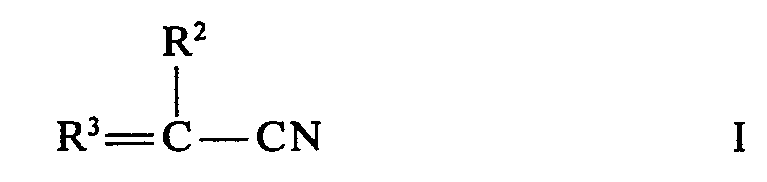
- ⁇ , ⁇ -unsaturated nitriles compounds of the general formula in which R 2 is a hydrogen atom or a methyl radical, and in which R 3 is a radical from the group CH 2 or CHCH 3 or CHCN or CHC 6 H 5 or C (CH 3 ) 2 means that the alcohols are those of the general formula in which R is a primary, secondary or tertiary saturated alkyl radical having 1 to 20 carbon atoms, preferably 1 to 4 carbon atoms, and that the process is carried out in the absence of hydrogen and in the presence of an ⁇ -substi
- n-ethylcyanoacetic acid esters can be prepared from 3-butenenitrile and the n-propylcyanoacetic acid esters can be prepared from 2-, 3- or 4-pentenenitrile.
- the process is best performed with carbon monoxide that is free of hydrogen. It is also important that ⁇ -substituted pyridines are used as the basic compound.
- 2-, 3- or 4-pentenenitrile makes it possible to obtain alkyl n-propylcyanoacetate in a high yield and purity in a simple and economical manner with regard to the prior art by the process according to the invention. According to the prior art, however, the formation of 2-ethyl-3-cyanopropionic acid ester as well as further carboxylic acid esters such as cyanovaleric acid ester would have been expected instead of the n-propylcyanoacetic acid ester.
- the invention therefore relates to the process for the preparation of ⁇ -n-propylcyanoacetic acid esters or ⁇ -n-ethylcyanoacetic acid esters, which is characterized in that 2-pentenenitrile, 3-pentenenitrile, 4-pentenenitrile, their mixtures or 3-butenenitrile in the presence of Co 2 (CO) 8 and an x-substituted pyridine as a basic compound with an alcohol and carbon monoxide.
- CO Co 2
- the 2-, 3- or 4-pentenenitrile used to prepare n-propylcyanoacetic acid esters is formed u. a. in the addition of hydrocyanic acid to butadiene in the presence of nickel complex compounds.
- the 2-, 3- or 4-pentenenitrile or mixtures thereof can be pure or as a fraction step can be used, which also contains other substances such as those obtained in the production of 2-, 3- or 4-pentenenitrile.
- 2-methyl-2-butenenitrile and / or 2-methyl-3-butenenitrile are suitable as accompanying substances.
- the contents of 2-pentenenitrile and / or 3-pentenenitrile in these starting materials should be at least 50% by weight, preferably more than 75% by weight.
- Primary, secondary or tertiary saturated alcohols having 1 to 20 carbon atoms, preferably 1 to 4 carbon atoms, can be used as alcohols. May be mentioned for.
- the alcohol is used in excess, for example in a 2- to 6-fold molar excess, based on the unsaturated nitrile used.
- the carbon monoxide can be used in the pressure range from 50 to 250 bar. Higher pressures are possible, but not necessary. It is preferable to work in the pressure range from 100 to 180 bar cold pressure.
- the carbon monoxide can be inert gas, such as. B. N 2 included.
- Co 2 (CO) 8 is used as catalyst. It is used in a molar ratio of 1:10 to 1: 1000, preferably 1:50 to 1: 500, based on unsaturated nitrile.
- ⁇ -substituted pyridines which are suitable for the purposes of the invention are those of the general formula
- the substituent X can be a primary or secondary or tertiary C i - to C 4 -alkyl radical, which optionally is olefinically unsaturated, or an optionally alkyl-substituted benzyl or halogen, or a phenyl radical, or an ⁇ -pyridyl.
- Y can be a C i to C 4 alkyl radical (primary, secondary or tertiary, saturated) or halogen.
- the substituents Y are preferably arranged in the 4- and / or 6-position on the core. Y can be equal to or different from X.
- ⁇ -picoline, 2,4- and 2,6-lutidine, 2,4,6-collidine, 2-ethylpyridine, 2-vinylpyridine and 2-chloropyridine have proven to be highly selective substances.
- ⁇ -Alkyl-substituted pyridines especially methyl- or ethyl-substituted ones, are preferred, especially ⁇ -picoline and 2,4-lutidine.
- ⁇ -alkyl-substituted pyridines based on unsaturated nitrile, are used in a molar ratio (pyridine derivatives to unsaturated nitrile) of 1: to 1: 100, preferably 1:10 to 1:50.
- the reaction temperature can be between 100 and 250 ° C, preferably between 120 and 220 ° C.
- reaction is carried out in such a way that the components are placed in an autoclave and are raised to the desired reaction temperature with stirring and pressure.
- reaction product alkyl n-propyl cyanoacetate can be easily separated from the reaction mixture.
- a common method is e.g. B. fractional distillation, whereby the excess alcohol and the ⁇ -substituted pyridine can be recovered.
- n-propylcyanoacetic acid alkyl esters obtainable by the process according to the invention are valuable chemical intermediates.
- the di-n-propylcyanoacetic acid ester can be prepared by alkylation with n-propyl halide and can be converted to dipropylacetic acid according to DE-OS 2 721 264.
- the nitrile group can be saponified and dialkyl propylmalonate is obtained.
- the yield consisted of 95% ethyl n-ethyl cyanoacetate and only 1% ethyl 4-cyanobutyrate.
Landscapes
- Chemical & Material Sciences (AREA)
- Organic Chemistry (AREA)
- Engineering & Computer Science (AREA)
- Materials Engineering (AREA)
- Chemical Kinetics & Catalysis (AREA)
- Inorganic Chemistry (AREA)
- Organic Low-Molecular-Weight Compounds And Preparation Thereof (AREA)
- Low-Molecular Organic Synthesis Reactions Using Catalysts (AREA)
Description
- Die Erfindung betrifft die Herstellung von α-n-Propylcyanessigsäureestern aus 2-, 3- oder 4-Pentennitril sowie die Herstellung von α-n-Äthylcyanessigsäureester aus 3-Butennitril durch Umsetzung mit einem Alkohol und Kohlenmonoxid in Gegenwart von Co2(CO)8 und einem α-substituierten Pyridin als basisch wirkende Verbindung.
- Cope et al. referieren in »Org. Reactionsl IX (1957), 265, die Herstellung von n-Propylcyanessigsäureäthylester durch Umsetzung von Cyanessigsäureäthylester mit n-Propylbromid oder -jodid in Gegenwart von Na-Äthylat. Dieses bekannte Alkylierungsverfahren liefert jedoch in beträchtlichem Ausmaß Nebenprodukte und Abfallstoffe, wodurch das Verfahren unwirtschaftlich wird.
- Die Hydrocarbalkoxylierung von 3- und 4-Pentennitril in Gegenwart von Metallcarbonylen und einer einen 5- oder 6-gliedrigen, stickstoffhaltigen Ring enthaltenden heterocyclischen Verbindung wird in der DE-OS 2 541 640 beschrieben. Reaktionsprodukte sind jedoch 5-Cyanvaleriansäureester. Die Bildung von Propylcyanessigsäureester wird nicht erwähnt.
- Weiterhin ist es bekannt, Acrylnitril mit Äthanol oder Propanol oder Isopropanol und CO in Gegenwart von Co2(CO)8 umzusetzen (JA-AS 31651/70). Neben anderen Reaktionsprodukten entsteht bis zu einer Ausbeute von höchstens 13% 2-Cyanpropionsäureäthyl- bzw. n-propyl- bzw. -isopropylester. Die Herstellung des Methylesters gelingt nach diesem Verfahren nicht.
- Ferner ist ein Verfahren bekannt (JA-AS 17246/67), bei dem Acrylnitril mit CO und Methanol in Gegenwart von Co2(CO)ε, Pyridin und bis 10 Gew.-% H2, bezogen auf Kohlenmonoxid, zu Gemischen von 2- und 3-Cyanpropionsäuremethylester, ß-Cyanpropionaldehyddimethylacetal und Propionitril umgesetzt wird. Die gleichen Ergebnisse werden auch in Bull. Chem. Soc., Japan 40,135-144 (1967) mitgeteilt.
- Dieses zuletzt genannte Carbonylierungsverfahren liefert neben 2-Cyanpropionsäuremethylester beträchtliche Anteile an Nebenprodukten, deren Abtrennung auf Grund geringer Siedepunktdifferenzen Schwierigkeiten bereitet. Ein weiterer Nachteil liegt in der Notwendigkeit, Wasserstoff bis zu 10 Gew.-% dem Kohlenmonoxid zuzugeben.
- Gegenstand der deutschen Patentanmeldung P 2639327 ist ein Verfahren zur Herstellung α-substituierter Cyanessigsäurealkylester durch Umsetzung eines α,β-olefinisch ungesättigten Nitrils mit einem Alkanol und Kohlenmonoxid in Gegenwart von Co2(CO)8 und einer basisch wirkenden organischen Verbindung bei erhöhten Temperaturen und erhöhtem Druck, daß als α,β-ungesättigte Nitrile Verbindungen der allgemeinen Formel

- Es wurde gefunden, daß aus 3-Butennitril die n-Äthylcyanessigsäureester und aus 2-, 3- oder 4-Pentennitril die n-Propylcyanessigsäureester herstellbar sind.
- Das Verfahren wird am besten mit Kohlenmonoxid durchgeführt, das frei von Wasserstoff ist. Wichtig ist ferner, daß α-substituierte Pyridine als basische Verbindung eingesetzt werden. Durch die Anwendung von 2-, 3- oder 4-Pentennitril werden im Hinblick auf den Stand der Technik nach dem erfindungsgemäßen Verfahren auf einfache und wirtschaftliche Weise n-Propylcyanessigsäurealkylester in großer Ausbeute und Reinheit zugänglich. Nach dem Stand der Technik wäre hingegen anstelle der n-Propylcyanessigsäureester die Bildung von 2-Äthyl-3-cyanpropionsäureester sowie weitere Carbonsäureester wie Cyanvaleriansäureester zu erwarten gewesen.
- Gegenstand der Erfindung ist daher das Verfahren zur Herstellung von α-n-Propylcyanessigsäureestern bzw. α-n-Äthylcyanessigsäureestern, welches dadurch gekennzeichnet ist, daß 2-Pentennitril, 3-Pentennitril, 4-Pentennitril, deren Mischungen bzw. 3-Butennitril in Gegenwart von Co2(CO)8 und einem x-substituierten Pyridin als basisch wirkender Verbindung mit einem Alkohol und Kohlenmonoxid umgesetzt werden.
- Aus 3- und 4-Pentennitril bzw. 3-Butennitril entsteht unerwartet ganz überwiegend ebenfalls die n-Propylcyanessigsäureester bzw. n-Äthylcyanessigsäureester neben nur wenig ω-Cyancarbonsäureester, d. h. es tritt offenbar eine Isomerisierung ein, so daß hier ein neues Reaktionsprinzip vorliegt.
- Das zur Herstellung von n-Propylcyanessigsäureestern verwendete 2-, 3- oder4-Pentennitril entsteht u. a. bei der Addition von Blausäure an Butadien in Gegenwart von Nickelkomplexverbindungen.
- Das 2-, 3- oder 4-Pentennitril oder deren Gemische können rein oder als ein Fraktionsschritt eingesetzt werden, der noch andere Stoffe, wie sie bei der Herstellung von 2-, 3- oder 4-Pentennitril anfallen, enthält. Als Begleitstoffe kommen besonders 2-Methyl-2-butennitril und/ oder 2-Methyl-3-butennitril in Frage. In diesen Ausgangsstoffen sollen die Gehalte von 2-Pentennitril und/oder 3-Pentennitril mindestens 50 Gew.-%, bevorzugt mehr als 75 Gew.-% betragen.
- Als Alkohole können primäre, sekundäre oder tertiäre gesättigte Alkohole mit 1 -20 C-Atomen, vorzugsweise 1 bis 4 C-Atomen, eingesetzt werden. Genannt seien z. B. Methanol, Äthanol, n oder Iso-Propanol, Butanole, Hexanole oder verzweigte Alkohole wie 2-Äthylhexanol und dgl. Im allgemeinen wird der Alkohol im Überschuß, beispielsweise im 2- bis 6fachen molaren Überschuß, bezogen auf eingesetztes ungesättigtes Nitril, verwendet.
- Der Kohlenmonoxid kann im Druckbereich von 50 bis 250 bar angewendet werden. Höhere Drücke sind möglich, aber nicht notwendig. Vorzugsweise wird im Druckbereich von 100 bis 180 bar Kaltdruck gearbeitet. Das Kohlenmonoxid kann Inertgas, wie z. B. N2, enthalten.
- Als Katalysator wird Co2(CO)8 verwendet. Er wird, bezogen auf ungesättigtes Nitril, im Molverhältnis von 1 : 10 bis 1 : 1000, vorzugsweise 1 : 50 bis 1 : 500 eingesetzt.
- Es ist zweckmäßig, a-substituierte Pyridine einzusetzen, deren Siedepunkte in einem Bereich liegen, daß eine leichte destillative Trennung von dem Endprodukt möglich ist.
- Die im Sinne der Erfindung geeigneten α-substituierten Pyridine sind solche der allgemeinen Formel

- Der Substituent X kann ein primärer oder sekundärer oder tertiärer Ci- bis C4-Alkylrest, der ggf. olefinisch ungesättigt ist, oder ein ggf. alkylsubstituierter Benzylrest, oder Halogen, oder ein Phenylrest, oder ein α-Pyridylrest sein.
- Y kann ein Ci- bis C4-Alkylrest (primär, sekundär oder tertiär, gesättigt) oder Halogen sein.
a ist 0 bis 2. Bei a = können die Substituenten Y gleich oder ungleich sein. - Bevorzugt sind die Substituenten Y (bzw. der Substituent Y) in 4- und/oder 6-Stellung an dem Kern angeordnet. Y kann gleich oder ungleich X sein.
- Genannt seien z. B. α-Picolin, 2,4-Lutidin, 2,6-Lutidin, 2,4,6-Kollidin, 2-Äthylpyridin, 2-n-Propyl- bzw. 2-Isopropylpyridin, 2-n-Butyl- bzw. 2-tert.-Butylpyridin, 2-Vinylpyridin, 2-Propenylpyridin, 2-Chlorpyridin, 2-Brom- bzw. 2-Jodpyridin, 2-Benzylpyridin, 2-Phenylpyridin, α,α'-Bipyridyl u. dgl. α-Picolin, 2,4- und 2,6-Lutidin, 2,4,6-Kollidin, 2-Äthylpyridin, 2-Vinylpyridin und 2-Chlorpyridin haben sich als gut selektiv wirkende Stoffe erwiesen.
- α-alkylsubstituierte Pyridine, insbesondere methyl- oder äthylsubstituierte, werden bevorzugt, insbesondere α-Picolin und 2,4-Lutidin.
- Die α-atkylsubstituierten Pyridine werden, bezogen auf ungesättigtes Nitril, im molaren Verhältnis (Pyridinabkömmlinge zu ungesättigtem Nitril) von 1 : bis 1 : 100, vorzugsweise 1 : 10 bis 1 : 50 eingesetzt.
- Die Reaktionstemperatur kann zwischen 100 und 250°C, vorzugsweise zwischen 120 und 220° C liegen.
- Im allgemeinen wird die Reaktion so durchgeführt, daß die Komponenten in einem Autoklav vorgelegt werden und unter Rühren und Druck auf die gewünschte Reaktionstemperatur erhöht wird.
- Es ist jedoch auch möglich, das ungesättigte Nitril bei erhöhtem Druck und erhöhter Temperatur den übrigen Reaktionsteilnehmern zuzudosieren.
- Das Reaktionsprodukt n-Propyl-cyanessigsäurealkylester läßt sich leicht aus dem Reaktionsgemisch abtrennen. Ein übliches Verfahren ist z. B. die fraktionierte Destillation, wodurch auch der überschüssige Alkohol sowie das α-substituierte Pyridin zurückgewonnen werden können.
- Die durch das erfindungsgemäße Verfahren zugänglichen n-Propylcyanessigsäurealkylester sind wertvolle chemische Zwischenprodukte. So kann z: B. durch Alkylierung mit n-Propylhalogenid der Di-n-propylcyanessigsäureester hergestellt werden, der nach der DE-OS 2 721 264 zu Dipropylessigsäure umgesetzt werden kann. Andererseits kann die Nitrilgruppe verseift werden und man erhält Propylmalonsäuredialkylester.
- In einem mit einem Hubrührer versehenen 1-I-Edelstahlautoklav werden bei Raumtemperatur 81 g (1 Mol) 2-Pentennitril, 10 g Co2(CO)ε, 20 g α-Picolin und 400 ml Äthanol unter Stickstoffatmosphäre vorgelegt. Danach wird durch Spülen mit Kohlenmonoxid der Stickstoff entfernt und ein CO-Kaltdruck von 200 bar eingestellt. Anschließend wird unter Rühren auf 150°C erhitzt und diese Temperatur 3 Stunden gehalten. Nach dem Erkalten des Reaktionsgutes wird der verbleibende CO-Druck abgelassen und der Ansatz durch Destillation aufgearbeitet. Der Umsatz an 2-Pentennitril liegt bei 90% und es werden 125,3 g n-Propylcyanessigsäureäthylester gewonnen (Ausbeute 90%).
- Analog Beispiel 1, jedoch mit nur 5 g Co2(CO)8 werden die Reaktionskomponenten 2 Stunden bei 160°C gehalten. Die Aufarbeitung ergibt bei einem Umsatz von 87% 117,2 g n-Propylcyanessigsäureäthylester (Ausbeute 87%).
- Analog Beispiel 1, jedoch mit 5 g Co2(CO)8, 15 g α-Picolin und 100 g einer Fraktion, die 85% 2-Pentennitril neben 2-Methyl-2-butennitril und 2-Methyl-3-butennitril enthielt, konnte nach 6 Stunden Reaktion bei 200 bar CO-Kaltdruck und 150°C 119 g n-Propylcyanessigsäureäthylester isoliert werden. Bei 80% Umsatz lag die Ausbeute bei 90%. 2-Methyl-2-butennitril und 3-Methyl-3-butennitril wurden unverändert zurückgewonnen.
- Analog Beispiel 3, jedoch mit nur 140 bar CO-Kaltdruck konnten bei einem Umsatz von 72% 101 g n-Propylcyanessigsäureäthylester erhalten werden (Ausbeute 86%).
- Analog Beispiel 4, jedoch mit iso-Propanol anstelle von Äthanol, wurde nach der destillativen Aufarbeitung 106 g n-Propylcyanessigsäureisopropylester erhalten. Bei einem Umsatz von 74% lag die Ausbeute somit bei 81,5%.
- n-Propylcyanessigsäureisopropylester Kp14:107°C
- C9H15N02,
Mol-Gew.:169,225; Mol-Gew.: 169 MS - C, H, N berechnet
C = 63,88%, H - 8,94%, N = 8,28% - C, H, N gefunden
C=63,89%, H = 9,34%, N = 8,18% - Analog Beispiel 4, jedoch mit n-Butanol anstelle von Äthanol, wurden 128,5 g n-Propylcyanessigsäure-n-butylester isoliert. Bei einem Umsatz von 75% lag die Ausbeute bei 89%.
- n-Propylcyanessigsäure-n-butylester Kp14:126-7°C
- C10H17NO2
Mol-Gew.: 183,25; Mol-Gew.:183 MS - C, H, N berechnet
C=65,54%, H=9,40%, N=7,69% - C, H, N gefunden
C=85,37%, H=9,57%, N=7,67% - Analog Beispiel 1, jedoch mit 81 g (1 Mol) 3-Pentennitril anstelle von 2-Pentennitril und einer Reaktionstemperatur von 160°C und einer Reaktionszeit von 5 Stunden, werden bei einem Umsatz von 63% 81% n-Propylcyanessigsäureäthylester und 7,5% 5-Cyanvaleriansäureäthylester isoliert. 4-Pentennitril kann in entsprechender Weise umgesetzt werden.
- Entsprechend Beispiel 1 wird 1 Mol 3-Butennitril (= Allylcyanid) bei einer Reaktionstemperatur von 140°C umgesetzt. Die Ausbeute bestehl zu 95% aus n-Äthylcyanessigsäureäthylester und zu nur 1% aus 4-Cyanbuttersäureäthylester.
Claims (2)
Applications Claiming Priority (2)
| Application Number | Priority Date | Filing Date | Title |
|---|---|---|---|
| DE19792907873 DE2907873A1 (de) | 1979-03-01 | 1979-03-01 | Verfahren zur herstellung von n-propylcyanessigsaeureestern |
| DE2907873 | 1979-03-01 |
Publications (2)
| Publication Number | Publication Date |
|---|---|
| EP0015385A1 EP0015385A1 (de) | 1980-09-17 |
| EP0015385B1 true EP0015385B1 (de) | 1982-05-12 |
Family
ID=6064133
Family Applications (1)
| Application Number | Title | Priority Date | Filing Date |
|---|---|---|---|
| EP80100511A Expired EP0015385B1 (de) | 1979-03-01 | 1980-02-01 | Verfahren zur Herstellung von n-Propylcyanessigsäureestern und n-Äthylcyanessigsäureestern |
Country Status (3)
| Country | Link |
|---|---|
| EP (1) | EP0015385B1 (de) |
| JP (1) | JPS55118451A (de) |
| DE (2) | DE2907873A1 (de) |
Family Cites Families (4)
| Publication number | Priority date | Publication date | Assignee | Title |
|---|---|---|---|---|
| NL272335A (de) * | 1960-12-08 | |||
| DE2403483A1 (de) * | 1974-01-25 | 1975-08-07 | Dynamit Nobel Ag | Verfahren zur herstellung von cyanessigsaeurealkylestern |
| DE2648004C2 (de) * | 1976-10-23 | 1985-03-07 | Basf Ag, 6700 Ludwigshafen | 4-Cyanvaleriansäureester und Verfahren zu deren Herstellung |
| IT1075123B (it) * | 1977-02-24 | 1985-04-22 | Snam Progetti | Processo per la preparazione di derivati dell'acido malonico |
-
1979
- 1979-03-01 DE DE19792907873 patent/DE2907873A1/de not_active Withdrawn
-
1980
- 1980-02-01 EP EP80100511A patent/EP0015385B1/de not_active Expired
- 1980-02-01 DE DE8080100511T patent/DE3060387D1/de not_active Expired
- 1980-02-29 JP JP2422680A patent/JPS55118451A/ja active Pending
Also Published As
| Publication number | Publication date |
|---|---|
| DE3060387D1 (en) | 1982-07-01 |
| DE2907873A1 (de) | 1980-09-11 |
| JPS55118451A (en) | 1980-09-11 |
| EP0015385A1 (de) | 1980-09-17 |
Similar Documents
| Publication | Publication Date | Title |
|---|---|---|
| DE2900231A1 (de) | Verfahren zur herstellung von n,n- diaethyl-m-toluamid aus m-toluylsaeure durch katalytische reaktion mit diaethylamin in fluessiger phase | |
| DE69408578T2 (de) | Verfahren zur herstellung von 2-hydroxyarylaldehyden | |
| DE2639327C2 (de) | Verfahren zur Herstellung von α-substituierten Cyancarbonsäurealkylestern | |
| EP0015385B1 (de) | Verfahren zur Herstellung von n-Propylcyanessigsäureestern und n-Äthylcyanessigsäureestern | |
| DE2630981C2 (de) | 4-β,β-Dichlor- und 4-β,β-Dibromvinyl-3,3-dimethylbutyrolactone, Verfahren zu ihrer Herstellung und deren Verwendung zur Herstellung von Estern der 3-β,β-Dichlor- oder 3-β,β-Dibrom-vinyl-2,2-dimethylcyclopropancarbonsäure | |
| DE2443142C2 (de) | Verfahren zur Herstellung von Cyclopropancarbonsäurenitril | |
| DE2919974A1 (de) | Verfahren zur herstellung von cyanhydrinacylaten von aldehyden | |
| DE60007148T2 (de) | Verfahren zur umsetzung von aldehyden zu nitrilen durch reaktion mit ammoniak and wasserstoff-peroxid | |
| DE2836077A1 (de) | Herstellung von 2,3,5-trichlorpyridin | |
| EP0087585A1 (de) | Verfahren zur Herstellung von 3-Alkoxi-acrylnitrilen | |
| DE2615309C2 (de) | Verfahren zur katalytischen Herstellung von 2-substituierten Pyridinen | |
| EP0542086B1 (de) | Verfahren zur Herstellung von N-[(2-Chlor-pyridin-5-yl)methyl]-ethylendiamin | |
| DE4225763A1 (de) | Verfahren zur Herstellung von Halogenaromaten | |
| EP0533131B1 (de) | Verfahren zur selektiven Mono-ortho-Hydroxyalkylierung von 4-substituierten Pyridin-Derivaten | |
| DE1235893B (de) | Verfahren zur Herstellung von N-Vinyl-N-alkyl-formamiden | |
| DE3037086A1 (de) | 3-(m-chloranilino-)acrylsaeureaethylester und ein verfahren zu dessen herstellung | |
| EP0508217B1 (de) | Verfahren zur Herstellung von 2-Chlorpyridinen | |
| EP0031108B1 (de) | Verfahren zur Herstellung von 5-Oxoalkansäuren | |
| EP0003107B1 (de) | Verfahren zur Herstellung von Furancarbonsäureanilid | |
| EP0447758B1 (de) | Verfahren zur Herstellung von ungesättigten und gesättigten Carbonylverbindungen | |
| DE1468624B2 (de) | Verfahren zur herstellung von beta-cyanketonen | |
| DE2005082C3 (de) | Verfahren zur Herstellung von N-Alkylamiden von alpha, beta-ungesättigten Carbonsäuren | |
| DE2830719C2 (de) | Verfahren zur Herstellung von Polyalkylpiperidon-(4)-cyanhydrinen | |
| DE1493965C (de) | Verfahren zum Herstellen von Racema ten optisch aktiver Nitrile | |
| DE1543995C (de) | Verfahren zur Herstellung von 5 (3 see AminoalkyhdenH0,11 dihydro 5H dibenzo eckige Klammer auf a,d ecki ge Klammer zu cycloheptenen |
Legal Events
| Date | Code | Title | Description |
|---|---|---|---|
| PUAI | Public reference made under article 153(3) epc to a published international application that has entered the european phase |
Free format text: ORIGINAL CODE: 0009012 |
|
| AK | Designated contracting states |
Designated state(s): BE CH DE FR GB IT NL |
|
| 17P | Request for examination filed |
Effective date: 19810109 |
|
| GRAA | (expected) grant |
Free format text: ORIGINAL CODE: 0009210 |
|
| AK | Designated contracting states |
Designated state(s): BE CH DE FR GB IT NL |
|
| PG25 | Lapsed in a contracting state [announced via postgrant information from national office to epo] |
Ref country code: IT Free format text: LAPSE BECAUSE OF FAILURE TO SUBMIT A TRANSLATION OF THE DESCRIPTION OR TO PAY THE FEE WITHIN THE PRESCRIBED TIME-LIMIT;WARNING: LAPSES OF ITALIAN PATENTS WITH EFFECTIVE DATE BEFORE 2007 MAY HAVE OCCURRED AT ANY TIME BEFORE 2007. THE CORRECT EFFECTIVE DATE MAY BE DIFFERENT FROM THE ONE RECORDED. Effective date: 19820512 |
|
| REF | Corresponds to: |
Ref document number: 3060387 Country of ref document: DE Date of ref document: 19820701 |
|
| PLBI | Opposition filed |
Free format text: ORIGINAL CODE: 0009260 |
|
| 26 | Opposition filed |
Opponent name: BASF AKTIENGESELLSCHAFT Effective date: 19830126 |
|
| PLBN | Opposition rejected |
Free format text: ORIGINAL CODE: 0009273 |
|
| STAA | Information on the status of an ep patent application or granted ep patent |
Free format text: STATUS: OPPOSITION REJECTED |
|
| 27O | Opposition rejected |
Effective date: 19831104 |
|
| PGFP | Annual fee paid to national office [announced via postgrant information from national office to epo] |
Ref country code: FR Payment date: 19840120 Year of fee payment: 5 |
|
| PGFP | Annual fee paid to national office [announced via postgrant information from national office to epo] |
Ref country code: CH Payment date: 19840222 Year of fee payment: 5 |
|
| PGFP | Annual fee paid to national office [announced via postgrant information from national office to epo] |
Ref country code: BE Payment date: 19840331 Year of fee payment: 5 |
|
| PGFP | Annual fee paid to national office [announced via postgrant information from national office to epo] |
Ref country code: NL Payment date: 19850228 Year of fee payment: 6 |
|
| PGFP | Annual fee paid to national office [announced via postgrant information from national office to epo] |
Ref country code: DE Payment date: 19850312 Year of fee payment: 6 |
|
| PG25 | Lapsed in a contracting state [announced via postgrant information from national office to epo] |
Ref country code: CH Effective date: 19860228 Ref country code: BE Effective date: 19860228 |
|
| BERE | Be: lapsed |
Owner name: DYNAMIT NOBEL A.G. Effective date: 19860228 |
|
| PG25 | Lapsed in a contracting state [announced via postgrant information from national office to epo] |
Ref country code: NL Effective date: 19860901 |
|
| GBPC | Gb: european patent ceased through non-payment of renewal fee | ||
| NLV4 | Nl: lapsed or anulled due to non-payment of the annual fee | ||
| PG25 | Lapsed in a contracting state [announced via postgrant information from national office to epo] |
Ref country code: FR Free format text: LAPSE BECAUSE OF NON-PAYMENT OF DUE FEES Effective date: 19861031 |
|
| REG | Reference to a national code |
Ref country code: CH Ref legal event code: PL |
|
| REG | Reference to a national code |
Ref country code: FR Ref legal event code: ST |
|
| PG25 | Lapsed in a contracting state [announced via postgrant information from national office to epo] |
Ref country code: DE Effective date: 19881101 |
|
| PG25 | Lapsed in a contracting state [announced via postgrant information from national office to epo] |
Ref country code: GB Effective date: 19881118 |