EP0017172A1 - Verfahren zum Färben von Cellulosefasern und von Cellulose/Polyester enthaltenden Fasermischungen mit Reaktivfarbstoffen - Google Patents
Verfahren zum Färben von Cellulosefasern und von Cellulose/Polyester enthaltenden Fasermischungen mit Reaktivfarbstoffen Download PDFInfo
- Publication number
- EP0017172A1 EP0017172A1 EP80101636A EP80101636A EP0017172A1 EP 0017172 A1 EP0017172 A1 EP 0017172A1 EP 80101636 A EP80101636 A EP 80101636A EP 80101636 A EP80101636 A EP 80101636A EP 0017172 A1 EP0017172 A1 EP 0017172A1
- Authority
- EP
- European Patent Office
- Prior art keywords
- cellulose
- dyeing
- dyes
- fibres
- reactive dyes
- Prior art date
- Legal status (The legal status is an assumption and is not a legal conclusion. Google has not performed a legal analysis and makes no representation as to the accuracy of the status listed.)
- Granted
Links
Classifications
-
- D—TEXTILES; PAPER
- D06—TREATMENT OF TEXTILES OR THE LIKE; LAUNDERING; FLEXIBLE MATERIALS NOT OTHERWISE PROVIDED FOR
- D06P—DYEING OR PRINTING TEXTILES; DYEING LEATHER, FURS OR SOLID MACROMOLECULAR SUBSTANCES IN ANY FORM
- D06P3/00—Special processes of dyeing or printing textiles, or dyeing leather, furs, or solid macromolecular substances in any form, classified according to the material treated
- D06P3/82—Textiles which contain different kinds of fibres
- D06P3/8204—Textiles which contain different kinds of fibres fibres of different chemical nature
- D06P3/8223—Textiles which contain different kinds of fibres fibres of different chemical nature mixtures of fibres containing hydroxyl and ester groups
- D06P3/8238—Textiles which contain different kinds of fibres fibres of different chemical nature mixtures of fibres containing hydroxyl and ester groups using different kinds of dye
- D06P3/8252—Textiles which contain different kinds of fibres fibres of different chemical nature mixtures of fibres containing hydroxyl and ester groups using different kinds of dye using dispersed and reactive dyes
-
- D—TEXTILES; PAPER
- D06—TREATMENT OF TEXTILES OR THE LIKE; LAUNDERING; FLEXIBLE MATERIALS NOT OTHERWISE PROVIDED FOR
- D06P—DYEING OR PRINTING TEXTILES; DYEING LEATHER, FURS OR SOLID MACROMOLECULAR SUBSTANCES IN ANY FORM
- D06P3/00—Special processes of dyeing or printing textiles, or dyeing leather, furs, or solid macromolecular substances in any form, classified according to the material treated
- D06P3/58—Material containing hydroxyl groups
- D06P3/60—Natural or regenerated cellulose
- D06P3/66—Natural or regenerated cellulose using reactive dyes
-
- D—TEXTILES; PAPER
- D06—TREATMENT OF TEXTILES OR THE LIKE; LAUNDERING; FLEXIBLE MATERIALS NOT OTHERWISE PROVIDED FOR
- D06P—DYEING OR PRINTING TEXTILES; DYEING LEATHER, FURS OR SOLID MACROMOLECULAR SUBSTANCES IN ANY FORM
- D06P3/00—Special processes of dyeing or printing textiles, or dyeing leather, furs, or solid macromolecular substances in any form, classified according to the material treated
- D06P3/82—Textiles which contain different kinds of fibres
- D06P3/8204—Textiles which contain different kinds of fibres fibres of different chemical nature
- D06P3/8219—Textiles which contain different kinds of fibres fibres of different chemical nature mixtures of fibres containing hydroxyl and amide groups
Definitions
- the process is generally carried out at pH values of about 7-8.5, especially at about 7-7.5.
- the optimal pH range depends on the type and amount of the dye. The less reactive the dye, the higher it is.
- the amount of alkaline agent should preferably not be significantly higher than is stoichiometrically required for dye fixation.
- Suitable buffers for adjusting the pH are, for example, sodium bicarbonate, disodium hydrogenphosphate, borax or conventional buffer systems which are able to maintain the above-mentioned pH range.
- sodium bicarbonate or disodium hydrogen phosphate are used per liter of dye liquor.
- the optimal amount depends on the type and amount of the dye used.
- the process is preferably carried out as an "all-in” process. It is particularly advantageous for reactive dyes with hydrolysis constants K w ⁇ 1.10 -3 (measured at pH 10.0 and 60 °; see Venkataraman: The Chemistry of Synthetic Dyes; Academic Press, New York, 1972, Volume VI, page 352) , ie in particular for fluoropyrimidinyl, monofluorotriazinyl and dichloroquinoxalinyl dyes.
- Dyes of the type mentioned are described in large numbers in the literature. Azo, anthraquinone and phthalocyanine dyes are preferably used.
- the process is preferably suitable for single-bath dyeing of cotton and rayon blends in strand and piece, in particular those with polyester and polyamide; Rayon spin cake and cellulose cheese spools as well as mercerized cotton in yarn and piece form.
- a in a dyeing machine located-dye liquor e which dye textile material (liquor ratio about 1: 5 - 1:20), alkali donors (particularly sodium bicarbonate) and other conventional additives, for example, salts such as sodium sulphate, as well as reduction inhibitors such as Containing sodium m-nitrobenzenesulfonate is heated to 100-130 ° in about 15-60 minutes and kept at this temperature. until the coloring is finished.
- 100 parts of a rayon yarn in the form of a spin cake are mixed in a HT yarn dyeing machine with a 75 ° C. warm liquor which and Contains 7.5 parts of m-nitrobenzenesulfonic acid sodium and the direction of flow is changed in the following alternation: 3 minutes from the inside out and 3 minutes from the outside in.
- the mixture is then heated to 100 ° C. and 1.5 parts of sodium bicarbonate are added over the course of 10 minutes.
- the temperature is then brought to 106 ° C. under static pressure and dyed at this temperature for 45 minutes. It is then rinsed as usual, soaped at the boil and dried.
- 100 parts of a cellulose fiber yarn on a package are mixed in an HT yarn dyeing machine with an 80 ° C warm liquor and
- the liquor is brought to 110 ° C. with vigorous circulation and left at this temperature for 1 hour.
- the exhausted remaining liquor is then drained and rinsed as usual and soaped at the boil for 8 minutes.
- the liquor is heated to 106 ° C. in 35 minutes with vigorous circulation and dyed at this temperature for 40 minutes.
- the extracted liquor is drained and, as usual, rinsed cold and warm and soaped at the boil.
- a deep level red color is obtained on both fiber components.
Landscapes
- Engineering & Computer Science (AREA)
- Textile Engineering (AREA)
- Chemical & Material Sciences (AREA)
- Dispersion Chemistry (AREA)
- Coloring (AREA)
Abstract
Description
- Gegenstand der vorliegenden Erfindung ist ein Verfahren zum Färben von Cellulosefasern und Cellulosefassern enthaltenden Fasermischungen mit Reaktivfarbstoffen nach dem Einbad-Ausziehverfahren, dadurch gekennzeichnet, daß man unter HT-Bedingungen mit Farbstoffen färbt, die eine Dihalogentriazinyl-, Monofluortriazinyl-, Fluorpyrimidinyl- oder Dichlorchinoxalinyl-Reaktivgruppe enthalten.
- Unter HT-Bedingungen wird dabei verstanden:
- Temperatur: Kochtemperatur und höher.
- beispielsweise 100-130°C, insbesondere etwa 105-120°C.
- Das Verfahren wird im allgemeinen bei pH-Werten von etwa 7 -8, 5, speziell bei etwa 7 - 7,5 durchgeführt.
- Der optimale pH-Bereich hängt dabei von der Art und Menge des Farbstoffs ab. Er ist umso höher, je weniger reaktiv der Farbstoff ist. Die Menge an alkalischem Mittel soll vorzugsweise nicht wesentlich höher sein, als für die Farbstoff-Fixierung stöchiometrisch erforderlich ist.
- Geeignete Puffer zur Einstellung des pH-Herts sind beispielsweise Natriumbicarbonat, Dinatriumhydrogenphosphat, Borax oder übliche Puffersysteme, die in der Lage sind, den obengenannten pH-Bereich aufrechtzuerhalten.
- Vorzugsweise setzt man etwa 1-3 g Natriumbicarbonat oder Dinatriumhydrogenphosphat (gegebenenfalls in Kombination mit Natriumdihydrogenphosphat) pro Liter Färbeflotte ein.
- Die optimale Menge richtet sich nach der Art und Menge des eingesetzten Farbstoffs.
- Das Verfahren wird bevorzugt als "all-in"-Verfahren durchgeführt. Es ist besonders vorteilhaft für Reaktivfarbstoffe mit Hydrolysen-Konstanten Kw ≥ 1.10-3 (bei pH 10,0 und 60° gemessen; vergleiche Venkataraman: The Chemistry of Synthetic Dyes; Academic Press, New York, 1972, Band VI, Seite 352), d.h. insbesondere für Fluorpyrimidinyl-, Monofluortriazinyl- und Dichlorchinoxalinyl-Farbstoffe.
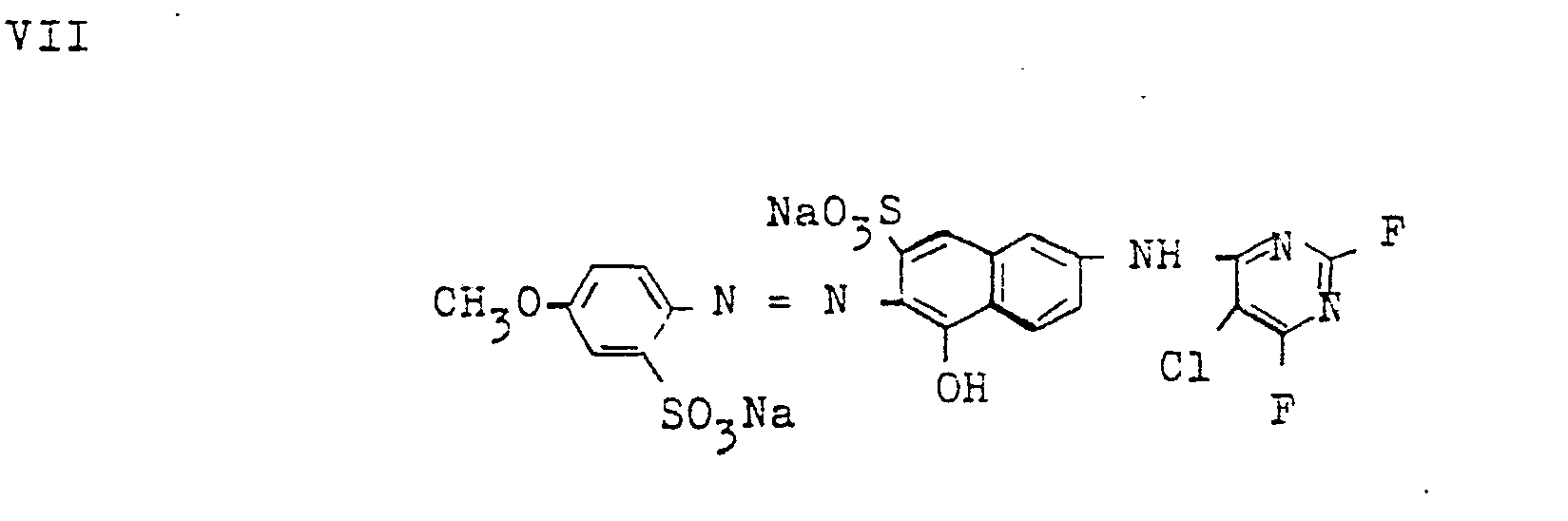
- Farbstoffe der genannten Art sind in der Literatur in großer Zahl beschrieben. Bevorzugt gelangen dabei Azo-, Anthrachinon- und Phthalocyan-Farbstoffe zur Anwendung.
- Das Verfahren eignet sich vorzugsweise zum einbadigen Färben von Baumwolle- und Zellwolle -Mischmaterialien in Strang und Stück, insbesondere solchen mit Polyester und Polyamid; Rayon-Spinnkuchen und Zellwolle-Kreuzspulen sowie mercerisierter Baumwolle in Garn- und Stückform.
- Bei Verwendung einer Mischung aus Reaktivfarbstoffen und Dispersionsfarbstoffen lassen sich bei Cellulose-Polyester-Mischmaterialien beide Faserarten gleichzeitig färben, ebenso bei Cellulose-Polyamid-Mischmaterialien mit Reaktivfarbstoffen und sauren bzw. Metallkomplexfarbstoffen.
- Das Verfahren wird im Einzelnen folgendermaßen durchgeführt:
- Eine in einem Färbeapparat (z.B. Garnfärbeapparat, Haspelkufe oder Jetfärbeapparat) befindliche-Färbeflottee welche Farbstoff, Textilmaterial (Flottenverhältnis etwa 1:5 - 1:20), Alkalispender (insbesondere Natriumbicarbonat) und weitere übliche Zusätze, beispielsweise Salze wie Natriumsulfat,sowie Reduktionsinhibitoren wie m-nitrobenzolsulfonsaures Natrium enthält, wird in etwa 15-60 Minuten auf 100 - 130° erhitzt und bei dieser Temperatur gehalten. bis die Färbung beendet ist.
- Bei Zellwolle wird vorzugsweise so gearbeitet, daß Fasermaterial, Farbstoff und alle Hilfsstoffe in eine auf etwa 70°C vorgeheizte Flotte eingebracht werden und danach auf HT-Temperatur aufgeheizt wird.
- 100 Teile eines Rayongarnes in Form eines Spinnkuchens werden in einem HT-Garnfärbeapparat mit einer 75°C warmen Flotte versetzt, die

7,5 Teile m-nitrobenzolsulfonsaures Natrium enthält und deren Durchströmungsrichtung in folgendem Wechsel geändert wird: 3 Minuten von innen nach außen und 3 Minuten von außen nach innen. Anschließend wird auf 100°C erhitzt und während dieser Zeit 1,5 Teile Natriumbicarbonat innerhalb von 10 Minuten zugesetzt. Daraufhin wird die Temperatur bei statischem Druck auf 106°C gebracht und bei dieser Temperatur 45 Minuten gefärbt. Anschließend wird wie üblich gespült, kochend geseift und getrocknet. - Man erhält eine tiefe, gut durchgefärbte egale Grünfärbung mit guten Echtheitseigenschaften.
- 100 Teile eines Zellwollfasergarns auf Kreuzspule werden in einem HT-Garnfärbeapparat mit einer 80°C warmen Flotte versetzt, die

- 3 Teile m-nitrobenzolsulfonsaures Natrium enthält. Anschließend wird bei guter Flottenzirkulation auf 110°C erwärmt und 60 Minuten bei dieser Temperatur gefärbt.
- Man erhält eine tiefe egale Rotfärbung mit guten Echtheitseigenschaften.
- Verwendet man anstelle des Farbstoffs III gleiche Teile des Farbstoffs IV, so erhält man eine gleichwertige Färbung.
- 100 Teile eines Mischgewebes bestehend aus 30 Teilen Zellwolle und 70 Teilen Polyester werden auf einer HT-Haspelkufe mit einer 65°C warmen Flotte versetzt, bestehend aus

- Nach Zugabe des Dinatriumhydrogenphosphates wird unter statischem Druck die Temperatur des Färbebades auf 120°C gebracht und 90 Minuten bei dieser Temperatur gefärbt. Anschließend wird die erschöpfte Flotte abgelassen und wie üblich gespült und 10 Minuten kochend geseift. Man erhält eine tiefe Blaufärbung mit guten Echtheitseigenschaften.
- 100 Teile eines Mischgewebes aus 50 Teilen Zellwolle und 50 Teilen Nylon 6,6 werden auf einer HT-Haspelkufe mit einer 70°C warmen Flotte versetzt, bestehend aus
-

- Man erhält eine tiefe, gleichmäßige Scharlachfärbung auf beiden Faserkomponenten.
- 100 Teile eines Schlingengewebes aus 50 Teilen Baumwolle und 50 Teilen Nylon 6 werden auf einem HT-Jetfärbeapparat mit einer 70°C warmen Flotte versetzt, bestehend aus
-

- Man erhält eine tiefe egale Rotfärbung auf beiden Faserkomponenten.




Claims (5)
Applications Claiming Priority (2)
| Application Number | Priority Date | Filing Date | Title |
|---|---|---|---|
| DE2913718A DE2913718B2 (de) | 1979-04-05 | 1979-04-05 | Verfahren zum Färben von Cellulosefasern und Cellulosefasern enthaltenden Fasermischungen mit Reaktivfarbstoffen |
| DE2913718 | 1979-04-05 |
Publications (2)
| Publication Number | Publication Date |
|---|---|
| EP0017172A1 true EP0017172A1 (de) | 1980-10-15 |
| EP0017172B1 EP0017172B1 (de) | 1982-08-25 |
Family
ID=6067533
Family Applications (1)
| Application Number | Title | Priority Date | Filing Date |
|---|---|---|---|
| EP80101636A Expired EP0017172B1 (de) | 1979-04-05 | 1980-03-27 | Verfahren zum Färben von Cellulosefasern und von Cellulose/Polyester enthaltenden Fasermischungen mit Reaktivfarbstoffen |
Country Status (3)
| Country | Link |
|---|---|
| EP (1) | EP0017172B1 (de) |
| JP (1) | JPS55137280A (de) |
| DE (2) | DE2913718B2 (de) |
Cited By (1)
| Publication number | Priority date | Publication date | Assignee | Title |
|---|---|---|---|---|
| EP0036537A3 (en) * | 1980-03-21 | 1981-12-16 | Bayer Ag | Process for dyeing fibre blends of polyester and cellulose |
Families Citing this family (3)
| Publication number | Priority date | Publication date | Assignee | Title |
|---|---|---|---|---|
| IT1171600B (it) | 1980-10-30 | 1987-06-10 | Sandoz Ag | Procedimento di tintura per materie cellulosiche |
| DE3122560A1 (de) * | 1981-06-06 | 1982-12-23 | Hoechst Ag, 6000 Frankfurt | Verfahren zum faerben oder bedrucken von zellulosefasern oder deren mischungen mit anderen fasern mit reaktivfarbstoffen |
| DE19922826A1 (de) * | 1999-05-19 | 2000-11-23 | Dystar Textilfarben Gmbh & Co | Orange- und scharlachfarbige Mischungen von Reaktivfarbstoffen |
Citations (6)
| Publication number | Priority date | Publication date | Assignee | Title |
|---|---|---|---|---|
| US3331654A (en) * | 1962-12-17 | 1967-07-18 | Sandoz Ltd | Process for dyeing blends of cellulose and polyester fibers with reactive and disperse dyes |
| FR1507101A (fr) * | 1965-12-31 | 1967-12-22 | Hoechst Ag | Teinture de matières fibreuses cellulosiques, seules ou mélangées avec d'autres fibres |
| FR1512665A (fr) * | 1966-02-23 | 1968-02-09 | Hoechst Ag | Procédé de teinture de fibres cellulosiques mélangées éventuellement à des fibres en polyesters |
| FR2112544A1 (en) * | 1970-11-09 | 1972-06-16 | Ici Ltd | Dyeing cellulose textiles - with reactive dyes at high temps in neutral or acid aq media |
| DE2834997B1 (de) * | 1978-08-10 | 1980-01-03 | Hoechst Ag | Verfahren zum Faerben von synthetischen Polyamidfasern mit Reaktivfarbstoffen nach der Ausziehmethode |
| GB2027756A (en) * | 1978-08-10 | 1980-02-27 | Hoechst Ag | Process for dyeing cellulose fibres with reactive dyes according to the batchwise exhaustion method |
-
1979
- 1979-04-05 DE DE2913718A patent/DE2913718B2/de not_active Withdrawn
-
1980
- 1980-03-27 DE DE8080101636T patent/DE3060773D1/de not_active Expired
- 1980-03-27 EP EP80101636A patent/EP0017172B1/de not_active Expired
- 1980-04-03 JP JP4293080A patent/JPS55137280A/ja active Pending
Patent Citations (6)
| Publication number | Priority date | Publication date | Assignee | Title |
|---|---|---|---|---|
| US3331654A (en) * | 1962-12-17 | 1967-07-18 | Sandoz Ltd | Process for dyeing blends of cellulose and polyester fibers with reactive and disperse dyes |
| FR1507101A (fr) * | 1965-12-31 | 1967-12-22 | Hoechst Ag | Teinture de matières fibreuses cellulosiques, seules ou mélangées avec d'autres fibres |
| FR1512665A (fr) * | 1966-02-23 | 1968-02-09 | Hoechst Ag | Procédé de teinture de fibres cellulosiques mélangées éventuellement à des fibres en polyesters |
| FR2112544A1 (en) * | 1970-11-09 | 1972-06-16 | Ici Ltd | Dyeing cellulose textiles - with reactive dyes at high temps in neutral or acid aq media |
| DE2834997B1 (de) * | 1978-08-10 | 1980-01-03 | Hoechst Ag | Verfahren zum Faerben von synthetischen Polyamidfasern mit Reaktivfarbstoffen nach der Ausziehmethode |
| GB2027756A (en) * | 1978-08-10 | 1980-02-27 | Hoechst Ag | Process for dyeing cellulose fibres with reactive dyes according to the batchwise exhaustion method |
Cited By (1)
| Publication number | Priority date | Publication date | Assignee | Title |
|---|---|---|---|---|
| EP0036537A3 (en) * | 1980-03-21 | 1981-12-16 | Bayer Ag | Process for dyeing fibre blends of polyester and cellulose |
Also Published As
| Publication number | Publication date |
|---|---|
| DE2913718B2 (de) | 1981-02-05 |
| DE2913718A1 (de) | 1980-10-09 |
| JPS55137280A (en) | 1980-10-25 |
| DE3060773D1 (en) | 1982-10-21 |
| EP0017172B1 (de) | 1982-08-25 |
Similar Documents
| Publication | Publication Date | Title |
|---|---|---|
| DE3314663C2 (de) | Verfahren zum Färben von Cellulosefasern oder Cellulosemischfasern nach der Ausschöpf-Färbemethode | |
| EP0044483B1 (de) | Reaktivfärbeverfahren | |
| EP0376086B1 (de) | Mischungen von Dispersionsazofarbstoffen | |
| DE2834997C2 (de) | Verfahren zum Färben von synthetischen Polyamidfasern mit Reaktivfarbstoffen nach der Ausziehmethode | |
| DE2914111C2 (de) | Verfahren zum Färben von Cellulosematerialien mit Reaktivfarbstoffen nach dem Ausziehverfahren | |
| EP0364752B1 (de) | Verfahren zum Färben von textilen Materialen aus Cellulosefasern | |
| EP0017172B1 (de) | Verfahren zum Färben von Cellulosefasern und von Cellulose/Polyester enthaltenden Fasermischungen mit Reaktivfarbstoffen | |
| EP0660894B1 (de) | Verfahren zum färben und bedrucken von textilen materialien aus cellulosefasern in gegenwart von zyklischen alphahydroxyketonen | |
| EP0024332B1 (de) | Färben von Wolle/Cellulosefasermischungen | |
| DE2527962A1 (de) | Verfahren zur behandlung von cellulose-fasern | |
| EP0021044B1 (de) | Verfahren zum Färben von Cellulosefasern und Cellulosefasern enthaltenden Fasermischungen mit Reaktivfarbstoffen | |
| DE4305453A1 (de) | Reaktivfarbstoffblaumischungen mit verbesserter Metamerie | |
| EP0203890B1 (de) | Verfahren zum Färben von Fasermaterial aus natürlichen Polyamiden mit Farbstoffmischungen | |
| CH296168A (fr) | Batterie de cellules photo-électriques à couche d'arrêt. | |
| EP0193053A2 (de) | Niedertemperatur-Färbeverfahren für Wollfasern | |
| DE933271C (de) | Verfahren zur Herstellung von echten Faerbungen | |
| EP0264346A1 (de) | Verfahren zum Färben von Fasermaterial aus natürlichen oder synthetischen Polyamiden mit 1:1-Metallkomplexfarbstoffen | |
| AT308044B (de) | Verfahren zum einbadigen Färben von Mischungen aus Cellulose-, Polyester- und sauer modifizierten Polyesterfasern | |
| DE4406785A1 (de) | Verfahren zum diskontinuierlichen Färben von cellulosehaltigem Textilmaterial mit Indigo nach dem Ausziehverfahren | |
| DE1619513C (de) | Verfahren zum Färben von Mischungen aus Cellulose- und Polyesterfasern | |
| DE4133995A1 (de) | Verfahren zum faerben von mischfasern aus cellulosehaltigen fasermaterialien und hydrophoben fasermaterialien | |
| CH672794A5 (en) | Reactive dis:azo dyestuff cpds. | |
| DE2549033C3 (de) | Verfahren zum Färben von textlien Flächengebilden | |
| DE2440207B1 (de) | Ein Verfahren zum unterschiedlichen Einfärben von Polyamidfasern und polyamidfaserhaltigen Materialien | |
| DE3049170A1 (de) | "verfahren zum faerben von polyester/cellulose mischgewebe" |
Legal Events
| Date | Code | Title | Description |
|---|---|---|---|
| PUAI | Public reference made under article 153(3) epc to a published international application that has entered the european phase |
Free format text: ORIGINAL CODE: 0009012 |
|
| 17P | Request for examination filed | ||
| AK | Designated contracting states |
Designated state(s): CH DE FR GB |
|
| GRAA | (expected) grant |
Free format text: ORIGINAL CODE: 0009210 |
|
| AK | Designated contracting states |
Designated state(s): CH DE FR GB |
|
| REF | Corresponds to: |
Ref document number: 3060773 Country of ref document: DE Date of ref document: 19821021 |
|
| PLBI | Opposition filed |
Free format text: ORIGINAL CODE: 0009260 |
|
| PLBI | Opposition filed |
Free format text: ORIGINAL CODE: 0009260 |
|
| 26 | Opposition filed |
Opponent name: HOECHST AKTIENGESELLSCHAFT, FRANKFURT Effective date: 19830513 |
|
| 26 | Opposition filed |
Opponent name: CIBA-GEIGY AG Effective date: 19830524 |
|
| PGFP | Annual fee paid to national office [announced via postgrant information from national office to epo] |
Ref country code: DE Payment date: 19840223 Year of fee payment: 5 |
|
| PGFP | Annual fee paid to national office [announced via postgrant information from national office to epo] |
Ref country code: FR Payment date: 19840301 Year of fee payment: 5 |
|
| PGFP | Annual fee paid to national office [announced via postgrant information from national office to epo] |
Ref country code: CH Payment date: 19840412 Year of fee payment: 5 |
|
| RDAG | Patent revoked |
Free format text: ORIGINAL CODE: 0009271 |
|
| STAA | Information on the status of an ep patent application or granted ep patent |
Free format text: STATUS: PATENT REVOKED |
|
| 27W | Patent revoked |
Effective date: 19841212 |
|
| GBPR | Gb: patent revoked under art. 102 of the ep convention designating the uk as contracting state | ||
| REG | Reference to a national code |
Ref country code: CH Ref legal event code: PL |
|
| REG | Reference to a national code |
Ref country code: FR Ref legal event code: ST |