EP0029705B1 - Statusmeldesystem und Datensender zur Verwendung in einem solchen System - Google Patents
Statusmeldesystem und Datensender zur Verwendung in einem solchen System Download PDFInfo
- Publication number
- EP0029705B1 EP0029705B1 EP80304144A EP80304144A EP0029705B1 EP 0029705 B1 EP0029705 B1 EP 0029705B1 EP 80304144 A EP80304144 A EP 80304144A EP 80304144 A EP80304144 A EP 80304144A EP 0029705 B1 EP0029705 B1 EP 0029705B1
- Authority
- EP
- European Patent Office
- Prior art keywords
- status
- bus
- transmitter
- processor
- transmitters
- Prior art date
- Legal status (The legal status is an assumption and is not a legal conclusion. Google has not performed a legal analysis and makes no representation as to the accuracy of the status listed.)
- Expired
Links
Images




Classifications
-
- H—ELECTRICITY
- H04—ELECTRIC COMMUNICATION TECHNIQUE
- H04L—TRANSMISSION OF DIGITAL INFORMATION, e.g. TELEGRAPHIC COMMUNICATION
- H04L12/00—Data switching networks
- H04L12/02—Details
- H04L12/16—Arrangements for providing special services to substations
- H04L12/18—Arrangements for providing special services to substations for broadcast or conference, e.g. multicast
- H04L12/1863—Arrangements for providing special services to substations for broadcast or conference, e.g. multicast comprising mechanisms for improved reliability, e.g. status reports
- H04L12/1868—Measures taken after transmission, e.g. acknowledgments
-
- G—PHYSICS
- G06—COMPUTING OR CALCULATING; COUNTING
- G06F—ELECTRIC DIGITAL DATA PROCESSING
- G06F13/00—Interconnection of, or transfer of information or other signals between, memories, input/output devices or central processing units
- G06F13/14—Handling requests for interconnection or transfer
- G06F13/20—Handling requests for interconnection or transfer for access to input/output bus
- G06F13/22—Handling requests for interconnection or transfer for access to input/output bus using successive scanning, e.g. polling
Definitions
- the present invention provides a status reporting system including a bus system for monitoring the status of a plurality of geographically distributed data points, in which each data point produces a digital response signal representing some physical state, such as whether an electrical contact is open or closed, or the status of an analogue device.
- the bus system comprises a plurality of transmitters, each of which is coupled to one of a plurality of buses. These buses are coupled to a processor by a signal processing and bus multiplexing device which transmits interrogation signals along the buses to the transmitters and returns their responses serially to the processor, as set out in claim 1 below.
- a signal processing and bus multiplexing device which transmits interrogation signals along the buses to the transmitters and returns their responses serially to the processor, as set out in claim 1 below.
- the signal processing and bus multiplexing device will be referred to simply as a bus multiplexer.
- Each of the buses may consist of a twisted pair cable over which the interrogation and response information are communicated, and it may be configured either in an open or in a closed loop.
- the transmitters may be of two types, single point or multiplexed, and each may compare the interrogation signals to a strapped address and supply a repsonse signal to the bus multiplexer.
- Each single transmitter may include a presettable counter and timing circuity which recognises its own interrogation signals and inserts the response signal on the bus at the appropriate time.
- Each single transmitter may also produce an output which may be used to indicate the data point's status at an intermediate monitor station or which may perform some operation, so that the transmitter also functions as a data receiver.
- the multiplexed transmitters may be similar to the single transmitters but may each also contain a decoder, a register and multiplexer for distinguishing between the localized data points coupled to it and for distinguishing its data points from all others in the system.
- the present bus system can be configured in either an open or closed loop fashion, with each of the data points coupled to the bus 6, which may be a twisted pair cable, via the single point or the multiplexed transmitters 8, which will be described in more detail later.
- the present embodiment is directed to an open loop system, which can accommodate up to eight buses at the bus multiplexer 4 with each bus 6 coupled to fifteen discrete data points and each data point having a four bit strapped address, A, hardwired to its associated transmitter 8. It is thus possible to accommodate 120 data points if all single point transmitters are used. If the multiplexed transmitters are used, the system can accommodate 192 data points, assuming three multiplexed and three single point transmitters per input of the bus multiplexer 4.
- the system can accommodate either 60 or 92 data points, since the bus multiplexer 4 interrogates the same data points from each end of bus 6.
- the redundant closed loop system enables the detection of failure conditions, such as the severing of the bus 6.
- the closed loop system also requires more processor time to sort the serial response signal received from the bus multiplexer 4 for each interrogation.
- the present invention is not directed to the operations required within the processor 2, since they are primarily software oriented, and merely assumes that the processor 2 appropriately initiates the interrogation signals and that the consequent data handling operations occur under the control of processor 2, and are fixed at the time each system is configured.
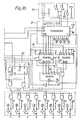
- the line driver/receiver 10 receives the serial interrogation signal from the processor 2, which may be a ⁇ 5 volt Baudot code corresponding to the strapped address, A, of one data point coupled to each of the buses 6, it couples the signal to the asynchronous transceiver 12, driven by the 1.8 MHz clock 14, where the signal is converted into a parallel, five bit, binary interrogation signal.
- the processor 2 may be a ⁇ 5 volt Baudot code corresponding to the strapped address, A, of one data point coupled to each of the buses 6, it couples the signal to the asynchronous transceiver 12, driven by the 1.8 MHz clock 14, where the signal is converted into a parallel, five bit, binary interrogation signal.
- a data ready (DR) signal is transmitted to the low speed clock enable logic circuitry 17, which enables frequency divider 18 and causes transceiver 12 to clear and load the interrogation signal into counter decoder 16, thus presetting the down count of counter/decoder 16 at a value of m.
- the enabling of the frequency divider 18 causes frequency divider 18 to disable the logic circuitry 17 during the remainder of the interrogation cycle and load and initiate its counters such that it divides down the 1.8 MHz clock signal to produce a 7.03 KHz clock signal which is then used to clock counter/decoder 16 and pulse generator 20. It is also to be noted that the enabling of frequency divider 18 causes pulse generator 20 to produce one additional pulse.
- counter decoder 16 With the transmission of the last pulse during the zero count period, counter decoder 16 continues to count down to a value of A minus 6, which establishes a 770 ⁇ sec time period. During this time, the response pulse from each of the transmitters having the strapped address, A, corresponding to the number of pulses in the pulse train is received and transmitted to the processor 2. In particular, during the last half of the minus two count period, typically 28 ⁇ ⁇ sec later, counter/decoder 16 couples a transmit load, TL signal to the TL terminal of transceiver 12 which causes the response signals from the transmitter 8 waiting on the input ports A through J of bus driver/receiver 22 to be loaded into transceiver 12.
- the response signals are loaded in transceiver 12 in parallel but during the next 490 fl sec, while counter/decoder 16 counts down to minus 6, the response signals are transmitted via the line driver/receiver 10 in a serial fashion to the processor 2 for sorting and analysis.
- the 490 fl sec period also enables each of the transmitters 8 to clear prior to receipt of the next interrogation pulse train, thus preventing any spurious response pulses from being transmitted.
- the first pulse is not recognized by the transmitters 8 as part of an interrogation signal, but rather is used to initiate and load the transmitters 8 with their strapped address; the transmitters 8 therefore respond only if they receive two times the value of their strapped address plus one pulse.
- each single point transmitter Upon receipt of the first pulse from the bus multiplexer 4, the receiver 24, which may be a Schmitt trigger, produces a noise free, square pulse which causes timer 28, which may be a retriggerable single shot, to being timing, and counter 26 to load its 4 bit strapped address, A, in complementary form, and the status input of its associated data point, which is coupled to the A o bit position of counter 26.
- timer 28 Once the Q terminal of timer 28 goes to a logic "high", counter 26 will count up on receipt of subsequent pulses. Each subsequent pulse will cause the counter 26 to advance and timer 28 to reset its time to zero.
- the Q terminal of timer 28 will thus remain "high” until approximately one pulse period beyond the end of the pulse train. Following the end of the pulse train, the binary signal on the terminal count, TC, terminal of counter 26 will correspond with the conditions established in Table II. where X implies that the status does not matter.
- timer 28 When timer 28 times out, its Q terminal goes “high” and causes the signal at the TC terminal of counter 26 to be stored in the D flip-flop 33, and the Q terminal goes “low” and triggers timer 30.
- Timer 30, which consists of two series coupled single shots, will delay approximately one half clock pulse period, nominally 70 jU sec, and then produce an output pulse of approximately one pulse period, nominally 140,usec. If the condition of the TC terminal of counter 26 is "high” (i.e., 2A+1 pulses and status of 0 or 2A+2 pulses and status of 1) terminal Q of the flip-flop 33 will be "high” and line driver 32, a logical NAND circuit, will transmit a "low” response signal, over the data bus 6 to the bus multiplexer 4. If the TC terminal is "low”, a "high” response signal (i.e., the bus remains at a logic "high”) will be transmitted.
- the Q or Q terminal of the J-K flip-flop 35 is connected to the status input and the other to the data point's input and/or a monitor station and the operation of the transmitter remains the same as during normal data transmission operations. Assuming Q is coupled to the status input, if it is desired to set flip-flop 35, a pulse train of 2A+ 1 pulses is applied. If flip-flop 35 was previously set, the status on the Q terminal will be "low", the TC terminal of counter 26 coupled to the J and K inputs will be “low” and flip-flop 35 will remain set.
- flip-flop 35 was previously cleared, the status on the Q terminal will be "high”, the TC terminal of counter 26 will be “high” and flip-flop 35 will change state to the set condition. If it is desired to clear flip-flop 35, a pulse train of 2A+2 pulses is applied and the response will be similar to that described for setting the previously set or cleared flip-flop 35. Typically, however, the previous state of flip-flop 35 is known and the appropriate pulse train is applied to force a change of state and thereby affect the status of the data point.
- the system's single point transmitters, as well as the multiplexed transmitters are fabricated from low power, complementary metal-oxide semiconductor (CMOS) parts which enables each transmitter 8 to operate without a separate power supply.
- CMOS complementary metal-oxide semiconductor
- the transmitter instead, derives its power from the interrogation pulse trains from the bus multiplexer 4 via the Vcc generator 34 which converts part of the energy in the pulse trains to a constant Vcc voltage which is coupled to the power pins of each part.
- the Vcc generator consists of a series coupled diode-capacitor combination and the Vcc voltage is the voltage that develops across the capacitor.
- the data points may in some cases be geographically concentrated. In such circumstances, a hardware saving can be achieved with the multiplexed transmitter shown in Figures. 7 and 8 and at the same time an increase in the number of addressable data points per bus multiplexer 4 input port and a reduction in interrogation time may be realised.
- the multiplexed transmitter achieves these ends by requiring fewer terminals per loop and fewer pulse trains to interrogate the data points coupled to the multiplexed transmitter.
- the multiplexed data points can be completely interrogated with eight pulse trains, whereas an equal number of single point transmitters requires fourteen pulse trains.
- a seven bit multiplexed transmitter which comprises similar CMOS parts and operates in a similar fashion to the single data point transmitter previously described.
- the multiplexed transmitter requires four addresses to accommodate seven data points, whereas the single point transmitter required one address per data point.
- the seven data points are thus grouped and represented by four bit positions, but the least significant bit position of the strapped address now corresponds to a wired "high".
- timer 38 which may be a retriggerable single-shot, is initiated and counter 36 is loaded with strapped address A in complementary form, thus permitting counter 36 to count on the successive pulses. Since the address being interrogated with the (2A+1 ) pulse train corresponds to the status input "0", the strapped address will match the count and the TC terminal will indicate a logic "high" at the end of the pulse train.
- timer 40 When timer 38 times out, approximately one pulse period after the interrogation pulse train, timer 40 is initiated and produces a logic "high” which remains approximately one-half pulse period.
- the logic "high” from counter 36 and timer 40 then cause register 44 to impress the status inputs "0" through “6" of the seven discrete data points on the inputs Do to D 5 and D, of multiplexer 46.
- three bits of the count information in counter 36 i.e., a binary 111
- corresponding to status input "0" bit position in register 44 are impressed on the select inputs A o through A 2 of multiplexer 46 and four bits indicating a match of the strapped address are impressed on decoder 42, causing decoder 42 to produce a logic "high".
- NAND gate 50 responding to the logic "high's” from timer 48 and decoder 42 produces a logic "low” which enables multiplexer 46 to select the information resident at its D, bit position which corresponds to the status input "0".
- Table III shows the effects of the pulse trains of (2A+2) through (2A+8), which are used to interrogate the remaining status bits 1 through 6, and parity bit 7. It is to be noted that register 44 is loaded only on the (2A+1 ) pulse train, since typically the processor 2 interrogates each strapped address sequentially.
- flip-flop 51 Once the information in the status input "0" bit position is selected, it is next stored in flip-flop 51. This occurs since decoder 42 produces a logic "high” on its output terminal W for each of the eight sequential pulse trains of Table III, thus as timer 48 goes “high", NAND gate 50 will cause multiplexer 46 to load flip-flop 51. If a logic "high” is present on the selected status input or parity bit position of multiplexer 46, flip-flop 51 will set for the duration of the timer 48 "high” output. The resulting "high” output on the Q terminal of set flip-flop 51 will then cause line driver 52 to produce a logic "low” which will be transmitted to multiplexer 4. In a similar manner, if flip-flop 51 is cleared, a logic "high” is transmitted.
- the status of the Q terminal of flip-flop 54 is selected by the multiplexer 46. If an even number of "1's" has been transmitted, Q will be “high” thus transmitting an additional "1 ". If an odd number of ones has been transmitted, will be "low” and "0" will be sent. It should be noted that the processor can cause failure of the parity generation by failing to perform the interrogations in the order indicated, but the processor is considered to be “smart” enough not to do this.
- the bus multiplexer 4 on receipt of the interrogated transmitter's response signals at input ports A through F, transmits the information in the manner previously described back to processor 2 via the asynchronous transceiver 12 and line driver/receiver 10.
- the processor 2 under software or firmware control, then processes the information, which activity is dependent on the configuration of the system selected from the possible permutations of transmitters on each of the open or closed loop data buses 6.
Landscapes
- Engineering & Computer Science (AREA)
- Theoretical Computer Science (AREA)
- Physics & Mathematics (AREA)
- General Engineering & Computer Science (AREA)
- General Physics & Mathematics (AREA)
- Computer Networks & Wireless Communication (AREA)
- Signal Processing (AREA)
- Small-Scale Networks (AREA)
Claims (6)
Applications Claiming Priority (2)
| Application Number | Priority Date | Filing Date | Title |
|---|---|---|---|
| US06/097,080 US4360912A (en) | 1979-11-23 | 1979-11-23 | Distributed status reporting system |
| US97080 | 1979-11-23 |
Publications (2)
| Publication Number | Publication Date |
|---|---|
| EP0029705A1 EP0029705A1 (de) | 1981-06-03 |
| EP0029705B1 true EP0029705B1 (de) | 1984-10-31 |
Family
ID=22260887
Family Applications (1)
| Application Number | Title | Priority Date | Filing Date |
|---|---|---|---|
| EP80304144A Expired EP0029705B1 (de) | 1979-11-23 | 1980-11-19 | Statusmeldesystem und Datensender zur Verwendung in einem solchen System |
Country Status (5)
| Country | Link |
|---|---|
| US (1) | US4360912A (de) |
| EP (1) | EP0029705B1 (de) |
| JP (1) | JPS5687960A (de) |
| CA (1) | CA1157544A (de) |
| DE (1) | DE3069567D1 (de) |
Families Citing this family (18)
| Publication number | Priority date | Publication date | Assignee | Title |
|---|---|---|---|---|
| JPS57208746A (en) * | 1981-06-18 | 1982-12-21 | Toyota Motor Corp | Transmission controlling system |
| US4413258A (en) * | 1981-12-14 | 1983-11-01 | Burroughs Corporation | Interconnection for local area contention networks |
| US4472712A (en) * | 1982-03-05 | 1984-09-18 | At&T Bell Laboratories | Multipoint data communication system with local arbitration |
| JPS58198993A (ja) * | 1982-05-15 | 1983-11-19 | Matsushita Electric Works Ltd | 時分割多重伝送システム |
| JPS5952992A (ja) * | 1982-09-20 | 1984-03-27 | Matsushita Electric Works Ltd | 多重伝送制御システム |
| GB2143403B (en) * | 1983-07-15 | 1986-10-29 | Standard Telephones Cables Ltd | Telecommunication exchange |
| US4652853A (en) * | 1983-08-15 | 1987-03-24 | Honda Giken Kogyo Kabushiki Kaisha | Multiple communication system for vehicular bodies |
| US4710919A (en) * | 1983-10-21 | 1987-12-01 | International Teldata Corporation | Multiplex system for automatic meter reading |
| BE898499A (nl) * | 1983-12-19 | 1984-04-16 | Rombaut Willy | Werkwijze en inrichting voor het elektronisch overbrengen van informatie. |
| JPS60231201A (ja) * | 1984-04-29 | 1985-11-16 | Toshiba Corp | センサ回路 |
| GB2189333B (en) * | 1986-03-20 | 1989-11-15 | Lucas Electrical Electronics A | Vehicle condition monitoring system |
| US5109484A (en) * | 1986-04-09 | 1992-04-28 | International Business Machines Corporation | Self configuring terminal which polls loop network and generates list of connected devices for use in selectively downloading control programs |
| DE4036639A1 (de) * | 1990-11-16 | 1992-05-21 | Esser Sicherheitstechnik | Verfahren zur ermittlung der konfiguration der melder einer gefahrenmeldeanlage und fuer die anlagenkonfigurationsbestimmung geeigneter melder |
| JP2873515B2 (ja) * | 1991-03-29 | 1999-03-24 | マツダ株式会社 | 多重伝送方法 |
| US5983371A (en) * | 1997-07-11 | 1999-11-09 | Marathon Technologies Corporation | Active failure detection |
| US6775726B2 (en) * | 2001-08-28 | 2004-08-10 | Sunrise Telecom Incorporated | Serial unit identification |
| US7443890B2 (en) * | 2002-08-12 | 2008-10-28 | Broadcom Corporation | Multi-stage multiplexing chip set having switchable forward/reverse clock relationship |
| US9306625B2 (en) | 2013-07-09 | 2016-04-05 | The Boeing Company | Systems and methods for broadband over power line multiple interface devices and systems |
Family Cites Families (13)
| Publication number | Priority date | Publication date | Assignee | Title |
|---|---|---|---|---|
| US3597549A (en) * | 1969-07-17 | 1971-08-03 | Bell Telephone Labor Inc | High speed data communication system |
| US3828313A (en) * | 1971-09-22 | 1974-08-06 | American Multiplex Syst Inc | Method and apparatus for data transmission |
| US3883693A (en) * | 1972-07-11 | 1975-05-13 | Applied Information Ind | Digital communication system |
| JPS4839895A (de) * | 1972-09-22 | 1973-06-12 | ||
| US3889064A (en) * | 1974-03-27 | 1975-06-10 | Nasa | Asynchronous, multiplexing, single line transmission and recovery data system |
| GB1478363A (en) * | 1974-07-30 | 1977-06-29 | Mullard Ltd | Data transmission systems |
| JPS51130108A (en) * | 1975-05-06 | 1976-11-12 | Tokyo Electric Power Co Inc:The | Data collection system |
| CH610167A5 (en) * | 1976-02-26 | 1979-03-30 | Vogelsang Remo | Data transmission system with stations connected to a common transmission line |
| US4093946A (en) * | 1976-03-01 | 1978-06-06 | The Laitram Corporation | Two-wire, multiple-transducer communications system |
| US4053714A (en) * | 1976-04-06 | 1977-10-11 | Canadian Pgl Electronics Inc. | Electrical data collecting device |
| GB1589748A (en) * | 1976-09-10 | 1981-05-20 | Matsushita Electric Works Ltd | Time division multiplex transmission system |
| US4089051A (en) * | 1977-01-24 | 1978-05-09 | Bell Telephone Laboratories, Incorporated | Alternative direct and indirect addressing |
| JPS55105491A (en) * | 1979-02-07 | 1980-08-13 | Nec Corp | Data exchange system |
-
1979
- 1979-11-23 US US06/097,080 patent/US4360912A/en not_active Expired - Lifetime
-
1980
- 1980-10-06 CA CA000361621A patent/CA1157544A/en not_active Expired
- 1980-11-19 DE DE8080304144T patent/DE3069567D1/de not_active Expired
- 1980-11-19 EP EP80304144A patent/EP0029705B1/de not_active Expired
- 1980-11-25 JP JP16578080A patent/JPS5687960A/ja active Pending
Also Published As
| Publication number | Publication date |
|---|---|
| CA1157544A (en) | 1983-11-22 |
| JPS5687960A (en) | 1981-07-17 |
| DE3069567D1 (en) | 1984-12-06 |
| US4360912A (en) | 1982-11-23 |
| EP0029705A1 (de) | 1981-06-03 |
Similar Documents
| Publication | Publication Date | Title |
|---|---|---|
| EP0029705B1 (de) | Statusmeldesystem und Datensender zur Verwendung in einem solchen System | |
| CA1178686A (en) | Line protocol for communication system | |
| US3771135A (en) | Remote terminal system | |
| US4133504A (en) | System for protected data transmission to track-bound vehicles | |
| US4149144A (en) | Polling and data communication system having a pulse position to binary address conversion circuit | |
| US3541513A (en) | Communications control apparatus for sequencing digital data and analog data from remote stations to a central data processor | |
| US3668645A (en) | Programable asynchronous data buffer having means to transmit error protected channel control signals | |
| US4298860A (en) | Monitor and control apparatus | |
| US3564145A (en) | Serial loop data transmission system fault locator | |
| US5132987A (en) | Bidirectional communication line buffer apparatus | |
| US4386426A (en) | Data transmission system | |
| US3593293A (en) | Remote control and data logging system | |
| US4181909A (en) | Method and appratus for initializing remote data communication equipment | |
| GB1582612A (en) | Data transmission system | |
| US3335404A (en) | Continuous monitor and binary chain code transmitter and receiver system | |
| EP0145319A2 (de) | Eingabe/Ausgabe-Multiplexer-Demultiplexer für Übertragungskanal | |
| US3719930A (en) | One-bit data transmission system | |
| US3516089A (en) | Shift register controlled scanning function monitor | |
| US4229819A (en) | Data transmission system | |
| US3245066A (en) | Signalling system | |
| US3427590A (en) | Priority and regular message pickup from multistation line data station transmitters | |
| SU1727112A1 (ru) | Распределенна система дл программного управлени с мажоритированием | |
| US3428949A (en) | Distributor system for monitoring position and status of a number of points | |
| SU1732366A1 (ru) | Устройство дл телеконтрол | |
| SU1647876A1 (ru) | Селектор импульсов по длительности |
Legal Events
| Date | Code | Title | Description |
|---|---|---|---|
| PUAI | Public reference made under article 153(3) epc to a published international application that has entered the european phase |
Free format text: ORIGINAL CODE: 0009012 |
|
| AK | Designated contracting states |
Designated state(s): DE FR GB IT |
|
| 17P | Request for examination filed |
Effective date: 19810904 |
|
| ITF | It: translation for a ep patent filed | ||
| GRAA | (expected) grant |
Free format text: ORIGINAL CODE: 0009210 |
|
| AK | Designated contracting states |
Designated state(s): DE FR GB IT |
|
| REF | Corresponds to: |
Ref document number: 3069567 Country of ref document: DE Date of ref document: 19841206 |
|
| ET | Fr: translation filed | ||
| PLBE | No opposition filed within time limit |
Free format text: ORIGINAL CODE: 0009261 |
|
| STAA | Information on the status of an ep patent application or granted ep patent |
Free format text: STATUS: NO OPPOSITION FILED WITHIN TIME LIMIT |
|
| 26N | No opposition filed | ||
| ITTA | It: last paid annual fee | ||
| PGFP | Annual fee paid to national office [announced via postgrant information from national office to epo] |
Ref country code: FR Payment date: 19931110 Year of fee payment: 14 |
|
| PGFP | Annual fee paid to national office [announced via postgrant information from national office to epo] |
Ref country code: GB Payment date: 19941017 Year of fee payment: 15 |
|
| PGFP | Annual fee paid to national office [announced via postgrant information from national office to epo] |
Ref country code: DE Payment date: 19941130 Year of fee payment: 15 |
|
| PG25 | Lapsed in a contracting state [announced via postgrant information from national office to epo] |
Ref country code: FR Effective date: 19950731 |
|
| REG | Reference to a national code |
Ref country code: FR Ref legal event code: ST |
|
| PG25 | Lapsed in a contracting state [announced via postgrant information from national office to epo] |
Ref country code: GB Effective date: 19951119 |
|
| GBPC | Gb: european patent ceased through non-payment of renewal fee |
Effective date: 19951119 |
|
| PG25 | Lapsed in a contracting state [announced via postgrant information from national office to epo] |
Ref country code: DE Effective date: 19960801 |