EP0034943A2 - Process for the preparation of copper quinolinate - Google Patents
Process for the preparation of copper quinolinate Download PDFInfo
- Publication number
- EP0034943A2 EP0034943A2 EP81300755A EP81300755A EP0034943A2 EP 0034943 A2 EP0034943 A2 EP 0034943A2 EP 81300755 A EP81300755 A EP 81300755A EP 81300755 A EP81300755 A EP 81300755A EP 0034943 A2 EP0034943 A2 EP 0034943A2
- Authority
- EP
- European Patent Office
- Prior art keywords
- reaction
- copper
- quinolinate
- copper quinolinate
- parts
- Prior art date
- Legal status (The legal status is an assumption and is not a legal conclusion. Google has not performed a legal analysis and makes no representation as to the accuracy of the status listed.)
- Granted
Links
Images

Classifications
-
- C—CHEMISTRY; METALLURGY
- C07—ORGANIC CHEMISTRY
- C07D—HETEROCYCLIC COMPOUNDS
- C07D213/00—Heterocyclic compounds containing six-membered rings, not condensed with other rings, with one nitrogen atom as the only ring hetero atom and three or more double bonds between ring members or between ring members and non-ring members
- C07D213/02—Heterocyclic compounds containing six-membered rings, not condensed with other rings, with one nitrogen atom as the only ring hetero atom and three or more double bonds between ring members or between ring members and non-ring members having three double bonds between ring members or between ring members and non-ring members
- C07D213/04—Heterocyclic compounds containing six-membered rings, not condensed with other rings, with one nitrogen atom as the only ring hetero atom and three or more double bonds between ring members or between ring members and non-ring members having three double bonds between ring members or between ring members and non-ring members having no bond between the ring nitrogen atom and a non-ring member or having only hydrogen or carbon atoms directly attached to the ring nitrogen atom
- C07D213/60—Heterocyclic compounds containing six-membered rings, not condensed with other rings, with one nitrogen atom as the only ring hetero atom and three or more double bonds between ring members or between ring members and non-ring members having three double bonds between ring members or between ring members and non-ring members having no bond between the ring nitrogen atom and a non-ring member or having only hydrogen or carbon atoms directly attached to the ring nitrogen atom with hetero atoms or with carbon atoms having three bonds to hetero atoms with at the most one bond to halogen, e.g. ester or nitrile radicals, directly attached to ring carbon atoms
- C07D213/78—Carbon atoms having three bonds to hetero atoms, with at the most one bond to halogen, e.g. ester or nitrile radicals
- C07D213/79—Acids; Esters
- C07D213/803—Processes of preparation
-
- C—CHEMISTRY; METALLURGY
- C07—ORGANIC CHEMISTRY
- C07D—HETEROCYCLIC COMPOUNDS
- C07D213/00—Heterocyclic compounds containing six-membered rings, not condensed with other rings, with one nitrogen atom as the only ring hetero atom and three or more double bonds between ring members or between ring members and non-ring members
- C07D213/02—Heterocyclic compounds containing six-membered rings, not condensed with other rings, with one nitrogen atom as the only ring hetero atom and three or more double bonds between ring members or between ring members and non-ring members having three double bonds between ring members or between ring members and non-ring members
- C07D213/04—Heterocyclic compounds containing six-membered rings, not condensed with other rings, with one nitrogen atom as the only ring hetero atom and three or more double bonds between ring members or between ring members and non-ring members having three double bonds between ring members or between ring members and non-ring members having no bond between the ring nitrogen atom and a non-ring member or having only hydrogen or carbon atoms directly attached to the ring nitrogen atom
- C07D213/60—Heterocyclic compounds containing six-membered rings, not condensed with other rings, with one nitrogen atom as the only ring hetero atom and three or more double bonds between ring members or between ring members and non-ring members having three double bonds between ring members or between ring members and non-ring members having no bond between the ring nitrogen atom and a non-ring member or having only hydrogen or carbon atoms directly attached to the ring nitrogen atom with hetero atoms or with carbon atoms having three bonds to hetero atoms with at the most one bond to halogen, e.g. ester or nitrile radicals, directly attached to ring carbon atoms
- C07D213/78—Carbon atoms having three bonds to hetero atoms, with at the most one bond to halogen, e.g. ester or nitrile radicals
- C07D213/79—Acids; Esters
- C07D213/80—Acids; Esters in position 3
Definitions
- This invention relates to a process for the preparation of copper quinolinate.
- Quinolinic acid is assuming increasing importance in the pressure-sensitive record material art where it is needed as a starting material for the synthesis of some medicines and chromogenic materials, such as the chromogenic pyridinone materials disclosed in British patent 1 367 569. It is readily prepared from copper quinolinate by reaction with hydrogen sulphide or sodium hydroxide but the preparation of copper quinolinate itself leaves considerable scope for improvement.
- Copper quinolinate has hitherto been obtained by the process described by Stix and Bulgatsch in Chem. Ber., 1932, 65, 11, hereinafter referred to as the Stix process, and comprises the oxidation of quinoline with hydrogen peroxide in sulphuric acid in the presence of copper sulphate.
- Stix process comprises the oxidation of quinoline with hydrogen peroxide in sulphuric acid in the presence of copper sulphate.
- the oxidation reaction is violently exothermic and difficult to control even with constant cooling of the reaction vessel.
- the temperature distribution within the vessel becomes increasingly uneven requiring large and cumbersome cooling apparatus.
- the present invention therefore provides a process for the preparation of copper quinolinate by oxidising quinoline with hydrogen peroxide in sulphuric acid in the presence of copper sulphate and isolating copper quinolinate from the reaction media, characterised in that the oxidation reaction is carried out under a pressure of less than 400 mm Hg.
- a minimum pressure is not critical to the performance of the invention; all that is required is that the pressure be less than that specified above.
- the temperature at which the oxidation reaction is carried out is preferably from 55 to 75 0 C and, because of the control over the reaction which can now be achieved by the present invention, it is optimally carried out from 70 to 75°C,
- a particular advantage of the present invention is that the resulting reaction media left after isolation of copper quinolinate can be used in a subsequent process run, and, in fact can be so used at least twenty times without any significant variation in yield.
- the reaction media is concentrated during the course of the reaction as a consequence of it being carried out under a pressure of less than 400 mm Hg.
- the present invention therefore affords a more efficient route to the large scale production of copper quinolinate.
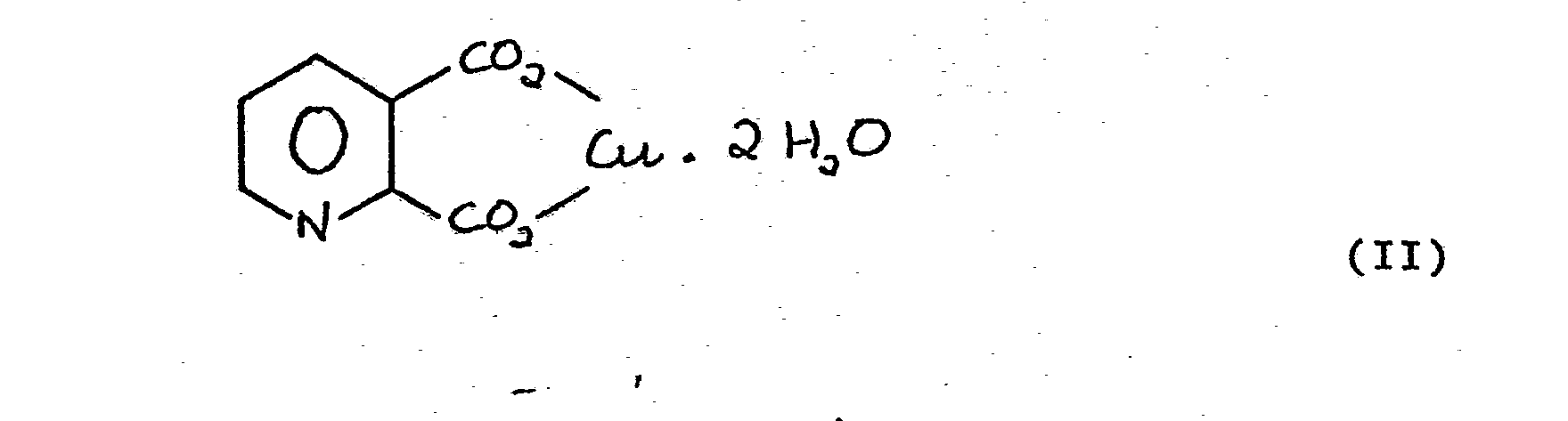
- Copper quinolinate can exist in two forms - 2:1 copper quinolinate (formula (I)) in which two molecules of quinolinic acid are combined with one atom of copper, and 1:1 copper quinolinate (formula (II))in which one molecule of quinolinic acid is combined with one atom of copper. Both of these forms can be prepared by the present process depending on the molar ratio of copper sulphate to quinoline. If the ratio is less than or equal to 0.5, the 2:1 copper quinolinate (I) is formed, whereas, if the ratio is greater than 0.5, then the 1:1 copper quinolinate (II) is formed. However, the 2:1 copper salt (I) is preferred since less copper is employed.
- the resulting reaction media left after filtration of the copper quinolinate was dark brown, and its re-use as the reaction media was most undesirable as the purity and the yield of the resulting product would seriously suffer and an uncontrollable reaction would tend to occur.
- the 2 : 1 copper quinolinate obtained in Examples 1 and 2 (reactions lst - 10th) is superior to that obtained in Examples 4 and 5 (reactions lst - 10th) in quality and yield.
- the 2 : 1 copper quinolinate obtained in Examples 1 and 2(reactions llth - 20th) is of somewhat inferior quality, but because of high yield its overall yield is higher than that obtained in Examples 4 and 5 (reactions 1st - 10th).
Landscapes
- Chemical & Material Sciences (AREA)
- Organic Chemistry (AREA)
- Catalysts (AREA)
- Pyridine Compounds (AREA)
- Organic Low-Molecular-Weight Compounds And Preparation Thereof (AREA)
Abstract
Description
- This invention relates to a process for the preparation of copper quinolinate.
- Quinolinic acid is assuming increasing importance in the pressure-sensitive record material art where it is needed as a starting material for the synthesis of some medicines and chromogenic materials, such as the chromogenic pyridinone materials disclosed in British patent 1 367 569. It is readily prepared from copper quinolinate by reaction with hydrogen sulphide or sodium hydroxide but the preparation of copper quinolinate itself leaves considerable scope for improvement.
- Copper quinolinate has hitherto been obtained by the process described by Stix and Bulgatsch in Chem. Ber., 1932, 65, 11, hereinafter referred to as the Stix process, and comprises the oxidation of quinoline with hydrogen peroxide in sulphuric acid in the presence of copper sulphate. However, at elevated temperatures the oxidation reaction is violently exothermic and difficult to control even with constant cooling of the reaction vessel. Moreover, as the reaction is scaled up, the temperature distribution within the vessel becomes increasingly uneven requiring large and cumbersome cooling apparatus.
- Better control of the reaction can of course be achieved by carrying it out at lower temperatures but then the rate of reaction becomes slow resulting in an increased reaction time and in a greater risk of the occurrence of side reactions, such as the decomposition of hydrogen peroxide. Such side reactions will lead in turn to a drop in the yield of copper quinolinate and also to a reduction in its purity. A slow rate of reaction therefore is economically undesirable.
- Further disadvantages of the Stix process include the fact that it does not give reproducible yields - on repetition a yield of only 44.7%was obtained - and that the resulting reaction media left after isolation of copper quinolinate is not suitable for re-use in a subsequent run of the process, leading to problems with recovery or waste disposal of the materials present, in particular sulphuric acid and a large amount of copper ions. The Stix process is not therefore suitable for the preparation of copper quinolinate cheaply on an industrial scale.
- A considerable improvement in the Stix process was achieved by the process described and claimed in European patent application 80 302782.0 (Publication No. 0024197). The use of the particular reaction conditions in the improved process afforded a much greater control of the reaction and a much higher yield and purity of copper quinolinate. In addition, the resulting reaction media left after isolation of copper quinolinate can be repeatedly used in subsequent process runs. As increased yields are obtained on repetition and as any unutilized material present in the media is-recycled, the process can thus be carried out even more cheaply. And also the repeated use of the media considerably minimises the problems normally associated with waste disposal of sulphuric acid and copper ions.
- It has now been found that an even further improvement in the Stix process can be obtained if it is carried out under a pressure of less than 400 mm Hg. In particular a much greater control of the reaction can be achieved especially at elevated temperatures. But also there are improvements in the yield and purity of copper quinolinate and in the number of repeated uses of the reaction media. These improvements moreover become more significant on scaling up the reaction to an industrial level.
- The present invention therefore provides a process for the preparation of copper quinolinate by oxidising quinoline with hydrogen peroxide in sulphuric acid in the presence of copper sulphate and isolating copper quinolinate from the reaction media, characterised in that the oxidation reaction is carried out under a pressure of less than 400 mm Hg.
- A minimum pressure is not critical to the performance of the invention; all that is required is that the pressure be less than that specified above.
- The temperature at which the oxidation reaction is carried out is preferably from 55 to 750C and, because of the control over the reaction which can now be achieved by the present invention, it is optimally carried out from 70 to 75°C,
- No criticality is attached to the relative amounts and concentrations of the various reactants but it is much preferred to use those amounts and concentrations which are set forth in European application 80 302732.0; the contents of which are expressly incorporated herein by reference.
- A particular advantage of the present invention is that the resulting reaction media left after isolation of copper quinolinate can be used in a subsequent process run, and, in fact can be so used at least twenty times without any significant variation in yield. Conveniently, the reaction media is concentrated during the course of the reaction as a consequence of it being carried out under a pressure of less than 400 mm Hg. Unlike the process of the European application 80 302782.0, there is therefore no need for an additional step of concentrating the reaction media prior to its re-use in a subsequent process run. The present invention therefore affords a more efficient route to the large scale production of copper quinolinate.
- Copper quinolinate can exist in two forms - 2:1 copper quinolinate (formula (I)) in which two molecules of quinolinic acid are combined with one atom of copper, and 1:1 copper quinolinate (formula (II))in which one molecule of quinolinic acid is combined with one atom of copper.

- The present invention will now be described in more detail with reference to a number of examples, in which all parts are by weight.
- 260 Parts of water, 60 parts of concentrated sulphuric acid, 8.0 parts of copper oxide, 25.8 parts of quinoline, and 122.4 parts of 60% hydrogen peroxide were heated to 70°C. Then, under a pressure of 150 - 400 mm Hg, the reaction was carried out at 70 - 75°C for 4 hours. After cooling, the precipitated 2 : 1 copper quinolinate was filtered, washed with 100 parts of water, and dried to give 27.3 parts of copper quinolinate (yield, 66.0%). During the course of the reaction, the reaction media had been concentrated to about 250 parts.
- To the filtrate and washings from example 1 were added 5.6 parts of copper oxide (equivalent to the 2 : 1 copper quinolinate obtained according to example 1), 25.8 parts of quinoline, and 122.4 parts of 60% hydrogen peroxide, and the temperature was increased to 70°C. Then, under a pressure of 150 - 400 mm Hg, the reaction was carried out at 70 - 75°C for 4 hours. After cooling, the precipitated 2 : 1 copper quinolinate was filtered, washed with 100 parts of water, and dried to give 30.9 parts of copper quinolinate (yield, 74.7 %). During the course of the reaction, the reaction media-had been concentrated to about 250 parts.
- The reaction was then repeated a further 18 times except with a slight variation each time in the amount of copper oxide. The results are given in Table 1..

- It was noticeable that each time the reaction was carried out, its control was very easy. Also, from the foregoing results, it can be seen that substantially high yields of copper quinolinate were constantly obtained.
- 24g of quinoline, 2100ml of 3% hydrogen peroxide, and 46g of 25% sulphuric acid were heated to 60°C and 64g of crystalline copper sulphate dissolved in 160ml of water were added thereto. As the temperature began to rise after a few minutes, the system was strongly cooled with-ice water so as to maintain the temperature below 70°C. However the control of the temperature was extremely difficult, and after the violent exothermic reaction subsided, the reaction was continued for 8 hours at 65 - 70°C. Then 200ml of 3% hydrogen peroxide were added and the reaction was continued for a further 3 hours at 65 - 70°C. After cooling, the precipitated copper quinolinate was filtered, washed with water, and dried, giving 22g of product in a yield of 44.7% The copper quinolinate obtained was greenish black and.low in purity.
- Also, the resulting reaction media left after filtration of the copper quinolinate was dark brown, and its re-use as the reaction media was most undesirable as the purity and the yield of the resulting product would seriously suffer and an uncontrollable reaction would tend to occur.
- 180 Parts of water, 60 parts of concentrated sulphuric acid, 8.0 parts of copper oxide, 25.8 parts of quinoline, and 122.4 parts of 60% hydrogen peroxide were heated to 60°C. Then the reaction was carried out at 60 - 70°C for 5 hours. After cooling, the precipitated 2 : 1 copper quinolinate was filtered, washed with 100 parts of water, and dried to give 27.0 parts of the product (yield, 65.3%).
- After the filtrate and the washings from example 4 had been concentrated to about 230 parts, 5.2 parts of copper oxide, 25.8 parts of quinoline, and 122.4 parts of 60% hydrogen peroxide were added. Then, the reaction was carried out at 60 - 70°C. for 5 hours. After cooling, the precipitated 2 : 1 copper quinolinate was filtered, washed with 100 parts of water, and dried to give 30.0 parts of the product (yield, 72.6%).
- The reaction was then repeated a further 10 times except with a slight variation each time in the amount of copper oxide - the results are given in Table 2.

- The reactions of examples 4 and 5 required in excess of twice the amount of external cooling water than in the reactions of examples 1 and 2 in spite of the fact that the reaction temperature in the former examples was lower. Moreover control over the reaction was difficult at times in examples 4 and 5 whereas no such difficulty occurred in examples 1 and 2. Further, the yield dropped after the eleventh re-use of the reaction media. As it was expected that a further re-use of the reaction media would result in an additional drop in yield, no further reaction was carried out after the 12th reaction.
- 20.7 parts each of copper quinolinate samples obtained 'according to Examples 1 and 2 and Examples 4 and 5 were dispersed in 500 parts of water with stirring. Hydrogen sulphide was passed into the dispersion at 60°C until the blue-coloured copper quinolinate entirely disappeared and a black precipitate of copper sulphide had fully formed. Then, after the copper sulphide had been filtered off, the filtrate was concentrated to give pale yellow quinolinic acid.
- The results are shown in Table 3.

- The 2 : 1 copper quinolinate obtained in Examples 1 and 2 (reactions lst - 10th) is superior to that obtained in Examples 4 and 5 (reactions lst - 10th) in quality and yield. The 2 : 1 copper quinolinate obtained in Examples 1 and 2(reactions llth - 20th) is of somewhat inferior quality, but because of high yield its overall yield is higher than that obtained in Examples 4 and 5 (reactions 1st - 10th).
Claims (4)
Applications Claiming Priority (2)
| Application Number | Priority Date | Filing Date | Title |
|---|---|---|---|
| JP21623/80 | 1980-02-25 | ||
| JP2162380A JPS56118067A (en) | 1980-02-25 | 1980-02-25 | Preparation of copper quinolinate |
Publications (3)
| Publication Number | Publication Date |
|---|---|
| EP0034943A2 true EP0034943A2 (en) | 1981-09-02 |
| EP0034943A3 EP0034943A3 (en) | 1981-09-23 |
| EP0034943B1 EP0034943B1 (en) | 1983-07-13 |
Family
ID=12060182
Family Applications (1)
| Application Number | Title | Priority Date | Filing Date |
|---|---|---|---|
| EP81300755A Expired EP0034943B1 (en) | 1980-02-25 | 1981-02-24 | Process for the preparation of copper quinolinate |
Country Status (4)
| Country | Link |
|---|---|
| US (1) | US4420616A (en) |
| EP (1) | EP0034943B1 (en) |
| JP (1) | JPS56118067A (en) |
| DE (1) | DE3160584D1 (en) |
Cited By (4)
| Publication number | Priority date | Publication date | Assignee | Title |
|---|---|---|---|---|
| EP0135328A1 (en) * | 1983-08-08 | 1985-03-27 | Appleton Papers Inc. | A process for the manufacture of quinolinic acid |
| EP0149857A1 (en) * | 1983-12-14 | 1985-07-31 | Rütgerswerke Aktiengesellschaft | Process for the preparation of quinolinic acid from quinoline |
| US4754039A (en) * | 1986-01-30 | 1988-06-28 | Ruetgers-Nease Chemical Co., Inc. | Process for the preparation of pyridine-2,3-dicarboxylic acid |
| EP0259687A3 (en) * | 1986-09-12 | 1989-05-31 | American Cyanamid Company | Method for the preparation of pyridine-2,3-dicarboxylic acids |
Families Citing this family (2)
| Publication number | Priority date | Publication date | Assignee | Title |
|---|---|---|---|---|
| CA3102925A1 (en) | 2020-12-18 | 2022-06-18 | Sixring Inc. | Novel approach to biomass delignification |
| CA3110357A1 (en) * | 2021-02-25 | 2022-08-25 | Sixring Inc. | Modified sulfuric acid and uses thereof |
Family Cites Families (2)
| Publication number | Priority date | Publication date | Assignee | Title |
|---|---|---|---|---|
| US2371691A (en) * | 1941-07-09 | 1945-03-20 | Du Pont | Preparation of quinolinic acid |
| JPS6054305B2 (en) * | 1979-08-14 | 1985-11-29 | 山本化学合成株式会社 | Production method of copper quinolinate |
-
1980
- 1980-02-25 JP JP2162380A patent/JPS56118067A/en active Granted
-
1981
- 1981-02-20 US US06/236,945 patent/US4420616A/en not_active Expired - Fee Related
- 1981-02-24 EP EP81300755A patent/EP0034943B1/en not_active Expired
- 1981-02-24 DE DE8181300755T patent/DE3160584D1/en not_active Expired
Cited By (5)
| Publication number | Priority date | Publication date | Assignee | Title |
|---|---|---|---|---|
| EP0135328A1 (en) * | 1983-08-08 | 1985-03-27 | Appleton Papers Inc. | A process for the manufacture of quinolinic acid |
| US4736036A (en) * | 1983-08-08 | 1988-04-05 | Appleton Papers Inc. | Process for the preparation of quinolinic acid |
| EP0149857A1 (en) * | 1983-12-14 | 1985-07-31 | Rütgerswerke Aktiengesellschaft | Process for the preparation of quinolinic acid from quinoline |
| US4754039A (en) * | 1986-01-30 | 1988-06-28 | Ruetgers-Nease Chemical Co., Inc. | Process for the preparation of pyridine-2,3-dicarboxylic acid |
| EP0259687A3 (en) * | 1986-09-12 | 1989-05-31 | American Cyanamid Company | Method for the preparation of pyridine-2,3-dicarboxylic acids |
Also Published As
| Publication number | Publication date |
|---|---|
| EP0034943B1 (en) | 1983-07-13 |
| JPS6347708B2 (en) | 1988-09-26 |
| JPS56118067A (en) | 1981-09-16 |
| DE3160584D1 (en) | 1983-08-18 |
| US4420616A (en) | 1983-12-13 |
| EP0034943A3 (en) | 1981-09-23 |
Similar Documents
| Publication | Publication Date | Title |
|---|---|---|
| EP0034943B1 (en) | Process for the preparation of copper quinolinate | |
| EP0024197B1 (en) | Process for the preparation of copper quinolinate | |
| EP0247513A1 (en) | Process for producing 2-methyl-1,4-naphthoquinone | |
| EP0126893B1 (en) | A method for oxidizing alkyl groups to carboxylic acids under basic conditions | |
| US4537971A (en) | Process for preparing quinolinic acid | |
| CN114315623B (en) | Method for synthesizing xanthoxylin WGX-50 and its derivative in one pot | |
| EP0092117B1 (en) | Process for producing chloronicotinic acid compounds | |
| CA1254898A (en) | Process for the preparation of quinolinic acid | |
| US4130633A (en) | Removal of selenium from urethane solutions | |
| JPS60156673A (en) | Manufacture of quinolic acid from quinoline | |
| US4310671A (en) | Process for producing 2,6-dichloro-3-nitropyridine | |
| US4337355A (en) | Process for preparing 4-hydroxyphenylacetic acid | |
| US6395903B1 (en) | Process for the preparation of 2,3-pyridinedicarboxylic acids | |
| US3790585A (en) | Manufacture of bipyridylium salts | |
| EP0230895B1 (en) | Process for producing hydroxylamine-0-sulfonic acid | |
| HU203535B (en) | Process for producing pyridine-2,3-dicarboxylic acids | |
| EP0124657A1 (en) | Method for the preparation of 3,5,6-trichloro-1H-pyridin-2-one | |
| US2738352A (en) | Purification of pyridine compounds | |
| KR100830557B1 (en) | Process for preparing pyrithione salt | |
| US2225357A (en) | Nitrosation of phenols | |
| US2999094A (en) | Quinoline sulfonation process | |
| JP2872444B2 (en) | Method for purifying bis (4-aminophenyl) sulfone compound containing copper compound | |
| EP0197633A1 (en) | Method for the production of m-aminophenol | |
| JPS62181268A (en) | Production of pyrazine-n-oxide compound | |
| JPH02250841A (en) | Production of 4,4'-dihydroxybiphenyl |
Legal Events
| Date | Code | Title | Description |
|---|---|---|---|
| PUAI | Public reference made under article 153(3) epc to a published international application that has entered the european phase |
Free format text: ORIGINAL CODE: 0009012 |
|
| PUAL | Search report despatched |
Free format text: ORIGINAL CODE: 0009013 |
|
| 17P | Request for examination filed |
Effective date: 19810302 |
|
| AK | Designated contracting states |
Designated state(s): BE CH DE FR GB IT |
|
| AK | Designated contracting states |
Designated state(s): BE CH DE FR GB IT |
|
| ITF | It: translation for a ep patent filed | ||
| GRAA | (expected) grant |
Free format text: ORIGINAL CODE: 0009210 |
|
| AK | Designated contracting states |
Designated state(s): BE CH DE FR GB IT LI |
|
| REF | Corresponds to: |
Ref document number: 3160584 Country of ref document: DE Date of ref document: 19830818 |
|
| ET | Fr: translation filed | ||
| PLBE | No opposition filed within time limit |
Free format text: ORIGINAL CODE: 0009261 |
|
| STAA | Information on the status of an ep patent application or granted ep patent |
Free format text: STATUS: NO OPPOSITION FILED WITHIN TIME LIMIT |
|
| 26N | No opposition filed | ||
| PGFP | Annual fee paid to national office [announced via postgrant information from national office to epo] |
Ref country code: CH Payment date: 19890123 Year of fee payment: 9 |
|
| PGFP | Annual fee paid to national office [announced via postgrant information from national office to epo] |
Ref country code: GB Payment date: 19890131 Year of fee payment: 9 |
|
| PGFP | Annual fee paid to national office [announced via postgrant information from national office to epo] |
Ref country code: DE Payment date: 19890206 Year of fee payment: 9 |
|
| ITTA | It: last paid annual fee | ||
| PGFP | Annual fee paid to national office [announced via postgrant information from national office to epo] |
Ref country code: BE Payment date: 19890228 Year of fee payment: 9 Ref country code: FR Payment date: 19890228 Year of fee payment: 9 |
|
| PG25 | Lapsed in a contracting state [announced via postgrant information from national office to epo] |
Ref country code: GB Effective date: 19900224 |
|
| PG25 | Lapsed in a contracting state [announced via postgrant information from national office to epo] |
Ref country code: BE Effective date: 19900228 Ref country code: LI Effective date: 19900228 Ref country code: CH Effective date: 19900228 |
|
| BERE | Be: lapsed |
Owner name: YAMAMOTO KAGAKU GOSEI CO. LTD Effective date: 19900228 |
|
| GBPC | Gb: european patent ceased through non-payment of renewal fee | ||
| PG25 | Lapsed in a contracting state [announced via postgrant information from national office to epo] |
Ref country code: FR Effective date: 19901031 |
|
| REG | Reference to a national code |
Ref country code: CH Ref legal event code: PL |
|
| PG25 | Lapsed in a contracting state [announced via postgrant information from national office to epo] |
Ref country code: DE Effective date: 19901101 |
|
| REG | Reference to a national code |
Ref country code: FR Ref legal event code: ST |