EP0035272A1 - Coating composition and process for preparing synthetic resin shaped articles by using same - Google Patents
Coating composition and process for preparing synthetic resin shaped articles by using same Download PDFInfo
- Publication number
- EP0035272A1 EP0035272A1 EP81101516A EP81101516A EP0035272A1 EP 0035272 A1 EP0035272 A1 EP 0035272A1 EP 81101516 A EP81101516 A EP 81101516A EP 81101516 A EP81101516 A EP 81101516A EP 0035272 A1 EP0035272 A1 EP 0035272A1
- Authority
- EP
- European Patent Office
- Prior art keywords
- weight
- parts
- synthetic resin
- coating composition
- monomer
- Prior art date
- Legal status (The legal status is an assumption and is not a legal conclusion. Google has not performed a legal analysis and makes no representation as to the accuracy of the status listed.)
- Granted
Links
- 239000008199 coating composition Substances 0.000 title claims abstract description 52
- 229920003002 synthetic resin Polymers 0.000 title claims abstract description 46
- 239000000057 synthetic resin Substances 0.000 title claims abstract description 46
- 238000004519 manufacturing process Methods 0.000 title description 2
- 239000000178 monomer Substances 0.000 claims abstract description 136
- -1 methacryloyloxy Chemical group 0.000 claims abstract description 77
- 238000000576 coating method Methods 0.000 claims abstract description 75
- 239000011248 coating agent Substances 0.000 claims abstract description 74
- 239000000203 mixture Substances 0.000 claims abstract description 66
- 238000005299 abrasion Methods 0.000 claims abstract description 42
- 239000006097 ultraviolet radiation absorber Substances 0.000 claims abstract description 36
- 229920000642 polymer Polymers 0.000 claims abstract description 17
- 125000005250 alkyl acrylate group Chemical group 0.000 claims abstract description 11
- 238000002360 preparation method Methods 0.000 claims abstract description 11
- 239000003504 photosensitizing agent Substances 0.000 claims abstract description 9
- 239000000463 material Substances 0.000 claims abstract description 7
- 230000001588 bifunctional effect Effects 0.000 claims description 23
- 229920000058 polyacrylate Polymers 0.000 claims description 22
- 238000000034 method Methods 0.000 claims description 19
- TXBCBTDQIULDIA-UHFFFAOYSA-N 2-[[3-hydroxy-2,2-bis(hydroxymethyl)propoxy]methyl]-2-(hydroxymethyl)propane-1,3-diol Chemical compound OCC(CO)(CO)COCC(CO)(CO)CO TXBCBTDQIULDIA-UHFFFAOYSA-N 0.000 claims description 14
- 239000004094 surface-active agent Substances 0.000 claims description 13
- 125000004432 carbon atom Chemical group C* 0.000 claims description 12
- QUAMTGJKVDWJEQ-UHFFFAOYSA-N octabenzone Chemical compound OC1=CC(OCCCCCCCC)=CC=C1C(=O)C1=CC=CC=C1 QUAMTGJKVDWJEQ-UHFFFAOYSA-N 0.000 claims description 10
- 229920001296 polysiloxane Polymers 0.000 claims description 10
- 230000008569 process Effects 0.000 claims description 10
- 125000002887 hydroxy group Chemical group [H]O* 0.000 claims description 9
- 150000001875 compounds Chemical class 0.000 claims description 8
- ZQBAKBUEJOMQEX-UHFFFAOYSA-N phenyl salicylate Chemical compound OC1=CC=CC=C1C(=O)OC1=CC=CC=C1 ZQBAKBUEJOMQEX-UHFFFAOYSA-N 0.000 claims description 8
- RWCCWEUUXYIKHB-UHFFFAOYSA-N benzophenone Chemical compound C=1C=CC=CC=1C(=O)C1=CC=CC=C1 RWCCWEUUXYIKHB-UHFFFAOYSA-N 0.000 claims description 7
- 239000012965 benzophenone Substances 0.000 claims description 7
- 238000009835 boiling Methods 0.000 claims description 7
- 229920001577 copolymer Polymers 0.000 claims description 7
- ZXDDPOHVAMWLBH-UHFFFAOYSA-N 2,4-Dihydroxybenzophenone Chemical compound OC1=CC(O)=CC=C1C(=O)C1=CC=CC=C1 ZXDDPOHVAMWLBH-UHFFFAOYSA-N 0.000 claims description 6
- RTZKZFJDLAIYFH-UHFFFAOYSA-N Diethyl ether Chemical compound CCOCC RTZKZFJDLAIYFH-UHFFFAOYSA-N 0.000 claims description 6
- MPIAGWXWVAHQBB-UHFFFAOYSA-N [3-prop-2-enoyloxy-2-[[3-prop-2-enoyloxy-2,2-bis(prop-2-enoyloxymethyl)propoxy]methyl]-2-(prop-2-enoyloxymethyl)propyl] prop-2-enoate Chemical compound C=CC(=O)OCC(COC(=O)C=C)(COC(=O)C=C)COCC(COC(=O)C=C)(COC(=O)C=C)COC(=O)C=C MPIAGWXWVAHQBB-UHFFFAOYSA-N 0.000 claims description 6
- 125000002947 alkylene group Chemical group 0.000 claims description 6
- 229920001519 homopolymer Polymers 0.000 claims description 6
- FDSUVTROAWLVJA-UHFFFAOYSA-N 2-[[3-hydroxy-2,2-bis(hydroxymethyl)propoxy]methyl]-2-(hydroxymethyl)propane-1,3-diol;prop-2-enoic acid Chemical compound OC(=O)C=C.OC(=O)C=C.OC(=O)C=C.OC(=O)C=C.OC(=O)C=C.OCC(CO)(CO)COCC(CO)(CO)CO FDSUVTROAWLVJA-UHFFFAOYSA-N 0.000 claims description 5
- 125000000217 alkyl group Chemical group 0.000 claims description 4
- 229960000969 phenyl salicylate Drugs 0.000 claims description 4
- 238000010521 absorption reaction Methods 0.000 claims description 3
- QRUDEWIWKLJBPS-UHFFFAOYSA-N benzotriazole Chemical compound C1=CC=C2N[N][N]C2=C1 QRUDEWIWKLJBPS-UHFFFAOYSA-N 0.000 claims description 3
- 239000012964 benzotriazole Substances 0.000 claims description 3
- FCJSHPDYVMKCHI-UHFFFAOYSA-N phenyl benzoate Chemical compound C=1C=CC=CC=1C(=O)OC1=CC=CC=C1 FCJSHPDYVMKCHI-UHFFFAOYSA-N 0.000 claims description 3
- 230000001678 irradiating effect Effects 0.000 claims description 2
- 239000011261 inert gas Substances 0.000 abstract description 4
- 229920005989 resin Polymers 0.000 description 10
- 239000011347 resin Substances 0.000 description 10
- 239000003960 organic solvent Substances 0.000 description 9
- 239000000758 substrate Substances 0.000 description 9
- ATUOYWHBWRKTHZ-UHFFFAOYSA-N Propane Chemical compound CCC ATUOYWHBWRKTHZ-UHFFFAOYSA-N 0.000 description 8
- 230000000694 effects Effects 0.000 description 8
- OMIGHNLMNHATMP-UHFFFAOYSA-N 2-hydroxyethyl prop-2-enoate Chemical compound OCCOC(=O)C=C OMIGHNLMNHATMP-UHFFFAOYSA-N 0.000 description 7
- 229920005668 polycarbonate resin Polymers 0.000 description 7
- 239000004431 polycarbonate resin Substances 0.000 description 7
- YXFVVABEGXRONW-UHFFFAOYSA-N Toluene Chemical compound CC1=CC=CC=C1 YXFVVABEGXRONW-UHFFFAOYSA-N 0.000 description 6
- 239000006096 absorbing agent Substances 0.000 description 6
- RUMACXVDVNRZJZ-UHFFFAOYSA-N 2-methylpropyl 2-methylprop-2-enoate Chemical compound CC(C)COC(=O)C(C)=C RUMACXVDVNRZJZ-UHFFFAOYSA-N 0.000 description 5
- SOGAXMICEFXMKE-UHFFFAOYSA-N Butylmethacrylate Chemical compound CCCCOC(=O)C(C)=C SOGAXMICEFXMKE-UHFFFAOYSA-N 0.000 description 5
- KFZMGEQAYNKOFK-UHFFFAOYSA-N Isopropanol Chemical compound CC(C)O KFZMGEQAYNKOFK-UHFFFAOYSA-N 0.000 description 5
- CERQOIWHTDAKMF-UHFFFAOYSA-M Methacrylate Chemical compound CC(=C)C([O-])=O CERQOIWHTDAKMF-UHFFFAOYSA-M 0.000 description 5
- 230000000379 polymerizing effect Effects 0.000 description 5
- 239000004926 polymethyl methacrylate Substances 0.000 description 5
- 239000000047 product Substances 0.000 description 5
- MUTNCGKQJGXKEM-UHFFFAOYSA-N tamibarotene Chemical compound C=1C=C2C(C)(C)CCC(C)(C)C2=CC=1NC(=O)C1=CC=C(C(O)=O)C=C1 MUTNCGKQJGXKEM-UHFFFAOYSA-N 0.000 description 5
- NIXOWILDQLNWCW-UHFFFAOYSA-M Acrylate Chemical compound [O-]C(=O)C=C NIXOWILDQLNWCW-UHFFFAOYSA-M 0.000 description 4
- WOBHKFSMXKNTIM-UHFFFAOYSA-N Hydroxyethyl methacrylate Chemical compound CC(=C)C(=O)OCCO WOBHKFSMXKNTIM-UHFFFAOYSA-N 0.000 description 4
- BAPJBEWLBFYGME-UHFFFAOYSA-N Methyl acrylate Chemical compound COC(=O)C=C BAPJBEWLBFYGME-UHFFFAOYSA-N 0.000 description 4
- CBENFWSGALASAD-UHFFFAOYSA-N Ozone Chemical compound [O-][O+]=O CBENFWSGALASAD-UHFFFAOYSA-N 0.000 description 4
- 230000007547 defect Effects 0.000 description 4
- 238000002845 discoloration Methods 0.000 description 4
- ZXEKIIBDNHEJCQ-UHFFFAOYSA-N isobutanol Chemical compound CC(C)CO ZXEKIIBDNHEJCQ-UHFFFAOYSA-N 0.000 description 4
- QSHDDOUJBYECFT-UHFFFAOYSA-N mercury Chemical compound [Hg] QSHDDOUJBYECFT-UHFFFAOYSA-N 0.000 description 4
- 229910052753 mercury Inorganic materials 0.000 description 4
- 229920003229 poly(methyl methacrylate) Polymers 0.000 description 4
- 239000001294 propane Substances 0.000 description 4
- 239000000126 substance Substances 0.000 description 4
- KDYFGRWQOYBRFD-UHFFFAOYSA-N succinic acid Chemical compound OC(=O)CCC(O)=O KDYFGRWQOYBRFD-UHFFFAOYSA-N 0.000 description 4
- 238000012360 testing method Methods 0.000 description 4
- FTALTLPZDVFJSS-UHFFFAOYSA-N 2-(2-ethoxyethoxy)ethyl prop-2-enoate Chemical compound CCOCCOCCOC(=O)C=C FTALTLPZDVFJSS-UHFFFAOYSA-N 0.000 description 3
- SMZOUWXMTYCWNB-UHFFFAOYSA-N 2-(2-methoxy-5-methylphenyl)ethanamine Chemical compound COC1=CC=C(C)C=C1CCN SMZOUWXMTYCWNB-UHFFFAOYSA-N 0.000 description 3
- ZWEHNKRNPOVVGH-UHFFFAOYSA-N 2-Butanone Chemical compound CCC(C)=O ZWEHNKRNPOVVGH-UHFFFAOYSA-N 0.000 description 3
- NIXOWILDQLNWCW-UHFFFAOYSA-N 2-Propenoic acid Natural products OC(=O)C=C NIXOWILDQLNWCW-UHFFFAOYSA-N 0.000 description 3
- UHOVQNZJYSORNB-UHFFFAOYSA-N Benzene Chemical compound C1=CC=CC=C1 UHOVQNZJYSORNB-UHFFFAOYSA-N 0.000 description 3
- LFQSCWFLJHTTHZ-UHFFFAOYSA-N Ethanol Chemical compound CCO LFQSCWFLJHTTHZ-UHFFFAOYSA-N 0.000 description 3
- XEKOWRVHYACXOJ-UHFFFAOYSA-N Ethyl acetate Chemical compound CCOC(C)=O XEKOWRVHYACXOJ-UHFFFAOYSA-N 0.000 description 3
- CERQOIWHTDAKMF-UHFFFAOYSA-N Methacrylic acid Chemical compound CC(=C)C(O)=O CERQOIWHTDAKMF-UHFFFAOYSA-N 0.000 description 3
- VVQNEPGJFQJSBK-UHFFFAOYSA-N Methyl methacrylate Chemical compound COC(=O)C(C)=C VVQNEPGJFQJSBK-UHFFFAOYSA-N 0.000 description 3
- LRHPLDYGYMQRHN-UHFFFAOYSA-N N-Butanol Chemical compound CCCCO LRHPLDYGYMQRHN-UHFFFAOYSA-N 0.000 description 3
- 239000012298 atmosphere Substances 0.000 description 3
- 238000003618 dip coating Methods 0.000 description 3
- 239000007788 liquid Substances 0.000 description 3
- 230000004048 modification Effects 0.000 description 3
- 238000012986 modification Methods 0.000 description 3
- 125000005702 oxyalkylene group Chemical group 0.000 description 3
- 230000009467 reduction Effects 0.000 description 3
- XLYOFNOQVPJJNP-UHFFFAOYSA-N water Substances O XLYOFNOQVPJJNP-UHFFFAOYSA-N 0.000 description 3
- HJIAMFHSAAEUKR-UHFFFAOYSA-N (2-hydroxyphenyl)-phenylmethanone Chemical compound OC1=CC=CC=C1C(=O)C1=CC=CC=C1 HJIAMFHSAAEUKR-UHFFFAOYSA-N 0.000 description 2
- MSAHTMIQULFMRG-UHFFFAOYSA-N 1,2-diphenyl-2-propan-2-yloxyethanone Chemical compound C=1C=CC=CC=1C(OC(C)C)C(=O)C1=CC=CC=C1 MSAHTMIQULFMRG-UHFFFAOYSA-N 0.000 description 2
- OZAIFHULBGXAKX-UHFFFAOYSA-N 2-(2-cyanopropan-2-yldiazenyl)-2-methylpropanenitrile Chemical compound N#CC(C)(C)N=NC(C)(C)C#N OZAIFHULBGXAKX-UHFFFAOYSA-N 0.000 description 2
- LEJBBGNFPAFPKQ-UHFFFAOYSA-N 2-(2-prop-2-enoyloxyethoxy)ethyl prop-2-enoate Chemical compound C=CC(=O)OCCOCCOC(=O)C=C LEJBBGNFPAFPKQ-UHFFFAOYSA-N 0.000 description 2
- GOXQRTZXKQZDDN-UHFFFAOYSA-N 2-Ethylhexyl acrylate Chemical compound CCCCC(CC)COC(=O)C=C GOXQRTZXKQZDDN-UHFFFAOYSA-N 0.000 description 2
- XFCMNSHQOZQILR-UHFFFAOYSA-N 2-[2-(2-methylprop-2-enoyloxy)ethoxy]ethyl 2-methylprop-2-enoate Chemical compound CC(=C)C(=O)OCCOCCOC(=O)C(C)=C XFCMNSHQOZQILR-UHFFFAOYSA-N 0.000 description 2
- HCLJOFJIQIJXHS-UHFFFAOYSA-N 2-[2-[2-(2-prop-2-enoyloxyethoxy)ethoxy]ethoxy]ethyl prop-2-enoate Chemical compound C=CC(=O)OCCOCCOCCOCCOC(=O)C=C HCLJOFJIQIJXHS-UHFFFAOYSA-N 0.000 description 2
- PTJDGKYFJYEAOK-UHFFFAOYSA-N 2-butoxyethyl prop-2-enoate Chemical compound CCCCOCCOC(=O)C=C PTJDGKYFJYEAOK-UHFFFAOYSA-N 0.000 description 2
- KMNCBSZOIQAUFX-UHFFFAOYSA-N 2-ethoxy-1,2-diphenylethanone Chemical compound C=1C=CC=CC=1C(OCC)C(=O)C1=CC=CC=C1 KMNCBSZOIQAUFX-UHFFFAOYSA-N 0.000 description 2
- FWWXYLGCHHIKNY-UHFFFAOYSA-N 2-ethoxyethyl prop-2-enoate Chemical compound CCOCCOC(=O)C=C FWWXYLGCHHIKNY-UHFFFAOYSA-N 0.000 description 2
- WDQMWEYDKDCEHT-UHFFFAOYSA-N 2-ethylhexyl 2-methylprop-2-enoate Chemical compound CCCCC(CC)COC(=O)C(C)=C WDQMWEYDKDCEHT-UHFFFAOYSA-N 0.000 description 2
- GWZMWHWAWHPNHN-UHFFFAOYSA-N 2-hydroxypropyl prop-2-enoate Chemical compound CC(O)COC(=O)C=C GWZMWHWAWHPNHN-UHFFFAOYSA-N 0.000 description 2
- CFVWNXQPGQOHRJ-UHFFFAOYSA-N 2-methylpropyl prop-2-enoate Chemical compound CC(C)COC(=O)C=C CFVWNXQPGQOHRJ-UHFFFAOYSA-N 0.000 description 2
- KUDUQBURMYMBIJ-UHFFFAOYSA-N 2-prop-2-enoyloxyethyl prop-2-enoate Chemical compound C=CC(=O)OCCOC(=O)C=C KUDUQBURMYMBIJ-UHFFFAOYSA-N 0.000 description 2
- NDWUBGAGUCISDV-UHFFFAOYSA-N 4-hydroxybutyl prop-2-enoate Chemical compound OCCCCOC(=O)C=C NDWUBGAGUCISDV-UHFFFAOYSA-N 0.000 description 2
- ROWKJAVDOGWPAT-UHFFFAOYSA-N Acetoin Chemical compound CC(O)C(C)=O ROWKJAVDOGWPAT-UHFFFAOYSA-N 0.000 description 2
- CSCPPACGZOOCGX-UHFFFAOYSA-N Acetone Chemical compound CC(C)=O CSCPPACGZOOCGX-UHFFFAOYSA-N 0.000 description 2
- 229920000298 Cellophane Polymers 0.000 description 2
- JIGUQPWFLRLWPJ-UHFFFAOYSA-N Ethyl acrylate Chemical compound CCOC(=O)C=C JIGUQPWFLRLWPJ-UHFFFAOYSA-N 0.000 description 2
- YNQLUTRBYVCPMQ-UHFFFAOYSA-N Ethylbenzene Chemical compound CCC1=CC=CC=C1 YNQLUTRBYVCPMQ-UHFFFAOYSA-N 0.000 description 2
- PBSMVJHCXWFNSG-UHFFFAOYSA-N [3-[2-(2-hydroxypropoxy)ethoxy]-4-[2-[2-[2-(2-hydroxypropoxy)ethoxy]-4-prop-2-enoyloxyphenyl]propan-2-yl]phenyl] prop-2-enoate Chemical compound CC(O)COCCOC1=CC(OC(=O)C=C)=CC=C1C(C)(C)C1=CC=C(OC(=O)C=C)C=C1OCCOCC(C)O PBSMVJHCXWFNSG-UHFFFAOYSA-N 0.000 description 2
- YSKCRYMJUCLQDG-UHFFFAOYSA-N [4-[2-(2,3-diethoxy-4-prop-2-enoyloxyphenyl)propan-2-yl]-2,3-diethoxyphenyl] prop-2-enoate Chemical compound CCOC1=C(OC(=O)C=C)C=CC(C(C)(C)C=2C(=C(OCC)C(OC(=O)C=C)=CC=2)OCC)=C1OCC YSKCRYMJUCLQDG-UHFFFAOYSA-N 0.000 description 2
- FHLPGTXWCFQMIU-UHFFFAOYSA-N [4-[2-(4-prop-2-enoyloxyphenyl)propan-2-yl]phenyl] prop-2-enoate Chemical class C=1C=C(OC(=O)C=C)C=CC=1C(C)(C)C1=CC=C(OC(=O)C=C)C=C1 FHLPGTXWCFQMIU-UHFFFAOYSA-N 0.000 description 2
- 239000000853 adhesive Substances 0.000 description 2
- 230000001070 adhesive effect Effects 0.000 description 2
- WNLRTRBMVRJNCN-UHFFFAOYSA-N adipic acid Chemical compound OC(=O)CCCCC(O)=O WNLRTRBMVRJNCN-UHFFFAOYSA-N 0.000 description 2
- ISAOCJYIOMOJEB-UHFFFAOYSA-N benzoin Chemical compound C=1C=CC=CC=1C(O)C(=O)C1=CC=CC=C1 ISAOCJYIOMOJEB-UHFFFAOYSA-N 0.000 description 2
- QUZSUMLPWDHKCJ-UHFFFAOYSA-N bisphenol A dimethacrylate Chemical class C1=CC(OC(=O)C(=C)C)=CC=C1C(C)(C)C1=CC=C(OC(=O)C(C)=C)C=C1 QUZSUMLPWDHKCJ-UHFFFAOYSA-N 0.000 description 2
- DKPFZGUDAPQIHT-UHFFFAOYSA-N butyl acetate Chemical compound CCCCOC(C)=O DKPFZGUDAPQIHT-UHFFFAOYSA-N 0.000 description 2
- CQEYYJKEWSMYFG-UHFFFAOYSA-N butyl acrylate Chemical compound CCCCOC(=O)C=C CQEYYJKEWSMYFG-UHFFFAOYSA-N 0.000 description 2
- 239000007795 chemical reaction product Substances 0.000 description 2
- 230000000052 comparative effect Effects 0.000 description 2
- 229920006037 cross link polymer Polymers 0.000 description 2
- 238000004132 cross linking Methods 0.000 description 2
- SUPCQIBBMFXVTL-UHFFFAOYSA-N ethyl 2-methylprop-2-enoate Chemical compound CCOC(=O)C(C)=C SUPCQIBBMFXVTL-UHFFFAOYSA-N 0.000 description 2
- FKRCODPIKNYEAC-UHFFFAOYSA-N ethyl propionate Chemical compound CCOC(=O)CC FKRCODPIKNYEAC-UHFFFAOYSA-N 0.000 description 2
- 230000006872 improvement Effects 0.000 description 2
- 238000002347 injection Methods 0.000 description 2
- 239000007924 injection Substances 0.000 description 2
- 229940035429 isobutyl alcohol Drugs 0.000 description 2
- RPQRDASANLAFCM-UHFFFAOYSA-N oxiran-2-ylmethyl prop-2-enoate Chemical compound C=CC(=O)OCC1CO1 RPQRDASANLAFCM-UHFFFAOYSA-N 0.000 description 2
- PNJWIWWMYCMZRO-UHFFFAOYSA-N pent‐4‐en‐2‐one Natural products CC(=O)CC=C PNJWIWWMYCMZRO-UHFFFAOYSA-N 0.000 description 2
- 229920001483 poly(ethyl methacrylate) polymer Polymers 0.000 description 2
- 229920005990 polystyrene resin Polymers 0.000 description 2
- BDERNNFJNOPAEC-UHFFFAOYSA-N propan-1-ol Chemical compound CCCO BDERNNFJNOPAEC-UHFFFAOYSA-N 0.000 description 2
- NHARPDSAXCBDDR-UHFFFAOYSA-N propyl 2-methylprop-2-enoate Chemical compound CCCOC(=O)C(C)=C NHARPDSAXCBDDR-UHFFFAOYSA-N 0.000 description 2
- PNXMTCDJUBJHQJ-UHFFFAOYSA-N propyl prop-2-enoate Chemical compound CCCOC(=O)C=C PNXMTCDJUBJHQJ-UHFFFAOYSA-N 0.000 description 2
- CYIDZMCFTVVTJO-UHFFFAOYSA-N pyromellitic acid Chemical compound OC(=O)C1=CC(C(O)=O)=C(C(O)=O)C=C1C(O)=O CYIDZMCFTVVTJO-UHFFFAOYSA-N 0.000 description 2
- 239000003381 stabilizer Substances 0.000 description 2
- 239000001384 succinic acid Substances 0.000 description 2
- 230000002195 synergetic effect Effects 0.000 description 2
- ARCGXLSVLAOJQL-UHFFFAOYSA-N trimellitic acid Chemical compound OC(=O)C1=CC=C(C(O)=O)C(C(O)=O)=C1 ARCGXLSVLAOJQL-UHFFFAOYSA-N 0.000 description 2
- QXJQHYBHAIHNGG-UHFFFAOYSA-N trimethylolethane Chemical compound OCC(C)(CO)CO QXJQHYBHAIHNGG-UHFFFAOYSA-N 0.000 description 2
- 230000002087 whitening effect Effects 0.000 description 2
- 238000004383 yellowing Methods 0.000 description 2
- DDKMFQGAZVMXQV-UHFFFAOYSA-N (3-chloro-2-hydroxypropyl) 2-methylprop-2-enoate Chemical compound CC(=C)C(=O)OCC(O)CCl DDKMFQGAZVMXQV-UHFFFAOYSA-N 0.000 description 1
- POTYORUTRLSAGZ-UHFFFAOYSA-N (3-chloro-2-hydroxypropyl) prop-2-enoate Chemical compound ClCC(O)COC(=O)C=C POTYORUTRLSAGZ-UHFFFAOYSA-N 0.000 description 1
- ARVUDIQYNJVQIW-UHFFFAOYSA-N (4-dodecoxy-2-hydroxyphenyl)-phenylmethanone Chemical compound OC1=CC(OCCCCCCCCCCCC)=CC=C1C(=O)C1=CC=CC=C1 ARVUDIQYNJVQIW-UHFFFAOYSA-N 0.000 description 1
- SWFHGTMLYIBPPA-UHFFFAOYSA-N (4-methoxyphenyl)-phenylmethanone Chemical compound C1=CC(OC)=CC=C1C(=O)C1=CC=CC=C1 SWFHGTMLYIBPPA-UHFFFAOYSA-N 0.000 description 1
- OMWSZDODENFLSV-UHFFFAOYSA-N (5-chloro-2-hydroxyphenyl)-phenylmethanone Chemical compound OC1=CC=C(Cl)C=C1C(=O)C1=CC=CC=C1 OMWSZDODENFLSV-UHFFFAOYSA-N 0.000 description 1
- UONCERAQKBPLML-UHFFFAOYSA-N (6-ethoxypyridin-3-yl)boronic acid Chemical compound CCOC1=CC=C(B(O)O)C=N1 UONCERAQKBPLML-UHFFFAOYSA-N 0.000 description 1
- 0 *[C@]1C=CC=CC1[N+](c1ccc(*)cc1C#O)[O-] Chemical compound *[C@]1C=CC=CC1[N+](c1ccc(*)cc1C#O)[O-] 0.000 description 1
- MYWOJODOMFBVCB-UHFFFAOYSA-N 1,2,6-trimethylphenanthrene Chemical compound CC1=CC=C2C3=CC(C)=CC=C3C=CC2=C1C MYWOJODOMFBVCB-UHFFFAOYSA-N 0.000 description 1
- VDYWHVQKENANGY-UHFFFAOYSA-N 1,3-Butyleneglycol dimethacrylate Chemical compound CC(=C)C(=O)OC(C)CCOC(=O)C(C)=C VDYWHVQKENANGY-UHFFFAOYSA-N 0.000 description 1
- RYHBNJHYFVUHQT-UHFFFAOYSA-N 1,4-Dioxane Chemical compound C1COCCO1 RYHBNJHYFVUHQT-UHFFFAOYSA-N 0.000 description 1
- DKEGCUDAFWNSSO-UHFFFAOYSA-N 1,8-dibromooctane Chemical compound BrCCCCCCCCBr DKEGCUDAFWNSSO-UHFFFAOYSA-N 0.000 description 1
- MEZZCSHVIGVWFI-UHFFFAOYSA-N 2,2'-Dihydroxy-4-methoxybenzophenone Chemical compound OC1=CC(OC)=CC=C1C(=O)C1=CC=CC=C1O MEZZCSHVIGVWFI-UHFFFAOYSA-N 0.000 description 1
- PIZHFBODNLEQBL-UHFFFAOYSA-N 2,2-diethoxy-1-phenylethanone Chemical compound CCOC(OCC)C(=O)C1=CC=CC=C1 PIZHFBODNLEQBL-UHFFFAOYSA-N 0.000 description 1
- WFTWWOCWRSUGAW-UHFFFAOYSA-N 2-(2-ethoxyethoxy)ethyl 2-methylprop-2-enoate Chemical compound CCOCCOCCOC(=O)C(C)=C WFTWWOCWRSUGAW-UHFFFAOYSA-N 0.000 description 1
- WXHVQMGINBSVAY-UHFFFAOYSA-N 2-(benzotriazol-2-yl)-4-tert-butylphenol Chemical compound CC(C)(C)C1=CC=C(O)C(N2N=C3C=CC=CC3=N2)=C1 WXHVQMGINBSVAY-UHFFFAOYSA-N 0.000 description 1
- ITLDHFORLZTRJI-UHFFFAOYSA-N 2-(benzotriazol-2-yl)-5-octoxyphenol Chemical compound OC1=CC(OCCCCCCCC)=CC=C1N1N=C2C=CC=CC2=N1 ITLDHFORLZTRJI-UHFFFAOYSA-N 0.000 description 1
- RGADKZXRWFOTFV-UHFFFAOYSA-N 2-(hydroxymethyl)-2-methylpropane-1,3-diol;prop-2-enoic acid Chemical compound OC(=O)C=C.OC(=O)C=C.OCC(C)(CO)CO RGADKZXRWFOTFV-UHFFFAOYSA-N 0.000 description 1
- YIJYFLXQHDOQGW-UHFFFAOYSA-N 2-[2,4,6-trioxo-3,5-bis(2-prop-2-enoyloxyethyl)-1,3,5-triazinan-1-yl]ethyl prop-2-enoate Chemical compound C=CC(=O)OCCN1C(=O)N(CCOC(=O)C=C)C(=O)N(CCOC(=O)C=C)C1=O YIJYFLXQHDOQGW-UHFFFAOYSA-N 0.000 description 1
- JFZBUNLOTDDXNY-UHFFFAOYSA-N 2-[2-(2-methylprop-2-enoyloxy)propoxy]propyl 2-methylprop-2-enoate Chemical compound CC(=C)C(=O)OCC(C)OCC(C)OC(=O)C(C)=C JFZBUNLOTDDXNY-UHFFFAOYSA-N 0.000 description 1
- LTHJXDSHSVNJKG-UHFFFAOYSA-N 2-[2-[2-[2-(2-methylprop-2-enoyloxy)ethoxy]ethoxy]ethoxy]ethyl 2-methylprop-2-enoate Chemical compound CC(=C)C(=O)OCCOCCOCCOCCOC(=O)C(C)=C LTHJXDSHSVNJKG-UHFFFAOYSA-N 0.000 description 1
- AGEXUCKZTAUZJM-UHFFFAOYSA-N 2-[4,6-bis[2-(2-methylprop-2-enoyloxy)ethyl]-1,3,5-triazin-2-yl]ethyl 2-methylprop-2-enoate Chemical compound CC(=C)C(=O)OCCC1=NC(CCOC(=O)C(C)=C)=NC(CCOC(=O)C(C)=C)=N1 AGEXUCKZTAUZJM-UHFFFAOYSA-N 0.000 description 1
- VIYWVRIBDZTTMH-UHFFFAOYSA-N 2-[4-[2-[4-[2-(2-methylprop-2-enoyloxy)ethoxy]phenyl]propan-2-yl]phenoxy]ethyl 2-methylprop-2-enoate Chemical compound C1=CC(OCCOC(=O)C(=C)C)=CC=C1C(C)(C)C1=CC=C(OCCOC(=O)C(C)=C)C=C1 VIYWVRIBDZTTMH-UHFFFAOYSA-N 0.000 description 1
- DJKKWVGWYCKUFC-UHFFFAOYSA-N 2-butoxyethyl 2-methylprop-2-enoate Chemical compound CCCCOCCOC(=O)C(C)=C DJKKWVGWYCKUFC-UHFFFAOYSA-N 0.000 description 1
- GPOGMJLHWQHEGF-UHFFFAOYSA-N 2-chloroethyl 2-methylprop-2-enoate Chemical compound CC(=C)C(=O)OCCCl GPOGMJLHWQHEGF-UHFFFAOYSA-N 0.000 description 1
- WHBAYNMEIXUTJV-UHFFFAOYSA-N 2-chloroethyl prop-2-enoate Chemical compound ClCCOC(=O)C=C WHBAYNMEIXUTJV-UHFFFAOYSA-N 0.000 description 1
- SFPNZPQIIAJXGL-UHFFFAOYSA-N 2-ethoxyethyl 2-methylprop-2-enoate Chemical compound CCOCCOC(=O)C(C)=C SFPNZPQIIAJXGL-UHFFFAOYSA-N 0.000 description 1
- JGRXEBOFWPLEAV-UHFFFAOYSA-N 2-ethylbutyl prop-2-enoate Chemical compound CCC(CC)COC(=O)C=C JGRXEBOFWPLEAV-UHFFFAOYSA-N 0.000 description 1
- XMLYCEVDHLAQEL-UHFFFAOYSA-N 2-hydroxy-2-methyl-1-phenylpropan-1-one Chemical compound CC(C)(O)C(=O)C1=CC=CC=C1 XMLYCEVDHLAQEL-UHFFFAOYSA-N 0.000 description 1
- 125000000954 2-hydroxyethyl group Chemical group [H]C([*])([H])C([H])([H])O[H] 0.000 description 1
- VHSHLMUCYSAUQU-UHFFFAOYSA-N 2-hydroxypropyl methacrylate Chemical compound CC(O)COC(=O)C(C)=C VHSHLMUCYSAUQU-UHFFFAOYSA-N 0.000 description 1
- BQZJOQXSCSZQPS-UHFFFAOYSA-N 2-methoxy-1,2-diphenylethanone Chemical compound C=1C=CC=CC=1C(OC)C(=O)C1=CC=CC=C1 BQZJOQXSCSZQPS-UHFFFAOYSA-N 0.000 description 1
- YXYJVFYWCLAXHO-UHFFFAOYSA-N 2-methoxyethyl 2-methylprop-2-enoate Chemical compound COCCOC(=O)C(C)=C YXYJVFYWCLAXHO-UHFFFAOYSA-N 0.000 description 1
- HFCUBKYHMMPGBY-UHFFFAOYSA-N 2-methoxyethyl prop-2-enoate Chemical compound COCCOC(=O)C=C HFCUBKYHMMPGBY-UHFFFAOYSA-N 0.000 description 1
- VZSLOTWRHBPQJG-UHFFFAOYSA-N 2-methylprop-2-enoic acid;2,2,4-trimethylpentane-1,3-diol Chemical compound CC(=C)C(O)=O.CC(C)C(O)C(C)(C)CO VZSLOTWRHBPQJG-UHFFFAOYSA-N 0.000 description 1
- HTWRFCRQSLVESJ-UHFFFAOYSA-N 3-(2-methylprop-2-enoyloxy)propyl 2-methylprop-2-enoate Chemical compound CC(=C)C(=O)OCCCOC(=O)C(C)=C HTWRFCRQSLVESJ-UHFFFAOYSA-N 0.000 description 1
- LKJTVGPNIFDNOA-UHFFFAOYSA-N 3-[4-[2-[4-(3-prop-2-enoyloxypropoxy)phenyl]propan-2-yl]phenoxy]propyl prop-2-enoate Chemical compound C=1C=C(OCCCOC(=O)C=C)C=CC=1C(C)(C)C1=CC=C(OCCCOC(=O)C=C)C=C1 LKJTVGPNIFDNOA-UHFFFAOYSA-N 0.000 description 1
- OPZLDVPRAIERSE-UHFFFAOYSA-N 3-[4-[2-[4-[3-(2-methylprop-2-enoyloxy)propoxy]phenyl]propan-2-yl]phenoxy]propyl 2-methylprop-2-enoate Chemical compound C1=CC(OCCCOC(=O)C(=C)C)=CC=C1C(C)(C)C1=CC=C(OCCCOC(=O)C(C)=C)C=C1 OPZLDVPRAIERSE-UHFFFAOYSA-N 0.000 description 1
- BUZICZZQJDLXJN-UHFFFAOYSA-N 3-azaniumyl-4-hydroxybutanoate Chemical compound OCC(N)CC(O)=O BUZICZZQJDLXJN-UHFFFAOYSA-N 0.000 description 1
- ZVYGIPWYVVJFRW-UHFFFAOYSA-N 3-methylbutyl prop-2-enoate Chemical compound CC(C)CCOC(=O)C=C ZVYGIPWYVVJFRW-UHFFFAOYSA-N 0.000 description 1
- FQMIAEWUVYWVNB-UHFFFAOYSA-N 3-prop-2-enoyloxybutyl prop-2-enoate Chemical compound C=CC(=O)OC(C)CCOC(=O)C=C FQMIAEWUVYWVNB-UHFFFAOYSA-N 0.000 description 1
- GFLJTEHFZZNCTR-UHFFFAOYSA-N 3-prop-2-enoyloxypropyl prop-2-enoate Chemical compound C=CC(=O)OCCCOC(=O)C=C GFLJTEHFZZNCTR-UHFFFAOYSA-N 0.000 description 1
- XOJWAAUYNWGQAU-UHFFFAOYSA-N 4-(2-methylprop-2-enoyloxy)butyl 2-methylprop-2-enoate Chemical compound CC(=C)C(=O)OCCCCOC(=O)C(C)=C XOJWAAUYNWGQAU-UHFFFAOYSA-N 0.000 description 1
- DBCAQXHNJOFNGC-UHFFFAOYSA-N 4-bromo-1,1,1-trifluorobutane Chemical compound FC(F)(F)CCCBr DBCAQXHNJOFNGC-UHFFFAOYSA-N 0.000 description 1
- YKXAYLPDMSGWEV-UHFFFAOYSA-N 4-hydroxybutyl 2-methylprop-2-enoate Chemical compound CC(=C)C(=O)OCCCCO YKXAYLPDMSGWEV-UHFFFAOYSA-N 0.000 description 1
- JHWGFJBTMHEZME-UHFFFAOYSA-N 4-prop-2-enoyloxybutyl prop-2-enoate Chemical compound C=CC(=O)OCCCCOC(=O)C=C JHWGFJBTMHEZME-UHFFFAOYSA-N 0.000 description 1
- DBOSBRHMHBENLP-UHFFFAOYSA-N 4-tert-Butylphenyl Salicylate Chemical compound C1=CC(C(C)(C)C)=CC=C1OC(=O)C1=CC=CC=C1O DBOSBRHMHBENLP-UHFFFAOYSA-N 0.000 description 1
- IEMHIOUNBGZEAG-UHFFFAOYSA-N 4-tert-butyl-2-(5-chlorobenzotriazol-2-yl)phenol Chemical compound CC(C)(C)C1=CC=C(O)C(N2N=C3C=C(Cl)C=CC3=N2)=C1 IEMHIOUNBGZEAG-UHFFFAOYSA-N 0.000 description 1
- WNGDGLDJIWDQAB-UHFFFAOYSA-N 5-(2-methylprop-2-enoyloxy)pentyl 2-methylprop-2-enoate Chemical compound CC(=C)C(=O)OCCCCCOC(=O)C(C)=C WNGDGLDJIWDQAB-UHFFFAOYSA-N 0.000 description 1
- BVEYJWQCMOVMAR-UHFFFAOYSA-N 5-Hydroxy-4-octanone Chemical compound CCCC(O)C(=O)CCC BVEYJWQCMOVMAR-UHFFFAOYSA-N 0.000 description 1
- FIHBHSQYSYVZQE-UHFFFAOYSA-N 6-prop-2-enoyloxyhexyl prop-2-enoate Chemical compound C=CC(=O)OCCCCCCOC(=O)C=C FIHBHSQYSYVZQE-UHFFFAOYSA-N 0.000 description 1
- QTBSBXVTEAMEQO-UHFFFAOYSA-M Acetate Chemical compound CC([O-])=O QTBSBXVTEAMEQO-UHFFFAOYSA-M 0.000 description 1
- 229920006353 Acrylite® Polymers 0.000 description 1
- 239000004342 Benzoyl peroxide Substances 0.000 description 1
- OMPJBNCRMGITSC-UHFFFAOYSA-N Benzoylperoxide Chemical compound C=1C=CC=CC=1C(=O)OOC(=O)C1=CC=CC=C1 OMPJBNCRMGITSC-UHFFFAOYSA-N 0.000 description 1
- XWUNIDGEMNBBAQ-UHFFFAOYSA-N Bisphenol A ethoxylate diacrylate Chemical compound C=1C=C(OCCOC(=O)C=C)C=CC=1C(C)(C)C1=CC=C(OCCOC(=O)C=C)C=C1 XWUNIDGEMNBBAQ-UHFFFAOYSA-N 0.000 description 1
- SCDHUPXEFVDBOB-UHFFFAOYSA-N C(C(=C)C)(=O)O.C(C(=C)C)(=O)O.C(C(=C)C)(=O)O.OCC(O)CO.OCC(O)CO.OCC(O)CO.OCC(O)CO.OCC(O)CO Chemical compound C(C(=C)C)(=O)O.C(C(=C)C)(=O)O.C(C(=C)C)(=O)O.OCC(O)CO.OCC(O)CO.OCC(O)CO.OCC(O)CO.OCC(O)CO SCDHUPXEFVDBOB-UHFFFAOYSA-N 0.000 description 1
- RKGCQUCVYMUYKE-UHFFFAOYSA-N CC(=C)C(=O)OCC(C)(CO)COC(=O)C(C)=C Chemical compound CC(=C)C(=O)OCC(C)(CO)COC(=O)C(C)=C RKGCQUCVYMUYKE-UHFFFAOYSA-N 0.000 description 1
- OKTJSMMVPCPJKN-UHFFFAOYSA-N Carbon Chemical compound [C] OKTJSMMVPCPJKN-UHFFFAOYSA-N 0.000 description 1
- 239000005057 Hexamethylene diisocyanate Substances 0.000 description 1
- 229920000877 Melamine resin Polymers 0.000 description 1
- CTQNGGLPUBDAKN-UHFFFAOYSA-N O-Xylene Chemical compound CC1=CC=CC=C1C CTQNGGLPUBDAKN-UHFFFAOYSA-N 0.000 description 1
- 239000004793 Polystyrene Substances 0.000 description 1
- 229910000831 Steel Inorganic materials 0.000 description 1
- 244000028419 Styrax benzoin Species 0.000 description 1
- 235000000126 Styrax benzoin Nutrition 0.000 description 1
- 235000008411 Sumatra benzointree Nutrition 0.000 description 1
- LCXXNKZQVOXMEH-UHFFFAOYSA-N Tetrahydrofurfuryl methacrylate Chemical compound CC(=C)C(=O)OCC1CCCO1 LCXXNKZQVOXMEH-UHFFFAOYSA-N 0.000 description 1
- ZJCCRDAZUWHFQH-UHFFFAOYSA-N Trimethylolpropane Chemical compound CCC(CO)(CO)CO ZJCCRDAZUWHFQH-UHFFFAOYSA-N 0.000 description 1
- DAKWPKUUDNSNPN-UHFFFAOYSA-N Trimethylolpropane triacrylate Chemical compound C=CC(=O)OCC(CC)(COC(=O)C=C)COC(=O)C=C DAKWPKUUDNSNPN-UHFFFAOYSA-N 0.000 description 1
- OKKRPWIIYQTPQF-UHFFFAOYSA-N Trimethylolpropane trimethacrylate Chemical compound CC(=C)C(=O)OCC(CC)(COC(=O)C(C)=C)COC(=O)C(C)=C OKKRPWIIYQTPQF-UHFFFAOYSA-N 0.000 description 1
- ZJWKFUBDXPALAF-AATRIKPKSA-N [(e)-4-prop-2-enoyloxybut-2-enyl] prop-2-enoate Chemical compound C=CC(=O)OC\C=C\COC(=O)C=C ZJWKFUBDXPALAF-AATRIKPKSA-N 0.000 description 1
- ULQMPOIOSDXIGC-UHFFFAOYSA-N [2,2-dimethyl-3-(2-methylprop-2-enoyloxy)propyl] 2-methylprop-2-enoate Chemical compound CC(=C)C(=O)OCC(C)(C)COC(=O)C(C)=C ULQMPOIOSDXIGC-UHFFFAOYSA-N 0.000 description 1
- RVWADWOERKNWRY-UHFFFAOYSA-N [2-(dimethylamino)phenyl]-phenylmethanone Chemical compound CN(C)C1=CC=CC=C1C(=O)C1=CC=CC=C1 RVWADWOERKNWRY-UHFFFAOYSA-N 0.000 description 1
- GCNKJQRMNYNDBI-UHFFFAOYSA-N [2-(hydroxymethyl)-2-(2-methylprop-2-enoyloxymethyl)butyl] 2-methylprop-2-enoate Chemical compound CC(=C)C(=O)OCC(CO)(CC)COC(=O)C(C)=C GCNKJQRMNYNDBI-UHFFFAOYSA-N 0.000 description 1
- TUOBEAZXHLTYLF-UHFFFAOYSA-N [2-(hydroxymethyl)-2-(prop-2-enoyloxymethyl)butyl] prop-2-enoate Chemical compound C=CC(=O)OCC(CO)(CC)COC(=O)C=C TUOBEAZXHLTYLF-UHFFFAOYSA-N 0.000 description 1
- JUDXBRVLWDGRBC-UHFFFAOYSA-N [2-(hydroxymethyl)-3-(2-methylprop-2-enoyloxy)-2-(2-methylprop-2-enoyloxymethyl)propyl] 2-methylprop-2-enoate Chemical compound CC(=C)C(=O)OCC(CO)(COC(=O)C(C)=C)COC(=O)C(C)=C JUDXBRVLWDGRBC-UHFFFAOYSA-N 0.000 description 1
- HVVWZTWDBSEWIH-UHFFFAOYSA-N [2-(hydroxymethyl)-3-prop-2-enoyloxy-2-(prop-2-enoyloxymethyl)propyl] prop-2-enoate Chemical compound C=CC(=O)OCC(CO)(COC(=O)C=C)COC(=O)C=C HVVWZTWDBSEWIH-UHFFFAOYSA-N 0.000 description 1
- LVPVKTANBAXGMA-UHFFFAOYSA-N [3-(2-hydroxypropoxy)-4-[2-[2-(2-hydroxypropoxy)-4-(2-methylprop-2-enoyloxy)phenyl]propan-2-yl]phenyl] 2-methylprop-2-enoate Chemical compound CC(O)COC1=CC(OC(=O)C(C)=C)=CC=C1C(C)(C)C1=CC=C(OC(=O)C(C)=C)C=C1OCC(C)O LVPVKTANBAXGMA-UHFFFAOYSA-N 0.000 description 1
- RVHZAEROAXRASX-UHFFFAOYSA-N [3-(2-hydroxypropoxy)-4-[2-[2-(2-hydroxypropoxy)-4-prop-2-enoyloxyphenyl]propan-2-yl]phenyl] prop-2-enoate Chemical compound CC(O)COC1=CC(OC(=O)C=C)=CC=C1C(C)(C)C1=CC=C(OC(=O)C=C)C=C1OCC(C)O RVHZAEROAXRASX-UHFFFAOYSA-N 0.000 description 1
- FOLZXGNHMSXYOG-UHFFFAOYSA-N [3-[2-(2-hydroxypropoxy)ethoxy]-4-[2-[2-[2-(2-hydroxypropoxy)ethoxy]-4-(2-methylprop-2-enoyloxy)phenyl]propan-2-yl]phenyl] 2-methylprop-2-enoate Chemical compound CC(O)COCCOC1=CC(OC(=O)C(C)=C)=CC=C1C(C)(C)C1=CC=C(OC(=O)C(C)=C)C=C1OCCOCC(C)O FOLZXGNHMSXYOG-UHFFFAOYSA-N 0.000 description 1
- IIHJDDQNGRKRIC-UHFFFAOYSA-N [4-(2,4,4-trimethylpentan-2-yl)phenyl] 2-hydroxybenzoate Chemical compound C1=CC(C(C)(C)CC(C)(C)C)=CC=C1OC(=O)C1=CC=CC=C1O IIHJDDQNGRKRIC-UHFFFAOYSA-N 0.000 description 1
- NKIDFMYWMSBSRA-UHFFFAOYSA-N [4-(2-methylprop-2-enoyloxymethyl)cyclohexyl]methyl 2-methylprop-2-enoate Chemical compound CC(=C)C(=O)OCC1CCC(COC(=O)C(C)=C)CC1 NKIDFMYWMSBSRA-UHFFFAOYSA-N 0.000 description 1
- SJSXBTSSSQCODU-UHFFFAOYSA-N [4-[2-[2,3-diethoxy-4-(2-methylprop-2-enoyloxy)phenyl]propan-2-yl]-2,3-diethoxyphenyl] 2-methylprop-2-enoate Chemical compound CCOC1=C(OC(=O)C(C)=C)C=CC(C(C)(C)C=2C(=C(OCC)C(OC(=O)C(C)=C)=CC=2)OCC)=C1OCC SJSXBTSSSQCODU-UHFFFAOYSA-N 0.000 description 1
- 229920000122 acrylonitrile butadiene styrene Polymers 0.000 description 1
- 229920001893 acrylonitrile styrene Polymers 0.000 description 1
- 239000001361 adipic acid Substances 0.000 description 1
- 235000011037 adipic acid Nutrition 0.000 description 1
- 150000001298 alcohols Chemical class 0.000 description 1
- 239000003963 antioxidant agent Substances 0.000 description 1
- 230000003078 antioxidant effect Effects 0.000 description 1
- 150000004945 aromatic hydrocarbons Chemical class 0.000 description 1
- QVGXLLKOCUKJST-UHFFFAOYSA-N atomic oxygen Chemical compound [O] QVGXLLKOCUKJST-UHFFFAOYSA-N 0.000 description 1
- WURBFLDFSFBTLW-UHFFFAOYSA-N benzil Chemical compound C=1C=CC=CC=1C(=O)C(=O)C1=CC=CC=C1 WURBFLDFSFBTLW-UHFFFAOYSA-N 0.000 description 1
- 229960002130 benzoin Drugs 0.000 description 1
- 235000019400 benzoyl peroxide Nutrition 0.000 description 1
- AOJOEFVRHOZDFN-UHFFFAOYSA-N benzyl 2-methylprop-2-enoate Chemical compound CC(=C)C(=O)OCC1=CC=CC=C1 AOJOEFVRHOZDFN-UHFFFAOYSA-N 0.000 description 1
- GCTPMLUUWLLESL-UHFFFAOYSA-N benzyl prop-2-enoate Chemical compound C=CC(=O)OCC1=CC=CC=C1 GCTPMLUUWLLESL-UHFFFAOYSA-N 0.000 description 1
- 230000015572 biosynthetic process Effects 0.000 description 1
- SODJJEXAWOSSON-UHFFFAOYSA-N bis(2-hydroxy-4-methoxyphenyl)methanone Chemical compound OC1=CC(OC)=CC=C1C(=O)C1=CC=C(OC)C=C1O SODJJEXAWOSSON-UHFFFAOYSA-N 0.000 description 1
- BRFBTKVHBSANSN-UHFFFAOYSA-N bis[2-(2-methylprop-2-enoyloxy)ethyl] benzene-1,2-dicarboxylate Chemical compound CC(=C)C(=O)OCCOC(=O)C1=CC=CC=C1C(=O)OCCOC(=O)C(C)=C BRFBTKVHBSANSN-UHFFFAOYSA-N 0.000 description 1
- 229910052799 carbon Inorganic materials 0.000 description 1
- 150000001728 carbonyl compounds Chemical class 0.000 description 1
- 229920006026 co-polymeric resin Polymers 0.000 description 1
- 238000005336 cracking Methods 0.000 description 1
- 150000004292 cyclic ethers Chemical class 0.000 description 1
- OIWOHHBRDFKZNC-UHFFFAOYSA-N cyclohexyl 2-methylprop-2-enoate Chemical compound CC(=C)C(=O)OC1CCCCC1 OIWOHHBRDFKZNC-UHFFFAOYSA-N 0.000 description 1
- KBLWLMPSVYBVDK-UHFFFAOYSA-N cyclohexyl prop-2-enoate Chemical compound C=CC(=O)OC1CCCCC1 KBLWLMPSVYBVDK-UHFFFAOYSA-N 0.000 description 1
- LSXWFXONGKSEMY-UHFFFAOYSA-N di-tert-butyl peroxide Chemical compound CC(C)(C)OOC(C)(C)C LSXWFXONGKSEMY-UHFFFAOYSA-N 0.000 description 1
- 239000002270 dispersing agent Substances 0.000 description 1
- GMSCBRSQMRDRCD-UHFFFAOYSA-N dodecyl 2-methylprop-2-enoate Chemical compound CCCCCCCCCCCCOC(=O)C(C)=C GMSCBRSQMRDRCD-UHFFFAOYSA-N 0.000 description 1
- MCPKSFINULVDNX-UHFFFAOYSA-N drometrizole Chemical compound CC1=CC=C(O)C(N2N=C3C=CC=CC3=N2)=C1 MCPKSFINULVDNX-UHFFFAOYSA-N 0.000 description 1
- 238000010894 electron beam technology Methods 0.000 description 1
- 230000032050 esterification Effects 0.000 description 1
- 238000005886 esterification reaction Methods 0.000 description 1
- 150000002148 esters Chemical class 0.000 description 1
- 150000002170 ethers Chemical class 0.000 description 1
- 125000001495 ethyl group Chemical group [H]C([H])([H])C([H])([H])* 0.000 description 1
- QKLCQKPAECHXCQ-UHFFFAOYSA-N ethyl phenylglyoxylate Chemical compound CCOC(=O)C(=O)C1=CC=CC=C1 QKLCQKPAECHXCQ-UHFFFAOYSA-N 0.000 description 1
- STVZJERGLQHEKB-UHFFFAOYSA-N ethylene glycol dimethacrylate Substances CC(=C)C(=O)OCCOC(=O)C(C)=C STVZJERGLQHEKB-UHFFFAOYSA-N 0.000 description 1
- 230000001747 exhibiting effect Effects 0.000 description 1
- 239000007789 gas Substances 0.000 description 1
- VOZRXNHHFUQHIL-UHFFFAOYSA-N glycidyl methacrylate Chemical compound CC(=C)C(=O)OCC1CO1 VOZRXNHHFUQHIL-UHFFFAOYSA-N 0.000 description 1
- 235000019382 gum benzoic Nutrition 0.000 description 1
- IQRVNLYKJBNWHE-UHFFFAOYSA-N heptan-2-yl prop-2-enoate Chemical compound CCCCCC(C)OC(=O)C=C IQRVNLYKJBNWHE-UHFFFAOYSA-N 0.000 description 1
- MDNFYIAABKQDML-UHFFFAOYSA-N heptyl 2-methylprop-2-enoate Chemical compound CCCCCCCOC(=O)C(C)=C MDNFYIAABKQDML-UHFFFAOYSA-N 0.000 description 1
- RRAMGCGOFNQTLD-UHFFFAOYSA-N hexamethylene diisocyanate Chemical compound O=C=NCCCCCCN=C=O RRAMGCGOFNQTLD-UHFFFAOYSA-N 0.000 description 1
- XXMIOPMDWAUFGU-UHFFFAOYSA-N hexane-1,6-diol Chemical compound OCCCCCCO XXMIOPMDWAUFGU-UHFFFAOYSA-N 0.000 description 1
- LNCPIMCVTKXXOY-UHFFFAOYSA-N hexyl 2-methylprop-2-enoate Chemical compound CCCCCCOC(=O)C(C)=C LNCPIMCVTKXXOY-UHFFFAOYSA-N 0.000 description 1
- 239000012456 homogeneous solution Substances 0.000 description 1
- GFAZHVHNLUBROE-UHFFFAOYSA-N hydroxymethyl propionaldehyde Natural products CCC(=O)CO GFAZHVHNLUBROE-UHFFFAOYSA-N 0.000 description 1
- 238000010348 incorporation Methods 0.000 description 1
- 239000004615 ingredient Substances 0.000 description 1
- 150000002576 ketones Chemical class 0.000 description 1
- PBOSTUDLECTMNL-UHFFFAOYSA-N lauryl acrylate Chemical compound CCCCCCCCCCCCOC(=O)C=C PBOSTUDLECTMNL-UHFFFAOYSA-N 0.000 description 1
- CDOSHBSSFJOMGT-UHFFFAOYSA-N linalool Chemical compound CC(C)=CCCC(C)(O)C=C CDOSHBSSFJOMGT-UHFFFAOYSA-N 0.000 description 1
- JDSHMPZPIAZGSV-UHFFFAOYSA-N melamine Chemical compound NC1=NC(N)=NC(N)=N1 JDSHMPZPIAZGSV-UHFFFAOYSA-N 0.000 description 1
- YDKNBNOOCSNPNS-UHFFFAOYSA-N methyl 1,3-benzoxazole-2-carboxylate Chemical compound C1=CC=C2OC(C(=O)OC)=NC2=C1 YDKNBNOOCSNPNS-UHFFFAOYSA-N 0.000 description 1
- YLHXLHGIAMFFBU-UHFFFAOYSA-N methyl phenylglyoxalate Chemical compound COC(=O)C(=O)C1=CC=CC=C1 YLHXLHGIAMFFBU-UHFFFAOYSA-N 0.000 description 1
- NZIDBRBFGPQCRY-UHFFFAOYSA-N octyl 2-methylprop-2-enoate Chemical compound CCCCCCCCOC(=O)C(C)=C NZIDBRBFGPQCRY-UHFFFAOYSA-N 0.000 description 1
- 230000003287 optical effect Effects 0.000 description 1
- YNXCGLKMOXLBOD-UHFFFAOYSA-N oxolan-2-ylmethyl prop-2-enoate Chemical compound C=CC(=O)OCC1CCCO1 YNXCGLKMOXLBOD-UHFFFAOYSA-N 0.000 description 1
- DXGLGDHPHMLXJC-UHFFFAOYSA-N oxybenzone Chemical compound OC1=CC(OC)=CC=C1C(=O)C1=CC=CC=C1 DXGLGDHPHMLXJC-UHFFFAOYSA-N 0.000 description 1
- 239000001301 oxygen Substances 0.000 description 1
- 229910052760 oxygen Inorganic materials 0.000 description 1
- QONHNMFEHWGACQ-UHFFFAOYSA-N pentan-3-yl prop-2-enoate Chemical compound CCC(CC)OC(=O)C=C QONHNMFEHWGACQ-UHFFFAOYSA-N 0.000 description 1
- GYDSPAVLTMAXHT-UHFFFAOYSA-N pentyl 2-methylprop-2-enoate Chemical compound CCCCCOC(=O)C(C)=C GYDSPAVLTMAXHT-UHFFFAOYSA-N 0.000 description 1
- 125000001997 phenyl group Chemical group [H]C1=C([H])C([H])=C(*)C([H])=C1[H] 0.000 description 1
- FSDNTQSJGHSJBG-UHFFFAOYSA-N piperidine-4-carbonitrile Chemical compound N#CC1CCNCC1 FSDNTQSJGHSJBG-UHFFFAOYSA-N 0.000 description 1
- 229920000196 poly(lauryl methacrylate) Polymers 0.000 description 1
- 229920000515 polycarbonate Polymers 0.000 description 1
- 239000004417 polycarbonate Substances 0.000 description 1
- 239000004645 polyester resin Substances 0.000 description 1
- 229920001225 polyester resin Polymers 0.000 description 1
- 229920002223 polystyrene Polymers 0.000 description 1
- 239000004800 polyvinyl chloride Substances 0.000 description 1
- 229920000915 polyvinyl chloride Polymers 0.000 description 1
- SCUZVMOVTVSBLE-UHFFFAOYSA-N prop-2-enenitrile;styrene Chemical compound C=CC#N.C=CC1=CC=CC=C1 SCUZVMOVTVSBLE-UHFFFAOYSA-N 0.000 description 1
- WREHAFOLOOKAOW-UHFFFAOYSA-N propane-1,2,3-triol prop-2-enoic acid Chemical compound OC(=O)C=C.OC(=O)C=C.OC(=O)C=C.OCC(O)CO.OCC(O)CO.OCC(O)CO.OCC(O)CO.OCC(O)CO WREHAFOLOOKAOW-UHFFFAOYSA-N 0.000 description 1
- 230000002285 radioactive effect Effects 0.000 description 1
- 238000011160 research Methods 0.000 description 1
- 239000011342 resin composition Substances 0.000 description 1
- GDESWOTWNNGOMW-UHFFFAOYSA-N resorcinol monobenzoate Chemical compound OC1=CC=CC(OC(=O)C=2C=CC=CC=2)=C1 GDESWOTWNNGOMW-UHFFFAOYSA-N 0.000 description 1
- 230000000717 retained effect Effects 0.000 description 1
- 238000006748 scratching Methods 0.000 description 1
- 230000002393 scratching effect Effects 0.000 description 1
- 238000000926 separation method Methods 0.000 description 1
- 230000035939 shock Effects 0.000 description 1
- 239000002904 solvent Substances 0.000 description 1
- 238000005507 spraying Methods 0.000 description 1
- 239000010959 steel Substances 0.000 description 1
- 238000003860 storage Methods 0.000 description 1
- 125000001424 substituent group Chemical group 0.000 description 1
- 150000003464 sulfur compounds Chemical class 0.000 description 1
- SJMYWORNLPSJQO-UHFFFAOYSA-N tert-butyl 2-methylprop-2-enoate Chemical compound CC(=C)C(=O)OC(C)(C)C SJMYWORNLPSJQO-UHFFFAOYSA-N 0.000 description 1
- ISXSCDLOGDJUNJ-UHFFFAOYSA-N tert-butyl prop-2-enoate Chemical compound CC(C)(C)OC(=O)C=C ISXSCDLOGDJUNJ-UHFFFAOYSA-N 0.000 description 1
- 229920001169 thermoplastic Polymers 0.000 description 1
- 229920001187 thermosetting polymer Polymers 0.000 description 1
- 239000004416 thermosoftening plastic Substances 0.000 description 1
- KUAZQDVKQLNFPE-UHFFFAOYSA-N thiram Chemical compound CN(C)C(=S)SSC(=S)N(C)C KUAZQDVKQLNFPE-UHFFFAOYSA-N 0.000 description 1
- 229960002447 thiram Drugs 0.000 description 1
- DVKJHBMWWAPEIU-UHFFFAOYSA-N toluene 2,4-diisocyanate Chemical compound CC1=CC=C(N=C=O)C=C1N=C=O DVKJHBMWWAPEIU-UHFFFAOYSA-N 0.000 description 1
- 239000002966 varnish Substances 0.000 description 1
- 125000000391 vinyl group Chemical group [H]C([*])=C([H])[H] 0.000 description 1
- 229920002554 vinyl polymer Polymers 0.000 description 1
- 210000002268 wool Anatomy 0.000 description 1
- 239000008096 xylene Substances 0.000 description 1
Classifications
-
- C—CHEMISTRY; METALLURGY
- C09—DYES; PAINTS; POLISHES; NATURAL RESINS; ADHESIVES; COMPOSITIONS NOT OTHERWISE PROVIDED FOR; APPLICATIONS OF MATERIALS NOT OTHERWISE PROVIDED FOR
- C09D—COATING COMPOSITIONS, e.g. PAINTS, VARNISHES OR LACQUERS; FILLING PASTES; CHEMICAL PAINT OR INK REMOVERS; INKS; CORRECTING FLUIDS; WOODSTAINS; PASTES OR SOLIDS FOR COLOURING OR PRINTING; USE OF MATERIALS THEREFOR
- C09D4/00—Coating compositions, e.g. paints, varnishes or lacquers, based on organic non-macromolecular compounds having at least one polymerisable carbon-to-carbon unsaturated bond ; Coating compositions, based on monomers of macromolecular compounds of groups C09D183/00 - C09D183/16
- C09D4/06—Organic non-macromolecular compounds having at least one polymerisable carbon-to-carbon unsaturated bond in combination with a macromolecular compound other than an unsaturated polymer of groups C09D159/00 - C09D187/00
Definitions
- This invention relates to a coating composition which provides under irradiation with ultraviolet rays a cross- linked and cured coating film excellent in the abrasion resistance, flexibility, heat resistance, solvent resistance, adhesion to the substrate and weatherability, and also to a process for preparing synthetic resin shaped articles excellent in the abrasion resistance and weatherability by using this coating composition.
- Synthetic resin shaped articles prepared from polymethyl methacrylate resins, polycarbonate resins, polystyrene resins and AS resins have a light weight and are excellent in their impact resistance, and these synthetic resins are cheap and can easily be molded. Because of these various advantages, these synthetic resin shaped articles have been used in various fields and new uses of these synthetic resin shaped articles have been developed in various fields. However, these synthetic resin shaped articles are poor in the abrasion resistance, and therefore, the surfaces are readily damaged by contact with a hard article or abrasion or scratching. Damage caused on the surfaces of these shaped articles lower the commercial value thereof drastically and shorten the service lives of these shaped articles.
- Shaped articles having an improved abrasion resistance which are prepared by coating the above-mentioned synthetic resin shaped article with a coating material, are often used outdoors.
- the abrasion resistance of the surface of synthetic resin shaped articles can be improved by these methods.
- these methods are not completely satisfactory in some points.
- the products obtained according to the former method are poor in durability to thermal shocks and hot water, and in chemical resistance.
- the products obtained according to the latter method are poor in weatherability though they are satisfactory in durability and chemical resistance.
- a synthetic resin shaped article on which an abrasion-resistant surface coating film is to be formed has a poor weatherability
- the shaped article is comprised of a polycarbonate resin or the like
- active energy rays such as ultraviolet rays
- a coating composition comprising:
- a process for the preparation of synthetic resin shaped articles excellent in abrasion resistance and weatherability which comprises coating the surface of a synthetic resin shaped article with the above-mentioned coating composition and irradiating the coated shaped article with ultraviolet rays in an inert gas or air to form a crosslinked and cured coating film having a thickness of 1 to 30 microns.
- polyfunctional monomer containing at least three methacryloyloxy or acryloyloxy groups in the molecule and having a molecular weight of not higher than approximately 900 (hereinafter referred to as "polyfunctional monomer” for grevity), that is used in the present invention, exhibits a good polymerizing activity under irradiation with ultraviolet rays and is cured to form a crosslinked polymer having a high degree of crosslinking which ensures high surface hardness and abrasion resistance.
- the polyfunctional monomer has a molecular weight of not higher than approximately 900. That is, the molecular weight per methacryloyloxy or acryloyloxy group is not higher than approximately 300, preferably not higher than approximately 250. Namely, it is preferred that the molecular weight of the polyfunctional monomer be not higher than approximately 750. If the molecular weight of the polyfunctional monomer exceeds approximately 900, the intended crosslinked coating film excellent in the surface hardness and abrasion resistance cannot be obtained.
- the above-mentioned polyfunctional monomer may be used alone. It is preferable, however, that the polyfunctional monomer is used as a monomer mixture comprised of the polyfunctional monomer and a bifunctional monomer and/or a monofunctional monomer.
- the proportion of the polyfunctional monomer in the monomer mixture is preferably at least 40% by weight and more preferably in the range of from 60 to 90% by weight, based on the weight of the monomer mixture. If the amount of the polyfunctional monomer is smaller than 40% by weight, a crosslinked coating film having sufficient surface hardness and abrasion resistance cannot be obtained.
- polyfunctional monomer there can be mentioned, for example, trimethylolpropane trimethacrylate, trimethylolpropane triacrylate, pentaglycerol trimethacrylate, pentaglycerol triacrylate, pentaerythritol trimethacrylate, pentaerythritol triacrylate, pentaerythritol tetramethacrylate, pentaerythritol tetraacrylate, dipentaerythritol trimethacrylate, dipentaerythritol triacrylate, dipentaerythritol tetramethacrylate, dipentaerythritol tetraacrylate, dipentaerythritol he y amethacrylate, dipentaerythritol hexaacrylate, monomers prepared by esterification of, for example, (i) one mole of trimellitic acid with three moles of 2-hydroxye
- polypentaerythritol polyacrylates represented by the above general formula (I), which contain at least three acryloyloxy groups in the molecule are especially preferred from the industrial viewpoint and in view of properties thereof, because these monomers exhibit a very good polymerizing activity under irradiation with ultraviolet rays even in an ordinary air atmosphere and are readily cured to form crosslinked polymers having a high degree of crosslinking ensuring a high abrasion resistance.
- dipentaerytritol polyacrylate monomers dipentaerythritol triacrylate, dipentaerythritol tetraacrylate, dipentaerythritol pentaacrylate and dipentaerythritol hexaacrylate are especially preferred because they are particularly excellent in the polymerizing activity under irradiation with ultraviolet rays in air.
- the monofunctional or bifunctional monomer which may be used in combination with the polyfunctional monomer in the present invention is a monomer which contains one or two methacryloyloxy or acryloyloxy groups in the molecule and has a molecular weight of not higher than approximately 300 per methacryloyloxy or acryloyloxy group. More specifically, in the case where the monomer contains two methacryloyloxy or acryloyloxy groups in the molecule, the molecular weight is not higher than approximately 600, preferably not higher than approximately 500, and in the case where the monomer contains one methacryloyloxy or acryloyloxy group in the molecule, the molecular weight is not higher than approximately 300, preferably not higher than approximately 250.
- the monofunctional or bifunctional monomer exhibits a good curing property under irradiation with ultraviolet rays, and this monomer is incorporated in the monomer mixture to impact excellent smoothness, flexibility and adhesion to the crosslinked coating film without reduction of the abrasion resistance of the coating film.
- ethylene glycol dimethacrylate ethylene glycol diacrylate, 1,3-propylene glycol dimethacrylate, 1,3-propylene glycol diacrylate, 1,4-butane--diol dimethacrylate, 1,4-butane-diol diacrylate, 1,6--hexane-diol dimethaacrylate, 1,6-hexane-diol diacrylate, diethylene glycol dimethacrylate, diethylene glycol diacrylate, neopentyl glycol dimethacrylate, neopentyl glycol diacrylate, tetraethylene glycol dimethacrylate, tetraethylene glycol diacrylate, 2-butene-l,4-dimethacrylate, 2-butene-1,4-diacrylate, cyclohexane-1,4-dimethanol dimethacrylate, cyclohexan
- methacrylate or 2-hydroxyethyl acrylate a reaction product of one mole of tolylene diisocyanate with two moles of 2-hydroxyethyl methacrylate or 2-hydroxyethyl acrylate, methyl methacrylate, methyl acrylate, ethyl methacrylate, ethyl acrylate, propyl methacrylate, propyl acrylate, butyl methacrylate, butyl acrylate, isobutyl methacrylate, isobutyl acrylate, t-butyl methacrylate, t-butyl acrylate, 2-ethylhexyl methacrylate, 2-ethylhexyl acrylate, lauryl methacrylate, lauryl acrylate, cyclohexyl methacrylate, cyclohexyl acrylate, methoxyethyl methacrylate, methoxyethyl acrylate, ethoxyethy
- the proportion of the monofunctional or bifunctional monomer in the polyfunctional monomer composition is up to 60% by weight, preferably up to 50% by weight. If the amount of this monomer is larger than 60% by weight based on the monomer mixture, the intended crosslinked coating film having sufficient surface hardness and abrasion resistance cannot be obtained. When good smoothness, flexibility and adhesion are especially required for the crosslinked coating film excellent in the weatherability, not the bifunctional monomer but the monofunctional monomer should be used preferably in an amount of 10 to 50% by weight based on the weight'of the polyfunctional monomer composition.
- the monofunctional monomer When used in an amount of at least 10% by weight based on the weight of the monomer mixture, by the synergistic action with an alkyl methacrylate or acrylate polymer described hereinafter, a larger quantity of an ultraviolet absorber can be incorporated stably in the coating composition without any bad influences on the crosslinked coating film.
- bifunctional monomers represented by the general formula (II) which are preferably used in combination with the monomer represented by the general formula (I), exhibit a good curing property under irradiation with ultraviolet rays in air, and therefore, these bifunctional monomers can advantageously be incorporated when an excellent flexibility is required for the crosslinked coating film without reduction of the abrasion resistance of the film.
- bifunctional monomer represented by the general formula (II) there can be mentioned, for example, 2,2-bis-(4-acryloxyphenyl)propane, 2,2-bis(4-acryloxyethoxy- phenyl)propane, 2,2-bis(4-acryloxydiethoxyphenyl)propane, 2,2-bis(4-acryloxypropoxyphenyl)propane, 2,2-bisl4-acryl- oxy(2-hydroxypropoxy)phenyl]propane and 2,2-bis[4-acryloxy-(2-hydroxypropoxyethoxy)phenyl]propane.
- the proportion of the bifunctional monomer represented by the general formula (II) in the polyfunctional monomer composition is up to 50% by weight, preferably up to 30% by weight. If the amount of the bifunctional monomer represented by the general formula (II) is larger than 50% by weight based on the polyfunctional monomer composition. The abrasion resistance of the crosslinked coating film is reduced.
- the monofuctional monomer containing one acryloyloxy group in the molecule and having a boiling point of at least 150°C at normal pressure and a viscosity of not higher than 20 cps as measured at 20°C (hereinafter referred to as "monofunctional monomer” for brevity), is used in combination with the monomer represented by the general formula (I), when a smooth coated surface is formed upon application of the coating composition on a substrate shaped article and excellent flexibility and adhesion to the substrate shaped article are required for the cross- linked coating film.
- the viscosity of the monomer mixture be up to 1,000 cps, and in order to impart to the cured coating film a good surface smoothness and excellent flexibility and adhesion to the substrate shaped article, a monofuctional monomer satisfying the above requirements should be used.
- those which have a hydroxyl group and/or a cyclic ether linkage and/or a linear ether linkage such as 2-hydroxyethyl acrylate, 2-hydroxypropyl acrylate, glycidyl acrylate, tetrahydrofurfuryl acrylate, ethoxyethyl acrylate, ethylcarbitol acrylate, butoxyethyl acrylate and 1,4-butylene glycol monoacrylate, are especially preferably used in the present invention, because these monomer are especially excellent in the polymerizing activity in air.
- the proportion of the monofunctional monomer in the polyfunctional monomer composition may be varied within the range of from 0% to 60% by weight.
- the monofunctional monomer may not be contained in the polyfunctional monomer composition. It is preferable, however, that the monofunctional monomer is contained in an amount of from 10% to 50% by weight. If the amount of the monofunctional monomer is smaller than 10% by weight based on the weight of the monomer mixture, it is not easy to reduce the viscosity of the coating composition to the desired extent and therefore, it sometimes happens that the surface smoothness is reduced to some extent. When the amount of the monofunctional monomer exceeds 60% by weight based on the weight-of the monomer mixture, a crosslinked coating film having a sufficient abrasion resistance cannot be obtained.
- the monofunctional monomer When the monofunctional monomer is used in an amount of 10 to 50% by weight based on the weight of the polyfunctional monomer composition, a large quantity of the ultraviolet absorber can be incorporated stably, by the synergistic action with an alkyl methacrylate or alkyl acrylate polymer described hereinafter, without any bad influences on the crosslinked coating film.
- the boiling point under atmospheric pressure of the monofunctional monomer is lower than 150°C, when the coating composition is coated and - cured on the surface of a shaped article, the monofunctional monomer is volatilized and removed from the coating composition, resulting in an increase of the viscosity of the coating composition.
- the viscosity of the monofunctional monomer exceeds 20 cps as measured at 20°C, it is impossible to effectively reduce the viscosity of the polyfunctional monomer composition.
- an alkyl methacrylate or alkyl acrylate polymer is incroporated with the above-mentioned polyfunctional monomer composition.
- This polymer exerts an effect of improving the adhesion of the cross- linked coating film to the substrate shaped article without reduction of appearance characteristics, such as transparency and smoothness of the crosslinked coating film and acts as a dispersant for uniformly dispersing a large quantity of the ultraviolet absorber in the crosslinked coating film.
- the polymer is indispensable for improving the weatherability of a synthetic resin shaped article having a high abrasion resistance.
- the ultraviolet absorber incorporated in such a large quantity cannot be retained uniformly in the crosslinked coating film, but the ultraviolet absorber is irregularly distributed in the form of small islands in the crosslinked coating film or the ultraviolet absorber bleeds out on the surface of the crosslinked coating film, with the result that the entire coating film becomes opaque and milky white or the surface hardness and abrasion resistance of the cured coating film are reduced to a great extent.
- an ultraviolet absorber can be included into the polyfunctional monomer composition of the present invention only in an amount of 4 parts by weight at the largest per 100 parts by weight of the polyfunctional monomer composition, unless the above-mentioned alkyl methacrylate or acrylate polymer is incorporated in combination with the ultraviolet absorber into the monomer composition. If an ultraviolet absorber is incorporated in an amount exceeding this critical level, various defects such as mentioned above are evident. If an ultraviolet absorber is incorporated in an amount smaller than 4 parts by weight per 100 parts by weight of the polyfunctional monomer composition, the above-mentioned defects do not occur, but the effect of improving the weatherability is insufficient. It should be noted that if a small amount of the above-mentioned alkyl methacrylate or acrylate polymer is incorporated in the coating composition, the foregoing defects can be eliminated completely.
- the alkyl methacrylate or acrylate polymer that is used in the present invention has an intrinsic viscosity [n] which is a criterion indicating the average molecular weight of the polymer, of from 0.01 to 0.30.
- a homopolymer or copolymer of an alkyl methacylate or alkyl acrylate having 1 to 8 carbon atoms is preferably used as the alkyl methacrylate or acrylate polymer in the present invention.
- the intrinsic viscosity [ ⁇ ] of the alkyl methacrylate or acrylate polymer is lower than 0.01, the effect of dispersing the ultraviolet absorber'in the crosslinked coating film by the alkyl methacrylate or acrylate polymer is not sufficient.
- the intrinsic viscosity In] is higher than 0.3, the solubility of the alkyl methacrylate or acrylate polymer in the coating composition.becomes poor or the smoothness or abrasion resistance of the cured coating film is reduced.
- the polymer has an alkyl group having 9 or more carbon atoms, the solubility of the polymer in the coating composition is degraded or the smoothness or abrasion resistance is reduced.
- alkyl methacrylate or acrylate polymer there can be mentioned homopolymers and copolymers of methyl methacrylate; methyl acrylate, ethyl metacrylate, ehtyl acrylate, propyl methacrylate, propyl acrylate, butyl methacrylate, butyl acrylate, isobutyl methacrylate, isobutyl acrylate, amyl methacrylate, hexyl methacrylate, heptyl methacrylate, octyl methacrylate, 2-ethyl-l-hexyl methacrylate, 2-ethyl-1-hexyl acrylate, 3-pentyl acrylate, 3-methyl-l-butyl acrylate, 2-ethyl-l-butyl acrylate and 2-heptyl acrylate.
- These polymers may be used alone or as a mixture of two or more of them.
- the alkyl methacrylate or acrylate polymer is incorporated in an amount of 0.5 to 8.0 parts by weight, preferably 1 to 5 parts by weight, based on 100 parts by weight of the polyfunctional monomer composition. If the amount of the polymer is smaller than 0.5 part by weight based on 100 parts by weight of the polyfunctional monomer composition, it is difficult to incorporate the desired amount of the ultraviolet absorber. If the amount of the polymer exceeds 8.0 parts by weight per 100 parts by weight of the polyfunctional monomer composition, the smoothness and abrasion resistance of the resulting crosslinked coating film are degraded.
- the kind of the ultraviolet absorber used in the present invention is not particularly critical, and even a photostabilizer for polymers in a broad sense is included.
- Any of ultraviolet absorbers which are soluble uniformly in the coating composition of the present invention and excellent in the weatherability can be used in the present invention. From viewpoints of good solubility in the coating composition and high improvement of the weatherability, it is preferred to use compounds derived from benzophenone, benzotriazole, phenyl salicylate or phenyl benzoate and having a maximum absorption wave length in the range of from 240 to 380 nm.
- a benzophenone type ultraviolet absorber is especially preferred because this ultraviolet absorber can be incorporated in an especially large amount in the coating composition of the present invention.
- the ultraviolet absorber there can be mentioned, for example, 2-hydroxybenzophenone, 5-chloro-2-hydroxybenzophenone, 2,4-dihydroxybenzophenone, 2-hydroxy-4-methoxybenzophenone, 2-hydroxy-4-octyloxybenzophenone, 4-dodecyl- oxy-2-hydroxybenzophenone, 2-hydroxy-4-octadecyloxybenzo- phenone, 2,2'-dihydroxy-4methoxybenzophenone, 2,2'-dihy- droxy-4,4'-dimethoxybenzophenone, phenyl salicylate, p-tert--butylphenyl salicylate, p-(1,1,3,3-tetramethylbutyl)-phenyl salicylate, 3-hydroxyphenyl benzoate, phenylene-1,3-di-- benzoate, 2-(2-hydroxy-5-methylphenyl)benzotriazole, 2-(2-hydroxy-5-tert-butyl
- ultraviolet absorbers those which are represented by the following general formula (III): wherein X stands for -H or -OH and Y stands for -OH or -OR in which R stands for an alkylene group having 1 to 20 carbon atoms, are preferred from a viewpoint of the solubility in the coating composition of the present invention. It is especially preferred that these ultraviolet absorbers be used in combination with the monomers represented by the general formula (I), which are excellent in the curing property under irradiation with ultraviolet rays in air.
- an ultraviolet absorber represented by the general formula (III) which contains one -OH group and an ultraviolet absorber represented by the genral formula (III) which contains two -OH groups be used in combination and at least one of the two benzophenone type ultraviolet absorbers represented by the general formula (III) has an -OR substituent, because a highest uniform solubility of the ultraviolet absorber is attained and highest effect of improving the weatherability can be obtained and because a synthetic resin shaped article having an excellent weatherability can be manufactured most easily on an industrial scale. For example, especially good results are obtained when 2-hydroxy-4--octyloxybenzophenone and 2,4-dihydroxybenzophenone are used in combination.
- ultraviolet absorbers may be used alone or as a mixture of two or more of them.
- the ultraviolet absorber is incorporated in the coating composition of the present invention in an amount of 5 to 35 parts by weight, preferably 8 to 30 parts by weight, based on 100 parts by weight of the polyfunctional monomer composition. If the amount of the ultraviolet absorber is smaller than 5 parts by weight per 100 parts by weight of the polyfunctional monomer composition, the effect of improving the weatherability of a synthetic resin shaped article is insufficient. If the amount of the ultraviolet absorber is incorporated in an amount larger than 35 parts by weight based on 100 parts by weight of the polyfunctional monomer composition, the abrasion resistance and smoothness of the crosslinked coating film are drastically reduced.
- the silicone type surface active agent which may be used in the present invention is effective for improving the smoothness of the crosslinked coating film, and if there is a risk of occurrence of whitening due to contact with an organic solvent, this component is necessary for preventing occurrence of this undesirable phenomenon.
- This surface active agent may be incorporated in the composition of the present invention in an amount of 0.0001 to 2.0 parts by weight based on 100 parts by weight of the polyfunctional monomer composition. If the amount of the surface active agent is smaller than 0.0001 part by weight, no substantial effects can be attained by incorporation of the surface active agent, and if the amount of the surface active agent is larger than 2.0 parts by weight, the smoothness of the coating film is reduced.
- the kind of the silicone type surface active agent is not particularly critical in the present invention. However, it is recommendable to use a silicone type surface active agent having a molecular structure comprised of polydimethylsiloxane units, parts of which are modified with a polyoxyalkylene group, as disclosed in Japanese Patent Application No. 4,569/79. It is preferred that the degree of modification be such that 0.1 to 10.0 units of at least one oxyalkylene group selected from -OCH 2 CH 2 -, OCH 2 CH(CH 3 )- and the like are bonded to one methylsiloxane unit CH3(SiO)1/2-.
- the degree of modification with an oxyalkylene group is lower than 0.1, the smoothness of the coating film is rather worse than in the case where the silicone type surface active agent is not added, and if the degree of modification with an oxyalkylene group is more than 10, the smoothness of the coating film is degraded.
- carbonyl compounds such as benzoin, benzoin methyl ether, benzoin ethyl ether, benzoin isopropyl ether, acetoin, butyroin, toluoin, benzil, benzophenone, p-methoxybenzophenone, diethoxyacetophenone, a,a-dimethoxy-a - phenylacetophenone, methylphenyl glyoxylate, ethylphenyl glyoxylate, 4,4'-bis(dimethylaminobenzophenone) and 2-hydroxy-2-methyl-l-phenylpropan-l-one 7 sulfur compounds such as tetramethylthiuram monosulfide and tetramethylthiuram disulfide; azo compounds such as azobisisobutyronitrile and azobis-2,4-dimethylvaleronitrile; and peroxide
- carbonyl compounds such as benzoin, benzoin methyl ether,
- the photosensitizer is preferably incorporated in an amount of 0.01 to 6 parts by weight based on 100 parts by weight of the monomer mixture. If the amount of the photosensitizer is too large, coloration of the crosslinked coating film is caused and the weatherability is reduced. If the amount of the photosensitizer is too small, the curability under irradiation of ultraviolet rays is reduced.
- At least one or other vinyl monomers exhibiting a polymerizing activity under irradiation with ultraviolet rays may be incorporated in order to impart antistatic and anti-fogging properties to the crosslinked coating film.
- appropriate amounts of an antioxidant, a storage stabilizer and other stabilizers may be added according to need.
- Various coating methods such as brush coating, flow coating, spray coating, rotary coating and dip coating methods can be adopted for coating the coating composition of the present invention on a synthetic resin shaped article. From the viewpoints of the adaptability of the coating composition to the coating operation, the smoothness and uniformity of the coating and the adhesion of the crosslinked coating film to the substrate shaped article, it is most recommendable to adopt the dip coating method using an appropriate organic solvent.
- organic solvent to be utilized in the dip coating method there is preferably used an organic solvent which is capable of forming a homogeneous solution when mixed with the coating composition and has a boiling point of 50 to 200°C under atmospheric pressure and a viscosity of lower than 10 cps at normal temperature, such as disclosed in Japanese Laid-Open Patent Application No. 102,936/78.
- the organic solvent is used in an amount of 90 to 20 parts by weight per 10 to 80 parts by weight of the coating composition (that is, the total amount is 100 parts by weight).
- the amount of the organic solvent used is smaller than 20 parts by weight, a coating excellent in the smoothness and uniformity cannot be obtained, and if the amount of the organic solvent exceeds 90 parts by weight, the resulting film becomes too thin and the surface hardness is degraded.
- organic solvent used in the present invention there can be mentioned, for example, alcohols such as ethanol, isopropanol, n-propanol, isobutyl alcohol and n-butyl alcohol; aromatic hydrocarbons such as benzene, toluene, xylene and ethylbenzene; ketones such as acetone and methyl ethyl ketone; ethers such as dioxane; and esters such as ethyl acetate, n-butyl acetate and ethyl propionate.
- organic solvents may be used alone. Alternatively, a mixture of two or more of them may be used so far as it satisfies the above-mentioned requirements of the boiling point, viscosity and mixing ratio.
- the coating composition should be coated on the surface of a synthetic resin shaped article in such an amount that the thickness of the resulting crosslinked coating film is 1 to 30 microns, preferably 2.5 to 20 microns. If the thickness of the crosslinked coating film is smaller than 1 micron, the weatherability-improving effect is low, and if the thickness of the coating film is larger than 30 microns, the adhesion to the substrate shaped article is reduced, cracking or hazing is readily caused, or no good curing of the coating composition is attained under irradiation with ultraviolet rays.
- Active energy rays for example, radioactive rays such as electron beams, a-rays, 6-rays and y-rays emitted from an electron accelerator of 20 to 2,000 KV, may be used as means for curing the coating composition of the present invention.
- radioactive rays such as electron beams, a-rays, 6-rays and y-rays emitted from an electron accelerator of 20 to 2,000 KV
- the coating composition be irradiated with ultraviolet rays having a 0 wave length of 1,500 to 8,000 A..
- the irradiation of the coating composition with ultraviolet rays can be effected.either in an inert gas atmosphere or air.
- the coating composition containing the polypentaerythritol polyacrylate represented by the general formula (I) can be advantageously irradiated with ultraviolet rays in an ordinary air atmosphere without using an expensive inert gas.
- the synthetic resin shaped article on which a crosslinked coating film is formed from the coating composition of the present invention for producing a synthetic resin shaped article excellent in both the abrasion resistance and weatherability there can be used shaped articles of various synthetic resins which may be either thermoplastic or thermosetting.
- sheet-like shaped articles, film-like shaped articles, rod-like molded articles and various injection molded articles which are prepared from polymethyl methacrylate resins, polycarbonate resins, polyallyldi- glycol carbonate resins, polystyrene resins, acrylonitrile-styrene copolymer resins (AS resins), polyvinyl chloride resins, acetate resins, ABS resins and polyester resins.
- those prepared from polymethyl methacrylate resins and polycarbonate resins are advantageously used because of their excellent characteristics such as good optical properties, high heat resistance and high impact resistance, and because, improvements in the abrasion resistance and weatherability of these resin shaped articles (especially in the weatherability of polycarbonate resins) are especially eagerly desired.
- Synthetic resin shaped articles having excellent abrasion resistance and weatherability which are prepared by using the coating composition of the present invention, are also excellent in such properties as smoothness, water resistance, chemical resistance and durability, and these properties are hardly reduced under severe conditions in environments containing oxygen, ozone, rain water and gasses contained in air or under influences of heat and the like. Therefore, synthetic resin shaped articles can be advantageously utilized in the fields where high abrasion resistance and weatherability are required.
- Steel wool of #000 was attached to the top end of a cylinder having a diameter of 25 mm and brought into contact with the surface of a sample placed horizontally.
- the cylinder was rotated 5 turns at 20 rpm under a load of 0.3 Kg on the sample, and the degree of damaging of the sample surface was observed with the naked eye and the abrasion resistance was evaluated according to the following standard.
- the cross-cut adhesive cellophane tape peel test was carried out. More specifically, eleven cuts reaching the substrate were formed on the crosslinked coating film at intervals of 1 mm in both the longitudinal and lateral directions, to form 100 square cuts each having an area of 1 mm 2 . An adhesive cellophane tape was applied to the cut coating film and it was rapidly peeled. The adhesion was evaluated according to the following standard.
- the surface smoothness was evaluated according to - the following standard.
- the weatherability test was carried out by using a sunshine carbon weather-ometer (Model WE-SUN-HC supplied by Toyo Rika) under conditions of a black panel temperature of 63 +3°C, a raining time of 120 minutes and a cycle period of 180 minutes.
- a sunshine carbon weather-ometer Model WE-SUN-HC supplied by Toyo Rika
- a curable liquid composition shown in Table 1, below was prepared and a polycarbonate resin sheet having a thickness of 2 mm (trade name "Upilon", supplied by Mitsubishi Gas Kagaku) was dipped in the composition and pulled up from the composition to form a coating thereon.
- the coated sheet was allowed to stand for 3 minutes and both the surface of the coated sheet were irradiated in air two times with ultraviolet rays for 10 seconds by using high pressure mercury lamps (ozone type) of 2 KW located at the positions apart by 20 cm from the surface of the coating, respectively.
- Table I The obtained results are shown in Table I, below.
- a polycarbonate resin sheet having a thickness of 3 mm was dipped in a curable liquid composition shown in Table II, below, and pulled out from the composition to form a coating thereon. Both the surfaces of the coated sheet were exposed in air to ultraviolet rays emitted from high pressure mercury lamps (ozone type) of 2 KW located at the positions apart by 20 cm from the surfaces of the sheet, respectively, for 15 seconds. The obtained results are shown in Table II, below.
- a polymethyl methacrylate sheet (trade name "ACRYLITE” supplied by Mitsubishi Rayon K.K.) having a thickness of 3 mm was dipped in a liquid coating composition comprising 25 parts by weight of dipentaerythritol hexaacrylate, 20 parts by weight of dipentaerythritol pentaacrylate, 10 parts by weight of dipentaerythritol tetraacrylate, 5 parts by weight of 2,2-bis(4-acryloxydiethoxyphenyl)propane, 35 parts by weight tetrahydrofurfuryl acrylate, 5 parts by weight of 2-hydroxyethyl acrylate, 100 parts by weight of isobutyl alcohol, 100 parts by weight of toluene, 2 parts by weight of benzoin isobutyl ether, 4.0 parts by weight of polyethyl methacrylate (MA7), 0.2 part by weight of a silicone type surface active agent, 16 parts by weight of 2-hydroxy-4--n-octy
- the sheet was allowed to stand still for 3 minutes, and both the surfaces of the coated sheet were irradiated 2 times with ultraviolet rays emitted from high pressure mercury lamps (ozone type) of 2 KW located at the positions apart by 20 cm from the surfaces of the coated sheet, respectively, for 13 seconds.
- the abrasion resistance, appearance and adhesion of the obtained product were good, and also the appearance and adhesion after 1,500 hours' weatherability test were good.
- both the surfaces of the coated sheets were irradiated two times with ultraviolet rays emitted from the same high pressure mercury lamps as used in Example 7, which were located at positions 20 cm apart from the surfaces of the coated sheet, respectively, for 13 seconds.
- the abrasion resistance, appearance and adhesion of . the obtained product were good, and also the appearance and adhesion after 1,500 hours' weatherability test were good.
Landscapes
- Chemical & Material Sciences (AREA)
- Life Sciences & Earth Sciences (AREA)
- Engineering & Computer Science (AREA)
- Materials Engineering (AREA)
- Wood Science & Technology (AREA)
- Organic Chemistry (AREA)
- Paints Or Removers (AREA)
Abstract
- (a) a polyfunctional monomer composition comprising (i) 40-100 wt.% of a polyfunctional monomer containing at least three methacryloyloxy or acryloyloxy groups in the molecule and having a MW of not higher than about 900 and (ii) 0-60 wt.% of a mono- or bi-functional monomer having one or two methacryloyloxy or acryloyloxy groups in the molecule and having a MW of not higher than about 300 per methacryloyloxy or acryloyloxy group,
- (b) 5-35 parts by wt., based on 100 wt. parts of the monomer composition, of at least one ultraviolet absorber,
- (c) 0.5-8 wt. parts, based on 100 parts by wt. of the monomer composition, of at least one polymeric material selected from polymers of alkyl methacrylates and alkyl acrylates, and
- (d) 0.01-6 parts by wt., based on 100 parts by wt. of the monomer composition, of a photosensitizer. The coating composition is coated on a synthetic resin shaped article and then, irradiated with ultraviolet rays in an inert gas or air to form a cross-linked coating film having a thickness of 1 to 30 microns.
Description
- This invention relates to a coating composition which provides under irradiation with ultraviolet rays a cross- linked and cured coating film excellent in the abrasion resistance, flexibility, heat resistance, solvent resistance, adhesion to the substrate and weatherability, and also to a process for preparing synthetic resin shaped articles excellent in the abrasion resistance and weatherability by using this coating composition.
- Synthetic resin shaped articles prepared from polymethyl methacrylate resins, polycarbonate resins, polystyrene resins and AS resins have a light weight and are excellent in their impact resistance, and these synthetic resins are cheap and can easily be molded. Because of these various advantages, these synthetic resin shaped articles have been used in various fields and new uses of these synthetic resin shaped articles have been developed in various fields. However, these synthetic resin shaped articles are poor in the abrasion resistance, and therefore, the surfaces are readily damaged by contact with a hard article or abrasion or scratching. Damage caused on the surfaces of these shaped articles lower the commercial value thereof drastically and shorten the service lives of these shaped articles. Therefore, it has eagerly been desired to improve the abrasion resistance of the surface in these synthetic resin shaped articles. Shaped articles having an improved abrasion resistance, which are prepared by coating the above-mentioned synthetic resin shaped article with a coating material, are often used outdoors.
- For example, they are used as windshields of air planes, outdoor signboards, traffic control signs and automobile parts, and therefore, a high weatherability is also eagerly desired in these shaped articles.
- Various methods have heretofore been proposed as means for eliminating these defects of the above-mentioned synthetic resin shaped articles. For example, there can be mentioned a method in which a coating material comprised of a resin composition comprising a silicone or melamine type resin is coated on the surface of a synthetic resin shaped article and then, the coating material is heated to be thereby condensed to yield a crosslinked coating film having an improved abrasion resistance on the synthetic resin shaped article, and a method in which a polyfunctional monomer containing at least one polymerizable group in the molecule is coated on the surface of a synthetic resin shaped article and then, the coated shaped article is irradiated with active energy rays to form a crosslinked and cured coating film on the surface of the synthetic resin shaped article,.whereby a synthetic resin shaped article having an excellent abrasion resistance is obtained (see U.S. Patents No. 3,518,341 and No. 4,041,120 and Japanese Laid-open Patent Application No. 102,936/78, No. 104,638/78 and No. 97,633/79)..
- Indeed, the abrasion resistance of the surface of synthetic resin shaped articles can be improved by these methods. However, these methods are not completely satisfactory in some points. For example, the products obtained according to the former method are poor in durability to thermal shocks and hot water, and in chemical resistance. Furthermore, the products obtained according to the latter method are poor in weatherability though they are satisfactory in durability and chemical resistance.
- Moreover, in the case where a synthetic resin shaped article on which an abrasion-resistant surface coating film is to be formed has a poor weatherability, for example, when the shaped article is comprised of a polycarbonate resin or the like, even if the weatherability of the abrasion-resistant surface coating film per se is excellent, the shaped article is deteriorated by active energy rays, such as ultraviolet rays, permeating through the surface coating film, with the result that strong yellowing is caused in the shaped article, cracks are formed on the cured surface coating film and in extreme cases, the surface coating film is undesirably separated from the shaped article.
- Under such background, we did research with a view to developing a synthetic resin shaped article excellent in not only abrasion resistance but also weatherability, and we have now found that when a coating composition comprising at specific ratios a monomer mixture comprising a specific polyfunctional methacrylate or acrylate and a monofunctional or bifunctional methacrylate or acrylate in a specific proportion, optionally with a monomer having a specific structure, a homopolymer or copolymer of an alkyl methacrylate or acrylate, an ultraviolet absorber, and a photosensitizer is coated on a synthetic resin shaped article and is then cured, a synthetic resin shaped article having excellent abrasion resistance and weatherability can be advantageously obtained on an industrial scale.
- In accordance with one fundamental aspect of the present invention, there is provided a coating composition comprising:
- (a) a polyfunctional monomer composition comprising (i) at least 40% to 100% by weight of a polyfunctional monomer containing at least three methacryloyloxy or acryloyloxy groups in the molecule and having a molecular weight of not higher than approximately 900 and (ii) 0% to 60% by weight of a monofunctional or bifunctional monomer having one or two methacryloyloxy or acryloyloxy groups in the molecule and having a molecular weight of not higher than approximately 300 per methacryloyloxy or acryloyloxy group, especially a monomer mixture comprising (i) at least 40% by weight of at least one polypentaerythritol polyacrylate containing at least three acryloyloxy groups in the molecule and having a molecular weight of not higher than approximately 900, said polypentaerythritol polyacrylate being represented by the following general formula (I):

- (ii) up to 50% by weight of a bifunctional monomer represented by the following general formula (II):
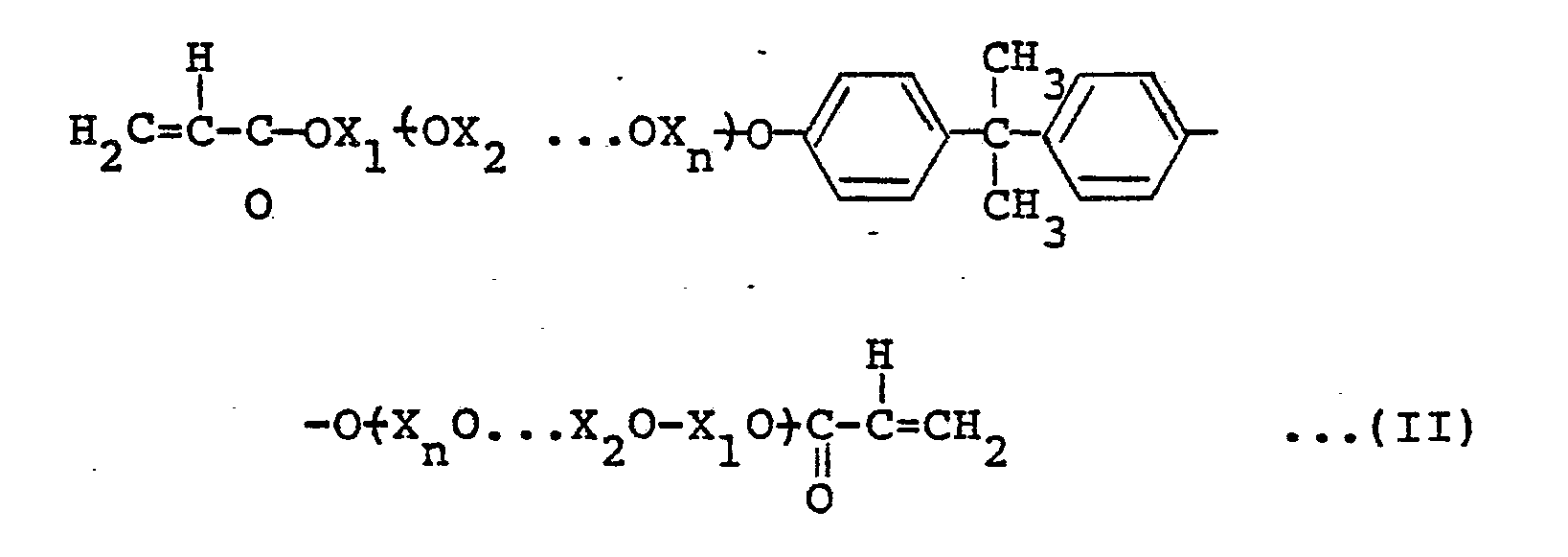
said bifunctional monomer having a molecular weight of not higher than approxinately 300 per acryloyloxy group, and (iii) 0% to 60% by weight of a monofunctional monomer containing one acryloyloxy group in the molecule and having a boiling point of at least 150°C at normal pressure, a viscosity of not higher than 20 cps as measured at 20°C and a molecular weight of not higher than approximately 300, - (b) 5 to 35 parts by weight, based on 100 parts by weight of the polyfunctional monomer composition (a) mentioned above, of at least one ultraviolet absorber,
- (c) 0.5 to 8 parts by weight, based on 100 parts by weight of the polyfunctional monomer composition (a) mentioned above, of at least one polymeric material selected from polymers of alkyl methacrylates and alkyl acrylates, and
- (d) 0.01 to 6 parts by weight, based on 100 parts by weight of the polyfunctional monomer composition (a) mentioned above, of a photosensitizer,
- In accordance with another fundamental aspect of the present invention, there is provided a process for the preparation of synthetic resin shaped articles excellent in abrasion resistance and weatherability, which comprises coating the surface of a synthetic resin shaped article with the above-mentioned coating composition and irradiating the coated shaped article with ultraviolet rays in an inert gas or air to form a crosslinked and cured coating film having a thickness of 1 to 30 microns.
- The polyfunctional monomer containing at least three methacryloyloxy or acryloyloxy groups in the molecule and having a molecular weight of not higher than approximately 900 (hereinafter referred to as "polyfunctional monomer" for grevity), that is used in the present invention, exhibits a good polymerizing activity under irradiation with ultraviolet rays and is cured to form a crosslinked polymer having a high degree of crosslinking which ensures high surface hardness and abrasion resistance.
- The polyfunctional monomer has a molecular weight of not higher than approximately 900. That is, the molecular weight per methacryloyloxy or acryloyloxy group is not higher than approximately 300, preferably not higher than approximately 250. Namely, it is preferred that the molecular weight of the polyfunctional monomer be not higher than approximately 750. If the molecular weight of the polyfunctional monomer exceeds approximately 900, the intended crosslinked coating film excellent in the surface hardness and abrasion resistance cannot be obtained.
- The above-mentioned polyfunctional monomer may be used alone. It is preferable, however, that the polyfunctional monomer is used as a monomer mixture comprised of the polyfunctional monomer and a bifunctional monomer and/or a monofunctional monomer. The proportion of the polyfunctional monomer in the monomer mixture is preferably at least 40% by weight and more preferably in the range of from 60 to 90% by weight, based on the weight of the monomer mixture. If the amount of the polyfunctional monomer is smaller than 40% by weight, a crosslinked coating film having sufficient surface hardness and abrasion resistance cannot be obtained.
- As the above-mentioned polyfunctional monomer, there can be mentioned, for example, trimethylolpropane trimethacrylate, trimethylolpropane triacrylate, pentaglycerol trimethacrylate, pentaglycerol triacrylate, pentaerythritol trimethacrylate, pentaerythritol triacrylate, pentaerythritol tetramethacrylate, pentaerythritol tetraacrylate, dipentaerythritol trimethacrylate, dipentaerythritol triacrylate, dipentaerythritol tetramethacrylate, dipentaerythritol tetraacrylate, dipentaerythritol heyamethacrylate, dipentaerythritol hexaacrylate, monomers prepared by esterification of, for example, (i) one mole of trimellitic acid with three moles of 2-hydroxyethyl methacrylate or 2-hydroxyethyl acrylate, (ii) one mole of pyromellitic acid with four moles of 2-hydroxyethyl methacrylate or 2-hydroxyethyl acrylate, (iii) two moles of trimethylolethane with one mole of succinic acid and 4 moles of methacrylic acid or acrylic acid, (iv) two moles of trimethylolethane with one mole of adipic acid and four moles of methacrylic acid or acrylic acid, (v) two moles of trimethylolpropane with one mole of succinic acid and four moles of methacrylic acid or acrylic acid, tris-(2-hydroxyethyl)isocyanurate trimethacrylate, tris-(2-hydroxyethyl)isocyanurate triacrylate, 2,2,4-trimethyl-1,3-pentane-diol methacrylate and 2,2,4-trimethyl-l,3-pentane-diol acrylate. These monomers may be used alone or as a mixture of two or more of them.
- Among these polyfunctional monomers, polypentaerythritol polyacrylates represented by the above general formula (I), which contain at least three acryloyloxy groups in the molecule, are especially preferred from the industrial viewpoint and in view of properties thereof, because these monomers exhibit a very good polymerizing activity under irradiation with ultraviolet rays even in an ordinary air atmosphere and are readily cured to form crosslinked polymers having a high degree of crosslinking ensuring a high abrasion resistance. Among these polypentaerytritol polyacrylate monomers, dipentaerythritol triacrylate, dipentaerythritol tetraacrylate, dipentaerythritol pentaacrylate and dipentaerythritol hexaacrylate are especially preferred because they are particularly excellent in the polymerizing activity under irradiation with ultraviolet rays in air.
- The monofunctional or bifunctional monomer which may be used in combination with the polyfunctional monomer in the present invention is a monomer which contains one or two methacryloyloxy or acryloyloxy groups in the molecule and has a molecular weight of not higher than approximately 300 per methacryloyloxy or acryloyloxy group. More specifically, in the case where the monomer contains two methacryloyloxy or acryloyloxy groups in the molecule, the molecular weight is not higher than approximately 600, preferably not higher than approximately 500, and in the case where the monomer contains one methacryloyloxy or acryloyloxy group in the molecule, the molecular weight is not higher than approximately 300, preferably not higher than approximately 250. The monofunctional or bifunctional monomer exhibits a good curing property under irradiation with ultraviolet rays, and this monomer is incorporated in the monomer mixture to impact excellent smoothness, flexibility and adhesion to the crosslinked coating film without reduction of the abrasion resistance of the coating film.
- When a monofunctional or bifunctional monomer having a molecular weight exceeding approximately 300 per methacryloyloxy or acryloyloxy group is used, the intended synthetic resin shaped article excellent in both surface hardness and abrasion resistance cannot be obtained.
- As the monofunctional or bifunctional monomer, there can be mentioned, for example, ethylene glycol dimethacrylate, ethylene glycol diacrylate, 1,3-propylene glycol dimethacrylate, 1,3-propylene glycol diacrylate, 1,4-butane--diol dimethacrylate, 1,4-butane-diol diacrylate, 1,6--hexane-diol dimethaacrylate, 1,6-hexane-diol diacrylate, diethylene glycol dimethacrylate, diethylene glycol diacrylate, neopentyl glycol dimethacrylate, neopentyl glycol diacrylate, tetraethylene glycol dimethacrylate, tetraethylene glycol diacrylate, 2-butene-l,4-dimethacrylate, 2-butene-1,4-diacrylate, cyclohexane-1,4-dimethanol dimethacrylate, cyclohexane-l,4-dimethanol diacrylate, hydrogenated bisphenol-A dimethacrylate, hydrogenated bisphenol--A diacrylate, 1,5-pentane dimethacrylate, 1,5-pentane diacrylate, trimethylolethane dimethacrylate, trimethylolethane diacrylate, trimethylolpropane dimethacrylate, trimethylolpropane diacrylate, dipropylene glycol dimethacrylate, dipropylene glycol diacrylate, 1,3-butylene glycol dimethacrylate, 1,3-butylene glycol diacrylate, 2,2-bis-(4--methacryloxyphenyl)propane, 2,2-bis-(4-acryloxyphenyl)propane, 2,2-bis-(4-methacryloxyethoxyphenyl)propane, 2,2-bis--(4-acryloxyethoxyphenyl)propane, 2,2-bis-(4-methacryloxydi- ethoxyphenyl)propane, 2,2-bis-(4-methacryloxypropoxy- phenyl)propane, 2,2-bis-(4-acryloxypropoxyphenyl)propane, 2,2-bis-[4-methacryloxy(2-hydroxypropoxy)phenyl]propane, 2,2-bis- [4-acryloxy(2-hydroxypropoxy)phenyl]propane, 2,2-bis-[4-acryloxy(2-hydroxypropoxyethoxy)phenyl]propane, 2,2-bis [4-methacryloxy(2-hydroxypropoxyethoxy)phenyl]propan, bis-(2-methacryloyloxyethyl) phthalate, a reaction product of one mole of hexamethylene diisocyanate with two moles of 2-hydroxyethyl. methacrylate or 2-hydroxyethyl acrylate, a reaction product of one mole of tolylene diisocyanate with two moles of 2-hydroxyethyl methacrylate or 2-hydroxyethyl acrylate, methyl methacrylate, methyl acrylate, ethyl methacrylate, ethyl acrylate, propyl methacrylate, propyl acrylate, butyl methacrylate, butyl acrylate, isobutyl methacrylate, isobutyl acrylate, t-butyl methacrylate, t-butyl acrylate, 2-ethylhexyl methacrylate, 2-ethylhexyl acrylate, lauryl methacrylate, lauryl acrylate, cyclohexyl methacrylate, cyclohexyl acrylate, methoxyethyl methacrylate, methoxyethyl acrylate, ethoxyethyl methacrylate, ethoxyethyl acrylate, butoxyethyl methacrylate, butoxyethyl acrylate, 2-hydroxyethyl methacrylate, 2-hydroxyethyl acrylate, 2-hydroxypropyl methacrylate, 2-hydroxypropyl acrylate, 2-hydroxy-3-chloropropyl methacrylate, 2-hydroxy--3-chloropropyl acrylate, glycidyl methacrylate, glycidyl acrylate, 2-chloroethyl methacrylate, 2-chloroethyl acrylate, ethylcarbitol methacrylate, ethylcarbitol acrylate, tetrahydrofurfuryl methacrylate, tetrahydrofurfuryl acrylate, benzyl methacrylate, benzyl acrylate, 1,4-butylene glycol monomethacrylate and 1,4-butylene glycol monoacrylate. These monomers may be used alone or as a mixture of two or more of them.
- The proportion of the monofunctional or bifunctional monomer in the polyfunctional monomer composition is up to 60% by weight, preferably up to 50% by weight. If the amount of this monomer is larger than 60% by weight based on the monomer mixture, the intended crosslinked coating film having sufficient surface hardness and abrasion resistance cannot be obtained. When good smoothness, flexibility and adhesion are especially required for the crosslinked coating film excellent in the weatherability, not the bifunctional monomer but the monofunctional monomer should be used preferably in an amount of 10 to 50% by weight based on the weight'of the polyfunctional monomer composition. When the monofunctional monomer is used in an amount of at least 10% by weight based on the weight of the monomer mixture, by the synergistic action with an alkyl methacrylate or acrylate polymer described hereinafter, a larger quantity of an ultraviolet absorber can be incorporated stably in the coating composition without any bad influences on the crosslinked coating film.
- Among the foregoing monofunctional and bifunctional monomers, bifunctional monomers represented by the general formula (II), which are preferably used in combination with the monomer represented by the general formula (I), exhibit a good curing property under irradiation with ultraviolet rays in air, and therefore, these bifunctional monomers can advantageously be incorporated when an excellent flexibility is required for the crosslinked coating film without reduction of the abrasion resistance of the film.
- However, use of compounds of the general formula (II) in which X n has 7 or more carbon atoms or n is an integer of 6 or more is not preferred, because the abrasion resistance of the crosslinked coating film is reduced or the adhesion to the substrate is reduced. Monomers of the general formula (II) in which X has up to 3 carbon atoms and n is an integer of up to 3 are especially preferred.
- As the bifunctional monomer represented by the general formula (II), there can be mentioned, for example, 2,2-bis-(4-acryloxyphenyl)propane, 2,2-bis(4-acryloxyethoxy- phenyl)propane, 2,2-bis(4-acryloxydiethoxyphenyl)propane, 2,2-bis(4-acryloxypropoxyphenyl)propane, 2,2-bisl4-acryl- oxy(2-hydroxypropoxy)phenyl]propane and 2,2-bis[4-acryloxy-(2-hydroxypropoxyethoxy)phenyl]propane.
- The proportion of the bifunctional monomer represented by the general formula (II) in the polyfunctional monomer composition is up to 50% by weight, preferably up to 30% by weight. If the amount of the bifunctional monomer represented by the general formula (II) is larger than 50% by weight based on the polyfunctional monomer composition. The abrasion resistance of the crosslinked coating film is reduced.
- The monofuctional monomer containing one acryloyloxy group in the molecule and having a boiling point of at least 150°C at normal pressure and a viscosity of not higher than 20 cps as measured at 20°C (hereinafter referred to as "monofunctional monomer" for brevity), is used in combination with the monomer represented by the general formula (I), when a smooth coated surface is formed upon application of the coating composition on a substrate shaped article and excellent flexibility and adhesion to the substrate shaped article are required for the cross- linked coating film. More specifically, in order to obtain a coating having a good smoothness upon application of the coating composition of the present invention on to a shaped article, it is preferred that the viscosity of the monomer mixture be up to 1,000 cps, and in order to impart to the cured coating film a good surface smoothness and excellent flexibility and adhesion to the substrate shaped article, a monofuctional monomer satisfying the above requirements should be used.
- As the monofunctional monomers, those which have a hydroxyl group and/or a cyclic ether linkage and/or a linear ether linkage, such as 2-hydroxyethyl acrylate, 2-hydroxypropyl acrylate, glycidyl acrylate, tetrahydrofurfuryl acrylate, ethoxyethyl acrylate, ethylcarbitol acrylate, butoxyethyl acrylate and 1,4-butylene glycol monoacrylate, are especially preferably used in the present invention, because these monomer are especially excellent in the polymerizing activity in air.
- The proportion of the monofunctional monomer in the polyfunctional monomer composition may be varied within the range of from 0% to 60% by weight. The monofunctional monomer may not be contained in the polyfunctional monomer composition. It is preferable, however, that the monofunctional monomer is contained in an amount of from 10% to 50% by weight. If the amount of the monofunctional monomer is smaller than 10% by weight based on the weight of the monomer mixture, it is not easy to reduce the viscosity of the coating composition to the desired extent and therefore, it sometimes happens that the surface smoothness is reduced to some extent. When the amount of the monofunctional monomer exceeds 60% by weight based on the weight-of the monomer mixture, a crosslinked coating film having a sufficient abrasion resistance cannot be obtained. When the monofunctional monomer is used in an amount of 10 to 50% by weight based on the weight of the polyfunctional monomer composition, a large quantity of the ultraviolet absorber can be incorporated stably, by the synergistic action with an alkyl methacrylate or alkyl acrylate polymer described hereinafter, without any bad influences on the crosslinked coating film. If the boiling point under atmospheric pressure of the monofunctional monomer is lower than 150°C, when the coating composition is coated and - cured on the surface of a shaped article, the monofunctional monomer is volatilized and removed from the coating composition, resulting in an increase of the viscosity of the coating composition. In contrast, if the viscosity of the monofunctional monomer exceeds 20 cps as measured at 20°C, it is impossible to effectively reduce the viscosity of the polyfunctional monomer composition.
- In the present invention, an alkyl methacrylate or alkyl acrylate polymer is incroporated with the above-mentioned polyfunctional monomer composition. This polymer exerts an effect of improving the adhesion of the cross- linked coating film to the substrate shaped article without reduction of appearance characteristics, such as transparency and smoothness of the crosslinked coating film and acts as a dispersant for uniformly dispersing a large quantity of the ultraviolet absorber in the crosslinked coating film. The polymer is indispensable for improving the weatherability of a synthetic resin shaped article having a high abrasion resistance.
- It is known to improve the weatherability of a coating film or coated product by incorporating an ultraviolet absorber into a coating composition or varnish. According to this known technique, however, it has been impossible to incorporate a large quantity of an ultraviolet absorber in a cured coating film excellent in the surface hardness and abrasion resistance, such as the film intended in the present invention. More specifically, even if a large quantity of an ultraviolet absorber is incorporated into a coating composition, when the coating composition is cured, the ultraviolet absorber incorporated in such a large quantity cannot be retained uniformly in the crosslinked coating film, but the ultraviolet absorber is irregularly distributed in the form of small islands in the crosslinked coating film or the ultraviolet absorber bleeds out on the surface of the crosslinked coating film, with the result that the entire coating film becomes opaque and milky white or the surface hardness and abrasion resistance of the cured coating film are reduced to a great extent.
- In fact, an ultraviolet absorber can be included into the polyfunctional monomer composition of the present invention only in an amount of 4 parts by weight at the largest per 100 parts by weight of the polyfunctional monomer composition, unless the above-mentioned alkyl methacrylate or acrylate polymer is incorporated in combination with the ultraviolet absorber into the monomer composition. If an ultraviolet absorber is incorporated in an amount exceeding this critical level, various defects such as mentioned above are evident. If an ultraviolet absorber is incorporated in an amount smaller than 4 parts by weight per 100 parts by weight of the polyfunctional monomer composition, the above-mentioned defects do not occur, but the effect of improving the weatherability is insufficient. It should be noted that if a small amount of the above-mentioned alkyl methacrylate or acrylate polymer is incorporated in the coating composition, the foregoing defects can be eliminated completely.
- The alkyl methacrylate or acrylate polymer that is used in the present invention has an intrinsic viscosity [n] which is a criterion indicating the average molecular weight of the polymer, of from 0.01 to 0.30. A homopolymer or copolymer of an alkyl methacylate or alkyl acrylate having 1 to 8 carbon atoms is preferably used as the alkyl methacrylate or acrylate polymer in the present invention.
- If the intrinsic viscosity [η] of the alkyl methacrylate or acrylate polymer is lower than 0.01, the effect of dispersing the ultraviolet absorber'in the crosslinked coating film by the alkyl methacrylate or acrylate polymer is not sufficient. On the other hand, if the intrinsic viscosity In] is higher than 0.3, the solubility of the alkyl methacrylate or acrylate polymer in the coating composition.becomes poor or the smoothness or abrasion resistance of the cured coating film is reduced. If the polymer has an alkyl group having 9 or more carbon atoms, the solubility of the polymer in the coating composition is degraded or the smoothness or abrasion resistance is reduced.
- As the alkyl methacrylate or acrylate polymer there can be mentioned homopolymers and copolymers of methyl methacrylate; methyl acrylate, ethyl metacrylate, ehtyl acrylate, propyl methacrylate, propyl acrylate, butyl methacrylate, butyl acrylate, isobutyl methacrylate, isobutyl acrylate, amyl methacrylate, hexyl methacrylate, heptyl methacrylate, octyl methacrylate, 2-ethyl-l-hexyl methacrylate, 2-ethyl-1-hexyl acrylate, 3-pentyl acrylate, 3-methyl-l-butyl acrylate, 2-ethyl-l-butyl acrylate and 2-heptyl acrylate. These polymers may be used alone or as a mixture of two or more of them.
- The alkyl methacrylate or acrylate polymer is incorporated in an amount of 0.5 to 8.0 parts by weight, preferably 1 to 5 parts by weight, based on 100 parts by weight of the polyfunctional monomer composition. If the amount of the polymer is smaller than 0.5 part by weight based on 100 parts by weight of the polyfunctional monomer composition, it is difficult to incorporate the desired amount of the ultraviolet absorber. If the amount of the polymer exceeds 8.0 parts by weight per 100 parts by weight of the polyfunctional monomer composition, the smoothness and abrasion resistance of the resulting crosslinked coating film are degraded.
- The kind of the ultraviolet absorber used in the present invention is not particularly critical, and even a photostabilizer for polymers in a broad sense is included. Any of ultraviolet absorbers which are soluble uniformly in the coating composition of the present invention and excellent in the weatherability can be used in the present invention. From viewpoints of good solubility in the coating composition and high improvement of the weatherability, it is preferred to use compounds derived from benzophenone, benzotriazole, phenyl salicylate or phenyl benzoate and having a maximum absorption wave length in the range of from 240 to 380 nm. A benzophenone type ultraviolet absorber is especially preferred because this ultraviolet absorber can be incorporated in an especially large amount in the coating composition of the present invention.
- As the ultraviolet absorber, there can be mentioned, for example, 2-hydroxybenzophenone, 5-chloro-2-hydroxybenzophenone, 2,4-dihydroxybenzophenone, 2-hydroxy-4-methoxybenzophenone, 2-hydroxy-4-octyloxybenzophenone, 4-dodecyl- oxy-2-hydroxybenzophenone, 2-hydroxy-4-octadecyloxybenzo- phenone, 2,2'-dihydroxy-4methoxybenzophenone, 2,2'-dihy- droxy-4,4'-dimethoxybenzophenone, phenyl salicylate, p-tert--butylphenyl salicylate, p-(1,1,3,3-tetramethylbutyl)-phenyl salicylate, 3-hydroxyphenyl benzoate, phenylene-1,3-di-- benzoate, 2-(2-hydroxy-5-methylphenyl)benzotriazole, 2-(2-hydroxy-5-tert-butylphenyl)-5-chlorobenzotriazole, 2-(2-hydroxy-3,5-di-tert-butylphenyl)benzotriazole, 2-(2-hydroxy-5-tert-butylphenyl)benzotriazole and 2-(2-hydroxy-4-octyloxyphenyl)benzotriazole. Among these ultraviolet absorbers, those which are represented by the following general formula (III):

- When these ultraviolet absorbers are used in combination with a homopolymer or copolymer of ethyl methacrylate or ethyl acrylate as the alkyl methacrylate or acrylate polymer ingredient (c) mentioned above, the intended effects of the present invention can be completely obtained.
- These ultraviolet absorbers may be used alone or as a mixture of two or more of them.
- The ultraviolet absorber is incorporated in the coating composition of the present invention in an amount of 5 to 35 parts by weight, preferably 8 to 30 parts by weight, based on 100 parts by weight of the polyfunctional monomer composition. If the amount of the ultraviolet absorber is smaller than 5 parts by weight per 100 parts by weight of the polyfunctional monomer composition, the effect of improving the weatherability of a synthetic resin shaped article is insufficient. If the amount of the ultraviolet absorber is incorporated in an amount larger than 35 parts by weight based on 100 parts by weight of the polyfunctional monomer composition, the abrasion resistance and smoothness of the crosslinked coating film are drastically reduced.
- The silicone type surface active agent which may be used in the present invention is effective for improving the smoothness of the crosslinked coating film, and if there is a risk of occurrence of whitening due to contact with an organic solvent, this component is necessary for preventing occurrence of this undesirable phenomenon.
- This surface active agent may be incorporated in the composition of the present invention in an amount of 0.0001 to 2.0 parts by weight based on 100 parts by weight of the polyfunctional monomer composition. If the amount of the surface active agent is smaller than 0.0001 part by weight, no substantial effects can be attained by incorporation of the surface active agent, and if the amount of the surface active agent is larger than 2.0 parts by weight, the smoothness of the coating film is reduced.
- The kind of the silicone type surface active agent is not particularly critical in the present invention. However, it is recommendable to use a silicone type surface active agent having a molecular structure comprised of polydimethylsiloxane units, parts of which are modified with a polyoxyalkylene group, as disclosed in Japanese Patent Application No. 4,569/79. It is preferred that the degree of modification be such that 0.1 to 10.0 units of at least one oxyalkylene group selected from -OCH2CH2-, OCH2CH(CH3)- and the like are bonded to one methylsiloxane unit CH3(SiO)1/2-. If the degree of modification with an oxyalkylene group is lower than 0.1, the smoothness of the coating film is rather worse than in the case where the silicone type surface active agent is not added, and if the degree of modification with an oxyalkylene group is more than 10, the smoothness of the coating film is degraded.
- As the photosensitizer used in the present invention, there can be mentioned, for example, carbonyl compounds such as benzoin, benzoin methyl ether, benzoin ethyl ether, benzoin isopropyl ether, acetoin, butyroin, toluoin, benzil, benzophenone, p-methoxybenzophenone, diethoxyacetophenone, a,a-dimethoxy-a-phenylacetophenone, methylphenyl glyoxylate, ethylphenyl glyoxylate, 4,4'-bis(dimethylaminobenzophenone) and 2-hydroxy-2-methyl-l-phenylpropan-l-one7 sulfur compounds such as tetramethylthiuram monosulfide and tetramethylthiuram disulfide; azo compounds such as azobisisobutyronitrile and azobis-2,4-dimethylvaleronitrile; and peroxide compounds such as benzoyl peroxide and di-tert.-butyl peroxide. The photosensitizer is preferably incorporated in an amount of 0.01 to 6 parts by weight based on 100 parts by weight of the monomer mixture. If the amount of the photosensitizer is too large, coloration of the crosslinked coating film is caused and the weatherability is reduced. If the amount of the photosensitizer is too small, the curability under irradiation of ultraviolet rays is reduced.
- If necessary, at least one or other vinyl monomers exhibiting a polymerizing activity under irradiation with ultraviolet rays may be incorporated in order to impart antistatic and anti-fogging properties to the crosslinked coating film. Furthermore, appropriate amounts of an antioxidant, a storage stabilizer and other stabilizers may be added according to need.
- Various coating methods such as brush coating, flow coating, spray coating, rotary coating and dip coating methods can be adopted for coating the coating composition of the present invention on a synthetic resin shaped article. From the viewpoints of the adaptability of the coating composition to the coating operation, the smoothness and uniformity of the coating and the adhesion of the crosslinked coating film to the substrate shaped article, it is most recommendable to adopt the dip coating method using an appropriate organic solvent.
- As the organic solvent to be utilized in the dip coating method, there is preferably used an organic solvent which is capable of forming a homogeneous solution when mixed with the coating composition and has a boiling point of 50 to 200°C under atmospheric pressure and a viscosity of lower than 10 cps at normal temperature, such as disclosed in Japanese Laid-Open Patent Application No. 102,936/78.
- The organic solvent is used in an amount of 90 to 20 parts by weight per 10 to 80 parts by weight of the coating composition (that is, the total amount is 100 parts by weight). When the amount of the organic solvent used is smaller than 20 parts by weight, a coating excellent in the smoothness and uniformity cannot be obtained, and if the amount of the organic solvent exceeds 90 parts by weight, the resulting film becomes too thin and the surface hardness is degraded.
- As the organic solvent used in the present invention, there can be mentioned, for example, alcohols such as ethanol, isopropanol, n-propanol, isobutyl alcohol and n-butyl alcohol; aromatic hydrocarbons such as benzene, toluene, xylene and ethylbenzene; ketones such as acetone and methyl ethyl ketone; ethers such as dioxane; and esters such as ethyl acetate, n-butyl acetate and ethyl propionate. These organic solvents may be used alone. Alternatively, a mixture of two or more of them may be used so far as it satisfies the above-mentioned requirements of the boiling point, viscosity and mixing ratio.
- The coating composition should be coated on the surface of a synthetic resin shaped article in such an amount that the thickness of the resulting crosslinked coating film is 1 to 30 microns, preferably 2.5 to 20 microns. If the thickness of the crosslinked coating film is smaller than 1 micron, the weatherability-improving effect is low, and if the thickness of the coating film is larger than 30 microns, the adhesion to the substrate shaped article is reduced, cracking or hazing is readily caused, or no good curing of the coating composition is attained under irradiation with ultraviolet rays.
- Active energy rays, for example, radioactive rays such as electron beams, a-rays, 6-rays and y-rays emitted from an electron accelerator of 20 to 2,000 KV, may be used as means for curing the coating composition of the present invention. However, in order to obtain a crosslinked and cured coating film having such a good hardness as intended in the present invention, it is preferred that the coating composition be irradiated with ultraviolet rays having a 0 wave length of 1,500 to 8,000 A..
- The irradiation of the coating composition with ultraviolet rays can be effected.either in an inert gas atmosphere or air. However, the coating composition containing the polypentaerythritol polyacrylate represented by the general formula (I) can be advantageously irradiated with ultraviolet rays in an ordinary air atmosphere without using an expensive inert gas.
- As the synthetic resin shaped article on which a crosslinked coating film is formed from the coating composition of the present invention for producing a synthetic resin shaped article excellent in both the abrasion resistance and weatherability, there can be used shaped articles of various synthetic resins which may be either thermoplastic or thermosetting. For example, there can be mentioned sheet-like shaped articles, film-like shaped articles, rod-like molded articles and various injection molded articles, which are prepared from polymethyl methacrylate resins, polycarbonate resins, polyallyldi- glycol carbonate resins, polystyrene resins, acrylonitrile-styrene copolymer resins (AS resins), polyvinyl chloride resins, acetate resins, ABS resins and polyester resins. Among these shaped articles, those prepared from polymethyl methacrylate resins and polycarbonate resins are advantageously used because of their excellent characteristics such as good optical properties, high heat resistance and high impact resistance, and because, improvements in the abrasion resistance and weatherability of these resin shaped articles (especially in the weatherability of polycarbonate resins) are especially eagerly desired.
- Synthetic resin shaped articles having excellent abrasion resistance and weatherability, which are prepared by using the coating composition of the present invention, are also excellent in such properties as smoothness, water resistance, chemical resistance and durability, and these properties are hardly reduced under severe conditions in environments containing oxygen, ozone, rain water and gasses contained in air or under influences of heat and the like. Therefore, synthetic resin shaped articles can be advantageously utilized in the fields where high abrasion resistance and weatherability are required.
- The present invention will now be described in detail with reference to the folloiwng Example that by no means limit the scope of the invention.
- In these Examples, the properties of crosslinked coating films were determined and evaluated according to the following methods.
- Steel wool of #000 was attached to the top end of a cylinder having a diameter of 25 mm and brought into contact with the surface of a sample placed horizontally. The cylinder was rotated 5 turns at 20 rpm under a load of 0.3 Kg on the sample, and the degree of damaging of the sample surface was observed with the naked eye and the abrasion resistance was evaluated according to the following standard.
- A: no substantial scratch on the sample surface
- B: slight scratch on the sample surface
- C: considerable scratch on the sample surface
- The cross-cut adhesive cellophane tape peel test was carried out. More specifically, eleven cuts reaching the substrate were formed on the crosslinked coating film at intervals of 1 mm in both the longitudinal and lateral directions, to form 100 square cuts each having an area of 1 mm2. An adhesive cellophane tape was applied to the cut coating film and it was rapidly peeled. The adhesion was evaluated according to the following standard.
- A: none of square cuts of the film peeled
- B: 1 to 50 square cuts peeled
- C: 51 to 100 square cuts peeled
- The surface smoothness was evaluated according to - the following standard.
- A: good surface smoothness of the coating
- B: slight unevenness on the surface of the coating
- C: considerable unevenness on the surface of the coating and poor smoothness
- The appearance was evaluated according to the following standard.
- (a) Discoloration or hazing:
- A: neither discoloration (yellowing or whitening) nor hazing
- B: slight discoloration or hazing
- C: prominent discoloration or hazing
- (b) Crack formation or film separation:
- A: not observed
- C: observed
- The weatherability test was carried out by using a sunshine carbon weather-ometer (Model WE-SUN-HC supplied by Toyo Rika) under conditions of a black panel temperature of 63 +3°C, a raining time of 120 minutes and a cycle period of 180 minutes.
- A curable liquid composition shown in Table 1, below, was prepared and a polycarbonate resin sheet having a thickness of 2 mm (trade name "Upilon", supplied by Mitsubishi Gas Kagaku) was dipped in the composition and pulled up from the composition to form a coating thereon. The coated sheet was allowed to stand for 3 minutes and both the surface of the coated sheet were irradiated in air two times with ultraviolet rays for 10 seconds by using high pressure mercury lamps (ozone type) of 2 KW located at the positions apart by 20 cm from the surface of the coating, respectively. The obtained results are shown in Table I, below.
- Abbreviations used in Table I indicate the following substances.
- 2P5A: dipentaerythritol pentaacrylate
- THF-A: tetrahydrofurfuryl acrylate
- Bip: benzoin isopropyl ether
- Y: 2-hydroxy-4-n-octyloxybenzophenone
- Z: 2,4-dihydroxybenzophenone
- MA2: methyl methacrylate/butyl methacrylate copolymer (50/50 weight ratio, [n] = 0.04)
- MA7: polyethyl methacrylate ([η] = 0.09)
- MA10: poly-iso-butyl methacrylate ([η] = 0.03)
- MAll: polystyrene ([n] = 0.10)
- MA12: polydodecyl methacrylate ([η] = 0.13)
- MA13: poly-iso-butyl methacrylate ([η] = 0.002)
- MA14: poly-iso-butyl methacrylate ([η] = 0.50)
- ISO-PrOH: isopropyl alcohol


- A polycarbonate resin sheet having a thickness of 3 mm was dipped in a curable liquid composition shown in Table II, below, and pulled out from the composition to form a coating thereon. Both the surfaces of the coated sheet were exposed in air to ultraviolet rays emitted from high pressure mercury lamps (ozone type) of 2 KW located at the positions apart by 20 cm from the surfaces of the sheet, respectively, for 15 seconds. The obtained results are shown in Table II, below.
-

- A polymethyl methacrylate sheet (trade name "ACRYLITE" supplied by Mitsubishi Rayon K.K.) having a thickness of 3 mm was dipped in a liquid coating composition comprising 25 parts by weight of dipentaerythritol hexaacrylate, 20 parts by weight of dipentaerythritol pentaacrylate, 10 parts by weight of dipentaerythritol tetraacrylate, 5 parts by weight of 2,2-bis(4-acryloxydiethoxyphenyl)propane, 35 parts by weight tetrahydrofurfuryl acrylate, 5 parts by weight of 2-hydroxyethyl acrylate, 100 parts by weight of isobutyl alcohol, 100 parts by weight of toluene, 2 parts by weight of benzoin isobutyl ether, 4.0 parts by weight of polyethyl methacrylate (MA7), 0.2 part by weight of a silicone type surface active agent, 16 parts by weight of 2-hydroxy-4--n-octyloxybenzophenone and 8 parts by weight of 2,4-dihydroxybenzophenone, and the sheet was pulled out from the composition to form a ccating thereon. The sheet was allowed to stand still for 3 minutes, and both the surfaces of the coated sheet were irradiated 2 times with ultraviolet rays emitted from high pressure mercury lamps (ozone type) of 2 KW located at the positions apart by 20 cm from the surfaces of the coated sheet, respectively, for 13 seconds. The abrasion resistance, appearance and adhesion of the obtained product were good, and also the appearance and adhesion after 1,500 hours' weatherability test were good.
- A coating composition comprising 25 parts by weight of dipentaerythritol hexaacrylate, 25 parts by weight of dipentaerythritol pentaacrylate, 10 parts by weight of dipentaerythritol tetraacrylate, 10 parts by weight ethylcarbitol acrylate, 30 parts by weight of tetrahydrofurfuryl acrylate, 0.4 part by weight of a silicone type surface active agent, 2 parts by weight of benzoin ethyl ether, 2- parts by weight of benzophenone, 4 parts by weight of poly--n-butyl methacrylate ([η] = 0.07), 12 parts by weight of 2-hydroxy-4-n-octyloxybenzophenone and 6 parts by weight of 2,4-dihydroxybenzophenone was coated on a polycarbonate injection molded sheet having a thickness of 3 mm by a bar coater to form a coating having a thickness of 5 microns thereon.
- In the same manner as described in Example 7, both the surfaces of the coated sheets were irradiated two times with ultraviolet rays emitted from the same high pressure mercury lamps as used in Example 7, which were located at positions 20 cm apart from the surfaces of the coated sheet, respectively, for 13 seconds.
- The abrasion resistance, appearance and adhesion of . the obtained product were good, and also the appearance and adhesion after 1,500 hours' weatherability test were good.
preferably with (e) 0.0001 to 2.0 parts by weight, based on 100 parts by weight of the polyfunctional monomer composition (a) mentioned above, of at least one silicone type surface active agent modified with a polyoxyalkylene group.
Claims (18)


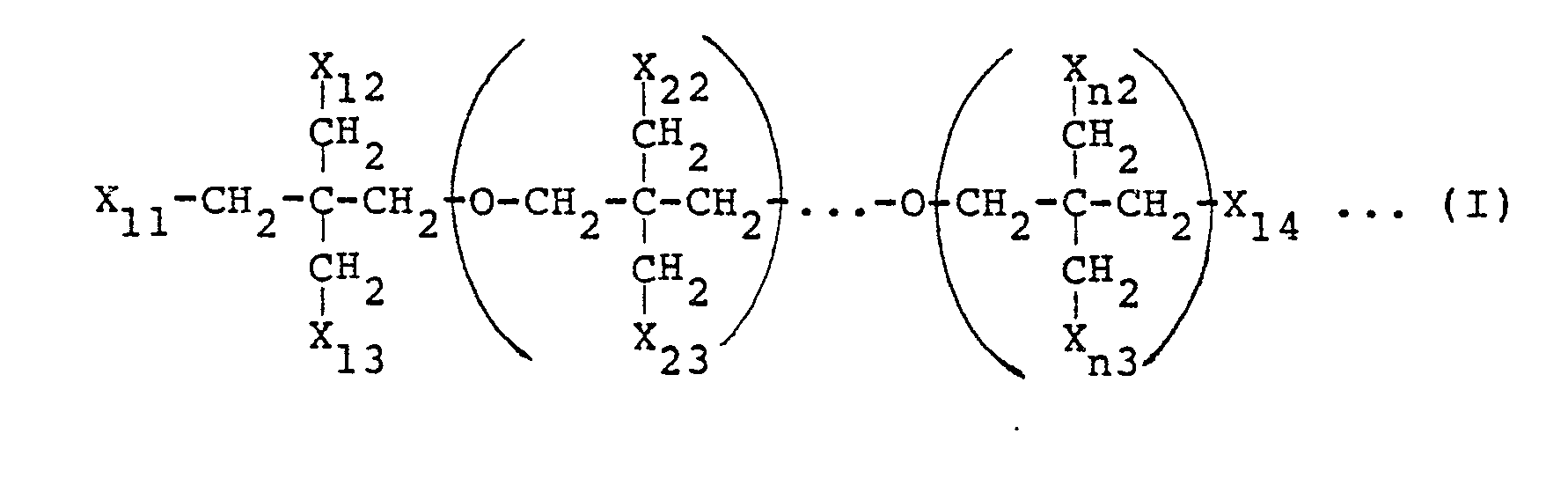


Applications Claiming Priority (4)
| Application Number | Priority Date | Filing Date | Title |
|---|---|---|---|
| JP2708880A JPS56122840A (en) | 1980-03-04 | 1980-03-04 | Coating material and preparation of synthetic resin molded product by use of the same |
| JP27088/80 | 1980-03-04 | ||
| JP31017/80 | 1980-03-12 | ||
| JP3101780A JPS56127635A (en) | 1980-03-12 | 1980-03-12 | Coating material composition and preparation of molded synthetic resin article made therefrom |
Publications (2)
| Publication Number | Publication Date |
|---|---|
| EP0035272A1 true EP0035272A1 (en) | 1981-09-09 |
| EP0035272B1 EP0035272B1 (en) | 1984-07-25 |
Family
ID=26364979
Family Applications (1)
| Application Number | Title | Priority Date | Filing Date |
|---|---|---|---|
| EP81101516A Expired EP0035272B1 (en) | 1980-03-04 | 1981-03-03 | Coating composition and process for preparing synthetic resin shaped articles by using same |
Country Status (6)
| Country | Link |
|---|---|
| US (1) | US4339474A (en) |
| EP (1) | EP0035272B1 (en) |
| AU (1) | AU542212B2 (en) |
| CA (1) | CA1149987A (en) |
| DE (1) | DE3164954D1 (en) |
| MX (1) | MX157398A (en) |
Cited By (8)
| Publication number | Priority date | Publication date | Assignee | Title |
|---|---|---|---|---|
| EP0274596A3 (en) * | 1986-12-22 | 1989-11-29 | General Electric Company | Aromatic carbonate resin articles coated with a photocured acrylic coating |
| EP0730011A1 (en) * | 1995-03-02 | 1996-09-04 | Röhm Gmbh | Scratch-resistant, UV-curable coating containing a copolymerizable thickener |
| DE102005043795A1 (en) * | 2005-09-13 | 2007-03-15 | Heraeus Kulzer Gmbh | Light and / or thermosetting sealing and fixing material for natural rock and building protection |
| DE102010028186A1 (en) | 2010-04-26 | 2011-10-27 | Evonik Röhm Gmbh | Plastic molded body made from a transparent, thermoplastic polymer, useful in an arrangement for producing a collector of solar cell, comprises coatings, which are colored with fluorescent dye, and are applied by roll coating method |
| DE102016112319A1 (en) | 2016-07-05 | 2018-01-11 | Krd Coatings Gmbh | coating system |
| WO2018069644A1 (en) | 2016-10-11 | 2018-04-19 | Université De Haute-Alsace | Thermoformable and scratch-resistant photopolymer coatings |
| EP3428199A1 (en) | 2017-07-12 | 2019-01-16 | Arkema France | A radiation-curable coating composition for improving the surface properties of plastics |
| EP3680283A1 (en) | 2019-01-11 | 2020-07-15 | KRD Coatings GmbH | Coating system with nanoparticles |
Families Citing this family (27)
| Publication number | Priority date | Publication date | Assignee | Title |
|---|---|---|---|---|
| US4605465A (en) * | 1982-04-26 | 1986-08-12 | W. R. Grace & Co. | UV and thermally curable, thermoplastic-containing compositions |
| JPS598419A (en) * | 1982-07-07 | 1984-01-17 | Hitachi Ltd | surface acoustic wave device |
| US4518472A (en) * | 1982-09-10 | 1985-05-21 | Mitsubishi Rayon Company Ltd. | Delustering coating composition excellent in abrasion resistance |
| IT1160482B (en) * | 1983-02-25 | 1987-03-11 | Siv Soc Italiana Vetro | PROCEDURE FOR PRODUCING A VEHICLE WINDSHIELD |
| JPS6049038A (en) * | 1983-08-29 | 1985-03-18 | Toyobo Co Ltd | Surface hardener for nylon lens |
| GB2168003B (en) * | 1984-10-16 | 1988-07-20 | Toyo Seikan Kaisha Ltd | Polyester vessel having improved dimension stability and process for preparation thereof |
| US4774035A (en) * | 1986-01-14 | 1988-09-27 | Camelot Industries Corporation | Process of coating an ophthalmic lens |
| US4716093A (en) * | 1986-03-17 | 1987-12-29 | E. I. Du Pont De Nemours And Company | Solvent developable photoresist composition and process of use |
| DE3616176A1 (en) * | 1986-05-14 | 1987-11-19 | Roehm Gmbh | METHOD FOR PRODUCING A SCRATCH-RESISTANT AND WEATHER-RESISTANT COATING ON A MOLDED BODY |
| EP0257812A3 (en) * | 1986-08-05 | 1989-09-13 | The Standard Oil Company | Nitrile acrylate coating composition containing pendant functionality and a radiation curable process |
| JPS6367188A (en) * | 1986-09-10 | 1988-03-25 | Mitsubishi Rayon Co Ltd | Sublimable disperse dye easily dyeable resin composition |
| EP0274595A3 (en) * | 1986-12-22 | 1989-11-29 | General Electric Company | Aromatic carbonate resin articles coated with a photocured acrylic coating |
| US4902725A (en) * | 1986-12-22 | 1990-02-20 | General Electric Company | Photocurable acrylic coating composition |
| US4902724A (en) * | 1986-12-22 | 1990-02-20 | General Electric Company | Photocurable acrylic coating composition |
| JPH085927B2 (en) * | 1986-12-26 | 1996-01-24 | 日本合成ゴム株式会社 | Photosensitive resin composition |
| US5006415A (en) * | 1987-01-16 | 1991-04-09 | Kyowa Gas Chemical Industry Co., Ltd. | Molded article of methacrylic resin |
| DE3779090D1 (en) * | 1987-01-16 | 1992-06-17 | Kuraray Co | MOLDED OBJECTS MADE OF METHACRYLIC ACID ESTER RESIN AND METHOD FOR THE PRODUCTION THEREOF. |
| JP2538992B2 (en) * | 1987-07-21 | 1996-10-02 | 三菱化学株式会社 | Photopolymerizable composition |
| US4902578A (en) * | 1987-12-31 | 1990-02-20 | General Electric Company | Radiation-curable coating for thermoplastic substrates |
| US5085917A (en) * | 1990-04-10 | 1992-02-04 | Thor Radiation Research, Inc. | Fabric having ravel resistant selvages and method for imparting the same |
| US5348844A (en) * | 1990-12-03 | 1994-09-20 | Napp Systems, Inc. | Photosensitive polymeric printing medium and water developable printing plates |
| US5559163A (en) * | 1991-01-28 | 1996-09-24 | The Sherwin-Williams Company | UV curable coatings having improved weatherability |
| US5318850A (en) * | 1991-11-27 | 1994-06-07 | General Electric Company | UV curable abrasion-resistant coatings with improved weatherability |
| US5214085A (en) * | 1992-02-03 | 1993-05-25 | General Electric Company | Abrasion-resistant coating compositions with improved weatherability |
| JP3864605B2 (en) * | 1998-02-27 | 2007-01-10 | 藤倉化成株式会社 | UV-curable coating resin composition |
| DE102007028601A1 (en) * | 2007-06-19 | 2008-12-24 | Evonik Röhm Gmbh | Reactive mixture for coating moldings by means of reaction injection molding and coated molding |
| TWI357922B (en) * | 2007-12-24 | 2012-02-11 | Eternal Chemical Co Ltd | Coating compositions and curing method thereof |
Citations (2)
| Publication number | Priority date | Publication date | Assignee | Title |
|---|---|---|---|---|
| GB1055196A (en) * | 1963-04-23 | 1967-01-18 | Du Pont | Improvements in photopolymerisalble compositions |
| EP0013939A2 (en) * | 1979-01-17 | 1980-08-06 | Mitsubishi Rayon Co., Ltd. | Coating composition and process for producing synthetic resin moldings by using the same |
Family Cites Families (4)
| Publication number | Priority date | Publication date | Assignee | Title |
|---|---|---|---|---|
| GB1466405A (en) * | 1973-11-26 | 1977-03-09 | Dainippon Printing Co Ltd | Moulded articles of plastics having surface characteristics and process for producing the same |
| JPS5315871B2 (en) * | 1974-07-31 | 1978-05-27 | ||
| JPS6052183B2 (en) * | 1977-02-23 | 1985-11-18 | 三菱レイヨン株式会社 | paint composition |
| FR2435340A1 (en) * | 1978-09-09 | 1980-04-04 | Asahi Dow Ltd | RESIN FILM AND SHEET BASED ON METHYL METHACRYLATE |
-
1981
- 1981-03-03 US US06/239,202 patent/US4339474A/en not_active Expired - Lifetime
- 1981-03-03 CA CA000372212A patent/CA1149987A/en not_active Expired
- 1981-03-03 DE DE8181101516T patent/DE3164954D1/en not_active Expired
- 1981-03-03 AU AU68030/81A patent/AU542212B2/en not_active Ceased
- 1981-03-03 EP EP81101516A patent/EP0035272B1/en not_active Expired
- 1981-03-04 MX MX186230A patent/MX157398A/en unknown
Patent Citations (2)
| Publication number | Priority date | Publication date | Assignee | Title |
|---|---|---|---|---|
| GB1055196A (en) * | 1963-04-23 | 1967-01-18 | Du Pont | Improvements in photopolymerisalble compositions |
| EP0013939A2 (en) * | 1979-01-17 | 1980-08-06 | Mitsubishi Rayon Co., Ltd. | Coating composition and process for producing synthetic resin moldings by using the same |
Non-Patent Citations (1)
| Title |
|---|
| CHEMICAL ABSTRACTS, vol. 87, no. 2, 11th July 1977, page 90, no. 7592z Columbus, Ohio, USA & JP - A - 52024296 (DAINICHSEIKA COLOR AND CHEM. MFG.CO.LTD.) * |
Cited By (11)
| Publication number | Priority date | Publication date | Assignee | Title |
|---|---|---|---|---|
| EP0274596A3 (en) * | 1986-12-22 | 1989-11-29 | General Electric Company | Aromatic carbonate resin articles coated with a photocured acrylic coating |
| EP0730011A1 (en) * | 1995-03-02 | 1996-09-04 | Röhm Gmbh | Scratch-resistant, UV-curable coating containing a copolymerizable thickener |
| DE102005043795A1 (en) * | 2005-09-13 | 2007-03-15 | Heraeus Kulzer Gmbh | Light and / or thermosetting sealing and fixing material for natural rock and building protection |
| DE102010028186A1 (en) | 2010-04-26 | 2011-10-27 | Evonik Röhm Gmbh | Plastic molded body made from a transparent, thermoplastic polymer, useful in an arrangement for producing a collector of solar cell, comprises coatings, which are colored with fluorescent dye, and are applied by roll coating method |
| DE102016112319A1 (en) | 2016-07-05 | 2018-01-11 | Krd Coatings Gmbh | coating system |
| WO2018007436A1 (en) | 2016-07-05 | 2018-01-11 | Krd Coatings Gmbh | Coating system |
| WO2018069644A1 (en) | 2016-10-11 | 2018-04-19 | Université De Haute-Alsace | Thermoformable and scratch-resistant photopolymer coatings |
| EP3428199A1 (en) | 2017-07-12 | 2019-01-16 | Arkema France | A radiation-curable coating composition for improving the surface properties of plastics |
| WO2019011784A1 (en) | 2017-07-12 | 2019-01-17 | Arkema France | A radiation-curable coating composition for improving the surface properties of plastics |
| EP3680283A1 (en) | 2019-01-11 | 2020-07-15 | KRD Coatings GmbH | Coating system with nanoparticles |
| DE102019100650A1 (en) | 2019-01-11 | 2020-07-16 | Krd Coatings Gmbh | Coating system with nanoparticles |
Also Published As
| Publication number | Publication date |
|---|---|
| AU542212B2 (en) | 1985-02-14 |
| MX157398A (en) | 1988-11-22 |
| US4339474A (en) | 1982-07-13 |
| AU6803081A (en) | 1981-09-10 |
| EP0035272B1 (en) | 1984-07-25 |
| DE3164954D1 (en) | 1984-08-30 |
| CA1149987A (en) | 1983-07-12 |
Similar Documents
| Publication | Publication Date | Title |
|---|---|---|
| US4339474A (en) | Coating composition and process for preparing synthetic resin shaped articles by using same | |
| US4291097A (en) | Scratch-resistant, dyeable coating compositions for synthetic resin articles | |
| EP0012949B1 (en) | Coating compositions, process for producing a cross-linked coating film with such compositions and thus produced articles | |
| US6306502B1 (en) | Coating composition forming wear-resistant coat and article covered with the coat | |
| US4863802A (en) | UV-stabilized coatings | |
| JP5057827B2 (en) | Active energy ray-curable coating composition and molded article having a cured coating of the composition | |
| JP5057826B2 (en) | Active energy ray-curable coating composition and molded article having a cured coating of the composition | |
| US5449702A (en) | Coating composition and process for producing abrasion-resistant synthetic resin molded articles | |
| US5700576A (en) | UV-curable scratch-resistant varnish having a thickener which becomes bound in the composition of the varnish by polymerization | |
| EP0037978B1 (en) | Coating composition and process for preparing synthetic resin shaped articles by using same | |
| JPS6328094B2 (en) | ||
| JP5560531B2 (en) | Active energy ray-curable resin composition and molded article having a cured film of the composition | |
| JPH09157315A (en) | Ultraviolet-curable resin raw material composition, resin molding surface-modified therewith, and production of the molding | |
| KR20010071849A (en) | Weather-resistant composition, coating materials and molded articles | |
| JPS6328095B2 (en) | ||
| JP2007070578A (en) | Active energy ray-curable coating composition | |
| JP4299513B2 (en) | Coating composition and article | |
| US5494645A (en) | Process for producing abrasion-resistant synthetic resin molded articles | |
| JP3061894B2 (en) | Coating composition and method for surface modification of resin molded article | |
| JP3182662B2 (en) | Coating composition | |
| JP3182661B2 (en) | Coating composition | |
| JPH0735419B2 (en) | Composition | |
| EP1118646B1 (en) | Anti-fogging coating composition | |
| JPH06128503A (en) | Coating composition | |
| JPH02163134A (en) | Polycarbonate resin molded product with improved wear resistance and weather resistance and its manufacturing method |
Legal Events
| Date | Code | Title | Description |
|---|---|---|---|
| PUAI | Public reference made under article 153(3) epc to a published international application that has entered the european phase |
Free format text: ORIGINAL CODE: 0009012 |
|
| AK | Designated contracting states |
Designated state(s): DE FR GB IT |
|
| 17P | Request for examination filed |
Effective date: 19811013 |
|
| ITF | It: translation for a ep patent filed | ||
| GRAA | (expected) grant |
Free format text: ORIGINAL CODE: 0009210 |
|
| AK | Designated contracting states |
Designated state(s): DE FR GB IT |
|
| REF | Corresponds to: |
Ref document number: 3164954 Country of ref document: DE Date of ref document: 19840830 |
|
| ET | Fr: translation filed | ||
| PLBE | No opposition filed within time limit |
Free format text: ORIGINAL CODE: 0009261 |
|
| STAA | Information on the status of an ep patent application or granted ep patent |
Free format text: STATUS: NO OPPOSITION FILED WITHIN TIME LIMIT |
|
| 26N | No opposition filed | ||
| ITTA | It: last paid annual fee | ||
| PGFP | Annual fee paid to national office [announced via postgrant information from national office to epo] |
Ref country code: GB Payment date: 19990304 Year of fee payment: 19 |
|
| PGFP | Annual fee paid to national office [announced via postgrant information from national office to epo] |
Ref country code: FR Payment date: 19990309 Year of fee payment: 19 |
|
| PGFP | Annual fee paid to national office [announced via postgrant information from national office to epo] |
Ref country code: DE Payment date: 19990315 Year of fee payment: 19 |
|
| PG25 | Lapsed in a contracting state [announced via postgrant information from national office to epo] |
Ref country code: GB Free format text: LAPSE BECAUSE OF NON-PAYMENT OF DUE FEES Effective date: 20000303 |
|
| GBPC | Gb: european patent ceased through non-payment of renewal fee |
Effective date: 20000303 |
|
| PG25 | Lapsed in a contracting state [announced via postgrant information from national office to epo] |
Ref country code: FR Free format text: LAPSE BECAUSE OF NON-PAYMENT OF DUE FEES Effective date: 20001130 |
|
| REG | Reference to a national code |
Ref country code: FR Ref legal event code: ST |
|
| PG25 | Lapsed in a contracting state [announced via postgrant information from national office to epo] |
Ref country code: DE Free format text: LAPSE BECAUSE OF NON-PAYMENT OF DUE FEES Effective date: 20010103 |