EP0036169B1 - Chromanderivate, Verfahren zu ihrer Herstellung, ihre Verwendung als Stabilisatoren von organischen Materialien sowie diese Stabilisatoren enthaltende organische Materialien - Google Patents
Chromanderivate, Verfahren zu ihrer Herstellung, ihre Verwendung als Stabilisatoren von organischen Materialien sowie diese Stabilisatoren enthaltende organische Materialien Download PDFInfo
- Publication number
- EP0036169B1 EP0036169B1 EP81101735A EP81101735A EP0036169B1 EP 0036169 B1 EP0036169 B1 EP 0036169B1 EP 81101735 A EP81101735 A EP 81101735A EP 81101735 A EP81101735 A EP 81101735A EP 0036169 B1 EP0036169 B1 EP 0036169B1
- Authority
- EP
- European Patent Office
- Prior art keywords
- derivative
- chroman derivative
- hal
- chroman
- preparation
- Prior art date
- Legal status (The legal status is an assumption and is not a legal conclusion. Google has not performed a legal analysis and makes no representation as to the accuracy of the status listed.)
- Expired
Links
- VZWXIQHBIQLMPN-UHFFFAOYSA-N chromane Chemical class C1=CC=C2CCCOC2=C1 VZWXIQHBIQLMPN-UHFFFAOYSA-N 0.000 title claims description 43
- 238000000034 method Methods 0.000 title claims description 30
- 238000002360 preparation method Methods 0.000 title claims description 30
- 239000003381 stabilizer Substances 0.000 title claims description 25
- 239000011368 organic material Substances 0.000 title claims description 9
- 150000001875 compounds Chemical class 0.000 claims description 28
- 239000002253 acid Substances 0.000 claims description 24
- 150000002148 esters Chemical class 0.000 claims description 17
- -1 carbamyl halide Chemical class 0.000 claims description 13
- 239000004033 plastic Substances 0.000 claims description 13
- 229920003023 plastic Polymers 0.000 claims description 13
- 230000000087 stabilizing effect Effects 0.000 claims description 11
- 125000002496 methyl group Chemical group [H]C([H])([H])* 0.000 claims description 8
- 229910052760 oxygen Inorganic materials 0.000 claims description 8
- 150000001412 amines Chemical class 0.000 claims description 7
- 239000000463 material Substances 0.000 claims description 7
- 150000004820 halides Chemical class 0.000 claims description 6
- 125000006239 protecting group Chemical group 0.000 claims description 6
- 238000003786 synthesis reaction Methods 0.000 claims description 5
- 150000007970 thio esters Chemical class 0.000 claims description 5
- LFQSCWFLJHTTHZ-UHFFFAOYSA-N Ethanol Chemical compound CCO LFQSCWFLJHTTHZ-UHFFFAOYSA-N 0.000 claims description 4
- 230000015572 biosynthetic process Effects 0.000 claims description 4
- 125000003178 carboxy group Chemical group [H]OC(*)=O 0.000 claims description 4
- 239000012948 isocyanate Substances 0.000 claims description 4
- 150000002513 isocyanates Chemical class 0.000 claims description 4
- 239000007858 starting material Substances 0.000 claims description 4
- 229910052717 sulfur Inorganic materials 0.000 claims description 4
- QVGXLLKOCUKJST-UHFFFAOYSA-N atomic oxygen Chemical group [O] QVGXLLKOCUKJST-UHFFFAOYSA-N 0.000 claims description 3
- 239000001301 oxygen Substances 0.000 claims description 3
- 150000003573 thiols Chemical class 0.000 claims description 3
- 125000004178 (C1-C4) alkyl group Chemical group 0.000 claims description 2
- 238000006243 chemical reaction Methods 0.000 claims description 2
- 230000008030 elimination Effects 0.000 claims description 2
- 238000003379 elimination reaction Methods 0.000 claims description 2
- 239000007800 oxidant agent Substances 0.000 claims description 2
- YKYOUMDCQGMQQO-UHFFFAOYSA-L cadmium dichloride Chemical compound Cl[Cd]Cl YKYOUMDCQGMQQO-UHFFFAOYSA-L 0.000 claims 2
- 230000000254 damaging effect Effects 0.000 claims 1
- 230000002195 synergetic effect Effects 0.000 claims 1
- OKKJLVBELUTLKV-UHFFFAOYSA-N Methanol Chemical compound OC OKKJLVBELUTLKV-UHFFFAOYSA-N 0.000 description 15
- 238000012360 testing method Methods 0.000 description 11
- AZQWKYJCGOJGHM-UHFFFAOYSA-N 1,4-benzoquinone Chemical compound O=C1C=CC(=O)C=C1 AZQWKYJCGOJGHM-UHFFFAOYSA-N 0.000 description 10
- YXFVVABEGXRONW-UHFFFAOYSA-N Toluene Chemical compound CC1=CC=CC=C1 YXFVVABEGXRONW-UHFFFAOYSA-N 0.000 description 9
- 239000000243 solution Substances 0.000 description 9
- XLYOFNOQVPJJNP-UHFFFAOYSA-N water Substances O XLYOFNOQVPJJNP-UHFFFAOYSA-N 0.000 description 9
- 239000004743 Polypropylene Substances 0.000 description 8
- 230000032050 esterification Effects 0.000 description 8
- 238000005886 esterification reaction Methods 0.000 description 8
- 239000000203 mixture Substances 0.000 description 8
- 229920001155 polypropylene Polymers 0.000 description 8
- 238000004519 manufacturing process Methods 0.000 description 7
- 238000012545 processing Methods 0.000 description 7
- JUJWROOIHBZHMG-UHFFFAOYSA-N Pyridine Chemical compound C1=CC=NC=C1 JUJWROOIHBZHMG-UHFFFAOYSA-N 0.000 description 6
- 150000001298 alcohols Chemical class 0.000 description 6
- 238000002845 discoloration Methods 0.000 description 6
- AUFZRCJENRSRLY-UHFFFAOYSA-N 2,3,5-trimethylhydroquinone Chemical compound CC1=CC(O)=C(C)C(C)=C1O AUFZRCJENRSRLY-UHFFFAOYSA-N 0.000 description 5
- OENHQHLEOONYIE-UKMVMLAPSA-N all-trans beta-carotene Natural products CC=1CCCC(C)(C)C=1/C=C/C(/C)=C/C=C/C(/C)=C/C=C/C=C(C)C=CC=C(C)C=CC1=C(C)CCCC1(C)C OENHQHLEOONYIE-UKMVMLAPSA-N 0.000 description 5
- 150000001408 amides Chemical class 0.000 description 5
- TUPZEYHYWIEDIH-WAIFQNFQSA-N beta-carotene Natural products CC(=C/C=C/C=C(C)/C=C/C=C(C)/C=C/C1=C(C)CCCC1(C)C)C=CC=C(/C)C=CC2=CCCCC2(C)C TUPZEYHYWIEDIH-WAIFQNFQSA-N 0.000 description 5
- 235000013734 beta-carotene Nutrition 0.000 description 5
- 239000011648 beta-carotene Substances 0.000 description 5
- 229960002747 betacarotene Drugs 0.000 description 5
- GVJHHUAWPYXKBD-IEOSBIPESA-N α-tocopherol Chemical compound OC1=C(C)C(C)=C2O[C@@](CCC[C@H](C)CCC[C@H](C)CCCC(C)C)(C)CCC2=C1C GVJHHUAWPYXKBD-IEOSBIPESA-N 0.000 description 5
- OENHQHLEOONYIE-JLTXGRSLSA-N β-Carotene Chemical compound CC=1CCCC(C)(C)C=1\C=C\C(\C)=C\C=C\C(\C)=C\C=C\C=C(/C)\C=C\C=C(/C)\C=C\C1=C(C)CCCC1(C)C OENHQHLEOONYIE-JLTXGRSLSA-N 0.000 description 5
- GVJHHUAWPYXKBD-UHFFFAOYSA-N (±)-α-Tocopherol Chemical compound OC1=C(C)C(C)=C2OC(CCCC(C)CCCC(C)CCCC(C)C)(C)CCC2=C1C GVJHHUAWPYXKBD-UHFFFAOYSA-N 0.000 description 4
- VYZAMTAEIAYCRO-UHFFFAOYSA-N Chromium Chemical group [Cr] VYZAMTAEIAYCRO-UHFFFAOYSA-N 0.000 description 4
- JOYRKODLDBILNP-UHFFFAOYSA-N Ethyl urethane Chemical compound CCOC(N)=O JOYRKODLDBILNP-UHFFFAOYSA-N 0.000 description 4
- QIGBRXMKCJKVMJ-UHFFFAOYSA-N Hydroquinone Chemical compound OC1=CC=C(O)C=C1 QIGBRXMKCJKVMJ-UHFFFAOYSA-N 0.000 description 4
- IMNFDUFMRHMDMM-UHFFFAOYSA-N N-Heptane Chemical compound CCCCCCC IMNFDUFMRHMDMM-UHFFFAOYSA-N 0.000 description 4
- 230000032683 aging Effects 0.000 description 4
- 230000000694 effects Effects 0.000 description 4
- 229910052739 hydrogen Inorganic materials 0.000 description 4
- 238000005259 measurement Methods 0.000 description 4
- 150000002825 nitriles Chemical class 0.000 description 4
- 238000007363 ring formation reaction Methods 0.000 description 4
- VEXZGXHMUGYJMC-UHFFFAOYSA-N Hydrochloric acid Chemical compound Cl VEXZGXHMUGYJMC-UHFFFAOYSA-N 0.000 description 3
- UFHFLCQGNIYNRP-UHFFFAOYSA-N Hydrogen Chemical compound [H][H] UFHFLCQGNIYNRP-UHFFFAOYSA-N 0.000 description 3
- ZMXDDKWLCZADIW-UHFFFAOYSA-N N,N-Dimethylformamide Chemical compound CN(C)C=O ZMXDDKWLCZADIW-UHFFFAOYSA-N 0.000 description 3
- ZMANZCXQSJIPKH-UHFFFAOYSA-N Triethylamine Chemical compound CCN(CC)CC ZMANZCXQSJIPKH-UHFFFAOYSA-N 0.000 description 3
- 125000000217 alkyl group Chemical group 0.000 description 3
- 125000001797 benzyl group Chemical group [H]C1=C([H])C([H])=C(C([H])=C1[H])C([H])([H])* 0.000 description 3
- 229910052799 carbon Inorganic materials 0.000 description 3
- 150000004649 carbonic acid derivatives Chemical class 0.000 description 3
- 229910052804 chromium Inorganic materials 0.000 description 3
- 239000011651 chromium Substances 0.000 description 3
- 239000001257 hydrogen Substances 0.000 description 3
- 238000005984 hydrogenation reaction Methods 0.000 description 3
- 230000007774 longterm Effects 0.000 description 3
- 239000003921 oil Substances 0.000 description 3
- 239000000843 powder Substances 0.000 description 3
- 239000002244 precipitate Substances 0.000 description 3
- UMJSCPRVCHMLSP-UHFFFAOYSA-N pyridine Natural products COC1=CC=CN=C1 UMJSCPRVCHMLSP-UHFFFAOYSA-N 0.000 description 3
- 238000010992 reflux Methods 0.000 description 3
- 239000000758 substrate Substances 0.000 description 3
- 125000000446 sulfanediyl group Chemical group *S* 0.000 description 3
- 150000003673 urethanes Chemical class 0.000 description 3
- 238000010626 work up procedure Methods 0.000 description 3
- 125000006701 (C1-C7) alkyl group Chemical group 0.000 description 2
- BSRHATGBRQMDRF-UHFFFAOYSA-N 3,4-dihydro-2h-chromen-2-ylmethanamine Chemical class C1=CC=C2OC(CN)CCC2=C1 BSRHATGBRQMDRF-UHFFFAOYSA-N 0.000 description 2
- OKTJSMMVPCPJKN-UHFFFAOYSA-N Carbon Chemical compound [C] OKTJSMMVPCPJKN-UHFFFAOYSA-N 0.000 description 2
- HEDRZPFGACZZDS-UHFFFAOYSA-N Chloroform Chemical compound ClC(Cl)Cl HEDRZPFGACZZDS-UHFFFAOYSA-N 0.000 description 2
- NBIIXXVUZAFLBC-UHFFFAOYSA-N Phosphoric acid Chemical compound OP(O)(O)=O NBIIXXVUZAFLBC-UHFFFAOYSA-N 0.000 description 2
- NQRYJNQNLNOLGT-UHFFFAOYSA-N Piperidine Chemical compound C1CCNCC1 NQRYJNQNLNOLGT-UHFFFAOYSA-N 0.000 description 2
- WYURNTSHIVDZCO-UHFFFAOYSA-N Tetrahydrofuran Chemical compound C1CCOC1 WYURNTSHIVDZCO-UHFFFAOYSA-N 0.000 description 2
- 238000002835 absorbance Methods 0.000 description 2
- 150000007513 acids Chemical class 0.000 description 2
- 239000002585 base Substances 0.000 description 2
- 230000008033 biological extinction Effects 0.000 description 2
- 150000001714 carbamic acid halides Chemical class 0.000 description 2
- 150000001732 carboxylic acid derivatives Chemical class 0.000 description 2
- 150000001735 carboxylic acids Chemical class 0.000 description 2
- 239000003054 catalyst Substances 0.000 description 2
- 150000001805 chlorine compounds Chemical class 0.000 description 2
- FZFAMSAMCHXGEF-UHFFFAOYSA-N chloro formate Chemical compound ClOC=O FZFAMSAMCHXGEF-UHFFFAOYSA-N 0.000 description 2
- 230000006378 damage Effects 0.000 description 2
- LQZZUXJYWNFBMV-UHFFFAOYSA-N dodecan-1-ol Chemical compound CCCCCCCCCCCCO LQZZUXJYWNFBMV-UHFFFAOYSA-N 0.000 description 2
- 238000005516 engineering process Methods 0.000 description 2
- 238000001125 extrusion Methods 0.000 description 2
- 238000010438 heat treatment Methods 0.000 description 2
- ARBOVOVUTSQWSS-UHFFFAOYSA-N hexadecanoyl chloride Chemical compound CCCCCCCCCCCCCCCC(Cl)=O ARBOVOVUTSQWSS-UHFFFAOYSA-N 0.000 description 2
- IXCSERBJSXMMFS-UHFFFAOYSA-N hydrogen chloride Substances Cl.Cl IXCSERBJSXMMFS-UHFFFAOYSA-N 0.000 description 2
- 229910000041 hydrogen chloride Inorganic materials 0.000 description 2
- 230000007062 hydrolysis Effects 0.000 description 2
- 238000006460 hydrolysis reaction Methods 0.000 description 2
- 230000003647 oxidation Effects 0.000 description 2
- 238000007254 oxidation reaction Methods 0.000 description 2
- 230000001590 oxidative effect Effects 0.000 description 2
- BWHMMNNQKKPAPP-UHFFFAOYSA-L potassium carbonate Chemical compound [K+].[K+].[O-]C([O-])=O BWHMMNNQKKPAPP-UHFFFAOYSA-L 0.000 description 2
- 238000001953 recrystallisation Methods 0.000 description 2
- 229920006395 saturated elastomer Polymers 0.000 description 2
- 125000001424 substituent group Chemical group 0.000 description 2
- 229920001169 thermoplastic Polymers 0.000 description 2
- 239000004416 thermosoftening plastic Substances 0.000 description 2
- 229930003799 tocopherol Natural products 0.000 description 2
- 229960001295 tocopherol Drugs 0.000 description 2
- 239000011732 tocopherol Substances 0.000 description 2
- 235000010384 tocopherol Nutrition 0.000 description 2
- JOXIMZWYDAKGHI-UHFFFAOYSA-N toluene-4-sulfonic acid Chemical compound CC1=CC=C(S(O)(=O)=O)C=C1 JOXIMZWYDAKGHI-UHFFFAOYSA-N 0.000 description 2
- JIAARYAFYJHUJI-UHFFFAOYSA-L zinc dichloride Chemical compound [Cl-].[Cl-].[Zn+2] JIAARYAFYJHUJI-UHFFFAOYSA-L 0.000 description 2
- MAKMDJFUNVXXQW-FNORWQNLSA-N (e)-4-(2,5-dihydroxy-3,4,6-trimethylphenyl)-2-methylbut-2-enoic acid Chemical compound OC(=O)C(/C)=C/CC1=C(C)C(O)=C(C)C(C)=C1O MAKMDJFUNVXXQW-FNORWQNLSA-N 0.000 description 1
- ZDSZDMJETWINGZ-DUXPYHPUSA-N (e)-4-chloro-2-methylbut-2-enoic acid Chemical compound OC(=O)C(/C)=C/CCl ZDSZDMJETWINGZ-DUXPYHPUSA-N 0.000 description 1
- 125000003903 2-propenyl group Chemical group [H]C([*])([H])C([H])=C([H])[H] 0.000 description 1
- PDCBSXRDMMRWRF-UHFFFAOYSA-N 5,6,7,8-tetramethyl-3,4-dihydro-2h-chromene Chemical class O1CCCC2=C(C)C(C)=C(C)C(C)=C21 PDCBSXRDMMRWRF-UHFFFAOYSA-N 0.000 description 1
- BVKZGUZCCUSVTD-UHFFFAOYSA-L Carbonate Chemical compound [O-]C([O-])=O BVKZGUZCCUSVTD-UHFFFAOYSA-L 0.000 description 1
- VMQMZMRVKUZKQL-UHFFFAOYSA-N Cu+ Chemical compound [Cu+] VMQMZMRVKUZKQL-UHFFFAOYSA-N 0.000 description 1
- MYMOFIZGZYHOMD-UHFFFAOYSA-N Dioxygen Chemical compound O=O MYMOFIZGZYHOMD-UHFFFAOYSA-N 0.000 description 1
- 239000002656 Distearyl thiodipropionate Substances 0.000 description 1
- 239000004952 Polyamide Substances 0.000 description 1
- 229930003427 Vitamin E Natural products 0.000 description 1
- 239000000654 additive Substances 0.000 description 1
- 230000000996 additive effect Effects 0.000 description 1
- 239000003513 alkali Substances 0.000 description 1
- 239000012670 alkaline solution Substances 0.000 description 1
- 125000003342 alkenyl group Chemical group 0.000 description 1
- 229910000147 aluminium phosphate Inorganic materials 0.000 description 1
- 239000012298 atmosphere Substances 0.000 description 1
- KCXMKQUNVWSEMD-UHFFFAOYSA-N benzyl chloride Chemical compound ClCC1=CC=CC=C1 KCXMKQUNVWSEMD-UHFFFAOYSA-N 0.000 description 1
- 229940073608 benzyl chloride Drugs 0.000 description 1
- CJZGTCYPCWQAJB-UHFFFAOYSA-L calcium stearate Chemical compound [Ca+2].CCCCCCCCCCCCCCCCCC([O-])=O.CCCCCCCCCCCCCCCCCC([O-])=O CJZGTCYPCWQAJB-UHFFFAOYSA-L 0.000 description 1
- 235000013539 calcium stearate Nutrition 0.000 description 1
- 239000008116 calcium stearate Substances 0.000 description 1
- 235000013877 carbamide Nutrition 0.000 description 1
- 125000004432 carbon atom Chemical group C* 0.000 description 1
- 230000015556 catabolic process Effects 0.000 description 1
- AOGYCOYQMAVAFD-UHFFFAOYSA-N chlorocarbonic acid Chemical class OC(Cl)=O AOGYCOYQMAVAFD-UHFFFAOYSA-N 0.000 description 1
- 150000001844 chromium Chemical class 0.000 description 1
- 239000012230 colorless oil Substances 0.000 description 1
- 238000001816 cooling Methods 0.000 description 1
- 239000002537 cosmetic Substances 0.000 description 1
- 238000004132 cross linking Methods 0.000 description 1
- 238000004042 decolorization Methods 0.000 description 1
- 238000000354 decomposition reaction Methods 0.000 description 1
- 238000006731 degradation reaction Methods 0.000 description 1
- 150000002009 diols Chemical class 0.000 description 1
- PWWSSIYVTQUJQQ-UHFFFAOYSA-N distearyl thiodipropionate Chemical compound CCCCCCCCCCCCCCCCCCOC(=O)CCSCCC(=O)OCCCCCCCCCCCCCCCCCC PWWSSIYVTQUJQQ-UHFFFAOYSA-N 0.000 description 1
- 235000019305 distearyl thiodipropionate Nutrition 0.000 description 1
- 239000010696 ester oil Substances 0.000 description 1
- 238000002474 experimental method Methods 0.000 description 1
- 239000003925 fat Substances 0.000 description 1
- WIGCFUFOHFEKBI-UHFFFAOYSA-N gamma-tocopherol Natural products CC(C)CCCC(C)CCCC(C)CCCC1CCC2C(C)C(O)C(C)C(C)C2O1 WIGCFUFOHFEKBI-UHFFFAOYSA-N 0.000 description 1
- 239000008187 granular material Substances 0.000 description 1
- HOQUWXSARQBQCW-UHFFFAOYSA-N hexadecyl carbonochloridate Chemical compound CCCCCCCCCCCCCCCCOC(Cl)=O HOQUWXSARQBQCW-UHFFFAOYSA-N 0.000 description 1
- 230000002209 hydrophobic effect Effects 0.000 description 1
- 230000006698 induction Effects 0.000 description 1
- 238000001746 injection moulding Methods 0.000 description 1
- 229910052500 inorganic mineral Inorganic materials 0.000 description 1
- 150000002576 ketones Chemical class 0.000 description 1
- 230000031700 light absorption Effects 0.000 description 1
- 229920002521 macromolecule Polymers 0.000 description 1
- 239000000155 melt Substances 0.000 description 1
- 238000002844 melting Methods 0.000 description 1
- 230000008018 melting Effects 0.000 description 1
- QSHDDOUJBYECFT-UHFFFAOYSA-N mercury Chemical compound [Hg] QSHDDOUJBYECFT-UHFFFAOYSA-N 0.000 description 1
- 229910052753 mercury Inorganic materials 0.000 description 1
- 150000004702 methyl esters Chemical class 0.000 description 1
- 239000011707 mineral Substances 0.000 description 1
- 235000010755 mineral Nutrition 0.000 description 1
- 150000007522 mineralic acids Chemical class 0.000 description 1
- 239000012452 mother liquor Substances 0.000 description 1
- 238000000465 moulding Methods 0.000 description 1
- 229910052757 nitrogen Inorganic materials 0.000 description 1
- IJGRMHOSHXDMSA-UHFFFAOYSA-N nitrogen Substances N#N IJGRMHOSHXDMSA-UHFFFAOYSA-N 0.000 description 1
- QJGQUHMNIGDVPM-UHFFFAOYSA-N nitrogen group Chemical group [N] QJGQUHMNIGDVPM-UHFFFAOYSA-N 0.000 description 1
- 150000007524 organic acids Chemical class 0.000 description 1
- 235000005985 organic acids Nutrition 0.000 description 1
- 239000012074 organic phase Substances 0.000 description 1
- 239000012071 phase Substances 0.000 description 1
- 229920002647 polyamide Polymers 0.000 description 1
- 239000001267 polyvinylpyrrolidone Substances 0.000 description 1
- 235000013855 polyvinylpyrrolidone Nutrition 0.000 description 1
- 229920000036 polyvinylpyrrolidone Polymers 0.000 description 1
- 229910000027 potassium carbonate Inorganic materials 0.000 description 1
- 239000002243 precursor Substances 0.000 description 1
- ZOKPDCKJLXVQPL-UHFFFAOYSA-N pyridine;hydrochloride Chemical compound Cl.C1=CC=NC=C1.C1=CC=NC=C1 ZOKPDCKJLXVQPL-UHFFFAOYSA-N 0.000 description 1
- 150000004059 quinone derivatives Chemical class 0.000 description 1
- 230000005855 radiation Effects 0.000 description 1
- 239000011541 reaction mixture Substances 0.000 description 1
- 230000035484 reaction time Effects 0.000 description 1
- 238000007493 shaping process Methods 0.000 description 1
- 239000002904 solvent Substances 0.000 description 1
- 238000003860 storage Methods 0.000 description 1
- 230000035882 stress Effects 0.000 description 1
- 239000000126 substance Substances 0.000 description 1
- HDFRDWFLWVCOGP-UHFFFAOYSA-M sulfanylformate Chemical compound [O-]C(S)=O HDFRDWFLWVCOGP-UHFFFAOYSA-M 0.000 description 1
- RLNWRDKVJSXXPP-UHFFFAOYSA-N tert-butyl 2-[(2-bromoanilino)methyl]piperidine-1-carboxylate Chemical compound CC(C)(C)OC(=O)N1CCCCC1CNC1=CC=CC=C1Br RLNWRDKVJSXXPP-UHFFFAOYSA-N 0.000 description 1
- YLQBMQCUIZJEEH-UHFFFAOYSA-N tetrahydrofuran Natural products C=1C=COC=1 YLQBMQCUIZJEEH-UHFFFAOYSA-N 0.000 description 1
- 230000008646 thermal stress Effects 0.000 description 1
- 150000003558 thiocarbamic acid derivatives Chemical class 0.000 description 1
- 238000005809 transesterification reaction Methods 0.000 description 1
- 150000003672 ureas Chemical class 0.000 description 1
- 238000011179 visual inspection Methods 0.000 description 1
- 229940088594 vitamin Drugs 0.000 description 1
- 239000011782 vitamin Substances 0.000 description 1
- 229930003231 vitamin Natural products 0.000 description 1
- 235000013343 vitamin Nutrition 0.000 description 1
- 239000011709 vitamin E Substances 0.000 description 1
- 229940046009 vitamin E Drugs 0.000 description 1
- 235000019165 vitamin E Nutrition 0.000 description 1
- 239000001993 wax Substances 0.000 description 1
- 239000011592 zinc chloride Substances 0.000 description 1
- 235000005074 zinc chloride Nutrition 0.000 description 1
Classifications
-
- C—CHEMISTRY; METALLURGY
- C07—ORGANIC CHEMISTRY
- C07D—HETEROCYCLIC COMPOUNDS
- C07D311/00—Heterocyclic compounds containing six-membered rings having one oxygen atom as the only hetero atom, condensed with other rings
- C07D311/02—Heterocyclic compounds containing six-membered rings having one oxygen atom as the only hetero atom, condensed with other rings ortho- or peri-condensed with carbocyclic rings or ring systems
- C07D311/04—Benzo[b]pyrans, not hydrogenated in the carbocyclic ring
- C07D311/58—Benzo[b]pyrans, not hydrogenated in the carbocyclic ring other than with oxygen or sulphur atoms in position 2 or 4
-
- C—CHEMISTRY; METALLURGY
- C07—ORGANIC CHEMISTRY
- C07D—HETEROCYCLIC COMPOUNDS
- C07D311/00—Heterocyclic compounds containing six-membered rings having one oxygen atom as the only hetero atom, condensed with other rings
- C07D311/02—Heterocyclic compounds containing six-membered rings having one oxygen atom as the only hetero atom, condensed with other rings ortho- or peri-condensed with carbocyclic rings or ring systems
- C07D311/04—Benzo[b]pyrans, not hydrogenated in the carbocyclic ring
- C07D311/58—Benzo[b]pyrans, not hydrogenated in the carbocyclic ring other than with oxygen or sulphur atoms in position 2 or 4
- C07D311/66—Benzo[b]pyrans, not hydrogenated in the carbocyclic ring other than with oxygen or sulphur atoms in position 2 or 4 with carbon atoms having three bonds to hetero atoms with at the most one bond to halogen, e.g. ester or nitrile radicals, directly attached in position 2
-
- C—CHEMISTRY; METALLURGY
- C09—DYES; PAINTS; POLISHES; NATURAL RESINS; ADHESIVES; COMPOSITIONS NOT OTHERWISE PROVIDED FOR; APPLICATIONS OF MATERIALS NOT OTHERWISE PROVIDED FOR
- C09K—MATERIALS FOR MISCELLANEOUS APPLICATIONS, NOT PROVIDED FOR ELSEWHERE
- C09K15/00—Anti-oxidant compositions; Compositions inhibiting chemical change
- C09K15/04—Anti-oxidant compositions; Compositions inhibiting chemical change containing organic compounds
- C09K15/06—Anti-oxidant compositions; Compositions inhibiting chemical change containing organic compounds containing oxygen
- C09K15/08—Anti-oxidant compositions; Compositions inhibiting chemical change containing organic compounds containing oxygen containing a phenol or quinone moiety
Definitions
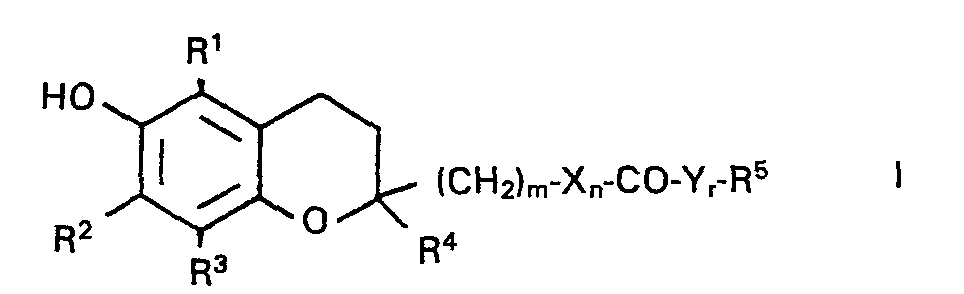
- the present invention relates to new chroman derivatives of the general formula I.
- the invention relates to the preparation of the compounds I, their use as stabilizers of organic compositions, especially plastics, against the effects of light, heat and oxidizing agents, and the organic compositions stabilized with these stabilizers.
- the chroman derivatives 1 according to the invention differ from the known chroman derivatives I 'essentially by the C 10 -C 30 alkyl group instead of the C 1 -C 7 alkyl group R.
- Similar compounds I " So those which also contain a short-chain radical R are known from DE-A-2 364 141.
- the compounds I 'and I leave something to be desired in their properties for stabilizing plastics and other organic compositions.
- the good stability values associated with the structurally related a-tocopherol (I"", vitamin E) can be achieved, as is known for example from DE-C-1 114 319 and 1 136 102, not achieved.
- a tocopherol is relatively difficult to manufacture and therefore too expensive as a stabilizing agent for most purposes.
- a - tocopherol often gives rise to undesirable discoloration.
- the very oxidation-sensitive oily substance a-tocopherol also presents problems in terms of processing technology.
- the invention was therefore based on the object of replacing the a-tocopherol by stabilizing agents which have essentially the same action but are cheaper and have the same or better quality values.
- the alkyl or alkenyl radical R 5 which by definition is to contain 10 to 30 carbon atoms, is essential for the stabilizing action, linear radicals and methyl-branched radicals being preferred.
- the type of grouping -X n -CO-Y r - is of minor importance with regard to the stabilizing properties of I, because this grouping has the primary function of linking the radical R 5 to the chromium grouping.
- the stabilizing properties are also not noticeably influenced by the number m of methyl groups. However, the other properties, including compatibility and miscibility with the substrate, can depend on m and on the grouping -X n CO-Y r -.
- connection types la-Ip correspond to the type of grouping -X n -CO-Y r :
- chroman derivatives of the type generally applies to the preparation of these compounds with compounds R 5- OH or R 5 -Y 2 -CO-OH or their functional derivatives such as chlorides or methyl esters.
- Chroman precursors of the type can also be obtained go out and then close the ring via the quinone to be produced therefrom and hydrogenate the chromium-2-ene formed.
- the chromium portion of the molecule is linked to the radical R 5 via the -X n -CO-Y r grouping in an analogous manner to that described above in general terms.
- the compounds Ia-Ip can be obtained by the following methods (a) - (p):
- Working up to la is then carried out as usual.
- the acid halides IIa are known from DE-A-2 364 141 or are available thereafter.
- esters Ib are particularly light due to the customary, acid-catalyzed esterification of the carboxylic acids IIb available with alcohols R 5- OH (IIIb).
- the starting compounds IIb are known, for example, from DE-A-2 364 141.
- the esterification is generally known in its numerous configurations with regard to the acid, the removal of the water of reaction, the temperature and the reaction time, so that further explanations are unnecessary. It should only be added that it is usually advisable to use the Ilb acid in excess.
- the unused acid can then be separated off from the ester Ib using aqueous alkali, after which the acid IIb can be easily recovered by acidifying the aqueous alkaline solution. If necessary, Ib can be purified by recrystallization, for which purpose methanol / water mixtures are usually suitable.
- the halides R 5- Hal or the esters of inorganic or organic acids can also be used.
- esterification or transesterification is carried out in the presence of weak bases and advantageously in a solvent.
- This method is also generally known, so there is no need for further explanations.
- esters Ib A further possibility for the preparation of the esters Ib consists in the implementation of the easily accessible nitriles IIb ' with alcohols in the presence of mineral acids.
- the preparation of the nitriles Ilb ' is described in the earlier patent application DE-A1-2 909 601.
- the esterification step which can be carried out according to the method described in (b 1 ), can also be brought forward.
- the trimethylhydroquinone is reacted with the allyl compounds in a known manner by the methods of Friedel-Craffts synthesis.
- the oxidation of the resulting intermediate compound to the quinone proceeds easily and can be carried out, for example, with air. It is usually necessary because only the quinone can be cyclized to the six-membered chroman, since the cyclization of the hydroquinone would usually lead to an O-containing five-membered ring.
- the cyclization is also carried out as usual, for example using a tertiary nitrogen base such as triethylamine or pyridine.
- carboxylic acids Ilb or their functional derivatives such as the halides or esters are reacted with an amine R 5 -NH 2 by known methods.
- the preparation of the thioesters Id proceeds analogously to the esterification Ib, starting from the thiols R 5- SH instead of the alcohols R 5- OH.
- the starting compounds in this case are the chroman derivatives IIe for example, by Friedel-Craffts additive diols of trimethylhydroquinone.
- the compounds IIe are reacted analogously to method (e) with a chloroformate R 5- O-CO-Hal (IIIf) or a carbonate such as R 5- O-CO-CH 3 .
- a corresponding carbamic acid halide R 5 -NH-CO-Hal or a urethane such as R 5 -NH-CO-O-CH 3 can also be used.
- the starting compounds are the amines Ili which can be prepared in a known manner by hydrolysis of the nitriles IIb '.
- the amines IIi are then converted into the amides li in a known manner by means of the carboxylic acid IIIe or its functional derivatives.
- the urethanes Ij are obtainable analogously to method (f) from the amines IIi and the chloroformic acid esters Illf or their carbonates R 5- O-CO-O-CH 3 .
- the amines IIi are reacted according to method (h) with the thio compounds Illh, R 5 -S-CO-Hal or R 5- S-CO-O-CH 3 .
- the chroman derivatives I according to the invention are outstandingly suitable as stabilizers of organic materials against damage by heat, light and oxidative influences. Fats, oils, waxes, pharmaceutical and cosmetic preparations and, above all, plastics can be mentioned as organic materials.
- the stabilizers are used in concentrations of 0.01 to 1.0, usually 0.1 to 0.5% by weight, based on the amount of plastic. For highly sensitive substrates, such as vitamins, the concentrations can rise up to 20% by weight.
- the stabilizers according to the invention can be used alone or in a mixture with other stabilizers, especially with so-called synergists. Synergists are those compounds which, by themselves, have little or no stabilizing effect, but together with stabilizing agents significantly improve their effect. Such synergists include calcium stearate and distearyl thiodipropionate
- the synergists are generally used in amounts of 50 to 500% by weight, based on the amount of stabilizing agent.
- the organic materials are protected against changes and decomposition by stabilizers, i.e. in the case of plastics primarily against the degradation and undesired cross-linking of the macromolecules, changes which manifest themselves as aging, embrittlement, discoloration and lowering of the softening temperature.
- the stabilizer should not discolor the substrate. This requirement, which is of course of particular importance for colorless plastics, is satisfactorily or excellently met by the stabilizers according to the invention in most plastics, and as a rule these compounds are superior to conventional stabilizers, including a-tocopherol.
- the quantitative determination of the color properties can be determined using various methods, e.g. after the yellowness test (ASTMD 1925).
- thermoplastics compared to the mechanical and thermal stress in molding processes such as extrusion and injection molding.
- a measure of the processing stability can be derived from the change in the melting behavior of the relevant thermoplastic after repeated shaping with remelting.
- the corresponding melt index text is described in DIN 53 735.
- An important criterion for processing stability is the color consistency, which e.g. can be determined according to the yellowness test.
- the behavior of the plastic against rigorous thermal and oxidative influences is an indication of the duration of the quality consistency when used as intended, i.e. the service life of the plastic article can be estimated from the values determined in the corresponding tests (DIN 53 383, sheet 1).
- the stabilizers according to the invention offer advantages in conjunction with synergists.
- This compound was esterified with n-dodecanol according to the instructions of Examples 1 to 12.
- the yield of ester, based on the acid, was 79%, mp. 40 to 43 ° C.
- the ester was 0.1 g of copper (1) bis-pyridine chloride dissolved in 250 ml of methanol, after which air was passed through this solution. The hydroquinone was converted into the corresponding quinone (yellow oil). Yield quantitative.
- the hydrogenation to the chroman derivative (1) was carried out at 50 ° C. and 10 bar hydrogen pressure on a Pd / carbon catalyst.
- the yield based on chromium was 96%.
- the color quality was measured as the yellowness index YI according to the yellowness test (ASTMD 1925).
- the polypropylene samples (same material as in the color test) were extruded and granulated six times.
- the quotient MFI 6 / MFI 1 was formed from the melt index MFI (for the determination method see DIN 53 735) after the first and the sixth extrusion. The greater this quotient, the lower the processing stability.
- the color measurements correspond to those of the color test. The results are shown in Table 5.
Landscapes
- Chemical & Material Sciences (AREA)
- Organic Chemistry (AREA)
- Engineering & Computer Science (AREA)
- Materials Engineering (AREA)
- Compositions Of Macromolecular Compounds (AREA)
- Pyrane Compounds (AREA)
- Anti-Oxidant Or Stabilizer Compositions (AREA)
- Heterocyclic Carbon Compounds Containing A Hetero Ring Having Oxygen Or Sulfur (AREA)
Description
- Die vorliegende Erfindung betrifft neue Chromanderivate der allgemeinen Formel I
- In dieser Formel bedeuten:
- R1-R4 H, C1-C4-Alkyl
- R5 Clo-C30-Alkyl oder -Alkenyl
- X, Y O, NH, S
- m 0, 1, 2 oder 3
- n, r 0 oder 1
- Ausserdem betrifft die Erfindung die Herstellung der Verbindungen I, deren Verwendung als Stabilisatoren von organischen Massen, vor allem von Kunststoffen, gegen die Einflüsse von Licht, Wärme und Oxidationsmitteln, sowie die mit diesen Stabilisatoren stabilisierten organischen Massen.
- Aus der DE-A-2 364 165 sind Chromanderivate des Typs I' bekannt,


- Die Verbindungen I' und I" lassen in ihren Eigenschaften zur Stabilisierung von Kunststoffen und sonstigen organischen Massen indes zu wünschen übrig. Insbesondere werden die guten Stabilitätswerte, die mit dem strukturverwandtena-Tocopherol (I''', Vitamin E)

- a -Tocopherol ist jedoch nur relativ schwierig herzustellen und deshalb als Stabilisierungsmittel für die meisten Zwecke zu teuer. Ausserdem gibt a - Tocopherol häufig zu unerwünschten Verfärbungen Anlass. Auch in verarbeitungstechnischer Hinsicht bietet die sehr oxidationsempfindliche ölige Substanz a -Tocopherol Probleme.
- Der Erfindung lag daher die Aufgabe zugrunde, das a-Tocopherol durch im wesentlichen gleich wirkende, aber billigere Stabilisierungsmittel mit gleichartigen oder besseren Qualitätswerten zu ersetzen.
- Es wurde gefunden, dass sich die eingangs definierten neuen Chromanderivate I hervorragend als Stabilisierungsmittel für organische Massen, darunter vor allem für Kunststoffe, eignen.
- Ferner wurden verschiedene, im folgenden näher beschriebene Verfahren für die Herstellung der Chromanderivate I gefunden. Unter den Verbindungen 1 werden solche bevorzugt, in denen die Reste R1-R4 Methylgruppen bedeuten, da Chromanderivate dieser Struktur besonders leicht zugänglich sind. Der Chromanrest mit dieser Struktur
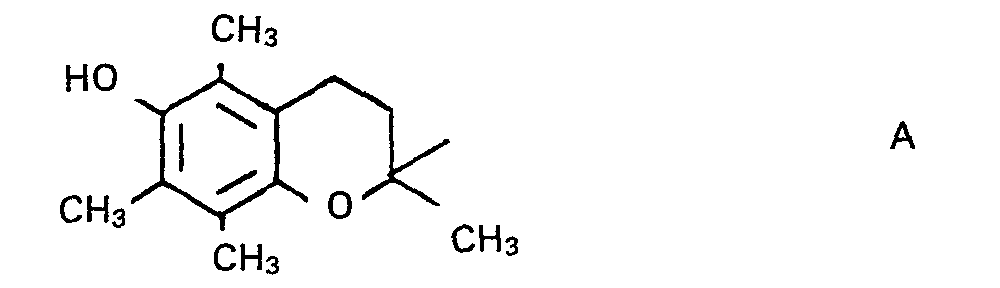

- Verbindungen I mit anderen Resten R1-R4 als jeweils der Methylgruppe sind in analoger Weise zugänglich, wie diejenigen mit der Gruppierung A, und ihre Wirkung als Stabilisierungsmittel ist nach den bisherigen Beobachtungen etwa die gleiche wie bei den Tetramethylchromanderivaten.
- Wesentlich für die Stabilisierungswirkung ist der Alkyl- bzw. Alkenylrest R5, der definitionsgemäss 10 bis 30 C-Atome enthalten soll, wobei lineare Reste und methylverzweigte Reste bevorzugt werden. Die Art der Gruppierung -Xn-CO-Yr- ist im Hinblick auf die Stabilisierungseigenschaften von I von untergeordneter Bedeutung, denn diese Gruppierung hat in erster Linie die Funktion, den Rest R5 mit der Chromangruppierung zu verknüpfen. Auch von der Anzahl m der Methylgruppen werden die Stabilisierungseigenschaften nicht erkennbar beeinflusst. Die sonstigen Eigenschaften, u.a. die Verträglichkeit und Mischbarkeit mit dem Substrat, können jedoch von m sowie von der Gruppierung -XnCO-Yr- abhängen. Beispielsweise werden für die Stabilisierung von Polyamiden Verbindungen I, in denen X und/oder Y für eine -NH-Gruppierung steht, aus Gründen der Verarbeitungstechnik bevorzugt, und für hydrophobe Kunststoffe wie Polypropylen empfehlen sich Verbindungen I mit Esterstruktur (X oder Y = O).
- Der Art der Gruppierung -Xn-CO-Yr- entsprechen die folgenden 16 Verbindungstypen la-Ip:

- Für die Herstellung dieser Verbindungen gilt allgemein das Prinzip, Chromanderivate des Typs

- Ferner kann man auch von Chroman-Vorprodukten des Typs

- Bei allen diesen Synthesen kann es sich ferner empfehlen, die 6-OH-Gruppe in bekannter Weise durch einen leicht wieder abspaltbaren Rest, z.B. die Benzylgruppe, zu schützen und diesen Rest im letzten Syntheseschritt zu eliminieren.
- Im einzelnen sind die Verbindungen la-Ip nach folgenden Methoden (a)-(p) erhältlich:
- Man geht von einem Säurehalogenid IIa aus

- Es ist auch möglich, die Schutzgruppe nach der Hydrolyse hydrogenolytisch abzuspalten.
- Die Säurehalogenide IIa sind aus der DE-A-2 364 141 bekannt oder hiernach erhältlich.
- Die Ester Ib sind besonders leicht durch übliche, sauer katalysierte Veresterung der Carbonsäuren IIb

- Die Veresterung ist in ihren zahlreichen Ausgestaltungen hinsichtlich der Säure, der Entfernung des Reaktionswassers, der Temperatur und der Reaktionszeit allgemein bekannt, so dass nähere Ausführungen sich hierzu erübrigen. Es ist lediglich hinzuzufügen, dass es sich meistens empfiehlt, die Säure Ilb im Überschuss einzusetzen. Die nicht verbrauchte Säure kann dann mit wässrigem Alkali vom Ester Ib abgetrennt werden, wonach die Säure IIb durch Ansäuern der wässrig-alkalischen Lösung wieder leicht zurückgewonnen werden kann. Die Reinigung von Ib kann, falls überhaupt erforderlich, durch Umkristallisation vorgenommen werden, wozu sich meistens Methanol/Wasser-Gemische eignen. Anstelle der Alkohole R5-OH kann man auch die Halogenide R5-Hal oder die Ester von anorganischen oder organischen Säuren einsetzen. In diesem Falle nimmt man die Veresterung bzw. Umesterung in Gegenwart von schwachen Basen sowie zweckmässigerweise in einem Lösungsmittel vor. Auch diese Methode ist allgemein bekannt, so dass sich nähere Ausführungen hierzu erübrigen. Umgekehrt kann man auch von den Halogeniden oder Estern von IIb ausgehen und diese mit den Alkoholen IIIb zu den Estern Ib umsetzen.
- Eine weitere Möglichkeit zur Herstellung der Ester Ib besteht in der Umsetzung der leicht zugänglichen Nitrile IIb'

- Im Hinblick auf die vom Trimethylhydrochinon (oder seinen Homologen) ausgehende Gesamtsynthese kann es zweckmässig sein, zunächst ein offenkettiges Trimethylhydrochinonderivat herzustellen, welches die Gruppierung -(CH2)m-CO-O-R5 enthält, und die Cyclisierung zum Chroman zum Schluss vorzunehmen. Dieser Syntheseweg lässt sich wie folgt veranschaulichen:

- Hierbei kann man den Veresterungsschritt, der nach den unter (b1) beschriebenen Verfahren vorgenommen werden kann, auch vorverlegen. Die Umsetzung des Trimethylhydrochinons mit den Allylverbindungen erfolgt in bekannter Weise nach den Methoden der Friedel-Craffts-Synthese. Die Oxidation der hierbei entstehenden Zwischenverbindung zum Chinon verläuft leicht und kann z.B. mit Luft vorgenommen werden. Sie ist in der Regel erforderlich, weil nur das Chinon zum Sechsring Chroman cyclisiert werden kann, denn die Cyclisierung des Hydrochinons würde meistens zu einem O-haltigen Fünfring führen. Die Cyclisierung nimmt man ebenfalls wie üblich vor, z.B. mittels einer tertiären Stickstoffbase wie Triethylamin oder Pyridin.
- Das gleiche gilt für die anschliessende Hydrierung des hierbei entstehenden Chromanderivates.
- Hierzu setzt man die Carbonsäuren Ilb oder deren funktionelle Derivate wie die Halogenide oder Ester nach bekannten Methoden mit einem Amin R5-NH2 um.
- Die Herstellung der Thioester Id verläuft analog der Veresterung Ib, indem man statt von den Alkoholen R5-OH von den Thiolen R5-SH ausgeht.
- Ausgangsverbindungen sind in diesem Falle die Chromanderivate IIe


- Die Veresterung von IIe und le erfolgt dann wie üblich mit einer Säure R5-COOH (Ille) oder einem funktionellen Derivat hiervon.
- Hierzu setzt man die Verbindungen IIe analog der Methode (e) mit einem Chlorameisensäureester R5-O-CO-Hal (IIIf) oder einem Carbonat wie R5-O--CO-CH3 um.
- Die einfachste Methode zur Herstellung dieser Verbindungen besteht in der Addition eines Isocyanats R5-N=C=O (IIIg) an einen Alkohol IIe, wobei es sich allerdings empfiehlt, die 6-OH-Gruppe des Chromans zu schützen.
- Anstelle des Isocyanats IIIg kann man auch ein entsprechendes Carbaminsäurehalogenid R5-NH-CO--Hal oder ein Urethan wie R5-NH-CO-O-CH3 einsetzen.
- Diese Verbindungen erhält man nach der Methode (f), mit dem Unterschied, dass man hier die entsprechenden Thioderivate (IIIh) also R5-S-CO-Hal oder R5-S-CO-O-CH3 einsetzt.
- Ausgangsverbindungen sind die Amine Ili

- Die Amine IIi werden sodann in bekannter Weise mittels der Carbonsäure IIIe bzw. deren funktionellen Derivaten in die Amide li überführt.
- Die Urethane Ij sind analog der Methode (f) aus den Aminen IIi und den Chlorameisensäureestern Illf bzw. deren Carbonaten R5-O-CO-O-CH3 erhältlich. (k) Herstellung der Harnstoffe Ik
- Diese Verbindungen erhält man, indem man die Amine IIi nach den Methoden (g) mit den Isocyanaten Ilig bzw. mit den entsprechenden Carbaminsäurehalogeniden oder Urethanen in bekannter Weise umsetzt.
- Hierzu setzt man die Amine IIi nach der Methode (h) mit den Thioverbindungen Illh, R5-S-CO-Hal bzw. R5-S-CO-O-CH3 um.
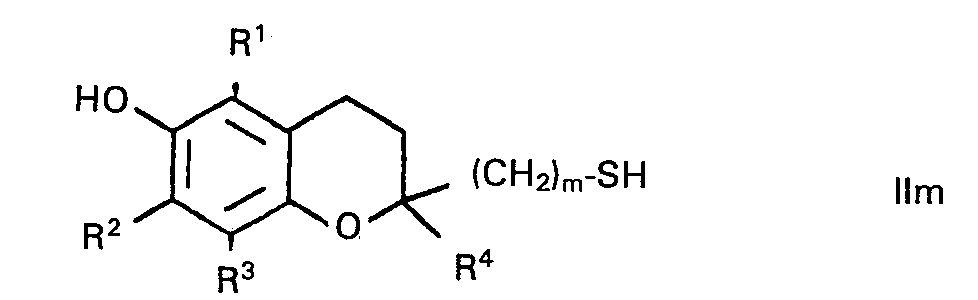
- Die Herstellung dieser Verbindungen verläuft analog den Methoden (e)-(h), indem man von den entsprechenden Thiolen IIm

- Die erfindungsgemässen Chromanderivate I eignen sich hervorragend als Stabilisatoren von organischen Materialien gegen Schädigungen durch Wärme, Lichtund oxidative Einflüsse. Als organische Materialien sind Fette, Ole, Wachse, pharmazeutische und kosmetische Zubereitungen sowie vor allem Kunststoffe zu nennen. Je nach der Beanspruchung dieser Materialien verwendet man die Stabilisatoren in Konzentrationen von 0,01 bis 1,0, in der Regel von 0,1 bis 0,5 Gew.-%, bezogen auf die Menge des Kunststoffes. Für hochempfindliche Substrate, z.B. Vitamine, können die Konzentrationen bis zu 20 Gew.-% ansteigen. Die erfindungsgemässen Stabilisatoren können allein oder in Mischung mit anderen Stabilisatoren, besonders mit sogenannten Synergisten, verwendet werden. Synergisten sind solche Verbindungen, die für sich allein keine oder nur eine geringe stabilisierende Wirkung haben, zusammen mit Stabilisierungsmitteln deren Effekt jedoch deutlich verbessern. Solche Synergisten sind beispielsweise Calciumstearat und Distearylthiodipropionat

- Man verwendet die Synergisten im allgemeinen in Mengen von 50 bis 500 Gew.-%, bezogen auf die Menge des Stabilisierungsmittels.
- Allgemein werden die organischen Materialien durch Stabilisatoren gegen Veränderungen und Zersetzung geschützt, im Falle von Kunststoffen also vornehmlich gegen den Abbau und die unerwünschte Vernetzung der Makromoleküle, Veränderungen, die sich als Alterung, Versprödung, Verfärbung und Herabsetzung der Erweichungstemperatur äussern.
- Für die Eignung und Wirksamkeit von Stabilisatoren sind vor allem folgende Kriterien massgebend:
- Das Substrat soll durch den Stabilisator nicht verfärbt werden. Diese Forderung, die naturgemäss für farblose Kunststoffe von besonderer Wichtigkeit ist, wird durch die erfindungsgemässen Stabilisatoren bei den meisten Kunststoffen befriedigend bis ausgezeichnet erfüllt, und in aller Regel sind diese Verbindungen herkömmlichen Stabilisierungsmitteln, darunter auch dem a-Tocopherol, überlegen. Die quantitative Ermittlung der Farbeigenschaften kann nach verschiedenen Methoden bestimmt werden, z.B. nach dem Yellowness-Test (ASTMD 1925).
- Hierunter ist die Eigenschaftskonstanz von Thermoplasten gegenüber der mechanischen und thermischen Beanspruchung bei Formgebungsverfahren wie der Extrusion und dem Spritzguss zu verstehen. In dieser Beziehung werden mit den erfindungsgemässen Stabilisatoren besonders gute Ergebnisse erzielt. Eine Masszahl für die Verarbeitungsstabilität lässt sich aus der Änderung des Schmelzverhaltens des betreffenden Thermoplasten nach mehrmaliger Formgebung unter Wiederaufschmelzen ableiten. Der entsprechende Schmelzindex-Text ist in DIN 53 735 beschrieben. Ein wichtiges Kriterium für die Verarbeitungsstabilität ist auch die Farbkonstanz, die z.B. nach dem Yellowness-Test ermittelt werden kann.
- Das Verhalten des Kunststoffes gegen rigorose thermische und oxidative Einflüsse ist ein Indiz für die Dauer der Qualitätskonstanz bei bestimmungsgemässem Gebrauch, d.h. aus den bei den entsprechenden Tests (DIN 53 383, Blatt 1) ermittelten Werten lässt sich die Lebensdauer des Kunststoffartikels abschätzen. Hier bieten die erfindungsgemässen Stabilisatoren in Verbindung mit Synergisten Vorteile.
- Nähere Angaben zur Qualitätsprüfung der erfindungsgemässen Stabilisatoren sind den Versuchen über deren Wirkung zu entnehmen.
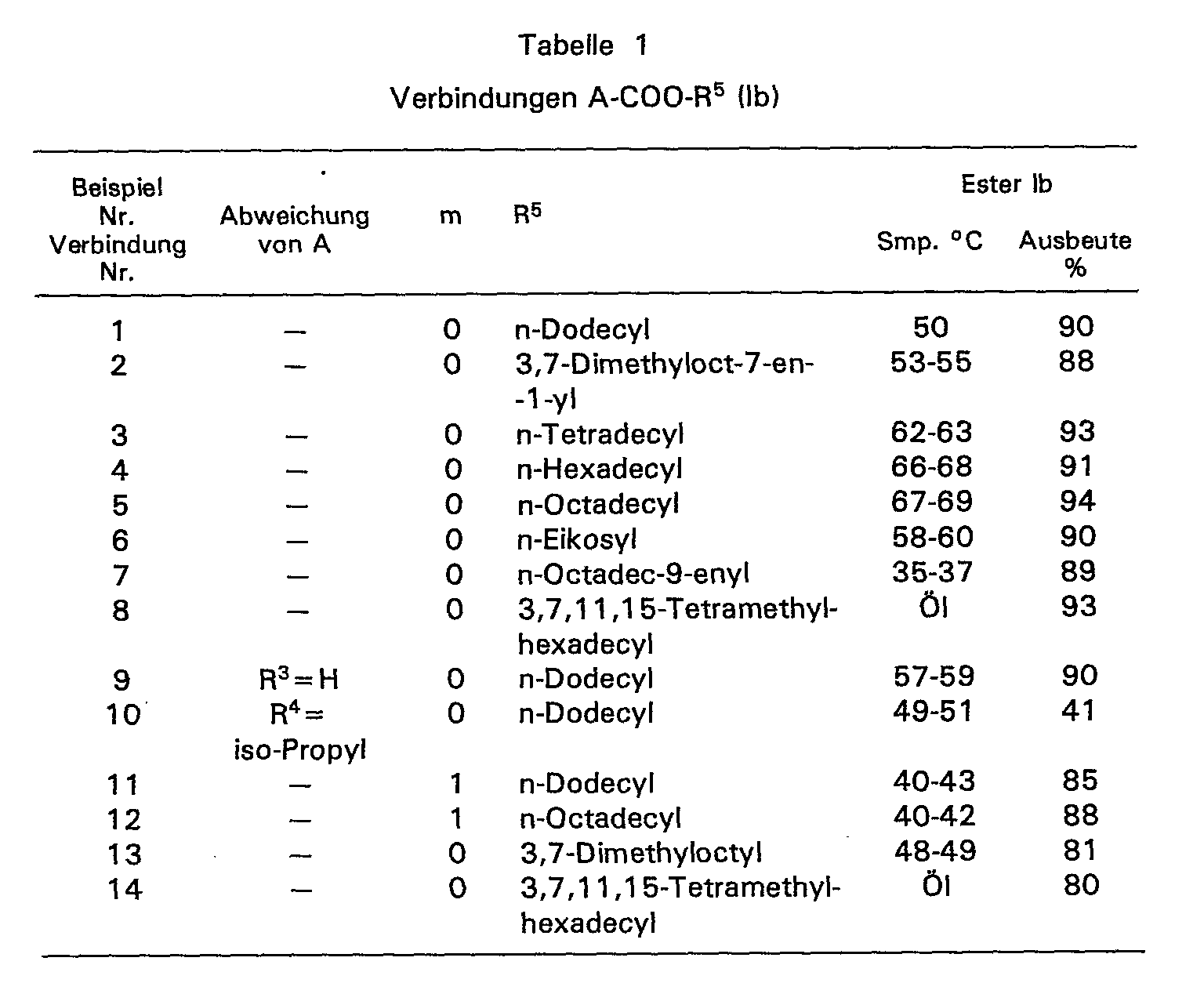
- In den Beispielen 1 bis 12 wurden je 80 g (0,32 Moi) 6-Hydroxy-2,5,7,8-tetramethylchroman-2--carbonsäure

- In den Beispielen 13 und 14 wurden je 10 g (43 mMol) des Nitrils A-CN in 50 ml wasserfreiem Tetrahydrofuran und 30 g des Alkohols R5-OH gelöst. Diese Lösung wurde bei 0°C mit Chlorwasserstoff gesättigt und 3 Tage bei dieserTemperatur gehalten. Die Aufarbeitung dieses Reaktionsgemisches erfolgte wie üblich.
- Die Ergebnisse sind in Tabelle 1 zusammengestellt. Soweit im Rest A einer der Substituenten R'-R4 nicht die Methylgruppe bedeutet, ist dies durch Angabe des tatsächlichen Substituenten, der anstelle der Methylgruppe steht, vermerkt.
- In den Beispielen 15 bis 21 wurden je 30 g (0,12 Mol) des Chromanderivates A-(CH2)m-OH in 1 I Toluol und in Gegenwart von 3 g p-Toluolsulfonsäure mit der äquimolaren Menge einer Carbonsäure R5-COOH so lange unter Rückflusskühlung erhitzt, bis kein Wasser mehr abgeschieden wurde. Die Aufarbeitung erfolgte wie üblich. Die Reinigung der Rohester le wurde durch Umkristallisation aus Methanol/Wasser vorgenommen.
- In den Beispielen 22 und 23 wurden anstelle der Säuren R5-COOH die entsprechenden Säurechloride eingesetzt, und die Veresterung wurde in Gegenwart der äquimolaren Menge Pyridin vorgenommen. Die Ergebnisse sind in Tabelle 2 zusammengestellt.

- Analog den Beispielen 22 und 23 wurde das Chromanderivat A-(CH2)m-OH mit einem Chlorameisensäureester R5-O-CO-Cl umgesetzt. Die Ergebnisse sind der Tabelle 3 zu entnehmen.

- 4,7 g (0,02 Mol) des Aminomethylchromanderivates A-CH2-NH2 wurden in 150 ml Toluol in Gegenwart von 3 g Piperidin mit 5,5 g (0,02 Mol) Palmitinsäurechlorid umgesetzt. Die übliche Aufarbeitung lieferte die Verbindung A-CH2-NH-CO-palmityl in 88%iger Ausbeute.
- Analog Beispiel 26 wurde das Aminomethylchromanderivat mit 6,13 g (0,02 Mol) n-Hexadecylchlorameisensäureester umgesetzt. Die übliche Aufarbeitung lieferte das Urethan A-CH2-NH-CO-O-n-hexadecyl als farbloses Öl in 90%iger Ausbeute.
- 10 g (31 mMol) 6-Benzyl-A-CH2-NH2, welches durch Umsetzung von A-CH2-NH2 mit Benzylchlorid in Gegenwart von Kaliumcarbonat und Dimethylformamid hergestellt wurde (Smp. des Hydrochlorids 155°C), wurde analog Beispiel 26 mit Palmitinsäurechlorid umgesetzt und wie üblich auf das 6-Benzyl-A-CH2-NH-CO-n-pentadecyl aufgearbeitet. Die Ausbeute an dieser Verbindung betrug 98%; Smp. 83 bis 84°C. Anschliessend wurde die Benzylgruppe durch Hydrierung bei 55°C und 10 bar Wasserstoffdruck in Gegenwart eines Pd/Kohle-Katalysators abgespalten. Die Aufarbeitung lieferte das freie A-CH2-NH-CO-n-pentadecyl in 87%iger Ausbeute als gelbliches Öl.
- In eine Mischung aus 9 g (0,06 Mol) Trimethylhydrochinon, 8 g (0,06 Mol) 4-Chlor-2-methylcroton- säure, 3 g wasserfreiem Zinkchlorid und 80 ml Heptan wurden im Laufe einer Stunde bei 98°C 3 I Chlorwasserstoff eingeleitet. Nach weiterem zweistündigem Erhitzen wurde die Heptanphase dekantiert und derverbleibende ölige Rückstand mit 50 ml Methanol versetzt und 24 Stunden lang bei 20°C gerührt. Hierbei bildete sich ein Niederschlag, der abgetrennt wurde. Die verbleibende methanolische Mutterlauge wurde mit Wasser versetzt, worauf sich ein weiterer Niederschlag bildete. Beide Niederschläge wurden vereinigt und aus Wasser umkristallisiert. Die Ausbeute an 4-(2,5-Dihydroxy-3,4,6-trimethylphenyl)--2-methylcrotonsäure betrug 62%, Smp. 208°C (Zers.).
- Diese Verbindung wurde nach der Vorschrift der Beispiele 1 bis 12 mit n-Dodecanol verestert. Die Ausbeute an Ester, bezogen auf die Säure, betrug 79%, Smp. 40 bis 43°C. Der Ester wurde mit 0,1 g Kupfer(l)-bis-pyridin-chlorid in 250 ml Methanol gelöst, worauf Luft durch diese Lösung geleitet wurde. Hierbei ging das Hydrochinon in das entsprechende Chinon über (gelbes Öl). Ausbeute quantitativ.
- 12 g des Chinonderivates wurden in 20 ml wasserfreiem Pyridin 1,5 Stunden lang unter Rückflusskühlung erhitzt, wobei sich das Chromenderivat

- Die Hydrierung zum Chromanderivat (1) wurde bei 50°C und 10 bar Wasserstoffdruck an einem Pd/ Kohle-Katalysator vorgenommen. Die Ausbeute, bezogen auf das Chromen, betrug 96%.
- Hier wurde die Farbqualität als Yellowness-Index YI nach dem Yellowness-Test (ASTMD 1925) gemessen.
- Als Testmaterial diente additivfreies dechloriertes Polypropylen, in welches der Stabilisator auf jeweils gleiche Weise eingearbeitet wurde, und das zu Granulat von 15 mm Schichtdicke und zu Platten von 1 mm Schichtdicke geformt wurde. Die angegebenen YI-Werte sind jeweils das Mittel aus zwei Messungen. Je höher diese Werte, um so geringer ist die Farbqualität. Die Ergebnisse sind der Tabelle 4 zu entnehmen. Den Werten entsprechen etwa folgende wahrnehmbare Verfärbungen des Testmaterials:
- 2 nicht erkennbare Verfärbung
- 3- 5 sehr schwache Verfärbung
- 5-10 schwache, aber bereits deutlich erkennbare Verfärbung
- 10-20 merkliche Verfärbung
- 20 starke Verfärbung


- Die Polypropylenproben (gleiches Material wie beim Farbtest) wurden sechsmal extrudiert und granuliert. Aus den Schmelzindizes MFI (zur Bestimmungsmethode s. DIN 53 735) nach der ersten und der sechsten Extrusion wurde der Quotient MFI6/MFI1 gebildet. Je grösser dieser Quotient ist, um so geringer ist die Verarbeitungsstabilität. Die Farbmessungen entsprechen dem vom Farbtest. Die Ergebnisse sind der Tabelle 5 zu entnehmen.


- Polypropylenplatten der Beschaffenheit wie beim Farbtest wurden nach DIN 53 383, Blatt 1, der sogenannten Ofenalterung unterworfen, indem die Platten im Wärmeschrank unter Frischluftzufuhr so lange auf 140°C erhitzt wurden, bis sie erkennbar versprödeten. Die visuelle Prüfung wurde alle 24 Stunden vorgenommen, d.h. die Alterung wurde hier in Tagen gemessen. Je geringer die Werte, desto geringer die Langzeitstabilität. Die Werte sind Mittelwerte aus 10 Messungen und verstehen sich jeweils mit einer Abweichung mit bis zu etwa 5%. Die Ergebnisse sind in Tabelle 6 zusammengestellt.
- Polypropylenproben wurden in geschmolzenem Zustand unter reiner Sauerstoffatmosphäre auf 180°C bis zum Beginn eines merklichen Sauerstoffverbrauchs erhitzt. Diese sogenannte Induktionszeit wurde in Minuten gemessen. Tabelle 7 gibt die Ergebnisse wieder.


- Je 10 mg eines Trockenpulvers, welches aus 88,5 Gew.-% Polyvinylpyrrolidon, 10 Gew.-% β-Carotin und 1,5 Gew.-% eines Stabilisators bestand, wurden in 10 ml luftgesättigtem Wasser gelöst. Der intensiven Gelbfärbung der klaren Lösung entsprach ein Licht-Absorptionsmaximum von 430 nm. Bei dieser Wellenlänge und 1 cm Schichtdicke der Lösung betrug die Extinktion 0,8, die gleich 100% gesetzt wurde.
- Zur Ermittlung der Stabilität des β-Carotins gegen den Einfluss von Licht wurde die Lösung mit monochromatischem UV-Licht einer Quecksilberhochdrucklampe bestrahlt (365 nm; 1 mW/cm2). Ein Mass für die Zerstörung des β-Carotins durch diese Bestrahlung ist die Entfärbung der Lösung, also die Abnahme der Extinktion. Der Tabelle 8 ist jeweils diejenige Zeit in Minuten zu entnehmen, bei der die Extinktion auf den 1 /e-ten Teil, also auf rund 0,4% abfiel. Näheres zu dieser Bestimmungsmethode vgl. J. Photochem., Band 7 (1977), S. 355.
- Das β-Carotin-Trockenpulver obiger Zusammensetzung wurde 7 Tage lang im Dunkeln bei 25°C gelagert. Anschliessend wurde die Extinktion in Prozent des ursprünglichen Wertes Eo (= 100%) bestimmt. Für die Messungen wurden jeweils Lösungen aus 50 mg des Trockenpulvers in 100 ml Chloroform verwendet. Die Ergebnisse dieses Tests gehen ebenfalls aus der Tabelle 8 hervor.

Claims (14)



Applications Claiming Priority (2)
| Application Number | Priority Date | Filing Date | Title |
|---|---|---|---|
| DE19803010505 DE3010505A1 (de) | 1980-03-19 | 1980-03-19 | Chromanderivate, verfahren zu ihrer herstellung, ihre verwendung als stabilisatoren von organischen materialien sowie diese stabilisatoren enthaltende organische materialien |
| DE3010505 | 1980-03-19 |
Publications (2)
| Publication Number | Publication Date |
|---|---|
| EP0036169A1 EP0036169A1 (de) | 1981-09-23 |
| EP0036169B1 true EP0036169B1 (de) | 1983-06-29 |
Family
ID=6097654
Family Applications (1)
| Application Number | Title | Priority Date | Filing Date |
|---|---|---|---|
| EP81101735A Expired EP0036169B1 (de) | 1980-03-19 | 1981-03-10 | Chromanderivate, Verfahren zu ihrer Herstellung, ihre Verwendung als Stabilisatoren von organischen Materialien sowie diese Stabilisatoren enthaltende organische Materialien |
Country Status (4)
| Country | Link |
|---|---|
| US (1) | US4511685A (de) |
| EP (1) | EP0036169B1 (de) |
| JP (1) | JPS56145283A (de) |
| DE (2) | DE3010505A1 (de) |
Families Citing this family (31)
| Publication number | Priority date | Publication date | Assignee | Title |
|---|---|---|---|---|
| DE3103740A1 (de) | 1981-02-04 | 1982-08-19 | Basf Ag, 6700 Ludwigshafen | Chromanderivate |
| DE3103707A1 (de) * | 1981-02-04 | 1982-08-19 | Basf Ag, 6700 Ludwigshafen | Chromanderivate |
| US4523024A (en) * | 1982-11-26 | 1985-06-11 | Kuraray Co., Ltd. | 3,4-Dihydro-2H-benzopyran derivatives, a method of producing them, a method of using them as stabilizers for organic materials, and organic compositions containing such stabilizers |
| US4785017A (en) * | 1983-06-24 | 1988-11-15 | Hoffmann-La Roche Inc. | 3,4-dihydro-2H-1-benzopyran derivatives |
| DE3421977A1 (de) * | 1984-06-14 | 1985-12-19 | Basf Ag, 6700 Ludwigshafen | 2,3-dihydrobenz-4-oxa-1-thiine |
| US4681890A (en) * | 1984-10-30 | 1987-07-21 | Kuraray Co., Ltd. | 3,4-dihydrobenzopyran compounds and pharmaceutical composition containing the same |
| DE3484473D1 (de) * | 1984-12-06 | 1991-05-23 | Kuraray Co | Chroman-verbindungen und deren herstellung. |
| US4599286A (en) * | 1984-12-24 | 1986-07-08 | Xerox Corporation | Photoconductive imaging member with stabilizer in charge transfer layer |
| DE3504981A1 (de) * | 1985-02-14 | 1986-08-14 | Basf Ag, 6700 Ludwigshafen | Stabilisatoren |
| DE3634531A1 (de) * | 1986-10-10 | 1988-04-14 | Basf Ag | Stabilisatorgemische fuer kunststoffe |
| DE3735577A1 (de) * | 1987-10-21 | 1989-05-03 | Basf Ag | Gemisch zum stabilisieren von polyurethanen |
| US5308549A (en) * | 1991-11-12 | 1994-05-03 | Hoffmann-La Roche Inc. | Stabilizers for thermo plastic materials |
| CA2082003A1 (en) * | 1991-11-20 | 1993-05-21 | David Laffan | Process for the preparation of substituted pentaalkylchromenes |
| EP0550292A1 (de) * | 1992-01-02 | 1993-07-07 | Merrell Dow Pharmaceuticals Inc. | Tocopherol-Analog zum Gewebeschutz |
| US5721233A (en) * | 1992-04-06 | 1998-02-24 | Merrell Pharmaceuticals Inc. | Derivatives of 2,3-dihydro benzofuranols |
| US5510373A (en) * | 1992-04-06 | 1996-04-23 | Merrell Pharmaceuticals Inc. | Cardioprotective agents |
| AU675784B2 (en) * | 1992-04-07 | 1997-02-20 | Merrell Dow Pharmaceuticals Inc. | Hydrazide derivatives of 3,4-dihydro-2H-1-benzopyrans |
| US5482986A (en) * | 1993-07-22 | 1996-01-09 | Mitsui Toatsu Chemicals, Inc. | Benzopyran compound and use of the same |
| WO1996033987A1 (en) * | 1995-04-26 | 1996-10-31 | Henkel Corporation | Method of producing a tocopherol product |
| DE19516283A1 (de) * | 1995-05-04 | 1996-11-07 | Basf Ag | Thermoplastische Formmasse |
| US5574082A (en) * | 1995-05-25 | 1996-11-12 | Quantum Chemical Company | Propylene polymer compositions having improved color and stabilizers therefor. |
| WO1997003974A2 (de) * | 1995-07-20 | 1997-02-06 | Basf Aktiengesellschaft | Chromanderivate, deren herstellung und deren verwendung als stabilisatoren von organischen material gegenüber licht, sauerstoff un wärme |
| DE19633560A1 (de) * | 1996-08-21 | 1998-02-26 | Basf Ag | Chromanyl-ascorbinsäurederivate, deren Herstellung und Verwendung |
| US6156421A (en) * | 1997-04-02 | 2000-12-05 | Kimberly-Clark Worldwide, Inc. | Stretched-filled microporous films and methods of making the same |
| CA2319131A1 (en) | 1998-01-26 | 1999-07-29 | Walter H. Moos | Mitochondria protecting agents for treating mitochondria associated diseases |
| US7083743B2 (en) | 1999-12-20 | 2006-08-01 | Clariant Finance (Bvi) Limited | Mixture of phosphanes and chromane derivatives |
| DE19961464A1 (de) * | 1999-12-20 | 2001-06-21 | Clariant Internat Ltd Muttenz | Mischungen aus Phosphanen und Chroman-Derivaten |
| ITTO20030140U1 (it) * | 2003-09-16 | 2005-03-17 | Interfila Srl | Matita cosmetica |
| WO2005033092A1 (en) | 2003-09-19 | 2005-04-14 | Galileo Pharmaceuticals, Inc. | Chroman derivatives |
| JP6255975B2 (ja) * | 2012-12-27 | 2018-01-10 | Jnc株式会社 | 液晶組成物、酸化防止剤および液晶表示素子 |
| CN104374900B (zh) * | 2014-11-17 | 2016-02-24 | 深圳市星源材质科技股份有限公司 | Pp薄膜耐老化性能测试方法 |
Family Cites Families (7)
| Publication number | Priority date | Publication date | Assignee | Title |
|---|---|---|---|---|
| LU37064A1 (de) * | 1958-04-04 | Hercules Powder Co Ltd | ||
| DE1114319B (de) * | 1959-05-02 | 1961-09-28 | Basf Ag | Formmasse aus Polyolefinen und einer Stabilisatormischung |
| DE1136102B (de) * | 1959-06-10 | 1962-09-06 | Basf Ag | Formmassen aus Polyolefinen und einer Stabilisatormischung |
| ZA739471B (en) * | 1972-12-22 | 1974-08-28 | Hoffmann La Roche | Chromane derivatives |
| US3947473A (en) * | 1972-12-22 | 1976-03-30 | Hoffman-La Roche Inc. | Antioxidant chroman compounds |
| US4051153A (en) * | 1975-01-27 | 1977-09-27 | Hoffmann-La Roche Inc. | Intermediates in the synthesis of vitamin E |
| US4150050A (en) * | 1978-01-30 | 1979-04-17 | Hoffmann-La Roche Inc. | 3,6-Dioxo-1,4-cyclohexadien-1-yl-butandate esters |
-
1980
- 1980-03-19 DE DE19803010505 patent/DE3010505A1/de not_active Withdrawn
-
1981
- 1981-02-26 US US06/238,593 patent/US4511685A/en not_active Expired - Fee Related
- 1981-03-10 DE DE8181101735T patent/DE3160510D1/de not_active Expired
- 1981-03-10 EP EP81101735A patent/EP0036169B1/de not_active Expired
- 1981-03-19 JP JP3880781A patent/JPS56145283A/ja active Granted
Also Published As
| Publication number | Publication date |
|---|---|
| DE3160510D1 (en) | 1983-08-04 |
| DE3010505A1 (de) | 1981-10-01 |
| JPS56145283A (en) | 1981-11-11 |
| JPS6366316B2 (de) | 1988-12-20 |
| US4511685A (en) | 1985-04-16 |
| EP0036169A1 (de) | 1981-09-23 |
Similar Documents
| Publication | Publication Date | Title |
|---|---|---|
| EP0036169B1 (de) | Chromanderivate, Verfahren zu ihrer Herstellung, ihre Verwendung als Stabilisatoren von organischen Materialien sowie diese Stabilisatoren enthaltende organische Materialien | |
| DE2811041C2 (de) | ||
| EP0418797B1 (de) | Pyrimidin-4,6-dicarbonsäurediamide, Verfahren zu deren Herstellung sowie Verwendung derselben sowie Arzneimittel auf Basis dieser Verbindungen | |
| DE69724422T2 (de) | Arylalkylpiperazin-verbindungen als antioxidantien | |
| DE3151534A1 (de) | Mit aminoreduktonen als antioxidantien stabilisierte organische materialien | |
| DE3510526A1 (de) | 1-(hydroxymethyl)-1,6,7,11b-tetrahydro-2h,4h-(1,3)oxazino-beziehungsweise 1-(hydroxymethyl)-1,6,7,11b-tetrahydro-2h,4h-(1,3)thiazino(4,3-a)isochinolinderivate, verfahren zu ihrer herstellung und diese enthaltende arzneimittel | |
| EP0057427B1 (de) | Chromanderivate | |
| EP0057425A1 (de) | Chromanderivate | |
| DE2546738A1 (de) | Benzophenonderivate, verfahren zu ihrer herstellung und sie enthaltende pharmazeutische mittel | |
| DE60102925T2 (de) | Amino-thiolester-verbindungen, diese enthaltende pharmazeutische und kosmetische zusammensetzungen und ihre anwendungen | |
| DE69124534T2 (de) | Katecholderivate, deren physiologisch unbedenkliche Salze, Ester und deren Verwendung bei der Behandlung von durch Lipidperoxidation verursachten Gewebeschäden | |
| EP0271649B1 (de) | Ester von 3-tert.-Butyl- bzw. 3-tert.-Butyl-5-alkyl-4-hydroxylphenyl-(alkan)-carbonsäuren mit Oxethylaten von Bis-(4- bzw. 2-hydroxyphenyl)-alkanen, -oxiden, -sulfiden und -sulfonen, von Tris-(4-hydroxyphenyl)-alkanen und von 1,3,5-Tris-(4-hydroxyphenyl-isopropyliden)-arylen, Verfahren zu ihrer Herstellung und ihre Verwendung als Stabilisatoren | |
| DE2254476A1 (de) | Nickel-komplexe von 2-(2'-hydroxyphenyl)-v-triazolen | |
| DE2514814C2 (de) | Verwendung von Pyridoxinderivaten als Lichtschutzmittel | |
| EP0268039B1 (de) | Ester von 3-tert.Butyl- bzw. 3-tert.-Butyl-5-alkyl-4-hydroxyphenyl-(alkan-)-carbonsäuren mit Oxethylaten von Polythiolen, Verfahren zu ihrer Herstellung und ihre Verwendung als Stabilisatoren | |
| EP0170822B1 (de) | 2,3-Dihydrobenz-4-oxa-1-thiine | |
| DE3639400C2 (de) | ||
| DE1911835C3 (de) | Schwefelhaltige Diaryloxalamide, Verfahren zu deren Herstellung und deren Verwendung zur Stabilisierung von Kunststoffen | |
| EP0007347B1 (de) | Lipidsenkende Alkylenglykolderivate und Verfahren zu ihrer Herstellung | |
| EP0268037B1 (de) | Ester von 3-tert.-Butyl- bzw. 3-tert.-Butyl-5-alkyl-4-hydroxyphenyl-(alkan)-carbonsäuren mit Oxethylaten von Polyhydroxy-aromaten, Verfahren zu ihrer Herstellung und ihre Verwendung als Stabilisatoren | |
| CH651580A5 (de) | Mischung zum stabilisieren von polymerisaten und verfahren zur herstellung dieser mischung. | |
| DE3639339C1 (en) | Diesters of bis-alpha,omega-(2-hydroxyethylthio)alkanes with 3-tert-butyl- or 3-tert-butyl-5-alkyl-4-hydroxyphenyl(alkane)carboxylic acids and their use as stabilisers for polyolefins and polydienes | |
| EP0758647B1 (de) | Acyl-substituierte Aminopyrane mit einer modulierende Wirkung auf Kaliumkanäle | |
| DE3927460A1 (de) | Entzuendungshemmende wirkstoffe fuer kosmetische praeparate | |
| DE2427503A1 (de) | Halogenfusarsaeureamide, verfahren zur herstellung derselben und mittel mit einem gehalt derselben |
Legal Events
| Date | Code | Title | Description |
|---|---|---|---|
| PUAI | Public reference made under article 153(3) epc to a published international application that has entered the european phase |
Free format text: ORIGINAL CODE: 0009012 |
|
| AK | Designated contracting states |
Designated state(s): BE CH DE FR GB IT NL |
|
| 17P | Request for examination filed |
Effective date: 19810930 |
|
| ITF | It: translation for a ep patent filed | ||
| GRAA | (expected) grant |
Free format text: ORIGINAL CODE: 0009210 |
|
| AK | Designated contracting states |
Designated state(s): BE CH DE FR GB IT LI NL |
|
| REF | Corresponds to: |
Ref document number: 3160510 Country of ref document: DE Date of ref document: 19830804 |
|
| ET | Fr: translation filed | ||
| PLBE | No opposition filed within time limit |
Free format text: ORIGINAL CODE: 0009261 |
|
| STAA | Information on the status of an ep patent application or granted ep patent |
Free format text: STATUS: NO OPPOSITION FILED WITHIN TIME LIMIT |
|
| 26N | No opposition filed | ||
| PGFP | Annual fee paid to national office [announced via postgrant information from national office to epo] |
Ref country code: FR Payment date: 19890224 Year of fee payment: 9 |
|
| PGFP | Annual fee paid to national office [announced via postgrant information from national office to epo] |
Ref country code: CH Payment date: 19890228 Year of fee payment: 9 |
|
| PGFP | Annual fee paid to national office [announced via postgrant information from national office to epo] |
Ref country code: BE Payment date: 19890306 Year of fee payment: 9 |
|
| PGFP | Annual fee paid to national office [announced via postgrant information from national office to epo] |
Ref country code: DE Payment date: 19890325 Year of fee payment: 9 |
|
| ITTA | It: last paid annual fee | ||
| PGFP | Annual fee paid to national office [announced via postgrant information from national office to epo] |
Ref country code: NL Payment date: 19890331 Year of fee payment: 9 Ref country code: GB Payment date: 19890331 Year of fee payment: 9 |
|
| PG25 | Lapsed in a contracting state [announced via postgrant information from national office to epo] |
Ref country code: GB Effective date: 19900310 |
|
| PG25 | Lapsed in a contracting state [announced via postgrant information from national office to epo] |
Ref country code: DE Effective date: 19900330 |
|
| PG25 | Lapsed in a contracting state [announced via postgrant information from national office to epo] |
Ref country code: LI Effective date: 19900331 Ref country code: CH Effective date: 19900331 Ref country code: BE Effective date: 19900331 |
|
| BERE | Be: lapsed |
Owner name: BASF A.G. Effective date: 19900331 |
|
| PG25 | Lapsed in a contracting state [announced via postgrant information from national office to epo] |
Ref country code: NL Effective date: 19901001 |
|
| GBPC | Gb: european patent ceased through non-payment of renewal fee | ||
| NLV4 | Nl: lapsed or anulled due to non-payment of the annual fee | ||
| PG25 | Lapsed in a contracting state [announced via postgrant information from national office to epo] |
Ref country code: FR Effective date: 19901130 |
|
| REG | Reference to a national code |
Ref country code: CH Ref legal event code: PL |
|
| REG | Reference to a national code |
Ref country code: FR Ref legal event code: ST |