EP0039220A1 - Lithiumfluoraluminate amorphe, électrolyte solide le contenant et dispositifs contenant celui-ci - Google Patents
Lithiumfluoraluminate amorphe, électrolyte solide le contenant et dispositifs contenant celui-ci Download PDFInfo
- Publication number
- EP0039220A1 EP0039220A1 EP81301820A EP81301820A EP0039220A1 EP 0039220 A1 EP0039220 A1 EP 0039220A1 EP 81301820 A EP81301820 A EP 81301820A EP 81301820 A EP81301820 A EP 81301820A EP 0039220 A1 EP0039220 A1 EP 0039220A1
- Authority
- EP
- European Patent Office
- Prior art keywords
- alf
- film
- amorphous
- same
- lif
- Prior art date
- Legal status (The legal status is an assumption and is not a legal conclusion. Google has not performed a legal analysis and makes no representation as to the accuracy of the status listed.)
- Granted
Links
Images

Classifications
-
- G—PHYSICS
- G02—OPTICS
- G02F—OPTICAL DEVICES OR ARRANGEMENTS FOR THE CONTROL OF LIGHT BY MODIFICATION OF THE OPTICAL PROPERTIES OF THE MEDIA OF THE ELEMENTS INVOLVED THEREIN; NON-LINEAR OPTICS; FREQUENCY-CHANGING OF LIGHT; OPTICAL LOGIC ELEMENTS; OPTICAL ANALOGUE/DIGITAL CONVERTERS
- G02F1/00—Devices or arrangements for the control of the intensity, colour, phase, polarisation or direction of light arriving from an independent light source, e.g. switching, gating or modulating; Non-linear optics
- G02F1/01—Devices or arrangements for the control of the intensity, colour, phase, polarisation or direction of light arriving from an independent light source, e.g. switching, gating or modulating; Non-linear optics for the control of the intensity, phase, polarisation or colour
- G02F1/15—Devices or arrangements for the control of the intensity, colour, phase, polarisation or direction of light arriving from an independent light source, e.g. switching, gating or modulating; Non-linear optics for the control of the intensity, phase, polarisation or colour based on an electrochromic effect
- G02F1/1514—Devices or arrangements for the control of the intensity, colour, phase, polarisation or direction of light arriving from an independent light source, e.g. switching, gating or modulating; Non-linear optics for the control of the intensity, phase, polarisation or colour based on an electrochromic effect characterised by the electrochromic material, e.g. by the electrodeposited material
- G02F1/1523—Devices or arrangements for the control of the intensity, colour, phase, polarisation or direction of light arriving from an independent light source, e.g. switching, gating or modulating; Non-linear optics for the control of the intensity, phase, polarisation or colour based on an electrochromic effect characterised by the electrochromic material, e.g. by the electrodeposited material comprising inorganic material
- G02F1/1525—Devices or arrangements for the control of the intensity, colour, phase, polarisation or direction of light arriving from an independent light source, e.g. switching, gating or modulating; Non-linear optics for the control of the intensity, phase, polarisation or colour based on an electrochromic effect characterised by the electrochromic material, e.g. by the electrodeposited material comprising inorganic material characterised by a particular ion transporting layer, e.g. electrolyte
-
- C—CHEMISTRY; METALLURGY
- C01—INORGANIC CHEMISTRY
- C01F—COMPOUNDS OF THE METALS BERYLLIUM, MAGNESIUM, ALUMINIUM, CALCIUM, STRONTIUM, BARIUM, RADIUM, THORIUM, OR OF THE RARE-EARTH METALS
- C01F7/00—Compounds of aluminium
- C01F7/48—Halides, with or without other cations besides aluminium
- C01F7/50—Fluorides
- C01F7/54—Double compounds containing both aluminium and alkali metals or alkaline-earth metals
-
- H—ELECTRICITY
- H01—ELECTRIC ELEMENTS
- H01M—PROCESSES OR MEANS, e.g. BATTERIES, FOR THE DIRECT CONVERSION OF CHEMICAL ENERGY INTO ELECTRICAL ENERGY
- H01M6/00—Primary cells; Manufacture thereof
- H01M6/14—Cells with non-aqueous electrolyte
- H01M6/18—Cells with non-aqueous electrolyte with solid electrolyte
Definitions
- the present invention relates to an amorphous lithium fluoaluminate, to a solid electrolyte comprising this for use for example in electrochromic display devices and lithium batteries.
- films of RbAg 4 I 5 , LiF, MgF 2 and Cr 2 0 3 have been proposed, but these are defective in that the time required'for coloration and bleaching is very long (longer than 1 minute), they are significantly affec-ted by the atmosphere, reproducibility is poor, they have no memory action and their life is short.
- the invention as claimed is intended to provide a remedy.
- the Na 5 A1 3 F 14 crystal which has a stable phase, has a cubic structure in which four apices of this octahedron are co-owned and the remaining spaces are filled with Na ions (see Fig.2).
- the elementary process is only (e) annexation of the LiF molecule to the LiAlF 4 molecule, and rupture of the Al-F-Li bond which is inherently stable and long range diffusion of molecules need not occur.
- the elementary process is only (e) annexation of the LiF molecule to the LiAlF 4 molecule, and rupture of the Al-F-Li bond which is inherently stable and long range diffusion of molecules need not occur.
- Li and F crystallize in an NaCl- type structure where six foreign atoms coordinate with each other according to the mutual ion bonding, the ion radius ratio and the ion valency.
- Al and 3F are crystallized to a perovskite structure (strictly speaking, a deformed perovskite structure) in which six F atoms coordinate with Al in the octahedral form and two Al atoms coordinate with F, i.e. the respective apices of the octahedron are co-owned by Al and F.
- This octahedral structure expediently expressed as AlF6 3 is very stable and is the basic unit in a crystal of a compound containing Al and F.
- LiAlF 4 when LiF ⁇ AlF 3 is evaporated, a molecule LiAlF 4 exists stably in the gas. This, however, is not expected if one takes into account that the LiAlF 4 molecule contains two ions having a low electronegativity (Li and Al +++ ) between which the electrostatic repulsive force is extremely large. This fact will not be satisfactorily explained unless it is presumed that any Al-F-Li bond having a covalent nature exists stably. Furthermore, as already pointed out, the Al-F bond tends to have a structure in which F atoms coordinate around the Al atom, though in the LiAlF 4 molecule, the coordination number is not 6 providing a stable structure but is 4. Therefore, it is considered that the LiAlF 4 molecule has the following structure:
- Li 3 AlF 6 satisfies the above conditions (a) and (b) and AlF 3 free of Li satisfies the above condition (b).
- the amorphous substance of the present invention is generally a substance represented by the above formula 5Li x Na 1-x F ⁇ 3AlF 3 (in which 0.1 ⁇ x ⁇ 1.0), a substance represented by the formula Li x Na 1-x AlF 4 (in which 0 ⁇ x ⁇ 1.0) or a mixture of these.
- the amorphous substance of the present invention further includes a mixture of compounds of the general formula of claim 1 and a mixture of LiF, NaF and AlF 3 which has a composition included in the scope defined by the general formula.
- the amounts of Li, Na and F may each be outside the stoichiometric composition by about ⁇ 20%.
- the substance of the present invention can have excellent electrical conductivity and can be used as a solid electrolyte.
- the electrical conductivity is especially high when 0.5 ⁇ x ⁇ 1.0.
- the substance of the present invention can be prepared, for example, by rapidly cooling a melt or gas having the desired composition, or a vacuum evaporation deposition method may for example be adopted.
- a powder of a stoichiometric composition of LiF and AlF 3 was charged into an evaporation boat made of tungsten, and evaporated by resistance heating in a vacuum evaporation apparatus to deposit a solid on a substrate.
- the degree of vacuum was 1 to 5 mPa and the boat temperature was 700 to 1000°C.
- the substrate was a slide glass or a ITO-coated (indium-tin oxide-coated) slide glass and was maintained at room temperature.
- the deposition speed was 10 to 100 nm/min.
- the deposit formed was a colorless and transparent film firmly adhering to the substrate. In the X-ray diffraction diagram of the film, no peak was observed, and it was confirmed that the film was amorphous. On chemical analysis, it was found that the film had an average composition of Li 1.2 AlF 4.2 .
- a L i-Al alloy film electrode was deposited on this amorphous film on the ITO coating by vacuum evaporation deposition, and when a DC field of less than 3V was applied between the ITO and the electrode, an electric conductivity of 0 . 5 x 10 to 2 x 10 -5 ( ⁇ -cm) -1 was observed at room temperature only if Li ions were deemed to be stationary in the film. Accordingly, it was judged that this film is a lithium ion conductor having the above electric conductivity.
- Example 2 A process was carried out as in Example 1 except that the substrate temperature was 300°C.
- the vacuum evaporation film obtained consisted of a non-equilibrium LiAlF 4 crystal and had a thickness of 1.0 ⁇ m. This filmm had a lithium ion conductivity of 2 x 10 -5 ( ⁇ -cm) -1 .
- a powder of a stoichiometric composition of LiF and AlF 3 was charged into a Pt crucible having a small hole of size 0.2 x 5 mm 2 in the bottom, and was heated and melted at 930°C in an argon atmosphere by high frequency heating.
- the melt was ejected from the small hole by the argon gas pressure and allowed to fall onto a rotating roll made of Cu to cool it rapidly.
- a ribbon having a width of 5 mm and a thickness of 15 to 30 ⁇ m was obtained. No peak was observed in the X-ray diffraction diagram of the ribbon, and it was confirmed that the ribbon was amorphous.
- L i-Al alloy vacuum evaporation film electrodes were formed on both the surfaces of the ribbon, and the DC conductivity was examined and found to be 1 x 10 -5 ( ⁇ -cm) -1 at room temperature.
- Cr-Au laminate vacuum evaporation film electrodes were formed on both the surfaces of the ribbon and the AC conductivity was measured at 1 KHz, and found to be 1 x 10 -5 ( ⁇ -cm) -1 . It was thus confirmed that this amorphous ribbon was a lithium ion conductor having a composition corresponding to LiAlF 4 .
- a vacuum evaporation film having a thickness of 1.0 pm was obtained from a starting material which was a stoichiometric composition of NaF and A1F 3 , as described in Example 1. No peak was observed in the X-ray diffraction diagram of the film, and it was confirmed that the film was amorphous. By chemical analysis, it was found that the film had an average composition of Na 1.1 AlF 4.1 . The Na ion conductivity of the film at room temperature was 0.8 x 10 -5 ( ⁇ -cm) -1 .
- a vacuum evaporation film having a thickness of 1.0 ⁇ m was prepared from a mixture containing LiF, NaF and AlF 3 at a molar ratio of 0.5/0.5/1 as described in Examples 1 and 4. No peak was observed in the X-ray diffraction diagram of the film, and it was confirmed that the film was amorphous. By chemical analysis, it was found that the film had an average composition of Li 0.6 Na 0.5 AlF 4.1 . The ionic conductivity of the film was 0.5 x 10 -5 ( ⁇ -cm) -1 at room temperature.
- a powder of a mixture containing LiF and AlF 3 at a molar ratio of 5/3 was vacuum-evaporated to form a film.
- the degree of vacuum was 1 to 5 mPa and the boat temperature was 700 to 1000°C.
- the vacuum evaporation speed was 10 to 100 mn/min and the substrate temperature was room temperature or 200°C.
- As the substrate there was used a slide glass or an ITO-coated (indium-tin oxide-coated) slide glass.
- the film formed had a thickness of 1.0 ⁇ m and was colorless and transparent and adhered firmly to the substrate. No peak was observed in the X-ray diffraction diagram of the film, and it was confirmed that the film was amorphous.
- .it was found that the film had an average composition of Li 5.5 Al 3.0 F 14.5 .
- This amorphous substance thus corresponded to 5.5LiF ⁇ 3AlF 3 , and the molar ratio of AlF 3 of this amorphous substance in the LiF ⁇ AlF 3 system was expressed as 35.3 mol % AlF 3 .
- a Li-Al alloy film electrode was vacuum-evaporated on this film deposited on the ITO coating, and a DC field of less than 3V was applied between ITO and Li-Al alloy.
- the electric conductivity of 2 x 10 -5 ( ⁇ -cm) -1 was measured at room temperature (25°C) only when Li ions were deemed to be stationary in the film. Accordingly, it was judged that the film was a lithium ion conductor having the above electric conductivity.
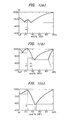
- Example 6 The process of Example 6 was carried out in a number of runs with the LiF/AlF 3 molar ratio varied to obtain the results shown in Fig.3, from which it is seen that when, the molar ratio is 5/3 or 1/1, a high lithium ion conductivity is obtained. Between these two molar ratios, a similarly high lithium ion conductivity can be obtained. It is thought that the reason for this is that each of substances having such an intermediate composition is a mixture of compounds having high ionic conductivity. On the other hand, an amorphous film in which the proportion of LiF is increased so that the molar ratio is 3/1 (corresponding to the stable phase Li 3 AlF 6 ), like LiF alone, has no ionic conductivity.
- Example 6 The process of Example 6 was changed in that half of the LiF was replaced by NaF. An amorphous substance having the composition Li 2.75 Na 2.75 Al 3.0 E 14.5 was obtained. The lithium ion conductivity of this was 1 x 10 -5 ( ⁇ -cm) -1 .
- a powder containing LiF and AlF3 at a molar ratio of 5/3 was charged into a Pt crucible having a small hole of size.0.2 x 5 mm 2 in the bottom, and was heated and melted at 800 0 C in an argon atmosphere by high frequency heating.
- the melt was ejected from the'small hole by the argon gas pressure and allowed to fall onto a rotating roll made of Cu to cool it rapidly.
- a ribbon of width 5 mm and thickness about 30 ⁇ m was obtained. From X -ray diffractiometry, it was found that the ribbon had an amorphous structure.
- Li-Al or Cr-Au electrodes were vacuum-evaporated onto both the surfaces of the ribbon, and the DC conductivity and AC conductivity were measured. It was found that the lithium ion conductivity was 1 x 10 -5 ( ⁇ -cm) -1 .
- the ionic conductivity (regarded as the lithium ion conductivity) of the film was 1 x 10 -5 ( ⁇ -cm) -1 at room temperature.
- This substance can be regarded not only as intermediate between Li 5 Al 3 F 14 and Li 3 AlF 6 but also as intermediate between Li 2 AlF 5 and Li 3 AlF 6 .
- Li 2 AlF 5 is not present as an equilibrium phase in the LiF-AlF 3 phase diagram, and even if Li is replaced by Na or K, no stable phase appears. Only if Li is replaced by Tl does a stable phase appear.
- the substance has a one- dimensional chain structure in which two apices of the AlF 6 3- octahedron are co - owned.
- the amorphous substance of this example is used in an electrochromic display device.
- a transparent electrode 2 (consisting of indium-tin oxide and having a thickness of 0.2 pm) is coated onto a glass substrate 1 and worked by photo-etching to give a desired plane configuration.
- a display electrode 3 (a tungsten oxide vacuum evaporation film having a thickness of 0.3 ⁇ m) having a desired plane configuration is formed on the electrode 2.
- a LiAlF 4 vacuum evaporation film 4 is deposited to cover the entire 'surface by mixing LiF powder with AlF 3 powder at a molar ratio of l/l, charging the mixture into a tungsten boat and heating the boat at 700 to 1000°C to effect evaporation.
- the substrate temperature is room temperature
- the deposition speed is 30 nm/min and the film thickness is 1.0 pm.
- a counter-electrode 5 is then formed, consisting of a vacuum evaporation film of LiAl, by mask deposition so that only the display electrode 3 is covered.
- the film thickness of the counter-electrode was 0.5 ⁇ m.
- an electrode 6 is formed to connect the counter-electrode 5 with an outer electrode.
- the electrode 6 consists of a vacuum evaporation film of Al having a thickness of 0.5 ⁇ m and is prepared by mask deposition so that a desired configuration is given to the electrode 6.
- the transparent electrode 2 and electrode 6 are not opposed to each other except where the display electrode is disposed.
- the resulting element is sealed in an appropriate package (not shown) to prevent mechanical and chemical damage.
- the main operational characteristics of the all solid state electrochromic display device so obtained at room temperature are as follows.
Landscapes
- Chemical & Material Sciences (AREA)
- Physics & Mathematics (AREA)
- Electrochemistry (AREA)
- Chemical Kinetics & Catalysis (AREA)
- Organic Chemistry (AREA)
- Nonlinear Science (AREA)
- Inorganic Chemistry (AREA)
- General Chemical & Material Sciences (AREA)
- Life Sciences & Earth Sciences (AREA)
- Manufacturing & Machinery (AREA)
- Geology (AREA)
- Engineering & Computer Science (AREA)
- General Physics & Mathematics (AREA)
- Optics & Photonics (AREA)
- Conductive Materials (AREA)
- Secondary Cells (AREA)
Applications Claiming Priority (4)
| Application Number | Priority Date | Filing Date | Title |
|---|---|---|---|
| JP54159/80 | 1980-04-25 | ||
| JP5415980A JPS56155018A (en) | 1980-04-25 | 1980-04-25 | Solid compound and solid electrolyte |
| JP15829880A JPS5782820A (en) | 1980-11-12 | 1980-11-12 | Amorphous body of lithium fluoroaluminate |
| JP158298/80 | 1980-11-12 |
Publications (2)
| Publication Number | Publication Date |
|---|---|
| EP0039220A1 true EP0039220A1 (fr) | 1981-11-04 |
| EP0039220B1 EP0039220B1 (fr) | 1983-09-14 |
Family
ID=26394901
Family Applications (1)
| Application Number | Title | Priority Date | Filing Date |
|---|---|---|---|
| EP81301820A Expired EP0039220B1 (fr) | 1980-04-25 | 1981-04-24 | Lithiumfluoraluminate amorphe, électrolyte solide le contenant et dispositifs contenant celui-ci |
Country Status (3)
| Country | Link |
|---|---|
| US (1) | US4367267A (fr) |
| EP (1) | EP0039220B1 (fr) |
| DE (1) | DE3160864D1 (fr) |
Cited By (2)
| Publication number | Priority date | Publication date | Assignee | Title |
|---|---|---|---|---|
| CN110550939A (zh) * | 2019-09-09 | 2019-12-10 | 长江师范学院 | 用于制作矿物绝缘电缆的绝缘材料及其制备方法 |
| EP4539063A4 (fr) * | 2022-06-07 | 2025-12-31 | Panasonic Ip Man Co Ltd | Matériau d'électrolyte solide et son procédé de production |
Families Citing this family (16)
| Publication number | Priority date | Publication date | Assignee | Title |
|---|---|---|---|---|
| US4399203A (en) * | 1982-04-15 | 1983-08-16 | The Standard Oil Company | Sulfide and selenide compositions |
| US4889414A (en) * | 1984-08-21 | 1989-12-26 | Eic Laboratories, Inc. | Light modulating device |
| US4810599A (en) * | 1987-03-27 | 1989-03-07 | Japan Synthetic Rubber Co., Ltd. | Structure suitable for solid electrochemical elements |
| US4832463A (en) * | 1987-09-08 | 1989-05-23 | Tufts University | Thin film ion conducting coating |
| US5138481A (en) * | 1991-07-23 | 1992-08-11 | Ford Motor Company | Electrochromic device with color gradient and method of making the device |
| US5607784A (en) * | 1995-01-19 | 1997-03-04 | Electrochem, Inc. | Hydrogen/fluorine power generating system |
| US6420071B1 (en) | 2000-03-21 | 2002-07-16 | Midwest Research Institute | Method for improving the durability of ion insertion materials |
| CN102754257B (zh) * | 2009-11-09 | 2016-06-01 | 拉特格斯,新泽西州立大学 | 用于自形成电池的金属氟化物组合物 |
| US9692039B2 (en) | 2012-07-24 | 2017-06-27 | Quantumscape Corporation | Nanostructured materials for electrochemical conversion reactions |
| WO2015130831A1 (fr) | 2014-02-25 | 2015-09-03 | Quantumscape Corporation | Électrodes hybrides comportant à la fois une matière d'intercalation et une matière de conversion |
| US10326135B2 (en) | 2014-08-15 | 2019-06-18 | Quantumscape Corporation | Doped conversion materials for secondary battery cathodes |
| CN106887639B (zh) * | 2015-12-15 | 2019-06-11 | 中国科学院上海硅酸盐研究所 | 一种开框架氟基固态电解质材料及其制备方法 |
| CN109659608A (zh) * | 2018-11-16 | 2019-04-19 | 湖北锂诺新能源科技有限公司 | 一种四氟铝酸锂的制备方法及应用 |
| JP7604248B2 (ja) * | 2021-01-26 | 2024-12-23 | 本田技研工業株式会社 | フッ化物イオン二次電池用負極及びこれを備えるフッ化物イオン二次電池 |
| JP7651305B2 (ja) * | 2021-01-26 | 2025-03-26 | 本田技研工業株式会社 | フッ化物イオン二次電池用負極及びこれを備えるフッ化物イオン二次電池 |
| JP7586735B2 (ja) * | 2021-03-03 | 2024-11-19 | 本田技研工業株式会社 | 負極活物質、負極層およびフッ化物イオン二次電池 |
Citations (2)
| Publication number | Priority date | Publication date | Assignee | Title |
|---|---|---|---|---|
| US4004946A (en) * | 1974-10-24 | 1977-01-25 | General Electric Company | Sealed lithium-chlorine cell |
| US4009936A (en) * | 1974-08-21 | 1977-03-01 | Kabushiki Kaisha Suwa Seikosha | Electrochromic display device free of liquid components |
Family Cites Families (4)
| Publication number | Priority date | Publication date | Assignee | Title |
|---|---|---|---|---|
| US3764385A (en) * | 1970-12-22 | 1973-10-09 | Exxon Research Engineering Co | Electric battery using complexed inorganic lithium salts as charge transfer agent |
| CH585913A5 (fr) * | 1974-01-31 | 1977-03-15 | Suisse Horlogerie | |
| US3989538A (en) * | 1975-03-19 | 1976-11-02 | General Electric Company | Sealed lithium-reducible gas cell |
| CA1149865A (fr) * | 1979-08-22 | 1983-07-12 | Margaretha J. Nolte | Electrolyte pour pile electrochimique, et pile electrochimique garnie dudit electrolyte |
-
1981
- 1981-04-24 US US06/257,340 patent/US4367267A/en not_active Expired - Fee Related
- 1981-04-24 EP EP81301820A patent/EP0039220B1/fr not_active Expired
- 1981-04-24 DE DE8181301820T patent/DE3160864D1/de not_active Expired
Patent Citations (2)
| Publication number | Priority date | Publication date | Assignee | Title |
|---|---|---|---|---|
| US4009936A (en) * | 1974-08-21 | 1977-03-01 | Kabushiki Kaisha Suwa Seikosha | Electrochromic display device free of liquid components |
| US4004946A (en) * | 1974-10-24 | 1977-01-25 | General Electric Company | Sealed lithium-chlorine cell |
Non-Patent Citations (1)
| Title |
|---|
| JAPANESE JOURNAL OF APPLIED PHYSICS, Vol. 20, No. 3, March 1981 M. SHIZUKUISHI, E. KAGA, I. SHIMIZU, H. KOKADO, E. INOUE " Electrochromic display device based on amorphous WO3 and solid proton conductor " page 581-586 * Page 581- page 582, column 1, line 20 ; fig. 1 * * |
Cited By (2)
| Publication number | Priority date | Publication date | Assignee | Title |
|---|---|---|---|---|
| CN110550939A (zh) * | 2019-09-09 | 2019-12-10 | 长江师范学院 | 用于制作矿物绝缘电缆的绝缘材料及其制备方法 |
| EP4539063A4 (fr) * | 2022-06-07 | 2025-12-31 | Panasonic Ip Man Co Ltd | Matériau d'électrolyte solide et son procédé de production |
Also Published As
| Publication number | Publication date |
|---|---|
| EP0039220B1 (fr) | 1983-09-14 |
| US4367267A (en) | 1983-01-04 |
| DE3160864D1 (en) | 1983-10-20 |
Similar Documents
| Publication | Publication Date | Title |
|---|---|---|
| EP0039220B1 (fr) | Lithiumfluoraluminate amorphe, électrolyte solide le contenant et dispositifs contenant celui-ci | |
| Fu | Fast Li+ Ion Conduction in Li2O‐Al2O3‐TiO2‐SiO2‐P2O2 Glass‐Ceramics | |
| Mao et al. | Structure of liquid PEO-LiTFSI electrolyte | |
| Agrawal et al. | Review of solid state electrochromic coatings produced using sol-gel techniques | |
| Pradel et al. | Lithium chalcogenide conductive glasses | |
| Tuller et al. | Fast ion conductors: future trends | |
| US10044061B2 (en) | Methods for growth of lithium-rich antiperovskite electrolyte films and use thereof | |
| US5080471A (en) | Electrochromic material and electro-optical device using same | |
| US20230096142A1 (en) | Sulfide Solid Electrolyte | |
| Oi et al. | Amorphous thin film ionic conductors of mLiF. nAlF3 | |
| WO2020105604A1 (fr) | Électrolyte solide, mélange d'électrodes, couche d'électrolyte solide et batterie entièrement solide | |
| Yoshimatsu et al. | Insulator-to-metal transition of WO3 epitaxial films induced by electrochemical Li-ion intercalation | |
| Dai et al. | All-solid-state thin-film batteries based on lithium phosphorus oxynitrides | |
| EP0049145B1 (fr) | Procédé de préparation d'un matériau amorphe à base d'oxyde de lithium | |
| EP0104936B1 (fr) | Conducteur d'ions amorphe à base de l'oxyde de lithium | |
| Oi | Ionic conductivity of LiF thin films containing Di-or trivalent metal fluorides | |
| JPH06340446A (ja) | 硫化物系リチウムイオン導電性固体電解質及びその合成法 | |
| Barriga et al. | Electrochemical lithium intercalation into misfit layer sulfides | |
| Joo et al. | Rapid anisotropic diffusion of lithium in electrochromic thin films based on the hexagonal tungsten bronze structure | |
| Kikkawa et al. | Plasma assisted CVD of TiS2 | |
| Nishita et al. | Li 7 Ba 3 Al 3 O 11: a new supertetrahedral oxide | |
| Rouxel et al. | Mechanistic studies of reversible layer-type electrodes | |
| JPH06333577A (ja) | リチウム固体電解質電池 | |
| EP4070395B1 (fr) | Procédé | |
| Dudney | Glass and ceramic electrolytes for lithium and lithium-ion batteries |
Legal Events
| Date | Code | Title | Description |
|---|---|---|---|
| PUAI | Public reference made under article 153(3) epc to a published international application that has entered the european phase |
Free format text: ORIGINAL CODE: 0009012 |
|
| 17P | Request for examination filed |
Effective date: 19810714 |
|
| AK | Designated contracting states |
Designated state(s): CH DE FR GB NL |
|
| RBV | Designated contracting states (corrected) |
Designated state(s): CH DE FR GB LI NL |
|
| GRAA | (expected) grant |
Free format text: ORIGINAL CODE: 0009210 |
|
| PGFP | Annual fee paid to national office [announced via postgrant information from national office to epo] |
Ref country code: FR Payment date: 19830823 Year of fee payment: 4 |
|
| AK | Designated contracting states |
Designated state(s): CH DE FR GB LI NL |
|
| REF | Corresponds to: |
Ref document number: 3160864 Country of ref document: DE Date of ref document: 19831020 |
|
| ET | Fr: translation filed | ||
| PGFP | Annual fee paid to national office [announced via postgrant information from national office to epo] |
Ref country code: DE Payment date: 19840627 Year of fee payment: 4 |
|
| PLBE | No opposition filed within time limit |
Free format text: ORIGINAL CODE: 0009261 |
|
| STAA | Information on the status of an ep patent application or granted ep patent |
Free format text: STATUS: NO OPPOSITION FILED WITHIN TIME LIMIT |
|
| 26N | No opposition filed | ||
| PGFP | Annual fee paid to national office [announced via postgrant information from national office to epo] |
Ref country code: NL Payment date: 19870430 Year of fee payment: 7 |
|
| PG25 | Lapsed in a contracting state [announced via postgrant information from national office to epo] |
Ref country code: GB Effective date: 19880424 |
|
| PG25 | Lapsed in a contracting state [announced via postgrant information from national office to epo] |
Ref country code: NL Effective date: 19881101 |
|
| NLV4 | Nl: lapsed or anulled due to non-payment of the annual fee | ||
| GBPC | Gb: european patent ceased through non-payment of renewal fee | ||
| PG25 | Lapsed in a contracting state [announced via postgrant information from national office to epo] |
Ref country code: FR Free format text: LAPSE BECAUSE OF NON-PAYMENT OF DUE FEES Effective date: 19881229 |
|
| PG25 | Lapsed in a contracting state [announced via postgrant information from national office to epo] |
Ref country code: DE Effective date: 19890103 |
|
| REG | Reference to a national code |
Ref country code: FR Ref legal event code: ST |
|
| PGFP | Annual fee paid to national office [announced via postgrant information from national office to epo] |
Ref country code: CH Payment date: 19950628 Year of fee payment: 15 |
|
| PG25 | Lapsed in a contracting state [announced via postgrant information from national office to epo] |
Ref country code: LI Effective date: 19960430 Ref country code: CH Effective date: 19960430 |
|
| REG | Reference to a national code |
Ref country code: CH Ref legal event code: PL |