EP0045520B1 - Pyrimido (4,5-d)(2) benzazépines, procédé pour leur préparation et compositions pharmaceutiques les contenant - Google Patents
Pyrimido (4,5-d)(2) benzazépines, procédé pour leur préparation et compositions pharmaceutiques les contenant Download PDFInfo
- Publication number
- EP0045520B1 EP0045520B1 EP81106138A EP81106138A EP0045520B1 EP 0045520 B1 EP0045520 B1 EP 0045520B1 EP 81106138 A EP81106138 A EP 81106138A EP 81106138 A EP81106138 A EP 81106138A EP 0045520 B1 EP0045520 B1 EP 0045520B1
- Authority
- EP
- European Patent Office
- Prior art keywords
- compound
- formula
- chloro
- signifies
- hydrogen
- Prior art date
- Legal status (The legal status is an assumption and is not a legal conclusion. Google has not performed a legal analysis and makes no representation as to the accuracy of the status listed.)
- Expired
Links
- 0 *c1ccccc1 Chemical compound *c1ccccc1 0.000 description 2
Classifications
-
- C—CHEMISTRY; METALLURGY
- C07—ORGANIC CHEMISTRY
- C07D—HETEROCYCLIC COMPOUNDS
- C07D209/00—Heterocyclic compounds containing five-membered rings, condensed with other rings, with one nitrogen atom as the only ring hetero atom
- C07D209/02—Heterocyclic compounds containing five-membered rings, condensed with other rings, with one nitrogen atom as the only ring hetero atom condensed with one carbocyclic ring
- C07D209/44—Iso-indoles; Hydrogenated iso-indoles
- C07D209/48—Iso-indoles; Hydrogenated iso-indoles with oxygen atoms in positions 1 and 3, e.g. phthalimide
-
- A—HUMAN NECESSITIES
- A61—MEDICAL OR VETERINARY SCIENCE; HYGIENE
- A61P—SPECIFIC THERAPEUTIC ACTIVITY OF CHEMICAL COMPOUNDS OR MEDICINAL PREPARATIONS
- A61P25/00—Drugs for disorders of the nervous system
- A61P25/20—Hypnotics; Sedatives
-
- C—CHEMISTRY; METALLURGY
- C07—ORGANIC CHEMISTRY
- C07C—ACYCLIC OR CARBOCYCLIC COMPOUNDS
- C07C49/00—Ketones; Ketenes; Dimeric ketenes; Ketonic chelates
- C07C49/76—Ketones containing a keto group bound to a six-membered aromatic ring
- C07C49/80—Ketones containing a keto group bound to a six-membered aromatic ring containing halogen
- C07C49/813—Ketones containing a keto group bound to a six-membered aromatic ring containing halogen polycyclic
-
- C—CHEMISTRY; METALLURGY
- C07—ORGANIC CHEMISTRY
- C07D—HETEROCYCLIC COMPOUNDS
- C07D223/00—Heterocyclic compounds containing seven-membered rings having one nitrogen atom as the only ring hetero atom
- C07D223/14—Heterocyclic compounds containing seven-membered rings having one nitrogen atom as the only ring hetero atom condensed with carbocyclic rings or ring systems
- C07D223/16—Benzazepines; Hydrogenated benzazepines
-
- C—CHEMISTRY; METALLURGY
- C07—ORGANIC CHEMISTRY
- C07D—HETEROCYCLIC COMPOUNDS
- C07D487/00—Heterocyclic compounds containing nitrogen atoms as the only ring hetero atoms in the condensed system, not provided for by groups C07D451/00 - C07D477/00
- C07D487/02—Heterocyclic compounds containing nitrogen atoms as the only ring hetero atoms in the condensed system, not provided for by groups C07D451/00 - C07D477/00 in which the condensed system contains two hetero rings
- C07D487/04—Ortho-condensed systems
Definitions
- the present invention relates to benzazepine derivatives.
- it relates to pyrimido- [4,5-d] - [2] -benzazepines of the general formula wherein R, hydrogen, lower alkyl, chlorine, bromine, lower alkoxy, hydroxy, lower alkylthio or -NR 4 R 5 , R 4 and R 5 are hydrogen, lower alkyl or lower alkylamino lower alkyl, R 2 is hydrogen, lower alkyl or amino, R 3 is hydrogen, acyloxy or hydroxy, X is an atomic number which is not greater than 35 and Y is hydrogen or halogen is an atomic number which is not more than 35, and the 6-oxides thereof when R 3 is hydrogen , and pharmaceutically acceptable salts thereof.
- DE-AI No. 2524048 describes 6-aryl-1,4-dihydro- or -2,4-dihydropyrazolo- [4,3-d] - [2] -benzazepines, which have antidepressant effects of the imipramine type and in particular anxiolytic effects show of long duration.
- halo or halogen used in the present description refer to chlorine, bromine or fluorine.
- lower alkyl denotes straight-chain or branched C 1 to C 7 hydrocarbon radicals, such as methyl, ethyl, propyl, isopropyl, butyl etc.
- acyloxy denotes a residue derived from an organic acid by removing a hydrogen atom, such as acetyloxy, benzoyloxy, etc.
- a compound of formula III can be prepared from an iodobenzophenone which has the appropriate X and Y substituents.
- the iodobenzophenone derivatives can be prepared by diazotizing a corresponding, known aminobenzophenone using sodium nitrite in sulfuric acid, isolating the salts obtained by precipitating the corresponding tetrafluoroborates, then slurrying them in water and treating them with aqueous potassium iodide. These reactions are carried out according to methods known per se.
- the iodobenzophenone derivatives can then in the presence of palladium chloride or acetate, copper (1) iodide, an organophosphine, e.g. Triphenylphosphine, and a tertiary or secondary amine, such as diethylamine or diisopropylamine, are reacted with propargyl phthalimide.
- Suitable solvents are the above amines, e.g. Diethylamine, halogenated hydrocarbons e.g. Methylene chloride, dimethylformamide or ethereal solvents.
- the reaction temperature varies in a range from 0 to 70 ° C and is preferably around room temperature.
- the product obtained can be hydrogenated using a Lindlar catalyst (10% palladium on barium sulfate, pre-hydrogenated) at about room temperature and atmospheric pressure.
- Suitable solvents include C 1 -C 6 alcohols, tetrahydrofuran, dioxane or toluene.
- the substance obtained can then be mixed with an aqueous solution of a lower alkylamine, e.g. As methylamine, are implemented.
- a lower alkylamine e.g. As methylamine
- a C 1 -C 4 alcohol preferably ethanol, is used as the solvent.
- the reaction is advantageously carried out at about room temperature.
- the open-chain amine formed in a first step is not isolated, it cyclizes spontaneously.
- the product obtained can then be halogenated with a halogenating agent, such as elemental chlorine, bromine or iodine, in a halogenated hydrocarbon, such as methylene chloride or chloroform.
- a halogenating agent such as elemental chlorine, bromine or iodine
- a halogenated hydrocarbon such as methylene chloride or chloroform.
- the product obtained can then be dehydrohalogenated to a compound of the formula III, using an alkali metal, for example potassium or sodium, hydroxide, carbonate or alkoxide.
- alkali metal for example potassium or sodium
- Suitable solvents include C i to C 6 alcohols, tetrahydrofuran, dioxane and dimethylformamide.
- the reaction temperature varies in a range from 0 ° C to the boiling point of the chosen solvent and is preferably around room temperature.
- a compound of the formula III can in the presence of a C 1 -C 6 alcohol, a tertiary amine, for example triethylamine or tri-n-butylamine, a palladium catalyst such as palladium acetate or palladium bromide and triphenylphosphine or dibromobis (triphenylphosphine) palladium (II) , and optionally copper (I) iodide or hydrazine are reacted with carbon monoxide.
- the reaction temperature varies in a range from 60 to 120 ° C and is preferably around 100 ° C.
- the reaction can optionally be carried out under pressure in order to shorten the reaction time.
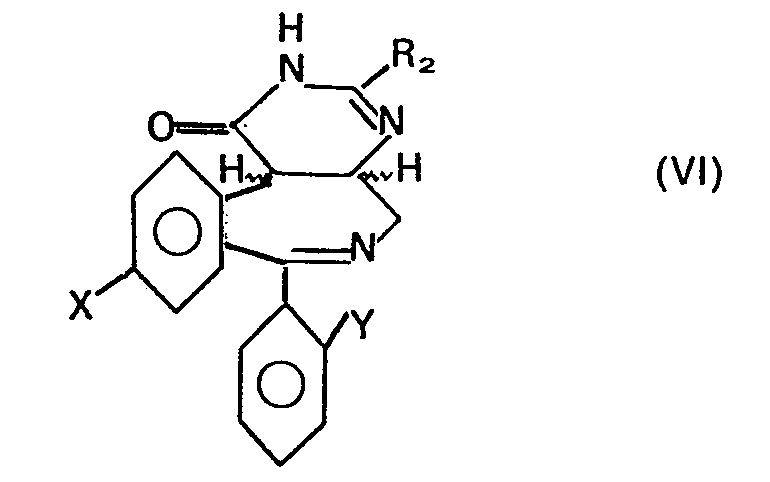
- the compounds of formulas IV and V can be combined with an amidine, such as formamidine, acetamidine or guanidine, in the presence of a base, such as an alkali metal alkoxide, for example sodium or potassium methoxide, ethoxide or butoxide.
- a base such as an alkali metal alkoxide, for example sodium or potassium methoxide, ethoxide or butoxide.
- suitable solvents are C 1 - to C 4 alcohols.
- the reaction temperature can vary in a range from room temperature to boiling temperature, the preferred temperature depending on the amidine chosen, but not more than 100 ° C.
- a compound of formula VI can be treated with an oxidizing agent such as manganese dioxide in a suitable solvent, e.g. in methylene chloride, tetrahydrofuran or in dimethylformamide.
- the reaction temperature can vary in a range from room temperature to 100 ° C and is preferably around 60 ° C.
- An oxo compound of formula VII is a tautomeric form of the corresponding compound of formula I, wherein R 1 is hydroxy.
- An oxo compound of formula IX is a tautomeric form of a 6-oxide of a corresponding compound of formula I, wherein R 1 is hydroxy.
- a compound of formula VII can be reacted with a peracid such as m-chloroperbenzoic acid or pertrifluoroacetic acid in a halogenated hydrocarbon such as methylene chloride.
- the reaction temperature can vary in a range from -20 ° C to room temperature and is preferably around 0 ° C.
- a compound of formula VI can be reacted with an acid anhydride derived from a C 1 to C 6 carboxylic acid, such as acetic anhydride, propionic anhydride etc. or trifluoroacetic anhydride.
- the reaction temperature can vary in a range from 40 ° C. to boiling temperature and is preferably around boiling temperature. The reaction temperature should not exceed 125 ° C.
- a compound of the formula X can be reacted with an aqueous alkali metal carbonate, such as sodium or potassium carbonate, or an aqueous alkali metal hydroxide, such as sodium or potassium hydroxide.
- an aqueous alkali metal carbonate such as sodium or potassium carbonate
- an aqueous alkali metal hydroxide such as sodium or potassium hydroxide.
- a solubilizer such as a C 1 to C 6 alcohol or tetrahydrofuran, can be used.
- the reaction temperature can vary in a range from 0 to 100 ° C and is preferably between room temperature and 100 ° C.
- a compound of formula VII can be combined with a phosphoryl halide, e.g. a chloride or bromide.
- a solubilizer such as a chlorinated hydrocarbon e.g. Use methylene chloride or chloroform.
- the reaction temperature can vary in a range from room temperature to the boiling point of the solvent selected. It is preferable to work at about room temperature.
- a compound of formula VIII or a corresponding 1-bromo compound can be reacted with an organometallic reagent such as a lower alkyl lithium or a lower alkyl cuprate in an ethereal solvent such as diethyl ether or tetrahydrofuran.
- the reaction temperature can vary in a range from -78 to 0 ° C and is preferably around -78 ° C.
- a compound of formula VIII or a corresponding 1-bromo compound can be reacted with an alkali metal salt of a lower alkyl mercaptan in a polar solvent such as dimethylformamide or dimethyl sulfoxide.
- the reaction temperature can vary in a range from -78 ° C to room temperature and is preferably around room temperature.
- a compound of formula VIII or a corresponding 1-bromo compound can be reacted with ammonia or a primary or secondary amine in a polar solvent such as dimethylformamide or dimethyl sulfoxide.
- the reaction temperature can vary in a range from room temperature to 100 ° C and is preferably around 60 ° C.
- a compound of formula XI II can be converted to a compound of formula XIV.
- a compound of formula VIII or a corresponding 1-bromo compound can with an alkali metal alkoxide in the corresponding C, - to C s -alcohol are implemented.
- a solubilizer such as an ether, for example tetrahydrofuran, dioxane, etc., or dimethylformamide can be used.
- the reaction temperature can vary in a range from 0 ° C to room temperature and is preferably around 0 ° C.
- a compound of formula VIII can with a reducing agent such as hydrogen at atmospheric pressure using Raney nickel as a catalyst and in a C 1 -C 4 alcohol, or zinc and ammonium chloride in a mixture of water and tetrahydrofuran or water and dioxane be implemented.
- the reaction temperature varies in a range from 0 ° C to the boiling point of the chosen solvent and is preferably at room temperature.
- the reaction temperature varies in a range from 0 ° C to the boiling point of the chosen solvent and is preferably around the boiling point. This reaction is a desulfurization familiar to the person skilled in the art.
- salts encompasses both salts with inorganic and with organic, pharmaceutically acceptable strong acids, such as sulfuric, hydrochloric, nitric, methanesulfonic, and p-toluenesulfonic acid.
- Such salts can be prepared very easily by a person skilled in the art if he is aware of the prior art and the nature of the compound to be converted into salts.
- the pyrimido- [4,5-d] - [2] -benzazepines according to the invention are useful as medicinal products and are distinguished by sedative and anxiolytic properties.
- These compounds can be used in the form of conventional pharmaceutical preparations; For example, they can be mixed with conventional organic or inorganic, inert carriers suitable for parenteral or enteral administration, for example with water, gelatin, milk sugar, starch, magnesium stearate, talc, vegetable oils, gum arabic, polyalkylene glycols, petroleum jelly or the like
- Usual pharmaceutical forms are administered, for example as solid forms such as tablets, dragees, capsules, suppositories or the like, or as liquid forms such as solutions, suspensions or emulsions.
- the pharmaceutical preparations containing the compounds according to the invention can be subjected to customary pharmaceutical operations, such as sterilization, and they can contain customary pharmaceutical auxiliaries, such as preservatives, stabilizers, wetting agents, emulsifiers, salts for changing the osmotic pressure or buffers.
- customary pharmaceutical auxiliaries such as preservatives, stabilizers, wetting agents, emulsifiers, salts for changing the osmotic pressure or buffers.
- the pharmaceutical preparations can also contain other therapeutically valuable substances.
- a suitable pharmaceutical dosage unit may contain between 1 to 500 mg of a compound of the formula I, a dosage range of 1 to 100 mg for oral administration and a dosage range of 1 to 50 mg for parenteral administration being preferred. In each individual case, however, the person who carries out or monitors the administration of the compounds in question must adjust the dosage according to their professional judgment to the individual requirements. It should be noted that the above dosages are given by way of example only and that they in no way limit the scope and execution of the present invention.
- dosage unit refers to individual pharmaceutical units which are suitable as unit doses for mammals and each of which contains a predetermined amount of the active ingredient which has been calculated to be taken together with the required pharmaceutical diluent, Carrier or vehicle has the desired therapeutic effect.
- Preferred compounds of formula 1 are those in which R 1 is as defined above, R 3 is hydrogen and R 2 is hydrogen or lower alkyl.
- mice You place two mice under an inverted 1 liter beaker on a grid, which strikes them on the feet. As a result, the animals get into a state of excitement, which is expressed in occasional short duels.
- logarithmically increasing doses up to a maximum of 100 mg / kg are used.
- the 100% inhibitory dose is defined as the dose which prevents a fight in 3 out of 3 pairs of mice.
- test substance is administered to 6 mice in each case (maximum dose is 500 mg / kg) and the behavior of the mice on the inclined plane is then observed for 4 hours for paralytic phenomena which cause it to slide off the plane. If an effect is observed, further doses are used until one has at least two doses in which some, but not all, of the animals slide off the inclined plane. Doses at which the animals slip due to toxic phenomena or arousal are not taken into account for the calculation of the PD 50 value.
- Cats are treated orally and observed for symptoms (usually ataxis). First you use a cat and a dose of 50 mg / kg. If there is an effect, vary the doses and use up to 3 capsules per dose. The results show the minimum effective dose.
- the ether solution is dried over anhydrous sodium sulfate and evaporated under reduced pressure, giving a mixture of 8-chloro-1- (2-chlorophenyl) -5H-2-benzazepine-5-carboxylic acid butyl ester and 8-chloro-1- (2-chlorophenyl) ) -3H-2-benzazepine-5-carboxylic acid butyl ester as a red oil. This oil is used in the next stage without further purification.
- the ether solution is dried over anhydrous sodium sulfate and evaporated under reduced pressure.
- the residue is purified by column chromatography on 30 g of silica gel while eluting with methylene chloride and the first product obtained is 8-chloro-2- (2-fluorophenyl) -3H-2-benzazepine-5-carboxylic acid Remethyl ester as whitish needles with a melting point of 106-107 °.
- 14.0 ml of a 4.34 M solution of sodium methoxide in methanol are added in one portion to a solution of 14.0 g (37.7 mmol) of a mixture of 8-chloro-1- (2-fluorophenyl) -5H- 2-benzazepine-5-carboxylic acid butyl ester and 8-chloro-1- (2-fluorophenyl) -3H-2-benzazepine-5-carboxylic acid butyl ester and 7.0 g (74 mmol) of acetamidine hydrochloride in 250 ml of ethanol, the mixture was heated for 17 h under reflux to boil, cool and pour on 1 water. The precipitate obtained is filtered off and washed with ether.
- the methyl esters obtained according to Example 4 or a mixture thereof can also be used.
- the mother liquors are evaporated under reduced pressure.
- the residue obtained is purified by filtration through silica gel while eluting with methylene chloride, and 8-chloro-1-phenyl-5H-2-benzazepine-5-carboxylic acid butyl ester (one of the two starting materials) is obtained, which has the same Rf value in a thin layer chromatogram as one authentic sample.
- 9-Chloro-7- (2-fluorophenyl-3-methyl-5H-pyrimido- [4,5-d] - [2] -benzazepin-1 (2H) -one is prepared in the same way as 9- Chloro-3-methyl-7-phenyl-5H-pyrimido- [4,5-d] - [2] -benzazepin-1 (2H) -one gives light yellow prisms with a melting point of 262-264 °.
- 5.0 ml (22 mmol) of a 4.34 M solution of sodium methoxide in methanol are added to a mixture of 5.0 g (13.5 mmol) of a mixture of 8-chloro-1- (2-fluorophenyl) ) -5H-2-benzazepine-5-carboxylic acid butyl ester and 8-chloro-1- (2-fluorophenyl) -3H-2-benzazepine-5-carboxylic acid butyl ester and 5.0 g (27.7 mmol) guanidine carbonate in 100 ml of ethanol, heat the mixture to boiling under reflux for 1 h and dilute with water. The precipitated material is filtered off and washed with ether; a brown solid is obtained.
- a mixture of this brown solid and 5.0 g of activated manganese dioxide in 175 ml of dimethylformamide is heated to 100 ° for 2 hours. Filter through diatomaceous earth to remove the manganese dioxide and partition the filtrate between methylene chloride and water. The methylene chloride solution is dried over anhydrous sodium sulfate and evaporated to a brownish solid under reduced pressure.
- the corresponding hydrochloride is obtained by adding an equivalent of a 1.4M solution of hydrogen chloride in methanol to a solution of 1,9-dichloro-7- (2-fluorophenyl) -3-methyl-5H-pyrimido- [4,5 -d] - [2] -benzazepine in ether and the precipitated material is filtered off.
- Pale yellow is obtained by recrystallizing 1,9-dichloro-7- (2-fluorophenyl) -3-methyl-5H-pyrimido- [4,5-d] - [2] -benza- zepin hydrochloride from a mixture of methylene chloride and ether Prisms with a melting point of 178-182 °.
- N- (9-chloro-3-methy) -7-pheny) -5-pyrimido- [4,5-d] - [2] -benzazepine-1 is obtained -y)) - N ', N'-dimethy) -1,3-propanediamine (crystallized with 1/3 mol water) as colorless needles with a melting point of 124-127 °.
- the hydrochloride is prepared by mixing one equivalent of a 1.4M solution of hydrogen chloride in methanol into a solution of N- (9-chloro-3-methyl-7-phenyl-5H-pyrimido- [4,5-d] - [2] -benzazepin-1-yl) -N ', N'-dimethyl-1,3-propanediamine in methanol and the salt formed precipitates by adding ether.
- the mixture is stirred at -25 ° for 1 h, warmed to room temperature, diluted with water and saturated with hydrogen sulfide. Filter through diatomaceous earth to remove the precipitated material and evaporate the filtrate under reduced pressure. The residue is purified by column chromatography on 10 g of silica gel while eluting with 20% ether in methylene chloride, and an oil is obtained which is crystallized from a mixture of ether and petroleum ether.
- the methylene chloride solution is dried over anhydrous sodium sulfate, acidified with methanolic hydrogen chloride, diluted with isopropanol and concentrated to a small volume under reduced pressure.
- the precipitated crude 8-chloro-1-phenyl-3H-2-benzazepine hydrochloride is filtered off. Brownish prisms with a melting point of 223-225 ° (decomposition) are obtained.
- the methanesulfonate of 8-chloro-1- (2-chlorophenyl) -3H-2-benzazepine is prepared by adding a 1M solution of methanesulfonic acid in methanol to a solution of this substance in methanol and precipitating the resulting salt by adding ether .
- 8-chloro-1- (2-chlorophenyl) -3H -2-benzazepine methanesulfonate is obtained as a colorless plate with a melting point of 201-202 °.
- 8-Chloro-1- (2-fluorophenyl) -3H-2-benzazepine hydrochloride is produced in the same way as 8-chloro-2- (2-chlorophenyl) -3H-2-benzazepine.
- White prisms with a melting point of 210-212 ° (decomposition) are obtained.
- 4,5-Dibromo-8-chloro-4,5-dihydro-1-pheny) -3H-2-benzazepine is obtained as colorless crystals with a melting point of 164-165 ° (decomposition). This compound has 172-173 ° (decomposition) ) a second melting point.
- 4,5-dibromo-8-chloro-1- (2-fluorophenyl) -4,5-dihydro-3H-2-benzazepine is prepared in the same way as 4,5-dibromo-8-chloro-4,5- dihydro-1-phenyl-3H-2-benzazepine.
- 4,5-Dibromo-8-chloro-1- (2-fluorophenyl) -4,5-dihydro-3H-2-benzazepine hydrochloride is obtained as a colorless solid with a melting point of 158-159 ° (decomposition) and the free base as colorless prisms from the melting point 102-103 °.
- 4,5-dibromo-8-chloro-1- (2-chlorophenyl) -4,5-dihydro-3H-2-benzazepine is prepared in the same way as 4,5-dibromo-8-chloro-4,5- dihydro-1-phenyl-3H-2-benzazepine. Pale yellow prisms with a melting point of 139 ° (decomposition) are obtained.
- the raw mother liquors are made basic with dilute aqueous sodium hydroxide solution and extracted with methylene chloride.
- the methylene chloride solution is dried over anhydrous sodium sulfate and evaporated in vacuo.
- Purification of the residue by column chromatography on silica gel while eluting with methylene chloride and then with ether gives a colorless oil after evaporation of the ether fractions. This oil is taken up in a solution of methanesulfonic acid in methanol and the salt formed is precipitated by adding ether.
- 5-Bromo-8-chloro-1 - (2-fluorophenyl) -3H-2-benzazepine hydrochloride is obtained as a colorless solid with a melting point of 231-232 °. Recrystallization from a mixture of methylene chloride and ether gives colorless crystals with a melting point of 233-234 ° (decomposition). The by-product methanesulfonate salt is not isolated.
- a mixture of 76 g (1.1 mol) sodium nitrite and 450 ml sulfuric acid is heated on the steam bath to approx. 80 ° until complete solution occurs.
- 232 g (1.0 mol) of 2-amino-5-chlorobenzophenone are added in portions with stirring so that the temperature remains between 30 and 40 °.
- the mixture is slowly added to 31 ice water and filtered through diatomaceous earth.
- a solution of 200 g (1.83 mol) of sodium tetrafluoroborate in 800 ml of water is slowly added to the filtrate with stirring. The resulting precipitate is filtered off and washed twice with 100 ml of water.
- 5-chloro-2'-fluoro-2-iodobenzophenone is carried out in the same way as the production of 5-chloro-2-iodobenzophenone and gives light yellow prisms with a melting point of 78-81 °.
- 3-Amino-1- [4-chloro-2- (2-chlorobenzoyl) phenyl] propyne is prepared in the same manner as 3-amino-1- [4-chloro-2- (2-fluorobenzoyl ) phenyl] propyne and gives light yellow prisms with melting point 81-82 °.
- the active ingredient is mixed well with the same amount of lactose.
- Components 3 and 4 and the rest of component 2 are added and mixed again.
- the magnesium stearate is then added, the mixture is mixed for 3 minutes and then compressed to tablets of a suitable size.
- Components 1 to 4 are mixed in a suitable mixer, granulated with sufficient distilled water to obtain a suitable consistency, ground and dried in a suitable oven. After grinding again, the mixture is mixed with the magnesium stearate for 3 minutes and then compressed to tablets of a suitable size.
- Components 1, 2, 3 and 5 are mixed in a suitable mixer, ground, mixed with the talc and mixed well. The mass is then filled into capsules of a suitable size on a capsule filling machine.
Landscapes
- Chemical & Material Sciences (AREA)
- Organic Chemistry (AREA)
- Health & Medical Sciences (AREA)
- Anesthesiology (AREA)
- Engineering & Computer Science (AREA)
- Bioinformatics & Cheminformatics (AREA)
- Biomedical Technology (AREA)
- Neurology (AREA)
- Neurosurgery (AREA)
- Chemical Kinetics & Catalysis (AREA)
- General Chemical & Material Sciences (AREA)
- Medicinal Chemistry (AREA)
- Nuclear Medicine, Radiotherapy & Molecular Imaging (AREA)
- Pharmacology & Pharmacy (AREA)
- Life Sciences & Earth Sciences (AREA)
- Animal Behavior & Ethology (AREA)
- General Health & Medical Sciences (AREA)
- Public Health (AREA)
- Veterinary Medicine (AREA)
- Pharmaceuticals Containing Other Organic And Inorganic Compounds (AREA)
- Nitrogen Condensed Heterocyclic Rings (AREA)
Claims (13)

et leurs sels acceptables pour l'usage pharmaceutique.
Applications Claiming Priority (2)
| Application Number | Priority Date | Filing Date | Title |
|---|---|---|---|
| US17555480A | 1980-08-05 | 1980-08-05 | |
| US175554 | 1980-08-05 |
Publications (2)
| Publication Number | Publication Date |
|---|---|
| EP0045520A1 EP0045520A1 (fr) | 1982-02-10 |
| EP0045520B1 true EP0045520B1 (fr) | 1984-06-20 |
Family
ID=22640697
Family Applications (1)
| Application Number | Title | Priority Date | Filing Date |
|---|---|---|---|
| EP81106138A Expired EP0045520B1 (fr) | 1980-08-05 | 1981-08-05 | Pyrimido (4,5-d)(2) benzazépines, procédé pour leur préparation et compositions pharmaceutiques les contenant |
Country Status (7)
| Country | Link |
|---|---|
| EP (1) | EP0045520B1 (fr) |
| JP (1) | JPS5754188A (fr) |
| AU (1) | AU547557B2 (fr) |
| CA (1) | CA1172630A (fr) |
| DE (1) | DE3164312D1 (fr) |
| DK (1) | DK347781A (fr) |
| ZA (1) | ZA815357B (fr) |
Families Citing this family (1)
| Publication number | Priority date | Publication date | Assignee | Title |
|---|---|---|---|---|
| JP2001099038A (ja) | 1999-09-29 | 2001-04-10 | Mitsubishi Electric Corp | スタータ |
Family Cites Families (2)
| Publication number | Priority date | Publication date | Assignee | Title |
|---|---|---|---|---|
| US3947585A (en) * | 1974-06-03 | 1976-03-30 | Ciba-Geigy Corporation | Pyrazolobenzazepines |
| CA1138863A (fr) * | 1979-02-07 | 1983-01-04 | Norman W. Gilman | Derives de benzazepine |
-
1981
- 1981-08-04 ZA ZA815357A patent/ZA815357B/xx unknown
- 1981-08-04 DK DK347781A patent/DK347781A/da not_active Application Discontinuation
- 1981-08-04 AU AU73668/81A patent/AU547557B2/en not_active Ceased
- 1981-08-04 CA CA000383127A patent/CA1172630A/fr not_active Expired
- 1981-08-05 EP EP81106138A patent/EP0045520B1/fr not_active Expired
- 1981-08-05 JP JP56121967A patent/JPS5754188A/ja active Pending
- 1981-08-05 DE DE8181106138T patent/DE3164312D1/de not_active Expired
Also Published As
| Publication number | Publication date |
|---|---|
| EP0045520A1 (fr) | 1982-02-10 |
| JPS5754188A (fr) | 1982-03-31 |
| DE3164312D1 (en) | 1984-07-26 |
| CA1172630A (fr) | 1984-08-14 |
| AU7366881A (en) | 1982-02-11 |
| ZA815357B (en) | 1982-07-28 |
| AU547557B2 (en) | 1985-10-24 |
| DK347781A (da) | 1982-02-06 |
Similar Documents
| Publication | Publication Date | Title |
|---|---|---|
| EP0005205B1 (fr) | 5.6-Diméthylpyrrolo(2,3-d)pyrimidines substituées, leur procédé de préparation et médicamentsles contenant | |
| EP0150040B1 (fr) | Dérivés de imidazobenzodiazépine | |
| DE2609486C2 (fr) | ||
| DE2952279A1 (de) | Neue 2-acylaminomethyl-1,4-benzodiazepine und deren salze sowie verfahren zu ihrer herstellung und diese verbindungen enthaltende arzneimittel | |
| DE1810423A1 (de) | 1-Phenyl-4-alkyl-3H-1,4-benzodiazepin-2,5-[1H,4H]-dione und Verfahren zu ihrer Herstellung | |
| EP0053767B1 (fr) | Dérivés tricycliques de la cytosine pour utilisation en médicaments et procédé pour leur préparation | |
| DE2323149C3 (de) | Thienopyrimidine, Verfahren zu deren Herstellung und diese Verbindungen enthaltende Arzneipräparate | |
| DD263772A5 (de) | Verfahren zur herstellung neuer 1h, 3h-pyrrolo[1,2-c]thiazolderivate | |
| EP0014470B1 (fr) | Dérivés de la benzazépine, procédé et intermédiaires pour leur préparation, leur application et compositions pharmaceutiques les contenant | |
| DE2118261A1 (de) | Neue N-haltige Bicyclen, deren Säureadditionssalze sowie Verfahren zu deren Herstellung | |
| DE3780015T2 (de) | Kondensierte heterocyclische tetrahydroaminochinolinole und verwandte verbindungen, verfahren zu ihrer herstellung und ihre verwendung als arzneimittel. | |
| EP0045520B1 (fr) | Pyrimido (4,5-d)(2) benzazépines, procédé pour leur préparation et compositions pharmaceutiques les contenant | |
| DE3020267C2 (fr) | ||
| EP0072029B1 (fr) | Triazolobenzazépines, procédé et intermédiaires pour leur fabrication et médicaments les contenant | |
| DE2259471C2 (de) | 2-Halogen-9-phenyl-5,6-dihydro-7H-pyrido [2,3-f] [1,4] diazepinderivate | |
| EP0030015B1 (fr) | Triazolobenzazépines, intermédiaires, procédé pour leur préparation et compositions les contenant | |
| DD150612A5 (de) | Verfahren zur herstellung von 3-substituierten tetrahydro-pyrrolo(1,2-a)pyrimidinen | |
| EP0045519B1 (fr) | Pyrrolo-(3,4-d)-benzazépines, procédé et intermédiaires pour leur préparation et compositions pharmaceutiques les contenant | |
| EP0045521B1 (fr) | Pyrazolobenzazépines, procédé pour leur préparation et compositions pharmaceutiques les contenant | |
| EP0041627B1 (fr) | 3H-2-benzazépines, produits intermédiaires, procédés pour leur préparation et compositions les contenant | |
| DD296920A5 (de) | Benzothiazinderivate, ihre herstellung und anwendung als medikamente oder synthesezwischenprodukte fuer diese | |
| EP0357043A2 (fr) | Dérivés d'imidazodiazépine | |
| EP0066303A1 (fr) | Azidométhyl-2-benzodiazépines 1,4, leurs sels, leur procédé de préparation et produits pharmaceutiques qui les contiennent | |
| AT395154B (de) | Verfahren zur herstellung von neuen imidazo(1,5-a)(1,4)diazepinverbindungen | |
| DE1695163A1 (de) | Verfahren zur Herstellung von heterocyclischen Verbindungen |
Legal Events
| Date | Code | Title | Description |
|---|---|---|---|
| PUAI | Public reference made under article 153(3) epc to a published international application that has entered the european phase |
Free format text: ORIGINAL CODE: 0009012 |
|
| 17P | Request for examination filed |
Effective date: 19810805 |
|
| AK | Designated contracting states |
Designated state(s): BE CH DE FR GB IT NL SE |
|
| ITF | It: translation for a ep patent filed | ||
| GRAA | (expected) grant |
Free format text: ORIGINAL CODE: 0009210 |
|
| AK | Designated contracting states |
Designated state(s): BE CH DE FR GB IT LI NL SE |
|
| PGFP | Annual fee paid to national office [announced via postgrant information from national office to epo] |
Ref country code: FR Payment date: 19840704 Year of fee payment: 4 |
|
| PGFP | Annual fee paid to national office [announced via postgrant information from national office to epo] |
Ref country code: DE Payment date: 19840709 Year of fee payment: 4 |
|
| REF | Corresponds to: |
Ref document number: 3164312 Country of ref document: DE Date of ref document: 19840726 |
|
| PGFP | Annual fee paid to national office [announced via postgrant information from national office to epo] |
Ref country code: CH Payment date: 19840830 Year of fee payment: 4 |
|
| ET | Fr: translation filed | ||
| PGFP | Annual fee paid to national office [announced via postgrant information from national office to epo] |
Ref country code: SE Payment date: 19840930 Year of fee payment: 4 Ref country code: BE Payment date: 19840930 Year of fee payment: 4 |
|
| PLBE | No opposition filed within time limit |
Free format text: ORIGINAL CODE: 0009261 |
|
| STAA | Information on the status of an ep patent application or granted ep patent |
Free format text: STATUS: NO OPPOSITION FILED WITHIN TIME LIMIT |
|
| 26N | No opposition filed | ||
| PGFP | Annual fee paid to national office [announced via postgrant information from national office to epo] |
Ref country code: NL Payment date: 19860831 Year of fee payment: 6 |
|
| PG25 | Lapsed in a contracting state [announced via postgrant information from national office to epo] |
Ref country code: SE Effective date: 19870806 |
|
| PG25 | Lapsed in a contracting state [announced via postgrant information from national office to epo] |
Ref country code: LI Effective date: 19870831 Ref country code: CH Effective date: 19870831 |
|
| BERE | Be: lapsed |
Owner name: F. HOFFMANN-LA ROCHE & CO. A.G. Effective date: 19870831 |
|
| PG25 | Lapsed in a contracting state [announced via postgrant information from national office to epo] |
Ref country code: NL Effective date: 19880301 |
|
| NLV4 | Nl: lapsed or anulled due to non-payment of the annual fee | ||
| PG25 | Lapsed in a contracting state [announced via postgrant information from national office to epo] |
Ref country code: FR Free format text: LAPSE BECAUSE OF NON-PAYMENT OF DUE FEES Effective date: 19880429 |
|
| REG | Reference to a national code |
Ref country code: CH Ref legal event code: PL |
|
| PG25 | Lapsed in a contracting state [announced via postgrant information from national office to epo] |
Ref country code: DE Effective date: 19880503 |
|
| GBPC | Gb: european patent ceased through non-payment of renewal fee | ||
| REG | Reference to a national code |
Ref country code: FR Ref legal event code: ST |
|
| PG25 | Lapsed in a contracting state [announced via postgrant information from national office to epo] |
Ref country code: GB Free format text: LAPSE BECAUSE OF NON-PAYMENT OF DUE FEES Effective date: 19881118 |
|
| PG25 | Lapsed in a contracting state [announced via postgrant information from national office to epo] |
Ref country code: BE Effective date: 19890831 |
|
| EUG | Se: european patent has lapsed |
Ref document number: 81106138.1 Effective date: 19880711 |