EP0048545B1 - Acétate de 1-éthoxy éthyl et utilisation pour augmenter ou rehausser l'arôme ou le goût de denrées de consommation - Google Patents
Acétate de 1-éthoxy éthyl et utilisation pour augmenter ou rehausser l'arôme ou le goût de denrées de consommation Download PDFInfo
- Publication number
- EP0048545B1 EP0048545B1 EP81303645A EP81303645A EP0048545B1 EP 0048545 B1 EP0048545 B1 EP 0048545B1 EP 81303645 A EP81303645 A EP 81303645A EP 81303645 A EP81303645 A EP 81303645A EP 0048545 B1 EP0048545 B1 EP 0048545B1
- Authority
- EP
- European Patent Office
- Prior art keywords
- acetaldehyde
- mixture
- ethoxyethyl acetate
- composition
- consumable material
- Prior art date
- Legal status (The legal status is an assumption and is not a legal conclusion. Google has not performed a legal analysis and makes no representation as to the accuracy of the status listed.)
- Expired
Links
Images


Classifications
-
- A—HUMAN NECESSITIES
- A61—MEDICAL OR VETERINARY SCIENCE; HYGIENE
- A61Q—SPECIFIC USE OF COSMETICS OR SIMILAR TOILETRY PREPARATIONS
- A61Q11/00—Preparations for care of the teeth, of the oral cavity or of dentures; Dentifrices, e.g. toothpastes; Mouth rinses
-
- A—HUMAN NECESSITIES
- A24—TOBACCO; CIGARS; CIGARETTES; SIMULATED SMOKING DEVICES; SMOKERS' REQUISITES
- A24B—MANUFACTURE OR PREPARATION OF TOBACCO FOR SMOKING OR CHEWING; TOBACCO; SNUFF
- A24B15/00—Chemical features or treatment of tobacco; Tobacco substitutes, e.g. in liquid form
- A24B15/18—Treatment of tobacco products or tobacco substitutes
- A24B15/28—Treatment of tobacco products or tobacco substitutes by chemical substances
- A24B15/30—Treatment of tobacco products or tobacco substitutes by chemical substances by organic substances
- A24B15/32—Treatment of tobacco products or tobacco substitutes by chemical substances by organic substances by acyclic compounds
-
- A—HUMAN NECESSITIES
- A61—MEDICAL OR VETERINARY SCIENCE; HYGIENE
- A61K—PREPARATIONS FOR MEDICAL, DENTAL OR TOILETRY PURPOSES
- A61K8/00—Cosmetics or similar toiletry preparations
- A61K8/18—Cosmetics or similar toiletry preparations characterised by the composition
- A61K8/30—Cosmetics or similar toiletry preparations characterised by the composition containing organic compounds
- A61K8/33—Cosmetics or similar toiletry preparations characterised by the composition containing organic compounds containing oxygen
- A61K8/37—Esters of carboxylic acids
-
- C—CHEMISTRY; METALLURGY
- C11—ANIMAL OR VEGETABLE OILS, FATS, FATTY SUBSTANCES OR WAXES; FATTY ACIDS THEREFROM; DETERGENTS; CANDLES
- C11B—PRODUCING, e.g. BY PRESSING RAW MATERIALS OR BY EXTRACTION FROM WASTE MATERIALS, REFINING OR PRESERVING FATS, FATTY SUBSTANCES, e.g. LANOLIN, FATTY OILS OR WAXES; ESSENTIAL OILS; PERFUMES
- C11B9/00—Essential oils; Perfumes
- C11B9/0007—Aliphatic compounds
- C11B9/0015—Aliphatic compounds containing oxygen as the only heteroatom
- C11B9/0019—Aliphatic compounds containing oxygen as the only heteroatom carbocylic acids; Salts or esters thereof
-
- C—CHEMISTRY; METALLURGY
- C11—ANIMAL OR VEGETABLE OILS, FATS, FATTY SUBSTANCES OR WAXES; FATTY ACIDS THEREFROM; DETERGENTS; CANDLES
- C11D—DETERGENT COMPOSITIONS; USE OF SINGLE SUBSTANCES AS DETERGENTS; SOAP OR SOAP-MAKING; RESIN SOAPS; RECOVERY OF GLYCEROL
- C11D3/00—Other compounding ingredients of detergent compositions covered in group C11D1/00
- C11D3/50—Perfumes
-
- C—CHEMISTRY; METALLURGY
- C11—ANIMAL OR VEGETABLE OILS, FATS, FATTY SUBSTANCES OR WAXES; FATTY ACIDS THEREFROM; DETERGENTS; CANDLES
- C11D—DETERGENT COMPOSITIONS; USE OF SINGLE SUBSTANCES AS DETERGENTS; SOAP OR SOAP-MAKING; RESIN SOAPS; RECOVERY OF GLYCEROL
- C11D9/00—Compositions of detergents based essentially on soap
- C11D9/04—Compositions of detergents based essentially on soap containing compounding ingredients other than soaps
- C11D9/44—Perfumes; Colouring materials; Brightening agents ; Bleaching agents
- C11D9/442—Perfumes
-
- D—TEXTILES; PAPER
- D06—TREATMENT OF TEXTILES OR THE LIKE; LAUNDERING; FLEXIBLE MATERIALS NOT OTHERWISE PROVIDED FOR
- D06M—TREATMENT, NOT PROVIDED FOR ELSEWHERE IN CLASS D06, OF FIBRES, THREADS, YARNS, FABRICS, FEATHERS OR FIBROUS GOODS MADE FROM SUCH MATERIALS
- D06M13/00—Treating fibres, threads, yarns, fabrics or fibrous goods made from such materials, with non-macromolecular organic compounds; Such treatment combined with mechanical treatment
- D06M13/005—Compositions containing perfumes; Compositions containing deodorants
Definitions
- This invention relates to a novel method of fixing acetaldehydes by means of the formation of 1- ethoxyethyl acetate which acts as a generator responding to conditions of use in a food product to yield acetaldehyde.
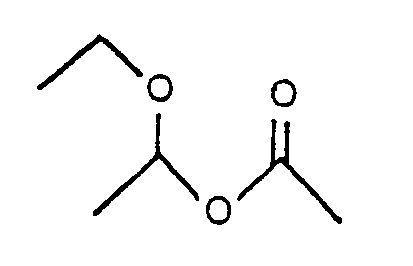
- This invention also relates to the use of mixtures of 1-ethoxyethyl acetate having the structure: and acetaldehyde, in flavors or taken alone or combined in carbohydrates, such as cyclic dextrins to generate acetaldehyde.
- acetaldehyde occurs in a wide variety of fresh and prepared foodstuffs, such as fruits, meat, dairy products, baked goods and vegetables. Acetaldehyde has been found particularly important in contributing to the flavor impact in "fresh" effect of certain foodstuffs especially of the citrus fruit and red berry types. As such, it is indispensable in compounding artificial flavors where the "fresh" effect is needed, plus, as early as 1921 acetaldehyde has been indicated to be useful in the formulation of a synthetic apple oil, as indicated in United States Patent No. 1,366,541 issued on June 25, 1921 and as indicated in United States Patent No. 1,436,290 issued on November 21, 1922.
- acetaldehyde precursors including the acetaldehyde precursor having the structure: None of the acetaldehyde precursors; either those of German Offenlegungschrift 2,802,821, including that having the structure: or those of U.S. Patent No. 3,140,184, including that having the structure: have as advantageous a flavor and aroma impact and have as advantageous a fragrance impact as the mixtures of 1-ethoxyethyl acetate having the structure: with acetaldehyde whether they are used as is, or whether they are combined with an absorbing solid such as an acyclic dextrin.
- mixtures of 1-ethoxyethyl acetate and acetaldehyde are capable of imparting a variety of flavors and fragrances to various consumable materials, and are also capable of augmenting or enhancing a variety of flavors and fragrances of various consumable materials.
- our invention contemplates augmenting or enhancing the flavors and/or fragrances of such consumable materials as perfumes, perfumed articles, colognes, foodstuffs, chewing gums, toothpastes, medicinal products and smoking tobaccos by adding thereto, a small but effective amount of mixtures of 1-ethoxyethyl acetate having the structure: and acetaldehyde, the range of weight ratios of 1-ethoxyethyl acetate:acetaldehyde varying between 50 parts 1-ethoxyethyl acetate:50 parts acetaldehyde down to 5 parts 1-ethoxyethyl acetate:95 parts acetaldehyde.
- mixtures of 1-ethoxyethyl acetate and acetaldehyde of my invention augment or enhance fresh, fruity, somewhat acetaldehyde-like, propionaldehyde-like, acetic acid-like and ethereal-like aroma and flavor characteristics insofar as augmenting or enhancing the aroma or taste of foodstuffs, toothpastes, medicinal products and chewing gums.
- mixtures of 1-ethoxyethyl acetate and acetaldehyde of my invention also augment or enhance the sweet, fruity and winey aromas of perfumes, perfumed articles and colognes of my invention.
- mixtures of 1-ethoxyethyl acetate and acetaldehyde of my invention also augment or enhance the sweet, fruity, winey, fresh and berry characteristics of smoking tobacco, both prior to and on smoking, by imparting thereto a "life" and freshness.
- the stability advantage of mixtures of 1-ethoxyethyl acetate and acetaldehyde over acetaldehyde itself is quite profound, yet its ability to liberate the acetaldehyde nuance in smoking tobacco is unexpected, unobvious and advantageous.
- the 1-ethoxyethyl acetate of my invention may be prepared according to processes well known in the prior art, for example, according to the reaction: Such a process is more specifically pointed out in Example I, infra, as well as in the article by Topchieva and Stepanova Vestnik Moskov. Univ. Ser. II, 15, No. 3, 3-6 (1960) (abstracted in Chem Abstracts at Chem Abstracts 1961, Column 2469 h (Vol. 55).
- the 1-ethoxyethyl acetate of my invention can be obtained in pure form, or in substantially pure form by conventional purification techniques.
- the products can be purified and/or isolated by distillation, preparative chromatographic techniques (column chromatography and vapor phase chromatography) and the like. It has been found desirable to purify the 1-ethoxyethyl acetate of my invention by fractional distillation in vacuo.
- the nature of the co-ingredients included with said mixtures of 1-ethoxyethyl acetate and acetaldehyde in formulating the product composition will also serve to alter, modify, augment or enhance the organoleptic characteristics of the ultimate foodstuff treated therewith.
- alter means "supplying or imparting flavor character or note to otherwise bland, relatively tasteless substances or augmenting the existing flavor characteristic where a natural flavor is deficient in some regard or supplementing the existing flavor impression to modify its quality, character or taste".
- flavour is used herein to mean the intensification of a flavour or aroma characteristic or note without modification of the quality thereof.
- “enhancement” of a flavor or aroma means that the enhancement agent does not add any additional flavor note.
- foodstuff includes both solid and liquid ingestible materials which usually do, but need not, have nutritional value.
- foodstuffs include soups, convenience foods, beverages, dairy products, candies, vegetables, cereals, soft drinks and snacks.
- immediate product includes both solids and liquids which are ingestible, non-toxic materials which have medicinal value such as cough syrups, cough drops, aspirin and chewable medicinal tablets.
- chewing gum is intended to mean a composition which comprises a substantially water insoluble, chewable plastic gum base such as chicle, or substitutes therefor, including jelutong, guttakay rubber or certain cosmetible natural or synthetic resins or waxes.
- plasticizers or softening agents e.g., glycerine
- sweetening agents which may be sugars, including sucrose or dextrose and/or artificial sweeteners such as cyclamates or saccharin.
- sweetening agents which may be sugars, including sucrose or dextrose and/or artificial sweeteners such as cyclamates or saccharin.
- Other optional ingredients may also be present.
- flavouring adjuvants or vehicles comprising, broadly, stabilizers, thickeners, surface active agents, conditioners, other flavorants and flavor intensifiers.
- Stabilizer compounds include preservatives, e.g., sodium chloride; antioxidants, e.g., calcium and sodium ascorbate, ascorbic acid, butylated hydroxyanisole (mixture of 2- and 3-tertiary-butyl-4-hydroxy anisole), butylated hydroxytoluene (2,6-di-tertiary-butyl-4-methyl phenol), and propyl gallate and sequestrants, e.g., citric acid.
- preservatives e.g., sodium chloride
- antioxidants e.g., calcium and sodium ascorbate, ascorbic acid, butylated hydroxyanisole (mixture of 2- and 3-tertiary-butyl-4-hydroxy anisole), butylated hydroxytoluene (2,6-di-tertiary-butyl-4-methyl phenol
- propyl gallate and sequestrants e.g., citric acid.
- Thickener compounds include carriers, binders, protective colloids, suspending agents, and emulsifiers, e.g. agar agar, carrageenan; cellulose and cellulose derivatives such as, carboxymethyl cellulose and methyl cellulose; natural and synthetic gums such as gum arabic, gum tragacanth; gelatin, proteinaceous materials; lipids, carbohydrates; starches, pectins, and emulsifiers, e.g., mono-and diglycerides of fatty acids, skim milk powder, hexoses, pentoses, disaccharides, e.g., sucrose, and corn syrup.
- agar agar, carrageenan cellulose and cellulose derivatives such as, carboxymethyl cellulose and methyl cellulose
- natural and synthetic gums such as gum arabic, gum tragacanth
- gelatin proteinaceous materials
- lipids, carbohydrates starches, pectins, and emulsifiers, e.g.
- Surface active agents include emulsifying agents, e.g., fatty acids such as capric acid, caprylic acid, palmitic acid, and myristic acid, mono- and diglycerides of fatty acids, lecithin, defoaming and flavor-dispersing agents such as sorbitan monostearate, potassium stearate, and hydrogenated tallow alcohol.
- emulsifying agents e.g., fatty acids such as capric acid, caprylic acid, palmitic acid, and myristic acid
- mono- and diglycerides of fatty acids e.g., lecithin
- defoaming and flavor-dispersing agents such as sorbitan monostearate, potassium stearate, and hydrogenated tallow alcohol.
- Conditioners include compounds such as bleaching and maturing agents, e.g., benzoyl peroxide, calcium peroxide, and hydrogen peroxide; starch modifiers such as peracetic acid, sodium chlorite, sodium hypochlorite, propylene oxide, and succinic anhydride, buffers and neutralizing agents, e.g., sodium acetate, ammonium bicarbonate, ammonium phosphate, citric acid, lactic acid, and vinegar; colorants, e.g., carminic acid, cochineal, tumeric and curcuma firming agents such as aluminum sodium sulfate, calcium chloride and calcium gluconate; texturizers, anticaking agents, e.g., aluminum calcium sulfate and tribasic calcium phosphate; enzymes; yeast foods, e.g., calcium lactate and calcium sulfate; nutrient supplements, e.g., iron salts such as ferric phosphate, and ferrous gluconate, rib
- flavorants and flavor intensifiers include organic acids, e.g., acetic acid, formic acid, 2-hexenoic acid, benzoic acid, n-butyric acid, caproic acid, caprylic acid, cinnamic acid, isobutyric acid, isovaleric acid, alphamethylbutyric acid, propionic acid, valeric acid, 2-methyl-2-pentenoic acid and 2-methyl-3-pentenoic acid; ketones and aldehydes, e.g., 2-methyl-3-ketofuran, acetophenone, acetone, acetyl methyl carbinol, acrolein, n-butanal, crotonal, diacetyl, 2-methylbutanal, beta-beta-dimethyl acrolein, methyl n-amyl ketone, n-hexanal, 2-hexanal, isopentenal, hydrocinnamic aldehyde, cis-3
- the specific flavoring adjuvant selected for use may be either solid or liquid depending upon the desired physical form of the ultimate product, i.e. foodstuff, whether simulated or natural, and should, in any event, (i) be organoleptically compatible with the mixtures of 1-ethoxyethyl acetate and acetaldehyde of my invention by not covering or spoiling the organoleptic properties (aroma and/or taste) thereof; (ii) be non-reactive with the mixtures of 1-ethoxyethyl acetate and acetaldehyde of my invention and (iii) be capable of providing an environment in which the mixtures of 1-ethoxyethyl acetate and acetaldehyde can be dispersed or admixed to provide a homogeneous medium.
- flavoring adjuvants selection of one or more flavoring adjuvants, as well as the quantities thereof will depend upon the precise organoleptic character desired in the finished product.
- ingredient selection will vary in accordance with the foodstuff, chewing gum, medicinal product or toothpaste to which the flavor and/or aroma are to be imparted, modified, altered or enhanced.
- ingredients capable of providing normally solid compositions should be selected such as various cellulose derivatives.
- the amount of mixture of 1-ethoxyethyl acetate and acetaldehyde employed in a particular instance can vary over a relatively wide range, depending upon the desired organoleptic effects to be achieved.
- the amount selected be effective, e.g., sufficient to alter, modify or enhance the organoleptic characteristics of the parent composition, whether foodstuff per se, chewing per se, medicinal product per se, toothpaste per se or flavoring composition.
- Food flavoring compositions prepared in accordance with the present invention preferable contain the mixture of 1-ethoxyethyl acetate and acetaldehyde in concentrations ranging from about 0.025% up to about 15% by weight based on the total weight of the flavoring composition.
- composition described herein can be prepared according to conventional techniques well known as typified by cake batters and fruit drinks and can be formulated by merely admixing the involved ingredients within the proportions stated in a suitable blender to obtain the desired consistency, homogeneity of dispersion, etc.
- flavoring compositions in the form of particulate solids can be conveniently prepared by mixing the mixture of 1-ethoxyethyl acetate and acetaldehyde with, for example, gum arabic, gum tragacanth, and carrageenan, and thereafter spraydrying the resultant mixture whereby to obtain the particular solid product.
- Preprepared flavor mixes in powder form e.g., a fruit-flavoured powder mix
- a fruit-flavoured powder mix are obtained by mixing the dried solid components, e.g., starch and sugar, and mixture of 1-ethoxyethyl acetate and acetaldeheyde in a dry blender until the requisite degree of uniformity is achieved.
- novel 1-ethoxyethyl acetate - acetaldehyde mixture containing flavoring compositions capable of retaining at least 7% by weight of the E-A mixture stably over a long period of time are obtained according to the present invention by a freeze-drying method which comprises subliming water vapor from ice crystals by means of applying a vacuum to a frozen mixture comprising (a) from 6 to 1 parts water; (b) from about 4 to 2 parts of an ingestibly acceptable, preferably cold water soluble, non-hygroscopic carrier comprising a carbohydrate and (c) from 2 to 1 parts of E-A mixture.
- a freeze-drying method which comprises subliming water vapor from ice crystals by means of applying a vacuum to a frozen mixture comprising (a) from 6 to 1 parts water; (b) from about 4 to 2 parts of an ingestibly acceptable, preferably cold water soluble, non-hygroscopic carrier comprising a carbohydrate and (c) from 2 to 1 parts
- compositions produced in accordance with the present invention contain levels of E-A mixture as low as about 7% and as high as about 20% by weight; preferably about 10% by weight based on the total weight of E-A mixture, non-hydroscopic carbohydrate carrier and water, such quantities being stably retained in the product composition despite exposure of the composition to the atmosphere for periods of one month and longer.
- the initial aqueous mixture of E-A mixture and carrier is preferably prepared at temperatures on the order of 30 to 50°F (-1 ° to 10°C) and thus, the carrier material employed should be substantially if not completely water soluble within this temperature range. Admixing the materials, as by solubilizing, slurrying, or making a paste thereof, within this temperature range is desirable by reason of the volatility of the acetaldehyde.
- the mixture may be prepared by admixing the carrier in water by dissolving or slurrying, at the necessary elevated temperature, e.g., 175-212°F, (75.4-100°C) cooling the mixture paste thus formed to a temperature of from 30 to 50°F (-1 ° to 10°C) and then adding the E-A mixture.
- the E-A mixture may be added by refluxing; and thus returning same into the aqueous carrier mixture while the latter is cooling.
- Yet another method involves mixing the carrier, E-A mixture and water in a reflux tank at a temperature from about 130° to 180°F (54.4° to 82°C).
- the relative quantities of the respective components employed in forming the aqueous mixture range from about 2 to 4 parts carrier, from about 2 to 1 parts E-A mixture, and from 1 to 6 parts water.
- the carrier is added to the aqueous medium in amounts sufficient to form a supersaturated solution, this being achieved by the addition of about 25-45% by weight of carrier to the aqueous medium.
- Non-hygroscopic, preferably cold water soluble, carbohydrate matrix materials suitable for use in the present invention include, for example, the hydrolyzed cereal solids product manufactured by Corn Products Industrial, Division Corn Products Company, and available under the trade name designation MOR-REX; a liquid dextrine commercially available from the Clinton Corn Co.
- the solids comprising essentially a mixture of saccharides, e.g., monosaccharides (dextrose), disaccharides (maltose), the latter ingredients being present in trace quantities, trisaccharides, tetrasaccharides, pentasaccharides, hexasaccharides, heptasaccharides, octasaccharides with higher saccharides constituting about 46% by weight on a dry basis; a hydrolyzed cereal solids mixture available commercially from the Grain Processing Corporation under the trade name designation MALTRIN-1 0 and comprising a mixture containing about 1% dextrose, 77.0% hexasaccharide, with the remainder being constituted by varying amounts of di-, tri-, tetra-, and penta-saccharides; a food-grade dextrin manufactured by the National Starch and Chemical Corporation and
- the aforedescribed materials and particularly the hydrolyzed cereal solids are beneficially adapted for use in the practice of the present invention since in addition to having the requisite degree of non- hygroscopicity they are, for the most part, bland to the taste, i.e., present no "starchy” flavor, exhibit no tendency to mask flavor even at high solids levels, do not cake on standing, yield clear as to be distinguished from "milky” solutions by virtue of their excellent "cold” water solubility, are outstanding bulking agents and, therefore, highly effective for carrying sweeteners and flavoring agents, are superior from a bodying standpoint and thus, from an aesthetic standpoint, have improved mouthfeel and offer greater viscosity.
- carbohydrate materials which may be employed herein include modified starches, modified cellulose, gelatins, simple sugars, sucrose, glucose, lactose, gums, gum arabic, and a mixture (50/50) of ethylcellulose and methylcellulose.
- the aforedescribed materials may be employed either singly or in admixtures comprising two or more thereof.
- the formulator is provided with effective means whereby to exploit the beneficial characteristics of each of a plurality of carbohydrate matrix materials in a given instance and thus comprises a particularly effective mode of proceeding.
- the use of mixtures entails the highly significant advantage that the carbohydrate matrix may be "tailored" to the requirements imposed upon the formulator in a given instance.
- carbohydrate material as supplied for use may contain very minor quantities of, for example, iron or ash. Accordingly, the terminology carbohydrate carrier as used in the context of the present invention is to be accorded a significance consistent therewith.
- the aqueous mixture of carrier, E-A mixture and water prepared as described hereinbefore, may be converted to a completely frozen state according to procedures well known in the art.
- the temperature employed for freezing should be substantially below the eutectic point of the aqueous, E-A mixture system which will usually be within the range of -50°F to -10°F (-45.6° to -23.3°C).
- eutectic point as used herein means the lowest temperature at which a specific mixture of E-A mixture, carrier and water solidifies.
- the particular freezing method selected will depend upon the physical form desired in the frozen specimen, i.e., in the form of a particulate solid or as a solid mass, e.g., slab or the like.
- the aqueous mixture of carrier and E-A mixture may be frozen in the form of droplets by dropwise addition of such mixture into liquid nitrogen.
- the particle size of the frozen material varies from approximately 4 to t cm.
- continuous freezing techniques such as spray-freezing and continuous belt freezing may be employed as well as the more commonly employed method of batch freezing of the aqueous mixture in shallow metal trays, e.g., stainless steel or aluminum.
- the aqueous mixture is merely poured into the trays to a maximum depth of about t inch (1.27 cm) and preferably about 1 ⁇ 2 inch (0.635 cm). Depths in excess of t inch (1.27 cm) are not normally recommended since the time required for freezing the mixture is correspondingly prolonged.
- the trays containing the aqueous mixture may thereafter be placed as such in a conventional freezing chamber for carrying out the freeze-drying operation.
- the mixture may thereafter be granulated, if desired, to form smaller particles by any suitable trituration means.
- the size-reduction operation must, of course, be carried out under conditions which insure against any possibility of melting the frozen particles; accordingly, the equipment as well as environment must be maintained at a temperature below the eutectic temperature of the frozen mass.
- the low temperature freezing treatment should be carried out to a point at which complete freezing of the aqueous mixture is achieved.
- the diffusion coefficient of the acetaldehyde, the 1-ethoxyethyl acetate and the E-A mixture in the liquid concentrate between the ice crystals is relatively low compared to that of water, this condition being promotive of E-A mixture retention.
- freeze-drying of the frozen mass obtained as hereinbefore explained is carried out under vacuum with heat being supplied at a rate sufficient to remove water by sublimation. It is critical, of course, that the quantity of heat supplied correspond to that amount necessary to expedite sublimation of ice during the freeze-drying process; however, at the same time, such quantity of heat should not be such as to raise the temperature of the frozen material above its eutectic point.
- the foregoing can be accomplished, for example, by maintaining the frozen composition at a temperature within the range of -70 to -10°F (-56.7° to -23.3°C) and preferably slightly below the eutectic temperature of the mixture and at an absolute pressure of less than about 1000,am of mercury with a range of 100 to 300 ⁇ m of mercury being preferred.
- the requisite rate of heat input can be accomplished by employing a shelf temperature within the range of -30°F to +100°F (-34.4° to 37.8°C).
- the heat must be introduced at the drying boundary to support the sublimation of water vapor.
- an outer shell or layer of dried material forms, such layer representing the primary obstacle to heat transfer. Accordingly, drying in this phase of the process occurs for the most part by transfer of water vapor from the vicinity of the ice crystal at the drying boundary through the outer shell or layer of dried material to the outer surface of the frozen specimen.
- the temperature in the dried outer layer to rise; such temperature rise is not absolutely proscribed by the present invention provided no significant loss of acetaldehyde or E-A mixture or 1-ethoxyethyl acetate occurs.
- the heat energy necessary to effect removal of water from the frozen mass by sublimation may be supplied by any suitable heating device conventionally employed in the art for such purposes including, for example, radiant heaters; or conduction heating plates.
- the rate of heat input should be sufficient to facilitate the desired sublimation rate without causing the temperature of the frozen mass to rise to its eutectic point since this would give rise to undesired melting and concomitant loss of acetaldehyde, 1-ethoxyethyl acetate or E-A mixture.
- the use of the shelf temperatures hereinbefore defined minimizes any possibility of melting.
- dielectric heating means in order to confine the predominant part of the heat energy absorption to the inner ice portion.
- the condenser means employed in the vacuum chamber should be maintained at a lower temperature than the frozen E-A mixture-containing mass since it is necessary that the vapor pressure of the frozen mass exceed the vapor pressure of the condenser so that the sublimed water vapor migrates from the frozen material to the condenser.
- the pressure maintained within the vacuum freeze-drying chamber should be less than about 1000,am of mercury and more preferably, within the range of 100 to 300 ,um of mercury since any rise in pressure is accompanied by a corresponding increase in the equilibrium temperature; should the increased temperature exceed the eutectic temperature of the frozen mass, the later will melt giving rise to the formation of liquid water, evaporation of the latter unavoidably involving significant loss of acetaldehyde, 1-ethoxyethyl acetate or E-A mixture as previously explained.
- the "vacuum drying" or “desorption” cycle of the freeze-drying process corresponds to that portion of the process wherein all the water ice crystals have been sublimed and the eutectic mixture of carrier, E-A mixture and water is dried to the desired stable moisture content. Actually this stage of the drying cycle need not be strictly sublimation since some evaporation of water from the liquid state may occur without melting the frozen extract.
- the freeze-drying process is carried out so as to provide a final E-A mixture-carrier composition having a mixture content within the range of 0.1% to 1.5% by weight of total composition.
- Apparatus suitable for use in carrying out freeze-drying in accordance with the present invention is disclosed, for example, in Catson, et al., "Freeze Drying of Foodstuffs" (Columbine Press, Man- chester, England, 1963, Chapter 4), This article describing a contact plate system.
- Other apparatus suitable for use herein is described in U.S. Patent No. 2,616,604 and 2,853,796.
- the apparatus described in U.S. Patent No. 2,616,604 is advantageously adapted for the freeze-drying of a mass provided in the form of small frozen particles of relatively uniform size.
- 2,853,796 is specifically adapted for the freeze-drying of a frozen sheet of specimen by sublimation.
- specific nature of the apparatus employed is not a particularly critical factor in the practice of the present invention provided such apparatus be equipped to enable the removal by sublimation of water from the freeze-dried mass, whether the mass be provided in the form of a particulate solid or continuous solid mass.
- such apparatus should include as essential features, means to accommodate the frozen solution, whether in particulate or solid form, means to provide the necessary depressed temperatures, means to supply heat to the frozen mass at a rate sufficient to enable removal of water by sublimation, and means to remove and condense the sublimed vapors.
- compositions produced in accordance with the present invention may be utilized per se as flavoring compositions to simulate a wide variety of organoleptic factors whereby to evoke a predetermined taste response on the part of the consumer.
- such compositions are particularly advantageously adapted for use in producing fruit-type flavors, e.g., those commonly found in a wide variety of beverages, candies, and dessert foods.
- fruit-type flavors e.g., those commonly found in a wide variety of beverages, candies, and dessert foods.
- they may be readily employed in product compositions which would in all probability, as a result of repetitive use, contact humid environments.
- the freeze-dried composition may be combined for example, with one or more additional flavorants, either natural or synthetic, citric acid, dextrose, sucrose and the like.
- gelatin jelly desserts may be prepared by combining the E-A mixture composition with a major quantity of sugar (i.e., on the order of 75 to 85 parts by weight) gelatin, citric acid, trisodium citrate and suitable fruit flavorants and colorants as desired.
- Low-calorie gelatin desserts may be prepared by combining the E-A mixture composition with a major quantity of gelatin, adipic acid, mono- and disodium phosphate, saccharin, one or more additional fruit flavorants, and colorants.
- low-calorie beverages may be prepared by combining the E-A mixture compositions with citric acid, mannitol, trisodium citrate, saccharin, tricalcium phosphate and one or more additional fruity flavorants, and fruit colorants.
- freeze-dried E-A mixture composition may be employed for purposes of enhancing one or more of the various flavor notes naturally present in meats and vegetables.
- the nature of the co-ingredients included with the freeze-dried composition will, of course, depend primarily upon the ultimate use contemplated, i.e., as a foodstuff per se or alternatively, as a flavoring composition adapted to be added to a foodstuff at some subsequent point of time.
- flavouring adjuvants or vehicles comprise broadly, stabilizers, thickeners, surface agents, conditioners, flavorants and flavor intensifiers.
- the specific flavoring adjuvant selected for use may be either solid or liquid, depending upon the desired physical form of the ultimate product, i.e., foodstuff whether simulated or natural, and should, in any event, be capable of providing an environment in which the freeze-dried E-A mixture-containing composition can be readily dispersed or admixed to provide a homogeneous medium.
- selection of one or more flavoring adjuvants as well as the quantity used thereof will depend upon the precise organoleptic character desired in the finished product; thus, in the case of the flavoring compositions, the ingredient selection will vary in accordance with the foodstuff to which the flavor and aroma are to be imparted.
- ingredients capable of providing normally solid compositions should be selected.
- the amount of freeze-dried E-A mixture-containing composition employed in a particular instance can vary over a relatively wide range whereby to achieve desired organoleptic effects having reference to the nature of the product.
- correspondingly greater amounts would be necessary in those instances wherein the ultimate food composition to be flavored is relatively bland to the taste, whereas relatively minor quantities may suffice for purposes of enhancing a composition merely deficient in natural flavor or aroma.
- the primary requirement is that the amount selected be effective, i.e., sufficient to alter the organoleptic characteristics of the parent composition.
- freeze-dried composition should be employed in amounts sufficient to yield a quantity of E-A mixture within the range of from about 1 to 500 ppm based on total parts by weight of composition. Concentrations in excess of the maximum quantities stated are not normally recommended since they fail to provide commensurate enhancement of organoleptic properties.
- the E-A mixture-containing flavoring composition may be further modified by addition of appropriate ingredients to provide yet further flavoring composition; in such instances, it is preferable that the freeze-dried composition be present in the mixture in amounts sufficient .to yield an E-A mixture concentration within the range of from .001% to about 13% by weight based on the total weight of said flavoring composition.
- compositions described herein can be prepared according to conventional techniques well known in the art for such purposes.
- liquid products can be formulated by merely admixing the involved ingredients within the proportions stated in a suitable blender to obtain the desired consistency, homogeneity of dispersion, etc.
- the freeze-dried composition may be combined with additional ingredients to provide a particulate solid product by admixing the freeze-dried composition with, for example gum arabic, gum tragacanth, and carrageenan and, thereafter, spray-drying the resultant mixture whereby to obtain the particulate solid product.
- it is desired to further combine the freeze-dried composition in the form of a powder flavor mix this can be accomplished by mixing the dried solid components and freeze-dried composition in a dry blender until the requisite degree of uniformity is achieved.
- the mixtures of 1-ethoxyethyl acetate and acetaldehyde of my invention can be used to contribute fresh, fruity, acetaldehyde-like aromas to perfumes, perfumed articles and colognes.
- the mixtures of 1-ethoxyethyl acetate and acetaldehyde of my invention can be formulated into, or used as components of a "perfume composition” or can be used as components of a "perfumed article” (e.g., solid or liquid, anionic, cationic, nonionic or zwitterionic, detergents, fabric softeners, fabric softener articles or hair conditioners or the perfume composition may be added to perfume, perfumed articles or cologne.
- perfume composition is used herein to mean a mixture .of organic compounds, including for example, alcohols, aldehydes, other than the acetaldehyde of my invention, ketones, nitriles, ethers, lactones, acetals, hemiacetals, ester acetals, other than the 1-ethoxyethyl acetate of my invention, natural essential oils, synthetic essential oils, and frequently, hydrocarbons, which are admixed so that the combined odors of the individual components produce a pleasant, or desired fragrance, e.g., a lemon fragrance.
- a pleasant, or desired fragrance e.g., a lemon fragrance
- Such perfume compositions usually contain: (a) the main note or the "bouquet" or foundation stone of the composition; (b) modifiers which round off and accompany the main note; (c) fixatives which include odorous substances which lend a particular note to the perfume throughout all stages of evaporation and substances which retard evaporation; and (d) top notes which are usually low-boiling, fresh-smelling materials.
- the individual component will contribute its particular olfactory characteristics, but the overall effect of the perfume composition will be the sum of the effects of each of the ingredients.
- the individual compounds of this invention, or mixtures thereof can be used to alter the aroma characteristics of a perfume composition, for example, by highlighting or moderating the olfactory reaction contributed by another ingredient in the composition.
- perfume compositions containing as little as 0.5% of the mixture of 1-ethoxyethyl acetate and acetaldehyde of this invention, or even less, can be used to impart an interesting, fresh, fruity, blueberry-like, acetaldehyde-like aroma to soaps, liquid and solid cationic, nonionic, anionic and zwitterionic detergents, cosmetics, powders, liquid and solid fabric softeners, dryer-added fabric softener articles, optical brightener compositions and other products.
- the amount employed can range up to 50% or higher and will depend on considerations of cost, nature of the end product and the effect desired on the finished product and particular fragrance sought.
- the range of mixture of 1-ethoxyethyl acetate and acetaldehyde in perfume compositions may range from 0.5% up to 50%.
- the mixtures of 1-ethoxyethyl acetate and acetaldehyde of this invention can be used alone or in a perfume composition as an olfactory component in detergents and soaps, space odorants and deodorants; perfumes; colognes, toilet waters; bath salts; hair preparations such as lacquers, brilliantines, pomades and shampoos; cosmetic preparations such as creams, deodorants, hand lotions and sun screens; powders such as talcs, dusting powders, face powder and the like.
- a solid or liquid anionic, cationic, nonionic or zwitterionic detergent When used as an olfactory component of a perfumed article, such as a solid or liquid anionic, cationic, nonionic or zwitterionic detergent, as little as 0.01% of the mixtures of 1-ethoxyethyl acetate and acetaldehyde will suffice to impart an interesting, fresh, fruity, blueberry-like, acetaldehyde-like aroma. Generally no more than 1.0% is required. Thus, the range of mixture of 1-ethoxyethyl acetate and acetaldehyde in perfumed articles will vary from 0.01% up to 1.0%.
- the perfume composition containing the mixtures of 1-ethoxyethyl acetate and acetaldehyde of my invention can contain a vehicle or carrier for the mixture of 1-ethoxyethyl acetate and acetaldehyde, alone or with other ingredients.
- the vehicle can be a liquid such as an alcohol, such as ethanol, or a glycol such as propylene glycol.
- the carrier can be an absorbent solid such as a gum or components for encapsulating the composition such as gelatin, which can be used to form a capsule wall surrounding the perfume oil as by means of coacervation.
- An additional aspect of my invention provides an organoleptically improved smoking tobacco product and additives therefor including methods of making the same which overcome problems heretofore encountered in the creation or enhancement of specific desired sweet, fruity, winey, fresh berry-like notes.
- Such notes both prior to and on smoking, in both the main stream and the side stream, may now be readily controlled and maintained at the desired uniform level regardless of variations in the tobacco components of the blend; or the nature of the filter used in conjunction with the smoking tobacco article.
- This invention further provides improved tobacco additives and additives for materials used in the fabrication of tobacco articles (particularly smoking tobacco articles) and methods whereby desirable sweet, fruity, winey, fresh berry-like notes may be imparted to smoking tobacco products and may be readily varied and controlled to produce the desired uniform flavoring characteristics.
- I add to smoking tobacco materials or a suitable substitute therefor (e.g., dried lettuce leaves) an aroma and flavor additive containing as an active ingredient, the mixtures of 1-ethoxyethyl acetate and acetaldehyde of my invention.
- a suitable substitute therefor e.g., dried lettuce leaves
- An aroma and flavoring concentrate containing the mixtures of 1-ethoxyethyl acetate and acetaldehyde of my invention and, if desired, one or more of the above indicated additional flavoring additives may be added to the smoking tobacco material, to the filter or the leaf or paper wrapper or to a filter which is part of the smoking article.
- the smoking tobacco material may be shredded, cured, cased and blended tobacco material or tobacco substitutes (e.g., dried lettuce leaves) or mixtures thereof.
- the proportions of flavoring additives may be varied in accordance with taste, but insofar as enhancement of the imparting of sweet, fruity, winey, fresh-berry-like notes prior to and on smoking, in both the main stream and the side stream, I have that satisfactory results are obtained if the proportion by weight of the sum total of 1-ethoxyethyl acetate to smoking tobacco material is between 50 parts per million and 1500 parts per million (0.005%-0.15°/) of the active ingredients to the smoking tobacco material. I have further found that satisfactory results are obtained if the proportions by weight of the sum total of mixture of 1-ethoxyethyl acetate and acetaldehyde used to flavoring material is between 0.05:1 and 0.50:1.
- any convenient method for incorporating the mixtures of 1-ethoxyethyl acetate and acetaldehyde in the tobacco product may be employed.
- the mixtures of 1-ethoxyethyl acetate and acetaldehyde taken alone or together with other flavoring additives may be dissolved in a suitable solvent such as food grade ethanol, pentane, diethyl ether and/or other volatile organic solvents, and the resulting solution may either be sprayed on the cured, cased and blended tobacco material; or the tobacco material or filter may be dipped into such solution.
- a solution of the mixture of 1-ethoxyethyl acetate and acetaldehyde taken alone or further together with other flavoring additives as set forth above, may be applied by means of a suitable applicator such as a brush or roller on the paper or leaf wrapper for the smoking tobacco product, or it may be applied to the filter by either spraying or dipping or coating.
- the tobacco treated may have the mixtures of 1-ethoxyethyl acetate and acetaldehyde of my invention in excess of the amounts or concentrations above indicated so that when blended with other tobaccos, the final product will have the percentage within the indicated range.
- While my invention is particularly useful in the manufacture of smoking tobacco such as cigarette tobacco, cigar tobacco and pipe tobacco, other tobacco products formed from sheeted tobacco dust or fines may also be used.
- the mixtures of 1-ethoxyethyl acetate and acetaldehyde of my invention can be incorporated with materials such as filter tip materials, seam paste, packaging materials and the like which are used along with the tobacco to form a product adapted for smoking.
- mixtures of 1-ethoxyethyl acetate and acetaldehyde of my invention can be added to certain tobacco substitutes of natural or synthetic origin (e.g., dried lettuce leaves) and, accordingly, by the term "tobacco” as used throughout this specification is meant any composition intended for human comsumption, by smoking or otherwise, whether composed of tobacco plant parts or substitute materials, or both.
- mixtures of 1-ethoxyethyl acetate and acetaldehyde of my invention can be utilized to alter, modify, augment or enhance sensory properties, particularly organoleptic properties, such as flavor(s) and/or fragrance(s) of a wide variety of consumable materials.
- reaction mass is then distilled through a micro-distillation apparatus, yielding the following fractions:
- beta-cyclic dextrin 500 mg. of beta-cyclic dextrin is dissolved in 40 ml of water to which there is added a drop of 0.1 M sodium hydroxide solution to avoid having water with an acid pH.
- 0.3 ml of a solution containing 50 parts by weight of 1-ethoxyethyl acetate (prepared according to Example I) and 50 parts by weight of acetaldehyde is then added to the solution.
- the container for the solution is immediately stoppered and shaken vigorously to obtain a homogeneous solution.
- another solution is prepared by dissolving 1.0 grams of alpha-cyclic dextrin in 40 ml of water to which has been added one drop of 0.1 M sodium hydroxide solution.
- a 50:50 (weight:weight) mixture of 1-ethoxyethyl acetate and acetaldehyde in an amount of 0.5 ml is then added to the resulting solution and the container is stoppered and shaken vigorously to obtain a homogeneous solution. Both solutions are then frozen and lyophilized overnight, to produce, respectively, beta-cyclic dextrin-1-ethoxyethyl acetate-acetaldehyde and alphacyclic dextrin-1-ethoxyethyl acetate-acetaldehyde complexes in dry form.
- the colorimetric analysis is run in the following way: to 1 ml of aqueous sample solution containing 0.1 mg (or 0.01% by weight) of dissolved complex, there is added 1.0 ml of a saturated alcoholic solution of 2,4-dinitrophenylhydrazine and one drop of concentrated hydrochloric acid, the resulting solution is mixed and then heated for 30 minutes at 50°C. After heating 10.0 ml of 10% potassium hydroxide in 70% alcohol is added, and the color is read at 480 millimicrons on a spectrophotometer. The concentration is read off a previously prepared color concentration curve.
- the foregoing assay is based on the method described by Snell, et al in "Colorimetric Method of Analyses", Vol. 3, page 253, D. Van Nostrand Co., Inc., New York 1953.
- Example IIA About 2.5 mg of the beta-cyclic dextrin complex of Example IIA is added to 6.7 gm of a dry orange-flavored beverage mix comprising sucrose, citric acid and a cloud-forming agent.
- a dry orange-flavored beverage mix comprising sucrose, citric acid and a cloud-forming agent.
- beta-cyclic dextrin 500 mg. of beta-cyclic dextrin is dissolved in 40 ml of water to which there is added a drop of 0.1 M sodium hydroxide solution to avoid having water with an acid pH.
- 0.3 ml of a solution containing 2 parts by weight of 1-ethoxyethyl acetate (prepared according to Example I) and 98 parts by weight of acetaldehyde is then added to the solution.
- the container for the solution is immediately stoppered and shaken vigorously to obtain a homogeneous solution.
- another solution is prepared by dissolving 1.0 g of alphacyclic dextrin in 40 ml of water to which has been added one drop of 0.1 M sodium hydroxide solution.
- a 5:95 (weight:weight) mixture of 1-ethoxyethyl acetate:acetaldehyde in an amount of 0.5 ml is then added to the resulting solution and the container is stoppered and shaken vigorously to obtain a homogeneous solution. Both solutions are then frozen and lyophilized overnight to produce, respectively, betacyclic dextrin-1-ethoxyethyl acetate-acetaldehyde and alphacyclic dextrin-1-ethoxyethyl acetate-acetaldehyde complexes in dry form.
- the colorimetric analysis is run in the following way: to 1 ml of aqueous sample solution containing 0.1 mg (or 0.01% by weight) of dissolved complex, there is added 1.0 ml of a saturated alcoholic solution of 2,4-dinitrophenylhydrazine and one drop of concentrated hydrochloric acid, the resulting solution is mixed, and then heated for 30 minutes at 50°C. After heating 10.0 ml of 10% potassium hydroxide in 70% alcohol is added, and the color is read at 480 millimicrons on a spectrophotometer. The concentration is read off a previously prepared color concentration curve.
- the foregoing assay is based on the method described by Snell, et al in "Colorimetric Method of Analyses", Vol. 3, page 253, D. Van Nostrand Co., Inc. New York 1953.
- Example II(C) About 2.5 mg of the beta-cyclic dextrin complex of Example II(C) is added to 6.7 gm of a dry orange flavored beverage mix comprising sucrose, citric acid and a cloud-forming agent. When the mix is dissolved in about 50 ml of water, the beverage has the characteristic odor and flavor of fresh oranges, and is judged to be superior in these respects over a beverage prepared in exactly the same way but in which the complex is omitted.
- An orange flavor formulation is prepared by admixing:
- Flavor "A" This flavor is denominated as Flavor "A”.
- a second formulation, Flavor "B” is prepared by adding 2-ethylidene-cis-3-hexenal (1% in food grade ethanol) to a portion of Flavor "A” in the ratio of 2 parts to 100 parts of Flavor "A”.
- Flavors "A”, “B”, “C” and “D” is added in the amount of 2 ounces per gallon (15 g/I) of 32° Baume sugar syrup to produce a syrup for combination with water to form a drink.
- the beverage prepared using Flavors “A” and “B” are passable orange beverages of good character, flavor and intensity, whereas the flavors using "C” and “D” are not passable.
- the flavor prepared using "A” and “B” have a much improved flavor, particularly the flavor denominated as "B".
- the improvement contributed by the 50:50 mixture of 1-ethoxyethyl acetate:acetaldehyde (versus the acetaldehyde itself) is due to a much longer-lasting degree of freshness.
- the improvement contributed by the ethylidene hexenal is due to:
- Flavor "A” This flavor is denominated as Flavor "A,”.
- a second flavor formulation “B” is prepared by adding 2-ethylidene-cis-3-hexenal (1% in food grade ethanol) to a portion of Flavor "A,” in the ratio of 2 parts to 100 parts of Flavor "A 1 ".
- To a third formulation deonominated as Flavor "C 1 " the 5:95 mixture of 1- ethoxyethyl acetate:acetaldehyde is substituted by acetaldehyde.
- Flavors "A,”, “B,”, “C 1 " and “D,” is added in the amount of 2 ounces per gallon of 32° Baume sugar syrup to produce a syrup for combination with water to form a drink.
- the beverage prepared using Flavors “A,” and “B 1 " are passable orange beverages of good character, flavor and intensity, whereas the flavors using “C 1 " and “D 1 " are not passable.
- the flavor prepared using "A,” and “B 1 " have a much improved flavored, particularly the flavor denominated as “B 1 ".
- the improvement contributed by the 5:95 mixture of 1-ethoxyethyl acetate-acetaldehyde (versus the acetaldehyde itself) is due to a much longer-lasting degree of freshness.
- the improvement contributed by the ethylidene hexenal is due to :
- This basic apple flavor is compared in water with and without the addition of (a) the mixture of 50:50 1-ethoxyethyl acetate:acetaldehyde and (b) the mixture of 5:95 1-ethoxyethyl acetate:acetaldehyde, at the rate of 6 ppm and at the rate of 10 ppm in water.
- the flavor with the addition of the mixtures of 1-ethoxyethyl acetate and acetaldehyde have a fresh apple juice character with light fruity top notes. Both notes are missing in the flavor that does not contain the 1-ethoxyethyl acetate:acetaldehyde mixtures. For this reason, the flavors with the 1-ethoxyethyl acetate:acetaldehyde mixtures are preferred unanimously by three member bench panels.
- Example IV 20 g of the flavor formulation of Example IV is emulsified in a solution containing 300 g gum acacia and 700 g water.
- the emulsion is spray-dried with a Bowen Lab Model Drier utilizing 260 c.f.m. (7.63 m 3 min) of air with an inlet temperature of 500°F (260°C) an outlet temperature of 200°F (93.3°C) and a wheel speed of 50,000 rpm.
- the following mixture is prepared:
- the Cab-0-Sil® is dispersed in each of the liquid apple flavor compositions of Example IV with vigorous stirring, thereby resulting in a viscous liquid.
- 71 parts by weight of the powder flavor composition of Part A, supra, is then blended into the said viscous liquid, with stirring, at 25°C for a period of 30 minutes, resulting in a dry, free-flowing sustained release powder.
- Coacervation is induced by adding slowly and uniformly, 40 parts by weight of a 20% aqueous solution of sodium sulphate. During coacervation the gelatin molecules are deposited uniformly about each oil droplet as a nucleus.
- Gelation is effected by pouring the heated coacervate mixture into 1,000 parts by weight of 7% aqueous solution of sodium sulphate at 65°F (18.3°C). The resulting jelled coacervate may be filtered and washed with water at temperatures below the melting point of gelatin, to remove the salt.
- Hardening of the filtered cake in this example, is effected by washing with 200 parts by weight of 37% solution of formaldehyde in water. The cake is then washed to remove residual formaldehyde.
- the resultant chewing gum blends are then manufactured into strips 1 inch (2.54 cm) in width and 0.1 inches (0.254 cm) in thickness. The strips are cut into lengths of 3 inches (7.62 cm) each. On chewing, the chewing gum has a pleasant, long-lasting apple flavor.
- the resultant chewing gum blends are then manufactured into strips 1 inch (2.54 cm) in width and 0.1 incyes (0.254 cm) in thickness. The strips are cut into lengths of 3 inches (7.62 cm) each. On chewing, the chewing gum has a pleasant, long-lasting apple flavor.
- Example III(A) 20 grams of the flavor formulation of Example III(A) is emulsified in a solution containing 300 grams gum acacia and 700 grams water.
- the emulsion is spray dried with a Bowen Lab Model Drier utilizing 260 c.f.m. (7.63 m 3 /min) of air with an inlet temperature of 500°F (260°C) an outlet temperature of 200°F (93.3°C) and a wheel speed of 50,000 rpm.
- the ethyl cellulose and xanthan gum are admixed.
- the resulting mixture is dispersed in the orange flavor composition of Example III(A) with vigorous stirring thereby resulting in a viscous liquid.
- 71 parts by weight of the powder flavor of Part A, supra, is then blended into the said viscous liquid with stirring at 25°C for a period of 30 minutes resulting in a dry, free-flowing sustained release orange flavor powder.
- the resulting toothpaste when used in a normal toothbrushing procedure yields a pleasant orange flavor, of constant strong intensity throughout said procedure (1-1.5 minutes).
- the flavor material produced according to the process of paragraph 1 of Example IX is added to a chewable vitamin tablet formulation at a rate of 10 gm/kg, which chewable vitamin tablet formulation is prepared as follows:
- Preliminary tablets are prepared by slugging with flat-faced punches and grinding the slugs to 14 mesh. 13.5 g dry Vitamin A Acetate and 0.6 g Vitamin D are then added as beadlets. The entire blend is then compressed using concave punches at 0.5 g each.
- Chewing of the resultant tablets yields a pleasant, long-lasting, consistently strong orange flavor for a period of 12 minutes.
- the resultant product is redried to a moisture content of 20%.
- this tobacco has an excellent substantially consistent, long-lasting apple-like nuance, in conjunction with the tobacco notes.
- a tobacco blend is made up by mixing the following materials:
- model "filter” cigarettes at the rate of 0.1%.
- One-third of these model filter cigarettes are treated in the tobacco section with a 50:50 mixture of 1-ethoxyethyl acetate (produced according to Example I):acetaldehyde at 100 ppm per cigarette.
- Another one-third of these model cigarettes is treated in the filter with a 50:50 mixture of 1-ethoxyethyl acetate (produced according to Example I):acetaldehyde at the rate of 2 x 10- 5 gm.
- the cigarettes treated both in the tobacco and in the filter with the 1-ethoxyethyl acetate are found, in smoke flavor, to be more tobacco-like, with enhanced sweet, fruity, winey and fresh berry nuances.
- the flavor is much weaker and the amount of freshness and "lift" to the smoke is much less.
- 1-ethoxyethyl acetate gives an intense freshness and lift to smoke when compared to cigarettes either without anything added or with acetaldehyde added in the same ratio.
- Lyral is the registered trademark of International Flavors and Fragrances, Inc., for 4-(4-methyl, 4-hydroxy amyl) - ⁇ -3-cyclohexene carboxaldehyde.
- Cosmetic powders are prepared by mixing in a ball mill 100 g of talcum powder with 0.25 grams of the perfume composition prepared according to either of Examples XIII(A) or XIII(B). Each has an excellent fresh, lemony aroma. The "fresh" aroma nuance is imparted to this cosmetic powder as a result of the use of mixtures of 1-ethoxyethyl acetate and acetaldehyde.
- Concentrated liquid detergent (Lysine salt of n-dodecylbenzene sulfonic acid, as more specifically described in U.S. Patent No. 3,948,818 issued on April 6, 1976) with fresh, lemony aroma nuances are prepared containing 0.10%, 0.15% and 0.20% of the fragrance prepared according to each of Examples XIII(A) and XIII(B). They are prepared by adding and homogeneously mixing the appropriate quantity of fragrance formulation prepared according to each of Examples XIII(A) and XIII(B) in the liquid detergent. The detergents all possess excellent fresh, lemony aromas, the intensity increasing with greater concentrations of perfume compositions of Examples XIII(A) and XIII(B). This "fresh" aroma is contributed by the 1-ethoxyethyl acetate produced according to Example I.
- compositions prepared according to each of Examples XIII(A) and IXXX(B) are individually incorporated into a cologne at concentrations of 2.0%, 2.5%, 3.0%, 3.5%, 4.0%, 4.5% and 5.0% in 85%, 90% and 95% aqueous food grade ethanol solutions, and into handkerchief perfume at concentrations of 15%, 20%, 25% and 30% (in 85%, 90% and 95% aqueous food grade ethanol solutions).
- Distinctive and definitive fresh lemony aromas are imparted to the cologne and to the handkerchief perfume at all levels indicated above.
- the "fresh" aroma nuance is contributed by the 1-ethoxyethyl acetate produced according to Example I.
- a detergent is prepared from the following ingredients according to Example I of Canadian Patent No. 1,007,948:
- This detergent is a "phosphate-free" detergent. A total of 100 grams of this detergent is admixed separately with 0.15 grams of each of the perfume formulations of Example XIII(A) and XIII(B). The detergent samples have excellent fresh, lemony aromas. The "fresh" nuance is imparted as a result of the use of 1-ethoxyethyl acetate produced according to Example I.
- Example I of column 15 of U.S. Patent No. 3,632,396 a nonwoven cloth substrate useful as a dryer-added fabric softening article of manufacture is prepared wherein the substrate, the substrate coating and the outer coating and the perfuming material are as follows:
- a fabric softening composition prepared as set forth above having the above aroma characteristics essentially consists of a substrate having a weight of about 3 grams per 100 square inches (645 cm 2 ), a substrate coating of about 1.85 grams per 100 square inches (645 cm 2 ) of substrate and an outer coating of about 1.4 grams per 100 square inches (645 cm 2 ) of substrate, thereby providing a total aromatized substrate and outer coating weight ratio of about 1:1 by weight of substrate.
- the aroma set forth above is imparted in a pleasant manner to the headspace in the dryer on operation thereof, using said dryer-added, fabric softening non-woven fabric.
- a completely frozen composition in particulate form and having the following formula: is loaded into trays to a depth of approximately 0.6 to 0.8 cm.
- the frozen composition is thereafter freeze-dried for a period of 23 hours employing a shelf temperature of 50°F (10°C) and a condenser temperature of -40°F (-40°C).
- the temperature of the frozen product rises from -13°F to -5°F (-25° to -21.2°C) in approximately 1-1/2 hours. At this point there is some evidence of melting as indicated by the shiny surfaces on the frozen particles; however, melting does not occur to an extent sufficient to impair acetaldehyde retention.
- product temperature rises to approximately 50°F (10°C) thereby equalling the shelf temperature.
- the product temperature is maintained at 50°F for an additional 4 hours after which the shelf temperature is raised to 68°F (20°C) for 3 more hours thereby giving a total drying time of 23 hours.
- the moisture content of the final product is approximately 0.2%.
- the pressure of the evacuated chamber is maintained at a value of approximately 150 / im.
- the freeze-dried product thus obtained can be heated to temperatures on the order of 50-60°F (10 0- 15.6°C) under high vacuum conditions without significant loss of acetaldehyde or 1-ethoxyethyl acetate or E-A mixture. Moreover, acetaldehyde and 1-ethoxyethyl acetate retention is excellent despite open storage of the freeze-dried product for periods of time up to 90 days under room temperature conditions and a relative humidity of 50%.
- the E-A mixture, hydrolyzed cereal solids, water composition is prepared for freeze-drying by initially forming a clear solution of the hydrolyzed cereal solids in water at a temperature within a range of 180-190°F (82.2°-87.8°C) and adding the E-A mixture thereto after cooling the clear solution to a temperature of 40°F (4.4°C).
- the solution thus obtained is converted to a completely frozen state by drop-feeding same into liquid nitrogen at a temperature of -320°F (-195.6°C) whereupon it freezes substantially immediately, forming substantially spherical particles having an average particle size within the range 1/4 to 1/2 cm.
- the particles thus obtained are supplied to the freeze-drying apparatus for processing as described.
- a composition prepared and frozen as described in Example XX and having the following composition is freeze-dried for a period of approximately 15 hours under a pressure ranging from about 100 to 300 ,um of mercury, a shelf temperature within the range of 0°F to 100°F (-17.8° to 37.8°C) product temperature being within the range of from ⁇ 50°F to 60°F (-45.6 to 15.6°C).
- the condenser temperature is maintained at -60°F (51. 1°C).
- the product is dried to a final moisture content of 0.2%.
- Acetaldehyde, 1-ethoxyethyl acetate and E-A mixture retention in the freeze-dried product is thereafter evaluated by open storage of the composition at room temperature in a relative humidity of up to 50%.
- the results obtained are as follows: As the foregoing results indicated, excellent acetaldehyde, 1-ethoxyethyl acetate and E-A mixture retention is obtained despite subjection of the freeze-dried product to open storage conditions for extended periods of time. As will further be noted, the percent E-A mixture in the product shows a leveling off effect for periods of standing exceeding 40 days.
- compositions are prepared:
- Each of the above solutions is formed by dissolving the hydrolyzed cereal solids in water at a temperature of about 185°F (85°C), cooling the solution thus formed to a temperature of about 35-40°F (1.7° to 4.4°C) and adding the indicated quantity of E-A mixture thereto.
- Each of said compositions is thereafter completely frozen by pouring same into stainless steel plates (36 x 17 x 2") (91.4 x 43.2 x 5.1 cm) and cooling on a bed of dry ice; a completely frozen condition is obtained after about 5 hours.
- the frozen material is ground in apparatus maintained at a temperature sufficiently low to insure against melting of the frozen product and thereafter placed in trays for insertion into the freeze-drying apparatus.
- Example XX The following composition, prepared and frozen as described in Example XX and having the formula is placed in dry ice-cooled, ribbed aluminum plates and freeze-dried employing a shelf temperature of about 50°F (10°C), a condenser temperature of -50°F (-45.6°C) and a vacuum ranging from 150 to 200,um of mercury.
- the freeze-drying was carried out for a period of 48 hours to a moisture content of 0.2%.
Landscapes
- Chemical & Material Sciences (AREA)
- Health & Medical Sciences (AREA)
- Life Sciences & Earth Sciences (AREA)
- Engineering & Computer Science (AREA)
- Chemical Kinetics & Catalysis (AREA)
- Organic Chemistry (AREA)
- Wood Science & Technology (AREA)
- Oil, Petroleum & Natural Gas (AREA)
- General Health & Medical Sciences (AREA)
- Veterinary Medicine (AREA)
- Public Health (AREA)
- Animal Behavior & Ethology (AREA)
- Oral & Maxillofacial Surgery (AREA)
- Epidemiology (AREA)
- Birds (AREA)
- Emergency Medicine (AREA)
- Textile Engineering (AREA)
- Toxicology (AREA)
- General Chemical & Material Sciences (AREA)
- Seasonings (AREA)
- Confectionery (AREA)
Claims (26)

Applications Claiming Priority (4)
| Application Number | Priority Date | Filing Date | Title |
|---|---|---|---|
| US176111 | 1980-08-07 | ||
| US06/176,111 US4296137A (en) | 1980-08-07 | 1980-08-07 | Flavoring with 1-ethoxy-1-ethanol acetate |
| US06/287,935 US4348416A (en) | 1980-08-07 | 1981-07-29 | Flavoring with 1-ethoxy-1-ethanol acetate - acetaldehyde mixtures |
| US287935 | 1988-12-21 |
Publications (3)
| Publication Number | Publication Date |
|---|---|
| EP0048545A2 EP0048545A2 (fr) | 1982-03-31 |
| EP0048545A3 EP0048545A3 (en) | 1982-09-08 |
| EP0048545B1 true EP0048545B1 (fr) | 1984-08-08 |
Family
ID=26871879
Family Applications (1)
| Application Number | Title | Priority Date | Filing Date |
|---|---|---|---|
| EP81303645A Expired EP0048545B1 (fr) | 1980-08-07 | 1981-08-07 | Acétate de 1-éthoxy éthyl et utilisation pour augmenter ou rehausser l'arôme ou le goût de denrées de consommation |
Country Status (4)
| Country | Link |
|---|---|
| US (1) | US4348416A (fr) |
| EP (1) | EP0048545B1 (fr) |
| CA (1) | CA1160030A (fr) |
| DE (1) | DE3165399D1 (fr) |
Families Citing this family (32)
| Publication number | Priority date | Publication date | Assignee | Title |
|---|---|---|---|---|
| US4405510A (en) * | 1981-07-29 | 1983-09-20 | International Flavors & Fragrances Inc. | 1-Ethoxy-1-ethanol acetate-acetaldehyde mixtures and uses thereof for augmenting or enhancing the aroma or taste of consumable materials |
| US4400290A (en) * | 1981-10-01 | 1983-08-23 | International Flavors & Fragrances Inc. | Process for augmenting or enchancing the aroma of detergent compositions using oxyalkyl esters |
| US4582716A (en) * | 1984-03-19 | 1986-04-15 | General Foods Corporation | Method for fixing acetaldehyde |
| EP0178532B1 (fr) * | 1984-10-18 | 1990-06-06 | Firmenich Sa | Compositions parfumantes et articles parfumés contenant le 2-acétyl-4-méthyl-4-penténoate d'éthyle |
| US5102564A (en) * | 1989-04-12 | 1992-04-07 | The Procter & Gamble Company | Treatment of fabric with perfume/cyclodextrin complexes |
| US4883680A (en) * | 1988-12-02 | 1989-11-28 | International Flavors & Fragrances Inc. | Process for preparing dry acetaldehyde and product produced thereby |
| US5094761A (en) * | 1989-04-12 | 1992-03-10 | The Procter & Gamble Company | Treatment of fabric with perfume/cyclodextrin complexes |
| CA2013485C (fr) * | 1990-03-06 | 1997-04-22 | John Michael Gardlik | Produit solide contenant de petites particules de complexes de cyclodextrine |
| US5139687A (en) * | 1990-05-09 | 1992-08-18 | The Proctor & Gamble Company | Non-destructive carriers for cyclodextrin complexes |
| US5384186A (en) * | 1990-05-09 | 1995-01-24 | The Proctor & Gamble Company | Non-destructive carriers for cyclodextrin complexes |
| US5246611A (en) * | 1990-05-09 | 1993-09-21 | The Procter & Gamble Company | Non-destructive carriers for cyclodextrin complexes |
| CA2054967C (fr) * | 1990-11-06 | 1997-10-07 | Michael J. Greenberg | Aromes renforces au moyen de cetals de menthone |
| US5348750A (en) * | 1990-11-06 | 1994-09-20 | Wm. Wrigley Jr. Company | Enhanced flavors using menthone ketals |
| US5348667A (en) * | 1993-10-08 | 1994-09-20 | The Procter & Gamble Company | Process for producing dryer-added fabric softener sheets containing cyclodextrin complexes |
| US5370139A (en) * | 1993-10-14 | 1994-12-06 | R. J. Reynolds Tobacco Company | Tobacco treatment process |
| US5866179A (en) * | 1996-05-03 | 1999-02-02 | Avant-Garde Technologies & Products S.A. | Medicated chewing gum and a process for preparation thereof |
| US6086927A (en) * | 1998-08-06 | 2000-07-11 | Pasco Beverage Co. | Process for preparing calcium enriched food products and the products therefrom |
| US6287603B1 (en) | 1999-09-16 | 2001-09-11 | Nestec S.A. | Cyclodextrin flavor delivery systems |
| FR2814677B1 (fr) * | 2000-10-03 | 2003-04-18 | Oreal | Composition cosmetique a phase continue hydrophile comprenant un pigment goniochromatique multicouche et son utilisation en maquillage |
| FR2840448B1 (fr) | 2002-05-30 | 2004-07-23 | Schneider Electric Ind Sas | Dispositif de protection contre les surtensions |
| WO2006137959A1 (fr) * | 2005-06-13 | 2006-12-28 | Cargill, Incorporated | Complexes d'inclusion de cyclodextrine et méthodes de synthèse desdits complexes |
| KR20080023684A (ko) * | 2005-06-13 | 2008-03-14 | 카아길, 인코포레이팃드 | 시클로덱스트린 포접 착물 및 이의 제조 방법 |
| US9101160B2 (en) | 2005-11-23 | 2015-08-11 | The Coca-Cola Company | Condiments with high-potency sweetener |
| US7810507B2 (en) * | 2006-02-10 | 2010-10-12 | R. J. Reynolds Tobacco Company | Smokeless tobacco composition |
| US20090185985A1 (en) * | 2006-06-13 | 2009-07-23 | Cargill, Incorporated | Large-particle cyclodextrin inclusion complexes and methods of preparing same |
| US8017168B2 (en) | 2006-11-02 | 2011-09-13 | The Coca-Cola Company | High-potency sweetener composition with rubisco protein, rubiscolin, rubiscolin derivatives, ace inhibitory peptides, and combinations thereof, and compositions sweetened therewith |
| EP2049083A2 (fr) * | 2006-12-27 | 2009-04-22 | Cargill, Incorporated | Complexes d'inclusion de cyclodextrine, et leurs procédés de préparation |
| US20080283693A1 (en) * | 2007-05-15 | 2008-11-20 | Evans Michael J F | Propulsion apparatus and system |
| GB2471303A (en) | 2009-06-24 | 2010-12-29 | Bell Flavors & Fragrances Duft Und Aroma Gmbh | Microparticles and method of making microparticles |
| US20130280399A1 (en) * | 2010-11-17 | 2013-10-24 | Kirin Beer Kabushiki Kaisha | Malt beverage having reduced wort off-flavor and process for production thereof |
| AR104282A1 (es) * | 2015-04-20 | 2017-07-12 | Interquim Sa | Composición aromatizante líquida, composición de alimento para animales, uso de dicha mezcla y procedimiento de aromatización de dicha composición de alimento para animales |
| CN108366599A (zh) * | 2015-12-16 | 2018-08-03 | 弗门尼舍有限公司 | 前体调味料递送颗粒 |
Family Cites Families (4)
| Publication number | Priority date | Publication date | Assignee | Title |
|---|---|---|---|---|
| US3554768A (en) * | 1967-08-01 | 1971-01-12 | Gen Foods Corp | Carbohydrate fixed acetaldehyde |
| NL7111071A (fr) * | 1971-08-11 | 1973-02-13 | ||
| CH555144A (de) * | 1971-10-22 | 1974-10-31 | Givaudan & Cie Sa | Aromatisierungsmittel. |
| US4296137A (en) * | 1980-08-07 | 1981-10-20 | International Flavors & Fragrances Inc. | Flavoring with 1-ethoxy-1-ethanol acetate |
-
1981
- 1981-07-29 US US06/287,935 patent/US4348416A/en not_active Expired - Fee Related
- 1981-08-04 CA CA000383152A patent/CA1160030A/fr not_active Expired
- 1981-08-07 EP EP81303645A patent/EP0048545B1/fr not_active Expired
- 1981-08-07 DE DE8181303645T patent/DE3165399D1/de not_active Expired
Also Published As
| Publication number | Publication date |
|---|---|
| EP0048545A2 (fr) | 1982-03-31 |
| CA1160030A (fr) | 1984-01-10 |
| EP0048545A3 (en) | 1982-09-08 |
| DE3165399D1 (en) | 1984-09-13 |
| US4348416A (en) | 1982-09-07 |
Similar Documents
| Publication | Publication Date | Title |
|---|---|---|
| EP0048545B1 (fr) | Acétate de 1-éthoxy éthyl et utilisation pour augmenter ou rehausser l'arôme ou le goût de denrées de consommation | |
| US4296138A (en) | Flavoring with 1-n-butoxy-1-ethanol acetate | |
| EP0046072B1 (fr) | Utilisation d'acétate de 1-éthoxyéthyl pour augmenter ou rehausser l'arôme ou le goût de denrées de consommation | |
| US4347857A (en) | 1-Ethoxy-1-ethanol acetate and uses thereof for augmenting or enhancing the aroma or taste of consumable materials | |
| US4335002A (en) | Compositions of matter containing cis-3-hexenal | |
| EP0154918B1 (fr) | Dérivés du pentaméthylindanol tertiaire et leurs utilisations organoleptiques | |
| US4084009A (en) | Flavoring with a hydroxy cyclohexenone derivative | |
| US4269862A (en) | Use of 1,3,5,5-Tetramethyl-2-oxabicyclo[2.2.2]octane in augmenting or enhancing the aroma or taste of foodstuffs | |
| US4419280A (en) | 1-Ethoxy-1-ethanol acetate and uses thereof for augmenting or enhancing aroma or taste of consumable materials | |
| US4241098A (en) | Flavoring with a mixture of cis-3-hexenal, trans-2-hexenal, cis-3-hexenyl formate, cis-3-hexenol and cis-3-hexenyl-cis-3-hexenoate | |
| US4405510A (en) | 1-Ethoxy-1-ethanol acetate-acetaldehyde mixtures and uses thereof for augmenting or enhancing the aroma or taste of consumable materials | |
| US4267067A (en) | Process for augmenting or enhancing the aroma of a detergent using 2-oxabicyclooctane derivative | |
| US4357315A (en) | Use of 1-ethoxy-1-ethanol acetate for augmenting or enhancing the taste of toothpaste | |
| US4387036A (en) | 1-Ethoxy-1-ethanol acetate-acetaldehyde mixtures for augmenting or enhancing the aroma of detergents | |
| US4321164A (en) | 2,4,6-Trimethylcyclohexanemethanol and derivatives, process for preparing same and organoleptic uses thereof | |
| US4312766A (en) | Derivatives of cis-3-hexenol and process for producing compositions of matter containing cis-3-hexenal and products produced thereby and organoleptic uses thereof | |
| US4357316A (en) | Use of 1-n-butoxy-1-ethanol acetate for augmenting or enhancing the taste of toothpaste | |
| US4331571A (en) | 1-N-Butoxy-1-ethanol acetate useful for augmenting or enhancing the aroma of perfume materials | |
| US4081483A (en) | 1-(2-Methyl-2-propenyl)-3-(4-methyl-3-pentenyl)-Δ3 -cyclohexene-1-carboxaldehyde and 1-(2-methyl-2-propenyl)-4-(4-methyl-3-pentenyl)-Δ3 -cyclohexene-1-carboxaldehyde | |
| US4289146A (en) | Use of 2,4,6-trimethylcyclohexanemethanol and derivatives for augmenting or enhancing the aroma or taste of smoking tobacco and smoking tobacco articles | |
| US4267066A (en) | Process for augmenting or enhancing the aroma of detergent using derivatives of cis-3-hexenol | |
| US4341646A (en) | 1-Ethoxy-1-ethanol acetate and uses thereof for augmenting or enhancing the aroma of taste of consumable materials | |
| US4339341A (en) | Process for augmenting or enhancing the aroma of a detergent using 1-ethoxy-1-ethanol acetate | |
| US4330417A (en) | 1-N-Butoxy-1-ethanol acetate and uses thereof for augmenting or enhancing the aroma or taste of consumable materials | |
| US4421125A (en) | Smoking tobacco composition or smoking tobacco article containing 1-ethoxy-1-ethanol acetate and acetaldehyde |
Legal Events
| Date | Code | Title | Description |
|---|---|---|---|
| PUAI | Public reference made under article 153(3) epc to a published international application that has entered the european phase |
Free format text: ORIGINAL CODE: 0009012 |
|
| AK | Designated contracting states |
Designated state(s): CH DE FR GB NL |
|
| PUAL | Search report despatched |
Free format text: ORIGINAL CODE: 0009013 |
|
| AK | Designated contracting states |
Designated state(s): CH DE FR GB NL |
|
| 17P | Request for examination filed |
Effective date: 19820816 |
|
| GRAA | (expected) grant |
Free format text: ORIGINAL CODE: 0009210 |
|
| AK | Designated contracting states |
Designated state(s): CH DE FR GB LI NL |
|
| REF | Corresponds to: |
Ref document number: 3165399 Country of ref document: DE Date of ref document: 19840913 |
|
| ET | Fr: translation filed | ||
| PLBE | No opposition filed within time limit |
Free format text: ORIGINAL CODE: 0009261 |
|
| STAA | Information on the status of an ep patent application or granted ep patent |
Free format text: STATUS: NO OPPOSITION FILED WITHIN TIME LIMIT |
|
| 26N | No opposition filed | ||
| PG25 | Lapsed in a contracting state [announced via postgrant information from national office to epo] |
Ref country code: LI Effective date: 19850831 Ref country code: CH Effective date: 19850831 |
|
| PGFP | Annual fee paid to national office [announced via postgrant information from national office to epo] |
Ref country code: NL Payment date: 19850831 Year of fee payment: 5 |
|
| GBPC | Gb: european patent ceased through non-payment of renewal fee | ||
| PG25 | Lapsed in a contracting state [announced via postgrant information from national office to epo] |
Ref country code: FR Free format text: LAPSE BECAUSE OF NON-PAYMENT OF DUE FEES Effective date: 19860430 |
|
| REG | Reference to a national code |
Ref country code: CH Ref legal event code: PL |
|
| PG25 | Lapsed in a contracting state [announced via postgrant information from national office to epo] |
Ref country code: DE Effective date: 19860501 |
|
| REG | Reference to a national code |
Ref country code: FR Ref legal event code: ST |
|
| PG25 | Lapsed in a contracting state [announced via postgrant information from national office to epo] |
Ref country code: NL Effective date: 19870301 |
|
| NLV4 | Nl: lapsed or anulled due to non-payment of the annual fee | ||
| PG25 | Lapsed in a contracting state [announced via postgrant information from national office to epo] |
Ref country code: GB Effective date: 19881118 |