EP0052365A1 - Method of binding a biologically active material, e.g. a protein to a carrier containing hydroxyl groups - Google Patents
Method of binding a biologically active material, e.g. a protein to a carrier containing hydroxyl groups Download PDFInfo
- Publication number
- EP0052365A1 EP0052365A1 EP81109709A EP81109709A EP0052365A1 EP 0052365 A1 EP0052365 A1 EP 0052365A1 EP 81109709 A EP81109709 A EP 81109709A EP 81109709 A EP81109709 A EP 81109709A EP 0052365 A1 EP0052365 A1 EP 0052365A1
- Authority
- EP
- European Patent Office
- Prior art keywords
- carrier
- isocyanate compound
- binding
- biologically active
- solution
- Prior art date
- Legal status (The legal status is an assumption and is not a legal conclusion. Google has not performed a legal analysis and makes no representation as to the accuracy of the status listed.)
- Granted
Links
- 238000000034 method Methods 0.000 title claims abstract description 42
- 238000009739 binding Methods 0.000 title claims abstract description 24
- 239000011149 active material Substances 0.000 title claims abstract description 21
- 125000002887 hydroxy group Chemical group [H]O* 0.000 title claims abstract description 13
- 102000004169 proteins and genes Human genes 0.000 title abstract description 13
- 108090000623 proteins and genes Proteins 0.000 title abstract description 13
- 239000012948 isocyanate Substances 0.000 claims abstract description 47
- -1 isocyanate compound Chemical group 0.000 claims abstract description 38
- YHWCPXVTRSHPNY-UHFFFAOYSA-N butan-1-olate;titanium(4+) Chemical compound [Ti+4].CCCC[O-].CCCC[O-].CCCC[O-].CCCC[O-] YHWCPXVTRSHPNY-UHFFFAOYSA-N 0.000 claims abstract description 19
- 150000002148 esters Chemical class 0.000 claims abstract description 10
- 239000010936 titanium Substances 0.000 claims abstract description 9
- RTAQQCXQSZGOHL-UHFFFAOYSA-N Titanium Chemical compound [Ti] RTAQQCXQSZGOHL-UHFFFAOYSA-N 0.000 claims abstract description 8
- 229910052719 titanium Inorganic materials 0.000 claims abstract description 8
- 239000002253 acid Substances 0.000 claims abstract description 7
- JOYRKODLDBILNP-UHFFFAOYSA-N Ethyl urethane Chemical compound CCOC(N)=O JOYRKODLDBILNP-UHFFFAOYSA-N 0.000 claims abstract description 3
- 108010046334 Urease Proteins 0.000 claims description 39
- 239000000243 solution Substances 0.000 claims description 33
- YMWUJEATGCHHMB-UHFFFAOYSA-N Dichloromethane Chemical compound ClCCl YMWUJEATGCHHMB-UHFFFAOYSA-N 0.000 claims description 26
- RTZKZFJDLAIYFH-UHFFFAOYSA-N Diethyl ether Chemical compound CCOCC RTZKZFJDLAIYFH-UHFFFAOYSA-N 0.000 claims description 14
- 150000001875 compounds Chemical class 0.000 claims description 13
- 239000003054 catalyst Substances 0.000 claims description 12
- 150000002513 isocyanates Chemical class 0.000 claims description 12
- 125000005442 diisocyanate group Chemical group 0.000 claims description 9
- 231100000252 nontoxic Toxicity 0.000 claims description 9
- 230000003000 nontoxic effect Effects 0.000 claims description 9
- CSCPPACGZOOCGX-UHFFFAOYSA-N Acetone Chemical compound CC(C)=O CSCPPACGZOOCGX-UHFFFAOYSA-N 0.000 claims description 8
- 230000015572 biosynthetic process Effects 0.000 claims description 8
- 239000001913 cellulose Substances 0.000 claims description 8
- 229920002678 cellulose Polymers 0.000 claims description 8
- 239000002904 solvent Substances 0.000 claims description 8
- VOPWNXZWBYDODV-UHFFFAOYSA-N Chlorodifluoromethane Chemical compound FC(F)Cl VOPWNXZWBYDODV-UHFFFAOYSA-N 0.000 claims description 7
- QKOWXXDOHMJOMQ-UHFFFAOYSA-N 1,3,5-tris(6-isocyanatohexyl)biuret Chemical compound O=C=NCCCCCCNC(=O)N(CCCCCCN=C=O)C(=O)NCCCCCCN=C=O QKOWXXDOHMJOMQ-UHFFFAOYSA-N 0.000 claims description 4
- 239000005056 polyisocyanate Substances 0.000 claims description 4
- 229920001228 polyisocyanate Polymers 0.000 claims description 4
- VZXPHDGHQXLXJC-UHFFFAOYSA-N 1,6-diisocyanato-5,6-dimethylheptane Chemical compound O=C=NC(C)(C)C(C)CCCCN=C=O VZXPHDGHQXLXJC-UHFFFAOYSA-N 0.000 claims description 3
- 239000000203 mixture Substances 0.000 claims description 3
- 239000005057 Hexamethylene diisocyanate Substances 0.000 claims description 2
- 125000001495 ethyl group Chemical group [H]C([H])([H])C([H])([H])* 0.000 claims description 2
- RRAMGCGOFNQTLD-UHFFFAOYSA-N hexamethylene diisocyanate Chemical compound O=C=NCCCCCCN=C=O RRAMGCGOFNQTLD-UHFFFAOYSA-N 0.000 claims description 2
- 125000001449 isopropyl group Chemical group [H]C([H])([H])C([H])(*)C([H])([H])[H] 0.000 claims description 2
- 125000002496 methyl group Chemical group [H]C([H])([H])* 0.000 claims description 2
- 125000004108 n-butyl group Chemical group [H]C([H])([H])C([H])([H])C([H])([H])C([H])([H])* 0.000 claims description 2
- 125000004123 n-propyl group Chemical group [H]C([H])([H])C([H])([H])C([H])([H])* 0.000 claims description 2
- 125000000217 alkyl group Chemical group 0.000 claims 2
- 239000003795 chemical substances by application Substances 0.000 abstract description 4
- 231100000404 nontoxic agent Toxicity 0.000 abstract 1
- 238000002474 experimental method Methods 0.000 description 25
- 229920003359 Levasint® Polymers 0.000 description 16
- 230000000694 effects Effects 0.000 description 16
- XSQUKJJJFZCRTK-UHFFFAOYSA-N Urea Chemical compound NC(N)=O XSQUKJJJFZCRTK-UHFFFAOYSA-N 0.000 description 11
- 239000004202 carbamide Substances 0.000 description 11
- 102000009027 Albumins Human genes 0.000 description 9
- 108010088751 Albumins Proteins 0.000 description 9
- 108090000790 Enzymes Proteins 0.000 description 8
- 102000004190 Enzymes Human genes 0.000 description 8
- 239000008363 phosphate buffer Substances 0.000 description 8
- 238000006243 chemical reaction Methods 0.000 description 7
- 239000000835 fiber Substances 0.000 description 7
- KCXVZYZYPLLWCC-UHFFFAOYSA-N EDTA Chemical compound OC(=O)CN(CC(O)=O)CCN(CC(O)=O)CC(O)=O KCXVZYZYPLLWCC-UHFFFAOYSA-N 0.000 description 6
- DVKJHBMWWAPEIU-UHFFFAOYSA-N toluene 2,4-diisocyanate Chemical compound CC1=CC=C(N=C=O)C=C1N=C=O DVKJHBMWWAPEIU-UHFFFAOYSA-N 0.000 description 6
- 239000000969 carrier Substances 0.000 description 5
- 239000012510 hollow fiber Substances 0.000 description 5
- IQPQWNKOIGAROB-UHFFFAOYSA-N isocyanate group Chemical group [N-]=C=O IQPQWNKOIGAROB-UHFFFAOYSA-N 0.000 description 5
- 239000000463 material Substances 0.000 description 5
- 230000000269 nucleophilic effect Effects 0.000 description 5
- 125000006850 spacer group Chemical group 0.000 description 5
- 239000000126 substance Substances 0.000 description 5
- 239000007864 aqueous solution Substances 0.000 description 4
- 230000007062 hydrolysis Effects 0.000 description 4
- 238000006460 hydrolysis reaction Methods 0.000 description 4
- 239000008055 phosphate buffer solution Substances 0.000 description 4
- 231100000331 toxic Toxicity 0.000 description 4
- 230000002588 toxic effect Effects 0.000 description 4
- XLYOFNOQVPJJNP-UHFFFAOYSA-N water Substances O XLYOFNOQVPJJNP-UHFFFAOYSA-N 0.000 description 4
- UPMLOUAZCHDJJD-UHFFFAOYSA-N 4,4'-Diphenylmethane Diisocyanate Chemical compound C1=CC(N=C=O)=CC=C1CC1=CC=C(N=C=O)C=C1 UPMLOUAZCHDJJD-UHFFFAOYSA-N 0.000 description 3
- SXRSQZLOMIGNAQ-UHFFFAOYSA-N Glutaraldehyde Chemical compound O=CCCCC=O SXRSQZLOMIGNAQ-UHFFFAOYSA-N 0.000 description 3
- PEDCQBHIVMGVHV-UHFFFAOYSA-N Glycerine Chemical compound OCC(O)CO PEDCQBHIVMGVHV-UHFFFAOYSA-N 0.000 description 3
- 125000003277 amino group Chemical group 0.000 description 3
- 238000004458 analytical method Methods 0.000 description 3
- 239000008280 blood Substances 0.000 description 3
- 210000004369 blood Anatomy 0.000 description 3
- 238000009835 boiling Methods 0.000 description 3
- ATDGTVJJHBUTRL-UHFFFAOYSA-N cyanogen bromide Chemical compound BrC#N ATDGTVJJHBUTRL-UHFFFAOYSA-N 0.000 description 3
- 239000012487 rinsing solution Substances 0.000 description 3
- 229920002818 (Hydroxyethyl)methacrylate Polymers 0.000 description 2
- XFXPMWWXUTWYJX-UHFFFAOYSA-N Cyanide Chemical compound N#[C-] XFXPMWWXUTWYJX-UHFFFAOYSA-N 0.000 description 2
- 229920000219 Ethylene vinyl alcohol Polymers 0.000 description 2
- HTTJABKRGRZYRN-UHFFFAOYSA-N Heparin Chemical compound OC1C(NC(=O)C)C(O)OC(COS(O)(=O)=O)C1OC1C(OS(O)(=O)=O)C(O)C(OC2C(C(OS(O)(=O)=O)C(OC3C(C(O)C(O)C(O3)C(O)=O)OS(O)(=O)=O)C(CO)O2)NS(O)(=O)=O)C(C(O)=O)O1 HTTJABKRGRZYRN-UHFFFAOYSA-N 0.000 description 2
- WOBHKFSMXKNTIM-UHFFFAOYSA-N Hydroxyethyl methacrylate Chemical compound CC(=C)C(=O)OCCO WOBHKFSMXKNTIM-UHFFFAOYSA-N 0.000 description 2
- 108060003951 Immunoglobulin Proteins 0.000 description 2
- KFZMGEQAYNKOFK-UHFFFAOYSA-N Isopropanol Chemical compound CC(C)O KFZMGEQAYNKOFK-UHFFFAOYSA-N 0.000 description 2
- ATUOYWHBWRKTHZ-UHFFFAOYSA-N Propane Chemical compound CCC ATUOYWHBWRKTHZ-UHFFFAOYSA-N 0.000 description 2
- 230000003213 activating effect Effects 0.000 description 2
- 238000004873 anchoring Methods 0.000 description 2
- 238000010420 art technique Methods 0.000 description 2
- OHJMTUPIZMNBFR-UHFFFAOYSA-N biuret Chemical compound NC(=O)NC(N)=O OHJMTUPIZMNBFR-UHFFFAOYSA-N 0.000 description 2
- 239000005038 ethylene vinyl acetate Substances 0.000 description 2
- 239000000706 filtrate Substances 0.000 description 2
- 150000004676 glycans Chemical class 0.000 description 2
- 229920000669 heparin Polymers 0.000 description 2
- 229960002897 heparin Drugs 0.000 description 2
- LELOWRISYMNNSU-UHFFFAOYSA-N hydrogen cyanide Chemical compound N#C LELOWRISYMNNSU-UHFFFAOYSA-N 0.000 description 2
- 230000002209 hydrophobic effect Effects 0.000 description 2
- 102000018358 immunoglobulin Human genes 0.000 description 2
- 229940072221 immunoglobulins Drugs 0.000 description 2
- 239000007788 liquid Substances 0.000 description 2
- 230000004048 modification Effects 0.000 description 2
- 238000012986 modification Methods 0.000 description 2
- JMANVNJQNLATNU-UHFFFAOYSA-N oxalonitrile Chemical compound N#CC#N JMANVNJQNLATNU-UHFFFAOYSA-N 0.000 description 2
- 229920001200 poly(ethylene-vinyl acetate) Polymers 0.000 description 2
- 229920005862 polyol Polymers 0.000 description 2
- 229920001282 polysaccharide Polymers 0.000 description 2
- 239000005017 polysaccharide Substances 0.000 description 2
- 230000003134 recirculating effect Effects 0.000 description 2
- 239000000758 substrate Substances 0.000 description 2
- 238000005406 washing Methods 0.000 description 2
- 239000002699 waste material Substances 0.000 description 2
- HPZJMUBDEAMBFI-WTNAPCKOSA-N (D-Ala(2)-mephe(4)-gly-ol(5))enkephalin Chemical compound C([C@H](N)C(=O)N[C@H](C)C(=O)NCC(=O)N(C)[C@@H](CC=1C=CC=CC=1)C(=O)NCCO)C1=CC=C(O)C=C1 HPZJMUBDEAMBFI-WTNAPCKOSA-N 0.000 description 1
- GEWWPSQIUSCTDK-UHFFFAOYSA-N 1,3-bis(6-isocyanatohexyl)-1-(6-isocyanatohexylcarbamoyl)urea;1,6-diisocyanatohexane Chemical compound O=C=NCCCCCCN=C=O.O=C=NCCCCCCNC(=O)N(CCCCCCN=C=O)C(=O)NCCCCCCN=C=O GEWWPSQIUSCTDK-UHFFFAOYSA-N 0.000 description 1
- YNCPXBIZAPNQIJ-UHFFFAOYSA-N 1h-imidazole;sodium Chemical compound [Na].C1=CNC=N1 YNCPXBIZAPNQIJ-UHFFFAOYSA-N 0.000 description 1
- 241000894006 Bacteria Species 0.000 description 1
- 102000014914 Carrier Proteins Human genes 0.000 description 1
- 102000008186 Collagen Human genes 0.000 description 1
- 108010035532 Collagen Proteins 0.000 description 1
- FBPFZTCFMRRESA-FSIIMWSLSA-N D-Glucitol Natural products OC[C@H](O)[C@H](O)[C@@H](O)[C@H](O)CO FBPFZTCFMRRESA-FSIIMWSLSA-N 0.000 description 1
- FBPFZTCFMRRESA-JGWLITMVSA-N D-glucitol Chemical compound OC[C@H](O)[C@@H](O)[C@H](O)[C@H](O)CO FBPFZTCFMRRESA-JGWLITMVSA-N 0.000 description 1
- 229920002307 Dextran Polymers 0.000 description 1
- OTMSDBZUPAUEDD-UHFFFAOYSA-N Ethane Chemical compound CC OTMSDBZUPAUEDD-UHFFFAOYSA-N 0.000 description 1
- VGGSQFUCUMXWEO-UHFFFAOYSA-N Ethene Chemical compound C=C VGGSQFUCUMXWEO-UHFFFAOYSA-N 0.000 description 1
- 239000005977 Ethylene Substances 0.000 description 1
- 102000003886 Glycoproteins Human genes 0.000 description 1
- 108090000288 Glycoproteins Proteins 0.000 description 1
- 239000005058 Isophorone diisocyanate Substances 0.000 description 1
- 241001065350 Lundia Species 0.000 description 1
- 239000004698 Polyethylene Substances 0.000 description 1
- 239000004372 Polyvinyl alcohol Substances 0.000 description 1
- 229920002472 Starch Polymers 0.000 description 1
- 239000007983 Tris buffer Substances 0.000 description 1
- 230000004913 activation Effects 0.000 description 1
- 229920000615 alginic acid Polymers 0.000 description 1
- 235000010443 alginic acid Nutrition 0.000 description 1
- 125000005907 alkyl ester group Chemical group 0.000 description 1
- 238000005915 ammonolysis reaction Methods 0.000 description 1
- 239000000010 aprotic solvent Substances 0.000 description 1
- 125000003118 aryl group Chemical group 0.000 description 1
- 230000008901 benefit Effects 0.000 description 1
- 230000008275 binding mechanism Effects 0.000 description 1
- 108091008324 binding proteins Proteins 0.000 description 1
- 235000010290 biphenyl Nutrition 0.000 description 1
- 239000004305 biphenyl Substances 0.000 description 1
- 230000000903 blocking effect Effects 0.000 description 1
- 230000003197 catalytic effect Effects 0.000 description 1
- 239000007795 chemical reaction product Substances 0.000 description 1
- 239000003153 chemical reaction reagent Substances 0.000 description 1
- 238000000576 coating method Methods 0.000 description 1
- 229920001436 collagen Polymers 0.000 description 1
- 229920001577 copolymer Polymers 0.000 description 1
- 230000009849 deactivation Effects 0.000 description 1
- 230000001419 dependent effect Effects 0.000 description 1
- 238000000502 dialysis Methods 0.000 description 1
- 150000002009 diols Chemical class 0.000 description 1
- 239000003814 drug Substances 0.000 description 1
- 238000001035 drying Methods 0.000 description 1
- 238000001914 filtration Methods 0.000 description 1
- 230000005484 gravity Effects 0.000 description 1
- 238000001631 haemodialysis Methods 0.000 description 1
- 229910001385 heavy metal Inorganic materials 0.000 description 1
- 230000000322 hemodialysis Effects 0.000 description 1
- 230000003301 hydrolyzing effect Effects 0.000 description 1
- 125000004029 hydroxymethyl group Chemical group [H]OC([H])([H])* 0.000 description 1
- 238000005470 impregnation Methods 0.000 description 1
- 230000003993 interaction Effects 0.000 description 1
- NIMLQBUJDJZYEJ-UHFFFAOYSA-N isophorone diisocyanate Chemical compound CC1(C)CC(N=C=O)CC(C)(CN=C=O)C1 NIMLQBUJDJZYEJ-UHFFFAOYSA-N 0.000 description 1
- 239000003446 ligand Substances 0.000 description 1
- 231100000053 low toxicity Toxicity 0.000 description 1
- 239000011159 matrix material Substances 0.000 description 1
- 239000012528 membrane Substances 0.000 description 1
- 238000005517 mercerization Methods 0.000 description 1
- 229910052751 metal Inorganic materials 0.000 description 1
- 239000002184 metal Substances 0.000 description 1
- VNWKTOKETHGBQD-UHFFFAOYSA-N methane Natural products C VNWKTOKETHGBQD-UHFFFAOYSA-N 0.000 description 1
- ZUOUZKKEUPVFJK-UHFFFAOYSA-N phenylbenzene Natural products C1=CC=CC=C1C1=CC=CC=C1 ZUOUZKKEUPVFJK-UHFFFAOYSA-N 0.000 description 1
- 229920000573 polyethylene Polymers 0.000 description 1
- 229920000642 polymer Polymers 0.000 description 1
- 150000003077 polyols Chemical class 0.000 description 1
- 229920002451 polyvinyl alcohol Polymers 0.000 description 1
- 239000000843 powder Substances 0.000 description 1
- 230000008569 process Effects 0.000 description 1
- 239000001294 propane Substances 0.000 description 1
- 238000002731 protein assay Methods 0.000 description 1
- 230000035484 reaction time Effects 0.000 description 1
- 125000003198 secondary alcohol group Chemical group 0.000 description 1
- 238000000926 separation method Methods 0.000 description 1
- 238000007086 side reaction Methods 0.000 description 1
- QZRSVBDWRWTHMT-UHFFFAOYSA-M silver;3-carboxy-3,5-dihydroxy-5-oxopentanoate Chemical compound [Ag+].OC(=O)CC(O)(C([O-])=O)CC(O)=O QZRSVBDWRWTHMT-UHFFFAOYSA-M 0.000 description 1
- 239000000600 sorbitol Substances 0.000 description 1
- 238000001179 sorption measurement Methods 0.000 description 1
- 239000008107 starch Substances 0.000 description 1
- 235000019698 starch Nutrition 0.000 description 1
- 238000003756 stirring Methods 0.000 description 1
- 235000000346 sugar Nutrition 0.000 description 1
- 150000008163 sugars Chemical class 0.000 description 1
- 239000000725 suspension Substances 0.000 description 1
- 230000008961 swelling Effects 0.000 description 1
- 238000003786 synthesis reaction Methods 0.000 description 1
- 229920001059 synthetic polymer Polymers 0.000 description 1
- 125000003396 thiol group Chemical group [H]S* 0.000 description 1
- 231100000419 toxicity Toxicity 0.000 description 1
- 230000001988 toxicity Effects 0.000 description 1
- 150000004072 triols Chemical class 0.000 description 1
- 150000003673 urethanes Chemical class 0.000 description 1
Classifications
-
- C—CHEMISTRY; METALLURGY
- C08—ORGANIC MACROMOLECULAR COMPOUNDS; THEIR PREPARATION OR CHEMICAL WORKING-UP; COMPOSITIONS BASED THEREON
- C08G—MACROMOLECULAR COMPOUNDS OBTAINED OTHERWISE THAN BY REACTIONS ONLY INVOLVING UNSATURATED CARBON-TO-CARBON BONDS
- C08G18/00—Polymeric products of isocyanates or isothiocyanates
- C08G18/06—Polymeric products of isocyanates or isothiocyanates with compounds having active hydrogen
- C08G18/28—Polymeric products of isocyanates or isothiocyanates with compounds having active hydrogen characterised by the compounds used containing active hydrogen
- C08G18/40—High-molecular-weight compounds
- C08G18/64—Macromolecular compounds not provided for by groups C08G18/42 - C08G18/63
- C08G18/6415—Macromolecular compounds not provided for by groups C08G18/42 - C08G18/63 having nitrogen
- C08G18/6446—Proteins and derivatives thereof
-
- C—CHEMISTRY; METALLURGY
- C12—BIOCHEMISTRY; BEER; SPIRITS; WINE; VINEGAR; MICROBIOLOGY; ENZYMOLOGY; MUTATION OR GENETIC ENGINEERING
- C12N—MICROORGANISMS OR ENZYMES; COMPOSITIONS THEREOF; PROPAGATING, PRESERVING, OR MAINTAINING MICROORGANISMS; MUTATION OR GENETIC ENGINEERING; CULTURE MEDIA
- C12N11/00—Carrier-bound or immobilised enzymes; Carrier-bound or immobilised microbial cells; Preparation thereof
- C12N11/02—Enzymes or microbial cells immobilised on or in an organic carrier
Definitions
- This invention relates to a method of binding a biologically active material, e.g. a protein to a carrier containing hydroxyl groups, wherein an isocyanate compound is bound to the carrier and whereafter the said biologically active material is bound to the so bound isocyanate compound.
- a biologically active material e.g. a protein
- a carrier containing hydroxyl groups e.g. a carrier containing hydroxyl groups
- contaminating cyanide ions from the cyanogen bromide can affect the activity of some enzymes by blocking central metal atoms. See, for example, K. Pommerening et al., J. Pol. Sci.: Polymer Symp., Vol. 66, pp. 185-188 (1979).
- cyanogen halogenides are highly toxic and comparable with hydrocyanic acid in this respect.
- the use of the strongly toxic and highly volatile (b.p. 61°C) cyanogen bromide according to the prior art technique therefore requires special measures for safety, especially when being used in industrial quantities.
- the BrCN-method when used in connection with cellulose- type carriers, has required that the cellulose has firstly been exposed to an alkaline treatment, i.e. mercerizing. See, for example, J.A. Jackson et al., J. Pharm. + Exp. Therapeutics, Vol. 209, 2 (1979), p. 271.
- Biebricher et al. Another technique for binding proteins to a carrier is disclosed in Biebricher et al. U.S. Patent No. 4,177,038.
- a vehicle containing free -NH 2 or -OH groups is reacted under anhydrous conditions with an excess of organic diisocyanate in the presence of a strong basic catalyst to produce vehicle substance which can be reacted with biologically active matter, e.g. protein.
- a strong basic catalyst to produce vehicle substance which can be reacted with biologically active matter, e.g. protein.
- the only specific catalyst mentioned is sodium imidazolide.
- Biebricher et al. also suggest the use of a "spacer" compound.
- a biologically active material e.g. a protein
- a method comprising the steps of binding an isocyanate compound to the carrier in the presence of a non-toxic titanium based compound catalyzing the formation of urethane bonds such as tetrabutyl titanate (TBT), and binding a biologically active material, e.g. a protein to the bound isocyanate compound.
- TBT tetrabutyl titanate
- toluene-diisocyanate TDI toluene-diisocyanate
- TDI toluene-diisocyanate
- a high boiling isocyanate or a non-volatile isocyanate prepolymer Furthermore, cyanide ions are not present and mercerization of the carrier is not necessary for this method.
- a further advantage is that due to the properly chosen length of the isocyanate or isocyanate prepolymer a separate spacer grafting step is not necessary.
- the method according to the present invention is useful in several different connections where it is desired to bind a biologically active compound such as a protein or heparin to a carrier containing hydroxyl groups.
- the present invention is especially useful in binding the enzyme urease to a carrier on the basis of cellulose for use in connection with extracorporeal treatment of body liquids for hydrolysis of urea in, for example, dialysis of blood.
- a method of binding a biologically active material to a carrier containing hydroxyl groups comprises the steps of binding an isocyanate compound to the carrier in the presence of a non-toxic titanium based compound catalyzing the formation of urethane bonds such as tetrabutyltitanate (TBT), and binding a biologically active material, e.g. a protein to the so bound isocyanate compound.
- TBT tetrabutyltitanate
- the method provides a catalytic formation of a stable bond by the addition of the isocyanate group to nuecleophiles, especially of the formation of a urethane group. Also, since the catalysts are non-toxic, the above-mentioned risks in connection with the known BrCN-method are completely eliminated.
- non-toxic titanium based catalysts suitable for use in the present invention are orthotitanium acid esters, for example, tetrabutyltitanate.
- NIOSH Registry of toxic effects of chemical substances 1977, Vol. II, p. 912, TXDS (oral rat: LD 50 3122 mg/kg).
- the esters are preferably low molecular weight alkyl esters, e.g., the esters can contain methyl, ethyl, n-propyl, iso-propyl, or n-butyl groups and isomers and mixtures thereof.
- the orthotitanium acid ester is used in dissolved form in a low boiling solvent.
- suitable solvents include, for example, ether, acetone, dichloromethane or frigen.
- the choice of isocyanate compound according to the invention may vary and is dependent on the steric characteristic of the biologically active material to be bound.
- the isocyanate compound preferably contains at least two isocyanate groups.
- the choice can be made among long-chain and short-chain isocyanate compounds depending on the distance from the surface of carrier that is the most suitable for the biologically active material to be bound.
- such isocyanate compounds may be diisocyanates, triisocyanates, or polyisocyanates with increasing numbers of carbons depending on the required increasing distance.
- isocyanate compounds according to the invention are diisocyanates as hexamethylene diisocyanate, trimethylhexamethylene diisocyanate, toluene diisocyanate (TDI) or methylene diphenyl diisocyanate (MDI) etc.
- Suitable isocyanate prepolymers include, for example, prepolymers derived from aromatic or aliphatic diisocyanates with diols and triols, such as ethylene glyol, glycerol, trishydroxymethyl ethane, trishydroxymethyl propane, or higher polyols such as sugars, sorbitol, etc.; and biurets derived from diisocyanates, such as methane diphenyl diisocyanate (MDI), toluene diisocyanate (TDI), isophorone-diisocyanate, and the like.
- MDI methane diphenyl diisocyanate
- TDI toluene diisocyanate
- isophorone-diisocyanate and the like.
- the aliphatic isocyanate compounds and the polyisocyanates derived therefrom are preferred. With the aliphatic isocyanate compounds, deactivation of reactive groups for sensitive materials is not required.
- the aliphatic isocyanate compounds are "selective" because the catalyst will be destroyed rapidly by water. “Selective” means that, in the competition of water and the amino groups of the biologically active material in the reaction with the isocyanate groups of the isocyanate compound grafted to the matrix or carrier, the amino groups preferentially react. Also, the aliphatic isocyanate compounds have a high boiling point and low toxicity.
- a preferred triisocyanate is N, N', N"-tris(6-isocyanatohexy1) biuret, as described by T. Lesiak, et al., Die Angewandte Makromolekulare Chemie, Vol. 88, No. 179 (1980).
- the isocyanate compound is used in dissolved form in an aprotic solvent.
- Suitable solvents include dichloromethane, acetone, ether or frigen.
- the isocyanate solution may be added either alone or in combination with a solution of the catalyzing agent according to the invention.
- carrier containing hydroxyl groups may also vary within wide limits.
- the carrier is selected from polysaccharides, for example, such as cellulose, starch, dextranes and alginates, preferably cellulose.
- other types of carriers may be used, such as proteins, e.g., collagen, and synthetic polymers, e.g., polyvinyl alcohol, saponified ethylene-vinyl acetate copolymer (ethylene-vinylalcohol copolymer) or hydroxyethylmethacrylate (HEMA).
- mixtures of carriers or multilayered structures are suitable, e.g. hydroxylic groups containing surface coatings.
- Bioly active materials which can be bound to a carrier in accordance with the present invention must have nucleophilic groups able to react with a isocyanate group. Therefore, amino-, hydroxyl- or thiol-groups must be accessable on the biologically active material to be bound.
- examples of such materials may be enzymes such as urease etc., co-factors, immunoglobulins, Fc-part of immunoglobulins, certain surface receptors from bacteria having affinity to the Fc-part (for example protein A of Staph. aureus), lectines, glycoproteins and heparin.
- the activated carrier needs no catalyst for the reaction in aqueous solution with the biologically active material or other substances containing nucleophilic groups such as NH 2 , OH or SH.
- the reaction products between the biologically active compound and activated carrier can be illustrated as follows: or where X is the -NH-, -0-, -S-linkage from the biologically active compound or nucleophilic compound and Z represents the remainder of the protein or nucleophilic compound.
- the protein or nucleophilic compound can react with other activated portions of an activated carrier also.
- the bound biologically active materials are useful in several fields for analysis, synthesis or separation purposes in technical, biological and medical fields.
- the bound enzyme urease is particularly useful in connection with the extracorporeal treatment of body liquids, for example, for hydrolyzing urea in dialysate of hemodialysis or hemofiltrate.
- the invention is illustrated in the examples with especial reference to a method of binding the enzyme urease and ablumin as examples of useful biologically active materials according to the invention. This should however, not constitute any restriction of the more general applicability of the present invention as regards the choice of biologically active materials to be bound.
- cellulose is used in the form of Cuprophan R- hollw fibers, contained in a Gabmro R Lundia R fiber dialyzer, as a carrier for urease.
- Example shows that a relatively high activity of the bound urease (900 mg urea is hydrolysed within 3 hours) may be obtained by means of the method according to the present invention.
- cellulose is used in the form of Cuprophan R- wastes from a Gambro R Lundia R High-flux dialyzer as a carrier for urease.
- Said Cuprophan R- waste had a surface area of about 200 cm 2 /g.
- the urease treated carrier was stirred at 37°C in 100 ml urea solution (250 mg/100 ml phosphate buffer, pH 7, 1/15 M, 5 ppm EDTA) for 1 hour. After 3 minutes and 1 hour, respectively, the converted amount of urea was determined according to the Berthelot-method. The results are given in Table 2 below.
- a phosphate buffer and EDTA in order to avoid deactivating the urease. Possible heavy metals in the used materials will thereby be complexed with said EDTA.
- Levasint is employed as a carrier for urease and for albumin.
- Levasint is a powder sold by Bayer AG and is a saponified ethylene-vinylacetate-copolymer (ethylene-vinylalcohol-coplymer) having the following characteristics:
- Levasint Several separate samples of Levasint (2-4g) were mixed with 100 ml of a TBT solution (lg TBT in 100 ml CH 2 Cl 2 ) and stirred for 1 hour.
- the TBT pretreated Levasint was mixed with 100 ml of an isocyanate solution (8 g N,N',N"-tris(6-isocyanatohexyl)biuret in 100 ml CH 2 C1 2 ) and stirred for 2 hours. After suction, this activated Levasint was washed twice each with 100 ml CH2C12. The activated Levasint was dried in vacuo for 0.5 hour in a desiccator.
- the urease (Urease S sold by Boehringer, Mannheim) required for each batch was dissolved in 100 ml phosphate buffer solution (pH 7, 1/15 M, 5 ppm EDTA) and cross-linked with glutardialdehyde (GDA) at 0°C (0.1 mg GDA/1000 U urease).
- GDA glutardialdehyde
- Levasint W is hardly wetted and therefore only slightly influenced in aqueous solutions, it was furthermore attempted to hydrophilize this material through the influence of the tenside HB 509 (sold by Unilever Anlagens GmbH, Hamburg). Specifically, 50 g of Levasint W was stirred in 500 m1 of a 0.2% solution of HB 509 in isopropanol and then left to stand for a longer time. After suction and drying, the pretreated Levasint was tested in the same way as described above. See Experiments 3.1 and 3.2 in Table 3 below.
- the albumin which was non-covalently bound to the carrier was determined in the filtrate joined with the wash solutions by Bio-Rad Protein assay with standards prepared from ox blood, Merck 12018.
- the carrier was treated as well with (a) phosphate buffer alone and (b) phosphate buffer which has been allowed to stand for 10 minutes with 5 ml of 6m urea solution, in order to release any adsorptively bound albumin.
- Table 4 The results are shown in Table 4 below.
- the results in this examples demonstrate that a binding of proteins such as urease or albumin to this synthetic carrier is possible.
- the binding is not only covalent; on a hydrophobic substrate also adsorption is contributing.
- the covalently bound portion is substantially smaller with Levasint, since the portion of free hydroxyl groups of Levasint probably is much smaller.
- the hydroxyl groups in the ethylene-vinylalcohol-copolymer are slowly reactive secondary alcohol groups.
- Levasint carrier A further characteristic of the Levasint carrier is that it is hardly wettable and, as a consequence of the specific gravity of 0.97 g/cm 2 , that it tends to float on the surface in aqueous solution. Therefore, a substrate as e.g. cellulose is preferred.
Landscapes
- Chemical & Material Sciences (AREA)
- Health & Medical Sciences (AREA)
- Organic Chemistry (AREA)
- Zoology (AREA)
- Wood Science & Technology (AREA)
- Genetics & Genomics (AREA)
- Life Sciences & Earth Sciences (AREA)
- Engineering & Computer Science (AREA)
- Bioinformatics & Cheminformatics (AREA)
- Biotechnology (AREA)
- Biomedical Technology (AREA)
- Polymers & Plastics (AREA)
- Microbiology (AREA)
- Medicinal Chemistry (AREA)
- Chemical Kinetics & Catalysis (AREA)
- Biochemistry (AREA)
- General Engineering & Computer Science (AREA)
- General Health & Medical Sciences (AREA)
- Immobilizing And Processing Of Enzymes And Microorganisms (AREA)
- External Artificial Organs (AREA)
- Peptides Or Proteins (AREA)
- Materials For Medical Uses (AREA)
Abstract
Description
- This invention relates to a method of binding a biologically active material, e.g. a protein to a carrier containing hydroxyl groups, wherein an isocyanate compound is bound to the carrier and whereafter the said biologically active material is bound to the so bound isocyanate compound.
- For several inherent reasons it has been necessary to use special methods for binding enzymes to a carrier. One reason is.that enzymes are sensitive substances and easily deactivated, requiring the use of mild reaction conditions for the binding. Hydroxyl groups on polymeric materials are very inert and must be attacked by rather aggressive reagents to be used as anchoring groups. Of course, only very strongly reactive groups can therefore take part in the binding reaction. Enzymes to be bound are usually handled in the form of buffered dilute aqueous solutions. This entails the risk that such anchoring groups may be consumed by side-reactions with the large excess of water present.
- According to the prior art techniques, some compensation had to be found for such an inherently low reaction efficiency. Particularly, in connection with carriers containing hydroxyl groups, for example polysaccharides, this has been achieved by means of some form of activation of the hydroxyl groups. The most common form for activating has been by means of cyanogen bromide, as described in Axen, Ernback: European J. Biochem. 1971, Vol. 18, p. 351.
- Although such activating has made it possible to solve the above-mentioned problem, the Axen-type method has entailed other serious disadvantages and risks. As is apparent from scheme 2 in the Axen et al. reference, the bonds are not very stable. The ligands can be split from the carrier, either hydrolytically or especially ammonolytically.
- Moreover, contaminating cyanide ions from the cyanogen bromide can affect the activity of some enzymes by blocking central metal atoms. See, for example, K. Pommerening et al., J. Pol. Sci.: Polymer Symp., Vol. 66, pp. 185-188 (1979).
- Furthermore, cyanogen halogenides are highly toxic and comparable with hydrocyanic acid in this respect. The use of the strongly toxic and highly volatile (b.p. 61°C) cyanogen bromide according to the prior art technique therefore requires special measures for safety, especially when being used in industrial quantities.
- For steric reasons, some enzymes also require an anchorage to the carrier via a long-chain linkage ("spacer"). In order to provide such an anchorage according to the known BrCN-method, it has therefore been necessary to employ a separate second reaction step, i.e., first to bind a spacer and finally to bind the biologically active material to this spacer.
- Finally, the BrCN-method, when used in connection with cellulose- type carriers, has required that the cellulose has firstly been exposed to an alkaline treatment, i.e. mercerizing. See, for example, J.A. Jackson et al., J. Pharm. + Exp. Therapeutics, Vol. 209, 2 (1979), p. 271.
- Another technique for binding proteins to a carrier is disclosed in Biebricher et al. U.S. Patent No. 4,177,038. In the Biebricher et al. method, a vehicle containing free -NH2 or -OH groups is reacted under anhydrous conditions with an excess of organic diisocyanate in the presence of a strong basic catalyst to produce vehicle substance which can be reacted with biologically active matter, e.g. protein. The only specific catalyst mentioned is sodium imidazolide. Biebricher et al. also suggest the use of a "spacer" compound.
- It has now been found that a biologically active material, e.g. a protein can be bound to a carrier by a method comprising the steps of binding an isocyanate compound to the carrier in the presence of a non-toxic titanium based compound catalyzing the formation of urethane bonds such as tetrabutyl titanate (TBT), and binding a biologically active material, e.g. a protein to the bound isocyanate compound. This method provides a urethane bond stable against hydrolysis or ammonolysis. By choosing a non-toxic catalyst, the toxic risks, which are unavoidable in connection with the known BrCN-method, are avoided. Moreover, safety risks due to the toxicity of isocyanate compounds (e.g. of toluene-diisocyanate TDI) are avoided by employing a high boiling isocyanate or a non-volatile isocyanate prepolymer. Furthermore, cyanide ions are not present and mercerization of the carrier is not necessary for this method. A further advantage is that due to the properly chosen length of the isocyanate or isocyanate prepolymer a separate spacer grafting step is not necessary.
- The method according to the present invention is useful in several different connections where it is desired to bind a biologically active compound such as a protein or heparin to a carrier containing hydroxyl groups. The present invention is especially useful in binding the enzyme urease to a carrier on the basis of cellulose for use in connection with extracorporeal treatment of body liquids for hydrolysis of urea in, for example, dialysis of blood.
- According to the present invention, there is provided a method of binding a biologically active material to a carrier containing hydroxyl groups. The method comprises the steps of binding an isocyanate compound to the carrier in the presence of a non-toxic titanium based compound catalyzing the formation of urethane bonds such as tetrabutyltitanate (TBT), and binding a biologically active material, e.g. a protein to the so bound isocyanate compound. The method provides a catalytic formation of a stable bond by the addition of the isocyanate group to nuecleophiles, especially of the formation of a urethane group. Also, since the catalysts are non-toxic, the above-mentioned risks in connection with the known BrCN-method are completely eliminated.
- Examples of the non-toxic titanium based catalysts suitable for use in the present invention are orthotitanium acid esters, for example, tetrabutyltitanate. (NIOSH: Registry of toxic effects of chemical substances 1977, Vol. II, p. 912, TXDS (oral rat: LD503122 mg/kg).
- The esters are preferably low molecular weight alkyl esters, e.g., the esters can contain methyl, ethyl, n-propyl, iso-propyl, or n-butyl groups and isomers and mixtures thereof.
- Preferably, the orthotitanium acid ester is used in dissolved form in a low boiling solvent. Suitable solvents include, for example, ether, acetone, dichloromethane or frigen.
- The choice of isocyanate compound according to the invention may vary and is dependent on the steric characteristic of the biologically active material to be bound. The isocyanate compound preferably contains at least two isocyanate groups. As desired, the choice can be made among long-chain and short-chain isocyanate compounds depending on the distance from the surface of carrier that is the most suitable for the biologically active material to be bound. For example, such isocyanate compounds may be diisocyanates, triisocyanates, or polyisocyanates with increasing numbers of carbons depending on the required increasing distance. Typical examples of isocyanate compounds according to the invention are diisocyanates as hexamethylene diisocyanate, trimethylhexamethylene diisocyanate, toluene diisocyanate (TDI) or methylene diphenyl diisocyanate (MDI) etc. and triisocyanates as given by the following formulae: diisocyanate: OCN-A-NCO and triisocyanate: (OCN-A-)3 Y wherein A is, for example;


- Preferably, the isocyanate compound is used in dissolved form in an aprotic solvent. Suitable solvents include dichloromethane, acetone, ether or frigen. The isocyanate solution may be added either alone or in combination with a solution of the catalyzing agent according to the invention.
- The choice of carrier containing hydroxyl groups may also vary within wide limits. Conveniently, the carrier is selected from polysaccharides, for example, such as cellulose, starch, dextranes and alginates, preferably cellulose. Also, other types of carriers may be used, such as proteins, e.g., collagen, and synthetic polymers, e.g., polyvinyl alcohol, saponified ethylene-vinyl acetate copolymer (ethylene-vinylalcohol copolymer) or hydroxyethylmethacrylate (HEMA). Also, mixtures of carriers or multilayered structures are suitable, e.g. hydroxylic groups containing surface coatings.
- Biologically active materials which can be bound to a carrier in accordance with the present invention must have nucleophilic groups able to react with a isocyanate group. Therefore, amino-, hydroxyl- or thiol-groups must be accessable on the biologically active material to be bound. Examples of such materials may be enzymes such as urease etc., co-factors, immunoglobulins, Fc-part of immunoglobulins, certain surface receptors from bacteria having affinity to the Fc-part (for example protein A of Staph. aureus), lectines, glycoproteins and heparin.
- The chemical binding mechanisms of the triisocyanate and polyisocyanate compounds can proceed two ways, e.g., as shown below:

- This reaction is conducted in a water-free medium. When water vapor is later contacted with this isocyanate carrier, the catalyst residues not rinsed away in the process are hydrolyzed very rapidly, i.e., more rapidly than hydrolysis of the isocyanate groups occurs. Aliphatic isocyanate compounds are not very sensitive to hydrolysis as compared to the catalyst, which becomes desactivated according to:
3H20 + Ti(OR)4 - Ti02 H20 + 4ROH - The activated carrier needs no catalyst for the reaction in aqueous solution with the biologically active material or other substances containing nucleophilic groups such as NH2, OH or SH. The reaction products between the biologically active compound and activated carrier can be illustrated as follows:


- The invention is illustrated in the examples with especial reference to a method of binding the enzyme urease and ablumin as examples of useful biologically active materials according to the invention. This should however, not constitute any restriction of the more general applicability of the present invention as regards the choice of biologically active materials to be bound.
- In this example, cellulose is used in the form of CuprophanR- hollw fibers, contained in a GabmroR LundiaR fiber dialyzer, as a carrier for urease.
- Four separate experiments to bind an isocyanate compound to the carrier were performed with the use of tetrabutyltitanate (TBT) as catalyst for urethane-forming and with the use of hexamethylene diisocyanate N,N',N"-tris(6-isocyanatohexyl)biuret as example of an isocyanate compound.
- 150 ml of a TBT-solution containing lg TBT per 200 ml ether were recirculated (50 ml/min) through said CuprophanR-hollow fibers for impregnating of the innerwalls of said fibers for 5 minutes. The first 50 milliliters were discarded, followed by rinsing with 100 ml of a rinsing solution (280 ml ether + 130 ml dichloromethane).
- 20 g of said isocyanate compound in 400 ml solvent (280 ml ether + 130 ml dichloromethane) were recirculated (50 ml/min) through the so rinsed hollow fibers for 5 minutes to bind said isocyanate to the so impregnated innerwalls of said fibers, whereafter the fibers were rinsed with 200 ml of the above-mentioned rinsing solution.
- The procedure of Experiment 1 was repeated, but with recirculation of said isocyanate solution for 10 minutes.
- 150 ml of a TBT-solution containing 2 g TBT/200 ml frigen were recirculated (50 ml/min) through said CuprophanR-hollow fibers for impregnation of the innerwalls of said fibers for 5 minutes. The first 50 millilitres were discarded.
- 40 g isocyanate compound in 330 ml solvent (200 ml frigen + 130 ml dichloromethane) were recirculated (50 ml/min) through the so impregnated CuprophanR-hollow fibers for 10 minutes to bind said diiscoyanate to the innerwalls of said fibers, followed by rinsing with 200 ml of a rinsing solution (200 ml frigen + 130 ml CN2C12).
- The procedure of Experiment 3 was repeated, but with 10 minutes impregnating with said TBT-solution and with 20 minutes recirculating of said triisocyanate solution.
- Following binding of said triisocyanate according to Experiments 1-4 and rinsing with the respective solvents, said dialyzers were dried under vacuum for 1 hour in a desiccator. Then the enzyme urease (Boehringer 174 882) was bound to the so bound triisocyanate according to the following procedure:
- 3000-5000 U of urease in 250 ml phosphate buffer (pH=7) was pumped (10 ml/min) through the above-mentioned triisocynate-treated dialyzers prepared according to Experiments 1 and 2 to bind the urease to said triisocyanate. The respective end solutions were collected. Determinations of activity were performed according to H.U. Bergmeier, Methoden der enzymatischen Analyse, Vol. 1, (1974), on the original as well as the collected urease solutions. The volume of the end solutions was restored prior to determination of activity to the original volume of 150 ml by collecting of the first milliliters of a phosphate buffer solution (pH=7) which was flushed through said dialyzers. (The loss of volume was due to swelling of the Cupro- phanR-hollow fibers). The results are given in Table 1 below.
- 3000-5000 U of urease in 250 ml phosphate buffer (pH=7) was recirculated (10 ml/min) for 1 hour through the above-mentioned triisocyanate-treated dialyzers prepared according to Experiments 3 and 4 to bind said urease to said triisocyanate. Again determinations of activity were performed. The results are given in Table 1 below.
- Finally, the activity of the bound urease according to'the Berthelot-method was performed in the following way:
- 18 liters of dialysate, initial concentration of urea about 250 mg%, was pumped (100 ml/min, single pass) through the respective dialyzers. Samples were taken from the respective end solution after 3 hours for determination of urease. The results are given in Table 1 below.
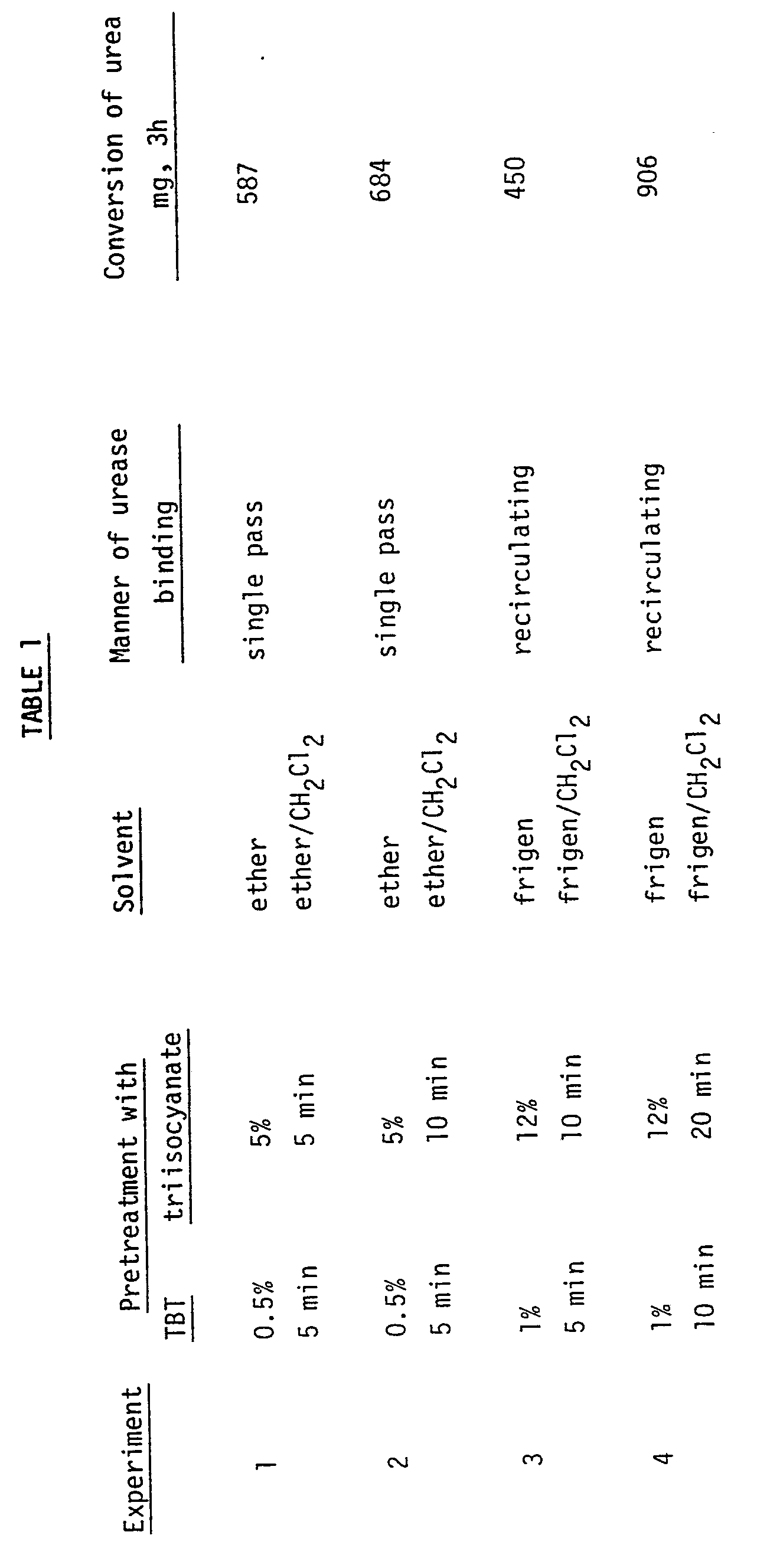
- From Table 1, it is apparent that the activity of the bound urease (as reflected through the conversion of urea) was doubled by doubling of the time for influence of TBT and triisocyanate, compare Experiments 3 and 4.
- Consequently, the Example shows that a relatively high activity of the bound urease (900 mg urea is hydrolysed within 3 hours) may be obtained by means of the method according to the present invention.
- In this Example, cellulose is used in the form of CuprophanR- wastes from a GambroRLundiaR High-flux dialyzer as a carrier for urease. Said CuprophanR-waste had a surface area of about 200 cm2/g.
- Twenty-seven different experiments to bind an isocyanate compound to the carrier were performed with the use of TBT as catalyst for urethane-forming and with N,N',N"-tris(6-isocyanatohexyl)biuret (experiments 5-25) and trimethylhexamethylene diisocyanate (experiments 26-31), respectively, as examples of the isocyanate compound according to the present invention.
- In each experiment, use was made of 3.5 g carrier which was mixed with 100 m1 of a TBT-solution (0.3-1.5 g TBT/100 m1 CH2C12) and stirred for 1 hour. After decanting of said solution, the impregnated carrier was mixed with 100 m1 of a diisocyanate solution (4-12 g diisocyanate/ 100 ml CH2C12) and stirred for 2 hours to bind said diisocyanate to the TBT-impregnated carrier. (In experiments 5-8 stirring was made for between 0.5 and 1 hour). After decanting of the solution, the carriers were dried under vacuum for 3 minutes in desiccator.
- 1.5 g of the dried carrier was then contacted with 100 m1 of a urease solution and stirred for 1 hour to bind said urease to the isocyanate-treated carrier. The suspension was finally filtered over a net and washed 4 times with 100 ml of phosphate buffer solution and used for determination of activity. The following methods of determination were used.
- The urease treated carrier was stirred at 37°C in 100 ml urea solution (250 mg/100 ml phosphate buffer, pH 7, 1/15 M, 5 ppm EDTA) for 1 hour. After 3 minutes and 1 hour, respectively, the converted amount of urea was determined according to the Berthelot-method. The results are given in Table 2 below.
- The urease activity was determined in accordance with the prescriptions in H.U. Bergmeier, Methoden der enzymatischen Analyse, Vol. 1 (1974). The results are given in Table 2 below.

- From Table 2, it is apparent that an increase of the binding capacity is achieved through increasing of the TBT-concentration from 0.34 g to 1 g TBT per 100 ml CH2C12. Furthermore, an increase of the binding capacity is achieved through extension of the reaction time for N,N',N"-tris(6-isocyanatohexyl)biuret. Under optimal conditions (for example, Experiment 21) 35-40 U of urease may be bound. Furthermore, under said optimal conditions, the amount of used urease (Experiments 23-25) could be lowered, while retaining high binding capacity.
- To prevent possible activity losses, it may be suitable to add a phosphate buffer and EDTA in order to avoid deactivating the urease. Possible heavy metals in the used materials will thereby be complexed with said EDTA.
- In this example Levasint is employed as a carrier for urease and for albumin. Levasint is a powder sold by Bayer AG and is a saponified ethylene-vinylacetate-copolymer (ethylene-vinylalcohol-coplymer) having the following characteristics:

- Several separate samples of Levasint (2-4g) were mixed with 100 ml of a TBT solution (lg TBT in 100 ml CH2Cl2) and stirred for 1 hour. The TBT pretreated Levasint was mixed with 100 ml of an isocyanate solution (8 g N,N',N"-tris(6-isocyanatohexyl)biuret in 100 ml CH2C12) and stirred for 2 hours. After suction, this activated Levasint was washed twice each with 100 ml CH2C12. The activated Levasint was dried in vacuo for 0.5 hour in a desiccator.
- The urease (Urease S sold by Boehringer, Mannheim) required for each batch was dissolved in 100 ml phosphate buffer solution (pH 7, 1/15 M, 5 ppm EDTA) and cross-linked with glutardialdehyde (GDA) at 0°C (0.1 mg GDA/1000 U urease). The urease activity was determined by the Bergmeyer method mentioned above.
- 500 mg of the activated Levasint was mixed with 100 ml of the urease solutions of varying concentrations (see Table 3 below) and stirred for 1 hour. After suction, the urease-treated Levasint was washed 4 times with each 100 m1 phosphate buffer solution.
- A determination of activity of bound urease was then performed by the following procedure:
- In Experiments 1.1, 1.2 and 1.3, the urease-coated Levasint was stirred for 1 hour at 37°C in 300 m1 urea solution (750 mg in 300 ml phosphate buffer, pH 7, 1/15 M, 5 ppm EDTA). From the amount of urea which was converted after 1 hour, the amount of bound active urease was determined (as determined by the Berthelot method). The value obtained at 37°C was converted to the corresponding value at 25°C with the factor of 0.66. The results are listed in Table 3 below.
- In Experiments 2.1 and 2.2, the urease-coated Levasint was stirred at room temperature for 1 hour-in 300 ml urea solution and the determination was carried out as described above for Experiments 1 and 2, but no factor was necessary. The results are also listed in Table 3 below.
- Since Levasint W is hardly wetted and therefore only slightly influenced in aqueous solutions, it was furthermore attempted to hydrophilize this material through the influence of the tenside HB 509 (sold by Unilever Forschungs GmbH, Hamburg). Specifically, 50 g of Levasint W was stirred in 500 m1 of a 0.2% solution of HB 509 in isopropanol and then left to stand for a longer time. After suction and drying, the pretreated Levasint was tested in the same way as described above. See Experiments 3.1 and 3.2 in Table 3 below.
- In Experiments 4.1 and 4.2, 500 mg of the pretreated and activated carrier was stirred for 1 hour with 100 ml albumin solution (albumin from ox blood, Merck 12018, 5mg% in phosphate buffer pH 7, 1/15 M, 5 ppm EDTA). After 1 hour, samples (2 m1 each) were taken, filtered off and albumin determined directly in the filtrate.
- After filtering, the albumin which was non-covalently bound to the carrier was determined in the filtrate joined with the wash solutions by Bio-Rad Protein assay with standards prepared from ox blood, Merck 12018. The carrier was treated as well with (a) phosphate buffer alone and (b) phosphate buffer which has been allowed to stand for 10 minutes with 5 ml of 6m urea solution, in order to release any adsorptively bound albumin. The results are shown in Table 4 below.

- The results in Table 3 demonstrate that as the ratio of used activated carrier to urease concentration was varied, between 27 and 78% of the enzyme activity lost from the solution was found bound to the carrier.
- The results in Table 4 also demonstrate that substantial amounts of albumin were adsorptively bound to the carrier. Such adsorptively bound albumin could be resolved through intensive washing.

- In summary, the results in this examples demonstrate that a binding of proteins such as urease or albumin to this synthetic carrier is possible. The binding is not only covalent; on a hydrophobic substrate also adsorption is contributing. In comparison to a CuprophanR membrane, the covalently bound portion is substantially smaller with Levasint, since the portion of free hydroxyl groups of Levasint probably is much smaller. Also, the hydroxyl groups in the ethylene-vinylalcohol-copolymer are slowly reactive secondary alcohol groups.
- Since enzyme activity could be redissolved partially from the carrier through washing, the binding on the synthetic copolymer is also ascribed to interactions with the hydrophobic polyethylene areas.
- A further characteristic of the Levasint carrier is that it is hardly wettable and, as a consequence of the specific gravity of 0.97 g/cm2, that it tends to float on the surface in aqueous solution. Therefore, a substrate as e.g. cellulose is preferred.
- It will be understood that the embodiments described herein are merely exemplary and that a person skilled in the art may make many variations and modifications without departing from the spirit and scope of the invention. All such modifications and variations are intended to be included within the scope of the invention as defined in the appended claims.
Claims (12)
Priority Applications (1)
| Application Number | Priority Date | Filing Date | Title |
|---|---|---|---|
| AT81109709T ATE4223T1 (en) | 1980-11-19 | 1981-11-16 | METHOD OF BINDING A BIOLOGICALLY ACTIVE MATERIAL, FOR EXAMPLE A PROTEIN, TO A CARRIER CONTAINING HYDROXYL GROUPS. |
Applications Claiming Priority (2)
| Application Number | Priority Date | Filing Date | Title |
|---|---|---|---|
| SE8008096 | 1980-11-19 | ||
| SE8008096A SE450834B (en) | 1980-11-19 | 1980-11-19 | SET TO BIND A PROTEIN TO A CARRIER CONTAINING HYDROXYL GROUPS |
Publications (2)
| Publication Number | Publication Date |
|---|---|
| EP0052365A1 true EP0052365A1 (en) | 1982-05-26 |
| EP0052365B1 EP0052365B1 (en) | 1983-07-20 |
Family
ID=20342273
Family Applications (1)
| Application Number | Title | Priority Date | Filing Date |
|---|---|---|---|
| EP81109709A Expired EP0052365B1 (en) | 1980-11-19 | 1981-11-16 | Method of binding a biologically active material, e.g. a protein to a carrier containing hydroxyl groups |
Country Status (6)
| Country | Link |
|---|---|
| US (1) | US4412000A (en) |
| EP (1) | EP0052365B1 (en) |
| JP (1) | JPS57117868A (en) |
| AT (1) | ATE4223T1 (en) |
| DE (1) | DE3160656D1 (en) |
| SE (1) | SE450834B (en) |
Cited By (5)
| Publication number | Priority date | Publication date | Assignee | Title |
|---|---|---|---|---|
| FR2500464A1 (en) * | 1981-02-21 | 1982-08-27 | Akzo Nv | POLYURETHANE COATING MASSES, PROCESS FOR THEIR MANUFACTURE AND USE THEREOF |
| EP0141224A1 (en) * | 1983-09-27 | 1985-05-15 | Hoechst Aktiengesellschaft | Process for enzymatic hydrolyse of nucleic acids |
| EP0141223A1 (en) * | 1983-09-27 | 1985-05-15 | Hoechst Aktiengesellschaft | Method for the production of an immobilized acylase and its use |
| EP0147914A3 (en) * | 1983-12-27 | 1987-01-07 | Corning Glass Works | Immobilized enzyme composites |
| WO1998012246A1 (en) * | 1996-09-18 | 1998-03-26 | GESELLSCHAFT FüR BIOTECHNOLOGISCHE FORSCHUNG MBH (GBF) | Shaping object with reactive functions |
Families Citing this family (10)
| Publication number | Priority date | Publication date | Assignee | Title |
|---|---|---|---|---|
| AU580548B2 (en) * | 1983-02-14 | 1989-01-19 | Cuno Incorporated | Polymer modified polysaccharide |
| US4663163A (en) * | 1983-02-14 | 1987-05-05 | Hou Kenneth C | Modified polysaccharide supports |
| GB8334499D0 (en) * | 1983-12-24 | 1984-02-01 | Beecham Group Plc | Derivatives |
| US4530905A (en) * | 1984-10-25 | 1985-07-23 | The Dow Chemical Company | Crosslinked gelatin foams |
| US4687820A (en) * | 1984-08-22 | 1987-08-18 | Cuno Incorporated | Modified polypeptide supports |
| JPS63186660A (en) * | 1986-09-24 | 1988-08-02 | 宇部興産株式会社 | body fluid purifier |
| US4954444A (en) * | 1987-03-02 | 1990-09-04 | E. I. Du Pont De Nemours And Company | Enzyme immobilization and bioaffinity separations with perfluorocarbon polymer-based supports |
| US5079155A (en) * | 1987-03-02 | 1992-01-07 | E. I. Du Pont De Nemours And Company | Fluorocarbon polymer support for chromatographic separations, diagnostic assays and enzyme immobilization |
| US5403750A (en) * | 1991-03-06 | 1995-04-04 | W. R. Grace & Co.-Conn. | Biocompatible, low protein adsorption affinity matrix |
| US7335400B2 (en) * | 2001-07-24 | 2008-02-26 | University Of Pittsburgh | Irreversible immobilization of enzymes into polyurethane coatings |
Citations (2)
| Publication number | Priority date | Publication date | Assignee | Title |
|---|---|---|---|---|
| US3119792A (en) * | 1956-12-21 | 1964-01-28 | Bayer Ag | Metal and metal compound catalysts for polyurethane plastics |
| US4177038A (en) * | 1976-05-18 | 1979-12-04 | Max-Planck-Gesellschaft Zur Forderung Der Wissenschafen E.V. | Method for the production of a vehicle substance which is capable of covalent bonding with biologically active matter |
Family Cites Families (1)
| Publication number | Priority date | Publication date | Assignee | Title |
|---|---|---|---|---|
| GB1346631A (en) * | 1971-02-10 | 1974-02-13 | Ranks Hovis Mcdougall Ltd | Enzymes |
-
1980
- 1980-11-19 SE SE8008096A patent/SE450834B/en not_active IP Right Cessation
-
1981
- 1981-11-12 US US06/320,215 patent/US4412000A/en not_active Expired - Fee Related
- 1981-11-16 AT AT81109709T patent/ATE4223T1/en not_active IP Right Cessation
- 1981-11-16 DE DE8181109709T patent/DE3160656D1/en not_active Expired
- 1981-11-16 EP EP81109709A patent/EP0052365B1/en not_active Expired
- 1981-11-19 JP JP56186076A patent/JPS57117868A/en active Pending
Patent Citations (2)
| Publication number | Priority date | Publication date | Assignee | Title |
|---|---|---|---|---|
| US3119792A (en) * | 1956-12-21 | 1964-01-28 | Bayer Ag | Metal and metal compound catalysts for polyurethane plastics |
| US4177038A (en) * | 1976-05-18 | 1979-12-04 | Max-Planck-Gesellschaft Zur Forderung Der Wissenschafen E.V. | Method for the production of a vehicle substance which is capable of covalent bonding with biologically active matter |
Cited By (6)
| Publication number | Priority date | Publication date | Assignee | Title |
|---|---|---|---|---|
| FR2500464A1 (en) * | 1981-02-21 | 1982-08-27 | Akzo Nv | POLYURETHANE COATING MASSES, PROCESS FOR THEIR MANUFACTURE AND USE THEREOF |
| EP0141224A1 (en) * | 1983-09-27 | 1985-05-15 | Hoechst Aktiengesellschaft | Process for enzymatic hydrolyse of nucleic acids |
| EP0141223A1 (en) * | 1983-09-27 | 1985-05-15 | Hoechst Aktiengesellschaft | Method for the production of an immobilized acylase and its use |
| EP0147914A3 (en) * | 1983-12-27 | 1987-01-07 | Corning Glass Works | Immobilized enzyme composites |
| WO1998012246A1 (en) * | 1996-09-18 | 1998-03-26 | GESELLSCHAFT FüR BIOTECHNOLOGISCHE FORSCHUNG MBH (GBF) | Shaping object with reactive functions |
| AU730793B2 (en) * | 1996-09-18 | 2001-03-15 | Gesellschaft Fur Biotechnologische Forschung Mbh | Shaped article having reactive functions |
Also Published As
| Publication number | Publication date |
|---|---|
| JPS57117868A (en) | 1982-07-22 |
| US4412000A (en) | 1983-10-25 |
| ATE4223T1 (en) | 1983-08-15 |
| EP0052365B1 (en) | 1983-07-20 |
| SE8008096L (en) | 1982-05-20 |
| DE3160656D1 (en) | 1983-08-25 |
| SE450834B (en) | 1987-08-03 |
Similar Documents
| Publication | Publication Date | Title |
|---|---|---|
| EP0052365B1 (en) | Method of binding a biologically active material, e.g. a protein to a carrier containing hydroxyl groups | |
| CA2272942C (en) | Bonding bio-active materials to substrate surfaces of medical devices via hydrophilic spacers | |
| US5541305A (en) | Composition compatible with blood | |
| US4944767A (en) | Synthetic material apt to stably adsorb high quantities of heparin, and process for the production thereof | |
| GB1568328A (en) | Immobilized enzymes on pullulan carriers and preparation thereof | |
| US5648070A (en) | Biocompatible anion exchange materials | |
| EP0105736B1 (en) | Immobilization of proteins on polymeric supports | |
| KR100404825B1 (en) | Material for superantigen removal or detoxification | |
| PIAO et al. | Heparin immobilization by surface amplification | |
| EP0595805B1 (en) | Method of modifying the properties of a substrate surface by covalent bonding of a compound to the surface, and membrane modified according to this method | |
| DE3109141A1 (en) | Antithrombogenic treatment of matrix surfaces | |
| CN100560198C (en) | A selective adsorbent for low-density lipoprotein cholesterol and its preparation method | |
| EP0769503A2 (en) | A heparin complex and medical device having such substance | |
| JPH0313868B2 (en) | ||
| GB2414241A (en) | Polyurethane for adsorbing leukocytes | |
| JP3733658B2 (en) | β2 microglobulin removal, detection or measurement material and body fluid purification column using the same | |
| JP3733657B2 (en) | Material for removing or detoxifying polypeptide antibiotics | |
| JP3173615B2 (en) | Blood compatible material | |
| WO1988004183A1 (en) | Antithrombotic medical materials and process for their production | |
| JP3806970B2 (en) | Superantigen removal or detoxification material | |
| CN120959241B (en) | A guanidine-based compound antibacterial agent and its preparation method | |
| JPS6365699B2 (en) | ||
| JPH0753177B2 (en) | Method for adsorption removal of β2-microglobulin | |
| JPH09220454A (en) | Modified polysulfone semipermeable membrane and method for producing the same | |
| JP2000334279A (en) | Regenerated cellulose-base separation membrane for artificial dialysis |
Legal Events
| Date | Code | Title | Description |
|---|---|---|---|
| PUAI | Public reference made under article 153(3) epc to a published international application that has entered the european phase |
Free format text: ORIGINAL CODE: 0009012 |
|
| AK | Designated contracting states |
Designated state(s): AT BE CH DE FR GB IT LI LU NL |
|
| 17P | Request for examination filed |
Effective date: 19820504 |
|
| ITF | It: translation for a ep patent filed | ||
| GRAA | (expected) grant |
Free format text: ORIGINAL CODE: 0009210 |
|
| AK | Designated contracting states |
Designated state(s): AT BE CH DE FR GB IT LI LU NL |
|
| REF | Corresponds to: |
Ref document number: 4223 Country of ref document: AT Date of ref document: 19830815 Kind code of ref document: T |
|
| ET | Fr: translation filed | ||
| REF | Corresponds to: |
Ref document number: 3160656 Country of ref document: DE Date of ref document: 19830825 |
|
| PGFP | Annual fee paid to national office [announced via postgrant information from national office to epo] |
Ref country code: LU Payment date: 19831109 Year of fee payment: 3 |
|
| PG25 | Lapsed in a contracting state [announced via postgrant information from national office to epo] |
Ref country code: LU Free format text: LAPSE BECAUSE OF NON-PAYMENT OF DUE FEES Effective date: 19831130 |
|
| PGFP | Annual fee paid to national office [announced via postgrant information from national office to epo] |
Ref country code: CH Payment date: 19831227 Year of fee payment: 3 |
|
| PLBE | No opposition filed within time limit |
Free format text: ORIGINAL CODE: 0009261 |
|
| STAA | Information on the status of an ep patent application or granted ep patent |
Free format text: STATUS: NO OPPOSITION FILED WITHIN TIME LIMIT |
|
| 26N | No opposition filed | ||
| PGFP | Annual fee paid to national office [announced via postgrant information from national office to epo] |
Ref country code: AT Payment date: 19840917 Year of fee payment: 4 |
|
| PGFP | Annual fee paid to national office [announced via postgrant information from national office to epo] |
Ref country code: FR Payment date: 19841128 Year of fee payment: 4 |
|
| PGFP | Annual fee paid to national office [announced via postgrant information from national office to epo] |
Ref country code: NL Payment date: 19841130 Year of fee payment: 4 |
|
| PGFP | Annual fee paid to national office [announced via postgrant information from national office to epo] |
Ref country code: BE Payment date: 19841231 Year of fee payment: 4 |
|
| PG25 | Lapsed in a contracting state [announced via postgrant information from national office to epo] |
Ref country code: AT Effective date: 19851116 |
|
| PG25 | Lapsed in a contracting state [announced via postgrant information from national office to epo] |
Ref country code: LI Effective date: 19851130 Ref country code: CH Effective date: 19851130 |
|
| PG25 | Lapsed in a contracting state [announced via postgrant information from national office to epo] |
Ref country code: NL Effective date: 19860601 |
|
| GBPC | Gb: european patent ceased through non-payment of renewal fee | ||
| NLV4 | Nl: lapsed or anulled due to non-payment of the annual fee | ||
| PG25 | Lapsed in a contracting state [announced via postgrant information from national office to epo] |
Ref country code: FR Free format text: LAPSE BECAUSE OF NON-PAYMENT OF DUE FEES Effective date: 19860731 |
|
| REG | Reference to a national code |
Ref country code: CH Ref legal event code: PL |
|
| REG | Reference to a national code |
Ref country code: FR Ref legal event code: ST |
|
| PG25 | Lapsed in a contracting state [announced via postgrant information from national office to epo] |
Ref country code: BE Effective date: 19861130 |
|
| BERE | Be: lapsed |
Owner name: GAMBRO DIALYSATOREN K.G. Effective date: 19861130 |
|
| PG25 | Lapsed in a contracting state [announced via postgrant information from national office to epo] |
Ref country code: GB Effective date: 19881118 |
|
| PGFP | Annual fee paid to national office [announced via postgrant information from national office to epo] |
Ref country code: DE Payment date: 19881227 Year of fee payment: 8 |
|
| PG25 | Lapsed in a contracting state [announced via postgrant information from national office to epo] |
Ref country code: DE Effective date: 19900801 |