EP0052436A2 - Shampoo composition - Google Patents
Shampoo composition Download PDFInfo
- Publication number
- EP0052436A2 EP0052436A2 EP81304974A EP81304974A EP0052436A2 EP 0052436 A2 EP0052436 A2 EP 0052436A2 EP 81304974 A EP81304974 A EP 81304974A EP 81304974 A EP81304974 A EP 81304974A EP 0052436 A2 EP0052436 A2 EP 0052436A2
- Authority
- EP
- European Patent Office
- Prior art keywords
- shampoo composition
- keratin
- acid
- decomposition
- shampoo
- Prior art date
- Legal status (The legal status is an assumption and is not a legal conclusion. Google has not performed a legal analysis and makes no representation as to the accuracy of the status listed.)
- Granted
Links
Classifications
-
- A—HUMAN NECESSITIES
- A61—MEDICAL OR VETERINARY SCIENCE; HYGIENE
- A61K—PREPARATIONS FOR MEDICAL, DENTAL OR TOILETRY PURPOSES
- A61K8/00—Cosmetics or similar toiletry preparations
- A61K8/18—Cosmetics or similar toiletry preparations characterised by the composition
- A61K8/30—Cosmetics or similar toiletry preparations characterised by the composition containing organic compounds
- A61K8/64—Proteins; Peptides; Derivatives or degradation products thereof
- A61K8/65—Collagen; Gelatin; Keratin; Derivatives or degradation products thereof
-
- A—HUMAN NECESSITIES
- A61—MEDICAL OR VETERINARY SCIENCE; HYGIENE
- A61Q—SPECIFIC USE OF COSMETICS OR SIMILAR TOILETRY PREPARATIONS
- A61Q5/00—Preparations for care of the hair
- A61Q5/02—Preparations for cleaning the hair
-
- Y—GENERAL TAGGING OF NEW TECHNOLOGICAL DEVELOPMENTS; GENERAL TAGGING OF CROSS-SECTIONAL TECHNOLOGIES SPANNING OVER SEVERAL SECTIONS OF THE IPC; TECHNICAL SUBJECTS COVERED BY FORMER USPC CROSS-REFERENCE ART COLLECTIONS [XRACs] AND DIGESTS
- Y10—TECHNICAL SUBJECTS COVERED BY FORMER USPC
- Y10S—TECHNICAL SUBJECTS COVERED BY FORMER USPC CROSS-REFERENCE ART COLLECTIONS [XRACs] AND DIGESTS
- Y10S424/00—Drug, bio-affecting and body treating compositions
- Y10S424/01—Aerosol hair preparation
Definitions
- This invention relates to a shampoo composition and more particularly, to a shampoo composition which comprises a shampoo base containing anionic surface active agents and decomposition derivatives of keratin material and which shows an excellent hair conditioning effect and mild eye irritation.
- Hitherto employed shampoos generally comprise singly or in combination, as their base, anionic surface active agents such as alkylsulfates and polyoxyethylenealkylsulfates and the like, nonionic surface active agents such as polyoxyethylene alkyl ethers, fatty acid alkylolamides and the like, or amphoteric surface active agents such as alkylbetaines, alkylamine oxides and the like.
- anionic surface active agents such as alkylsulfates and polyoxyethylenealkylsulfates and the like
- nonionic surface active agents such as polyoxyethylene alkyl ethers, fatty acid alkylolamides and the like
- amphoteric surface active agents such as alkylbetaines, alkylamine oxides and the like.
- the system in an emulsified or solubilized state by the action of surface active agents, so that it is difficult to add oils in amounts sufficient for scalp and hair without impairing the stability of the system.
- a shampoo composition which comprises a shampoo base containing anionic surface active agents and a decomposition derivative of keratin material selected from the group consisting of (1) decomposition products obtained by oxidation of keratin materials, (2) derivatives at the thiol. group of decomposition products obtained by reduction of keratin materials and a mixture thereof.
- Preferable anionic active agents to be used as the base of the shampoo composition include:
- the counter ions of these anionic surface active agents include alkali metal ions such as sodium, potassium and the like, alkaline earth metal ions such as calcium, magnesium and the like, ammonium ions, and alkanolamines having 1 -.3 alkanol groups having 2 or 3 carbon atoms (e.g. monoethanolamine, diethanolamine, triethanolamine, triisopropanolamine and the like).
- Preferable anionic surface active agents among those mentioned above are linear or branched alkylsulfates having 10 - 16 carbon atoms on average, polyoxyethylenealkylsulfates (having an average number of added moles of 0.5 - 8) whose alkyl group has 8 - 20 carbon atoms on average, or olefinsulfonates having 10 - 16 carbon atoms on average, which are used singly or in combinations.
- the decomposition derivatives of keratin material to be used in the present invention are (1) decomposition products obtained by oxidation of a keratin material, (2) derivatives at the thiol group of decomposition products obtained by reduction of a keratin which are prepared in the following manner and have an average molecular weight of 30,000 - 100,000, and a mixture thereof.
- the starting keratin materials include, for example, animal hair, human hair, feather, claw, horn, hoof and scale, among which wool, the hairs and feather are preferably used. These keratin materials may be subjected to the oxidation or reduction reaction as they are but, if necessary, may be cut or reduced into pieces of a suitable size or may be pretreated such as by washing and defatting.
- the decomposition derivatives of the keratin material used in the present invention are originally insoluble in polar solvents such as water, ethanol, propylene glycol and the like but show solubility in the presence of anionic surface active agents.
- polar solvents such as water, ethanol, propylene glycol and the like
- alkaline materials include inorganic alkali compounds such as sodium hydroxide, potassium hydroxide and the like and organic alkali compounds such as ammonia, ethanolamine, diethanolamine, triethanolamine, 2-amino-2-methylpropanol, aminomethylmercaptopropanediol, triisopropanolamine, glycine, alginine, histidine and the like.
- the shampoo composition according to the invention is prepared by adding 0.05 - 10 wt% (hereinafter referred to simply as %), preferably 0.2 - 3%, of one or more of the decomposition derivatives of keratin material to a shampoo base containing 5 - 30%, preferably 10 - 25%, of one or more of anionic surface active agents. Less amounts of the decomposition derivative than 0.1% are not favorable since satisfactory effects are not shown, whereas larger amounts than 10% are unfavorable since hair becomes sticky under high humidity conditions.
- the shampoo composition of the invention is so adjusted that the pH of its 5% aqueous solution is in the range of 4 -8.
- the shampoo composition of the invention may further comprise, aside from the above-described two essential components, ingredients added to known shampoo compositions.
- ingredients added to known shampoo compositions may be added, if necessary, the following ingredients in such amounts as not to impair the effect of the invention: amphoteric surface active agents, nonionic surface active agents, cationic surface active agents, solubilizing agents such as propylene glycol, glycerine, urea and the like, viscosity-adjusting agents such as ethyl alcohol, isopropyl alcohol, hydroxyethyl cellulose, methyl cellulose, higher alcohols, and the like, perfumes, colorants, UV absorbers, antioxidants, preservatives, pearling agents, and lotioning agents.
- the thus obtained shampoo composition of the-invention not only is excellent in hair conditioning effect and washing effect, but also shows milder eye irritation than known shampoo compositions when getting in eyes by accident and only a gentle influence on the conjunctiva and iris.
- Shampoo compositions A (inventive product) and B (comparative product) of the following formulations were prepared and their effects were evaluated by a paired sensorial evaluation by a panel of 20 female members. The results are shown in Table 3.
- the shampoo composition A (inventive product) used in Example 2 and a commercially available shampoo were used to check the degree of irritation to eyes by the Oraize method. That is, 0.1 mt of each shampoo composition was dropped in the eyes of five healthy white, male rabbits weighing 2.5 - 3.0 kg. Three hours and 24 hours after the dropping, the cornea, iris and conjuctiva of five rabbits were observed and the results were calculated according to the following inspection method to give average values. A total value was obtained by adding a value which was obtained by multiplying two average values of cornea by themselves and further by 5, a value which was obtained by multiplying an average value of the iris by 5, and a value which was obtained by adding three average values of the conjuctiva to one another and then multiplied by 2. A higher total value shows a greater degree of the irritation to eyes. The results are shown in Table 4.
Landscapes
- Health & Medical Sciences (AREA)
- Life Sciences & Earth Sciences (AREA)
- Animal Behavior & Ethology (AREA)
- General Health & Medical Sciences (AREA)
- Public Health (AREA)
- Veterinary Medicine (AREA)
- Birds (AREA)
- Epidemiology (AREA)
- Cosmetics (AREA)
Abstract
Description
- This invention relates to a shampoo composition and more particularly, to a shampoo composition which comprises a shampoo base containing anionic surface active agents and decomposition derivatives of keratin material and which shows an excellent hair conditioning effect and mild eye irritation.
- Hitherto employed shampoos generally comprise singly or in combination, as their base, anionic surface active agents such as alkylsulfates and polyoxyethylenealkylsulfates and the like, nonionic surface active agents such as polyoxyethylene alkyl ethers, fatty acid alkylolamides and the like, or amphoteric surface active agents such as alkylbetaines, alkylamine oxides and the like.
- On washing of hair with the shampoos containing these bases, it will be found that the sebum or other oils existing on the hair surface are washed off too much, so that the feeling of the washed hair becomes very poor to the touch and hard to comb or brush. In addition, when completely dried, such hair is hard to style. Especially in winter season of low humidity, since static electricity is ready to generate on brushing, there occurs a phenomenon such as of hair fly with the attendant disadvantage that the hair is hard to comb, causing split-ends or broken hairs.
- In order to overcome the above disadvantage, there is known a method of adding oils to ordinary shampoo bases to supplement the oil at the time of washing. Ordinarily employed shampoos are admixed with a variety of oils.
- However, in the formulation system of shampoo, the system is in an emulsified or solubilized state by the action of surface active agents, so that it is difficult to add oils in amounts sufficient for scalp and hair without impairing the stability of the system.
- With shampoos to which large amounts of oil are added, an amount of adsorption of oil on hair increases but they involve disadvantages that lathering and detergency which shampoos should orginally have deteriorate extremely with the commercial value being considerably impaired.
- In recent years, on the.other hand, there have been proposed many shampoo compositions including cationic . polymers for the purpose of imparting a rinsing effect to hair after washing. However, these compositions have the following disadvantages: (1) Showing a conditioning effect but deteriorated in lathering ability and detergency; (2) Colored or discolored as time goes; (3) Excellent in lathering characteristic but poor in conditioning effect; and (4) High in cost.
- It is an object of the present invention to provide a shampoo composition which can overcome the disadvantages of the known shampoo compositions and has such a consition- ing effect as to impart softness and smoothness to hair after washing.
- It is another object of the invention to provide a shampoo composition which comprises anionic surface active agents and decomposition derivatives of kertain materials in combination whereby excellent touches such as of softness, smoothness and the like and excellent conditioning effects'such as of combing ease. can be imparted to pair after washing without sacrifices of properties of the shampoo composition itself.
- The above objects can be achieved according to the present invention by a shampoo composition which comprises a shampoo base containing anionic surface active agents and a decomposition derivative of keratin material selected from the group consisting of (1) decomposition products obtained by oxidation of keratin materials, (2) derivatives at the thiol. group of decomposition products obtained by reduction of keratin materials and a mixture thereof.
- Preferable anionic active agents to be used as the base of the shampoo composition include:
- (1) Linear or branched alkylbenzenesulfonates whose alkyl group has 10 - 16 carbon atoms on average;
- (2) Polyoxyalkylenealkylsulfates added with 0.5 - 8 moles, in average, of ethylene oxide and/or propylene oxide per molecule, which have a linear or branched alkyl group having 8 - 20 carbon atoms on average;
- (3) Alkylsulfates whose alkyl group has 10 - 20 carbon atoms on average;
- (4)'Olefinsulfonates having 10 - 12 carbon atoms on average in one molecule thereof;
- (5) Alkanesulfonates having 10 - 20 carbon atoms on average in one molecule thereof;
- (6) Alkylethoxycarbonates having 10 - 20 carbon atoms on average in the alkyl group thereof and added with 0.5 - 8 moles of ethylene oxide on average in one molecule thereof; and
- (7) Derivatives of succinic acid represented by the formula

- The counter ions of these anionic surface active agents include alkali metal ions such as sodium, potassium and the like, alkaline earth metal ions such as calcium, magnesium and the like, ammonium ions, and alkanolamines having 1 -.3 alkanol groups having 2 or 3 carbon atoms (e.g. monoethanolamine, diethanolamine, triethanolamine, triisopropanolamine and the like).
- Preferable anionic surface active agents among those mentioned above are linear or branched alkylsulfates having 10 - 16 carbon atoms on average, polyoxyethylenealkylsulfates (having an average number of added moles of 0.5 - 8) whose alkyl group has 8 - 20 carbon atoms on average, or olefinsulfonates having 10 - 16 carbon atoms on average, which are used singly or in combinations.
- The decomposition derivatives of keratin material to be used in the present invention are (1) decomposition products obtained by oxidation of a keratin material, (2) derivatives at the thiol group of decomposition products obtained by reduction of a keratin which are prepared in the following manner and have an average molecular weight of 30,000 - 100,000, and a mixture thereof.
- The starting keratin materials include, for example, animal hair, human hair, feather, claw, horn, hoof and scale, among which wool, the hairs and feather are preferably used. These keratin materials may be subjected to the oxidation or reduction reaction as they are but, if necessary, may be cut or reduced into pieces of a suitable size or may be pretreated such as by washing and defatting.
-
- (1) Decomposition products obtained by oxidation of keratins.
- The oxidation of keratin is feasible by a variety of methods known per se (N. H. Leon; Textile Progress, Vol. 7, page 1 (1975)). Oxidizing agents are preferably organic or inorganic agents of the type which electrophilically acts on the disulfide bond (S-S bond) in the keratin structure. Examples of the oxidizing agents include organic peracids, inorganic peroxo acids or their salts, permanganic acid or its salts, chromic'acid or related compounds, halogens, peroxides, oxyacids or their salts, and the like, among which the organic peracids such as peracetic acid, performic acid and perbenzoic acid are preferable. The oxidation reaction is conducted in liquid media using oxidizing agents in excess with respect to the disulfide bonds in the keratin material, ordinarily in the amounts of over two equivalents or more, preferably 4 - 10 equivalents, of the disulfide bonds.
- The reaction is feasible under acidic or alkaline conditions and is preferably conducted under acidic conditions and particularly weakly acidic conditions.
- The reaction temperature and pressure are varied depending on the types of the oxidizing agent and keratin material and are not critical. Room : temperature is generally sufficient but, if necessary, heat may be.applied. An atmospheric pressure is satisfactorily used in the practice of the invention but the reaction may be conducted under reduced pressure or under pressure.
- By this, the disulfide bond of keratin material is cleft into sulfonic acid ("S03H).
- (2) Derivatives at the thiol group of decomposition products obtained by reduction of keratin materials.
- Reducing agents employed for reducing keratin materials are preferably organic or inorganic reducing agents of the type which serves to cleave the disulfide bond in the keratin structure into a thiol group (-SH) and generally acts nucleophilically on the disulfide bond.
- Examples of the reducing agents include organic reducing agents such as mercaptoethanol, thioglycollic acid, benzylmercaptan, 1,4-dithiothreitol, tributylphosphine and the like, and inorganic reducing agents such as sodium hydrogensulfite, sulfides such as sodium hydrosulfide, metallic hydrides such as lithium aluminium hydride. The amount of the reducing agent is usually in the range of 2 - 10 equivalents of the disulfide bonds in keratin material. The pH of the reaction system is in the range of 2 - 12, preferably 6 - 11.
- Outside the range, the hydrolysis undesirably takes place at the same time. Room temperature is sufficient for the reaction but heat may be applied to shorten the reaction time. The reaction time is ordinarily in the range of 2 - 3 hours or more. Since the thiol group produced by the reduction is required not to be substantially oxidized, the reduction operation should conveniently be carried out in an atmosphere of inert gas to give good results.
- The decomposition product obtained by the reduction of the keratin material is then chemically modified at the thiol group thereof to obtain a derivative thereof. The derivatives at the thiol group include:


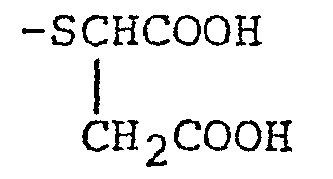
- The chemical modification of the thiol group is known per se and can be conducted, for example, based on the procedures known from N. H. Leon; Textile Progress, Vol. 7, page 1 (1975), "Yuki Ioo Kagobutsu (Organic Sulfur Compounds)" written by Shigeru Ookyo and published by Kagaku Dojin (1968) and "Kobunshi Jikkengaku Koza" written by Masami Oku, Vol. 12, Kyoritsu Shuppan (1957). Typical methods are shown below.
- (a) Method utilizing the nucelophilic substitution reaction of SH group

- (b) Method utilizing the nucleophilic addition reaction of SH group with a double bond between carbon atoms

- (c) Method using a substitution reaction between SH group and sulfite compound


- (d) Method of oxidizing SH group into sulfonic acid group

- (a) Method utilizing the nucelophilic substitution reaction of SH group
- The decomposition derivatives of the keratin material used in the present invention are originally insoluble in polar solvents such as water, ethanol, propylene glycol and the like but show solubility in the presence of anionic surface active agents. In order to further increase the solubility, it is desirable to use alkaline materials in combination or for forming salts with the derivative. Examples of the alkaline materials include inorganic alkali compounds such as sodium hydroxide, potassium hydroxide and the like and organic alkali compounds such as ammonia, ethanolamine, diethanolamine, triethanolamine, 2-amino-2-methylpropanol, aminomethylmercaptopropanediol, triisopropanolamine, glycine, alginine, histidine and the like.
- The shampoo composition according to the invention is prepared by adding 0.05 - 10 wt% (hereinafter referred to simply as %), preferably 0.2 - 3%, of one or more of the decomposition derivatives of keratin material to a shampoo base containing 5 - 30%, preferably 10 - 25%, of one or more of anionic surface active agents. Less amounts of the decomposition derivative than 0.1% are not favorable since satisfactory effects are not shown, whereas larger amounts than 10% are unfavorable since hair becomes sticky under high humidity conditions.
- Preferably, the shampoo composition of the invention is so adjusted that the pH of its 5% aqueous solution is in the range of 4 -8.
- The shampoo composition of the invention may further comprise, aside from the above-described two essential components, ingredients added to known shampoo compositions. For instance, there may be added, if necessary, the following ingredients in such amounts as not to impair the effect of the invention: amphoteric surface active agents, nonionic surface active agents, cationic surface active agents, solubilizing agents such as propylene glycol, glycerine, urea and the like, viscosity-adjusting agents such as ethyl alcohol, isopropyl alcohol, hydroxyethyl cellulose, methyl cellulose, higher alcohols, and the like, perfumes, colorants, UV absorbers, antioxidants, preservatives, pearling agents, and lotioning agents.
- The thus obtained shampoo composition of the-invention not only is excellent in hair conditioning effect and washing effect, but also shows milder eye irritation than known shampoo compositions when getting in eyes by accident and only a gentle influence on the conjunctiva and iris.
- The present invention is particularly described by way of references and examples, which should not be construed as limiting the present invention thereto.
- Preparation of oxidation decomposition derivatives of keratin materials:
- (a) Ten grams of wool fibers were immersed in 700 g of 8% aqueous peracetic acid solution at room temperature for 1 day for the oxidation reaction. The resulting oxidized wool was filtered and washed with water, and then immersed in 700 g of a O.lN ammoniacal solution at room temperature for 1 day, permitting about 90% of the wool to dissolve in the ammoniacal solution. About 1 g of the insoluble matters were removed by filtration and the aqueous ammoniacal solution of keratose as an oxidized decomposition product of wool keratin was admixed with 2N hydrochloric acid to adjust pH to 4.0 whereupon a-keratose was settled as a precipitate. This precipitate was filtered, washed with acetone and dried to obtain 5.4 g of a-keratose.
- (b) Wool fibers were heated under pressure in an autoclave by the use of saturated steam of 6 kg/cm2 for 6 minutes and were abruptly released into the air to obtain a porous swollen matter. Ten grams of the swollen matter which had been reduced to pieces, 250 g of formic acid and 50 g of a 30% aqueous hydrogen peroxide solution were charged into a 500 mℓ three neck distillation flask to immerse the pieces at room temperature for 1 day, whereupon no powder was found in the solution with the foam-like matter being floated on the upper layer. This reaction mixture was filtered and the filtrate was poured into 1.5 liters of water, followed by adding hydrochloric acid to adjust the pH to 4. The resulting precipitate was collected by filtration and washed with 500 mt of water to obtain 4.5 g of a-keratose. To the insoluble matters from which.the reaction product had been removed by filtration were added 350 mt of water and then an ammoniacal solution to adjust the pH to 11, and the matters were immersed at room temperature for 1 day. The system was filtered and the filtrate' was added with hydrochloric acid to adjust the pH to 4. The resulting precipitate was collected by filtration to obtain 0.7 g of a-keratose. It was found that 1.4 g of the insoluble matters were primarily made of β-keratose.
- Preparation of reduced decomposition derivatives of keratin materials:
- (a) Ten grams of wool fibers were immersed in 600 mℓ of an aqueous solution with concentrations of 8 M urea and 0.01 M Tris buffer, to which was added 6 mℓ of 2-mercaptoethanol, followed by adjusting the pH to 10 by means of a 5N potassium hydroxide aqueous solution to conduct the reduction reaction in an atmosphere of nitrogen at room temperature. About 3 hours after commencement of the reaction, the wool was allowed to dissolve in the reaction solution in an amount of about 85%' thereof. While the system was adjusted with a 5N potassium hydroxide aqueous solution so as not to permit the pH below 7, 16.5 g of iodoacetic acid was gradually added and the pH of the system was finally adjusted to 8.5 to carry out the carboxymethylation reaction at room temperature for 2 hours. The reaction solution was filtered to remove insoluble matters therefrom and the resultant filtrate was charged into a cellulose tube wherein it was dialyzed.against deionized water to remove low molecular weight impurities including urea. As the urea was dialyzed, the content in the cellulose tube was turned white since HGT (component with high contents of glycine and tyrosine) to be a water-insoluble component precipitated. After completion of the dialysis, the HGT was removed by centrifugal separation and S-carboxymethyl kerain (SCMKA) was obtained from the neutral transparent aqueous solution of SCMKA by the isoelectric precipitation method. That is, 1N hydrochloric acid was added to the system to adjust. its pH to 4.4 by which SCMKA was turned insoluble and separated as precipitate. This precipitate was filtered, washed with ethanol and dried to obtain 4.2 g of SCMKA.
- (b) The procedure of Reference 2-(a) was repeated except that there were used instead of wool fibers feathers which were heated for 6 minutes in an autoclave by means of superheated steam of 6 kg/cm2 and 240°C and then abruptly released in the air to obtain a porous swollen matter and that 1.75 g of maleic acid was used instead of iodoacetic acid, thereby obtaining 5.3 g of S-(1,2-dicarboxyethyl)-keratin.
- (c) The procedure of Reference 2-(a) was repeated using a powder of hoof of horse instead of wool fibers and 11 g of acrylic acid instead of iodoacetic acid, thereby obtaining 4.2 g of S-(2-carboxyethyl)-keratin.
- (b) The procedure of Reference 2-(a) was repeated using 28 g of styrenesulfonic acid instead of iodoacetic acid, thereby obtaining 4.8 g of S-(sulfophenylvinyl)-keratin.
- (e) Eight grams of wool fibers were dispersed in .300 m£ of n-propanol and 300 mQ of a 0.1N Tris buffer solution. After substitution'with nitrogen, 3.2 mℓ of tri-n-butylphosphine was added, followed by agitaing at room temperature for 24 hours. After the solution was subjected to filtration, to the insoluble matters were addee 400 mℓ of water, 9.28 g of maleic acid and about 30 mℓ of 5N potassium hydroxide to adjust the pH to 8.0, followed by agitating at room temperature for 6 hours. To the reaction system was added about 20 mℓ of a 28% aqueous ammoniacal solution to adjust the pH to 11.5, after which it was agitated at room temperature for 18 hours. The reaction solution was filtered to remove insoluble portion therefrom and the resultant filtrate was placed in a cellulose tube in which it was dialyzed against deionized water to remove low molecular weight impurities therefrom. After completion of the dialysis, the insoluble matters in the cellulose tube were removed by centrifugal separation and the neutral transparent aqueous solution was adjusted to have a pH of 4.4 by addition of about 5.5 mℓ of 1N hydrochloric acid and the resulting precipitate was collected by filtration, followed by washing with ethanol and drying to obtain 3.9 g of S-(1,2-dicarboxyethyl)-keratin.
- (f) The procedure of Reference 2-(e) was repeated except that there was used instead of wool fibers a power of a porous swollen matter which was obtained by heating wool in an autoclave by means of saturated steam of 6 kg/cm2 for 6 minutes and that 16.5 g of 2-acrylamido-2-methylpropanesulfonic acid was used instead of maleic acid, thereby obtaining 4.5 g of keratin-S-(2-acrylamido-2-methylpropanesulfonic acid).
- Shampoo compositions containing 30% of coconut fatty acid diethanolamide and suitable amounts of perfumes, and anionic active agents and decomposition derivatives of keratin materials indicated in Table 1 were prepared to conduct their performance evaluation tests. The results are shown in Table 2.
- The evaluation tests were conducted according to the following methods.
- (1) Lathering test To an aqueous 1% solution of each shampoo composition was added an artificial stain of 0.1% of lanolin, which was agitated in a cylinder by means of a plain propeller at a rate of 1000 r.p.m. at 40°C for 5 minutes under such conditions that the rotation was reversed every 10 seconds. Thirty seconds after completion of the agitation, the amount of lather was measured.
- (2) Feeling of Lather After thirty grams of a human hair had been wetted with water at 40°C, the excess water was squeezed out to permit 20 g of the water to be contained. Then, the hair was washed by use of 1 g of each shampoo composition and the feeling of the lather was sensorially evaluated by a pannel of twenty female members.
- Evaluation Items: The degree of easiness of passing fingers through hair while washing was evaluated as "slipping of lather" and the appearance of the lather was evaluated from a viewpoint of "creaminess".
- Evaluation Standards: * The slipping of lather is better than that of reference product or the appearance of lather is more creamy. * Equal to reference product.
- .Reference Product:

- (3) Combing Force After thirty grams of an artificial hair was wetted with water at 40°C, the excess water was squeezed out to permit 20 g of water to be contained. One gram of each shampoo composition was used for washing of the hair and a rinsing operation was repeated twice. The hair was attached to a strain gauge after the excess water was squeezed out and combed to measure a force exerted on the hair at the time of the combing (wet state). Then, the hair was dried by a dryer and allowed to stand overnight in an air-conditioned room of 20°C and 65% R.H. and then attached to a strain gauge, followed by combing to measure a force exerted on the hair at the time of combing (dry state).
- (4) Hair Fly On the measurement of the "combing force" in the dry state, it was observed whether or not the hair fly phenomenon occurred by the action of static electricity. Evaluation: * Hair fly took place. * Hair fly did not take place.
- Shampoo compositions A (inventive product) and B (comparative product) of the following formulations were prepared and their effects were evaluated by a paired sensorial evaluation by a panel of 20 female members. The results are shown in Table 3.


- The shampoo composition A (inventive product) used in Example 2 and a commercially available shampoo were used to check the degree of irritation to eyes by the Oraize method. That is, 0.1 mt of each shampoo composition was dropped in the eyes of five healthy white, male rabbits weighing 2.5 - 3.0 kg. Three hours and 24 hours after the dropping, the cornea, iris and conjuctiva of five rabbits were observed and the results were calculated according to the following inspection method to give average values. A total value was obtained by adding a value which was obtained by multiplying two average values of cornea by themselves and further by 5, a value which was obtained by multiplying an average value of the iris by 5, and a value which was obtained by adding three average values of the conjuctiva to one another and then multiplied by 2. A higher total value shows a greater degree of the irritation to eyes. The results are shown in Table 4.
-
- 1. Cornea: Opacity 0 ~ 4 Area of cornea.involved 0 ~ 4
- 2. Iris: Congestion 0 ~ 2
- 3. Conjuctiva: Redness 0 ~ 3 Chemosis 0 ~ 4 Discharge 0 ~ 3


Claims (9)


Priority Applications (1)
| Application Number | Priority Date | Filing Date | Title |
|---|---|---|---|
| AT81304974T ATE17440T1 (en) | 1980-11-14 | 1981-10-22 | HAIR DETERGENT. |
Applications Claiming Priority (2)
| Application Number | Priority Date | Filing Date | Title |
|---|---|---|---|
| JP55160357A JPS599600B2 (en) | 1980-11-14 | 1980-11-14 | Shampoo - Composition |
| JP160357/80 | 1980-11-14 |
Publications (3)
| Publication Number | Publication Date |
|---|---|
| EP0052436A2 true EP0052436A2 (en) | 1982-05-26 |
| EP0052436A3 EP0052436A3 (en) | 1983-01-12 |
| EP0052436B1 EP0052436B1 (en) | 1986-01-15 |
Family
ID=15713220
Family Applications (1)
| Application Number | Title | Priority Date | Filing Date |
|---|---|---|---|
| EP81304974A Expired EP0052436B1 (en) | 1980-11-14 | 1981-10-22 | Shampoo composition |
Country Status (5)
| Country | Link |
|---|---|
| US (1) | US4439417A (en) |
| EP (1) | EP0052436B1 (en) |
| JP (1) | JPS599600B2 (en) |
| AT (1) | ATE17440T1 (en) |
| DE (1) | DE3173520D1 (en) |
Cited By (2)
| Publication number | Priority date | Publication date | Assignee | Title |
|---|---|---|---|---|
| EP0057353A3 (en) * | 1981-01-27 | 1983-01-19 | Kao Soap Company Limited | Hair rinse composition |
| FR2522657A1 (en) * | 1982-03-05 | 1983-09-09 | Oreal | COMPOSITION FOR TREATING A KERATINIC SUBSTRATE COMPRISING CHEMICALLY MODIFIED PROTEINS AND PROCESS FOR THE PREPARATION OF SAID PROTEINS |
Families Citing this family (25)
| Publication number | Priority date | Publication date | Assignee | Title |
|---|---|---|---|---|
| JP2519024B2 (en) * | 1982-06-07 | 1996-07-31 | 花王株式会社 | Hair cosmetics |
| JPS6172900U (en) * | 1984-10-19 | 1986-05-17 | ||
| US4741854A (en) * | 1986-11-04 | 1988-05-03 | Lever Brothers Company | Transparent toilet soap of light color |
| DE3930725A1 (en) * | 1989-09-14 | 1991-03-21 | Benckiser Gmbh Joh A | EXTRA-MILDE SHOWER AND HAIR SHAMPOO FORMULATION WITH LOW TENSION CONCENTRATION |
| US6572845B2 (en) | 1998-10-16 | 2003-06-03 | Burt D. Ensley | Recombinant hair treatment compositions |
| GB9917453D0 (en) * | 1999-07-23 | 1999-09-29 | Unilever Plc | Method of hair treatment using organic amino compounds |
| US6783546B2 (en) | 1999-09-13 | 2004-08-31 | Keraplast Technologies, Ltd. | Implantable prosthetic or tissue expanding device |
| US6316598B1 (en) | 1999-09-13 | 2001-11-13 | Keraplast Technologies, Ltd. | Water absorbent keratin and gel formed therefrom |
| US6544548B1 (en) | 1999-09-13 | 2003-04-08 | Keraplast Technologies, Ltd. | Keratin-based powders and hydrogel for pharmaceutical applications |
| US6270793B1 (en) | 1999-09-13 | 2001-08-07 | Keraplast Technologies, Ltd. | Absorbent keratin wound dressing |
| US6371984B1 (en) | 1999-09-13 | 2002-04-16 | Keraplast Technologies, Ltd. | Implantable prosthetic or tissue expanding device |
| US6461628B1 (en) | 1999-09-13 | 2002-10-08 | Keraplast Technologies, Ltd. | Non-woven keratin cell scaffold |
| US7678836B2 (en) * | 1999-11-04 | 2010-03-16 | Fxs Ventures, Llc | Method for rendering a contact lens wettable |
| US8557868B2 (en) * | 2000-11-04 | 2013-10-15 | Fxs Ventures, Llc | Ophthalmic and contact lens solutions using low molecular weight amines |
| US20070098813A1 (en) * | 2000-11-08 | 2007-05-03 | Fxs Ventures, Llc | Ophthalmic and contact lens solutions with a peroxide source and a preservative |
| US20070110782A1 (en) * | 2000-11-08 | 2007-05-17 | Fxs Ventures, Llc | L-histidine in ophthalmic solutions |
| US9492582B2 (en) * | 2000-11-08 | 2016-11-15 | Fxs Ventures, Llc | Ophthalmic and contact lens solutions containing simple saccharides as preservative enhancers |
| US20060127496A1 (en) * | 2000-11-08 | 2006-06-15 | Bioconcept Laboratories | L-histidine in ophthalmic solutions |
| WO2002038161A1 (en) | 2000-11-08 | 2002-05-16 | Bio-Concept Laboratories | Improved ophthalmic and contact lens solutions containing simple saccharides as preservative enhancers |
| EP3045168A1 (en) * | 2000-11-08 | 2016-07-20 | FXS Ventures, LLC | Improved ophthalmic and contact lens solution |
| US9308264B2 (en) | 2000-11-08 | 2016-04-12 | Fxs Ventures, Llc | Ophthalmic contact lens solutions containing forms of vitamin B |
| US20070104744A1 (en) * | 2000-11-08 | 2007-05-10 | Fxs Ventures, Llc | Ophthalmic and contact lens solutions containing forms of vitamin b |
| US20040082717A1 (en) * | 2002-06-24 | 2004-04-29 | Southwest Research Institute | Keratin-silicone copolymers and interpenetrating networks (IPN's), methods of production and methods of use thereof |
| WO2004091438A2 (en) * | 2003-04-15 | 2004-10-28 | Fxs Ventures, Llc | Improved ophthalmic and contact lens solutions containing peptides as representative enhancers |
| US9045600B2 (en) | 2009-05-13 | 2015-06-02 | Keraplast Technologies, Ltd. | Biopolymer materials |
Family Cites Families (10)
| Publication number | Priority date | Publication date | Assignee | Title |
|---|---|---|---|---|
| GB190722643A (en) * | 1906-11-14 | 1907-12-05 | Conrad Beyer | Improvements in and connected with a Hair-restorer and Beautifier |
| US3033755A (en) * | 1961-04-14 | 1962-05-08 | Kolmar Laboratories | Process for removing the water soluble materials from a keratin structure and cosmetic or pharmaceutical product formed therefrom |
| GB1111934A (en) * | 1966-01-07 | 1968-05-01 | Eurocosmesi S P A | Improvements relating to cosmetic preparations and methods of producing them |
| US4041150A (en) * | 1971-05-27 | 1977-08-09 | Wilson Foods Corporation | Keratin modifying agents and method of beneficially modifying filamentous keratin materials |
| DE2151740C3 (en) * | 1971-10-18 | 1975-03-13 | Henkel & Cie Gmbh, 4000 Duesseldorf | Hair cosmetics |
| US3806501A (en) * | 1972-11-07 | 1974-04-23 | J Rymer | Protein product and process of preparing it which comprises reacting poultry feather meal,lime and sodium sulfide |
| DE2338518C3 (en) * | 1973-07-30 | 1986-07-10 | Henkel KGaA, 4000 Düsseldorf | Preparations for bleaching and coloring hair |
| DE2345621B2 (en) * | 1973-09-10 | 1980-12-11 | Henkel Kgaa, 4000 Duesseldorf | Preparations for permanently changing the shape of human hair |
| US4279996A (en) * | 1978-10-09 | 1981-07-21 | Seiwa Kasei Co., Ltd. | Keratin hydrolyzate useful as hair fixatives |
| LU81836A1 (en) * | 1979-10-29 | 1981-06-04 | Oreal | PROCESS FOR THE PREPARATION OF KERATIN HYDROLYSATES AND OLIGOPEPTIDE COMPOSITION OBTAINED BY THIS PROCESS |
-
1980
- 1980-11-14 JP JP55160357A patent/JPS599600B2/en not_active Expired
-
1981
- 1981-10-22 AT AT81304974T patent/ATE17440T1/en not_active IP Right Cessation
- 1981-10-22 EP EP81304974A patent/EP0052436B1/en not_active Expired
- 1981-10-22 DE DE8181304974T patent/DE3173520D1/en not_active Expired
- 1981-10-29 US US06/316,489 patent/US4439417A/en not_active Expired - Fee Related
Cited By (2)
| Publication number | Priority date | Publication date | Assignee | Title |
|---|---|---|---|---|
| EP0057353A3 (en) * | 1981-01-27 | 1983-01-19 | Kao Soap Company Limited | Hair rinse composition |
| FR2522657A1 (en) * | 1982-03-05 | 1983-09-09 | Oreal | COMPOSITION FOR TREATING A KERATINIC SUBSTRATE COMPRISING CHEMICALLY MODIFIED PROTEINS AND PROCESS FOR THE PREPARATION OF SAID PROTEINS |
Also Published As
| Publication number | Publication date |
|---|---|
| EP0052436B1 (en) | 1986-01-15 |
| JPS599600B2 (en) | 1984-03-03 |
| ATE17440T1 (en) | 1986-02-15 |
| US4439417A (en) | 1984-03-27 |
| JPS5785896A (en) | 1982-05-28 |
| EP0052436A3 (en) | 1983-01-12 |
| DE3173520D1 (en) | 1986-02-27 |
Similar Documents
| Publication | Publication Date | Title |
|---|---|---|
| US4439417A (en) | Shampoo composition | |
| US4751074A (en) | Hair rinse composition | |
| EP0053448B1 (en) | Pre-shampoo type hair treatment composition | |
| US4895722A (en) | Hair treatments | |
| EP0057837B1 (en) | Hair treatment compositions | |
| EP0052943B1 (en) | Hair setting composition | |
| RU2252010C2 (en) | Application of preparation containing creatine, creatinine and/or their derivatives for enhancing and improving structures of keratin fibers | |
| US4839168A (en) | Hair cosmetics | |
| EP3344344A1 (en) | Composition comprising an anionic-ampholytic polymer association | |
| EP0858314B1 (en) | Hair-treatment agents | |
| CA2015397A1 (en) | Hair treatment composition | |
| JP2000319142A (en) | Permanent wave agent composition | |
| EP0057353B1 (en) | Hair rinse composition | |
| JPS58145795A (en) | Polyanionic compound, manufacture and composition | |
| GB2120271A (en) | Shampoo composition | |
| JP3382821B2 (en) | Permanent wave pretreatment agent and method of using the same | |
| JPH0160448B2 (en) | ||
| JPS6160806B2 (en) | ||
| JPH05927A (en) | Hair cleaner | |
| JPS59157010A (en) | Hair cosmetic | |
| JPH0238562B2 (en) | ||
| JP2020132563A (en) | Cosmetic | |
| JP2003040742A (en) | Permanent wave pretreatment agent | |
| HK40044442B (en) | Process for treating hair | |
| JPH0160005B2 (en) |
Legal Events
| Date | Code | Title | Description |
|---|---|---|---|
| PUAI | Public reference made under article 153(3) epc to a published international application that has entered the european phase |
Free format text: ORIGINAL CODE: 0009012 |
|
| AK | Designated contracting states |
Designated state(s): AT BE CH DE FR IT NL |
|
| PUAL | Search report despatched |
Free format text: ORIGINAL CODE: 0009013 |
|
| AK | Designated contracting states |
Designated state(s): AT BE CH DE FR IT LI NL |
|
| 17P | Request for examination filed |
Effective date: 19830222 |
|
| RAP1 | Party data changed (applicant data changed or rights of an application transferred) |
Owner name: KAO SOAP CO., LTD. |
|
| ITF | It: translation for a ep patent filed | ||
| GRAA | (expected) grant |
Free format text: ORIGINAL CODE: 0009210 |
|
| AK | Designated contracting states |
Designated state(s): AT BE CH DE FR IT LI NL |
|
| REF | Corresponds to: |
Ref document number: 17440 Country of ref document: AT Date of ref document: 19860215 Kind code of ref document: T |
|
| REF | Corresponds to: |
Ref document number: 3173520 Country of ref document: DE Date of ref document: 19860227 |
|
| ET | Fr: translation filed | ||
| PLBI | Opposition filed |
Free format text: ORIGINAL CODE: 0009260 |
|
| 26 | Opposition filed |
Opponent name: BLENDAX-WERKE R. SCHNEIDER GMBH & CO. Effective date: 19861009 |
|
| NLR1 | Nl: opposition has been filed with the epo |
Opponent name: BLENDAX-WERKE R. SCHNEIDER GMBH & CO. |
|
| ITTA | It: last paid annual fee | ||
| RAP2 | Party data changed (patent owner data changed or rights of a patent transferred) |
Owner name: KAO CORPORATION |
|
| NLT2 | Nl: modifications (of names), taken from the european patent patent bulletin |
Owner name: KAO CORPORATION TE TOKIO, JAPAN. |
|
| PGFP | Annual fee paid to national office [announced via postgrant information from national office to epo] |
Ref country code: FR Payment date: 19911007 Year of fee payment: 11 |
|
| PGFP | Annual fee paid to national office [announced via postgrant information from national office to epo] |
Ref country code: AT Payment date: 19911015 Year of fee payment: 11 |
|
| PGFP | Annual fee paid to national office [announced via postgrant information from national office to epo] |
Ref country code: CH Payment date: 19911025 Year of fee payment: 11 |
|
| PGFP | Annual fee paid to national office [announced via postgrant information from national office to epo] |
Ref country code: NL Payment date: 19911031 Year of fee payment: 11 |
|
| PGFP | Annual fee paid to national office [announced via postgrant information from national office to epo] |
Ref country code: DE Payment date: 19911129 Year of fee payment: 11 |
|
| PGFP | Annual fee paid to national office [announced via postgrant information from national office to epo] |
Ref country code: BE Payment date: 19911211 Year of fee payment: 11 |
|
| PG25 | Lapsed in a contracting state [announced via postgrant information from national office to epo] |
Ref country code: AT Effective date: 19921022 |
|
| PG25 | Lapsed in a contracting state [announced via postgrant information from national office to epo] |
Ref country code: LI Free format text: LAPSE BECAUSE OF NON-PAYMENT OF DUE FEES Effective date: 19921031 Ref country code: CH Free format text: LAPSE BECAUSE OF NON-PAYMENT OF DUE FEES Effective date: 19921031 Ref country code: BE Effective date: 19921031 |
|
| BERE | Be: lapsed |
Owner name: KAO CORP. Effective date: 19921031 |
|
| PG25 | Lapsed in a contracting state [announced via postgrant information from national office to epo] |
Ref country code: NL Effective date: 19930501 |
|
| NLV4 | Nl: lapsed or anulled due to non-payment of the annual fee | ||
| PG25 | Lapsed in a contracting state [announced via postgrant information from national office to epo] |
Ref country code: FR Effective date: 19930630 |
|
| REG | Reference to a national code |
Ref country code: CH Ref legal event code: PL |
|
| PG25 | Lapsed in a contracting state [announced via postgrant information from national office to epo] |
Ref country code: DE Effective date: 19930701 |
|
| REG | Reference to a national code |
Ref country code: FR Ref legal event code: ST |
|
| PLAB | Opposition data, opponent's data or that of the opponent's representative modified |
Free format text: ORIGINAL CODE: 0009299OPPO |
|
| R26 | Opposition filed (corrected) |
Opponent name: BLENDAX GMBH Effective date: 19861009 |
|
| RDAG | Patent revoked |
Free format text: ORIGINAL CODE: 0009271 |
|
| STAA | Information on the status of an ep patent application or granted ep patent |
Free format text: STATUS: PATENT REVOKED |
|
| 27W | Patent revoked |
Effective date: 19950512 |