EP0053223A1 - Verfahren zum Herstellen von Bausteinen oder Bauteilen - Google Patents
Verfahren zum Herstellen von Bausteinen oder Bauteilen Download PDFInfo
- Publication number
- EP0053223A1 EP0053223A1 EP81105768A EP81105768A EP0053223A1 EP 0053223 A1 EP0053223 A1 EP 0053223A1 EP 81105768 A EP81105768 A EP 81105768A EP 81105768 A EP81105768 A EP 81105768A EP 0053223 A1 EP0053223 A1 EP 0053223A1
- Authority
- EP
- European Patent Office
- Prior art keywords
- organo
- poly
- siloxane
- radicals
- mixture
- Prior art date
- Legal status (The legal status is an assumption and is not a legal conclusion. Google has not performed a legal analysis and makes no representation as to the accuracy of the status listed.)
- Granted
Links
- 238000004519 manufacturing process Methods 0.000 title claims abstract description 7
- 238000000034 method Methods 0.000 title claims description 11
- 239000011469 building brick Substances 0.000 title 1
- XLYOFNOQVPJJNP-UHFFFAOYSA-N water Substances O XLYOFNOQVPJJNP-UHFFFAOYSA-N 0.000 claims abstract description 29
- 125000000962 organic group Chemical group 0.000 claims abstract description 19
- KPUWHANPEXNPJT-UHFFFAOYSA-N disiloxane Chemical compound [SiH3]O[SiH3] KPUWHANPEXNPJT-UHFFFAOYSA-N 0.000 claims abstract description 16
- 125000004432 carbon atom Chemical group C* 0.000 claims abstract description 13
- 239000002002 slurry Substances 0.000 claims abstract description 13
- 239000011230 binding agent Substances 0.000 claims abstract description 8
- 239000000654 additive Substances 0.000 claims abstract description 7
- 239000000203 mixture Substances 0.000 claims description 22
- 238000007493 shaping process Methods 0.000 claims description 7
- 239000002994 raw material Substances 0.000 claims description 6
- 239000000084 colloidal system Substances 0.000 claims description 4
- 230000001681 protective effect Effects 0.000 claims description 4
- 239000000126 substance Substances 0.000 claims description 4
- 150000001875 compounds Chemical class 0.000 claims description 3
- 239000004094 surface-active agent Substances 0.000 claims description 3
- 239000003054 catalyst Substances 0.000 claims description 2
- 230000007062 hydrolysis Effects 0.000 claims description 2
- 238000006460 hydrolysis reaction Methods 0.000 claims description 2
- 150000002736 metal compounds Chemical class 0.000 claims description 2
- 150000007522 mineralic acids Chemical class 0.000 claims description 2
- 239000002904 solvent Substances 0.000 claims description 2
- 150000001732 carboxylic acid derivatives Chemical class 0.000 claims 1
- 238000000465 moulding Methods 0.000 abstract description 6
- -1 alkyl radicals Chemical class 0.000 description 14
- 150000003254 radicals Chemical class 0.000 description 9
- VYPSYNLAJGMNEJ-UHFFFAOYSA-N Silicium dioxide Chemical compound O=[Si]=O VYPSYNLAJGMNEJ-UHFFFAOYSA-N 0.000 description 7
- 235000008733 Citrus aurantifolia Nutrition 0.000 description 5
- 235000011941 Tilia x europaea Nutrition 0.000 description 5
- 239000004567 concrete Substances 0.000 description 5
- 239000004571 lime Substances 0.000 description 5
- 125000005375 organosiloxane group Chemical group 0.000 description 5
- 239000010802 sludge Substances 0.000 description 5
- QTBSBXVTEAMEQO-UHFFFAOYSA-N Acetic acid Chemical compound CC(O)=O QTBSBXVTEAMEQO-UHFFFAOYSA-N 0.000 description 3
- XAGFODPZIPBFFR-UHFFFAOYSA-N aluminium Chemical compound [Al] XAGFODPZIPBFFR-UHFFFAOYSA-N 0.000 description 3
- 239000011455 calcium-silicate brick Substances 0.000 description 3
- 238000009826 distribution Methods 0.000 description 3
- 125000002496 methyl group Chemical group [H]C([H])([H])* 0.000 description 3
- 229920001296 polysiloxane Polymers 0.000 description 3
- 239000004576 sand Substances 0.000 description 3
- 238000007790 scraping Methods 0.000 description 3
- RGHNJXZEOKUKBD-SQOUGZDYSA-N D-gluconic acid Chemical compound OC[C@@H](O)[C@@H](O)[C@H](O)[C@@H](O)C(O)=O RGHNJXZEOKUKBD-SQOUGZDYSA-N 0.000 description 2
- VEXZGXHMUGYJMC-UHFFFAOYSA-N Hydrochloric acid Chemical compound Cl VEXZGXHMUGYJMC-UHFFFAOYSA-N 0.000 description 2
- KFZMGEQAYNKOFK-UHFFFAOYSA-N Isopropanol Chemical compound CC(C)O KFZMGEQAYNKOFK-UHFFFAOYSA-N 0.000 description 2
- 239000004372 Polyvinyl alcohol Substances 0.000 description 2
- 239000011398 Portland cement Substances 0.000 description 2
- 239000006004 Quartz sand Substances 0.000 description 2
- 238000010521 absorption reaction Methods 0.000 description 2
- 239000012615 aggregate Substances 0.000 description 2
- 239000011575 calcium Substances 0.000 description 2
- 239000007788 liquid Substances 0.000 description 2
- 125000004108 n-butyl group Chemical group [H]C([H])([H])C([H])([H])C([H])([H])C([H])([H])* 0.000 description 2
- 229920002451 polyvinyl alcohol Polymers 0.000 description 2
- 125000002914 sec-butyl group Chemical group [H]C([H])([H])C([H])([H])C([H])(*)C([H])([H])[H] 0.000 description 2
- 125000004079 stearyl group Chemical group [H]C([*])([H])C([H])([H])C([H])([H])C([H])([H])C([H])([H])C([H])([H])C([H])([H])C([H])([H])C([H])([H])C([H])([H])C([H])([H])C([H])([H])C([H])([H])C([H])([H])C([H])([H])C([H])([H])C([H])([H])C([H])([H])[H] 0.000 description 2
- 239000002023 wood Substances 0.000 description 2
- RYHBNJHYFVUHQT-UHFFFAOYSA-N 1,4-Dioxane Chemical compound C1COCCO1 RYHBNJHYFVUHQT-UHFFFAOYSA-N 0.000 description 1
- IIVWHGMLFGNMOW-UHFFFAOYSA-N 2-methylpropane Chemical compound C[C](C)C IIVWHGMLFGNMOW-UHFFFAOYSA-N 0.000 description 1
- RGHNJXZEOKUKBD-UHFFFAOYSA-N D-gluconic acid Natural products OCC(O)C(O)C(O)C(O)C(O)=O RGHNJXZEOKUKBD-UHFFFAOYSA-N 0.000 description 1
- 229910004298 SiO 2 Inorganic materials 0.000 description 1
- XUIMIQQOPSSXEZ-UHFFFAOYSA-N Silicon Chemical compound [Si] XUIMIQQOPSSXEZ-UHFFFAOYSA-N 0.000 description 1
- DBMJMQXJHONAFJ-UHFFFAOYSA-M Sodium laurylsulphate Chemical compound [Na+].CCCCCCCCCCCCOS([O-])(=O)=O DBMJMQXJHONAFJ-UHFFFAOYSA-M 0.000 description 1
- UKLDJPRMSDWDSL-UHFFFAOYSA-L [dibutyl(dodecanoyloxy)stannyl] dodecanoate Chemical compound CCCCCCCCCCCC(=O)O[Sn](CCCC)(CCCC)OC(=O)CCCCCCCCCCC UKLDJPRMSDWDSL-UHFFFAOYSA-L 0.000 description 1
- 239000013543 active substance Substances 0.000 description 1
- 230000000996 additive effect Effects 0.000 description 1
- 150000001298 alcohols Chemical class 0.000 description 1
- 239000003513 alkali Substances 0.000 description 1
- 150000008051 alkyl sulfates Chemical class 0.000 description 1
- 229940045714 alkyl sulfonate alkylating agent Drugs 0.000 description 1
- 150000008052 alkyl sulfonates Chemical class 0.000 description 1
- 239000010425 asbestos Substances 0.000 description 1
- 239000010426 asphalt Substances 0.000 description 1
- YHWCPXVTRSHPNY-UHFFFAOYSA-N butan-1-olate;titanium(4+) Chemical compound [Ti+4].CCCC[O-].CCCC[O-].CCCC[O-].CCCC[O-] YHWCPXVTRSHPNY-UHFFFAOYSA-N 0.000 description 1
- AXCZMVOFGPJBDE-UHFFFAOYSA-L calcium dihydroxide Chemical compound [OH-].[OH-].[Ca+2] AXCZMVOFGPJBDE-UHFFFAOYSA-L 0.000 description 1
- 239000004227 calcium gluconate Substances 0.000 description 1
- 235000013927 calcium gluconate Nutrition 0.000 description 1
- 229960004494 calcium gluconate Drugs 0.000 description 1
- 239000000920 calcium hydroxide Substances 0.000 description 1
- 235000011116 calcium hydroxide Nutrition 0.000 description 1
- 229910001861 calcium hydroxide Inorganic materials 0.000 description 1
- NEEHYRZPVYRGPP-UHFFFAOYSA-L calcium;2,3,4,5,6-pentahydroxyhexanoate Chemical compound [Ca+2].OCC(O)C(O)C(O)C(O)C([O-])=O.OCC(O)C(O)C(O)C(O)C([O-])=O NEEHYRZPVYRGPP-UHFFFAOYSA-L 0.000 description 1
- 229910052799 carbon Inorganic materials 0.000 description 1
- 150000001735 carboxylic acids Chemical class 0.000 description 1
- 239000004568 cement Substances 0.000 description 1
- 230000000052 comparative effect Effects 0.000 description 1
- 239000000470 constituent Substances 0.000 description 1
- 125000000113 cyclohexyl group Chemical group [H]C1([H])C([H])([H])C([H])([H])C([H])(*)C([H])([H])C1([H])[H] 0.000 description 1
- 239000012975 dibutyltin dilaurate Substances 0.000 description 1
- 125000003438 dodecyl group Chemical group [H]C([H])([H])C([H])([H])C([H])([H])C([H])([H])C([H])([H])C([H])([H])C([H])([H])C([H])([H])C([H])([H])C([H])([H])C([H])([H])C([H])([H])* 0.000 description 1
- 125000001495 ethyl group Chemical group [H]C([H])([H])C([H])([H])* 0.000 description 1
- 238000002474 experimental method Methods 0.000 description 1
- 235000013312 flour Nutrition 0.000 description 1
- 239000011381 foam concrete Substances 0.000 description 1
- 239000000174 gluconic acid Substances 0.000 description 1
- 235000012208 gluconic acid Nutrition 0.000 description 1
- 125000004051 hexyl group Chemical group [H]C([H])([H])C([H])([H])C([H])([H])C([H])([H])C([H])([H])C([H])([H])* 0.000 description 1
- 230000002209 hydrophobic effect Effects 0.000 description 1
- 239000002609 medium Substances 0.000 description 1
- 239000010445 mica Substances 0.000 description 1
- 229910052618 mica group Inorganic materials 0.000 description 1
- 238000012986 modification Methods 0.000 description 1
- 230000004048 modification Effects 0.000 description 1
- 125000004123 n-propyl group Chemical group [H]C([H])([H])C([H])([H])C([H])([H])* 0.000 description 1
- 239000003921 oil Substances 0.000 description 1
- 239000003973 paint Substances 0.000 description 1
- 239000010451 perlite Substances 0.000 description 1
- 235000019362 perlite Nutrition 0.000 description 1
- 239000000049 pigment Substances 0.000 description 1
- 239000010695 polyglycol Substances 0.000 description 1
- 229920000151 polyglycol Polymers 0.000 description 1
- 239000011148 porous material Substances 0.000 description 1
- 229910052895 riebeckite Inorganic materials 0.000 description 1
- 229910052710 silicon Inorganic materials 0.000 description 1
- 239000010703 silicon Substances 0.000 description 1
- 239000000377 silicon dioxide Substances 0.000 description 1
- 235000012239 silicon dioxide Nutrition 0.000 description 1
- 229920002545 silicone oil Polymers 0.000 description 1
- 235000019333 sodium laurylsulphate Nutrition 0.000 description 1
- 238000003860 storage Methods 0.000 description 1
- 239000010455 vermiculite Substances 0.000 description 1
- 235000019354 vermiculite Nutrition 0.000 description 1
- 229910052902 vermiculite Inorganic materials 0.000 description 1
- 229920002554 vinyl polymer Polymers 0.000 description 1
- 239000002699 waste material Substances 0.000 description 1
- 210000002268 wool Anatomy 0.000 description 1
Classifications
-
- C—CHEMISTRY; METALLURGY
- C04—CEMENTS; CONCRETE; ARTIFICIAL STONE; CERAMICS; REFRACTORIES
- C04B—LIME, MAGNESIA; SLAG; CEMENTS; COMPOSITIONS THEREOF, e.g. MORTARS, CONCRETE OR LIKE BUILDING MATERIALS; ARTIFICIAL STONE; CERAMICS; REFRACTORIES; TREATMENT OF NATURAL STONE
- C04B24/00—Use of organic materials as active ingredients for mortars, concrete or artificial stone, e.g. plasticisers
- C04B24/40—Compounds containing silicon, titanium or zirconium or other organo-metallic compounds; Organo-clays; Organo-inorganic complexes
- C04B24/42—Organo-silicon compounds
Definitions
- the building blocks or components produced according to the invention which were allowed to set or harden under the action of steam, have greater water repellency with the same amount of added organopolysiloxane, which is also more evenly distributed on their surface or in them, and better pore distribution and can be coated more easily after setting or hardening , e.g. B. with bitumen, as building blocks or components that were allowed to set or harden under the action of steam and contain silicone oil according to DE-OS 30 04 346.
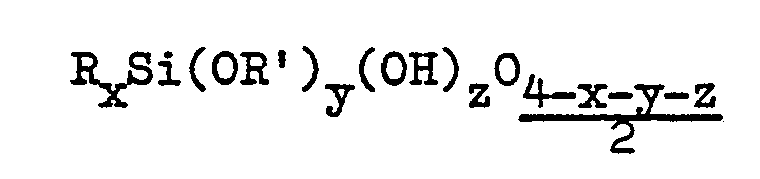
- the invention relates to a method for producing building blocks or components which set or are hardened under the action of steam, the slurry of hydraulic binding medium, water and additives before the shaping and exposure to water vapor contains organo (poly) siloxane, characterized in that at least part of the organo (poly) siloxane consists of at least one compound of the general formula in which at least 10% of the number of the radicals R are identical or different alkyl radicals with at least 4 carbon atoms per radical and the optionally present other radicals R are alkyl radicals with 1 to 3 carbon atoms, in particular methyl and / or phenyl radicals, and R 'have identical or different alkyl radicals 1 to 4 carbon atoms per residue mean x 0, 1, 2 or 3, on average 0.9 to 1.8, y 0, 1, 2 or 3, on average 0.01 to 2.0 and z 0.1, 2 or 3, is on average 0.00 to 0.5, with the proviso that the sum of x + y + z is at most 3.5.
- radicals R preferably each have at least 8 and at most 18 carbon atoms per radical.
- radicals R with at least 4 carbon atoms per radical are the n-butyl, sec-butyl, cyclohexyl, 2-ethylhexyl, n-octyl , Lauryl and stearyl as well as hexyl, methylcyclohexyl and octadecyl.
- x is at most 1.5 on average.
- the radicals R ' can be the methyl, ethyl, n-propyl, n-butyl, sec-butyl or tert-butyl radical or mixtures of such radicals.
- the organo (poly) siloxanes preferably have the general formula a viscosity of at most 300 mm 2 ⁇ s -1 at 25 ° C, in particular from 5 to 30 mm 2 .s -1 at 25 ° C.
- organo (poly) siloxanes of the above formula are where R and R 'each have the meaning given above, and a is 0 or 1, and where R and R 'each have the meaning given above.
- the building blocks or components produced in accordance with the invention can be any building blocks or components that have previously been able to be set or hardened under the action of steam. Those made of gas concrete are preferred. Further examples of building blocks or components which can be produced according to the invention are those made of foam concrete and sand-lime brick.
- the hydraulic binder from which such building blocks or components are produced is likely to be lime (Ca 0 or Ca (OH) 2) or Portland cement. Examples of additives are sand, vermiculite (expanded mica), perlite (expanded mava), gravel, wood flour, wood wool, asbestos, setting retarders such as gluconic acid, calcium gluconate, vinyl polymers, pigments, e.g. B. oxide paints, and gas generators, for. B. aluminum powder.
- Organopolysiloxane of the general formula is preferred in amounts of 0.01 to 5.0 percent by weight, in particular 0.05 to 1.0 percent by weight, in each case based on the total weight of dry hydraulic binder and dry additive.
- the organo (poly) siloxane used according to the invention or a mixture of at least two such organo (poly) siloxanes can be mixed in any way with the other raw materials which are used for the production of the building blocks or components which set or are hardened under the action of steam be. It can thus, for. B. have been mixed with the more or less finished slurry of hydraulic binder, water and aggregate before shaping the mixture formed from these raw materials.
- the organo (poly) siloxane used according to the invention was initially only with some of the raw materials from which this slurry is prepared, e.g. B. mixed with water or with water and lime, and the mixture thus obtained is then mixed with the remaining amount of raw materials.
- this organo (poly) siloxane can be mixed with a solvent which is miscible with water, such as alcohols with 1 to 3 carbon atoms, e.g. B. isopropanol, or dioxane may be mixed.
- a solvent which is miscible with water such as alcohols with 1 to 3 carbon atoms, e.g. B. isopropanol, or dioxane may be mixed.
- this organopolysiloxane can also be mixed with surface-active substances, such as alkali alkyl sulfates, alkyl sulfonates or polyglycols, or protective colloids, such as polyvinyl alcohol, or a mixture of surface-active substance and protective colloid , e.g. B. a mixture of sodium lauryl sulfate and polyvinyl alcohol.
- surface-active substances such as alkali alkyl sulfates, alkyl sulfonates or polyglycols
- protective colloids such as polyvinyl alcohol, or a mixture of surface-active substance and protective colloid , e.g. B. a mixture of sodium lauryl sulfate and polyvinyl alcohol.
- the slurry can be produced from the building blocks or components by shaping and exposure to water vapor, metal compounds suitable as hydrolysis catalysts, such as organotin compounds, e.g. B. dibutyltin dilaurate or titanium butylate.
- organo (poly) siloxane used according to the invention can also have been mixed with inorganic acids, such as hydrochloric acid, or carboxylic acid, such as acetic acid, before being mixed with the other substances.
- Mixtures of 90 parts by weight of SiO 2 sand and 10 parts by weight of white fine lime (Ca0) are each given the amount of organosiloxane of the formula given in the table below wherein 70% of the number of R groups are methyl groups and 30% - the number of R groups are 2-ethylhexyl groups, and as much water is given as is necessary to extinguish the lime and to achieve a mixture with suitable press moisture. Moldings are pressed from the mixtures thus obtained and hardened under the action of steam.
- the following table shows the water absorption of the sand-lime bricks obtained in this way after 24 hours of storage under water in percent by weight, based on the dry weight of the sand-lime bricks.
- the gas concrete thus obtained has the following properties:
- Example 2 The procedure described in Example 2 is repeated with the modification that the mixture containing 0.45 kg of the organosiloxane is not used.
- the 58.5 kg quartz sand is thus wet-ground into a liquid slurry in the ball mill.
- Into this sludge are first placed 5.0 kg of Portland cement, then 24.5 kg of unlime lime, then 12.0 kg of "scraping sludge", then so much Water that the total amount of water is 58.5 kg and finally 0.14 kg of the thin-scaled aluminum powder mixed. Moldings are poured from this mixture without further addition and the moldings are hardened as indicated in Example 2.
- Sputter sludge is a mixture which, in a previous batch, prepares from the constituents indicated above and was formed as waste during the shaping).
- the gas concrete thus obtained has the same properties as the gas concrete produced according to Example 2, with the exception that the water absorption is 15 percent by volume.
Landscapes
- Chemical & Material Sciences (AREA)
- Engineering & Computer Science (AREA)
- Ceramic Engineering (AREA)
- Inorganic Chemistry (AREA)
- Materials Engineering (AREA)
- Structural Engineering (AREA)
- Organic Chemistry (AREA)
- Curing Cements, Concrete, And Artificial Stone (AREA)
- Compositions Of Macromolecular Compounds (AREA)
- Aftertreatments Of Artificial And Natural Stones (AREA)
- Moulds For Moulding Plastics Or The Like (AREA)
- Laminated Bodies (AREA)
- Crystals, And After-Treatments Of Crystals (AREA)
- Finishing Walls (AREA)
- Road Paving Structures (AREA)
- Battery Electrode And Active Subsutance (AREA)
- Compositions Of Oxide Ceramics (AREA)
- Silicon Compounds (AREA)
- Aiming, Guidance, Guns With A Light Source, Armor, Camouflage, And Targets (AREA)
- Re-Forming, After-Treatment, Cutting And Transporting Of Glass Products (AREA)
- Vessels, Lead-In Wires, Accessory Apparatuses For Cathode-Ray Tubes (AREA)
- Diaphragms For Electromechanical Transducers (AREA)
- Dowels (AREA)
- Silicon Polymers (AREA)
Abstract
Description
- Es ist bereits bekannt, bei der Herstellung von Bausteinen oder Bauteilen, die unter Dampfeinwirkung, was auch als "hydrother~ mal" bezeichnet wird, abbinden oder gehärtet werden, nämlich zur Herstellung von dampfgehärtetem geringgewichtigem Gasbeton mit hydrophoben Eigenschaften, dem Brei aus hydraulischem Bindemittel, Wasser und Zuschlagstoffen vor der Formgebung und Einwirkung des Wasserdampfs Silikonöl zuzusetzen. Hierzu wird auf DE-OS 30 04 346, offengelegt 28. August 1980, Internationella Siporex AB, verwiesen.
- Die erfindungsgemäß hergestellten Bausteine oder Bauteile, die unter Dampfeinwirkung abbinden gelassen oder gehärtet wurden, besitzen bei gleicher Menge von zugesetztem Organopolysiloxan stärkeres Wasserabweisungsvermögen, das zudem gleichmäßiger auf ihrer Oberfläche oder in ihnen verteilt ist sowie bessere Porenverteilung und können nach dem Abbinden oder Härten leichter beschichtet werden, z. B. mit Bitumen, als Bausteine oder Bauteile, die unter Dampfeinwirkung abbinden gelassen oder gehärtet wurden und Silikonöl gemäß DE-OS 30 04 346 enthalten.
- Gegenstand der Erfindung ist ein Verfahren zum Herstellen von Bausteinen oder Bauteilen, die unter Dampfeinwirkung abbinden oder gehärtet werden, wobei der Brei aus hydraulischem Bindemittel, Wasser und Zuschlagstoffen vor der Formgebung und Einwirkung des Wasserdampfs Organo(poly)siloxan enthält, dadurch gekennzeichnet, daß zumindest ein Teil des Organo(poly)siloxa- nes aus mindestens einer Verbindung der allgemeinen Formel

- Vorzugsweise haben die Reste R jeweils mindestens 8 und höchstens 18 Kohlenstoffatome je Rest. Beispiele für Reste R mit mindestens 4 Kohlenstoffatomen je Rest sind der n-Butyl-, sec.-Butyl-, Cyclohexyl-, 2-Ethylhexyl-, n-Octyl-, Lauryl- und Stearylrest sowie Hexyl-, Methylcyclohexyl- und Octadecylreste.
- Weiterhin ist insbesondere wegen der leichteren Zugänglichkeit bevorzugt, daß x durchschnittlich höchstens 1,5 ist.
- Bei den Resten R' kann es sich um den Methyl-, Ethyl-, n-Propyl-, n-Butyl-, sec.-Butyl- oder tert.-Butylrest oder um Gemische aus solchen Resten handeln.
- Vorzugsweise haben die Organo(poly)siloxane der allgemeinen Formel

- Beispiele für Strukturen von Organo(poly)siloxanen der oben angegebenen Formel sind


- Bei den erfindungsgemäß hergestellten Bausteinen oder Bauteilen kann es sich um beliebige Bausteine oder Bauteile handeln, die auch bisher unter Dampfeinwirkung, abbinden lassen oder gehärtet werden konnten. Solche aus Gasbeton sind bevorzugt. Weitere Beispiele für erfindungsgemäß herstellbare Bausteine oder Bauteile sind solche aus Schaumbeton und Kalksandstein. Bei dem hydraulischen Bindemittel, aus dem solche Bausteine oder Bauteile hergestellt werden, dürfte es sich insbesondere um Kalk (Ca 0 bzw. Ca (OH)2), oder Portlandzement handeln. Beispiele für Zuschlagstoffe sind Sand, Vermiculite (Blähglimmer), Perlite (Blählava), Kies, Holzmehl, Holzwolle, Asbest, Abbindeverzögerer, wie Gluconsäure, Calciumgluconat, Vinylpolymerisate, Pigmente, z. B. Oxidfarben, und Gasbildner, z. B. Aluminiumpulver.
- Vorzugsweise wird Organopolysiloxan der allgemeinen Formel

- Das erfindungsgemäß verwendete Organo(poly)siloxan oder ein Gemisch aus mindestens zwei solcher Organo(poly)siloxane kann in beliebiger Weise mit den übrigen Rohstoffen, die für die Herstellung der Bausteine oder Bauteile verwendet werden, die unter Dampfeinwirkung abbinden oder gehärtet werden, vermischt worden sein. Es kann somit z. B. mit dem mehr oder weniger fertigen Brei aus hydraulischem Bindemittel, Wasser und Zuschlagstoff vor der Formgebung des aus diesen Rohstoffen gebildeten Gemisches vermischt worden sein. Vorzugsweise wurde jedoch das erfindungsgemäß verwendete Organo(poly)siloxan zunächst nur mit einem Teil der Rohstoffe aus denen dieser Brei bereitet wird, z. B. mit Wasser oder mit Wasser und Kalk, vermischt und das so erhaltene Gemisch dann mit der restlichen Menge der Rohstoffe vermengt.
- Zur besseren Verteilung von erfindungsgemäß verwendetem Organo-(poly)siloxan in den damit zu vermischenden anderen Stoffen kann dieses Organo(poly)siloxan mit Lösungsmittel, das mit Wasser mischbar ist, wie Alkoholen mit 1 bis 3 Kohlenstoffatomen, z. B. Isopropanol, oder Dioxan, vermischt sein.
- Zur besseren Verteilung vom erfindungsgemäß verwendeten Organo-(poly)siloxan in den damit zu vermischenden anderen Stoffen kann dieses Organopolysiloxan auch im Gemisch mit oberflächenaktiven Stoffen, wie Alkalialkylsulfaten, Alkylsulfonaten oder Polyglykolen, oder Schutzkolloiden, wie Polyvinylalkohol, oder einer Mischung aus oberflächenaktivem Stoff und Schutzkolloid, z. B. einer Mischung aus Natriumlaurylsulfat und Polyvinylalkohol eingesetzt worden sein.
- Zusätzlich zum hydraulischen Bindemittel, Wasser, Zuschlagstoff und Organo(poly)siloxan kann der Brei aus dem durch Formgebung und Einwirkung von Wasserdampf Bausteine oder Bauteile hergestellt werden, als Hydrolysekatalysatoren geeignete Metallverbindungen, wie Organozinnverbindungen, z. B. Dibutylzinndilaurat oder Titanbutylat, enthalten. Das erfindungsgemäß verwendete Organo(poly)siloxan kann auch vor dem Vermischen mit den anderen Stoffen mit anorganischer Säure, wie Salzsäure, oder Carbonsäure, wie Essigsäure, vermischt worden sein.
- Die Formgebung des Breies, aus dem die Bausteine oder Bauteile hergestellt werden, und die Dampfeinwirkung, unter der-das'Abbinden oder Härten erfolgt, kann auf beliebige Weise erfolgen, nach der auch bisher Bausteine oder Bauteile unter Einwirkung von Wasserdampf hergestellt werden konnten.
- Zu Gemischen aus 90 Gewichtsteilen SiO2-Sand und 10 Gewichtsteilen Weißfeinkalk (Ca0) wird jeweils die in der folgenden Tabelle angegebene Menge Organosiloxan der Formel

- In der folgenden Tabelle ist die Wasseraufnahme der so erhaltenen Kalksandsteine nach 24 Stunden Lagerung unter Wasser in Gewichtsprozent, bezogen auf das Trockengewicht der Kalksandsteine, angegeben.

- 58,5 kg Quarzsand mit einem Siliciumdioxidgehalt von 97 Gewichtsprozent, bezogen auf das Gewicht des Sands, werden in einer Kugelmühle naß zu einem leichtflüssigem Schlamm gemahlen. In diesen Schlamm werden zunächst 5,0 kg Portlandzement, dann 24,5 kg ungelöschter Kalk mit einem CaO-Gehalt von 86 Gewichtsprozent, dann 12,0 kg sogenannter "Abkratzschlamm" (Erklärung dieses Begriffs erfolgt bei der Beschreibung des Vergleichsversuchs), dann soviel Wasser, daß die .Gesamtmenge an Wasser 41,5 kg beträgt, dann 22,2 kg Organosiloxan der in Beispiel 1 angegebenen Formel und schließlich 0,14 kg dünnschuppiges Aluminiumpulver mit einem Al-Gehalt von 93 Gewichtsprozent eingemischt. Dann wird noch 6 Minuten bei 35°C gemischt und die so erhaltene Mischung 1,5 Stunden ruhen gelassen.
- 0,45 kg der so erhaltenen Mischung werden zu einer Mischung gegeben, die wie vorstehend beschrieben bereitet wurde mit der Abänderung, daß 58,5 kg Wasser anstelle von 41,5 kg Wasser eingesetzt wurden und kein Organosiloxan verwendet wurde. Dann werden aus der Mischung Formlinge gegossen und die Formlinge unter einem Wasserdampfdruck von 11,8 bar innerhalb 11 Stunden gehärtet.
- Der so erhaltene Gasbeton hat folgende Eigenschaften:

- Die in Beispiel 2 beschriebene Arbeitsweise wird wiederholt mit der Abänderung, daß die 0,45 kg der Organosiloxan enthaltenden Mischung nicht mitverwendet werden. Es werden also die 58,5 kg Quarzsand in der Kugelmühle naß zu einem leichtflüssigen Schlamm gemahlen. In diesen Schlamm werden zunächst 5,0 kg Portlandzement, dann 24,5 kg ungelöschter Kalk, dann 12,0 kg "Abkratzschlamm", dann soviel Wasser, daß die Gesamtmenge an Wasser 58,5 kg beträgt und schließlich 0,14 kg des dünnschuppigen Aluminiumpulvers eingemischt. Aus dieser Mischung werden ohne weiteren Zusatz Formlinge gegossen und die Formlinge wie in Beispiel 2 angegeben gehärtet.
- (Bei "Abkratzschlamm" handelt es sich um eine Mischung, die bei einem vorhergehenden Ansatz aus den vorstehend angegebenen Bestandteilen bereitet und bei der Formgebung als Abfall anfiel).
- Der so erhaltene Gasbeton hat die gleichen Eigenschaften wie der gemäß Beispiel 2 hergestellte Gasbeton mit der Ausnahme, daß die Wasseraufnahme 15 Volumenprozent beträgt.
Claims (9)
Priority Applications (1)
| Application Number | Priority Date | Filing Date | Title |
|---|---|---|---|
| AT81105768T ATE16585T1 (de) | 1980-11-28 | 1981-07-22 | Verfahren zum herstellen von bausteinen oder bauteilen. |
Applications Claiming Priority (2)
| Application Number | Priority Date | Filing Date | Title |
|---|---|---|---|
| DE3044948 | 1980-11-28 | ||
| DE19803044948 DE3044948A1 (de) | 1980-11-28 | 1980-11-28 | Verfahren zum herstellen von bausteinen oder bauteilen |
Publications (2)
| Publication Number | Publication Date |
|---|---|
| EP0053223A1 true EP0053223A1 (de) | 1982-06-09 |
| EP0053223B1 EP0053223B1 (de) | 1985-11-21 |
Family
ID=6117864
Family Applications (1)
| Application Number | Title | Priority Date | Filing Date |
|---|---|---|---|
| EP81105768A Expired EP0053223B1 (de) | 1980-11-28 | 1981-07-22 | Verfahren zum Herstellen von Bausteinen oder Bauteilen |
Country Status (10)
| Country | Link |
|---|---|
| US (1) | US4394335A (de) |
| EP (1) | EP0053223B1 (de) |
| JP (1) | JPS5792561A (de) |
| AT (1) | ATE16585T1 (de) |
| CA (1) | CA1162204A (de) |
| DE (2) | DE3044948A1 (de) |
| DK (1) | DK157291C (de) |
| FI (1) | FI70879C (de) |
| NO (1) | NO158939C (de) |
| PT (1) | PT73709B (de) |
Cited By (5)
| Publication number | Priority date | Publication date | Assignee | Title |
|---|---|---|---|---|
| EP0124748A1 (de) * | 1983-04-11 | 1984-11-14 | Th. Goldschmidt AG | Zubereitung zum Wasserabweisendmachen anorganischer Baustoffe |
| EP0139838B1 (de) * | 1983-07-26 | 1988-09-07 | Hüls Aktiengesellschaft | Schadstoffresistente Dichtmasse |
| EP0247346A3 (en) * | 1986-04-23 | 1988-09-14 | Mitsubishi Chemical Industries Limited | Process for preparing a water repellent calcium silicate shaped product |
| EP0980853A1 (de) * | 1998-08-17 | 2000-02-23 | Veit Dennert KG Baustoffbetriebe | Hydrophobierte mineralische Dämmplatte und Verfahren zu deren Herstellung |
| DE102010005361A1 (de) | 2010-01-21 | 2011-07-28 | Veit Dennert KG Baustoffbetriebe, 96132 | Mineralischer Formkörper, Verwendung und Verfahren zur Herstellung des mineralischen Formkörpers |
Families Citing this family (18)
| Publication number | Priority date | Publication date | Assignee | Title |
|---|---|---|---|---|
| JPS59232954A (ja) * | 1983-06-13 | 1984-12-27 | 東レ・ダウコーニング・シリコーン株式会社 | 撥水性成形硬化体の製造方法 |
| US4877654A (en) * | 1988-05-02 | 1989-10-31 | Pcr, Inc. | Buffered silane emulsions for rendering porous substrates water repellent |
| DE3840579A1 (de) * | 1988-12-01 | 1990-06-07 | Wacker Chemie Gmbh | Verfahren zur herstellung von gasbeton |
| US5187882A (en) * | 1989-02-17 | 1993-02-23 | Cam Sales, Inc. | System for curing concrete articles |
| US5089198A (en) * | 1989-02-17 | 1992-02-18 | Cam Sales, Inc. | Method for curing concrete articles |
| JPH035348A (ja) * | 1989-05-30 | 1991-01-11 | Mitsui Petrochem Ind Ltd | アルカリ骨材反応防止剤およびその用途 |
| US5174821A (en) * | 1989-12-12 | 1992-12-29 | Taisei Corporation | Hydraulic composition, formed products therefrom and segregation reduction agent for hydraulic substances |
| JPH0396078U (de) * | 1990-01-22 | 1991-10-01 | ||
| JP2971240B2 (ja) * | 1992-03-24 | 1999-11-02 | 東レ・ダウコーニング・シリコーン株式会社 | 撥水性成形硬化体の製造方法 |
| US5650004A (en) * | 1995-06-20 | 1997-07-22 | Yon; Michael D. | Cement plaster composition, additive therefor and method of using the composition |
| GB9611776D0 (en) * | 1996-06-06 | 1996-08-07 | Dow Corning | Cementitious materials |
| US6576199B1 (en) * | 1998-09-18 | 2003-06-10 | Alliedsignal Inc. | Environmental control system including ozone-destroying catalytic converter having anodized and washcoat layers |
| JP2001089221A (ja) * | 1999-09-24 | 2001-04-03 | Dow Corning Toray Silicone Co Ltd | セメント組成物 |
| AU2001283061A1 (en) * | 2000-08-03 | 2002-02-18 | Enviroc, Inc. | Method of manufacturing autoclaved, cellular concrete products using bottom ash |
| JP2005022913A (ja) * | 2003-07-01 | 2005-01-27 | Shin Etsu Chem Co Ltd | モルタル又はコンクリート組成物 |
| DE102005005259B4 (de) * | 2005-02-04 | 2009-09-10 | Xella Dämmsysteme GmbH | Mineralisches Dämmelement und Verfahren zu seiner Herstellung |
| US20230131818A1 (en) | 2020-03-17 | 2023-04-27 | Dow Toray Co., Ltd. | Cement composition and cured product thereof |
| KR20220150966A (ko) | 2020-03-17 | 2022-11-11 | 다우 도레이 캄파니 리미티드 | 프리캐스트 콘크리트 성형체 |
Citations (3)
| Publication number | Priority date | Publication date | Assignee | Title |
|---|---|---|---|---|
| DE2356142B2 (de) * | 1973-11-09 | 1977-01-13 | Wacker-Chemie GmbH, 8000 München | Verfahren zum wasserabweisendmachen von baustoffen |
| DE2558184A1 (de) * | 1975-12-23 | 1977-07-07 | Wacker Chemie Gmbh | Verfahren zum wasserabweisendmachen von baustoffen |
| DE3004346A1 (de) * | 1979-02-15 | 1980-08-28 | Siporex Int Ab | Verfahren zur herstellung von dampfgehaertetem geringgewichtigem gasbeton mit hydrophoben eigenschaften |
Family Cites Families (5)
| Publication number | Priority date | Publication date | Assignee | Title |
|---|---|---|---|---|
| NL302553A (de) * | 1963-01-28 | |||
| US3972969A (en) * | 1970-08-06 | 1976-08-03 | Arturo Rio | Manufacture of cement-resin composite articles |
| US4002713A (en) * | 1972-04-13 | 1977-01-11 | Imperial Chemical Industries Limited | Cementing compositions and concretes and mortars derived therefrom |
| US4043826A (en) * | 1974-11-22 | 1977-08-23 | Hum Bing W | Process for making artificial rocks |
| WO1981001703A1 (en) * | 1979-12-17 | 1981-06-25 | J Puehringer | Process for the preparation of a mortar and the product thereby obtained |
-
1980
- 1980-11-28 DE DE19803044948 patent/DE3044948A1/de not_active Withdrawn
-
1981
- 1981-07-22 AT AT81105768T patent/ATE16585T1/de not_active IP Right Cessation
- 1981-07-22 DE DE8181105768T patent/DE3172978D1/de not_active Expired
- 1981-07-22 EP EP81105768A patent/EP0053223B1/de not_active Expired
- 1981-08-10 JP JP56124644A patent/JPS5792561A/ja active Granted
- 1981-08-26 FI FI812641A patent/FI70879C/fi not_active IP Right Cessation
- 1981-09-21 PT PT73709A patent/PT73709B/de unknown
- 1981-11-12 US US06/322,038 patent/US4394335A/en not_active Expired - Lifetime
- 1981-11-16 CA CA000390148A patent/CA1162204A/en not_active Expired
- 1981-11-17 DK DK509481A patent/DK157291C/da active
- 1981-11-27 NO NO814059A patent/NO158939C/no unknown
Patent Citations (3)
| Publication number | Priority date | Publication date | Assignee | Title |
|---|---|---|---|---|
| DE2356142B2 (de) * | 1973-11-09 | 1977-01-13 | Wacker-Chemie GmbH, 8000 München | Verfahren zum wasserabweisendmachen von baustoffen |
| DE2558184A1 (de) * | 1975-12-23 | 1977-07-07 | Wacker Chemie Gmbh | Verfahren zum wasserabweisendmachen von baustoffen |
| DE3004346A1 (de) * | 1979-02-15 | 1980-08-28 | Siporex Int Ab | Verfahren zur herstellung von dampfgehaertetem geringgewichtigem gasbeton mit hydrophoben eigenschaften |
Cited By (6)
| Publication number | Priority date | Publication date | Assignee | Title |
|---|---|---|---|---|
| EP0124748A1 (de) * | 1983-04-11 | 1984-11-14 | Th. Goldschmidt AG | Zubereitung zum Wasserabweisendmachen anorganischer Baustoffe |
| EP0139838B1 (de) * | 1983-07-26 | 1988-09-07 | Hüls Aktiengesellschaft | Schadstoffresistente Dichtmasse |
| EP0247346A3 (en) * | 1986-04-23 | 1988-09-14 | Mitsubishi Chemical Industries Limited | Process for preparing a water repellent calcium silicate shaped product |
| EP0980853A1 (de) * | 1998-08-17 | 2000-02-23 | Veit Dennert KG Baustoffbetriebe | Hydrophobierte mineralische Dämmplatte und Verfahren zu deren Herstellung |
| DE102010005361A1 (de) | 2010-01-21 | 2011-07-28 | Veit Dennert KG Baustoffbetriebe, 96132 | Mineralischer Formkörper, Verwendung und Verfahren zur Herstellung des mineralischen Formkörpers |
| EP2354109A2 (de) | 2010-01-21 | 2011-08-10 | Veit Dennert KG Baustoffbetriebe | Mineralischer Formkörper, Verwendung und Verfahren zur Herstellung des mineralischen Formkörpers |
Also Published As
| Publication number | Publication date |
|---|---|
| US4394335A (en) | 1983-07-19 |
| NO158939C (no) | 1988-11-16 |
| FI70879B (fi) | 1986-07-18 |
| JPS5792561A (en) | 1982-06-09 |
| DK157291B (da) | 1989-12-04 |
| PT73709B (de) | 1982-12-20 |
| FI812641L (fi) | 1982-05-29 |
| JPH0144673B2 (de) | 1989-09-28 |
| DK509481A (da) | 1982-05-29 |
| DE3044948A1 (de) | 1982-07-01 |
| FI70879C (fi) | 1986-10-27 |
| NO814059L (no) | 1982-06-01 |
| DE3172978D1 (en) | 1986-01-02 |
| NO158939B (no) | 1988-08-08 |
| ATE16585T1 (de) | 1985-12-15 |
| CA1162204A (en) | 1984-02-14 |
| PT73709A (de) | 1981-10-01 |
| EP0053223B1 (de) | 1985-11-21 |
| DK157291C (da) | 1990-05-07 |
Similar Documents
| Publication | Publication Date | Title |
|---|---|---|
| EP0053223B1 (de) | Verfahren zum Herstellen von Bausteinen oder Bauteilen | |
| EP0242798B1 (de) | Wässerige Emulsionen von Organopolysiloxan und Verwendung solcher Emulsionen | |
| DE1223287B (de) | Verfahren zum Herstellen von wasserabweisenden Formkoerpern und UEberzuegen aus anorganischen Massen | |
| DE3004346A1 (de) | Verfahren zur herstellung von dampfgehaertetem geringgewichtigem gasbeton mit hydrophoben eigenschaften | |
| DE2808101A1 (de) | Gips-zubereitung | |
| EP0278518A1 (de) | Verfahren zur Herstellung von wasserabweisenden Gegenständen aus Gips und Hydrophobierungsmittel enthaltende Gipspulver | |
| EP0685438A1 (de) | Verfahren zur wasserabweisenden Imprägnierung von Gips | |
| DE2606273C3 (de) | Verfahren zur Herstellung von Hydrophobiermitteln | |
| DE102005005259B4 (de) | Mineralisches Dämmelement und Verfahren zu seiner Herstellung | |
| DE1769508B2 (de) | Verfahren zur herstellung von hydrophobiermitteln | |
| DE19844654A1 (de) | Verfahren zur Festigung und Hydrophobierung von Bodenmaterialien | |
| AT228111B (de) | Zusatzmischung für hydraulische Zementmischungen sowie hydraulische Zementmischungen, welche die Zusatzmischung enthalten | |
| DE2136745C3 (de) | Stabilisierung von wäßrigen Lösungen, die bereitet worden sind aus wasserlöslichen, hydrolysierbaren Methylsilanen | |
| EP0064793B1 (de) | Verfahren zur Herstellung von Gipsformsteinen | |
| DE2419562A1 (de) | Feuerbestaendige gipsformkoerper und verfahren zu ihrer herstellung | |
| DE3117662A1 (de) | Gipsstein- und gipssandsteinherstellung | |
| DE2031109A1 (en) | Quicklime treated with flocculant - based on polyacrylic material gives stronger sand-lime bricks | |
| DE2601683C3 (de) | Kalk-Kieselsäure-Gemisch sowie Verfahren zur Herstellung von dampfgehärteten Baustoffen daraus | |
| DE2806327C2 (de) | Verwendung einer Betainverbindung zur Herstellung von Leichtbeton-Formkörpern | |
| DE1769508C (de) | Verfahren zur Herstellung \ on Hydrophobiermitteln | |
| DE2551310A1 (de) | Verfahren zur herstellung von calciumaluminatmonosulfat-hydrat | |
| DE651404C (de) | Verfahren zur Herstellung von Zement- bzw. Betonerzeugnissen | |
| AT153813B (de) | Verfahren zur Herstellung von Steinmassen mit hochporösem Gefüge. | |
| AT260765B (de) | Verfahren zum Herstellen von wasserabweisenden Formkörpern und Überzügen | |
| DE2617218A1 (de) | Verfahren zur herstellung von betonkoerpern |
Legal Events
| Date | Code | Title | Description |
|---|---|---|---|
| PUAI | Public reference made under article 153(3) epc to a published international application that has entered the european phase |
Free format text: ORIGINAL CODE: 0009012 |
|
| 17P | Request for examination filed |
Effective date: 19810722 |
|
| AK | Designated contracting states |
Designated state(s): AT BE CH DE FR GB NL SE |
|
| GRAA | (expected) grant |
Free format text: ORIGINAL CODE: 0009210 |
|
| AK | Designated contracting states |
Designated state(s): AT BE CH DE FR GB LI NL SE |
|
| REF | Corresponds to: |
Ref document number: 16585 Country of ref document: AT Date of ref document: 19851215 Kind code of ref document: T |
|
| REF | Corresponds to: |
Ref document number: 3172978 Country of ref document: DE Date of ref document: 19860102 |
|
| ET | Fr: translation filed | ||
| PLBE | No opposition filed within time limit |
Free format text: ORIGINAL CODE: 0009261 |
|
| STAA | Information on the status of an ep patent application or granted ep patent |
Free format text: STATUS: NO OPPOSITION FILED WITHIN TIME LIMIT |
|
| 26N | No opposition filed | ||
| PGFP | Annual fee paid to national office [announced via postgrant information from national office to epo] |
Ref country code: CH Payment date: 19900619 Year of fee payment: 10 |
|
| PGFP | Annual fee paid to national office [announced via postgrant information from national office to epo] |
Ref country code: BE Payment date: 19900622 Year of fee payment: 10 |
|
| PG25 | Lapsed in a contracting state [announced via postgrant information from national office to epo] |
Ref country code: LI Effective date: 19910731 Ref country code: CH Effective date: 19910731 Ref country code: BE Effective date: 19910731 |
|
| BERE | Be: lapsed |
Owner name: WACKER-CHEMIE G.M.B.H. Effective date: 19910731 |
|
| REG | Reference to a national code |
Ref country code: CH Ref legal event code: PL |
|
| EAL | Se: european patent in force in sweden |
Ref document number: 81105768.6 |
|
| PGFP | Annual fee paid to national office [announced via postgrant information from national office to epo] |
Ref country code: FR Payment date: 19980618 Year of fee payment: 18 |
|
| PGFP | Annual fee paid to national office [announced via postgrant information from national office to epo] |
Ref country code: SE Payment date: 19980622 Year of fee payment: 18 |
|
| PGFP | Annual fee paid to national office [announced via postgrant information from national office to epo] |
Ref country code: AT Payment date: 19980623 Year of fee payment: 18 |
|
| PGFP | Annual fee paid to national office [announced via postgrant information from national office to epo] |
Ref country code: DE Payment date: 19980625 Year of fee payment: 18 |
|
| PGFP | Annual fee paid to national office [announced via postgrant information from national office to epo] |
Ref country code: GB Payment date: 19980626 Year of fee payment: 18 |
|
| PGFP | Annual fee paid to national office [announced via postgrant information from national office to epo] |
Ref country code: NL Payment date: 19980629 Year of fee payment: 18 |
|
| PG25 | Lapsed in a contracting state [announced via postgrant information from national office to epo] |
Ref country code: GB Free format text: LAPSE BECAUSE OF NON-PAYMENT OF DUE FEES Effective date: 19990722 Ref country code: AT Free format text: LAPSE BECAUSE OF NON-PAYMENT OF DUE FEES Effective date: 19990722 |
|
| PG25 | Lapsed in a contracting state [announced via postgrant information from national office to epo] |
Ref country code: SE Free format text: THE PATENT HAS BEEN ANNULLED BY A DECISION OF A NATIONAL AUTHORITY Effective date: 19990730 |
|
| PG25 | Lapsed in a contracting state [announced via postgrant information from national office to epo] |
Ref country code: FR Free format text: THE PATENT HAS BEEN ANNULLED BY A DECISION OF A NATIONAL AUTHORITY Effective date: 19990731 |
|
| PG25 | Lapsed in a contracting state [announced via postgrant information from national office to epo] |
Ref country code: NL Free format text: LAPSE BECAUSE OF NON-PAYMENT OF DUE FEES Effective date: 20000201 |
|
| GBPC | Gb: european patent ceased through non-payment of renewal fee |
Effective date: 19990722 |
|
| EUG | Se: european patent has lapsed |
Ref document number: 81105768.6 |
|
| NLV4 | Nl: lapsed or anulled due to non-payment of the annual fee |
Effective date: 20000201 |
|
| PG25 | Lapsed in a contracting state [announced via postgrant information from national office to epo] |
Ref country code: DE Free format text: LAPSE BECAUSE OF NON-PAYMENT OF DUE FEES Effective date: 20000503 |
|
| REG | Reference to a national code |
Ref country code: FR Ref legal event code: ST |