EP0054290B1 - Method of preparing carboxyl group-modified polyhydroxyethers, preparing an aequous colloidal ionomer dispersion therefrom, and the use of the dispersion as protecting coating composition - Google Patents
Method of preparing carboxyl group-modified polyhydroxyethers, preparing an aequous colloidal ionomer dispersion therefrom, and the use of the dispersion as protecting coating composition Download PDFInfo
- Publication number
- EP0054290B1 EP0054290B1 EP81110422A EP81110422A EP0054290B1 EP 0054290 B1 EP0054290 B1 EP 0054290B1 EP 81110422 A EP81110422 A EP 81110422A EP 81110422 A EP81110422 A EP 81110422A EP 0054290 B1 EP0054290 B1 EP 0054290B1
- Authority
- EP
- European Patent Office
- Prior art keywords
- dispersion
- water
- polyhydroxyether
- preparing
- bis
- Prior art date
- Legal status (The legal status is an assumption and is not a legal conclusion. Google has not performed a legal analysis and makes no representation as to the accuracy of the status listed.)
- Expired
Links
- 239000006185 dispersion Substances 0.000 title claims description 31
- 125000003178 carboxy group Chemical group [H]OC(*)=O 0.000 title claims description 14
- 238000000034 method Methods 0.000 title claims description 10
- 229920000554 ionomer Polymers 0.000 title claims description 9
- 239000008199 coating composition Substances 0.000 title description 3
- 239000000203 mixture Substances 0.000 claims description 25
- LYCAIKOWRPUZTN-UHFFFAOYSA-N Ethylene glycol Chemical compound OCCO LYCAIKOWRPUZTN-UHFFFAOYSA-N 0.000 claims description 20
- 229920001169 thermoplastic Polymers 0.000 claims description 18
- 239000004416 thermosoftening plastic Substances 0.000 claims description 18
- XLYOFNOQVPJJNP-UHFFFAOYSA-N water Substances O XLYOFNOQVPJJNP-UHFFFAOYSA-N 0.000 claims description 17
- 239000003960 organic solvent Substances 0.000 claims description 13
- LRHPLDYGYMQRHN-UHFFFAOYSA-N N-Butanol Chemical compound CCCCO LRHPLDYGYMQRHN-UHFFFAOYSA-N 0.000 claims description 12
- 239000000178 monomer Substances 0.000 claims description 11
- ISWSIDIOOBJBQZ-UHFFFAOYSA-N Phenol Chemical compound OC1=CC=CC=C1 ISWSIDIOOBJBQZ-UHFFFAOYSA-N 0.000 claims description 9
- 239000003085 diluting agent Substances 0.000 claims description 8
- 239000000758 substrate Substances 0.000 claims description 8
- MTHSVFCYNBDYFN-UHFFFAOYSA-N diethylene glycol Chemical compound OCCOCCO MTHSVFCYNBDYFN-UHFFFAOYSA-N 0.000 claims description 7
- 239000002904 solvent Substances 0.000 claims description 7
- 150000002118 epoxides Chemical class 0.000 claims description 6
- 125000002887 hydroxy group Chemical group [H]O* 0.000 claims description 6
- 238000006116 polymerization reaction Methods 0.000 claims description 6
- 229930195735 unsaturated hydrocarbon Natural products 0.000 claims description 6
- 150000001346 alkyl aryl ethers Chemical class 0.000 claims description 4
- WGCNASOHLSPBMP-UHFFFAOYSA-N hydroxyacetaldehyde Natural products OCC=O WGCNASOHLSPBMP-UHFFFAOYSA-N 0.000 claims description 4
- 229920005989 resin Polymers 0.000 claims description 4
- 239000011347 resin Substances 0.000 claims description 4
- 238000001246 colloidal dispersion Methods 0.000 claims description 3
- 239000007787 solid Substances 0.000 claims description 3
- 239000003039 volatile agent Substances 0.000 claims description 3
- DNIAPMSPPWPWGF-GSVOUGTGSA-N (R)-(-)-Propylene glycol Chemical group C[C@@H](O)CO DNIAPMSPPWPWGF-GSVOUGTGSA-N 0.000 claims description 2
- 150000004292 cyclic ethers Chemical class 0.000 claims description 2
- 238000000151 deposition Methods 0.000 claims description 2
- 229920001187 thermosetting polymer Polymers 0.000 claims description 2
- DKGAVHZHDRPRBM-UHFFFAOYSA-N Tert-Butanol Chemical compound CC(C)(C)O DKGAVHZHDRPRBM-UHFFFAOYSA-N 0.000 claims 2
- BNCADMBVWNPPIZ-UHFFFAOYSA-N 2-n,2-n,4-n,4-n,6-n,6-n-hexakis(methoxymethyl)-1,3,5-triazine-2,4,6-triamine Chemical compound COCN(COC)C1=NC(N(COC)COC)=NC(N(COC)COC)=N1 BNCADMBVWNPPIZ-UHFFFAOYSA-N 0.000 claims 1
- RXKJFZQQPQGTFL-UHFFFAOYSA-N dihydroxyacetone Chemical group OCC(=O)CO RXKJFZQQPQGTFL-UHFFFAOYSA-N 0.000 claims 1
- -1 poly(hydroxyethers) Polymers 0.000 description 40
- RTZKZFJDLAIYFH-UHFFFAOYSA-N Diethyl ether Chemical compound CCOCC RTZKZFJDLAIYFH-UHFFFAOYSA-N 0.000 description 21
- ZWEHNKRNPOVVGH-UHFFFAOYSA-N 2-Butanone Chemical compound CCC(C)=O ZWEHNKRNPOVVGH-UHFFFAOYSA-N 0.000 description 13
- 238000000576 coating method Methods 0.000 description 11
- IJGRMHOSHXDMSA-UHFFFAOYSA-N Atomic nitrogen Chemical compound N#N IJGRMHOSHXDMSA-UHFFFAOYSA-N 0.000 description 8
- 239000011248 coating agent Substances 0.000 description 8
- 239000000243 solution Substances 0.000 description 8
- 239000002966 varnish Substances 0.000 description 8
- 125000004432 carbon atom Chemical group C* 0.000 description 7
- KWYUFKZDYYNOTN-UHFFFAOYSA-M Potassium hydroxide Chemical compound [OH-].[K+] KWYUFKZDYYNOTN-UHFFFAOYSA-M 0.000 description 6
- HEMHJVSKTPXQMS-UHFFFAOYSA-M Sodium hydroxide Chemical compound [OH-].[Na+] HEMHJVSKTPXQMS-UHFFFAOYSA-M 0.000 description 6
- PPBRXRYQALVLMV-UHFFFAOYSA-N Styrene Chemical compound C=CC1=CC=CC=C1 PPBRXRYQALVLMV-UHFFFAOYSA-N 0.000 description 6
- 239000002585 base Substances 0.000 description 6
- VLKZOEOYAKHREP-UHFFFAOYSA-N n-Hexane Chemical compound CCCCCC VLKZOEOYAKHREP-UHFFFAOYSA-N 0.000 description 6
- QVGXLLKOCUKJST-UHFFFAOYSA-N atomic oxygen Chemical group [O] QVGXLLKOCUKJST-UHFFFAOYSA-N 0.000 description 5
- 238000002156 mixing Methods 0.000 description 5
- 125000000466 oxiranyl group Chemical group 0.000 description 5
- 239000001301 oxygen Substances 0.000 description 5
- 229910052760 oxygen Inorganic materials 0.000 description 5
- 150000002989 phenols Chemical class 0.000 description 5
- 150000003254 radicals Chemical class 0.000 description 5
- VHUUQVKOLVNVRT-UHFFFAOYSA-N Ammonium hydroxide Chemical compound [NH4+].[OH-] VHUUQVKOLVNVRT-UHFFFAOYSA-N 0.000 description 4
- JIGUQPWFLRLWPJ-UHFFFAOYSA-N Ethyl acrylate Chemical compound CCOC(=O)C=C JIGUQPWFLRLWPJ-UHFFFAOYSA-N 0.000 description 4
- CERQOIWHTDAKMF-UHFFFAOYSA-N Methacrylic acid Chemical compound CC(=C)C(O)=O CERQOIWHTDAKMF-UHFFFAOYSA-N 0.000 description 4
- ATUOYWHBWRKTHZ-UHFFFAOYSA-N Propane Chemical compound CCC ATUOYWHBWRKTHZ-UHFFFAOYSA-N 0.000 description 4
- WYURNTSHIVDZCO-UHFFFAOYSA-N Tetrahydrofuran Chemical compound C1CCOC1 WYURNTSHIVDZCO-UHFFFAOYSA-N 0.000 description 4
- 235000011114 ammonium hydroxide Nutrition 0.000 description 4
- 229910052757 nitrogen Inorganic materials 0.000 description 4
- PNJWIWWMYCMZRO-UHFFFAOYSA-N pent‐4‐en‐2‐one Natural products CC(=O)CC=C PNJWIWWMYCMZRO-UHFFFAOYSA-N 0.000 description 4
- 229920006287 phenoxy resin Polymers 0.000 description 4
- 239000013034 phenoxy resin Substances 0.000 description 4
- 229920006395 saturated elastomer Polymers 0.000 description 4
- YLQBMQCUIZJEEH-UHFFFAOYSA-N tetrahydrofuran Natural products C=1C=COC=1 YLQBMQCUIZJEEH-UHFFFAOYSA-N 0.000 description 4
- CSCPPACGZOOCGX-UHFFFAOYSA-N Acetone Chemical compound CC(C)=O CSCPPACGZOOCGX-UHFFFAOYSA-N 0.000 description 3
- 239000004342 Benzoyl peroxide Substances 0.000 description 3
- OMPJBNCRMGITSC-UHFFFAOYSA-N Benzoylperoxide Chemical compound C=1C=CC=CC=1C(=O)OOC(=O)C1=CC=CC=C1 OMPJBNCRMGITSC-UHFFFAOYSA-N 0.000 description 3
- 229930185605 Bisphenol Natural products 0.000 description 3
- 239000004215 Carbon black (E152) Substances 0.000 description 3
- WMFOQBRAJBCJND-UHFFFAOYSA-M Lithium hydroxide Chemical compound [Li+].[OH-] WMFOQBRAJBCJND-UHFFFAOYSA-M 0.000 description 3
- OKKJLVBELUTLKV-UHFFFAOYSA-N Methanol Chemical compound OC OKKJLVBELUTLKV-UHFFFAOYSA-N 0.000 description 3
- ZMXDDKWLCZADIW-UHFFFAOYSA-N N,N-Dimethylformamide Chemical compound CN(C)C=O ZMXDDKWLCZADIW-UHFFFAOYSA-N 0.000 description 3
- SJRJJKPEHAURKC-UHFFFAOYSA-N N-Methylmorpholine Chemical compound CN1CCOCC1 SJRJJKPEHAURKC-UHFFFAOYSA-N 0.000 description 3
- UEEJHVSXFDXPFK-UHFFFAOYSA-N N-dimethylaminoethanol Chemical compound CN(C)CCO UEEJHVSXFDXPFK-UHFFFAOYSA-N 0.000 description 3
- RWRDLPDLKQPQOW-UHFFFAOYSA-N Pyrrolidine Chemical compound C1CCNC1 RWRDLPDLKQPQOW-UHFFFAOYSA-N 0.000 description 3
- YXFVVABEGXRONW-UHFFFAOYSA-N Toluene Chemical compound CC1=CC=CC=C1 YXFVVABEGXRONW-UHFFFAOYSA-N 0.000 description 3
- ZMANZCXQSJIPKH-UHFFFAOYSA-N Triethylamine Chemical compound CCN(CC)CC ZMANZCXQSJIPKH-UHFFFAOYSA-N 0.000 description 3
- 150000003973 alkyl amines Chemical group 0.000 description 3
- 125000002947 alkylene group Chemical group 0.000 description 3
- 239000000908 ammonium hydroxide Substances 0.000 description 3
- 239000007864 aqueous solution Substances 0.000 description 3
- 125000003118 aryl group Chemical group 0.000 description 3
- 235000019400 benzoyl peroxide Nutrition 0.000 description 3
- IISBACLAFKSPIT-UHFFFAOYSA-N bisphenol A Chemical compound C=1C=C(O)C=CC=1C(C)(C)C1=CC=C(O)C=C1 IISBACLAFKSPIT-UHFFFAOYSA-N 0.000 description 3
- 238000004587 chromatography analysis Methods 0.000 description 3
- 239000000839 emulsion Substances 0.000 description 3
- 150000002148 esters Chemical class 0.000 description 3
- 238000010528 free radical solution polymerization reaction Methods 0.000 description 3
- 239000007789 gas Substances 0.000 description 3
- 229930195733 hydrocarbon Natural products 0.000 description 3
- 239000007788 liquid Substances 0.000 description 3
- 229920000642 polymer Polymers 0.000 description 3
- 239000011541 reaction mixture Substances 0.000 description 3
- 125000001424 substituent group Chemical group 0.000 description 3
- 229920002554 vinyl polymer Polymers 0.000 description 3
- SDJHPPZKZZWAKF-UHFFFAOYSA-N 2,3-dimethylbuta-1,3-diene Chemical compound CC(=C)C(C)=C SDJHPPZKZZWAKF-UHFFFAOYSA-N 0.000 description 2
- OZAIFHULBGXAKX-UHFFFAOYSA-N 2-(2-cyanopropan-2-yldiazenyl)-2-methylpropanenitrile Chemical compound N#CC(C)(C)N=NC(C)(C)C#N OZAIFHULBGXAKX-UHFFFAOYSA-N 0.000 description 2
- NIXOWILDQLNWCW-UHFFFAOYSA-N 2-Propenoic acid Natural products OC(=O)C=C NIXOWILDQLNWCW-UHFFFAOYSA-N 0.000 description 2
- LVLNPXCISNPHLE-UHFFFAOYSA-N 2-[(4-hydroxyphenyl)methyl]phenol Chemical compound C1=CC(O)=CC=C1CC1=CC=CC=C1O LVLNPXCISNPHLE-UHFFFAOYSA-N 0.000 description 2
- URFNSYWAGGETFK-UHFFFAOYSA-N 4,4'-Dihydroxybibenzyl Chemical compound C1=CC(O)=CC=C1CCC1=CC=C(O)C=C1 URFNSYWAGGETFK-UHFFFAOYSA-N 0.000 description 2
- VPWNQTHUCYMVMZ-UHFFFAOYSA-N 4,4'-sulfonyldiphenol Chemical compound C1=CC(O)=CC=C1S(=O)(=O)C1=CC=C(O)C=C1 VPWNQTHUCYMVMZ-UHFFFAOYSA-N 0.000 description 2
- QTBSBXVTEAMEQO-UHFFFAOYSA-M Acetate Chemical compound CC([O-])=O QTBSBXVTEAMEQO-UHFFFAOYSA-M 0.000 description 2
- 229920001342 Bakelite® Polymers 0.000 description 2
- LCGLNKUTAGEVQW-UHFFFAOYSA-N Dimethyl ether Chemical compound COC LCGLNKUTAGEVQW-UHFFFAOYSA-N 0.000 description 2
- ROSDSFDQCJNGOL-UHFFFAOYSA-N Dimethylamine Chemical compound CNC ROSDSFDQCJNGOL-UHFFFAOYSA-N 0.000 description 2
- IAZDPXIOMUYVGZ-UHFFFAOYSA-N Dimethylsulphoxide Chemical compound CS(C)=O IAZDPXIOMUYVGZ-UHFFFAOYSA-N 0.000 description 2
- BRLQWZUYTZBJKN-UHFFFAOYSA-N Epichlorohydrin Chemical compound ClCC1CO1 BRLQWZUYTZBJKN-UHFFFAOYSA-N 0.000 description 2
- LFQSCWFLJHTTHZ-UHFFFAOYSA-N Ethanol Chemical compound CCO LFQSCWFLJHTTHZ-UHFFFAOYSA-N 0.000 description 2
- VZCYOOQTPOCHFL-OWOJBTEDSA-N Fumaric acid Chemical compound OC(=O)\C=C\C(O)=O VZCYOOQTPOCHFL-OWOJBTEDSA-N 0.000 description 2
- VVQNEPGJFQJSBK-UHFFFAOYSA-N Methyl methacrylate Chemical compound COC(=O)C(C)=C VVQNEPGJFQJSBK-UHFFFAOYSA-N 0.000 description 2
- BAVYZALUXZFZLV-UHFFFAOYSA-N Methylamine Chemical compound NC BAVYZALUXZFZLV-UHFFFAOYSA-N 0.000 description 2
- YNAVUWVOSKDBBP-UHFFFAOYSA-N Morpholine Chemical compound C1COCCN1 YNAVUWVOSKDBBP-UHFFFAOYSA-N 0.000 description 2
- GLUUGHFHXGJENI-UHFFFAOYSA-N Piperazine Chemical compound C1CNCCN1 GLUUGHFHXGJENI-UHFFFAOYSA-N 0.000 description 2
- NQRYJNQNLNOLGT-UHFFFAOYSA-N Piperidine Chemical compound C1CCNCC1 NQRYJNQNLNOLGT-UHFFFAOYSA-N 0.000 description 2
- 239000002253 acid Substances 0.000 description 2
- 239000000853 adhesive Substances 0.000 description 2
- 230000001070 adhesive effect Effects 0.000 description 2
- 238000013019 agitation Methods 0.000 description 2
- 229910052783 alkali metal Inorganic materials 0.000 description 2
- 150000001340 alkali metals Chemical class 0.000 description 2
- 125000003545 alkoxy group Chemical group 0.000 description 2
- 125000000217 alkyl group Chemical group 0.000 description 2
- 125000001118 alkylidene group Chemical group 0.000 description 2
- 229920003180 amino resin Polymers 0.000 description 2
- HHEFNVCDPLQQTP-UHFFFAOYSA-N ammonium perchlorate Chemical compound [NH4+].[O-]Cl(=O)(=O)=O HHEFNVCDPLQQTP-UHFFFAOYSA-N 0.000 description 2
- 125000004104 aryloxy group Chemical group 0.000 description 2
- 230000015572 biosynthetic process Effects 0.000 description 2
- PXKLMJQFEQBVLD-UHFFFAOYSA-N bisphenol F Chemical compound C1=CC(O)=CC=C1CC1=CC=C(O)C=C1 PXKLMJQFEQBVLD-UHFFFAOYSA-N 0.000 description 2
- 125000002915 carbonyl group Chemical group [*:2]C([*:1])=O 0.000 description 2
- 239000007795 chemical reaction product Substances 0.000 description 2
- 150000001875 compounds Chemical class 0.000 description 2
- 229960002887 deanol Drugs 0.000 description 2
- 239000012972 dimethylethanolamine Substances 0.000 description 2
- 230000000694 effects Effects 0.000 description 2
- 150000002170 ethers Chemical class 0.000 description 2
- 229920000578 graft copolymer Polymers 0.000 description 2
- VKYKSIONXSXAKP-UHFFFAOYSA-N hexamethylenetetramine Chemical compound C1N(C2)CN3CN1CN2C3 VKYKSIONXSXAKP-UHFFFAOYSA-N 0.000 description 2
- 150000002430 hydrocarbons Chemical class 0.000 description 2
- 239000004615 ingredient Substances 0.000 description 2
- 239000003999 initiator Substances 0.000 description 2
- 239000004816 latex Substances 0.000 description 2
- 229920000126 latex Polymers 0.000 description 2
- XMGQYMWWDOXHJM-UHFFFAOYSA-N limonene Chemical compound CC(=C)C1CCC(C)=CC1 XMGQYMWWDOXHJM-UHFFFAOYSA-N 0.000 description 2
- 239000007791 liquid phase Substances 0.000 description 2
- XNLICIUVMPYHGG-UHFFFAOYSA-N pentan-2-one Chemical compound CCCC(C)=O XNLICIUVMPYHGG-UHFFFAOYSA-N 0.000 description 2
- FDPIMTJIUBPUKL-UHFFFAOYSA-N pentan-3-one Chemical compound CCC(=O)CC FDPIMTJIUBPUKL-UHFFFAOYSA-N 0.000 description 2
- 239000001294 propane Substances 0.000 description 2
- VZCYOOQTPOCHFL-UHFFFAOYSA-N trans-butenedioic acid Natural products OC(=O)C=CC(O)=O VZCYOOQTPOCHFL-UHFFFAOYSA-N 0.000 description 2
- GETQZCLCWQTVFV-UHFFFAOYSA-N trimethylamine Chemical compound CN(C)C GETQZCLCWQTVFV-UHFFFAOYSA-N 0.000 description 2
- RWQJGUMXDPYDGI-UHFFFAOYSA-N (4-oxo-9-tetracyclo[6.2.1.02,7.03,5]undecanyl) 3-methyloxirane-2-carboxylate Chemical compound O1C(C(=O)OC2C3C4CC5C(C5C4C(C2)C3)=O)C1C RWQJGUMXDPYDGI-UHFFFAOYSA-N 0.000 description 1
- HCNHNBLSNVSJTJ-UHFFFAOYSA-N 1,1-Bis(4-hydroxyphenyl)ethane Chemical compound C=1C=C(O)C=CC=1C(C)C1=CC=C(O)C=C1 HCNHNBLSNVSJTJ-UHFFFAOYSA-N 0.000 description 1
- OZXIZRZFGJZWBF-UHFFFAOYSA-N 1,3,5-trimethyl-2-(2,4,6-trimethylphenoxy)benzene Chemical compound CC1=CC(C)=CC(C)=C1OC1=C(C)C=C(C)C=C1C OZXIZRZFGJZWBF-UHFFFAOYSA-N 0.000 description 1
- BGJSXRVXTHVRSN-UHFFFAOYSA-N 1,3,5-trioxane Chemical compound C1OCOCO1 BGJSXRVXTHVRSN-UHFFFAOYSA-N 0.000 description 1
- RYHBNJHYFVUHQT-UHFFFAOYSA-N 1,4-Dioxane Chemical compound C1COCCO1 RYHBNJHYFVUHQT-UHFFFAOYSA-N 0.000 description 1
- PVOAHINGSUIXLS-UHFFFAOYSA-N 1-Methylpiperazine Chemical compound CN1CCNCC1 PVOAHINGSUIXLS-UHFFFAOYSA-N 0.000 description 1
- DURPTKYDGMDSBL-UHFFFAOYSA-N 1-butoxybutane Chemical compound CCCCOCCCC DURPTKYDGMDSBL-UHFFFAOYSA-N 0.000 description 1
- MQCPOLNSJCWPGT-UHFFFAOYSA-N 2,2'-Bisphenol F Chemical compound OC1=CC=CC=C1CC1=CC=CC=C1O MQCPOLNSJCWPGT-UHFFFAOYSA-N 0.000 description 1
- NSMWYRLQHIXVAP-UHFFFAOYSA-N 2,5-dimethylpiperazine Chemical compound CC1CNC(C)CN1 NSMWYRLQHIXVAP-UHFFFAOYSA-N 0.000 description 1
- VXHYVVAUHMGCEX-UHFFFAOYSA-N 2-(2-hydroxyphenoxy)phenol Chemical class OC1=CC=CC=C1OC1=CC=CC=C1O VXHYVVAUHMGCEX-UHFFFAOYSA-N 0.000 description 1
- QUWAJPZDCZDTJS-UHFFFAOYSA-N 2-(2-hydroxyphenyl)sulfonylphenol Chemical class OC1=CC=CC=C1S(=O)(=O)C1=CC=CC=C1O QUWAJPZDCZDTJS-UHFFFAOYSA-N 0.000 description 1
- SMZOUWXMTYCWNB-UHFFFAOYSA-N 2-(2-methoxy-5-methylphenyl)ethanamine Chemical compound COC1=CC=C(C)C=C1CCN SMZOUWXMTYCWNB-UHFFFAOYSA-N 0.000 description 1
- JAHNSTQSQJOJLO-UHFFFAOYSA-N 2-(3-fluorophenyl)-1h-imidazole Chemical compound FC1=CC=CC(C=2NC=CN=2)=C1 JAHNSTQSQJOJLO-UHFFFAOYSA-N 0.000 description 1
- BQONGVOFGQBTMR-UHFFFAOYSA-N 2-(6-oxabicyclo[3.1.0]hexan-2-ylsulfonyl)-6-oxabicyclo[3.1.0]hexane Chemical compound C1CC2OC2C1S(=O)(=O)C1C2OC2CC1 BQONGVOFGQBTMR-UHFFFAOYSA-N 0.000 description 1
- MMTOSBCMFDNOIY-UHFFFAOYSA-N 2-(chloromethyl)-3-methyloxirane Chemical compound CC1OC1CCl MMTOSBCMFDNOIY-UHFFFAOYSA-N 0.000 description 1
- WFSMVVDJSNMRAR-UHFFFAOYSA-N 2-[2-(2-ethoxyethoxy)ethoxy]ethanol Chemical compound CCOCCOCCOCCO WFSMVVDJSNMRAR-UHFFFAOYSA-N 0.000 description 1
- DKHNRHWAVBIOGY-UHFFFAOYSA-N 2-[2-(7-oxabicyclo[4.1.0]heptane-4-carbonyloxy)ethoxy]ethyl 7-oxabicyclo[4.1.0]heptane-4-carboxylate Chemical compound C1CC2OC2CC1C(=O)OCCOCCOC(=O)C1CC2OC2CC1 DKHNRHWAVBIOGY-UHFFFAOYSA-N 0.000 description 1
- MOKUGWNXCKUKNS-UHFFFAOYSA-N 2-[8-(3-octyloxiran-2-yl)octanoyloxy]ethyl 8-(3-octyloxiran-2-yl)octanoate Chemical compound CCCCCCCCC1OC1CCCCCCCC(=O)OCCOC(=O)CCCCCCCC1C(CCCCCCCC)O1 MOKUGWNXCKUKNS-UHFFFAOYSA-N 0.000 description 1
- AVNFUVHTTAGFJM-UHFFFAOYSA-N 2-bromo-4-(3-bromo-4-hydroxyphenoxy)phenol Chemical compound C1=C(Br)C(O)=CC=C1OC1=CC=C(O)C(Br)=C1 AVNFUVHTTAGFJM-UHFFFAOYSA-N 0.000 description 1
- POAOYUHQDCAZBD-UHFFFAOYSA-N 2-butoxyethanol Chemical compound CCCCOCCO POAOYUHQDCAZBD-UHFFFAOYSA-N 0.000 description 1
- YJDRQOIZAHRMCH-UHFFFAOYSA-N 2-chloro-3-[(2-chloro-7-oxabicyclo[4.1.0]heptan-3-yl)methyl]-7-oxabicyclo[4.1.0]heptane-3-carboxylic acid Chemical compound C1CC2C(O2)C(C1CC3(CCC4C(C3Cl)O4)C(=O)O)Cl YJDRQOIZAHRMCH-UHFFFAOYSA-N 0.000 description 1
- DYTIQBZNYCPBKT-UHFFFAOYSA-N 2-chloro-4-(3-chloro-4-hydroxynaphthalen-1-yl)oxynaphthalen-1-ol Chemical compound C12=CC=CC=C2C(O)=C(Cl)C=C1OC1=CC(Cl)=C(O)C2=CC=CC=C12 DYTIQBZNYCPBKT-UHFFFAOYSA-N 0.000 description 1
- GMVRBNZMOQKAPI-UHFFFAOYSA-N 2-chloro-4-(3-chloro-4-hydroxyphenoxy)phenol Chemical compound C1=C(Cl)C(O)=CC=C1OC1=CC=C(O)C(Cl)=C1 GMVRBNZMOQKAPI-UHFFFAOYSA-N 0.000 description 1
- BFSVOASYOCHEOV-UHFFFAOYSA-N 2-diethylaminoethanol Chemical compound CCN(CC)CCO BFSVOASYOCHEOV-UHFFFAOYSA-N 0.000 description 1
- ZNQVEEAIQZEUHB-UHFFFAOYSA-N 2-ethoxyethanol Chemical compound CCOCCO ZNQVEEAIQZEUHB-UHFFFAOYSA-N 0.000 description 1
- VFIUGIUVIMSJBF-UHFFFAOYSA-N 2-fluoro-4-(3-fluoro-4-hydroxyphenoxy)phenol Chemical compound C1=C(F)C(O)=CC=C1OC1=CC=C(O)C(F)=C1 VFIUGIUVIMSJBF-UHFFFAOYSA-N 0.000 description 1
- WFCSWCVEJLETKA-UHFFFAOYSA-N 2-piperazin-1-ylethanol Chemical compound OCCN1CCNCC1 WFCSWCVEJLETKA-UHFFFAOYSA-N 0.000 description 1
- RKSBPFMNOJWYSB-UHFFFAOYSA-N 3,3-Bis(4-hydroxyphenyl)pentane Chemical compound C=1C=C(O)C=CC=1C(CC)(CC)C1=CC=C(O)C=C1 RKSBPFMNOJWYSB-UHFFFAOYSA-N 0.000 description 1
- GRWFFFOEIHGUBG-UHFFFAOYSA-N 3,4-Epoxy-6-methylcyclohexylmethyl-3,4-epoxy-6-methylcyclo-hexanecarboxylate Chemical compound C1C2OC2CC(C)C1C(=O)OCC1CC2OC2CC1C GRWFFFOEIHGUBG-UHFFFAOYSA-N 0.000 description 1
- TUJHKTMBIVIOOV-UHFFFAOYSA-N 3-(4-hydroxyphenyl)-1,1,3-trimethyl-2h-inden-5-ol Chemical compound C12=CC(O)=CC=C2C(C)(C)CC1(C)C1=CC=C(O)C=C1 TUJHKTMBIVIOOV-UHFFFAOYSA-N 0.000 description 1
- XJMQCZIQCKNFBG-UHFFFAOYSA-N 3-[3-(2-ethylhexoxycarbonyl)oxiran-2-yl]propanoic acid Chemical compound CCCCC(CC)COC(=O)C1C(O1)CCC(=O)O XJMQCZIQCKNFBG-UHFFFAOYSA-N 0.000 description 1
- CGFCKPWPXHKFPU-UHFFFAOYSA-N 3-chloro-4-[1-(2-chloro-4-hydroxyphenyl)ethyl]phenol Chemical compound C=1C=C(O)C=C(Cl)C=1C(C)C1=CC=C(O)C=C1Cl CGFCKPWPXHKFPU-UHFFFAOYSA-N 0.000 description 1
- PSNRHDNGXGJLMB-UHFFFAOYSA-N 3-methyl-4-[2-[(3-methyl-7-oxabicyclo[4.1.0]heptan-4-yl)methoxy]pentan-2-yloxymethyl]-7-oxabicyclo[4.1.0]heptane Chemical compound C1C2OC2CC(C)C1COC(C)(CCC)OCC1C(C)CC2OC2C1 PSNRHDNGXGJLMB-UHFFFAOYSA-N 0.000 description 1
- XJBDGYMLLCHIMB-UHFFFAOYSA-N 4-(4-hydroxy-3-propan-2-ylphenoxy)-2-propan-2-ylphenol Chemical compound C1=C(O)C(C(C)C)=CC(OC=2C=C(C(O)=CC=2)C(C)C)=C1 XJBDGYMLLCHIMB-UHFFFAOYSA-N 0.000 description 1
- HAXZAKSZTJVNIS-UHFFFAOYSA-N 4-(4-hydroxynaphthalen-1-yl)oxynaphthalen-1-ol Chemical compound C12=CC=CC=C2C(O)=CC=C1OC1=CC=C(O)C2=CC=CC=C12 HAXZAKSZTJVNIS-UHFFFAOYSA-N 0.000 description 1
- NZGQHKSLKRFZFL-UHFFFAOYSA-N 4-(4-hydroxyphenoxy)phenol Chemical compound C1=CC(O)=CC=C1OC1=CC=C(O)C=C1 NZGQHKSLKRFZFL-UHFFFAOYSA-N 0.000 description 1
- JLBJTVDPSNHSKJ-UHFFFAOYSA-N 4-Methylstyrene Chemical compound CC1=CC=C(C=C)C=C1 JLBJTVDPSNHSKJ-UHFFFAOYSA-N 0.000 description 1
- ACEMPBSQAVZNEJ-UHFFFAOYSA-N 4-[(4-hydroxy-3-methoxy-2,6-dimethylphenyl)methyl]-2-methoxy-3,5-dimethylphenol Chemical compound C1=C(O)C(OC)=C(C)C(CC=2C(=C(OC)C(O)=CC=2C)C)=C1C ACEMPBSQAVZNEJ-UHFFFAOYSA-N 0.000 description 1
- RSSGMIIGVQRGDS-UHFFFAOYSA-N 4-[(4-hydroxyphenyl)-phenylmethyl]phenol Chemical compound C1=CC(O)=CC=C1C(C=1C=CC(O)=CC=1)C1=CC=CC=C1 RSSGMIIGVQRGDS-UHFFFAOYSA-N 0.000 description 1
- XDGXPHFWSPGAIB-UHFFFAOYSA-N 4-[1-(4-hydroxy-3-methylphenyl)ethyl]-2-methylphenol Chemical compound C=1C=C(O)C(C)=CC=1C(C)C1=CC=C(O)C(C)=C1 XDGXPHFWSPGAIB-UHFFFAOYSA-N 0.000 description 1
- KCAPNGLKHXOABM-UHFFFAOYSA-N 4-[2-(4-hydroxy-2-propan-2-ylphenyl)propan-2-yl]-3-propan-2-ylphenol Chemical compound CC(C)C1=CC(O)=CC=C1C(C)(C)C1=CC=C(O)C=C1C(C)C KCAPNGLKHXOABM-UHFFFAOYSA-N 0.000 description 1
- BKTRENAPTCBBFA-UHFFFAOYSA-N 4-[2-(4-hydroxy-3-phenylphenyl)propan-2-yl]-2-phenylphenol Chemical compound C=1C=C(O)C(C=2C=CC=CC=2)=CC=1C(C)(C)C(C=1)=CC=C(O)C=1C1=CC=CC=C1 BKTRENAPTCBBFA-UHFFFAOYSA-N 0.000 description 1
- IJWIRZQYWANBMP-UHFFFAOYSA-N 4-[2-(4-hydroxy-3-propan-2-ylphenyl)propan-2-yl]-2-propan-2-ylphenol Chemical compound C1=C(O)C(C(C)C)=CC(C(C)(C)C=2C=C(C(O)=CC=2)C(C)C)=C1 IJWIRZQYWANBMP-UHFFFAOYSA-N 0.000 description 1
- DUKMWXLEZOCRSO-UHFFFAOYSA-N 4-[2-(4-hydroxyphenyl)-1-phenylpropan-2-yl]phenol Chemical compound C=1C=C(O)C=CC=1C(C=1C=CC(O)=CC=1)(C)CC1=CC=CC=C1 DUKMWXLEZOCRSO-UHFFFAOYSA-N 0.000 description 1
- TZFMSTADIGHZSF-UHFFFAOYSA-N 4-[2-(4-hydroxyphenyl)-2-methyl-5-propan-2-ylcyclohexyl]phenol Chemical compound C1C(C(C)C)CCC(C)(C=2C=CC(O)=CC=2)C1C1=CC=C(O)C=C1 TZFMSTADIGHZSF-UHFFFAOYSA-N 0.000 description 1
- XHQYAMKBTLODDV-UHFFFAOYSA-N 4-[2-(4-hydroxyphenyl)heptan-2-yl]phenol Chemical compound C=1C=C(O)C=CC=1C(C)(CCCCC)C1=CC=C(O)C=C1 XHQYAMKBTLODDV-UHFFFAOYSA-N 0.000 description 1
- WCUDAIJOADOKAW-UHFFFAOYSA-N 4-[2-(4-hydroxyphenyl)pentan-2-yl]phenol Chemical compound C=1C=C(O)C=CC=1C(C)(CCC)C1=CC=C(O)C=C1 WCUDAIJOADOKAW-UHFFFAOYSA-N 0.000 description 1
- CQTIYWSPDYRTCR-UHFFFAOYSA-N 4-[3-ethyl-3-(4-hydroxyphenyl)cyclohexyl]phenol Chemical compound C1C(CC)(C=2C=CC(O)=CC=2)CCCC1C1=CC=C(O)C=C1 CQTIYWSPDYRTCR-UHFFFAOYSA-N 0.000 description 1
- KWQRQJQLSQOJFN-UHFFFAOYSA-N 4-[4-(4-hydroxyphenyl)-4-methylpentan-2-yl]phenol Chemical compound C=1C=C(O)C=CC=1C(C)CC(C)(C)C1=CC=C(O)C=C1 KWQRQJQLSQOJFN-UHFFFAOYSA-N 0.000 description 1
- DRFCYJSCXJNNSS-UHFFFAOYSA-N 4-[4-hydroxy-3-(2-methylpropyl)phenoxy]-2-(2-methylpropyl)phenol Chemical compound C1=C(O)C(CC(C)C)=CC(OC=2C=C(CC(C)C)C(O)=CC=2)=C1 DRFCYJSCXJNNSS-UHFFFAOYSA-N 0.000 description 1
- YZYGDZRBLOLVDY-UHFFFAOYSA-N 4-[cyclohexyl-(4-hydroxyphenyl)methyl]phenol Chemical compound C1=CC(O)=CC=C1C(C=1C=CC(O)=CC=1)C1CCCCC1 YZYGDZRBLOLVDY-UHFFFAOYSA-N 0.000 description 1
- YBTVZIMJQCDOHL-UHFFFAOYSA-N 6-methyl-3-[5-[(6-methyl-7-oxabicyclo[4.1.0]heptan-3-yl)methoxy]pentoxymethyl]-7-oxabicyclo[4.1.0]heptane Chemical compound C1CC2(C)OC2CC1COCCCCCOCC1CCC(C)(O2)C2C1 YBTVZIMJQCDOHL-UHFFFAOYSA-N 0.000 description 1
- LBRZEKDKQIOFGB-UHFFFAOYSA-N 6-oxabicyclo[3.1.0]hexane-2-carboxylic acid Chemical compound O1C2CCC(C21)C(=O)O LBRZEKDKQIOFGB-UHFFFAOYSA-N 0.000 description 1
- NLHHRLWOUZZQLW-UHFFFAOYSA-N Acrylonitrile Chemical compound C=CC#N NLHHRLWOUZZQLW-UHFFFAOYSA-N 0.000 description 1
- ADAHGVUHKDNLEB-UHFFFAOYSA-N Bis(2,3-epoxycyclopentyl)ether Chemical compound C1CC2OC2C1OC1CCC2OC21 ADAHGVUHKDNLEB-UHFFFAOYSA-N 0.000 description 1
- WKBOTKDWSSQWDR-UHFFFAOYSA-N Bromine atom Chemical compound [Br] WKBOTKDWSSQWDR-UHFFFAOYSA-N 0.000 description 1
- PUWMVFGXXWYMPI-UHFFFAOYSA-N C(C)(=O)O.C(CC)OC(COCCO)O Chemical compound C(C)(=O)O.C(CC)OC(COCCO)O PUWMVFGXXWYMPI-UHFFFAOYSA-N 0.000 description 1
- OKTJSMMVPCPJKN-UHFFFAOYSA-N Carbon Chemical compound [C] OKTJSMMVPCPJKN-UHFFFAOYSA-N 0.000 description 1
- ZAMOUSCENKQFHK-UHFFFAOYSA-N Chlorine atom Chemical compound [Cl] ZAMOUSCENKQFHK-UHFFFAOYSA-N 0.000 description 1
- 239000004971 Cross linker Substances 0.000 description 1
- ZFIVKAOQEXOYFY-UHFFFAOYSA-N Diepoxybutane Chemical compound C1OC1C1OC1 ZFIVKAOQEXOYFY-UHFFFAOYSA-N 0.000 description 1
- PXGOKWXKJXAPGV-UHFFFAOYSA-N Fluorine Chemical compound FF PXGOKWXKJXAPGV-UHFFFAOYSA-N 0.000 description 1
- UFHFLCQGNIYNRP-UHFFFAOYSA-N Hydrogen Chemical compound [H][H] UFHFLCQGNIYNRP-UHFFFAOYSA-N 0.000 description 1
- 229920000877 Melamine resin Polymers 0.000 description 1
- 239000004640 Melamine resin Substances 0.000 description 1
- AMQJEAYHLZJPGS-UHFFFAOYSA-N N-Pentanol Chemical class CCCCCO AMQJEAYHLZJPGS-UHFFFAOYSA-N 0.000 description 1
- OPKOKAMJFNKNAS-UHFFFAOYSA-N N-methylethanolamine Chemical compound CNCCO OPKOKAMJFNKNAS-UHFFFAOYSA-N 0.000 description 1
- 238000005481 NMR spectroscopy Methods 0.000 description 1
- WFJZCPIGKLCZSX-UHFFFAOYSA-N OC1=CC=C(C=C1)C(C(C)C1=CC=CC=C1)C1=CC=CC=C1 Chemical compound OC1=CC=C(C=C1)C(C(C)C1=CC=CC=C1)C1=CC=CC=C1 WFJZCPIGKLCZSX-UHFFFAOYSA-N 0.000 description 1
- OFOBLEOULBTSOW-UHFFFAOYSA-N Propanedioic acid Natural products OC(=O)CC(O)=O OFOBLEOULBTSOW-UHFFFAOYSA-N 0.000 description 1
- NINIDFKCEFEMDL-UHFFFAOYSA-N Sulfur Chemical compound [S] NINIDFKCEFEMDL-UHFFFAOYSA-N 0.000 description 1
- GSEJCLTVZPLZKY-UHFFFAOYSA-N Triethanolamine Chemical compound OCCN(CCO)CCO GSEJCLTVZPLZKY-UHFFFAOYSA-N 0.000 description 1
- UZLIPWKFUFXLGE-UHFFFAOYSA-N [1,1-bis(5-butyl-7-oxabicyclo[4.1.0]hepta-1,3,5-trien-2-yl)-2-ethylhexyl] dihydrogen phosphate Chemical compound CCCCC1=C2C(=C(C=C1)C(C3=C4C(=C(C=C3)CCCC)O4)(C(CC)CCCC)OP(=O)(O)O)O2 UZLIPWKFUFXLGE-UHFFFAOYSA-N 0.000 description 1
- 238000005299 abrasion Methods 0.000 description 1
- GNXREDRPWQJDHF-UHFFFAOYSA-N acetic acid;1-butoxy-2-(2-hydroxyethoxy)ethanol Chemical compound CC(O)=O.CCCCOC(O)COCCO GNXREDRPWQJDHF-UHFFFAOYSA-N 0.000 description 1
- 150000001335 aliphatic alkanes Chemical class 0.000 description 1
- 150000001338 aliphatic hydrocarbons Chemical group 0.000 description 1
- 150000008044 alkali metal hydroxides Chemical class 0.000 description 1
- XYLMUPLGERFSHI-UHFFFAOYSA-N alpha-Methylstyrene Chemical compound CC(=C)C1=CC=CC=C1 XYLMUPLGERFSHI-UHFFFAOYSA-N 0.000 description 1
- 150000001412 amines Chemical class 0.000 description 1
- LHIJANUOQQMGNT-UHFFFAOYSA-N aminoethylethanolamine Chemical compound NCCNCCO LHIJANUOQQMGNT-UHFFFAOYSA-N 0.000 description 1
- IMUDHTPIFIBORV-UHFFFAOYSA-N aminoethylpiperazine Chemical compound NCCN1CCNCC1 IMUDHTPIFIBORV-UHFFFAOYSA-N 0.000 description 1
- 125000000129 anionic group Chemical group 0.000 description 1
- 239000012736 aqueous medium Substances 0.000 description 1
- 150000004982 aromatic amines Chemical class 0.000 description 1
- 239000012298 atmosphere Substances 0.000 description 1
- 239000004637 bakelite Substances 0.000 description 1
- RQPZNWPYLFFXCP-UHFFFAOYSA-L barium dihydroxide Chemical compound [OH-].[OH-].[Ba+2] RQPZNWPYLFFXCP-UHFFFAOYSA-L 0.000 description 1
- 229910001863 barium hydroxide Inorganic materials 0.000 description 1
- OZZCUBYFARYBHZ-UHFFFAOYSA-N bis(7-oxabicyclo[4.1.0]heptan-4-ylmethyl) benzene-1,2-dicarboxylate Chemical compound C1CC2OC2CC1COC(=O)C1=CC=CC=C1C(=O)OCC1CC2OC2CC1 OZZCUBYFARYBHZ-UHFFFAOYSA-N 0.000 description 1
- DJUWPHRCMMMSCV-UHFFFAOYSA-N bis(7-oxabicyclo[4.1.0]heptan-4-ylmethyl) hexanedioate Chemical compound C1CC2OC2CC1COC(=O)CCCCC(=O)OCC1CC2OC2CC1 DJUWPHRCMMMSCV-UHFFFAOYSA-N 0.000 description 1
- MLVSWIXRZNPEKF-UPHRSURJSA-N bis(oxiran-2-ylmethyl) (z)-but-2-enedioate Chemical compound C1OC1COC(=O)\C=C/C(=O)OCC1CO1 MLVSWIXRZNPEKF-UPHRSURJSA-N 0.000 description 1
- JRPRCOLKIYRSNH-UHFFFAOYSA-N bis(oxiran-2-ylmethyl) benzene-1,2-dicarboxylate Chemical compound C=1C=CC=C(C(=O)OCC2OC2)C=1C(=O)OCC1CO1 JRPRCOLKIYRSNH-UHFFFAOYSA-N 0.000 description 1
- NTJYFWYFUKSSEM-UHFFFAOYSA-N bis(oxiran-2-ylmethyl) carbonate Chemical compound C1OC1COC(=O)OCC1CO1 NTJYFWYFUKSSEM-UHFFFAOYSA-N 0.000 description 1
- GDTBXPJZTBHREO-UHFFFAOYSA-N bromine Substances BrBr GDTBXPJZTBHREO-UHFFFAOYSA-N 0.000 description 1
- 229910052794 bromium Inorganic materials 0.000 description 1
- CQEYYJKEWSMYFG-UHFFFAOYSA-N butyl acrylate Chemical compound CCCCOC(=O)C=C CQEYYJKEWSMYFG-UHFFFAOYSA-N 0.000 description 1
- AXCZMVOFGPJBDE-UHFFFAOYSA-L calcium dihydroxide Chemical compound [OH-].[OH-].[Ca+2] AXCZMVOFGPJBDE-UHFFFAOYSA-L 0.000 description 1
- 239000000920 calcium hydroxide Substances 0.000 description 1
- 229910001861 calcium hydroxide Inorganic materials 0.000 description 1
- 229910052799 carbon Inorganic materials 0.000 description 1
- YCIMNLLNPGFGHC-UHFFFAOYSA-N catechol Chemical compound OC1=CC=CC=C1O YCIMNLLNPGFGHC-UHFFFAOYSA-N 0.000 description 1
- 239000000460 chlorine Substances 0.000 description 1
- 229910052801 chlorine Inorganic materials 0.000 description 1
- 239000011362 coarse particle Substances 0.000 description 1
- 239000010960 cold rolled steel Substances 0.000 description 1
- 238000007796 conventional method Methods 0.000 description 1
- 125000004093 cyano group Chemical group *C#N 0.000 description 1
- 125000000753 cycloalkyl group Chemical group 0.000 description 1
- XXJWXESWEXIICW-UHFFFAOYSA-N diethylene glycol monoethyl ether Chemical compound CCOCCOCCO XXJWXESWEXIICW-UHFFFAOYSA-N 0.000 description 1
- GYZLOYUZLJXAJU-UHFFFAOYSA-N diglycidyl ether Chemical compound C1OC1COCC1CO1 GYZLOYUZLJXAJU-UHFFFAOYSA-N 0.000 description 1
- 238000004821 distillation Methods 0.000 description 1
- 230000007613 environmental effect Effects 0.000 description 1
- GKIPXFAANLTWBM-UHFFFAOYSA-N epibromohydrin Chemical compound BrCC1CO1 GKIPXFAANLTWBM-UHFFFAOYSA-N 0.000 description 1
- LDLDYFCCDKENPD-UHFFFAOYSA-N ethenylcyclohexane Chemical compound C=CC1CCCCC1 LDLDYFCCDKENPD-UHFFFAOYSA-N 0.000 description 1
- 238000001704 evaporation Methods 0.000 description 1
- 230000008020 evaporation Effects 0.000 description 1
- 230000001747 exhibiting effect Effects 0.000 description 1
- 239000010419 fine particle Substances 0.000 description 1
- 239000011737 fluorine Substances 0.000 description 1
- 229910052731 fluorine Inorganic materials 0.000 description 1
- 238000009472 formulation Methods 0.000 description 1
- 239000001530 fumaric acid Substances 0.000 description 1
- 150000002334 glycols Chemical class 0.000 description 1
- 229910052736 halogen Inorganic materials 0.000 description 1
- 125000005843 halogen group Chemical group 0.000 description 1
- 150000002367 halogens Chemical group 0.000 description 1
- 238000010438 heat treatment Methods 0.000 description 1
- 239000004312 hexamethylene tetramine Substances 0.000 description 1
- 235000010299 hexamethylene tetramine Nutrition 0.000 description 1
- 239000001257 hydrogen Substances 0.000 description 1
- 229910052739 hydrogen Inorganic materials 0.000 description 1
- 125000004435 hydrogen atom Chemical group [H]* 0.000 description 1
- 150000004679 hydroxides Chemical class 0.000 description 1
- 238000002329 infrared spectrum Methods 0.000 description 1
- 150000007529 inorganic bases Chemical class 0.000 description 1
- PNDPGZBMCMUPRI-UHFFFAOYSA-N iodine Chemical compound II PNDPGZBMCMUPRI-UHFFFAOYSA-N 0.000 description 1
- 150000002576 ketones Chemical class 0.000 description 1
- VTHJTEIRLNZDEV-UHFFFAOYSA-L magnesium dihydroxide Chemical compound [OH-].[OH-].[Mg+2] VTHJTEIRLNZDEV-UHFFFAOYSA-L 0.000 description 1
- 239000000347 magnesium hydroxide Substances 0.000 description 1
- 229910001862 magnesium hydroxide Inorganic materials 0.000 description 1
- VZCYOOQTPOCHFL-UPHRSURJSA-N maleic acid Chemical compound OC(=O)\C=C/C(O)=O VZCYOOQTPOCHFL-UPHRSURJSA-N 0.000 description 1
- 239000011976 maleic acid Substances 0.000 description 1
- 238000005259 measurement Methods 0.000 description 1
- 239000002609 medium Substances 0.000 description 1
- 239000000155 melt Substances 0.000 description 1
- SHOJXDKTYKFBRD-UHFFFAOYSA-N mesityl oxide Natural products CC(C)=CC(C)=O SHOJXDKTYKFBRD-UHFFFAOYSA-N 0.000 description 1
- 229910052751 metal Inorganic materials 0.000 description 1
- 239000002184 metal Substances 0.000 description 1
- 229960004011 methenamine Drugs 0.000 description 1
- CRVGTESFCCXCTH-UHFFFAOYSA-N methyl diethanolamine Chemical compound OCCN(C)CCO CRVGTESFCCXCTH-UHFFFAOYSA-N 0.000 description 1
- LVHBHZANLOWSRM-UHFFFAOYSA-N methylenebutanedioic acid Natural products OC(=O)CC(=C)C(O)=O LVHBHZANLOWSRM-UHFFFAOYSA-N 0.000 description 1
- 125000004957 naphthylene group Chemical group 0.000 description 1
- 239000012299 nitrogen atmosphere Substances 0.000 description 1
- HGXWGDPXIFBZIA-UHFFFAOYSA-N octahydro-4-(oxiranylmethoxy)-2,5-methano-2h-indeno(1,2-b)oxirene Chemical compound C1C(C2C3OC3CC22)CC2C1OCC1CO1 HGXWGDPXIFBZIA-UHFFFAOYSA-N 0.000 description 1
- CABDEMAGSHRORS-UHFFFAOYSA-N oxirane;hydrate Chemical compound O.C1CO1 CABDEMAGSHRORS-UHFFFAOYSA-N 0.000 description 1
- 239000012071 phase Substances 0.000 description 1
- 125000000843 phenylene group Chemical group C1(=C(C=CC=C1)*)* 0.000 description 1
- 230000000704 physical effect Effects 0.000 description 1
- 229920005862 polyol Polymers 0.000 description 1
- 239000000047 product Substances 0.000 description 1
- BDERNNFJNOPAEC-UHFFFAOYSA-N propan-1-ol Chemical class CCCO BDERNNFJNOPAEC-UHFFFAOYSA-N 0.000 description 1
- NHARPDSAXCBDDR-UHFFFAOYSA-N propyl 2-methylprop-2-enoate Chemical compound CCCOC(=O)C(C)=C NHARPDSAXCBDDR-UHFFFAOYSA-N 0.000 description 1
- 239000011253 protective coating Substances 0.000 description 1
- 230000001681 protective effect Effects 0.000 description 1
- 238000010992 reflux Methods 0.000 description 1
- 230000002441 reversible effect Effects 0.000 description 1
- 229930195734 saturated hydrocarbon Natural products 0.000 description 1
- 239000007921 spray Substances 0.000 description 1
- 235000020354 squash Nutrition 0.000 description 1
- 238000003756 stirring Methods 0.000 description 1
- UUCCCPNEFXQJEL-UHFFFAOYSA-L strontium dihydroxide Chemical compound [OH-].[OH-].[Sr+2] UUCCCPNEFXQJEL-UHFFFAOYSA-L 0.000 description 1
- 229910001866 strontium hydroxide Inorganic materials 0.000 description 1
- 150000003457 sulfones Chemical class 0.000 description 1
- 150000003462 sulfoxides Chemical class 0.000 description 1
- 229910052717 sulfur Inorganic materials 0.000 description 1
- 239000011593 sulfur Substances 0.000 description 1
- 238000010557 suspension polymerization reaction Methods 0.000 description 1
- 125000001302 tertiary amino group Chemical group 0.000 description 1
- 230000007704 transition Effects 0.000 description 1
- 229940086542 triethylamine Drugs 0.000 description 1
- 229960004418 trolamine Drugs 0.000 description 1
- 238000005406 washing Methods 0.000 description 1
- 238000009736 wetting Methods 0.000 description 1
- LRXTYHSAJDENHV-UHFFFAOYSA-H zinc phosphate Chemical compound [Zn+2].[Zn+2].[Zn+2].[O-]P([O-])([O-])=O.[O-]P([O-])([O-])=O LRXTYHSAJDENHV-UHFFFAOYSA-H 0.000 description 1
Classifications
-
- C—CHEMISTRY; METALLURGY
- C08—ORGANIC MACROMOLECULAR COMPOUNDS; THEIR PREPARATION OR CHEMICAL WORKING-UP; COMPOSITIONS BASED THEREON
- C08F—MACROMOLECULAR COMPOUNDS OBTAINED BY REACTIONS ONLY INVOLVING CARBON-TO-CARBON UNSATURATED BONDS
- C08F283/00—Macromolecular compounds obtained by polymerising monomers on to polymers provided for in subclass C08G
- C08F283/06—Macromolecular compounds obtained by polymerising monomers on to polymers provided for in subclass C08G on to polyethers, polyoxymethylenes or polyacetals
-
- Y—GENERAL TAGGING OF NEW TECHNOLOGICAL DEVELOPMENTS; GENERAL TAGGING OF CROSS-SECTIONAL TECHNOLOGIES SPANNING OVER SEVERAL SECTIONS OF THE IPC; TECHNICAL SUBJECTS COVERED BY FORMER USPC CROSS-REFERENCE ART COLLECTIONS [XRACs] AND DIGESTS
- Y10—TECHNICAL SUBJECTS COVERED BY FORMER USPC
- Y10S—TECHNICAL SUBJECTS COVERED BY FORMER USPC CROSS-REFERENCE ART COLLECTIONS [XRACs] AND DIGESTS
- Y10S525/00—Synthetic resins or natural rubbers -- part of the class 520 series
- Y10S525/93—Reaction product of a polyhydric phenol and epichlorohydrin or diepoxide, having a molecular weight of over 5,000, e.g. phenoxy resins
Definitions
- Thermoplastic polyhydroxyether compositions are a family of amorphous, high molecular weight resins derived from diphenols and epichlorohydrin. They are noted for their excellent flexibility, impact and abrasion resistance and adhesive strength. Because of these outstanding properties, they are used commercially for a variety of coating and adhesive uses. In coating applications theremoplastic polyhydroxyethers also offer good salt-spray and overtake resistance.
- Thermoplastic polyhydroxyethers are insoluble in water and are usually applied as a solution in organic solvents, such as ketones or esters or mixture of such solvents. Because of their high molecular weight (at least 20,000 weight average) and chain rigidity, large amount of organic solvent must be employed to achieve a satisfactory solution properties during application. To prevent pollution of the atmosphere, environmental standards require that such organic solvents or vehicles must be either recovered or burned at considerable cost to the end user.
- a low molecular weight liquid mixture as coating composition is known, viz. a water dilutable mixture based on 3 components which are themselves water soluble or dispersable.
- the non-ionic polyetherpolyols mentioned there are low molecular weight liquid oligomers having molecular weights of between 300 and 4000.
- the second component is a nongelling anionic vinyl polymer and the third component an aminoplast.
- the vinyl polymer may be grafted onto the non-ionic polyether- polyol. This mixture must be cross-linked for the purpose of coating formation; the aminoplast serves as crosslinker.
- high molecular weight graft polymers are not concerned, which graft polymers as such are not soluble and dispersable in water.
- compositions can be dispersed in water as aqueous colloidal dispersions and the dispersions are used to protect metallic substrates.
- a colloidal aqueous ionomer dispersion may be made from the grafted polyhydroxyether composition through blending in high turbulence field with water, a water-miscible base and a water-miscible organic solvent in which the polyhydroxyether composition is soluble.
- the grafting operation provides from 1 to 4 carboxyl group(s) per monomeric unit of polyhydroxyether.
- Protective coatings of grafted polyhydroxyethers can be applied to metallic substrates by depositing the dispersions onto said substrates and then baking at elevated temperature.
- the grafting operation can be carried out by conventional techniques, such as, suspension polymerization wherein powdered thermoplastic polyhydroxyether, carboxyl containing hydrocarbon monomer and free radical initiator are suspended in a liquid medium and polymerized; polymerization of the above ingredients in a melt extruder and solution polymerization of the above ingredients as a varnish in an organic solvent.
- Solution polymerization is the preferred method of preparing the grafted polyhydroxyethers.
- the dispersions of the grafted polyhydroxyethers are blended in a high turbulence field with at least one water-miscible organic solvent having an affinity for the grafted polyhydroxyether and water-miscible diluent and then removing solvent and diluent until the resultant colloidal dispersion contains from 0.1 to 25 weight % organic volatiles. Contacting substrates with this dispersion and baking affords a smooth coating thereon.
- thermoplastic polyhydroxyether herein refers to substantially linear polymers consisting of n units wherein D is the residuum of a dihydric phenol, E is an hydroxyl containing residuum of an epoxide having a degree of polymerization n of at least 30 to preferably 80 or more.
- thermoplastic polyhydroxyether is intended to include mixtures of at least 2 thermoplastic polyhydroxyethers.
- thermoplastic poly(hydroxyethers) can be prepared by admixing from 0.985 to 1.015 moles of an epihalohydrin with 1 mole of a dihydric phenol together with from 0.6 to 1.5 moles of an alkali metal hydroxide, such as sodium hydroxide or potassium hydroxide, generally in an aqueous medium at a temperature of 10° to 50°C until at least 60 mole percent of the epihalohydrin has been consumed.
- the thermoplastic poly(hydroxyethers) thus produced have reduced viscosities of at least 0.43.
- Reduced viscosity values were computed by use of the equation: wherein to is the efflux time of the solvent (tetrahydrofuran, t s is the efflux time of the poly(hydroxyether) solution, c is the concentration of the poly(hydroxyether) solution in terms of grams of poly(hydroxyether) per 100 ml of tetrahydrofuran.
- the dihydric phenol contributing the phenol residuum, D can be either a dihydric mononuclear phenol such as those having the general formula: wherein Ar is an aromatic divalent hydrocarbon such as naphthylene and, preferably, phenylene, Y and Y 1 which can be the same or different are alkyl radicals, preferably having from 1 to 4 carbon atoms, halogen atoms, i.e., fluorine, chlorine, bromine and iodine, or alkoxy radicals, preferably having from 1 to 4 carbon atoms, r and z are integers having a value from 0 to a maximum value corresponding to the number of hydrogen atoms on the aromatic radical (Ar) which can be replaced by substituents and R 1 is a bond between adjacent carbon atoms as in dihydroxydiphenol or is a divalent radical including, for example -0-, -S-, -SO-, -SO 2 - and -S-S-, and di
- dihydric polynuclear phenols examples include among others:
- Di(hydroxyphenyl)sulfones such as bis(4-hydroxyphenyl)sulfone, 2,4'-dihydroxydiphenyl sulfone, 5'-chloro-2,4'-dihydroxydiphenyl sulfone, or 5'-chloro-4,4'-dihydroxydiphenyl sulfone.
- Di(hydroxyphenyl)ethers such as bis(4-hydroxyphenyl)ether, the 4,3'-, 4,2'-, 2,2'-, 2,3'-, dihydroxydiphenyl ethers, 4,4'-dihydroxy-2,6-dimethyldiphenyl ether, bis(4-hydroxy-3-isobutylphenyl)ether, bis(4-hydroxy-3-isopropylphenyl)ether, bis(4-hydroxy-3-chlorophenyl)ether, bis(4-hydroxy-3-fluorophenyl)ether, bis(4-hydroxy-3-bromophenyl)ether, bis(4-hydroxynaphthyl)ether, bis(4-hydroxy-3-chloronaphthyl)ether, bis(2-hydroxydiphenyl)ether, 4,4'-dihydroxy-2,6-dimethoxydiphenyl ether, or 4,4'-dihydroxy-2,5-diethoxydiphenyl ether.
- bisphenol reaction products of 4-vinylcyclohexane and phenols e.g., 1,3-bis(p-hydroxyphenyl)-1-ethylcyclohexane and the bisphenol reaction products of dipentene or its isomers and phenols such as 1,2-bis(p-hydroxyphenyl)-1-methyl-4-isopropylcyclohexane as well as bisphenols such as 1,3,3-trimethyl-1-(4-hydroxyphenyl)-6-hydroxyindane, and 2,4-bis(4-hydroxyphenyl)-4-methylpentane.
- dihydric polynuclear phenols have the formula wherein Y and Y, are as previously defined, r and z have values from 0 to 4 and R' is a divalent saturated aliphatic hydrocarbon radical, particularly alkylene and alkylidene radicals having from 1 to 3 carbon atoms, and cycloalkylene radicals having up to 10 carbon atoms.
- dihydric phenols can also be employed and whenever the term "dihydric phenol” or "dihydric polynuclear phenol” is used herein, mixtures of these compounds are intended to be included.
- epoxide contributing the hydroxyl containing residuum, E, can be monopoxide or diepoxide.
- epoxide is meant a compound containing an oxirane group, i.e., oxygen bonded to 2 vicinal aliphatic carbon atoms, thus,
- a monoepoxide contains 1 such oxirane group and provides a residuum E containing a single hydroxyl group
- a diepoxide contains 2 such oxirane groups and provides a residuum E containing 2 hydroxyl groups.
- halogen substituted saturated monoepoxides i.e., the epihalohydrins and saturated diepoxides which contain solely carbon, hydrogen and oxygen, especially those wherein the vicinal or adjacent carbon atoms form a part of an aliphatic hydrocarbon chain.
- Oxygen in such diepoxides can be, in addition to oxirane oxygen, ether oxygen -0-, oxacarbonyl oxygen
- monoepoxides include epichlorohydrins such as epichlorohydrin, epibromohydrin, 1,2-epoxy-1-methyl-3-chloropropane, 1,2-epoxy-1-butyi-3-chloropropane, or 1,2-epoxy-2-methyl-2-fluorepropane.
- Illustrative diepoxides include diethylene glycol bis(3,4-epoxycyclohexane-carboxylate), bis(3,4-epoxycyclohexyl-methyl)adipate, bis(3,4-epoxycyclohexylmethyl)phthalate, 6-methyl-3,4-epoxycyclohexylmethyl-6-methyl-3,4-epoxycyclohexane carboxylate, 2-chloro-3,4-epoxycyclohexylmethyl-2-chloro-3,4-epoxycyclohexanecarboxylate, diglycidyl ether, bis(2,3-epoxycyclopentyl)ether, 1,5-pentanediol bis(4-methyl-3,4-epoxycyclohexylmethyl)ether, bis(2,3-epoxy-2-ethylhexyladipate, diglycidyl maleate, diglycidyl phthalate, 3-oxatetracyclo-[
- the preferred diepoxide are those wherein each of the oxirane group is connected to an electron donating substituent which is not immediately connected to the carbon atoms of that oxirane group.
- water-miscible base is used in the broad sense of any proton acceptor which will neutralize the acid functionalities in the thermoplastic polyhydroxyether, i.e., -COOH groups and whose solubility is at least 1 g per 1000 cm 3 of water.
- exemplary bases which may be organic or inorganic, include alkali metal or alkaline earth hydroxides, such as, sodium hydroxide, potassium hydroxide, lithium hydroxide, magnesium hydroxide, calcium hydroxide, strontium hydroxide, barium hydroxide and ammonium hydroxide; organic amines including monoalkylamines, alkalolamines, aromatic amines, cyclic amines, or alkaryl amines.
- alkali metal, alkaline earth and ammonium hydroxides are preferred inorganic bases.
- volatile bases which are fugitive and consequently reversible ionomers are formed.
- ammonium hydroxide or lower molecular weight alkylamines form ionomers which afford coatings wherein the ionomer moieties revert to acid and from which the base, being fugitive, is removed. This enhances blush resistance and minimizes color formation upon exposure of the final coating to the elements.
- Particularly preferred alkyl amines include monomethyl amine, dimethyl amine, trimethyl amine, and triethyl amine.
- preferred alkyl amines have the formula: wherein each of R a , R b , and R c is H or a C l -C 6 alkyl with the proviso that R a + R b + R, :-5 6 carbons.
- Preferred alkanolamines include mono-, di-, and tri-ethanolamine, N-methyl ethanolamine, N,N-dimethylethanolamine, N,N-diethyl ethanolamine, N-aminoethylethanolamine, and N-methyl diethanolamine.
- Preferred cyclic amines include morpholine, N-methyl morpholine, piperidine, pyrrolidine, piperazine, N-methyl piperazine, N-(2-hydroxyethyl)piperazine, N-aminoethyl piperazine, 2,5-dimethyl piperazine, and hexamethylene tetramine.
- Exemplary ethylenically unsaturated hydrocarbon monomers containing carboxyl groups include: acrylic acid, methacrylic acid, itaconic acid, maleic acid, and fumaric acid.
- the grafting of non-carboxyl containing ethylenically unsaturated hydrocarbon monomers serves to modify the physical properties of the grafted thermoplastic polyhydroxyether, such as, Tg (second order transition temperature),
- Exemplary ethylenically unsaturated hydrocarbon monomers that do not contain carboxyl groups include acrylic or methacrylic alkyl esters, such as methyl methacrylate, ethyl acrylate, n-propyl methacrylate and butyl acrylate, cyano-containing monomers, such as acrylonitrile and methacrylonitrile aromatic vinyl monomers, such as, styrene, a-methyl styrene and p-vinyl toluene.
- Suitable water-miscible organic solvents include aliphatic ketones having 3 to 5 carbons as for example, acetone, methyl ethyl ketone, diethyl ketone, and methyl propyl ketone; monoalkyl ether glycols, e.g., monomethyl ether of ethylene glycol, monoethyl ether of ethylene glycol, monopyropyl ether of ethylene glycol, and monobutyl ether of ethylene glycol; monoalkyl ether diethylene glycols, e.g., monomethyl ether of diethylene glycol, monoethyl ether of diethylene glycol or monobutyl ether of diethylene glycol; monoalkyl ethers of triethiene glycol, e.g., ethoxy triglycol; esters of monoalkyl ethers of ethylene glycol, e.g., monoethoxy glycol acetate and monobutoxy glycol acetate; esters
- 4-methoxy-4-methyl pentanone-2 alkoxy alkyl aliphatic alcohols, such as 4-methoxy-4-methyl pentanol-2; cyclic ethers, e.g., furan, dioxane, and trioxane; dialkyl aliphatic acid amides, e.g., dimethyl formamide, dimethyl sulfoxide, mesityl oxide; and mixtures of organic solvents having a solubility parameter, 6, within 1 unit of that of that of the thermoplastic polyhydroxyether.
- Exemplary mixtures include toluene/butanol, 60/40.
- Suitable water-miscible diluents which are poor solvents for grafted thermoplastic polyhydroxyethers include aliphatic alcohols having 1 to 5 carbons as, for example, methanol, ethanol, propanols, butanols and pentanols.
- Blending in a high turbulence field can be readily accomplished by the use of a Waring Blendor or any high shear mixer known to those skilled in the art.
- Removal of organic solvents and diluent from the colloidal aqueous dispersion can be effected by means known to those skilled in the art, as for example by stripping, distillation or evaporation at atmospheric or subatmospheric pressures.
- the grafting of the ethylenically unsaturated hydrocarbon monomers can be accomplished by standard polymerization techniques known in the art. Solution polymerization using a free radical initiator, such as benzoyl peroxide and azobisisobutyronitrile, is preferred.
- a free radical initiator such as benzoyl peroxide and azobisisobutyronitrile
- aqueous dispersion of grafted polyhydroxyethers of this invention exhibit excellent stability, good wetting and filming behavior.
- a phenoxy resin varnish containing 60 g of a thermoplastic polyhydroxyether having a weight average molecular weight of about 30,000 (Bakelite Phenoxy Resins PKHA 8 ) and 240 g of methyl ethyl ketone, 9.1 g of styrene, 10.1 g methacrylic acid, 0.92 g of ethyl acrylate, and 1.2 g of benzoyl peroxide in 20 ml of methyl ethyl ketone.
- a thermoplastic polyhydroxyether having a weight average molecular weight of about 30,000 (Bakelite Phenoxy Resins PKHA 8 ) and 240 g of methyl ethyl ketone
- 9.1 g of styrene 10.1 g methacrylic acid, 0.92 g of ethyl acrylate, and 1.2 g of benzoyl peroxide in 20 ml of methyl ethyl ketone
- reaction mixture was heated to 80°C with an external heating mantle while under a nitrogen atmosphere and agitation. After refluxing at 80.5°C for 1 hour, the reaction mixture became clo.udy, which is believed to result from a change in solubility characteristics of the phenoxy resin as a consequence of grafting.
- a 20-gram quantity of the above mixture was cooled to room temperature and coagulated in hexane. After washing with additional hexane, the solid polymer was dried under vacuum at 60°C.
- a transparent film was cast from a methyl ethyl ketone solution of the above recovered polymer.
- Infrared spectrum showed the presence of typical carbonyl bands due to the grafting of methacrylic acid and ethyl acrylate.
- the simultaneous grafting of styrene was confirmed by nuclear magnetic resonance measurement.
- Example 1 illustrates that the acid-grafting product prepared in Example 1 can be converted to an aqueous dispersion hy high speed mixing and in the presence of a water-miscible base and water.
- Example 2 250 g of the varnish prepared in Example 1 was preheated to 44°C and, subsequently, mixed in a highspeed Waring blendor with an aqueous solution containing 10 g of dimethylethanolamine and 250 g of water. A milky, aqueous latex was obtained. The latex had a pH of 7.5 and contained fairly coarse particles ranging from 5 to 50 ⁇ m in diameter.
- the example demonstrates that an extremely fine dispersion of the acid-modified polyhydroxyether composition can be prepared if the interfacial tension of the system is further reduced by the addition of a suitable water-miscible organic diluent such as an aliphatic alcohol.
- Example 2 Into a Waring blendor containing 475.7 g of the coarse emulsion prepared in Example 2, there was added while under vigorous stirring, 57.1 g of n-butanol. The finished emulsion exhibits an intense Tyndall scattering effect characteristic of extremely fine dispersions. It possessed a pH of 8.6 and a Brookfield viscosity of 454 mPa - s.
- Example 3 400 grams of the dispersion prepared in Example 3 was concentrated under vacuum at 50°C using a rotatory evaporator. A total of 287.6 g of condensates was collected, and the resin content of the dispersion was raised from the original 8.72 percent to 20 percent. The concentrated dispersion remained highly uniform. It exhibited a pH of 8.5 and a Brookfield viscosity of 3200 mPa - s. Gas chromatographic analysis showed that the liquid phase containing 21 percent and 79 percent by weight of organics and water, respectively.
- the reaction mixture was heated to 119°C and refluxed for a period of 2 hours.
- the initially slightly opaque solution was transformed to a colorless and translucent solution.
- the finished varnish exhibited a Brookfield viscosity of 376 mPa - s at 255°C.
- a mixture containing 250 g of the acid-modified polyhydroxy ether varnish made in Example 5 and 63.2 g of n-butanol was mixed in a Waring blendor until the temperature reached 40°C. Thereafter an aqueous solution composed of 10 g of dimethylethanolamine and 250 g of water was added in under vigorous mixing until the mixture's temperature reached 50°C. A uniform, fine dispersion exhibiting a fairly strong Tyndall scattering effect was obtained. The dispersion exhibited a Brookfield viscosity of 28 mPa - s and a pH of 8.9 at 26.2°C.
- Example 6 400 g of the aqueous dispersion of the polyhydroxy ether composition prepared in Example 6 was concentrated under vacuum to a final weight of 171.3 g.
- the concentrated emulsion has a polyhydroxy ether content of 18 percent by weight and a Brookfield viscosity of 200 mPa - s.
- Example 1 was repeated with a somewhat different formulation shown as follows:
- the polymerization was carried out at 80.5°C for a period of 1 hour. A slightly hazy solution was obtained.
- Example 9 The dispersion prepared in Example 9 was stripped under vacuum at 55°C. Sufficient amount of volatiles was removed until the concentration was raised from the initial 7.53 percent to 18 percent by weight. A more viscous but highly uniform dispersion was obtained, which possessed a pH of 7.8 and a Brookfield viscosity of 242 mPa - s at 26°C. Gas chromatographic analysis showed the volatile phase contained 80 percent and 20 percent by weight of water and organics respectively.
- the dispersion of the grafted polyhydroxy ethers exhibit excellent film-forming protective properties on a variety of metallic substrates shown in the following table:
- the above coatings were prepared using the dispersion prepared in Example 4.
- a suitable drawdown rod was employed to produce a dry-film thickness of 5 ⁇ m.
- thermosetting, grafted polyhydroxy ether dispersion was prepared by thoroughly mixing 50 g of the dispersion made in Example 7 with 0.5 g of melamine resin (Cymel-303°) i.e. a hexamethoxymethylamine resin.
- a drawdown coating was applied on a cold-rolled steel panel (Bonderite-40) and was baked at 165°C for a period of 5 minutes. A clear glossy coating was obtained which was no longer soluble in MEK.
Landscapes
- Chemical & Material Sciences (AREA)
- Health & Medical Sciences (AREA)
- Chemical Kinetics & Catalysis (AREA)
- Medicinal Chemistry (AREA)
- Polymers & Plastics (AREA)
- Organic Chemistry (AREA)
- Paints Or Removers (AREA)
- Graft Or Block Polymers (AREA)
- Compositions Of Macromolecular Compounds (AREA)
Description
- Thermoplastic polyhydroxyether compositions are a family of amorphous, high molecular weight resins derived from diphenols and epichlorohydrin. They are noted for their excellent flexibility, impact and abrasion resistance and adhesive strength. Because of these outstanding properties, they are used commercially for a variety of coating and adhesive uses. In coating applications theremoplastic polyhydroxyethers also offer good salt-spray and overtake resistance.
- Thermoplastic polyhydroxyethers are insoluble in water and are usually applied as a solution in organic solvents, such as ketones or esters or mixture of such solvents. Because of their high molecular weight (at least 20,000 weight average) and chain rigidity, large amount of organic solvent must be employed to achieve a satisfactory solution properties during application. To prevent pollution of the atmosphere, environmental standards require that such organic solvents or vehicles must be either recovered or burned at considerable cost to the end user.
- From FR-A-2 330 730 a low molecular weight liquid mixture as coating composition is known, viz. a water dilutable mixture based on 3 components which are themselves water soluble or dispersable. The non-ionic polyetherpolyols mentioned there are low molecular weight liquid oligomers having molecular weights of between 300 and 4000. The second component is a nongelling anionic vinyl polymer and the third component an aminoplast. Optionally, the vinyl polymer may be grafted onto the non-ionic polyether- polyol. This mixture must be cross-linked for the purpose of coating formation; the aminoplast serves as crosslinker. In this known coating composition, thus, high molecular weight graft polymers are not concerned, which graft polymers as such are not soluble and dispersable in water.
- It is therefore an object of this invention to produce a polyhydroxyether composition and the use thereof without large amounts of organic solvents for protecting coatings or metal articles. The compositions can be dispersed in water as aqueous colloidal dispersions and the dispersions are used to protect metallic substrates.
- It has now been found that one may prepare a carboxyl group-modified polyhydroxyether composition dispersable in water by grafting onto normally solid thermoplastic polyhydroxyether consisting of n units -(D-O-E-O)- wherein D is the residuum of a dihydric phenol, E is an hydroxyl containing residuum of an epoxide, the degree of polymerization n being at least 30, one or more ethylenically unsaturated hydrocarbon monomers having 3 to 8 carbons at least one of the monomers containing sufficient carboxyl groups to provide from 1 to 10 carboxyl group per 10 monomeric units of thermoplastic polyhydroxyether.
- A colloidal aqueous ionomer dispersion may be made from the grafted polyhydroxyether composition through blending in high turbulence field with water, a water-miscible base and a water-miscible organic solvent in which the polyhydroxyether composition is soluble.
- Preferably the grafting operation provides from 1 to 4 carboxyl group(s) per monomeric unit of polyhydroxyether.
- Protective coatings of grafted polyhydroxyethers can be applied to metallic substrates by depositing the dispersions onto said substrates and then baking at elevated temperature.
- The grafting operation can be carried out by conventional techniques, such as, suspension polymerization wherein powdered thermoplastic polyhydroxyether, carboxyl containing hydrocarbon monomer and free radical initiator are suspended in a liquid medium and polymerized; polymerization of the above ingredients in a melt extruder and solution polymerization of the above ingredients as a varnish in an organic solvent. Solution polymerization is the preferred method of preparing the grafted polyhydroxyethers.
- Where fine particle size colloidal aqueous dispersions are desired, the dispersions of the grafted polyhydroxyethers are blended in a high turbulence field with at least one water-miscible organic solvent having an affinity for the grafted polyhydroxyether and water-miscible diluent and then removing solvent and diluent until the resultant colloidal dispersion contains from 0.1 to 25 weight % organic volatiles. Contacting substrates with this dispersion and baking affords a smooth coating thereon.
- The term "thermoplastic polyhydroxyether" herein refers to substantially linear polymers consisting of n units

- The thermoplastic poly(hydroxyethers) can be prepared by admixing from 0.985 to 1.015 moles of an epihalohydrin with 1 mole of a dihydric phenol together with from 0.6 to 1.5 moles of an alkali metal hydroxide, such as sodium hydroxide or potassium hydroxide, generally in an aqueous medium at a temperature of 10° to 50°C until at least 60 mole percent of the epihalohydrin has been consumed. The thermoplastic poly(hydroxyethers) thus produced have reduced viscosities of at least 0.43. Reduced viscosity values were computed by use of the equation:

- The dihydric phenol contributing the phenol residuum, D, can be either a dihydric mononuclear phenol such as those having the general formula:


- Examples of specific dihydric polynuclear phenols include among others:
- The bis(hydroxyphenol) alkanes such as 2,2-bis(4-hydroxyphenol)propane, 2,4'-dihydroxydiphenylmethane, bis(2-hydroxyphenyl)methane, bis-(4-hydroxyphenyl)methane, bis(4-hydroxy-2,6-dimethyl-3-methoxyphenyl)methane, 1,1-bis(4-hydroxyphenyl)ethane, 1,2-bis(4-hydroxyphenyl)ethane, 1,1-bis(4-hydroxy-2-chlorophenyl)ethane, 1,1-bis(3-methyl-4-hydroxyphenyl)ethane, 1,3-bis(3-methyl-4-hydroxy- phenyi)propane, 2,2-bis(3-phenyl-4-hydroxyphenyl)propane, 2,2-bis(3-isopropyl-4-hydroxyphenyl)-propane, 2,2-bis(2-isopropyl-4-hydroxyphenyl)propane, 2,2-bis(4-hydroxyinaphthyi)propane, 2,2-bis(4-hydroxyphenyl)pentane, 3,3-bis(4-hydroxyphenyl)pentane, 2,2-bis(4-hydroxyphenyl)heptane, bis(4-hydroxyphenyl)phenylmethane, bis(4-hydroxyphenyl)cyclohexylmethane, 1,2-bis(4-hydroxyphenyl-1,2- bis(phenyl)propane, or 2,2-bis(4-hydroxyphenyl)-1-phenyl-propane.
- Di(hydroxyphenyl)sulfones such as bis(4-hydroxyphenyl)sulfone, 2,4'-dihydroxydiphenyl sulfone, 5'-chloro-2,4'-dihydroxydiphenyl sulfone, or 5'-chloro-4,4'-dihydroxydiphenyl sulfone.
- Di(hydroxyphenyl)ethers such as bis(4-hydroxyphenyl)ether, the 4,3'-, 4,2'-, 2,2'-, 2,3'-, dihydroxydiphenyl ethers, 4,4'-dihydroxy-2,6-dimethyldiphenyl ether, bis(4-hydroxy-3-isobutylphenyl)ether, bis(4-hydroxy-3-isopropylphenyl)ether, bis(4-hydroxy-3-chlorophenyl)ether, bis(4-hydroxy-3-fluorophenyl)ether, bis(4-hydroxy-3-bromophenyl)ether, bis(4-hydroxynaphthyl)ether, bis(4-hydroxy-3-chloronaphthyl)ether, bis(2-hydroxydiphenyl)ether, 4,4'-dihydroxy-2,6-dimethoxydiphenyl ether, or 4,4'-dihydroxy-2,5-diethoxydiphenyl ether.
- Also suitable are the bisphenol reaction products of 4-vinylcyclohexane and phenols, e.g., 1,3-bis(p-hydroxyphenyl)-1-ethylcyclohexane and the bisphenol reaction products of dipentene or its isomers and phenols such as 1,2-bis(p-hydroxyphenyl)-1-methyl-4-isopropylcyclohexane as well as bisphenols such as 1,3,3-trimethyl-1-(4-hydroxyphenyl)-6-hydroxyindane, and 2,4-bis(4-hydroxyphenyl)-4-methylpentane.
- Particularly desirable dihydric polynuclear phenols have the formula

- Mixtures of dihydric phenols can also be employed and whenever the term "dihydric phenol" or "dihydric polynuclear phenol" is used herein, mixtures of these compounds are intended to be included.
- The epoxide contributing the hydroxyl containing residuum, E, can be monopoxide or diepoxide. By "epoxide" is meant a compound containing an oxirane group, i.e., oxygen bonded to 2 vicinal aliphatic carbon atoms, thus,

- A monoepoxide contains 1 such oxirane group and provides a residuum E containing a single hydroxyl group, a diepoxide contains 2 such oxirane groups and provides a residuum E containing 2 hydroxyl groups. Saturated epoxides, by which term is meant diepoxides free of ethylenic unsaturation, i.e., >C=C< and acetylenic unsaturation i.e., -C-=C-, are preferred. Particularly preferred are halogen substituted saturated monoepoxides, i.e., the epihalohydrins and saturated diepoxides which contain solely carbon, hydrogen and oxygen, especially those wherein the vicinal or adjacent carbon atoms form a part of an aliphatic hydrocarbon chain. Oxygen in such diepoxides can be, in addition to oxirane oxygen, ether oxygen -0-, oxacarbonyl oxygen

- Specific examples of monoepoxides include epichlorohydrins such as epichlorohydrin, epibromohydrin, 1,2-epoxy-1-methyl-3-chloropropane, 1,2-epoxy-1-butyi-3-chloropropane, or 1,2-epoxy-2-methyl-2-fluorepropane.
- Illustrative diepoxides include diethylene glycol bis(3,4-epoxycyclohexane-carboxylate), bis(3,4-epoxycyclohexyl-methyl)adipate, bis(3,4-epoxycyclohexylmethyl)phthalate, 6-methyl-3,4-epoxycyclohexylmethyl-6-methyl-3,4-epoxycyclohexane carboxylate, 2-chloro-3,4-epoxycyclohexylmethyl-2-chloro-3,4-epoxycyclohexanecarboxylate, diglycidyl ether, bis(2,3-epoxycyclopentyl)ether, 1,5-pentanediol bis(4-methyl-3,4-epoxycyclohexylmethyl)ether, bis(2,3-epoxy-2-ethylhexyladipate, diglycidyl maleate, diglycidyl phthalate, 3-oxatetracyclo-[4.4.0.17,10.02,4]-undec-8-yl 2,3-epoxypropyl ether, bis(2,3-epoxycyclopentyl)-sulfone, bis(3,4-epoxyhexoxypropyl)sulfone, 2,2'-sulfonyldiethyl, bis(2,3-epoxycyclopentanecarboxylate), 3-oxotetracyclo[4.4.0.17,10.02,4]-undec-8-yl 2,3-epoxybutyrate, 4-pentanal-di-(6-methyl-3,4-epoxycyclohexylmethyl)acetal, ethylene glycol bis-(9,10-epoxystearate), diglycidyl carbonate, bis(2,3-epoxy- butylphenyl)-2-ethylhexyl phosphate, diepoxydioxane, butadiene diepoxide, and 2,3-dimethyl butadiene diepoxide. The preferred diepoxide are those wherein each of the oxirane group is connected to an electron donating substituent which is not immediately connected to the carbon atoms of that oxirane group. Such diepoxides having the grouping


- For the purposes of this invention the term "water-miscible base" is used in the broad sense of any proton acceptor which will neutralize the acid functionalities in the thermoplastic polyhydroxyether, i.e., -COOH groups and whose solubility is at least 1 g per 1000 cm3 of water. Exemplary bases which may be organic or inorganic, include alkali metal or alkaline earth hydroxides, such as, sodium hydroxide, potassium hydroxide, lithium hydroxide, magnesium hydroxide, calcium hydroxide, strontium hydroxide, barium hydroxide and ammonium hydroxide; organic amines including monoalkylamines, alkalolamines, aromatic amines, cyclic amines, or alkaryl amines. For economic reasons and ready availability alkali metal, alkaline earth and ammonium hydroxides are preferred inorganic bases. In coating applications it is preferred to use volatile bases which are fugitive and consequently reversible ionomers are formed. For example, ammonium hydroxide or lower molecular weight alkylamines form ionomers which afford coatings wherein the ionomer moieties revert to acid and from which the base, being fugitive, is removed. This enhances blush resistance and minimizes color formation upon exposure of the final coating to the elements. Particularly preferred alkyl amines include monomethyl amine, dimethyl amine, trimethyl amine, and triethyl amine.
- In general, preferred alkyl amines have the formula:
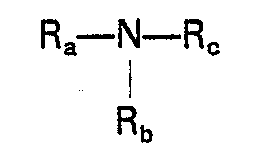
- Preferred alkanolamines include mono-, di-, and tri-ethanolamine, N-methyl ethanolamine, N,N-dimethylethanolamine, N,N-diethyl ethanolamine, N-aminoethylethanolamine, and N-methyl diethanolamine.
- Preferred cyclic amines include morpholine, N-methyl morpholine, piperidine, pyrrolidine, piperazine, N-methyl piperazine, N-(2-hydroxyethyl)piperazine, N-aminoethyl piperazine, 2,5-dimethyl piperazine, and hexamethylene tetramine.
- Exemplary ethylenically unsaturated hydrocarbon monomers containing carboxyl groups, useful in this invention include: acrylic acid, methacrylic acid, itaconic acid, maleic acid, and fumaric acid.
- While not critical for the practice of this invention, the grafting of non-carboxyl containing ethylenically unsaturated hydrocarbon monomers serves to modify the physical properties of the grafted thermoplastic polyhydroxyether, such as, Tg (second order transition temperature),
- Exemplary ethylenically unsaturated hydrocarbon monomers that do not contain carboxyl groups include acrylic or methacrylic alkyl esters, such as methyl methacrylate, ethyl acrylate, n-propyl methacrylate and butyl acrylate, cyano-containing monomers, such as acrylonitrile and methacrylonitrile aromatic vinyl monomers, such as, styrene, a-methyl styrene and p-vinyl toluene.
- Suitable water-miscible organic solvents include aliphatic ketones having 3 to 5 carbons as for example, acetone, methyl ethyl ketone, diethyl ketone, and methyl propyl ketone; monoalkyl ether glycols, e.g., monomethyl ether of ethylene glycol, monoethyl ether of ethylene glycol, monopyropyl ether of ethylene glycol, and monobutyl ether of ethylene glycol; monoalkyl ether diethylene glycols, e.g., monomethyl ether of diethylene glycol, monoethyl ether of diethylene glycol or monobutyl ether of diethylene glycol; monoalkyl ethers of triethiene glycol, e.g., ethoxy triglycol; esters of monoalkyl ethers of ethylene glycol, e.g., monoethoxy glycol acetate and monobutoxy glycol acetate; esters of monoalkyl ethers of diethlene glycols, e.g., monopropoxy diethylene glycol acetate and monobutoxy diethylene glycol acetate; alkoxy alkyl ketones, e.g. 4-methoxy-4-methyl pentanone-2; alkoxy alkyl aliphatic alcohols, such as 4-methoxy-4-methyl pentanol-2; cyclic ethers, e.g., furan, dioxane, and trioxane; dialkyl aliphatic acid amides, e.g., dimethyl formamide, dimethyl sulfoxide, mesityl oxide; and mixtures of organic solvents having a solubility parameter, 6, within 1 unit of that of that of the thermoplastic polyhydroxyether. Exemplary mixtures include toluene/butanol, 60/40.
- Suitable water-miscible diluents which are poor solvents for grafted thermoplastic polyhydroxyethers include aliphatic alcohols having 1 to 5 carbons as, for example, methanol, ethanol, propanols, butanols and pentanols.
- Blending in a high turbulence field can be readily accomplished by the use of a Waring Blendor or any high shear mixer known to those skilled in the art.
- Removal of organic solvents and diluent from the colloidal aqueous dispersion can be effected by means known to those skilled in the art, as for example by stripping, distillation or evaporation at atmospheric or subatmospheric pressures.
- The grafting of the ethylenically unsaturated hydrocarbon monomers can be accomplished by standard polymerization techniques known in the art. Solution polymerization using a free radical initiator, such as benzoyl peroxide and azobisisobutyronitrile, is preferred.
- The aqueous dispersion of grafted polyhydroxyethers of this invention exhibit excellent stability, good wetting and filming behavior.
- The invention is further described in the Examples which follow. All parts and percentages are by weight unless otherwise specified.
- Into a 500 ml, three necked, round bottom flask, equipped with a mechanical stirrer, a condenser, a thermometer, and a nitrogen inlet and outlet, there was charged a phenoxy resin varnish containing 60 g of a thermoplastic polyhydroxyether having a weight average molecular weight of about 30,000 (Bakelite Phenoxy Resins PKHA 8) and 240 g of methyl ethyl ketone, 9.1 g of styrene, 10.1 g methacrylic acid, 0.92 g of ethyl acrylate, and 1.2 g of benzoyl peroxide in 20 ml of methyl ethyl ketone. The system was purged with nitrogen for 30 minutes. Thereafter, the reaction mixture was heated to 80°C with an external heating mantle while under a nitrogen atmosphere and agitation. After refluxing at 80.5°C for 1 hour, the reaction mixture became clo.udy, which is believed to result from a change in solubility characteristics of the phenoxy resin as a consequence of grafting.
- A 20-gram quantity of the above mixture was cooled to room temperature and coagulated in hexane. After washing with additional hexane, the solid polymer was dried under vacuum at 60°C.
- A transparent film was cast from a methyl ethyl ketone solution of the above recovered polymer. Infrared spectrum showed the presence of typical carbonyl bands due to the grafting of methacrylic acid and ethyl acrylate. The simultaneous grafting of styrene was confirmed by nuclear magnetic resonance measurement.
- This example illustrates that the acid-grafting product prepared in Example 1 can be converted to an aqueous dispersion hy high speed mixing and in the presence of a water-miscible base and water.
- 250 g of the varnish prepared in Example 1 was preheated to 44°C and, subsequently, mixed in a highspeed Waring blendor with an aqueous solution containing 10 g of dimethylethanolamine and 250 g of water. A milky, aqueous latex was obtained. The latex had a pH of 7.5 and contained fairly coarse particles ranging from 5 to 50 µm in diameter.
- The example demonstrates that an extremely fine dispersion of the acid-modified polyhydroxyether composition can be prepared if the interfacial tension of the system is further reduced by the addition of a suitable water-miscible organic diluent such as an aliphatic alcohol.
- Into a Waring blendor containing 475.7 g of the coarse emulsion prepared in Example 2, there was added while under vigorous stirring, 57.1 g of n-butanol. The finished emulsion exhibits an intense Tyndall scattering effect characteristic of extremely fine dispersions. It possessed a pH of 8.6 and a Brookfield viscosity of 454 mPa - s.
- 400 grams of the dispersion prepared in Example 3 was concentrated under vacuum at 50°C using a rotatory evaporator. A total of 287.6 g of condensates was collected, and the resin content of the dispersion was raised from the original 8.72 percent to 20 percent. The concentrated dispersion remained highly uniform. It exhibited a pH of 8.5 and a Brookfield viscosity of 3200 mPa - s. Gas chromatographic analysis showed that the liquid phase containing 21 percent and 79 percent by weight of organics and water, respectively.
- Into a 500 ml three-necked, round-bottom flask, equipped with a mechanical stirrer, a condenser, a thermometer, and a nitrogen inlet and outlet, there was charged a polyhydroxy ether varnish containing 58.4 g of the Bakerlite Phenoxy Resin PKHA 0 of example 1 and 233.6 g of ethylene glycol monoethyl ether as solvent 9.2 g of methyl methacrylate, 10.1 g of methacrylic acid, 0.92 g of ethyl acrylate, and 1.2 g of benzoyl peroxide dissolved in 20 ml of the same solvent. The system was purged with nitrogen for 30 minutes. Thereafter, the reaction mixture was heated to 119°C and refluxed for a period of 2 hours. The initially slightly opaque solution was transformed to a colorless and translucent solution. The finished varnish exhibited a Brookfield viscosity of 376 mPa - s at 255°C.
- A mixture containing 250 g of the acid-modified polyhydroxy ether varnish made in Example 5 and 63.2 g of n-butanol was mixed in a Waring blendor until the temperature reached 40°C. Thereafter an aqueous solution composed of 10 g of dimethylethanolamine and 250 g of water was added in under vigorous mixing until the mixture's temperature reached 50°C. A uniform, fine dispersion exhibiting a fairly strong Tyndall scattering effect was obtained. The dispersion exhibited a Brookfield viscosity of 28 mPa - s and a pH of 8.9 at 26.2°C.
- 400 g of the aqueous dispersion of the polyhydroxy ether composition prepared in Example 6 was concentrated under vacuum to a final weight of 171.3 g. The concentrated emulsion has a polyhydroxy ether content of 18 percent by weight and a Brookfield viscosity of 200 mPa - s.
- Gas chromatographic analysis showed that the liquid phase contained 21 percent total organics and 79 percent water.
- Example 1 was repeated with a somewhat different formulation shown as follows:

- The polymerization was carried out at 80.5°C for a period of 1 hour. A slightly hazy solution was obtained.
- 250 g quantity of the above acid-modified varnish was mixed with 63 g of n-butyl alcohol in a Waring Blendor. Thereafter, an aqueous solution containing 250 g of water and 5 g of ammonium hydroxide was added to the varnish while under vigorous agitation. A uniform, fine dispersion was obtained, having a pH of 9.8 and a Brookfield viscosity of 29 mPa - s at 25°C.
- The dispersion prepared in Example 9 was stripped under vacuum at 55°C. Sufficient amount of volatiles was removed until the concentration was raised from the initial 7.53 percent to 18 percent by weight. A more viscous but highly uniform dispersion was obtained, which possessed a pH of 7.8 and a Brookfield viscosity of 242 mPa - s at 26°C. Gas chromatographic analysis showed the volatile phase contained 80 percent and 20 percent by weight of water and organics respectively.
- The dispersion of the grafted polyhydroxy ethers exhibit excellent film-forming protective properties on a variety of metallic substrates shown in the following table:

- The above coatings were prepared using the dispersion prepared in Example 4. A suitable drawdown rod was employed to produce a dry-film thickness of 5 µm.
- A thermosetting, grafted polyhydroxy ether dispersion was prepared by thoroughly mixing 50 g of the dispersion made in Example 7 with 0.5 g of melamine resin (Cymel-303°) i.e. a hexamethoxymethylamine resin. A drawdown coating was applied on a cold-rolled steel panel (Bonderite-40) and was baked at 165°C for a period of 5 minutes. A clear glossy coating was obtained which was no longer soluble in MEK.
Claims (8)
Applications Claiming Priority (2)
| Application Number | Priority Date | Filing Date | Title |
|---|---|---|---|
| US06/216,639 US4355122A (en) | 1980-12-15 | 1980-12-15 | Water-borne thermoplastic polyhydroxyether compositions |
| US216639 | 1980-12-15 |
Publications (3)
| Publication Number | Publication Date |
|---|---|
| EP0054290A2 EP0054290A2 (en) | 1982-06-23 |
| EP0054290A3 EP0054290A3 (en) | 1983-04-13 |
| EP0054290B1 true EP0054290B1 (en) | 1987-05-06 |
Family
ID=22807882
Family Applications (1)
| Application Number | Title | Priority Date | Filing Date |
|---|---|---|---|
| EP81110422A Expired EP0054290B1 (en) | 1980-12-15 | 1981-12-14 | Method of preparing carboxyl group-modified polyhydroxyethers, preparing an aequous colloidal ionomer dispersion therefrom, and the use of the dispersion as protecting coating composition |
Country Status (6)
| Country | Link |
|---|---|
| US (1) | US4355122A (en) |
| EP (1) | EP0054290B1 (en) |
| JP (1) | JPS57121016A (en) |
| BR (1) | BR8108043A (en) |
| CA (1) | CA1169989A (en) |
| DE (1) | DE3176156D1 (en) |
Families Citing this family (28)
| Publication number | Priority date | Publication date | Assignee | Title |
|---|---|---|---|---|
| ATE21109T1 (en) * | 1982-07-06 | 1986-08-15 | Ciba Geigy Ag | WATER-SOLUBLE OR WATER-DISPERSABLE GROSS POLYMERS, THEIR PRODUCTION AND USE. |
| US4638038A (en) * | 1985-04-22 | 1987-01-20 | Union Carbide Corporation | Carboxylic acid-grafted phenoxy resins |
| US5093392A (en) * | 1986-05-05 | 1992-03-03 | The Glidden Company | Epoxy-acrylic graft polymers with aminoplast |
| US5051470A (en) * | 1986-05-05 | 1991-09-24 | The Glidden Company | Epoxy-acrylic graft polymers |
| US4954553A (en) * | 1988-09-30 | 1990-09-04 | Union Carbide Chemicals And Plastics Company Inc. | Modified waterborne phenoxy resins |
| DE4019030A1 (en) * | 1990-06-14 | 1991-12-19 | Herberts Gmbh | EPOXY RESIN-BASED WATER-DISCOVERABLE BINDERS, METHOD FOR THE PRODUCTION AND USE THEREOF FOR AQUEOUS COATING AGENTS AND AQUEOUS COATING AGENTS |
| US5231131A (en) * | 1991-12-24 | 1993-07-27 | E. I. Du Pont De Nemours And Company | Aqueous graft copolymer pigment dispersants |
| US5260357A (en) * | 1992-04-30 | 1993-11-09 | The Dexter Corporation | Corrosion resistant waterbone adhesive primers |
| US5266611A (en) * | 1992-07-21 | 1993-11-30 | The Dexter Corporation | Waterborne epoxy derived adhesive primers |
| US5387625A (en) * | 1993-05-18 | 1995-02-07 | The Dexter Corporation | Waterborne coating composition for metal containers |
| US5514433A (en) * | 1993-07-30 | 1996-05-07 | The Dexter Corporation | Coating composition for metal containers |
| US5776569A (en) * | 1993-07-30 | 1998-07-07 | The Dexter Corporation | Coating composition for metal containers |
| US5574079A (en) * | 1994-12-21 | 1996-11-12 | Union Carbide Chemicals & Plastics Technology Corporation | Method for the preparation of water-borne coating compositions using thermoplastic polyhydroxyether resins having narrow polydispersity |
| US6034160A (en) * | 1995-12-19 | 2000-03-07 | Inchem Corp. | Method for the preparation of water-borne coating compositions using thermoplastic polyhydroxyether resins having narrow polydispersity |
| US5830952A (en) * | 1996-02-22 | 1998-11-03 | The Dexter Corporation | Water-dispersible polymer and coating composition containing the same |
| US6008273A (en) * | 1997-05-09 | 1999-12-28 | The Dexter Corporation | Waterborne coating compositions for metal containers |
| TW457284B (en) | 1997-09-12 | 2001-10-01 | Cytec Tech Corp | Water based primer compositions and their use for treating metal surfaces |
| US6359062B1 (en) | 1999-03-02 | 2002-03-19 | The Valspar Corporation | Coating compositions |
| WO2003057467A2 (en) * | 2002-01-10 | 2003-07-17 | Voith Fabrics Heidenheim Gmbh & Co. Kg. | Surface treatment of industrial textiles |
| CN1981109A (en) * | 2004-06-03 | 2007-06-13 | 国际壳牌研究有限公司 | Method and apparatus for performing chemical treatments of exposed geological formations |
| JP4698170B2 (en) * | 2004-06-17 | 2011-06-08 | 新日鐵化学株式会社 | Epoxy resin, method for producing the same, and epoxy resin composition thereof |
| US20100168368A1 (en) * | 2004-06-17 | 2010-07-01 | Kukdo Chemical Co., Ltd. (Korean Corporation) | Epoxy Resin, Method for Producing Same and Epoxy Resin Composition Thereof |
| US7696133B2 (en) | 2005-06-02 | 2010-04-13 | Shell Oil Company | Geosynthetic composite for borehole strengthening |
| CA2667480A1 (en) * | 2006-10-24 | 2008-05-02 | Akzo Nobel Coatings International B.V. | Non-stick coating composition |
| WO2010117757A1 (en) * | 2009-03-31 | 2010-10-14 | Cytec Technology Corp. | Water based non-chromated primers for structural bonding applications |
| CA3046599C (en) * | 2011-12-20 | 2020-04-14 | Cytec Industries Inc. | Dry fibrous material for subsequent resin infusion |
| CN110392708B (en) * | 2017-02-20 | 2021-11-09 | 洛德公司 | Adhesive composition based on grafted resins |
| EP3607007A1 (en) | 2017-03-24 | 2020-02-12 | 3M Innovative Properties Company | Aqueous primer composition and related methods |
Family Cites Families (7)
| Publication number | Priority date | Publication date | Assignee | Title |
|---|---|---|---|---|
| AT299543B (en) * | 1970-07-22 | 1972-06-26 | Vianova Kunstharz Ag | Process for the production of water-thinnable, thermosetting, self-crosslinking copolymers |
| CA1065991A (en) * | 1975-10-31 | 1979-11-06 | Girish G. Parekh | Non-polluting water-dispersible coating compositions |
| US4212781A (en) * | 1977-04-18 | 1980-07-15 | Scm Corporation | Modified epoxy resins, processes for making and using same and substrates coated therewith |
| US4207227A (en) * | 1976-12-03 | 1980-06-10 | Bayer Aktiengesellschaft | Stable suspensions of inorganic fillers in organic polyhydroxyl compounds |
| US4182699A (en) * | 1977-10-28 | 1980-01-08 | Union Carbide Corporation | Aqueous microemulsions of vinyl resins having carboxylic or sulfonic groups |
| JPS5490287A (en) * | 1977-12-27 | 1979-07-17 | Nhk Spring Co Ltd | Preparation of graft polyether |
| US4202808A (en) * | 1978-03-13 | 1980-05-13 | Union Carbide Corporation | Vinyl resin latex coating compositions |
-
1980
- 1980-12-15 US US06/216,639 patent/US4355122A/en not_active Expired - Lifetime
-
1981
- 1981-11-06 CA CA000389632A patent/CA1169989A/en not_active Expired
- 1981-12-05 JP JP56195138A patent/JPS57121016A/en active Granted
- 1981-12-11 BR BR8108043A patent/BR8108043A/en unknown
- 1981-12-14 EP EP81110422A patent/EP0054290B1/en not_active Expired
- 1981-12-14 DE DE8181110422T patent/DE3176156D1/en not_active Expired
Also Published As
| Publication number | Publication date |
|---|---|
| JPS57121016A (en) | 1982-07-28 |
| EP0054290A3 (en) | 1983-04-13 |
| BR8108043A (en) | 1982-09-21 |
| US4355122A (en) | 1982-10-19 |
| CA1169989A (en) | 1984-06-26 |
| DE3176156D1 (en) | 1987-06-11 |
| EP0054290A2 (en) | 1982-06-23 |
| JPS6333765B2 (en) | 1988-07-06 |
Similar Documents
| Publication | Publication Date | Title |
|---|---|---|
| US4355122A (en) | Water-borne thermoplastic polyhydroxyether compositions | |
| EP0361519B1 (en) | Modified waterborne phenoxy resins | |
| US4442246A (en) | Aqueous coating composition comprising self-emulsifiable ester of epoxy and acid containing addition polymer | |
| US4480058A (en) | Aqueous epoxy ester emulsions | |
| US5008335A (en) | Powder coating compositions of polyepoxides, acrylic copolymers and aliphatic or polyester dibasic acids | |
| US4374875A (en) | Water-borne thermoplastic polyhydroxyether compositions | |
| US5574079A (en) | Method for the preparation of water-borne coating compositions using thermoplastic polyhydroxyether resins having narrow polydispersity | |
| EP0200144B1 (en) | Carboxylic acid grafted phenoxy resins | |
| EP0214448A2 (en) | Powder coating compositions of polyepoxides and acrylic copolymers | |
| EP0141381A1 (en) | Improved zinc rich coatings | |
| US4544688A (en) | Metal-containing phenolic coating compositions | |
| GB1585486A (en) | Epoxy resins processes for making and using same and substrates coated therewith | |
| US4303565A (en) | Composition comprising ester of epoxy, unsaturated fatty acid dimer or trimer and acid containing addition polymer, and aqueous coating compositions prepared therefrom | |
| EP1112298B1 (en) | Thermosetting compositions containing epoxy-functional polymers prepared using atom transfer radical polymerization | |
| US6034160A (en) | Method for the preparation of water-borne coating compositions using thermoplastic polyhydroxyether resins having narrow polydispersity | |
| US4711924A (en) | Carboxylic acid-grafted phenoxy resins | |
| US4547535A (en) | Aqueous coating composition comprising self-emulsifiable ester of epoxy and acid containing addition polymer | |
| US3113036A (en) | Baked | |
| EP0445863B1 (en) | Aqueous dispersion of a hybrid polymer and coating composition therefrom | |
| EP0302363A2 (en) | Carboxylic acid-grafted blends of phenoxy and a modifier resin and waterborne coatings thereof | |
| EP0249200A2 (en) | High solids sag resistant cycloaliphatic epoxy coatings | |
| JP3385436B2 (en) | Water-based paint composition | |
| US4715977A (en) | Magnetic coating compositions from carboxylic acid-grafted phenoxy resins | |
| US4711817A (en) | Carboxylic acid-grafted phenoxy resins | |
| US3444122A (en) | Vinyl chloride polymer compositions containing a vinyl chloride,vinyl acetate,vinyl alcohol terpolymer and an epoxy resin |
Legal Events
| Date | Code | Title | Description |
|---|---|---|---|
| PUAI | Public reference made under article 153(3) epc to a published international application that has entered the european phase |
Free format text: ORIGINAL CODE: 0009012 |
|
| AK | Designated contracting states |
Designated state(s): BE DE FR GB SE |
|
| PUAL | Search report despatched |
Free format text: ORIGINAL CODE: 0009013 |
|
| RHK1 | Main classification (correction) |
Ipc: C08F283/00 |
|
| AK | Designated contracting states |
Designated state(s): BE DE FR GB SE |
|
| 17P | Request for examination filed |
Effective date: 19830503 |
|
| GRAA | (expected) grant |
Free format text: ORIGINAL CODE: 0009210 |
|
| AK | Designated contracting states |
Kind code of ref document: B1 Designated state(s): BE DE FR GB SE |
|
| REF | Corresponds to: |
Ref document number: 3176156 Country of ref document: DE Date of ref document: 19870611 |
|
| ET | Fr: translation filed | ||
| PLBI | Opposition filed |
Free format text: ORIGINAL CODE: 0009260 |
|
| 26 | Opposition filed |
Opponent name: BASF LACKE + FARBEN AKTIENGESELLSCHAFT, MUENSTER Effective date: 19880115 |
|
| PGFP | Annual fee paid to national office [announced via postgrant information from national office to epo] |
Ref country code: DE Payment date: 19920910 Year of fee payment: 12 |
|
| PGFP | Annual fee paid to national office [announced via postgrant information from national office to epo] |
Ref country code: SE Payment date: 19920914 Year of fee payment: 12 |
|
| PGFP | Annual fee paid to national office [announced via postgrant information from national office to epo] |
Ref country code: GB Payment date: 19920921 Year of fee payment: 12 |
|
| PGFP | Annual fee paid to national office [announced via postgrant information from national office to epo] |
Ref country code: FR Payment date: 19920922 Year of fee payment: 12 |
|
| PGFP | Annual fee paid to national office [announced via postgrant information from national office to epo] |
Ref country code: BE Payment date: 19920928 Year of fee payment: 12 |
|
| RDAG | Patent revoked |
Free format text: ORIGINAL CODE: 0009271 |
|
| STAA | Information on the status of an ep patent application or granted ep patent |
Free format text: STATUS: PATENT REVOKED |
|
| 27W | Patent revoked |
Effective date: 19930819 |
|
| GBPR | Gb: patent revoked under art. 102 of the ep convention designating the uk as contracting state |
Free format text: 930819 |
|
| EUG | Se: european patent has lapsed |
Ref document number: 81110422.3 Effective date: 19931006 |
|
| APAH | Appeal reference modified |
Free format text: ORIGINAL CODE: EPIDOSCREFNO |