EP0061264A1 - Tetracyanoanthraquinodimethane compounds and processes for the production thereof, polymers and charge-transfer complexes derived therefrom - Google Patents
Tetracyanoanthraquinodimethane compounds and processes for the production thereof, polymers and charge-transfer complexes derived therefrom Download PDFInfo
- Publication number
- EP0061264A1 EP0061264A1 EP82301256A EP82301256A EP0061264A1 EP 0061264 A1 EP0061264 A1 EP 0061264A1 EP 82301256 A EP82301256 A EP 82301256A EP 82301256 A EP82301256 A EP 82301256A EP 0061264 A1 EP0061264 A1 EP 0061264A1
- Authority
- EP
- European Patent Office
- Prior art keywords
- tcnaq
- compounds
- tetracyano
- compound
- anthraquinodimethane
- Prior art date
- Legal status (The legal status is an assumption and is not a legal conclusion. Google has not performed a legal analysis and makes no representation as to the accuracy of the status listed.)
- Granted
Links
Images

Classifications
-
- H—ELECTRICITY
- H01—ELECTRIC ELEMENTS
- H01B—CABLES; CONDUCTORS; INSULATORS; SELECTION OF MATERIALS FOR THEIR CONDUCTIVE, INSULATING OR DIELECTRIC PROPERTIES
- H01B1/00—Conductors or conductive bodies characterised by the conductive materials; Selection of materials as conductors
- H01B1/06—Conductors or conductive bodies characterised by the conductive materials; Selection of materials as conductors mainly consisting of other non-metallic substances
- H01B1/12—Conductors or conductive bodies characterised by the conductive materials; Selection of materials as conductors mainly consisting of other non-metallic substances organic substances
- H01B1/121—Charge-transfer complexes
-
- C—CHEMISTRY; METALLURGY
- C07—ORGANIC CHEMISTRY
- C07C—ACYCLIC OR CARBOCYCLIC COMPOUNDS
- C07C255/00—Carboxylic acid nitriles
-
- C—CHEMISTRY; METALLURGY
- C08—ORGANIC MACROMOLECULAR COMPOUNDS; THEIR PREPARATION OR CHEMICAL WORKING-UP; COMPOSITIONS BASED THEREON
- C08G—MACROMOLECULAR COMPOUNDS OBTAINED OTHERWISE THAN BY REACTIONS ONLY INVOLVING UNSATURATED CARBON-TO-CARBON BONDS
- C08G61/00—Macromolecular compounds obtained by reactions forming a carbon-to-carbon link in the main chain of the macromolecule
- C08G61/02—Macromolecular compounds containing only carbon atoms in the main chain of the macromolecule, e.g. polyxylylenes
- C08G61/10—Macromolecular compounds containing only carbon atoms in the main chain of the macromolecule, e.g. polyxylylenes only aromatic carbon atoms, e.g. polyphenylenes
-
- C—CHEMISTRY; METALLURGY
- C08—ORGANIC MACROMOLECULAR COMPOUNDS; THEIR PREPARATION OR CHEMICAL WORKING-UP; COMPOSITIONS BASED THEREON
- C08G—MACROMOLECULAR COMPOUNDS OBTAINED OTHERWISE THAN BY REACTIONS ONLY INVOLVING UNSATURATED CARBON-TO-CARBON BONDS
- C08G65/00—Macromolecular compounds obtained by reactions forming an ether link in the main chain of the macromolecule
- C08G65/34—Macromolecular compounds obtained by reactions forming an ether link in the main chain of the macromolecule from hydroxy compounds or their metallic derivatives
-
- C—CHEMISTRY; METALLURGY
- C08—ORGANIC MACROMOLECULAR COMPOUNDS; THEIR PREPARATION OR CHEMICAL WORKING-UP; COMPOSITIONS BASED THEREON
- C08K—Use of inorganic or non-macromolecular organic substances as compounding ingredients
- C08K5/00—Use of organic ingredients
- C08K5/16—Nitrogen-containing compounds
- C08K5/315—Compounds containing carbon-to-nitrogen triple bonds
-
- C—CHEMISTRY; METALLURGY
- C09—DYES; PAINTS; POLISHES; NATURAL RESINS; ADHESIVES; COMPOSITIONS NOT OTHERWISE PROVIDED FOR; APPLICATIONS OF MATERIALS NOT OTHERWISE PROVIDED FOR
- C09B—ORGANIC DYES OR CLOSELY-RELATED COMPOUNDS FOR PRODUCING DYES, e.g. PIGMENTS; MORDANTS; LAKES
- C09B1/00—Dyes with anthracene nucleus not condensed with any other ring
-
- H—ELECTRICITY
- H10—SEMICONDUCTOR DEVICES; ELECTRIC SOLID-STATE DEVICES NOT OTHERWISE PROVIDED FOR
- H10K—ORGANIC ELECTRIC SOLID-STATE DEVICES
- H10K85/00—Organic materials used in the body or electrodes of devices covered by this subclass
- H10K85/60—Organic compounds having low molecular weight
- H10K85/611—Charge transfer complexes
Definitions
- This invention relates to novel compounds, and more particularly to 11,11,12,12-tetracyano-9,10-anthraquinodimethane and its derivatives.
- TCNQ 7,7,8,8-tetracyanoquinodimethane
- TCNNQ 9,9,10,10-tetracyano-1,4-naphthaquinodimethane
- TCNQ and TCNNQ compounds are known.
- These organic ompounds have excellent semiconductor characteristics and, as is well known, have great industrial values.
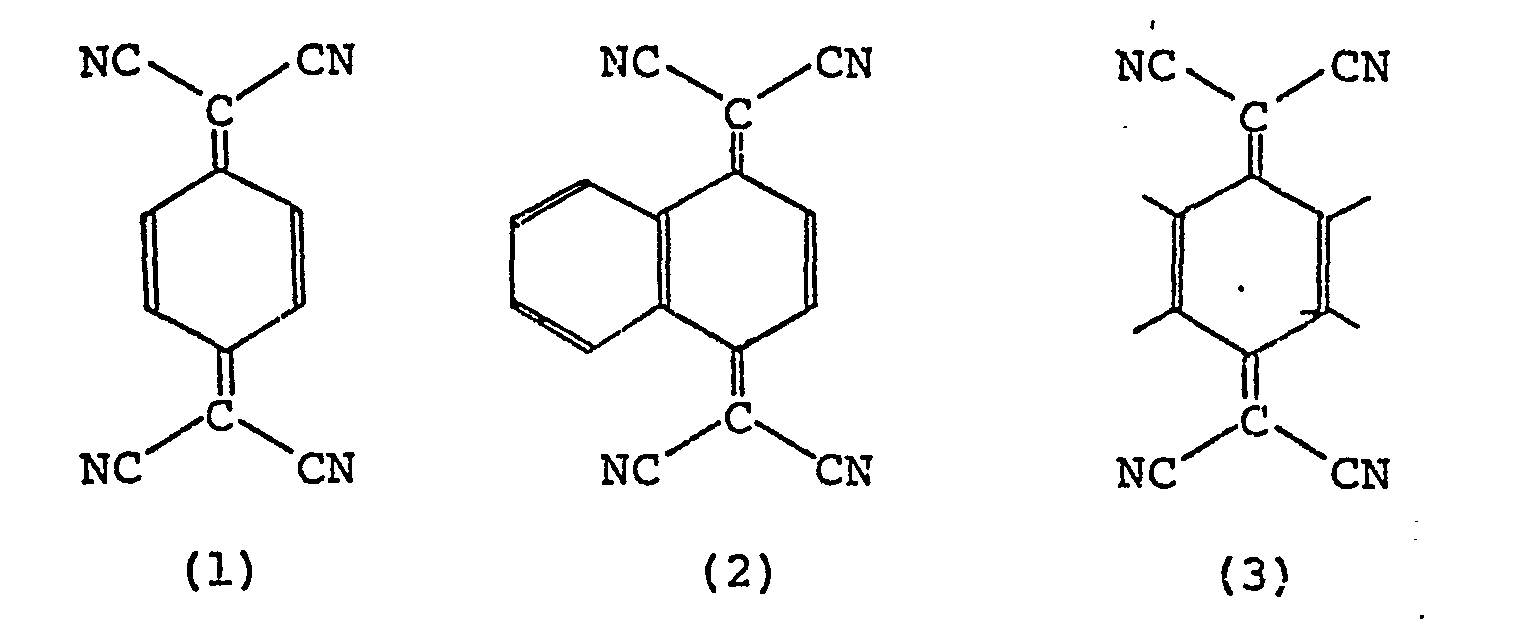
- TCNQ and TCNNQ The molecular formulas of TCNQ and TCNNQ are presented hereinafter [(1) and (2), respectively].
- TCNQ and TCNNQ, and various derivatives thereof have the tetracyancquinodimethane skeleton represented by formula (3), and this skeletal structure is determinant of the characteristics of these compounds.
- 'tetracyanoquinodimethane skeleton' means the skeletal structure consisting of those carbon and nitrogen atoms which constitute the molecule of TCNQ.
- TCNQ and its derivatives have been described in the literature including D. S. Acker, et al., J. Am. Chem. Soc., 84, 3370 (1962) andR. C. Wheland, et al., J. Org. Chem., 40(21), 3101 (1975).
- This invention provides novel compounds which, based on the tetracyanoquinodimethane skeleton possessed in common, display certain characteristics which are not seen in TCNQ or TCNNQ or in any known derivative thereof.
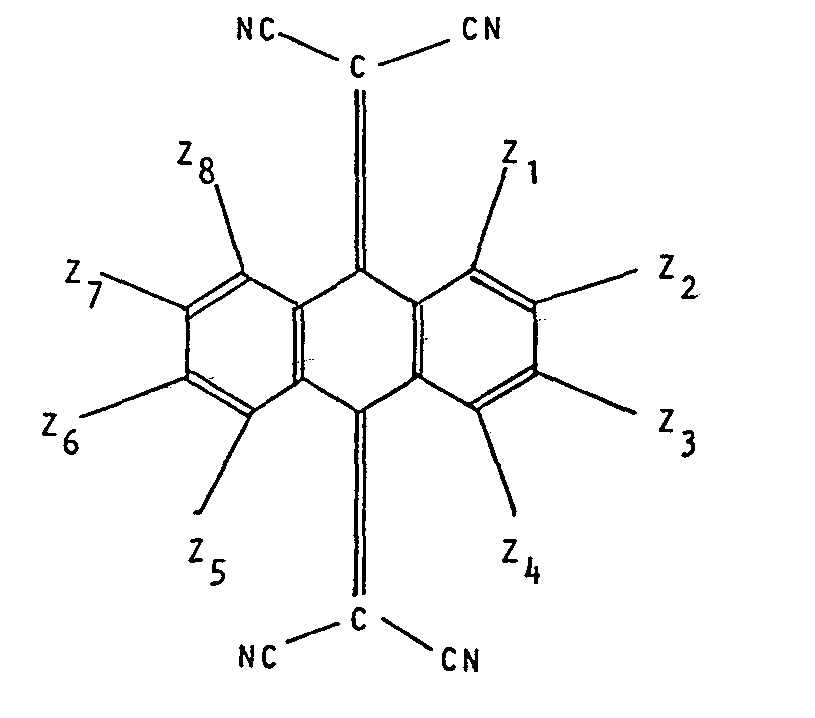
- TCNAQ compounds 11,11,12,12-tetracyano-9,10,-anthraquinodimethane and its derivatives
- TCNAQ compounds 11,11,12,12-tetracyano-9,10,-anthraquinodimethane and its derivatives
- TCNAQ compounds having useful characteristics can be obtained by selecting suitable species for substituents Z 1 to Z 8 .
- Z 1 , Z 2 , ... Z 8 are substituent groups attached to C 1 , C 2 , ........ , C 8 , respectively, of 11,11,12, 12-tetracyano-9, 10-anthraquinodimethane (TCNAQ). More particularly, Z 2 , Z 3 , Z 6 and Z 7 each_is H, halogen, alkyl, phenyl, alkylphenyl, hydroxyalkyl, carboxyalkyl, hydroxy, amino or carboxy; Z 1 , Z 4 , Z 5 and Z 8 each is H, Cl, hydroxy or amino.
- the halogen referred to above may be fluorine, chlorine,bromine or iodine.
- the number of carbon atoms contained in said alkyl, alkylphenyl, hydroxyalkyl or carboxyalkyl may be 1 to 8.
- the TCNAQ compounds (A) have a tetracyanoanthraquinodimethane skeleton in common and display excellent charac--- teristics due to the electronic structure characteristic of the benzene rings located at both sides of the tetracyanoanthraquinodimethane skeleton.
- the term 'tetracyanoanthraquinodimethane skeleton' as used herein denotes the skeletal structure consisting of carbon and nitrigon atoms constituting the molecule of TCNAQ.
- the tetracyanoanthraquinodimethane skeleton has the following features.
- TCNAQ compounds are derived from its tetracyanoquinodimethane structure (a).
- the other features (b) and (c) each provides basis for the versatility and functionality of the derivatives as organic compounds, and are the features which differentiate TCNAQ compounds from TCNQ and TCNNQ compounds.
- the tetracyanoanthraquinodimethane skeleton has a large expanse of electron cloud and due to the synergistic action of the tetracyanoquinodimethane nucleus and the benzene rings fused thereto at both sides, the energy breadth between the ground and excited states of electrons is so small that some useful results such as increased electrical conductivity are obtained.
- TCNAQ compounds industrially useful organic compounds or organic semiconductors. Moreover, by varying the kinds and positions of substituents, varieties can be imparted to the above features. Taking their electrical characteristics as examples, the conductivity values of TCNAQ compounds (A) according to this invention lie in the range of about 10 -9 to 10 -7 ⁇ -1 ⁇ cm -1 .
- TCNAQ compounds described above can be used in a variety of applications. Moreover, these compounds are useful as intermediates for the production of other valuable compounds or substances. Furthermore, these compounds or substances may be incorporated or dispersed in other inorganic compounds, organic compounds or high polymer compounds to provide compositions having desirable properties and characteristics. These compounds, substances and compositions generally can be used in a large variety of applications as organo-electronic materials. Desirable results can be obtained by using the compounds of this invention selectively in accordance with the intended use or application.
- polymer as used herein means a compound formed as a plurality of tetracyanoanthraquinodimethane skeletons are linked up either directly or through the intermediary of some other group or groups.
- group is used herein to mean an atom or a group of atoms.
- a polyether compound can be synthesized by.condensing a TCNAQ derivative (A) having at least two hydroxyalkyl groups as substituents.
- - Polyester compounds can also be synthesized by reacting a TCNAQ derivatives (A) having at least 2 hydroxyalkyl groups as substituents with a TCNAQ derivative (A) having at least 2 carboxy or carboxyalkyl groups as substituents.
- a halogenated derivative (A) can be dehalogenated by Ullmann reaction to obtain a polymer formed as a plurality. of tetracyanoanthraquinodimethane skeletons are linked together..
- a TCNAQ derivative (A) or a polymer derived therefrom may be doped with a compound capable of acting as an electron donor or acceptor for it to obtain a charge transfer complex.
- Such electron transfer complexes have desirable characteristics and, therefore, are of-great industrial value.
- TCNAQ compounds or polymers derived therefrom or charge transfer complexes based thereon may be dispersed or otherwise incorporated in other high molecular compounds or the like to provide composi-. tions having very desirable properties.
- said electron donor there may be mentioned such metal elements as sodium, copper, etc., aromatic compounds, e.g. anthracene, etc., amines and phthalocyanines.
- metal elements such as sodium, copper, etc., aromatic compounds, e.g. anthracene, etc., amines and phthalocyanines.
- Lewis acids such as arsenic pentafluoride, etc. are especially desirable.
- TCNAQ compounds and polymers and the charge transfer complexes derived therefrom, as well as compositions containing such compounds, polymers or complexes can be used in a large variety of applications as organo-electronic materials. For example, they can be used as dielectric materials, conductors, resistors, thermisters and other semiconductors, photovoltaic materials, and so on.
- TCNQ is produced from a diethyl succinate by converting the starting compound to 1,4-cyclohexanedione and reacting the latter with malonitrile.
- the literature of Wheland et al teaches a method of producing TCNQ compounds.
- a benzene derivative, p-xylene derivative or terephthalic acid derivative is used as a starting material to give a p-xylene halide which is further subjected to a complicated series of steps to give a TCNQ compound.
- the tetracyano compound produced as an intermediate in the above series of reactions is only sparingly soluble in the common solvents because of the high polarity of its 4 cyano groups and, therefore, a large amount of solvent is required in the final stage of the process leading to a TCN Q compound.
- TCNAQ compounds according to this invention are free from the above-mentioned disadvantages of these methods known for the production of TCNQ compounds and are of great industrial value.
- the Diets-Alder reaction (a) must be-conducted under heating at 70 to 80°C but the other reactions proceed satisfactorily under very mild heating or at room temperature, or even at reduced temperature. This means that the method requires only a very low level of energy or power. Moreover, except for the reaction (b) for the introduction of dicyanomethylene groups, all other reactions are simple addition or elimination reactions, and substantially no side reactions occur in any stage of the process. Furthermore, because the method consists of as few as three reaction steps, the desired TCNAQ compound can be obtained in high yield.
- 1,4,4a,5,8,8a,9a,10a-octahydro-11,11,12,12-tetracyano-9,10-anthraquinodimethane derivative produced in the step (b) is readily soluble in solvents because the high polarity of cyano groups has been mitigated by the two cyclic substituents condensed to the carbon atoms in 4a,9a- and 8a,10a-positions. It . is for this reason that a large amount of TCNAQ compound can be produced with use of a small amount of solvent in step (c).
- TCNAQ compounds (A) were produced in the following manner.
- l,4,4a,5,8,8a,9a,10a-octahydro-9,10-anthraquinone compounds were produced from 0.5 mole of p-benzoquinone and 1.2 moles of butadiene or its derivatives.
- the butadiene derivatives employed were 2-methyl-butadiene, 2,3-dimethylbutadiene, 2-ethylbutadiene, 2,3-diethylbutadiene, 2-propylbutadiene, 2-butylbutadiene, 2-pentylbutadiene, 2-hexylbutadiene, 2-octylbutadiene, 2-phenylbutadiene and 2-(4-methylphenyl)butadiene.
- T CNAQ compounds produced in the above manner are shown in Table 1. Though varying somewhat with different species of TCNAQ compound, the yields were invariably over 90%. The overall yields of TCNAQ compounds through the above processes i) and ii) were invariably over 75%.
- TCNAQ mono-substituted by an alkyl, amino or other group can be obtained in this manner.
Landscapes
- Chemical & Material Sciences (AREA)
- Organic Chemistry (AREA)
- Health & Medical Sciences (AREA)
- Chemical Kinetics & Catalysis (AREA)
- Medicinal Chemistry (AREA)
- Polymers & Plastics (AREA)
- Physics & Mathematics (AREA)
- Spectroscopy & Molecular Physics (AREA)
- Engineering & Computer Science (AREA)
- Materials Engineering (AREA)
- Organic Low-Molecular-Weight Compounds And Preparation Thereof (AREA)
Abstract
Description
- This invention relates to novel compounds, and more particularly to 11,11,12,12-tetracyano-9,10-anthraquinodimethane and its derivatives.
- Heretofore, 7,7,8,8-tetracyanoquinodimethane (hereinafter referred to briefly as TCNQ) and 9,9,10,10-tetracyano-1,4-naphthaquinodimethane (briefly, TCNNQ) and various derivatives thereof (All of these compounds are collectively referred to as TCNQ and TCNNQ compounds) are known. These organic ompounds have excellent semiconductor characteristics and, as is well known, have great industrial values.
- The molecular formulas of TCNQ and TCNNQ are presented hereinafter [(1) and (2), respectively]. TCNQ and TCNNQ, and various derivatives thereof have the tetracyancquinodimethane skeleton represented by formula (3), and this skeletal structure is determinant of the characteristics of these compounds.
- In this specification and the claims appended thereto, the term 'tetracyanoquinodimethane skeleton' means the skeletal structure consisting of those carbon and nitrogen atoms which constitute the molecule of TCNQ.
- TCNQ and its derivatives have been described in the literature including D. S. Acker, et al., J. Am. Chem. Soc., 84, 3370 (1962) andR. C. Wheland, et al., J. Org. Chem., 40(21), 3101 (1975).
- The structural analysis of TCNNQ has been attempted and reported in F. Iwasaki, Acta Cryst. B27, 1360 (1971).
- This invention provides novel compounds which, based on the tetracyanoquinodimethane skeleton possessed in common, display certain characteristics which are not seen in TCNQ or TCNNQ or in any known derivative thereof.
- The novel organic compounds according to this invention are 11,11,12,12-tetracyano-9,10,-anthraquinodimethane and its derivatives (hereinafter referred to as TCNAQ compounds), and may be represented by the following general formula (A).

- A variety of TCNAQ compounds having useful characteristics can be obtained by selecting suitable species for substituents Z1 to Z8.
- These derivatives can be easily produced from benzoquinone and butadiene derivatives.
-
- Fig. 1 is a longitudinal cross-sectional view showing a device for measuring electric resistances.
- Fig. 2 is a diagrammatic representation of the conductivity-temperature characteristics (compressed powder samples) of 11,11,12,12-tetracyano-9,10-anthraquinodimethane (TCNAQ), 1,4-dihydroxy-11,11,12,12-tetracyanc-9,10-anthraquinodimethane (DOCAQ) and 1-amino-11,11,12,12-tetracyano-9,10-anthraquinodimethane (ACAQ).
- This invention will hereinafter be described in detail. As mentioned hereinbefore, the compounds according to this invention may be represented by the following general formula (A):

- The halogen referred to above may be fluorine, chlorine,bromine or iodine. The number of carbon atoms contained in said alkyl, alkylphenyl, hydroxyalkyl or carboxyalkyl may be 1 to 8.
- The TCNAQ compounds (A) have a tetracyanoanthraquinodimethane skeleton in common and display excellent charac--- teristics due to the electronic structure characteristic of the benzene rings located at both sides of the tetracyanoanthraquinodimethane skeleton. The term 'tetracyanoanthraquinodimethane skeleton' as used herein denotes the skeletal structure consisting of carbon and nitrigon atoms constituting the molecule of TCNAQ. Now, the characteristics of the tetracyanoanthraquinodimethane skeleton constituting the cardinal structure of the compounds of this invention will be explained and the TCNAQ compounds will be compared with TCNQ and TCNNQ compounds. The tetracyanoanthraquinodimethane skeleton has the following features.
- (a) It has a tetracyanoquinodimethane nucleus;
- (b) One or more substituents can be introduced into any one or more among C1,C2,C3,C4,C5,C6,C7 and C8.
- (c) It has an aromatic benzene ring at both sides of its structure.
- The semiconductor characteristics of TCNAQ compounds are derived from its tetracyanoquinodimethane structure (a). The other features (b) and (c) each provides basis for the versatility and functionality of the derivatives as organic compounds, and are the features which differentiate TCNAQ compounds from TCNQ and TCNNQ compounds.
- Particularly, the tetracyanoanthraquinodimethane skeleton has a large expanse of electron cloud and due to the synergistic action of the tetracyanoquinodimethane nucleus and the benzene rings fused thereto at both sides, the energy breadth between the ground and excited states of electrons is so small that some useful results such as increased electrical conductivity are obtained.
- These features make TCNAQ compounds industrially useful organic compounds or organic semiconductors. Moreover, by varying the kinds and positions of substituents, varieties can be imparted to the above features. Taking their electrical characteristics as examples, the conductivity values of TCNAQ compounds (A) according to this invention lie in the range of about 10-9 to 10-7Ω-1·cm-1.
- Moreover, when, of the above-mentioned substituent groups, a chlorine atom, a hydroxy group or an amino group exists on C1 of TCNAQ, there occurs a resonance (mesomeric effect) which extends the conjugated system of π electrons on the tetracyanoanthraquinodimethane skeleton so that some useful results such as a remarkable increase of electrical conductivity are obtained. The above-mentioned resonance effect is schematically illustrated below.

- The TCNAQ compounds described above can be used in a variety of applications. Moreover, these compounds are useful as intermediates for the production of other valuable compounds or substances. Furthermore, these compounds or substances may be incorporated or dispersed in other inorganic compounds, organic compounds or high polymer compounds to provide compositions having desirable properties and characteristics. These compounds, substances and compositions generally can be used in a large variety of applications as organo-electronic materials. Desirable results can be obtained by using the compounds of this invention selectively in accordance with the intended use or application.
- Some of such applications and uses will be described briefly.
- Starting from TCNAQ compounds, various polymers having useful properties can be produced. The term "polymer" as used herein means a compound formed as a plurality of tetracyanoanthraquinodimethane skeletons are linked up either directly or through the intermediary of some other group or groups. The term "group" is used herein to mean an atom or a group of atoms.
- By way of illustration, a polyether compound can be synthesized by.condensing a TCNAQ derivative (A) having at least two hydroxyalkyl groups as substituents.- Polyester compounds can also be synthesized by reacting a TCNAQ derivatives (A) having at least 2 hydroxyalkyl groups as substituents with a TCNAQ derivative (A) having at least 2 carboxy or carboxyalkyl groups as substituents. Moreover, a halogenated derivative (A) can be dehalogenated by Ullmann reaction to obtain a polymer formed as a plurality. of tetracyanoanthraquinodimethane skeletons are linked together..
- A TCNAQ derivative (A) or a polymer derived therefrom may be doped with a compound capable of acting as an electron donor or acceptor for it to obtain a charge transfer complex. Such electron transfer complexes have desirable characteristics and, therefore, are of-great industrial value.
- The above-mentioned TCNAQ compounds or polymers derived therefrom or charge transfer complexes based thereon may be dispersed or otherwise incorporated in other high molecular compounds or the like to provide composi-. tions having very desirable properties.
- As preferred examples of said electron donor, there may be mentioned such metal elements as sodium, copper, etc., aromatic compounds, e.g. anthracene, etc., amines and phthalocyanines. As for said electron acceptor, Lewis acids such as arsenic pentafluoride, etc. are especially desirable.
- As matrices in which the compounds and derivatives according to this invention are incorporated or dispersed, various resins and other high molecular compounds are especially useful. In such applications, it is preferable to employ a compound (A) having substituents compatible with the high molecular matrix compound, for such a combination ensures a uniform composition or dispersion. For example, when a polyolefin compound is selected as said high molecular compound, an alkylated derivative (A) can be used with great advantage. When an aromatic high molecular compound is selected as the matrix material, it is advantageous to use a phenylated or alkyphenylated derivative (A).
- These TCNAQ compounds and polymers and the charge transfer complexes derived therefrom, as well as compositions containing such compounds, polymers or complexes can be used in a large variety of applications as organo-electronic materials. For example, they can be used as dielectric materials, conductors, resistors, thermisters and other semiconductors, photovoltaic materials, and so on.
- The method of producing TCNAQ compounds in accordance with this invention will hereinafter be described briefly, reference being made to TCNQ and TCNNQ compounds for comparison's sake. Thus, the methods of producing TCNQ compounds have been described in the literature such as D. S. Acker et al, J. Am. Chem. Soc. 84, 3370 (1962), R. C. Wheland et al, J. Org. Chem. 40 (21), 3101 (1975) and U.S. Patent 3,115,506, for instance. By way of example TCNQ is produced from a diethyl succinate by converting the starting compound to 1,4-cyclohexanedione and reacting the latter with malonitrile. The process for synthesis of 1,4-cyclohexanedione from diethyl succinate has been described in J. R. Vincent et al, J. Org. Chem., 3, 603 (1939) and the subsequent process has been described in the above-mentioned paper of D. S. Acker et al.
- In the former process by which 1,4-cyclohexanedione is synthesized from diethyl succinosuccinate, the hydrolysis and decarboxylation reaction of diethyl succinosuccinate require the very rigorous conditions of 195 to 200°C. For this reason, the production of TCNQ by the above series of reactions hac had to face a considerable difficulty.
- The literature of Wheland et al teaches a method of producing TCNQ compounds. In accordance with the method, a benzene derivative, p-xylene derivative or terephthalic acid derivative is used as a starting material to give a p-xylene halide which is further subjected to a complicated series of steps to give a TCNQ compound. Moreover, the tetracyano compound produced as an intermediate in the above series of reactions is only sparingly soluble in the common solvents because of the high polarity of its 4 cyano groups and, therefore, a large amount of solvent is required in the final stage of the process leading to a TCNQ compound.
- Thus, the conventional methods for producing TCNQ compounds require either reactions under very severe conditions, a complicated series of reaction steps, or/and use of large amounts of solvents. These requirements are unfavorable not only in terms of reaction time and yield but also from the standpoints of conservation of energy or power for conducting the reactions and the consumption of solvents, for instance.
- The method of producing TCNAQ compounds according to this invention are free from the above-mentioned disadvantages of these methods known for the production of TCNQ compounds and are of great industrial value.
- The production method according to this invention will be illustrated by way of chemical reaction formula [Formula (C)]. In Formula C, the substituents W, X, Y and Z are selected from among the substituents Z1 through Z8 in Formula (A).

- In the above series of reactions, the Diets-Alder reaction (a) must be-conducted under heating at 70 to 80°C but the other reactions proceed satisfactorily under very mild heating or at room temperature, or even at reduced temperature. This means that the method requires only a very low level of energy or power. Moreover, except for the reaction (b) for the introduction of dicyanomethylene groups, all other reactions are simple addition or elimination reactions, and substantially no side reactions occur in any stage of the process. Furthermore, because the method consists of as few as three reaction steps, the desired TCNAQ compound can be obtained in high yield.
- In addition, the 1,4,4a,5,8,8a,9a,10a-octahydro-11,11,12,12-tetracyano-9,10-anthraquinodimethane derivative produced in the step (b) is readily soluble in solvents because the high polarity of cyano groups has been mitigated by the two cyclic substituents condensed to the carbon atoms in 4a,9a- and 8a,10a-positions. It . is for this reason that a large amount of TCNAQ compound can be produced with use of a small amount of solvent in step (c).
- Furthermore, p-benzoquinone and butadine or its derivative, which are starting materials, are available in quantities and at low cost and this factor also contributes to the economic advantage of this invention.
- The following production examples are further illustrative of this invention.
- The TCNAQ compounds (A) were produced in the following manner.
- l,4,4a,5,8,8a,9a,10a-octahydro-9,10-anthraquinone compounds were produced from 0.5 mole of p-benzoquinone and 1.2 moles of butadiene or its derivatives.
- The butadiene derivatives employed were 2-methyl- butadiene, 2,3-dimethylbutadiene, 2-ethylbutadiene, 2,3-diethylbutadiene, 2-propylbutadiene, 2-butylbutadiene, 2-pentylbutadiene, 2-hexylbutadiene, 2-octylbutadiene, 2-phenylbutadiene and 2-(4-methylphenyl)butadiene.
- p-Benzoquinone and one of the above-mentioned butadiene derivatives were dissolved in benzene and the solution was refluxed at 70°C. Though varying somewhat with different species of butadiene derivative, the reaction yields were invariably in excess of 85 percent.
- 0.2 Mole of each 1,4,4a,5,8,8a,9a,l0a-octahydro-9,10-anthraquinone derivative obtained in i) and 0.24 mole of malonitrile were independently dissolved in 300 ml of benzene, followed by addition of 12 ml of acetic acid and 4 ml of ammonium acetate. The mixture was refluxed for 3 hours under constant stirring. The solution was then cooled and filtered and the crystals were recrystallized from acetonitrile to give the corresponding 1,4,4a,5,8, 8a,9a,10a-octahydro-11,11,12,12-tetracyano-9,10-anthraquinodimethane derivative.
- Of each of these compounds, a 0.1 mole portion was taken and, together with 0.12 mole of bromine, was added to 200 ml of acetonitrile cooled to 0°C. Then, in N2 gas streams, 25 ml of pyridine was added and the solution was stirred at 0°C for an hour. To the reaction mixture was added cold water and the resulting crystals were recovered by filtration and recrystallized from acetonitrile. The TCNAQ compounds produced in the above manner are shown in Table 1. Though varying somewhat with different species of TCNAQ compound, the yields were invariably over 90%. The overall yields of TCNAQ compounds through the above processes i) and ii) were invariably over 75%.

- In the above examples, when butadiene derivatives other than 2,3-dimethylbutadiene and 2,3-diethylbutadiene were used as starting materials, two stereoisomers were obtained for each derivative as shown in Table 1. In such cases, the reaction product was separated into the 2,6- di-substituted compound and 2,7-di-substituted compound by routine paper chromatography. Identification of the respective isomers was made by measurement of dipole moment, and the compound showing a dipole moment of o was identified to be the 2,6-di-substituted compound. Incidentally, the method of Wheland et al may be advantageously employed to obtain derivatives (A) having substituents in designated positions. This is because the inconstancy of addition reaction in the Diels-Alder system is then eliminated. Moreover, by using a mono-substituted anthracene, there can be obtained a mono-substituted TCNAQ. For example, TCNAQ mono-substituted by an alkyl, amino or other group can be obtained in this manner.
- By the above procedure, it is easy to introduce a substituent onto one or more among C1, C3, C5 and C8. For example, DOCAQ and ACAQ, whose conductivity-temperature characteristics are shown in Fig. 2, were produced in this manner.
Claims (5)


Applications Claiming Priority (4)
| Application Number | Priority Date | Filing Date | Title |
|---|---|---|---|
| JP56036728A JPS57149259A (en) | 1981-03-13 | 1981-03-13 | Tetracyanoquinodimethane derivative |
| JP36728/81 | 1981-03-13 | ||
| JP56108593A JPS5810553A (en) | 1981-07-10 | 1981-07-10 | Method for producing tetracyanoanthraquinodimethane derivatives |
| JP108593/81 | 1981-07-10 |
Publications (2)
| Publication Number | Publication Date |
|---|---|
| EP0061264A1 true EP0061264A1 (en) | 1982-09-29 |
| EP0061264B1 EP0061264B1 (en) | 1985-07-24 |
Family
ID=26375820
Family Applications (1)
| Application Number | Title | Priority Date | Filing Date |
|---|---|---|---|
| EP82301256A Expired EP0061264B1 (en) | 1981-03-13 | 1982-03-11 | Tetracyanoanthraquinodimethane compounds and processes for the production thereof, polymers and charge-transfer complexes derived therefrom |
Country Status (2)
| Country | Link |
|---|---|
| EP (1) | EP0061264B1 (en) |
| DE (1) | DE3264840D1 (en) |
Cited By (7)
| Publication number | Priority date | Publication date | Assignee | Title |
|---|---|---|---|---|
| EP0350709A3 (en) * | 1988-06-27 | 1990-08-22 | Sumitomo Electric Industries, Limited | Organic conductive complex organic conductive complex |
| DE19625620A1 (en) * | 1996-06-26 | 1998-01-22 | Siemens Ag | Travel velocity regulator for automobile |
| EP1596445A1 (en) | 2003-12-04 | 2005-11-16 | Novaled GmbH | Process for doping organic semiconductors with derivatives of diiminoquinones |
| WO2006081780A1 (en) * | 2005-02-04 | 2006-08-10 | Novaled Ag | Dopants for organic semiconductors |
| CN102786438A (en) * | 2011-05-16 | 2012-11-21 | 海洋王照明科技股份有限公司 | Cyano anthraquinone derivatives, preparation method and organic electroluminescent devices thereof |
| CN106349106A (en) * | 2016-08-24 | 2017-01-25 | 中节能万润股份有限公司 | Organic photoelectric material and organic electrofluorescence device including material |
| CN108586289A (en) * | 2018-05-04 | 2018-09-28 | 西北大学 | The aryl anthracene phenanthrene class electroluminescent organic material and its preparation method and application of malononitrile substitution |
Citations (4)
| Publication number | Priority date | Publication date | Assignee | Title |
|---|---|---|---|---|
| US3097227A (en) * | 1960-04-28 | 1963-07-09 | Du Pont | 4-(1, 2-dicyanovinyl) diaryldicyano methanes, and preparation thereof |
| BE668658A (en) * | 1964-08-24 | 1965-12-16 | ||
| US3687987A (en) * | 1969-04-07 | 1972-08-29 | Du Pont | Substituted chalcogeno derivatives of tetracyanoquinodimethans |
| FR2211464A1 (en) * | 1972-12-26 | 1974-07-19 | Monsanto Co |
-
1982
- 1982-03-11 EP EP82301256A patent/EP0061264B1/en not_active Expired
- 1982-03-11 DE DE8282301256T patent/DE3264840D1/en not_active Expired
Patent Citations (4)
| Publication number | Priority date | Publication date | Assignee | Title |
|---|---|---|---|---|
| US3097227A (en) * | 1960-04-28 | 1963-07-09 | Du Pont | 4-(1, 2-dicyanovinyl) diaryldicyano methanes, and preparation thereof |
| BE668658A (en) * | 1964-08-24 | 1965-12-16 | ||
| US3687987A (en) * | 1969-04-07 | 1972-08-29 | Du Pont | Substituted chalcogeno derivatives of tetracyanoquinodimethans |
| FR2211464A1 (en) * | 1972-12-26 | 1974-07-19 | Monsanto Co |
Non-Patent Citations (1)
| Title |
|---|
| CHEMICAL ABSTRACTS, vol. 91, no. 1, 2nd July 1979, page 456, no. 4846g, Columbus Ohio (USA); * |
Cited By (11)
| Publication number | Priority date | Publication date | Assignee | Title |
|---|---|---|---|---|
| EP0350709A3 (en) * | 1988-06-27 | 1990-08-22 | Sumitomo Electric Industries, Limited | Organic conductive complex organic conductive complex |
| US5030387A (en) * | 1988-06-27 | 1991-07-09 | Sumitomo Electric Industries Ltd. | Organic conductive complex |
| DE19625620A1 (en) * | 1996-06-26 | 1998-01-22 | Siemens Ag | Travel velocity regulator for automobile |
| EP1596445A1 (en) | 2003-12-04 | 2005-11-16 | Novaled GmbH | Process for doping organic semiconductors with derivatives of diiminoquinones |
| WO2006081780A1 (en) * | 2005-02-04 | 2006-08-10 | Novaled Ag | Dopants for organic semiconductors |
| CN102786438A (en) * | 2011-05-16 | 2012-11-21 | 海洋王照明科技股份有限公司 | Cyano anthraquinone derivatives, preparation method and organic electroluminescent devices thereof |
| CN102786438B (en) * | 2011-05-16 | 2014-04-02 | 海洋王照明科技股份有限公司 | Cyano anthraquinone derivatives, preparation method and organic electroluminescent devices thereof |
| CN106349106A (en) * | 2016-08-24 | 2017-01-25 | 中节能万润股份有限公司 | Organic photoelectric material and organic electrofluorescence device including material |
| CN106349106B (en) * | 2016-08-24 | 2018-01-30 | 中节能万润股份有限公司 | A kind of organic photoelectrical material and the organic electroluminescence device comprising the material |
| CN108586289A (en) * | 2018-05-04 | 2018-09-28 | 西北大学 | The aryl anthracene phenanthrene class electroluminescent organic material and its preparation method and application of malononitrile substitution |
| CN108586289B (en) * | 2018-05-04 | 2020-12-29 | 西北大学 | Malononitrile-substituted aryl anthracene phenanthrene-based organic electroluminescent material, preparation method and application thereof |
Also Published As
| Publication number | Publication date |
|---|---|
| EP0061264B1 (en) | 1985-07-24 |
| DE3264840D1 (en) | 1985-08-29 |
Similar Documents
| Publication | Publication Date | Title |
|---|---|---|
| US4500459A (en) | Tetracyanoanthraquinodimethane compounds | |
| EP1673322B1 (en) | Synthesis of phenyl-substituted fluoranthenes by a diesel-alder reaction and the use thereof | |
| EP1663919B1 (en) | Compounds based on fluoranthene and use thereof | |
| Suzuki et al. | Clathrate formation and molecular recognition by novel chalcogen-cyano interactions in tetracyanoquinodimethanes fused with thiadiazole and selenadiazole rings | |
| EP0676461B1 (en) | Spiro compounds and their application as electroluminescence materials | |
| EP0894107B1 (en) | Compounds with spiro atoms and their use as electroluminescent materials | |
| EP0882082B1 (en) | Partly conjugated polymers with spiro centres and their use as electro-luminescent materials | |
| Rak et al. | Electrochemistry and near-infrared spectra of anion radicals containing several imide or quinone groups | |
| Sandman et al. | Improved synthetic route to 11, 11, 12, 12-tetracyanonaphtho-2, 6-quinodimethan | |
| EP0061264B1 (en) | Tetracyanoanthraquinodimethane compounds and processes for the production thereof, polymers and charge-transfer complexes derived therefrom | |
| van Asselt et al. | New synthetic routes to poly (isothianaphthene) I. Reaction of phthalic anhydride and phthalide with phosphorus pentasulfide | |
| US4847441A (en) | Difluorotetrachlorophenanthrenes | |
| Ballester et al. | Syntheses and spectra of some inert triphenylmethyl diradicals. A concurrent diradical form | |
| EP0076639B1 (en) | Production of 11,11,12,12-tetracyano-9,10-anthraquinodimethane and derivatives thereof | |
| US4243601A (en) | Cyano substituted diphenoquinones and a process for preparing them | |
| EP0106805B1 (en) | Process for the preparation of 3,4,9,10-tetrathioperylene and 3,4,9,10-tetraselenoperylene | |
| USRE29210E (en) | Synthesis of chalcogenated polyacenes | |
| EP0067691B1 (en) | Octahydrotetracyanoquinodimethane and derivatives thereof | |
| EP0039085A1 (en) | Process for increasing the solubility of aromatic systems | |
| Grant et al. | Study of the electrochromism of methoxyfluorene compounds | |
| Staab et al. | Syntheses, Structures and Basicities of 1, 2, 4, 5‐Tetrakis (dimethylamino) benzene and 2, 3, 6, 7‐Tetrakis (dimethylamino) naphthalene | |
| US5220048A (en) | Substituted benzocyclobutenes, a process for their preparation and their use | |
| EP0026846B1 (en) | Substituted fulvalenophane derivatives, their preparation and their use | |
| JPH0665248A (en) | Novel tetrathiafulvalene and its production | |
| DE4024647A1 (en) | Aromatic naphthalene and perylene condensn. prods. - can be converted into conductive derivs. by doping with oxidising or reducing substances or by anodic oxidn. |
Legal Events
| Date | Code | Title | Description |
|---|---|---|---|
| PUAI | Public reference made under article 153(3) epc to a published international application that has entered the european phase |
Free format text: ORIGINAL CODE: 0009012 |
|
| AK | Designated contracting states |
Designated state(s): DE FR GB |
|
| 17P | Request for examination filed |
Effective date: 19830304 |
|
| GRAA | (expected) grant |
Free format text: ORIGINAL CODE: 0009210 |
|
| AK | Designated contracting states |
Designated state(s): DE FR GB |
|
| REF | Corresponds to: |
Ref document number: 3264840 Country of ref document: DE Date of ref document: 19850829 |
|
| ET | Fr: translation filed | ||
| PLBE | No opposition filed within time limit |
Free format text: ORIGINAL CODE: 0009261 |
|
| STAA | Information on the status of an ep patent application or granted ep patent |
Free format text: STATUS: NO OPPOSITION FILED WITHIN TIME LIMIT |
|
| 26N | No opposition filed | ||
| PGFP | Annual fee paid to national office [announced via postgrant information from national office to epo] |
Ref country code: GB Payment date: 19940301 Year of fee payment: 13 |
|
| PGFP | Annual fee paid to national office [announced via postgrant information from national office to epo] |
Ref country code: FR Payment date: 19940310 Year of fee payment: 13 Ref country code: DE Payment date: 19940310 Year of fee payment: 13 |
|
| PG25 | Lapsed in a contracting state [announced via postgrant information from national office to epo] |
Ref country code: GB Effective date: 19950311 |
|
| GBPC | Gb: european patent ceased through non-payment of renewal fee |
Effective date: 19950311 |
|
| PG25 | Lapsed in a contracting state [announced via postgrant information from national office to epo] |
Ref country code: FR Free format text: LAPSE BECAUSE OF NON-PAYMENT OF DUE FEES Effective date: 19951130 |
|
| PG25 | Lapsed in a contracting state [announced via postgrant information from national office to epo] |
Ref country code: DE Effective date: 19951201 |
|
| REG | Reference to a national code |
Ref country code: FR Ref legal event code: ST |