EP0063064B1 - Reagent for the radio-or enzymo-immunological determination of ige - Google Patents
Reagent for the radio-or enzymo-immunological determination of ige Download PDFInfo
- Publication number
- EP0063064B1 EP0063064B1 EP82400519A EP82400519A EP0063064B1 EP 0063064 B1 EP0063064 B1 EP 0063064B1 EP 82400519 A EP82400519 A EP 82400519A EP 82400519 A EP82400519 A EP 82400519A EP 0063064 B1 EP0063064 B1 EP 0063064B1
- Authority
- EP
- European Patent Office
- Prior art keywords
- support
- allergen
- reagent
- ige
- discs
- Prior art date
- Legal status (The legal status is an assumption and is not a legal conclusion. Google has not performed a legal analysis and makes no representation as to the accuracy of the status listed.)
- Expired
Links
- 239000003153 chemical reaction reagent Substances 0.000 title claims abstract description 26
- 239000013566 allergen Substances 0.000 claims abstract description 57
- 238000000034 method Methods 0.000 claims abstract description 24
- 239000000872 buffer Substances 0.000 claims abstract description 16
- 150000004676 glycans Chemical class 0.000 claims abstract description 16
- 229920001282 polysaccharide Polymers 0.000 claims abstract description 15
- 239000005017 polysaccharide Substances 0.000 claims abstract description 15
- JQWHASGSAFIOCM-UHFFFAOYSA-M sodium periodate Chemical compound [Na+].[O-]I(=O)(=O)=O JQWHASGSAFIOCM-UHFFFAOYSA-M 0.000 claims abstract description 12
- BVKZGUZCCUSVTD-UHFFFAOYSA-L Carbonate Chemical compound [O-]C([O-])=O BVKZGUZCCUSVTD-UHFFFAOYSA-L 0.000 claims abstract description 11
- 108060003951 Immunoglobulin Proteins 0.000 claims abstract description 10
- 102000018358 immunoglobulin Human genes 0.000 claims abstract description 10
- 229940072221 immunoglobulins Drugs 0.000 claims abstract description 10
- 230000008878 coupling Effects 0.000 claims abstract description 8
- 238000010168 coupling process Methods 0.000 claims abstract description 8
- 238000005859 coupling reaction Methods 0.000 claims abstract description 8
- 229910000033 sodium borohydride Inorganic materials 0.000 claims abstract description 6
- 239000012279 sodium borohydride Substances 0.000 claims abstract description 6
- 125000003172 aldehyde group Chemical group 0.000 claims abstract description 5
- 230000001900 immune effect Effects 0.000 claims abstract description 5
- 238000011534 incubation Methods 0.000 claims abstract description 4
- 238000013019 agitation Methods 0.000 claims abstract description 3
- 238000001035 drying Methods 0.000 claims abstract 2
- 239000001913 cellulose Substances 0.000 claims description 11
- 229920002678 cellulose Polymers 0.000 claims description 11
- 239000003085 diluting agent Substances 0.000 claims description 4
- 241000238740 Dermatophagoides pteronyssinus Species 0.000 claims description 3
- 241000282326 Felis catus Species 0.000 claims description 3
- 210000004209 hair Anatomy 0.000 claims description 3
- 239000000203 mixture Substances 0.000 claims description 3
- 241000209210 Dactylis Species 0.000 claims 1
- KHIWWQKSHDUIBK-UHFFFAOYSA-M periodate Chemical compound [O-]I(=O)(=O)=O KHIWWQKSHDUIBK-UHFFFAOYSA-M 0.000 description 22
- ATDGTVJJHBUTRL-UHFFFAOYSA-N cyanogen bromide Chemical compound BrC#N ATDGTVJJHBUTRL-UHFFFAOYSA-N 0.000 description 21
- 210000002966 serum Anatomy 0.000 description 15
- 230000035945 sensitivity Effects 0.000 description 12
- 238000003556 assay Methods 0.000 description 11
- 239000000427 antigen Substances 0.000 description 10
- 102000036639 antigens Human genes 0.000 description 10
- 108091007433 antigens Proteins 0.000 description 10
- 239000000243 solution Substances 0.000 description 9
- 238000012360 testing method Methods 0.000 description 9
- 230000004913 activation Effects 0.000 description 8
- 102000004169 proteins and genes Human genes 0.000 description 8
- 108090000623 proteins and genes Proteins 0.000 description 8
- 240000004585 Dactylis glomerata Species 0.000 description 7
- 230000008569 process Effects 0.000 description 6
- 238000005406 washing Methods 0.000 description 6
- 238000006243 chemical reaction Methods 0.000 description 5
- 102000004190 Enzymes Human genes 0.000 description 4
- 108090000790 Enzymes Proteins 0.000 description 4
- 238000010324 immunological assay Methods 0.000 description 4
- 239000013642 negative control Substances 0.000 description 4
- IJGRMHOSHXDMSA-UHFFFAOYSA-N Atomic nitrogen Chemical compound N#N IJGRMHOSHXDMSA-UHFFFAOYSA-N 0.000 description 3
- 241000209504 Poaceae Species 0.000 description 3
- 230000015572 biosynthetic process Effects 0.000 description 3
- 239000000428 dust Substances 0.000 description 3
- 210000003743 erythrocyte Anatomy 0.000 description 3
- 230000009467 reduction Effects 0.000 description 3
- 230000006641 stabilisation Effects 0.000 description 3
- 238000011105 stabilization Methods 0.000 description 3
- 238000003756 stirring Methods 0.000 description 3
- 0 CCC(CC(C)(*)C(C)(*)OC(C)=*)(C=C)OCC(C)(*)COC(C)(C(C)(*)C[O+]CC(*)(CCC(CC)=CC)OC(C)(*)*)N1NC1 Chemical compound CCC(CC(C)(*)C(C)(*)OC(C)=*)(C=C)OCC(C)(*)COC(C)(C(C)(*)C[O+]CC(*)(CCC(CC)=CC)OC(C)(*)*)N1NC1 0.000 description 2
- 229920002307 Dextran Polymers 0.000 description 2
- DGAQECJNVWCQMB-PUAWFVPOSA-M Ilexoside XXIX Chemical compound C[C@@H]1CC[C@@]2(CC[C@@]3(C(=CC[C@H]4[C@]3(CC[C@@H]5[C@@]4(CC[C@@H](C5(C)C)OS(=O)(=O)[O-])C)C)[C@@H]2[C@]1(C)O)C)C(=O)O[C@H]6[C@@H]([C@H]([C@@H]([C@H](O6)CO)O)O)O.[Na+] DGAQECJNVWCQMB-PUAWFVPOSA-M 0.000 description 2
- 229920001213 Polysorbate 20 Polymers 0.000 description 2
- 150000001412 amines Chemical class 0.000 description 2
- -1 cyanogen halide Chemical class 0.000 description 2
- 238000002474 experimental method Methods 0.000 description 2
- 238000003018 immunoassay Methods 0.000 description 2
- 230000003647 oxidation Effects 0.000 description 2
- 238000007254 oxidation reaction Methods 0.000 description 2
- 239000002953 phosphate buffered saline Substances 0.000 description 2
- 239000000256 polyoxyethylene sorbitan monolaurate Substances 0.000 description 2
- 150000004804 polysaccharides Polymers 0.000 description 2
- 230000002285 radioactive effect Effects 0.000 description 2
- 229910052708 sodium Inorganic materials 0.000 description 2
- 239000011734 sodium Substances 0.000 description 2
- 239000000758 substrate Substances 0.000 description 2
- 238000012795 verification Methods 0.000 description 2
- 235000018185 Betula X alpestris Nutrition 0.000 description 1
- 235000018212 Betula X uliginosa Nutrition 0.000 description 1
- 238000012286 ELISA Assay Methods 0.000 description 1
- 102000008100 Human Serum Albumin Human genes 0.000 description 1
- 108091006905 Human Serum Albumin Proteins 0.000 description 1
- UFHFLCQGNIYNRP-UHFFFAOYSA-N Hydrogen Chemical compound [H][H] UFHFLCQGNIYNRP-UHFFFAOYSA-N 0.000 description 1
- 102000018071 Immunoglobulin Fc Fragments Human genes 0.000 description 1
- 108010091135 Immunoglobulin Fc Fragments Proteins 0.000 description 1
- 101000894412 Mycolicibacterium paratuberculosis (strain ATCC BAA-968 / K-10) Bacterioferritin Proteins 0.000 description 1
- 206010029719 Nonspecific reaction Diseases 0.000 description 1
- 239000002250 absorbent Substances 0.000 description 1
- 230000002745 absorbent Effects 0.000 description 1
- 230000000172 allergic effect Effects 0.000 description 1
- 150000001413 amino acids Chemical class 0.000 description 1
- 125000003277 amino group Chemical group 0.000 description 1
- 208000010668 atopic eczema Diseases 0.000 description 1
- 230000008901 benefit Effects 0.000 description 1
- 230000015556 catabolic process Effects 0.000 description 1
- 239000003054 catalyst Substances 0.000 description 1
- 238000004737 colorimetric analysis Methods 0.000 description 1
- 238000006731 degradation reaction Methods 0.000 description 1
- 238000010790 dilution Methods 0.000 description 1
- 239000012895 dilution Substances 0.000 description 1
- LOKCTEFSRHRXRJ-UHFFFAOYSA-I dipotassium trisodium dihydrogen phosphate hydrogen phosphate dichloride Chemical compound P(=O)(O)(O)[O-].[K+].P(=O)(O)([O-])[O-].[Na+].[Na+].[Cl-].[K+].[Cl-].[Na+] LOKCTEFSRHRXRJ-UHFFFAOYSA-I 0.000 description 1
- 230000002255 enzymatic effect Effects 0.000 description 1
- 239000000284 extract Substances 0.000 description 1
- JMANVNJQNLATNU-UHFFFAOYSA-N glycolonitrile Natural products N#CC#N JMANVNJQNLATNU-UHFFFAOYSA-N 0.000 description 1
- 239000001257 hydrogen Substances 0.000 description 1
- 229910052739 hydrogen Inorganic materials 0.000 description 1
- 125000002887 hydroxy group Chemical group [H]O* 0.000 description 1
- ZCYVEMRRCGMTRW-YPZZEJLDSA-N iodine-125 Chemical compound [125I] ZCYVEMRRCGMTRW-YPZZEJLDSA-N 0.000 description 1
- 229940044173 iodine-125 Drugs 0.000 description 1
- 239000007791 liquid phase Substances 0.000 description 1
- 238000005497 microtitration Methods 0.000 description 1
- 229910052757 nitrogen Inorganic materials 0.000 description 1
- 239000008363 phosphate buffer Substances 0.000 description 1
- 229920000642 polymer Polymers 0.000 description 1
- 235000010486 polyoxyethylene sorbitan monolaurate Nutrition 0.000 description 1
- 229920000136 polysorbate Polymers 0.000 description 1
- 125000002924 primary amino group Chemical group [H]N([H])* 0.000 description 1
- 108090000765 processed proteins & peptides Proteins 0.000 description 1
- 238000003127 radioimmunoassay Methods 0.000 description 1
- 238000011160 research Methods 0.000 description 1
- 125000000548 ribosyl group Chemical group C1([C@H](O)[C@H](O)[C@H](O1)CO)* 0.000 description 1
- 229920006395 saturated elastomer Polymers 0.000 description 1
- 239000007787 solid Substances 0.000 description 1
- 231100000331 toxic Toxicity 0.000 description 1
- 230000002588 toxic effect Effects 0.000 description 1
- 230000001131 transforming effect Effects 0.000 description 1
Classifications
-
- G—PHYSICS
- G01—MEASURING; TESTING
- G01N—INVESTIGATING OR ANALYSING MATERIALS BY DETERMINING THEIR CHEMICAL OR PHYSICAL PROPERTIES
- G01N33/00—Investigating or analysing materials by specific methods not covered by groups G01N1/00 - G01N31/00
- G01N33/48—Biological material, e.g. blood, urine; Haemocytometers
- G01N33/50—Chemical analysis of biological material, e.g. blood, urine; Testing involving biospecific ligand binding methods; Immunological testing
- G01N33/53—Immunoassay; Biospecific binding assay; Materials therefor
- G01N33/543—Immunoassay; Biospecific binding assay; Materials therefor with an insoluble carrier for immobilising immunochemicals
- G01N33/544—Immunoassay; Biospecific binding assay; Materials therefor with an insoluble carrier for immobilising immunochemicals the carrier being organic
- G01N33/548—Carbohydrates, e.g. dextran
Definitions
- the subject of the invention is a reagent for the radio- or enzymo-immunological assay of IgE.
- an insoluble support is also used, but on which the antibody directed against the immunoglobulins to be assayed has been fixed (for example, total anti-IgE or anti-reagents, or anti-IgG).
- This support is then brought into contact with the serum containing the antigen to be assayed (total IgE, or reactins, or IgG) which combines with the antibody.
- the support is brought into contact with the same antibody as the previous one, but which has been labeled with a radioactive element or an enzyme which serves as a developer, as in the first method.
- an insoluble support which has fixed either the antigen or the antibody, and this bond must be such that it is not broken by washing. , and that the antigen or antibody retains its ability to combine reciprocally with the corresponding antibody or antigen.
- the invention relates to a new reagent obtained for radio- and enzymo-immunological assays of immunoglobulins E (IgE), said reagent consisting of a polysaccharide support on which is fixed an allergen.
- the reagent according to the invention is suitable for the determination, in the serum of allergic patients, of immunoglobulins called "reagins" specific for the allergen.
- disks, bands or plates consisting of a polysaccharide or a polysaccharide derivative, such as cellulose, dextran, etc.
- the antigen or antibody which is generally a protein and therefore has amino groups, is, according to a known method (French Patent of Pharmacia No. 1,584,535) linked to the support by formation of covalent bond between the groups amino of the protein and the hydroxyl groups of the support previously "activated" by reaction with a cyanogen halide.
- the reagent for the immunological assay of IgE according to the invention is obtained by fixing an allergen on an insoluble support of polysaccharides by implementing a step of oxidation of the polysaccharide chains by sodium metaperiodate and of stabilization of the polysaccharide thus activated by sodium borohydride.
- the process for obtaining the reagent according to the invention is based on the reaction known in itself, of oxidation of the polysaccharide chains by sodium metaperiodate of formula Nal0 4 which causes an opening of the beta-D-glucopyranosyl cycles with formation of aldehyde groups.
- the polysaccharide thus "activated” with metaperiodate can then be coupled with an amine of formula RNH 2 , with the formation of an unstable imine bond, of formula:
- a reduction by sodium borohydride stabilizes the polymer by transforming the imine bond into an amine bond of formula:
- IgE immunoglobulins
- Cellulose discs were thus prepared according to the invention on which various allergens such as house dust and mold, cocksfoot pollen, grasses, cat hair were fixed, and these discs were used successfully for determination in serum reagents specifically directed against these allergens, either by a radioimmunological method (RASI) or by an enzymoimmunological method (ELISA).
- RASI radioimmunological method
- ELISA enzymoimmunological method
- the cellulosic support (paper discs for example) is brought into contact at room temperature, with stirring, for approximately 2 hours with a 0.2 M solution of Nal0 4 at the rate of 100 ml of solution for 5 to 10 g of cellulose.
- the support is then rinsed with a 0.1 M carbonate buffer - pH 9.
- the appearance of the aldehyde functions on the cellulosic support can then be controlled by the Schiff reagent on a sample (appearance of a purple coloration).
- the lyophilized allergen is taken up in the 0.1 M carbonate buffer - pH 9 at the desired concentration.
- the activated cellulose is placed in a hermetically sealed tube and the allergen is added. The whole is incubated, under continuous rotation for 8 to 15 hours, from + 4 ° C. to ambient temperature.
- Powdered sodium borohydride (NaBH 4 ) is introduced directly into the tubes of the previous operation, so as to have a final concentration of 0.2 M in NaBH 4 in the solution; this operation is carried out under an extractor hood due to the evolution of hydrogen. It is left in contact for 2 hours at room temperature, then the support is rinsed a first time with 0.1 M carbonate buffer; a second time with NaCI IM, and a third time with phosphate buffer (PBS) which will then be used for the assays.
- PBS phosphate buffer
- the support is dried on absorbent paper and stored in the freezer at -25 ° C.
- RAST tests were carried out in a conventional manner.
- the discs to be studied are placed in the wells of microtitration plates and covered with 50 ⁇ l of diluted serum (or of control). It is incubated for 3 hours at room temperature with continuous horizontal stirring, then the discs are washed three times with PBS-tween 20 (4%). The washing solutions are eliminated and 25 ⁇ J of anti-IgE reagent labeled with iodine 125 are added to each disc. The plate is covered and incubated overnight at room temperature. The discs are then washed 4 times with the PBS-tween buffer and the washing solutions are eliminated.
- RAST assays are performed on the same day with the same serum and the same anti-IgE reagent.
- Reactive or negative controls evolve slowly depending on the concentration of the allergen.
- the values of the reactive control do not exceed those of the negative control and vary between 270 and 340 cpm.
- the sensitivity of the assay increases as a function of the allergen concentration and reaches a plateau at 10 mg of allergen / ml.
- the sensitivity of the reactive controls is independent of the concentration of the allergen, but is higher than for the same controls with metaperiodate discs.
- the RAST assays were carried out with the same pools of positive sera as those used previously, and with 6 positive and 4 negative tests per series, and were repeated 4 times.
- the results are reported in Table V below. They show that the sensitivity of discs activated to metaperiodate is slightly higher than that of discs activated to BrCN, but the variability within each test is identical for the two fixing methods and the reproducibility is good from one test to another. .
- the negative and reactive controls are low and very regular and the "background noise" (reactive control) is slightly lower for the discs activated according to the invention. Verification of the reproducibility of the activation of the disks by the metaperiodate. 4 batches of discs were activated independently of each other with metaperiodate. The discs activated at BRCN were all part of the same activation batch.
- the coupling was made from a unique proportion of dactyl allergen (10 mg / ml) and PMD allergen (15 mg / ml), distributed over each series of discs.
- the sensitivity of the RAST assays with the activated discs to metaperiodate according to the invention is also good and even slightly higher than that of the same assays carried out with the discs activated with BrCN.
- the amount of IgE combined with disks activated with cyanogen bromide and coupled with the allergen was compared with the amount of IgE combined with disks activated with metaperiodate and coupled with the allergen.
- allergen has been fixed according to the invention are contacted with a pool of serum containing the IgE to be assayed, specific for the allergen.
- IgEs selectively combine with an anti-IgE specific for the Fc fragment of the allergen, coupled to an enzyme which can be detected during the degradation of its substrate.
- the disc is then removed, and the colored substrate, in the liquid phase, is read with a colorimeter.
- Cellulosic supports activated and coupled according to the invention with an allergen can therefore be used successfully both for radioimmunoassays and for enzymo-immunoassays of IgE, while presenting with respect to supports activated by the method known in the art.
- cyanogen bromide the advantage of not being toxic.
Landscapes
- Health & Medical Sciences (AREA)
- Life Sciences & Earth Sciences (AREA)
- Immunology (AREA)
- Molecular Biology (AREA)
- Engineering & Computer Science (AREA)
- Urology & Nephrology (AREA)
- Biomedical Technology (AREA)
- Chemical & Material Sciences (AREA)
- Hematology (AREA)
- Physics & Mathematics (AREA)
- Microbiology (AREA)
- Cell Biology (AREA)
- Food Science & Technology (AREA)
- Medicinal Chemistry (AREA)
- Biotechnology (AREA)
- Analytical Chemistry (AREA)
- Biochemistry (AREA)
- General Health & Medical Sciences (AREA)
- General Physics & Mathematics (AREA)
- Pathology (AREA)
- Medicines Containing Antibodies Or Antigens For Use As Internal Diagnostic Agents (AREA)
- Measuring Or Testing Involving Enzymes Or Micro-Organisms (AREA)
Abstract
Description
L'invention a pour objet un réactif pour le dosage radio- ou enzymo- immunologique des IgE.The subject of the invention is a reagent for the radio- or enzymo-immunological assay of IgE.
Les déterminations immunologiques des anticorps et des antigènes (immunoglobulines par exemple) présents dans le sérum sanguin peuvent être effectuées principalement selon deux methodes:
- Selon une première méthode, pour doser les anticorps spécifiques d'un antigène donné, et en particulier les réagines specifiques d'un allergène, on utilise un support insoluble dans l'eau, ou immunoadsorbant, sur lequel a été fixé l'antigène contre lequel est dirigé spécifiquement l'anticorps à doser. Dans une première étape, ce support est mis en contact avec le sérum à doser: les anticorps specifiques de l'antigène fixé sur le support se combinent avec celuici. Après lavage, le support est, dans une deuxième étape, mis en contact avec un anticorps dirigé spécifiquement contre les anticorps ou immunoglobulines à doser, et qui a été marqué, soit par un élément radioactif, soit par un enzyme. Après lavage, on mesure dans le premier cas la radioactivité (test radio-immunologique), dans le second cas, l'activité enzymatique, fixée sur le support par colorimétrie (test enzymo- immunologique).
- According to a first method, in order to assay the antibodies specific for a given antigen, and in particular the specific reains for an allergen, a water-insoluble support, or immunoadsorbent, is used on which the antigen against which has been fixed is specifically directed the antibody to be assayed. In a first step, this support is brought into contact with the serum to be assayed: the specific antibodies of the antigen fixed on the support combine with it. After washing, the support is, in a second step, brought into contact with an antibody directed specifically against the antibodies or immunoglobulins to be assayed, and which has been labeled, either with a radioactive element, or with an enzyme. After washing, the radioactivity is measured in the first case (radio-immunological test), in the second case, the enzymatic activity, fixed on the support by colorimetry (enzymo-immunological test).
Selon une deuxième méthode, dite "sandwich", pour doser en particulier certaines immunoglobulines du sérum, qui jouent alors le rôle d'antigènes, on utilise également un support insoluble, mais sur lequel a été fixé l'anticorps dirigé contre les immunoglobulines à doser (par exemple, anti-IgE totales ou anti-réagines, ou anti-IgG). Ce support est ensuite mis en contact avec le sérum contenant l'antigène à doser (IgE totales, ou réagines, ou IgG) qui se combine à l'anticorps. Après lavage, le support est mis au contact du même anticorps que le précédent, mais qui a été marqué par un élément radioactif ou un enzyme qui sert de révélateur, comme dans la première méthode.According to a second method, known as a "sandwich", in order to assay in particular certain serum immunoglobulins, which then act as antigens, an insoluble support is also used, but on which the antibody directed against the immunoglobulins to be assayed has been fixed (for example, total anti-IgE or anti-reagents, or anti-IgG). This support is then brought into contact with the serum containing the antigen to be assayed (total IgE, or reactins, or IgG) which combines with the antibody. After washing, the support is brought into contact with the same antibody as the previous one, but which has been labeled with a radioactive element or an enzyme which serves as a developer, as in the first method.
Dans l'une comme dans l'autre des deux méthodes ci-dessus, on utilise donc un support insoluble qui a fixé soit l'antigène, soit l'anticorps, et cette liaison doit être telle qu'elle ne soit pas rompue par lavage, et que l'antigéne ou l'anticorps conserve sa capacité de se combiner réciproquement avec l'anticorps ou l'antigène correspondant.In either of the two methods above, an insoluble support is therefore used which has fixed either the antigen or the antibody, and this bond must be such that it is not broken by washing. , and that the antigen or antibody retains its ability to combine reciprocally with the corresponding antibody or antigen.
L'invention, objet de la demande de brevet, concerne un nouveau réactif obtenu pour les dosages radio- et enzymo-immunologiques des immunoglobulines E (IgE), ledit réactif étant constitué d'un support de polysaccharides sur lequel est fixé un allergène. Le réactif selon l'invention convient pour le dosage, dans le sérum des malades allergiques, des immunoglobulines dites "réagines" spécifiques de l'allergène.The invention, subject of the patent application, relates to a new reagent obtained for radio- and enzymo-immunological assays of immunoglobulins E (IgE), said reagent consisting of a polysaccharide support on which is fixed an allergen. The reagent according to the invention is suitable for the determination, in the serum of allergic patients, of immunoglobulins called "reagins" specific for the allergen.
Selon les techniques connues, on utilise fréquemment comme supports solides, insolubles, des disques, bandes ou plaques constitués par un polysaccharide, ou un dérivé de polysaccharide, tel que cellulose, dextrane, etc. L'antigène ou l'anticorps, qui est en général une protéine et présente par conséquent des groupes amino est, selon un procédé connu (Brevet français de Pharmacia n° 1.584.535) lié au support par formation de liaison de covalence entre les groupes amino de la protéine et les groupes hydroxyle du support au préalable "activés" par réaction avec un halogénure de cyanogène.According to known techniques, disks, bands or plates consisting of a polysaccharide or a polysaccharide derivative, such as cellulose, dextran, etc., are frequently used as solid, insoluble supports. The antigen or antibody, which is generally a protein and therefore has amino groups, is, according to a known method (French Patent of Pharmacia No. 1,584,535) linked to the support by formation of covalent bond between the groups amino of the protein and the hydroxyl groups of the support previously "activated" by reaction with a cyanogen halide.
Le réactif pour le dosage immunologique des IgE selon l'invention est obtenu par fixation d'un allergène sur un support insoluble de polysaccharides en mettant en oeuvre une étape d'oxydation des chaînes de polysaccharides par le métaperiodate de sodium et de stabilisation du polysaccharide ainsi activé par le borohydrure de sodium.The reagent for the immunological assay of IgE according to the invention is obtained by fixing an allergen on an insoluble support of polysaccharides by implementing a step of oxidation of the polysaccharide chains by sodium metaperiodate and of stabilization of the polysaccharide thus activated by sodium borohydride.
Le réactif selon l'invention comprend donc un support polysaccharidique sur lequel on a fixé l'allergène contre lequel sont dirigées les immunoglobulines IgE à doser, par le procédé consistant à:
- - dans une première étape, mettre en contact le support avec une solution de métaperiodate de sodium 0,2 M, avec agitation à la température ambiante jusqu'à apparition de fonctions aldéhyde contrôlées sur un prélèvement par le réactif de Schiff;
- - dans une seconde étape, coupler le support après rinçage avec un tampon carbonate 0,1 M à pH 9, avec l'allergène dilué dans le même tampon, par incubation à la température ambiante pendant 8 à 15 heures;
- - dans une troisième étape, à ajouter à la solution contenant le support, du borohydrure de sodium en poudre jusqu'à une concentration finale de 0,2 M; à laisser incuber 2 heures à la température ambiante, puis à rincer le support d'abord avec le tampon carbonate, puis avec le tampon qui servira au dosage immunologique et à le sécher.
- - in a first step, bringing the support into contact with a 0.2 M sodium metaperiodate solution, with stirring at room temperature until appearance of controlled aldehyde functions on a sample with the Schiff reagent;
- - in a second step, couple the support after rinsing with a 0.1 M carbonate buffer at pH 9, with the allergen diluted in the same buffer, by incubation at room temperature for 8 to 15 hours;
- - in a third step, to add to the solution containing the support, powdered sodium borohydride to a final concentration of 0.2 M; incubate for 2 hours at room temperature, then rinse the support first with the carbonate buffer, then with the buffer which will be used for the immunoassay and to dry it.
Le procédé d'obtention du réactif selon l'invention est basé sur la réaction connue en elle-même, d'oxydation des chaînes de polysaccharides par le métaperiodate de sodium de formule Nal04 qui provoque une ouverture des cycles béta-D-glucopyranosyle avec formation de groupes aldéhyde.The process for obtaining the reagent according to the invention is based on the reaction known in itself, of oxidation of the polysaccharide chains by sodium metaperiodate of formula Nal0 4 which causes an opening of the beta-D-glucopyranosyl cycles with formation of aldehyde groups.
Ainsi, lorsqu'on fait incuber la cellulose, formée de chaînes de ribose branchées, avec le catalyseur métaperiodate de sodium, la réaction partielle qui se produit peut être représentée de la façon suivante:

Le polysaccharide ainsi "activé" au métaperiodate peut ensuite être couplé avec une amine de formule RNH2, avec formation d'une liaison imine instable, de formule:

Une réduction par le borohydrure de sodium stabilise le polymère en transformant la liaison imine en liaison amine de formule:

L'amine de formule RNH2 peut être en particulier une protéine ou un peptide, et la série des réactions ci-dessus a été déjà utilisée pour coupler:
- - des polysaccharides de pneumocoques aux globules rouges (Rebers et col.; J. Bactériol. 83, 335, 1952);
- - des protéines aux globules rouges;
- - le dextrane à un anticorps anti-globules rouges (Sanderson et col., Immuno chemistry 8, 163-8, 1971);
- - un polysaccharide tel que la cellulose à une molécule porteuse de groupes NH2: le lysoganglioside GM1 (Brevet FR 77/28163 publié sous le n° 2.403.098
- - la cellubiose de la fraction d'antigène D à une protéine (brevet FR 77/30521 publié sous le n° 2.382.458).
- - pneumococcus polysaccharides with red blood cells (Rebers et al .; J. Bactériol. 83, 335, 1952);
- - proteins with red blood cells;
- - Dextran to an antibody against red blood cells (Sanderson et al., Immuno chemistry 8, 163-8, 1971);
- a polysaccharide such as cellulose with a molecule carrying NH 2 groups: lysoganglioside GM 1 (Patent FR 77/28163 published under the number 2.403.098
- - cellubiosis of the antigen D fraction to a protein (patent FR 77/30521 published under No. 2,382,458).
La réaction d'activation d'un polysaccharide par le métaperiodate, suivie du couplage avec une protéine et de la stabilisation par réduction de la liaison imine formée, a été appliquée, selon l'invention, à la fixation d'un allergène sur un support polysaccharidique, celui-ci pouvant ensuite être utilisé pour la détermination immunologique des immunoglobulines (IgE) (réagines spécifiques d'un allergène).The activation reaction of a polysaccharide by metaperiodate, followed by coupling with a protein and stabilization by reduction of the imine bond formed, was applied, according to the invention, to the fixing of an allergen on a support polysaccharide, which can then be used for the immunological determination of immunoglobulins (IgE) (specific reagents of an allergen).
On a ainsi préparé, selon l'invention des disques de cellulose sur lesquels étaient fixés divers allergènes tels que poussières et moisissures domestiques, pollen de dactyle, graminées, poils de chat, et on a utilisé ces disques avec succès pour la détermination dans le sérum des réagines dirigées spécifiquement contre ces allergènes, soit par une méthode radio-immunologique (RASI) soit par une méthode enzymo-immunologique (ELISA).Cellulose discs were thus prepared according to the invention on which various allergens such as house dust and mold, cocksfoot pollen, grasses, cat hair were fixed, and these discs were used successfully for determination in serum reagents specifically directed against these allergens, either by a radioimmunological method (RASI) or by an enzymoimmunological method (ELISA).
Le mode opératoire pour préparer les immunoadsorbants selon l'invention est le suivant:
- a) Activation
- a) Activation
Le support cellulosique (disques de papier par exemple) est mis en contact à température ambiante, sous agitation, pendant 2 heures environ avec une solution 0,2 M de Nal04 à raison de 100 ml de solution pour 5 à 10 g de cellulose. On rince ensuite le support avec un tampon carbonate 0,1 M - pH 9.The cellulosic support (paper discs for example) is brought into contact at room temperature, with stirring, for approximately 2 hours with a 0.2 M solution of Nal0 4 at the rate of 100 ml of solution for 5 to 10 g of cellulose. The support is then rinsed with a 0.1 M carbonate buffer - pH 9.
L'apparition des fonctions aldéhyde sur le support cellulosique peut alors être contrôlée par le réactif de Schiff sur un prélèvement (apparition d'une coloration violette).The appearance of the aldehyde functions on the cellulosic support can then be controlled by the Schiff reagent on a sample (appearance of a purple coloration).
b) Couplage de l'allergèneb) Coupling of the allergen
L'allergène lyophilisé est repris par le tampon carbonate 0,1 M - pH 9 à la concentration voulue.The lyophilized allergen is taken up in the 0.1 M carbonate buffer - pH 9 at the desired concentration.
La cellulose activée est placée dans un tube fermant hermétiquement et on ajoute l'allergène. On fait incuber le tout, sous rotation continue de 8 à 15 heures, de +4°C à la température ambiante.The activated cellulose is placed in a hermetically sealed tube and the allergen is added. The whole is incubated, under continuous rotation for 8 to 15 hours, from + 4 ° C. to ambient temperature.
c) Stabilisation par réductionc) Stabilization by reduction
Du borohydrure de sodium (NaBH4) en poudre est introduit directement dans les tubes de l'opération précédente, de façon à avoir une concentration finale 0,2 M en NaBH4 dans la solution; cette opération est effectuée sous une hotte aspirante à cause du dégagement d'hydrogène. On laisse en contact 2 heures à la température ambiante, puis on rince le support une première fois au tampon carbonate 0,1 M; une deuxième fois au NaCI IM, et une troisième fois avec le tampon phosphate (PBS) qui servira ensuite pour les dosages.Powdered sodium borohydride (NaBH 4 ) is introduced directly into the tubes of the previous operation, so as to have a final concentration of 0.2 M in NaBH 4 in the solution; this operation is carried out under an extractor hood due to the evolution of hydrogen. It is left in contact for 2 hours at room temperature, then the support is rinsed a first time with 0.1 M carbonate buffer; a second time with NaCI IM, and a third time with phosphate buffer (PBS) which will then be used for the assays.
Puis on sèche le support sur papier absorbant et le stocke au congélateur à -25°C.Then the support is dried on absorbent paper and stored in the freezer at -25 ° C.
On a montré que les supports sur lesquels un allergène a été fixé par le procédé selon l'invention, peuvent être utilisés avantageusement pour le dosage des réagines sériques, spécifiques de l'allergène, en les comparant à des supports sur lesquels le même allergène avait été fixé par le procédé connu d'activation préalable au bromure de cyanogène (BrCN). Dans ce but, on a utilisé à titre d'exemple, deux allergènes lyophilisés:
- - Pollen de dactyle (ci-dessous appelé "dactyle") titrant 167.000 unités d'azote protéique (PNU)/ml;
- - Poussières et moisissures domestiques (ci-dessous désigné PMD) titrant 179.000 PNU/ml.
- - cocksfoot pollen (hereinafter called "cocksfoot") titrating 167,000 units of protein nitrogen (PNU) / ml;
- - Domestic dust and mold (below designated PMD) titrating 179,000 PNU / ml.
Les disques de cellulose sur lesquels on avait fixé l'un de ces allergènes ont été ensuite essayés pour le dosage des réagines spécifiques, par le procédé radio immunologique classique (RASI) en utilisant un pool de sérums positifs (dilué au 1/5) et 3 témoins négatifs:
- - témoin HSA (albumine sérique humaine) 0,1 %;
- - témoin sérum négatif (dilué au 1/5);
- - témoin réactif (sans sérum et avec le réactif anti-IgE pour tenir compte des réactions non-spécifiques).
- - HSA control (human serum albumin) 0.1%;
- - negative serum control (diluted 1/5);
- - reactive control (without serum and with anti-IgE reagent to take account of non-specific reactions).
Les tests RAST étaient réalisés de façon classique. Les disques à étudier sont placés dans les puits de plaques de microtitration et recouverts avec 50 µl de sérum dilue (ou de témoin). On laisse incuber 3 heures à température ambiante sous agitation horizontale continue, puis lave les disques trois fois avec du PBS-tween 20 (4%). On élimine les solutions de lavage et ajoute sur chaque disque 25 pJ de reactif anti-IgE marqué à l'iode 125. On couvre la plaque et laisse incuber toute une nuit à température ambiante. Les disques sont ensuite lavés 4 fois avec le tampon PBS-tween et les solutions de lavage sont éliminées. On met les disques secs dans des tubes préalablement repérés et lit au compteur gamma la radio-activité en coups par minute (c.p.m.). Recherche de la concentration optimale d'allergènes à fixer sur les disques de cellulose pour obtenir la plus grande sensibilité dans le dosage des réagines:RAST tests were carried out in a conventional manner. The discs to be studied are placed in the wells of microtitration plates and covered with 50 μl of diluted serum (or of control). It is incubated for 3 hours at room temperature with continuous horizontal stirring, then the discs are washed three times with PBS-tween 20 (4%). The washing solutions are eliminated and 25 μJ of anti-IgE reagent labeled with iodine 125 are added to each disc. The plate is covered and incubated overnight at room temperature. The discs are then washed 4 times with the PBS-tween buffer and the washing solutions are eliminated. The dry disks are placed in previously identified tubes and the radioactivity reads in counts per minute on the gamma counter (c.p.m.). Research of the optimal concentration of allergens to fix on cellulose discs to obtain the greatest sensitivity in the dosage of reagents:
Deux lots de disques, l'un activé au BrCN selon la méthode connue, et l'autre au métaperiodate selon le procédé de l'invention, ont été couplés dans les mêmes conditions avec des concentrations croissantes d'allergène: soit 0,5 - 5 - 10 - 15 - 20 - 25 et 30 mg de lyophilisat par ml de diluant; ce qui correspond respectivement pour l'allergène PMD (179.000 PNU/ml). à 60 - 640-1290 - 2000 - 2600 - 3230 et 3800 µg de protéine théorique par ml de diluant, et pour l'allergène dactyle (167.000 PNU/ml) à
- 78 ug - 783 µg 1,56 - 2,35 - 3,13 - 3,9 et 4,70 mg par ml de diluant.
- 78 ug - 783 µg 1.56 - 2.35 - 3.13 - 3.9 and 4.70 mg per ml of diluent.
Après couplage, les sites réactifs libres sur les disques activés au BrCN sont saturés avec un mélange d'acides aminés (EPA33) et les disques activés au métaperiodate sont réduits par le NaBH4 selon le procédé de l'invention.After coupling, the free reactive sites on the discs activated with BrCN are saturated with a mixture of amino acids (EPA 33 ) and the discs activated with metaperiodate are reduced by NaBH 4 according to the process of the invention.
On effectue le même jour, à l'aide de ces deux lots de disques, des dosages RAST avec le même sérum et le même réactif anti-IgE.Using these two sets of discs, RAST assays are performed on the same day with the same serum and the same anti-IgE reagent.
Le tableau 1 ci-après présente les résultats enregistrés avec les disques activés au bromure de cyanogène, couplés à l'allergène PMD:
- la) contrôlés avec le sérum positif;
- Ib) contrôlés avec le sérum négatif ou HSA. Le témoin réactif est un témoin "bruit de fond".
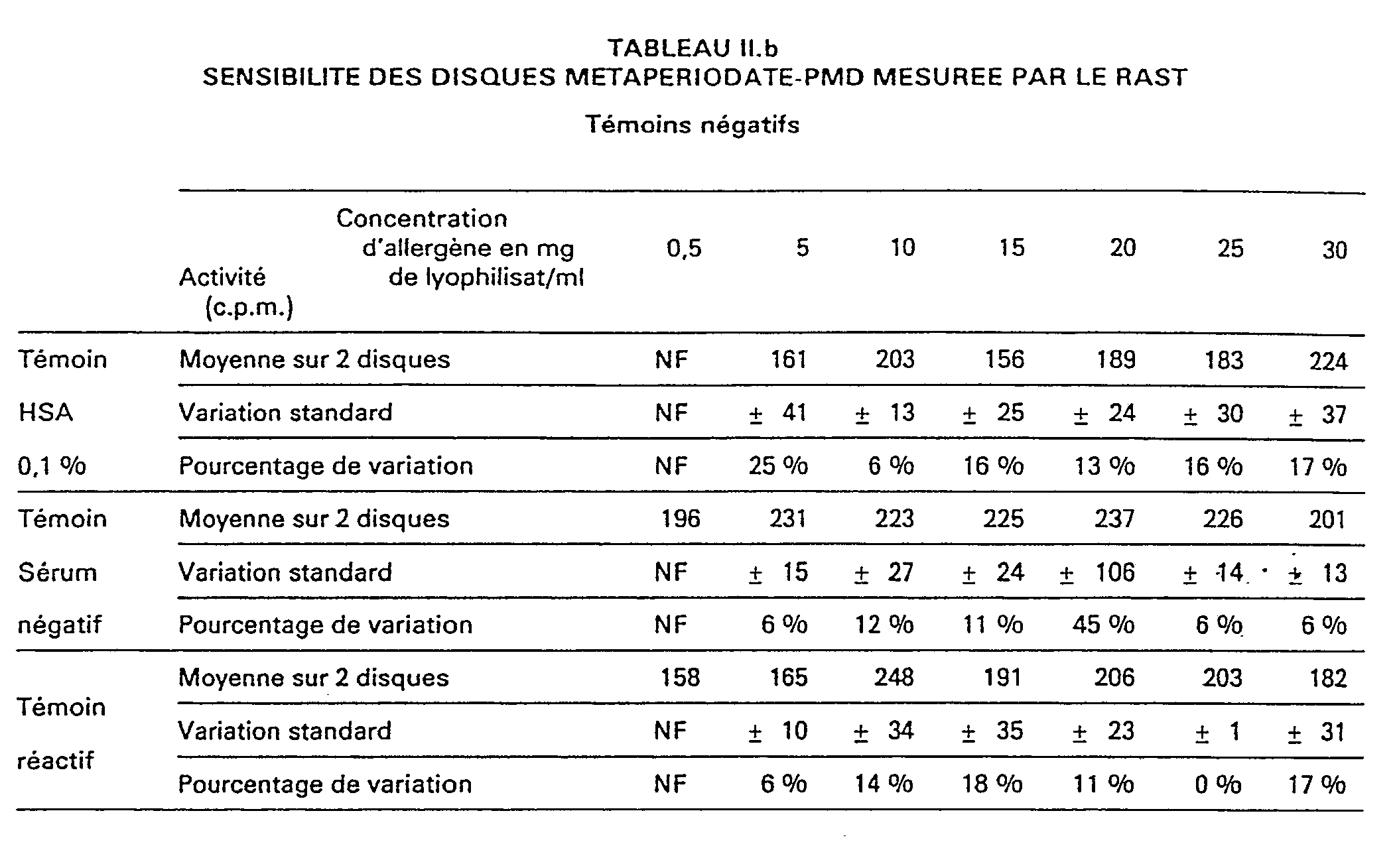
- Le tableau Il ci-après présente les résultats enregistrés sur les disques activés avec le métaperiodate, dans les mêmes conditions.
- la) checked with positive serum;
- Ib) controlled with negative serum or HSA. The reactive control is a "background noise" control.
- Table II below presents the results recorded on the discs activated with metaperiodate, under the same conditions.
Les tableau, III et IV ci-après présentent les résultats obtenus avec l'allergène dactyle:
- III: disques activés au BrCN;
- IV: disques activés au métaperiodate.
- III: discs activated at BrCN;
- IV: discs activated with metaperiodate.
L'examen de ces tableaux montre:
- Pour les disques activés au métaperiodate (tableaux Il et IV) selon l'invention, la sensibilité du dosage croit en fonction de la concentration de l'allergène et se stabilise plus ou moins pour une concentration de 15 mg d'allergène/ml (pour atteindre environ 5500 cpm pour le PMD et 7000 cpm pour le dactyle).
- For discs activated with metaperiodate (Tables II and IV) according to the invention, the sensitivity of the assay increases as a function of the concentration of the allergen and stabilizes more or less for a concentration of 15 mg of allergen / ml (for about 5500 cpm for PMD and 7000 cpm for cocksfoot).
Les témoins réactifs ou négatifs évoluent lentement en fonction de la concentration de l'allergène. Les valeurs du témoin réactif ne dépassent pas celles du témoin négatif et varient entre 270 et 340 cpm.Reactive or negative controls evolve slowly depending on the concentration of the allergen. The values of the reactive control do not exceed those of the negative control and vary between 270 and 340 cpm.
Pour les disques activés au BrCN (tableaux l et lll), la sensibilité du dosage croit en fonction de la concentration d'allergène et atteint un plateau à 10 mg d'allergène/ml. La sensibilité des témoins réactifs est indépendante de la concentration de l'allergène, mais est plus élevée que pour les mêmes témoins avec les disques au métaperiodate.For the discs activated with BrCN (tables l and lll), the sensitivity of the assay increases as a function of the allergen concentration and reaches a plateau at 10 mg of allergen / ml. The sensitivity of the reactive controls is independent of the concentration of the allergen, but is higher than for the same controls with metaperiodate discs.
Vérification de la reproductibilité du couplage de l'allergène sur les disques activés.Verification of the reproducibility of the allergen coupling on the activated discs.
Après avoir déterminé comme indiqué ci-dessus la concentration optimale de l'allergène à coupler sur les disques préalablement activés, on a incubé des disques préalablement activés, avec la même concentration du même allergène; c'est-à-dire:
- 10 disques activés au métaperiodate et couplés avec 10 mg/ml
- 10 disques activés au BrCN de dactyle;
- 10 disques activés au métaperiodate et couplés avec 15 mg/ml
- 10 disques activés au BrCN de PMD
- 10 discs activated with metaperiodate and coupled with 10 mg / ml
- 10 cocks of cocksfoot activated;
- 10 discs activated with metaperiodate and coupled with 15 mg / ml
- 10 discs activated at PMD's BrCN
Les dosages RAST ont été effectués avec les mêmes pools de sérums positifs que ceux utilisés précédemment, et avec 6 essais positifs et 4 négatifs par série, et ont été répétés 4 fois. Les résultats sont consignés dans le tableau V ci-après. Ils montrent que la sensibilité des disques activés au métaperiodate est légèrement supérieure à celle des disques activés au BrCN, mais les variabilités au sein de chaque essai sont identiques pour les deux méthodes de fixation et la reproductibilité est bonne d'un essai à l'autre. Les témoins négatifs et réactifs sont bas et très réguliers et le "bruit de fond" (témoin réactif) est légèrement plus faible pour les disques activés selon l'invention. Vérification de la reproductibilité de l'activation des disques par le métaperiodate. 4 lots de disques ont été activés indépendemment les uns des autres avec le métaperiodate. Les disques activés au BRCN faisaient tous partie du même lot d'activation.The RAST assays were carried out with the same pools of positive sera as those used previously, and with 6 positive and 4 negative tests per series, and were repeated 4 times. The results are reported in Table V below. They show that the sensitivity of discs activated to metaperiodate is slightly higher than that of discs activated to BrCN, but the variability within each test is identical for the two fixing methods and the reproducibility is good from one test to another. . The negative and reactive controls are low and very regular and the "background noise" (reactive control) is slightly lower for the discs activated according to the invention. Verification of the reproducibility of the activation of the disks by the metaperiodate. 4 batches of discs were activated independently of each other with metaperiodate. The discs activated at BRCN were all part of the same activation batch.
Le couplage s'est fait à partir d'une proportion unique d'allergène dactyle (10 mg/ml) et d'allergène PMD (15 mg/ml), répartie sur chaque série de disques.The coupling was made from a unique proportion of dactyl allergen (10 mg / ml) and PMD allergen (15 mg / ml), distributed over each series of discs.
Les résultats sont consignés dans le tableau VI ci-après. Ils montrent que la sensibilité des disques au métaperiodate n'est pas modifiée d'un lot d'activation à l'autre. La variabilité de la sensibilité au sein d'un lot recoupe assez bien celle enregistrée avec les disques activés àu BrCN.The results are reported in Table VI below. They show that the sensitivity of discs to metaperiodate is not changed from one activation batch to another. The variability of the sensitivity within a batch overlaps fairly well that recorded with the discs activated with the BrCN.
Mais pour les disques activés au métaperiodate les témoins negatifs sont bas et peu variables et les témoins réactifs témoignent d'un bruit de fond faible.But for discs activated with metaperiodate the negative controls are low and not very variable and the reactive controls show a low background noise.
En conclusion, la sensibilité des dosages RAST avec lés disques activés au métaperiodate selon l'invention est aussi bonne et même légèrement supérieure à celle des mêmes dosages effectués avec les disques activés au BrCN.In conclusion, the sensitivity of the RAST assays with the activated discs to metaperiodate according to the invention is also good and even slightly higher than that of the same assays carried out with the discs activated with BrCN.
La reproductibilité de l'activation par le métaperiodate et le couplage, selon l'invention, avec les allergènes étudiés est tout à fait satisfaisante.The reproducibility of the activation by metaperiodate and the coupling, according to the invention, with the allergens studied is entirely satisfactory.
Les bruits de fond donnés par le témoin réactif et les témoins négatifs sont plus faibles avec les disques activés selon l'invention qu'avec ceux activés par le BrCN, d'où une sensibilité plus grande pour les sérums faiblement positifs.The background noises given by the reactive control and the negative controls are lower with the discs activated according to the invention than with those activated by BrCN, hence a greater sensitivity for weakly positive sera.
Les expériences précédentes ont montré que les disques activés au métaperiodate conviennent au, dosages RAST pour un certain nombre d'allergènes. D'autres expériences ont permis de comparer les disques activés au métaperiodate et les disques activés au bromure de cyanogène, lorsqu'on fixe sur ces disques des extraits d'allergènes très divers:
- - Poussière de maison, Dermatophagoides pteronyssinus, poil de chat, cinq graminées, bouleau.
- - House dust, Dermatophagoides pteronyssinus, cat hair, five grasses, birch.
Les disques de papier activés au bromure de cyanogène d'une part, et au métaperiodate d'autre part, ont été couplés avec les allergènes ci-dessus (approximativement 1 ml par disque), comme décrit préalablement.The paper discs activated with cyanogen bromide on the one hand, and metaperiodate on the other hand, were coupled with the above allergens (approximately 1 ml per disc), as described previously.
La sensibilité des disques activés au bromure de cyanogène d'une part, et activés au métaperiodate de l'autre, et couplés aux allergènes ci-dessus, a été étudiée directement par la méthode RAST. On incube 50 µl de sérum humain à la dilution 1,5 dans une solution saline tamponnée au phosphate (s.t.p.) avec un disque couplé avec un allergène pendant trois heures à la température ambiante. On lave ensuite le disque soigneusement en utilisant du s.t.p. contenant 1 % de Tween 20, puis on mesure l'IgE combiné aux disques en utilisant de l'anti-lgE marqué par 125 l.The sensitivity of discs activated with cyanogen bromide on the one hand, and activated with metaperiodate on the other, and coupled with the above allergens, has been studied directly by the RAST method. Incubate 50 µl of human serum at dilution 1.5 in phosphate buffered saline (stp) with a coupled disc with an allergen for three hours at room temperature. The disc is then washed carefully using stp containing 1% Tween 20, then the IgE combined with the discs is measured using anti-IgE labeled with 125 l.
La quantité d'lgE combinée aux disques activés au bromure de cyanogène et couplés à l'allergène fut comparée à la quantité d'lgE combinée aux disques activés au métaperiodate et couplés à l'allergène.The amount of IgE combined with disks activated with cyanogen bromide and coupled with the allergen was compared with the amount of IgE combined with disks activated with metaperiodate and coupled with the allergen.
Les résultats sont donnés dans les tableaux Vll à XI ci-après.The results are given in Tables Vll to XI below.
En conclusion, la sensibilité des disques activés au métapcriodate, mesurée en coupspar minute (anti-lgE marqué par 125l correspondant à l'IgE combiné aux disques) s'est révélée au moins équivalente, et dans plusieurs cas, supérieure à celle des disques de papier activés au bromure de cyanogène, quand on les utilise pour un grand nombre d'allergènes.In conclusion, the sensitivity of activated discs to metapcriodate, measured in counts per minute (anti-IgE marked by 125 l corresponding to IgE combined with discs) was found to be at least equivalent, and in several cases, higher than that of discs cyanogen bromide activated paper, when used for a large number of allergens.
D'autre part, une série d'essais ont été faits pour utiliser les disques activés et couplés selon L'invention avec divers allergènes, dans les procédés de dosage enzymo-immunologiques (ELISA) des réagines spécifiques des allergènes: Les disques sur lesquels un allergène a été fixé selon l'invention sont mis en contact avec un pool de sérum contenant les IgE à doser, spécifiques de l'allergène. Ces IgE se combinent sélectivement à un anti-IgE spécifique du fragment Fc de l'allergène, couplé à un enzyme que l'on peut déceler lors de la dégradation de son substrat. Le disque est alors éliminé, et le substrat coloré, en phase liquide, est lu au colorimètre.On the other hand, a series of tests have been made to use the activated and coupled discs according to the invention with various allergens, in the enzymo-immunological assay methods (ELISA) of the specific reagents of allergens: allergen has been fixed according to the invention are contacted with a pool of serum containing the IgE to be assayed, specific for the allergen. These IgEs selectively combine with an anti-IgE specific for the Fc fragment of the allergen, coupled to an enzyme which can be detected during the degradation of its substrate. The disc is then removed, and the colored substrate, in the liquid phase, is read with a colorimeter.
On a ainsi pû observer la même sensibilité et reproductibilité des dosages ELISA réalisés avec les disques selon l'invention, que lors des dosages RAST effectués avec les mêmes disques.It was thus possible to observe the same sensitivity and reproducibility of the ELISA assays performed with the discs according to the invention, as during the RAST assays performed with the same discs.
Les supports cellulosiques activés et couplés selon l'invention avec un allergène peuvent donc être utilisas avec succès aussi bien pour les dosages radio-immunologiques que pour les dosages enzymo-immunologiques des IgE, tout en presentant par rapport aux supports activés par la méthode connue au bromure de cyanogène, l'avantage de n'être pas toxique.




Claims (4)
Priority Applications (1)
| Application Number | Priority Date | Filing Date | Title |
|---|---|---|---|
| AT82400519T ATE20622T1 (en) | 1981-03-24 | 1982-03-23 | REAGENTS FOR RADIO OR ENZYME IMMUNOLOGICAL DETERMINATION OF IGE. |
Applications Claiming Priority (2)
| Application Number | Priority Date | Filing Date | Title |
|---|---|---|---|
| FR8105877A FR2502786B1 (en) | 1981-03-24 | 1981-03-24 | METHOD FOR FIXING ANTIGENS AND ANTIBODIES TO POLYSACCHARIDE SUPPORT, AND USE OF THE PRODUCT OBTAINED THEREFOR FOR IMMUNOASSAYS |
| FR8105877 | 1981-03-24 |
Publications (2)
| Publication Number | Publication Date |
|---|---|
| EP0063064A1 EP0063064A1 (en) | 1982-10-20 |
| EP0063064B1 true EP0063064B1 (en) | 1986-07-02 |
Family
ID=9256583
Family Applications (1)
| Application Number | Title | Priority Date | Filing Date |
|---|---|---|---|
| EP82400519A Expired EP0063064B1 (en) | 1981-03-24 | 1982-03-23 | Reagent for the radio-or enzymo-immunological determination of ige |
Country Status (5)
| Country | Link |
|---|---|
| EP (1) | EP0063064B1 (en) |
| JP (1) | JPS58756A (en) |
| AT (1) | ATE20622T1 (en) |
| DE (1) | DE3271868D1 (en) |
| FR (1) | FR2502786B1 (en) |
Families Citing this family (10)
| Publication number | Priority date | Publication date | Assignee | Title |
|---|---|---|---|---|
| US4806490A (en) * | 1983-12-06 | 1989-02-21 | Werner & Mertz Gmbh | Procedure for the detection of allergen-containing house dust |
| DE3404821A1 (en) * | 1984-02-10 | 1985-08-14 | Werner & Mertz Gmbh, 6500 Mainz | METHOD FOR DETECTING ALLERGEN DUST |
| DE3430896A1 (en) * | 1984-08-22 | 1986-03-06 | Werner & Mertz Gmbh, 6500 Mainz | METHOD FOR DETECTING ALLERGEN DUST |
| GB2181840B (en) * | 1985-10-16 | 1989-11-29 | Farmos Group Ltd | Method for the immunoassay of a macromolecular analyte |
| EP0243471A4 (en) * | 1985-10-22 | 1989-07-11 | Cooper Lipotech Inc | Solid-phase liposome immunoassay system. |
| FR2590674B1 (en) * | 1985-11-25 | 1989-03-03 | Inst Nat Sante Rech Med | NEW DIAGNOSTIC REAGENTS |
| DE3543749A1 (en) * | 1985-12-11 | 1987-06-19 | Boehringer Mannheim Gmbh | METHOD FOR PRODUCING A REAGENT PAPER FOR IMMUNOLOGICAL ANALYSIS |
| DE3841566A1 (en) * | 1988-12-09 | 1990-06-13 | Boehringer Mannheim Gmbh | METHOD FOR PRODUCING A SOLID-PHASE MATRIX TO WHICH HAPTENE IS COVALENT |
| CA2104413C (en) * | 1992-09-04 | 1996-05-21 | Dean William Schroer | Intrinsic factor - horse radish peroxidase conjugates |
| RU2152034C1 (en) * | 1999-08-27 | 2000-06-27 | Пермский научно-исследовательский клинический институт детской экопатологии | Method of quantitative determination of allergen-specific immunoglobulins e in serum (plasma) blood |
Family Cites Families (9)
| Publication number | Priority date | Publication date | Assignee | Title |
|---|---|---|---|---|
| SE341239B (en) * | 1967-09-06 | 1971-12-20 | Pharmacia Ab | |
| FR2331567A1 (en) * | 1975-11-13 | 1977-06-10 | Inst Nat Sante Rech Med | Fixation of organic cpds. contg. sugar residues - by oxidn. and coupling to a support contg. amino gps. |
| US4140679A (en) * | 1976-10-12 | 1979-02-20 | Research Corporation | Antigen-protein complex for blocking allergic reactions |
| GB1595101A (en) * | 1977-03-15 | 1981-08-05 | Hoffmann La Roche | Enzyme modifier immunoassay |
| EP0001223A3 (en) * | 1977-09-19 | 1979-12-12 | F.Hoffmann-La Roche & Co. Aktiengesellschaft | Latex coated with a polyhydroxy compound, process for the preparation of this latex, immunological reagent containing this latex, process for the preparation of this reagent, application of this reagent, testing procedure utilising this reagent and reagent kit containing this reagent |
| FR2403098A1 (en) * | 1977-09-19 | 1979-04-13 | Merieux Inst | NEW MATERIAL CAPABLE OF REVERSIBLE BINDING OF BIOLOGICAL MACROMOLECULES, ITS PREPARATION AND APPLICATION |
| US4211762A (en) * | 1978-01-26 | 1980-07-08 | Huggins Keith G | Specific binding assay techniques |
| FR2440555A1 (en) * | 1978-10-31 | 1980-05-30 | Maes Roland | IMPROVEMENTS IN METHODS OF DETERMINING SUBSTANCES SHOWING SPECIFIC BINDING AFFINITIES BETWEEN THEM, BY TESTS INVOLVING A SOLID PHASE |
| US4256833A (en) * | 1979-01-08 | 1981-03-17 | Majid Ali | Enzyme immunoassay for allergic disorders |
-
1981
- 1981-03-24 FR FR8105877A patent/FR2502786B1/en not_active Expired
-
1982
- 1982-03-23 EP EP82400519A patent/EP0063064B1/en not_active Expired
- 1982-03-23 AT AT82400519T patent/ATE20622T1/en not_active IP Right Cessation
- 1982-03-23 DE DE8282400519T patent/DE3271868D1/en not_active Expired
- 1982-03-24 JP JP57045729A patent/JPS58756A/en active Pending
Non-Patent Citations (1)
| Title |
|---|
| C.J. SANDERSON et al., Immunology, 1971, 20, 1061-1065 * |
Also Published As
| Publication number | Publication date |
|---|---|
| FR2502786B1 (en) | 1985-06-21 |
| EP0063064A1 (en) | 1982-10-20 |
| FR2502786A1 (en) | 1982-10-01 |
| DE3271868D1 (en) | 1986-08-07 |
| ATE20622T1 (en) | 1986-07-15 |
| JPS58756A (en) | 1983-01-05 |
Similar Documents
| Publication | Publication Date | Title |
|---|---|---|
| EP0041426B1 (en) | Coupled product between a lectin and a specific ligand, obtention and use in the biological field | |
| CA1083508A (en) | Supports having lateral chains, process for obtaining such supports, process for the fixation of organic compounds comprising a glucidic residue on said supports, products and reactives from said chimical fixation | |
| US4399217A (en) | Process and a device for the determination of serum lipoproteins | |
| EP0230166A1 (en) | Diagnostic reagents | |
| EP0063064B1 (en) | Reagent for the radio-or enzymo-immunological determination of ige | |
| EP0189389B1 (en) | Immunoassay method for antibodies of different classes in a liquid sample | |
| EP0311492B1 (en) | Kit and immunoassay method applicable to whole cells | |
| JPH0322946B2 (en) | ||
| EP0804736B1 (en) | Ultrasensitive process for assaying cardiac troponine i | |
| EP0055751A1 (en) | Method for detecting and determining a biological substance by erythroadsorption. | |
| BE1000850A3 (en) | METHOD FOR DETERMINATION OF ANTIBODY antisporozoite FALCIPARUM IN THE HUMAN BLOOD. | |
| US4433060A (en) | Chemiluminescent immunoassays with triphenylmethane dyes activated by H.sub. O2 and a chloramine | |
| EP1051623A1 (en) | Troponin assay free heparin-mediated interference | |
| CA2148268A1 (en) | Method for specific immunoassay of human plasmatic glutathione peroxidase | |
| Turk et al. | Products of advanced glycation in patients with type 2 diabetes and vascular disease | |
| FR2549230A1 (en) | METHOD FOR DETECTING AN OLIGOMER IN A LIQUID MEDIUM CONTAINING CORRESPONDING MONOMERS, DEVICE FOR CARRYING OUT SAID METHOD, AND APPLICATION IN PARTICULAR TO THE SEARCH FOR ALLERGENS | |
| JPS61241665A (en) | Stabilized sold phase reagent | |
| JPS58149700A (en) | Composite containing peroxidase, its preparation and reagent | |
| FR2496692A1 (en) | PROCESS FOR DETERMINING PEROXIDE DISMUTASE | |
| EP0187076A1 (en) | Fluorescent compounds, (amino-4) naphthalimide derivatives, their use in immunological determinations of fluorescence polarization | |
| JPH0373857A (en) | Drug for diagnosing rheumatism | |
| JP4288750B2 (en) | Immunological measurement method | |
| JPS6232363A (en) | Method and device for detecting antinuclear antibody | |
| BE901567A (en) | Assaying IgM antibodies in presence of IgG - by reaction with anti-IgG antibodies, then with particle supported and free antigen | |
| JPH07122622B2 (en) | Immunosensor |
Legal Events
| Date | Code | Title | Description |
|---|---|---|---|
| PUAI | Public reference made under article 153(3) epc to a published international application that has entered the european phase |
Free format text: ORIGINAL CODE: 0009012 |
|
| AK | Designated contracting states |
Designated state(s): AT BE CH DE GB IT LU NL SE |
|
| 17P | Request for examination filed |
Effective date: 19821111 |
|
| GRAA | (expected) grant |
Free format text: ORIGINAL CODE: 0009210 |
|
| AK | Designated contracting states |
Kind code of ref document: B1 Designated state(s): AT BE CH DE GB IT LI LU NL SE |
|
| PG25 | Lapsed in a contracting state [announced via postgrant information from national office to epo] |
Ref country code: NL Effective date: 19860702 Ref country code: IT Free format text: LAPSE BECAUSE OF FAILURE TO SUBMIT A TRANSLATION OF THE DESCRIPTION OR TO PAY THE FEE WITHIN THE PRESCRIBED TIME-LIMIT;WARNING: LAPSES OF ITALIAN PATENTS WITH EFFECTIVE DATE BEFORE 2007 MAY HAVE OCCURRED AT ANY TIME BEFORE 2007. THE CORRECT EFFECTIVE DATE MAY BE DIFFERENT FROM THE ONE RECORDED. Effective date: 19860702 Ref country code: AT Effective date: 19860702 |
|
| REF | Corresponds to: |
Ref document number: 20622 Country of ref document: AT Date of ref document: 19860715 Kind code of ref document: T |
|
| PG25 | Lapsed in a contracting state [announced via postgrant information from national office to epo] |
Ref country code: SE Effective date: 19860731 |
|
| REF | Corresponds to: |
Ref document number: 3271868 Country of ref document: DE Date of ref document: 19860807 |
|
| NLV1 | Nl: lapsed or annulled due to failure to fulfill the requirements of art. 29p and 29m of the patents act | ||
| PG25 | Lapsed in a contracting state [announced via postgrant information from national office to epo] |
Ref country code: LU Free format text: LAPSE BECAUSE OF NON-PAYMENT OF DUE FEES Effective date: 19870331 |
|
| PLBE | No opposition filed within time limit |
Free format text: ORIGINAL CODE: 0009261 |
|
| STAA | Information on the status of an ep patent application or granted ep patent |
Free format text: STATUS: NO OPPOSITION FILED WITHIN TIME LIMIT |
|
| 26N | No opposition filed | ||
| PG25 | Lapsed in a contracting state [announced via postgrant information from national office to epo] |
Ref country code: GB Effective date: 19890323 |
|
| PG25 | Lapsed in a contracting state [announced via postgrant information from national office to epo] |
Ref country code: LI Effective date: 19890331 Ref country code: CH Effective date: 19890331 Ref country code: BE Effective date: 19890331 |
|
| BERE | Be: lapsed |
Owner name: LABORATOIRE DES STALLERGENES Effective date: 19890331 |
|
| GBPC | Gb: european patent ceased through non-payment of renewal fee | ||
| REG | Reference to a national code |
Ref country code: CH Ref legal event code: PL |
|
| PG25 | Lapsed in a contracting state [announced via postgrant information from national office to epo] |
Ref country code: DE Effective date: 19891201 |