EP0070155A1 - Process of preparing a ketazine from a ketone - Google Patents
Process of preparing a ketazine from a ketone Download PDFInfo
- Publication number
- EP0070155A1 EP0070155A1 EP82303590A EP82303590A EP0070155A1 EP 0070155 A1 EP0070155 A1 EP 0070155A1 EP 82303590 A EP82303590 A EP 82303590A EP 82303590 A EP82303590 A EP 82303590A EP 0070155 A1 EP0070155 A1 EP 0070155A1
- Authority
- EP
- European Patent Office
- Prior art keywords
- carbon atoms
- acid
- process according
- ketone
- reaction
- Prior art date
- Legal status (The legal status is an assumption and is not a legal conclusion. Google has not performed a legal analysis and makes no representation as to the accuracy of the status listed.)
- Granted
Links
- PFLUPZGCTVGDLV-UHFFFAOYSA-N acetone azine Chemical compound CC(C)=NN=C(C)C PFLUPZGCTVGDLV-UHFFFAOYSA-N 0.000 title claims abstract description 19
- 150000002576 ketones Chemical class 0.000 title claims abstract description 15
- 238000000034 method Methods 0.000 title claims description 35
- MHAJPDPJQMAIIY-UHFFFAOYSA-N Hydrogen peroxide Chemical compound OO MHAJPDPJQMAIIY-UHFFFAOYSA-N 0.000 claims abstract description 54
- 238000006243 chemical reaction Methods 0.000 claims abstract description 50
- QGZKDVFQNNGYKY-UHFFFAOYSA-N Ammonia Chemical compound N QGZKDVFQNNGYKY-UHFFFAOYSA-N 0.000 claims abstract description 42
- 239000003054 catalyst Substances 0.000 claims abstract description 18
- 229910021529 ammonia Inorganic materials 0.000 claims abstract description 15
- 150000001875 compounds Chemical class 0.000 claims abstract description 14
- 125000003118 aryl group Chemical group 0.000 claims abstract description 10
- 125000000217 alkyl group Chemical group 0.000 claims abstract description 9
- 150000001495 arsenic compounds Chemical class 0.000 claims abstract description 8
- 125000003710 aryl alkyl group Chemical group 0.000 claims abstract description 8
- 150000002009 diols Chemical class 0.000 claims abstract description 6
- DNIAPMSPPWPWGF-GSVOUGTGSA-N (R)-(-)-Propylene glycol Chemical compound C[C@@H](O)CO DNIAPMSPPWPWGF-GSVOUGTGSA-N 0.000 claims abstract 2
- 125000004432 carbon atom Chemical group C* 0.000 claims description 34
- 239000000203 mixture Substances 0.000 claims description 14
- 239000002904 solvent Substances 0.000 claims description 11
- LVKZSFMYNWRPJX-UHFFFAOYSA-N phenylarsonic acid Chemical compound O[As](O)(=O)C1=CC=CC=C1 LVKZSFMYNWRPJX-UHFFFAOYSA-N 0.000 claims description 10
- OGGXGZAMXPVRFZ-UHFFFAOYSA-N dimethylarsinic acid Chemical compound C[As](C)(O)=O OGGXGZAMXPVRFZ-UHFFFAOYSA-N 0.000 claims description 8
- 229950004243 cacodylic acid Drugs 0.000 claims description 4
- 239000007795 chemical reaction product Substances 0.000 claims description 4
- QYPPRTNMGCREIM-UHFFFAOYSA-N methylarsonic acid Chemical compound C[As](O)(O)=O QYPPRTNMGCREIM-UHFFFAOYSA-N 0.000 claims description 4
- 150000001298 alcohols Chemical class 0.000 claims description 3
- 125000003545 alkoxy group Chemical group 0.000 claims description 3
- 150000002148 esters Chemical class 0.000 claims description 3
- 125000005843 halogen group Chemical group 0.000 claims description 3
- 125000002887 hydroxy group Chemical group [H]O* 0.000 claims description 3
- FUUFQLXAIUOWML-UHFFFAOYSA-N nitarsone Chemical compound O[As](O)(=O)C1=CC=C([N+]([O-])=O)C=C1 FUUFQLXAIUOWML-UHFFFAOYSA-N 0.000 claims description 3
- GODGOGGXLHQPBK-UHFFFAOYSA-N (4-methylphenyl)arsonic acid Chemical compound CC1=CC=C([As](O)(O)=O)C=C1 GODGOGGXLHQPBK-UHFFFAOYSA-N 0.000 claims description 2
- XAPDHTDYLUWMOD-UHFFFAOYSA-N diethoxyarsinic acid Chemical compound CCO[As](O)(=O)OCC XAPDHTDYLUWMOD-UHFFFAOYSA-N 0.000 claims description 2
- QJASAJZQTBJCMI-UHFFFAOYSA-N diphenoxyarsinic acid Chemical compound C=1C=CC=CC=1O[As](=O)(O)OC1=CC=CC=C1 QJASAJZQTBJCMI-UHFFFAOYSA-N 0.000 claims description 2
- 150000002170 ethers Chemical class 0.000 claims description 2
- YHAUELCERLPWSP-UHFFFAOYSA-N ethylarsonic acid Chemical compound CC[As](O)(O)=O YHAUELCERLPWSP-UHFFFAOYSA-N 0.000 claims description 2
- 150000008282 halocarbons Chemical class 0.000 claims description 2
- 229930195733 hydrocarbon Natural products 0.000 claims description 2
- 150000002430 hydrocarbons Chemical class 0.000 claims description 2
- 150000003457 sulfones Chemical class 0.000 claims description 2
- LFQSCWFLJHTTHZ-UHFFFAOYSA-N Ethanol Chemical compound CCO LFQSCWFLJHTTHZ-UHFFFAOYSA-N 0.000 claims 2
- MDFUVLDZVFTYSX-UHFFFAOYSA-N (3-nitrophenyl)arsonic acid Chemical compound O[As](O)(=O)C1=CC=CC([N+]([O-])=O)=C1 MDFUVLDZVFTYSX-UHFFFAOYSA-N 0.000 claims 1
- 125000003158 alcohol group Chemical group 0.000 claims 1
- ZWEHNKRNPOVVGH-UHFFFAOYSA-N 2-Butanone Chemical compound CCC(C)=O ZWEHNKRNPOVVGH-UHFFFAOYSA-N 0.000 abstract description 24
- CSCPPACGZOOCGX-UHFFFAOYSA-N Acetone Chemical compound CC(C)=O CSCPPACGZOOCGX-UHFFFAOYSA-N 0.000 abstract description 7
- OAKJQQAXSVQMHS-UHFFFAOYSA-N Hydrazine Chemical compound NN OAKJQQAXSVQMHS-UHFFFAOYSA-N 0.000 abstract description 6
- 239000003960 organic solvent Substances 0.000 abstract description 3
- 125000000753 cycloalkyl group Chemical group 0.000 abstract description 2
- 150000003839 salts Chemical class 0.000 abstract description 2
- 125000004642 (C1-C12) alkoxy group Chemical group 0.000 abstract 1
- 125000004400 (C1-C12) alkyl group Chemical group 0.000 abstract 1
- 150000004820 halides Chemical class 0.000 abstract 1
- 150000003568 thioethers Chemical class 0.000 abstract 1
- DKGAVHZHDRPRBM-UHFFFAOYSA-N Tert-Butanol Chemical compound CC(C)(C)O DKGAVHZHDRPRBM-UHFFFAOYSA-N 0.000 description 10
- DNIAPMSPPWPWGF-UHFFFAOYSA-N Propylene glycol Chemical compound CC(O)CO DNIAPMSPPWPWGF-UHFFFAOYSA-N 0.000 description 9
- -1 ketone compound Chemical class 0.000 description 9
- 239000000376 reactant Substances 0.000 description 9
- XLYOFNOQVPJJNP-UHFFFAOYSA-N water Substances O XLYOFNOQVPJJNP-UHFFFAOYSA-N 0.000 description 9
- 229910052785 arsenic Inorganic materials 0.000 description 8
- LYCAIKOWRPUZTN-UHFFFAOYSA-N Ethylene glycol Chemical compound OCCO LYCAIKOWRPUZTN-UHFFFAOYSA-N 0.000 description 6
- 150000001408 amides Chemical class 0.000 description 6
- 239000011541 reaction mixture Substances 0.000 description 6
- RQNWIZPPADIBDY-UHFFFAOYSA-N arsenic atom Chemical compound [As] RQNWIZPPADIBDY-UHFFFAOYSA-N 0.000 description 5
- PUPZLCDOIYMWBV-UHFFFAOYSA-N (+/-)-1,3-Butanediol Chemical compound CC(O)CCO PUPZLCDOIYMWBV-UHFFFAOYSA-N 0.000 description 4
- LAWAERKRWYQEEN-FKJILZIQSA-N (e)-n-[(z)-butan-2-ylideneamino]butan-2-imine Chemical compound CC\C(C)=N/N=C(\C)CC LAWAERKRWYQEEN-FKJILZIQSA-N 0.000 description 4
- 150000002825 nitriles Chemical class 0.000 description 4
- 238000003756 stirring Methods 0.000 description 4
- 239000002253 acid Substances 0.000 description 3
- 150000007513 acids Chemical class 0.000 description 3
- 239000007864 aqueous solution Substances 0.000 description 3
- 238000004817 gas chromatography Methods 0.000 description 3
- 238000004519 manufacturing process Methods 0.000 description 3
- 239000000047 product Substances 0.000 description 3
- 238000010992 reflux Methods 0.000 description 3
- 239000007858 starting material Substances 0.000 description 3
- 238000010792 warming Methods 0.000 description 3
- RNMCCPMYXUKHAZ-UHFFFAOYSA-N 2-[3,3-diamino-1,2,2-tris(carboxymethyl)cyclohexyl]acetic acid Chemical compound NC1(N)CCCC(CC(O)=O)(CC(O)=O)C1(CC(O)=O)CC(O)=O RNMCCPMYXUKHAZ-UHFFFAOYSA-N 0.000 description 2
- UIHCLUNTQKBZGK-UHFFFAOYSA-N 3-methyl-2-pentanone Chemical compound CCC(C)C(C)=O UIHCLUNTQKBZGK-UHFFFAOYSA-N 0.000 description 2
- USFZMSVCRYTOJT-UHFFFAOYSA-N Ammonium acetate Chemical compound N.CC(O)=O USFZMSVCRYTOJT-UHFFFAOYSA-N 0.000 description 2
- 239000005695 Ammonium acetate Substances 0.000 description 2
- SXVPOSFURRDKBO-UHFFFAOYSA-N Cyclododecanone Chemical compound O=C1CCCCCCCCCCC1 SXVPOSFURRDKBO-UHFFFAOYSA-N 0.000 description 2
- KDLHZDBZIXYQEI-UHFFFAOYSA-N Palladium Chemical compound [Pd] KDLHZDBZIXYQEI-UHFFFAOYSA-N 0.000 description 2
- 125000001931 aliphatic group Chemical group 0.000 description 2
- 229940043376 ammonium acetate Drugs 0.000 description 2
- 235000019257 ammonium acetate Nutrition 0.000 description 2
- 150000003863 ammonium salts Chemical class 0.000 description 2
- 150000008365 aromatic ketones Chemical class 0.000 description 2
- 229910000413 arsenic oxide Inorganic materials 0.000 description 2
- 238000007664 blowing Methods 0.000 description 2
- WERYXYBDKMZEQL-UHFFFAOYSA-N butane-1,4-diol Chemical compound OCCCCO WERYXYBDKMZEQL-UHFFFAOYSA-N 0.000 description 2
- JHIVVAPYMSGYDF-UHFFFAOYSA-N cyclohexanone Chemical compound O=C1CCCCC1 JHIVVAPYMSGYDF-UHFFFAOYSA-N 0.000 description 2
- BGTOWKSIORTVQH-UHFFFAOYSA-N cyclopentanone Chemical compound O=C1CCCC1 BGTOWKSIORTVQH-UHFFFAOYSA-N 0.000 description 2
- RXKJFZQQPQGTFL-UHFFFAOYSA-N dihydroxyacetone Chemical compound OCC(=O)CO RXKJFZQQPQGTFL-UHFFFAOYSA-N 0.000 description 2
- XNLICIUVMPYHGG-UHFFFAOYSA-N pentan-2-one Chemical compound CCCC(C)=O XNLICIUVMPYHGG-UHFFFAOYSA-N 0.000 description 2
- 238000011084 recovery Methods 0.000 description 2
- 238000000926 separation method Methods 0.000 description 2
- 239000000243 solution Substances 0.000 description 2
- 239000003381 stabilizer Substances 0.000 description 2
- DNIAPMSPPWPWGF-VKHMYHEASA-N (+)-propylene glycol Chemical compound C[C@H](O)CO DNIAPMSPPWPWGF-VKHMYHEASA-N 0.000 description 1
- OAKWMQGNBGGJGT-UHFFFAOYSA-N (4-chlorophenyl)arsonic acid Chemical class O[As](O)(=O)C1=CC=C(Cl)C=C1 OAKWMQGNBGGJGT-UHFFFAOYSA-N 0.000 description 1
- JNDUBNWTNMWLAR-UHFFFAOYSA-N (4-methoxyphenyl)arsonic acid Chemical class COC1=CC=C([As](O)(O)=O)C=C1 JNDUBNWTNMWLAR-UHFFFAOYSA-N 0.000 description 1
- YPFDHNVEDLHUCE-UHFFFAOYSA-N 1,3-propanediol Substances OCCCO YPFDHNVEDLHUCE-UHFFFAOYSA-N 0.000 description 1
- RIFKADJTWUGDOV-UHFFFAOYSA-N 1-cyclohexylethanone Chemical compound CC(=O)C1CCCCC1 RIFKADJTWUGDOV-UHFFFAOYSA-N 0.000 description 1
- SYBYTAAJFKOIEJ-UHFFFAOYSA-N 3-Methylbutan-2-one Chemical compound CC(C)C(C)=O SYBYTAAJFKOIEJ-UHFFFAOYSA-N 0.000 description 1
- ZYNMYJFCAHXBDB-UHFFFAOYSA-N 4-arsonobenzoic acid Chemical compound OC(=O)C1=CC=C([As](O)(O)=O)C=C1 ZYNMYJFCAHXBDB-UHFFFAOYSA-N 0.000 description 1
- VHUUQVKOLVNVRT-UHFFFAOYSA-N Ammonium hydroxide Chemical compound [NH4+].[OH-] VHUUQVKOLVNVRT-UHFFFAOYSA-N 0.000 description 1
- KCXVZYZYPLLWCC-UHFFFAOYSA-N EDTA Chemical compound OC(=O)CN(CC(O)=O)CCN(CC(O)=O)CC(O)=O KCXVZYZYPLLWCC-UHFFFAOYSA-N 0.000 description 1
- 229940120146 EDTMP Drugs 0.000 description 1
- DBVJJBKOTRCVKF-UHFFFAOYSA-N Etidronic acid Chemical compound OP(=O)(O)C(O)(C)P(O)(O)=O DBVJJBKOTRCVKF-UHFFFAOYSA-N 0.000 description 1
- QPCDCPDFJACHGM-UHFFFAOYSA-N N,N-bis{2-[bis(carboxymethyl)amino]ethyl}glycine Chemical compound OC(=O)CN(CC(O)=O)CCN(CC(=O)O)CCN(CC(O)=O)CC(O)=O QPCDCPDFJACHGM-UHFFFAOYSA-N 0.000 description 1
- ALQSHHUCVQOPAS-UHFFFAOYSA-N Pentane-1,5-diol Chemical compound OCCCCCO ALQSHHUCVQOPAS-UHFFFAOYSA-N 0.000 description 1
- OAICVXFJPJFONN-UHFFFAOYSA-N Phosphorus Chemical compound [P] OAICVXFJPJFONN-UHFFFAOYSA-N 0.000 description 1
- BUGBHKTXTAQXES-UHFFFAOYSA-N Selenium Chemical compound [Se] BUGBHKTXTAQXES-UHFFFAOYSA-N 0.000 description 1
- VYPSYNLAJGMNEJ-UHFFFAOYSA-N Silicium dioxide Chemical compound O=[Si]=O VYPSYNLAJGMNEJ-UHFFFAOYSA-N 0.000 description 1
- XUIMIQQOPSSXEZ-UHFFFAOYSA-N Silicon Chemical compound [Si] XUIMIQQOPSSXEZ-UHFFFAOYSA-N 0.000 description 1
- NINIDFKCEFEMDL-UHFFFAOYSA-N Sulfur Chemical compound [S] NINIDFKCEFEMDL-UHFFFAOYSA-N 0.000 description 1
- YDONNITUKPKTIG-UHFFFAOYSA-N [Nitrilotris(methylene)]trisphosphonic acid Chemical compound OP(O)(=O)CN(CP(O)(O)=O)CP(O)(O)=O YDONNITUKPKTIG-UHFFFAOYSA-N 0.000 description 1
- 125000004423 acyloxy group Chemical group 0.000 description 1
- 230000002411 adverse Effects 0.000 description 1
- VZTDIZULWFCMLS-UHFFFAOYSA-N ammonium formate Chemical compound [NH4+].[O-]C=O VZTDIZULWFCMLS-UHFFFAOYSA-N 0.000 description 1
- FFBCLZHRHDRKFK-UHFFFAOYSA-N arsorane Chemical compound [AsH5] FFBCLZHRHDRKFK-UHFFFAOYSA-N 0.000 description 1
- XJMWHXZUIGHOBA-UHFFFAOYSA-N azane;propanoic acid Chemical compound N.CCC(O)=O XJMWHXZUIGHOBA-UHFFFAOYSA-N 0.000 description 1
- 238000010533 azeotropic distillation Methods 0.000 description 1
- RWCCWEUUXYIKHB-UHFFFAOYSA-N benzophenone Chemical compound C=1C=CC=CC=1C(=O)C1=CC=CC=C1 RWCCWEUUXYIKHB-UHFFFAOYSA-N 0.000 description 1
- 239000012965 benzophenone Substances 0.000 description 1
- 230000015572 biosynthetic process Effects 0.000 description 1
- 239000006227 byproduct Substances 0.000 description 1
- 229910052799 carbon Inorganic materials 0.000 description 1
- 125000002915 carbonyl group Chemical group [*:2]C([*:1])=O 0.000 description 1
- 150000001732 carboxylic acid derivatives Chemical class 0.000 description 1
- 239000002738 chelating agent Substances 0.000 description 1
- 150000001868 cobalt Chemical class 0.000 description 1
- 238000011109 contamination Methods 0.000 description 1
- SXOZDDAFVJANJP-UHFFFAOYSA-N cyclodecanone Chemical compound O=C1CCCCCCCCC1 SXOZDDAFVJANJP-UHFFFAOYSA-N 0.000 description 1
- CGZZMOTZOONQIA-UHFFFAOYSA-N cycloheptanone Chemical compound O=C1CCCCCC1 CGZZMOTZOONQIA-UHFFFAOYSA-N 0.000 description 1
- IIRFCWANHMSDCG-UHFFFAOYSA-N cyclooctanone Chemical compound O=C1CCCCCCC1 IIRFCWANHMSDCG-UHFFFAOYSA-N 0.000 description 1
- 230000007423 decrease Effects 0.000 description 1
- 230000003247 decreasing effect Effects 0.000 description 1
- 239000012024 dehydrating agents Substances 0.000 description 1
- COLINYSWCPQTDQ-UHFFFAOYSA-N dimethoxyarsinic acid;dimethylarsinic acid Chemical compound C[As](C)(O)=O.CO[As](O)(=O)OC COLINYSWCPQTDQ-UHFFFAOYSA-N 0.000 description 1
- NFDRPXJGHKJRLJ-UHFFFAOYSA-N edtmp Chemical compound OP(O)(=O)CN(CP(O)(O)=O)CCN(CP(O)(O)=O)CP(O)(O)=O NFDRPXJGHKJRLJ-UHFFFAOYSA-N 0.000 description 1
- 239000007789 gas Substances 0.000 description 1
- 229940093920 gynecological arsenic compound Drugs 0.000 description 1
- 229910001385 heavy metal Inorganic materials 0.000 description 1
- 125000000623 heterocyclic group Chemical group 0.000 description 1
- 230000003301 hydrolyzing effect Effects 0.000 description 1
- 239000000543 intermediate Substances 0.000 description 1
- 239000007791 liquid phase Substances 0.000 description 1
- 239000000463 material Substances 0.000 description 1
- QJGQUHMNIGDVPM-UHFFFAOYSA-N nitrogen group Chemical group [N] QJGQUHMNIGDVPM-UHFFFAOYSA-N 0.000 description 1
- 229910052763 palladium Inorganic materials 0.000 description 1
- 229960003330 pentetic acid Drugs 0.000 description 1
- 150000002978 peroxides Chemical class 0.000 description 1
- 229910052698 phosphorus Inorganic materials 0.000 description 1
- 239000011574 phosphorus Substances 0.000 description 1
- 229920000166 polytrimethylene carbonate Polymers 0.000 description 1
- 229910052711 selenium Inorganic materials 0.000 description 1
- 239000011669 selenium Substances 0.000 description 1
- 239000000741 silica gel Substances 0.000 description 1
- 229910002027 silica gel Inorganic materials 0.000 description 1
- 229910052710 silicon Inorganic materials 0.000 description 1
- 239000010703 silicon Substances 0.000 description 1
- 229910052717 sulfur Inorganic materials 0.000 description 1
- 239000011593 sulfur Substances 0.000 description 1
- 238000003786 synthesis reaction Methods 0.000 description 1
Classifications
-
- C—CHEMISTRY; METALLURGY
- C07—ORGANIC CHEMISTRY
- C07C—ACYCLIC OR CARBOCYCLIC COMPOUNDS
- C07C251/00—Compounds containing nitrogen atoms doubly-bound to a carbon skeleton
- C07C251/72—Hydrazones
- C07C251/88—Hydrazones having also the other nitrogen atom doubly-bound to a carbon atom, e.g. azines
Definitions
- This invention relates to a process of preparing a ketazine and, more particularly, to a process for preparing a ketazine by reacting an aliphatic or aromatic ketone with ammonia and hydrogen peroxide in the presence of a catalyst compound.
- Ketazines are useful as intermediates for the synthesis of hydrazine, and various methods are known for preparing ketazines. Recently, extensive studies have been made of the process for preparing ketazines using a ketone, ammonia and hydrogen peroxide as starting materials, and such processes are disclosed, for example, in West German OLS Nos. 2127229, 2314038, 2143516, 2504924 and 2639009.
- the process of the present invention for preparing a ketazine comprises reacting an aliphatic or aromatic ketone with ammonia and hydrogen peroxide in the presence of an arsenic compound catalyst, to provide a corresponding ketazine.
- the ketone used in the process of this invention can be any ketone compound which is known to form a corresponding ketazine.
- Examples of ketone compounds are represented by the general formula wherein R 1 and R 2 , which may be the same or different, each represents a straight or branched chain alkyl group having not more than 12 carbon atoms, a cycloalkyl group having 3 to 12 carbon atoms or an aryl group having 6 to 12 carbon atoms, or R 1 and R 2 may, together with the carbon atom of the carbonyl group to which they are attached, complete a ring having 4 to 11 carbon atoms.
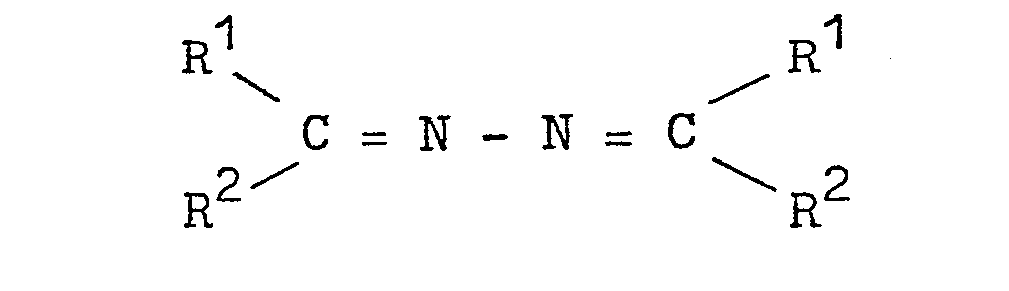
- Such ketone compound can form, upon reaction, a ketazine represented by the general formula wherein R 1 and R 2 are as defined above.
- ketones which can be used include acetone, methyl ethyl ketone, 2-pentanone, 3-methyl-2-butanone, 3-methyl-2-pentanone, methyl cyclohexyl ketone, benzophenone, cyclopentanone, cyclohexanone, cycloheptanone, cyclooctanone, cyclodecanone and cyclododecanone.
- ketazine When the ketazine is prepared for the purpose of producing hydrazine by hydrolyzing the resulting ketazine with water, an alkyl ketone, particularly acetone or methyl ethyl ketone, is preferred as ketone compound from the economic standpoint since it is easily handled and easily available.
- the reaction tends to proceed rapidly and the selectivity tends to increase as the water content in the reaction system decreases.
- concentration of hydrogen peroxide used in the form of its aqueous solution for the reaction is preferably as high as possible.
- an aqueous solution having a lower concentration of hydrogen peroxide may be used so long as the water content in the reaction system is maintained at a low level during the reaction while removing water from the reaction system by azeotropic distillation with a solvent which forms an azetropic mixture with water or while removing water with an entraining gas such as ammonia gas.
- the water content can be reduced, for example, by adding a dehydrating agent to the reaction system.
- a ketone can be previously combined with hydrogen peroxide by the well known procedure to form a ketoperoxide, and the resulting peroxide can be used in the reaction in place of the ketone and hydrogen peroxide reactants.
- the catalyst used in the process of this invention can be an inorganic arsenic compound, an organoarsenic compound or a mixture thereof, preferably an organoarsenic compound.
- inorganic arsenic compounds are arsenic oxides, arsenic oxyacids, salts or esters of arsenic oxyacids, arsenic halides, arsenic oxyhalides and arsenic sulfides.
- R' and R which may be the same or different, each represents an alkyl group having 1 to 12 carbon atoms, an aralkyl group having 7 to 12 carbon atoms or an aryl group having 6 to 12 carbon atoms), n is an integer representing the number of recurring unit in the polymeric structure, and X and Y, which may be the same or different, each represents an alkyl group having 1 to 12 carbon atoms, an aralkyl group having 7 to 12 carbon atoms, an aryl group having 6 to 12 carbon atoms, a halogen atom, a hydroxyl group or an alkoxy group having 1 to 12 carbon atoms.
- acids examples include methylarsonic acid, ethylarsonic acid, phenylarsonic acid, o-, m- and p-methylphenylarsonic acids, o-, m- and p-methoxyphenylarsonic acids, o-, m- and p-carboxyphenylarsonic acid, o-, m- and p-nitrophenylarsonic acids, o-, m- and p-chlorophenylarsonic acids, o-, m- and p-nitrophenylarsonic acids, cacodylic acid (dimethylarsenic acid), diethylarsenic acid and diphenylarsenic acid.
- the catalyst is usually used in an amount of 0.01 to 5 moles, preferably 0.1 to 1 mole, per mole of hydrogen peroxide.
- the reaction between ketone, ammonia and hydrogen peroxide proceeds in the presence of the catalyst without using a solvent, but the reaction may be conducted in the presence of an inert organic solvent in order to ensure a uniform reaction system and to reduce the water concentration in the reaction system.
- an inert organic solvent can be used in the reaction provided that it is not decomposed under the reaction conditions used and it does not take part in the reaction with the reactants and reaction products and does not decompose or otherwise adversely affect the reactants and reaction products.
- Preferred examples of such solvents are alcohols, esters, ethers, hydrocarbons, halogenated hydrocarbons and sulfones.
- the solvent is selected by consideration of such factors as high solubility of reactants, easy separation from the reaction product and low cost, and in general preferrred solvents include aliphatic C1-4- alcohols and diols or mixtures of C 2 - 5 diols and aliphatic C1-4 alcohols.
- Particularly preferred solvents are diols having 3 to 5 carbon atoms, for example, propylene glycol, 1,3-propanediol, 1,3-butanediol, 1,4-butanediol and 1,5-pentanediol..
- Ammonia used in the process of the invention can be introduced in the reaction system in the form of aqueous ammonia or ammonia gas. However, in order to reduce the water content in the reaction system ammonia is preferably introduced in the form of ammonia gas.
- the starting materials, a ketone, ammonia and hydrogen peroxide can be used in any proportions, but from the standpoints of yield of the desired ketazine and economy, the ketone is preferably used in an amount of from 0.5 to 10 moles, most preferably 1.5 to 5 moles, and ammonia is preferably used in an amount of from 0.5 to 20 moles, most preferably 2 to 10 moles, per mole of hydrogen peroxide.
- the maximum amount of ammonia which can be used is spontaneously limited due to its saturation in the reaction system. Therefore, an increased concentration of ammonia in the reaction system obtained by using pressurized reaction conditions or by adding an ammonium carboxylate such as ammonium acetate, ammonium formate or ammonium propionate to the reaction system is generally very effective to increase the reaction rate.
- the reaction can be conducted in a liquid phase at a temperature of 0° to 120°C, preferably 30° to 100°C, under atmospheric pressure or pressurized conditions.
- the hydrogen peroxide reactant is relatively unstable and is liable to be decomposed during the reaction by contamination with a foreign material such as a heavy metal, thereby decreasing the yield of the desired ketazine. It is therefore highly desirable to add a stabilizer such as a chelating agent, such as ethylenediaminetetraacetic acid, diethylenetriaminepentaacetic acid, cyclohexanediaminetetraacetic acid, aminotrimethylenephosphonic acid, 1-hydroxyethylidene-1, 1-diphosphonic acid or ethylenediaminetetramethylene- phosphonic acid to the reaction system to stabilize the hydrogen peroxide reactant.
- a stabilizer such as a chelating agent, such as ethylenediaminetetraacetic acid, diethylenetriaminepentaacetic acid, cyclohexanediaminetetraacetic acid, aminotrimethylenephosphonic acid, 1-hydroxyethylidene-1, 1-diphosphonic acid or ethylenediaminetetramethylene
- the desired ketazine can be produced with high selectivity and in high yield and thus the process is very useful for practicing on an industrial scale.
- methyl ethyl ketone azine formed in the reaction mixture was quantitatively determined by gas chromatography and the yield of the product was found to be 6.7 g (0.048 mole) which corresponded to 86% yield based on the hydrogen peroxide used.
- the reaction mixture was then distilled under reduced pressure so as to leave unreacted cacodylic acid and propylene glycol as a residue in the still, whereby 95% of the ketazine contained in the reaction mixture was obtained as a distillate.
Landscapes
- Chemical & Material Sciences (AREA)
- Organic Chemistry (AREA)
- Organic Low-Molecular-Weight Compounds And Preparation Thereof (AREA)
- Low-Molecular Organic Synthesis Reactions Using Catalysts (AREA)
Abstract


Description
- This invention relates to a process of preparing a ketazine and, more particularly, to a process for preparing a ketazine by reacting an aliphatic or aromatic ketone with ammonia and hydrogen peroxide in the presence of a catalyst compound.
- Ketazines are useful as intermediates for the synthesis of hydrazine, and various methods are known for preparing ketazines. Recently, extensive studies have been made of the process for preparing ketazines using a ketone, ammonia and hydrogen peroxide as starting materials, and such processes are disclosed, for example, in West German OLS Nos. 2127229, 2314038, 2143516, 2504924 and 2639009. These published processes comprise reacting the above starting materials in the presence of a nitrile or an amide as a co-reactant as an essential component of the reaction system; however, the nitrile or amide is converted into an amide or an ammonium salt of a carboxylic acid, respectively, as the reaction proceeds, and complicated procedures are required for separation and recovery of the amide or the ammonium salt from the reaction mixture, and also for the recovery of the nitrile and the amide from these by-products.
- Also, processes for preparing ketazines using various catalysts without a nitrile or amide have been proposed; the use of a selenium catalyst is proposed in German 018 2403810, a cobalt salt in Japanese published Patent Application (OPI) No. 125629/79, palladium in Japanese Patent Application (OPI) Nos. 135719/79 and of silica gel catalyst in Belgian Patent No. 875594. However, none of these conventional processes using a catalyst has sufficient reaction rate and selectivity to the desired ketazine and, therefore, these processes are still unsatisfactory in practice on an industrial scale.
- As a result of extensive studies on a process for preparing ketazines efficiently and in high yield, we have found that such objects can be achieved by using a specific arsenic compound as a catalyst.
- The process of the present invention for preparing a ketazine comprises reacting an aliphatic or aromatic ketone with ammonia and hydrogen peroxide in the presence of an arsenic compound catalyst, to provide a corresponding ketazine.
- The ketone used in the process of this invention can be any ketone compound which is known to form a corresponding ketazine. Examples of ketone compounds are represented by the general formula

- Illustrative examples of ketones which can be used include acetone, methyl ethyl ketone, 2-pentanone, 3-methyl-2-butanone, 3-methyl-2-pentanone, methyl cyclohexyl ketone, benzophenone, cyclopentanone, cyclohexanone, cycloheptanone, cyclooctanone, cyclodecanone and cyclododecanone. When the ketazine is prepared for the purpose of producing hydrazine by hydrolyzing the resulting ketazine with water, an alkyl ketone, particularly acetone or methyl ethyl ketone, is preferred as ketone compound from the economic standpoint since it is easily handled and easily available.
- In the process of this invention, the reaction tends to proceed rapidly and the selectivity tends to increase as the water content in the reaction system decreases. Thus, the concentration of hydrogen peroxide used in the form of its aqueous solution for the reaction is preferably as high as possible. Generally, it is advantageous to use an aqueous solution of hydrogen peroxide having a hydrogen peroxide concentration of 30 to 90% by weight, preferably more than 60% by weight. Of course, an aqueous solution having a lower concentration of hydrogen peroxide may be used so long as the water content in the reaction system is maintained at a low level during the reaction while removing water from the reaction system by azeotropic distillation with a solvent which forms an azetropic mixture with water or while removing water with an entraining gas such as ammonia gas. Alternatively, the water content can be reduced, for example, by adding a dehydrating agent to the reaction system. In another embodiment, a ketone can be previously combined with hydrogen peroxide by the well known procedure to form a ketoperoxide, and the resulting peroxide can be used in the reaction in place of the ketone and hydrogen peroxide reactants.
- The catalyst used in the process of this invention can be an inorganic arsenic compound, an organoarsenic compound or a mixture thereof, preferably an organoarsenic compound.
- Examples of inorganic arsenic compounds are arsenic oxides, arsenic oxyacids, salts or esters of arsenic oxyacids, arsenic halides, arsenic oxyhalides and arsenic sulfides.
- Examples of organoarsenic compounds wherein the valency of arsenic is trivalent (+3) include compounds represented by the formula RAsXY, arsenoso compounds [(RAsO)n], primary arsenic oxides (RAsO], heterocyclic derivatives of arsenic such as arsorane

- Examples of organoarsenic compounds wherein the valency of arsenic is pentavalent (+5) are compounds represented by the formulae R'R"R'"AsXY, R'R"Ar(=O)X and R'"As(=O)XY wherein, R', R", X and Y are as defined above, and R'" represents an alkyl group having 1 to 12 carbon atoms, an aralkyl group having 7 to 12 carbon atoms or an aryl group having 6 to 12 carbon atoms which may be the same as or different from R' and R".
- Preferred organoarsenic compounds are those represented by the formulae R'R"As(=0)X and R'"As(=O)XY, and particularly preferred compounds are organoarsenic acids of the formula R'R"As(=O)OH, and organoarsenic acids of the formula R'"As(=O)(QH)2 wherein R', R" and R'" are as defined above. Examples of such acids are methylarsonic acid, ethylarsonic acid, phenylarsonic acid, o-, m- and p-methylphenylarsonic acids, o-, m- and p-methoxyphenylarsonic acids, o-, m- and p-carboxyphenylarsonic acid, o-, m- and p-nitrophenylarsonic acids, o-, m- and p-chlorophenylarsonic acids, o-, m- and p-nitrophenylarsonic acids, cacodylic acid (dimethylarsenic acid), diethylarsenic acid and diphenylarsenic acid.
- Generally, the higher the catalyst concentration in the reaction system, the higher the reaction rate, but the optimum concentration of the catalyst can be determined depending upon the reaction conditions used and from the economic standpoint. The catalyst is usually used in an amount of 0.01 to 5 moles, preferably 0.1 to 1 mole, per mole of hydrogen peroxide.
- In the process of this invention, the reaction between ketone, ammonia and hydrogen peroxide proceeds in the presence of the catalyst without using a solvent, but the reaction may be conducted in the presence of an inert organic solvent in order to ensure a uniform reaction system and to reduce the water concentration in the reaction system. Any inert organic solvent can be used in the reaction provided that it is not decomposed under the reaction conditions used and it does not take part in the reaction with the reactants and reaction products and does not decompose or otherwise adversely affect the reactants and reaction products. Preferred examples of such solvents are alcohols, esters, ethers, hydrocarbons, halogenated hydrocarbons and sulfones. In practice, the solvent is selected by consideration of such factors as high solubility of reactants, easy separation from the reaction product and low cost, and in general preferrred solvents include aliphatic C1-4- alcohols and diols or mixtures of C2-5 diols and aliphatic C1-4 alcohols. Particularly preferred solvents are diols having 3 to 5 carbon atoms, for example, propylene glycol, 1,3-propanediol, 1,3-butanediol, 1,4-butanediol and 1,5-pentanediol..
- Ammonia used in the process of the invention can be introduced in the reaction system in the form of aqueous ammonia or ammonia gas. However, in order to reduce the water content in the reaction system ammonia is preferably introduced in the form of ammonia gas.
- The starting materials, a ketone, ammonia and hydrogen peroxide; can be used in any proportions, but from the standpoints of yield of the desired ketazine and economy, the ketone is preferably used in an amount of from 0.5 to 10 moles, most preferably 1.5 to 5 moles, and ammonia is preferably used in an amount of from 0.5 to 20 moles, most preferably 2 to 10 moles, per mole of hydrogen peroxide.
- However, the maximum amount of ammonia which can be used is spontaneously limited due to its saturation in the reaction system. Therefore, an increased concentration of ammonia in the reaction system obtained by using pressurized reaction conditions or by adding an ammonium carboxylate such as ammonium acetate, ammonium formate or ammonium propionate to the reaction system is generally very effective to increase the reaction rate.
- The reaction can be conducted in a liquid phase at a temperature of 0° to 120°C, preferably 30° to 100°C, under atmospheric pressure or pressurized conditions.
- The hydrogen peroxide reactant is relatively unstable and is liable to be decomposed during the reaction by contamination with a foreign material such as a heavy metal, thereby decreasing the yield of the desired ketazine. It is therefore highly desirable to add a stabilizer such as a chelating agent, such as ethylenediaminetetraacetic acid, diethylenetriaminepentaacetic acid, cyclohexanediaminetetraacetic acid, aminotrimethylenephosphonic acid, 1-hydroxyethylidene-1, 1-diphosphonic acid or ethylenediaminetetramethylene- phosphonic acid to the reaction system to stabilize the hydrogen peroxide reactant.
- By the process of this invention, the desired ketazine can be produced with high selectivity and in high yield and thus the process is very useful for practicing on an industrial scale.
- The present invention is illustrated by the following Examples, wherein the percentages are by weight.
- 2 g of cacodylic acid was placed in a 100 cc capacity four-necked flask equipped with a refluxing condenser and then 5 ml of propylene glycol, 20 ml of t-butanol and 20 ml of methyl ethyl ketone were charged into the flask. Ammonia gas was then blown into the resulting mixture to saturation while warming the mixture at 60°C and stirring. Thereafter, the rate of blowing the ammonia gas was adjusted to 40 cc/minute (S.T.P.) and 20 ml of a t-butanol solution containing 0.056 mole of 60% hydrogen peroxide was added dropwise to the mixture over a period of 5 minutes. After allowing the mixture to react for 1 hour at 60°C, methyl ethyl ketone azine formed in the reaction mixture was quantitatively determined by gas chromatography and the yield of the product was found to be 6.7 g (0.048 mole) which corresponded to 86% yield based on the hydrogen peroxide used. The reaction mixture was then distilled under reduced pressure so as to leave unreacted cacodylic acid and propylene glycol as a residue in the still, whereby 95% of the ketazine contained in the reaction mixture was obtained as a distillate.
- The above reaction was repeated using the residue in the distillator to obtain methyl ethyl ketone azine in a yield of 85%.
- 2 g of phenylarsonic acid was placed in a 100 cc capacity flask equipped with a refluxing condenser and then 10 ml of ethylene glycol, 20 ml of t-butanol and 20 ml of methyl ethyl ketone were charged into the flask. Ammonia gas was then blown into the resulting mixture to saturation while warming the mixture at 60°C and stirring. Thereafter, the blowing rate of ammonia gas was adjusted to 40 cc/minute (S.T.P.) and 20 ml of a t-butanol solution containing 0.056 mole of 90% hydrogen peroxide was added dropwise to the mixture over a period of 5 minutes. After allowing the mixture to react for 2 hours at 50°C, methyl ethyl ketone azine formed in the reaction mixture was quantitatively determined by gas chromatography and yield of the product was found to be 6.8 g (0.049 mole) which corresponded to 88% yield based on the hydrogen peroxide used.
- These examples were conducted using different solvent systems.
- ..The reaction was repeated using the same reaction conditions and procedures as described in Example 2 but using the solvent system shown in Table 1 below in place of the solvent system of ethylene glycol and t-butanol. The results obtained are shown in Table 1 below.

- These examples were conducted using different ketone reactants. The reaction was repeated using the same reaction conditions and procedures as described in Example 2 but using the ketone reactant shown in Table 2 below in place of the methyl ethyl ketone. The results obtained are shown in Table 2 below.

- These examples were conducted using different reaction temperatures. The reaction was repeated using the same reaction conditions and procedures as descrined in Example 2 but using the reaction temperatures shown in Table 3 below. The results obtained are shown in Table 3 below.

- These examples were conducted using different catalysts. The reaction was repeated using the same reaction conditions and procedures as described in Example 2 but using the catalyst shown in Table 4 in place of phenylarsonic acid. The results obtained are shown in Table 4 below.

- The reaction was repeated using the same reaction conditions and procedures as described in Example 2 but using 0.5 g of phenylarsonic acid and additionally 5 g of ammonium acetate. The yield of ketazine was found to be 68%.
- 4 g of cacodylic acid and 0.1 g of cyclohexanediaminetetraacetic acid as a stabilizer were placed in a 100 cc capacity four-necked flask equipped with a refluxing condenser and then48g of 1,3-butanediol was charged into the flask. Ammonia gas was then blown into the resulting mixture to saturation while warming the mixture at 60°C and stirring. Thereafter, 0.24 mole of methyl ethyl ketone and 0.10 mole of hydrogen peroxide were added over a period of 20 minutes with vigorous stirring. During the addition, ammonia gas was absorbed vigorously and additional ammonia gas was supplied to the reaction system continuously to compensate for the consumption during the reaction. After completion of the addition of methyl ethyl ketone and hydrogen peroxide, the reaction mixture was stirred at 60°C for 3 hours in an ammonia gas stream. After completion of the reaction, methyl ethyl ketone azine was quantitatively determined by gas chromatography and the yield of the product was found to be 12.2 g (0.087 mole) which corresponded to 87% yield based on the hydrogen peroxide used.
Claims (12)


Applications Claiming Priority (2)
| Application Number | Priority Date | Filing Date | Title |
|---|---|---|---|
| JP107384/81 | 1981-07-09 | ||
| JP56107384A JPS5810547A (en) | 1981-07-09 | 1981-07-09 | Method for manufacturing ketazine |
Publications (2)
| Publication Number | Publication Date |
|---|---|
| EP0070155A1 true EP0070155A1 (en) | 1983-01-19 |
| EP0070155B1 EP0070155B1 (en) | 1984-10-10 |
Family
ID=14457755
Family Applications (1)
| Application Number | Title | Priority Date | Filing Date |
|---|---|---|---|
| EP82303590A Expired EP0070155B1 (en) | 1981-07-09 | 1982-07-08 | Process of preparing a ketazine from a ketone |
Country Status (4)
| Country | Link |
|---|---|
| US (1) | US4473708A (en) |
| EP (1) | EP0070155B1 (en) |
| JP (1) | JPS5810547A (en) |
| DE (1) | DE3260953D1 (en) |
Cited By (6)
| Publication number | Priority date | Publication date | Assignee | Title |
|---|---|---|---|---|
| US5986134A (en) * | 1995-08-14 | 1999-11-16 | Mitsubishi Gas Chemical Company, Inc. | Processes for producing ketazine and hydrazine |
| FR2950887A1 (en) * | 2009-10-01 | 2011-04-08 | Arkema France | PROCESS FOR THE PREPARATION OF AZINES AT HIGH TEMPERATURE AND PRESSURE |
| CN104860843A (en) * | 2015-06-03 | 2015-08-26 | 重庆锦杉科技有限公司 | Synthesis method of ketazine |
| WO2018065997A1 (en) | 2016-10-03 | 2018-04-12 | Council Of Scientific & Industrial Research | An improved process for production of hydrazine hydrate |
| WO2020229773A1 (en) | 2019-05-16 | 2020-11-19 | Arkema France | Improved process for preparing hydrazine hydrate with oxime recycling |
| WO2020229774A1 (en) | 2019-05-16 | 2020-11-19 | Arkema France | Improved process for preparing hydrazine hydrate with pyrazoline recycling |
Families Citing this family (2)
| Publication number | Priority date | Publication date | Assignee | Title |
|---|---|---|---|---|
| FR2677648B1 (en) * | 1991-06-12 | 1993-08-27 | Atochem | PROCESS FOR REDUCING THE CO2 CONTENT IN REACTORS OF SYNTHESIS OF AZINES. |
| CN116120205A (en) * | 2022-12-23 | 2023-05-16 | 中国天辰工程有限公司 | Preparation method of butanone azine |
Citations (4)
| Publication number | Priority date | Publication date | Assignee | Title |
|---|---|---|---|---|
| FR2260569A1 (en) * | 1974-02-08 | 1975-09-05 | Ugine Kuhlmann | |
| FR2324618A1 (en) * | 1975-09-17 | 1977-04-15 | Ugine Kuhlmann | NEW PROCESS FOR PREPARING AZINES |
| FR2422627A1 (en) * | 1978-04-13 | 1979-11-09 | Showa Denko Kk | CETAZINES MANUFACTURING PROCESS |
| FR2456086A1 (en) * | 1979-05-11 | 1980-12-05 | Mitsubishi Gas Chemical Co | PROCESS FOR PRODUCING BENZOPHENONE-AZINE |
-
1981
- 1981-07-09 JP JP56107384A patent/JPS5810547A/en active Granted
-
1982
- 1982-07-08 DE DE8282303590T patent/DE3260953D1/en not_active Expired
- 1982-07-08 EP EP82303590A patent/EP0070155B1/en not_active Expired
- 1982-07-09 US US06/396,572 patent/US4473708A/en not_active Expired - Lifetime
Patent Citations (4)
| Publication number | Priority date | Publication date | Assignee | Title |
|---|---|---|---|---|
| FR2260569A1 (en) * | 1974-02-08 | 1975-09-05 | Ugine Kuhlmann | |
| FR2324618A1 (en) * | 1975-09-17 | 1977-04-15 | Ugine Kuhlmann | NEW PROCESS FOR PREPARING AZINES |
| FR2422627A1 (en) * | 1978-04-13 | 1979-11-09 | Showa Denko Kk | CETAZINES MANUFACTURING PROCESS |
| FR2456086A1 (en) * | 1979-05-11 | 1980-12-05 | Mitsubishi Gas Chemical Co | PROCESS FOR PRODUCING BENZOPHENONE-AZINE |
Cited By (10)
| Publication number | Priority date | Publication date | Assignee | Title |
|---|---|---|---|---|
| US5986134A (en) * | 1995-08-14 | 1999-11-16 | Mitsubishi Gas Chemical Company, Inc. | Processes for producing ketazine and hydrazine |
| FR2950887A1 (en) * | 2009-10-01 | 2011-04-08 | Arkema France | PROCESS FOR THE PREPARATION OF AZINES AT HIGH TEMPERATURE AND PRESSURE |
| CN104860843A (en) * | 2015-06-03 | 2015-08-26 | 重庆锦杉科技有限公司 | Synthesis method of ketazine |
| WO2018065997A1 (en) | 2016-10-03 | 2018-04-12 | Council Of Scientific & Industrial Research | An improved process for production of hydrazine hydrate |
| WO2020229773A1 (en) | 2019-05-16 | 2020-11-19 | Arkema France | Improved process for preparing hydrazine hydrate with oxime recycling |
| WO2020229774A1 (en) | 2019-05-16 | 2020-11-19 | Arkema France | Improved process for preparing hydrazine hydrate with pyrazoline recycling |
| FR3096049A1 (en) | 2019-05-16 | 2020-11-20 | Arkema France | IMPROVED PROCESS FOR THE PREPARATION OF HYDRAZINE HYDRATE WITH PYRAZOLINE RECYCLING |
| FR3096048A1 (en) | 2019-05-16 | 2020-11-20 | Arkema France | IMPROVED PROCESS FOR THE PREPARATION OF HYDRAZINE HYDRATE WITH OXIME RECYCLING |
| US12134558B2 (en) | 2019-05-16 | 2024-11-05 | Arkema France | Process for preparing hydrazine hydrate with pyrazoline recycling |
| US12180070B2 (en) | 2019-05-16 | 2024-12-31 | Arkema France | Process for preparing hydrazine hydrate with oxime recycling |
Also Published As
| Publication number | Publication date |
|---|---|
| EP0070155B1 (en) | 1984-10-10 |
| DE3260953D1 (en) | 1984-11-15 |
| JPS6141509B2 (en) | 1986-09-16 |
| US4473708A (en) | 1984-09-25 |
| JPS5810547A (en) | 1983-01-21 |
Similar Documents
| Publication | Publication Date | Title |
|---|---|---|
| US4247480A (en) | Process for producing amineoxide | |
| US6462235B1 (en) | Process for production of oximes cocatalyzed by ammonium salts or substituted ammonium salts | |
| EP0006611B1 (en) | Process for preparing diesters of malonic acid | |
| US4426331A (en) | Preparation of carbonate esters in the presence of sulfones | |
| EP0070155B1 (en) | Process of preparing a ketazine from a ketone | |
| US3962326A (en) | Process for the manufacture of carboxylic acid chlorides | |
| JPH0959238A (en) | Method for synthesizing ketazine | |
| IE914071A1 (en) | Process for the synthesis of azines | |
| US4918194A (en) | Process for the synthesis of a N,N-dialkyl-hydroxylamine | |
| US4233242A (en) | Process for producing ketazine by reacting a ketone with ammonia and a peroxide | |
| JPH06277516A (en) | Method for stabilizing rhodium compound | |
| JP4131140B2 (en) | Method for producing ketazine and hydrated hydrazine | |
| US4929756A (en) | Process for preparing oximes | |
| JPH0557250B2 (en) | ||
| JPH07285899A (en) | Method for producing γ, δ-unsaturated alcohol | |
| CA2124522C (en) | A method of preparing ortho esters | |
| JPH09263403A (en) | Method for producing hydrazine | |
| KR20010079651A (en) | Method for preparing hydrazine hydrate | |
| US3505403A (en) | Amidoximes and amidhydrazones and method of preparation | |
| EP0053400B1 (en) | Process for preparing malononitrile | |
| US3201468A (en) | Preparation of alpha-isonitrosoketones by nitrosation of ketones | |
| JPS6212777B2 (en) | ||
| JPH10130219A (en) | Method for producing ketazine and hydrated hydrazine | |
| EP0468727B1 (en) | Process for producing hydrazone derivative | |
| JP3539433B2 (en) | Ketazine production method |
Legal Events
| Date | Code | Title | Description |
|---|---|---|---|
| PUAI | Public reference made under article 153(3) epc to a published international application that has entered the european phase |
Free format text: ORIGINAL CODE: 0009012 |
|
| AK | Designated contracting states |
Designated state(s): DE FR GB |
|
| 17P | Request for examination filed |
Effective date: 19830202 |
|
| GRAA | (expected) grant |
Free format text: ORIGINAL CODE: 0009210 |
|
| AK | Designated contracting states |
Designated state(s): DE FR GB |
|
| REF | Corresponds to: |
Ref document number: 3260953 Country of ref document: DE Date of ref document: 19841115 |
|
| ET | Fr: translation filed | ||
| PLBE | No opposition filed within time limit |
Free format text: ORIGINAL CODE: 0009261 |
|
| STAA | Information on the status of an ep patent application or granted ep patent |
Free format text: STATUS: NO OPPOSITION FILED WITHIN TIME LIMIT |
|
| 26N | No opposition filed | ||
| PGFP | Annual fee paid to national office [announced via postgrant information from national office to epo] |
Ref country code: DE Payment date: 20010702 Year of fee payment: 20 |
|
| PGFP | Annual fee paid to national office [announced via postgrant information from national office to epo] |
Ref country code: GB Payment date: 20010704 Year of fee payment: 20 |
|
| PGFP | Annual fee paid to national office [announced via postgrant information from national office to epo] |
Ref country code: FR Payment date: 20010712 Year of fee payment: 20 |
|
| REG | Reference to a national code |
Ref country code: GB Ref legal event code: IF02 |
|
| PG25 | Lapsed in a contracting state [announced via postgrant information from national office to epo] |
Ref country code: GB Free format text: LAPSE BECAUSE OF EXPIRATION OF PROTECTION Effective date: 20020707 |
|
| REG | Reference to a national code |
Ref country code: GB Ref legal event code: PE20 Effective date: 20020707 |