EP0077624B1 - Zeolite synthesis - Google Patents
Zeolite synthesis Download PDFInfo
- Publication number
- EP0077624B1 EP0077624B1 EP82305369A EP82305369A EP0077624B1 EP 0077624 B1 EP0077624 B1 EP 0077624B1 EP 82305369 A EP82305369 A EP 82305369A EP 82305369 A EP82305369 A EP 82305369A EP 0077624 B1 EP0077624 B1 EP 0077624B1
- Authority
- EP
- European Patent Office
- Prior art keywords
- reaction mixture
- rubidium
- oxide
- zeolite
- diamine
- Prior art date
- Legal status (The legal status is an assumption and is not a legal conclusion. Google has not performed a legal analysis and makes no representation as to the accuracy of the status listed.)
- Expired
Links
Classifications
-
- C—CHEMISTRY; METALLURGY
- C01—INORGANIC CHEMISTRY
- C01B—NON-METALLIC ELEMENTS; COMPOUNDS THEREOF; METALLOIDS OR COMPOUNDS THEREOF NOT COVERED BY SUBCLASS C01C
- C01B35/00—Boron; Compounds thereof
- C01B35/08—Compounds containing boron and nitrogen, phosphorus, oxygen, sulfur, selenium or tellurium
- C01B35/10—Compounds containing boron and oxygen
- C01B35/1009—Compounds containing boron and oxygen having molecular-sieve properties
-
- C—CHEMISTRY; METALLURGY
- C01—INORGANIC CHEMISTRY
- C01B—NON-METALLIC ELEMENTS; COMPOUNDS THEREOF; METALLOIDS OR COMPOUNDS THEREOF NOT COVERED BY SUBCLASS C01C
- C01B33/00—Silicon; Compounds thereof
- C01B33/20—Silicates
- C01B33/26—Aluminium-containing silicates, i.e. silico-aluminates
- C01B33/28—Base exchange silicates, e.g. zeolites
- C01B33/2807—Zeolitic silicoaluminates with a tridimensional crystalline structure possessing molecular sieve properties; Isomorphous compounds wherein a part of the aluminium ore of the silicon present may be replaced by other elements such as gallium, germanium, phosphorus; Preparation of zeolitic molecular sieves from molecular sieves of another type or from preformed reacting mixtures
- C01B33/2869—Zeolitic silicoaluminates with a tridimensional crystalline structure possessing molecular sieve properties; Isomorphous compounds wherein a part of the aluminium ore of the silicon present may be replaced by other elements such as gallium, germanium, phosphorus; Preparation of zeolitic molecular sieves from molecular sieves of another type or from preformed reacting mixtures of other types characterised by an X-ray spectrum and a definite composition
-
- C—CHEMISTRY; METALLURGY
- C01—INORGANIC CHEMISTRY
- C01B—NON-METALLIC ELEMENTS; COMPOUNDS THEREOF; METALLOIDS OR COMPOUNDS THEREOF NOT COVERED BY SUBCLASS C01C
- C01B33/00—Silicon; Compounds thereof
- C01B33/20—Silicates
- C01B33/26—Aluminium-containing silicates, i.e. silico-aluminates
- C01B33/28—Base exchange silicates, e.g. zeolites
- C01B33/2807—Zeolitic silicoaluminates with a tridimensional crystalline structure possessing molecular sieve properties; Isomorphous compounds wherein a part of the aluminium ore of the silicon present may be replaced by other elements such as gallium, germanium, phosphorus; Preparation of zeolitic molecular sieves from molecular sieves of another type or from preformed reacting mixtures
- C01B33/2876—Zeolitic silicoaluminates with a tridimensional crystalline structure possessing molecular sieve properties; Isomorphous compounds wherein a part of the aluminium ore of the silicon present may be replaced by other elements such as gallium, germanium, phosphorus; Preparation of zeolitic molecular sieves from molecular sieves of another type or from preformed reacting mixtures from a reacting mixture containing an amine or an organic cation, e.g. a quaternary onium cation-ammonium, phosphonium, stibonium
-
- C—CHEMISTRY; METALLURGY
- C01—INORGANIC CHEMISTRY
- C01B—NON-METALLIC ELEMENTS; COMPOUNDS THEREOF; METALLOIDS OR COMPOUNDS THEREOF NOT COVERED BY SUBCLASS C01C
- C01B33/00—Silicon; Compounds thereof
- C01B33/20—Silicates
- C01B33/26—Aluminium-containing silicates, i.e. silico-aluminates
- C01B33/28—Base exchange silicates, e.g. zeolites
- C01B33/2807—Zeolitic silicoaluminates with a tridimensional crystalline structure possessing molecular sieve properties; Isomorphous compounds wherein a part of the aluminium ore of the silicon present may be replaced by other elements such as gallium, germanium, phosphorus; Preparation of zeolitic molecular sieves from molecular sieves of another type or from preformed reacting mixtures
- C01B33/2884—Zeolitic silicoaluminates with a tridimensional crystalline structure possessing molecular sieve properties; Isomorphous compounds wherein a part of the aluminium ore of the silicon present may be replaced by other elements such as gallium, germanium, phosphorus; Preparation of zeolitic molecular sieves from molecular sieves of another type or from preformed reacting mixtures the aluminium or the silicon in the network being partly replaced
Definitions
- the present invention relates to a zeolite synthesis and particularly to a new method for the preparation of zeolite Nu-10.
- This definition includes both freshly prepared Nu-10 ("freshly prepared” means the product of synthesis, and washing, with optional drying, as hereinafter described) and also forms of it resulting from dehydration, and/or calcination, and/or ion exchange.
- R may include an alkali metal cation, especially sodium, potassium, rubidium or caesium. Ammonium and hydrogen may also be present.
- zeolite Nu-10 includes nitrogen-containing organic cations or bases as described below or cationic degradation products thereof, or precursors thereof. These nitrogen containing cations or bases are hereinafter referred to as Q.
- the freshly prepared Nu-10 may also contain nitrogen-containing compounds well in excess of the 1.5 moles set out in the aforesaid definition of the composition of Nu-10 typically in the range 0.1 to 120 moles per mole of Y 2 0 3 . Since Nu-10 is a zeolite, the nitrogen containing base must be physically trapped within the crystal lattice. It can be removed by thermal treatment and/or oxidative degradation or by displacement by suitable small molecules. This physically trapped basic material does not constitute part of the composition for the purpose of the definition. Thus Nu-10 as made typically has the following molar composition: wherein M is an alkali metal and/or ammonium and can include hydrogen.
- the aforementioned patent application also describes a method of preparing zeolite Nu-10 which comprises reacting an aqueous mixture containing specified proportions of at least one oxide XO 2 , at least one oxide Y 2 0 3 and at least one polyalkylene polyamine having the formula: wherein each of R 1 and R 2 , independently, represents hydrogen or a C 1 to C 6 alkyl group, x is in the range 2 to 6 and y is in the range 0 to 10 provided that when y is 0, x is in the range 2 to 5, or a degradation product or a precursor of said polyamine.
- Preferred polyamines include triethylene tetramine and tetraethylene pentamine.
- zeolite Nu-10 may be prepared from a reaction mixture in which the aforesaid polyamine is omitted and optionally replaced by an organic compound as hereinafter defined.
- a method for the preparation of zeolite Nu-10 which comprises reacting an aqueous mixture containing sources of at least one oxide X0 2 , at least one oxide Y 2 0 3 where X is silicon and/or germanium and Y is one or more of aluminium, iron, chromium, vanadium, molybdenum, arsenic, antimony, manganese, gallium and boron and, optionally, at least one organic compound selected from:
- the organic compound (a) may be a diamine, an amino-alcohol or a diol or any mixture thereof, for example a mixture of a diamine and a diol.
- Suitable diamines include compounds of the formula: wherein each of R 3 to R 6 , independently, represents hydrogen or a C 1 to C 6 alkyl group and n has the meaning given above.
- a particularly useful diamine is hexamethylene diamine.
- Suitable diols include 1,6-hexanediol.
- the organic compound (b) is preferably a 5- or 6-membered saturated heterocyclic diamine such as piperazine or triethylene diamine or a mono-amine such as pyrrolidone, piperidine or morpholine.
- Mixtures of compounds of types (a) and (b) may be used, for example a mixture of hexamethylene diamine and piperazine.
- alkali metals for use in the method of the invention include sodium, potassium, rubidium and caesium, and mixtures of two or more of these, especially (a) rubidium and sodium, and (b) rubidium and potassium.
- the preferred oxide X0 2 is silica (Si0 2 ) and the preferred oxide Y 2 0 3 is alumina (AI203).
- the silica source can be any of those commonly considered for use in synthesising zeolites, for example powdered silica, silicic acid, colloidal silica or dissolved silica.
- powdered silicas usable are precipitated silica, especially those made by precipitation from an alkali metal silicate solution, such as the type known as "KS 300" made by AKZO, and similar products, aerosil silicas, fume silicas such as "CAB-O-SIL@" M5 and silica gels suitably in grades for use in reinforcing pigments for rubber or silicone rubber.
- Colloidal silicas of various particle sizes may be used, for example 10 to 15 or 40 to 50 microns (pm), as sold under the Registered Trade Marks "LUDOX”, “NALCOAG” and “SYTON”.
- the usable dissolved silicas include commercially available waterglass silicates containing 0.5 to 6.0, especially 2.0 to 4.0 mols of Si0 2 per mol of alkali metal oxide, "active" alkali metal silicates as defined in UK Patent 1193254 and silicates made by dissolving silica in alkali metal hydroxide or quaternary ammonium hydroxide or a mixture thereof.
- the alumina source is most conveniently a soluble aluminate, but aluminium, and aluminium salts, for example the chloride, nitrate or sulphate, an aluminium alkoxide or alumina itself, which should preferably be in a hydrated or hydratable form such as colloidal alumina, pseudoboehmite, boehmite, gamma alumina or the alpha or beta trihydrate.
- the reaction mixture is usually reacted under autogenous pressure, optionally with added gas, e.g. nitrogen, at a temperature between 85 and 250°C until crystals of zeolite Nu-10 form, which can be from 1 hour to many months depending on the reactant composition and the operating temperature.
- Preferred reaction temperatures lie in the range 130 to 220°C. Agitation is optional, but is preferable since it assists homogenisation of the reaction mixture and reduces the reaction time. Seeding of the reaction mixture with Nu-10 can also be advantageous.
- the solid phase is collected on a filter and washed and is then ready for further steps such as drying, calcination and ion-exchange.
- the product of the reaction contains alkali metal ions, these have to be at least partly removed in order to prepare the catalytically active hydrogen form of Nu-10 and this can be done by ion exchange with an acid, especially a strong mineral acid such as hydrochloric acid or by way of the ammonium compound, made by ion exchange with a solution of an ammonium salt such as ammonium chloride.
- Ion exchange can be carried out by slurrying once or several times with the ion-exchange solution.
- the zeolite is usually calcined before ion exchange but this may be effected after ion-exchange or during ion-exchange if the latter is carried out in a number of stages,
- Zeolite Nu-10 prepared by the method of the invention is useful as a catalyst, for example as a hydrocarbon conversion catalyst and in the conversion of small oxygen-containing organic molecules to hydrocarbons.
- Other uses for zeolite Nu-10 are set out in our co-pending European patent application No. 82302366.8 (EP-A-65400). It may be employed using the general techniques described in the prior art for zeolite catalysts.
- An aluminate solution was made by dissolving 1.04 g of alumina trihydrate in a solution of 8.03 g of rubidium hydroxide monohydrate dissolved in 10.0 g of distilled water in a beaker using a hotplate magnetic stirrer.
- the aluminate solution was then added to a mixture of 24.0 g CAB-O-SIL M5 silica, 15.5 g of hexane-1,6-diamine and 300 g of water.
- An additional 48 g of water was used to rinse the aluminate solution from the beaker and added to the reaction mixture. The mixture was then stirred until it appeared to be homogeneous.
- the zeolite was then filtered from the reaction mixture, washed with distilled water and dried at 120°C.
- samples of zeolite Nu-10 were made using, in turn, sodium, potassium, rubidium and caesium as the alkali metal.
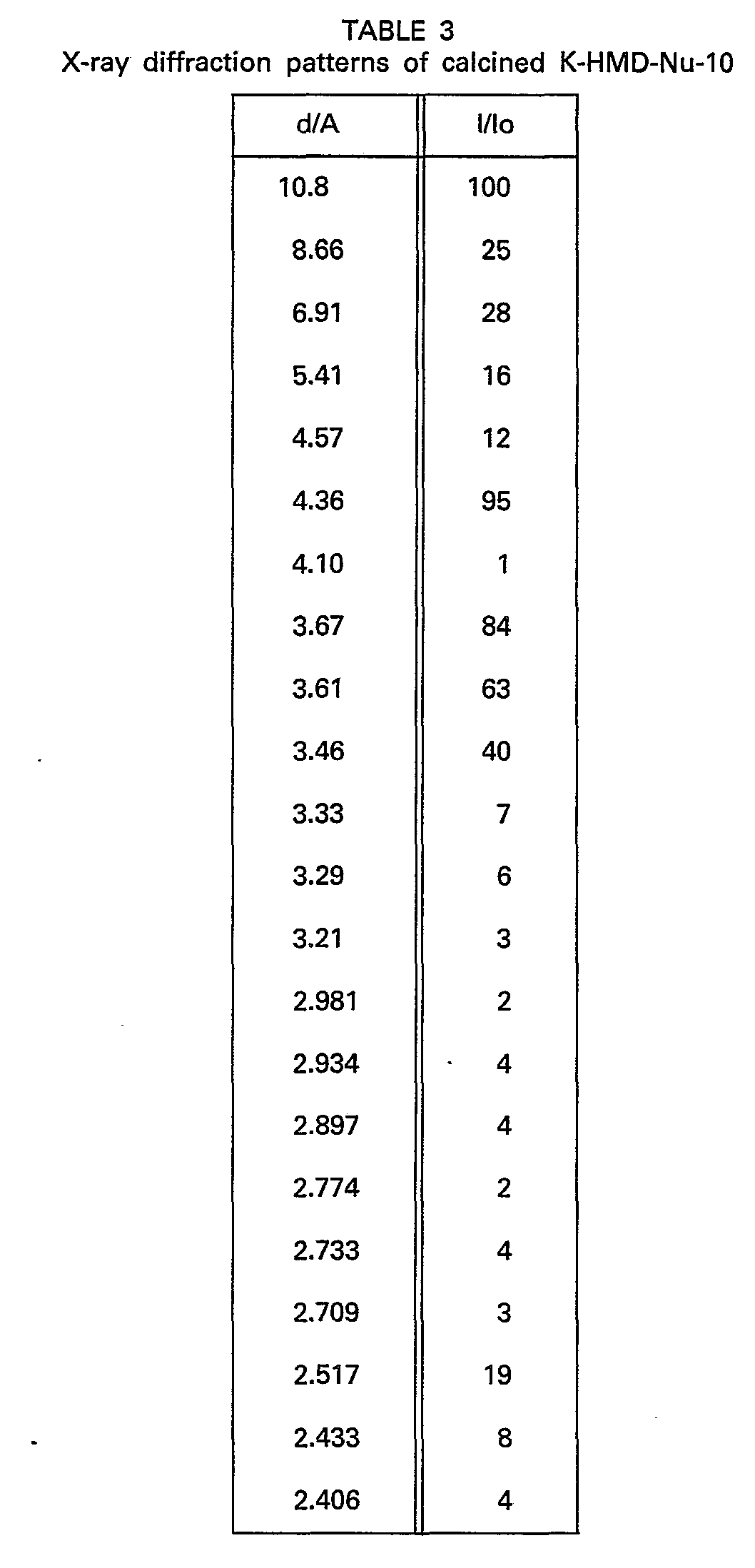
- the potassium HMD Nu-10 was calcined for 72 hours in air at 550°C and then equilibrated with water vapour over saturated aqueous sodium chloride solution for 8 days.
- the X-ray diffraction pattern of the calcined product is shown in Table 3.
- Intermediate values of x do not lead to the formation of other zeolites and it is clear that the presence of very small amounts of rubidium (as low as 2% of the alkali metals present-see Example 19) is sufficient to prevent the formation of ZSM-5.
- rubidium is so effective in directing the reaction towards the formation of Nu-10 but it seems possible that rubidium is particularly effective in the formation of seed nuclei of Nu-10 and hence it reduces the induction period for Nu-10 formation and in this particular case reduces it below that for ZSM-5.
- Example 20 The reaction mixture of Example 20 was identical to those of Table 6 but contained no inorganic cations. This mixture did not crystallise after 243 hours, but when potassium hydroxide equivalent to 5K 2 0 was added to the reaction mixture held at 180°C a mixture of Nu-10, ZSM-5 and cristobalite was formed within 15 hours. This is in marked contrast to Example A (Table 6) which gave a form of ZSM-5 from an identical composition.
- Example A Table 6 which gave a form of ZSM-5 from an identical composition.
- One reason may be that X-ray amorphous seed nuclei formed in the alkali free reaction mixture but could not grow because of lack of hydroxide ions to depolymerise the aluminosilicate solids.
- Examples 21 and 22 are analogous to Example 19 which gave Nu-10 together with a trace of cristobalite.
- Example 21 shows that some Nu-10 can be produced even if the organic component is omitted.
- Example 23 gave a very crystalline form of Nu-10 and there is little doubt that the combination of sodium and rubidium ions is particularly suitable for crystallisation of Nu-10.
- Examples 26 and 27 represent two attempts to prepare Nu-10 from an aluminium-free reaction mixture at 180°C and 150°C respectively. Both reactions gave ZSM-48 but Nu-10 was also formed at the lower temperature.
Landscapes
- Chemical & Material Sciences (AREA)
- Organic Chemistry (AREA)
- Inorganic Chemistry (AREA)
- Life Sciences & Earth Sciences (AREA)
- General Life Sciences & Earth Sciences (AREA)
- Geology (AREA)
- Silicates, Zeolites, And Molecular Sieves (AREA)
- Catalysts (AREA)
Description
- The present invention relates to a zeolite synthesis and particularly to a new method for the preparation of zeolite Nu-10.
- In our earlier European Patent Application No. 82302366.8 (EP-A-65400) there is described zeolite Nu-10 having a molar composition expressed by the formula:


- In the table, the relative intensities, I/Io, are given in terms of the symbols:-
- w=weak (I/Io in the range 0 to 20)
- m=medium (I/Io in the range 20 to 40)
- s=strong (I/lo in the range 40 to 60)
- vs=very strong (1/10 in the range 60 to 100)
- The freshly prepared Nu-10 may also contain nitrogen-containing compounds well in excess of the 1.5 moles set out in the aforesaid definition of the composition of Nu-10 typically in the range 0.1 to 120 moles per mole of Y203. Since Nu-10 is a zeolite, the nitrogen containing base must be physically trapped within the crystal lattice. It can be removed by thermal treatment and/or oxidative degradation or by displacement by suitable small molecules. This physically trapped basic material does not constitute part of the composition for the purpose of the definition. Thus Nu-10 as made typically has the following molar composition:

- The aforementioned patent application also describes a method of preparing zeolite Nu-10 which comprises reacting an aqueous mixture containing specified proportions of at least one oxide XO2, at least one oxide Y203 and at least one polyalkylene polyamine having the formula:

- It has now been found that zeolite Nu-10 may be prepared from a reaction mixture in which the aforesaid polyamine is omitted and optionally replaced by an organic compound as hereinafter defined.
- Thus, according to the present invention, there is provided a method for the preparation of zeolite Nu-10 which comprises reacting an aqueous mixture containing sources of at least one oxide X02, at least one oxide Y203 where X is silicon and/or germanium and Y is one or more of aluminium, iron, chromium, vanadium, molybdenum, arsenic, antimony, manganese, gallium and boron and, optionally, at least one organic compound selected from:
- (a) compounds of the formula:

- (b) nitrogen-containing heterocyclic bases, the reaction mixture having the molar composition:
- XO2/Y2O3=10 to 10000, preferably 30 to 1500, more preferably 50 to 600
- M1OH/XO2=18-8 to 1.0, preferably 10-6 to 0.25
- H20/XO2=10 to 200, preferably 15 to 60
- Q/XO2=0 to 4, preferably 0.1 to 1.0
- M2Z/X02=0 to 4.0, preferably 0 to 1.0
wherein each of M1 and M2 represent an alkali metal or ammonium, Q represents the organic compound, X and Y have the meanings given above and Z represents an acid radical. - As the formula shows, the organic compound (a) may be a diamine, an amino-alcohol or a diol or any mixture thereof, for example a mixture of a diamine and a diol. Suitable diamines include compounds of the formula:

- The organic compound (b) is preferably a 5- or 6-membered saturated heterocyclic diamine such as piperazine or triethylene diamine or a mono-amine such as pyrrolidone, piperidine or morpholine.
- Mixtures of compounds of types (a) and (b) may be used, for example a mixture of hexamethylene diamine and piperazine.
- Particularly suitable alkali metals for use in the method of the invention include sodium, potassium, rubidium and caesium, and mixtures of two or more of these, especially (a) rubidium and sodium, and (b) rubidium and potassium.
- The preferred oxide X02 is silica (Si02) and the preferred oxide Y203 is alumina (AI203).
- The silica source can be any of those commonly considered for use in synthesising zeolites, for example powdered silica, silicic acid, colloidal silica or dissolved silica. Among the powdered silicas usable are precipitated silica, especially those made by precipitation from an alkali metal silicate solution, such as the type known as "KS 300" made by AKZO, and similar products, aerosil silicas, fume silicas such as "CAB-O-SIL@" M5 and silica gels suitably in grades for use in reinforcing pigments for rubber or silicone rubber. Colloidal silicas of various particle sizes may be used, for example 10 to 15 or 40 to 50 microns (pm), as sold under the Registered Trade Marks "LUDOX", "NALCOAG" and "SYTON". The usable dissolved silicas include commercially available waterglass silicates containing 0.5 to 6.0, especially 2.0 to 4.0 mols of Si02 per mol of alkali metal oxide, "active" alkali metal silicates as defined in UK Patent 1193254 and silicates made by dissolving silica in alkali metal hydroxide or quaternary ammonium hydroxide or a mixture thereof.
- The alumina source is most conveniently a soluble aluminate, but aluminium, and aluminium salts, for example the chloride, nitrate or sulphate, an aluminium alkoxide or alumina itself, which should preferably be in a hydrated or hydratable form such as colloidal alumina, pseudoboehmite, boehmite, gamma alumina or the alpha or beta trihydrate.
- The reaction mixture is usually reacted under autogenous pressure, optionally with added gas, e.g. nitrogen, at a temperature between 85 and 250°C until crystals of zeolite Nu-10 form, which can be from 1 hour to many months depending on the reactant composition and the operating temperature. Preferred reaction temperatures lie in the range 130 to 220°C. Agitation is optional, but is preferable since it assists homogenisation of the reaction mixture and reduces the reaction time. Seeding of the reaction mixture with Nu-10 can also be advantageous.
- At the end of the reaction, the solid phase is collected on a filter and washed and is then ready for further steps such as drying, calcination and ion-exchange.
- If the product of the reaction contains alkali metal ions, these have to be at least partly removed in order to prepare the catalytically active hydrogen form of Nu-10 and this can be done by ion exchange with an acid, especially a strong mineral acid such as hydrochloric acid or by way of the ammonium compound, made by ion exchange with a solution of an ammonium salt such as ammonium chloride. Ion exchange can be carried out by slurrying once or several times with the ion-exchange solution. The zeolite is usually calcined before ion exchange but this may be effected after ion-exchange or during ion-exchange if the latter is carried out in a number of stages,
- Zeolite Nu-10, prepared by the method of the invention is useful as a catalyst, for example as a hydrocarbon conversion catalyst and in the conversion of small oxygen-containing organic molecules to hydrocarbons. Other uses for zeolite Nu-10 are set out in our co-pending European patent application No. 82302366.8 (EP-A-65400). It may be employed using the general techniques described in the prior art for zeolite catalysts.
- The invention is illustrated but not limited by the following Examples.
- A synthesis mixture having the molar composition

- The mixture was then placed in a stainless steel autoclave in which it was stirred at 300 revolutions per minute, and allowed to react at 180°C. Crystallisation was complete in 49 hours.
- The zeolite was then filtered from the reaction mixture, washed with distilled water and dried at 120°C.
- Using the procedure described in Example 1 and a reaction mixture having the molar composition:

- The X-ray diffraction data of the products are given in Table 2.
- The potassium HMD Nu-10 was calcined for 72 hours in air at 550°C and then equilibrated with water vapour over saturated aqueous sodium chloride solution for 8 days. The X-ray diffraction pattern of the calcined product is shown in Table 3.
- Further samples of potassium HMD Nu-10 were made using the reaction mixtures and reaction conditions given in Table 4.


- A synthesis mixture having the molar composition:


- It would appear from these results that it is preferable to operate at a reaction temperature of 180°C rather than 150°C. However, as can be seen from later Examples (see below) much depends on the cation present. Thus, even at 150°C the C12 diamine produces Nu-10 zeolite when part or all of the alkali metal cation is rubidium.
- A number of synthesis mixtures having the molar composition
-


- As can be seen, this reaction mixture at 150°C produces ZSM-5 when x=0 and Nu-10 when x=5. Intermediate values of x do not lead to the formation of other zeolites and it is clear that the presence of very small amounts of rubidium (as low as 2% of the alkali metals present-see Example 19) is sufficient to prevent the formation of ZSM-5. We are not certain why rubidium is so effective in directing the reaction towards the formation of Nu-10 but it seems possible that rubidium is particularly effective in the formation of seed nuclei of Nu-10 and hence it reduces the induction period for Nu-10 formation and in this particular case reduces it below that for ZSM-5.
- A number of reaction mixtures designed to give Nu-10 under different conditions were prepared. Their composition and the products obtained are summarised in Table 7.


- The reaction mixture of Example 20 was identical to those of Table 6 but contained no inorganic cations. This mixture did not crystallise after 243 hours, but when potassium hydroxide equivalent to 5K20 was added to the reaction mixture held at 180°C a mixture of Nu-10, ZSM-5 and cristobalite was formed within 15 hours. This is in marked contrast to Example A (Table 6) which gave a form of ZSM-5 from an identical composition. One reason may be that X-ray amorphous seed nuclei formed in the alkali free reaction mixture but could not grow because of lack of hydroxide ions to depolymerise the aluminosilicate solids.
- Examples 21 and 22 are analogous to Example 19 which gave Nu-10 together with a trace of cristobalite. Example 21 shows that some Nu-10 can be produced even if the organic component is omitted.
- Example 23 gave a very crystalline form of Nu-10 and there is little doubt that the combination of sodium and rubidium ions is particularly suitable for crystallisation of Nu-10.
- Examples 26 and 27 represent two attempts to prepare Nu-10 from an aluminium-free reaction mixture at 180°C and 150°C respectively. Both reactions gave ZSM-48 but Nu-10 was also formed at the lower temperature.
- Introduction of a small amount of aluminium into an aluminium-free mixture causes Nu-10 to form even at 180°C (see Examples 28 and 29). When rubidium is used instead of potassium (Example 30) there is a substantial increase in the proportion of Nu-10 in the products.
Claims (9)


Applications Claiming Priority (2)
| Application Number | Priority Date | Filing Date | Title |
|---|---|---|---|
| GB8131767 | 1981-10-21 | ||
| GB8131767 | 1981-10-21 |
Publications (3)
| Publication Number | Publication Date |
|---|---|
| EP0077624A2 EP0077624A2 (en) | 1983-04-27 |
| EP0077624A3 EP0077624A3 (en) | 1983-10-05 |
| EP0077624B1 true EP0077624B1 (en) | 1986-03-12 |
Family
ID=10525311
Family Applications (1)
| Application Number | Title | Priority Date | Filing Date |
|---|---|---|---|
| EP82305369A Expired EP0077624B1 (en) | 1981-10-21 | 1982-10-08 | Zeolite synthesis |
Country Status (6)
| Country | Link |
|---|---|
| US (1) | US4900528A (en) |
| EP (1) | EP0077624B1 (en) |
| JP (1) | JPS5891033A (en) |
| AU (1) | AU554995B2 (en) |
| DE (1) | DE3269856D1 (en) |
| NZ (1) | NZ202099A (en) |
Cited By (2)
| Publication number | Priority date | Publication date | Assignee | Title |
|---|---|---|---|---|
| EP2781497A1 (en) | 2013-03-21 | 2014-09-24 | IFP Energies nouvelles | Method for converting loads from renewable sources using a catalyst including an Nu-10 zeolite and a ZSM-48 zeolite |
| EP2781583A1 (en) | 2013-03-21 | 2014-09-24 | IFP Energies nouvelles | Method for converting loads from renewable sources using a catalyst including an Nu-10 zeolite and a silica-alumina |
Families Citing this family (36)
| Publication number | Priority date | Publication date | Assignee | Title |
|---|---|---|---|---|
| US4902406A (en) * | 1982-04-30 | 1990-02-20 | Mobil Oil Corporation | Synthesis of zeolite ZSM-22 |
| CA1209981A (en) * | 1982-09-04 | 1986-08-19 | Dennis Young | Crystalline gallosilicates, a process for producing them and their use as catalysts |
| US4568654A (en) * | 1982-11-03 | 1986-02-04 | Mobil Oil Corporation | Zeolite ZSM-51 composition |
| US4481177A (en) * | 1982-12-09 | 1984-11-06 | Mobil Oil Corporation | Synthesis of zeolite ZSM-22 with a heterocyclic organic compound |
| EP0113116B1 (en) * | 1982-12-30 | 1985-12-04 | Asahi Kasei Kogyo Kabushiki Kaisha | A crystalline aluminosilicate, a process for producing the same, and a catalyst comprising the crystalline aluminosilicate |
| US4840780A (en) * | 1983-03-28 | 1989-06-20 | Mobil Oil Corporation | ZSM-51, method of preparing same and catalytic conversion therewith |
| AU572518B2 (en) * | 1983-06-30 | 1988-05-12 | Mobil Oil Corp. | Low sodium porous crystalline zeolite |
| GB8318336D0 (en) * | 1983-07-06 | 1983-08-10 | Ici Plc | Zeolites |
| GB8321849D0 (en) * | 1983-08-13 | 1983-09-14 | British Petroleum Co Plc | Crystalline silicates |
| US4632815A (en) * | 1983-10-13 | 1986-12-30 | Mobil Oil Corporation | Crystalline layered silicate |
| US4483835A (en) * | 1983-11-14 | 1984-11-20 | Chevron Research Company | Process for preparing molecular sieves using imidazole template |
| US4670615A (en) * | 1984-12-18 | 1987-06-02 | Mobil Oil Corporation | Hydrocarbon compound conversion |
| US4626421A (en) * | 1985-06-28 | 1986-12-02 | Chevron Research Company | Preparation of magadiite |
| CA1282398C (en) * | 1985-10-21 | 1991-04-02 | Donald J. Klocke | Synthesis of zeolites zsm-22 and zsm-23 |
| US5063038A (en) * | 1985-10-21 | 1991-11-05 | Mobil Oil Corp. | Zeolite synthesis using an alcohol or like molecule |
| FR2631621B1 (en) * | 1988-05-19 | 1990-09-07 | Inst Francais Du Petrole | NOVEL TON STRUCTURAL TYPE ZEOLITHS, THEIR PREPARATION AND THEIR USE |
| ZA93594B (en) * | 1992-01-30 | 1993-08-31 | Exxon Chemical Patents Inc | Alkene oligomerisation. |
| US5866096A (en) * | 1994-12-09 | 1999-02-02 | Exxon Chemical Patents, Inc. | ZSM-22 zeolite |
| FR2738243B1 (en) * | 1995-09-06 | 1997-10-10 | Inst Francais Du Petrole | PROCESS FOR HYDROISOMERIZATION OF LONG LINEAR AND / OR SLIGHTLY BRANCHED PARAFFINS WITH A ZEOLITH-BASED NU-10 CATALYST |
| FR2932811B1 (en) | 2008-06-24 | 2010-09-03 | Inst Francais Du Petrole | METHOD FOR CONVERTING CHARGES FROM RENEWABLE SOURCES TO GOOD GAS FUEL BASES USING A ZEOLITHIC TYPE CATALYST |
| FR2932812B1 (en) | 2008-06-24 | 2011-07-29 | Inst Francais Du Petrole | PROCESS FOR CONVERTING CHARGES FROM RENEWABLE SOURCES TO GOOD QUALITY GASOLINE FUEL BASES USING A ZEOLITHIC CATALYST WITHOUT INTERMEDIATE LIQUID GAS SEPARATION |
| FR2940144B1 (en) | 2008-12-23 | 2016-01-22 | Inst Francais Du Petrole | PROCESS FOR TRANSFORMING EXCELLENT QUALITY RENEWABLE FUEL ORIGLENT EFFLUENTS USING A MOLYBDENATED CATALYST |
| FR2943071B1 (en) | 2009-03-10 | 2011-05-13 | Inst Francais Du Petrole | PROCESS FOR THE HYDRODESOXYGENATION OF CHARGES RESULTING FROM RENEWABLE SOURCES WITH LIMITED CONVERSION TO DECARBOXYLATION USING A CATALYST BASED ON NICKEL AND MOLYBDEN |
| FR2949476B1 (en) | 2009-09-02 | 2012-08-03 | Inst Francais Du Petrole | METHOD FOR CONVERTING CHARGES FROM RENEWABLE SOURCES IN CO-PROCESSING WITH A PETROLEUM LOAD USING A CATALYST BASED ON NICKEL AND MOLYBDEN |
| FR2949475B1 (en) | 2009-09-02 | 2012-04-20 | Inst Francais Du Petrole | METHOD FOR CONVERTING CHARGES FROM RENEWABLE SOURCES IN CO-PROCESSING WITH A PETROLEUM LOAD USING A MOLYBDENATED CATALYST |
| FR2951734B1 (en) | 2009-10-27 | 2012-08-03 | Inst Francais Du Petrole | METHOD FOR HYDROTREATING CHARGES FROM RENEWABLE SOURCES WITH INDIRECT HEATING |
| FR2951732B1 (en) | 2009-10-27 | 2012-08-03 | Inst Francais Du Petrole | METHOD FOR HYDROTREATING CHARGES FROM RENEWABLE SOURCES WITH INDIRECT HEATING USING A CATALYST BASED ON NICKEL AND MOLYBDENES HAVING A PARTICULAR ATOMIC RATIO |
| FR2951733B1 (en) | 2009-10-27 | 2012-08-10 | Inst Francais Du Petrole | METHOD FOR HYDROTREATING CHARGES FROM RENEWABLE SOURCES WITH INDIRECT HEATING USING A CATALYST BASED ON MOLYBDENES |
| FR2969642B1 (en) | 2010-12-22 | 2012-12-28 | IFP Energies Nouvelles | PRODUCTION OF PARAFFINIC FUELS FROM RENEWABLE MATERIALS BY A CONTINUOUS HYDROTREATING PROCESS |
| CN103274428A (en) * | 2013-07-01 | 2013-09-04 | 中国海洋石油总公司 | Method of synthesizing nano Nu-10 molecular sieve by recycling mother solution |
| US9266744B2 (en) | 2013-10-10 | 2016-02-23 | Chevron U.S.A. Inc. | Synthesis of borosilicate ton-framework type molecular sieves |
| CN106853972B (en) * | 2015-12-09 | 2019-11-08 | 中国石油天然气股份有限公司 | Stable synthesis method of TON zeolite |
| JP7058602B2 (en) | 2016-03-04 | 2022-04-22 | カリフォルニア インスティチュート オブ テクノロジー | New germanium silicate composition and its production method |
| BR112018076987B1 (en) | 2016-06-24 | 2022-05-03 | Albemarle Corporation | Mesoporous Zsm-22 for increased propylene production |
| EP4244188B1 (en) | 2020-11-10 | 2024-06-05 | Chevron U.S.A. Inc. | Organotemplate-free synthesis of a zeolite of ton framework type |
| US11565943B2 (en) | 2021-02-11 | 2023-01-31 | Chevron U.S.A. Inc. | Synthesis of ton framework type molecular sieves |
Family Cites Families (11)
| Publication number | Priority date | Publication date | Assignee | Title |
|---|---|---|---|---|
| GB1553209A (en) * | 1975-09-29 | 1979-09-26 | Ici Ltd | Zeolites |
| US4139600A (en) * | 1977-04-22 | 1979-02-13 | Mobil Oil Corporation | Synthesis of zeolite ZSM-5 |
| US4108881A (en) * | 1977-08-01 | 1978-08-22 | Mobil Oil Corporation | Synthesis of zeolite ZSM-11 |
| DK155176C (en) * | 1978-06-22 | 1989-07-17 | Snam Progetti | PROCEDURE FOR THE PREPARATION OF ALUMINUM OXIDE MODIFIED SILICON Dioxide |
| DE2831334A1 (en) * | 1978-07-17 | 1980-02-07 | Basf Ag | METHOD FOR PRODUCING CRYSTALLINE ALUMINOSILICATE ZOLITHES |
| US4423021A (en) * | 1979-08-08 | 1983-12-27 | Mobil Oil Corporation | Method of preparing silico-crystal ZSM-48 |
| US4285922A (en) * | 1979-09-10 | 1981-08-25 | Mobil Oil Corporation | Method of preparing crystalline zeolite |
| IT1140784B (en) * | 1980-03-13 | 1986-10-10 | Anic Spa | METHOD FOR THE PRODUCTION OF ZEOLITHIC STRUCTURE ALUMINUM SILICATES |
| EP0042225B1 (en) * | 1980-06-12 | 1984-02-01 | Imperial Chemical Industries Plc | Zeolite synthesis |
| US4358397A (en) * | 1980-10-29 | 1982-11-09 | Mobil Oil Corporation | Zeolite catalysts modified with group IV A metals |
| US4481177A (en) * | 1982-12-09 | 1984-11-06 | Mobil Oil Corporation | Synthesis of zeolite ZSM-22 with a heterocyclic organic compound |
-
1982
- 1982-10-06 NZ NZ202099A patent/NZ202099A/en unknown
- 1982-10-08 DE DE8282305369T patent/DE3269856D1/en not_active Expired
- 1982-10-08 EP EP82305369A patent/EP0077624B1/en not_active Expired
- 1982-10-14 AU AU89361/82A patent/AU554995B2/en not_active Ceased
- 1982-10-14 US US06/434,228 patent/US4900528A/en not_active Expired - Fee Related
- 1982-10-19 JP JP57183619A patent/JPS5891033A/en active Granted
Cited By (2)
| Publication number | Priority date | Publication date | Assignee | Title |
|---|---|---|---|---|
| EP2781497A1 (en) | 2013-03-21 | 2014-09-24 | IFP Energies nouvelles | Method for converting loads from renewable sources using a catalyst including an Nu-10 zeolite and a ZSM-48 zeolite |
| EP2781583A1 (en) | 2013-03-21 | 2014-09-24 | IFP Energies nouvelles | Method for converting loads from renewable sources using a catalyst including an Nu-10 zeolite and a silica-alumina |
Also Published As
| Publication number | Publication date |
|---|---|
| AU554995B2 (en) | 1986-09-11 |
| EP0077624A2 (en) | 1983-04-27 |
| AU8936182A (en) | 1983-04-28 |
| US4900528A (en) | 1990-02-13 |
| DE3269856D1 (en) | 1986-04-17 |
| JPS5891033A (en) | 1983-05-30 |
| EP0077624A3 (en) | 1983-10-05 |
| NZ202099A (en) | 1986-07-11 |
| JPH0214287B2 (en) | 1990-04-06 |
Similar Documents
| Publication | Publication Date | Title |
|---|---|---|
| EP0077624B1 (en) | Zeolite synthesis | |
| EP0055529B2 (en) | Zeolites | |
| EP0059059B2 (en) | Zeolites | |
| EP0063436B1 (en) | Zeolites | |
| EP0040016B1 (en) | Zeolite nu-3 | |
| EP0377291B1 (en) | Zeolites | |
| EP0108486B1 (en) | Preparation of zeolites | |
| EP0142348B1 (en) | Process for preparing a zeolite of the l type using organic templates | |
| EP0184409A2 (en) | Improved method for the preparation of zeolites | |
| KR101285526B1 (en) | Processes for preparing mtt zeolites using nitrogen-containing organic compounds using nitrogen-containing organic compounds | |
| EP0042225B1 (en) | Zeolite synthesis | |
| EP0107908B1 (en) | Zeolites | |
| EP0105679B1 (en) | Zeolites | |
| EP0183346A2 (en) | Iron-containing silicate having ZSM-5 crystalline structure, its method of preparation, and its use in hydrocarbon conversion | |
| CN112551543B (en) | Method for preparing IZM-2 zeolite in the presence of a mixture of nitrogen-containing organic structuring agents in the form of hydroxide and bromide | |
| JPH0353249B2 (en) | ||
| JP4462933B2 (en) | Porous crystalline material (ITQ-21) and process for its preparation in the absence of fluoride ions | |
| GB2202838A (en) | Synthesis of ZSM - 23 type 3 eolite | |
| JP2697037B2 (en) | Crystalline metal silicate and method for producing the same | |
| JPH02160615A (en) | New crystalline metallic silicate | |
| US20060246002A1 (en) | Offretite aluminosilicate composition and preparation and use of same | |
| JPS59156912A (en) | Manufacture of crystalline aluminosilicate | |
| JP2000344515A (en) | Manufacture for mfi-type crystal line metallo silicate | |
| JPH0672010B2 (en) | Crystalline aluminosilicate and method for producing the same |
Legal Events
| Date | Code | Title | Description |
|---|---|---|---|
| PUAI | Public reference made under article 153(3) epc to a published international application that has entered the european phase |
Free format text: ORIGINAL CODE: 0009012 |
|
| AK | Designated contracting states |
Designated state(s): BE DE FR GB IT NL |
|
| PUAL | Search report despatched |
Free format text: ORIGINAL CODE: 0009013 |
|
| AK | Designated contracting states |
Designated state(s): BE DE FR GB IT NL |
|
| 17P | Request for examination filed |
Effective date: 19840314 |
|
| GRAA | (expected) grant |
Free format text: ORIGINAL CODE: 0009210 |
|
| AK | Designated contracting states |
Kind code of ref document: B1 Designated state(s): BE DE FR GB IT NL |
|
| ITF | It: translation for a ep patent filed | ||
| REF | Corresponds to: |
Ref document number: 3269856 Country of ref document: DE Date of ref document: 19860417 |
|
| ET | Fr: translation filed | ||
| PLBI | Opposition filed |
Free format text: ORIGINAL CODE: 0009260 |
|
| 26 | Opposition filed |
Opponent name: BASF AKTIENGESELLSCHAFT, LUDWIGSHAFEN Effective date: 19861211 |
|
| NLR1 | Nl: opposition has been filed with the epo |
Opponent name: BASF AKTIENGESELLSCHAFT |
|
| PLBN | Opposition rejected |
Free format text: ORIGINAL CODE: 0009273 |
|
| STAA | Information on the status of an ep patent application or granted ep patent |
Free format text: STATUS: OPPOSITION REJECTED |
|
| 27O | Opposition rejected |
Effective date: 19900115 |
|
| NLR2 | Nl: decision of opposition | ||
| PGFP | Annual fee paid to national office [announced via postgrant information from national office to epo] |
Ref country code: FR Payment date: 19930914 Year of fee payment: 12 |
|
| PGFP | Annual fee paid to national office [announced via postgrant information from national office to epo] |
Ref country code: DE Payment date: 19930920 Year of fee payment: 12 |
|
| PGFP | Annual fee paid to national office [announced via postgrant information from national office to epo] |
Ref country code: GB Payment date: 19930923 Year of fee payment: 12 |
|
| PGFP | Annual fee paid to national office [announced via postgrant information from national office to epo] |
Ref country code: BE Payment date: 19930927 Year of fee payment: 12 |
|
| ITTA | It: last paid annual fee | ||
| PGFP | Annual fee paid to national office [announced via postgrant information from national office to epo] |
Ref country code: NL Payment date: 19931031 Year of fee payment: 12 |
|
| PG25 | Lapsed in a contracting state [announced via postgrant information from national office to epo] |
Ref country code: GB Effective date: 19941008 |
|
| PG25 | Lapsed in a contracting state [announced via postgrant information from national office to epo] |
Ref country code: BE Effective date: 19941031 |
|
| BERE | Be: lapsed |
Owner name: IMPERIAL CHEMICAL INDUSTRIES P.L.C. Effective date: 19941031 |
|
| PG25 | Lapsed in a contracting state [announced via postgrant information from national office to epo] |
Ref country code: NL Effective date: 19950501 |
|
| GBPC | Gb: european patent ceased through non-payment of renewal fee |
Effective date: 19941008 |
|
| NLV4 | Nl: lapsed or anulled due to non-payment of the annual fee | ||
| PG25 | Lapsed in a contracting state [announced via postgrant information from national office to epo] |
Ref country code: FR Effective date: 19950630 |
|
| PG25 | Lapsed in a contracting state [announced via postgrant information from national office to epo] |
Ref country code: DE Effective date: 19950701 |
|
| REG | Reference to a national code |
Ref country code: FR Ref legal event code: ST |