EP0087679B1 - 1,3-Dioxane - Google Patents
1,3-Dioxane Download PDFInfo
- Publication number
- EP0087679B1 EP0087679B1 EP83101466A EP83101466A EP0087679B1 EP 0087679 B1 EP0087679 B1 EP 0087679B1 EP 83101466 A EP83101466 A EP 83101466A EP 83101466 A EP83101466 A EP 83101466A EP 0087679 B1 EP0087679 B1 EP 0087679B1
- Authority
- EP
- European Patent Office
- Prior art keywords
- trans
- dioxane
- dioxan
- phenyl
- propylcyclohexyl
- Prior art date
- Legal status (The legal status is an assumption and is not a legal conclusion. Google has not performed a legal analysis and makes no representation as to the accuracy of the status listed.)
- Expired
Links
- 150000000093 1,3-dioxanes Chemical class 0.000 title claims description 4
- 239000003989 dielectric material Substances 0.000 claims description 16
- 125000000217 alkyl group Chemical group 0.000 claims description 15
- 125000004432 carbon atom Chemical group C* 0.000 claims description 13
- 125000003545 alkoxy group Chemical group 0.000 claims description 12
- 125000004423 acyloxy group Chemical group 0.000 claims description 10
- 125000004453 alkoxycarbonyl group Chemical group 0.000 claims description 9
- 239000004973 liquid crystal related substance Substances 0.000 claims description 6
- 229910052794 bromium Inorganic materials 0.000 claims description 5
- 229910052801 chlorine Inorganic materials 0.000 claims description 5
- 238000000034 method Methods 0.000 claims description 5
- 229910052731 fluorine Inorganic materials 0.000 claims description 4
- VDFVNEFVBPFDSB-UHFFFAOYSA-N 1,3-dioxane Chemical compound C1COCOC1 VDFVNEFVBPFDSB-UHFFFAOYSA-N 0.000 claims description 3
- 125000001140 1,4-phenylene group Chemical group [H]C1=C([H])C([*:2])=C([H])C([H])=C1[*:1] 0.000 claims description 3
- 150000002009 diols Chemical class 0.000 claims description 3
- 210000002858 crystal cell Anatomy 0.000 claims 2
- 125000002485 formyl group Chemical class [H]C(*)=O 0.000 claims 1
- -1 1,4-cyclohexylene radicals Chemical class 0.000 description 50
- 150000001875 compounds Chemical class 0.000 description 30
- 150000003254 radicals Chemical class 0.000 description 10
- 239000000126 substance Substances 0.000 description 7
- UHOVQNZJYSORNB-UHFFFAOYSA-N Benzene Chemical compound C1=CC=CC=C1 UHOVQNZJYSORNB-UHFFFAOYSA-N 0.000 description 6
- YXFVVABEGXRONW-UHFFFAOYSA-N Toluene Chemical compound CC1=CC=CC=C1 YXFVVABEGXRONW-UHFFFAOYSA-N 0.000 description 6
- 125000000113 cyclohexyl group Chemical group [H]C1([H])C([H])([H])C([H])([H])C([H])(*)C([H])([H])C1([H])[H] 0.000 description 6
- 239000000203 mixture Substances 0.000 description 5
- XXUSEPRYHRDKFV-CTYIDZIISA-N C1C[C@@H](CCC)CC[C@@H]1C1=CC=C(C#N)C=C1 Chemical compound C1C[C@@H](CCC)CC[C@@H]1C1=CC=C(C#N)C=C1 XXUSEPRYHRDKFV-CTYIDZIISA-N 0.000 description 4
- FURZYCFZFBYJBT-JCNLHEQBSA-N C1C[C@@H](CCCCC)CC[C@@H]1C1=CC=C(C#N)C=C1 Chemical compound C1C[C@@H](CCCCC)CC[C@@H]1C1=CC=C(C#N)C=C1 FURZYCFZFBYJBT-JCNLHEQBSA-N 0.000 description 4
- JOXIMZWYDAKGHI-UHFFFAOYSA-N toluene-4-sulfonic acid Chemical compound CC1=CC=C(S(O)(=O)=O)C=C1 JOXIMZWYDAKGHI-UHFFFAOYSA-N 0.000 description 4
- YYAVXASAKUOZJJ-KOMQPUFPSA-N C1C[C@@H](CCCC)CC[C@@H]1C1=CC=C(C#N)C=C1 Chemical compound C1C[C@@H](CCCC)CC[C@@H]1C1=CC=C(C#N)C=C1 YYAVXASAKUOZJJ-KOMQPUFPSA-N 0.000 description 3
- 239000002253 acid Substances 0.000 description 3
- 150000001299 aldehydes Chemical class 0.000 description 3
- 239000000460 chlorine Substances 0.000 description 3
- RYHBNJHYFVUHQT-UHFFFAOYSA-N 1,4-Dioxane Chemical compound C1COCCO1 RYHBNJHYFVUHQT-UHFFFAOYSA-N 0.000 description 2
- AOOMMSDKAJQIJS-UHFFFAOYSA-N 2-[4-(4-butylphenyl)phenyl]-5-pentyl-1,3-dioxane Chemical compound O1CC(CCCCC)COC1C1=CC=C(C=2C=CC(CCCC)=CC=2)C=C1 AOOMMSDKAJQIJS-UHFFFAOYSA-N 0.000 description 2
- MNRXLBCOILCJPL-UHFFFAOYSA-N 2-[4-(4-butylphenyl)phenyl]-5-propyl-1,3-dioxane Chemical compound C1=CC(CCCC)=CC=C1C1=CC=C(C2OCC(CCC)CO2)C=C1 MNRXLBCOILCJPL-UHFFFAOYSA-N 0.000 description 2
- GFTUCRZSBAYWFJ-UHFFFAOYSA-N 2-[4-(4-methoxyphenyl)phenyl]-5-(4-propylphenyl)-1,3-dioxane Chemical compound C1=CC(CCC)=CC=C1C1COC(C=2C=CC(=CC=2)C=2C=CC(OC)=CC=2)OC1 GFTUCRZSBAYWFJ-UHFFFAOYSA-N 0.000 description 2
- OVUSKVBLIQSERG-UHFFFAOYSA-N 2-[4-(4-pentylphenyl)phenyl]-5-propyl-1,3-dioxane Chemical compound C1=CC(CCCCC)=CC=C1C1=CC=C(C2OCC(CCC)CO2)C=C1 OVUSKVBLIQSERG-UHFFFAOYSA-N 0.000 description 2
- DPOCGHWCDBKZAU-UHFFFAOYSA-N 5-butyl-2-[4-(4-butylphenyl)phenyl]-1,3-dioxane Chemical compound O1CC(CCCC)COC1C1=CC=C(C=2C=CC(CCCC)=CC=2)C=C1 DPOCGHWCDBKZAU-UHFFFAOYSA-N 0.000 description 2
- LJUKRJQQSWQGGU-UHFFFAOYSA-N 5-methyl-2-(4-phenylphenyl)-1,3-dioxane Chemical compound O1CC(C)COC1C1=CC=C(C=2C=CC=CC=2)C=C1 LJUKRJQQSWQGGU-UHFFFAOYSA-N 0.000 description 2
- VDQSYIJXHIBVRB-UHFFFAOYSA-N 5-pentyl-2-[4-(4-propylphenyl)phenyl]-1,3-dioxane Chemical compound O1CC(CCCCC)COC1C1=CC=C(C=2C=CC(CCC)=CC=2)C=C1 VDQSYIJXHIBVRB-UHFFFAOYSA-N 0.000 description 2
- DFRHUBOHICBMLB-UHFFFAOYSA-N 5-propyl-2-[4-(4-propylphenyl)phenyl]-1,3-dioxane Chemical compound O1CC(CCC)COC1C1=CC=C(C=2C=CC(CCC)=CC=2)C=C1 DFRHUBOHICBMLB-UHFFFAOYSA-N 0.000 description 2
- UNWCPVDFJUSWKA-BFMYOTCPSA-N BrC1=CC=C(C=C1)C1OCC(CO1)[C@@H]1CC[C@H](CC1)CCC Chemical compound BrC1=CC=C(C=C1)C1OCC(CO1)[C@@H]1CC[C@H](CC1)CCC UNWCPVDFJUSWKA-BFMYOTCPSA-N 0.000 description 2
- MVKFVOAOPGUWDH-LXKFRJFUSA-N C(#N)C1=CC=C(C=C1)C1OCC(CO1)[C@@H]1CC[C@H](CC1)CCCCC Chemical compound C(#N)C1=CC=C(C=C1)C1OCC(CO1)[C@@H]1CC[C@H](CC1)CCCCC MVKFVOAOPGUWDH-LXKFRJFUSA-N 0.000 description 2
- DGZAEPGFCACHDV-WTKWLVDJSA-N C(CC)C1=CC=C(C=C1)C1=CC=C(C=C1)C1OCC(CO1)[C@@H]1CC[C@H](CC1)CCC Chemical compound C(CC)C1=CC=C(C=C1)C1=CC=C(C=C1)C1OCC(CO1)[C@@H]1CC[C@H](CC1)CCC DGZAEPGFCACHDV-WTKWLVDJSA-N 0.000 description 2
- WCMSJIUXZQNZAW-HAQNSBGRSA-N C(CC)[C@@H]1CC[C@H](CC1)C1OCCCO1 Chemical compound C(CC)[C@@H]1CC[C@H](CC1)C1OCCCO1 WCMSJIUXZQNZAW-HAQNSBGRSA-N 0.000 description 2
- NSGMZTNTQKRAFA-UAPYVXQJSA-N C1C[C@@H](CCCCCCC)CC[C@@H]1C1=CC=C(C#N)C=C1 Chemical compound C1C[C@@H](CCCCCCC)CC[C@@H]1C1=CC=C(C#N)C=C1 NSGMZTNTQKRAFA-UAPYVXQJSA-N 0.000 description 2
- ZXZMPIYVSNKWSJ-BFMYOTCPSA-N ClC1=CC=C(C=C1)C1OCC(CO1)[C@@H]1CC[C@H](CC1)CCC Chemical compound ClC1=CC=C(C=C1)C1OCC(CO1)[C@@H]1CC[C@H](CC1)CCC ZXZMPIYVSNKWSJ-BFMYOTCPSA-N 0.000 description 2
- QAOWNCQODCNURD-UHFFFAOYSA-N Sulfuric acid Chemical compound OS(O)(=O)=O QAOWNCQODCNURD-UHFFFAOYSA-N 0.000 description 2
- 239000000654 additive Substances 0.000 description 2
- 239000000470 constituent Substances 0.000 description 2
- NZNMSOFKMUBTKW-UHFFFAOYSA-N cyclohexanecarboxylic acid Chemical compound OC(=O)C1CCCCC1 NZNMSOFKMUBTKW-UHFFFAOYSA-N 0.000 description 2
- IGARGHRYKHJQSM-UHFFFAOYSA-N cyclohexylbenzene Chemical class C1CCCCC1C1=CC=CC=C1 IGARGHRYKHJQSM-UHFFFAOYSA-N 0.000 description 2
- WVIIMZNLDWSIRH-UHFFFAOYSA-N cyclohexylcyclohexane Chemical class C1CCCCC1C1CCCCC1 WVIIMZNLDWSIRH-UHFFFAOYSA-N 0.000 description 2
- 125000000959 isobutyl group Chemical group [H]C([H])([H])C([H])(C([H])([H])[H])C([H])([H])* 0.000 description 2
- 125000001972 isopentyl group Chemical group [H]C([H])([H])C([H])(C([H])([H])[H])C([H])([H])C([H])([H])* 0.000 description 2
- 239000007788 liquid Substances 0.000 description 2
- 238000002844 melting Methods 0.000 description 2
- 230000008018 melting Effects 0.000 description 2
- 125000002914 sec-butyl group Chemical group [H]C([H])([H])C([H])([H])C([H])(*)C([H])([H])[H] 0.000 description 2
- 239000007858 starting material Substances 0.000 description 2
- XLYOFNOQVPJJNP-UHFFFAOYSA-N water Substances O XLYOFNOQVPJJNP-UHFFFAOYSA-N 0.000 description 2
- PKORYTIUMAOPED-UHFFFAOYSA-N 1,2,3,4-tetrahydroquinazoline Chemical compound C1=CC=C2NCNCC2=C1 PKORYTIUMAOPED-UHFFFAOYSA-N 0.000 description 1
- 150000000185 1,3-diols Chemical class 0.000 description 1
- QQFSIGWYINAJOB-UHFFFAOYSA-N 1,4-dicyclohexylbenzene Chemical class C1CCCCC1C1=CC=C(C2CCCCC2)C=C1 QQFSIGWYINAJOB-UHFFFAOYSA-N 0.000 description 1
- RAYZALBEMJMGEA-UHFFFAOYSA-N 1-cyclohexylnaphthalene Chemical class C1CCCCC1C1=CC=CC2=CC=CC=C12 RAYZALBEMJMGEA-UHFFFAOYSA-N 0.000 description 1
- SIMYRXPCIUXDGR-UHFFFAOYSA-N 2-butylpropane-1,3-diol Chemical compound CCCCC(CO)CO SIMYRXPCIUXDGR-UHFFFAOYSA-N 0.000 description 1
- 125000004493 2-methylbut-1-yl group Chemical group CC(C*)CC 0.000 description 1
- 125000005916 2-methylpentyl group Chemical group 0.000 description 1
- 125000004746 2-methylpropyloxycarbonyl group Chemical group CC(COC(=O)*)C 0.000 description 1
- 125000005917 3-methylpentyl group Chemical group 0.000 description 1
- ZCZHIMLDHBRGMF-UHFFFAOYSA-N 4-(5-butyl-1,3-dioxan-2-yl)benzonitrile Chemical compound O1CC(CCCC)COC1C1=CC=C(C#N)C=C1 ZCZHIMLDHBRGMF-UHFFFAOYSA-N 0.000 description 1
- SSXIKUCDZOQOKB-UHFFFAOYSA-N 4-(5-pentyl-1,3-dioxan-2-yl)benzonitrile Chemical compound O1CC(CCCCC)COC1C1=CC=C(C#N)C=C1 SSXIKUCDZOQOKB-UHFFFAOYSA-N 0.000 description 1
- GQPFCPRCGONDNN-UHFFFAOYSA-N 4-(5-propyl-1,3-dioxan-2-yl)benzonitrile Chemical compound O1CC(CCC)COC1C1=CC=C(C#N)C=C1 GQPFCPRCGONDNN-UHFFFAOYSA-N 0.000 description 1
- QKEBUASRTJNJJS-UHFFFAOYSA-N 4-[4-(4-pentylcyclohexyl)phenyl]benzonitrile Chemical group C1CC(CCCCC)CCC1C1=CC=C(C=2C=CC(=CC=2)C#N)C=C1 QKEBUASRTJNJJS-UHFFFAOYSA-N 0.000 description 1
- XPZRPIUDDITVQT-UHFFFAOYSA-N 4-[4-(5-propyl-1,3-dioxan-2-yl)phenyl]benzonitrile Chemical compound O1CC(CCC)COC1C1=CC=C(C=2C=CC(=CC=2)C#N)C=C1 XPZRPIUDDITVQT-UHFFFAOYSA-N 0.000 description 1
- QIDPYPHTIOFAPA-UHFFFAOYSA-N 4-[5-[4-(4-propylphenyl)phenyl]-1,3-dioxan-2-yl]benzonitrile Chemical compound C1=CC(CCC)=CC=C1C1=CC=C(C2COC(OC2)C=2C=CC(=CC=2)C#N)C=C1 QIDPYPHTIOFAPA-UHFFFAOYSA-N 0.000 description 1
- YFVRUGGMSVPAPA-CTYIDZIISA-N C1C[C@@H](CCC)CC[C@@H]1C1=CC=C(C=O)C=C1 Chemical compound C1C[C@@H](CCC)CC[C@@H]1C1=CC=C(C=O)C=C1 YFVRUGGMSVPAPA-CTYIDZIISA-N 0.000 description 1
- OXBRRUNAAVNTOZ-SHTZXODSSA-N C1C[C@@H](CCC)CC[C@@H]1C1=CC=C(OCC)C=C1 Chemical compound C1C[C@@H](CCC)CC[C@@H]1C1=CC=C(OCC)C=C1 OXBRRUNAAVNTOZ-SHTZXODSSA-N 0.000 description 1
- BPVJENLMEMWFBW-QAQDUYKDSA-N CCCCOc1ccc(cc1)[C@H]1CC[C@H](CCC)CC1 Chemical compound CCCCOc1ccc(cc1)[C@H]1CC[C@H](CCC)CC1 BPVJENLMEMWFBW-QAQDUYKDSA-N 0.000 description 1
- VEXZGXHMUGYJMC-UHFFFAOYSA-M Chloride anion Chemical compound [Cl-] VEXZGXHMUGYJMC-UHFFFAOYSA-M 0.000 description 1
- ZAMOUSCENKQFHK-UHFFFAOYSA-N Chlorine atom Chemical compound [Cl] ZAMOUSCENKQFHK-UHFFFAOYSA-N 0.000 description 1
- 238000006828 Rosenmund reduction reaction Methods 0.000 description 1
- 241001104043 Syringa Species 0.000 description 1
- 235000004338 Syringa vulgaris Nutrition 0.000 description 1
- 150000001241 acetals Chemical class 0.000 description 1
- 150000001298 alcohols Chemical class 0.000 description 1
- 125000005194 alkoxycarbonyloxy group Chemical group 0.000 description 1
- 125000002947 alkylene group Chemical group 0.000 description 1
- 235000010290 biphenyl Nutrition 0.000 description 1
- 150000004074 biphenyls Chemical class 0.000 description 1
- 125000003178 carboxy group Chemical group [H]OC(*)=O 0.000 description 1
- 150000001735 carboxylic acids Chemical class 0.000 description 1
- 239000003054 catalyst Substances 0.000 description 1
- 238000006243 chemical reaction Methods 0.000 description 1
- 235000013985 cinnamic acid Nutrition 0.000 description 1
- WBYWAXJHAXSJNI-UHFFFAOYSA-N cinnamic acid group Chemical class C(C=CC1=CC=CC=C1)(=O)O WBYWAXJHAXSJNI-UHFFFAOYSA-N 0.000 description 1
- VZFUCHSFHOYXIS-UHFFFAOYSA-N cycloheptane carboxylic acid Natural products OC(=O)C1CCCCCC1 VZFUCHSFHOYXIS-UHFFFAOYSA-N 0.000 description 1
- DQZKGSRJOUYVPL-UHFFFAOYSA-N cyclohexyl benzoate Chemical class C=1C=CC=CC=1C(=O)OC1CCCCC1 DQZKGSRJOUYVPL-UHFFFAOYSA-N 0.000 description 1
- 150000005690 diesters Chemical class 0.000 description 1
- 239000002019 doping agent Substances 0.000 description 1
- 239000000975 dye Substances 0.000 description 1
- 230000005684 electric field Effects 0.000 description 1
- 125000003754 ethoxycarbonyl group Chemical group C(=O)(OCC)* 0.000 description 1
- 125000001495 ethyl group Chemical group [H]C([H])([H])C([H])([H])* 0.000 description 1
- 229910052736 halogen Inorganic materials 0.000 description 1
- 150000002367 halogens Chemical class 0.000 description 1
- 125000000623 heterocyclic group Chemical group 0.000 description 1
- 238000011065 in-situ storage Methods 0.000 description 1
- 239000012442 inert solvent Substances 0.000 description 1
- 239000004615 ingredient Substances 0.000 description 1
- 229910052740 iodine Inorganic materials 0.000 description 1
- 125000001449 isopropyl group Chemical group [H]C([H])([H])C([H])(*)C([H])([H])[H] 0.000 description 1
- 125000005928 isopropyloxycarbonyl group Chemical group [H]C([H])([H])C([H])(OC(*)=O)C([H])([H])[H] 0.000 description 1
- 239000000463 material Substances 0.000 description 1
- 125000001160 methoxycarbonyl group Chemical group [H]C([H])([H])OC(*)=O 0.000 description 1
- 125000002496 methyl group Chemical group [H]C([H])([H])* 0.000 description 1
- UVEWQKMPXAHFST-UHFFFAOYSA-N n,1-diphenylmethanimine Chemical class C=1C=CC=CC=1C=NC1=CC=CC=C1 UVEWQKMPXAHFST-UHFFFAOYSA-N 0.000 description 1
- 125000004108 n-butyl group Chemical group [H]C([H])([H])C([H])([H])C([H])([H])C([H])([H])* 0.000 description 1
- 125000006257 n-butyloxycarbonyl group Chemical group [H]C([H])([H])C([H])([H])C([H])([H])C([H])([H])OC(*)=O 0.000 description 1
- 125000006610 n-decyloxy group Chemical group 0.000 description 1
- 125000003136 n-heptyl group Chemical group [H]C([H])([H])C([H])([H])C([H])([H])C([H])([H])C([H])([H])C([H])([H])C([H])([H])* 0.000 description 1
- 125000001280 n-hexyl group Chemical group C(CCCCC)* 0.000 description 1
- 125000000740 n-pentyl group Chemical group [H]C([H])([H])C([H])([H])C([H])([H])C([H])([H])C([H])([H])* 0.000 description 1
- 125000004123 n-propyl group Chemical group [H]C([H])([H])C([H])([H])C([H])([H])* 0.000 description 1
- 125000006256 n-propyloxycarbonyl group Chemical group [H]C([H])([H])C([H])([H])C([H])([H])OC(*)=O 0.000 description 1
- 230000003287 optical effect Effects 0.000 description 1
- 230000003647 oxidation Effects 0.000 description 1
- 238000007254 oxidation reaction Methods 0.000 description 1
- BOTNYLSAWDQNEX-UHFFFAOYSA-N phenoxymethylbenzene Chemical compound C=1C=CC=CC=1COC1=CC=CC=C1 BOTNYLSAWDQNEX-UHFFFAOYSA-N 0.000 description 1
- 125000001997 phenyl group Chemical group [H]C1=C([H])C([H])=C(*)C([H])=C1[H] 0.000 description 1
- JWVCLYRUEFBMGU-UHFFFAOYSA-N quinazoline Chemical compound N1=CN=CC2=CC=CC=C21 JWVCLYRUEFBMGU-UHFFFAOYSA-N 0.000 description 1
- 239000011541 reaction mixture Substances 0.000 description 1
- 150000001629 stilbenes Chemical class 0.000 description 1
- 125000001424 substituent group Chemical group 0.000 description 1
- 150000001911 terphenyls Chemical class 0.000 description 1
- CXWXQJXEFPUFDZ-UHFFFAOYSA-N tetralin Chemical compound C1=CC=C2CCCCC2=C1 CXWXQJXEFPUFDZ-UHFFFAOYSA-N 0.000 description 1
- 230000017105 transposition Effects 0.000 description 1
Classifications
-
- C—CHEMISTRY; METALLURGY
- C09—DYES; PAINTS; POLISHES; NATURAL RESINS; ADHESIVES; COMPOSITIONS NOT OTHERWISE PROVIDED FOR; APPLICATIONS OF MATERIALS NOT OTHERWISE PROVIDED FOR
- C09K—MATERIALS FOR MISCELLANEOUS APPLICATIONS, NOT PROVIDED FOR ELSEWHERE
- C09K19/00—Liquid crystal materials
- C09K19/04—Liquid crystal materials characterised by the chemical structure of the liquid crystal components, e.g. by a specific unit
- C09K19/06—Non-steroidal liquid crystal compounds
- C09K19/34—Non-steroidal liquid crystal compounds containing at least one heterocyclic ring
- C09K19/3402—Non-steroidal liquid crystal compounds containing at least one heterocyclic ring having oxygen as hetero atom
-
- C—CHEMISTRY; METALLURGY
- C07—ORGANIC CHEMISTRY
- C07D—HETEROCYCLIC COMPOUNDS
- C07D319/00—Heterocyclic compounds containing six-membered rings having two oxygen atoms as the only ring hetero atoms
- C07D319/04—1,3-Dioxanes; Hydrogenated 1,3-dioxanes
- C07D319/06—1,3-Dioxanes; Hydrogenated 1,3-dioxanes not condensed with other rings
-
- C—CHEMISTRY; METALLURGY
- C09—DYES; PAINTS; POLISHES; NATURAL RESINS; ADHESIVES; COMPOSITIONS NOT OTHERWISE PROVIDED FOR; APPLICATIONS OF MATERIALS NOT OTHERWISE PROVIDED FOR
- C09K—MATERIALS FOR MISCELLANEOUS APPLICATIONS, NOT PROVIDED FOR ELSEWHERE
- C09K19/00—Liquid crystal materials
- C09K19/04—Liquid crystal materials characterised by the chemical structure of the liquid crystal components, e.g. by a specific unit
- C09K19/06—Non-steroidal liquid crystal compounds
- C09K19/34—Non-steroidal liquid crystal compounds containing at least one heterocyclic ring
- C09K19/3402—Non-steroidal liquid crystal compounds containing at least one heterocyclic ring having oxygen as hetero atom
- C09K2019/3422—Non-steroidal liquid crystal compounds containing at least one heterocyclic ring having oxygen as hetero atom the heterocyclic ring being a six-membered ring
Definitions
- the invention relates to new 1,3-dioxanes of the formula wherein
- connections can be like similar e.g. Compounds known from DE-OS 2 944 905 are used as components of liquid-crystalline dielectrics, in particular for display elements which are based on the principle of the twisted cell.
- the substances hitherto used for this purpose all have certain disadvantages, for example melting points that are too high, clearing points that are too low, stability that is poor in relation to the action of heat, light or electrical fields, temperature dependence of the threshold voltage that is too high.
- the object of the invention was to find new liquid-crystalline compounds which are suitable as components of liquid-crystalline dielectrics, in particular for nematic phases with high dielectric anisotropy, and which do not show the disadvantages of the known compounds or only show them to a lesser extent. This object was achieved by the provision of the new compounds of the formula I.
- the compounds of the formula I are particularly suitable as components of liquid-crystalline dielectrics.
- they can be used to obtain liquid-crystalline phases with wide nematic ranges, low temperature dependence of the threshold voltage and / or small optical anisotropy.
- the new compounds also show good solubility for other components of such dielectrics and, especially those among them, in which the radical R 'is a CN group, high positive dielectric anisotropy.
- the compounds of formula 1 are colorless in the pure state and form liquid-crystalline mesophases in a temperature range which is favorably located for electro-optical use.
- R 1 , Q and m have the meaning given or one of its functional derivatives with a diol of the formula III wherein
- R 2 , Q and n have the meaning given.
- the invention furthermore relates to the use of the compounds of the formula I as components of liquid-crystalline dielectrics, liquid-crystalline dielectrics containing at least one compound of the formula and electro-optical display elements which contain such dielectrics.
- R 1 , R 2 , Q, m and n have the meaning given above and below, unless expressly stated otherwise.
- the compounds of formula 1 specifically include compounds of the following subforms:
- R 1 is H, alkanoyloxy or alkoxycarbonyl each having 1 to 10 carbon atoms, F, Cl, Br, CN or CF 3 .
- the alkyl, alkoxy, alkanoyloxy or alkoxycarbonyl groups preferably each have 1-6, in particular 3, 4, 5 or 6, carbon atoms.
- the radical R ' is preferably alkyl or CN, the radical R 2 is preferably alkyl.
- the alkyl, alkoxy, alkanoyloxy and alkoxycarbonyl groups are preferably straight-chain.
- alkyl preferably means methyl, ethyl, n-propyl, n-butyl, n-pentyl, n-hexyl, n-heptyl, n-octyl, n-nonyl or n-decyl;
- Alkoxy preferably means methoxy, ethoxy, n-propyloxy, n-butyloxy, n-pentyloxy, n-hexyloxy, n-heptyloxy, n-octyloxy, n-nonyloxy or n-decyloxy;
- Alkanoyloxy preferably means acetoxy, propionyloxy, butyryloxy, valeryloxy, capronyloxy, heptanoyloxy, octanoyloxy, nonanoyloxy or decanoyloxy;
- Alkoxycarbonyl preferably means methoxycarbony
- preferred branched alkoxy radicals are isopropyloxy, 2-methyl-propyloxy, 2-methyl-butyloxy, 3-methyl-butyloxy, 2-methyl-pentyloxy, 3-methyl-pentyloxy, 1-methyl-hexyloxy, 1-methyl-heptyloxy, 2- Ethylhexyloxy
- preferred branched alkanoyloxy radicals are isobutyryloxy, 2-methylbutyryloxy, isovaleryloxy, 2-methylhexanoyloxy, 2-ethylhe
- the compounds of formula 1 are otherwise prepared by methods known per se, as described in the literature (for example in the standard works such as Houben-Weyl, Methods of Organic Chemistry, Georg-Thieme-Verlag, Stuttgart), under reaction conditions who are known and suitable for the implementations mentioned. Use can also be made of variants which are known per se and are not mentioned here in detail.
- the starting materials can also be formed in situ in such a way that they are not isolated from the reaction mixture, but instead are immediately converted further into the compounds of the formula I.
- the compounds of formulas II and 111 are advantageously in the presence of an inert solvent such as benzene or toluene and / or a catalyst, for.
- a strong acid such as sulfuric acid, benzene or p-toluenesulfonic acid, at temperatures between about 20 and about 150, preferably between 80 and 120 ° C, reacted with each other.
- Simple acetals of the formulas R 1 - (C) m -CH (OR 3 ) 2 or lilac are primarily suitable as reactive derivatives of the compounds of the formulas 11 and III wherein
- R 3 is alkyl with 1-4 C atoms, two radicals R 3 together also mean alkylene with 2 or 3 C atoms and R 4 H, alkyl with 1-4 C atoms or phenyl.
- the aldehydes of the formula II can be obtained by oxidation of corresponding alcohols of the formula R 1 - (Q) m -CH 2 OH or by reduction of corresponding carboxylic acids of the formula R 1 - (Q) m -COOH (or their derivatives), the diols of Formula III by reducing corresponding diesters of the formula (alkyl-OOCCH 2 ) 2 -CH- (Q) n -R 2 .
- the dielectrics according to the invention consist of 2 to 15, preferably 3 to 12 components, including at least one compound of the formula I.
- the other constituents are preferably selected from the nematic or nematogenic substances, in particular the known substances, from the classes of azoxybenzenes, benzylidene anilines and biphenyls , Terphenyls, phenyl- or cyclohexylbenzoates, cyclohexane carboxylic acid phenyl- or cyclohexyl esters, phenylcyclohexanes, cyclohexylbiphenyls, cyclohexylcyclohexanes, cyclohexylnaphthalenes, 1,4-bis-cyclohexylbenzenes, 4,4-bis-cyclohexylbiphenyls, phenyl- or cyclohexylphenyl, phenyl- or cyclohexy
- a and E each have a carbo- or heterocyclic ring system consisting of the system consisting of 1,4-disubstituted benzene and cyclohexane rings, 4,4'-disubstituted biphenyl, phenylcyclohexane and cyclohexylcyclohexane systems, 2,5-disubstituted pyrimidine and 1,3- Dioxane rings, 2,6-disubstituted naphthalene, di- and tetrahydronaphthalene, quinazoline and tetrahydroquinazoline, or a CC single bond, L halogen, preferably chlorine, or CN, and R 5 and R 6 alkyl, alkyloxy, alkanoyloxy or alkoxycarbonyloxy having up to 18, preferably up to 8 carbon atoms, or one of
- the dielectrics according to the invention contain about 0.1 to 40, preferably 2 to 35% of one or more compounds of the formula I.
- the dielectrics according to the invention are produced in a conventional manner.
- the components are dissolved in one another, expediently at elevated temperature. If a temperature above the clearing point of the main constituent is chosen, the completeness of the dissolving process can be observed particularly easily.
- Suitable additives can be used to modify the liquid-crystalline dielectrics according to the invention in such a way that they can be used in all types of liquid-crystal display elements which have hitherto become known.
- dichroic dyes or substances for changing the dielectric anisotropy, the viscosity, the conductivity and / or the orientation of the nematic phases can be added.
- Such substances are e.g. B. in DE-OS 2209127, 2240864, 2321632, 2338281, 2450088, 2 637 430, 2853728 and 2 902 177 described.
- F. is the melting point and K. is the clearing point of a liquid crystalline substance.
- Percentages above and below mean percentages by weight; all temperatures are given in degrees Celsius.
Landscapes
- Chemical & Material Sciences (AREA)
- Organic Chemistry (AREA)
- Crystallography & Structural Chemistry (AREA)
- Engineering & Computer Science (AREA)
- Materials Engineering (AREA)
- Liquid Crystal Substances (AREA)
- Heterocyclic Compounds That Contain Two Or More Ring Oxygen Atoms (AREA)
Description
- Die Erfindung betrifft neue 1,3-Dioxane der Formel

- R' H, Alkyl, Alkoxy, Alkanoyloxy oder Alkoxycarbonyl mit jeweils 1 bis 10 C-Atomen, F, Cl, Br, CF3 oder CN,
- R2 Alkyl oder Alkoxy mit jeweils 1-10 C-Atomen, die Reste Q, die gleich oder verschieden sein können, 1,4-Phenylen- oder 1,4-Cyclohexylenreste und die Parameter m und n jeweils 0, 1 oder 2, ihre Summe (m + n) jedoch 2 oder 3 bedeuten, mit der Massgabe, dass im Falle m = n = 1 mindestens einer der beiden Reste Q ein 1,4-Cyclohexylenrest ist.
- Diese Verbindungen können wie ähnliche, z.B. aus der DE-OS 2 944 905 bekannte Verbindungen als Komponenten flüssigkristalliner Dielektrika verwendet werden, insbesondere für Anzeigeelemente, die auf dem Prinzip der verdrillten Zelle beruhen.
- Die bisher für diesen Zweck eingesetzten Substanzen besitzen sämtlich gewisse Nachteile, beispielsweise zu hohe Schmelzpunkte, zu niedrige Klärpunkte, zu geringe Stabilität gegenüber der Einwirkung von Wärme, Licht oder elektrischen Feldern, zu hohe Temperaturabhängigkeit der Schwellenspannung.
- Aus Mol. Cryst. Liqu. Cryst. 1981, Vol. 63, pp. 129-144 sind 2-(p-Cyanphenyl)-5-(p-alkylphenyl)-1,3-dioxane und p-Alkyl- bzw. p-Alkoxyben- zoesäure-p-(5-alkyl-1,3-dioxan-2-yl)-phenylester als Komponenten flüssigkristalliner Dielektrika bekannt. Die Verbindungen der Formel I sind jedoch wesentlich besser geeignet, in Dielektrika die Klärpunkte zu erhöhen bei nahezu unveränderter oder nur unwesentlich erhöhter Viskosität.
- Der Erfindung lag die Aufgabe zugrunde, neue flüssigkristalline Verbindungen aufzufinden, die als Komponenten flüssigkristalliner Dielektrika geeignet sind, insbesondere für nematische Phasen mit hoher dielektrischer Anisotropie, und die die Nachteile der bekannten Verbindungen nicht oder nur in geringerem Masse zeigen. Diese Aufgabe wurde durch die Bereitstellung der neuen Verbindungen der Formel I gelöst.
- Es wurde gefunden, dass die Verbindungen der Formel I vorzüglich als Komponenten flüssigkristalliner Dielektrika geeignet sind. Insbesondere sind mit ihrer Hilfe flüssigkristalline Phasen mit weiten nematischen Bereichen geringer Temperaturabhängigkeit der Schwellenspannung und/ oder kleiner optischer Anisotropie erhältlich. Die neuen Verbindungen zeigen ausserdem eine gute Löslichkeit für andere Komponenten derartiger Dielektrika und, besonders diejenigen unter ihnen, worin der Rest R' eine CN-Gruppe bedeutet, hohe positive dielektrische Anisotropie.
- Die Verbindungen der Formel 1 sind in reinem Zustand farblos und bilden flüssigkristalline Mesophasen in einem für die elektrooptische Verwendung günstig gelegenen Temperaturbereich.
- Gegenstand der Erfindung sind somit die Verbindungen der Formel I sowie ein Verfahren zu ihrer Herstellung, das dadurch gekennzeichnet ist, dass man einen Aldehyd der Formel II

- R1, Q und m die angegebene Bedeutung haben oder eines seiner funktionellen Derivate mit einem Diol der Formel III

- R2, Q und n die angegebene Bedeutung haben, umsetzt.
- Weiterhin sind Gegenstand der Erfindung die Verwendung der Verbindungen der Formel I als Komponenten flüssigkristalliner Dielektrika, flüssigkristalline Dielektrika mit einem Gehalt an mindestens einer Verbindung der Formel sowie elektrooptische Anzeigeelemente, die derartige Dielektrika enthalten.
- Vor- und nachstehend haben R1, R2, Q, m und n die angegebene Bedeutung, sofern nicht ausdrücklich etwas anderes vermerkt ist.
- Die Verbindungen der Formel 1 umschliessen im einzelnen Verbindungen folgender Teilformein:
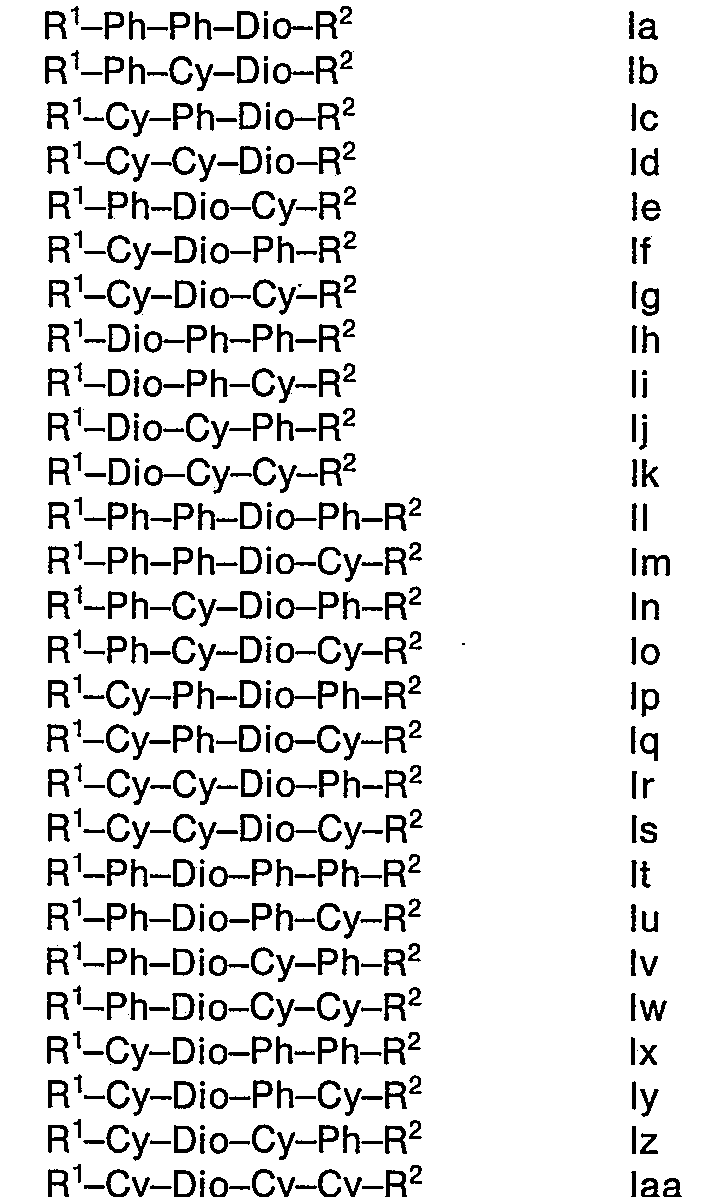
- Verbindungen der Formeln la, Ic und lu, ferner diejenigen der Formeln le, Il, Im, Ip, Iq, lt, Iv und Iw, die die Teilgruppe -Ph-Dio- enthalten, sind bevorzugt.
- Bevorzugt sind ferner Verbindungen der Formel I sowie la bis laa, worin der Rest R1 H, Alkanoyloxy oder Alkoxycarbonyl mit jeweils 1 bis 10 C-Atomen, F, Cl, Br, CN oder CF3 bedeutet.
- In den Verbindungen der Formeln la bis laa haben die Alkyl-, Alkoxy-, Alkanoyloxy- oder Alkoxycarbonylgruppen vorzugsweise jeweils 1-6, insbesondere 3, 4, 5 oder 6 C-Atome. Der Rest R' ist vorzugsweise Alkyl oder CN, der Rest R2 ist vorzugsweise Alkyl.
- In den Verbindungen der Formeln I sowie la bis laa sind diejenigen Stereoisomeren bevorzugt, in denen die beiden Substituenten am Dioxandiylrest und an den Cyclohexylenresten jeweisl in trans-Stellung zueinander stehen. In den Verbindungen der Formel I sowie la bis laa sind die Alkyl-, Alkoxy-, Alkanoyloxy und Alkoxycarbonylgruppen vorzugsweise geradkettig.
- Dementsprechend bedeutet Alkyl vorzugsweise Methyl, Ethyl, n-Propyl, n-Butyl, n-Pentyl, n-Hexyl, n-Heptyl, n-Octyl, n-Nonyl oder n-Decyl; Alkoxy bedeutet vorzugsweise Methoxy, Ethoxy, n-Propyloxy, n-Butyloxy, n-Pentyloxy, n-Hexyloxy, n-Heptyloxy, n-Octyloxy, n-Nonyloxy oder n-Decyloxy; Alkanoyloxy bedeutet vorzugsweise Acetoxy, Propionyloxy, Butyryloxy, Valeryloxy, Capronyloxy, Heptanoyloxy, Octanoyloxy, Nonanoyloxy oder Decanoyloxy; Alkoxycarbonyl bedeutet vorzugsweise Methoxycarbonyl, Ethoxycarbonyl, n-Propyloxycarbonyl, n-Butyloxycarbonyl, n-Pentyloxycarbonyl, n-Hexyloxycarbonyl, n-Heptyloxy-carbonyl, n-Octyloxycarbonyl oder n-Nonyloxycarbonyl.
- Bevorzugt sind ferner Verbindungen der Formel I, worin, falls n = O und gleichzeitig m = 2 ist, der Rest R' H, Alkanoyloxy oder Alkoxycarbonyl mit jeweils 1 bis 10 C-Atomen, F, CI, Br, CN oder CF3 bedeutet.
- Verbindungen der Formel 1 sowie la bis laa mit verzweigten Alkyl-, Alkoxy-, Alkanoyloxy- oder Alkoxycarbonylgruppen können gelegentlich wegen einer besseren Löslichkeit in den üblichen flüssigkristallinen Basismaterialien von Bedeutung sein, insbesondere aber als chirale Dotierstoffe, wenn sie optisch aktiv sind. Verzweigte Gruppen dieser Art enthalten in der Regel nicht mehr als eine Kettenverzweigung. Bevorzugte verzweigte Alkylreste sind Isopropyl, 2-Butyl (= 1-Methylpropyl), Isobutyl (= 2-Methyl-propyl) 2-Methyl-butyl, Isopentyl (= 3-Methylbutyl), 2-Methylpentyl, 3-Methylpentyl, 2-Heptyl (= 1-Methylhexyl), 2-Octyl (= 1-Methylheptyl), 2-Ethylhexyl; bevorzugte verzweigte Alkoxyreste sind Isopropyloxy, 2-Methyl-propyloxy, 2-Methyl-butyloxy, 3-Methyl-butyloxy, 2-Methyl-pentyloxy, 3-Methyl-pentyloxy, 1-Methyl-hexyloxy, 1-Methyl-heptyloxy, 2-Ethyl-hexyloxy, bevorzugte verzweigte Alkanoyloxyreste sind Isobutyryloxy, 2-Methylbutyryloxy, Isovaleryloxy, 2-Methylhexanoyloxy, 2-Ethylhexanoyloxy, bevorzugte verzweigte Alkoxycarbonylreste sind Isopropyloxycarbonyl, 2-Methylpropyloxycarbonyl, 2-Methyl-butyloxycarbonyl, 3-Methyl-butyloxy-carbonyl, 2-Methyl-pentyloxy-carbonyl, 3-Methyl-pentyloxy-carbonyl, 1-Methyl-hexyloxy-carbonyl, 1-Methyl-heptyloxy-carbonyl, 2-Ethyl-hexyloxy-carbonyl.
- Die Verbindungen der Formel 1 werden im übrigen nach an sich bekannten Methoden hergestellt, wie sie in der Literatur (z.B. in den Standardwerken wie Houben-Weyl, Methoden der Organischen Chemie, Georg-Thieme-Verlag, Stuttgart) beschrieben sind, und zwar unter Reaktionsbedingungen, die für die genannten Umsetzungen bekannt und geeignet sind. Dabei kann man auch von an sich bekannten, hier nicht näher erwähnten Varianten Gebrauch machen.
- Die Ausgangsstoffe können gewünschtenfalls auch in situ gebildet werden, derart, dass man sie aus dem Reaktionsgemisch nicht isoliert, sondern sofort weiter zu den Verbindungen der Formel I umsetzt.
- Die Verbindungen der Formeln II und 111 werden zweckmässig in Gegenwart eines inerten Lösungsmittels wie Benzol oder Toluol und/oder eines Katalysators, z. B. einer starken Säure wie Schwefelsäure, Benzol- oder p-Toluolsulfonsäure, bei Temperaturen zwischen etwa 20 und etwa 150, vorzugsweise zwischen 80 und 120°C, miteinander umgesetzt. Als reaktionsfähige Derivate der Verbindungen der Formeln 11 und III eignen sich in erster Linie einfache Acetale der Formeln R1-(C)m-CH(OR3)2 bzw. lila

- R3 Alkyl mit 1-4 C-Atomen, zwei Reste R3 zusammen auch Alkylen mit 2 oder 3 C-Atomen und R4 H, Alkyl mit 1-4 C-Atomen oder Phenyl bedeuten.
- Die Ausgangsstoffe der Formeln II und III sowie ihre reaktionsfähigen Derivate sind zum Teil bekannt, zum Teil können sie ohne Schwierigkeiten nach Standardverfahren der organischen Chemie aus literaturbekannten Verbindungen hergestellt werden. Beispielsweise sind die Aldehyde der Formel II durch Oxydation entsprechender Alkohole der Formel R1-(Q)m-CH2OH oder durch Reduktion entsprechender Carbonsäuren der Formel R1-(Q)m-COOH (oder ihrer Derivate) erhältlich, die Diole der Formel III durch Reduktion entsprechender Diester der Formel (Alkyl-OOCCH2)2-CH-(Q)n-R2.
- Die erfindungsgemässen Dielektrika bestehen aus 2 bis 15, vorzugsweise 3 bis 12 Komponenten, darunter mindestens einer Verbindung der Formel I. Die anderen Bestandteile werden vorzugsweise ausgewählt aus den nematischen oder nematogenen Substanzen, insbesondere den bekannten Substanzen, aus den Klassen der Azoxybenzole, Benzylidenaniline, Biphenyle, Terphenyle, Phenyl- oder Cyclohexylbenzoate, Cyclohexancarbonsäurephenyl- oder -cyclohexylester, Phenylcyclohexane, Cyclohexylbiphenyle, Cyclohexylcyclohexane, Cyclohexylnaphthaline, 1,4-Bis-cyclohexylbenzole, 4,4-Bis-cyclohexylbiphenyle, Phenyl- oder Cyclohexyl-pyrimidine, Phenyl-oder Cyclohexyldioxane, gegebenenfalls halogenierten Stilbene, Benzylphenylether, Tolane und substituierten Zimtsäuren. Die wichtigsten als Bestandteile derartiger flüssigkristalliner Dielektrika in Frage kommenden Verbindungen lassen sich durch die Formel IV charakterisieren,


- Die erfindungsgemässen Dielektrika enthalten etwa 0,1 bis 40, vorzugsweise 2 bis 35% einer oder mehrerer Verbindungen der Formel I.
- Die Herstellung der erfindungsgemässen Dielektrika erfolgt in an sich üblicher Weise. In der Regel werden die Komponenten ineinander gelöst, zweckmässig bei erhöhter Temperatur. Wenn dabei eine Temperatur oberhalb des Klärpunkts des Hauptbestandteils gewählt wird, kann die Vollständigkeit des Lösungsvorgangs besonders leicht beobachtet werden.
- Durch geeignete Zusätze können die flüssigkristallinen Dielektrika nach der Erfindung so modifi- , ziert werden, dass sie in allen bisher bekannt gewordenen Arten von Flüssigkristallanzeigeelementen verwendet werden können.
- Derartige Zusätze sind dem Fachmann bekannt und in der Literatur ausführlich beschrieben. Beispielsweise können dichroitische Farbstoffe oder Substanzen zur Veränderung der dielektrischen Anisotropie, der Viskosität, der Leitfähigkeit und/ oder der Orientierung der nematischen Phasen zugesetzt werden. Derartige Substanzen sind z. B. in den DE-OS 2209127, 2240864, 2321632, 2338281, 2450088, 2 637 430, 2853728 und 2 902 177 beschrieben.
- Die folgenden Beispiele sollen die Erfindung erläutern, ohne sie zu begrenzen. In den Beispielen bedeuten F. den Schmelzpunkt und K. den Klärpunkt einer flüssigkristallinen Substanz. Vor-und nachstehend bedeuten Prozentangaben Gewichtsprozent; alle Temperaturen sind in Grad Celsius angegeben.
- Ein Gemisch von 2,3 g p-(trans-4-Propylcyclohexyl)-benzaldehyd (erhältlich durch Überführung der entsprechenden Säure in das Chlorid und Rosenmund-Reduktion) 1,32 g 2-Butylpropan-1,3- diol, 0,01 g p-Toluolsulfonsäure und 15 ml Toluol wird am Wasserabscheider 3 Std. gekocht, abgekühlt, mit Wasser gewaschen und eingedampft. Man erhält 2-(p-trans-4-Propylcyclohexyl-phenyl)-5-butyl-1,3-dioxan, F. 80°, K. 150°.
- Analog Beispiel 1 erhält man aus den entsprechenden Aldehyden und den entsprechenden 1,3-Diolen:
- 2. 2-(4-Biphenylyl)-5-methyl-1,3-dioxan.
- 3. 2-(4'-Propyl-4-biphenylyl)-5-propyl-1,3-dioxan.
- 4. 2-(4'-Propyl-4-biphenyfyl)-5-butyl-1,3-dioxan.
- 5. 2-(4'-Propyl-4-biphenylyl)-5-pentyl-1,3-dioxan.
- 6. 2-(4'-Butyl-4-biphenylyl)-5-propyl-1,3-dioxan.
- 7. 2-(4'-Butyl-4-biphenylyl)-5-butyl-1,3-dioxan.
- 8. 2-(4'-Butyl-4-biphenylyl)-5-pentyl-1,3-dioxan.
- 9. 2-(4'-Pentyl-4-biphenylyl)-5-propyl-1,3-dioxan.
- 10. 2-(4'-Pentyl-4-biphenylyi)-5-butyl-1,3-dioxan.
- 11. 2-(4'-Pentyl-4-biphenylyl)-5-pentyl-1,3-dioxan.
- 12. 2-(4'-Decyl-4-biphenylyl)-5-propyl-1,3-dioxan.
- 13. 2-(4'-Cyan-4-biphenylyl)-5-propyl-1,3-dioxan.
- 14. 2-(4'-Cyan-4-biphenylyl)-5-butyl-1,3-dioxan.
- 15. 2-(4'-Cyan-4-biphenylyl)-5-pentyl-1,3-dioxan.
- 16. 2-(p-trans-4-Propylcyclohexyl-phenyl)-5-propyl-1,3-dioxan.
- 17. 2-(p-trans-4-Propylcyclohexyl-phenyl)-5-pentyl-1,3-dioxan.
- 18. 2-(p-trans-4-Butylcyclohexyl-phenyl)-5-propyl-1,3-dioxan.
- 19. 2-(p-trans-4-Butylcyclohexyl-phenyl)-5-butyl-1,3-dioxan.
- 20. 2-(p-trans-4-Butylcyclohexyl-phenyl)-5-pentyl-1,3-dioxan.
- 21. 2-(p-trans-4-Pentylcyclohexyl-phenyl)-5-propyl-1,3-dioxan.
- 22. 2-(p-trans-4-Pentylcyclohexyl-phenyl)-5-butyl-1,3-dioxan.
- 23. 2-(p-trans-4-Pentylcyclohexyl-phenyl)-5-pentyl-1,3-dioxan.
- 24. 2-Phenyl-5-(trans-4-propylcyclohexyl-1,3-dioxan.
- 25. 2-p-Tolyl-5-(trans-4-propylcyclohexyl)-1,3-dioxan.
- 26. 2-p-Methoxyphenyl-5-(trans-4-propylcyclohexyl)-1,3-dioxan.
- 27. 2-p-Decyloxyphenyl-5-(trans-4-propylcyclohexyl)-1,3-dioxan.
- 28. 2-p-Formyloxyphenyl-5-(trans-4-propylcyclohexyl)-1,3-dioxan.
- 29. 2-p-Decanoyloxyphenyl-5-(trans-4-propylcyclohexyl)-1,3-dioxan.
- 30. 2-p-Methoxycarbonylphenyl-5-(trans-4-propylcyclohexyl)-1,3-dioxan.
- 31. 2-p-Nonyloxycarbonylphenyl-5-(trans-4-propylcyclohexyl)-1,3-dioxan.
- 32. 2-p-FI uorphenyl-5-(trans-4-propylcyclohexyl)-1-3,dioxan.
- 33. 2-p-Chlorphenyl-5-(trans-4-propylcyclohexyl)-1,3-dioxan.
- 34. 2-p-Bromphenyl-5-(trans-4-propylcyclohexyl)-1,3-dioxan.
- 35. 2-p-Trifluormethylphenyl-5-(trans-4-propylcyclohexyl)-1,3-dioxan.
- 36. 2-p-Cyanphenyl-5-(trans-4-propylcyclohexyl-1,3-dioxan.
- 37. 2-p-Cyanphenyl-5-(trans-4-butyicyclohexyl)-1,3-dioxan.
- 28. 2-p-Cyanophenyl-5-(trans-4-pentylcyclo- hexyl)-1,3-dioxan.
- 39. 2-(4'-Methoxy-4-biphenylyl)-5-p-propylphenyl-1,3-dioxan.
- 40. 2-(4'-Propyl-4-biphenylyl)-5-(trans-4-propylcyclohexyl)-1,3-dioxan.
- 41. 2-p-(trans-4-Propylcyclohexyl)-phenyl-5-p-propylphenyl-1,3-dioxan.
- 42. 2-p-(trans-4-Propylcyclohexyl)-phenyl-5-(trans-4-propylcyclohexyl)-1,3-dioxan.
- 43. 2-p-Cyanphenyl-5-(4'-propyl-4-biphenylyl)-1,3-dioxan.
- 44. 2-p-Cyanphenyl-5-(4'-butyl-4-biphenylyl-1,3-dioxan.
- 45. 2-p-Cyanphenyl-5-(4'-pentyl-4-biphenylyl)-1,3-dioxan.
- 46. 2-p-Propyiphenyl-5-(p-trans-4-propylcyclohexyl-phenyl)-1,3-dioxan.
- 47. 2-p-Propylphenyl-5-(p-trans-4-butylcyclo- hexyl-phenyl)-1,3-dioxan.
- 48. 2-p-Propylphenyl-5-(p-trans-4-pentylcyclo- hexyl-phenyl)-1,3-dioxan.
- 49. 2-p-Butylphenyl-5-(p-trans-4-propylcyclohexyl-phenyl)-1,3-dioxan.
- 50. 2-p-Butylphenyl-5-(p-trans-4-butylcyclo- hexyl-phenyl)-1,3-dioxan.
- 51. 2-p-Butylphenyl-5-(p-trans-4-pentylcyclo- hexyl-phenyl)-1,3-dioxan.
- 52. 2-p-Pentylphenyl-5-(p-trans-4-propylcyclohexyl-phenyl)-1,3-dioxan.
- 53. 2-p-Pentylphenyl-5-(p-trans-4-butyicyclo- hexyl-phenyl)-1,3-dioxan.
- 54. 2-p-Pentylphenyl-5-(p-trans-4-pentylcyclo- hexyl-phenyl)-1,3-dioxan.
- 55. 2-p-Hexylphenyl-5-(p-trans-4-propyicyclo- hexyl-phenyl)-1,3-dioxan.
- 56. 2-p-Hexyl phenyl-5-(p-trans-4-butylcyclo- hexyl-phenyl-1,3-dioxan.
- 57. 2-p-Hexylphenyl-5-(p-trans-4-pentylcyclo- hexyl-phenyl)-1,3-dioxan.
- 58. 2-p-Propyloxyphenyl-5-(p-trans-4-propylcyclohexyl-phenyl)-1,3-dioxan.
- 59. 2-p-Propyloxyphenyl-5-(p-trans-4-butyl- cyclohexyl-phenyl)-1,3-dioxan.
- 60. 2-p-Propyloxyphenyl-5-(p-trans-4-pentyl- cyclohexyl-phenyl)-1,3-dioxan.
- 61. 2-p-Butyloxyphenyl-5-(p-trans-4-propylcyclohexyl-phenyl)-1,3-dioxan.
- 62. 2-p-Butyloxyphenyl-5-(p-trans-4-butyl- cyclohexyl-phenyl)-1,3-dioxan.
- 63. 2-p-Butyloxyphenyl-5-(p-trans-4-pentyl- cyclohexyl-phenyl)-1,3-dioxan.
- 64. 2-p-Pentyloxyphenyl-5-(p-trans-4-propylcyclohexyl-phenyl)-1,3-dioxan.
- 65. 2-p-Pentyloxyphenyl-5-(p-trans-4-butyl- cyclohexyl-phenyl)-1,3-dioxan.
- 66. 2-p-Pentyloxyphenyl-5-(p-trans-4-pentyl- cyclohexyl-phenyl)-1,3-dioxan.
- 67. 2-p-Hexyloxyphenyl-5-(p-trans-4-propylcyclohexyl-phenyl)-1,3-dioxan.
- 68. 2-p-Hexyloxyphenyl-5-(p-trans-4-butyl- cyclohexyl-phenyl)-1,3-dioxan.
- 69. 2-p-Hexyloxyphenyl-5-(p-trans-4-pentyl- cyclohexyl-phenyl)-1,3-dioxan.
- 70. 2-p-Propyloxycarbonylphenyl-5-(p-trans-4-propylcyclohexyl-phenyl)-1,3-dioxan.
- 71. 2-p-Propyloxycarbonylphenyl-5-(p-trans-4-butylcyclohexyl-phenyl)-1,3-dioxan.
- 72. 2-p-Propyloxycarbonylphenyl-5-(p-trans-4-pentylcyclohexyl-phenyl)-1,3-dioxan.
- 73. 2-p-Butyloxycarbonylphenyl-5-(p-trans-4-propylcyclohexyl-phenyl)-1,3-dioxan.
- 74. 2-p-Butyloxycarbonylphenyl-5-(p-trans-4-butylcyclohexyl-phenyl)-1,3-dioxan.
- 75. 2-p-Butyloxycarbonylphenyl-5-(p-trans-4-pentylcyclohexyl-phenyl)-1,3-dioxan.
- 76. 2-p-Pentyloxycarbonylphenyl-5-(p-trans-4-propylcyclohexyl-phenyl)-1,3-dioxan.
- 77. 2-p-Pentyloxycarbonylphenyl-5-(p-trans-4-butylcyclohexyl-phenyl)-1,3-dioxan.
- 78. 2-p-Pentyloxycarbonylphenyl-5-(p-trans-4-pentylcyclohexyl-phenyl)-1,3-dioxan.
- 79. 2-p-Hexyloxycarbonylphenyl-5-(p-trans-4-propylcyclohexyl-phenyl)-1,3-dioxan.
- 80. 2-p-Hexyloxycarbonylphenyl-5-(p-trans-4-butylcyclohexyl-phenyl)-1,3-dioxan.
- 81. 2-p-Hexyloxycarbonylphenyl-5-(p-trans-4-pentylcyclohexyl-phenyl)-1,3-dioxan.
- 82. 2-p-Cyanphenyl-5-(p-trans-4-propylcyclo. hexyl-phenyl)-1,3-dioxan.
- 83. 2-p-Cyanphenyl-5-(p-trans-4-butylcyclo- hexyl-phenyl)-1,3-dioxan.
- 84. 2-p-Cyanphenyl-5-(p-trans-4-pentylcyclo- hexyl-phenyl)-1,3-dioxan.
- 85. 2-p-Cyanphenyl-5-(trans-4-p-propyloxyphenyl-cyclohexyl)-1,3-dioxan.
- 86. 2-p-Cyanphenyl-5-[trans-4-(trans-4-propylcyclohexyl)-cyclohexyl]-1,3-dioxan.
- Es folgen Beispiele für Dielektrika mit einem Gehalt an mindestens einer Verbindung der Formel I:
- Ein Gemisch aus
- 17% p-(trans-4-Propylcyclohexyl)-benzonitril,
- 12% p-(trans-4-Butylcyclohexyl)-benzonitril,
- 24% p-(trans-4-Pentylcyclohexyl)-benzonitril,
- 14% p-(trans-4-Heptylcyclohexyl)-benzonitril,
- 15% 2-(p-trans-4-Propylcyclohexyl-phenyl)-5-butyl-1,3-dioxan und
- 18% 2-(p-trans-4-Propylcyclohexyl-phenyl)-5-pentyl-1,3-dioxan
- zeigt F. -12°, K. 81°.
-
- 16% trans-1-(p-Ethoxyphenyl)-4-propylcyclo- hexan,
- 12% trans-1-(p-Butoxyphenyl)-4-propylcyclo- hexan,
- 16% p-(trans-4-Propylcyclohexyl)-benzonitril,
- 23% p-(trans-4-Pentylcyclohexyl)-benzonitril,
- 15% 2-(p-trans-4-Propylcyclohexyl-phenyl)-5-butyl-1,3-dioxan und
- 18% 2-(p-trans-4-Propyicyclohexyl-phenyl)-5-pentyl-1,3-dioxan
- zeigt F. -10°, K. 76°.
-
- 8% 2-p-Cyanphenyl-5-propyl-1,3-dioxan,
- 10% 2-p-Cyanphenyl-5-butyl-1,3-dioxan,
- 8% 2-p-Cyanphenyl-5-pentyl-1,3-dioxan,
- 12% p-(trans-4-Propylcyclohexyl)-benzonitril,
- 8% p-(trans-4-Butylcyclohexyl)-benzonitril,
- 18% p-(trans-4-Pentylcyclohexyl)-benzonitril,
- 11 % 4-Cyan-4'-(trans-4-pentylcyclohexyl)-biphenyl,
- 15% 2-(p-trans-4-Propylcyciohexyl-phenyl)-5-butyl-1,3-dioxan und
- 10% 2-(p-trans-4-Propylcyclohexyl-phenyl)-5-pentyl-1,3-dioxan
- zeigt F. -15°, K. 88°.
Claims (5)


Applications Claiming Priority (2)
| Application Number | Priority Date | Filing Date | Title |
|---|---|---|---|
| DE19823207114 DE3207114A1 (de) | 1982-02-27 | 1982-02-27 | 1,3-dioxane |
| DE3207114 | 1982-02-27 |
Publications (3)
| Publication Number | Publication Date |
|---|---|
| EP0087679A2 EP0087679A2 (de) | 1983-09-07 |
| EP0087679A3 EP0087679A3 (en) | 1984-12-19 |
| EP0087679B1 true EP0087679B1 (de) | 1988-06-22 |
Family
ID=6156878
Family Applications (1)
| Application Number | Title | Priority Date | Filing Date |
|---|---|---|---|
| EP83101466A Expired EP0087679B1 (de) | 1982-02-27 | 1983-02-16 | 1,3-Dioxane |
Country Status (3)
| Country | Link |
|---|---|
| EP (1) | EP0087679B1 (de) |
| JP (1) | JPS58159488A (de) |
| DE (2) | DE3207114A1 (de) |
Families Citing this family (15)
| Publication number | Priority date | Publication date | Assignee | Title |
|---|---|---|---|---|
| EP0107759B1 (de) * | 1982-08-26 | 1992-12-16 | MERCK PATENT GmbH | Cyclohexanderivate und ihre Verwendung als Komponenten Flüssigkristalliner-Dielektrika |
| US4565425A (en) * | 1983-03-16 | 1986-01-21 | Hoffmann-La Roche Inc. | Liquid crystals |
| DE3322982A1 (de) * | 1983-06-25 | 1985-01-03 | Merck Patent Gmbh, 6100 Darmstadt | 1,4-dioxane |
| DE3328638A1 (de) * | 1983-08-09 | 1985-02-21 | Merck Patent Gmbh, 6100 Darmstadt | Cyclohexyldioxane |
| GB8400665D0 (en) * | 1984-01-11 | 1984-02-15 | Secr Defence | Disubstituted ethanes |
| DE3405914A1 (de) * | 1984-02-18 | 1985-08-22 | Merck Patent Gmbh, 6100 Darmstadt | Fluessigkristalline verbindungen |
| DE3534106A1 (de) * | 1984-10-16 | 1986-04-17 | VEB Werk für Fernsehelektronik im VEB Kombinat Mikroelektronik, DDR 1160 Berlin | Kristallin-fluessige 2,5-disubstituierte-trans-1,3-dioxadecaline |
| US4715984A (en) * | 1985-01-22 | 1987-12-29 | Merck Patent Gesellschaft Mit Beschrankter Haftung | Liquid-crystalline dihydroazines |
| JPS6210083A (ja) * | 1985-07-04 | 1987-01-19 | Chisso Corp | ピリミジニルジオキサン誘導体 |
| DE3614778A1 (de) * | 1986-05-02 | 1987-11-05 | Merck Patent Gmbh | Smektische fluessigkristalline phasen |
| EP0269963B1 (de) * | 1986-11-28 | 1995-02-22 | F. Hoffmann-La Roche Ag | Ferroelektrische Flüssigkristalle |
| WO1991016321A1 (de) * | 1990-04-26 | 1991-10-31 | MERCK Patent Gesellschaft mit beschränkter Haftung | 1,3-dioxanderivate und flüssigkristallines medium |
| TW211581B (de) * | 1991-11-07 | 1993-08-21 | Hoechst Ag | |
| US5667721A (en) * | 1995-03-16 | 1997-09-16 | Rolic Ag | Liquid crystalline di-1,3-dioxane derivatives |
| EP0881221B1 (de) * | 1996-10-22 | 2016-06-29 | JNC Corporation | Dioxanderivate, flüssigkeitskristallzusammensetzungen, die diese enthalten, und flüssigkeitskristallanzeige unter verwendung derselben |
Family Cites Families (7)
| Publication number | Priority date | Publication date | Assignee | Title |
|---|---|---|---|---|
| DE2944905A1 (de) * | 1978-12-13 | 1980-10-23 | Werk Fernsehelektronik Veb | Kristallin-fluessige substituierte 1,3-dioxane und diese enthaltende gemische |
| US4344856A (en) * | 1979-12-12 | 1982-08-17 | VEB Werk fur Fernsehelektronik Berlin im VEB Kombinat Mikroelektronik | Crystalline-liquid substituted 1,3-dioxanes and mixtures containing them |
| US4298528A (en) * | 1980-03-28 | 1981-11-03 | Timex Corporation | Cyclohexyl-dioxane liquid crystalline compounds |
| US4323473A (en) * | 1980-03-28 | 1982-04-06 | Timex Corporation | Cyclohexyl cyclohexyl dioxane liquid crystalline compounds and admixture containing same |
| US4325830A (en) * | 1980-12-24 | 1982-04-20 | Timex Corporation | Three ring dioxane liquid crystalline compounds |
| DD207308A3 (de) * | 1981-08-18 | 1984-02-22 | Dietrich Demus | Anwendung neuer kristallin-fluessiger nematischer substanzen |
| CA1189311A (en) * | 1981-11-09 | 1985-06-25 | Nicholas L. Sethofer | Liquid crystalline chiral compound, compositions and guest-host display including same |
-
1982
- 1982-02-27 DE DE19823207114 patent/DE3207114A1/de not_active Withdrawn
-
1983
- 1983-02-16 DE DE8383101466T patent/DE3377128D1/de not_active Expired
- 1983-02-16 EP EP83101466A patent/EP0087679B1/de not_active Expired
- 1983-02-25 JP JP58029608A patent/JPS58159488A/ja active Pending
Also Published As
| Publication number | Publication date |
|---|---|
| JPS58159488A (ja) | 1983-09-21 |
| EP0087679A2 (de) | 1983-09-07 |
| DE3207114A1 (de) | 1983-09-08 |
| DE3377128D1 (de) | 1988-07-28 |
| EP0087679A3 (en) | 1984-12-19 |
Similar Documents
| Publication | Publication Date | Title |
|---|---|---|
| EP0154840B1 (de) | Flüssigkristalline Verbindungen | |
| EP0209622B1 (de) | Hydroterphenyle | |
| EP0087032B1 (de) | Bicyclohexylderivatemit flüssig-kristallinen Eigenschaften | |
| EP0144013B1 (de) | Thienothiophenderivate | |
| EP0182054B1 (de) | Heterocyclische Verbindungen | |
| EP0030277B1 (de) | Partiell hydrierte Oligo-1,4-phenylene, diese enthaltende Dielektrika und elektrooptisches Anzeigeelement | |
| EP0087679B1 (de) | 1,3-Dioxane | |
| EP0104327B1 (de) | Verwendung von Ringverbindungen als Komponenten-Flüssigkristallinen-Dielektrika | |
| EP0471813B1 (de) | 4,4'-disubstituierte 2',3-difluorbiphenyle und flüssigkristallines medium | |
| EP0117476A1 (de) | Tetrahydropyrane | |
| DE3510434A1 (de) | Cyclohexanderivate | |
| EP0151446B1 (de) | Flüssigkristalline Phase | |
| EP0095626B1 (de) | Piperidinderivate | |
| DE3322982A1 (de) | 1,4-dioxane | |
| DE3509170A1 (de) | Vinylenverbindungen | |
| EP0135062B1 (de) | Cyclohexyldioxane | |
| EP0482157B1 (de) | 1,3-dioxanderivate und flüssigkristallines medium | |
| EP0428665B1 (de) | Fluorphenylpyrimidine | |
| DE3410733A1 (de) | Cyclohexanderivate | |
| EP0438574B1 (de) | 2,5-disubstituierte heterocyclen und flüssigkristallines medium | |
| DE3511111A1 (de) | Heterocyclische verbindungen | |
| DE3335244A1 (de) | Kondensierte dioxane | |
| EP0131837A1 (de) | Flüssigkristalline Verbindungen | |
| DE4025370A1 (de) | 2,5-disubstituierte heterocyclen und fluessigkristallines medium | |
| DE4230288A1 (de) | Chirale Valerolacton-Derivate |
Legal Events
| Date | Code | Title | Description |
|---|---|---|---|
| PUAI | Public reference made under article 153(3) epc to a published international application that has entered the european phase |
Free format text: ORIGINAL CODE: 0009012 |
|
| AK | Designated contracting states |
Designated state(s): CH DE FR GB LI |
|
| PUAL | Search report despatched |
Free format text: ORIGINAL CODE: 0009013 |
|
| AK | Designated contracting states |
Designated state(s): CH DE FR GB LI |
|
| 17P | Request for examination filed |
Effective date: 19850423 |
|
| 17Q | First examination report despatched |
Effective date: 19860924 |
|
| GRAA | (expected) grant |
Free format text: ORIGINAL CODE: 0009210 |
|
| AK | Designated contracting states |
Kind code of ref document: B1 Designated state(s): CH DE FR GB LI |
|
| REF | Corresponds to: |
Ref document number: 3377128 Country of ref document: DE Date of ref document: 19880728 |
|
| ET | Fr: translation filed | ||
| GBT | Gb: translation of ep patent filed (gb section 77(6)(a)/1977) | ||
| PLBE | No opposition filed within time limit |
Free format text: ORIGINAL CODE: 0009261 |
|
| STAA | Information on the status of an ep patent application or granted ep patent |
Free format text: STATUS: NO OPPOSITION FILED WITHIN TIME LIMIT |
|
| 26N | No opposition filed | ||
| PGFP | Annual fee paid to national office [announced via postgrant information from national office to epo] |
Ref country code: FR Payment date: 19970211 Year of fee payment: 15 |
|
| PGFP | Annual fee paid to national office [announced via postgrant information from national office to epo] |
Ref country code: CH Payment date: 19970220 Year of fee payment: 15 |
|
| PG25 | Lapsed in a contracting state [announced via postgrant information from national office to epo] |
Ref country code: LI Free format text: LAPSE BECAUSE OF NON-PAYMENT OF DUE FEES Effective date: 19980228 Ref country code: FR Free format text: THE PATENT HAS BEEN ANNULLED BY A DECISION OF A NATIONAL AUTHORITY Effective date: 19980228 Ref country code: CH Free format text: LAPSE BECAUSE OF NON-PAYMENT OF DUE FEES Effective date: 19980228 |
|
| REG | Reference to a national code |
Ref country code: CH Ref legal event code: PL |
|
| REG | Reference to a national code |
Ref country code: FR Ref legal event code: ST |
|
| PGFP | Annual fee paid to national office [announced via postgrant information from national office to epo] |
Ref country code: GB Payment date: 19990218 Year of fee payment: 17 |
|
| PG25 | Lapsed in a contracting state [announced via postgrant information from national office to epo] |
Ref country code: GB Free format text: LAPSE BECAUSE OF NON-PAYMENT OF DUE FEES Effective date: 20000216 |
|
| GBPC | Gb: european patent ceased through non-payment of renewal fee |
Effective date: 20000216 |
|
| PGFP | Annual fee paid to national office [announced via postgrant information from national office to epo] |
Ref country code: DE Payment date: 20020306 Year of fee payment: 20 |