EP0094611A2 - A method for the heat treatment of plasma of plasma fractions and compositions obtained thereby - Google Patents
A method for the heat treatment of plasma of plasma fractions and compositions obtained thereby Download PDFInfo
- Publication number
- EP0094611A2 EP0094611A2 EP83104642A EP83104642A EP0094611A2 EP 0094611 A2 EP0094611 A2 EP 0094611A2 EP 83104642 A EP83104642 A EP 83104642A EP 83104642 A EP83104642 A EP 83104642A EP 0094611 A2 EP0094611 A2 EP 0094611A2
- Authority
- EP
- European Patent Office
- Prior art keywords
- composition
- virus
- factor
- factor viii
- hepatitis
- Prior art date
- Legal status (The legal status is an assumption and is not a legal conclusion. Google has not performed a legal analysis and makes no representation as to the accuracy of the status listed.)
- Granted
Links
Classifications
-
- C—CHEMISTRY; METALLURGY
- C12—BIOCHEMISTRY; BEER; SPIRITS; WINE; VINEGAR; MICROBIOLOGY; ENZYMOLOGY; MUTATION OR GENETIC ENGINEERING
- C12N—MICROORGANISMS OR ENZYMES; COMPOSITIONS THEREOF; PROPAGATING, PRESERVING, OR MAINTAINING MICROORGANISMS; MUTATION OR GENETIC ENGINEERING; CULTURE MEDIA
- C12N9/00—Enzymes; Proenzymes; Compositions thereof; Processes for preparing, activating, inhibiting, separating or purifying enzymes
- C12N9/14—Hydrolases (3)
- C12N9/48—Hydrolases (3) acting on peptide bonds (3.4)
- C12N9/50—Proteinases, e.g. Endopeptidases (3.4.21-3.4.25)
- C12N9/64—Proteinases, e.g. Endopeptidases (3.4.21-3.4.25) derived from animal tissue
- C12N9/6421—Proteinases, e.g. Endopeptidases (3.4.21-3.4.25) derived from animal tissue from mammals
- C12N9/6424—Serine endopeptidases (3.4.21)
- C12N9/644—Coagulation factor IXa (3.4.21.22)
-
- A—HUMAN NECESSITIES
- A61—MEDICAL OR VETERINARY SCIENCE; HYGIENE
- A61K—PREPARATIONS FOR MEDICAL, DENTAL OR TOILETRY PURPOSES
- A61K35/00—Medicinal preparations containing materials or reaction products thereof with undetermined constitution
- A61K35/12—Materials from mammals; Compositions comprising non-specified tissues or cells; Compositions comprising non-embryonic stem cells; Genetically modified cells
- A61K35/14—Blood; Artificial blood
-
- A—HUMAN NECESSITIES
- A61—MEDICAL OR VETERINARY SCIENCE; HYGIENE
- A61K—PREPARATIONS FOR MEDICAL, DENTAL OR TOILETRY PURPOSES
- A61K35/00—Medicinal preparations containing materials or reaction products thereof with undetermined constitution
- A61K35/12—Materials from mammals; Compositions comprising non-specified tissues or cells; Compositions comprising non-embryonic stem cells; Genetically modified cells
- A61K35/14—Blood; Artificial blood
- A61K35/16—Blood plasma; Blood serum
-
- A—HUMAN NECESSITIES
- A61—MEDICAL OR VETERINARY SCIENCE; HYGIENE
- A61K—PREPARATIONS FOR MEDICAL, DENTAL OR TOILETRY PURPOSES
- A61K39/00—Medicinal preparations containing antigens or antibodies
- A61K39/12—Viral antigens
- A61K39/29—Hepatitis virus
-
- A—HUMAN NECESSITIES
- A61—MEDICAL OR VETERINARY SCIENCE; HYGIENE
- A61L—METHODS OR APPARATUS FOR STERILISING MATERIALS OR OBJECTS IN GENERAL; DISINFECTION, STERILISATION OR DEODORISATION OF AIR; CHEMICAL ASPECTS OF BANDAGES, DRESSINGS, ABSORBENT PADS OR SURGICAL ARTICLES; MATERIALS FOR BANDAGES, DRESSINGS, ABSORBENT PADS OR SURGICAL ARTICLES
- A61L2/00—Disinfection or sterilisation of materials or objects, in general; Accessories therefor
- A61L2/02—Disinfection or sterilisation of materials or objects, in general; Accessories therefor using physical processes
-
- A—HUMAN NECESSITIES
- A61—MEDICAL OR VETERINARY SCIENCE; HYGIENE
- A61L—METHODS OR APPARATUS FOR STERILISING MATERIALS OR OBJECTS IN GENERAL; DISINFECTION, STERILISATION OR DEODORISATION OF AIR; CHEMICAL ASPECTS OF BANDAGES, DRESSINGS, ABSORBENT PADS OR SURGICAL ARTICLES; MATERIALS FOR BANDAGES, DRESSINGS, ABSORBENT PADS OR SURGICAL ARTICLES
- A61L2/00—Disinfection or sterilisation of materials or objects, in general; Accessories therefor
- A61L2/02—Disinfection or sterilisation of materials or objects, in general; Accessories therefor using physical processes
- A61L2/04—Heat
-
- A—HUMAN NECESSITIES
- A61—MEDICAL OR VETERINARY SCIENCE; HYGIENE
- A61L—METHODS OR APPARATUS FOR STERILISING MATERIALS OR OBJECTS IN GENERAL; DISINFECTION, STERILISATION OR DEODORISATION OF AIR; CHEMICAL ASPECTS OF BANDAGES, DRESSINGS, ABSORBENT PADS OR SURGICAL ARTICLES; MATERIALS FOR BANDAGES, DRESSINGS, ABSORBENT PADS OR SURGICAL ARTICLES
- A61L2/00—Disinfection or sterilisation of materials or objects, in general; Accessories therefor
- A61L2/02—Disinfection or sterilisation of materials or objects, in general; Accessories therefor using physical processes
- A61L2/08—Radiation
- A61L2/12—Microwaves
-
- C—CHEMISTRY; METALLURGY
- C07—ORGANIC CHEMISTRY
- C07K—PEPTIDES
- C07K14/00—Peptides having more than 20 amino acids; Gastrins; Somatostatins; Melanotropins; Derivatives thereof
- C07K14/435—Peptides having more than 20 amino acids; Gastrins; Somatostatins; Melanotropins; Derivatives thereof from animals; from humans
- C07K14/745—Blood coagulation or fibrinolysis factors
- C07K14/755—Factors VIII, e.g. factor VIII C (AHF), factor VIII Ag (VWF)
-
- C—CHEMISTRY; METALLURGY
- C12—BIOCHEMISTRY; BEER; SPIRITS; WINE; VINEGAR; MICROBIOLOGY; ENZYMOLOGY; MUTATION OR GENETIC ENGINEERING
- C12Y—ENZYMES
- C12Y304/00—Hydrolases acting on peptide bonds, i.e. peptidases (3.4)
- C12Y304/21—Serine endopeptidases (3.4.21)
- C12Y304/21022—Coagulation factor IXa (3.4.21.22)
-
- A—HUMAN NECESSITIES
- A61—MEDICAL OR VETERINARY SCIENCE; HYGIENE
- A61L—METHODS OR APPARATUS FOR STERILISING MATERIALS OR OBJECTS IN GENERAL; DISINFECTION, STERILISATION OR DEODORISATION OF AIR; CHEMICAL ASPECTS OF BANDAGES, DRESSINGS, ABSORBENT PADS OR SURGICAL ARTICLES; MATERIALS FOR BANDAGES, DRESSINGS, ABSORBENT PADS OR SURGICAL ARTICLES
- A61L2103/00—Materials or objects being the target of disinfection or sterilisation
- A61L2103/05—Living organisms or biological materials
Definitions
- the present invention relates generally to heat treated plasma.
- the invention is directed to heat treated fractions which may be heated in lyophilized form for the purpose of inactivating undesirable microorganisms and viruses, such as hepatitis virus present in the fractions.
- clotting factor concentrates obtained from fractionated blood plasma for the purpose of intervening therapeutically with respect to inherited bleeding disorders such as hemophilia is severely compromised as a consequence of the inordinate risk posed to the hemophiliac patient by the presence of hepatitis virus in the concentrates.
- commercial Factor VIII and IX concentrates are typically employed to increase the clotting ability of a hemophilia victim's blood, but these concentrates are prepared from pools of plasma contributed by thousands of donors and contain the inherent hepatitis risk of a like number of single unit transfusions.
- McCullen and Zuckerman have shown, see Journal of Medical Virology, Vol. 8, No. 29 (1981), despite stringent screening of individual donors for hepatitis B surface antigens (HBsAg), such plasma pools clearly transmit both hepatitis B and non-A, non-B hepatitis.
- Hepatitis transmission by albumin and other heat- stable plasma components unrelated to blood coagulation has heretofore been prevented by heating the plasma components in solution at temperatures of 60° C. for ten hours.
- Similar attempts to heat clotting factor concentrates in solution have been shown to markedly reduce or eliminate clotting factor activity in the concentrates and thus do not appear to offer a viable solution to the problem of hepatitis transmission associated with conventional hemophiliac therapy.
- highly purified Factor VIII precipitate has been dissolved in a solution of sucrose glycine and heated for ten hours at 60° C.
- the prior art to date does not furnish any means for effectively inactivating hepatitis virus present in clotting factor concentrates nor does the prior art teach a means for effectively inactivating hepatitis virus present in clotting factor concentrates nor does the prior art teach a means for preventing the transmission of hepatitis virus to patients undergoing therapy with clotting factor concentrates.
- the heat treating of substantially dry compositions VIII inactivates, reduces or eliminates the infectivity of the microorganisms, such as viruses present therein without reducing clotting factor activity.
- substantially dry clotting factor concentrates including Factor VIII inactivates any hepatitis virus present therein permitting a substantial yield of concentrate without significant reduction of clotting factor activity in the concentrate.
- Also by the present invention is included the heat treating of clotting factor concentrates containing Factor VIII wherein the concentrates are first prepared in lyophilized form to enhance the stability of the concentrates during the heating process.
- Heat-treated lyophilized plasma fractions preferably produce a composition and a vaccine effective against both hepatitis B virus and non-A, non-B hepatitis virus.
- Paired samples of various lyophilized plasma fractions were received from several manufacturers.
- the samples generally weighed less than 100 g and were packaged in vials having volumes of 60 ml to 90 ml.
- One sample in each pair was heated, either by placing the sample vial in a water bath or dry oven at a predetermined temperature under room pressure for a predetermined period of time, or by placing the lyophilized material itself in a dry oven without the vial present.
- the remaining sample in each pair served as a control and was refrigerated at 4°C - 6°C during the heat-treating process. Following heat treatment, both the control and heat-treated lyophilized samples were reconstituted with sterile water.
- Reconstitution was generally carried out according to manufacturer's specifications, although the solubility of some haat-treated samples was markedly improved by increasing the amount of sterile water used during reconstitution over that recommended by the manufacturer.
- In vitro Factor VIII and Factor IX assays were performed using a one-stage manual fibrometer method at dilutions ranging between 1:40 and 1:400 to obtain a measure of Factor VIII and Factor IX clotting activity.
- In vitro recovery of fibrinogen following reconstitution of both the control and heat-treated lyophilized fibrinogen samples was measured in a similar fashion. In some of the experiments, reconstituted plasma fractions were observed for light transmission at 580 nm in a Beckman Model 25 Spectrophotometer.
- Agarose gel electrophoresis with an ICL immunoelectrophoresis plate was carried out for several of the Factor VIII and Factor IX paired samples, using goat anti-human serum supplied by Hyland Diagnostics as a standard. The plates were specifically electrophoresed by a Buchler power supply set at 25 ma for 35 minutes. Upon completion of the electrophoresis, the plates were incubated in antisera for 18 to 24 hours and examined under indirect light. Panagell electrophoresis with a Worthington Diagnostics plate was carried out on additional paired samples of Factor VIII concentrate, using a Biorad water-cooled electrophoresis cell.
- Factor VIII Factor VIII results were calculated for dilutions of 1:40, 1:80, 1:100 and 1:200 by plotting the height of the rockets of the Laurell standard curve against the percentage of dilution. Unknowns were expressed as a percentage of normal, based on the rocket heights of the unknowns in the standard curve.
- Tables I-IV can be combined to provide a relative indication of clotting activity retention and fibrinogen recovery in lyophilized plasma fractions subjected to the heat-treatment process of the present invention. More particularly, the percentage activity or measured recovery at various dilutions of reconstituted Factor VIII, Factor IX and fibrinogen concentrates can be averaged for individual control samples and compared with similarly-averaged percentage activity or measured recovery in corresponding paired samples of heat-treated Factor VIII, Factor IX and fibrinogen concentrate. Where such comparisons are made, it can be seen, for example, that lyophilized Factor VIII concentrate obtained from one manufacturer (Lot No. A C-1081) and heated at 60° C.
- lyophilized Factor VIII concentrate obtained from a second manufacturer (Lot No. C Al-1120), when heated at approximately 78° C. for 21 hours, showed 62% in vitro retention of clotting activity upon reconstitution as compared to an unheated control.
- Reconstituted Factor VIII concentrate from the same lot of the second manufacturer, after heat treatment in lyophilized form for 20 hours at approximately 80° C. still retained 57% in vitro clotting activity as compared to an unheated control
- reconstituted Factor VIII from the same lot of the second manufacturer which had previously been heated in lyophilized form for one and one-half hour at approximately 100° C., retained approximately 52% in vitro clotting activity as compared to an unheated control.
- Heat treatment of lyophilized Factor VIII samples obtained from a third manufacturer confirmed results obserbed for the first two manufacturers. That is, heat treatment of the third manufacturer's lyophilized Factor VIII concentrate for 20 hours at 64° C. yielded clotting activity recovery of 61% in comparison to an unheated control, heat treatment of the same concentrate for 17 hours at 74° C. yielded clotting activity recovery of 63% and heat treatment of the same concentrate for 17 hours at 76° C. yielded clotting activity recovery of 57%.
- Factor VIII antigen levels in the reconstituted samples heated at 64° C. and 74° C showed no decrease when compared to the unheated control level.
- Absorbance measurements obtained 2 hours after reconstitution yielded values of 0.006 to 0.007 at 580 mm for both control and heat-treated samples. No visual difference could be detected between the heat-treated concentrate and the unheated control following immunoelectrophoresis of the Factor IX concentrate against goat anti-human serum.
- plasma fractions such as Factor VIII and Factor IX concentrates of varying purity can be safely heat-treated in lyophilized form at elevated temperatures for extended periods of time without significantly destroying the clotting activity of the concentrates. It has further been demostrated that plasma fractions such as fibrinogen of varying purity can be safely heat-treated in lyophilized form at elevated temperatures for extended periods of time without destroying the recoverability of the fibrinogen.
- Visual obvervations confirm that the solubility of lyophilized Factor VIII, Factor IX and fibrinogen concentrates is not deleteriously affected by heat-treatment inasmuch as the amount of sterile water added to the lyophilized concentrate samples during reconstitution can simply be increased until complete solubility is achieved.
- hepatitis virus of both the B type and the non-A, non-B type can be inactivated in plasma fractions while maintaining the viability and therapeutic integrity of the fractions.
- heat treatment of the clotting factor fractions in lyophilized form at suitable temperatures for suitable periods of time can also serve to render the hepatitis virus immunogenic as well as non-infectious.
- reconstituted heat-treated lyophilized Factor VIII and Factor IX concentrates can function as hepatitis vaccines while simultaenously providing the therapeutic benefits otherwise associated with clotting factor fractions.
- the method of the present invention can be performed at essentially any point during the plasma fractionation process. That is, at any point along the fractionation process where a plasma derivative can be lyophilized, heat treatment of the plasma derivative can be performed and the derivative resolubilized or reconstituted prior to continuation of the fractionation process.
- a plasma fractionation scheme such as that disclosed in Mammen, et al., "Treatment of Bleeding Disorders with Blood Components," Reviews of Hematology, Vol 1, p.
- cryoprecipitate obtained from fresh frozen plasma, clarified extract obtained from cryoprecipitate and supernatant obtained from clarified extract can all be lyophilized and heat-treated in the same manner as the Factor VIII concentrate itself. Selection of an appropriate point in the plasma fractionation scheme for applying the heat treatment can then be based on pragmatic considerations such as cost or convenience.
- exemplary embodiments of the invention are the inactivation of the undesirable microorganisms such as a virus related to AIDS, namely Acquired Immune Deficiency Syndrome, cytomegalovirus and Epstein-Barr virus.
- a particularly significant use of the process herein is the treatment of AHF-enriched compositions.
- Such compositions contain concentrations of AHF on a total protein weight basis that exceed those concentrations found in plasma or other conventional plasma protein fractions such as prothrombin complex (Factor IX concentrates), gamma globulin, albumin, fibrinogen or anti- throbmin III.
- prothrombin complex Factor IX concentrates
- gamma globulin such as gamma globulin, albumin, fibrinogen or anti- throbmin III.
- Such high AHF concentrations are needed to ensure that when the compositions are dissolved in water or other physiologically acceptable carrier that they can correct the patient's clotting abnormality sufficiently to demonstrate a favorable clincal effect, without requiring the infusion of excess water or extraneous proteins.
- a therapeutically effective dose of AHF can be determined readily by those skilled in the art.
- the AHF concentration in the infusate should preferably not exceed 34 units/ml, but should be greater than 15 units/ml. If the concentration exceeds 34 units/ml, no more than 2 ml per minute should be infused. Infusated with less than 34 AHF units can be infused more rapidly, on the order of 10 to 20 ml over a 3 minute period.
- An AHF unit is defined as the activity of AHF present in l.ml of normal pooled human plasma less than 1 hour old.
- compositions ordinarily will contain greater than about 20 AHF units usually greater than about 300 AHF units/gram of protein. Obviously, the greater the AHF purity the more desirable the product. Compositions containing about from 100 to 2000 AHF units/ gram of protein are most feasible commercially.
- the AHF compositions may be freed of other plasma proteins to varying degrees during the purification process, depending upon the process used.
- plasma proteins include the blood clotting enzymes (herein meaning both the inactive proenzymes and the activated enzymes) such as prothrombin complex or Factor IX concentrate (Factors II, VII, IX and X).
- Factors XII or XIII, fibrinogen, albumin and gamma globulin When an AHF composition is essentially free of blood clotting enzymes it contains subtherapeutic activities of the enzymes.
- the AHF compositions may be purified to a level in which the activity of any blood clotting enzyme is at a trace level, generally less than about 15 units/gram of protein, and preferably less than about 5 units/gram of protein.
- the ratio of AHF units to any individual enzyme unit activity in such compositions ordinarily ranges from about 10:1 to 500:1, and is preferably greater than 300:1.
- a unit of enzyme activity for each of the various clotting enzymes in their activated or proenzyme forms are defined in PCT International Application WO 82/03871 (published November 11, 1982).
- the heat-treated AHF compositions herein are principally administered to patients having a congential deficiency of AHF. These patients fail to synthesize biologically active AHF, and are to be distinguished from those having acquired AHF inhibitors (probably antibodies) which also cause the symptoms of hemophilia.
- the latter group is preferrably treated with activated clotting enzyme compositions.
- the clotting enzyme compositions contain therapeutically effective amounts of the enzymes. However, the compositions herein generally will not contain such amounts of blood clotting enzymes, but instead essentially rely upon AHF activity for hemostasis.
- the improved AHF compositions herein contain suci., lower quantities of denatured AHF than produced using prior processes.
- the amount of denatured AHF is less than about 50% of the total active and denatured AHF in the composition. Preferably it ranges about from 30% to 10%.
- the amount of denatured AHF is equivalent to the precent loss in AHF units after the virus-infected AHF composition is subjected to the heat treatment method described herein.
- the effect of heating virus-contaminated AHF in the dry state may be followed by assaying the AHF clotting activity, as described above, and the viral titer.
- candidate virus such as bacteriophage, Sindbis, adenovirus or EHC virus may be employed as disclosed in PCT International Application WO 82/03871 (published November 11, 1982.
- a predetermined titer of the candidate virus is seeded into a solution of the composition to be heat treated, the solution lyophilized and various heat treatments undertaken.
- the infected AHF composition may be rendered substantially free of the virus in infectious form. This means that the titer of virus is reduced so low that infusion of therapeutic quantities of the product into a plurality of normal animal hosts for the virus will fail to produce clinical or serological evidence of infection in a host population, or will delay significantly the onset of infection in such population.
- tissue culture assay is available to determine biological infectivity, it may be used in place of normal animal hosts as indicia of infectivity.
- the mild dry state heating process herein preserves substantially all of the antigenicity of the infectious microbes, i.e. the epitopic sites on the organisms are not irreversibly denatured. This is in contrast to other methods involving covalent reactions with chemical substances, high energy irradiation or excessive heating.
- the heating step may be accomplished in closed or open containers, as noted above, and is most efficaciously accomplished by simple, inexpensive techniques such as contact heating of the product containers, as in ovens or water or sand baths, or by infrared irradiation. For safety and for reasons of expense microwave heating is not preferred.
Landscapes
- Health & Medical Sciences (AREA)
- Life Sciences & Earth Sciences (AREA)
- Chemical & Material Sciences (AREA)
- General Health & Medical Sciences (AREA)
- Engineering & Computer Science (AREA)
- Epidemiology (AREA)
- Animal Behavior & Ethology (AREA)
- Public Health (AREA)
- Veterinary Medicine (AREA)
- Zoology (AREA)
- Organic Chemistry (AREA)
- Medicinal Chemistry (AREA)
- Hematology (AREA)
- Biomedical Technology (AREA)
- Genetics & Genomics (AREA)
- Virology (AREA)
- Pharmacology & Pharmacy (AREA)
- Cell Biology (AREA)
- Biochemistry (AREA)
- Bioinformatics & Cheminformatics (AREA)
- Biotechnology (AREA)
- Immunology (AREA)
- Wood Science & Technology (AREA)
- General Engineering & Computer Science (AREA)
- Molecular Biology (AREA)
- Microbiology (AREA)
- Developmental Biology & Embryology (AREA)
- Mycology (AREA)
- Communicable Diseases (AREA)
- Toxicology (AREA)
- Gastroenterology & Hepatology (AREA)
- Biophysics (AREA)
- Proteomics, Peptides & Aminoacids (AREA)
- Medicines That Contain Protein Lipid Enzymes And Other Medicines (AREA)
- Medicines Containing Material From Animals Or Micro-Organisms (AREA)
- Medicines Containing Antibodies Or Antigens For Use As Internal Diagnostic Agents (AREA)
Abstract
Description
- The present invention relates generally to heat treated plasma. In particular the invention is directed to heat treated fractions which may be heated in lyophilized form for the purpose of inactivating undesirable microorganisms and viruses, such as hepatitis virus present in the fractions.
- Utilization of clotting factor concentrates obtained from fractionated blood plasma for the purpose of intervening therapeutically with respect to inherited bleeding disorders such as hemophilia is severely compromised as a consequence of the inordinate risk posed to the hemophiliac patient by the presence of hepatitis virus in the concentrates. For example, commercial Factor VIII and IX concentrates are typically employed to increase the clotting ability of a hemophilia victim's blood, but these concentrates are prepared from pools of plasma contributed by thousands of donors and contain the inherent hepatitis risk of a like number of single unit transfusions. As McCullen and Zuckerman have shown, see Journal of Medical Virology, Vol. 8, No. 29 (1981), despite stringent screening of individual donors for hepatitis B surface antigens (HBsAg), such plasma pools clearly transmit both hepatitis B and non-A, non-B hepatitis.
- Hepatitis transmission by albumin and other heat- stable plasma components unrelated to blood coagulation has heretofore been prevented by heating the plasma components in solution at temperatures of 60° C. for ten hours. Similar attempts to heat clotting factor concentrates in solution, by way of contrast, have been shown to markedly reduce or eliminate clotting factor activity in the concentrates and thus do not appear to offer a viable solution to the problem of hepatitis transmission associated with conventional hemophiliac therapy. More recently, highly purified Factor VIII precipitate has been dissolved in a solution of sucrose glycine and heated for ten hours at 60° C. Although the Factor VIII concentrate subsequently derived from the heated precipitate does retain clotting factor activity, the yields obtained using this approach are very low, e.g., about 8%. See Heimburger, et al., Hemostatis, Vol. 10 (supplement 1), p. 204 (1981) and Heimburger, et al., Blut, Vol. 44, p. 249-251 (1982).
- As a net result, the prior art to date does not furnish any means for effectively inactivating hepatitis virus present in clotting factor concentrates nor does the prior art teach a means for effectively inactivating hepatitis virus present in clotting factor concentrates nor does the prior art teach a means for preventing the transmission of hepatitis virus to patients undergoing therapy with clotting factor concentrates.
- According to the present invention the heat treating of substantially dry compositions
VIII inactivates, reduces or eliminates the infectivity of the microorganisms, such as viruses present therein without reducing clotting factor activity. - Further, the heat treating of substantially dry clotting factor concentrates including Factor VIII inactivates any hepatitis virus present therein permitting a substantial yield of concentrate without significant reduction of clotting factor activity in the concentrate.
- Also by the present invention is included the heat treating of clotting factor concentrates containing Factor VIII wherein the concentrates are first prepared in lyophilized form to enhance the stability of the concentrates during the heating process.
- Heat-treated lyophilized plasma fractions preferably produce a composition and a vaccine effective against both hepatitis B virus and non-A, non-B hepatitis virus.
- These and other aspects of the present invention are achieved by lyophilizing either whole plasma or plasma fractions including Factor VIII concentrate, and also factors such as Factor IX concentrate, fibrinogen and cryoprecipitate and thereafter subjecting the lyopholized whole plasma or plasma fractions to elevated temperatures for varying periods of time.
- The ability to isolate clotting factors present in human blood has been indispensable in understanding the pathology of hemophilia and other inherited bleeding disorders. Concommitantly, the discovery of plasma fractionation schemes for obtaining practical quantities of clotting factor concentrates has enabled medical science to utilize the clotting factor concentrates as therapeutic tools in treating bleeding disorders. Transfusion therapy employing Factor VIII and Factor IX concentrates in particular has proven quite successful in ministering to hemophiliac patients. Unfortunately, the risk of hepatitis transmission due to the large number of plasma donors required for commercial production of clotting factor concentrates remains as the one serious drawback associated with transfusion therapy. A typical plasma fractionation scheme, disclosed in Seminars in Thrombosis and Hemostatis, Vol. VI, No. l, p. 4 (1979), yields cryoprecipitate and supernate, the former fraction constituting a source of both Factor VIII concentrate and fibrinogen and the latter fraction constituting a source of Factor IX concentrate in addition to Factors II, VIII, and I concentrates. As Gerety and Eyster have demonstrated in "Hepatitis Among Hemophiliacs", Non-A, Non-B Hepatitis, p.103-106 (1981), hepatitis B virus initially present in whole plasma is distributed to the Factor VIII and Factor IX derivatives during the plasma fractionation process. As also demonstrated by Maynard and Bradley, "Transmission by Blood Products", Non-A Non-B Hepatitis, p. 78-79 (1981), non-A, non-B hepatitis exists in both Factor VIII and Factor IX derivatives. Previous attempts to heat-treat clotting factor concentrates in solution for the purpose of inactivating hepatitis virus have been ineffective. The development of techniques for lyophilizing clotting factor derivatives, however, has opened a new avenue of exploration with regard to stabilizing clotting factor derivatives during the heat treating process, in turn establishing a means for inactivating hepatitis virus present in the clotting factor derivatives without destroying clotting factor activity.
- Paired samples of various lyophilized plasma fractions, each such pair having identifcal lot numbers, were received from several manufacturers. The samples generally weighed less than 100 g and were packaged in vials having volumes of 60 ml to 90 ml. One sample in each pair was heated, either by placing the sample vial in a water bath or dry oven at a predetermined temperature under room pressure for a predetermined period of time, or by placing the lyophilized material itself in a dry oven without the vial present. The remaining sample in each pair served as a control and was refrigerated at 4°C - 6°C during the heat-treating process. Following heat treatment, both the control and heat-treated lyophilized samples were reconstituted with sterile water. Reconstitution was generally carried out according to manufacturer's specifications, although the solubility of some haat-treated samples was markedly improved by increasing the amount of sterile water used during reconstitution over that recommended by the manufacturer. In vitro Factor VIII and Factor IX assays were performed using a one-stage manual fibrometer method at dilutions ranging between 1:40 and 1:400 to obtain a measure of Factor VIII and Factor IX clotting activity. In vitro recovery of fibrinogen following reconstitution of both the control and heat-treated lyophilized fibrinogen samples was measured in a similar fashion. In some of the experiments, reconstituted plasma fractions were observed for light transmission at 580 nm in a Beckman Model 25 Spectrophotometer. Agarose gel electrophoresis with an ICL immunoelectrophoresis plate was carried out for several of the Factor VIII and Factor IX paired samples, using goat anti-human serum supplied by Hyland Diagnostics as a standard. The plates were specifically electrophoresed by a Buchler power supply set at 25 ma for 35 minutes. Upon completion of the electrophoresis, the plates were incubated in antisera for 18 to 24 hours and examined under indirect light. Panagell electrophoresis with a Worthington Diagnostics plate was carried out on additional paired samples of Factor VIII concentrate, using a Biorad water-cooled electrophoresis cell.
- Further in vitro experiments were performed by heating lyophilized samples of Factor VIII concentrate in a water bath at room temperature and at predetermined temperatures for predetermined periods of time. Factor VIII was then determined using the method described by Laurell, "Electroimmuno Assay," The Scandinavian Journal of Clinical and Laboratory Investigation, Vo. 29, pp. 21-37 (1972). Factor VIII results were calculated for dilutions of 1:40, 1:80, 1:100 and 1:200 by plotting the height of the rockets of the Laurell standard curve against the percentage of dilution. Unknowns were expressed as a percentage of normal, based on the rocket heights of the unknowns in the standard curve.
- In vivo recovery of clotting factor activity for both heat-treated Factor VIII and Factor IX concentrates was measured by injecting reconstituted, heat-treated lyophilized Factor VIII and Factor IX concentrates respectively into hemophilia A and hemophilia B dogs. A heat-treated, lyophilized Factor IX concentrate was also injected into a control dog. Laboratory parameters including Hct, serum protein, WBC, platelet count, blood smear, respiration rate, body temperature, pulse and clotting factor activity were subsequently ascertained for each of the animals at various intervals following the injections.
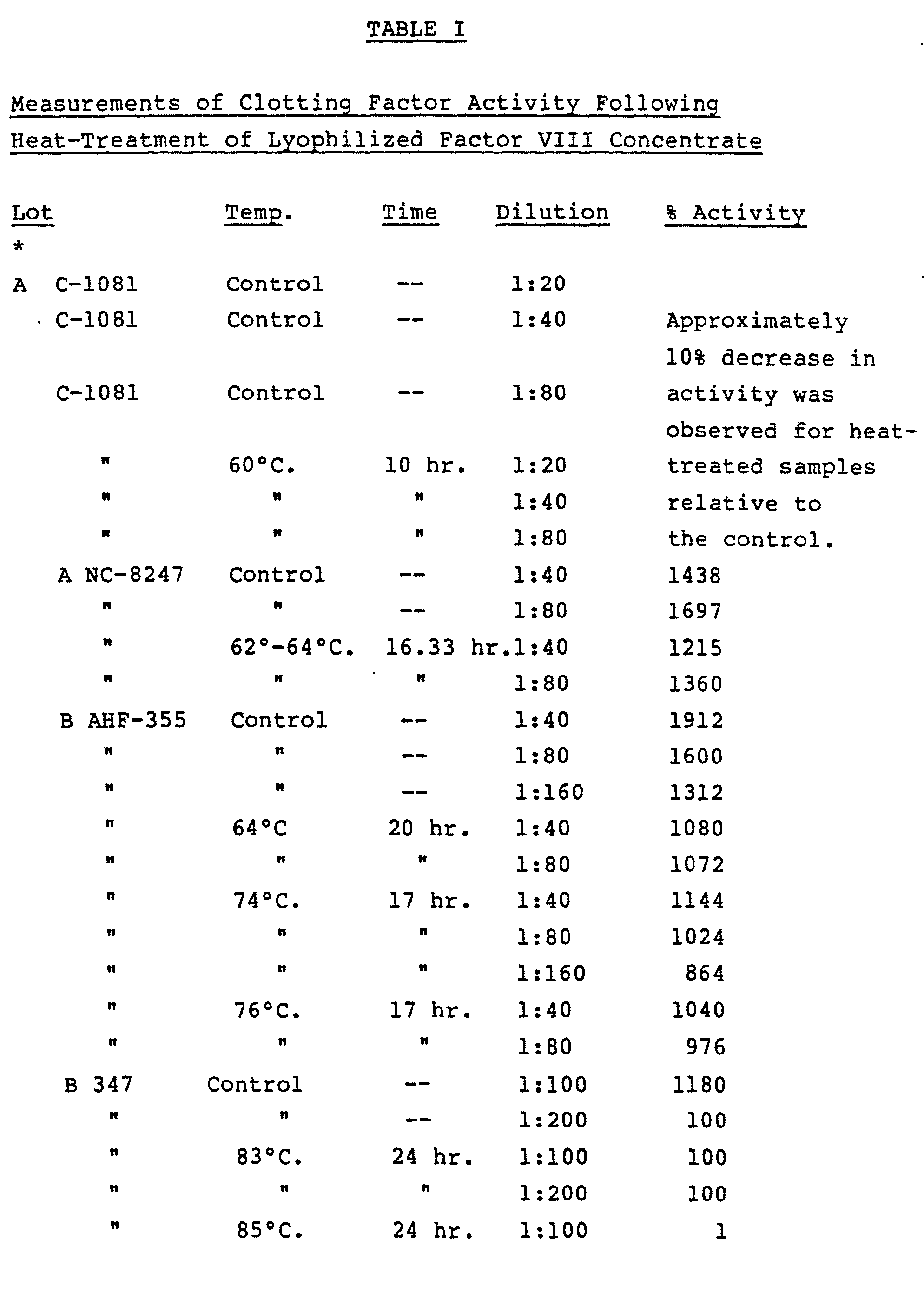
- Results of the in vitro testing performed on Factor VIII concentrate are summarized in Tables I and II:


- Results of the testing performed on fibrinogen concentrate are summarized in Table IV:


- The results summarized in Tables I-IV can be combined to provide a relative indication of clotting activity retention and fibrinogen recovery in lyophilized plasma fractions subjected to the heat-treatment process of the present invention. More particularly, the percentage activity or measured recovery at various dilutions of reconstituted Factor VIII, Factor IX and fibrinogen concentrates can be averaged for individual control samples and compared with similarly-averaged percentage activity or measured recovery in corresponding paired samples of heat-treated Factor VIII, Factor IX and fibrinogen concentrate. Where such comparisons are made, it can be seen, for example, that lyophilized Factor VIII concentrate obtained from one manufacturer (Lot No. A C-1081) and heated at 60° C. for 10 hours retained greated than 90% of its in vitro Factor VIII clotting activity in comparison to an unheated control. The reconstituted, heat-treated Factor VIII concentrate further exhibited an absorbance of 0.30 at 580 nm in comparison to an absorbance of 0.20 for the unheated control, and showed no differences relative to the unheated control following immunoelectrophoresis with the goat antihuman serum. Reconstituted Factor VIII concentrates from a different lot (Lot No. A NC-8747) of the same manufacturer, which had been heated in lyophilized form at 62° - 64° C. for approximately 16 hours and then stored at 6 C. for seven days, showed greater than 80% recovery of Factor VIII clotting activity in comparison to an unheated control. An overall increase in anodal migration relative to the unheated control was noted following immunoelectropheresis against goat antihuman serum.
- In similar fashion, lyophilized Factor VIII concentrate obtained from a second manufacturer (Lot No. C Al-1120), when heated at approximately 78° C. for 21 hours, showed 62% in vitro retention of clotting activity upon reconstitution as compared to an unheated control. Reconstituted Factor VIII concentrate from the same lot of the second manufacturer, after heat treatment in lyophilized form for 20 hours at approximately 80° C. still retained 57% in vitro clotting activity as compared to an unheated control, whereas reconstituted Factor VIII from the same lot of the second manufacturer, which had previously been heated in lyophilized form for one and one-half hour at approximately 100° C., retained approximately 52% in vitro clotting activity as compared to an unheated control. When a different lot (Lot No. C Al-1150) of lyophilized Factor VIII concentrate from the second manufacturer was heat-treated in accordance with the present invention, in vitro recoveries of clotting activity in comparison to the unheated control ranged from 67% for 26 hours and 20 minutes of heat treatment at 65° C. to 34% for 24 hours of heat treatment at 83° C. to 55% for 24 hours of heat treatment at 85° C. Measurements of Factor VIII antigen for the two samples of Factor VIII concentrate heat-treated at 83° C. and 85° C. respectively showed a 15% loss and no loss in antigen levels. It should also be noted that greatly improved solubilization of the latter sample of heat-treated Factor VIII concentrate was achieved by adding between 50 ml and 75 ml of sterile water to the sample rather than the 25 ml recommended by the manufacturer.
- Heat treatment of lyophilized Factor VIII samples obtained from a third manufacturer (Lot No. AHF-355) confirmed results obserbed for the first two manufacturers. That is, heat treatment of the third manufacturer's lyophilized Factor VIII concentrate for 20 hours at 64° C. yielded clotting activity recovery of 61% in comparison to an unheated control, heat treatment of the same concentrate for 17 hours at 74° C. yielded clotting activity recovery of 63% and heat treatment of the same concentrate for 17 hours at 76° C. yielded clotting activity recovery of 57%. Factor VIII antigen levels in the reconstituted samples heated at 64° C. and 74° C showed no decrease when compared to the unheated control level.
- A sample of lyophilized Factor IX concentrate obtained from the first manufacturer (Lot No. A 9-C0044) and immersed in a water bath at 100° C. for 20-30 minutes yielded essentially full in vitro recovery of clotting activity when compared to an unheated control. Factor II and Factor VII both appeared stable 2 hours following reconstitution of the heat-treated sample, while Factor IX decreased approximately 20% within 6 days of reconstitution. Absorbance measurements obtained 2 hours after reconstitution yielded values of 0.006 to 0.007 at 580 mm for both control and heat-treated samples. No visual difference could be detected between the heat-treated concentrate and the unheated control following immunoelectrophoresis of the Factor IX concentrate against goat anti-human serum. Additional samples of Factor IX concentrate from the first manufacturer, which were respectively heat-treated in lyophilized form at 100° C. for 12 hours and at 110° C. for 13 hours, also showed full recovery of Factor IX clotting activity, although complete solubilization of the latter sample required 40 ml to 60 ml greater of sterile water as opposed to the manufacturer's recommended 20 ml. The data from Table III thus suggests that Factor IX concentrate in lyophilized form is largely heat stable for 4 hours at temperatures between 100° C..-110* C.
- A sample of lyophilized fibrinogen concentrate obtained from a fourth manufacturer (Lot No. D-003678) and heat-treated for 11 hours at 60° C. showed no in vitro loss of fibrinogen when compared with an unheated control. A sample of lyophilized fibrinogen concentrate obtained from the same manufacturer, when heat-treated for 17 hours at 60°C., showed a fibrinogen recovery of 97% compard with the unheated control. Samples of lyophilized fibrinogen concentrates obtained from a fifth manufacturer (Lot E), when heated for 10 and 23 hours respectively at 60° G. and 65° C., showed no in vitro loss of fibrinogen relative to the unheated control, while a sample of lyophilized fibrinogen concentrate from the fifth manufacturer showed 74% fibrinogen recovery compared to the control following heat treatment for 3 hours at 100° C.
- As previously indicated, in vivo testing of heat-treated Factor VIII and Factor IX concentrates was carried out using hemophilia A or Factor VIII deficient and hemophilia B or Factor IX deficient dogs. The hemophilia A dog received reconstituted Factor VIII concentrate which had previously been heat-treated in lyophilized form at 60° C. for 10 hours, while the hemophilia B dog received reconstituted Factor Ix concentrate which had previously been heat-treated at 100° C. for 3 to 4 hours. Results of the in vivo testing are reported in Tables V and VI below.


- The results reported in Table V amply illustrate the marked increase in Factor VIII clotting activity for a hemophilia A dog following injection of heat-treated Factor VIII concentrate. Similarly, the results reported in Table VI amply illustrate the Factor IX recovery observed in a hemophilia B dog following injection of heat-treated Factor IX concentrate. The apparent absence of physiological stress or other adverse reaction as seen from the data in Tables V and VI suggests that Factor VIII and Factor IX concentrates which have been processed according to the steps of the present invention remain biologically acceptable.
- It has now been demonstrated that plasma fractions such as Factor VIII and Factor IX concentrates of varying purity can be safely heat-treated in lyophilized form at elevated temperatures for extended periods of time without significantly destroying the clotting activity of the concentrates. It has further been demostrated that plasma fractions such as fibrinogen of varying purity can be safely heat-treated in lyophilized form at elevated temperatures for extended periods of time without destroying the recoverability of the fibrinogen. Visual obvervations confirm that the solubility of lyophilized Factor VIII, Factor IX and fibrinogen concentrates is not deleteriously affected by heat-treatment inasmuch as the amount of sterile water added to the lyophilized concentrate samples during reconstitution can simply be increased until complete solubility is achieved. Consequently, through suitable adjustment of the heating temperature, length of heating and purity levels involved, hepatitis virus of both the B type and the non-A, non-B type can be inactivated in plasma fractions while maintaining the viability and therapeutic integrity of the fractions. Given the additional fact that hepatitis B virus and probably non-A, non-B hepatitis virus are preferentially distributed in the clotting factor fractions, i.e., in Factor VIII and Factor IX concentrates, heat treatment of the clotting factor fractions in lyophilized form at suitable temperatures for suitable periods of time can also serve to render the hepatitis virus immunogenic as well as non-infectious. As a consequence, reconstituted heat-treated lyophilized Factor VIII and Factor IX concentrates can function as hepatitis vaccines while simultaenously providing the therapeutic benefits otherwise associated with clotting factor fractions.
- It should, moreover, be apparent from extrapolation of the test results reported in Tables I-VI that the method of the present invention can be performed at essentially any point during the plasma fractionation process. That is, at any point along the fractionation process where a plasma derivative can be lyophilized, heat treatment of the plasma derivative can be performed and the derivative resolubilized or reconstituted prior to continuation of the fractionation process. Thus, for example, where Factor VIII concentrate is ultimately derived from a plasma fractionation scheme such as that disclosed in Mammen, et al., "Treatment of Bleeding Disorders with Blood Components," Reviews of Hematology, Vol 1, p. 144 (1980), cryoprecipitate obtained from fresh frozen plasma, clarified extract obtained from cryoprecipitate and supernatant obtained from clarified extract can all be lyophilized and heat-treated in the same manner as the Factor VIII concentrate itself. Selection of an appropriate point in the plasma fractionation scheme for applying the heat treatment can then be based on pragmatic considerations such as cost or convenience.
- Within other exemplary embodiments of the invention are the inactivation of the undesirable microorganisms such as a virus related to AIDS, namely Acquired Immune Deficiency Syndrome, cytomegalovirus and Epstein-Barr virus.
- Furthermore different drying techniques could be employed to the plasma compositions such as plasma fractions, namely spray drying or vacuum drying.
- The addition of sterile water to dry or lyophilized plasma in degrees greater than the volumes suggested by manufacturers creates plasma solutions of greater dilution than normally recommended; however, the effectiveness of the plasma and its constituents is not noticeably deteriorated. This is particularly useful where the temperatures to which the plasma composition is to be heated to non-activate undesirable microorganisms, such as viruses, is so high that clotting of the reconstituted plasma would normally occur unless the excess sterile water is added.
- A particularly significant use of the process herein is the treatment of AHF-enriched compositions. Such compositions contain concentrations of AHF on a total protein weight basis that exceed those concentrations found in plasma or other conventional plasma protein fractions such as prothrombin complex (Factor IX concentrates), gamma globulin, albumin, fibrinogen or anti- throbmin III. Such high AHF concentrations are needed to ensure that when the compositions are dissolved in water or other physiologically acceptable carrier that they can correct the patient's clotting abnormality sufficiently to demonstrate a favorable clincal effect, without requiring the infusion of excess water or extraneous proteins. Generally, a therapeutically effective dose of AHF can be determined readily by those skilled in the art. It will depend upon the clinical state of the patient, particularly the type of bleed encountered. Ordinarily, sufficient AHF should be infused to produce a patient plasma AHF level of at least 30% of that present in normal individuals, although for serious hemorrhages levels of 50% or more are preferred. This may be accomplished by infusion of a total number of AHF units as defined by the formula: Units required = body weight (kg) x 0.4 x desired AHF increase (in % of normal).
- The AHF concentration in the infusate should preferably not exceed 34 units/ml, but should be greater than 15 units/ml. If the concentration exceeds 34 units/ml, no more than 2 ml per minute should be infused. Infusated with less than 34 AHF units can be infused more rapidly, on the order of 10 to 20 ml over a 3 minute period. An AHF unit is defined as the activity of AHF present in l.ml of normal pooled human plasma less than 1 hour old.
- The AHF-enriched compositions ordinarily will contain greater than about 20 AHF units usually greater than about 300 AHF units/gram of protein. Obviously, the greater the AHF purity the more desirable the product. Compositions containing about from 100 to 2000 AHF units/ gram of protein are most feasible commercially.
- The AHF compositions may be freed of other plasma proteins to varying degrees during the purification process, depending upon the process used. Such plasma proteins include the blood clotting enzymes (herein meaning both the inactive proenzymes and the activated enzymes) such as prothrombin complex or Factor IX concentrate (Factors II, VII, IX and X). Factors XII or XIII, fibrinogen, albumin and gamma globulin. When an AHF composition is essentially free of blood clotting enzymes it contains subtherapeutic activities of the enzymes. The AHF compositions may be purified to a level in which the activity of any blood clotting enzyme is at a trace level, generally less than about 15 units/gram of protein, and preferably less than about 5 units/gram of protein. The ratio of AHF units to any individual enzyme unit activity in such compositions ordinarily ranges from about 10:1 to 500:1, and is preferably greater than 300:1. A unit of enzyme activity for each of the various clotting enzymes in their activitated or proenzyme forms are defined in PCT International Application WO 82/03871 (published November 11, 1982).
- The heat-treated AHF compositions herein are principally administered to patients having a congential deficiency of AHF. These patients fail to synthesize biologically active AHF, and are to be distinguished from those having acquired AHF inhibitors (probably antibodies) which also cause the symptoms of hemophilia. The latter group is preferrably treated with activated clotting enzyme compositions. The clotting enzyme compositions contain therapeutically effective amounts of the enzymes. However, the compositions herein generally will not contain such amounts of blood clotting enzymes, but instead essentially rely upon AHF activity for hemostasis.
- The improved AHF compositions herein contain suci., lower quantities of denatured AHF than produced using prior processes. Generally, the amount of denatured AHF is less than about 50% of the total active and denatured AHF in the composition. Preferably it ranges about from 30% to 10%. The amount of denatured AHF is equivalent to the precent loss in AHF units after the virus-infected AHF composition is subjected to the heat treatment method described herein.
- The effect of heating virus-contaminated AHF in the dry state may be followed by assaying the AHF clotting activity, as described above, and the viral titer. Where it is difficult to measure biologically active viral titer, as in the case of hepatitis viruses, candidate virus such as bacteriophage, sindbis, adenovirus or EHC virus may be employed as disclosed in PCT International Application WO 82/03871 (published November 11, 1982. A predetermined titer of the candidate virus is seeded into a solution of the composition to be heat treated, the solution lyophilized and various heat treatments undertaken. One selects the point at which actual measurements or regression analysis (statistical extrapolation) indicate the desired degree of viral inactivation as the conditions which will govern heat treatment of the product. These conditions generally will be the time and temperature of viral inactivation, although the moisture content of the composition will also be a variable that should be controlled. Time and temperature are described above. The moisture content should be below 5% by weight, ordinarily less than 1% by weight.
- While some inactivation and denaturation of AHF takes place in the dry state heating process, it occurs at a lesser rate than the inactivation of even the more hardy candidate viruses or hepatitis virus. Thus, the infected AHF composition may be rendered substantially free of the virus in infectious form. This means that the titer of virus is reduced so low that infusion of therapeutic quantities of the product into a plurality of normal animal hosts for the virus will fail to produce clinical or serological evidence of infection in a host population, or will delay significantly the onset of infection in such population. Where an equivalent tissue culture assay is available to determine biological infectivity, it may be used in place of normal animal hosts as indicia of infectivity.
- The mild dry state heating process herein preserves substantially all of the antigenicity of the infectious microbes, i.e. the epitopic sites on the organisms are not irreversibly denatured. This is in contrast to other methods involving covalent reactions with chemical substances, high energy irradiation or excessive heating.
- The heating step may be accomplished in closed or open containers, as noted above, and is most efficaciously accomplished by simple, inexpensive techniques such as contact heating of the product containers, as in ovens or water or sand baths, or by infrared irradiation. For safety and for reasons of expense microwave heating is not preferred.
- Several embodiments of the present invention have been illustrated hereinabove. It is to be understood, however, that various modifications to the temperature ranges, heating periods and purity levels set forth in conjunction with the aforementioned embodiments can be made by those skilled in the art without departing from the scope and spirit of the present invention. It is therefore the intention of the inventpr to be bounded only by the limits of the following claims.
Claims (62)
Applications Claiming Priority (2)
| Application Number | Priority Date | Filing Date | Title |
|---|---|---|---|
| US377863 | 1982-05-13 | ||
| US06377863 US4456590B2 (en) | 1981-11-02 | 1982-05-13 | Heat treatment of lyphilized blood clotting factor viii concentrate |
Related Child Applications (3)
| Application Number | Title | Priority Date | Filing Date |
|---|---|---|---|
| EP85103962.8 Division-Into | 1983-05-11 | ||
| EP85103962A Division-Into EP0171506B1 (en) | 1982-05-13 | 1983-05-11 | A method for the heat treatment of plasma or plasma fractions and compositions obtained thereby |
| EP85103962A Division EP0171506B1 (en) | 1982-05-13 | 1983-05-11 | A method for the heat treatment of plasma or plasma fractions and compositions obtained thereby |
Publications (3)
| Publication Number | Publication Date |
|---|---|
| EP0094611A2 true EP0094611A2 (en) | 1983-11-23 |
| EP0094611A3 EP0094611A3 (en) | 1984-08-22 |
| EP0094611B1 EP0094611B1 (en) | 1986-06-11 |
Family
ID=23490802
Family Applications (2)
| Application Number | Title | Priority Date | Filing Date |
|---|---|---|---|
| EP85103962A Expired - Lifetime EP0171506B1 (en) | 1982-05-13 | 1983-05-11 | A method for the heat treatment of plasma or plasma fractions and compositions obtained thereby |
| EP83104642A Expired EP0094611B1 (en) | 1982-05-13 | 1983-05-11 | A method for the heat treatment of plasma of plasma fractions and compositions obtained thereby |
Family Applications Before (1)
| Application Number | Title | Priority Date | Filing Date |
|---|---|---|---|
| EP85103962A Expired - Lifetime EP0171506B1 (en) | 1982-05-13 | 1983-05-11 | A method for the heat treatment of plasma or plasma fractions and compositions obtained thereby |
Country Status (19)
| Country | Link |
|---|---|
| US (1) | US4456590B2 (en) |
| EP (2) | EP0171506B1 (en) |
| JP (1) | JPS58213721A (en) |
| AR (1) | AR230186A1 (en) |
| AT (1) | AT392905B (en) |
| AU (3) | AU554282B2 (en) |
| BE (1) | BE896724A (en) |
| BR (1) | BR8302504A (en) |
| CA (1) | CA1203165A (en) |
| CH (1) | CH665125A5 (en) |
| DE (3) | DE3364057D1 (en) |
| DK (1) | DK171796B1 (en) |
| ES (5) | ES522310A0 (en) |
| FR (1) | FR2526660B1 (en) |
| GB (2) | GB2120254B (en) |
| IE (1) | IE55008B1 (en) |
| LU (1) | LU84804A1 (en) |
| MX (1) | MX172861B (en) |
| ZA (1) | ZA833315B (en) |
Cited By (21)
| Publication number | Priority date | Publication date | Assignee | Title |
|---|---|---|---|---|
| EP0110407A3 (en) * | 1982-12-02 | 1985-05-08 | Armour Pharmaceutical Corporation | Hepatitis b and non-a-non-b-safe biological products |
| EP0142059A3 (en) * | 1983-10-19 | 1985-07-03 | Green Cross Corporation | Method of heat-treating plasma proteins |
| EP0159311A1 (en) * | 1984-03-09 | 1985-10-23 | IMMUNO Aktiengesellschaft für chemisch-medizinische Produkte | Method for inactivating pathogens in blood products |
| EP0159749A1 (en) * | 1984-04-04 | 1985-10-30 | Stichting Centraal Laboratorium van de Bloedtransfusiedienst van het Nederlandse Rode Kruis | Activated hepatitis B surface antigen product |
| EP0183674A1 (en) * | 1984-09-28 | 1986-06-04 | IMMUNO Aktiengesellschaft für chemisch-medizinische Produkte | Method for inactivating filterable pathogens |
| EP0177836A3 (en) * | 1984-09-25 | 1986-10-08 | The Green Cross Corporation | Process for the virus-inactivation of immunoglobulin |
| EP0212040A1 (en) * | 1985-08-05 | 1987-03-04 | IMMUNO Aktiengesellschaft für chemisch-medizinische Produkte | Process for producing preparations based on blood coagulation factors |
| WO1987003813A1 (en) * | 1985-12-20 | 1987-07-02 | Nordisk Gentofte A/S | A PROCESS FOR INACTIVATING THERMALLY SENSITIVE, PATHOGENIC, BLOOD-CARRIED VIRA IN IgG PREPARATIONS |
| AT385657B (en) * | 1984-03-09 | 1988-05-10 | Immuno Ag | METHOD FOR INACTIVATING VARIABLE FILTERABLE DISEASERS IN BLOOD PRODUCTS |
| EP0217662A3 (en) * | 1985-09-30 | 1989-04-12 | Stanley E. Charm | High temperature, short time heating method and apparatus for sterilizing heat-sensitive biologicals fluids |
| EP0225581A3 (en) * | 1985-11-30 | 1989-05-24 | Green Cross Corporation | Method for the heat-treatment of immunoglobulins and immunoglobulin product |
| US5410022A (en) * | 1992-04-24 | 1995-04-25 | Immuno Aktiengesellschaft | Method of producing a factor VIII preparation |
| DE4441167C1 (en) * | 1994-11-18 | 1996-03-14 | Fraunhofer Ges Forschung | Prodn. of blood plasma as virus free dry granulate |
| US5614405A (en) * | 1991-06-20 | 1997-03-25 | Immuno Aktiengesellschaft | Method of determining the virus inactivation capacity of an inactivation treatment |
| US5614493A (en) * | 1993-06-18 | 1997-03-25 | Immuno Ag | Use of human protein C for prevention and treatment of depositions of thrombocytes |
| US5639730A (en) * | 1992-12-16 | 1997-06-17 | Immuno Aktiengesellschaft | Method of producing a virus-safe biological preparation |
| EP0812858A1 (en) * | 1996-06-11 | 1997-12-17 | Biotest Pharma Gmbh | Process for the preparation of a composition containing factor VIII |
| EP0844005A1 (en) * | 1996-11-21 | 1998-05-27 | Bayer Corporation | Dry-heat viral inactivation under controlled moisture conditions |
| US6632648B1 (en) | 1996-05-14 | 2003-10-14 | Elan Drug Delivery Limited | Methods of terminal sterilization of fibrinogen |
| FR2894830A1 (en) * | 2005-12-19 | 2007-06-22 | Lab Francais Du Fractionnement | METHOD FOR VIRAL INACTIVATION BY DRY HEATING ACCORDING TO THE VITREOUS TRANSITION TEMPERATURE |
| US7727743B2 (en) | 2003-07-09 | 2010-06-01 | Laboratoire Francais Du Fractionnement Et Des Biotechnologies | Method for stabilizing a cryoprecipitate of plasmatic proteins for being subjected to a viral inactivation thermal treatment |
Families Citing this family (34)
| Publication number | Priority date | Publication date | Assignee | Title |
|---|---|---|---|---|
| US4495278A (en) * | 1981-04-27 | 1985-01-22 | Baxter Travenol Laboratories, Inc. | Process for making novel blood clotting enzyme compositions |
| US4994438A (en) * | 1981-11-02 | 1991-02-19 | Cedars Sinai Medical Center | Heat treatment of lyophilized plasma fractions |
| US4456590B2 (en) * | 1981-11-02 | 1989-05-30 | Heat treatment of lyphilized blood clotting factor viii concentrate | |
| DE3230849A1 (en) * | 1982-08-19 | 1984-02-23 | Behringwerke Ag, 3550 Marburg | PASTEURIZED HUMAN FIBRINOGEN (HF) AND METHOD FOR THE PRODUCTION THEREOF |
| US4615886A (en) * | 1983-08-31 | 1986-10-07 | The United States Of America As Represented By The Secretary Of The Department Of Health & Human Services | Utilizing a halohydrocarbon containing dissolved water to inactivate a lipid virus |
| US4490361A (en) * | 1983-12-02 | 1984-12-25 | Alpha Therapeutic Corporation | Virus inactivating heat treatment of plasma fractions |
| WO1985004407A1 (en) * | 1984-03-23 | 1985-10-10 | Baxter Travenol Laboratories, Inc. | Virus risk-reduced hemoglobin and method for making same |
| US4831012A (en) * | 1984-03-23 | 1989-05-16 | Baxter International Inc. | Purified hemoglobin solutions and method for making same |
| US5281579A (en) * | 1984-03-23 | 1994-01-25 | Baxter International Inc. | Purified virus-free hemoglobin solutions and method for making same |
| US5185160A (en) * | 1984-06-21 | 1993-02-09 | Prp, Inc. | Platelet membrane microvesicles |
| AT390373B (en) * | 1984-10-02 | 1990-04-25 | Schwab & Co Gmbh | METHOD FOR PASTEURIZING PLASMA PROTEINS OR OF PLASMA PROTEIN FRACTIONS |
| DK155886D0 (en) * | 1986-04-04 | 1986-04-04 | Bo Arne Hofmann | VACCINE AND PROCEDURE FOR PREPARING THIS |
| AT391808B (en) * | 1986-11-03 | 1990-12-10 | Immuno Ag | METHOD FOR PRODUCING A FACTOR VIII (AHF) CONTAINING FRACTION |
| US5118795A (en) * | 1987-05-15 | 1992-06-02 | University Of Southern California | Sequential heat treatment of blood-clotting factor products |
| AU2251288A (en) * | 1987-05-15 | 1988-12-06 | Alan I. Rubinstein | Sequential improved method for treatment of human blood- clotting factor products |
| US5099002A (en) * | 1987-05-15 | 1992-03-24 | University Of Southern California | Sequential improved method for treatment of human blood-clotting factor products |
| US5097018A (en) * | 1988-05-12 | 1992-03-17 | University Of Southern California | Sequential heat treatment of blood-clotting factor products |
| US4876241A (en) * | 1987-05-22 | 1989-10-24 | Armour Pharmaceutical Company | Stabilization of biological and pharmaceutical products during thermal inactivation of viral and bacterial contaminants |
| US4861867A (en) * | 1988-02-03 | 1989-08-29 | Baxter International, Inc. | Purified hemoglobin solutions and method for making same |
| CA2007545A1 (en) * | 1989-01-13 | 1990-07-13 | Yahiro Uemura | Production method for protein-containing composition |
| US5332578A (en) * | 1989-04-14 | 1994-07-26 | Prp, Inc. | Platelet membrane microparticles |
| JPH06166634A (en) * | 1992-12-01 | 1994-06-14 | Green Cross Corp:The | Method for producing composition containing plasminogen |
| DE4404625C2 (en) * | 1994-02-14 | 1996-10-17 | Ludwig Dr Baumgartner | Method for inactivating thermolabile viruses in biological material while maintaining the collagenic properties |
| US20030143518A1 (en) * | 1994-11-18 | 2003-07-31 | Fraunhofer-Gesellschaft Zur Foerderung Der Angewandten Forschung E.V. | Method of drying blood plasma |
| GB9424732D0 (en) * | 1994-12-08 | 1995-02-08 | Common Services Agency | Heat treated blood plasma proteins |
| US5741894A (en) * | 1995-09-22 | 1998-04-21 | Baxter International, Inc. | Preparation of pharmaceutical grade hemoglobins by heat treatment in partially oxygenated form |
| US5659017A (en) * | 1995-11-07 | 1997-08-19 | Alpha Therapeutic Corporation | Anion exchange process for the purification of Factor VIII |
| CA2634663C (en) | 1999-02-22 | 2009-08-25 | University Of Connecticut | Novel albumin-free factor viii formulations |
| JP4663837B2 (en) * | 1999-12-24 | 2011-04-06 | 一般財団法人化学及血清療法研究所 | Pharmaceutical composition for preventing / treating bleeding disorders associated with thrombocytopenia, comprising factor VIII as the main component |
| RU2174841C1 (en) * | 2000-06-06 | 2001-10-20 | Российский научно-исследовательский институт гематологии и трансфузиологии | Method of normal plasma pool preparing |
| HUE031042T2 (en) | 2005-07-29 | 2017-06-28 | Abbott Laboratories Gmbh | Processes for the manufacture of pancreatin powder with low virus content |
| EP2385825B1 (en) | 2008-11-07 | 2018-10-10 | University of Connecticut | Factor viii formulations |
| CN111295094A (en) | 2017-10-09 | 2020-06-16 | 泰尔茂比司特生物技术有限公司 | Freeze-drying container and method of using freeze-drying container |
| WO2020185916A1 (en) | 2019-03-14 | 2020-09-17 | Terumo Bct Biotechnologies, Llc | Lyophilization container fill fixture, system and method of use |
Family Cites Families (16)
| Publication number | Priority date | Publication date | Assignee | Title |
|---|---|---|---|---|
| US3100737A (en) * | 1958-02-05 | 1963-08-13 | Auerswald Wilhelm | Method of preparing a plasma protein solution free of active hepatitis virus and product produced thereby |
| US3041242A (en) * | 1958-06-17 | 1962-06-26 | Sr Courtland H Barr | Gas and heat sterilization of dried human plasma |
| DE1617350C3 (en) * | 1967-06-22 | 1979-09-06 | Behringwerke Ag, 3550 Marburg | Process for the inactivation of biological material |
| US3859168A (en) * | 1967-06-22 | 1975-01-07 | Behringwerke Ag | Process of inactivating rabies virus |
| US3579631A (en) * | 1968-05-21 | 1971-05-18 | Aubrey P Stewart Jr | Sterilization of materials containing protein |
| GB1471336A (en) * | 1973-04-16 | 1977-04-21 | Armour Pharma | Process for the purification and sterilisation of acidophilic biologicals- |
| US3998516A (en) * | 1973-05-15 | 1976-12-21 | Mabuchi Motor Co. Ltd. | Adapter |
| JPS6015B2 (en) * | 1977-07-16 | 1985-01-05 | 株式会社新潟鐵工所 | Method for producing sterilized blood powder that is water-soluble and thermocoagulable |
| US4250139A (en) * | 1979-02-01 | 1981-02-10 | Collagen Corporation | Microwave sterilization of dry protein |
| DE2916711A1 (en) * | 1979-04-25 | 1980-11-06 | Behringwerke Ag | Blood coagulation factors and process for their manufacture |
| JPS56135418A (en) * | 1980-03-27 | 1981-10-22 | Green Cross Corp:The | Heat treatment of aqueous solution containing 8 factor of coagulation of blood derived from human |
| DE3043857A1 (en) * | 1980-11-21 | 1982-07-08 | Behringwerke Ag, 3550 Marburg | METHOD FOR THE PRODUCTION OF BLOOD coagulation FACTORS AND THE PREPARATION OF FACTORS II AND VII THEREFORE PRODUCED |
| DE3045153A1 (en) * | 1980-11-29 | 1982-07-08 | Behringwerke Ag, 3550 Marburg | METHOD FOR THE PRODUCTION OF BLOOD COagulation FACTORS AND THE PREPARATION OF FACTORS IX AND X THEREFORE PRODUCED |
| JPS57140724A (en) * | 1981-02-25 | 1982-08-31 | Green Cross Corp:The | Heat-treatment of aqueous solution containing cold insoluble globulin |
| US4495278A (en) * | 1981-04-27 | 1985-01-22 | Baxter Travenol Laboratories, Inc. | Process for making novel blood clotting enzyme compositions |
| US4456590B2 (en) * | 1981-11-02 | 1989-05-30 | Heat treatment of lyphilized blood clotting factor viii concentrate |
-
1982
- 1982-05-13 US US06377863 patent/US4456590B2/en not_active Expired - Lifetime
-
1983
- 1983-05-09 IE IE1068/83A patent/IE55008B1/en not_active IP Right Cessation
- 1983-05-10 ZA ZA833315A patent/ZA833315B/en unknown
- 1983-05-10 AU AU14421/83A patent/AU554282B2/en not_active Expired
- 1983-05-11 BE BE0/210752A patent/BE896724A/en not_active IP Right Cessation
- 1983-05-11 EP EP85103962A patent/EP0171506B1/en not_active Expired - Lifetime
- 1983-05-11 DE DE8383104642T patent/DE3364057D1/en not_active Expired
- 1983-05-11 DE DE198585103962T patent/DE171506T1/en active Pending
- 1983-05-11 AR AR29298783A patent/AR230186A1/en active
- 1983-05-11 GB GB8312915A patent/GB2120254B/en not_active Expired
- 1983-05-11 DK DK210283A patent/DK171796B1/en not_active IP Right Cessation
- 1983-05-11 CH CH2598/83A patent/CH665125A5/en not_active IP Right Cessation
- 1983-05-11 EP EP83104642A patent/EP0094611B1/en not_active Expired
- 1983-05-11 DE DE85103962T patent/DE3382716T2/en not_active Expired - Fee Related
- 1983-05-12 MX MX026844A patent/MX172861B/en unknown
- 1983-05-12 BR BR8302504A patent/BR8302504A/en unknown
- 1983-05-12 CA CA000427988A patent/CA1203165A/en not_active Expired
- 1983-05-12 JP JP58083434A patent/JPS58213721A/en active Pending
- 1983-05-12 ES ES522310A patent/ES522310A0/en active Granted
- 1983-05-13 LU LU84804A patent/LU84804A1/en unknown
- 1983-05-13 FR FR8308000A patent/FR2526660B1/en not_active Expired
- 1983-05-13 AT AT1767/83A patent/AT392905B/en not_active IP Right Cessation
- 1983-12-05 GB GB8332374A patent/GB2144428B/en not_active Expired
-
1984
- 1984-09-07 ES ES535745A patent/ES535745A0/en active Granted
- 1984-12-19 ES ES538801A patent/ES8601699A1/en not_active Expired
- 1984-12-19 ES ES538803A patent/ES538803A0/en active Granted
- 1984-12-19 ES ES538802A patent/ES538802A0/en active Granted
-
1986
- 1986-05-21 AU AU57659/86A patent/AU569428B2/en not_active Expired
- 1986-05-21 AU AU57660/86A patent/AU568979B2/en not_active Expired
Cited By (28)
| Publication number | Priority date | Publication date | Assignee | Title |
|---|---|---|---|---|
| EP0110407A3 (en) * | 1982-12-02 | 1985-05-08 | Armour Pharmaceutical Corporation | Hepatitis b and non-a-non-b-safe biological products |
| EP0142059A3 (en) * | 1983-10-19 | 1985-07-03 | Green Cross Corporation | Method of heat-treating plasma proteins |
| AT389815B (en) * | 1984-03-09 | 1990-02-12 | Immuno Ag | METHOD FOR INACTIVATING VARIABLE FILTERABLE DISEASERS IN BLOOD PRODUCTS |
| EP0159311A1 (en) * | 1984-03-09 | 1985-10-23 | IMMUNO Aktiengesellschaft für chemisch-medizinische Produkte | Method for inactivating pathogens in blood products |
| US4640834A (en) * | 1984-03-09 | 1987-02-03 | Immuno Aktiengesellschaft Fur Chemisch-Medizinische Produkte | Method of inactivating reproducible filterable pathogens in blood products as well as a method of producing blood products |
| AT385657B (en) * | 1984-03-09 | 1988-05-10 | Immuno Ag | METHOD FOR INACTIVATING VARIABLE FILTERABLE DISEASERS IN BLOOD PRODUCTS |
| EP0159749A1 (en) * | 1984-04-04 | 1985-10-30 | Stichting Centraal Laboratorium van de Bloedtransfusiedienst van het Nederlandse Rode Kruis | Activated hepatitis B surface antigen product |
| EP0177836A3 (en) * | 1984-09-25 | 1986-10-08 | The Green Cross Corporation | Process for the virus-inactivation of immunoglobulin |
| US4721777A (en) * | 1984-09-25 | 1988-01-26 | The Green Cross Corporation | Process for the virus-inactivation of immunoglobulin |
| EP0183674A1 (en) * | 1984-09-28 | 1986-06-04 | IMMUNO Aktiengesellschaft für chemisch-medizinische Produkte | Method for inactivating filterable pathogens |
| EP0212040A1 (en) * | 1985-08-05 | 1987-03-04 | IMMUNO Aktiengesellschaft für chemisch-medizinische Produkte | Process for producing preparations based on blood coagulation factors |
| EP0217662A3 (en) * | 1985-09-30 | 1989-04-12 | Stanley E. Charm | High temperature, short time heating method and apparatus for sterilizing heat-sensitive biologicals fluids |
| EP0225581A3 (en) * | 1985-11-30 | 1989-05-24 | Green Cross Corporation | Method for the heat-treatment of immunoglobulins and immunoglobulin product |
| WO1987003813A1 (en) * | 1985-12-20 | 1987-07-02 | Nordisk Gentofte A/S | A PROCESS FOR INACTIVATING THERMALLY SENSITIVE, PATHOGENIC, BLOOD-CARRIED VIRA IN IgG PREPARATIONS |
| US5614405A (en) * | 1991-06-20 | 1997-03-25 | Immuno Aktiengesellschaft | Method of determining the virus inactivation capacity of an inactivation treatment |
| US5864016A (en) * | 1991-06-20 | 1999-01-26 | Immuno Aktiengesellschaft | Blood product, a method of producing the same and a method of determining the virus inactivation capacity of an inactivation treatment |
| US5410022A (en) * | 1992-04-24 | 1995-04-25 | Immuno Aktiengesellschaft | Method of producing a factor VIII preparation |
| US5639730A (en) * | 1992-12-16 | 1997-06-17 | Immuno Aktiengesellschaft | Method of producing a virus-safe biological preparation |
| US5733885A (en) * | 1992-12-16 | 1998-03-31 | Immuno Aktiengesellschaft | Method of producing a virus-safe biological preparation |
| US5614493A (en) * | 1993-06-18 | 1997-03-25 | Immuno Ag | Use of human protein C for prevention and treatment of depositions of thrombocytes |
| DE4441167C1 (en) * | 1994-11-18 | 1996-03-14 | Fraunhofer Ges Forschung | Prodn. of blood plasma as virus free dry granulate |
| US6632648B1 (en) | 1996-05-14 | 2003-10-14 | Elan Drug Delivery Limited | Methods of terminal sterilization of fibrinogen |
| EP0812858A1 (en) * | 1996-06-11 | 1997-12-17 | Biotest Pharma Gmbh | Process for the preparation of a composition containing factor VIII |
| EP0844005A1 (en) * | 1996-11-21 | 1998-05-27 | Bayer Corporation | Dry-heat viral inactivation under controlled moisture conditions |
| US7727743B2 (en) | 2003-07-09 | 2010-06-01 | Laboratoire Francais Du Fractionnement Et Des Biotechnologies | Method for stabilizing a cryoprecipitate of plasmatic proteins for being subjected to a viral inactivation thermal treatment |
| FR2894830A1 (en) * | 2005-12-19 | 2007-06-22 | Lab Francais Du Fractionnement | METHOD FOR VIRAL INACTIVATION BY DRY HEATING ACCORDING TO THE VITREOUS TRANSITION TEMPERATURE |
| WO2007071845A3 (en) * | 2005-12-19 | 2007-08-16 | Lab Francais Du Fractionnement | Method for viral inactivation by dry heating based on glass transition temperature |
| US8252227B2 (en) | 2005-12-19 | 2012-08-28 | Laboratoire Francais Du Fractionnement Et Des Biotechnologies | Invention relates to a method of viral inactivation by dry heating |
Also Published As
Similar Documents
| Publication | Publication Date | Title |
|---|---|---|
| EP0094611B1 (en) | A method for the heat treatment of plasma of plasma fractions and compositions obtained thereby | |
| CA1223203A (en) | Protein compositions substantially free from infectious agents | |
| JP3512163B2 (en) | Determination of virus inactivation ability | |
| Edwards et al. | Tri (n-butyl) phosphate/detergent treatment of licensed therapeutic and experimental blood derivatives | |
| EP0177836B1 (en) | Process for the inactivation of virus in immunoglobulins | |
| JPH0739348B2 (en) | A method for inactivating a pathogenic pathogen having proliferation in a blood product and a method for producing a blood product | |
| US5733885A (en) | Method of producing a virus-safe biological preparation | |
| US4490361A (en) | Virus inactivating heat treatment of plasma fractions | |
| JPH0611702B2 (en) | Method for heat treatment of therapeutically active protein composition | |
| Hart et al. | Effect of terminal (dry) heat treatment on non-enveloped viruses in coagulation factor concentrates | |
| Ng et al. | Pasteurization of antihemophilic factor and model virus inactivation studies | |
| US4556558A (en) | Treatment of factor VIII concentrate to minimize the affect of undesirable microorganisms | |
| JP2879427B2 (en) | Stabilization of biological and pharmaceutical products during thermal inactivation of viral and bacterial contaminants | |
| Purcell et al. | Hepatitis B virus, hepatitis non‐A, non‐B virus and hepatitis delta virus in lyophilized antihemophilic factor: relative sensitivity to heat | |
| US4994438A (en) | Heat treatment of lyophilized plasma fractions | |
| US4845074A (en) | Heat treatment of Factor VIII | |
| CA1207662A (en) | Hepatitis b and non-a-non-b-safe biological products | |
| IE55182B1 (en) | Heat treatment of plasma | |
| WO1988008710A1 (en) | Sequential improved method for treatment of human blood-clotting factor products | |
| WO1991001138A1 (en) | Sequential heat treatment of blood-clotting factor products | |
| AU663641B2 (en) | A blood product, a method of producing the same and a method of determining the virus inactivation capacity of an inactivation treatment | |
| Mozen | HIV inactivation in plasma products | |
| JPH09286798A (en) | Method for producing active protein composition |
Legal Events
| Date | Code | Title | Description |
|---|---|---|---|
| PUAI | Public reference made under article 153(3) epc to a published international application that has entered the european phase |
Free format text: ORIGINAL CODE: 0009012 |
|
| AK | Designated contracting states |
Designated state(s): DE IT NL SE |
|
| PUAL | Search report despatched |
Free format text: ORIGINAL CODE: 0009013 |
|
| AK | Designated contracting states |
Designated state(s): DE IT NL SE |
|
| 17P | Request for examination filed |
Effective date: 19841026 |
|
| ITCL | It: translation for ep claims filed |
Representative=s name: BARZANO' E ZANARDO MILANO S.P.A. |
|
| TCNL | Nl: translation of patent claims filed | ||
| GRAA | (expected) grant |
Free format text: ORIGINAL CODE: 0009210 |
|
| AK | Designated contracting states |
Kind code of ref document: B1 Designated state(s): DE IT NL SE |
|
| ITF | It: translation for a ep patent filed | ||
| REF | Corresponds to: |
Ref document number: 3364057 Country of ref document: DE Date of ref document: 19860717 |
|
| PLBI | Opposition filed |
Free format text: ORIGINAL CODE: 0009260 |
|
| PLBI | Opposition filed |
Free format text: ORIGINAL CODE: 0009260 |
|
| 26 | Opposition filed |
Opponent name: IMMUNO AKTIENGESELLSCHAFT FUER CHEMISCH-MEDIZINISC Effective date: 19870226 |
|
| 26 | Opposition filed |
Opponent name: YAMADA, HIDEO Effective date: 19870311 Opponent name: RORER GROUP, INC. Effective date: 19870310 Opponent name: KABIVITRUM AB Effective date: 19870309 Opponent name: CENTRAL BLOOD LABORATORIES AUTHORITY 'THE CREST' Effective date: 19870305 |
|
| NLR1 | Nl: opposition has been filed with the epo |
Opponent name: YAMADA, HIDEO Opponent name: RORER GROUP, INC. Opponent name: KABIVITRUM AB Opponent name: CENTRAL BLOOD LABORATORIES AUTHORITY :THE CREST : Opponent name: IMMUNO A.G.FUER CHEMISCH - MEDIZINISCHE PRODUKTE |
|
| PLAB | Opposition data, opponent's data or that of the opponent's representative modified |
Free format text: ORIGINAL CODE: 0009299OPPO |
|
| R26 | Opposition filed (corrected) |
Opponent name: IMMUNO AKTIENGESELLSCHAFT FUER CHEMISCH-MEDIZINISC Effective date: 19870226 |
|
| PLAB | Opposition data, opponent's data or that of the opponent's representative modified |
Free format text: ORIGINAL CODE: 0009299OPPO |
|
| R26 | Opposition filed (corrected) |
Opponent name: IMMUNO AKTIENGESELLSCHAFT FUER CHEMISCH-MEDIZINISC Effective date: 19870226 |
|
| PLAB | Opposition data, opponent's data or that of the opponent's representative modified |
Free format text: ORIGINAL CODE: 0009299OPPO |
|
| R26 | Opposition filed (corrected) |
Opponent name: IMMUNO AKTIENGESELLSCHAFT * 870305 CENTRAL BLOOD L Effective date: 19870226 |
|
| NLXE | Nl: other communications concerning ep-patents (part 3 heading xe) |
Free format text: IN PAT.BUL.10/87,CORR.:IMMUNO AG. AND THE NAME OF THE OPPONENT III CORR.:KABI PHARMACIA AB |
|
| ITTA | It: last paid annual fee | ||
| PLAB | Opposition data, opponent's data or that of the opponent's representative modified |
Free format text: ORIGINAL CODE: 0009299OPPO |
|
| R26 | Opposition filed (corrected) |
Opponent name: IMMUNO AKTIENGESELLSCHAFT * 870305 CENTRAL BLOOD L Effective date: 19870226 |
|
| EAL | Se: european patent in force in sweden |
Ref document number: 83104642.0 |
|
| NLXE | Nl: other communications concerning ep-patents (part 3 heading xe) |
Free format text: PAT.BUL.18/91 CORR.:PHARMACIA AKTIEBOLAG |
|
| APAC | Appeal dossier modified |
Free format text: ORIGINAL CODE: EPIDOS NOAPO |
|
| APAC | Appeal dossier modified |
Free format text: ORIGINAL CODE: EPIDOS NOAPO |
|
| PGFP | Annual fee paid to national office [announced via postgrant information from national office to epo] |
Ref country code: NL Payment date: 19980324 Year of fee payment: 16 |
|
| PGFP | Annual fee paid to national office [announced via postgrant information from national office to epo] |
Ref country code: DE Payment date: 19980529 Year of fee payment: 16 |
|
| APAC | Appeal dossier modified |
Free format text: ORIGINAL CODE: EPIDOS NOAPO |
|
| PLAW | Interlocutory decision in opposition |
Free format text: ORIGINAL CODE: EPIDOS IDOP |
|
| RDAH | Patent revoked |
Free format text: ORIGINAL CODE: EPIDOS REVO |
|
| RDAG | Patent revoked |
Free format text: ORIGINAL CODE: 0009271 |
|
| STAA | Information on the status of an ep patent application or granted ep patent |
Free format text: STATUS: PATENT REVOKED |
|
| 27W | Patent revoked |
Effective date: 19981118 |
|
| NLR2 | Nl: decision of opposition | ||
| PGFP | Annual fee paid to national office [announced via postgrant information from national office to epo] |
Ref country code: SE Payment date: 20000425 Year of fee payment: 18 |
|
| APAH | Appeal reference modified |
Free format text: ORIGINAL CODE: EPIDOSCREFNO |
|
| PLAB | Opposition data, opponent's data or that of the opponent's representative modified |
Free format text: ORIGINAL CODE: 0009299OPPO |