EP0095313B1 - Fühler für brennbares Gas und dessen Herstellung - Google Patents
Fühler für brennbares Gas und dessen Herstellung Download PDFInfo
- Publication number
- EP0095313B1 EP0095313B1 EP83302807A EP83302807A EP0095313B1 EP 0095313 B1 EP0095313 B1 EP 0095313B1 EP 83302807 A EP83302807 A EP 83302807A EP 83302807 A EP83302807 A EP 83302807A EP 0095313 B1 EP0095313 B1 EP 0095313B1
- Authority
- EP
- European Patent Office
- Prior art keywords
- gas
- detecting element
- sulfate
- gas detecting
- sensitivity
- Prior art date
- Legal status (The legal status is an assumption and is not a legal conclusion. Google has not performed a legal analysis and makes no representation as to the accuracy of the status listed.)
- Expired
Links
- 238000004519 manufacturing process Methods 0.000 title claims description 9
- 239000000654 additive Substances 0.000 claims description 22
- 239000000243 solution Substances 0.000 claims description 20
- 239000010931 gold Substances 0.000 claims description 19
- 239000010936 titanium Substances 0.000 claims description 19
- XSQUKJJJFZCRTK-UHFFFAOYSA-N Urea Chemical compound NC(N)=O XSQUKJJJFZCRTK-UHFFFAOYSA-N 0.000 claims description 18
- 238000000034 method Methods 0.000 claims description 17
- 229910052718 tin Inorganic materials 0.000 claims description 16
- 239000004202 carbamide Substances 0.000 claims description 14
- 229910052719 titanium Inorganic materials 0.000 claims description 13
- 229910052737 gold Inorganic materials 0.000 claims description 12
- 229910021653 sulphate ion Inorganic materials 0.000 claims description 12
- BAUYGSIQEAFULO-UHFFFAOYSA-L iron(2+) sulfate (anhydrous) Chemical compound [Fe+2].[O-]S([O-])(=O)=O BAUYGSIQEAFULO-UHFFFAOYSA-L 0.000 claims description 11
- 239000000463 material Substances 0.000 claims description 11
- -1 sulphate ions Chemical class 0.000 claims description 11
- XOLBLPGZBRYERU-UHFFFAOYSA-N SnO2 Inorganic materials O=[Sn]=O XOLBLPGZBRYERU-UHFFFAOYSA-N 0.000 claims description 10
- 229910052793 cadmium Inorganic materials 0.000 claims description 10
- GWEVSGVZZGPLCZ-UHFFFAOYSA-N titanium dioxide Inorganic materials O=[Ti]=O GWEVSGVZZGPLCZ-UHFFFAOYSA-N 0.000 claims description 9
- 238000010438 heat treatment Methods 0.000 claims description 8
- 239000007864 aqueous solution Substances 0.000 claims description 7
- 150000001450 anions Chemical class 0.000 claims description 5
- PCHJSUWPFVWCPO-UHFFFAOYSA-N gold Chemical compound [Au] PCHJSUWPFVWCPO-UHFFFAOYSA-N 0.000 claims description 5
- 230000000996 additive effect Effects 0.000 claims description 4
- 239000002244 precipitate Substances 0.000 claims description 4
- BDOSMKKIYDKNTQ-UHFFFAOYSA-N cadmium atom Chemical compound [Cd] BDOSMKKIYDKNTQ-UHFFFAOYSA-N 0.000 claims description 3
- XEEYBQQBJWHFJM-UHFFFAOYSA-N iron Substances [Fe] XEEYBQQBJWHFJM-UHFFFAOYSA-N 0.000 claims description 3
- ATJFFYVFTNAWJD-UHFFFAOYSA-N Tin Chemical compound [Sn] ATJFFYVFTNAWJD-UHFFFAOYSA-N 0.000 claims description 2
- RTAQQCXQSZGOHL-UHFFFAOYSA-N Titanium Chemical compound [Ti] RTAQQCXQSZGOHL-UHFFFAOYSA-N 0.000 claims description 2
- 238000001035 drying Methods 0.000 claims description 2
- 150000002500 ions Chemical class 0.000 claims description 2
- VSZWPYCFIRKVQL-UHFFFAOYSA-N selanylidenegallium;selenium Chemical compound [Se].[Se]=[Ga].[Se]=[Ga] VSZWPYCFIRKVQL-UHFFFAOYSA-N 0.000 claims description 2
- 239000005569 Iron sulphate Substances 0.000 claims 1
- 239000007789 gas Substances 0.000 description 102
- QAOWNCQODCNURD-UHFFFAOYSA-L Sulfate Chemical compound [O-]S([O-])(=O)=O QAOWNCQODCNURD-UHFFFAOYSA-L 0.000 description 47
- VNWKTOKETHGBQD-UHFFFAOYSA-N methane Chemical compound C VNWKTOKETHGBQD-UHFFFAOYSA-N 0.000 description 36
- 230000035945 sensitivity Effects 0.000 description 32
- UGFAIRIUMAVXCW-UHFFFAOYSA-N Carbon monoxide Chemical compound [O+]#[C-] UGFAIRIUMAVXCW-UHFFFAOYSA-N 0.000 description 20
- 229910002091 carbon monoxide Inorganic materials 0.000 description 20
- 230000000694 effects Effects 0.000 description 17
- 239000000203 mixture Substances 0.000 description 17
- ATUOYWHBWRKTHZ-UHFFFAOYSA-N Propane Chemical compound CCC ATUOYWHBWRKTHZ-UHFFFAOYSA-N 0.000 description 16
- 229910000359 iron(II) sulfate Inorganic materials 0.000 description 13
- UQSXHKLRYXJYBZ-UHFFFAOYSA-N iron oxide Inorganic materials [Fe]=O UQSXHKLRYXJYBZ-UHFFFAOYSA-N 0.000 description 12
- NNPPMTNAJDCUHE-UHFFFAOYSA-N isobutane Chemical compound CC(C)C NNPPMTNAJDCUHE-UHFFFAOYSA-N 0.000 description 12
- 229910052726 zirconium Inorganic materials 0.000 description 12
- 230000008859 change Effects 0.000 description 9
- 239000000843 powder Substances 0.000 description 9
- 239000001257 hydrogen Substances 0.000 description 8
- 229910052739 hydrogen Inorganic materials 0.000 description 8
- 239000002245 particle Substances 0.000 description 8
- 239000001294 propane Substances 0.000 description 8
- RBTARNINKXHZNM-UHFFFAOYSA-K iron trichloride Chemical compound Cl[Fe](Cl)Cl RBTARNINKXHZNM-UHFFFAOYSA-K 0.000 description 7
- 239000004570 mortar (masonry) Substances 0.000 description 7
- NDLPOXTZKUMGOV-UHFFFAOYSA-N oxo(oxoferriooxy)iron hydrate Chemical compound O.O=[Fe]O[Fe]=O NDLPOXTZKUMGOV-UHFFFAOYSA-N 0.000 description 7
- 239000000758 substrate Substances 0.000 description 7
- XLYOFNOQVPJJNP-UHFFFAOYSA-N water Substances O XLYOFNOQVPJJNP-UHFFFAOYSA-N 0.000 description 7
- VYPSYNLAJGMNEJ-UHFFFAOYSA-N Silicium dioxide Chemical compound O=[Si]=O VYPSYNLAJGMNEJ-UHFFFAOYSA-N 0.000 description 6
- 239000003153 chemical reaction reagent Substances 0.000 description 6
- 239000001282 iso-butane Substances 0.000 description 6
- 235000013847 iso-butane Nutrition 0.000 description 6
- 238000005245 sintering Methods 0.000 description 6
- UFHFLCQGNIYNRP-UHFFFAOYSA-N Hydrogen Chemical compound [H][H] UFHFLCQGNIYNRP-UHFFFAOYSA-N 0.000 description 5
- 230000007062 hydrolysis Effects 0.000 description 5
- 238000006460 hydrolysis reaction Methods 0.000 description 5
- SZVJSHCCFOBDDC-UHFFFAOYSA-N iron(II,III) oxide Inorganic materials O=[Fe]O[Fe]O[Fe]=O SZVJSHCCFOBDDC-UHFFFAOYSA-N 0.000 description 5
- 229910052751 metal Inorganic materials 0.000 description 5
- 239000002184 metal Substances 0.000 description 5
- 150000002739 metals Chemical class 0.000 description 5
- 239000007858 starting material Substances 0.000 description 5
- 238000012360 testing method Methods 0.000 description 5
- LFQSCWFLJHTTHZ-UHFFFAOYSA-N Ethanol Chemical compound CCO LFQSCWFLJHTTHZ-UHFFFAOYSA-N 0.000 description 4
- 229910021578 Iron(III) chloride Inorganic materials 0.000 description 4
- 239000011230 binding agent Substances 0.000 description 4
- CXKCTMHTOKXKQT-UHFFFAOYSA-N cadmium oxide Inorganic materials [Cd]=O CXKCTMHTOKXKQT-UHFFFAOYSA-N 0.000 description 4
- CFEAAQFZALKQPA-UHFFFAOYSA-N cadmium(2+);oxygen(2-) Chemical compound [O-2].[Cd+2] CFEAAQFZALKQPA-UHFFFAOYSA-N 0.000 description 4
- 239000003054 catalyst Substances 0.000 description 4
- 238000010348 incorporation Methods 0.000 description 4
- 229910044991 metal oxide Inorganic materials 0.000 description 4
- 150000004706 metal oxides Chemical class 0.000 description 4
- RVTZCBVAJQQJTK-UHFFFAOYSA-N oxygen(2-);zirconium(4+) Chemical compound [O-2].[O-2].[Zr+4] RVTZCBVAJQQJTK-UHFFFAOYSA-N 0.000 description 4
- BASFCYQUMIYNBI-UHFFFAOYSA-N platinum Chemical compound [Pt] BASFCYQUMIYNBI-UHFFFAOYSA-N 0.000 description 4
- 238000001556 precipitation Methods 0.000 description 4
- OTMSDBZUPAUEDD-UHFFFAOYSA-N Ethane Chemical compound CC OTMSDBZUPAUEDD-UHFFFAOYSA-N 0.000 description 3
- 238000004566 IR spectroscopy Methods 0.000 description 3
- 229910017974 NH40H Inorganic materials 0.000 description 3
- 238000000441 X-ray spectroscopy Methods 0.000 description 3
- PNEYBMLMFCGWSK-UHFFFAOYSA-N aluminium oxide Inorganic materials [O-2].[O-2].[O-2].[Al+3].[Al+3] PNEYBMLMFCGWSK-UHFFFAOYSA-N 0.000 description 3
- BFNBIHQBYMNNAN-UHFFFAOYSA-N ammonium sulfate Chemical compound N.N.OS(O)(=O)=O BFNBIHQBYMNNAN-UHFFFAOYSA-N 0.000 description 3
- 229910052921 ammonium sulfate Inorganic materials 0.000 description 3
- 239000013078 crystal Substances 0.000 description 3
- 238000001514 detection method Methods 0.000 description 3
- 235000003891 ferrous sulphate Nutrition 0.000 description 3
- 239000011790 ferrous sulphate Substances 0.000 description 3
- 150000002431 hydrogen Chemical class 0.000 description 3
- 229910000510 noble metal Inorganic materials 0.000 description 3
- 238000002360 preparation method Methods 0.000 description 3
- 230000008569 process Effects 0.000 description 3
- 239000004065 semiconductor Substances 0.000 description 3
- 238000001179 sorption measurement Methods 0.000 description 3
- VEXZGXHMUGYJMC-UHFFFAOYSA-M Chloride anion Chemical compound [Cl-] VEXZGXHMUGYJMC-UHFFFAOYSA-M 0.000 description 2
- 229910015400 FeC13 Inorganic materials 0.000 description 2
- 208000005374 Poisoning Diseases 0.000 description 2
- 239000000908 ammonium hydroxide Substances 0.000 description 2
- XGGLLRJQCZROSE-UHFFFAOYSA-K ammonium iron(iii) sulfate Chemical compound [NH4+].[Fe+3].[O-]S([O-])(=O)=O.[O-]S([O-])(=O)=O XGGLLRJQCZROSE-UHFFFAOYSA-K 0.000 description 2
- 235000011130 ammonium sulphate Nutrition 0.000 description 2
- 230000009286 beneficial effect Effects 0.000 description 2
- 238000006243 chemical reaction Methods 0.000 description 2
- 238000002485 combustion reaction Methods 0.000 description 2
- 238000011156 evaluation Methods 0.000 description 2
- 238000004880 explosion Methods 0.000 description 2
- 230000006872 improvement Effects 0.000 description 2
- 150000002505 iron Chemical class 0.000 description 2
- 239000003949 liquefied natural gas Substances 0.000 description 2
- 230000007774 longterm Effects 0.000 description 2
- 239000011812 mixed powder Substances 0.000 description 2
- 230000001473 noxious effect Effects 0.000 description 2
- CMOAHYOGLLEOGO-UHFFFAOYSA-N oxozirconium;dihydrochloride Chemical compound Cl.Cl.[Zr]=O CMOAHYOGLLEOGO-UHFFFAOYSA-N 0.000 description 2
- 229910052697 platinum Inorganic materials 0.000 description 2
- 231100000572 poisoning Toxicity 0.000 description 2
- 230000000607 poisoning effect Effects 0.000 description 2
- 239000000047 product Substances 0.000 description 2
- OGIDPMRJRNCKJF-UHFFFAOYSA-N titanium oxide Inorganic materials [Ti]=O OGIDPMRJRNCKJF-UHFFFAOYSA-N 0.000 description 2
- 238000009834 vaporization Methods 0.000 description 2
- 229910052725 zinc Inorganic materials 0.000 description 2
- 229910001928 zirconium oxide Inorganic materials 0.000 description 2
- VHUUQVKOLVNVRT-UHFFFAOYSA-N Ammonium hydroxide Chemical compound [NH4+].[OH-] VHUUQVKOLVNVRT-UHFFFAOYSA-N 0.000 description 1
- 239000004215 Carbon black (E152) Substances 0.000 description 1
- 208000001408 Carbon monoxide poisoning Diseases 0.000 description 1
- VTLYFUHAOXGGBS-UHFFFAOYSA-N Fe3+ Chemical compound [Fe+3] VTLYFUHAOXGGBS-UHFFFAOYSA-N 0.000 description 1
- 229910004042 HAuCl4 Inorganic materials 0.000 description 1
- 239000002202 Polyethylene glycol Substances 0.000 description 1
- 238000002441 X-ray diffraction Methods 0.000 description 1
- 229910006213 ZrOCl2 Inorganic materials 0.000 description 1
- 239000002253 acid Substances 0.000 description 1
- 239000012190 activator Substances 0.000 description 1
- 239000000853 adhesive Substances 0.000 description 1
- 230000001070 adhesive effect Effects 0.000 description 1
- 238000005054 agglomeration Methods 0.000 description 1
- 230000002776 aggregation Effects 0.000 description 1
- 230000003679 aging effect Effects 0.000 description 1
- 239000012298 atmosphere Substances 0.000 description 1
- 230000015572 biosynthetic process Effects 0.000 description 1
- 230000015271 coagulation Effects 0.000 description 1
- 238000005345 coagulation Methods 0.000 description 1
- 230000003247 decreasing effect Effects 0.000 description 1
- 230000007812 deficiency Effects 0.000 description 1
- 230000002950 deficient Effects 0.000 description 1
- 230000001419 dependent effect Effects 0.000 description 1
- 238000003795 desorption Methods 0.000 description 1
- 238000011161 development Methods 0.000 description 1
- 230000018109 developmental process Effects 0.000 description 1
- 238000009826 distribution Methods 0.000 description 1
- 238000005516 engineering process Methods 0.000 description 1
- 230000002708 enhancing effect Effects 0.000 description 1
- 238000002474 experimental method Methods 0.000 description 1
- 229910001447 ferric ion Inorganic materials 0.000 description 1
- 238000001914 filtration Methods 0.000 description 1
- 238000005469 granulation Methods 0.000 description 1
- 230000003179 granulation Effects 0.000 description 1
- 239000000383 hazardous chemical Substances 0.000 description 1
- 230000036541 health Effects 0.000 description 1
- 231100000206 health hazard Toxicity 0.000 description 1
- 229930195733 hydrocarbon Natural products 0.000 description 1
- 150000002430 hydrocarbons Chemical class 0.000 description 1
- 230000002452 interceptive effect Effects 0.000 description 1
- 229910052742 iron Inorganic materials 0.000 description 1
- 229910000358 iron sulfate Inorganic materials 0.000 description 1
- 230000001788 irregular Effects 0.000 description 1
- 230000035777 life prolongation Effects 0.000 description 1
- 238000005259 measurement Methods 0.000 description 1
- 239000005300 metallic glass Substances 0.000 description 1
- 229910052763 palladium Inorganic materials 0.000 description 1
- 230000000704 physical effect Effects 0.000 description 1
- 229920001223 polyethylene glycol Polymers 0.000 description 1
- 239000002994 raw material Substances 0.000 description 1
- 230000009467 reduction Effects 0.000 description 1
- 238000012827 research and development Methods 0.000 description 1
- 230000004044 response Effects 0.000 description 1
- 230000002441 reversible effect Effects 0.000 description 1
- 229910001925 ruthenium oxide Inorganic materials 0.000 description 1
- WOCIAKWEIIZHES-UHFFFAOYSA-N ruthenium(iv) oxide Chemical compound O=[Ru]=O WOCIAKWEIIZHES-UHFFFAOYSA-N 0.000 description 1
- 230000001235 sensitizing effect Effects 0.000 description 1
- 239000011343 solid material Substances 0.000 description 1
- 239000003381 stabilizer Substances 0.000 description 1
- 238000003756 stirring Methods 0.000 description 1
- 239000000126 substance Substances 0.000 description 1
- HDUMBHAAKGUHAR-UHFFFAOYSA-J titanium(4+);disulfate Chemical compound [Ti+4].[O-]S([O-])(=O)=O.[O-]S([O-])(=O)=O HDUMBHAAKGUHAR-UHFFFAOYSA-J 0.000 description 1
- 230000009466 transformation Effects 0.000 description 1
- 238000007740 vapor deposition Methods 0.000 description 1
Images




Classifications
-
- G—PHYSICS
- G01—MEASURING; TESTING
- G01N—INVESTIGATING OR ANALYSING MATERIALS BY DETERMINING THEIR CHEMICAL OR PHYSICAL PROPERTIES
- G01N27/00—Investigating or analysing materials by the use of electric, electrochemical, or magnetic means
- G01N27/02—Investigating or analysing materials by the use of electric, electrochemical, or magnetic means by investigating impedance
- G01N27/04—Investigating or analysing materials by the use of electric, electrochemical, or magnetic means by investigating impedance by investigating resistance
- G01N27/12—Investigating or analysing materials by the use of electric, electrochemical, or magnetic means by investigating impedance by investigating resistance of a solid body in dependence upon absorption of a fluid; of a solid body in dependence upon reaction with a fluid, for detecting components in the fluid
Definitions
- This invention is concerned with a combustible gas detecting element which changes in its electrical resistance when in contact with a combustible gas, and with a method of making such a detecting element.
- the first of these involves detecting the temperature rise caused by the combustion of the gas on a catalyzer by means of a resistor, such as platinum wire, the electrical resistance of which is dependent on the temperature.
- the second of the methods involves detecting a combustible gas by determining the change in the electrical resistance of a semiconductor following the adsorption of the gas thereon.
- the first method gives an output in proportion to the concentration of gas and accordingly is particularly suitable for gas concentration meters and similar equipment.
- the second method can be used in inexpensive detecting devices and accordingly is particularly suitable for use in gas leak detectors and the like.
- the present invention is concerned with a gas detecting element of the semiconductor type operating by the second method.
- Liquefied natural gas (LNG) containing methane gas as its principal component has come into wide use in homes in many countries and this has led to a great demand for a gas detecting element for selectively detecting methane gas.
- Gas detecting elements for this purpose have been described and even developed, but are subject to a variety of deficiencies such as catalyst poisoning by a range of gases, low selectivity for methane gas, and great dependence upon the ambient humidity because they contain noble metal catalysts as the activators for the responsive material. Such gas detecting elements have not yet proved to be of practical utility.
- noxious gases such as carbon monoxide
- detecting elements having sufficient sensitivity and stability for practical use have not yet been developed.
- the gas concentration to be detected should be as low as 100 ppm, which is approximately one tenth of what is required in the case of other combustible gases, such as methane, propane and hydrogen.
- gamma-ferric oxide (y-Fe 2 0 3 ) having a spinel-type crystalline structure has excellent gas detection characteristics.
- ferric oxide There are various crystalline forms of ferric oxide which are very different from each other in their chemical and physical properties. Among them, the best known is alpha-ferric oxide (a-Fe 2 0 3 ) having a corundum-type crystalline structure; y-Fe 2 0 3 , 0-Fe203, 6-Fe 2 0 3 , etc. are also known. Among these, only y-Fe 2 0 3 actually has useful gas detection characteristics.
- y-Fe 2 0 3 has a high sensitivity to hydrogen, ethane, propane and iso-butane, its sensitivity to methane is not always sufficient.
- Crystalline a-Fe 2 0 3 as commercially available or when made from commercially available materials has a remarkably low sensitivity not only to methane, but also to ethane, propane, iso-butane and carbon monoxide.
- amorphous form of a-Fe 2 0 3 has a high sensitivity to combustible gases, such as methane, and this discovery is the basis of the detecting element described in our European Patent Application 30112.
- This European application describes combustible gas detecting elements in the form of a sintered film or body formed of or comprising an amorphous metal oxide semiconductor, preferably ferric oxide, containing anionic radicals, which are preferably halide ions and sulphate ions.
- Amorphous a-Fe 2 0 3 does not have sufficient stability and durability because it tends to transform into the crystalline form and the purpose of the anions present in the compositions of this European application is to prevent or retard such transformation.
- a further disadvantage of amorphous a-Fe 2 0 3 is that it is not sensitive to carbon monoxide.
- the conventional wet process, involving hydrolysis and precipitation, for making a-Fe 2 0 3 leads to non-uniformity in the particle size of the precipitated crystals and agglomeration of the particles is unavoidable because of microscopic non-uniformity of the precipitant concentration in the solution. These factors increase the instability and lack of durability of a-Fe 2 0 3 .
- ferric oxide which are characterised in that the ferric oxide is in the y- and/or a-crystal form and has an average grain size of less than 0.5 microns (pm) and a porosity of 35 to 85%.
- ferric oxide being prepared by hydrolysis and precipitation from aqueous solutions of ferrous sulphate, but the final sintering temperatures used to make the sintered film or sintered body are either below the vaporisation temperature of sulphate ion so that the element obtained contains much more than 10% by weight of sulphate ion (Example 5) or above such vaporisation temperature so that the element contains less than 0.005% by weight of sulphate ion (Examples 1-4).
- a combustible gas detecting element which comprises a sintered body or film of crystalline a-Fe 2 0 3 containing sulphate ions (S04 -), characterised in that the concentration of sulphate ions therein is from 0.005 to 10% by weight.
- the sensitivity of crystalline a-Fe 2 0 3 can be further increased by the incorporation of one or more of the quadrivalent metals, tin (Sn), zirconium (Zr), and titanium (Ti), the total amount of such additive(s) being from 0.1 to 50 mole %, calculated as Sn0 2 , Zr0 2 and Ti0 2 .
- Detecting elements containing one or more of Sn, Zr and Ti can be rendered particularly sensitive to carbon monoxide, that is so that they can detect carbon monoxide at concentrations as low as 100 ppm, by the incorporation of 1 to 20% by weight of cadmium (Cd), as CdO, and/or 0.1 to 10% by weight of gold (Au).
- Cd cadmium
- Au gold
- a method of making a combustible gas detecting material which comprises adding urea to an aqueous solution containing Fe ions and at least sulphate ions as an anion, heating the solution, and drying the resulting precipitate to obtain a gas sensitive material which can be sintered to form a gas detecting element according to the invention.
- This method gives rise to crystalline a-Fe 2 0 3 with an extremely uniform microstructure; this material has excellent stability and long term durability.
- Powdered ferrous sulfate (Fe2SO4. 7H 2 0) was added to commercial alpha-ferric oxide (a-Fe 2 0 3 ) reagent, as a sulfate ion donor at various addition levels, and each of the mixtures was granulated with an organic binder to produce several samples having a particle diameter of 100 to 200 microns.
- a-Fe 2 0 3 commercial alpha-ferric oxide
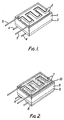
- Gold was then deposited by vacuum vapor deposition on the surface of the body 1 to form a pair of comb-shaped electrodes 2 and each electrode 2 was provided with a connecting electrode 5.
- a platinum heating element 3 with electrodes 4 was affixed to the other side of the body 1 with an inorganic adhesive to complete a sensor element. An electric current was passed to the heating element through the electrodes 4 and the current value was adjusted to control the operating temperature of the element. With the element temperature maintained at 400°C, the change in resistance between electrodes 5 was examined to determine the gas sensitive properties of the sensor element.
- the resistance in air (Ra) was determined in a 50-liter cell in which dry air was gently stirred, while the resistance in gas (Rg) was determined by introducing into the above cell a gas of at least 99% purity, i.e. methane (CH 4 ), propane (C 3 H 8 ), isobutane (i-C 4 H 10 ) or hydrogen (H 2 ) at the rate of 10 ppm/sec each (volume ratio) and measuring the resistance when the concentration of the gas had reached 0.2 volume percent.
- a gas of at least 99% purity i.e. methane (CH 4 ), propane (C 3 H 8 ), isobutane (i-C 4 H 10 ) or hydrogen (H 2 )
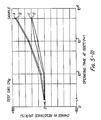
- Alumina substrates 6 (see Fig. 2) 6.5 mm by 5 mm and 0.5 mm thick were prepared as substrates for gas sensor elements and the surface of each substrate was printed with a gold paste in a comb-shaped pattern at a spacing of 0.5 mm and heat treated to give a pair of comb-shaped electrodes 7.
- a commercially available glazed ruthenium oxide heater composition was printed and heat treated to form a heater 9 and the latter was provided with power supply electrodes 8.
- the ferric oxide/ion sulphate paste referred to above was printed on the "top" surface of the substrate 6 in a thickness of about 70 microns, and after allowing to dry at room temperature, the substrate was heated gradually to a temperature of 400°C and maintained at this temperature for 1 hour. By this stage, the binder of the paste had evaporated and the Fe 3 0 4 had been oxidized to form gamma-Fe 2 0 3 .
- the film was further heat treated at a temperature of 600°C for 1 hour to convert the gamma-Fe 2 0 3 to alpha-Fe 2 0 3 , whereby a sintered film 10 of alpha-Fe 2 0 3 containing sulfate ions was obtained.
- the final thickness of the sintered film was about 60 microns.
- the sulfate ion content of the gas-sensitive film was determined as follows. A portion of each of the above pastes, instead of being printed on an alumina substrate, was directly heated gradually to a temperature of 400°C in the same manner as above and TG-DTA and fluorescent X-ray spectroscopy were carried out. The determination of sulfate ions was made by infrared absorption spectroscopy as in Example 1.
- alpha-Fe 2 0 3 has been thought to be scarcely sensitive to combustible gases (refer to No. 1 in Tables 1 and 2). But alpha-Fe 2 0 3 can be rendered highly sensitive to the gases by the addition of 0.005 to 10.0 weight percent of sulfate ion thereto. Further, as explained in Examples 1 and 2, a high sensitivity can be obtained by an extremely simple method, i.e. merely adding iron sulfate.
- iron (II) sulfate as a sulfate ion donor is used in the foregoing Examples 1 and 2, any other materials containing sulfate ion can also be used.
- Examples 1 and 2 the commercial Fe 2 0 3 and Fe 3 0 4 reagents were used as starting materials, and iron (II) sulfate was used as a sulfate ion donor.
- iron (II) sulfate was used as a sulfate ion donor.
- alpha-Fe 2 0 3 containing sulfate ion can also be obtained by heat-treating the powder obtained from an iron salt containing sulfate ion by hydrolysis and precipitation.
- the element Since the gas detecting element should be heated with a minimum of electric power, the element is also generally constructed as small as possible. Therefore, the uniformity of the composition and microstructure of the element becomes an important factor. The lack of uniformity may result in a variation in characteristics among the elements, an instability in long-time life characteristics of the element and a low reliability thereof.
- alpha-Fe 2 0 3 is prepared from the above-mentioned iron salt by the wet process.
- the manufacturing method according to this invention was established after an extensive study of various kinds of precipitants and a series of fabrication processes.
- the method comprises adding urea [(NH 2 ) 2 CO] to an aqueous solution containing iron ion and, as an anion, at least sulfate ion and heating the solution to cause a slow hydrolysis of urea and a consequent gradual increase of pH, thus enabling one to obtain uniform particles.
- the dried sample was milled in an agate mortar for two hours, after which it was granulated with an organic binder to prepare particles each having a diameter of 100 to 200 microns.
- This granulated powder was pressed and sintered in the same manner as in Example 1 to produce a detecting element.
- This element is represented for convenience as Sample A.
- Sample C 80 g of commercial iron (III) chloride [FeCl 3 ⁇ 6H 2 0], 40 g of ammonium sulfate [(NH 4 ) 2 SO 4] and 60 g of urea [(NH 2 ) 2 CO] were dissolved in 1 liter of water and the solution was stirred with heating over a hot plate. The heating was effected for 3 hours at a temperature of 90°C. The pH at the time was 7.0. Thereafter, the same method as used for Samples A and B was employed to produce a detecting element.
- Sample D 96 g of commercial iron (III) ammonium sulfate and 60 g of urea [(NH 2 ) 2 CO] were dissolved in 1 liter of water and the solution was stirred with heating over a hot plate. Thereafter, the same method as used for Sample C was employed to produce a detecting element.
- Samples A through D were compared to one another under two conditions.
- the elements were operated at a standard operating temperature.
- the elements were maintained under a thermally accelerated condition i.e., at a temperature of 600°C which is much higher than the standard operating temperature of 400°C.
- methane and hydrogen were used as the test gases.
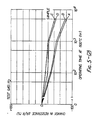
- the evaluation of the characteristics variation was performed by examining resistance changes from an initial value. The results of (a) and (b) are shown in Figs. 4 and 5, respectively.
- the production method according to this invention utilizes the precipitation reaction involving hydrolysis of urea in the preparation of material powders for gas sensing bodies.
- the shape and diameter of each of the obtained powders are considerably uniform. This makes a scatter in gas sensing properties among the detecting elements considerably small and permits production of a detecting element which is capable of retaining extremely stable characteristics for a long operating time at a high temperature.
- a highly reliable combustible gas detecting element is provided, contributing much to gas security technology.
- Example 2 To this mixture was added an organic binder, followed by granulation to the size of 100 to 200 microns. Then, in the same manner as Example 1, several samples containing Sn0 2 , Zr0 2 or Ti0 2 in different amounts and/or combinations were prepared.
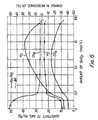
- Figs. 6 through 8 show the addition level dependency of gas sensitive properties in the cases of single addition of said additives.
- the gas sensitive characteristic was evaluated in terms of (i) gas sensitivity (Ra/Rg) and (ii) change in resistance vs. operating time (AR) (the percent change relative to the initial value in the resistance of the element after operating at 400°C for 2000 hours).
- the metal oxide partially in amorphous state is liable to be more active in physicochemical reactions such as adsorption phenomenon.
- the substantially 100% crystallized commercial a-Fe 2 0 3 as used in this example displays very high activity on incorporation of sulfate ions and addition of Sn, Zr or Ti.
- this activity remains stable without aging effects, the element made thereof affords an extremely high gas sensitivity and a high reliability as a consequence.
- Example 4 the cases in which the amount of sulfate ion was unvaried but additives were varied in amount and/or combination were described.
- Example 5 which follows, the kind and level of addition of such additives were held constant but the amount of sulfate ion was varied.
- this invention is still valid even when the gas sensitive element is in the form of a sintered film and the influence of the amount of sulfate ion on gas sensitive properties will be described.
- the detecting elements described in Examples 4 and 5 are either sintered bodies or sintered films each based on a-Fe 2 0 3 and containing sulfate ions and Sn, Zr and/or Ti, and the incorporation of sulfate ion and the addition of said additive metals result in a remarkable enhancement of gas sensitivity.
- methane gas the detection of which in trace amounts could hardly be accomplished without the employment of a noble metal catalyst, a very high sensitivity can now be realized even at a comparatively low temperature of 400°C.
- Another effect that can be obtained by the use of such additives is a remarkable life prolongation effect, i.e. a drastic reduction of change in resistance vs. operating time. In other words, this means a great contribution to the enhancement of reliability which is the most important factor in gas detecting elements for practical use.
- This powder was divided into 12 aliquots. Then, commercial cadmium oxide (CdO) and chloroauric acid (HAuCl 4 ⁇ 4H 2 0) were respectively dissolved in water to prepare solutions of 100 mg/ml concentration. These solutions were added to the above-mentioned aliquots at the addition levels indicated in Table 7, and each mixture was milled in an agate mortar. Using these 12 powders, the procedure of Example 1 was repeated to prepare sintered elements. In this example, however, the sintering temperature and the operating temperature were 500°C and 350°C, respectively. As the test gases, carbon monoxide (CO), methane (CH 4 ), propane (C 3 H 8 ) and hydrogen (H 2 ) were employed. The allowable concentration of CO for human health is generally acknowledged to be 100 ppm. Therefore, the evaluation of gas sensitivity was made at the concentration level of 100 ppm for all the gases mentioned so that a definite direct comparison could be made among them.
- CO carbon monoxide
- CH 4 me
- This Example pertains to cases in which all of the metals in the first additive group, namely Sn, Zr and Ti, are contained in the compositions but the above-described effect of addition of Cd and/or Au is not limited to such cases but is realized in cases where at least one of Sn, Zr and Ti is contained. This will be demonstrated using several typical samples prepared in the same manner as Example 6. In these cases, the amounts of Cd and Au were held constant. The results are shown in Table 8.
- the gas detecting element of this invention was constructed in the form of a sintered body or a sintered film, both as produced by sintering in the atmospheric air.
- this invention is not specifically limited by sintering conditions such as sintering temperature, time and atmosphere but rather any sintering conditions can be employed only if products are made available in the form of sintered bodies or films.
- Example 3 sets forth the effect of using urea as a precipitant for the preparation of raw materials for the gas detecting element, this effect of urea is manifested not only in the absence of additives as in Example 3 but also in the presence of additives such as Sn, Zr and Ti and/or Cd and Au.
Landscapes
- Chemical & Material Sciences (AREA)
- Chemical Kinetics & Catalysis (AREA)
- Electrochemistry (AREA)
- Physics & Mathematics (AREA)
- Health & Medical Sciences (AREA)
- Life Sciences & Earth Sciences (AREA)
- Analytical Chemistry (AREA)
- Biochemistry (AREA)
- General Health & Medical Sciences (AREA)
- General Physics & Mathematics (AREA)
- Immunology (AREA)
- Pathology (AREA)
- Investigating Or Analyzing Materials By The Use Of Fluid Adsorption Or Reactions (AREA)
Claims (5)
Applications Claiming Priority (6)
| Application Number | Priority Date | Filing Date | Title |
|---|---|---|---|
| JP83443/82 | 1982-05-17 | ||
| JP57083443A JPS58200151A (ja) | 1982-05-17 | 1982-05-17 | ガス検知素子 |
| JP144512/82 | 1982-08-19 | ||
| JP57144512A JPS5934140A (ja) | 1982-08-19 | 1982-08-19 | ガス感応体材料の製造方法 |
| JP57168768A JPS5957153A (ja) | 1982-09-27 | 1982-09-27 | ガス検知素子 |
| JP168768/82 | 1982-09-27 |
Publications (3)
| Publication Number | Publication Date |
|---|---|
| EP0095313A2 EP0095313A2 (de) | 1983-11-30 |
| EP0095313A3 EP0095313A3 (en) | 1984-09-05 |
| EP0095313B1 true EP0095313B1 (de) | 1989-03-22 |
Family
ID=27304226
Family Applications (1)
| Application Number | Title | Priority Date | Filing Date |
|---|---|---|---|
| EP83302807A Expired EP0095313B1 (de) | 1982-05-17 | 1983-05-17 | Fühler für brennbares Gas und dessen Herstellung |
Country Status (3)
| Country | Link |
|---|---|
| US (1) | US4732738A (de) |
| EP (1) | EP0095313B1 (de) |
| DE (1) | DE3379481D1 (de) |
Families Citing this family (12)
| Publication number | Priority date | Publication date | Assignee | Title |
|---|---|---|---|---|
| KR960016712B1 (ko) * | 1986-11-05 | 1996-12-20 | 오오니시 마사후미 | 가스센서 및 그의 제조방법 |
| DE3914294A1 (de) * | 1989-04-29 | 1990-10-31 | Gutec Gmbh | Traegerkatalysatoren zur oxidation von kohlenmonoxid |
| DE4009575A1 (de) * | 1989-06-22 | 1991-01-03 | Gutec Gmbh | Traegerkatalysator zur oxidation von kohlenmonoxid |
| US4953387A (en) * | 1989-07-31 | 1990-09-04 | The Regents Of The University Of Michigan | Ultrathin-film gas detector |
| DE4100915A1 (de) * | 1991-01-15 | 1992-07-16 | Bosch Gmbh Robert | Sensor fuer die bestimmung von kohlenmonoxid |
| US5767388A (en) * | 1995-04-26 | 1998-06-16 | Siemens Aktiengesellschaft | Methane sensor and method for operating a sensor |
| US5764150A (en) * | 1996-04-10 | 1998-06-09 | Fleury; Byron | Gas alarm |
| US5966065A (en) * | 1996-06-27 | 1999-10-12 | Tdk Corporation | Core for inductance elements and its production method |
| US6787047B1 (en) * | 1997-03-13 | 2004-09-07 | Robert Bosch Gmbh | Methods for manufacturing a microstructured sensor |
| US7694547B2 (en) * | 2007-03-01 | 2010-04-13 | The Ohio State University Research Foundation | Robust high temperature composite and CO sensor made from such composite |
| DE102016201193A1 (de) * | 2016-01-27 | 2017-07-27 | Technische Universität München | Gedruckte Sensorvorrichtung zum Detektieren von Medien |
| CN116626114B (zh) * | 2023-07-25 | 2023-10-20 | 南方电网数字电网研究院有限公司 | C2h6传感器、制备方法、气体检测装置及应用 |
Family Cites Families (9)
| Publication number | Priority date | Publication date | Assignee | Title |
|---|---|---|---|---|
| DE5480C (de) * | K. R. RUNQJIST in Stockholm | Oscillations-Regulator | ||
| US3999947A (en) * | 1974-10-11 | 1976-12-28 | Matsushita Electric Industrial Co., Ltd. | Reducing gas sensor and a method of producing the same |
| DE2651160C3 (de) * | 1975-11-08 | 1979-05-31 | Matsushita Electric Industrial Co., Ltd., Kadoma, Osaka (Japan) | Sensor für reduzierende Gase |
| US4045178A (en) * | 1975-11-08 | 1977-08-30 | Matsushita Electric Industrial Co., Ltd. | Reducing gas sensor |
| JPS5853862B2 (ja) * | 1978-02-20 | 1983-12-01 | 松下電器産業株式会社 | 可燃性ガス検知素子 |
| JPS5848058B2 (ja) * | 1978-04-21 | 1983-10-26 | 松下電器産業株式会社 | 可燃性ガス検知素子 |
| DE2821266A1 (de) * | 1978-05-16 | 1979-11-22 | Siemens Ag | Gassensoren |
| AU518932B2 (en) * | 1979-07-06 | 1981-10-29 | Matsushita Electric Industrial Co., Ltd. | Combustible gas sensor |
| JPS5674646A (en) * | 1979-11-24 | 1981-06-20 | Matsushita Electric Ind Co Ltd | Combustible gas detecting element |
-
1983
- 1983-05-17 EP EP83302807A patent/EP0095313B1/de not_active Expired
- 1983-05-17 DE DE8383302807T patent/DE3379481D1/de not_active Expired
- 1983-05-17 US US06/496,492 patent/US4732738A/en not_active Expired - Lifetime
Also Published As
| Publication number | Publication date |
|---|---|
| DE3379481D1 (en) | 1989-04-27 |
| US4732738A (en) | 1988-03-22 |
| EP0095313A3 (en) | 1984-09-05 |
| EP0095313A2 (de) | 1983-11-30 |
Similar Documents
| Publication | Publication Date | Title |
|---|---|---|
| EP0095313B1 (de) | Fühler für brennbares Gas und dessen Herstellung | |
| Coles et al. | Selectivity studies on tin oxide-based semiconductor gas sensors | |
| US4194994A (en) | Sintered metal oxide semiconductor having electrical conductivity highly sensitive to oxygen partial pressure | |
| EP0022369B1 (de) | Detektorelemente für brennbare Gase | |
| US11692987B2 (en) | CoCr2O4-based gas sensor and method for manufacturing the same | |
| Zou et al. | Solution combustion synthesis and enhanced gas sensing properties of porous In 2 O 3/ZnO heterostructures | |
| EP0030112B1 (de) | Detektoren für brennbares Gas | |
| JPH0389162A (ja) | 可燃性ガス検知材料、及び可燃性ガス検知方法 | |
| JPH027025B2 (de) | ||
| JP3919306B2 (ja) | 炭化水素ガス検知素子 | |
| KR890001982B1 (ko) | α-Fe_2O_3 계 가스 검지 소자 | |
| JPS5957154A (ja) | ガス検知素子 | |
| JPH0230661B2 (ja) | Gasukenchisoshi | |
| JPS623375B2 (de) | ||
| JPH0230662B2 (ja) | Cosensa | |
| JPS6193945A (ja) | 窒素酸化物検出素子 | |
| JPS6152933B2 (de) | ||
| JPS58200152A (ja) | ガス検知素子 | |
| JPS5958352A (ja) | ガス検知素子 | |
| JPS6222420B2 (de) | ||
| JPH0230663B2 (ja) | Gasukenchisoshi | |
| JPS5957149A (ja) | ガス検知素子 | |
| Chadwick | University Chemical Laboratory University of Kent Canterbury | |
| Chadwick | Defect Problems in the Field of Chemical Sensors | |
| JPS5853741B2 (ja) | カネンセイガスケンチソシ |
Legal Events
| Date | Code | Title | Description |
|---|---|---|---|
| PUAI | Public reference made under article 153(3) epc to a published international application that has entered the european phase |
Free format text: ORIGINAL CODE: 0009012 |
|
| AK | Designated contracting states |
Designated state(s): DE FR GB |
|
| PUAL | Search report despatched |
Free format text: ORIGINAL CODE: 0009013 |
|
| AK | Designated contracting states |
Designated state(s): DE FR GB |
|
| 17P | Request for examination filed |
Effective date: 19850306 |
|
| 17Q | First examination report despatched |
Effective date: 19860917 |
|
| D17Q | First examination report despatched (deleted) | ||
| GRAA | (expected) grant |
Free format text: ORIGINAL CODE: 0009210 |
|
| AK | Designated contracting states |
Kind code of ref document: B1 Designated state(s): DE FR GB |
|
| REF | Corresponds to: |
Ref document number: 3379481 Country of ref document: DE Date of ref document: 19890427 |
|
| ET | Fr: translation filed | ||
| PLBE | No opposition filed within time limit |
Free format text: ORIGINAL CODE: 0009261 |
|
| STAA | Information on the status of an ep patent application or granted ep patent |
Free format text: STATUS: NO OPPOSITION FILED WITHIN TIME LIMIT |
|
| 26N | No opposition filed | ||
| PGFP | Annual fee paid to national office [announced via postgrant information from national office to epo] |
Ref country code: GB Payment date: 19950510 Year of fee payment: 13 Ref country code: FR Payment date: 19950510 Year of fee payment: 13 |
|
| PGFP | Annual fee paid to national office [announced via postgrant information from national office to epo] |
Ref country code: DE Payment date: 19950511 Year of fee payment: 13 |
|
| PG25 | Lapsed in a contracting state [announced via postgrant information from national office to epo] |
Ref country code: GB Effective date: 19960517 |
|
| GBPC | Gb: european patent ceased through non-payment of renewal fee |
Effective date: 19960517 |
|
| PG25 | Lapsed in a contracting state [announced via postgrant information from national office to epo] |
Ref country code: FR Effective date: 19970131 |
|
| PG25 | Lapsed in a contracting state [announced via postgrant information from national office to epo] |
Ref country code: DE Effective date: 19970201 |
|
| REG | Reference to a national code |
Ref country code: FR Ref legal event code: ST |