EP0098935A1 - Ätzverfahren mit negativen Ionen - Google Patents
Ätzverfahren mit negativen Ionen Download PDFInfo
- Publication number
- EP0098935A1 EP0098935A1 EP83104579A EP83104579A EP0098935A1 EP 0098935 A1 EP0098935 A1 EP 0098935A1 EP 83104579 A EP83104579 A EP 83104579A EP 83104579 A EP83104579 A EP 83104579A EP 0098935 A1 EP0098935 A1 EP 0098935A1
- Authority
- EP
- European Patent Office
- Prior art keywords
- hydrogen
- substrate
- layer
- target
- negative
- Prior art date
- Legal status (The legal status is an assumption and is not a legal conclusion. Google has not performed a legal analysis and makes no representation as to the accuracy of the status listed.)
- Granted
Links
Images


Classifications
-
- H—ELECTRICITY
- H10—SEMICONDUCTOR DEVICES; ELECTRIC SOLID-STATE DEVICES NOT OTHERWISE PROVIDED FOR
- H10P—GENERIC PROCESSES OR APPARATUS FOR THE MANUFACTURE OR TREATMENT OF DEVICES COVERED BY CLASS H10
- H10P50/00—Etching of wafers, substrates or parts of devices
- H10P50/20—Dry etching; Plasma etching; Reactive-ion etching
- H10P50/24—Dry etching; Plasma etching; Reactive-ion etching of semiconductor materials
- H10P50/242—Dry etching; Plasma etching; Reactive-ion etching of semiconductor materials of Group IV materials
Definitions
- etching methods use ion beams, neutral atoms, reactive gases, etc. for the removal of layers of different materials, including metals, insulators, and semiconductors.
- Negative ions have been found in low discharge sputtering systems and have been used to produce etched substrates by physical sputtering processes, as described in US-A-4,132,614 and 4,250,009.
- a highly ionic target is struck by an energetic particle, such as argon atoms, neutrons, ions, or other particles to produce negative ions which are then accelerated to a sample to be etched.
- the ionic targets are typically compounds which will release negative ion species such as F, Cl, Br, and I.
- the negative ions from the target will be accelerated by the fall potential (the potential between the negative target and the plasma) ta impinge upon the sample (substrate) in order to etch it.
- the negative ion may lose electrons in the plasma, it will be sufficiently accelerated to strike the substrate as an energetic neutral particle.
- negative ion etching has advantages in the etching of various materials, it would be desirable to be able to control that process in order to provide selective etching. For example, in the fabrication of semiconductor devices, it is often advantageous to have SiO 2 etch at a much more rapid rate than Si. Further, Si 3 N 4 may also be found on the semiconductor devices and advantages result when Si 3 N 4 has a different etch rate from those of Si and Si02. Heretofore, no good way has been taught or suggested for controlling the relative etch rate of different materials in a negative ion etching system.
- a negative ion beam etching process comprising plasma sputtering negative ions from a target and accelerating the negative ions to a substrate to cause etching thereof, is characterised, according to the invention, by the plasma containing hydrogen or a hydrogen compound in order to modify the etch-rate of the substrate.
- the presense of hydrogen produces a significant effect on the etch rates of different materials in this negative ion etching system.
- FIG. 1 illustrates the process of the present invention wherein a target 10 is held at a negative potential V which is measured with respect to the walls of the sputtering chamber (substantially ground).
- a sputtering gas comprising, substantially, argon ions (Ar + ) impinges upon the target 10 to release negative ions therefrom.
- the sputtering gas includes not only the traditionally used inert gases Ar, Ne, Kr, etc., but also hydrogen.
- the hydrogen is introduced into the sputtering gas as either H 2 , or as a material which will yield hydrogen.
- water vapor and other compounds of hydrogen, preferably gaseous ones can be used for this purpose.
- the presence of hydrogen in the gas used to sputter negative ions from target 10 dramatically affects the etch rates achieved in a negative ion etching process.
- the negative ions released from the target 10, indicated by the arrows F are accelerated to the full fall potential (the potential between the negative target and the sputtering gas plasma) to a substrate 12 which is to be etched.
- the negative ions will often lose electrons in the sputtering gas plasma and strike substrate 12 as energetic neutral particles.
- Substrate 12 is located on a substrate electrode 14, which can have a small negative bias voltage V B , measured with respect to the chamber wall.
- negative ions and/or energetic neutral particles are used for etching the substrate 12.
- Positive ions can be prevented from reaching substrate 12 in accordance with the teachings of aforementioned U.S.-A-4,250,009.
- Substrate 12 can be comprised of any material that is to be etched, including metals, insulators, and semiconductors. Particular examples will be described with respect to Si, Si0 2 , Si3N4, and A1203. In the practice of this invention, it has been found that the presence of hydrogen in the sputtering gas plasma causes dramatic changes in the relative etch rates of the substrate materials, without any accompanying adverse effects.
- the voltage V is a negative voltage for the purpose of attracting positive sputtering gas atoms from the plasma to the target, to cause release of negative ions therefrom.
- a typical range of V T is from about -250V to about -5000 or more volts (with respect to ground).
- the sputtering ions produce events at the target which result in the release of these negative ions, which are then extracted by the electric field between the target and the plasma.
- the bias voltage V B is also a negative voltage with respect to ground, and typically is about -25V to -several hundred volts. It is also of a smaller magnitude than V T . Voltage V B is used to inject electrons into the plasma, thereby enhancing ionization, and thereby also enhancing sputtering of the target.
- the hydrogen in the sputtering gas is present in an amount ranging from a few percent to about 50-75 percent, by volume. If the hydrogen is present in too small an amount, the effect on etch rates is very small while, if there is an excessive amount of hydrogen, for example in excess of 80% by volume, sputtering of the target will diminish by a large amount.
- the target 10 is at an angle to the direction of the energetic particle beam 16 used to sputter negative ions from target 10.
- Beam 16 is produced by known apparatus, as described in U. S. 4,250,009.
- Substrate 10 is located on a substrate holder (electrode 18) which is connected to a power supply 20, providing the voltage V T .
- Power supply 20 is also connected to substrate 12 to provide the substrate bias V B . Then beam 16 strikes target 10, negative ions will be released and accelerated towards substrate 12, as indicated by the arrows F .
- Endergetic particle beam 16 is used to sputter negative ions from the target 10, and contains hydrogen in order to provide selective etching of the substrate.
- Beam 16 can be comprised of energetic particles such as accelerated Ar + atoms, neutrons, ions, and other particles including combinations of atoms and other subatomic particles, such as Ar + ions or the like.
- Neutral beams 16 are often preferred because they do not generate high electrical currents at the target 10.
- an ion beam containing electrons it is often necessary to use means, such as a wire mesh grid, in front of the target to prevent drawing high electrical currents. This is also described in U.S.-A-4,250,009.
- sputtering gas argon, etc.
- sputtering gas argon, etc.
- hydrogen or a species containing hydrogen is also introduced with the sputtering gas.
- the pressures, voltages, apparatus etc., described herein and in those patents can be used in the practice of the present invention.
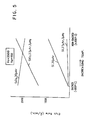
- FIGS. 3, 4, and 5 are various plots of the etch rates of Si and SiO 2 vs. bias voltage (FIGS. 3 and 4) and substrate temperature (FIG. 5). These curves illustrate the effect of the introduction of hydrogen into the sputtering gas and illustrate the striking differentials in etch rates that occur. The data upon which these curves are based is contained in the following table:
- the target was MgF 2 . Backed substrates contained a backing of GaIn to provide heat dissipation. This target had a three inch diameter and was shielded to provide a two inch opening for the sputtering plasma. A Mo substrate holder had holes therein filled with SiO 2 /Si substrate.
- the target voltage V T was -2500 V and Argon at a pressure of 4 pascals (30 microns Hg) was used as the sputtering gas.
- the substrates were not backed. No hydrogen was introduced into the sputtering gas. From these curves, it is apparent that the etch rates of both Si and SiO 2 increase as the bias voltage V B becomes more negative.
- FIG. 4 illustrates the situation in which three microns of hydrogen are present in the sputtering gas stream. Again, the substrates are non-backed. As is apparent from FIG. 4, the etch rate of Si decreases much more rapidly than the etch rate of SiO 2 when this amount of hydrogen is present. Thus, the etch rate ratio SiO 2 /Si is dramatically changed. In fact, the etch rate ratio Si0 2 /Si is about 2/1 without the hydrogen. With 10% hydrogen added to argon, the ratio is almost infinite.
- the etch rate of hot films of Si is reduced 0 from 930 to 84 A/min, with the introduction of 10% hydrogen, while the etch rate of hot films of SiO is increased from 1900 to 2300 A/min.
- the relative etch rate ratio Si 3 N 4/ Si is decreased from 780 to 57A/min, for hot films.
- the addition of 10% hydrogen causes the etch rate of silicon to be reduced to approximately 0, while the etch 0 rate of SiO 2 is decreased from 2200 to 1300 A/min.
- the etch rate ratio Si 3 N 4 /Si is approximately 0.
- a semiconductor device comprising layers of silicon (Si), silicon dioxide (SiO 2 ), and silicon nitride (Si 3 N 4 ) was etched.
- the etch rate ratio SiO 2 /Si is about 2/1 in the absence of hydrogen.
- SiO 2 silicon dioxide
- Si 3 N 4 silicon nitride
- the presence of hydrogen in the sputtering gas causes visually observable effects.
- the plasma becomes more brilliant, indicating a higher negative ion yield, such as F and possibly (HF ) in the case of MgF targets.
- the number of secondary electrons emitted from the target appeared to increase, causing further enhancement of the plasma.
Landscapes
- Drying Of Semiconductors (AREA)
- Physical Deposition Of Substances That Are Components Of Semiconductor Devices (AREA)
Applications Claiming Priority (2)
| Application Number | Priority Date | Filing Date | Title |
|---|---|---|---|
| US393838 | 1982-06-30 | ||
| US06/393,838 US4414069A (en) | 1982-06-30 | 1982-06-30 | Negative ion beam selective etching process |
Publications (2)
| Publication Number | Publication Date |
|---|---|
| EP0098935A1 true EP0098935A1 (de) | 1984-01-25 |
| EP0098935B1 EP0098935B1 (de) | 1986-03-26 |
Family
ID=23556447
Family Applications (1)
| Application Number | Title | Priority Date | Filing Date |
|---|---|---|---|
| EP83104579A Expired EP0098935B1 (de) | 1982-06-30 | 1983-05-10 | Ätzverfahren mit negativen Ionen |
Country Status (4)
| Country | Link |
|---|---|
| US (1) | US4414069A (de) |
| EP (1) | EP0098935B1 (de) |
| JP (1) | JPH06105700B2 (de) |
| DE (1) | DE3362664D1 (de) |
Families Citing this family (16)
| Publication number | Priority date | Publication date | Assignee | Title |
|---|---|---|---|---|
| US4778562A (en) * | 1984-08-13 | 1988-10-18 | General Motors Corporation | Reactive ion etching of tin oxide films using neutral reactant gas containing hydrogen |
| US4544444A (en) * | 1984-08-15 | 1985-10-01 | General Motors Corporation | Reactive ion etching of tin oxide films using silicon tetrachloride reactant gas |
| US4620898A (en) * | 1985-09-13 | 1986-11-04 | The United States Of America As Represented By The Administrator Of The National Aeronautics And Space Administration | Ion beam sputter etching |
| US6942764B1 (en) * | 1995-08-24 | 2005-09-13 | Taiwan Semiconductor Manufacturing Company, Ltd. | Arc-sprayed shield for pre-sputter etching chamber |
| US8357267B2 (en) * | 2005-10-26 | 2013-01-22 | Sharp Kabushiki Kaisha | Film producing method using atmospheric pressure hydrogen plasma, and method and apparatus for producing refined film |
| US7416989B1 (en) | 2006-06-30 | 2008-08-26 | Novellus Systems, Inc. | Adsorption based material removal process |
| US7977249B1 (en) | 2007-03-07 | 2011-07-12 | Novellus Systems, Inc. | Methods for removing silicon nitride and other materials during fabrication of contacts |
| US8187486B1 (en) | 2007-12-13 | 2012-05-29 | Novellus Systems, Inc. | Modulating etch selectivity and etch rate of silicon nitride thin films |
| US7981763B1 (en) * | 2008-08-15 | 2011-07-19 | Novellus Systems, Inc. | Atomic layer removal for high aspect ratio gapfill |
| US8058179B1 (en) | 2008-12-23 | 2011-11-15 | Novellus Systems, Inc. | Atomic layer removal process with higher etch amount |
| US9431268B2 (en) | 2015-01-05 | 2016-08-30 | Lam Research Corporation | Isotropic atomic layer etch for silicon and germanium oxides |
| US9425041B2 (en) | 2015-01-06 | 2016-08-23 | Lam Research Corporation | Isotropic atomic layer etch for silicon oxides using no activation |
| WO2019226341A1 (en) | 2018-05-25 | 2019-11-28 | Lam Research Corporation | Thermal atomic layer etch with rapid temperature cycling |
| US11637022B2 (en) | 2018-07-09 | 2023-04-25 | Lam Research Corporation | Electron excitation atomic layer etch |
| JP7075537B2 (ja) * | 2020-02-10 | 2022-05-25 | 株式会社日立ハイテク | プラズマ処理方法 |
| WO2022169509A1 (en) | 2021-02-03 | 2022-08-11 | Lam Research Corporation | Etch selectivity control in atomic layer etching |
Citations (3)
| Publication number | Priority date | Publication date | Assignee | Title |
|---|---|---|---|---|
| FR2332616A1 (fr) * | 1975-11-24 | 1977-06-17 | Selenia Ind Elettroniche | Procede de fabrication de dispositifs semi-conducteurs, notamment par la technique de la crepitation |
| US4132614A (en) * | 1977-10-26 | 1979-01-02 | International Business Machines Corporation | Etching by sputtering from an intermetallic target to form negative metallic ions which produce etching of a juxtaposed substrate |
| US4250009A (en) * | 1979-05-18 | 1981-02-10 | International Business Machines Corporation | Energetic particle beam deposition system |
Family Cites Families (2)
| Publication number | Priority date | Publication date | Assignee | Title |
|---|---|---|---|---|
| JPS5651578A (en) * | 1979-10-01 | 1981-05-09 | Toshiba Corp | Plasma etching method |
| JPS56100421A (en) * | 1980-01-17 | 1981-08-12 | Toshiba Corp | Plasma etching method |
-
1982
- 1982-06-30 US US06/393,838 patent/US4414069A/en not_active Expired - Lifetime
-
1983
- 1983-05-10 DE DE8383104579T patent/DE3362664D1/de not_active Expired
- 1983-05-10 EP EP83104579A patent/EP0098935B1/de not_active Expired
- 1983-05-13 JP JP58082856A patent/JPH06105700B2/ja not_active Expired - Lifetime
Patent Citations (3)
| Publication number | Priority date | Publication date | Assignee | Title |
|---|---|---|---|---|
| FR2332616A1 (fr) * | 1975-11-24 | 1977-06-17 | Selenia Ind Elettroniche | Procede de fabrication de dispositifs semi-conducteurs, notamment par la technique de la crepitation |
| US4132614A (en) * | 1977-10-26 | 1979-01-02 | International Business Machines Corporation | Etching by sputtering from an intermetallic target to form negative metallic ions which produce etching of a juxtaposed substrate |
| US4250009A (en) * | 1979-05-18 | 1981-02-10 | International Business Machines Corporation | Energetic particle beam deposition system |
Non-Patent Citations (1)
| Title |
|---|
| JOURNAL OF VACUUM SCIENCE TECHNOLOG, vol. 13 , no. 1, 1976 J. HANAK et al. "Effect of secondary electrons and negative ions on sputtering of films" * Pages 406-409 * * |
Also Published As
| Publication number | Publication date |
|---|---|
| EP0098935B1 (de) | 1986-03-26 |
| JPS599925A (ja) | 1984-01-19 |
| JPH06105700B2 (ja) | 1994-12-21 |
| US4414069A (en) | 1983-11-08 |
| DE3362664D1 (en) | 1986-04-30 |
Similar Documents
| Publication | Publication Date | Title |
|---|---|---|
| EP0098935B1 (de) | Ätzverfahren mit negativen Ionen | |
| US4259145A (en) | Ion source for reactive ion etching | |
| US4521286A (en) | Hollow cathode sputter etcher | |
| US3472751A (en) | Method and apparatus for forming deposits on a substrate by cathode sputtering using a focussed ion beam | |
| US4094764A (en) | Device for cathodic sputtering at a high deposition rate | |
| KR102044913B1 (ko) | 갈륨 이온을 갖는 이온 빔을 생성하기 위한 방법 및 그 장치 | |
| Holland | Some characteristics and uses of low‐pressure plasmas in materials science | |
| JPH0635323B2 (ja) | 表面処理方法 | |
| US4243476A (en) | Modification of etch rates by solid masking materials | |
| EP0203573B1 (de) | Mittels Elektronenstrahl angeregte Ionenstrahlquelle | |
| US6682634B1 (en) | Apparatus for sputter deposition | |
| US4902647A (en) | Surface modification using low energy ground state ion beams | |
| JP2849771B2 (ja) | スパッタ型イオン源 | |
| Kiyohara et al. | Reactive ion beam machining of diamond using an ECR-type oxygen source | |
| EP0360994B1 (de) | Vorrichtung und Verfahren zur Herstellung von Diamantfilmen bei tiefen Temperaturen | |
| JPH11238485A (ja) | イオン注入方法 | |
| Ray et al. | Mechanism of production and the current density effects of doubly charged ion emission from Cd+-bombarded Nb and V targets | |
| JPS6328992B2 (de) | ||
| JPH05114572A (ja) | ベリリウムおよびフツ化ベリリウムを含むプラズマの生成方法 | |
| JPS5992995A (ja) | 高融点金属シリサイド膜の形成方法 | |
| JPS61248428A (ja) | 表面処理方法および装置 | |
| JPS62130287A (ja) | 乾式エッチング装置 | |
| Matsuo et al. | Novel analysis techniques using cluster ion beams | |
| EP0095879A2 (de) | Verfahren und Vorrichtung zur Oberflächenbehandlung mit einem Niederenergie- und Hochintensitätsionenbündel | |
| Gamo et al. | Maskless fabrication using focused ion beams |
Legal Events
| Date | Code | Title | Description |
|---|---|---|---|
| PUAI | Public reference made under article 153(3) epc to a published international application that has entered the european phase |
Free format text: ORIGINAL CODE: 0009012 |
|
| AK | Designated contracting states |
Designated state(s): DE FR GB |
|
| 17P | Request for examination filed |
Effective date: 19840426 |
|
| GRAA | (expected) grant |
Free format text: ORIGINAL CODE: 0009210 |
|
| AK | Designated contracting states |
Kind code of ref document: B1 Designated state(s): DE FR GB |
|
| ET | Fr: translation filed | ||
| REF | Corresponds to: |
Ref document number: 3362664 Country of ref document: DE Date of ref document: 19860430 |
|
| PLBE | No opposition filed within time limit |
Free format text: ORIGINAL CODE: 0009261 |
|
| STAA | Information on the status of an ep patent application or granted ep patent |
Free format text: STATUS: NO OPPOSITION FILED WITHIN TIME LIMIT |
|
| 26N | No opposition filed | ||
| PGFP | Annual fee paid to national office [announced via postgrant information from national office to epo] |
Ref country code: GB Payment date: 19930427 Year of fee payment: 11 |
|
| PGFP | Annual fee paid to national office [announced via postgrant information from national office to epo] |
Ref country code: DE Payment date: 19930525 Year of fee payment: 11 |
|
| PGFP | Annual fee paid to national office [announced via postgrant information from national office to epo] |
Ref country code: FR Payment date: 19940427 Year of fee payment: 12 |
|
| PG25 | Lapsed in a contracting state [announced via postgrant information from national office to epo] |
Ref country code: GB Effective date: 19940510 |
|
| GBPC | Gb: european patent ceased through non-payment of renewal fee |
Effective date: 19940510 |
|
| PG25 | Lapsed in a contracting state [announced via postgrant information from national office to epo] |
Ref country code: DE Effective date: 19950201 |
|
| PG25 | Lapsed in a contracting state [announced via postgrant information from national office to epo] |
Ref country code: FR Effective date: 19960229 |
|
| REG | Reference to a national code |
Ref country code: FR Ref legal event code: ST |
|
| REG | Reference to a national code |
Ref country code: FR Ref legal event code: ST |