EP0100509B1 - Verfahren zur Herstellung elektrisch leitfähiger Polyarylen-Verbindungen mit elektronenanziehenden Seitengruppen und deren Verwendung in der Elektrotechnik und antistatischen Ausrüstung von Kunststoffen - Google Patents
Verfahren zur Herstellung elektrisch leitfähiger Polyarylen-Verbindungen mit elektronenanziehenden Seitengruppen und deren Verwendung in der Elektrotechnik und antistatischen Ausrüstung von Kunststoffen Download PDFInfo
- Publication number
- EP0100509B1 EP0100509B1 EP83107276A EP83107276A EP0100509B1 EP 0100509 B1 EP0100509 B1 EP 0100509B1 EP 83107276 A EP83107276 A EP 83107276A EP 83107276 A EP83107276 A EP 83107276A EP 0100509 B1 EP0100509 B1 EP 0100509B1
- Authority
- EP
- European Patent Office
- Prior art keywords
- electrically conductive
- electron
- nitrile
- complexing agent
- carboxyl
- Prior art date
- Legal status (The legal status is an assumption and is not a legal conclusion. Google has not performed a legal analysis and makes no representation as to the accuracy of the status listed.)
- Expired
Links
- 229920000412 polyarylene Polymers 0.000 title claims description 24
- 150000001875 compounds Chemical class 0.000 title claims description 22
- 238000000034 method Methods 0.000 title claims description 14
- 238000004519 manufacturing process Methods 0.000 title claims description 5
- 238000009877 rendering Methods 0.000 title 1
- 229920002994 synthetic fiber Polymers 0.000 title 1
- 239000008139 complexing agent Substances 0.000 claims description 12
- 150000001408 amides Chemical group 0.000 claims description 11
- 150000002825 nitriles Chemical group 0.000 claims description 11
- 239000002841 Lewis acid Substances 0.000 claims description 10
- 229910052783 alkali metal Inorganic materials 0.000 claims description 10
- 150000001340 alkali metals Chemical class 0.000 claims description 10
- QVGXLLKOCUKJST-UHFFFAOYSA-N atomic oxygen Chemical compound [O] QVGXLLKOCUKJST-UHFFFAOYSA-N 0.000 claims description 10
- 125000003178 carboxy group Chemical group [H]OC(*)=O 0.000 claims description 10
- 125000004185 ester group Chemical group 0.000 claims description 10
- 150000007517 lewis acids Chemical class 0.000 claims description 10
- 239000001301 oxygen Substances 0.000 claims description 10
- 229910052760 oxygen Inorganic materials 0.000 claims description 10
- 125000004435 hydrogen atom Chemical group [H]* 0.000 claims description 6
- 125000000843 phenylene group Chemical group C1(=C(C=CC=C1)*)* 0.000 claims description 3
- DGAQECJNVWCQMB-PUAWFVPOSA-M Ilexoside XXIX Chemical compound C[C@@H]1CC[C@@]2(CC[C@@]3(C(=CC[C@H]4[C@]3(CC[C@@H]5[C@@]4(CC[C@@H](C5(C)C)OS(=O)(=O)[O-])C)C)[C@@H]2[C@]1(C)O)C)C(=O)O[C@H]6[C@@H]([C@H]([C@@H]([C@H](O6)CO)O)O)O.[Na+] DGAQECJNVWCQMB-PUAWFVPOSA-M 0.000 claims description 2
- ZLMJMSJWJFRBEC-UHFFFAOYSA-N Potassium Chemical compound [K] ZLMJMSJWJFRBEC-UHFFFAOYSA-N 0.000 claims description 2
- 238000006243 chemical reaction Methods 0.000 claims description 2
- 229920003023 plastic Polymers 0.000 claims description 2
- 239000004033 plastic Substances 0.000 claims description 2
- 229910052700 potassium Inorganic materials 0.000 claims description 2
- 239000011591 potassium Substances 0.000 claims description 2
- 229910052708 sodium Inorganic materials 0.000 claims description 2
- 239000011734 sodium Substances 0.000 claims description 2
- 239000001257 hydrogen Substances 0.000 claims 2
- 229910052739 hydrogen Inorganic materials 0.000 claims 2
- UFHFLCQGNIYNRP-UHFFFAOYSA-N Hydrogen Chemical compound [H][H] UFHFLCQGNIYNRP-UHFFFAOYSA-N 0.000 claims 1
- 238000004870 electrical engineering Methods 0.000 claims 1
- 230000005670 electromagnetic radiation Effects 0.000 claims 1
- 238000002360 preparation method Methods 0.000 claims 1
- 238000003860 storage Methods 0.000 claims 1
- -1 polyene compounds Chemical class 0.000 description 8
- XLYOFNOQVPJJNP-UHFFFAOYSA-N water Substances O XLYOFNOQVPJJNP-UHFFFAOYSA-N 0.000 description 6
- 230000007717 exclusion Effects 0.000 description 5
- XKRFYHLGVUSROY-UHFFFAOYSA-N Argon Chemical compound [Ar] XKRFYHLGVUSROY-UHFFFAOYSA-N 0.000 description 4
- UFWIBTONFRDIAS-UHFFFAOYSA-N Naphthalene Chemical compound C1=CC=CC2=CC=CC=C21 UFWIBTONFRDIAS-UHFFFAOYSA-N 0.000 description 4
- 229910017008 AsF 6 Inorganic materials 0.000 description 3
- YMWUJEATGCHHMB-UHFFFAOYSA-N Dichloromethane Chemical compound ClCCl YMWUJEATGCHHMB-UHFFFAOYSA-N 0.000 description 3
- YXFVVABEGXRONW-UHFFFAOYSA-N Toluene Chemical compound CC1=CC=CC=C1 YXFVVABEGXRONW-UHFFFAOYSA-N 0.000 description 3
- 229920000642 polymer Polymers 0.000 description 3
- 0 *C(CC=CCNF)=*I Chemical compound *C(CC=CCNF)=*I 0.000 description 2
- 229910018287 SbF 5 Inorganic materials 0.000 description 2
- 229910018286 SbF 6 Inorganic materials 0.000 description 2
- WYURNTSHIVDZCO-UHFFFAOYSA-N Tetrahydrofuran Chemical compound C1CCOC1 WYURNTSHIVDZCO-UHFFFAOYSA-N 0.000 description 2
- XYLMUPLGERFSHI-UHFFFAOYSA-N alpha-Methylstyrene Chemical compound CC(=C)C1=CC=CC=C1 XYLMUPLGERFSHI-UHFFFAOYSA-N 0.000 description 2
- 229910052786 argon Inorganic materials 0.000 description 2
- 230000009918 complex formation Effects 0.000 description 2
- 230000007062 hydrolysis Effects 0.000 description 2
- 238000006460 hydrolysis reaction Methods 0.000 description 2
- QWUWMCYKGHVNAV-UHFFFAOYSA-N 1,2-dihydrostilbene Chemical compound C=1C=CC=CC=1CCC1=CC=CC=C1 QWUWMCYKGHVNAV-UHFFFAOYSA-N 0.000 description 1
- NHJVRSWLHSJWIN-UHFFFAOYSA-N 2,4,6-trinitrobenzenesulfonic acid Chemical compound OS(=O)(=O)C1=C([N+]([O-])=O)C=C([N+]([O-])=O)C=C1[N+]([O-])=O NHJVRSWLHSJWIN-UHFFFAOYSA-N 0.000 description 1
- KAQBNBSMMVTKRN-UHFFFAOYSA-N 2,4,6-trinitrobenzoic acid Chemical compound OC(=O)C1=C([N+]([O-])=O)C=C([N+]([O-])=O)C=C1[N+]([O-])=O KAQBNBSMMVTKRN-UHFFFAOYSA-N 0.000 description 1
- ZNZYKNKBJPZETN-WELNAUFTSA-N Dialdehyde 11678 Chemical compound N1C2=CC=CC=C2C2=C1[C@H](C[C@H](/C(=C/O)C(=O)OC)[C@@H](C=C)C=O)NCC2 ZNZYKNKBJPZETN-WELNAUFTSA-N 0.000 description 1
- 125000001931 aliphatic group Chemical group 0.000 description 1
- 239000003125 aqueous solvent Substances 0.000 description 1
- 125000003118 aryl group Chemical group 0.000 description 1
- 239000002585 base Substances 0.000 description 1
- 238000009835 boiling Methods 0.000 description 1
- 229920001940 conductive polymer Polymers 0.000 description 1
- 230000000694 effects Effects 0.000 description 1
- 239000011261 inert gas Substances 0.000 description 1
- 239000007788 liquid Substances 0.000 description 1
- 230000015654 memory Effects 0.000 description 1
- 125000002496 methyl group Chemical group [H]C([H])([H])* 0.000 description 1
- LYGJENNIWJXYER-UHFFFAOYSA-N nitromethane Chemical compound C[N+]([O-])=O LYGJENNIWJXYER-UHFFFAOYSA-N 0.000 description 1
- 125000001997 phenyl group Chemical group [H]C1=C([H])C([H])=C(*)C([H])=C1[H] 0.000 description 1
- OXNIZHLAWKMVMX-UHFFFAOYSA-N picric acid Chemical compound OC1=C([N+]([O-])=O)C=C([N+]([O-])=O)C=C1[N+]([O-])=O OXNIZHLAWKMVMX-UHFFFAOYSA-N 0.000 description 1
- 229920000553 poly(phenylenevinylene) Polymers 0.000 description 1
- 150000004291 polyenes Chemical class 0.000 description 1
- LPNYRYFBWFDTMA-UHFFFAOYSA-N potassium tert-butoxide Chemical compound [K+].CC(C)(C)[O-] LPNYRYFBWFDTMA-UHFFFAOYSA-N 0.000 description 1
- ODZPKZBBUMBTMG-UHFFFAOYSA-N sodium amide Chemical compound [NH2-].[Na+] ODZPKZBBUMBTMG-UHFFFAOYSA-N 0.000 description 1
- 239000002904 solvent Substances 0.000 description 1
- 239000000126 substance Substances 0.000 description 1
- IAHFWCOBPZCAEA-UHFFFAOYSA-N succinonitrile Chemical compound N#CCCC#N IAHFWCOBPZCAEA-UHFFFAOYSA-N 0.000 description 1
- YLQBMQCUIZJEEH-UHFFFAOYSA-N tetrahydrofuran Natural products C=1C=COC=1 YLQBMQCUIZJEEH-UHFFFAOYSA-N 0.000 description 1
Classifications
-
- C—CHEMISTRY; METALLURGY
- C07—ORGANIC CHEMISTRY
- C07C—ACYCLIC OR CARBOCYCLIC COMPOUNDS
- C07C255/00—Carboxylic acid nitriles
-
- C—CHEMISTRY; METALLURGY
- C07—ORGANIC CHEMISTRY
- C07C—ACYCLIC OR CARBOCYCLIC COMPOUNDS
- C07C57/00—Unsaturated compounds having carboxyl groups bound to acyclic carbon atoms
- C07C57/30—Unsaturated compounds having carboxyl groups bound to acyclic carbon atoms containing six-membered aromatic rings
- C07C57/42—Unsaturated compounds having carboxyl groups bound to acyclic carbon atoms containing six-membered aromatic rings having unsaturation outside the rings
-
- C—CHEMISTRY; METALLURGY
- C08—ORGANIC MACROMOLECULAR COMPOUNDS; THEIR PREPARATION OR CHEMICAL WORKING-UP; COMPOSITIONS BASED THEREON
- C08L—COMPOSITIONS OF MACROMOLECULAR COMPOUNDS
- C08L101/00—Compositions of unspecified macromolecular compounds
-
- H—ELECTRICITY
- H01—ELECTRIC ELEMENTS
- H01B—CABLES; CONDUCTORS; INSULATORS; SELECTION OF MATERIALS FOR THEIR CONDUCTIVE, INSULATING OR DIELECTRIC PROPERTIES
- H01B1/00—Conductors or conductive bodies characterised by the conductive materials; Selection of materials as conductors
- H01B1/06—Conductors or conductive bodies characterised by the conductive materials; Selection of materials as conductors mainly consisting of other non-metallic substances
- H01B1/12—Conductors or conductive bodies characterised by the conductive materials; Selection of materials as conductors mainly consisting of other non-metallic substances organic substances
- H01B1/124—Intrinsically conductive polymers
- H01B1/128—Intrinsically conductive polymers comprising six-membered aromatic rings in the main chain, e.g. polyanilines, polyphenylenes
-
- H—ELECTRICITY
- H01—ELECTRIC ELEMENTS
- H01M—PROCESSES OR MEANS, e.g. BATTERIES, FOR THE DIRECT CONVERSION OF CHEMICAL ENERGY INTO ELECTRICAL ENERGY
- H01M4/00—Electrodes
- H01M4/02—Electrodes composed of, or comprising, active material
- H01M4/36—Selection of substances as active materials, active masses, active liquids
- H01M4/60—Selection of substances as active materials, active masses, active liquids of organic compounds
-
- C—CHEMISTRY; METALLURGY
- C08—ORGANIC MACROMOLECULAR COMPOUNDS; THEIR PREPARATION OR CHEMICAL WORKING-UP; COMPOSITIONS BASED THEREON
- C08L—COMPOSITIONS OF MACROMOLECULAR COMPOUNDS
- C08L2201/00—Properties
- C08L2201/04—Antistatic
-
- Y—GENERAL TAGGING OF NEW TECHNOLOGICAL DEVELOPMENTS; GENERAL TAGGING OF CROSS-SECTIONAL TECHNOLOGIES SPANNING OVER SEVERAL SECTIONS OF THE IPC; TECHNICAL SUBJECTS COVERED BY FORMER USPC CROSS-REFERENCE ART COLLECTIONS [XRACs] AND DIGESTS
- Y02—TECHNOLOGIES OR APPLICATIONS FOR MITIGATION OR ADAPTATION AGAINST CLIMATE CHANGE
- Y02E—REDUCTION OF GREENHOUSE GAS [GHG] EMISSIONS, RELATED TO ENERGY GENERATION, TRANSMISSION OR DISTRIBUTION
- Y02E60/00—Enabling technologies; Technologies with a potential or indirect contribution to GHG emissions mitigation
- Y02E60/10—Energy storage using batteries
Definitions
- the invention relates to a process for producing electrically conductive polymeric systems with electrical conductivity values greater than 10-4 S / cm from polyarylene compounds by treating the polyarylene compounds with the exclusion of water moisture and oxygen with 0.03 to 0.9 mol percent, based on the polyarylene compound used, a strong Lewis acid with pks values from -10 to +4 or an alkali metal.
- the doping with the strong Lewis acids or the alkali metals increases the electrical conductivity of the polyarylene compounds.
- the invention has for its object to provide electrically conductive polyarylene compounds which can be produced in a simple manner by doping in accordance with the prior art, but which have a lower tendency towards hydrolysis, better processability and, in addition, increased stability to atmospheric oxygen and heat.
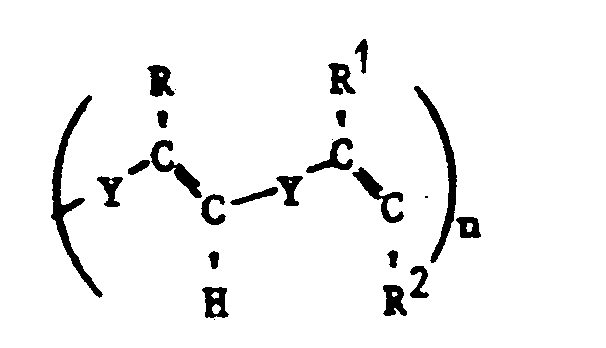
- this object is achieved by doping such polyarylene compounds with electron-attracting or electron-donating complexing agents which at least once contain the chain link of the formula: contain, where n is each greater than 1, preferably 5 to 50, R represents a nitrile, acid amide, carboxyl or ester group and R 1 and R 2 represent a hydrogen atom or a nitrile, acid amide, carboxyl or ester group with with the proviso that one of the radicals R 1 or R 2 is always a hydrogen atom and the other of these two radicals is a nitrile, acid amide, carboxyl or ester group and Y is an aromatic radical, preferably phenylene.
- Electrically conductive polymer systems having electrical conductivities greater than 10- 4 S / cm are understood substances which according to the measuring method of F. Beck, reports of the Bunsen Society 68 (1964), pages 558-567, an electrical conductivity greater than 10- 4 S / cm.
- the polyarylene compounds to be used according to the invention are, according to the methods known per se, with the exclusion of water moisture and oxygen, with 0.03 to 0.9 mol percent, based on the polyarylene compound used, in particular a strong Lewis acid with pks values of 10 to +4 or an alkali metal treated as a complexing agent.
- the compounds are suitable, for example, as Lewis acids with pks values from -10 to +4 (n-complexing agent) AsF 5 , SbF 5 , HCIO 4, FSO 3 H, C10 2 , NO + SbF 6 , NO 2 + SbF 6 , NO + AsF 6 , NO 2 + AsF 6 , NO + PF 6 -, NO 2 + PF 6 , NO + BF 4- , NO 2 + BF 4 , NO + C10 4 , (CF3) 2 SO 4 2,4,6-trinitrophenol, 2,4,6-trinitrobenzenesulfonic acid or 2,4,6-trinitrobenzoic acid.
- alkali metals e.g. Sodium or potassium
- alkali metals e.g. Sodium or potassium
- solutions e.g. in naphthalene or a-methylstyrene
- the treatment of the polyarylene compounds with the Lewis acids or the alkali metals is carried out at temperatures from -70 to 150 ° C., preferably -10 to 100 ° C., in particular 0 to 30 ° C.
- the Lewis acids or alkali metals which form the electrically conductive systems with the polyarylenes with complex formation are used in amounts of from 0.03 to 0.9, preferably from 0.1 to 0.5, mol percent, based on the polyarylene compounds , at.
- the complexing agents are incorporated with the exclusion of moisture (water) and oxygen (air), so it is preferably carried out under an inert gas atmosphere (argon).
- argon inert gas atmosphere
- non-aqueous solvents that do not react with the complexing agents under the process conditions, such as methylene chloride, tetrahydrofuran, dimethoxyglycol, nitromethane, naphthalene or a-methylstyrene.
- the mostly deep-colored, electrically conductive polyarylenes are formed in a few seconds to minutes in the process according to the invention. Any solvents used are expediently removed in vacuo at temperatures below 100.degree.
- polyarylene compounds which have at least once the chain link of the formula: contain, wherein n is greater than 1, preferably 5 to 50, R is a nitrile, acid amide, carboxyl or ester group and R is a nitrile, acid amide, carboxyl or ester group and R 1 and R 2 is a hydrogen atom or Nitrile, acid amide, carboxyl or ester group with the proviso that one of the radicals R 1 or R 2 is always a hydrogen atom and the other of these two radicals is a nitrile, acid amide, carboxyl or ester group, and Y is one aromatic radical, preferably phenylene.
- polyarylene compounds to be used according to the invention are known per se and can be prepared in accordance with the literature reference DE-OS 16 18 733.
- Aromatic dialdehydes for example terephthalic dialdehyde, for example with succinonitrile and / or 1,2-diphenylethane in a molar ratio of 1: 1 are expediently heated to boiling temperature in toluene for up to eight hours in the presence of bases such as sodium amide or potassium tert-butoxide .
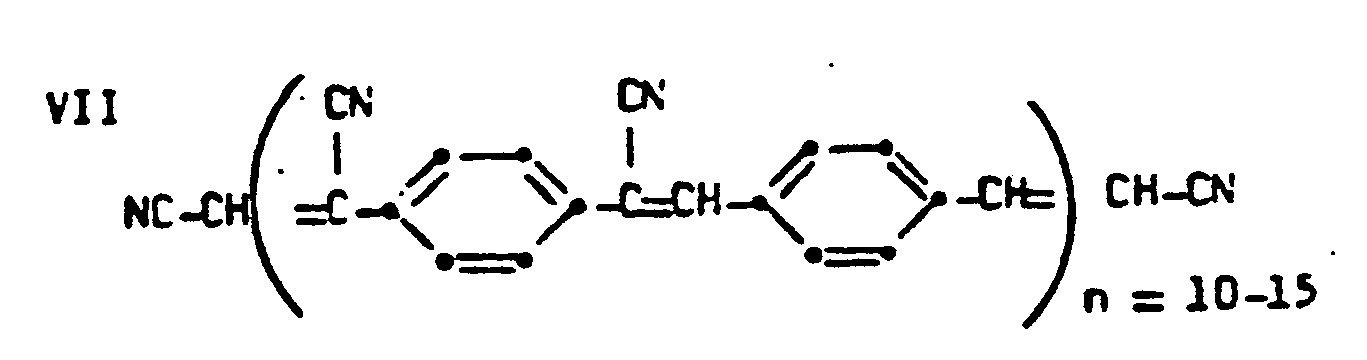
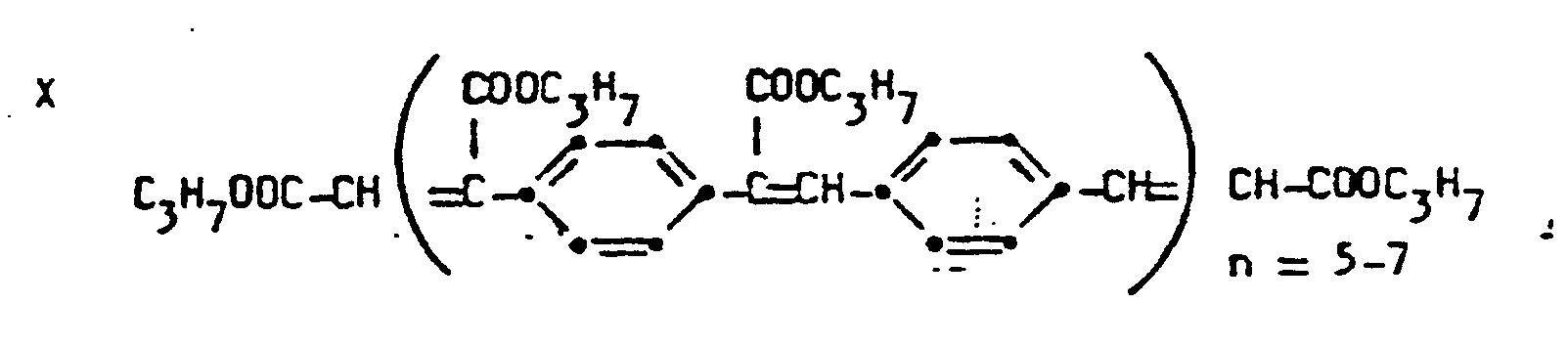
- polyarylene compounds of the formulas I to X below are particularly suitable for the process according to the invention.
- the electrically conductive polyarylenes produced according to the invention can be used for the antistatic finishing of plastics, for the production of solar cells, for the conversion and fixation of electromagnetic rays as well as for the production of electrical and magnetic switches and electrical memories.
- n- or p-complexing agent was added to 10 parts of the respective polyarylene compound under argon at room temperature and with the exclusion of water moisture and atmospheric oxygen. The complex formation occurred immediately. Deep blue-black crystalline compounds were obtained which had a conductivity of> 10- 4 S / cm when measured in a conductivity measuring cell. The conductivity of the administratpolyarylene was about 10- 10 S / cm.
- the polyarylenes and complexing agents used in the individual examples and the electrical conductivities of the products obtained are shown in the table. The polyarylenes are identified by the numbering used above in the description.
Landscapes
- Chemical & Material Sciences (AREA)
- Organic Chemistry (AREA)
- Chemical Kinetics & Catalysis (AREA)
- Electrochemistry (AREA)
- Medicinal Chemistry (AREA)
- Polymers & Plastics (AREA)
- Health & Medical Sciences (AREA)
- General Chemical & Material Sciences (AREA)
- Physics & Mathematics (AREA)
- Spectroscopy & Molecular Physics (AREA)
- Polyoxymethylene Polymers And Polymers With Carbon-To-Carbon Bonds (AREA)
- Compositions Of Macromolecular Compounds (AREA)
- Phenolic Resins Or Amino Resins (AREA)
Description
- Die Erfindung betrifft ein Verfahren zur Herstellung von elektrisch leitfähigen polymeren Systemen mit elektrischen Leitfähigkeitswerten größer als 10-4 S/cm aus Polyarylen-Verbindungen durch Behandeln der Polyarylen-Verbindungen unter Ausschluß von Wasserfeuchtigkeit und von Sauerstoff mit 0.03 bis 0,9 Molprozent, bezogen auf die eingesetzte Polyarylen-Verbindung, einer starken Lewis-Säure mit pks-Werten von -10 bis +4 oder eines Alkalimetalls.
- Durch die Dotierung mit den starken Lewis-Säuren bzw. den Alkalimetallen wird eine Erhöhung der elektrischen Leitfähigkeit der Polyarylen-Verbindungen bewirkt.
- Aus der DE-OS 29 47 797 ist es bereits bekannt, die elektrische Leitfähigkeit von Polyen-Verbindungen, die mindestens einmal das Kettenglied der Formel:

- Des weiteren ist es aus der DE-OS 29 47 796 sowie Polymer, Vol. 20 (1979), Seiten 1441 bis 1443, bekannt, Poly(phenylenvinylene) der Formel (Ph-CH = CH) zur Erhöhung der elektrischen Leitfähigkeit mit Alkalimetallen bzw. starken Lewis-Säuren, wie AsF5, zu dotieren. Doch auch diese elektrisch leitfähigen Systeme sind gegenüber Sauerstoff und/oder Wasser instabil und verlieren rasch ihre Leitfähigkeit, wenn man sie bei Raumtemperatur der Luft aussetzt (vgl. den oben zitierten Artikel in "Polymer").
- In der DE-OS 31 14 342 ist bereits vorgeschlagen worden, elektrisch leitfähige Polyen-Systeme mit verbesserter Hydrolysebeständigkeit und erhöhter Stabilität gegenüber Sauerstoff herzustellen, indem man Polyen-Verbindungen mit rein aliphatischen Polymer-Hauptketten, die durch Nitril-, Säureamid- oder Phenylgruppen substituiert sind, mit Alkalimetallen oder starken Lewis-Säuren dotiert.
- Der Erfindung liegt die Aufgabe zugrunde, elektrisch leitfähige Polyarylen-Verbindungen zu schaffen, die in einfacher Weise durch Dotierung entsprechend dem Stand der Technik herstellbar sind, die aber eine geringere Hydrolysetendenz, bessere Verarbeitbarkeit sowie zusätzlich eine erhöhte Stabilität gegenüber Luftsauerstoff und Wärme aufweisen.
- Diese Aufgabe wird erfindungsgemäß dadurch gelöst, daß man solche Polyarylen-Verbindungen mit elektronenanziehenden oder elektronenabgebenden Komplexierungsmitteln dotiert, die mindestens einmal das Kettenglied der Formel:
- Unter elektrisch leitfähigen polymeren Systemen mit elektrischen Leitfähigkeitswerten größer als 10-4 S/cm werden Substanzen verstanden, die nach der Meßmethode von F. Beck, Berichte der Bunsengesellschaft 68 (1964), Seiten 558 bis 567 eine elektrische Leitfähigkeit von mehr als 10-4 S/cm aufweisen.
- Die erfindungsgemäß einzusetzenden Polyarylen-Verbindungen werden nach den an sich bekannten Methoden unter Ausschluß von Wasserfeuchtigkeit und von Sauerstoff mit 0,03 bis 0,9 Molprozent, bezogen auf die eingesetzte Polyarylen-Verbindung, insbesondere einer starken Lewis-Säure mit pks-Werten von -10 bis +4 oder eines Alkalimetalls als Komplexierungsmittel behandelt.
- Als Lewis-Säuren mit pks-Werten von -10 bis +4 (n-Komplexierungsmittel) eignen sich z.B. die Verbindungen AsF5, SbF5, HCIO4, FSO3H, C102, NO+SbF6 , NO2+SbF6 , NO+AsF6 , NO2+AsF6, NO+PF6-, NO2+PF6 , NO+B F4-, NO2+BF4 , NO+C104 , (CF3)2SO4 2,4,6-Trinitrophenol, 2,4,6-Trinitrobenzolsulfonsäure oder 2,4,6-Trinitrobenzoesäure.
- Als Alkalimetalle (p-Komplexierungsmittel) verwendet man z.B. Natrium oder Kalium, die auch in Form von Lösungen, z.B. in Naphthalin oder a-Methylstyrol, eingesetzt werden können.
- Die Behandlung der Polyarylen-Verbindungen mit den Lewis-Säuren oder den Alkalimetallen führt man bei Temperaturen von -70 bis 150°C, vorzugsweise -10 bis 100°C, insbesondere 0 bis 30-C durch. Dabei wendet man die Lewis-Säuren oder Alkalimetalle, die mit den Polyarylenen unter Komplexbildung die elektrisch leitfähigen Systeme ergeben, in Mengen von 0,03 bis 0,9, vorzugsweise von 0,1 bis 0,5 Molprozent, bezogen auf die Polyarylen-Verbindungen, an.
- Das Einarbeiten der Komplexierungsmittel erfolgt unter Ausschluß von Feuchtigkeit (Wasser) sowie Sauerstoff (Luft), es wird daher vorzugsweise unter Edelgasatmosphäre (Argon) gearbeitet. Gegebenen alls werden als Hilfsflüssigkeiten nicht-wäßrige Lösungsmittel, die unter den Verfahrensbedingungen nicht mit den Komplexierungsmitteln reagieren, wie Methylenchlorid, Tetrahydrofuran, Dimethoxyglykol, Nitromethan, Naphthalin oder a-Methylstyrol, eingesetzt. Die meist tieffarbigen elektrisch leitfähigen Polyarylene werden bei dem erfindungsgemäßen Verfahren in wenigen Sekunden bis Minuten gebildet. Gegebenenfalls verwendete Lösungsmittel werden zweckmäßig bei Temperaturen unter 100°C im Vakuum abgezogen.
- In dem erfindungsgemäßen Verfahren werden Polyarylen-Verbindungen eingesetzt, die mindestens einmal das Kettenglied der Formel:

- Für das erfindungsgemäße Verfahren sind die Polyarylen-Verbindungen der nachfolgenden Formeln I bis X besonders geeignet.




- Die erfindungsgemäß hergestellten elektrisch leitfähigen Polyarylene sind zur antistatischen Ausrüstung von Kunststoffen, zur Herstellung von Sonnenzellen, zur Umwandlung und Fixierung von elektromagnetischen Strahlen sowie zur Herstellung elektrischer und magnetischer Schalter und elektrischer Speicher verwendbar.
- Die in den folgenden Beispielen genannten Teile sind Gewichtsteile.
- Zu 10 Teilen der jeweiligen Poyarylen-Verbindung wurde unter Argon bei Raumtemperatur und unter Ausschluß von Wasserfeuchtigkeit und Luftsauerstoff ein n- oder p-Komplexierungsmittel gegeben. Die Komplexbildung trat sofort ein. Man erhielt tiefblauschwarze kristalline Verbindungen, die beim Messen in einer Leitfähigkeitsmeßzelle eine Leitfähigkeit von > 10-4 S/cm aufwiesen. Die Leitfähigkeit der Ausgangspolyarylene betrug ca. 10-10 S/cm. Die in den einzelnen Beispielen eingesetzten Polyarylene und Komplexierungsmittel sowie die elektrischen Leitfähigkeiten der erhaltenen Produkte sind in der Tabelle wiedergegeben. Die Polyarylene sind dabei mit der weiter oben in der Beschreibung benutzten Bezifferung gekennzeichnet.

Claims (8)

Applications Claiming Priority (2)
| Application Number | Priority Date | Filing Date | Title |
|---|---|---|---|
| DE3228880 | 1982-08-03 | ||
| DE19823228880 DE3228880A1 (de) | 1982-08-03 | 1982-08-03 | Verfahren zur herstellung elektrisch leitfaehiger polyarylen-verbindungen mit elektronenanziehenden seitengruppen und deren verwendung in der elektrotechnik und zur antistatischen ausruestung von kunststoffen |
Publications (3)
| Publication Number | Publication Date |
|---|---|
| EP0100509A2 EP0100509A2 (de) | 1984-02-15 |
| EP0100509A3 EP0100509A3 (en) | 1984-11-28 |
| EP0100509B1 true EP0100509B1 (de) | 1986-05-21 |
Family
ID=6169970
Family Applications (1)
| Application Number | Title | Priority Date | Filing Date |
|---|---|---|---|
| EP83107276A Expired EP0100509B1 (de) | 1982-08-03 | 1983-07-25 | Verfahren zur Herstellung elektrisch leitfähiger Polyarylen-Verbindungen mit elektronenanziehenden Seitengruppen und deren Verwendung in der Elektrotechnik und antistatischen Ausrüstung von Kunststoffen |
Country Status (4)
| Country | Link |
|---|---|
| US (1) | US4488986A (de) |
| EP (1) | EP0100509B1 (de) |
| JP (1) | JPS5947220A (de) |
| DE (2) | DE3228880A1 (de) |
Families Citing this family (2)
| Publication number | Priority date | Publication date | Assignee | Title |
|---|---|---|---|---|
| US5514878A (en) * | 1994-03-18 | 1996-05-07 | Holmes; Andrew B. | Polymers for electroluminescent devices |
| US7332227B2 (en) * | 2003-03-14 | 2008-02-19 | Becton, Dickinson And Company | Non-volatile lubricant system for medical devices |
Family Cites Families (8)
| Publication number | Priority date | Publication date | Assignee | Title |
|---|---|---|---|---|
| DE1618733U (de) | 1950-11-22 | 1951-01-11 | Philipp Niedermeier Vorm Saalh | Spielfahrzeug. |
| US4222903A (en) * | 1978-05-04 | 1980-09-16 | University Patents, Inc. | P-Type electrically conducting doped polyacetylene film and method of preparing same |
| US4440669A (en) * | 1979-03-20 | 1984-04-03 | Allied Corporation | Electrically conducting compositions of doped polyphenylenes and shaped articles comprising the same |
| DE2947797A1 (de) | 1979-11-28 | 1981-07-30 | Basf Ag, 6700 Ludwigshafen | Verfahren zur herstellung elektrisch leitfaehiger polyene und deren verwendung in der elektrotechnik und zur antistatischen ausruestung von kunststoffen |
| US4375427A (en) * | 1979-12-13 | 1983-03-01 | Allied Corporation | Thermoplastic conductive polymers |
| DE3009351A1 (de) * | 1980-03-12 | 1981-09-24 | Basf Ag, 6700 Ludwigshafen | Verfahren zur herstellung elektrische leitfaehiger heteropolyphenylene und deren verwendung in der elektrotechnik und zur antistatischen ausruestung von kunststoffen |
| DE3025771A1 (de) * | 1980-07-08 | 1982-02-04 | Basf Ag, 6700 Ludwigshafen | Verfahren zur herstellung elektrisch leitfaehiger loeslicher heteropolyphenylene und deren verwendung in der elektrotechnik und zur antistatischen ausruestung von kunststoffen |
| DE3114342A1 (de) | 1981-04-09 | 1982-11-04 | Basf Ag, 6700 Ludwigshafen | Verfahren zur herstellung elektrisch leitfaehiger polyen-verbindungen mit elektronenanziehenden seitengruppen und deren verwendung in der elektrotechnik und zur antistatischen ausruestung von kunststoffen |
-
1982
- 1982-08-03 DE DE19823228880 patent/DE3228880A1/de not_active Withdrawn
-
1983
- 1983-07-25 DE DE8383107276T patent/DE3363587D1/de not_active Expired
- 1983-07-25 EP EP83107276A patent/EP0100509B1/de not_active Expired
- 1983-08-02 US US06/519,507 patent/US4488986A/en not_active Expired - Fee Related
- 1983-08-02 JP JP58140642A patent/JPS5947220A/ja active Pending
Also Published As
| Publication number | Publication date |
|---|---|
| DE3363587D1 (en) | 1986-06-26 |
| EP0100509A3 (en) | 1984-11-28 |
| DE3228880A1 (de) | 1984-02-09 |
| JPS5947220A (ja) | 1984-03-16 |
| EP0100509A2 (de) | 1984-02-15 |
| US4488986A (en) | 1984-12-18 |
Similar Documents
| Publication | Publication Date | Title |
|---|---|---|
| EP0045366B1 (de) | Verfahren zur Herstellung elektrisch leitfähiger löslicher Heteropolyphenylene und deren Verwendung | |
| EP0035715B1 (de) | Verfahren zur Herstellung elektrisch leitfähiger Heteropolyaromaten und deren Verwendung in der Elektrotechnik und zur antistatischen Ausrüstung von Kunststoffen | |
| EP0035713B1 (de) | Verfahren zur Herstellung elektrisch leitfähiger Heteropolyphenylene und deren Verwendung in der Elektrotechnik und zur antistatischen Ausrüstung von Kunststoffen | |
| EP0031967B1 (de) | Verfahren zur Herstellung von elektrisch leitfähigen Polyaromaten und deren Verwendung in der Elektrotechnik und zur antistatischen Ausrüstung von Kunststoffen | |
| EP0059317A1 (de) | Verfahren zur Herstellung von elektrisch leitfähigen Polymeren und deren Verwendung | |
| DE3249532T1 (de) | Elektroaktives Polymeres | |
| DE3223544A1 (de) | Copolymere von pyrrolen, verfahren zu ihrer herstellung sowie ihre verwendung | |
| EP0059342B1 (de) | Verfahren zur Herstellung von stabilen elektrisch leitfähigen Polymeren und deren Verwendung | |
| DE60032744T2 (de) | Aromatische aminoderivate, löslich leitfähige zusammensetzung, und elektroluminescente vorrichtung | |
| EP0100509B1 (de) | Verfahren zur Herstellung elektrisch leitfähiger Polyarylen-Verbindungen mit elektronenanziehenden Seitengruppen und deren Verwendung in der Elektrotechnik und antistatischen Ausrüstung von Kunststoffen | |
| DE3027529A1 (de) | Verfahren zur herstellung von elektrisch leitfaehigen polymeren systemen und deren verwendung in der elektrotechnik und zur antistatischen ausruestung von kunststoffen | |
| EP0071082B1 (de) | Verfahren zur Herstellung luftstabiler, elektrisch leitfähiger, polymerer Polyensysteme und ihre Verwendung in der Elektrotechnik und zur antistatischen Ausrüstung von Kunststoffen | |
| DE69706646T2 (de) | Halbleitfähiges polymer | |
| EP0023596A1 (de) | Verfahren zur Herstellung elektrisch leitfähiger Polyphenylene und deren Verwendung in der Elektrotechnik und zur antistatischen Ausrüstung von Kunststoffen | |
| DE68914047T2 (de) | Polymer-Zusammensetzungen. | |
| EP0062837A1 (de) | Verfahren zur Herstellung elektrisch leitfähiger Polyen-Verbindungen mit elektronenanziehenden Seitengruppen und deren Verwendung in der Elektrotechnik und zur antistatischen Ausrüstung von Kunststoffen | |
| EP0037924B1 (de) | Verfahren zur Herstellung von elektrisch leitfähigen Polykondensaten und deren Verwendung in der Elektrotechnik und zur antistatischen Ausrüstung von Kunststoffen | |
| EP0029945B1 (de) | Verfahren zur Herstellung elektrisch leitfähiger Polyene und deren Verwendung in der Elektrotechnik und zur antistatischen Ausrüstung von Kunststoffen | |
| EP0045852B1 (de) | Verfahren zur Herstellung von elektrisch leitfähigen polymeren Systemen und deren Verwendung in der Elektrotechnik und zur antistatischen Ausrüstung von Kunststoffen | |
| DE69325351T2 (de) | Leitfähiges N-Typ-Polymer und Methode zur Herstellung desselben | |
| EP0054683A2 (de) | Verfahren zur Herstellung von elektrisch leitfähigen polymeren Systemen und deren Verwendung in der Elektrotechnik und zur antistatischen Ausrüstung von Kunststoffen | |
| DE3305401A1 (de) | Verfahren zur herstellung von elektrisch leitfaehigen kunststoffen | |
| EP0089575A1 (de) | Verfahren zur Herstellung elektrisch leitfähiger Oligophenyle, die nach dem Verfahren hergestellten Produkte und deren Verwendung | |
| DE3215970A1 (de) | Verfahren zur herstellung von elektrisch leitfaehigen polymeren systemen | |
| DE3026328A1 (de) | Verfahren zur herstellung von elektrisch leitfaehigen polymeren systemen und deren verwendung in der elektrotechnik und zur antistatischen ausruestung von kunststoffen |
Legal Events
| Date | Code | Title | Description |
|---|---|---|---|
| PUAI | Public reference made under article 153(3) epc to a published international application that has entered the european phase |
Free format text: ORIGINAL CODE: 0009012 |
|
| AK | Designated contracting states |
Designated state(s): BE DE FR GB NL |
|
| PUAL | Search report despatched |
Free format text: ORIGINAL CODE: 0009013 |
|
| AK | Designated contracting states |
Designated state(s): BE DE FR GB NL |
|
| 17P | Request for examination filed |
Effective date: 19840928 |
|
| GRAA | (expected) grant |
Free format text: ORIGINAL CODE: 0009210 |
|
| AK | Designated contracting states |
Kind code of ref document: B1 Designated state(s): BE DE FR GB NL |
|
| PG25 | Lapsed in a contracting state [announced via postgrant information from national office to epo] |
Ref country code: NL Effective date: 19860521 |
|
| PG25 | Lapsed in a contracting state [announced via postgrant information from national office to epo] |
Ref country code: DE Effective date: 19860531 |
|
| REF | Corresponds to: |
Ref document number: 3363587 Country of ref document: DE Date of ref document: 19860626 |
|
| PG25 | Lapsed in a contracting state [announced via postgrant information from national office to epo] |
Ref country code: BE Effective date: 19860731 |
|
| ET | Fr: translation filed | ||
| NLV1 | Nl: lapsed or annulled due to failure to fulfill the requirements of art. 29p and 29m of the patents act | ||
| BERE | Be: lapsed |
Owner name: BASF A.G. Effective date: 19860731 |
|
| PLBE | No opposition filed within time limit |
Free format text: ORIGINAL CODE: 0009261 |
|
| STAA | Information on the status of an ep patent application or granted ep patent |
Free format text: STATUS: NO OPPOSITION FILED WITHIN TIME LIMIT |
|
| PG25 | Lapsed in a contracting state [announced via postgrant information from national office to epo] |
Ref country code: FR Free format text: LAPSE BECAUSE OF NON-PAYMENT OF DUE FEES Effective date: 19870331 |
|
| 26N | No opposition filed | ||
| REG | Reference to a national code |
Ref country code: FR Ref legal event code: ST |
|
| GBPC | Gb: european patent ceased through non-payment of renewal fee | ||
| PG25 | Lapsed in a contracting state [announced via postgrant information from national office to epo] |
Ref country code: GB Free format text: LAPSE BECAUSE OF NON-PAYMENT OF DUE FEES Effective date: 19881122 |