EP0103599B1 - Ion-selektive messelektrodenanordnung - Google Patents
Ion-selektive messelektrodenanordnung Download PDFInfo
- Publication number
- EP0103599B1 EP0103599B1 EP83900917A EP83900917A EP0103599B1 EP 0103599 B1 EP0103599 B1 EP 0103599B1 EP 83900917 A EP83900917 A EP 83900917A EP 83900917 A EP83900917 A EP 83900917A EP 0103599 B1 EP0103599 B1 EP 0103599B1
- Authority
- EP
- European Patent Office
- Prior art keywords
- electrode
- ions
- electrode device
- intercalation
- selective
- Prior art date
- Legal status (The legal status is an assumption and is not a legal conclusion. Google has not performed a legal analysis and makes no representation as to the accuracy of the status listed.)
- Expired
Links
Images


Classifications
-
- G—PHYSICS
- G01—MEASURING; TESTING
- G01N—INVESTIGATING OR ANALYSING MATERIALS BY DETERMINING THEIR CHEMICAL OR PHYSICAL PROPERTIES
- G01N27/00—Investigating or analysing materials by the use of electric, electrochemical, or magnetic means
- G01N27/26—Investigating or analysing materials by the use of electric, electrochemical, or magnetic means by investigating electrochemical variables; by using electrolysis or electrophoresis
- G01N27/28—Electrolytic cell components
- G01N27/30—Electrodes, e.g. test electrodes; Half-cells
- G01N27/36—Glass electrodes
Definitions
- the invention relates to an H + selective electrode device comprising an H + selective element containing a species of metal ions which during operation of the electrode device are exchanged with H + ions, an electrical connection and a solid material providing the electrical contact between the ion selective element and the electrical connection.
- a device is known from US-A-3 853 731.
- the invention also relates to a method for preparing such a device.
- Solid lithium-containing contact materials have been employed in pH-electrode devices having a pH-sensitive membrane of lithium containing glass. These electrode devices are disclosed in the specification of SU patent No. 7 599 43 (Shul'ts) and in connection with a study concerning the stability of ion selective measuring electrode devices in Shul'ts M.M.: Journal of Applied Chemistry of the USSR, 52 (11), 2354 (1980).
- intercalation electrodes have been used for other electrochemical purposes, e.g. in electrical batteries and in electrochemical measuring electrode devices of another type than the measuring electrode device according to the present invention.
- the object of the invention is to provide pH measuring electrode devices which may be constructed as solid state ion selective electrode devices and which as regards the well known electrode properties such as sensitivity and stability compare to or are superior to the prior art ion selective electrode devices.
- Solid state measuring electrode devices are advantageous in many respects and for years it has been a desire to make available solid state electrode devices suited for replacing the prior art electrode devices containing an inner liquid.
- the solid state electrode devices may be used for a wider temperature range than the electrode devices containing a liquid; they may be arbitrarily oriented, and they are suitable for miniaturization which is of interest in connection with physiological or biochemical applications.
- the ion selective electrode device comprises an H' selective element containing a species of metal ions which during operation of the electrode device are exchanged with H * ions, an electrical connection and a solid material providing the electrical contact between the H * selective element and the electrical connection, and is characterized in that the solid material comprises a solid crystalline material capable of incorporating or giving off ions of the said metal ions species as an intercalation electrode.
- any suitable H * selective element may be selected for the ion selective element.
- organic as well as inorganic ion selective elements may be used in the electrode device according to the invention.
- any suitable electronic conductive material which may be connected to the analyzing equipment used together with the electrode device may be used as the electrical connection. Usually, the connection will be established by means of an electronic conductor in a cable.
- the electrical connection and the solid contact material may be constructed from the same material and may form an integral structure.
- a metal wire will be suitable as the electrical connection or part of it.
- a liquid more or less viscous electrolyte or a solid crystalline or amorphous ionic conductive material containing the metal ions may be inserted between the ion selective element and the solid contact material.
- the solid material providing the electrical contact between the ion selective element and the electrical connection is an intercalation electrode for the metal ions.
- intercalation electrode and “intercalation compound” are used as the name for a crystalline material having the following properties:
- intercalation compounds are: Li x V 2 O 5 , Li.V e 0 13 , Li x TiS 2 , Li x W0 3 , Na x W0 3 , where x is a number which may vary within a certain range, and other bronze materials of the oxide type.
- the H * selective electrode devices according to the invention may further comprise elements such as e.g. an external reference electrode structure, other electrochemical measuring electrode means, transducers of other kinds, e.g. temperature sensors, and signal amplifying means.
- elements such as e.g. an external reference electrode structure, other electrochemical measuring electrode means, transducers of other kinds, e.g. temperature sensors, and signal amplifying means.
- the advantageous electrode properties depend on the possibility of reversible transport of certain metal ions across the boundary between the ion selective element and the solid contact material and reversible transport of electrons across the boundary between the solid contact material and the electrical connection and the reversible interaction between ions and electrons in the solid contact material.
- Electrode devices for pH-measurements showing advantageous electrode properties have been disclosed previously, cf. Shul'ts: Journal of Applied Chemistry in the USSR, 52(11), 2354 (1980).
- the electrode devices disclosed herein are glass electrodes having a pH-sensitive glass membrane containing lithium or sodium.
- Two types of electrode devices have been disclosed. One of these is provided with metallic lithium or sodium on the inner side of the lithium respective sodium containing glass membrane. As far as stability concerns these electrode devices are excellent. For practical applications, however, they are considered inapplicable in connection with measurements in aqueous solutions due to the potential danger of a heavy reaction between the metallic contact material and the solution on breakage of the glass membrane.
- the pure alkali metal material is replaced by a contact material showing reduced activity of the alkali metal. It is stated that very stable electrode devices may be prepared using these materials, which are not further defined.
- the intercalation electrode comprises an equilibrium mixture of two phases at least one of which functions as an intercalation electrode for the metal ions.
- the chemical potential of the metal ion is fixed and in consequence thereof the stability of the measurements performed by the electrode device is increased.
- an intercalation electrode comprising lithium vanadium bronze.
- the ion selective elements in question may be made from pH-sensitive glasses or sodium sensitive glasses. Also lithium sensitive glasses containing lithium are known.
- Lithium vanadium bronze having ⁇ - or ⁇ '-structure and of the composition Li x V 2 O 5-y , wherein 0.22 ⁇ x ⁇ 0.47 and 0 ⁇ y ⁇ 0.05 is especially preferred due to the particularly suitable properties of these compounds.
- the compounds are described in J. Galy et a l .: Revue de Chimie minerale, B, 509 (1971), and possess the following advantageous properties:
- lithium vanadium bronze having the composition Li x V 2 O 5-y' wherein 0.37 ⁇ x ⁇ 0.44 and O ⁇ y ⁇ 0.05 is preferred for use in the intercalation electrode in the electrode device according to the invention. Based on this material as starting material it is possible to establish an equilibrium between two phases comprising Li o . 37 V 2 O 5 and Li O . 44 V 2 0 5 , respectively, thereby fixing the chemical potential of the lithium ions as also explained in general terms previously.
- a glass membrane is suitable as the ion selective element in the electrode device according to the invention.
- Glass membranes made from silica glass containing lithium ions are usable in connection with intercalation compounds containing lithium. This is because of the fact that these membranes exchange in a manner known per se the ion to which they are selective with lithium ions, lithium ions being incorporated in the lithium containing intercalation compound under reaction with electrons, cf. Fig. 4 and the part of the specification dealing with Fig. 4.
- ion selective lithium containing silica glasses should be mentioned a glass used in pH-electrode devices manufactured by RADIOMETER A/S, Copenhagen, and designated C-glass.
- the invention also relates to a method of preparing an H + selective electrode device according to claim 1, wherein the H + selective element is a pH-sensitive silica glass containing lithium ions, and the solid crystalline material capable of incorporating or giving off ions of the said metal ion species as an intercalation electrode is a lithium vanadium bronze, the glass membrane and the lithium vanadium bronze being bonded to each other by sintering or melting.
- the H + selective element is a pH-sensitive silica glass containing lithium ions
- the solid crystalline material capable of incorporating or giving off ions of the said metal ion species as an intercalation electrode is a lithium vanadium bronze, the glass membrane and the lithium vanadium bronze being bonded to each other by sintering or melting.
- An ion selective electrode device having a layer of solid contact material adhered to the ion selective element is obtained thereby.
- working electrode devices according to the invention may also be prepared without the sintering step. In that case care should be taken to ensure adequate transfer conditions between the ion selective element and the solid contact material.
- the electrode device according to Fig. 1 is an embodiment from the experimental stage of the development course.
- the electrode device of Fig. 1 comprises a tube 1 of lead glass to which an ion selective bulb-shaped glass membrane 2 of lithium containing silica glass is melted.
- a solid powdered material 3 is placed in the bottom of the bulb, the said material functioning as an intercalation electrode.
- An ion conducting liquid film (not shown) is provided between the membrane 2 and the powdered material to ensure adequate ion transfer conditions.
- a rod of an electrically conducting material 4 is provided in electrical contact with the intercalation electrode .
- the material 4 is fixed against the intercalation electrode 3 by means of a bronze spring 5, the opposite end of which is soldered to an electrical conductor in the electrode cable 6 which is a cable shielded against electrical noise.
- the interior of the electrode device is filled with an inert gas and the open end of the tube 1 is sealed by a wax stopper 7.
- the embodiment shown in Fig. 2 for the electrode device according to the invention is also an electrode of a preliminary design.
- the electrode device comprises a tube 1, an ion selective bulb-shaped glass membrane 2 and a solid contact material 3 comprising Li O . 38 V 2 0 s .
- the solid contact material is sintered to the inner side of the bulb-shaped glass membrane 2. Accordingly, the ionic conductive liquid film in the electrode device according to Fig. 1 is superfluous in the embodiment according to Fig. 2.
- An electrical connection 9 is via an electrically conductive silver epoxy 8 in electrical contact with the solid contact material 3 and at the opposite end connected to a shielded eleectrode cable 6.
- the embodiment shown in Fig. 3 for the electrode device according to the invention is of a more compact type and may be suitable for production in a commercial scale.
- the electrode device shown comprises an ion selective element 10 with a centrally located electrical connection 12. Between this electrical connection and the ion selective element an intercalation electrode 11 is interlayered.
- the electrical connection is connected to a conductor in a shielded electrode cable 14.
- An electrically insulating enclosure 13 surrounds the upper end of the electrode device and a segment of the electrode cable 14.
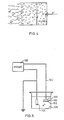
- Fig. 4 illustrates the electrochemical conditions in a pH-sensitive lithium containing silica glass having one surface interfacing a sample and another surface interfacing an intercalation electrode for lithium ions, in casu Li X V 2 0 5 .
- Hydrogen ions drawn into the glass from the sample cause a flow of lithium ions into the intercalation electrode.
- the positively charged lithium ions are incorporated in the intercalation electrode. Thereby, a corresponding amount of electrons is bound, giving rise to the development of a potential on the measuring electrode device.
- the electrons necessary for the electrode reaction can easily be supplied via the intercalation electrode and the electrical connection and ensure the obtainment of an equilibrium state in the system.
- the obtainment of an equilibrium state is a prerequisite for the achievement of stable electrode potential measurements.
- FIG. 5 shows diagrammatically a measuring system.
- An ion selective electrode device generally designated 100 and a reference electrode 101 is placed in a solution 105 containing ions A * to which the ion selective measuring electrode device 100 is selective.
- the measuring electrode device comprises an ion selective element 102, an intercalation compound 103 and a conductor 104.
- the measuring electrode device is connected to one input means of a pH/mV-meter 106, and the reference electrode 101, the potential of which is defined in a suitable manner, in casu by grounding, is connected to another input means.
- the electrical potential measured by the mV-meter 106 should be related to the activity of A+ in the sample in a simple manner.
- the intercalation electrode can be fixed by using as the intercalation electrode a system comprising two phases which is chemically in equilibrium. In that case the potential measured will in a straightforward way reflect the activity of the ion A+ in the sample.
- Fig. 6 is a phase diagram showing the varying crystal structures of Li x V 2 O 5 for 0 ⁇ x ⁇ 1. It appears from Fig. 6 that in the range 0.37 ⁇ x ⁇ 0.44 an equilibrium mixture of the two crystal forms ⁇ and j3' exists. Furthermore, the transformation between the two crystal forms ⁇ and ⁇ ' takes place very quickly at room temperature. Accordingly, it is theoretically contemplated that Li x V 2 O s with 0.37 ⁇ x ⁇ 0.44 will be a material especially suitable as intercalation electrode in the electrode device according to the invention, the chemical potential of the intercalation electrode being fixed regardless of a change in x due to transport of lithium ions from the ion selective element into the intercalation electrode.
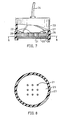
- Fig. 7 is another contemplated construction of the electrode device according to the invention.
- the construction is compact, rugged and probably suitable for production on a commercial scale.
- the embodiment comprises a ceramic substrate 25 having a thermal coefficient of expansion making the substrate compatible with the materials further used in the electrode device.
- the substrate 25 is provided with a number of through-going passages in which an intercalation compound 21 is provided.
- An ion selective glass membrane 20 is bonded to a glass layer 26 extending over one side of the substrate and having through-going passages registering with the passages in the substrate 25.
- the glass layer 26 is made from a relatively low melting glass and the layer is interposed between the membrane 20 and the substrate 25.
- the embodiment shown comprises an electrically insulating enclosure 23 to which the substrate 25 and the elements connected therewith are cemented by gluing.
- the enclosure 23 leaves the main part of the glass membrane 20 exposed to the surroundings.
- one or more fields 22 constituting the electrical connection is/are applied by means of conventional layer technique such as thick or thin film technique, the said fields 22 contacting the intercalation compound 21.
- Conductor means 24 for connecting the electrode device to a pH-meter is also shown.
- Electronic amplifying means 27 and a temperature sensor 28 are also provided in the device according to Fig. 7.
- the device according to Fig. 7 may be modified in several ways. E.g. the layer of relatively low melting glass may be omitted, the glass membrane and the substrate then contacting each other directly. Moreover, further suitable electronic components may be integrated in the electrode device.
- a number of measuring electrode devices according to Fig. 1 was prepared for control of the electrode properties. Electrode devices of similar configuration with the only difference that the tube was a sealed glass tube was prepared, too. Across the seal a platinum wire extended as connection between the spring 5 and the electrode cable 6.
- Li x TiS 2 Li x V 6 O 13 and Li XV2 0 5 was tested.
- the rod 4 a graphite rod was used in some instances and a steel rod in other instances and as the inert atmosphere argon was used.
- the ionic conductive liquid film various combinations of lithium salts in organic solvents were used, e.g. LiCl0 4 in propylene carbonate.
- a number of measuring electrode devices of the embodiment according to Fig. 1 was prepared using Li 2 V 6 O 13 as the intercalation compound.
- the electrode devices differed from those of example 1 therein that the ionic conductive liquid film was replaced by an ionic conductive polymer comprising polyethylene oxide and lithium thiocyanate in the weight ratio 3:1.
- This polymer was prepared according to M. B. Armand et al.: Fast Ion Transport in Solids, published by Vashishta, Mundy and Shenoy, Elsevier, 1979, p. 131-136.
- a bulb-shaped pH-sensitive membrane having a thickness of 0.2 mm was blown from a pH-sensitive lithium containing silica glass.
- This glass part corresponds to the glass part of commercially available pH-electrode manufactured and sold by RADIOMETER A/S, Copenhagen under the trade designation G202C.
- the lithium vanadium bronze was sintered to the glass membrane and a two phase system was formed.
- a copper conductor was cemented to the lithium vanadium bronze by means of an electrically conductive silver epoxy cement and this conductor was connected to a pH-meter by means of a shielded cable.
- the electrode device thus prepared corresponds to the device shown in Fig. 2.
- the pH electrode device was tested in buffer solutions with varying pH values and the electrical potential was measured at 25°C by a pH-meter using a standard calomel reference electrode.
- the sensitivity was determined to 58.5 mV/pH and in a phosphate buffer of pH 7.00 a potential difference between the electrode device and the reference electrode was determined to 373.3 mV.
- a commercially available glass electrode of the type RADIOMETER G202C having a chloride containing phosphate buffer system as inner liquid and a Ag/AgCI internal reference electrode was tested under the same experimental conditions. An average drift about 0.4 mV/24 hours was found for this device.
Landscapes
- Chemical & Material Sciences (AREA)
- Life Sciences & Earth Sciences (AREA)
- Health & Medical Sciences (AREA)
- Biochemistry (AREA)
- Chemical Kinetics & Catalysis (AREA)
- Electrochemistry (AREA)
- Physics & Mathematics (AREA)
- Analytical Chemistry (AREA)
- Molecular Biology (AREA)
- General Health & Medical Sciences (AREA)
- General Physics & Mathematics (AREA)
- Immunology (AREA)
- Pathology (AREA)
- Investigating Or Analyzing Materials By The Use Of Electric Means (AREA)
- Battery Electrode And Active Subsutance (AREA)
- Glass Compositions (AREA)
Claims (9)
Priority Applications (1)
| Application Number | Priority Date | Filing Date | Title |
|---|---|---|---|
| AT83900917T ATE29592T1 (de) | 1982-03-15 | 1983-03-15 | Ion-selektive messelektrodenanordnung. |
Applications Claiming Priority (2)
| Application Number | Priority Date | Filing Date | Title |
|---|---|---|---|
| DK113282A DK158244C (da) | 1982-03-15 | 1982-03-15 | Ionselektiv maaleelektrode og fremgangsmaade til fremstilling af denne elektrode |
| DK1132/82 | 1982-03-15 |
Publications (2)
| Publication Number | Publication Date |
|---|---|
| EP0103599A1 EP0103599A1 (de) | 1984-03-28 |
| EP0103599B1 true EP0103599B1 (de) | 1987-09-09 |
Family
ID=8101380
Family Applications (1)
| Application Number | Title | Priority Date | Filing Date |
|---|---|---|---|
| EP83900917A Expired EP0103599B1 (de) | 1982-03-15 | 1983-03-15 | Ion-selektive messelektrodenanordnung |
Country Status (6)
| Country | Link |
|---|---|
| US (1) | US4632732A (de) |
| EP (1) | EP0103599B1 (de) |
| JP (1) | JPS59500386A (de) |
| DE (1) | DE3373541D1 (de) |
| DK (1) | DK158244C (de) |
| WO (1) | WO1983003304A1 (de) |
Cited By (2)
| Publication number | Priority date | Publication date | Assignee | Title |
|---|---|---|---|---|
| DE102016202083A1 (de) * | 2016-02-11 | 2017-08-17 | Knick Elektronische Messgeräte GmbH & Co. KG | Elektrochemischer Sensor und Verfahren zu dessen Herstellung |
| US11391688B2 (en) | 2018-04-09 | 2022-07-19 | Endress+Hauser Conducta Gmbh+Co. Kg | Sensor element for a potentiometric sensor |
Families Citing this family (26)
| Publication number | Priority date | Publication date | Assignee | Title |
|---|---|---|---|---|
| FR2574937B1 (fr) * | 1984-12-14 | 1987-07-24 | Centre Nat Rech Scient | Nouveau systeme de reference interne pour electrodes de verre |
| US5139626A (en) * | 1985-10-02 | 1992-08-18 | Terumo Corporation | Ion concentration measurement method |
| DK626986A (da) * | 1985-12-25 | 1987-06-26 | Terumo Corp | Ionsensor |
| DE3687123T2 (de) * | 1986-01-24 | 1993-05-13 | Terumo Corp | Ionenempfindlicher fet-fuehler. |
| JPS62180263A (ja) * | 1986-02-04 | 1987-08-07 | Terumo Corp | 酸素センサ− |
| US4871442A (en) * | 1986-05-01 | 1989-10-03 | Terumo Corporation | Ion sensor |
| JPS62277547A (ja) * | 1986-05-26 | 1987-12-02 | Terumo Corp | ガスセンサ− |
| DE3639312A1 (de) * | 1986-11-17 | 1988-05-26 | Battelle Institut E V | Festkoerperelektrode zur bestimmung von natriumionenkonzentrationen in loesungen |
| JPS63131057A (ja) * | 1986-11-20 | 1988-06-03 | Terumo Corp | 酵素センサ |
| JPS63131056A (ja) * | 1986-11-20 | 1988-06-03 | Terumo Corp | Fet電極 |
| CA1315927C (en) * | 1986-12-10 | 1993-04-13 | Terumo Kabushiki Kaisha | Ion carrier membrane, and ion sensor having same |
| US5192417A (en) * | 1987-09-21 | 1993-03-09 | Terumo Kabushiki Kaisha | Lithium ion sensor |
| US5112456A (en) * | 1989-12-12 | 1992-05-12 | Trustees Of The University Of Pennsylvania | Electrochemical sensors and methods for their use |
| DK163944C (da) * | 1990-02-07 | 1992-09-21 | Radiometer As | Glaselektrode og anvendelse af denne |
| US5041792A (en) * | 1990-03-22 | 1991-08-20 | Exxon Production Research Company | Electrodes incorporating intercalation compounds for mangetotelluric, electroseismic and other electrical survey applications |
| GB9424825D0 (en) * | 1994-12-07 | 1995-02-08 | Belford Rona E | Solid state blown glass pH and other ion sensor systems |
| RU2117281C1 (ru) * | 1994-12-15 | 1998-08-10 | Семен Борисович Ицыгин | Универсальный комбинированный ионоселективный датчик (варианты) |
| DE10018750C2 (de) * | 1999-04-23 | 2003-03-27 | Kurt Schwabe Inst Fuer Mess Un | Festkontaktierte ionenselektive Glaselektrode und Verfahren zu ihrer Herstellung |
| EP1269172B1 (de) | 2000-03-01 | 2009-05-13 | Radiometer Medical ApS | Elektrodeneinrichtung mit festkörper-bezugssystem |
| GB0118931D0 (en) * | 2001-08-02 | 2001-09-26 | Oxford Biosensors Ltd | Voltammetric ion-selective biosensor |
| EP3309541B1 (de) * | 2016-10-13 | 2020-08-12 | Mettler-Toledo GmbH | Messelement für eine ionensensitive festkontakt-elektrode und ionensensitive festkontakt-elektrode |
| JP6881018B2 (ja) * | 2017-05-18 | 2021-06-02 | 横河電機株式会社 | pHセンサ |
| US11397161B2 (en) * | 2017-10-11 | 2022-07-26 | Anb Sensors Limited | Calibration electrode |
| EP3517944A1 (de) * | 2018-01-30 | 2019-07-31 | Mettler-Toledo GmbH | Messeinheit für eine ionensensitive festkörperelektrode und ionensensitive elektrode |
| EP3517943A1 (de) | 2018-01-30 | 2019-07-31 | Mettler-Toledo GmbH | Ionensensitive glaselektrode, messeinheit und verfahren zur herstellung |
| DE102020121688A1 (de) * | 2019-08-21 | 2021-02-25 | Endress+Hauser Conducta Gmbh+Co. Kg | Verfahren zum Herstellen eines Sensorelements und ionenselektive Elektrode |
Family Cites Families (8)
| Publication number | Priority date | Publication date | Assignee | Title |
|---|---|---|---|---|
| CH534356A (de) * | 1969-04-25 | 1973-02-28 | Perkin Elmer Corp | Nichtpolarisierende, ionenselektive Elektrode |
| US3825482A (en) * | 1972-02-16 | 1974-07-23 | Univ Iowa State Res Found Inc | Ion-selective electrodes using tungsten bronzes as active element |
| US3853731A (en) * | 1973-03-12 | 1974-12-10 | Owens Illinois Inc | Solid state junction glass electrode and method of making said electrode |
| US3856634A (en) * | 1973-03-19 | 1974-12-24 | Univ Iowa State Res Found Inc | Method for measuring dissolved oxygen in aqueous solution using tungsten bronzes as a potentiometric indicating electrode |
| GB1470558A (en) * | 1974-07-03 | 1977-04-14 | Nat Res Dev | Method and apparatus for detecting elements |
| US4111777A (en) * | 1974-09-04 | 1978-09-05 | National Research Development Corporation | Ion-sensitive electrodes |
| US4182667A (en) * | 1974-09-04 | 1980-01-08 | National Research Development Corporation | Ion-sensitive electrodes |
| DE2926172C2 (de) * | 1979-06-28 | 1982-05-06 | Max-Planck-Gesellschaft Zur Foerderung Der Wissenschaften E.V., 3400 Goettingen | Verfahren zur Messung von Aktivitäten mit festen Ionenleitern |
-
1982
- 1982-03-15 DK DK113282A patent/DK158244C/da not_active IP Right Cessation
-
1983
- 1983-03-15 EP EP83900917A patent/EP0103599B1/de not_active Expired
- 1983-03-15 WO PCT/DK1983/000035 patent/WO1983003304A1/en not_active Ceased
- 1983-03-15 US US06/557,161 patent/US4632732A/en not_active Expired - Fee Related
- 1983-03-15 DE DE8383900917T patent/DE3373541D1/de not_active Expired
- 1983-03-15 JP JP58501121A patent/JPS59500386A/ja active Pending
Cited By (3)
| Publication number | Priority date | Publication date | Assignee | Title |
|---|---|---|---|---|
| DE102016202083A1 (de) * | 2016-02-11 | 2017-08-17 | Knick Elektronische Messgeräte GmbH & Co. KG | Elektrochemischer Sensor und Verfahren zu dessen Herstellung |
| DE102016202083B4 (de) | 2016-02-11 | 2023-09-07 | Knick Elektronische Messgeräte GmbH & Co. KG | Elektrochemischer Sensor und Verfahren zu dessen Herstellung |
| US11391688B2 (en) | 2018-04-09 | 2022-07-19 | Endress+Hauser Conducta Gmbh+Co. Kg | Sensor element for a potentiometric sensor |
Also Published As
| Publication number | Publication date |
|---|---|
| DK158244C (da) | 1990-09-10 |
| DK113282A (da) | 1983-09-16 |
| EP0103599A1 (de) | 1984-03-28 |
| DK158244B (da) | 1990-04-16 |
| JPS59500386A (ja) | 1984-03-08 |
| WO1983003304A1 (en) | 1983-09-29 |
| US4632732A (en) | 1986-12-30 |
| DE3373541D1 (en) | 1987-10-15 |
Similar Documents
| Publication | Publication Date | Title |
|---|---|---|
| EP0103599B1 (de) | Ion-selektive messelektrodenanordnung | |
| US4613422A (en) | Ambient sensing devices | |
| US4052285A (en) | Ion selective electrodes | |
| Fabry et al. | NASICON, an ionic conductor for solid-state Na+-selective electrode | |
| JPH0633063U (ja) | 黒鉛をベースとする固態ポリマー膜イオン選択性電極 | |
| JP2003525450A (ja) | 固体状態参照系を持つ電極デバイス | |
| Komaba et al. | All-solid-state ion-selective electrodes with redox-active lithium, sodium, and potassium insertion materials as the inner solid-contact layer | |
| JPH0342425B2 (de) | ||
| EP0573612A1 (de) | Sensor für natriumionen | |
| US4783250A (en) | Immobilized electrochemical cell devices and methods of manufacture | |
| Yang et al. | Development of a NASICON-based amperometric carbon dioxide sensor | |
| US4182667A (en) | Ion-sensitive electrodes | |
| JPS6351503B2 (de) | ||
| US5910239A (en) | Potentiometric CO2 sensor having an open titanate- or stannate-based reference electrode | |
| US4814062A (en) | Membrane reference electrode | |
| US5122254A (en) | Solid state electrode for the determination of sodium ion concentrations in solutions | |
| US3980543A (en) | Electrochemical cell structure | |
| US3825482A (en) | Ion-selective electrodes using tungsten bronzes as active element | |
| JP3186363B2 (ja) | イオン電極 | |
| US4111777A (en) | Ion-sensitive electrodes | |
| Pui et al. | Micro-size potentiometric probes for gas and substrate sensing | |
| US4495053A (en) | Replaceable junctions for reference electrodes | |
| US4549953A (en) | Ion-selective electrodes | |
| JPH0470584B2 (de) | ||
| EP0126452A2 (de) | Elektrochemische Zelle |
Legal Events
| Date | Code | Title | Description |
|---|---|---|---|
| PUAI | Public reference made under article 153(3) epc to a published international application that has entered the european phase |
Free format text: ORIGINAL CODE: 0009012 |
|
| AK | Designated contracting states |
Designated state(s): AT BE CH DE FR GB LI LU NL SE |
|
| 17P | Request for examination filed |
Effective date: 19840321 |
|
| GRAA | (expected) grant |
Free format text: ORIGINAL CODE: 0009210 |
|
| AK | Designated contracting states |
Kind code of ref document: B1 Designated state(s): AT BE CH DE FR GB LI LU NL SE |
|
| PG25 | Lapsed in a contracting state [announced via postgrant information from national office to epo] |
Ref country code: NL Effective date: 19870909 Ref country code: LI Effective date: 19870909 Ref country code: FR Free format text: THE PATENT HAS BEEN ANNULLED BY A DECISION OF A NATIONAL AUTHORITY Effective date: 19870909 Ref country code: CH Effective date: 19870909 Ref country code: BE Effective date: 19870909 Ref country code: AT Effective date: 19870909 |
|
| REF | Corresponds to: |
Ref document number: 29592 Country of ref document: AT Date of ref document: 19870915 Kind code of ref document: T |
|
| PG25 | Lapsed in a contracting state [announced via postgrant information from national office to epo] |
Ref country code: SE Effective date: 19870930 |
|
| REF | Corresponds to: |
Ref document number: 3373541 Country of ref document: DE Date of ref document: 19871015 |
|
| REG | Reference to a national code |
Ref country code: CH Ref legal event code: PL |
|
| EN | Fr: translation not filed | ||
| NLV1 | Nl: lapsed or annulled due to failure to fulfill the requirements of art. 29p and 29m of the patents act | ||
| PG25 | Lapsed in a contracting state [announced via postgrant information from national office to epo] |
Ref country code: LU Free format text: LAPSE BECAUSE OF NON-PAYMENT OF DUE FEES Effective date: 19880331 |
|
| PLBE | No opposition filed within time limit |
Free format text: ORIGINAL CODE: 0009261 |
|
| STAA | Information on the status of an ep patent application or granted ep patent |
Free format text: STATUS: NO OPPOSITION FILED WITHIN TIME LIMIT |
|
| 26N | No opposition filed | ||
| PGFP | Annual fee paid to national office [announced via postgrant information from national office to epo] |
Ref country code: GB Payment date: 19900331 Year of fee payment: 8 |
|
| PGFP | Annual fee paid to national office [announced via postgrant information from national office to epo] |
Ref country code: DE Payment date: 19900430 Year of fee payment: 8 |
|
| PG25 | Lapsed in a contracting state [announced via postgrant information from national office to epo] |
Ref country code: GB Effective date: 19910315 |
|
| GBPC | Gb: european patent ceased through non-payment of renewal fee | ||
| PG25 | Lapsed in a contracting state [announced via postgrant information from national office to epo] |
Ref country code: DE Effective date: 19920101 |