EP0121444A2 - Biochemical method for preparation of optically active carnitine - Google Patents
Biochemical method for preparation of optically active carnitine Download PDFInfo
- Publication number
- EP0121444A2 EP0121444A2 EP84302316A EP84302316A EP0121444A2 EP 0121444 A2 EP0121444 A2 EP 0121444A2 EP 84302316 A EP84302316 A EP 84302316A EP 84302316 A EP84302316 A EP 84302316A EP 0121444 A2 EP0121444 A2 EP 0121444A2
- Authority
- EP
- European Patent Office
- Prior art keywords
- hydrase
- carnitine
- strain
- apocarnitine
- culture
- Prior art date
- Legal status (The legal status is an assumption and is not a legal conclusion. Google has not performed a legal analysis and makes no representation as to the accuracy of the status listed.)
- Granted
Links
Classifications
-
- C—CHEMISTRY; METALLURGY
- C12—BIOCHEMISTRY; BEER; SPIRITS; WINE; VINEGAR; MICROBIOLOGY; ENZYMOLOGY; MUTATION OR GENETIC ENGINEERING
- C12P—FERMENTATION OR ENZYME-USING PROCESSES TO SYNTHESISE A DESIRED CHEMICAL COMPOUND OR COMPOSITION OR TO SEPARATE OPTICAL ISOMERS FROM A RACEMIC MIXTURE
- C12P13/00—Preparation of nitrogen-containing organic compounds
- C12P13/007—Carnitine; Butyrobetaine; Crotonobetaine
Definitions
- the present invention relates to the production of optically active carnitine by the action of an enzyme produced by a microorganism on apocarnitine.
- L-carnitir.e is a substance which exhibits various pharmacological activities, particularly the activity of hyperfunction for digestion, and is in use as a medicine.
- L-carnitine currently used as a medicine is produced by the optical resolution of a racemate obtained through chemical reaction processes.
- the said resolution process requires costly optical resolving agents and involves complex procedures and thus it is desired to develop a cheaper production process.
- the present inventors after investigation into a cheaper production process for optically active carnitine, found a process-which uses an enzyme produced by a microorganism to convert apocarnitine into L-carnitine through a reaction so far unknown, an have come to establish the present invent- tion.
- An aspect of the invention is directed to a process for preparing L-carnitine which comprises bringing apocarnitine into contact with water in the presence of hydrase capable of hydrating apocarnitine in an aqueous medium having a pH of 4 - 10 at a temperature of 20 - 60°C for an effective period of time to convert apocarnitine to L-carnitine and recovering L-carnitine from the aqueous medium.
- Another aspect of the invention is directed to a composition for producing L-carnitine which comprises an aqueous medium containing apocarnitine and hydrase in an amount effective to convert apocarnitine to L-carnitine, the hydrase having been produced by a strain of Enterobacter.
- a further aspect of the invention is directed to a composition for recovering L-carnitine which comprises an aqueous medium containing L-carnitine converted from apocarnitine and hydrase produced by a strain of Enterobacter, the hydrase being able to convert apocarnitine to L-carnitine.
- the strain shows the following properties:
- the strain Y-239-b is susceptible to change in properties, and undergoes mutations brought about by artificial mutagenic means using ultraviolet rays, X-rays, microwaves,chemicals, etc., and even the mutants of the strain thus obtained, when they produce the hydrase capable of catalyzing the conversion of apocarnitine into L-carnitine, can be employed in the process of the present invention.
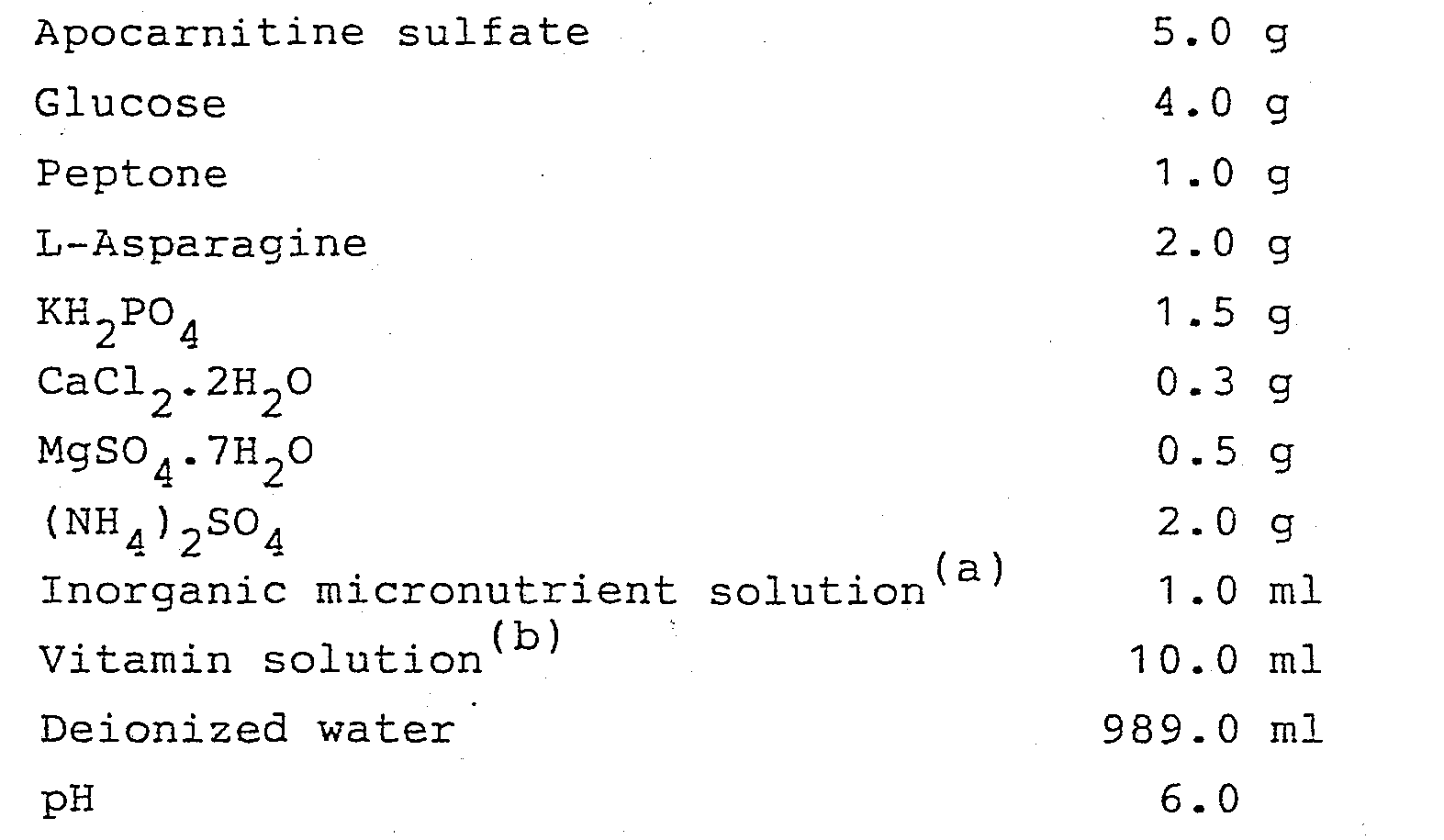
- the said strain or mutants may be cultivated on a culture medium containing nutrients which can normally be utilized by microorganisms.
- a culture medium containing nutrients which can normally be utilized by microorganisms.
- known materials used for cultivating bacteria can be employed.
- the culture medium may contain a carbon source such as glucose sucrose, starch, dextrin, molasses, organic acids, etc. and a nitrogen source such as urea, ammonium chloride, peptone, meat extract, yeast extract, etc. as well as inorganic salts such as salts of phosphoric acid, magnesium, potassium, sodium, calcium, manganese zinc, copper, iron, molybdic acid and so forth.
- a carbon source such as glucose sucrose, starch, dextrin, molasses, organic acids, etc.
- a nitrogen source such as urea, ammonium chloride, peptone, meat extract, yeast extract, etc.
- inorganic salts such as salts of phosphoric acid, magnesium, potassium, sodium, calcium, manganese zinc, copper, iron, molybdic acid and so forth.
- the cultivation may be conducted under aerobic conditions at 25 to 30°C for 24 to 72 hours, whereby the enzyme, hydrase, being able to catalyze the conversion of apocarnitine into carnitine is produced.
- the said hydrase is accumulated in the filtrate of the culture broth as well as in the microbial cells (solid component).
- apocarnitine is brought into contact with water in the presence of the hydrase.
- the cataly tic reaction of the hydrase can suitably be carried out normally at a pH of 4 to 10 and at a temperature of 20 to 60°C, and the reaction time varies depending upon the titer, concentration, etc. of the enzyme.
- the enzyme may be employed in the form of the culture broth including microbial cells; the culture broth having the microbial cells separated; the separated cells; crushed cell solutions obtained by grinding, autolyzing or disintegrating with, ultrasonic waves the separated cells; cell-free extracts obtained by subjecting such crushed cell solutions to treatment such as centrifugation, salting out and precipitation; solid materials produced from such cell-free extracts by air-drying or treating with a solvent such as acetone and ether; or immobilized enzymes obtained by fixing the cells or the solid materials by per se known method in the field of biochemical reactors.
- the conversion of apocarnitine into L-carnitine can also be conducted in an aqueous medium cultivating the said microorganisms.
- the above-mentioned culture medium is inoculated with the strain Y-239-b, and shake culture is carried out at 30°C for 48 hours. After the incubation, the resultant culture broth is centrifuged to give 1000 ml of the supernatant solution.
- the supernatant solution is adjusted to pH 8, and passed through a column of Diaion SK-IB, type H (produced by Mitsubishi Chemical Ind., Ltd., Tokyo), a strongly acid cation exchange resin, to allow adsorption. Elution is carried out with 200 ml of 0.5N aqueous ammonia, and the eluate is concentrated under reduced pressure at 40°C.
- the culture medium as used in Example 1 is inoculated with the strain Y-239-b, and culture is carried out at 30°C for 48 hours.
- the microbial cells are obtained by centrifuging 600 ml of the resultant culture broth, washed three times with physiological saline and subjected to ultrasonic treatment at a temperature of not more than 10°C, followed by centrifugation.
- 50 ml of 0.1N potassium phosphate buffer is added to the resultant residue to give an enzyme solution.
- 50 ul of the enzyme solution is allowed to undergo reaction in a solution of 50 ul of 1 % apocarnitine sulfate solution and 400 ⁇ l of 0.1N potassium phosphate buffer (pH 6.5) at 30°C for 2.5 hours.
- Quantitative determination with use of TLC indicates that there is produced 180 vg of L-carnitine.
- acetone powder 20 mg is allowed to undergo reaction in a solution of 20 ul of 10 % apocarnitine sulfate solution and 980 ⁇ l of 0.1 % potassium phosphate buffer (pH 6.5) at 30°C for 3 hours, and quantitative determination is effected with use of TLC. As a result, there is produced 200 ⁇ g of L-carnitine per 20 mg of the acetone powder (from microbial cells).
- strain Y-239-b was originally deposited at Fermentation Research Institute and given Deposit No. FERM 6972 on 9 March 1983. This deposit was changed to International Deposit and the number changed to FERM BP-510 on 19 March 1984
Landscapes
- Organic Chemistry (AREA)
- Chemical & Material Sciences (AREA)
- Engineering & Computer Science (AREA)
- Zoology (AREA)
- Life Sciences & Earth Sciences (AREA)
- Wood Science & Technology (AREA)
- Chemical Kinetics & Catalysis (AREA)
- Microbiology (AREA)
- General Chemical & Material Sciences (AREA)
- Biotechnology (AREA)
- Health & Medical Sciences (AREA)
- Biochemistry (AREA)
- Bioinformatics & Cheminformatics (AREA)
- General Engineering & Computer Science (AREA)
- General Health & Medical Sciences (AREA)
- Genetics & Genomics (AREA)
- Preparation Of Compounds By Using Micro-Organisms (AREA)
Abstract
Description
- The present invention relates to the production of optically active carnitine by the action of an enzyme produced by a microorganism on apocarnitine.
- L-carnitir.e is a substance which exhibits various pharmacological activities, particularly the activity of hyperfunction for digestion, and is in use as a medicine. L-carnitine currently used as a medicine is produced by the optical resolution of a racemate obtained through chemical reaction processes. However, the said resolution process requires costly optical resolving agents and involves complex procedures and thus it is desired to develop a cheaper production process.
- Under these circumstances, the present inventors conducted an investigation into the production of optically active carnitine by means of biochemical procedures.
- As reactions that biochemically yield L-carnitine, there have been conventionally known the hydroxylation of 4-N-tri- methylaminob tyric acid (J. Biol. Chem., vol. 256, pp. 12437 to 12444, 1981), the reduction of 3-dehydrocarnitine (Appl. Environ. Microbiol., vol. 39, pp. 329 to 334, 1980) and so forth. Nevert less, these processes suffer from the disadvantages that the required raw materials are costly and the used enzymes are uns able, and cannot be put into practical use.
- The present inventors, after investigation into a cheaper production process for optically active carnitine, found a process-which uses an enzyme produced by a microorganism to convert apocarnitine into L-carnitine through a reaction so far unknown, an have come to establish the present invent- tion.
- An aspect of the invention is directed to a process for preparing L-carnitine which comprises bringing apocarnitine into contact with water in the presence of hydrase capable of hydrating apocarnitine in an aqueous medium having a pH of 4 - 10 at a temperature of 20 - 60°C for an effective period of time to convert apocarnitine to L-carnitine and recovering L-carnitine from the aqueous medium.
- Another aspect of the invention is directed to a composition for producing L-carnitine which comprises an aqueous medium containing apocarnitine and hydrase in an amount effective to convert apocarnitine to L-carnitine, the hydrase having been produced by a strain of Enterobacter.
- A further aspect of the invention is directed to a composition for recovering L-carnitine which comprises an aqueous medium containing L-carnitine converted from apocarnitine and hydrase produced by a strain of Enterobacter, the hydrase being able to convert apocarnitine to L-carnitine.
- In the following, the present invention is described in more detail:
- As the hydrase in the present invention, a hydrase produced by a microorganism is generally employed. And as the microorganism, use may be made of any microorganism that can produce hydrase able to convert apocarnitine to L-carnitine.
- For example, there may be mentioned a microorganism, the strain No. Y-239-b, which the present inventors separated from nature.
- The strain shows the following properties:
- (1) Morphological properties


- (2) State of growth
- (a) Incubation on a meat extract-agar plate

- (b) Incubation on a meat extract-agar slant
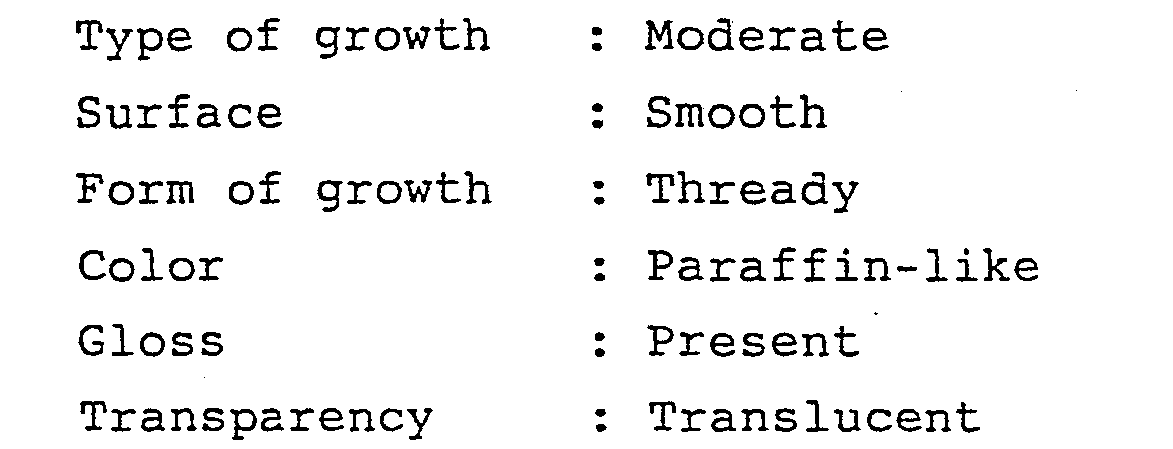
- (c) Incubation on a meat extract liquid

- (a) Incubation on a meat extract-agar plate
- (3) Physiological properties

- Utilization of inorganic nitrogen sources (growth)

- Production of acid and gas from saccharides


- Identification in accordance with the classification described in Bergey's Manual of Determinative Bacteriology (7th edition) indicates that the microorganism showing the above bacteriological properties belongs to the genus enterobacter, and it has been decided that the microorganism is refered to as Enterobacter sp. Y-239-b. The said strain has been deposited at Fermentation Research Institute, Agency of Industrial Science & Technology with the deposit number FERM BP-510. The strain Y-239-b is susceptible to change in properties, and undergoes mutations brought about by artificial mutagenic means using ultraviolet rays, X-rays, microwaves,chemicals, etc., and even the mutants of the strain thus obtained, when they produce the hydrase capable of catalyzing the conversion of apocarnitine into L-carnitine, can be employed in the process of the present invention.
- The said strain or mutants may be cultivated on a culture medium containing nutrients which can normally be utilized by microorganisms. As the nutrient sources, known materials used for cultivating bacteria can be employed.
- The culture medium may contain a carbon source such as glucose sucrose, starch, dextrin, molasses, organic acids, etc. and a nitrogen source such as urea, ammonium chloride, peptone, meat extract, yeast extract, etc. as well as inorganic salts such as salts of phosphoric acid, magnesium, potassium, sodium, calcium, manganese zinc, copper, iron, molybdic acid and so forth.
- With reference to the cultural method, the cultivation may be conducted under aerobic conditions at 25 to 30°C for 24 to 72 hours, whereby the enzyme, hydrase, being able to catalyze the conversion of apocarnitine into carnitine is produced.
- The said hydrase is accumulated in the filtrate of the culture broth as well as in the microbial cells (solid component).
- In the present invention, apocarnitine is brought into contact with water in the presence of the hydrase.
- The cataly tic reaction of the hydrase can suitably be carried out normally at a pH of 4 to 10 and at a temperature of 20 to 60°C, and the reaction time varies depending upon the titer, concentration, etc. of the enzyme.
- In conducting the reaction, the enzyme may be employed in the form of the culture broth including microbial cells; the culture broth having the microbial cells separated; the separated cells; crushed cell solutions obtained by grinding, autolyzing or disintegrating with, ultrasonic waves the separated cells; cell-free extracts obtained by subjecting such crushed cell solutions to treatment such as centrifugation, salting out and precipitation; solid materials produced from such cell-free extracts by air-drying or treating with a solvent such as acetone and ether; or immobilized enzymes obtained by fixing the cells or the solid materials by per se known method in the field of biochemical reactors.
- The conversion of apocarnitine into L-carnitine can also be conducted in an aqueous medium cultivating the said microorganisms.
- Examples of the present invention are described in the following, however, the invention is not limited by these examples.
-
-

-

[a] = -30.5 (c=1., aqueous solution)
Decomposition point, 197 - 198°C
Elemental analysis (%), for C7H15NO3
Calcd.: C, 52.15; H, 9.38; N, 29.78
Found: C, 52.20; H, 9.35; N, 29.82 - The culture medium as used in Example 1 is inoculated with the strain Y-239-b, and culture is carried out at 30°C for 48 hours. The microbial cells are obtained by centrifuging 600 ml of the resultant culture broth, washed three times with physiological saline and subjected to ultrasonic treatment at a temperature of not more than 10°C, followed by centrifugation. 50 ml of 0.1N potassium phosphate buffer is added to the resultant residue to give an enzyme solution. 50 ul of the enzyme solution is allowed to undergo reaction in a solution of 50 ul of 1 % apocarnitine sulfate solution and 400 µl of 0.1N potassium phosphate buffer (pH 6.5) at 30°C for 2.5 hours. Quantitative determination with use of TLC indicates that there is produced 180 vg of L-carnitine.
- The culture medium as used in Example 1, which is freed of apocarnitine sulfate, is inoculated with the strain Y-239-b, and after the incubation at 30°C for 48 hours, the microbial cells are obtained by centrifuging the resultant cuture broth, washed with physiological saline, and subjected to the conventional treatment to prepare an acetone powder, whereby 440 mg of the acetone powder is obtained from 300 ml of the culture broth. 20 mg of acetone powder is allowed to undergo reaction in a solution of 20 ul of 10 % apocarnitine sulfate solution and 980 µl of 0.1 % potassium phosphate buffer (pH 6.5) at 30°C for 3 hours, and quantitative determination is effected with use of TLC. As a result, there is produced 200 µg of L-carnitine per 20 mg of the acetone powder (from microbial cells).
- The strain Y-239-b was originally deposited at Fermentation Research Institute and given Deposit No. FERM 6972 on 9 March 1983. This deposit was changed to International Deposit and the number changed to FERM BP-510 on 19 March 1984
Claims (14)
Applications Claiming Priority (2)
| Application Number | Priority Date | Filing Date | Title |
|---|---|---|---|
| JP58060412A JPS59183694A (en) | 1983-04-05 | 1983-04-05 | Biochemical preparation of optically active carnitine |
| JP60412/83 | 1983-04-05 |
Publications (3)
| Publication Number | Publication Date |
|---|---|
| EP0121444A2 true EP0121444A2 (en) | 1984-10-10 |
| EP0121444A3 EP0121444A3 (en) | 1986-08-13 |
| EP0121444B1 EP0121444B1 (en) | 1989-02-08 |
Family
ID=13141436
Family Applications (1)
| Application Number | Title | Priority Date | Filing Date |
|---|---|---|---|
| EP84302316A Expired EP0121444B1 (en) | 1983-04-05 | 1984-04-04 | Biochemical method for preparation of optically active carnitine |
Country Status (5)
| Country | Link |
|---|---|
| US (1) | US4636471A (en) |
| EP (1) | EP0121444B1 (en) |
| JP (1) | JPS59183694A (en) |
| CA (1) | CA1210351A (en) |
| DE (1) | DE3476682D1 (en) |
Cited By (3)
| Publication number | Priority date | Publication date | Assignee | Title |
|---|---|---|---|---|
| EP0122794A3 (en) * | 1983-04-13 | 1986-07-02 | Ajinomoto Co., Inc. | Method for producing l-carnitine |
| EP0148132A3 (en) * | 1983-11-03 | 1986-07-16 | Sigma-Tau Industrie Farmaceutiche Riunite S.P.A. | Microbiological process for stereoselectively synthesizing l(-)-carnitine |
| US5491260A (en) * | 1993-04-08 | 1996-02-13 | Sigma-Tau Industrie Farmaceutiche Riunite S.P.A. | Process for manufacturing L-(-)-carnitine from derivatives having a configuration opposite to that of L-(-)-carnitine |
Families Citing this family (4)
| Publication number | Priority date | Publication date | Assignee | Title |
|---|---|---|---|---|
| GB2195630B (en) * | 1986-08-26 | 1990-07-18 | Chuo Kaseihin Co Inc | Method for producing carnitine, l-carnitineamide hydrolase and method for producing same |
| JPH0669381B2 (en) * | 1987-12-04 | 1994-09-07 | 協和醗酵工業株式会社 | Carnitine manufacturing method |
| JP4967659B2 (en) * | 2004-09-08 | 2012-07-04 | 和光純薬工業株式会社 | Method for purifying L-carnitine |
| CN100359326C (en) * | 2004-10-15 | 2008-01-02 | 山东齐都药业有限公司 | Method for investigating propylene L-relavent matter and content |
Family Cites Families (5)
| Publication number | Priority date | Publication date | Assignee | Title |
|---|---|---|---|---|
| DE2454048A1 (en) * | 1973-11-14 | 1975-07-24 | Kanegafuchi Chemical Ind | METHOD OF BREEDING YEAST |
| IT1142201B (en) * | 1980-06-24 | 1986-10-08 | Sigma Tau Ind Farmaceuti | PROCEDURE FOR THE ENZYMATIC PRODUCTION OF L-CARNITINA |
| JPS59192095A (en) * | 1983-04-13 | 1984-10-31 | Ajinomoto Co Inc | Preparation of l-carnitine |
| DD221905B1 (en) * | 1983-11-03 | 1987-03-18 | Univ Leipzig | PROCESS FOR THE PREPARATION OF L (-) - CARNITINE AND ITS DERIVATIVES |
| FI86889C (en) * | 1984-03-29 | 1992-10-26 | Lonza Ag | Process for the preparation of L-carnitine in a microbiological manner |
-
1983
- 1983-04-05 JP JP58060412A patent/JPS59183694A/en active Granted
-
1984
- 1984-04-04 DE DE8484302316T patent/DE3476682D1/en not_active Expired
- 1984-04-04 EP EP84302316A patent/EP0121444B1/en not_active Expired
- 1984-04-04 CA CA000451244A patent/CA1210351A/en not_active Expired
- 1984-04-05 US US06/597,233 patent/US4636471A/en not_active Expired - Fee Related
Cited By (3)
| Publication number | Priority date | Publication date | Assignee | Title |
|---|---|---|---|---|
| EP0122794A3 (en) * | 1983-04-13 | 1986-07-02 | Ajinomoto Co., Inc. | Method for producing l-carnitine |
| EP0148132A3 (en) * | 1983-11-03 | 1986-07-16 | Sigma-Tau Industrie Farmaceutiche Riunite S.P.A. | Microbiological process for stereoselectively synthesizing l(-)-carnitine |
| US5491260A (en) * | 1993-04-08 | 1996-02-13 | Sigma-Tau Industrie Farmaceutiche Riunite S.P.A. | Process for manufacturing L-(-)-carnitine from derivatives having a configuration opposite to that of L-(-)-carnitine |
Also Published As
| Publication number | Publication date |
|---|---|
| DE3476682D1 (en) | 1989-03-16 |
| US4636471A (en) | 1987-01-13 |
| EP0121444A3 (en) | 1986-08-13 |
| CA1210351A (en) | 1986-08-26 |
| JPS59183694A (en) | 1984-10-18 |
| EP0121444B1 (en) | 1989-02-08 |
| JPH0586188B2 (en) | 1993-12-10 |
Similar Documents
| Publication | Publication Date | Title |
|---|---|---|
| US5900370A (en) | Process for the production of ascorbic acid with prototheca | |
| CA1174622A (en) | Enzyme inhibitor produced by cultivation of streptomyces microorganisms | |
| EP0122794B1 (en) | Method for producing l-carnitine | |
| US3043749A (en) | Preparation of 2-keto-l-gulonic acid | |
| EP0096547B1 (en) | Process for preparing uridine diphosphate-n-acetylgalactosamine | |
| EP0121444B1 (en) | Biochemical method for preparation of optically active carnitine | |
| JP3523285B2 (en) | Production method for glycolytic enzymes | |
| US5166061A (en) | Process for the production of 4-halo-3-hydroxybutyronitrile with Corynebacterium or Microbacterium | |
| EP0133694B1 (en) | Process for producing neuraminidase and method and reagent for the quantitative determination of a sialic acid-containing substance using neuraminidase | |
| IE911637A1 (en) | Biocatalytic process for the production of l-(-)-carnitine from crotonobetaine and strains of proteeae for use in said process | |
| US3970522A (en) | Method for the production of D-ribose | |
| US4933289A (en) | Biologically pure cultures of Pseudomonas sorbosoxidans useful for producing 2-keto-L-gulonic acid | |
| US4767713A (en) | Pure culture of Brevibacterium acetylicum AT-6-7, ATCC 39311 | |
| US4892823A (en) | Method for producing 2-keto-L-gulonic acid | |
| US5116752A (en) | Process for preparing neuraminidase | |
| JP2876417B2 (en) | Method for producing D-sorbose | |
| US5041375A (en) | Method of producing carnitine | |
| US3630842A (en) | Production of 3{40 ,5{40 -cyclic adenylic acid with micro-organisms | |
| US4918012A (en) | Method for producing carnitine, L-carnitinamide hydrolase and method for producing same | |
| US3589982A (en) | Production of l-asparaginase | |
| JPH022589B2 (en) | ||
| JP3030916B2 (en) | Method for producing β-glucooligosaccharide | |
| US3703439A (en) | Process for the preparation of l-beta-(3,4-dihydroxyphenyl)-alpha-alanine by fermentation | |
| WO1992018637A1 (en) | Method for the production of d-gluconic acid | |
| CA1334741C (en) | Method for production of a growth factor for bifidobacterium sp |
Legal Events
| Date | Code | Title | Description |
|---|---|---|---|
| PUAI | Public reference made under article 153(3) epc to a published international application that has entered the european phase |
Free format text: ORIGINAL CODE: 0009012 |
|
| AK | Designated contracting states |
Designated state(s): CH DE FR GB LI |
|
| PUAL | Search report despatched |
Free format text: ORIGINAL CODE: 0009013 |
|
| AK | Designated contracting states |
Kind code of ref document: A3 Designated state(s): CH DE FR GB LI |
|
| 17P | Request for examination filed |
Effective date: 19860729 |
|
| 17Q | First examination report despatched |
Effective date: 19871211 |
|
| GRAA | (expected) grant |
Free format text: ORIGINAL CODE: 0009210 |
|
| AK | Designated contracting states |
Kind code of ref document: B1 Designated state(s): CH DE FR GB LI |
|
| REF | Corresponds to: |
Ref document number: 3476682 Country of ref document: DE Date of ref document: 19890316 |
|
| ET | Fr: translation filed | ||
| PLBE | No opposition filed within time limit |
Free format text: ORIGINAL CODE: 0009261 |
|
| STAA | Information on the status of an ep patent application or granted ep patent |
Free format text: STATUS: NO OPPOSITION FILED WITHIN TIME LIMIT |
|
| 26N | No opposition filed | ||
| PGFP | Annual fee paid to national office [announced via postgrant information from national office to epo] |
Ref country code: GB Payment date: 19900228 Year of fee payment: 7 |
|
| PGFP | Annual fee paid to national office [announced via postgrant information from national office to epo] |
Ref country code: CH Payment date: 19900307 Year of fee payment: 7 |
|
| PGFP | Annual fee paid to national office [announced via postgrant information from national office to epo] |
Ref country code: FR Payment date: 19900316 Year of fee payment: 7 |
|
| PGFP | Annual fee paid to national office [announced via postgrant information from national office to epo] |
Ref country code: DE Payment date: 19900629 Year of fee payment: 7 |
|
| PG25 | Lapsed in a contracting state [announced via postgrant information from national office to epo] |
Ref country code: GB Effective date: 19910404 |
|
| PG25 | Lapsed in a contracting state [announced via postgrant information from national office to epo] |
Ref country code: LI Effective date: 19910430 Ref country code: CH Effective date: 19910430 |
|
| GBPC | Gb: european patent ceased through non-payment of renewal fee | ||
| PG25 | Lapsed in a contracting state [announced via postgrant information from national office to epo] |
Ref country code: FR Effective date: 19911230 |
|
| REG | Reference to a national code |
Ref country code: CH Ref legal event code: PL |
|
| PG25 | Lapsed in a contracting state [announced via postgrant information from national office to epo] |
Ref country code: DE Effective date: 19920201 |
|
| REG | Reference to a national code |
Ref country code: FR Ref legal event code: ST |