EP0123377A2 - Polycondensation process - Google Patents
Polycondensation process Download PDFInfo
- Publication number
- EP0123377A2 EP0123377A2 EP84300747A EP84300747A EP0123377A2 EP 0123377 A2 EP0123377 A2 EP 0123377A2 EP 84300747 A EP84300747 A EP 84300747A EP 84300747 A EP84300747 A EP 84300747A EP 0123377 A2 EP0123377 A2 EP 0123377A2
- Authority
- EP
- European Patent Office
- Prior art keywords
- reactor
- seconds
- salt
- psig
- residence time
- Prior art date
- Legal status (The legal status is an assumption and is not a legal conclusion. Google has not performed a legal analysis and makes no representation as to the accuracy of the status listed.)
- Granted
Links
Classifications
-
- C—CHEMISTRY; METALLURGY
- C08—ORGANIC MACROMOLECULAR COMPOUNDS; THEIR PREPARATION OR CHEMICAL WORKING-UP; COMPOSITIONS BASED THEREON
- C08G—MACROMOLECULAR COMPOUNDS OBTAINED OTHERWISE THAN BY REACTIONS ONLY INVOLVING UNSATURATED CARBON-TO-CARBON BONDS
- C08G63/00—Macromolecular compounds obtained by reactions forming a carboxylic ester link in the main chain of the macromolecule
- C08G63/78—Preparation processes
-
- C—CHEMISTRY; METALLURGY
- C08—ORGANIC MACROMOLECULAR COMPOUNDS; THEIR PREPARATION OR CHEMICAL WORKING-UP; COMPOSITIONS BASED THEREON
- C08G—MACROMOLECULAR COMPOUNDS OBTAINED OTHERWISE THAN BY REACTIONS ONLY INVOLVING UNSATURATED CARBON-TO-CARBON BONDS
- C08G69/00—Macromolecular compounds obtained by reactions forming a carboxylic amide link in the main chain of the macromolecule
- C08G69/02—Polyamides derived from amino-carboxylic acids or from polyamines and polycarboxylic acids
- C08G69/26—Polyamides derived from amino-carboxylic acids or from polyamines and polycarboxylic acids derived from polyamines and polycarboxylic acids
- C08G69/28—Preparatory processes
-
- C—CHEMISTRY; METALLURGY
- C08—ORGANIC MACROMOLECULAR COMPOUNDS; THEIR PREPARATION OR CHEMICAL WORKING-UP; COMPOSITIONS BASED THEREON
- C08G—MACROMOLECULAR COMPOUNDS OBTAINED OTHERWISE THAN BY REACTIONS ONLY INVOLVING UNSATURATED CARBON-TO-CARBON BONDS
- C08G73/00—Macromolecular compounds obtained by reactions forming a linkage containing nitrogen with or without oxygen or carbon in the main chain of the macromolecule, not provided for in groups C08G12/00 - C08G71/00
- C08G73/06—Polycondensates having nitrogen-containing heterocyclic rings in the main chain of the macromolecule
- C08G73/10—Polyimides; Polyester-imides; Polyamide-imides; Polyamide acids or similar polyimide precursors
- C08G73/1003—Preparatory processes
- C08G73/1007—Preparatory processes from tetracarboxylic acids or derivatives and diamines
- C08G73/1028—Preparatory processes from tetracarboxylic acids or derivatives and diamines characterised by the process itself, e.g. steps, continuous
-
- C—CHEMISTRY; METALLURGY
- C08—ORGANIC MACROMOLECULAR COMPOUNDS; THEIR PREPARATION OR CHEMICAL WORKING-UP; COMPOSITIONS BASED THEREON
- C08G—MACROMOLECULAR COMPOUNDS OBTAINED OTHERWISE THAN BY REACTIONS ONLY INVOLVING UNSATURATED CARBON-TO-CARBON BONDS
- C08G73/00—Macromolecular compounds obtained by reactions forming a linkage containing nitrogen with or without oxygen or carbon in the main chain of the macromolecule, not provided for in groups C08G12/00 - C08G71/00
- C08G73/06—Polycondensates having nitrogen-containing heterocyclic rings in the main chain of the macromolecule
- C08G73/10—Polyimides; Polyester-imides; Polyamide-imides; Polyamide acids or similar polyimide precursors
- C08G73/14—Polyamide-imides
Definitions
- the field of this invention relates to a polycondensation process for the manufacture of organic polymers from prepolymers or salts using a high temperature system wherein the polymerization is conducted in a steam or vapor stream at melt temperatures in the range of about 350°F to about 750°F while the wall temperature of the aerosol jet tube reactor is about 400°F to about 1000°F and the total residence time is kept in the range of about 0.1 seconds to about 20 seconds.
- Our process is suitable for the manufacture of polyesters, polycarbonates, polyarylates, polyesterarylates, polyamides, polyamide-imides and polyimides.
- our novel aerojet regime process is applicable to any polycondensation reactor provided the salt or prepolymer is homogeneous and is in a single phase, the salt or prepolymer is stable under the high reaction temperatures and is capable of forming droplets.
- the salt or prepolymers useful in our novel process atomize easily at the inlet of the jet reactor and thus have a high surface to volume ratio in the reactor.
- U.S. Patent 2,361,717 discloses a slug flow tubular reactor, reaction pressures were about 1000 psig in the preheat sections and residence times were 15 to 30 minutes. This is clearly a much slower process than our novel aerosol jet process where the residence times are about 0.1 to about 20 seconds.
- Another reference of interest may be Canadian Patent 527,473 which discloses the use of variable tube diameters to control pressure drop and temperatures.
- U.S. Patent 3,960,820 discloses a slug flow regime using steam injection to control residence time by pressure control.
- Other references of interest include U.S. Patent 2,689,839 and U.S. Patent 3,357,955 which relate to additive additions or product quality adjustment of polyamides; and U.S.
- Patent 3,300,449 which discloses a residence time of about 10 to about 120 minutes.
- U.S. Patents 3,193,535 and 3,258,313 disclose a process with a tubular reactor which uses a high water content 47% by weight.
- the general object of this invention is to provide a novel polycondensation process wherein the polycondensation is carried out in an aerosol jet regime at melt temperatures of about 500°F to about 750°F and contact times of about 0.1 seconds to about 20 seconds.
- a more particular object is to provide a novel condensation process for condensing aromatic carboxylic acids and anhydrides with diamines which are difficult to conduct under methods known to the prior art. Further, objects will be apparent from the description of the invention hereunder.
- a salt is first produced. This is carried out in any suitably designed stirred reactor. Feed materials are charged into the reactor at a temperature of about 75°F to about 175°F. Solvent content of the salt solution is maintained at less than 25% by weight, preferably about 13 to about 17% by weight. Temperatures are then raised to provide a homogenous salt solution. This is usually the range of about 375°F to about 450°F. As quickly as possible, pressures are allowed to build to the limits of the equipment, usually to about 300 to about 600 psig. The salt prepared as described above, is metered through a pump and pressure is increased to about 1500 to about 3000 psig.
- the operation is carried out prior to the pump.
- the resulting salt and prepolymer mix is then heated and flashed through a control valve or nozzle to give an aerosol mist at pressures of about 0 to about 400 psig.
- the salt and prepolymer mix then is passed through the flash reactor.
- This reactor is designed to provide a high heat flux to the polymer and has a wall temperature of about 600°F to about 1000°F.
- the melt temperature range is about 500°F to about 750°F through the flash reactor.
- the total residence time of the reactants in the flash reactor is about 0.1 to about 20 seconds, preferably about 0.2 to about 10 seconds and varies with the feed rate and pressure which are suitably in the range of about 100 lb/hour inch 2 to about 200 lb/hour inch 2 .
- the polymer is injected directly on to the screws of a twin screw extruder.
- Residence time in the twin screw extruder is about 45 seconds to about 3 minutes.
- finishing reactors are also suitably employed such as disc ring reactors, agitated stranding devolatizers and thin film evaporators.
- the advantages of our novel aerosol jet reactor process are that the flow regime in the flash reactor is an aerosol jet and that the residence time after salt preparation is about 76 to about 240 seconds while in the prior art process the residence time is in the range of about 75 to 240 minutes.
- the maximum melt temperature in our novel process is about 620°F to about 730°F while in the prior art processes the range is below 570°F, usually around 390°F to 450°F.
- the flow is self-controlling while the prior art processes require special controls.
- a further advantage of our novel aerosol jet process is that we are able to process high melt viscosity polymers while conventional processes are not able to process high melt viscosity polymers with any confidence.
- Suitable di, tri and tetracarboxylic acids useful in our process to manufacture polyamides include terephthalic acid, isophthalic acid, trimellitic acid, 5-tertiary-butylisophthalic acid, adipic acid, azelaic acid, sebacic acid, dodecanedioic acid, bussylic acid and etc.
- the preferred acids are terephthalic acid, isophthalic acid and adipic acid and mixtures of these.
- Suitable anhydrides useful in our process include trimellitic anhydride, pyromellitic dianhydrides 2, 3, 6, 7-naphthalene tetracarboxylic dianhydride, 3,3', 4,4'-diphenyl tetracarboxylic dianhydride, 1, 2, 5, 6-naphthalene tetracarboxylic dianhydride, 1, 2, 3, 4-cyclopentane tetracarboxylic dianhydride, 2,2', 3,3'-diphenyl tetracarboxylic dianhydride, 2,2-bis(3,4-dicarboxylphenyl) propane dianhydride, 3,4-dicarboxylphenol sulfone dianhydride, 3, 4, 9, 10-perylene tetracarboxylic dianhydride, 2, 3, 4, 5-pyrrolidone tetracarboxylic dianhydride, bis(3,4-dicarboxylphenyl) ether dianhydride; ethylene tetrac
- the preferred dianhydride is trimellitic anhydride, tricarboxylic acids and their corresponding anhydrides. It should be understood that tricarboxylic acids and their corresponding anhydrides like trimellitic anhydride are useful for the manufacture of polyamide-imides and tetracarboxylic acids and their corresponding anhydrides are useful for the manufacture of polyimides.
- Aliphatic, cycloaliphatic and aromatic diamines useful in our process include the following: hexamethylene diamines, trimethylhexamethylene diamine, ethylenediamine, tetramethylene diamine, octamethylene diamine, nonamethylene diamine, decamethylene diamine, dodecamethylene diamine, 4,4'-diamino (dicyclohexylmethane), xylene diamine.
- the preferred aliphatic diamines include hexamethylene diamine and trimethylhexamethylene diamines.
- Suitable aromatic diamines useful in our process include para- and meta-phenylenediamine, para- and meta- xylenediamine, para-toluenediamine, 2,4-toluenediamine, 2,6-toluenediamine, 3,5-toluenediamine, oxybis(aniline), thiobis(aniline), sulfonylbis(aniline), diaminobenzophenone, methylenebis(aniline), benzidine, 1,5-diaminonaphthalene, oxybis(2-methylaniline), thiobis(2-methylaniline), and the like.
- aromatic primary diamines examples include 2,2'-naphthalene diamine, 2,4'-naphthalene diamine, 2,2'-biphenylene diamine, 3,3'-biphenylene diamine, 4,4'-biphenylene diamine, and the like; 3,3'-dichlorobenzidine, ethylene dianiline (4,4'-diaminodiphenyl ethane), and the like; ketodiani- line, 3,3'-diaminodiphenyl sulfide, 4 1 4'-diaminodiphenyl sulfone, 3,3'-diaminodiphenyl sulfone, hexafluoroisopropylidene-bis(4-phenyl amine), 4,4'-diaminodiphenyl methane, 2,6-diaminopyridine, bis-(4-aminophenyl)-diethyl silane, bis(
- the preferred process comprises preparing a salt of an aliphatic or aromatic diamine or a mixture of these and di, tri or tetracarboxylic acid, a mixture of these or their corresponding anhydrides by reacting both feedstocks at a temperature of about 375°F to about 450°F in an aqueous medium provided the water content of the resulting solution is kept below 25% water by weight.
- the resulting salt solution is subjected to a pressure of about 1500 to about 3000 psig and is then passed through a preheat zone where the temperature is increased from about 425°F to about 625°F, the total residence time is kept about 25 to about 50 seconds, the reactants then are flashed through a control valve or nozzle to give an aerosol mist at a pressure of about 0°F to about 400°F and melt temperatures of about 500°F to about 750°F.
- the total residence time in the reactor being about 0.1 to about 20 seconds.
- the polymer is then injected onto the screws of a twin screw reactor.
- the residence time in the extruder being about 45 seconds to about 3 minutes.
- the preferred polymers manufactured by our process are the polyamides prepared from hexamethylene diamine and terephthalic acid, isophthalic acid and adipic acid in the mole ratio of about 100:65:25:10; to about 100:85:5:10; and the polyamides which are prepared from hexamethylene diamine, terephthalic acid and isophthalic acid in the mole ratio of about 100:30:70 to about 100:90:10.
- polyamides, polyamide-imides and polyimides prepared by the novel process described herein are used as replacements for metals in engineering applications, and therefore, they are molded and usually filled with reinforcing materials.
- fibers and laminates are also prepared from the polymers manufactured using our novel process.
- Injection molding of the novel polymers produced by the novel process is accomplished by injecting the polymer into a mold maintained at a temperature of about 250°F to about 500°F. In this process a 0.1-2.0 minute cycle is used with a barrel temperature of about 500°F to about 700°F.
- the injection molding conditions are given in Table 1.
- novel polyamides, polyamide-imides and polyimides prepared by our novel process are improved by the addition of reinforcing material, particularly the mechanical properties of the polymers are improved if these polymers contain from about 10 to about 60% by weight glass fibers, glass beads, or graphite or mixtures thereof. The preferred range is about 30 to about 40%.
- suitable reinforcing materials are glass fibers, glass beads, glass spheres and glass fabrics.
- the glass fibers are made of alkali-free boron-silicate glass or alkali containing C-glass.
- the thickness of the glass fiber is suitably on the average between 3mm and 30mm.
- the length of the glass fiber is not critical and both long and short glass fibers are suitable.
- Long fibers have an average length of from 5mm to 55mm and short fibers have an average filament length from about 0.05mm to about 5mm. Any standard commercial-grade fibers, especially glass fiber, may be used to reinforce our polymers. Glass beads ranging from about 5mm to about 50mm in diameter may also be used as a reinforcing material.
- the reinforced polymers may be prepared in various ways. For example, so-called roving endless glass fiber strands are coated with the polymer and subsequently granulated. The cut fibers or the glass beads may also be mixed with the soluble polymer and heated to form the reinforced polymer. Injection molding of the reinforced polymers is carried out in the same manner as shown in Table 1.
- the salt is prepared as follows: diacid and diamine monomers are charged to a batch reactor with a pitched blade turbine and of suitable temperature and pressure ratings to provide a homogeneous salt solution. This is typically 425°F to 450°F and 450 to 550 psig. Additional components including water, catalyst, silicone oil end capping reagent, and plasticizer are also introduced in the salt reactor. Water content of the salt can range to 25% by weight. The preferred range is about 13 to 17% by weight.
- the salt is metered through a pump and pressure is increased to 1500-5000 psig.
- the resulting prepolymer then passes through a preheat zone where temperature is raised from about 425°F to about 450°F to about 550°F to about 625°F.
- the total residence time here is 25 to 50 seconds.
- the resulting prepolymer is then flashed through a control valve to give an aerosol mist at pressure of 0-400 psig and the polymer is then passed through a tubular flash reactor.
- This reactor is designed to provide a high heat flux to the polymer and has a wall temperature of about 650°F to about 1000°F, melt temperature range is about 500°F to about 750°F through the flash reactor.
- the total residence time in the reactor is about 0.1 to about 20 seconds based on feed rate and pressure and this is indicated for each example, Examples 1 through 20.
- the inherent viscosity (I.V.) is measured in 60/40 phenol tetrachloroethane at 30°C.
- the polymer is injected directly on the screws of the twin screw reactor and the results are given in Examples 1 through 14 under appreciated molecular weight.
- the salt reactor Once the salt reactor had been charged, it was purged with inert gas and heated to 425°F (218°C). The pressure was set to 480 psig by first allowing the water in the salt to reach its equilibrium pressure and then adjusting with inert gas. In the fed batch operations, the salt saw a range of residence times. They averaged about 100 minutes. Also as a result of the fed batch mode of operation, it was necessary to include a second surge vessel in the salt preparation section. This vessel, which was at 425°F (218°C) and 450 psig, was used to isolate the salt reactor during charge addition.
- the salt Upon leaving the salt section, the salt was passed through a 140 micron filter into a two headed positive displacement pump. Temperature through the pump were maintained at 425°F (218°C). Pressures were increased to 1800 psig in the pump. Following the pump, the salt solution was passed through a preheat zone and heated to 600°F (316°C). The pressure prevented vapor formation in the preheater. Residence time in the preheater was 40 seconds.
- the salt entered the flash reactor through a research control valve*where pressure was reduced from 1800 psig to 400 psig.
- Wall temperature in the flash reactor were kept at 750°F (399°C) using electrical heaters but the melt temperature ranged from 525°F (274°C) to 612°F (322°C) depending on location in the flash reactor.
- Pressure in the flash reactor was controlled by a second RCV.
- Residence time in the flash reactor was estimated at 7.6 seconds.
- the run had a 141 lb/hr-in 2 specific mass feed rate per unit of cross sectional area.
- our prepolymer After leaving the flash reactor, our prepolymer had an inherent viscosity (Phenol/TCE) of 0.20 to 0.24 dl/g. It was injected directly onto the screws of the extruder. An open screw design was used to facilitate vapor removal. A screw speed of 200 rpm was used to maintain minimum fill on the screws. Temperatures were 620°F (327°C) in the injection zone but they were dropped gradually to 600°F (316°C) at the die head. Following the extruder, the polymer strand was passed through a water bath and then pelletized. The mean product I.V. was 1.20 dl/g with a standard deviation of 0.09 dl/g over the 6-hour run. Total production was 64 lbs of polymer.
- Phenol/TCE inherent viscosity
Landscapes
- Chemical & Material Sciences (AREA)
- Health & Medical Sciences (AREA)
- Chemical Kinetics & Catalysis (AREA)
- Medicinal Chemistry (AREA)
- Polymers & Plastics (AREA)
- Organic Chemistry (AREA)
- Macromolecular Compounds Obtained By Forming Nitrogen-Containing Linkages In General (AREA)
- Polyamides (AREA)
- Other Resins Obtained By Reactions Not Involving Carbon-To-Carbon Unsaturated Bonds (AREA)
Abstract
Description
- The field of this invention relates to a polycondensation process for the manufacture of organic polymers from prepolymers or salts using a high temperature system wherein the polymerization is conducted in a steam or vapor stream at melt temperatures in the range of about 350°F to about 750°F while the wall temperature of the aerosol jet tube reactor is about 400°F to about 1000°F and the total residence time is kept in the range of about 0.1 seconds to about 20 seconds. Our process is suitable for the manufacture of polyesters, polycarbonates, polyarylates, polyesterarylates, polyamides, polyamide-imides and polyimides. Our novel aerojet regime process is applicable to any polycondensation reactor provided the salt or prepolymer is homogeneous and is in a single phase, the salt or prepolymer is stable under the high reaction temperatures and is capable of forming droplets. This means that the salt or prepolymers useful in our novel process atomize easily at the inlet of the jet reactor and thus have a high surface to volume ratio in the reactor.
- Our novel aerosol jet process for the manufacture of polyamides, polyamide-imides, polyimides, polyesters, polycarbonates, polyarylates and polyesterarylates is unknown to the prior art, however, we will discuss the most relevant prior art references relating to polyamides.
- U.S. Patent 2,361,717 discloses a slug flow tubular reactor, reaction pressures were about 1000 psig in the preheat sections and residence times were 15 to 30 minutes. This is clearly a much slower process than our novel aerosol jet process where the residence times are about 0.1 to about 20 seconds. Another reference of interest may be Canadian Patent 527,473 which discloses the use of variable tube diameters to control pressure drop and temperatures. U.S. Patent 3,960,820 discloses a slug flow regime using steam injection to control residence time by pressure control. Other references of interest include U.S. Patent 2,689,839 and U.S. Patent 3,357,955 which relate to additive additions or product quality adjustment of polyamides; and U.S. Patent 3,300,449 which discloses a residence time of about 10 to about 120 minutes. U.S. Patents 3,193,535 and 3,258,313 disclose a process with a tubular reactor which uses a high water content 47% by weight. In reviewing all these references it is clear that our novel aerosol jet polycondensation process has not been contemplated by the
- The general object of this invention is to provide a novel polycondensation process wherein the polycondensation is carried out in an aerosol jet regime at melt temperatures of about 500°F to about 750°F and contact times of about 0.1 seconds to about 20 seconds. A more particular object is to provide a novel condensation process for condensing aromatic carboxylic acids and anhydrides with diamines which are difficult to conduct under methods known to the prior art. Further, objects will be apparent from the description of the invention hereunder.
- In our novel process we prepare a salt by reacting an aliphatic or aromatic diamine with di, tri or tetracarboxylic acids or their corresponding anhydrides or mixtures of the various acids or anhydrides. For polyesters, polycarbonates, polyarylates and polyesterarylates we prepare the appropriate prepolymers.
- Suitably, in our process for the manufacture of polyamides, polyamide-imides or polyimides, a salt is first produced. This is carried out in any suitably designed stirred reactor. Feed materials are charged into the reactor at a temperature of about 75°F to about 175°F. Solvent content of the salt solution is maintained at less than 25% by weight, preferably about 13 to about 17% by weight. Temperatures are then raised to provide a homogenous salt solution. This is usually the range of about 375°F to about 450°F. As quickly as possible, pressures are allowed to build to the limits of the equipment, usually to about 300 to about 600 psig. The salt prepared as described above, is metered through a pump and pressure is increased to about 1500 to about 3000 psig. If additional processing is required to purify or filter the salt solution, the operation is carried out prior to the pump. The resulting salt and prepolymer mix is then heated and flashed through a control valve or nozzle to give an aerosol mist at pressures of about 0 to about 400 psig. The salt and prepolymer mix then is passed through the flash reactor. This reactor is designed to provide a high heat flux to the polymer and has a wall temperature of about 600°F to about 1000°F. The melt temperature range is about 500°F to about 750°F through the flash reactor. The total residence time of the reactants in the flash reactor is about 0.1 to about 20 seconds, preferably about 0.2 to about 10 seconds and varies with the feed rate and pressure which are suitably in the range of about 100 lb/hour inch2 to about 200 lb/hour inch2.
- In our process specific mass flow refers to mass flow per unit of reactor cross sectional area. The lower limit is defined by the limits of proper flow velocity through the reactor for the aerosol jet regime as opposed to slug flow. The upper limit is defined by the limits of heat input. When utilizing our process to prepare polyesters from dicarboxylic acids and glycol, polycarbonates from diphenols and phosgene, polyarylates from diphenols and dicarboxylic acids and polyesterarylates from diphenols, dicarboxylic acids and phosgenes we prepare a prepolymer which can suitably be an oligomer,. dimer or trimer but must be homogeneous and is in a single phase, is stable under the high reaction temperatures and is capable of atomizing readily at the inlet of the jet reactor. The temperatures and other reaction conditions are the same as set forth hereinabove. Suitable polyesters which are prepared by our process and disclosed by Kirk-Othmer Encyclopedia of Chemical Technology, John Wiley and Sons (1982), pages 531-576, including the references cited therein. All the pages and the references cited therein from the article in - Kirk-Othmer are incorporated into this application and made part hereof. Suitable polycarbonates which are prepared by our process are disclosed in the aforementioned Kirk-Othmer Encyclopedia of Chemical Technology, Vol. 18, pages 479 through 494 including the references cited therein and in Chapter 2 of the book, New Linear Polymers by Lee et al, McGraw Hill Book Co. (1967) including the references cited therein. All the pages from both citations are incorporated into this application and made part hereof including the references cited in the Kirk-Othmer article and in Chapter 2 of the Lee et al book. Suitable polyarylates prepared by our process are disclosed in U.S. Patents 3,772,389 and 4,302,382 and the references cited therein. Both patents and the references cited therein are incorporated by references into this application and made part hereof.
- Suitably, from the flash reactor the polymer is injected directly on to the screws of a twin screw extruder. Residence time in the twin screw extruder is about 45 seconds to about 3 minutes. Other types of finishing reactors are also suitably employed such as disc ring reactors, agitated stranding devolatizers and thin film evaporators.
- The advantages of our novel aerosol jet reactor process are that the flow regime in the flash reactor is an aerosol jet and that the residence time after salt preparation is about 76 to about 240 seconds while in the prior art process the residence time is in the range of about 75 to 240 minutes. The maximum melt temperature in our novel process is about 620°F to about 730°F while in the prior art processes the range is below 570°F, usually around 390°F to 450°F. Furthermore, in our process the flow is self-controlling while the prior art processes require special controls. A further advantage of our novel aerosol jet process is that we are able to process high melt viscosity polymers while conventional processes are not able to process high melt viscosity polymers with any confidence.
- Suitable di, tri and tetracarboxylic acids useful in our process to manufacture polyamides include terephthalic acid, isophthalic acid, trimellitic acid, 5-tertiary-butylisophthalic acid, adipic acid, azelaic acid, sebacic acid, dodecanedioic acid, bussylic acid and etc. The preferred acids are terephthalic acid, isophthalic acid and adipic acid and mixtures of these.
- Suitable anhydrides useful in our process include trimellitic anhydride, pyromellitic dianhydrides 2, 3, 6, 7-naphthalene tetracarboxylic dianhydride, 3,3', 4,4'-diphenyl tetracarboxylic dianhydride, 1, 2, 5, 6-naphthalene tetracarboxylic dianhydride, 1, 2, 3, 4-cyclopentane tetracarboxylic dianhydride, 2,2', 3,3'-diphenyl tetracarboxylic dianhydride, 2,2-bis(3,4-dicarboxylphenyl) propane dianhydride, 3,4-dicarboxylphenol sulfone dianhydride, 3, 4, 9, 10-perylene tetracarboxylic dianhydride, 2, 3, 4, 5-pyrrolidone tetracarboxylic dianhydride, bis(3,4-dicarboxylphenyl) ether dianhydride; ethylene tetracarboxylic dianhydrides; 3,3', 4,4'-benzophenone tetracarboxylic dianhydrides, bis(3,4-dicarboxylphenyl) sulfide dianhydride, bis(3, 4-dicarboxylphenyl) methane dianhydride, 1, 4, 5, 8-naphthalene tetracarboxylic dianhydride and etc. The preferred dianhydride is trimellitic anhydride, tricarboxylic acids and their corresponding anhydrides. It should be understood that tricarboxylic acids and their corresponding anhydrides like trimellitic anhydride are useful for the manufacture of polyamide-imides and tetracarboxylic acids and their corresponding anhydrides are useful for the manufacture of polyimides.
- Aliphatic, cycloaliphatic and aromatic diamines useful in our process include the following: hexamethylene diamines, trimethylhexamethylene diamine, ethylenediamine, tetramethylene diamine, octamethylene diamine, nonamethylene diamine, decamethylene diamine, dodecamethylene diamine, 4,4'-diamino (dicyclohexylmethane), xylene diamine. The preferred aliphatic diamines include hexamethylene diamine and trimethylhexamethylene diamines.
- Suitable aromatic diamines useful in our process include para- and meta-phenylenediamine, para- and meta- xylenediamine, para-toluenediamine, 2,4-toluenediamine, 2,6-toluenediamine, 3,5-toluenediamine, oxybis(aniline), thiobis(aniline), sulfonylbis(aniline), diaminobenzophenone, methylenebis(aniline), benzidine, 1,5-diaminonaphthalene, oxybis(2-methylaniline), thiobis(2-methylaniline), and the like. Examples of other useful aromatic primary diamines are the following: 2,2'-naphthalene diamine, 2,4'-naphthalene diamine, 2,2'-biphenylene diamine, 3,3'-biphenylene diamine, 4,4'-biphenylene diamine, and the like; 3,3'-dichlorobenzidine, ethylene dianiline (4,4'-diaminodiphenyl ethane), and the like; ketodiani- line, 3,3'-diaminodiphenyl sulfide, 414'-diaminodiphenyl sulfone, 3,3'-diaminodiphenyl sulfone, hexafluoroisopropylidene-bis(4-phenyl amine), 4,4'-diaminodiphenyl methane, 2,6-diaminopyridine, bis-(4-aminophenyl)-diethyl silane, bis(4-aminophenyl) ethyl phosphine oxide, bis(4-aminophenyl)-N-phenylamine, bis(4-amino-phenyl)-N-methylamine, 3,3'-dimethyl-4,4'-diaminobiphenyl para-bis(2-methyl-4-aminophenyl)-benzene, 3,3'-diaminoadamantane. The preferred aromatic diamine is meta-phenylene diamine.
- The preferred process comprises preparing a salt of an aliphatic or aromatic diamine or a mixture of these and di, tri or tetracarboxylic acid, a mixture of these or their corresponding anhydrides by reacting both feedstocks at a temperature of about 375°F to about 450°F in an aqueous medium provided the water content of the resulting solution is kept below 25% water by weight. The resulting salt solution is subjected to a pressure of about 1500 to about 3000 psig and is then passed through a preheat zone where the temperature is increased from about 425°F to about 625°F, the total residence time is kept about 25 to about 50 seconds, the reactants then are flashed through a control valve or nozzle to give an aerosol mist at a pressure of about 0°F to about 400°F and melt temperatures of about 500°F to about 750°F. The total residence time in the reactor being about 0.1 to about 20 seconds. The polymer is then injected onto the screws of a twin screw reactor. The residence time in the extruder being about 45 seconds to about 3 minutes.
- The preferred polymers manufactured by our process are the polyamides prepared from hexamethylene diamine and terephthalic acid, isophthalic acid and adipic acid in the mole ratio of about 100:65:25:10; to about 100:85:5:10; and the polyamides which are prepared from hexamethylene diamine, terephthalic acid and isophthalic acid in the mole ratio of about 100:30:70 to about 100:90:10.
- These polyamides, polyamide-imides and polyimides prepared by the novel process described herein are used as replacements for metals in engineering applications, and therefore, they are molded and usually filled with reinforcing materials. For other applications fibers and laminates are also prepared from the polymers manufactured using our novel process.
- Injection molding of the novel polymers produced by the novel process is accomplished by injecting the polymer into a mold maintained at a temperature of about 250°F to about 500°F. In this process a 0.1-2.0 minute cycle is used with a barrel temperature of about 500°F to about 700°F. The injection molding conditions are given in Table 1.

- We have found that the novel polyamides, polyamide-imides and polyimides prepared by our novel process are improved by the addition of reinforcing material, particularly the mechanical properties of the polymers are improved if these polymers contain from about 10 to about 60% by weight glass fibers, glass beads, or graphite or mixtures thereof. The preferred range is about 30 to about 40%. Suitably reinforcing materials are glass fibers, glass beads, glass spheres and glass fabrics. The glass fibers are made of alkali-free boron-silicate glass or alkali containing C-glass. The thickness of the glass fiber is suitably on the average between 3mm and 30mm. The length of the glass fiber is not critical and both long and short glass fibers are suitable. Long fibers have an average length of from 5mm to 55mm and short fibers have an average filament length from about 0.05mm to about 5mm. Any standard commercial-grade fibers, especially glass fiber, may be used to reinforce our polymers. Glass beads ranging from about 5mm to about 50mm in diameter may also be used as a reinforcing material.
- The reinforced polymers may be prepared in various ways. For example, so-called roving endless glass fiber strands are coated with the polymer and subsequently granulated. The cut fibers or the glass beads may also be mixed with the soluble polymer and heated to form the reinforced polymer. Injection molding of the reinforced polymers is carried out in the same manner as shown in Table 1.
- The following examples illustrate the preferred embodiments of the invention. It will be understood that the examples are for illustrative purposes only and do not purport to be wholly definitive with respect to conditions or scope of the invention.
- The salt is prepared as follows: diacid and diamine monomers are charged to a batch reactor with a pitched blade turbine and of suitable temperature and pressure ratings to provide a homogeneous salt solution. This is typically 425°F to 450°F and 450 to 550 psig. Additional components including water, catalyst, silicone oil end capping reagent, and plasticizer are also introduced in the salt reactor. Water content of the salt can range to 25% by weight. The preferred range is about 13 to 17% by weight.
- The salt is metered through a pump and pressure is increased to 1500-5000 psig. The resulting prepolymer then passes through a preheat zone where temperature is raised from about 425°F to about 450°F to about 550°F to about 625°F. The total residence time here is 25 to 50 seconds. The resulting prepolymer is then flashed through a control valve to give an aerosol mist at pressure of 0-400 psig and the polymer is then passed through a tubular flash reactor. This reactor is designed to provide a high heat flux to the polymer and has a wall temperature of about 650°F to about 1000°F, melt temperature range is about 500°F to about 750°F through the flash reactor. The total residence time in the reactor is about 0.1 to about 20 seconds based on feed rate and pressure and this is indicated for each example, Examples 1 through 20. (The inherent viscosity (I.V.) is measured in 60/40 phenol tetrachloroethane at 30°C.)
- The polymer is injected directly on the screws of the twin screw reactor and the results are given in Examples 1 through 14 under appreciated molecular weight.
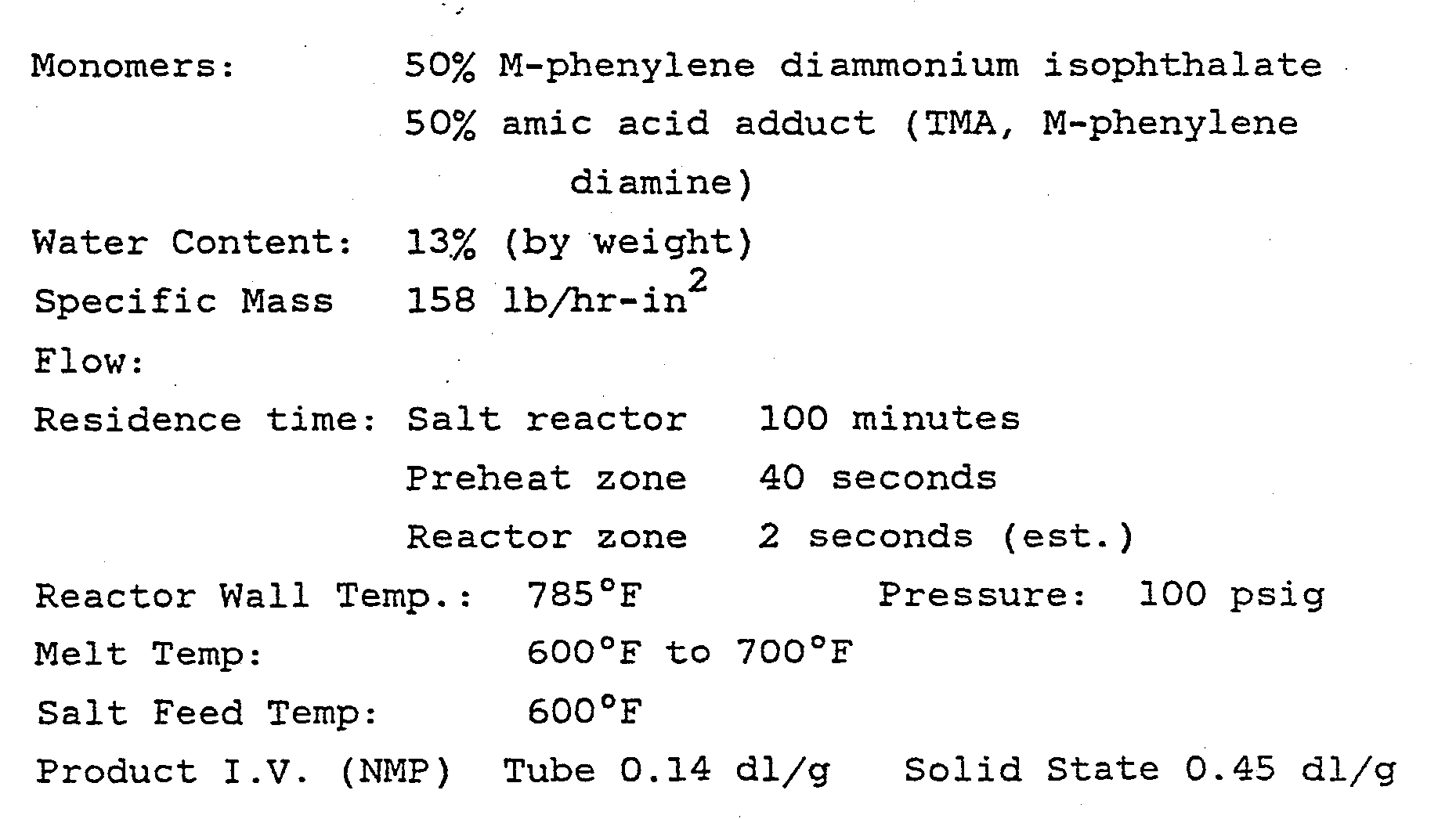
- Examples 1 through 14 were prepared as described in General Procedure but specific details and results are noted for each Example hereinbelow:
- Monomers: 10% hexamethylene diammonium adipate 65% hexamethylene diammonium terephthalate 25% hexamethylene diammonium isophthalate Water Content: 15% (by weight) Procedure: The diacids, diamines and water were charged to the salt reactor of room temperature. The initial charge totaled 36 lb (50 g/moles). Additional charges were 7.2 lbs (10 g/moles) each and were fed through lock hoppers as the salt reactor was operated in a fed batch mode. The salt reactor was a 5 gallon stirred tank reactor with a pitched blade turbine, oil jacket, variable speed drive and internal coils.
- Once the salt reactor had been charged, it was purged with inert gas and heated to 425°F (218°C). The pressure was set to 480 psig by first allowing the water in the salt to reach its equilibrium pressure and then adjusting with inert gas. In the fed batch operations, the salt saw a range of residence times. They averaged about 100 minutes. Also as a result of the fed batch mode of operation, it was necessary to include a second surge vessel in the salt preparation section. This vessel, which was at 425°F (218°C) and 450 psig, was used to isolate the salt reactor during charge addition.
- Upon leaving the salt section, the salt was passed through a 140 micron filter into a two headed positive displacement pump. Temperature through the pump were maintained at 425°F (218°C). Pressures were increased to 1800 psig in the pump. Following the pump, the salt solution was passed through a preheat zone and heated to 600°F (316°C). The pressure prevented vapor formation in the preheater. Residence time in the preheater was 40 seconds.
- The salt entered the flash reactor through a research control valve*where pressure was reduced from 1800 psig to 400 psig. Wall temperature in the flash reactor were kept at 750°F (399°C) using electrical heaters but the melt temperature ranged from 525°F (274°C) to 612°F (322°C) depending on location in the flash reactor. Pressure in the flash reactor was controlled by a second RCV. Residence time in the flash reactor was estimated at 7.6 seconds. The run had a 141 lb/hr-in2 specific mass feed rate per unit of cross sectional area.
- After leaving the flash reactor, our prepolymer had an inherent viscosity (Phenol/TCE) of 0.20 to 0.24 dl/g. It was injected directly onto the screws of the extruder. An open screw design was used to facilitate vapor removal. A screw speed of 200 rpm was used to maintain minimum fill on the screws. Temperatures were 620°F (327°C) in the injection zone but they were dropped gradually to 600°F (316°C) at the die head. Following the extruder, the polymer strand was passed through a water bath and then pelletized. The mean product I.V. was 1.20 dl/g with a standard deviation of 0.09 dl/g over the 6-hour run. Total production was 64 lbs of polymer.
- Monomers: 10% hexamethylene diammonium adipate 75% hexamethylene diammonium terephthalate 15% hexamethylene diammonium isophthalate Water Content: 15% (by weight)
- *An air operated control valve sold under the name "Research Control Valve" by the Badger Meter Company.
-

-

-

-

-

-

-

-

-
-


-

-


-

Claims (12)
Priority Applications (1)
| Application Number | Priority Date | Filing Date | Title |
|---|---|---|---|
| AT84300747T ATE46180T1 (en) | 1983-02-16 | 1984-02-07 | POLYCONDENSATION PROCESS. |
Applications Claiming Priority (2)
| Application Number | Priority Date | Filing Date | Title |
|---|---|---|---|
| US46690483A | 1983-02-16 | 1983-02-16 | |
| US466904 | 1983-02-16 |
Publications (4)
| Publication Number | Publication Date |
|---|---|
| EP0123377A2 true EP0123377A2 (en) | 1984-10-31 |
| EP0123377A3 EP0123377A3 (en) | 1985-07-31 |
| EP0123377B1 EP0123377B1 (en) | 1989-09-06 |
| EP0123377B2 EP0123377B2 (en) | 1995-07-12 |
Family
ID=23853531
Family Applications (1)
| Application Number | Title | Priority Date | Filing Date |
|---|---|---|---|
| EP84300747A Expired - Lifetime EP0123377B2 (en) | 1983-02-16 | 1984-02-07 | Polycondensation process |
Country Status (5)
| Country | Link |
|---|---|
| EP (1) | EP0123377B2 (en) |
| JP (1) | JPH0621161B2 (en) |
| AT (1) | ATE46180T1 (en) |
| CA (1) | CA1226993A (en) |
| DE (1) | DE3479667D1 (en) |
Cited By (16)
| Publication number | Priority date | Publication date | Assignee | Title |
|---|---|---|---|---|
| EP0193023B1 (en) * | 1985-02-26 | 1989-10-18 | Bayer Ag | Process for the preparation of copolyamides from aromatic dicarboxylic acids, adipic acid and hexamethylene diamine |
| EP0254367B1 (en) * | 1986-07-22 | 1993-04-28 | Dsm N.V. | Production of high-molecular polytetramethyleneadipamide |
| EP0693515A1 (en) * | 1994-07-14 | 1996-01-24 | Ems-Inventa Ag | Process for the preparation of precondensates of semi-crystalline or amorphous semi-aromatic thermoplastic (co)polyamides |
| WO1996033234A1 (en) * | 1995-04-15 | 1996-10-24 | Basf Aktiengesellschaft | Process for producing a polyamide based on a dicarboxylic acid and a diamine |
| EP0697429A3 (en) * | 1994-08-17 | 1996-12-27 | Toray Industries | Copolymerized polyamide and process for its production |
| EP1322695A2 (en) | 2000-09-30 | 2003-07-02 | E.I. Du Pont De Nemours And Company | Single-phase or multi-phase continuous polyamide polymerization processes |
| LT5413B (en) | 2004-04-23 | 2007-03-26 | Zimmer Aktiengesellschaft | Method for the production of polyesters |
| EP2813530A1 (en) | 2013-06-12 | 2014-12-17 | Basf Se | Partially aromatic copolyamides based on terephthalic acid and hexamethylene diamine |
| WO2014198759A1 (en) | 2013-06-12 | 2014-12-18 | Basf Se | Process for the continuous preparation of an aliphatic or partially aromatic polyamide |
| WO2014198755A1 (en) | 2013-06-12 | 2014-12-18 | Basf Se | Method for the continuous production of an aliphatic or semi-aromatic polyamide oligomer |
| WO2014198764A1 (en) | 2013-06-12 | 2014-12-18 | Basf Se | Method for producing semi-aromatic copolyamides with a high diamine excess |
| WO2014198762A1 (en) | 2013-06-12 | 2014-12-18 | Basf Se | Semi-aromatic copolyamides having high glass transition temperature and high degree of crystallinity |
| WO2016016115A1 (en) * | 2014-07-29 | 2016-02-04 | Dsm Ip Assets B.V. | Process for preparing nylon salt and its polymerization |
| US9701790B2 (en) | 2013-06-12 | 2017-07-11 | Basf Se | Method for producing aliphatic or partially aromatic polyamides, said method comprising a solid-phase polymerization process |
| US10676569B2 (en) | 2013-06-12 | 2020-06-09 | Basf Se | Method for continuously producing polyamide oligomers and producing semicrystalline or amorphous polyamides that can be thermoplastically processed |
| CN115976676A (en) * | 2023-02-07 | 2023-04-18 | 东华大学 | A kind of preparation method of the polyarylate spun yarn of continuous polymerization spinning and polyarylate spun yarn |
Families Citing this family (4)
| Publication number | Priority date | Publication date | Assignee | Title |
|---|---|---|---|---|
| WO2007023097A1 (en) * | 2005-08-24 | 2007-03-01 | Basf Se | Method for producing water-absorbing polymer particles |
| CN101679626B (en) * | 2007-06-20 | 2011-12-21 | 巴斯夫欧洲公司 | Method for the production of polyamides in extruders |
| JP6309778B2 (en) * | 2014-02-12 | 2018-04-11 | ユニチカ株式会社 | Polyamideimide production method and polyamideimide |
| TWI671121B (en) * | 2014-07-29 | 2019-09-11 | 荷蘭商帝斯曼知識產權資產管理有限公司 | Process for preparing a polyamide, a nylon salt to be used therein and a process for making the salt |
Family Cites Families (2)
| Publication number | Priority date | Publication date | Assignee | Title |
|---|---|---|---|---|
| AT356901B (en) * | 1976-08-02 | 1980-06-10 | Vnii Sintetischeskich Smol | METHOD FOR PRODUCING HETEROCHAIN POLYMER |
| FR2497516B1 (en) * | 1981-01-05 | 1986-06-06 | Kalininsky Politekhniche Insti | PROCESS FOR THE PREPARATION OF FIBERS OF SYNTHETIC POLYMERS WITH HETEROGENEOUS CHAINS AND DEVICE FOR CARRYING OUT SAME |
-
1984
- 1984-01-27 CA CA000446200A patent/CA1226993A/en not_active Expired
- 1984-02-07 AT AT84300747T patent/ATE46180T1/en active
- 1984-02-07 DE DE8484300747T patent/DE3479667D1/en not_active Expired
- 1984-02-07 EP EP84300747A patent/EP0123377B2/en not_active Expired - Lifetime
- 1984-02-15 JP JP59026904A patent/JPH0621161B2/en not_active Expired - Lifetime
Cited By (24)
| Publication number | Priority date | Publication date | Assignee | Title |
|---|---|---|---|---|
| EP0193023B1 (en) * | 1985-02-26 | 1989-10-18 | Bayer Ag | Process for the preparation of copolyamides from aromatic dicarboxylic acids, adipic acid and hexamethylene diamine |
| EP0254367B1 (en) * | 1986-07-22 | 1993-04-28 | Dsm N.V. | Production of high-molecular polytetramethyleneadipamide |
| EP0693515A1 (en) * | 1994-07-14 | 1996-01-24 | Ems-Inventa Ag | Process for the preparation of precondensates of semi-crystalline or amorphous semi-aromatic thermoplastic (co)polyamides |
| EP0697429A3 (en) * | 1994-08-17 | 1996-12-27 | Toray Industries | Copolymerized polyamide and process for its production |
| US5663284A (en) * | 1994-08-17 | 1997-09-02 | Toray Industries, Inc. | Copolymerized polyamide and a production process/thereof |
| WO1996033234A1 (en) * | 1995-04-15 | 1996-10-24 | Basf Aktiengesellschaft | Process for producing a polyamide based on a dicarboxylic acid and a diamine |
| US6187877B1 (en) | 1995-04-15 | 2001-02-13 | Basf Aktiengesellschaft | Process for producing a polyamide based on a dicarboxylic acid and a diamine |
| EP1322695A2 (en) | 2000-09-30 | 2003-07-02 | E.I. Du Pont De Nemours And Company | Single-phase or multi-phase continuous polyamide polymerization processes |
| LT5413B (en) | 2004-04-23 | 2007-03-26 | Zimmer Aktiengesellschaft | Method for the production of polyesters |
| WO2014198764A1 (en) | 2013-06-12 | 2014-12-18 | Basf Se | Method for producing semi-aromatic copolyamides with a high diamine excess |
| US9708449B2 (en) | 2013-06-12 | 2017-07-18 | Basf Se | Method for the continuous production of an aliphatic or semi-aromatic polyamide oligomer |
| WO2014198755A1 (en) | 2013-06-12 | 2014-12-18 | Basf Se | Method for the continuous production of an aliphatic or semi-aromatic polyamide oligomer |
| EP2813530A1 (en) | 2013-06-12 | 2014-12-17 | Basf Se | Partially aromatic copolyamides based on terephthalic acid and hexamethylene diamine |
| WO2014198762A1 (en) | 2013-06-12 | 2014-12-18 | Basf Se | Semi-aromatic copolyamides having high glass transition temperature and high degree of crystallinity |
| US10676569B2 (en) | 2013-06-12 | 2020-06-09 | Basf Se | Method for continuously producing polyamide oligomers and producing semicrystalline or amorphous polyamides that can be thermoplastically processed |
| US9701790B2 (en) | 2013-06-12 | 2017-07-11 | Basf Se | Method for producing aliphatic or partially aromatic polyamides, said method comprising a solid-phase polymerization process |
| WO2014198759A1 (en) | 2013-06-12 | 2014-12-18 | Basf Se | Process for the continuous preparation of an aliphatic or partially aromatic polyamide |
| EP3327062A1 (en) | 2013-06-12 | 2018-05-30 | Basf Se | Partially aromatic copolyamides with a high glass transition temperature and high degree of crystallinity |
| US9994678B2 (en) | 2013-06-12 | 2018-06-12 | Basf Se | Process for the continuous preparation of an aliphatic or partially aromatic polyamide |
| US10590238B2 (en) | 2014-07-29 | 2020-03-17 | Dsm Ip Assets B.V. | Process for preparing nylon salt and its polymerization |
| WO2016016115A1 (en) * | 2014-07-29 | 2016-02-04 | Dsm Ip Assets B.V. | Process for preparing nylon salt and its polymerization |
| US11306181B2 (en) | 2014-07-29 | 2022-04-19 | Dsm Ip Assets B.V. | Process for preparing nylon salt and its polymerization |
| CN115976676A (en) * | 2023-02-07 | 2023-04-18 | 东华大学 | A kind of preparation method of the polyarylate spun yarn of continuous polymerization spinning and polyarylate spun yarn |
| CN115976676B (en) * | 2023-02-07 | 2026-03-03 | 东华大学 | Preparation method of continuous polymerization spinning polyarylate nascent filament and polyarylate nascent filament |
Also Published As
| Publication number | Publication date |
|---|---|
| EP0123377B2 (en) | 1995-07-12 |
| ATE46180T1 (en) | 1989-09-15 |
| DE3479667D1 (en) | 1989-10-12 |
| EP0123377B1 (en) | 1989-09-06 |
| CA1226993A (en) | 1987-09-15 |
| JPH0621161B2 (en) | 1994-03-23 |
| EP0123377A3 (en) | 1985-07-31 |
| JPS59155433A (en) | 1984-09-04 |
Similar Documents
| Publication | Publication Date | Title |
|---|---|---|
| US4603193A (en) | Polycondensation process with aerosol mist of aqueous solution of reactant salts | |
| EP0123377B1 (en) | Polycondensation process | |
| US4831108A (en) | Polycondensation process with mean dispersion residence time | |
| US7041773B2 (en) | Polyimide sulfones, method and articles made therefrom | |
| US4358561A (en) | Injection moldable amide-imide copolymers | |
| EP0043848B1 (en) | Preparation of moulded objects from injection mouldable amide-imide copolymers | |
| US4212963A (en) | Polybutylene terephthalates having a low carboxyl content and continuous process for the production thereof | |
| EP0121984B1 (en) | Polyamide compositions | |
| EP0121983A2 (en) | Polyamide compositions from mixtures of trimethylhexamethylene diamine, hexamethylene diamine and diacids | |
| EP0043855B1 (en) | Injection moldable amide-imide copolymers and terpolymers | |
| US4417045A (en) | Polyimides and polyimide-amides | |
| US4360657A (en) | Tricyclo[6.4.0.02,7 ]-dodecane-1,8,2,7-tetracarboxylic acid dianhydride and polyimides therefrom | |
| US5109107A (en) | Polyamide-imide polymers having fluorine-containing linking groups | |
| US5120826A (en) | Polyamide-imide polymers having fluorine-containing linking groups | |
| US4973651A (en) | Polyimide polymers having 12-F fluorine-containing linking groups | |
| US4348513A (en) | Injection moldable amide-imide copolymers and terpolymers | |
| US4393162A (en) | Polyamides and copolyamides comprising -1,2-di(p-aminophenoxy) ethane moieties | |
| US4384112A (en) | Polyamides and copolyamides containing 2,2',4,4',6,6'-hexamethyl-3,3'-diaminobiphenyl moieties | |
| CN109851779A (en) | A kind of semi-aromatic polyamide and its moulding compound | |
| US4413115A (en) | Copolyimides-polyamides from aliphatic and aromatic anhydrides, dicarboxylic acids, and diamines | |
| US4366304A (en) | Copolyimides from aliphatic and aromatic anhydrides and diamines | |
| US3674741A (en) | Copolymer of poly(quinozolone and imide) and process for producing the same | |
| US4431791A (en) | Fibers from copolyimides and polymidies derived from tetramethylcyclobutane-1,2,3,4-tetracarboxylic dianhydride and diamines | |
| US4410658A (en) | Polyimides-amides and copolyimides-polyamides from tetramethylcyclobutane-1,2,3,4-tetracarboxylic dianhydride, dicarboxylic acids and a mixture of diamines | |
| US4358562A (en) | Copolyimides from tetramethylcyclobutane-1,2,3,4-tetracarboxylic dianhydride and a mixture of diamines |
Legal Events
| Date | Code | Title | Description |
|---|---|---|---|
| PUAI | Public reference made under article 153(3) epc to a published international application that has entered the european phase |
Free format text: ORIGINAL CODE: 0009012 |
|
| AK | Designated contracting states |
Designated state(s): AT BE CH DE FR GB IT LI LU NL SE |
|
| PUAL | Search report despatched |
Free format text: ORIGINAL CODE: 0009013 |
|
| AK | Designated contracting states |
Designated state(s): AT BE CH DE FR GB IT LI LU NL SE |
|
| RAP1 | Party data changed (applicant data changed or rights of an application transferred) |
Owner name: AMOCO CORPORATION |
|
| 17P | Request for examination filed |
Effective date: 19860123 |
|
| 17Q | First examination report despatched |
Effective date: 19870330 |
|
| ITF | It: translation for a ep patent filed | ||
| GRAA | (expected) grant |
Free format text: ORIGINAL CODE: 0009210 |
|
| AK | Designated contracting states |
Kind code of ref document: B1 Designated state(s): AT BE CH DE FR GB IT LI LU NL SE |
|
| PG25 | Lapsed in a contracting state [announced via postgrant information from national office to epo] |
Ref country code: LI Effective date: 19890906 Ref country code: CH Effective date: 19890906 |
|
| REF | Corresponds to: |
Ref document number: 46180 Country of ref document: AT Date of ref document: 19890915 Kind code of ref document: T |
|
| REF | Corresponds to: |
Ref document number: 3479667 Country of ref document: DE Date of ref document: 19891012 |
|
| ET | Fr: translation filed | ||
| PGFP | Annual fee paid to national office [announced via postgrant information from national office to epo] |
Ref country code: NL Payment date: 19900228 Year of fee payment: 7 |
|
| PLBI | Opposition filed |
Free format text: ORIGINAL CODE: 0009260 |
|
| 26 | Opposition filed |
Opponent name: HOECHST AKTIENGESELLSCHAFT ZENTRALE PATENTABTEILUN Effective date: 19900606 |
|
| NLR1 | Nl: opposition has been filed with the epo |
Opponent name: HOECHST AG. |
|
| ITTA | It: last paid annual fee | ||
| PG25 | Lapsed in a contracting state [announced via postgrant information from national office to epo] |
Ref country code: NL Effective date: 19910901 |
|
| NLV4 | Nl: lapsed or anulled due to non-payment of the annual fee | ||
| EPTA | Lu: last paid annual fee | ||
| PGFP | Annual fee paid to national office [announced via postgrant information from national office to epo] |
Ref country code: LU Payment date: 19950101 Year of fee payment: 12 |
|
| PGFP | Annual fee paid to national office [announced via postgrant information from national office to epo] |
Ref country code: CH Payment date: 19950112 Year of fee payment: 12 |
|
| PGFP | Annual fee paid to national office [announced via postgrant information from national office to epo] |
Ref country code: SE Payment date: 19950116 Year of fee payment: 12 Ref country code: AT Payment date: 19950116 Year of fee payment: 12 |
|
| EAL | Se: european patent in force in sweden |
Ref document number: 84300747.7 |
|
| PG25 | Lapsed in a contracting state [announced via postgrant information from national office to epo] |
Ref country code: SE Free format text: LAPSE BECAUSE OF NON-PAYMENT OF DUE FEES Effective date: 19950208 |
|
| PUAH | Patent maintained in amended form |
Free format text: ORIGINAL CODE: 0009272 |
|
| STAA | Information on the status of an ep patent application or granted ep patent |
Free format text: STATUS: PATENT MAINTAINED AS AMENDED |
|
| 27A | Patent maintained in amended form |
Effective date: 19950712 |
|
| AK | Designated contracting states |
Kind code of ref document: B2 Designated state(s): AT BE CH DE FR GB IT LI LU NL SE |
|
| ITF | It: translation for a ep patent filed | ||
| REG | Reference to a national code |
Ref country code: CH Ref legal event code: AEN |
|
| PG25 | Lapsed in a contracting state [announced via postgrant information from national office to epo] |
Ref country code: AT Effective date: 19951012 |
|
| REG | Reference to a national code |
Ref country code: CH Ref legal event code: PL |
|
| ET3 | Fr: translation filed ** decision concerning opposition | ||
| PG25 | Lapsed in a contracting state [announced via postgrant information from national office to epo] |
Ref country code: LU Free format text: LAPSE BECAUSE OF NON-PAYMENT OF DUE FEES Effective date: 19960207 |
|
| REG | Reference to a national code |
Ref country code: GB Ref legal event code: IF02 |
|
| REG | Reference to a national code |
Ref country code: FR Ref legal event code: CD |
|
| BECN | Be: change of holder's name |
Effective date: 20020117 |
|
| PGFP | Annual fee paid to national office [announced via postgrant information from national office to epo] |
Ref country code: GB Payment date: 20030205 Year of fee payment: 20 |
|
| REG | Reference to a national code |
Ref country code: GB Ref legal event code: 732E |
|
| PGFP | Annual fee paid to national office [announced via postgrant information from national office to epo] |
Ref country code: FR Payment date: 20030210 Year of fee payment: 20 |
|
| PGFP | Annual fee paid to national office [announced via postgrant information from national office to epo] |
Ref country code: DE Payment date: 20030220 Year of fee payment: 20 |
|
| PGFP | Annual fee paid to national office [announced via postgrant information from national office to epo] |
Ref country code: BE Payment date: 20030425 Year of fee payment: 20 |
|
| REG | Reference to a national code |
Ref country code: FR Ref legal event code: TP |
|
| PG25 | Lapsed in a contracting state [announced via postgrant information from national office to epo] |
Ref country code: GB Free format text: LAPSE BECAUSE OF EXPIRATION OF PROTECTION Effective date: 20040206 |
|
| BE20 | Be: patent expired |
Owner name: *SOLVAY ADVANCED POLYMERS L.L.C. Effective date: 20040207 |
|
| REG | Reference to a national code |
Ref country code: GB Ref legal event code: PE20 |
|
| APAH | Appeal reference modified |
Free format text: ORIGINAL CODE: EPIDOSCREFNO |