EP0131922A1 - Electrical apparatus employing a gaseous dielectric - Google Patents
Electrical apparatus employing a gaseous dielectric Download PDFInfo
- Publication number
- EP0131922A1 EP0131922A1 EP19840108219 EP84108219A EP0131922A1 EP 0131922 A1 EP0131922 A1 EP 0131922A1 EP 19840108219 EP19840108219 EP 19840108219 EP 84108219 A EP84108219 A EP 84108219A EP 0131922 A1 EP0131922 A1 EP 0131922A1
- Authority
- EP
- European Patent Office
- Prior art keywords
- mole
- dielectric
- gaseous
- electrical apparatus
- gaseous dielectric
- Prior art date
- Legal status (The legal status is an assumption and is not a legal conclusion. Google has not performed a legal analysis and makes no representation as to the accuracy of the status listed.)
- Withdrawn
Links
Images
Classifications
-
- H—ELECTRICITY
- H01—ELECTRIC ELEMENTS
- H01H—ELECTRIC SWITCHES; RELAYS; SELECTORS; EMERGENCY PROTECTIVE DEVICES
- H01H33/00—High-tension or heavy-current switches with arc-extinguishing or arc-preventing means
- H01H33/02—Details
- H01H33/24—Means for preventing discharge to non-current-carrying parts, e.g. using corona ring
-
- H—ELECTRICITY
- H01—ELECTRIC ELEMENTS
- H01B—CABLES; CONDUCTORS; INSULATORS; SELECTION OF MATERIALS FOR THEIR CONDUCTIVE, INSULATING OR DIELECTRIC PROPERTIES
- H01B3/00—Insulators or insulating bodies characterised by the insulating materials; Selection of materials for their insulating or dielectric properties
- H01B3/02—Insulators or insulating bodies characterised by the insulating materials; Selection of materials for their insulating or dielectric properties mainly consisting of inorganic substances
- H01B3/16—Insulators or insulating bodies characterised by the insulating materials; Selection of materials for their insulating or dielectric properties mainly consisting of inorganic substances gases
-
- H—ELECTRICITY
- H01—ELECTRIC ELEMENTS
- H01B—CABLES; CONDUCTORS; INSULATORS; SELECTION OF MATERIALS FOR THEIR CONDUCTIVE, INSULATING OR DIELECTRIC PROPERTIES
- H01B3/00—Insulators or insulating bodies characterised by the insulating materials; Selection of materials for their insulating or dielectric properties
- H01B3/18—Insulators or insulating bodies characterised by the insulating materials; Selection of materials for their insulating or dielectric properties mainly consisting of organic substances
- H01B3/56—Insulators or insulating bodies characterised by the insulating materials; Selection of materials for their insulating or dielectric properties mainly consisting of organic substances gases
Definitions
- the present invention relates in general to electrical apparatuses which employ a gaseous dielectric, and in particular to an improved electrical apparatus employing a novel gaseous dielectric which has a high dielectric strength and which forms only a small amount of carbon at the time of arcing.
- C 2 F S CN (1.8 times the dielectric strength of SF 6 )
- CBrClF 2 (1.4 times the dielectric strength of SF 6 )
- c-C 4 F 8 (1.4 times the dielectric strength of SF 6 ) are all excellent from the standpoint of dielectric strength, they can not be applied alone as gaseous dielectrics in electrical equipment in which arcing takes place, since they form electrically-conducting carbon powder during arcing.
- An improved electrical apparatus is of the type comprising a sealed chamber filled with a gaseous dielectric, an electrical conductor disposed in the chamber, and a solid electrically-insulating member which supports the electrical conductor.
- the improvement resides in the composition of the gaseous dielectric, which comprises a mixture of SF 6 and a saturated fluorocarbon compound, i.e. a fluorocarbon compound having no unsaturated carbon bonds.
- the amount of SF 6 in the gaseous dielectric is approximately 60 - 99.5 mole % and the amount of the fluorocarbon compound is approximately 0.5 - 40 mole
- Preferred substances for use as the fluorocarbon compound are C 2 F S CN, CBrCIF 2 , and c- C 4 F 8 .
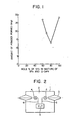
- element number 1 is a sealed chamber filled with a gaseous dielectric 2.
- Elements number 3 are bushings electrically connected to disconnecting switches 4.
- Element number 5 is a circuit breaker electrically connected to the disconnecting switches 4 by electrical conductors 6.
- the novel feature of this apparatus is the composition of the gaseous dielectric 2. It comprises approximately 60 - 99.5 mole % of SF 6 and approximately 0.5 - 40 mole % of a saturated fluorocarbon compound.
- Preferred substances for use as the fluorocarbon compound are C 2 F S CN, CBrClF 2 , and c-C 4 F 8 .
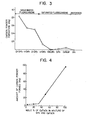
- the amount of carbon powder formed during the arcing was measured and the results are shown in Figure 4.
- the mole % of C 2 F 5 CN reached approximately 40%, the slope of the curve abruptly increased, and at mole percentages above this, the amount of carbon powder formed became large. Accordingly, in order to suppress the amount of carbon powder formed during arcing, the amount of a saturated fluorocarbon compound used in the present invention should be no greater than approximately 40 mole %.
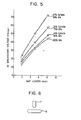
- a similar arcing experiment was carried out using the electrodes illustrated in Figure 6.
- a rod-shaped electrode 7 having a hemispherical end and a diameter of 30mm was disposed perpendicularly with respect to a plate electrode 8 having a length of 80mm.
- a 60 Hz AC voltage was applied between the electrodes and the AC breakdown voltages of the gas mixtures were measured using various gap lengths between the electrodes 7 and 8.
- the results are shown in Figure 5.
- the mole % of C 2 F S CN is extremely low, a significant increase in breakdown voltage over SF 6 alone can be achieved merely by increasing the separation between the electrodes. Accordingly, the lower limit for a saturated fluorocarbon compound is approximately 0.5 mole%.
- an electrical apparatus according to the present invention employs a gas mixture which has a higher dielectric strength than SF 6 and which greatly suppresses carbon formation at the time of arcing, for a given rating, an apparatus of smaller size than an apparatus using SF 6 alone as a gaseous dielectric is achievable.
- an electrical apparatus according to the present invention can have a higher rating than an apparatus of the same physical size which uses SF 6 alone as a gaseous dielectric.
Landscapes
- Physics & Mathematics (AREA)
- Spectroscopy & Molecular Physics (AREA)
- Chemical & Material Sciences (AREA)
- Inorganic Chemistry (AREA)
- Organic Insulating Materials (AREA)
- Gas-Insulated Switchgears (AREA)
- Installation Of Bus-Bars (AREA)
Abstract
An improved electrical apparatus employing a gaseous dielectric is disclosed. The improvement resides in the composition of the gaseous dielectric, which comprises a mixture of approximately 60 - 99.5 mole % of SF. and approximately 0.5 - 40 mole % of a fluorocarbon compound having no unsaturated carbon bonds. Preferred fluorocarbon compounds are C2F5CN, CBrCIF2, and c-C4F8. The gaseous dielectric has a higher dielectric strength than SF. alone and greatly suppresses formation of carbon powder during arcing.
Description
- The present invention relates in general to electrical apparatuses which employ a gaseous dielectric, and in particular to an improved electrical apparatus employing a novel gaseous dielectric which has a high dielectric strength and which forms only a small amount of carbon at the time of arcing.
- In electrical equipment of the type comprising a sealed chamber, a gaseous dielectric which fills the chamber, a conductor disposed inside the chamber, and a solid insulating member which supports the conductor, it is common to use sulfur hexafluoride (SF6), which has excellent dielectric properties, as the gaseous dielectric. In order to achieve further reductions in the size of this type of electrical equipment, there is a need for a gaseous dielectric having a higher dielectric strength than SF6. However, there has yet to be found a gas having suitable properties. For example, while C2FSCN (1.8 times the dielectric strength of SF6), CBrClF2 (1.4 times the dielectric strength of SF6), and c-C4F8 (1.4 times the dielectric strength of SF6) are all excellent from the standpoint of dielectric strength, they can not be applied alone as gaseous dielectrics in electrical equipment in which arcing takes place, since they form electrically-conducting carbon powder during arcing.
- I- a paper entitled "Ternary Gas Dielectrics" (The Third International Symposium on Gaseous Dielectrics, 1982, Document No. 15), I.G. Christophorou et al. disclosed a gaseous dielectric comprising a mixture of SF6 and 2-C4F8 (octofluorobutene) which has a high dielectric strength but which forms a powder during arcing consisting of a nonconducting powder and a conducting powder. Figure 1 shows test results published in the above-mentioned paper for arcing tests using aluminum electrodes in gas mixtures consisting of SF6 and 2-C4F8. The amount and the content of the powder formed during arcing clearly depend on the mole % of 2-C4F8 in the gas mixture. When the gas mixture consisted of 100% SF6, the powder which was formed consisted of AlF3. However, at greater than 20 mole % 2-C4F8, the content of the powder greatly changed and the powder began to consist of increasing amounts of carbon powder. Thus, although a mixture of SF6 and z-C4F8 has a higher dielectric strength than SF6 alone, it still has the drawback that it forms too large a quantity of conducting powder.
- It is the object of the present invention to provide an improved electrical apparatus which utilizes a gaseous dielectric which has a higher dielectric strength than SF6 and which forms only a small amount of carbon powder at the time of arcing.
- An improved electrical apparatus according to the present invention is of the type comprising a sealed chamber filled with a gaseous dielectric, an electrical conductor disposed in the chamber, and a solid electrically-insulating member which supports the electrical conductor. The improvement resides in the composition of the gaseous dielectric, which comprises a mixture of SF6 and a saturated fluorocarbon compound, i.e. a fluorocarbon compound having no unsaturated carbon bonds. The amount of SF6 in the gaseous dielectric is approximately 60 - 99.5 mole % and the amount of the fluorocarbon compound is approximately 0.5 - 40 mole Preferred substances for use as the fluorocarbon compound are C2FSCN, CBrCIF2, and c-C 4 F8.
- Figure 1 is a graph of the amount of powder formed at the time of arcing as a function of the mole % of SF6 in a gaseous dielectric comprising a mixture of SF6 and 2-C4F8.
- Figure 2 is a schematic illustration of an improved electrical apparatus according to the present invention. a
- Figure 3 is/chart of the amount of carbon powder formed during arcing tests performed in SF6 and in various fluorocarbon compounds.
- Figure 4 is a graph of the amount of carbon powder formed at the time of arcing plotted as a function of the composition of a gaseous dielectric comprising a mixture of SF6 and C2F5CN.
- Figure 5 is a graph of the AC breakdown voltage plotted as a function of electrode separation for various mixtures of SF6 and C2F5CN.
- Figure 6 is a schematic representation of the electrodes used to obtain the data of Figure 5.
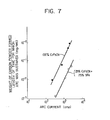
- Figure 7 is a graph of the relationship between (the amount of powder formed at the time of arcing / the length of time for which an arc was sustained) and arc current for two different gaseous dielectrics, one comprising 100% C2F5CN and the other comprising a mixture of 25 mole % of C2F5CN and 75 mole % of SF6.
- An embodiment of an improved electrical apparatus employing a gaseous dielectric will now be described while referring to Figure 2 of the accompanying drawings. In the figure, element number 1 is a sealed chamber filled with a gaseous dielectric 2.
Elements number 3 are bushings electrically connected to disconnectingswitches 4.Element number 5 is a circuit breaker electrically connected to the disconnectingswitches 4 byelectrical conductors 6. - The novel feature of this apparatus is the composition of the gaseous dielectric 2. It comprises approximately 60 - 99.5 mole % of SF6 and approximately 0.5 - 40 mole % of a saturated fluorocarbon compound. Preferred substances for use as the fluorocarbon compound are C2FSCN, CBrClF2, and c-C4F8.
- In the above-described prior art, a mixture of SFG with an unsaturated fluorocarbon (2-C4F8) had the disadvantage that too large a quantity of carbon powder was formed during arcing. The present inventors found that if a saturated fluorocarbon is used instead, the amount of carbon powder formed can be greatly decreased.
- To illustrate this fact, the present inventors performed arcing experiments in various saturated and unsaturated fluorocarbon compounds in gaseous form sealed at atmospheric pressure in a 2-liter container using a discharge voltage of 30kv. The amount of carbon powder formed (mg) for each gas is plotted in Figure 3. As can be seen from the figure, saturated fluorocarbon compounds such as C2F5CN, CBrClF2, and c-C4F8 formed much less carbon powder than unsaturated fluorocarbon compounds such as 1,3-C4F6, c-C4F6, and 2-C4F6.
- In order to determine the appropriate amount of a fluorocarbon compound in a gaseous dielectric for the present invention, the present inventors carried out an experiment using 4 different mixtures of SF6 and C2F5CN: (1) SF6: 99.5 mole %, C2F5CN: 0.5 mole %; (2) SF6: 80 mole %, C2F5CN: 20 mole %; (3) SF6: 50 mole %, C2F5CN: 50 mole %; and (4) SF6: 0 mole %; C2F5CN: 100 mole %. Each gas mixture was sealed in a 2-liter container at atmospheric pressure. Inside each container, arcing was produced using copper-tungsten electrodes with a separation of 2mm at a voltage of 30kv. The amount of carbon powder formed during the arcing was measured and the results are shown in Figure 4. When the mole % of C2F5CN reached approximately 40%, the slope of the curve abruptly increased, and at mole percentages above this, the amount of carbon powder formed became large. Accordingly, in order to suppress the amount of carbon powder formed during arcing, the amount of a saturated fluorocarbon compound used in the present invention should be no greater than approximately 40 mole %.
- A similar arcing experiment was carried out using the electrodes illustrated in Figure 6. A rod-shaped electrode 7 having a hemispherical end and a diameter of 30mm was disposed perpendicularly with respect to a
plate electrode 8 having a length of 80mm. In sealed containers containing various combinations of SF6 and C2F5CN at 200C and atmospheric pressure, a 60 Hz AC voltage was applied between the electrodes and the AC breakdown voltages of the gas mixtures were measured using various gap lengths between theelectrodes 7 and 8. The results are shown in Figure 5. As can be seen from the figure, even when the mole % of C2FSCN is extremely low, a significant increase in breakdown voltage over SF6 alone can be achieved merely by increasing the separation between the electrodes. Accordingly, the lower limit for a saturated fluorocarbon compound is approximately 0.5 mole%. - In addition, an experiment was carried out in which arcing was produced in gaseous mixtures comprising either 100 mole % of C2FSCN or 25 mole % C2F5CN and 75 mole % SF6. The gas mixtures were separately sealed in a 2-liter container at 20°C and atmospheric pressure. Arcing was produced inside the container between copper-tungsten electrodes with an electrode separation of 2mm using voltages ranging from 10kv to 30kv. The arc current, the length of time for which the arc was sustained, and the amount of carbon powder formed were measured. The results are plotted in Figure 7, in which the abscissa is the arc current and the ordinate is the weight of carbon powder formed during arcing divided by the length of time for which the arc was sustained. From this experiment, it was learned that the amount of carbon powder formed by the mixture of 25 mole % C2F5CN and 75 mole % SF6 was less than 1/10 the amount formed by C2F5CN alone.
- Although the above experiments were carried out using mixtures of C2F5CN and SF6, similar results can be expected if another saturated fluorocarbon such as CBrCl2 gas or c-C4F8 gas is used instead of C2F5CN. Both of these gases have a high dielectric strength relative to SF6, as shown in the following table, which gives the relative dielectric strengths compared to the dielectric strength of SF6 for C2FSCN alone, CBrClF2 alone, c-C4F8 alone, and mixtures of each of these three gases with SF6. In the table, all quantities are given as mole percentages.

- Since an electrical apparatus according to the present invention employs a gas mixture which has a higher dielectric strength than SF6 and which greatly suppresses carbon formation at the time of arcing, for a given rating, an apparatus of smaller size than an apparatus using SF6 alone as a gaseous dielectric is achievable. Alternatively, an electrical apparatus according to the present invention can have a higher rating than an apparatus of the same physical size which uses SF6 alone as a gaseous dielectric.
Claims (5)
1. An improved electrical apparatus of the type comprising a sealed chamber, a gaseous dielectric which fills said chamber, a conductor disposed inside said chamber, and a solid insulating member disposed so as to support said conductor, characterized in that said gaseous dielectric comprises a mixture of approximately 60 - 99.5 mole % of SF6 and approximately 0.5 - 40 mole % of a saturated fluorocarbon compound.
2. An improved electrical apparatus as claimed in Claim 1, wherein said fluorocarbon compound is C2F5CN.
3. An improved electrical apparatus as claimed in Claim 1, wherein said fluorocarbon compound is CBrCIF2.
4. An improved electrical apparatus as claimed in Claim 1, wherein said fluorocarbon compound is c-C4F8.
5. The use of a mixture of approximately 60 to 99.5 mole % of SF6 and approximately 0.5 to 40 mole % of a saturated gaseous fluorocarbon compound as dielectric medium in electrical apparatuses.
Applications Claiming Priority (2)
| Application Number | Priority Date | Filing Date | Title |
|---|---|---|---|
| JP58129063A JPS6020406A (en) | 1983-07-13 | 1983-07-13 | Gas insulated electric device |
| JP129063/83 | 1983-07-13 |
Publications (1)
| Publication Number | Publication Date |
|---|---|
| EP0131922A1 true EP0131922A1 (en) | 1985-01-23 |
Family
ID=15000165
Family Applications (1)
| Application Number | Title | Priority Date | Filing Date |
|---|---|---|---|
| EP19840108219 Withdrawn EP0131922A1 (en) | 1983-07-13 | 1984-07-12 | Electrical apparatus employing a gaseous dielectric |
Country Status (2)
| Country | Link |
|---|---|
| EP (1) | EP0131922A1 (en) |
| JP (1) | JPS6020406A (en) |
Cited By (11)
| Publication number | Priority date | Publication date | Assignee | Title |
|---|---|---|---|---|
| WO2012038443A1 (en) * | 2010-09-22 | 2012-03-29 | Alstom Grid Sas | Use of sf6/fluoroketone(s) mixtures for electric insulation and/or electric arc quenching |
| WO2012080269A1 (en) * | 2010-12-16 | 2012-06-21 | Abb Technology Ag | Dielectric insulation medium |
| US8680421B2 (en) | 2009-06-12 | 2014-03-25 | Abb Technology Ag | Encapsulated switchgear |
| US8709303B2 (en) | 2010-12-14 | 2014-04-29 | Abb Research Ltd. | Dielectric insulation medium |
| US8822870B2 (en) | 2010-12-14 | 2014-09-02 | Abb Technology Ltd. | Dielectric insulation medium |
| US8916059B2 (en) | 2009-06-17 | 2014-12-23 | Abb Technology Ag | Fluorinated ketones as high-voltage insulating medium |
| WO2015040069A1 (en) | 2013-09-20 | 2015-03-26 | Alstom Technology Ltd | Gas-insulated medium or high voltage electrical apparatus including carbon dioxide, oxygen and heptafluoroisobutyronitrile |
| US9172221B2 (en) | 2011-12-13 | 2015-10-27 | Abb Technology Ag | Converter building |
| US9455562B2 (en) | 2011-05-24 | 2016-09-27 | Schneider Electric Industries Sas | Electrical apparatus having a gas insulation containing a fluorinated compound |
| EP2893602B1 (en) | 2012-09-10 | 2017-05-24 | General Electric Technology GmbH | Medium voltage or high voltage electrical switchgear with low environmental impact and hybrid isolation |
| EP2834818B1 (en) | 2012-04-04 | 2018-06-06 | 3M Innovative Properties Company | Fluorinated nitriles as dielectric gases |
Families Citing this family (2)
| Publication number | Priority date | Publication date | Assignee | Title |
|---|---|---|---|---|
| JP2557417B2 (en) * | 1987-10-22 | 1996-11-27 | 株式会社東芝 | Abnormality monitoring method for gas filled electrical equipment |
| JPH0736651B2 (en) * | 1987-11-06 | 1995-04-19 | 三菱電機株式会社 | Electrical equipment |
Citations (2)
| Publication number | Priority date | Publication date | Assignee | Title |
|---|---|---|---|---|
| US4071461A (en) * | 1975-06-23 | 1978-01-31 | Allied Chemical Corporation | Gaseous dielectric mixtures for suppressing carbon formation |
| US4162227A (en) * | 1976-02-24 | 1979-07-24 | The United States Of America As Represented By The United States Department Of Energy | Dielectric gas mixtures containing sulfur hexafluoride |
-
1983
- 1983-07-13 JP JP58129063A patent/JPS6020406A/en active Pending
-
1984
- 1984-07-12 EP EP19840108219 patent/EP0131922A1/en not_active Withdrawn
Patent Citations (2)
| Publication number | Priority date | Publication date | Assignee | Title |
|---|---|---|---|---|
| US4071461A (en) * | 1975-06-23 | 1978-01-31 | Allied Chemical Corporation | Gaseous dielectric mixtures for suppressing carbon formation |
| US4162227A (en) * | 1976-02-24 | 1979-07-24 | The United States Of America As Represented By The United States Department Of Energy | Dielectric gas mixtures containing sulfur hexafluoride |
Non-Patent Citations (1)
| Title |
|---|
| IEEE TRANSACTIONS ON ELECTRICAL INSULATION, vol. EI-15, nr. 2, April 1980, Piscataway (NJ, USA) J.C. DEVINS "Replacement Gases for SF6" pages 81-86 page 82, fig. 1 page 85, table 1, lines 3, 8, 9, 12, 13, 16, 17, 24, 30 * |
Cited By (20)
| Publication number | Priority date | Publication date | Assignee | Title |
|---|---|---|---|---|
| US9928973B2 (en) | 2009-06-12 | 2018-03-27 | Abb Technology Ag | Dielectric insulation medium |
| US8680421B2 (en) | 2009-06-12 | 2014-03-25 | Abb Technology Ag | Encapsulated switchgear |
| US8704095B2 (en) | 2009-06-12 | 2014-04-22 | Abb Technology Ag | Dielectric insulation medium |
| US9196431B2 (en) | 2009-06-12 | 2015-11-24 | Abb Technology Ag | Encapsulated switchgear |
| US8916059B2 (en) | 2009-06-17 | 2014-12-23 | Abb Technology Ag | Fluorinated ketones as high-voltage insulating medium |
| WO2012038443A1 (en) * | 2010-09-22 | 2012-03-29 | Alstom Grid Sas | Use of sf6/fluoroketone(s) mixtures for electric insulation and/or electric arc quenching |
| US8822870B2 (en) | 2010-12-14 | 2014-09-02 | Abb Technology Ltd. | Dielectric insulation medium |
| US8709303B2 (en) | 2010-12-14 | 2014-04-29 | Abb Research Ltd. | Dielectric insulation medium |
| WO2012080269A1 (en) * | 2010-12-16 | 2012-06-21 | Abb Technology Ag | Dielectric insulation medium |
| RU2567754C2 (en) * | 2010-12-16 | 2015-11-10 | Абб Текнолоджи Аг | Dielectric insulating medium |
| US9257213B2 (en) | 2010-12-16 | 2016-02-09 | Abb Technology Ag | Dielectric insulation medium |
| US9455562B2 (en) | 2011-05-24 | 2016-09-27 | Schneider Electric Industries Sas | Electrical apparatus having a gas insulation containing a fluorinated compound |
| US9172221B2 (en) | 2011-12-13 | 2015-10-27 | Abb Technology Ag | Converter building |
| US10573426B2 (en) | 2012-04-04 | 2020-02-25 | 3M Innovative Properties Company | Fluorinated nitriles as dielectric gases |
| EP2834818B1 (en) | 2012-04-04 | 2018-06-06 | 3M Innovative Properties Company | Fluorinated nitriles as dielectric gases |
| EP2893602B1 (en) | 2012-09-10 | 2017-05-24 | General Electric Technology GmbH | Medium voltage or high voltage electrical switchgear with low environmental impact and hybrid isolation |
| US9899125B2 (en) | 2012-09-10 | 2018-02-20 | Alstom Technology Ltd | Medium- or high-voltage electrical appliance having a low environmental impact and hybrid insulation |
| EP3047491B1 (en) | 2013-09-20 | 2017-12-06 | General Electric Technology GmbH | Gas-insulated medium or high voltage electrical apparatus including carbon dioxide, oxygen and heptafluoroisobutyronitrile |
| US9837801B2 (en) | 2013-09-20 | 2017-12-05 | Alstom Technology Ltd | Gas-insulated medium or high-voltage electrical apparatus including carbon dioxide, oxygen, and heptafluoro-isobutyronitrile |
| WO2015040069A1 (en) | 2013-09-20 | 2015-03-26 | Alstom Technology Ltd | Gas-insulated medium or high voltage electrical apparatus including carbon dioxide, oxygen and heptafluoroisobutyronitrile |
Also Published As
| Publication number | Publication date |
|---|---|
| JPS6020406A (en) | 1985-02-01 |
Similar Documents
| Publication | Publication Date | Title |
|---|---|---|
| KR102321950B1 (en) | Gas-insulated medium or high voltage electrical apparatus including carbon dioxide, oxygen and heptafluoroisobutyronitrile | |
| CN111211515B (en) | Arc extinguishing and/or insulating electrical equipment | |
| Belmadani et al. | SF/sub 6/decomposition under power arcs. II. Chemical aspects | |
| US4288651A (en) | Dielectric gas selected from binary mixtures of SF6, SO2 and CF3 CFCF2 | |
| CA2028592A1 (en) | Voltage limiting circuit-breaker | |
| CA1107360A (en) | High-voltage electrical apparatus utilizing an insulating gas of sulfur hexafluoride and helium | |
| SE9404455D0 (en) | Electrical switchgear | |
| Lingal et al. | An investigation of the arc-quenching behavior of sulfur hexafloride [includes discussion] | |
| US3582586A (en) | Arc-interrupting materials and apparatus | |
| JPS6020406A (en) | Gas insulated electric device | |
| HU188441B (en) | Vacuum chamber circuit breaker | |
| JP4244081B2 (en) | Gas insulated electrical equipment | |
| Yanabu et al. | Use of axial magnetic fields to improve high-current vacuum interrupters | |
| Hama et al. | Application problems of SF6/N2 mixtures to gas insulated bus | |
| GR3029451T3 (en) | Medium or high voltage circuit-breaker. | |
| CA1289615C (en) | Power spark gap assembly for high current conduction with improved sparkover level control | |
| CN1050455C (en) | Overvoltage absorber | |
| US4797522A (en) | Vacuum-type circuit interrupter | |
| RU2159971C2 (en) | Gas-filled disconnecting switch | |
| CA1140207A (en) | Power spark gap high current conduction | |
| JP2745393B2 (en) | Discharge type surge absorbing element | |
| RU2146405C1 (en) | Gas mixture for filling gas-discharge devices | |
| ATE120031T1 (en) | HIGH VOLTAGE LOAD SWITCH WITH GASEOUS DILECTRIC FOR BLOWING. | |
| Hori et al. | Arc erosion characteristics of Cu‐W contact at load current range in SF6 gas | |
| Susuki et al. | Arc Motions Driven by Magnetic Field in Sulfur Hexafluoride (SF6) |
Legal Events
| Date | Code | Title | Description |
|---|---|---|---|
| PUAI | Public reference made under article 153(3) epc to a published international application that has entered the european phase |
Free format text: ORIGINAL CODE: 0009012 |
|
| AK | Designated contracting states |
Designated state(s): CH DE FR GB LI SE |
|
| 17P | Request for examination filed |
Effective date: 19841228 |
|
| STAA | Information on the status of an ep patent application or granted ep patent |
Free format text: STATUS: THE APPLICATION IS DEEMED TO BE WITHDRAWN |
|
| 18D | Application deemed to be withdrawn |
Effective date: 19860124 |
|
| RIN1 | Information on inventor provided before grant (corrected) |
Inventor name: YOSHIOKA, TAKEO Inventor name: YAMAUCHI, SHIRO Inventor name: MUNEMURA, HIROTSUGU |