EP0134196A1 - Foamed mayonnaises and method for the preparation of such products - Google Patents
Foamed mayonnaises and method for the preparation of such products Download PDFInfo
- Publication number
- EP0134196A1 EP0134196A1 EP84810373A EP84810373A EP0134196A1 EP 0134196 A1 EP0134196 A1 EP 0134196A1 EP 84810373 A EP84810373 A EP 84810373A EP 84810373 A EP84810373 A EP 84810373A EP 0134196 A1 EP0134196 A1 EP 0134196A1
- Authority
- EP
- European Patent Office
- Prior art keywords
- foodstuff
- mayonnaise
- egg
- white
- fact
- Prior art date
- Legal status (The legal status is an assumption and is not a legal conclusion. Google has not performed a legal analysis and makes no representation as to the accuracy of the status listed.)
- Granted
Links
- 235000010746 mayonnaise Nutrition 0.000 title claims abstract description 57
- 238000002360 preparation method Methods 0.000 title claims description 8
- 238000000034 method Methods 0.000 title claims description 5
- 239000008268 mayonnaise Substances 0.000 claims abstract description 51
- 239000006260 foam Substances 0.000 claims abstract description 37
- 239000003381 stabilizer Substances 0.000 claims abstract description 3
- 102000002322 Egg Proteins Human genes 0.000 claims description 43
- 108010000912 Egg Proteins Proteins 0.000 claims description 43
- QCVGEOXPDFCNHA-UHFFFAOYSA-N 5,5-dimethyl-2,4-dioxo-1,3-oxazolidine-3-carboxamide Chemical compound CC1(C)OC(=O)N(C(N)=O)C1=O QCVGEOXPDFCNHA-UHFFFAOYSA-N 0.000 claims description 36
- 235000014103 egg white Nutrition 0.000 claims description 35
- 210000000969 egg white Anatomy 0.000 claims description 35
- 239000000839 emulsion Substances 0.000 claims description 17
- 239000000203 mixture Substances 0.000 claims description 15
- 239000003795 chemical substances by application Substances 0.000 claims description 13
- 235000021419 vinegar Nutrition 0.000 claims description 13
- 239000000052 vinegar Substances 0.000 claims description 13
- 239000004615 ingredient Substances 0.000 claims description 12
- 229920002472 Starch Polymers 0.000 claims description 8
- 239000008107 starch Substances 0.000 claims description 8
- 235000019698 starch Nutrition 0.000 claims description 8
- 239000007864 aqueous solution Substances 0.000 claims description 7
- 238000005345 coagulation Methods 0.000 claims description 6
- 230000015271 coagulation Effects 0.000 claims description 6
- 238000013019 agitation Methods 0.000 claims description 5
- 238000003860 storage Methods 0.000 claims description 5
- 108010010803 Gelatin Proteins 0.000 claims description 4
- -1 carrageenates Polymers 0.000 claims description 4
- 239000000470 constituent Substances 0.000 claims description 4
- 239000008273 gelatin Substances 0.000 claims description 4
- 229920000159 gelatin Polymers 0.000 claims description 4
- 235000019322 gelatine Nutrition 0.000 claims description 4
- 235000011852 gelatine desserts Nutrition 0.000 claims description 4
- 238000002156 mixing Methods 0.000 claims description 4
- 235000010443 alginic acid Nutrition 0.000 claims description 3
- 229920000615 alginic acid Polymers 0.000 claims description 3
- 230000003068 static effect Effects 0.000 claims description 3
- 229920001817 Agar Polymers 0.000 claims description 2
- 240000008886 Ceratonia siliqua Species 0.000 claims description 2
- 235000013912 Ceratonia siliqua Nutrition 0.000 claims description 2
- 239000008272 agar Substances 0.000 claims description 2
- 235000010419 agar Nutrition 0.000 claims description 2
- 239000000463 material Substances 0.000 claims description 2
- 239000001814 pectin Substances 0.000 claims description 2
- 235000010987 pectin Nutrition 0.000 claims description 2
- 229920001277 pectin Polymers 0.000 claims description 2
- 235000011962 puddings Nutrition 0.000 claims description 2
- 238000000926 separation method Methods 0.000 claims description 2
- 239000007970 homogeneous dispersion Substances 0.000 claims 2
- 235000013305 food Nutrition 0.000 claims 1
- 150000004676 glycans Chemical class 0.000 claims 1
- 229920001282 polysaccharide Polymers 0.000 claims 1
- 239000005017 polysaccharide Substances 0.000 claims 1
- 239000003921 oil Substances 0.000 description 16
- 235000019198 oils Nutrition 0.000 description 16
- 239000000243 solution Substances 0.000 description 13
- XLYOFNOQVPJJNP-UHFFFAOYSA-N water Substances O XLYOFNOQVPJJNP-UHFFFAOYSA-N 0.000 description 12
- 235000013345 egg yolk Nutrition 0.000 description 8
- 210000002969 egg yolk Anatomy 0.000 description 8
- 230000000694 effects Effects 0.000 description 7
- 238000009434 installation Methods 0.000 description 7
- 235000015067 sauces Nutrition 0.000 description 7
- 239000007789 gas Substances 0.000 description 6
- 102000009027 Albumins Human genes 0.000 description 4
- 108010088751 Albumins Proteins 0.000 description 4
- IJGRMHOSHXDMSA-UHFFFAOYSA-N Atomic nitrogen Chemical compound N#N IJGRMHOSHXDMSA-UHFFFAOYSA-N 0.000 description 4
- 150000003839 salts Chemical class 0.000 description 4
- 235000013599 spices Nutrition 0.000 description 4
- 235000000346 sugar Nutrition 0.000 description 4
- QTBSBXVTEAMEQO-UHFFFAOYSA-N Acetic acid Chemical compound CC(O)=O QTBSBXVTEAMEQO-UHFFFAOYSA-N 0.000 description 3
- 239000000654 additive Substances 0.000 description 3
- 238000010009 beating Methods 0.000 description 3
- 235000011194 food seasoning agent Nutrition 0.000 description 3
- 239000000843 powder Substances 0.000 description 3
- 235000014438 salad dressings Nutrition 0.000 description 3
- 240000004160 Capsicum annuum Species 0.000 description 2
- 235000008534 Capsicum annuum var annuum Nutrition 0.000 description 2
- WQZGKKKJIJFFOK-GASJEMHNSA-N Glucose Natural products OC[C@H]1OC(O)[C@H](O)[C@@H](O)[C@@H]1O WQZGKKKJIJFFOK-GASJEMHNSA-N 0.000 description 2
- 235000007688 Lycopersicon esculentum Nutrition 0.000 description 2
- 240000003768 Solanum lycopersicum Species 0.000 description 2
- 240000008042 Zea mays Species 0.000 description 2
- 235000005824 Zea mays ssp. parviglumis Nutrition 0.000 description 2
- 235000002017 Zea mays subsp mays Nutrition 0.000 description 2
- WQZGKKKJIJFFOK-VFUOTHLCSA-N beta-D-glucose Chemical compound OC[C@H]1O[C@@H](O)[C@H](O)[C@@H](O)[C@@H]1O WQZGKKKJIJFFOK-VFUOTHLCSA-N 0.000 description 2
- 239000000679 carrageenan Substances 0.000 description 2
- 235000010418 carrageenan Nutrition 0.000 description 2
- 229920001525 carrageenan Polymers 0.000 description 2
- 229940113118 carrageenan Drugs 0.000 description 2
- HVYWMOMLDIMFJA-DPAQBDIFSA-N cholesterol Chemical compound C1C=C2C[C@@H](O)CC[C@]2(C)[C@@H]2[C@@H]1[C@@H]1CC[C@H]([C@H](C)CCCC(C)C)[C@@]1(C)CC2 HVYWMOMLDIMFJA-DPAQBDIFSA-N 0.000 description 2
- 235000008504 concentrate Nutrition 0.000 description 2
- 239000012141 concentrate Substances 0.000 description 2
- 238000010924 continuous production Methods 0.000 description 2
- 235000005822 corn Nutrition 0.000 description 2
- 235000015071 dressings Nutrition 0.000 description 2
- 235000013601 eggs Nutrition 0.000 description 2
- 239000003995 emulsifying agent Substances 0.000 description 2
- 239000000796 flavoring agent Substances 0.000 description 2
- 235000019634 flavors Nutrition 0.000 description 2
- 235000003599 food sweetener Nutrition 0.000 description 2
- 238000002347 injection Methods 0.000 description 2
- 239000007924 injection Substances 0.000 description 2
- 229910052757 nitrogen Inorganic materials 0.000 description 2
- 235000002639 sodium chloride Nutrition 0.000 description 2
- 238000003756 stirring Methods 0.000 description 2
- 239000003765 sweetening agent Substances 0.000 description 2
- UHVMMEOXYDMDKI-JKYCWFKZSA-L zinc;1-(5-cyanopyridin-2-yl)-3-[(1s,2s)-2-(6-fluoro-2-hydroxy-3-propanoylphenyl)cyclopropyl]urea;diacetate Chemical compound [Zn+2].CC([O-])=O.CC([O-])=O.CCC(=O)C1=CC=C(F)C([C@H]2[C@H](C2)NC(=O)NC=2N=CC(=CC=2)C#N)=C1O UHVMMEOXYDMDKI-JKYCWFKZSA-L 0.000 description 2
- FHVDTGUDJYJELY-UHFFFAOYSA-N 6-{[2-carboxy-4,5-dihydroxy-6-(phosphanyloxy)oxan-3-yl]oxy}-4,5-dihydroxy-3-phosphanyloxane-2-carboxylic acid Chemical compound O1C(C(O)=O)C(P)C(O)C(O)C1OC1C(C(O)=O)OC(OP)C(O)C1O FHVDTGUDJYJELY-UHFFFAOYSA-N 0.000 description 1
- 244000291564 Allium cepa Species 0.000 description 1
- 235000002732 Allium cepa var. cepa Nutrition 0.000 description 1
- 240000002234 Allium sativum Species 0.000 description 1
- GUBGYTABKSRVRQ-XLOQQCSPSA-N Alpha-Lactose Chemical compound O[C@@H]1[C@@H](O)[C@@H](O)[C@@H](CO)O[C@H]1O[C@@H]1[C@@H](CO)O[C@H](O)[C@H](O)[C@H]1O GUBGYTABKSRVRQ-XLOQQCSPSA-N 0.000 description 1
- 244000105624 Arachis hypogaea Species 0.000 description 1
- 240000003291 Armoracia rusticana Species 0.000 description 1
- 235000011330 Armoracia rusticana Nutrition 0.000 description 1
- 244000056139 Brassica cretica Species 0.000 description 1
- 235000003351 Brassica cretica Nutrition 0.000 description 1
- 240000002791 Brassica napus Species 0.000 description 1
- 235000003343 Brassica rupestris Nutrition 0.000 description 1
- 235000004977 Brassica sinapistrum Nutrition 0.000 description 1
- 241000195940 Bryophyta Species 0.000 description 1
- 235000002566 Capsicum Nutrition 0.000 description 1
- 229920000742 Cotton Polymers 0.000 description 1
- KCXVZYZYPLLWCC-UHFFFAOYSA-N EDTA Chemical compound OC(=O)CN(CC(O)=O)CCN(CC(O)=O)CC(O)=O KCXVZYZYPLLWCC-UHFFFAOYSA-N 0.000 description 1
- 239000004278 EU approved seasoning Substances 0.000 description 1
- 241000219146 Gossypium Species 0.000 description 1
- 244000020551 Helianthus annuus Species 0.000 description 1
- 235000003222 Helianthus annuus Nutrition 0.000 description 1
- GUBGYTABKSRVRQ-QKKXKWKRSA-N Lactose Natural products OC[C@H]1O[C@@H](O[C@H]2[C@H](O)[C@@H](O)C(O)O[C@@H]2CO)[C@H](O)[C@@H](O)[C@H]1O GUBGYTABKSRVRQ-QKKXKWKRSA-N 0.000 description 1
- 240000008415 Lactuca sativa Species 0.000 description 1
- 240000003183 Manihot esculenta Species 0.000 description 1
- 235000016735 Manihot esculenta subsp esculenta Nutrition 0.000 description 1
- 235000019483 Peanut oil Nutrition 0.000 description 1
- 239000006002 Pepper Substances 0.000 description 1
- 235000016761 Piper aduncum Nutrition 0.000 description 1
- 235000017804 Piper guineense Nutrition 0.000 description 1
- 244000203593 Piper nigrum Species 0.000 description 1
- 235000008184 Piper nigrum Nutrition 0.000 description 1
- 229920000388 Polyphosphate Polymers 0.000 description 1
- 235000019486 Sunflower oil Nutrition 0.000 description 1
- 108010046377 Whey Proteins Proteins 0.000 description 1
- 230000002378 acidificating effect Effects 0.000 description 1
- 229940072056 alginate Drugs 0.000 description 1
- 239000012736 aqueous medium Substances 0.000 description 1
- OGBUMNBNEWYMNJ-UHFFFAOYSA-N batilol Chemical class CCCCCCCCCCCCCCCCCCOCC(O)CO OGBUMNBNEWYMNJ-UHFFFAOYSA-N 0.000 description 1
- 230000015572 biosynthetic process Effects 0.000 description 1
- QKSKPIVNLNLAAV-UHFFFAOYSA-N bis(2-chloroethyl) sulfide Chemical compound ClCCSCCCl QKSKPIVNLNLAAV-UHFFFAOYSA-N 0.000 description 1
- 230000009172 bursting Effects 0.000 description 1
- 239000001511 capsicum annuum Substances 0.000 description 1
- 239000001913 cellulose Substances 0.000 description 1
- 229920002678 cellulose Polymers 0.000 description 1
- 235000012000 cholesterol Nutrition 0.000 description 1
- 239000000084 colloidal system Substances 0.000 description 1
- 230000003750 conditioning effect Effects 0.000 description 1
- 230000008602 contraction Effects 0.000 description 1
- 238000001816 cooling Methods 0.000 description 1
- 239000006071 cream Substances 0.000 description 1
- 235000011850 desserts Nutrition 0.000 description 1
- 239000008121 dextrose Substances 0.000 description 1
- 235000014113 dietary fatty acids Nutrition 0.000 description 1
- 239000000975 dye Substances 0.000 description 1
- 235000013399 edible fruits Nutrition 0.000 description 1
- 238000004945 emulsification Methods 0.000 description 1
- 239000000194 fatty acid Substances 0.000 description 1
- 229930195729 fatty acid Natural products 0.000 description 1
- 235000013312 flour Nutrition 0.000 description 1
- 238000005187 foaming Methods 0.000 description 1
- 239000004088 foaming agent Substances 0.000 description 1
- 235000012055 fruits and vegetables Nutrition 0.000 description 1
- 235000004611 garlic Nutrition 0.000 description 1
- 239000000499 gel Substances 0.000 description 1
- 239000008103 glucose Substances 0.000 description 1
- 125000005456 glyceride group Chemical group 0.000 description 1
- 238000010438 heat treatment Methods 0.000 description 1
- 235000012907 honey Nutrition 0.000 description 1
- 230000036571 hydration Effects 0.000 description 1
- 238000006703 hydration reaction Methods 0.000 description 1
- 229920003063 hydroxymethyl cellulose Polymers 0.000 description 1
- 229940031574 hydroxymethyl cellulose Drugs 0.000 description 1
- 235000015243 ice cream Nutrition 0.000 description 1
- 238000010348 incorporation Methods 0.000 description 1
- 239000011261 inert gas Substances 0.000 description 1
- 239000008101 lactose Substances 0.000 description 1
- 150000002632 lipids Chemical class 0.000 description 1
- 230000001050 lubricating effect Effects 0.000 description 1
- 239000002075 main ingredient Substances 0.000 description 1
- 238000004519 manufacturing process Methods 0.000 description 1
- 235000011929 mousse Nutrition 0.000 description 1
- 235000010460 mustard Nutrition 0.000 description 1
- 239000010461 other edible oil Substances 0.000 description 1
- 230000020477 pH reduction Effects 0.000 description 1
- 235000020232 peanut Nutrition 0.000 description 1
- 239000000312 peanut oil Substances 0.000 description 1
- 150000003904 phospholipids Chemical class 0.000 description 1
- 239000001205 polyphosphate Substances 0.000 description 1
- 235000011176 polyphosphates Nutrition 0.000 description 1
- 235000018102 proteins Nutrition 0.000 description 1
- 102000004169 proteins and genes Human genes 0.000 description 1
- 108090000623 proteins and genes Proteins 0.000 description 1
- 230000000284 resting effect Effects 0.000 description 1
- 235000012045 salad Nutrition 0.000 description 1
- 238000005070 sampling Methods 0.000 description 1
- 239000007787 solid Substances 0.000 description 1
- 239000000126 substance Substances 0.000 description 1
- 239000002600 sunflower oil Substances 0.000 description 1
- 239000006188 syrup Substances 0.000 description 1
- 235000020357 syrup Nutrition 0.000 description 1
- 230000008719 thickening Effects 0.000 description 1
- 235000013311 vegetables Nutrition 0.000 description 1
- 235000021119 whey protein Nutrition 0.000 description 1
Images
Classifications
-
- A—HUMAN NECESSITIES
- A23—FOODS OR FOODSTUFFS; TREATMENT THEREOF, NOT COVERED BY OTHER CLASSES
- A23L—FOODS, FOODSTUFFS OR NON-ALCOHOLIC BEVERAGES, NOT OTHERWISE PROVIDED FOR; PREPARATION OR TREATMENT THEREOF
- A23L27/00—Spices; Flavouring agents or condiments; Artificial sweetening agents; Table salts; Dietetic salt substitutes; Preparation or treatment thereof
- A23L27/60—Salad dressings; Mayonnaise; Ketchup
-
- A—HUMAN NECESSITIES
- A23—FOODS OR FOODSTUFFS; TREATMENT THEREOF, NOT COVERED BY OTHER CLASSES
- A23P—SHAPING OR WORKING OF FOODSTUFFS, NOT FULLY COVERED BY A SINGLE OTHER SUBCLASS
- A23P30/00—Shaping or working of foodstuffs characterised by the process or apparatus
- A23P30/40—Foaming or whipping
Definitions
- the present invention concerns lighter foodstuffs and especially emulsions of fatty substances in aqueous medium, for instance, products of the mayonnaise type.
- mayonnaise an emulsion of oil in an aqueous solution containing various edible additives whose oil weight proportion with regard to the rest of the composition is of at least 77%.
- various edible additives for lower proportions, for instance from 77 to 64%, one speaks then of "mayonnaise sauce” and for values still lower, of "sauce” for short, being understood that the additives (for instance, seasonings, spices or others) can be used for defining the type of "sauce” under discussion (sauce tartare, sauce provencale, etc..).
- the present invention relates, in general, to these different foodstuffs of "mayonnaise” type, this definition being used hereafter for simplification.
- compositions of the "mayonnaise” type comprise oil, water, vinegar, an emulsifier exemplified by egg-yolk and, at will, various other seasoning additives such as salt, sugar, spices, flavors and other ingredients imparting taste characteristics to said ccaposi- tion.
- the egg-yolk is constituted by lipids, phospholipids and proteins and these two last constituents are responsible for the formation of an emulsion "oil-in-water” typical of the mayonnaises in which the oil droplets are separated from each other by the aqueous solution containing the emulsifying agents.
- the emulsion constitutive of a mayonnaise is obtained by vigorously whipping the aqueous solution of egg-yolk and progressively adding the oil.
- the other ingredients can be added, depending on the recipes, before or after emulsification.
- the mayonnaise described above presents itself in the form of a mass of high viscosity, compact and with a density near 1. It sometimes lacks stability and on standing, part of the oil phase can separate from the emulsion which gives to the foodstuff a rather unpleasant look. This shortcoming is absent in the foodstuff of the invention. Besides, it was desirable to decrease the density of the mayonnaise by imparting thereto a lighter and aerated structure due to the presence of microbubbles of air or gas. In other words, one has sought to convert mayonnaise and related products into "foams" of mayonnaise with a storage stable and stiff texture.
- Mayonnaise foams have been disclosed in the prior art and, for instance, in Patent US-A-3,728,133, one discloses mayonnaise foams comprising, as foaming agents, monoglycerides and fatty acid esters hydroxylated with partially hydrolyzed glycerides.
- foams are rather difficult to prepare and lack stability. Besides, they do not present a strong texture analogous to that of a gel, this texture being one of the distinctive features of the invention.
- Document GB-A-2.078.483 teaches an oilless composition having lubricating properties capable of replacing oil in foodstuffs such as salad dressings, mayonnaise,, aerated desserts and others.
- This composition by mixing for instance a cellulose derivative (hydroxymethyl cellulose) with water and egg-white and whipping the mixture for incorporating air thereto to obtain a product A of density 0.7 or less.
- Document FR-A-2.360.264 discloses fruit and vegetable mousses which are prepared by adding beaten up egg-white to purees of fruits or vegetables.
- the document teaches tenperatures not lower than 60° for adding the egg-white even in the case of acidic products.
- the method of the invention has therefore an advantage over this disclosure since no or very little heating is required which strongly minimizes the risk of collapse of the foam due to possible expansion, bursting of the gas bubbles under the effect of temperature and ultimate contraction be cooling.
- EP-A-12490 concerns a composition to replace or reinforce the properties of beaten up egg-white in aerated foodstuffs.
- This composition based on gelatin, polyphosphate, and whey proteins is not quoted as usable for making mayonnaise foams.
- the foodstuff of "mayonnaise” type of the present invention is also lightened by the presence of microbubbles of gas or air distributed homogeneously and imparting to the foodstuff the aspect of a stable foam of stiff texture. It is characterized, in addition to the usual components of mayonnaises and related products, by the presence of a gelifying stabilizer agent and of a ligtening agent constituted by beaten up egg-white whose texture is reinforced by coagulation.
- oil and water and egg-yolk which are the essential constituents thereof, vinegar, salt, sweetening agents, flavors, spices, various seasoning agents such as, for instance, mustard, horse-radish, tomato concentrate, pepper, pimento, paprika, onion, garlic and others.
- sweetening agents one can recite sugar, glucose, dextrose, lactose, honey, corn syrup, etc..
- the oils which are convenient for the product of the invention belong to many kinds and conprise, for instance, oils of soy, peanuts, cotton, sunflower, rapeseed, grapestones and other edible oils.
- gelifying agent one uses advantageously at least one of the following products: gelatin, pectin, alginates, carrageenates, agar, carob, starch and other thickening and gelifying materials.
- the useful proportion by weight of such gelifying agents relative to the total of the composition is, of preference, between 0.01 and 0.5%. Below this range, the effect has little significance or is even un- depictable. Quantities over 0.5% are not impossible but, in general, are not advantageous unless special effects are sought; indeed, above 0.5%, the structure becomes exaggerately stiff which can be undesirable for eating.
- egg-white one can use that of new-laid eggs or powdered eggs; one prefers powdered egg-white for practical reasons because wheigh- ing up a dehydrated product provides more easily reproducible results than that of natural egg-white.
- the proportions of beaten up egg-white, calculated as weight of solid egg-white (powder), relative to the remainder of the composition are, preferably, 0.4 to 0.6%; lower quantities (for instance 0.2 - 0.3% are not impossible but in general they do not impart to the mayonnaise foam sufficient lightening effect.
- Quantities above 0.6% are also possible (for instance for obtaining foams with a density below 0.6 - 0.7) but foams lightened to such a degree are much less stable than denser foams, for example with densities of 0.8 to 0.6, which are obtained from the aforementioned quantities of lightening agent.
- the products of the invention present themselves in the form of an aerated mass of very fine taste and of highly appetizing aspect as compared with the original not yet lightened products. They have a light and foamy aspect with more or less visible bubbles, however combined with a remarkably stiff texture. The color is generally fainter than that of the original product and, in sane cases, it may be advantageous to add to the composition a food-grade dyestuff in order to reinforce the color of the foam.
- the present foodstuffs To fabricate the present foodstuffs, one starts with the preparation of a mayonnaise or similar product according to usual means and by using the usual ingredients, the gelifying agent being also added; then one incorporates thereto the beaten up egg-white between 17 and 27°C. When in contact with the vinegar, the egg-white rigidifies itself by coagulation and its structure aerated due to the presence of the air or gas bubbles is stabilized despite the mixing stress to which it is subjected upon agitating with the remainder of the composition.
- This effect is unexpected and constitutes one of the surprising features of the present invention.
- Another surprising feature is the storage stability of the present foam, the latter preserving itself perfectly for several weeks at 50°C and, a for- tiori, at roan temperature without appreciable changes and without separation of part of the oil phase.
- Example 1 One has proceeded as in Example 1 with the same ingredients but, in the starting aqueous solution, the vinegar was omitted. The latter was added to the emulsion once the latter was achieved, then one has proceeded to the incorporation of the beaten up egg-white as described in Example 1.
- a mayonnaise sauce as follows: in an aqueous solution containing 3.4 g of egg-yolk in powder form, 7 g of water, 0.03 g of carrageenan and 16.07 g of tomato concentrate (at 80% of dry matter), one has added, separately but simultaneously under agitation at room temperature, 64 g of peanut oil and 6 g of 8° vinegar.
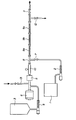
- Said installation comports on one hand a mayonnaise injection circuit consisting of a storage container 1 for storing the unfoamed initially prepared mayonnaise foodstuff and a delivery pump 2 and, on the other hand, an egg-white solution injection circuit including a reactor 3 for the initial preparation of an albumin solution, a pump 4 for circulating this solution and a beater 5 or expanding head activated by a motor 6 for beating up this solution.
- a mayonnaise injection circuit consisting of a storage container 1 for storing the unfoamed initially prepared mayonnaise foodstuff and a delivery pump 2 and, on the other hand, an egg-white solution injection circuit including a reactor 3 for the initial preparation of an albumin solution, a pump 4 for circulating this solution and a beater 5 or expanding head activated by a motor 6 for beating up this solution.
- a control valve 7 in the mayonnaise circuit which enables to dispense a controlled amount of mayonnaise relative to the egg-white and a T shaped duct 8, one causes the two foodstuff streams to meet in correct relationship so that they penetrate together in a series of static mixers 9a, 9b and 9c.
- These still mixers comprise a plurality of fixed baffles arranged for causing the stream mayonnaise and beaten up egg-white components to intimately interpenetrate and intermix and provide a homogeneous mass of mayonnaise foam.
- the installation further comprises a back-pressure check tube 10 connected to the circuit to control the allowed inside pressure and release overpressures, a valve 11 for directing the foam into a conditioning machine (not shown) for filling jars with the mayonnaise foam and a side valve 12 for sampling from time to time the mayonnaise foam under continuous production, the samples being subjected to analysis.
- the installation further cimprises a gas introduction line 13 for adding a pressurized inert gas like N 2 in order to achieve the foaming and the mixing under an inert atmosphere.
- Aside fran this one has prepared in reactor 3 a solution of powdered egg-white in water at 16.7% by weight. Then, by means of the pumps 2 and 4, one circulates the mayonnaise in direction of meet point 8 and the egg-white solution in the direction of the expanding head 5, respectively, in the following proportions: 96.615 parts by weight of mayonnaise and 3.385 parts by weight of the egg-white solution.
- the nitrogen pressure in line 13 is 7 bar and the operating pressure in the installation is 2.1 bar.
- the beaten up egg-white and mayonnaise streams meet at point 8 and intermix in static mixers 9a to 9c to provide a mayonnaise foam of density about 0.73.
- the continuous production of this foam is about 280 kg/hr which enables to fill approximately 700 jars of 400 g each.
Landscapes
- Life Sciences & Earth Sciences (AREA)
- Chemical & Material Sciences (AREA)
- Engineering & Computer Science (AREA)
- Food Science & Technology (AREA)
- Polymers & Plastics (AREA)
- Health & Medical Sciences (AREA)
- Nutrition Science (AREA)
- Seasonings (AREA)
- Seeds, Soups, And Other Foods (AREA)
- Confectionery (AREA)
Abstract
Description
- The present invention concerns lighter foodstuffs and especially emulsions of fatty substances in aqueous medium, for instance, products of the mayonnaise type.
- In the foodstuff field, one defines by the term "mayonnaise" an emulsion of oil in an aqueous solution containing various edible additives whose oil weight proportion with regard to the rest of the composition is of at least 77%. For lower proportions, for instance from 77 to 64%, one speaks then of "mayonnaise sauce" and for values still lower, of "sauce" for short, being understood that the additives (for instance, seasonings, spices or others) can be used for defining the type of "sauce" under discussion (sauce tartare, sauce provencale, etc..). The present invention relates, in general, to these different foodstuffs of "mayonnaise" type, this definition being used hereafter for simplification.
- The compositions of the "mayonnaise" type comprise oil, water, vinegar, an emulsifier exemplified by egg-yolk and, at will, various other seasoning additives such as salt, sugar, spices, flavors and other ingredients imparting taste characteristics to said ccaposi- tion. The egg-yolk is constituted by lipids, phospholipids and proteins and these two last constituents are responsible for the formation of an emulsion "oil-in-water" typical of the mayonnaises in which the oil droplets are separated from each other by the aqueous solution containing the emulsifying agents. Normally, the emulsion constitutive of a mayonnaise is obtained by vigorously whipping the aqueous solution of egg-yolk and progressively adding the oil. The other ingredients can be added, depending on the recipes, before or after emulsification.
- The mayonnaise described above presents itself in the form of a mass of high viscosity, compact and with a density near 1. It sometimes lacks stability and on standing, part of the oil phase can separate from the emulsion which gives to the foodstuff a rather unpleasant look. This shortcoming is absent in the foodstuff of the invention. Besides, it was desirable to decrease the density of the mayonnaise by imparting thereto a lighter and aerated structure due to the presence of microbubbles of air or gas. In other words, one has sought to convert mayonnaise and related products into "foams" of mayonnaise with a storage stable and stiff texture.
- Mayonnaise foams have been disclosed in the prior art and, for instance, in Patent US-A-3,728,133, one discloses mayonnaise foams comprising, as foaming agents, monoglycerides and fatty acid esters hydroxylated with partially hydrolyzed glycerides. However, such foams are rather difficult to prepare and lack stability. Besides, they do not present a strong texture analogous to that of a gel, this texture being one of the distinctive features of the invention.
- Document US-A-3,764,347 discloses a salad dressing of mayonnaise type without cholesterol, i.e. without egg-yolk. This dressing is composed of oil and starch and comprises an emulsifyer and a che- latant. The starch disclosed consists of a dough obtained by hydra- tation of a corn flour, of tapioca or other. In Example '2 of this document, one uses the following ingredients (by weight): starch dough (42.02); egg-white (5.64); alginate (0.1); EDTA (0.01); spices (3,19); vegetal oil (43.04); vinegar (1). After premixing the ingredients, the latter are put into a colloid mill which provides an emulsion whose aspect, taste and structure, are identical with that of a cam- mon mayonnaise. However there is no question of foam in this document.
- Document GB-A-2.078.483 teaches an oilless composition having lubricating properties capable of replacing oil in foodstuffs such as salad dressings, mayonnaise,, aerated desserts and others. One obtains this composition by mixing for instance a cellulose derivative (hydroxymethyl cellulose) with water and egg-white and whipping the mixture for incorporating air thereto to obtain a product A of density 0.7 or less.
- Aside therefrom, one subjects a starch product to hydration and acidification at pH 3-6 (acetic acid or other) and, after gelatinization thereof (product B), one mixes under continuous stirring components A and B. One obtains thus the searched after product containing air bubbles trapped in the mass which impart thereto lubricative organoleptic properties. The Examples in this document illustrate the preparation of various foodstuffs such as salad dressing and ice- cream. It is however not indicated how it can be used for making mayonnaise. Although this document teaches that the addition of air bubbles impart oil-feel properties to a mixture of starch and egg-white, it does not teach mayonnaise foam since the main ingredient of mayonnaise, i.e. oil, is absent from the foodstuff.
- The teaching of document US-A-2.217.699 is in rather close relationship to that of the previous document. It discloses an aerated oilless dressing for salads, the gas bubbles therein being essentially intended to decrease the gluey properties of the foodstuff due to the starch product therein. This document neither teaches mayonnaise foams like in the present invention.
- Document FR-A-2.360.264 discloses fruit and vegetable mousses which are prepared by adding beaten up egg-white to purees of fruits or vegetables. However, the document teaches tenperatures not lower than 60° for adding the egg-white even in the case of acidic products. The method of the invention has therefore an advantage over this disclosure since no or very little heating is required which strongly minimizes the risk of collapse of the foam due to possible expansion, bursting of the gas bubbles under the effect of temperature and ultimate contraction be cooling.
- Another document (EP-A-12490) concerns a composition to replace or reinforce the properties of beaten up egg-white in aerated foodstuffs. This composition based on gelatin, polyphosphate, and whey proteins is not quoted as usable for making mayonnaise foams.
- The foodstuff of "mayonnaise" type of the present invention is also lightened by the presence of microbubbles of gas or air distributed homogeneously and imparting to the foodstuff the aspect of a stable foam of stiff texture. It is characterized, in addition to the usual components of mayonnaises and related products, by the presence of a gelifying stabilizer agent and of a ligtening agent constituted by beaten up egg-white whose texture is reinforced by coagulation.
- Among the usual constituents of mayonnaises, one can recite, resides oil and water and egg-yolk which are the essential constituents thereof, vinegar, salt, sweetening agents, flavors, spices, various seasoning agents such as, for instance, mustard, horse-radish, tomato concentrate, pepper, pimento, paprika, onion, garlic and others. Among the sweetening agents, one can recite sugar, glucose, dextrose, lactose, honey, corn syrup, etc.. The oils which are convenient for the product of the invention belong to many kinds and conprise, for instance, oils of soy, peanuts, cotton, sunflower, rapeseed, grapestones and other edible oils.
- As gelifying agent, one uses advantageously at least one of the following products: gelatin, pectin, alginates, carrageenates, agar, carob, starch and other thickening and gelifying materials. The useful proportion by weight of such gelifying agents relative to the total of the composition is, of preference, between 0.01 and 0.5%. Below this range, the effect has little significance or is even un- depictable. Quantities over 0.5% are not impossible but, in general, are not advantageous unless special effects are sought; indeed, above 0.5%, the structure becomes exaggerately stiff which can be undesirable for eating.
- As egg-white, one can use that of new-laid eggs or powdered eggs; one prefers powdered egg-white for practical reasons because wheigh- ing up a dehydrated product provides more easily reproducible results than that of natural egg-white.
- The proportions of beaten up egg-white, calculated as weight of solid egg-white (powder), relative to the remainder of the composition are, preferably, 0.4 to 0.6%; lower quantities (for instance 0.2 - 0.3% are not impossible but in general they do not impart to the mayonnaise foam sufficient lightening effect. Quantities above 0.6% are also possible (for instance for obtaining foams with a density below 0.6 - 0.7) but foams lightened to such a degree are much less stable than denser foams, for example with densities of 0.8 to 0.6, which are obtained from the aforementioned quantities of lightening agent. The coagulation of the egg-white albumin which inparts its stiffness to the lightening agent and, in part, its stability to the mayonnaise foam results from the action of the vinegar of the composition. This point will be reminded afterwards when describing the preparation of the foam.
- Regarding the proportions of the other ingredients, the latter conform to practise in the field of mayonnaises and related products and have no particular impact on the above-mentionned proportions of gelifier and lightening agents. These proportions can therefore be freely chosen by the man skilled in the art in agreement with the recipes in usage and his experience as a practitioner.
- The products of the invention present themselves in the form of an aerated mass of very fine taste and of highly appetizing aspect as compared with the original not yet lightened products. They have a light and foamy aspect with more or less visible bubbles, however combined with a remarkably stiff texture. The color is generally fainter than that of the original product and, in sane cases, it may be advantageous to add to the composition a food-grade dyestuff in order to reinforce the color of the foam.
- To fabricate the present foodstuffs, one starts with the preparation of a mayonnaise or similar product according to usual means and by using the usual ingredients, the gelifying agent being also added; then one incorporates thereto the beaten up egg-white between 17 and 27°C. When in contact with the vinegar, the egg-white rigidifies itself by coagulation and its structure aerated due to the presence of the air or gas bubbles is stabilized despite the mixing stress to which it is subjected upon agitating with the remainder of the composition. This effect is unexpected and constitutes one of the surprising features of the present invention. Another surprising feature is the storage stability of the present foam, the latter preserving itself perfectly for several weeks at 50°C and, a for- tiori, at roan temperature without appreciable changes and without separation of part of the oil phase.
- The temperature scale given above is markedly advantageous; indeed, below the above-given limits, the coagulation effect is too slow and the lightening effect is less significant, above the afore given limits, the foam thus obtained loses somewhat of its stability.
- Regarding the preparation of the mayonnaise composition mentioned above, one may, before adding the egg-white, either (1) add the oil (under agitation) to the solution of the other ingredients, or (2) proceed identically, the vinegar being omitted in the solution and being added at the end of the preparation of the emulsion, or (3) add simultaneously but separately (under agitation) the oil and the vinegar to the other ingredients dissolved in water.
- When one lightens the produced emulsion as indicated under (1), one obtains a more fluffy foam whose bubbles are well apparent; however it is less stiff than when the emulsion is prepared as indicated under (2) or (3).
- The Examples that follow illustrate the invention in a detailed manner.
- One has dissolved 0.3 g of gelatin in 7 g of water at 70°C under stirring, then after allowing to cool down to 25°C, one has added to this solution 3.4 g of egg-yolk in powder form, 6.7 g of vinegar at 8°, 1.2 g of salt and 1 g of sugar. Under agitation by means of a cream beater, one has thereafter added streamwise 77 g of sunflower oil and one has agitated until a homogeneous emulsion is obtained.
- Besides, one has beaten at room temperature a solution of 0.57 g of powdered egg-white in 3 g of water.
- One has thereafter incorporated, under beating, the beaten up egg-white to the emulsion at 25°C and one has poured the foamy mass into jars. After about 1 hr of rest, one has noted that the foam had stiffened and that its structure had become stiff. The mayonnaise foam thus prepared had a very fine taste although as strong as the starting emulsion. Its aspect was light, aerated and very appetizing (d = 0.720).
- One has proceeded as in Example 1 with the same ingredients but, in the starting aqueous solution, the vinegar was omitted. The latter was added to the emulsion once the latter was achieved, then one has proceeded to the incorporation of the beaten up egg-white as described in Example 1.
- The foam obtained was even stiffer than that described in Example 1 and, once it had been introduced into a mold and turned out after "setting", it provided a mayonnaise foam "pudding" whose shape was stable (d = 0.730).
- One has proceeded like in Example 1 but with the following ingredients: carrageenan (LXGOMME) 0.1 g; water 7.1 g; powdered egg-yolk 3.5 g;
vinegar 8° 6.4 g; salt 1.2 g; sugar 1.0 g; powdered egg-white 0.584 g dissolved in 2.916 g of water. After the introduction of the beaten egg-white, one has obtained an appetizing mayonnaise foam with an excellent taste (d = 0.72). - One has prepared a mayonnaise sauce as follows: in an aqueous solution containing 3.4 g of egg-yolk in powder form, 7 g of water, 0.03 g of carrageenan and 16.07 g of tomato concentrate (at 80% of dry matter), one has added, separately but simultaneously under agitation at room temperature, 64 g of peanut oil and 6 g of 8° vinegar.
- One has thereafter added to the resulting emulsion, at 20°C, beaten up egg-white prepared fran 0.584 g of powdered egg-white dissolved in 2.916 g of water. One has thus obtained, after resting stored in jars, a mayonnaise sauce foam of pale red color having an aerated aspect and very agreeable to the taste.
- For an improved comprehension of this Example, reference is made to the annexed drawing which schematically represents an industrial installation for the production of mayonnaise foam.
- Said installation comports on one hand a mayonnaise injection circuit consisting of a storage container 1 for storing the unfoamed initially prepared mayonnaise foodstuff and a
delivery pump 2 and, on the other hand, an egg-white solution injection circuit including areactor 3 for the initial preparation of an albumin solution, a pump 4 for circulating this solution and abeater 5 or expanding head activated by amotor 6 for beating up this solution. - By means of a control valve 7 in the mayonnaise circuit, which enables to dispense a controlled amount of mayonnaise relative to the egg-white and a T shaped
duct 8, one causes the two foodstuff streams to meet in correct relationship so that they penetrate together in a series ofstatic mixers - The installation further comprises a back-
pressure check tube 10 connected to the circuit to control the allowed inside pressure and release overpressures, a valve 11 for directing the foam into a conditioning machine (not shown) for filling jars with the mayonnaise foam and aside valve 12 for sampling from time to time the mayonnaise foam under continuous production, the samples being subjected to analysis. The installation further cimprises agas introduction line 13 for adding a pressurized inert gas like N2 in order to achieve the foaming and the mixing under an inert atmosphere. - Using the presently disclosed installation, one has introduced a previously prepared mayonnaise charge into tank 1; this mayonnaise was prepared by usual means with the following ingredients:

- Aside fran this, one has prepared in reactor 3 a solution of powdered egg-white in water at 16.7% by weight. Then, by means of the
pumps 2 and 4, one circulates the mayonnaise in direction ofmeet point 8 and the egg-white solution in the direction of the expandinghead 5, respectively, in the following proportions: 96.615 parts by weight of mayonnaise and 3.385 parts by weight of the egg-white solution. The nitrogen pressure inline 13 is 7 bar and the operating pressure in the installation is 2.1 bar. After beating up in thehead 5 and passing throughtube 10, the beaten up egg-white and mayonnaise streams meet atpoint 8 and intermix instatic mixers 9a to 9c to provide a mayonnaise foam of density about 0.73. - Under the operating conditions set up below, the continuous production of this foam is about 280 kg/hr which enables to fill approximately 700 jars of 400 g each.
- Said operating conditions are as follows:
- Back pressure 2.1 bar; nitrogen consumption 9 1/min; albumin solution flow rate 10.8 kg/hr; temperature 20-22°C; density of the albumin solution 1.030: density of the beaten up egg-white 0.075.
- The present installation was built up using elements fabricated by MONDOMIX, Nederhorst, Holland. By making slight variations to the above mentioned operating parameters, mayonnaise foams with densities of 0.68 to 0.75 were obtained having excellent organoleptic and storage properties.
Claims (9)
Priority Applications (1)
| Application Number | Priority Date | Filing Date | Title |
|---|---|---|---|
| AT84810373T ATE28119T1 (en) | 1983-08-02 | 1984-07-30 | FOAM MAYONNAISE AND PROCESS FOR PRODUCTION. |
Applications Claiming Priority (2)
| Application Number | Priority Date | Filing Date | Title |
|---|---|---|---|
| CH419283 | 1983-08-02 | ||
| CH4192/83 | 1983-08-02 |
Publications (2)
| Publication Number | Publication Date |
|---|---|
| EP0134196A1 true EP0134196A1 (en) | 1985-03-13 |
| EP0134196B1 EP0134196B1 (en) | 1987-07-08 |
Family
ID=4271502
Family Applications (1)
| Application Number | Title | Priority Date | Filing Date |
|---|---|---|---|
| EP84810373A Expired EP0134196B1 (en) | 1983-08-02 | 1984-07-30 | Foamed mayonnaises and method for the preparation of such products |
Country Status (7)
| Country | Link |
|---|---|
| US (1) | US4578278A (en) |
| EP (1) | EP0134196B1 (en) |
| JP (1) | JPS6054659A (en) |
| AT (1) | ATE28119T1 (en) |
| AU (1) | AU3111384A (en) |
| DE (1) | DE3464535D1 (en) |
| ES (1) | ES8603748A1 (en) |
Cited By (6)
| Publication number | Priority date | Publication date | Assignee | Title |
|---|---|---|---|---|
| EP0377312A1 (en) * | 1989-01-06 | 1990-07-11 | Kraft, Incorporated | Low oil mayonnaise |
| WO1993017584A1 (en) * | 1992-03-13 | 1993-09-16 | Lecoindre Gerard | Mayonnaise-type edible sauce, method for preparing the sauce, and food composition containing same |
| WO1994012063A1 (en) * | 1992-12-02 | 1994-06-09 | Unilever N.V. | Use of stable gas cells in food products |
| US8293313B2 (en) | 2005-10-26 | 2012-10-23 | Compagnie Gervais Danone | Microfoamed fruit or vegetable puree and method for preparing same |
| DE102012003953A1 (en) * | 2012-03-02 | 2013-09-05 | DOJA T.E.C. Sondermaschinen GmbH | Device for continuous and/or discontinuous static foaming of food masses, comprises device e.g. for extracting liquid or fat containing solid mass, unit for supplying air for introducing into liquid or solid mass, and unit for foaming disc |
| CN103917112A (en) * | 2011-11-04 | 2014-07-09 | 丘比株式会社 | Acidic oil-in-water emulsified food |
Families Citing this family (19)
| Publication number | Priority date | Publication date | Assignee | Title |
|---|---|---|---|---|
| US5194282A (en) * | 1987-04-12 | 1993-03-16 | Bar Ilan University | Food products having a reduced fat content |
| JPH082260B2 (en) * | 1988-11-30 | 1996-01-17 | 正田醤油株式会社 | Frothy seasoning |
| JPH0319667A (en) * | 1989-06-15 | 1991-01-28 | Kikkoman Corp | Foamy seasoning, foaming seasoning composition liquid and its production |
| US5082682A (en) * | 1990-11-09 | 1992-01-21 | Fantasy Flavors, Inc. | Nonfat frozen dairy dessert with method and premix therefor |
| PT716811E (en) * | 1994-12-13 | 2001-07-31 | Produits Nestle S A Societe De | HEAT-IN-WATER EMULSES CONTAINING HEAT CONTAINING EGG GEM AND PROCESS FOR THEIR PREPARATION |
| WO1996029894A1 (en) * | 1995-03-29 | 1996-10-03 | Unilever N.V. | Sauce base composition |
| ATE220507T1 (en) * | 1996-04-12 | 2002-08-15 | Unilever Nv | PACKAGED DAIRY PRODUCT SPREAD WITH HETEROGENEOUS TEXTURE |
| JPH1033108A (en) * | 1996-07-23 | 1998-02-10 | Kankyo Kagaku Kogyo Kk | Bubble-entrained dough for cake, its production and apparatus therefor |
| DE69931857T2 (en) * | 1998-04-24 | 2007-02-15 | Unilever N.V. | Transparent salad dressing with separate layers of oil and water |
| DE60131616T2 (en) * | 2000-10-03 | 2008-10-23 | Unilever N.V. | Dressing or marinade |
| ES2177429B1 (en) * | 2000-11-24 | 2004-08-16 | Yemas De Santa Teresa, S.A. | A MAYON SAUCE AND ITS MANUFACTURING PROCEDURE. |
| CA2571199A1 (en) * | 2004-06-15 | 2006-01-05 | Nestec S.A. | Aerated creamers and processes |
| AU2005293868B2 (en) * | 2004-10-13 | 2008-09-25 | Upfield Europe B.V. | Aerated oil in water emulsion comprising vegetable fat |
| US20060141107A1 (en) * | 2004-12-29 | 2006-06-29 | Kraft Foods Holdings, Inc. | Method and system for controlling product density |
| US20060204642A1 (en) * | 2005-03-09 | 2006-09-14 | Adams Leslie N | Reduced-density foodstuff having improved flavor aroma, and mouth feel |
| CA2672381C (en) * | 2006-12-28 | 2015-12-01 | Marc Joaquin Antoine Anton | Edible aerated oil-and-water emulsion |
| WO2009080423A1 (en) * | 2007-12-19 | 2009-07-02 | Unilever Plc | Food products with reduced salt levels |
| US10645967B2 (en) | 2017-08-08 | 2020-05-12 | The Clorox Company | Shelf-stable acidified aerated food emulsion |
| JP2020058316A (en) * | 2018-10-12 | 2020-04-16 | キユーピー株式会社 | Bubble-containing acidic oil-in-water emulsion seasoning, salad using bubble-containing acidic oil-in-water emulsion seasoning, and methods for producing the same |
Citations (6)
| Publication number | Priority date | Publication date | Assignee | Title |
|---|---|---|---|---|
| US2217699A (en) * | 1938-09-14 | 1940-10-15 | Musher Corp | Salad dressing and method of preparing the same |
| US3728133A (en) * | 1971-08-11 | 1973-04-17 | Scm Corp | Foamed mayonnaise composition |
| US3764347A (en) * | 1971-05-12 | 1973-10-09 | United Food Industries | No cholesterol mayonnaise type salad dressing |
| FR2360264A1 (en) * | 1976-08-05 | 1978-03-03 | Grace W R Ltd | PROCESS FOR PREPARING AN FOOD FOAM |
| EP0012490A1 (en) * | 1978-12-18 | 1980-06-25 | The Kroger Co. | New egg albumen extender prepared from derived protein-containing compositions and additives and food products containing them |
| GB2078483A (en) * | 1980-06-20 | 1982-01-13 | Gen Foods Corp | Oil replacement composition |
Family Cites Families (7)
| Publication number | Priority date | Publication date | Assignee | Title |
|---|---|---|---|---|
| US2162585A (en) * | 1937-12-14 | 1939-06-13 | Musher Corp | Aerated products |
| US3414413A (en) * | 1966-02-01 | 1968-12-03 | Hca Food Corp | Edible composition and method of making the same |
| JPS497221A (en) * | 1972-05-29 | 1974-01-22 | ||
| JPS5130145B2 (en) * | 1972-11-07 | 1976-08-30 | ||
| JPS5218865A (en) * | 1975-07-30 | 1977-02-12 | Kyupi Kk | Production of acidic emulsified food |
| NL7811439A (en) * | 1978-11-21 | 1980-05-23 | Unilever Nv | Foamed edible emulsions e.g. low calorie mayonnaise - obtd. by mixing aq. mixt. contg. carbon di:oxide releasing agent, protein emulsifier and thickener, with gas-contg. oil and adding acid |
| US4420495A (en) * | 1980-05-17 | 1983-12-13 | Grosskuchenanlagen Ing. Josef Hammer | Method and apparatus for preparing foamy sauces or the like |
-
1984
- 1984-07-24 AU AU31113/84A patent/AU3111384A/en not_active Abandoned
- 1984-07-30 DE DE8484810373T patent/DE3464535D1/en not_active Expired
- 1984-07-30 AT AT84810373T patent/ATE28119T1/en not_active IP Right Cessation
- 1984-07-30 EP EP84810373A patent/EP0134196B1/en not_active Expired
- 1984-07-30 US US06/635,594 patent/US4578278A/en not_active Expired - Fee Related
- 1984-07-31 JP JP59159479A patent/JPS6054659A/en active Pending
- 1984-08-02 ES ES534830A patent/ES8603748A1/en not_active Expired
Patent Citations (6)
| Publication number | Priority date | Publication date | Assignee | Title |
|---|---|---|---|---|
| US2217699A (en) * | 1938-09-14 | 1940-10-15 | Musher Corp | Salad dressing and method of preparing the same |
| US3764347A (en) * | 1971-05-12 | 1973-10-09 | United Food Industries | No cholesterol mayonnaise type salad dressing |
| US3728133A (en) * | 1971-08-11 | 1973-04-17 | Scm Corp | Foamed mayonnaise composition |
| FR2360264A1 (en) * | 1976-08-05 | 1978-03-03 | Grace W R Ltd | PROCESS FOR PREPARING AN FOOD FOAM |
| EP0012490A1 (en) * | 1978-12-18 | 1980-06-25 | The Kroger Co. | New egg albumen extender prepared from derived protein-containing compositions and additives and food products containing them |
| GB2078483A (en) * | 1980-06-20 | 1982-01-13 | Gen Foods Corp | Oil replacement composition |
Non-Patent Citations (1)
| Title |
|---|
| PROSPER MONTAGNE: "Nouveau Larousse Gastronomique", édition revue et corrigée par Robert J. Courtine, 1st November 1980, page 941, Paris, Fr.; * |
Cited By (8)
| Publication number | Priority date | Publication date | Assignee | Title |
|---|---|---|---|---|
| EP0377312A1 (en) * | 1989-01-06 | 1990-07-11 | Kraft, Incorporated | Low oil mayonnaise |
| WO1993017584A1 (en) * | 1992-03-13 | 1993-09-16 | Lecoindre Gerard | Mayonnaise-type edible sauce, method for preparing the sauce, and food composition containing same |
| FR2688384A1 (en) * | 1992-03-13 | 1993-09-17 | Lecoindre Gerard | FOOD SAUCE OF MAYONNAISE TYPE, PROCESS FOR PREPARING SUCH SAUCE AND FOOD PREPARATION CONTAINING SAME. |
| WO1994012063A1 (en) * | 1992-12-02 | 1994-06-09 | Unilever N.V. | Use of stable gas cells in food products |
| US8293313B2 (en) | 2005-10-26 | 2012-10-23 | Compagnie Gervais Danone | Microfoamed fruit or vegetable puree and method for preparing same |
| CN103917112A (en) * | 2011-11-04 | 2014-07-09 | 丘比株式会社 | Acidic oil-in-water emulsified food |
| EP2774493A4 (en) * | 2011-11-04 | 2015-05-06 | Kewpie Corp | OIL EMULSION FOOD IN ACIDIC WATER |
| DE102012003953A1 (en) * | 2012-03-02 | 2013-09-05 | DOJA T.E.C. Sondermaschinen GmbH | Device for continuous and/or discontinuous static foaming of food masses, comprises device e.g. for extracting liquid or fat containing solid mass, unit for supplying air for introducing into liquid or solid mass, and unit for foaming disc |
Also Published As
| Publication number | Publication date |
|---|---|
| ES534830A0 (en) | 1986-01-01 |
| ES8603748A1 (en) | 1986-01-01 |
| AU3111384A (en) | 1985-02-07 |
| DE3464535D1 (en) | 1987-08-13 |
| US4578278A (en) | 1986-03-25 |
| JPS6054659A (en) | 1985-03-29 |
| EP0134196B1 (en) | 1987-07-08 |
| ATE28119T1 (en) | 1987-07-15 |
Similar Documents
| Publication | Publication Date | Title |
|---|---|---|
| EP0134196B1 (en) | Foamed mayonnaises and method for the preparation of such products | |
| US3809764A (en) | Low calorie topping,spread,and frozen dessert | |
| US3936391A (en) | Hydrated polyglycerol ester composition | |
| KR860001810B1 (en) | Process for producing cheese containing composition for dessert making | |
| US5308639A (en) | Low calorie fat substitute | |
| US4046874A (en) | Soapless shave composition | |
| US3183098A (en) | Dry mix for frozen desserts | |
| JPH0690654A (en) | Cookie containing high grain content | |
| CZ303697A3 (en) | Preparation with a continuous fatty phase and process for preparing thereof | |
| JPH10507356A (en) | Methods for preparing and using pseudofat in low fat / cholesterol foods | |
| EP1662899A1 (en) | Uht treated 100 % non dairy whipping cream | |
| JP3829371B2 (en) | Air-containing dessert and its manufacturing method | |
| JP4089112B2 (en) | Low-fat oil-in-water composition | |
| JP2020080811A (en) | Novel whipped cream, and production method of the same | |
| JP2725774B2 (en) | Method for producing ice creams | |
| US2836497A (en) | Edible composition of vegetable oil emulsion and butter fat emulsion convertible by aeration into a stiff mass | |
| JPH1023876A (en) | Production of oil-in-water type emulsified food | |
| EA007605B1 (en) | Food additive | |
| US3326691A (en) | Edible foam-producing composition | |
| JP2005218407A (en) | Souffle-like food-based manufacturing method | |
| JPS5922504B2 (en) | Method for producing multicellular food | |
| RU2854587C1 (en) | Method for preparing sauce | |
| JP2003038099A (en) | Oil-in-water emulsion composition for confectionery and method for producing cake using the same | |
| JP2734063B2 (en) | Low calorie emulsified composition | |
| JP2023127902A (en) | Whipped cream and its manufacturing method |
Legal Events
| Date | Code | Title | Description |
|---|---|---|---|
| PUAI | Public reference made under article 153(3) epc to a published international application that has entered the european phase |
Free format text: ORIGINAL CODE: 0009012 |
|
| AK | Designated contracting states |
Designated state(s): AT BE CH DE FR GB IT LI LU NL SE |
|
| 17P | Request for examination filed |
Effective date: 19850711 |
|
| RAP1 | Party data changed (applicant data changed or rights of an application transferred) |
Owner name: LESIEUR ALIMENTAIRE S.A. Owner name: BATTELLE MEMORIAL INSTITUTE |
|
| 17Q | First examination report despatched |
Effective date: 19860321 |
|
| GRAA | (expected) grant |
Free format text: ORIGINAL CODE: 0009210 |
|
| RAP1 | Party data changed (applicant data changed or rights of an application transferred) |
Owner name: THOMI + FRANCK AG Owner name: LESIEUR ALIMENTAIRE S.A. Owner name: BATTELLE MEMORIAL INSTITUTE |
|
| AK | Designated contracting states |
Kind code of ref document: B1 Designated state(s): AT BE CH DE FR GB IT LI LU NL SE |
|
| PG25 | Lapsed in a contracting state [announced via postgrant information from national office to epo] |
Ref country code: IT Free format text: LAPSE BECAUSE OF FAILURE TO SUBMIT A TRANSLATION OF THE DESCRIPTION OR TO PAY THE FEE WITHIN THE PRESCRIBED TIME-LIMIT;WARNING: LAPSES OF ITALIAN PATENTS WITH EFFECTIVE DATE BEFORE 2007 MAY HAVE OCCURRED AT ANY TIME BEFORE 2007. THE CORRECT EFFECTIVE DATE MAY BE DIFFERENT FROM THE ONE RECORDED. Effective date: 19870708 Ref country code: AT Effective date: 19870708 |
|
| REF | Corresponds to: |
Ref document number: 28119 Country of ref document: AT Date of ref document: 19870715 Kind code of ref document: T |
|
| PG25 | Lapsed in a contracting state [announced via postgrant information from national office to epo] |
Ref country code: SE Effective date: 19870731 |
|
| PGFP | Annual fee paid to national office [announced via postgrant information from national office to epo] |
Ref country code: NL Payment date: 19870731 Year of fee payment: 4 |
|
| REF | Corresponds to: |
Ref document number: 3464535 Country of ref document: DE Date of ref document: 19870813 |
|
| ET | Fr: translation filed | ||
| PLBE | No opposition filed within time limit |
Free format text: ORIGINAL CODE: 0009261 |
|
| STAA | Information on the status of an ep patent application or granted ep patent |
Free format text: STATUS: NO OPPOSITION FILED WITHIN TIME LIMIT |
|
| 26N | No opposition filed | ||
| PG25 | Lapsed in a contracting state [announced via postgrant information from national office to epo] |
Ref country code: GB Effective date: 19880730 |
|
| GBPC | Gb: european patent ceased through non-payment of renewal fee | ||
| PG25 | Lapsed in a contracting state [announced via postgrant information from national office to epo] |
Ref country code: DE Effective date: 19890401 |
|
| PG25 | Lapsed in a contracting state [announced via postgrant information from national office to epo] |
Ref country code: NL Effective date: 19900201 |
|
| NLV4 | Nl: lapsed or anulled due to non-payment of the annual fee | ||
| PGFP | Annual fee paid to national office [announced via postgrant information from national office to epo] |
Ref country code: CH Payment date: 19920717 Year of fee payment: 9 |
|
| PG25 | Lapsed in a contracting state [announced via postgrant information from national office to epo] |
Ref country code: LI Effective date: 19930731 Ref country code: CH Effective date: 19930731 |
|
| REG | Reference to a national code |
Ref country code: CH Ref legal event code: PL |
|
| EPTA | Lu: last paid annual fee | ||
| REG | Reference to a national code |
Ref country code: FR Ref legal event code: TP |
|
| PGFP | Annual fee paid to national office [announced via postgrant information from national office to epo] |
Ref country code: FR Payment date: 19960524 Year of fee payment: 13 |
|
| PGFP | Annual fee paid to national office [announced via postgrant information from national office to epo] |
Ref country code: LU Payment date: 19960701 Year of fee payment: 13 |
|
| PGFP | Annual fee paid to national office [announced via postgrant information from national office to epo] |
Ref country code: BE Payment date: 19960812 Year of fee payment: 13 |
|
| PG25 | Lapsed in a contracting state [announced via postgrant information from national office to epo] |
Ref country code: LU Free format text: LAPSE BECAUSE OF NON-PAYMENT OF DUE FEES Effective date: 19970730 |
|
| PG25 | Lapsed in a contracting state [announced via postgrant information from national office to epo] |
Ref country code: BE Free format text: LAPSE BECAUSE OF NON-PAYMENT OF DUE FEES Effective date: 19970731 |
|
| BERE | Be: lapsed |
Owner name: C.P.C. FRANCE Effective date: 19970731 |
|
| PG25 | Lapsed in a contracting state [announced via postgrant information from national office to epo] |
Ref country code: FR Free format text: LAPSE BECAUSE OF NON-PAYMENT OF DUE FEES Effective date: 19980331 |
|
| REG | Reference to a national code |
Ref country code: FR Ref legal event code: ST |