EP0136704A2 - Nail enamel containing silicone-coated pigments - Google Patents
Nail enamel containing silicone-coated pigments Download PDFInfo
- Publication number
- EP0136704A2 EP0136704A2 EP84111810A EP84111810A EP0136704A2 EP 0136704 A2 EP0136704 A2 EP 0136704A2 EP 84111810 A EP84111810 A EP 84111810A EP 84111810 A EP84111810 A EP 84111810A EP 0136704 A2 EP0136704 A2 EP 0136704A2
- Authority
- EP
- European Patent Office
- Prior art keywords
- pigment
- nail enamel
- coated
- enamel
- nail
- Prior art date
- Legal status (The legal status is an assumption and is not a legal conclusion. Google has not performed a legal analysis and makes no representation as to the accuracy of the status listed.)
- Granted
Links
- 239000000049 pigment Substances 0.000 title claims abstract description 43
- 210000003298 dental enamel Anatomy 0.000 title claims abstract description 42
- 229920001296 polysiloxane Polymers 0.000 title abstract description 11
- 230000005012 migration Effects 0.000 claims abstract description 18
- 238000013508 migration Methods 0.000 claims abstract description 18
- -1 poly(organosiloxane) Polymers 0.000 claims description 11
- 239000001023 inorganic pigment Substances 0.000 claims description 9
- 239000011248 coating agent Substances 0.000 claims description 7
- 238000000576 coating method Methods 0.000 claims description 7
- 238000004519 manufacturing process Methods 0.000 claims description 2
- 238000000034 method Methods 0.000 claims description 2
- GWEVSGVZZGPLCZ-UHFFFAOYSA-N Titan oxide Chemical compound O=[Ti]=O GWEVSGVZZGPLCZ-UHFFFAOYSA-N 0.000 description 12
- UQSXHKLRYXJYBZ-UHFFFAOYSA-N iron oxide Inorganic materials [Fe]=O UQSXHKLRYXJYBZ-UHFFFAOYSA-N 0.000 description 7
- 125000002496 methyl group Chemical group [H]C([H])([H])* 0.000 description 6
- 239000000203 mixture Substances 0.000 description 6
- 239000003973 paint Substances 0.000 description 6
- 239000003349 gelling agent Substances 0.000 description 4
- 235000013980 iron oxide Nutrition 0.000 description 4
- 238000002156 mixing Methods 0.000 description 4
- 239000011347 resin Substances 0.000 description 4
- 229920005989 resin Polymers 0.000 description 4
- 239000002904 solvent Substances 0.000 description 4
- 238000003756 stirring Methods 0.000 description 4
- 239000004408 titanium dioxide Substances 0.000 description 4
- XEKOWRVHYACXOJ-UHFFFAOYSA-N Ethyl acetate Chemical compound CCOC(C)=O XEKOWRVHYACXOJ-UHFFFAOYSA-N 0.000 description 3
- YXFVVABEGXRONW-UHFFFAOYSA-N Toluene Chemical compound CC1=CC=CC=C1 YXFVVABEGXRONW-UHFFFAOYSA-N 0.000 description 3
- 239000003086 colorant Substances 0.000 description 3
- 230000000694 effects Effects 0.000 description 3
- 125000001997 phenyl group Chemical group [H]C1=C([H])C([H])=C(*)C([H])=C1[H] 0.000 description 3
- 239000004014 plasticizer Substances 0.000 description 3
- 239000000375 suspending agent Substances 0.000 description 3
- KFZMGEQAYNKOFK-UHFFFAOYSA-N Isopropanol Chemical compound CC(C)O KFZMGEQAYNKOFK-UHFFFAOYSA-N 0.000 description 2
- 229910007161 Si(CH3)3 Inorganic materials 0.000 description 2
- 238000013019 agitation Methods 0.000 description 2
- 125000003342 alkenyl group Chemical group 0.000 description 2
- 125000000217 alkyl group Chemical group 0.000 description 2
- 125000004429 atom Chemical group 0.000 description 2
- GUJOJGAPFQRJSV-UHFFFAOYSA-N dialuminum;dioxosilane;oxygen(2-);hydrate Chemical compound O.[O-2].[O-2].[O-2].[Al+3].[Al+3].O=[Si]=O.O=[Si]=O.O=[Si]=O.O=[Si]=O GUJOJGAPFQRJSV-UHFFFAOYSA-N 0.000 description 2
- DOIRQSBPFJWKBE-UHFFFAOYSA-N dibutyl phthalate Chemical compound CCCCOC(=O)C1=CC=CC=C1C(=O)OCCCC DOIRQSBPFJWKBE-UHFFFAOYSA-N 0.000 description 2
- 239000004615 ingredient Substances 0.000 description 2
- 239000000463 material Substances 0.000 description 2
- 239000010445 mica Substances 0.000 description 2
- 229910052618 mica group Inorganic materials 0.000 description 2
- 125000004430 oxygen atom Chemical group O* 0.000 description 2
- LIVNPJMFVYWSIS-UHFFFAOYSA-N silicon monoxide Inorganic materials [Si-]#[O+] LIVNPJMFVYWSIS-UHFFFAOYSA-N 0.000 description 2
- 239000000725 suspension Substances 0.000 description 2
- 125000000923 (C1-C30) alkyl group Chemical group 0.000 description 1
- 235000007173 Abies balsamea Nutrition 0.000 description 1
- 239000004857 Balsam Substances 0.000 description 1
- DKPFZGUDAPQIHT-UHFFFAOYSA-N Butyl acetate Natural products CCCCOC(C)=O DKPFZGUDAPQIHT-UHFFFAOYSA-N 0.000 description 1
- MQIUGAXCHLFZKX-UHFFFAOYSA-N Di-n-octyl phthalate Natural products CCCCCCCCOC(=O)C1=CC=CC=C1C(=O)OCCCCCCCC MQIUGAXCHLFZKX-UHFFFAOYSA-N 0.000 description 1
- LCGLNKUTAGEVQW-UHFFFAOYSA-N Dimethyl ether Chemical compound COC LCGLNKUTAGEVQW-UHFFFAOYSA-N 0.000 description 1
- 244000018716 Impatiens biflora Species 0.000 description 1
- 239000000020 Nitrocellulose Substances 0.000 description 1
- 229910018557 Si O Inorganic materials 0.000 description 1
- BLRPTPMANUNPDV-UHFFFAOYSA-N Silane Chemical compound [SiH4] BLRPTPMANUNPDV-UHFFFAOYSA-N 0.000 description 1
- WGLPBDUCMAPZCE-UHFFFAOYSA-N Trioxochromium Chemical compound O=[Cr](=O)=O WGLPBDUCMAPZCE-UHFFFAOYSA-N 0.000 description 1
- 239000000654 additive Substances 0.000 description 1
- 230000002411 adverse Effects 0.000 description 1
- UHHXUPJJDHEMGX-UHFFFAOYSA-K azanium;manganese(3+);phosphonato phosphate Chemical compound [NH4+].[Mn+3].[O-]P([O-])(=O)OP([O-])([O-])=O UHHXUPJJDHEMGX-UHFFFAOYSA-K 0.000 description 1
- IRERQBUNZFJFGC-UHFFFAOYSA-L azure blue Chemical compound [Na+].[Na+].[Na+].[Na+].[Na+].[Na+].[Na+].[Na+].[Al+3].[Al+3].[Al+3].[Al+3].[Al+3].[Al+3].[S-]S[S-].[O-][Si]([O-])([O-])[O-].[O-][Si]([O-])([O-])[O-].[O-][Si]([O-])([O-])[O-].[O-][Si]([O-])([O-])[O-].[O-][Si]([O-])([O-])[O-].[O-][Si]([O-])([O-])[O-] IRERQBUNZFJFGC-UHFFFAOYSA-L 0.000 description 1
- BJQHLKABXJIVAM-UHFFFAOYSA-N bis(2-ethylhexyl) phthalate Chemical compound CCCCC(CC)COC(=O)C1=CC=CC=C1C(=O)OCC(CC)CCCC BJQHLKABXJIVAM-UHFFFAOYSA-N 0.000 description 1
- 125000004432 carbon atom Chemical group C* 0.000 description 1
- 229910000423 chromium oxide Inorganic materials 0.000 description 1
- VQWFNAGFNGABOH-UHFFFAOYSA-K chromium(iii) hydroxide Chemical compound [OH-].[OH-].[OH-].[Cr+3] VQWFNAGFNGABOH-UHFFFAOYSA-K 0.000 description 1
- 230000000052 comparative effect Effects 0.000 description 1
- 239000002537 cosmetic Substances 0.000 description 1
- 239000006185 dispersion Substances 0.000 description 1
- 239000002320 enamel (paints) Substances 0.000 description 1
- 238000005516 engineering process Methods 0.000 description 1
- 125000001301 ethoxy group Chemical group [H]C([H])([H])C([H])([H])O* 0.000 description 1
- 238000011156 evaluation Methods 0.000 description 1
- 238000005189 flocculation Methods 0.000 description 1
- 230000016615 flocculation Effects 0.000 description 1
- 238000005188 flotation Methods 0.000 description 1
- QFKPPROZZUZXSO-UHFFFAOYSA-N formaldehyde;phenylmethanesulfonamide Chemical compound O=C.NS(=O)(=O)CC1=CC=CC=C1 QFKPPROZZUZXSO-UHFFFAOYSA-N 0.000 description 1
- 238000009472 formulation Methods 0.000 description 1
- FUZZWVXGSFPDMH-UHFFFAOYSA-N hexanoic acid Chemical compound CCCCCC(O)=O FUZZWVXGSFPDMH-UHFFFAOYSA-N 0.000 description 1
- 229910052739 hydrogen Inorganic materials 0.000 description 1
- 239000001257 hydrogen Substances 0.000 description 1
- 125000004435 hydrogen atom Chemical class [H]* 0.000 description 1
- VBMVTYDPPZVILR-UHFFFAOYSA-N iron(2+);oxygen(2-) Chemical class [O-2].[Fe+2] VBMVTYDPPZVILR-UHFFFAOYSA-N 0.000 description 1
- 238000003801 milling Methods 0.000 description 1
- 229910052901 montmorillonite Inorganic materials 0.000 description 1
- 229920001220 nitrocellulos Polymers 0.000 description 1
- 239000012860 organic pigment Substances 0.000 description 1
- 229920000728 polyester Polymers 0.000 description 1
- 229920000642 polymer Polymers 0.000 description 1
- 229920001843 polymethylhydrosiloxane Polymers 0.000 description 1
- 238000002360 preparation method Methods 0.000 description 1
- 238000000926 separation method Methods 0.000 description 1
- 229910000077 silane Inorganic materials 0.000 description 1
- 229920005573 silicon-containing polymer Polymers 0.000 description 1
- 239000004447 silicone coating Substances 0.000 description 1
- 238000001179 sorption measurement Methods 0.000 description 1
Classifications
-
- A—HUMAN NECESSITIES
- A61—MEDICAL OR VETERINARY SCIENCE; HYGIENE
- A61Q—SPECIFIC USE OF COSMETICS OR SIMILAR TOILETRY PREPARATIONS
- A61Q3/00—Manicure or pedicure preparations
- A61Q3/02—Nail coatings
-
- A—HUMAN NECESSITIES
- A61—MEDICAL OR VETERINARY SCIENCE; HYGIENE
- A61K—PREPARATIONS FOR MEDICAL, DENTAL OR TOILETRY PURPOSES
- A61K8/00—Cosmetics or similar toiletry preparations
- A61K8/02—Cosmetics or similar toiletry preparations characterised by special physical form
- A61K8/0241—Containing particulates characterized by their shape and/or structure
-
- A—HUMAN NECESSITIES
- A61—MEDICAL OR VETERINARY SCIENCE; HYGIENE
- A61K—PREPARATIONS FOR MEDICAL, DENTAL OR TOILETRY PURPOSES
- A61K8/00—Cosmetics or similar toiletry preparations
- A61K8/18—Cosmetics or similar toiletry preparations characterised by the composition
- A61K8/19—Cosmetics or similar toiletry preparations characterised by the composition containing inorganic ingredients
-
- A—HUMAN NECESSITIES
- A61—MEDICAL OR VETERINARY SCIENCE; HYGIENE
- A61K—PREPARATIONS FOR MEDICAL, DENTAL OR TOILETRY PURPOSES
- A61K8/00—Cosmetics or similar toiletry preparations
- A61K8/18—Cosmetics or similar toiletry preparations characterised by the composition
- A61K8/19—Cosmetics or similar toiletry preparations characterised by the composition containing inorganic ingredients
- A61K8/29—Titanium; Compounds thereof
-
- A—HUMAN NECESSITIES
- A61—MEDICAL OR VETERINARY SCIENCE; HYGIENE
- A61K—PREPARATIONS FOR MEDICAL, DENTAL OR TOILETRY PURPOSES
- A61K8/00—Cosmetics or similar toiletry preparations
- A61K8/18—Cosmetics or similar toiletry preparations characterised by the composition
- A61K8/72—Cosmetics or similar toiletry preparations characterised by the composition containing organic macromolecular compounds
- A61K8/84—Cosmetics or similar toiletry preparations characterised by the composition containing organic macromolecular compounds obtained by reactions otherwise than those involving only carbon-carbon unsaturated bonds
- A61K8/89—Polysiloxanes
- A61K8/891—Polysiloxanes saturated, e.g. dimethicone, phenyl trimethicone, C24-C28 methicone or stearyl dimethicone
-
- A—HUMAN NECESSITIES
- A61—MEDICAL OR VETERINARY SCIENCE; HYGIENE
- A61K—PREPARATIONS FOR MEDICAL, DENTAL OR TOILETRY PURPOSES
- A61K2800/00—Properties of cosmetic compositions or active ingredients thereof or formulation aids used therein and process related aspects
- A61K2800/40—Chemical, physico-chemical or functional or structural properties of particular ingredients
- A61K2800/41—Particular ingredients further characterized by their size
- A61K2800/412—Microsized, i.e. having sizes between 0.1 and 100 microns
-
- A—HUMAN NECESSITIES
- A61—MEDICAL OR VETERINARY SCIENCE; HYGIENE
- A61K—PREPARATIONS FOR MEDICAL, DENTAL OR TOILETRY PURPOSES
- A61K2800/00—Properties of cosmetic compositions or active ingredients thereof or formulation aids used therein and process related aspects
- A61K2800/40—Chemical, physico-chemical or functional or structural properties of particular ingredients
- A61K2800/42—Colour properties
- A61K2800/43—Pigments; Dyes
-
- A—HUMAN NECESSITIES
- A61—MEDICAL OR VETERINARY SCIENCE; HYGIENE
- A61K—PREPARATIONS FOR MEDICAL, DENTAL OR TOILETRY PURPOSES
- A61K2800/00—Properties of cosmetic compositions or active ingredients thereof or formulation aids used therein and process related aspects
- A61K2800/40—Chemical, physico-chemical or functional or structural properties of particular ingredients
- A61K2800/60—Particulates further characterized by their structure or composition
- A61K2800/61—Surface treated
- A61K2800/62—Coated
- A61K2800/624—Coated by macromolecular compounds
Definitions
- This invention relates to nail enamels. It particularly relates to nail enamels which are substantially free of the settling and the migration of the pigment and other materials suspended in the composition.
- Conventional nail enamel compositions incorporate in their formulas a montmorillonite clay as a gellant to suspend pigments and pearlescent materials contained therein.
- U.S. Patent No. 4,166,110 discloses a nail enamel which contains an organically substituted polysiloxane to render the enamel film easily strippable from the nail.
- the patent does not discuss how to incorporate pigments into such a formulation and does not suggest coating pigments with the polysiloxane.
- a pigmented nail enamel which is substantially free from settling and migration of the pigment contained therein, in which the nail enamel contains an inorganic pigment which is coated with a poly(organosiloxane).
- the improved nail enamel is prepared by coating the pigment with the polysiloxane before mixing the coated pigment with the remaining components of the nail enamel.
- the pigmented nail enamels contain pigment which has been coated with organically substituted polysiloxane.
- the polysiloxane coating is generally characterized in that it imparts to the pigment the desirable properties mentioned herein when formulated into a nail enamel. While we do not intend to be bound by any particular specific definition for the coating, we use the term "polysiloxane" to include polymeric chains having up to 100 or even to 1,000 repeating (Si-O) units, wherein at least one Si atom of each chain is linked to the pigment surface or the coated pigment surface as hereinafter described through an oxygen atom. The chains can be cross-linked to each other as well.
- each Si atom in the chain can be occupied by hydrogen, methyl, C 2 -C 30 alkyl or alkenyl, and/or phenyl, and equivalents thereof, resulting in units such as ( ⁇ Si(CH 3 ) (C6H5)O) ⁇ , ( ⁇ Si(CH 3 ) (H)O) ⁇ , or ( ⁇ Si(H)(C 6 H 5 )O) ⁇ , and generally capped with -Si(CH 3 ) 3 .
- Satisfactory colors can be obtained in a variety of poly(organosiloxane)-coated pigments from Clarks Colors for whom the sole known distributor is Whittaker, Clark & Daniels, Inc.
- the product has the trade name "Hydrophobes.”
- one can make the coated pigment by, for instance, reacting the uncoated pigment with (A) a silane of the formula A 1 SiX 1 X 2 X 3 , wherein A 1 is alkyl or alkenyl having up to 30 carbon atoms and X,, X 2 and X 3 are independently chloro, methoxy or ethoxy; (B) (CH 3 ) 3 SiO ( ⁇ Si(CH 3 ) 2 O) ⁇ n Si(CH 3 ) 2 0A 2 wherein n is 1 to 100 or up to 1,000, and A 2 is C 1 -C 30 alkyl; or (C) (CH 3 ) 3 SiO-( ⁇ Si(CH 3 ) (H)O) ⁇ p
- reaction conditions are chosen so that X 1 , X 2 , X 3 , A 2 , or (H), as the case may be, hydrolyzes and bonds to the coated pigment surface through oxygen atoms. This mechanism, and appropriate reaction conditions, are familiar matters to the chemist.
- the pigment which is incorporated within the coating can be any cosmetically acceptable inorganic or organic pigment.
- examples of such pigments include: iron oxides, titanated mica, iron oxide coated mica, titanium dioxide (e.g. rutile, anatase), ultramarine, chromium oxide, chromium hydroxide, manganese violet, and their equivalents.
- Preferred pigments from the above list are iron oxide and titanium dioxide.
- the poly(organosiloxane) coated pigment can in general comprise up to about 10 wt. % of the nail enamel product. More preferably, the coated pigment comprises up to about 2 wt. %, and even more preferably it comprises about 1 wt. % to about 2 wt. %.
- Nail enamels which contain the coated pigments set forth above exhibit greatly reduced settling and migration compared to enamels which are identical except for lacking the silicone coating on the pigment.
- the nail enamel contains an otherwise conventional base, including nitrocellulose, solvent, and suspending agent.
- the base can also include a resin and a plasticizer.
- the resin should be one which adds to the durability adhesion, and gloss of the enamel.
- preferred resins include toluene sulfonamide formaldehyde resin, and polyesters.
- the plasticizer should be effective to aid the enamel coating's flexibility. Examples of preferred plasticizers include dibutyl phthalate and dioctyl phthalate.
- the solvent should dissolve the other components of the base, allowing the enamel to flow onto the nail, and should be able to evaporate from the nail. Examples of preferred solvents include toluene, isopropanol, butyl acetate, ethyl acetate, and mixtures thereof.
- the suspending agent should help suspend the pigments in the base. Examples of preferred suspending agents include montmorillonite clays.
- the coated pigment can be dispersed into the other nail enamel components readily by conventional mixing techniques employed in nail enamel manufacture, for example, chipping, roller milling, etc.
Landscapes
- Health & Medical Sciences (AREA)
- Life Sciences & Earth Sciences (AREA)
- Animal Behavior & Ethology (AREA)
- General Health & Medical Sciences (AREA)
- Public Health (AREA)
- Veterinary Medicine (AREA)
- Epidemiology (AREA)
- Birds (AREA)
- Inorganic Chemistry (AREA)
- Chemical & Material Sciences (AREA)
- Cosmetics (AREA)
- Compositions Of Macromolecular Compounds (AREA)
- Pigments, Carbon Blacks, Or Wood Stains (AREA)
Abstract
Description
- This invention relates to nail enamels. It particularly relates to nail enamels which are substantially free of the settling and the migration of the pigment and other materials suspended in the composition.
- Conventional nail enamel compositions incorporate in their formulas a montmorillonite clay as a gellant to suspend pigments and pearlescent materials contained therein.
- To achieve desired properties for these systems, as much as 2.0% or more of the gellant is recommended to effect complete and stable suspension. The use of larger amounts of the gellant in a nail enamel composition adversely affects the application and flow properties of the preparation. When the levels of the gellant are reduced to about 0.5-1.25%, other additives must then be added to maintain desired suspension and performance characteristics. It is also known that nail enamel compositions exhibit pigment migration, i.e., preferential separation, flocculation and flotation as distinguished from settling. While migration does affect the performance of the nail enamel, the streaking effects noticeable from such migration are aesthetically undesirable.
- U.S. Patent No. 4,166,110 discloses a nail enamel which contains an organically substituted polysiloxane to render the enamel film easily strippable from the nail. The patent does not discuss how to incorporate pigments into such a formulation and does not suggest coating pigments with the polysiloxane.
- An article by B.V. Ashmead et al., "The Silicone Treatment of Titania", J. Oil Col. Chem. Assoc., Vol. 54 (1971), pp. 403-424, discusses the adsorption of various silicone polymers onto the surface of titanium dioxide and discloses that silicone treated pigments disperse better in conventional paint media than untreated pigments. This disclosure does not suggest how coated pigments would behave in the solvent system employed in nail enamels. Moreover, the emphasis on dispersion, i.e. the length of time one needs to stir the paint in order to disperse. the pigment in the surrounding media, does not support any suggestion as to how quickly the pigment settles and/or migrates once stirring is stopped. Indeed, freedom from settling and migration is of little or no concern to paint manufacturers, because the paint is in a non-transparent can until the user opens the can, stirs the paint, and applies the paint. By contrast, freedom from settling and migration even without stirring are of vital concern to the nail enamel manufacturer, who customarily sells the enamel in a transparent bottle, because the customer must be persuaded to buy the enamel based on how the enamel looks in the bottle.
- In accordance with the present invention, a pigmented nail enamel is provided which is substantially free from settling and migration of the pigment contained therein, in which the nail enamel contains an inorganic pigment which is coated with a poly(organosiloxane). The improved nail enamel is prepared by coating the pigment with the polysiloxane before mixing the coated pigment with the remaining components of the nail enamel.
- As indicated, the pigmented nail enamels contain pigment which has been coated with organically substituted polysiloxane.
- The polysiloxane coating is generally characterized in that it imparts to the pigment the desirable properties mentioned herein when formulated into a nail enamel. While we do not intend to be bound by any particular specific definition for the coating, we use the term "polysiloxane" to include polymeric chains having up to 100 or even to 1,000 repeating (Si-O) units, wherein at least one Si atom of each chain is linked to the pigment surface or the coated pigment surface as hereinafter described through an oxygen atom. The chains can be cross-linked to each other as well. The remaining functional sites of each Si atom in the chain can be occupied by hydrogen, methyl, C2-C30 alkyl or alkenyl, and/or phenyl, and equivalents thereof, resulting in units such as (̵Si(CH3) (C6H5)O)̵, (̵Si(CH3) (H)O)̵, or (̵Si(H)(C6H5)O)̵, and generally capped with -Si(CH3)3.
- Satisfactory colors can be obtained in a variety of poly(organosiloxane)-coated pigments from Clarks Colors for whom the sole known distributor is Whittaker, Clark & Daniels, Inc. The product has the trade name "Hydrophobes." Alternatively, one can make the coated pigment by, for instance, reacting the uncoated pigment with (A) a silane of the formula A1SiX1X2X3, wherein A1 is alkyl or alkenyl having up to 30 carbon atoms and X,, X2 and X3 are independently chloro, methoxy or ethoxy; (B) (CH3)3SiO (̵Si(CH3)2O)̵n Si(CH3)20A2 wherein n is 1 to 100 or up to 1,000, and A2 is C1-C30 alkyl; or (C) (CH3)3SiO-(̵Si(CH3) (H)O)̵p Si(CH3)3 wherein p is 1 to 100 or up to 1,000. The reaction conditions are chosen so that X1, X2, X3, A2, or (H), as the case may be, hydrolyzes and bonds to the coated pigment surface through oxygen atoms. This mechanism, and appropriate reaction conditions, are familiar matters to the chemist.
- The pigment which is incorporated within the coating can be any cosmetically acceptable inorganic or organic pigment. Examples of such pigments include: iron oxides, titanated mica, iron oxide coated mica, titanium dioxide (e.g. rutile, anatase), ultramarine, chromium oxide, chromium hydroxide, manganese violet, and their equivalents. Preferred pigments from the above list are iron oxide and titanium dioxide.
- The poly(organosiloxane) coated pigment can in general comprise up to about 10 wt. % of the nail enamel product. More preferably, the coated pigment comprises up to about 2 wt. %, and even more preferably it comprises about 1 wt. % to about 2 wt. %.
- Nail enamels which contain the coated pigments set forth above exhibit greatly reduced settling and migration compared to enamels which are identical except for lacking the silicone coating on the pigment.
- In addition to the coated pigment, the nail enamel contains an otherwise conventional base, including nitrocellulose, solvent, and suspending agent. The base can also include a resin and a plasticizer.
- The resin should be one which adds to the durability adhesion, and gloss of the enamel. Examples of preferred resins include toluene sulfonamide formaldehyde resin, and polyesters. The plasticizer should be effective to aid the enamel coating's flexibility. Examples of preferred plasticizers include dibutyl phthalate and dioctyl phthalate. The solvent should dissolve the other components of the base, allowing the enamel to flow onto the nail, and should be able to evaporate from the nail. Examples of preferred solvents include toluene, isopropanol, butyl acetate, ethyl acetate, and mixtures thereof. The suspending agent should help suspend the pigments in the base. Examples of preferred suspending agents include montmorillonite clays.
- A more complete listing of conventional bases which are useful with this invention can be found in standard sources well-known to the chemist, such as Cosmetics, Science and Technology, Balsam and Sagarin (eds.), 2nd Edition (1972), Vol. 2, Chapter 29 (Wiley Interscience, New York, N.Y.).
- The coated pigment can be dispersed into the other nail enamel components readily by conventional mixing techniques employed in nail enamel manufacture, for example, chipping, roller milling, etc.
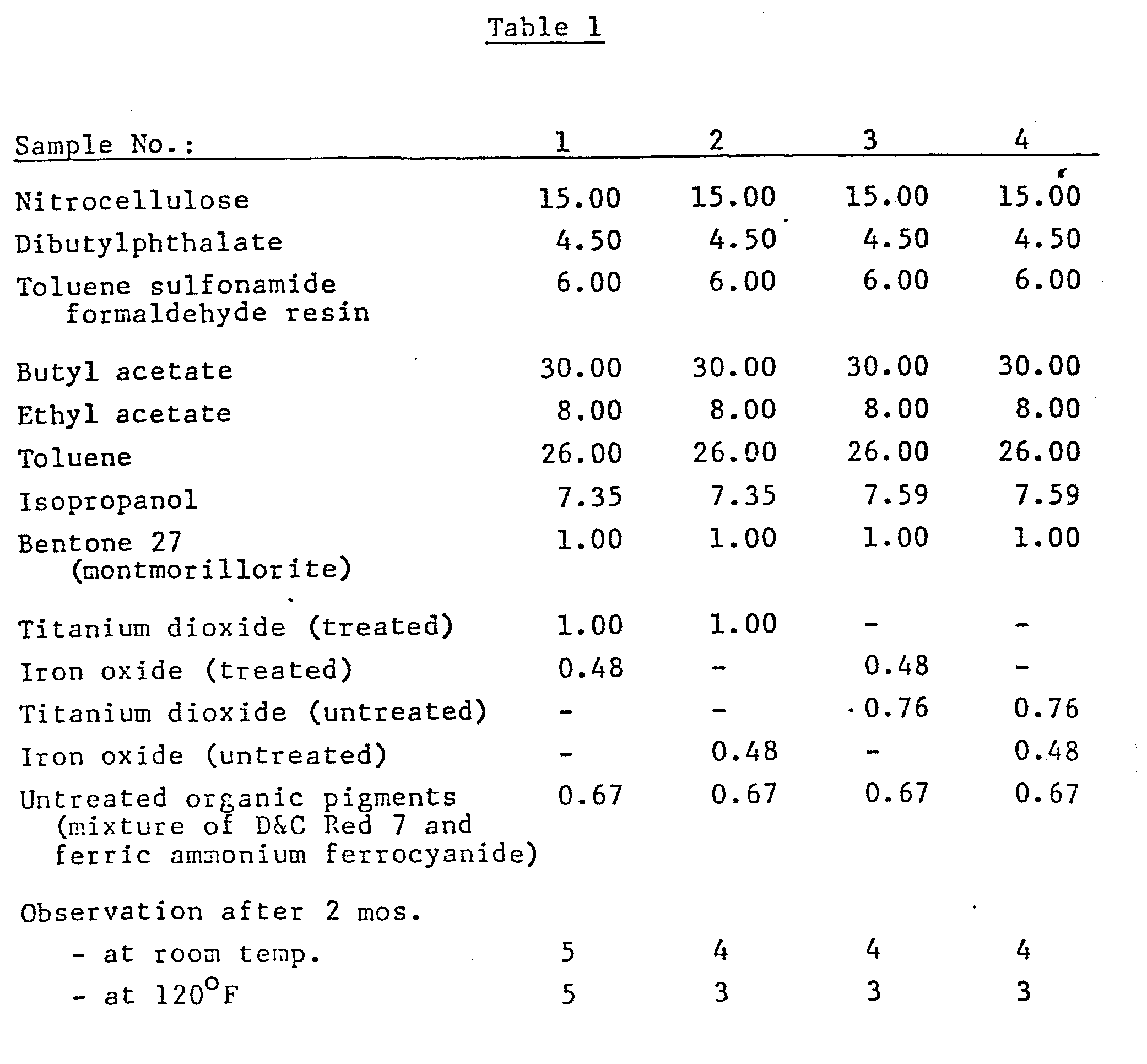
- The superior effect of the present invention is seen in the following comparative examples. These examples are illustrative only and should not be construed as limiting. The numerical evaluation ratings have the following meanings:
- 5. Excellent - no visible signs of pigment migration or settling.
- 4. Good - Very slight settling observed, no signs of pigment migration.
- 3. Average - Some settling and very slight pigment migration.
- 2. Poor - Settling and migration readily apparent (not saleable).
- 1. Unacceptable - Very bad settling and migration (not saleable).
- In the following tables where pigment is indicated as "treated" it had been coated with poly(methyl-hydrogen)siloxane obtained from Clark Colors with the product number 9454 for the coated iron oxide, and product number 9428 for the coated titanium dioxide. The amounts of treated pigment were chosen to provide equal amounts of pigment per se in all four samples.
- All amounts are in percent by weight.
- Four samples of a nail enamel ("Ripe Plum") were prepared by mixing uniformly the ingredients indicated in Table 1. The products were compared for settling and migration after holding for two months without agitation, at room temperature or at 120°F.
- Four samples of a nail enamel ("Carmel") were prepared by mixing uniformly the ingredients indicated in Table 2. The products were compared for settling and migration after holding for two months without agitation, at room temperature or at 120° C.

- The observations in Tables 1 and 2 indicate that nail enamels in which all inorganic pigments were coated with the organopolysiloxane were superior to enamels in which some, or all, inorganic pigments were not so coated.
Claims (5)
Priority Applications (1)
| Application Number | Priority Date | Filing Date | Title |
|---|---|---|---|
| AT84111810T ATE48529T1 (en) | 1983-10-03 | 1984-10-03 | NAIL POLISH THAT CONTAINS PIGMENTS COATED WITH SILICONE. |
Applications Claiming Priority (2)
| Application Number | Priority Date | Filing Date | Title |
|---|---|---|---|
| US53860183A | 1983-10-03 | 1983-10-03 | |
| US538601 | 1983-10-03 |
Publications (3)
| Publication Number | Publication Date |
|---|---|
| EP0136704A2 true EP0136704A2 (en) | 1985-04-10 |
| EP0136704A3 EP0136704A3 (en) | 1986-03-26 |
| EP0136704B1 EP0136704B1 (en) | 1989-12-13 |
Family
ID=24147596
Family Applications (1)
| Application Number | Title | Priority Date | Filing Date |
|---|---|---|---|
| EP84111810A Expired EP0136704B1 (en) | 1983-10-03 | 1984-10-03 | Nail enamel containing silicone-coated pigments |
Country Status (8)
| Country | Link |
|---|---|
| EP (1) | EP0136704B1 (en) |
| JP (1) | JPS6094906A (en) |
| AT (1) | ATE48529T1 (en) |
| AU (1) | AU571582B2 (en) |
| CA (1) | CA1248026A (en) |
| DE (1) | DE3480688D1 (en) |
| ES (1) | ES8506444A1 (en) |
| ZA (1) | ZA847766B (en) |
Cited By (3)
| Publication number | Priority date | Publication date | Assignee | Title |
|---|---|---|---|---|
| EP0507888A4 (en) * | 1989-12-18 | 1993-04-14 | Amalia, Inc. | Quick-drying nail enamel compositions |
| CN107787216A (en) * | 2015-06-29 | 2018-03-09 | Elc 管理有限责任公司 | Particles with cross-linked coatings for cosmetic applications |
| CN107809995A (en) * | 2015-06-29 | 2018-03-16 | Elc 管理有限责任公司 | The method for forming the particle with cross-linked coating for cosmetic applications |
Families Citing this family (1)
| Publication number | Priority date | Publication date | Assignee | Title |
|---|---|---|---|---|
| JPS61189211A (en) * | 1985-02-16 | 1986-08-22 | Shiseido Co Ltd | Make-up cosmetic |
Family Cites Families (2)
| Publication number | Priority date | Publication date | Assignee | Title |
|---|---|---|---|---|
| US3864294A (en) * | 1972-11-02 | 1975-02-04 | Chesebrough Ponds | Gelled coating compositions and method of making same |
| US4578266A (en) * | 1983-07-29 | 1986-03-25 | Revlon, Inc. | Silicone-based cosmetic products containing pigment |
-
1984
- 1984-10-03 AT AT84111810T patent/ATE48529T1/en not_active IP Right Cessation
- 1984-10-03 JP JP59206468A patent/JPS6094906A/en active Granted
- 1984-10-03 ZA ZA847766A patent/ZA847766B/en unknown
- 1984-10-03 DE DE8484111810T patent/DE3480688D1/en not_active Expired - Lifetime
- 1984-10-03 CA CA000464698A patent/CA1248026A/en not_active Expired
- 1984-10-03 AU AU33806/84A patent/AU571582B2/en not_active Expired
- 1984-10-03 ES ES536777A patent/ES8506444A1/en not_active Expired
- 1984-10-03 EP EP84111810A patent/EP0136704B1/en not_active Expired
Cited By (5)
| Publication number | Priority date | Publication date | Assignee | Title |
|---|---|---|---|---|
| EP0507888A4 (en) * | 1989-12-18 | 1993-04-14 | Amalia, Inc. | Quick-drying nail enamel compositions |
| CN107787216A (en) * | 2015-06-29 | 2018-03-09 | Elc 管理有限责任公司 | Particles with cross-linked coatings for cosmetic applications |
| CN107809995A (en) * | 2015-06-29 | 2018-03-16 | Elc 管理有限责任公司 | The method for forming the particle with cross-linked coating for cosmetic applications |
| EP3313354A4 (en) * | 2015-06-29 | 2018-12-05 | ELC Management LLC | Method for forming particles with cross-linked coatings for cosmetic applications |
| EP3313368A4 (en) * | 2015-06-29 | 2018-12-12 | ELC Management LLC | Particles with cross-linked coatings for cosmetic applications |
Also Published As
| Publication number | Publication date |
|---|---|
| ATE48529T1 (en) | 1989-12-15 |
| ZA847766B (en) | 1985-05-29 |
| EP0136704A3 (en) | 1986-03-26 |
| CA1248026A (en) | 1989-01-03 |
| EP0136704B1 (en) | 1989-12-13 |
| AU3380684A (en) | 1985-04-18 |
| ES536777A0 (en) | 1985-08-01 |
| DE3480688D1 (en) | 1990-01-18 |
| JPH0212444B2 (en) | 1990-03-20 |
| ES8506444A1 (en) | 1985-08-01 |
| JPS6094906A (en) | 1985-05-28 |
| AU571582B2 (en) | 1988-04-21 |
Similar Documents
| Publication | Publication Date | Title |
|---|---|---|
| US4832944A (en) | Nail enamel containing silicone-coated pigments | |
| US5319040A (en) | Method for making substantially silanol-free silicone resin powder, product and use | |
| EP0393511B1 (en) | Anti-microbial silicone rubber particles | |
| US5725866A (en) | Translucent composition that can be applied to the nail | |
| US5328683A (en) | Water repellent and method of preparation | |
| CA2364378A1 (en) | Cosmetic compositions containing silicone gel | |
| GB1494670A (en) | Manufacture of curable organopolysiloxane compositions | |
| US5174996A (en) | Nail enamel containing oxidized polyethylene coated inorganic pigments | |
| DE69708005D1 (en) | Thermoplastic resin composition containing titanium dioxide pigment and process for producing the same | |
| JPH06184444A (en) | Compound of low durometer hardness and high tear strength for mold | |
| US20010007676A1 (en) | Transparent clear suspension nail polish enamel | |
| US5258437A (en) | Silicone putty compositions | |
| EP0136704B1 (en) | Nail enamel containing silicone-coated pigments | |
| KR960015890B1 (en) | Emulsion Composition | |
| US5051311A (en) | Silicone corrosion protection coating having extended bath life | |
| EP0479669B1 (en) | Nail enamel containing oxidized polyethylene coated inorganic pigments | |
| JPH1147688A5 (en) | ||
| JPH02292367A (en) | Two-pack organopolysiloxane composition crosslinkable by alkoxy-functional group containing water-retentive group, and manufacture thereof | |
| US5690860A (en) | Particulate inorganic oxide treated with cyclic polysiloxane | |
| JPS60101162A (en) | Surface-protective agent | |
| JP3513867B2 (en) | Nail polish | |
| JP3306075B2 (en) | Surface treatment agent | |
| EP0117621B1 (en) | Cosmetic | |
| JPS62174003A (en) | Nail enamel | |
| JPH01102013A (en) | Pack cosmetic |
Legal Events
| Date | Code | Title | Description |
|---|---|---|---|
| PUAI | Public reference made under article 153(3) epc to a published international application that has entered the european phase |
Free format text: ORIGINAL CODE: 0009012 |
|
| AK | Designated contracting states |
Designated state(s): AT BE CH DE FR GB IT LI LU NL SE |
|
| PUAL | Search report despatched |
Free format text: ORIGINAL CODE: 0009013 |
|
| AK | Designated contracting states |
Kind code of ref document: A3 Designated state(s): AT BE CH DE FR GB IT LI LU NL SE |
|
| 17P | Request for examination filed |
Effective date: 19860716 |
|
| 17Q | First examination report despatched |
Effective date: 19880322 |
|
| GRAA | (expected) grant |
Free format text: ORIGINAL CODE: 0009210 |
|
| AK | Designated contracting states |
Kind code of ref document: B1 Designated state(s): AT BE CH DE FR GB IT LI LU NL SE |
|
| REF | Corresponds to: |
Ref document number: 48529 Country of ref document: AT Date of ref document: 19891215 Kind code of ref document: T |
|
| ET | Fr: translation filed | ||
| REF | Corresponds to: |
Ref document number: 3480688 Country of ref document: DE Date of ref document: 19900118 |
|
| ITF | It: translation for a ep patent filed | ||
| PLBI | Opposition filed |
Free format text: ORIGINAL CODE: 0009260 |
|
| 26 | Opposition filed |
Opponent name: L'OREAL Effective date: 19900912 |
|
| NLR1 | Nl: opposition has been filed with the epo |
Opponent name: L'OREAL |
|
| ITTA | It: last paid annual fee | ||
| ITPR | It: changes in ownership of a european patent |
Owner name: CESSIONE;REVLON CONSUMER PRODUCTS CORPORATION |
|
| REG | Reference to a national code |
Ref country code: CH Ref legal event code: PUE Owner name: REVLON CONSUMER PRODUCTS CORPORATION |
|
| REG | Reference to a national code |
Ref country code: FR Ref legal event code: CL |
|
| NLS | Nl: assignments of ep-patents |
Owner name: REVLON CONSUMER PRODUCTS CORPORATION TE NEW YORK, |
|
| EPTA | Lu: last paid annual fee | ||
| EAL | Se: european patent in force in sweden |
Ref document number: 84111810.2 |
|
| PGFP | Annual fee paid to national office [announced via postgrant information from national office to epo] |
Ref country code: AT Payment date: 19950904 Year of fee payment: 12 |
|
| PGFP | Annual fee paid to national office [announced via postgrant information from national office to epo] |
Ref country code: FR Payment date: 19950913 Year of fee payment: 12 |
|
| PGFP | Annual fee paid to national office [announced via postgrant information from national office to epo] |
Ref country code: DE Payment date: 19950919 Year of fee payment: 12 |
|
| PGFP | Annual fee paid to national office [announced via postgrant information from national office to epo] |
Ref country code: CH Payment date: 19960828 Year of fee payment: 13 |
|
| PGFP | Annual fee paid to national office [announced via postgrant information from national office to epo] |
Ref country code: GB Payment date: 19960905 Year of fee payment: 13 |
|
| PGFP | Annual fee paid to national office [announced via postgrant information from national office to epo] |
Ref country code: NL Payment date: 19960930 Year of fee payment: 13 |
|
| PGFP | Annual fee paid to national office [announced via postgrant information from national office to epo] |
Ref country code: LU Payment date: 19961001 Year of fee payment: 13 |
|
| PGFP | Annual fee paid to national office [announced via postgrant information from national office to epo] |
Ref country code: SE Payment date: 19961003 Year of fee payment: 13 |
|
| APAC | Appeal dossier modified |
Free format text: ORIGINAL CODE: EPIDOS NOAPO |
|
| RDAH | Patent revoked |
Free format text: ORIGINAL CODE: EPIDOS REVO |
|
| RDAG | Patent revoked |
Free format text: ORIGINAL CODE: 0009271 |
|
| STAA | Information on the status of an ep patent application or granted ep patent |
Free format text: STATUS: PATENT REVOKED |
|
| PGFP | Annual fee paid to national office [announced via postgrant information from national office to epo] |
Ref country code: BE Payment date: 19961023 Year of fee payment: 13 |
|
| REG | Reference to a national code |
Ref country code: CH Ref legal event code: PL |
|
| GBPR | Gb: patent revoked under art. 102 of the ep convention designating the uk as contracting state |
Free format text: 960809 |
|
| 27W | Patent revoked |
Effective date: 19960809 |
|
| NLR2 | Nl: decision of opposition | ||
| APAH | Appeal reference modified |
Free format text: ORIGINAL CODE: EPIDOSCREFNO |