EP0137525B1 - Arithmetische Einheit mit Bit-Ausbreitungsschaltung in einem Datenverarbeitungssystem - Google Patents
Arithmetische Einheit mit Bit-Ausbreitungsschaltung in einem Datenverarbeitungssystem Download PDFInfo
- Publication number
- EP0137525B1 EP0137525B1 EP84200987A EP84200987A EP0137525B1 EP 0137525 B1 EP0137525 B1 EP 0137525B1 EP 84200987 A EP84200987 A EP 84200987A EP 84200987 A EP84200987 A EP 84200987A EP 0137525 B1 EP0137525 B1 EP 0137525B1
- Authority
- EP
- European Patent Office
- Prior art keywords
- bit
- cycle
- data processing
- processing system
- divide
- Prior art date
- Legal status (The legal status is an assumption and is not a legal conclusion. Google has not performed a legal analysis and makes no representation as to the accuracy of the status listed.)
- Expired
Links
Images


Classifications
-
- G—PHYSICS
- G06—COMPUTING OR CALCULATING; COUNTING
- G06F—ELECTRIC DIGITAL DATA PROCESSING
- G06F7/00—Methods or arrangements for processing data by operating upon the order or content of the data handled
- G06F7/38—Methods or arrangements for performing computations using exclusively denominational number representation, e.g. using binary, ternary, decimal representation
- G06F7/48—Methods or arrangements for performing computations using exclusively denominational number representation, e.g. using binary, ternary, decimal representation using non-contact-making devices, e.g. tube, solid state device; using unspecified devices
- G06F7/52—Multiplying; Dividing
- G06F7/523—Multiplying only
- G06F7/527—Multiplying only in serial-parallel fashion, i.e. one operand being entered serially and the other in parallel
- G06F7/5272—Multiplying only in serial-parallel fashion, i.e. one operand being entered serially and the other in parallel with row wise addition of partial products
-
- G—PHYSICS
- G06—COMPUTING OR CALCULATING; COUNTING
- G06F—ELECTRIC DIGITAL DATA PROCESSING
- G06F7/00—Methods or arrangements for processing data by operating upon the order or content of the data handled
- G06F7/38—Methods or arrangements for performing computations using exclusively denominational number representation, e.g. using binary, ternary, decimal representation
- G06F7/48—Methods or arrangements for performing computations using exclusively denominational number representation, e.g. using binary, ternary, decimal representation using non-contact-making devices, e.g. tube, solid state device; using unspecified devices
- G06F7/483—Computations with numbers represented by a non-linear combination of denominational numbers, e.g. rational numbers, logarithmic number system or floating-point numbers
-
- G—PHYSICS
- G06—COMPUTING OR CALCULATING; COUNTING
- G06F—ELECTRIC DIGITAL DATA PROCESSING
- G06F7/00—Methods or arrangements for processing data by operating upon the order or content of the data handled
- G06F7/38—Methods or arrangements for performing computations using exclusively denominational number representation, e.g. using binary, ternary, decimal representation
- G06F7/48—Methods or arrangements for performing computations using exclusively denominational number representation, e.g. using binary, ternary, decimal representation using non-contact-making devices, e.g. tube, solid state device; using unspecified devices
- G06F7/52—Multiplying; Dividing
- G06F7/535—Dividing only
-
- G—PHYSICS
- G06—COMPUTING OR CALCULATING; COUNTING
- G06F—ELECTRIC DIGITAL DATA PROCESSING
- G06F2207/00—Indexing scheme relating to methods or arrangements for processing data by operating upon the order or content of the data handled
- G06F2207/38—Indexing scheme relating to groups G06F7/38 - G06F7/575
- G06F2207/3804—Details
- G06F2207/386—Special constructional features
- G06F2207/3896—Bit slicing
-
- G—PHYSICS
- G06—COMPUTING OR CALCULATING; COUNTING
- G06F—ELECTRIC DIGITAL DATA PROCESSING
- G06F2207/00—Indexing scheme relating to methods or arrangements for processing data by operating upon the order or content of the data handled
- G06F2207/535—Indexing scheme relating to groups G06F7/535 - G06F7/5375
- G06F2207/5352—Non-restoring division not covered by G06F7/5375
-
- G—PHYSICS
- G06—COMPUTING OR CALCULATING; COUNTING
- G06F—ELECTRIC DIGITAL DATA PROCESSING
- G06F7/00—Methods or arrangements for processing data by operating upon the order or content of the data handled
- G06F7/38—Methods or arrangements for performing computations using exclusively denominational number representation, e.g. using binary, ternary, decimal representation
- G06F7/48—Methods or arrangements for performing computations using exclusively denominational number representation, e.g. using binary, ternary, decimal representation using non-contact-making devices, e.g. tube, solid state device; using unspecified devices
- G06F7/483—Computations with numbers represented by a non-linear combination of denominational numbers, e.g. rational numbers, logarithmic number system or floating-point numbers
- G06F7/487—Multiplying; Dividing
- G06F7/4873—Dividing
-
- G—PHYSICS
- G06—COMPUTING OR CALCULATING; COUNTING
- G06F—ELECTRIC DIGITAL DATA PROCESSING
- G06F7/00—Methods or arrangements for processing data by operating upon the order or content of the data handled
- G06F7/38—Methods or arrangements for performing computations using exclusively denominational number representation, e.g. using binary, ternary, decimal representation
- G06F7/48—Methods or arrangements for performing computations using exclusively denominational number representation, e.g. using binary, ternary, decimal representation using non-contact-making devices, e.g. tube, solid state device; using unspecified devices
- G06F7/499—Denomination or exception handling, e.g. rounding or overflow
- G06F7/49905—Exception handling
- G06F7/4991—Overflow or underflow
-
- G—PHYSICS
- G06—COMPUTING OR CALCULATING; COUNTING
- G06F—ELECTRIC DIGITAL DATA PROCESSING
- G06F7/00—Methods or arrangements for processing data by operating upon the order or content of the data handled
- G06F7/38—Methods or arrangements for performing computations using exclusively denominational number representation, e.g. using binary, ternary, decimal representation
- G06F7/48—Methods or arrangements for performing computations using exclusively denominational number representation, e.g. using binary, ternary, decimal representation using non-contact-making devices, e.g. tube, solid state device; using unspecified devices
- G06F7/499—Denomination or exception handling, e.g. rounding or overflow
- G06F7/49942—Significance control
- G06F7/49947—Rounding
-
- G—PHYSICS
- G06—COMPUTING OR CALCULATING; COUNTING
- G06F—ELECTRIC DIGITAL DATA PROCESSING
- G06F7/00—Methods or arrangements for processing data by operating upon the order or content of the data handled
- G06F7/38—Methods or arrangements for performing computations using exclusively denominational number representation, e.g. using binary, ternary, decimal representation
- G06F7/48—Methods or arrangements for performing computations using exclusively denominational number representation, e.g. using binary, ternary, decimal representation using non-contact-making devices, e.g. tube, solid state device; using unspecified devices
- G06F7/499—Denomination or exception handling, e.g. rounding or overflow
- G06F7/49994—Sign extension
Definitions
- This invention relates generally to data processing systems which utilize fixed and floating-point arithmetic units and, more particularly, to an improved technique for providing arithmetic words extension logic for use in performing multiplication and division operations.
- data processing systems may employ "fixed point notation" wherein the radix point is placed immediately to the right of the least significant bit or placed immediately to the right of the sign bit before the first information bit.
- Calculations upon the mantissa may be performed by operating on groups of bits (i.e. "bit slices") of the mantissa words involved, the computation for each bit slice producing a "carry” bit to be added to the adjacent bit slice until the calculation is completed for the entire word.
- bit slices groups of bits (i.e. "bit slices") of the mantissa words involved, the computation for each bit slice producing a "carry” bit to be added to the adjacent bit slice until the calculation is completed for the entire word.
- bit slices groups of bits (i.e. "bit slices" of the mantissa words involved, the computation for each bit slice producing a "carry” bit to be added to the adjacent bit slice until the calculation is completed for the entire word.
- overall mantissa words having 32 bits may use eight 4-bit slice logic units in such calculations
- the invention makes use of simplified arithmetic unit extension logic, using less complex programmable array logic and addition stages to provide a simpler technique for operand extensions during multiply and divide operations.
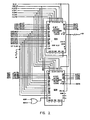
- FIG. 154 A broad block diagram of the arithmetic logic unit (ALU) used therein is shown in Fig. 154 of the application which is reproduced herein in Fig. 1. Specific logic diagrams required to understand the invention described herein are shown here in Figs. 2 and 3.
- ALU arithmetic logic unit
- the computation is made in four-bit slices by eight microprocessor four-bit slice logic units (not shown). Two 4-bit values are operated on, and a 1-bit carry value is added to the result of this operation to produce the 4-bit output (DS-outputs).
- the slice units produce an unrounded floating point result formed as the following 4-bit slices shown below:
- each of the 4-bit slices effectively produces a carry (CRY) bit which is supplied to the next adjacent 4-bit slice, e.g. bit slice 0-3 is effectively supplied with the carry bit CRY4 from the 4-bit slice 4-7, the latter slice is supplied with CRY8 from 4-bit slice 8-11, and so on.
- CRY carry
- the CRY 31 bit is supplied from microcode, while the CRYO bit is the carry bit for the final overall floating point result.
- the carry bits are actually generated in parallel with the 4-bit computations in each of the 4-bit microprocessor slice logic units, the parallel carry bit calculations being performed in look ahead carry generator units.
- the overall computation is performed substantially simultaneously to form the unrounded 32-bit result.
- the exponent calculation is performed in two 4-bit slices as shown in Fig. 2 by 4-bit microprocessor slice logic units 20A and 20B.
- AEXP is addressed from the A register (AREG0A ⁇ 3A) while the externally sourced exponent DEXP is supplied as bits XDO-XD7.
- bits EXPO-7 hold the AEXP value.
- BEXP is then calculated and supplied to the register addressed by the B register (BREGOA-3A).
- FIG. 3 depicts a programmable array logic unit 26 and a simple 4-bit adder unit 27.
- the following analyses assist in explaining the operation of units 26 and 27 for a multiply or division operation.
- the multiply operation provides a result by adding a value A to the product of two values B and C, i.e. the multiply result is A+(BXC).
- a multiply operation may be signed or unsigned.
- a signed multiply operation requires both a first operand (the partial product) and a second operand (either a 0, the mutiplicand, or twice the multiplicand) to be sign extended.
- An unsigned multiply operation requires the first operand to be sign extended (except in the first multiplication cycle) and requires the second operand to be zero extended.
- the chart set forth below depicts the two extended bits for both the first and second operands for the various multiply operations.
- the signal DO contains the value of Do and QBit contains the value of Q B in the above chart.
- the programmable array logic 26 handles the generation of the above values for the first and second operands as shown in Fig. 3.
- IRI ⁇ and IRl1 bits identify the cases set forth below, the IROP4 signifies an "add” or “subtract” operation during the multiply, the UNSIGN bit signifies a signed or an unsigned multiply operation and the MACC CN bit signifies operation either in the first multiply cycle or in a cycle other than the first multiply cycle, as set forth below.
- Bits IRI1, IRIO, IR0P4 are generated in accordance with the particular multiply algorithm which is used, utilizing known logic techniques, and bits MPY, UNSIGN and MACC CN are obtained from microcode control, in accordance with well known techniques.
- input bits to programmable array logic 26 as specified above provide the two operand extension bits at the A-inputs (first operand) and the B-inputs (second operand) of adder unit 27.
- the resulting addition produces the extension bits DSTX and DSTY for the next partial product as shown in Fig. 3.
- the required CRYO bit is also input to adder unit 27 as mentioned above.
- the LDQB, TCRYO and QBIN are used for purposes other than in the multiply or divide operations and need not be discussed further.
- the first operand is the dividend and the second operand is the divisor.
- the first operand is always extended by the most significant bit of the result from the last divide cycle (identified as the LINK bit, as shown in Fig. 3) while the second operand is always zero extended, as follows:
- the CRYY bit signifies whether an "add” or "subtract” is required, as follows:
- the carry bit (CRYY) from adder unit 27 resulting from the above additions of the LINK bit and the ⁇ 0 bit is the quotient bit and such bit is registered for the next divide cycle, the registered value being designed the TCRYY bit.
- the PAL unit 27 and adder 27, thus, determine the carry bit required for the divide operation from the extended bits of the divided (first operand) and the divisor (second operand).
- the signal DIVD is "true" during divide cycles as set by microcode.
- PAL unit 27 and adder unit 27 provides for the extension requirements in both a multiply and a divide operation without requiring the use of an additional 4-bit microprocessor slice logic unit of the type depicted in Fig. 2.
Landscapes
- Engineering & Computer Science (AREA)
- Physics & Mathematics (AREA)
- General Physics & Mathematics (AREA)
- Mathematical Analysis (AREA)
- Mathematical Optimization (AREA)
- Pure & Applied Mathematics (AREA)
- Computational Mathematics (AREA)
- Theoretical Computer Science (AREA)
- Computing Systems (AREA)
- General Engineering & Computer Science (AREA)
- Nonlinear Science (AREA)
- Complex Calculations (AREA)
- Executing Machine-Instructions (AREA)
Claims (10)
Applications Claiming Priority (6)
| Application Number | Priority Date | Filing Date | Title |
|---|---|---|---|
| US06/256,772 US4405992A (en) | 1981-04-23 | 1981-04-23 | Arithmetic unit for use in data processing systems |
| US06/256,726 US4442498A (en) | 1981-04-23 | 1981-04-23 | Arithmetic unit for use in data processing systems |
| US256923 | 1981-04-23 | ||
| US256726 | 1981-04-23 | ||
| US256772 | 1981-04-23 | ||
| US06/256,923 US4429370A (en) | 1981-04-23 | 1981-04-23 | Arithmetic unit for use in a data processing system for computing exponent results and detecting overflow and underflow conditions thereof |
Related Parent Applications (2)
| Application Number | Title | Priority Date | Filing Date |
|---|---|---|---|
| EP19820302080 Division EP0064826B1 (de) | 1981-04-23 | 1982-04-23 | Arithmetische Einheit mit Rundung der Gleitkommaergebnisse in einem Datenverarbeitungssystem |
| EP19820302080 Division-Into EP0064826B1 (de) | 1981-04-23 | 1982-04-23 | Arithmetische Einheit mit Rundung der Gleitkommaergebnisse in einem Datenverarbeitungssystem |
Publications (3)
| Publication Number | Publication Date |
|---|---|
| EP0137525A2 EP0137525A2 (de) | 1985-04-17 |
| EP0137525A3 EP0137525A3 (en) | 1985-07-03 |
| EP0137525B1 true EP0137525B1 (de) | 1987-12-02 |
Family
ID=27400985
Family Applications (3)
| Application Number | Title | Priority Date | Filing Date |
|---|---|---|---|
| EP19840200991 Expired EP0137526B1 (de) | 1981-04-23 | 1982-04-23 | Arithmetische Einheit mit Exponent-Über-/Unterlauf-Detektion in einem Datenverarbeitungssystem |
| EP84200987A Expired EP0137525B1 (de) | 1981-04-23 | 1982-04-23 | Arithmetische Einheit mit Bit-Ausbreitungsschaltung in einem Datenverarbeitungssystem |
| EP19820302080 Expired EP0064826B1 (de) | 1981-04-23 | 1982-04-23 | Arithmetische Einheit mit Rundung der Gleitkommaergebnisse in einem Datenverarbeitungssystem |
Family Applications Before (1)
| Application Number | Title | Priority Date | Filing Date |
|---|---|---|---|
| EP19840200991 Expired EP0137526B1 (de) | 1981-04-23 | 1982-04-23 | Arithmetische Einheit mit Exponent-Über-/Unterlauf-Detektion in einem Datenverarbeitungssystem |
Family Applications After (1)
| Application Number | Title | Priority Date | Filing Date |
|---|---|---|---|
| EP19820302080 Expired EP0064826B1 (de) | 1981-04-23 | 1982-04-23 | Arithmetische Einheit mit Rundung der Gleitkommaergebnisse in einem Datenverarbeitungssystem |
Country Status (3)
| Country | Link |
|---|---|
| EP (3) | EP0137526B1 (de) |
| AU (1) | AU549632B2 (de) |
| CA (1) | CA1175572A (de) |
Families Citing this family (3)
| Publication number | Priority date | Publication date | Assignee | Title |
|---|---|---|---|---|
| US4562553A (en) * | 1984-03-19 | 1985-12-31 | Analogic Corporation | Floating point arithmetic system and method with rounding anticipation |
| US4879676A (en) * | 1988-02-29 | 1989-11-07 | Mips Computer Systems, Inc. | Method and apparatus for precise floating point exceptions |
| JP3076046B2 (ja) * | 1989-01-31 | 2000-08-14 | 日本電気株式会社 | 例外検出回路 |
Family Cites Families (5)
| Publication number | Priority date | Publication date | Assignee | Title |
|---|---|---|---|---|
| US3699326A (en) * | 1971-05-05 | 1972-10-17 | Honeywell Inf Systems | Rounding numbers expressed in 2{40 s complement notation |
| US3842250A (en) * | 1973-08-29 | 1974-10-15 | Sperry Rand Corp | Circuit for implementing rounding in add/subtract logic networks |
| US4282581A (en) * | 1979-10-15 | 1981-08-04 | Sperry Corporation | Automatic overflow/imminent overflow detector |
| US4295203A (en) * | 1979-11-09 | 1981-10-13 | Honeywell Information Systems Inc. | Automatic rounding of floating point operands |
| EP0039227A3 (en) | 1980-04-25 | 1982-09-01 | Data General Corporation | Data processing system |
-
1982
- 1982-04-16 AU AU82695/82A patent/AU549632B2/en not_active Ceased
- 1982-04-22 CA CA000401467A patent/CA1175572A/en not_active Expired
- 1982-04-23 EP EP19840200991 patent/EP0137526B1/de not_active Expired
- 1982-04-23 EP EP84200987A patent/EP0137525B1/de not_active Expired
- 1982-04-23 EP EP19820302080 patent/EP0064826B1/de not_active Expired
Non-Patent Citations (1)
| Title |
|---|
| IBM TECHNICAL DISCLOSURE BULLETIN, Vol.7, No.8, Jan.1965, pages 664-665 * |
Also Published As
| Publication number | Publication date |
|---|---|
| EP0137525A2 (de) | 1985-04-17 |
| EP0137526B1 (de) | 1988-08-10 |
| EP0064826A3 (en) | 1983-01-26 |
| AU8269582A (en) | 1982-10-28 |
| CA1175572A (en) | 1984-10-02 |
| EP0137526A2 (de) | 1985-04-17 |
| EP0064826B1 (de) | 1988-06-22 |
| EP0137525A3 (en) | 1985-07-03 |
| AU549632B2 (en) | 1986-02-06 |
| EP0137526A3 (en) | 1985-05-15 |
| EP0064826A2 (de) | 1982-11-17 |
Similar Documents
| Publication | Publication Date | Title |
|---|---|---|
| US4442498A (en) | Arithmetic unit for use in data processing systems | |
| US6163791A (en) | High accuracy estimates of elementary functions | |
| US6647404B2 (en) | Double precision floating point multiplier having a 32-bit booth-encoded array multiplier | |
| US8046399B1 (en) | Fused multiply-add rounding and unfused multiply-add rounding in a single multiply-add module | |
| JPH02196328A (ja) | 浮動小数点演算装置 | |
| US4429370A (en) | Arithmetic unit for use in a data processing system for computing exponent results and detecting overflow and underflow conditions thereof | |
| US5184318A (en) | Rectangular array signed digit multiplier | |
| US5258944A (en) | High performance mantissa divider | |
| US6549926B1 (en) | SRT divider having several bits of each partial remainder one-hot encoded to minimize the logic levels needed to estimate quotient bits | |
| US5305248A (en) | Fast IEEE double precision reciprocals and square roots | |
| EP0206762A2 (de) | Digitale elektronische Multiplizierschaltungen | |
| US5341319A (en) | Method and apparatus for controlling a rounding operation in a floating point multiplier circuit | |
| EP0416308A2 (de) | Rechteckiger Matrixstrukturierter Vorzeichenziffernmultiplizierer | |
| US4405992A (en) | Arithmetic unit for use in data processing systems | |
| US5195051A (en) | Computation of sign bit and sign extension in the partial products in a floating point multiplier unit | |
| US5036482A (en) | Method and circuitry for digital system multiplication | |
| EP0063361A2 (de) | Korrekturschaltung für annähernden Quotienten | |
| US5734599A (en) | Performing a population count using multiplication | |
| US5721697A (en) | Performing tree additions via multiplication | |
| USH1222H (en) | Apparatus for determining sticky bit value in arithmetic operations | |
| US4996660A (en) | Selection of divisor multipliers in a floating point divide circuit | |
| US4979142A (en) | Two-bit floating point divide circuit with single carry-save adder | |
| EP0137525B1 (de) | Arithmetische Einheit mit Bit-Ausbreitungsschaltung in einem Datenverarbeitungssystem | |
| US4979141A (en) | Technique for providing a sign/magnitude subtraction operation in a floating point computation unit | |
| JPH0687219B2 (ja) | 制御方法 |
Legal Events
| Date | Code | Title | Description |
|---|---|---|---|
| PUAI | Public reference made under article 153(3) epc to a published international application that has entered the european phase |
Free format text: ORIGINAL CODE: 0009012 |
|
| AC | Divisional application: reference to earlier application |
Ref document number: 64826 Country of ref document: EP |
|
| AK | Designated contracting states |
Designated state(s): AT BE CH DE FR GB IT LI LU NL SE |
|
| PUAL | Search report despatched |
Free format text: ORIGINAL CODE: 0009013 |
|
| RTI1 | Title (correction) | ||
| AK | Designated contracting states |
Designated state(s): AT BE CH DE FR GB IT LI LU NL SE |
|
| 17P | Request for examination filed |
Effective date: 19851218 |
|
| 17Q | First examination report despatched |
Effective date: 19870218 |
|
| GRAA | (expected) grant |
Free format text: ORIGINAL CODE: 0009210 |
|
| AC | Divisional application: reference to earlier application |
Ref document number: 64826 Country of ref document: EP |
|
| AK | Designated contracting states |
Kind code of ref document: B1 Designated state(s): AT BE CH DE FR GB IT LI LU NL SE |
|
| PG25 | Lapsed in a contracting state [announced via postgrant information from national office to epo] |
Ref country code: LI Effective date: 19871202 Ref country code: IT Free format text: LAPSE BECAUSE OF FAILURE TO SUBMIT A TRANSLATION OF THE DESCRIPTION OR TO PAY THE FEE WITHIN THE PRESCRIBED TIME-LIMIT;WARNING: LAPSES OF ITALIAN PATENTS WITH EFFECTIVE DATE BEFORE 2007 MAY HAVE OCCURRED AT ANY TIME BEFORE 2007. THE CORRECT EFFECTIVE DATE MAY BE DIFFERENT FROM THE ONE RECORDED. Effective date: 19871202 Ref country code: CH Effective date: 19871202 Ref country code: BE Effective date: 19871202 Ref country code: AT Effective date: 19871202 |
|
| REF | Corresponds to: |
Ref document number: 31225 Country of ref document: AT Date of ref document: 19871215 Kind code of ref document: T |
|
| PG25 | Lapsed in a contracting state [announced via postgrant information from national office to epo] |
Ref country code: SE Effective date: 19871231 |
|
| REF | Corresponds to: |
Ref document number: 3277788 Country of ref document: DE Date of ref document: 19880114 |
|
| ET | Fr: translation filed | ||
| REG | Reference to a national code |
Ref country code: CH Ref legal event code: PL |
|
| PG25 | Lapsed in a contracting state [announced via postgrant information from national office to epo] |
Ref country code: LU Free format text: LAPSE BECAUSE OF NON-PAYMENT OF DUE FEES Effective date: 19880430 |
|
| PLBE | No opposition filed within time limit |
Free format text: ORIGINAL CODE: 0009261 |
|
| STAA | Information on the status of an ep patent application or granted ep patent |
Free format text: STATUS: NO OPPOSITION FILED WITHIN TIME LIMIT |
|
| 26N | No opposition filed | ||
| BERE | Be: lapsed |
Owner name: DATA GENERAL CORP. Effective date: 19890430 |
|
| BERE | Be: lapsed |
Owner name: DATA GENERAL CORP. Effective date: 19910430 |
|
| PGFP | Annual fee paid to national office [announced via postgrant information from national office to epo] |
Ref country code: NL Payment date: 19930430 Year of fee payment: 12 |
|
| PG25 | Lapsed in a contracting state [announced via postgrant information from national office to epo] |
Ref country code: NL Effective date: 19941101 |
|
| NLV4 | Nl: lapsed or anulled due to non-payment of the annual fee | ||
| PGFP | Annual fee paid to national office [announced via postgrant information from national office to epo] |
Ref country code: DE Payment date: 19980323 Year of fee payment: 17 |
|
| PGFP | Annual fee paid to national office [announced via postgrant information from national office to epo] |
Ref country code: FR Payment date: 19990317 Year of fee payment: 18 |
|
| PG25 | Lapsed in a contracting state [announced via postgrant information from national office to epo] |
Ref country code: DE Free format text: LAPSE BECAUSE OF NON-PAYMENT OF DUE FEES Effective date: 20000201 |
|
| PG25 | Lapsed in a contracting state [announced via postgrant information from national office to epo] |
Ref country code: FR Free format text: LAPSE BECAUSE OF NON-PAYMENT OF DUE FEES Effective date: 20001229 |
|
| REG | Reference to a national code |
Ref country code: FR Ref legal event code: ST |
|
| PGFP | Annual fee paid to national office [announced via postgrant information from national office to epo] |
Ref country code: GB Payment date: 20010326 Year of fee payment: 20 |
|
| REG | Reference to a national code |
Ref country code: GB Ref legal event code: IF02 |
|
| PG25 | Lapsed in a contracting state [announced via postgrant information from national office to epo] |
Ref country code: GB Free format text: LAPSE BECAUSE OF EXPIRATION OF PROTECTION Effective date: 20020422 |
|
| REG | Reference to a national code |
Ref country code: GB Ref legal event code: PE20 Effective date: 20020422 |