EP0141646A1 - Reinforced pavement-marking sheet material - Google Patents
Reinforced pavement-marking sheet material Download PDFInfo
- Publication number
- EP0141646A1 EP0141646A1 EP84307502A EP84307502A EP0141646A1 EP 0141646 A1 EP0141646 A1 EP 0141646A1 EP 84307502 A EP84307502 A EP 84307502A EP 84307502 A EP84307502 A EP 84307502A EP 0141646 A1 EP0141646 A1 EP 0141646A1
- Authority
- EP
- European Patent Office
- Prior art keywords
- pavement
- sheet material
- marking composition
- composition
- marking
- Prior art date
- Legal status (The legal status is an assumption and is not a legal conclusion. Google has not performed a legal analysis and makes no representation as to the accuracy of the status listed.)
- Granted
Links
- 239000000463 material Substances 0.000 title abstract description 55
- 239000000945 filler Substances 0.000 claims abstract description 21
- 239000002243 precursor Substances 0.000 claims abstract description 15
- 229920001169 thermoplastic Polymers 0.000 claims abstract description 14
- 238000003490 calendering Methods 0.000 claims abstract description 10
- 239000004698 Polyethylene Substances 0.000 claims abstract description 9
- -1 polyethylene Polymers 0.000 claims abstract description 9
- 229920000573 polyethylene Polymers 0.000 claims abstract description 8
- 239000011256 inorganic filler Substances 0.000 claims abstract description 5
- 229910003475 inorganic filler Inorganic materials 0.000 claims abstract description 5
- HCWCAKKEBCNQJP-UHFFFAOYSA-N magnesium orthosilicate Chemical compound [Mg+2].[Mg+2].[O-][Si]([O-])([O-])[O-] HCWCAKKEBCNQJP-UHFFFAOYSA-N 0.000 claims abstract description 4
- 239000000391 magnesium silicate Substances 0.000 claims abstract description 4
- 229910052919 magnesium silicate Inorganic materials 0.000 claims abstract description 4
- 235000019792 magnesium silicate Nutrition 0.000 claims abstract description 4
- NTXGQCSETZTARF-UHFFFAOYSA-N buta-1,3-diene;prop-2-enenitrile Chemical compound C=CC=C.C=CC#N NTXGQCSETZTARF-UHFFFAOYSA-N 0.000 claims abstract description 3
- 239000010445 mica Substances 0.000 claims abstract description 3
- 229910052618 mica group Inorganic materials 0.000 claims abstract description 3
- 229920002587 poly(1,3-butadiene) polymer Polymers 0.000 claims abstract description 3
- 239000000454 talc Substances 0.000 claims abstract description 3
- 229910052623 talc Inorganic materials 0.000 claims abstract description 3
- 239000000203 mixture Substances 0.000 claims description 30
- 229920000642 polymer Polymers 0.000 claims description 25
- 229920001971 elastomer Polymers 0.000 claims description 17
- 239000000806 elastomer Substances 0.000 claims description 17
- 230000003014 reinforcing effect Effects 0.000 claims description 15
- 239000004416 thermosoftening plastic Substances 0.000 claims description 12
- 239000002245 particle Substances 0.000 claims description 5
- 229920000098 polyolefin Polymers 0.000 claims description 5
- 239000004606 Fillers/Extenders Substances 0.000 claims description 4
- 229920001684 low density polyethylene Polymers 0.000 claims description 4
- 239000011347 resin Substances 0.000 claims description 4
- 229920005989 resin Polymers 0.000 claims description 4
- 239000004702 low-density polyethylene Substances 0.000 claims description 3
- 229920000092 linear low density polyethylene Polymers 0.000 claims description 2
- 239000012188 paraffin wax Substances 0.000 claims description 2
- 239000004700 high-density polyethylene Substances 0.000 claims 1
- 229920004889 linear high-density polyethylene Polymers 0.000 claims 1
- 239000004615 ingredient Substances 0.000 description 11
- 238000005299 abrasion Methods 0.000 description 10
- 230000002787 reinforcement Effects 0.000 description 5
- 239000000835 fiber Substances 0.000 description 4
- 238000000034 method Methods 0.000 description 4
- 239000010425 asbestos Substances 0.000 description 3
- 239000004005 microsphere Substances 0.000 description 3
- 229920001084 poly(chloroprene) Polymers 0.000 description 3
- 238000002310 reflectometry Methods 0.000 description 3
- 229910052895 riebeckite Inorganic materials 0.000 description 3
- 244000043261 Hevea brasiliensis Species 0.000 description 2
- 229920000459 Nitrile rubber Polymers 0.000 description 2
- 239000004793 Polystyrene Substances 0.000 description 2
- 230000005923 long-lasting effect Effects 0.000 description 2
- 229920003052 natural elastomer Polymers 0.000 description 2
- 229920001194 natural rubber Polymers 0.000 description 2
- 229920000058 polyacrylate Polymers 0.000 description 2
- 229920003048 styrene butadiene rubber Polymers 0.000 description 2
- KUBDPQJOLOUJRM-UHFFFAOYSA-N 2-(chloromethyl)oxirane;4-[2-(4-hydroxyphenyl)propan-2-yl]phenol Chemical compound ClCC1CO1.C=1C=C(O)C=CC=1C(C)(C)C1=CC=C(O)C=C1 KUBDPQJOLOUJRM-UHFFFAOYSA-N 0.000 description 1
- ZZSNKZQZMQGXPY-UHFFFAOYSA-N Ethyl cellulose Chemical compound CCOCC1OC(OC)C(OCC)C(OCC)C1OC1C(O)C(O)C(OC)C(CO)O1 ZZSNKZQZMQGXPY-UHFFFAOYSA-N 0.000 description 1
- 229920013646 Hycar Polymers 0.000 description 1
- 239000013032 Hydrocarbon resin Substances 0.000 description 1
- 229920006382 Lustran Polymers 0.000 description 1
- 229920005372 Plexiglas® Polymers 0.000 description 1
- 239000002174 Styrene-butadiene Substances 0.000 description 1
- 238000010521 absorption reaction Methods 0.000 description 1
- 239000000654 additive Substances 0.000 description 1
- 239000010426 asphalt Substances 0.000 description 1
- MTAZNLWOLGHBHU-UHFFFAOYSA-N butadiene-styrene rubber Chemical compound C=CC=C.C=CC1=CC=CC=C1 MTAZNLWOLGHBHU-UHFFFAOYSA-N 0.000 description 1
- 229920002678 cellulose Polymers 0.000 description 1
- 239000001913 cellulose Substances 0.000 description 1
- 230000000052 comparative effect Effects 0.000 description 1
- 230000002950 deficient Effects 0.000 description 1
- 239000011521 glass Substances 0.000 description 1
- 229920001903 high density polyethylene Polymers 0.000 description 1
- 229920006270 hydrocarbon resin Polymers 0.000 description 1
- 238000009434 installation Methods 0.000 description 1
- 239000004707 linear low-density polyethylene Substances 0.000 description 1
- 238000005259 measurement Methods 0.000 description 1
- 239000000049 pigment Substances 0.000 description 1
- 239000004014 plasticizer Substances 0.000 description 1
- 229920002285 poly(styrene-co-acrylonitrile) Polymers 0.000 description 1
- 229920000728 polyester Polymers 0.000 description 1
- 229920000570 polyether Polymers 0.000 description 1
- 229920005644 polyethylene terephthalate glycol copolymer Polymers 0.000 description 1
- 239000004926 polymethyl methacrylate Substances 0.000 description 1
- 229920002223 polystyrene Polymers 0.000 description 1
- 229920002635 polyurethane Polymers 0.000 description 1
- 239000004814 polyurethane Substances 0.000 description 1
- 239000012783 reinforcing fiber Substances 0.000 description 1
- 239000012763 reinforcing filler Substances 0.000 description 1
- 239000011115 styrene butadiene Substances 0.000 description 1
- 230000001988 toxicity Effects 0.000 description 1
- 231100000419 toxicity Toxicity 0.000 description 1
- 229920006163 vinyl copolymer Polymers 0.000 description 1
- XLYOFNOQVPJJNP-UHFFFAOYSA-N water Substances O XLYOFNOQVPJJNP-UHFFFAOYSA-N 0.000 description 1
Classifications
-
- B—PERFORMING OPERATIONS; TRANSPORTING
- B29—WORKING OF PLASTICS; WORKING OF SUBSTANCES IN A PLASTIC STATE IN GENERAL
- B29C—SHAPING OR JOINING OF PLASTICS; SHAPING OF MATERIAL IN A PLASTIC STATE, NOT OTHERWISE PROVIDED FOR; AFTER-TREATMENT OF THE SHAPED PRODUCTS, e.g. REPAIRING
- B29C43/00—Compression moulding, i.e. applying external pressure to flow the moulding material; Apparatus therefor
- B29C43/003—Compression moulding, i.e. applying external pressure to flow the moulding material; Apparatus therefor characterised by the choice of material
-
- E—FIXED CONSTRUCTIONS
- E01—CONSTRUCTION OF ROADS, RAILWAYS, OR BRIDGES
- E01F—ADDITIONAL WORK, SUCH AS EQUIPPING ROADS OR THE CONSTRUCTION OF PLATFORMS, HELICOPTER LANDING STAGES, SIGNS, SNOW FENCES, OR THE LIKE
- E01F9/00—Arrangement of road signs or traffic signals; Arrangements for enforcing caution
- E01F9/50—Road surface markings; Kerbs or road edgings, specially adapted for alerting road users
- E01F9/506—Road surface markings; Kerbs or road edgings, specially adapted for alerting road users characterised by the road surface marking material, e.g. comprising additives for improving friction or reflectivity; Methods of forming, installing or applying markings in, on or to road surfaces
- E01F9/512—Preformed road surface markings, e.g. of sheet material; Methods of applying preformed markings
-
- B—PERFORMING OPERATIONS; TRANSPORTING
- B29—WORKING OF PLASTICS; WORKING OF SUBSTANCES IN A PLASTIC STATE IN GENERAL
- B29C—SHAPING OR JOINING OF PLASTICS; SHAPING OF MATERIAL IN A PLASTIC STATE, NOT OTHERWISE PROVIDED FOR; AFTER-TREATMENT OF THE SHAPED PRODUCTS, e.g. REPAIRING
- B29C43/00—Compression moulding, i.e. applying external pressure to flow the moulding material; Apparatus therefor
- B29C43/22—Compression moulding, i.e. applying external pressure to flow the moulding material; Apparatus therefor of articles of indefinite length
- B29C43/24—Calendering
-
- B—PERFORMING OPERATIONS; TRANSPORTING
- B29—WORKING OF PLASTICS; WORKING OF SUBSTANCES IN A PLASTIC STATE IN GENERAL
- B29K—INDEXING SCHEME ASSOCIATED WITH SUBCLASSES B29B, B29C OR B29D, RELATING TO MOULDING MATERIALS OR TO MATERIALS FOR MOULDS, REINFORCEMENTS, FILLERS OR PREFORMED PARTS, e.g. INSERTS
- B29K2021/00—Use of unspecified rubbers as moulding material
-
- B—PERFORMING OPERATIONS; TRANSPORTING
- B29—WORKING OF PLASTICS; WORKING OF SUBSTANCES IN A PLASTIC STATE IN GENERAL
- B29K—INDEXING SCHEME ASSOCIATED WITH SUBCLASSES B29B, B29C OR B29D, RELATING TO MOULDING MATERIALS OR TO MATERIALS FOR MOULDS, REINFORCEMENTS, FILLERS OR PREFORMED PARTS, e.g. INSERTS
- B29K2105/00—Condition, form or state of moulded material or of the material to be shaped
- B29K2105/06—Condition, form or state of moulded material or of the material to be shaped containing reinforcements, fillers or inserts
- B29K2105/16—Fillers
-
- B—PERFORMING OPERATIONS; TRANSPORTING
- B29—WORKING OF PLASTICS; WORKING OF SUBSTANCES IN A PLASTIC STATE IN GENERAL
- B29K—INDEXING SCHEME ASSOCIATED WITH SUBCLASSES B29B, B29C OR B29D, RELATING TO MOULDING MATERIALS OR TO MATERIALS FOR MOULDS, REINFORCEMENTS, FILLERS OR PREFORMED PARTS, e.g. INSERTS
- B29K2223/00—Use of polyalkenes or derivatives thereof as reinforcement
-
- B—PERFORMING OPERATIONS; TRANSPORTING
- B29—WORKING OF PLASTICS; WORKING OF SUBSTANCES IN A PLASTIC STATE IN GENERAL
- B29L—INDEXING SCHEME ASSOCIATED WITH SUBCLASS B29C, RELATING TO PARTICULAR ARTICLES
- B29L2007/00—Flat articles, e.g. films or sheets
- B29L2007/008—Wide strips, e.g. films, webs
-
- Y—GENERAL TAGGING OF NEW TECHNOLOGICAL DEVELOPMENTS; GENERAL TAGGING OF CROSS-SECTIONAL TECHNOLOGIES SPANNING OVER SEVERAL SECTIONS OF THE IPC; TECHNICAL SUBJECTS COVERED BY FORMER USPC CROSS-REFERENCE ART COLLECTIONS [XRACs] AND DIGESTS
- Y10—TECHNICAL SUBJECTS COVERED BY FORMER USPC
- Y10T—TECHNICAL SUBJECTS COVERED BY FORMER US CLASSIFICATION
- Y10T428/00—Stock material or miscellaneous articles
- Y10T428/25—Web or sheet containing structurally defined element or component and including a second component containing structurally defined particles
-
- Y—GENERAL TAGGING OF NEW TECHNOLOGICAL DEVELOPMENTS; GENERAL TAGGING OF CROSS-SECTIONAL TECHNOLOGIES SPANNING OVER SEVERAL SECTIONS OF THE IPC; TECHNICAL SUBJECTS COVERED BY FORMER USPC CROSS-REFERENCE ART COLLECTIONS [XRACs] AND DIGESTS
- Y10—TECHNICAL SUBJECTS COVERED BY FORMER USPC
- Y10T—TECHNICAL SUBJECTS COVERED BY FORMER US CLASSIFICATION
- Y10T428/00—Stock material or miscellaneous articles
- Y10T428/25—Web or sheet containing structurally defined element or component and including a second component containing structurally defined particles
- Y10T428/251—Mica
-
- Y—GENERAL TAGGING OF NEW TECHNOLOGICAL DEVELOPMENTS; GENERAL TAGGING OF CROSS-SECTIONAL TECHNOLOGIES SPANNING OVER SEVERAL SECTIONS OF THE IPC; TECHNICAL SUBJECTS COVERED BY FORMER USPC CROSS-REFERENCE ART COLLECTIONS [XRACs] AND DIGESTS
- Y10—TECHNICAL SUBJECTS COVERED BY FORMER USPC
- Y10T—TECHNICAL SUBJECTS COVERED BY FORMER US CLASSIFICATION
- Y10T428/00—Stock material or miscellaneous articles
- Y10T428/25—Web or sheet containing structurally defined element or component and including a second component containing structurally defined particles
- Y10T428/259—Silicic material
Definitions
- the present invention provides a new reinforced form of pavement-marking sheet material of the general type described in U.S. Pat. 4,117,192. Such sheet material exhibits viscoelastic properties, which lead to long-lasting pavement markings.
- Sheet material as taught in U.S. Pat. 4,117,192 comprises a polymeric material that could be crosslinked to form an elastomer, but which is not crosslinked in the sheet material and thereby provides desired viscoelastic properties.
- a blend of this polymeric material with other polymeric materials and inorganic fillers has been found to provide properties that give long-lasting pavement markings -- good conformability to a roadway surface, abrasion resistance, tensile and tear strength, etc.
- sheet material of the invention eliminates asbestos fibers, and does it without sacrificing desired properties of the sheet material.
- sheet material of the invention offers superior properties -- superior abrasion resistance, higher tensile strength and modulus, and improved whiteness; and also the composition may be processed into sheet form more readily.
- compositions that comprises 100 parts of non-crosslinked elastomer precursorl (notes are at the end of the specification): at least 5 parts of a thermoplastic reinforcing polymer which is dispersed in the elastomer as a separate phase (i.e., because of insolubility or immiscibility with the other polymeric ingredients) and softens at a temperature between about 75°C and 200°C: and a particulate inorganic filler dispersed in the composition.
- This composition is processable on calendering rolls into a thin sheet material, generally between about 1/4 and 3 millimeters in thickness.
- the separate-phase nature of the reinforcing polymer is considered desirable, in that it is believed that the polymer becomes oriented during the calendering operation and reinforces the sheet material. Such a reinforcement is indicated by the fact that the tensile strength of the sheet material is significantly stronger in the downweb direction (i.e., in the direction of calendering) than in the crossweb, or transverse, direction.
- the reinforcing polymer comprises polyolefin, especially polyethylene.
- An extender resin such as halogenated paraffin, which is soluble in the non-crosslinked elastomer precursor, is also preferably included in the composition.
- platelet fillers such as magnesium silicate, are preferred.
- the prior art composition is low in tensile and tear strength, especially at elevated temperatures such as may be experienced in summer-time application of pavement markings; and it is difficult to process the composition in an internal mixer and calender it.
- the sheet material is quite soft, making it more susceptible to dirt pick up; and glass microspheres tend to be pushed into the sheet material by road traffic, whereupon the microspheres are embedded and reflection is reduced.
- Non-crosslinked elastomer precursor is used in pavement-marking sheet material of the invention to provide a viscoelastic character, which permits absorption of the forces and pressures of wheeled road traffic without creating internal forces that tend to remove the marking from the roadway.
- Acrylonitrile-butadiene polymers are especially desirable elastomer precursors because they offer a high degree of oil resistance.
- Other useful non-crosslinked elastomer precursors which offer good oil resistance include neoprene and polyacrylates. Natural rubber and styrene-butadiene polymers may also be used.
- Extender resins preferably halogenated polymers such as chlorinated paraffins, but also hydrocarbon resins or polystyrenes, are preferably included with the non-crosslinked elastomer precursor ingredients, and are miscible with, or form a single phase with, the elastomer precursor ingredients.
- the latter preferably account for at least 50 weight-percent of the polymeric ingredients in a composition of the invention.
- the reinforcing polymer should soften at a temperature between about 75°C and 200°C.
- Useful thermoplastic reinforcing polymers include polyolefins, vinyl copolymers, polyethers, polyacrylates, styrene-acrylonitrile copolymers, polyesters, polyurethanes and cellulose derivatives. Polyolefins act as a plasticizer during the mixing operation, and lower the energy required to complete the mixing, which is one reason they are preferred.
- the polymer should generally be extrudable as a self-supporting stretchable continuous film.
- Such a polymer is typified by low-density polyethylenes having molecular weights of 75,000-100,000 or more, and linear low-density polyethylene (i.e., low density polyethylene that has short-chain polymer branching but reduced long-chain polymer branching) and high-density polyethylenes having molecular weights of 20,000 or more.
- linear low-density polyethylene i.e., low density polyethylene that has short-chain polymer branching but reduced long-chain polymer branching
- high-density polyethylenes having molecular weights of 20,000 or more.
- polyolefins especially polyethylene
- they do not absorb or otherwise pick up dirt as fast as many other polymers, with the result that a pavement-marking composition of the invention can remain whiter and cleaner longer than prior-art pavement-marking materials.
- thermoplastic reinforcing polymer At least 5 parts of thermoplastic reinforcing polymer, but no more than 100 parts, are generally included for each 100 parts of non-crosslinked elastomer precursor in a sheet material of the invention, and preferably between about 10 and 50 parts are included.
- the proportions can be varied within the stated ranges depending upon the amount of other ingredients included in the composition, especially the amount and kind of fillers included.
- Fillers are generally included in the composition at least to color it but preferably also to add other properties such as reinforcement, extending, surface hardness, and abrasion resistance.
- Platelet fillers i.e., fillers having a plate-like shape, such as magnesium silicate, talc, or mica, are preferred, because they have been found to give the best abrasion resistance and downweb strength properties.
- the platelets become oriented during the calendering procedure, which contributes especially to the abrasion resistance and downweb properties of the sheet product. Also the platelet fillers make the sheet material harder, which contributes to maintaining a white appearance on the roadway.
- the platelet fillers have a high ratio of surface area to volume, which enhances their reinforcing ability.
- fillers such as needle-type or bead-type fillers, may be included instead of or in addition to the platelet fillers, but they are less desired because of their lower surface area per unit volume.
- the amount of filler included in sheet material of the invention varies with the kind of filler used. Preferably at least 10 parts of platelet fillers are used per 100 parts of non-crosslinked elastomer-precursor. With lower amounts of thermoplastic reinforcing filler, higher amounts of filler are desired, though platelet fillers in an amount more than 150 parts per 100 parts of elastomer-precursor tend to stiffen the product excessively. Best results have been achieved with amounts of platelet fillers between about 50 and 100 parts.
- Transparent microspheres and skid-resisting particles are also generally included in a sheet material of the invention to provide reflectivity at night and to give the sheet material skid-resisting qualities.
- An exterior layer of such particles may be provided on the top of the sheet material, partially embedded in the sheet material and partially protruding from the sheet material, to provide immediate reflectivity and skid-resistance; and other particles may be embedded in the sheet material to become exposed as the sheet material is worn away.
- the particles may be held in the partially protruding position by use of a support film adhered to sheet material of the invention, for example, as taught in U.S. Pat. 4,117,192.
- the ingredients are processed on calendering rolls where they form a smooth band and are processed into thin sheets of the desired thickness.
- sheets are formed having a thickness of at least about 1/4 millimeter, and preferably at least about 1 millimeter, but generally the sheets are less than about 5 millimeters thick, and preferrably less than 3 millimeters thick.
- the calendered sheet material is found to have a significantly greater tensile strength downweb than it does crossweb, i.e., its downweb tensile strength is at least about 20-25 percent higher than its crossweb tensile strength, apparently due to orientation of the reinforcing polymer.
- a high downweb tensile strength is desirable for ease of processing and for ease of application, but a lower crossweb tensile strength may allow the sheet material to have better conformability to a roadway surface.
- Sheet material of the invention generally has a downweb tensile stength of at least 10 kilograms per square centimeter at 25°C, and preferably at least 25 kilograms per square centimeter downweb.
- the sheet material also has good abrasion resistance as may be indicated by a modified Taber abrasion test.
- the test uses an H-22 Taber abrader wheel, with a one kilogram weight on the wheel. The test specimen is held under water, and the abrader wheel passed over the specimen for 500 cycles. Sheet material of the invention generally exhibits a loss of no more than about 5 grams in this test.
- sheet material of the invention may also be included in sheet material of the invention, such as reinforcing fibers, pigments, and various additives.
- Pavement-marking compositions of the invention are especially useful in sheets or tapes having an embossed top surface to improve reflectivity and other properties.
- embossed sheeting is described in U.S. Pat. 4,388,359 and other embossed forms of pavement marking sheet material are also taught in the art.
- the resulting sheet material was tested for tensile strength, abrasion resistance in the test described above, and Shore A hardness. Similar measurements were made on two comparative sheet materials.
- the first labeled "First Prior Art Sheet Material” in the table below was as described in the Example in column 4 of U.S. Pat. 4,069,281, using Hycar 1022 for the "regenerated nitrile rubber” and low-density polyethylene having a molecular weight of about 5000 as the "low-molecular weight” polyethylene.
- the second had a composition as described in U.S. Pat. 4,117,192, table bridging columns 4 and 5 ("Second Prior Art Sheet Material”). Results are presented in Table II.
- Sheet material of this example has been experimentally tested in actual road applications. For example, triangular sections of sheet material of the example having an embossed top surface were applied to a public roadway and observed periodically. After one-and-one-half years, the installations were well intact with regard to abrasions down to the underlying asphalt. Only two small pieces of two triangles from among 34 triangles applied in three different locations had shifted slightly.
- Example 2 Following the procedures of Example 1, a wide variety of pavement-marking compositions were prepared in which different classes of polymeric materials were chosen as the thermoplastic reinforcing polymer. Table III summarizes processing conditions and test properties for these pavement-marking compositions of the invention. The column headed Tmax gives the maximum temperature that the ingredients reached during mixing.
- the non-crosslinked elastomer precursor comprises a mixture of a styrene-butadiene copolymer and natural rubber.
- the sheet material was tested for tensile strength, abrasion resistance as decribed above, and Shore A hardness. Test results are found in Table V.
Landscapes
- Engineering & Computer Science (AREA)
- Mechanical Engineering (AREA)
- Architecture (AREA)
- Civil Engineering (AREA)
- Structural Engineering (AREA)
- Road Signs Or Road Markings (AREA)
- Compositions Of Macromolecular Compounds (AREA)
- Road Repair (AREA)
- Manufacture Of Macromolecular Shaped Articles (AREA)
- Synthetic Leather, Interior Materials Or Flexible Sheet Materials (AREA)
Abstract
Description
- The present invention provides a new reinforced form of pavement-marking sheet material of the general type described in U.S. Pat. 4,117,192. Such sheet material exhibits viscoelastic properties, which lead to long-lasting pavement markings.
- Sheet material as taught in U.S. Pat. 4,117,192 comprises a polymeric material that could be crosslinked to form an elastomer, but which is not crosslinked in the sheet material and thereby provides desired viscoelastic properties. A blend of this polymeric material with other polymeric materials and inorganic fillers has been found to provide properties that give long-lasting pavement markings -- good conformability to a roadway surface, abrasion resistance, tensile and tear strength, etc.
- Despite its well established utility, the described sheet material is deficient for some uses because asbestos fibers constitute a large proportion of the inorganic fillers in the sheet material. Asbestos fibers contribute importantly to the desired properties of the sheet material, but for toxicity reasons, use of such fibers has been foreclosed under many circumstances.
- The new sheet material eliminates asbestos fibers, and does it without sacrificing desired properties of the sheet material. To the contrary, sheet material of the invention offers superior properties -- superior abrasion resistance, higher tensile strength and modulus, and improved whiteness; and also the composition may be processed into sheet form more readily.
- Briefly, the listed advantages are obtained with a composition that comprises 100 parts of non-crosslinked elastomer precursorl (notes are at the end of the specification): at least 5 parts of a thermoplastic reinforcing polymer which is dispersed in the elastomer as a separate phase (i.e., because of insolubility or immiscibility with the other polymeric ingredients) and softens at a temperature between about 75°C and 200°C: and a particulate inorganic filler dispersed in the composition. This composition is processable on calendering rolls into a thin sheet material, generally between about 1/4 and 3 millimeters in thickness.
- The separate-phase nature of the reinforcing polymer is considered desirable, in that it is believed that the polymer becomes oriented during the calendering operation and reinforces the sheet material. Such a reinforcement is indicated by the fact that the tensile strength of the sheet material is significantly stronger in the downweb direction (i.e., in the direction of calendering) than in the crossweb, or transverse, direction.
- Preferably the reinforcing polymer comprises polyolefin, especially polyethylene. An extender resin such as halogenated paraffin, which is soluble in the non-crosslinked elastomer precursor, is also preferably included in the composition. Also, platelet fillers, such as magnesium silicate, are preferred.
- An earlier patent, U.S. Pat. 4,069,281, teaches a pavement-marking sheet material which includes low-molecular-weight polyethylene together with regenerated nitrile rubber and chlorobutadiene rubber (neoprene). However, when sheet material as described in this patent is made and calendered, no orientation or downweb reinforcement is detected. The sheet material is as strong in the crossweb direction as it is in the downweb direction. Apparently the low-molecular-weight polyethylene does not form an oriented reinforcement in the manner of the reinforcing polymer in sheet material of the invention. The prior art composition is low in tensile and tear strength, especially at elevated temperatures such as may be experienced in summer-time application of pavement markings; and it is difficult to process the composition in an internal mixer and calender it. Also, the sheet material is quite soft, making it more susceptible to dirt pick up; and glass microspheres tend to be pushed into the sheet material by road traffic, whereupon the microspheres are embedded and reflection is reduced.
- Non-crosslinked elastomer precursor is used in pavement-marking sheet material of the invention to provide a viscoelastic character, which permits absorption of the forces and pressures of wheeled road traffic without creating internal forces that tend to remove the marking from the roadway. Acrylonitrile-butadiene polymers are especially desirable elastomer precursors because they offer a high degree of oil resistance. Other useful non-crosslinked elastomer precursors which offer good oil resistance include neoprene and polyacrylates. Natural rubber and styrene-butadiene polymers may also be used. Extender resins, preferably halogenated polymers such as chlorinated paraffins, but also hydrocarbon resins or polystyrenes, are preferably included with the non-crosslinked elastomer precursor ingredients, and are miscible with, or form a single phase with, the elastomer precursor ingredients. The latter preferably account for at least 50 weight-percent of the polymeric ingredients in a composition of the invention.
- To achieve desired mixing of the thermoplastic reinforcing polymer and the other ingredients, the reinforcing polymer should soften at a temperature between about 75°C and 200°C. Useful thermoplastic reinforcing polymers include polyolefins, vinyl copolymers, polyethers, polyacrylates, styrene-acrylonitrile copolymers, polyesters, polyurethanes and cellulose derivatives. Polyolefins act as a plasticizer during the mixing operation, and lower the energy required to complete the mixing, which is one reason they are preferred. To achieve desired reinforcement, the polymer should generally be extrudable as a self-supporting stretchable continuous film. Such a polymer is typified by low-density polyethylenes having molecular weights of 75,000-100,000 or more, and linear low-density polyethylene (i.e., low density polyethylene that has short-chain polymer branching but reduced long-chain polymer branching) and high-density polyethylenes having molecular weights of 20,000 or more.
- Another advantage of polyolefins, especially polyethylene, is that they do not absorb or otherwise pick up dirt as fast as many other polymers, with the result that a pavement-marking composition of the invention can remain whiter and cleaner longer than prior-art pavement-marking materials.
- At least 5 parts of thermoplastic reinforcing polymer, but no more than 100 parts, are generally included for each 100 parts of non-crosslinked elastomer precursor in a sheet material of the invention, and preferably between about 10 and 50 parts are included. The proportions can be varied within the stated ranges depending upon the amount of other ingredients included in the composition, especially the amount and kind of fillers included.
- Fillers are generally included in the composition at least to color it but preferably also to add other properties such as reinforcement, extending, surface hardness, and abrasion resistance. Platelet fillers, i.e., fillers having a plate-like shape, such as magnesium silicate, talc, or mica, are preferred, because they have been found to give the best abrasion resistance and downweb strength properties. The platelets become oriented during the calendering procedure, which contributes especially to the abrasion resistance and downweb properties of the sheet product. Also the platelet fillers make the sheet material harder, which contributes to maintaining a white appearance on the roadway. In addition, the platelet fillers have a high ratio of surface area to volume, which enhances their reinforcing ability.
- Other fillers, such as needle-type or bead-type fillers, may be included instead of or in addition to the platelet fillers, but they are less desired because of their lower surface area per unit volume.
- The amount of filler included in sheet material of the invention varies with the kind of filler used. Preferably at least 10 parts of platelet fillers are used per 100 parts of non-crosslinked elastomer-precursor. With lower amounts of thermoplastic reinforcing filler, higher amounts of filler are desired, though platelet fillers in an amount more than 150 parts per 100 parts of elastomer-precursor tend to stiffen the product excessively. Best results have been achieved with amounts of platelet fillers between about 50 and 100 parts.
- Transparent microspheres and skid-resisting particles are also generally included in a sheet material of the invention to provide reflectivity at night and to give the sheet material skid-resisting qualities. An exterior layer of such particles may be provided on the top of the sheet material, partially embedded in the sheet material and partially protruding from the sheet material, to provide immediate reflectivity and skid-resistance; and other particles may be embedded in the sheet material to become exposed as the sheet material is worn away. The particles may be held in the partially protruding position by use of a support film adhered to sheet material of the invention, for example, as taught in U.S. Pat. 4,117,192.
- After mixing, the ingredients are processed on calendering rolls where they form a smooth band and are processed into thin sheets of the desired thickness. Generally sheets are formed having a thickness of at least about 1/4 millimeter, and preferably at least about 1 millimeter, but generally the sheets are less than about 5 millimeters thick, and preferrably less than 3 millimeters thick.
- As previously indicated, the calendered sheet material is found to have a significantly greater tensile strength downweb than it does crossweb, i.e., its downweb tensile strength is at least about 20-25 percent higher than its crossweb tensile strength, apparently due to orientation of the reinforcing polymer. A high downweb tensile strength is desirable for ease of processing and for ease of application, but a lower crossweb tensile strength may allow the sheet material to have better conformability to a roadway surface. Sheet material of the invention generally has a downweb tensile stength of at least 10 kilograms per square centimeter at 25°C, and preferably at least 25 kilograms per square centimeter downweb.
- The sheet material also has good abrasion resistance as may be indicated by a modified Taber abrasion test. The test uses an H-22 Taber abrader wheel, with a one kilogram weight on the wheel. The test specimen is held under water, and the abrader wheel passed over the specimen for 500 cycles. Sheet material of the invention generally exhibits a loss of no more than about 5 grams in this test.
- Other ingredients may also be included in sheet material of the invention, such as reinforcing fibers, pigments, and various additives.
- Pavement-marking compositions of the invention are especially useful in sheets or tapes having an embossed top surface to improve reflectivity and other properties. Such an embossed sheeting is described in U.S. Pat. 4,388,359 and other embossed forms of pavement marking sheet material are also taught in the art.
- The invention will be further illustrated by the following examples
- The ingredients shown in Table I were mixed in an internal mixer, such as a Banbury mixer, where they reached a temperature of approximately 150°C. The material as then cooled and calendered into a sheet about one millimeter thick.

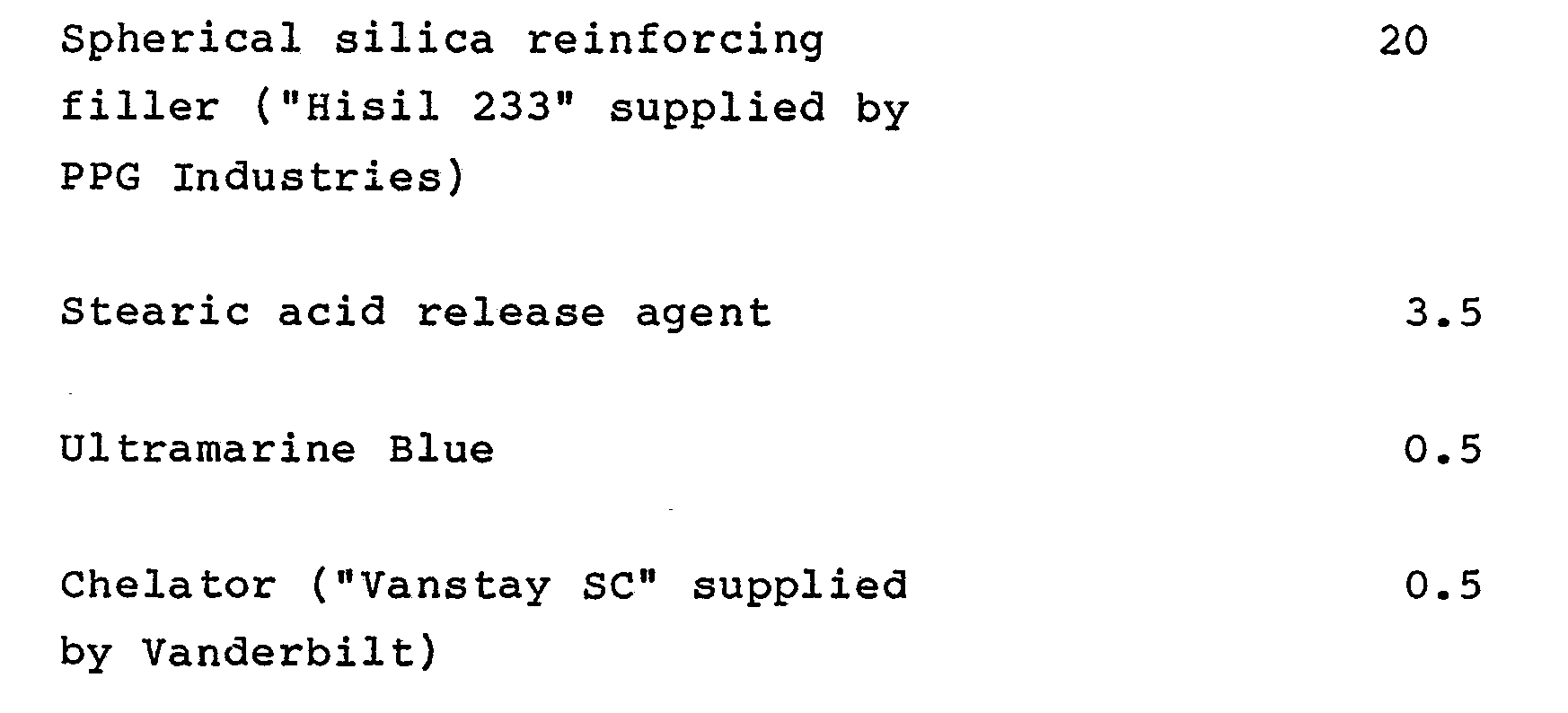
- The resulting sheet material was tested for tensile strength, abrasion resistance in the test described above, and Shore A hardness. Similar measurements were made on two comparative sheet materials. The first labeled "First Prior Art Sheet Material" in the table below was as described in the Example in column 4 of U.S. Pat. 4,069,281, using Hycar 1022 for the "regenerated nitrile rubber" and low-density polyethylene having a molecular weight of about 5000 as the "low-molecular weight" polyethylene. The second had a composition as described in U.S. Pat. 4,117,192, table bridging columns 4 and 5 ("Second Prior Art Sheet Material"). Results are presented in Table II.

- Sheet material of this example has been experimentally tested in actual road applications. For example, triangular sections of sheet material of the example having an embossed top surface were applied to a public roadway and observed periodically. After one-and-one-half years, the installations were well intact with regard to abrasions down to the underlying asphalt. Only two small pieces of two triangles from among 34 triangles applied in three different locations had shifted slightly.
- Following the procedures of Example 1, a wide variety of pavement-marking compositions were prepared in which different classes of polymeric materials were chosen as the thermoplastic reinforcing polymer. Table III summarizes processing conditions and test properties for these pavement-marking compositions of the invention. The column headed Tmax gives the maximum temperature that the ingredients reached during mixing.


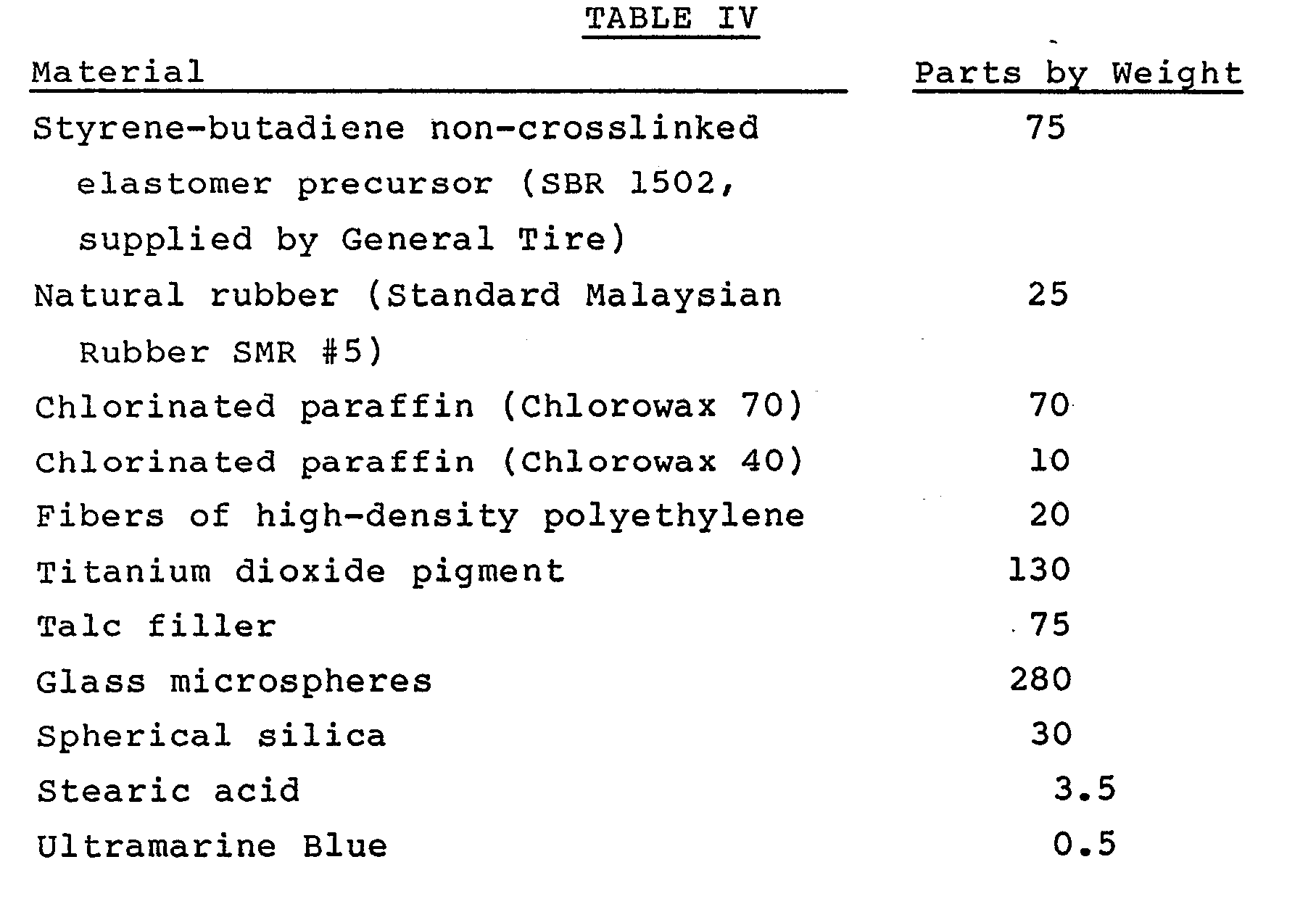
- Following the procedures of Example 1, the ingredients shown in Table IV were processed to form a pavement-marking composition of the invention. In this example, the non-crosslinked elastomer precursor comprises a mixture of a styrene-butadiene copolymer and natural rubber. The sheet material was tested for tensile strength, abrasion resistance as decribed above, and Shore A hardness. Test results are found in Table V.

- 1 "Elastomer-precursor" is used herein to describe a polymer which can be crosslinked, vulcanized, or cured to form an elastomer. "Elastomer" is used to mean a material that can be stretched, to at least about twice its original dimensions without rupture and upon release of the stretching force rapidly returns to substantially its original dimensions.
- 2 The commercial designations and suppliers for polymers used as the thermoplastic reinforcing polymer in the examples are:
- 2 LD600, Exxon
- 3 GRSN 7047, Union Carbide
- 4 VYHH, Union Carbide
- 5 VAGH, Union Carbide
- 6 VMCH, Union Carbide
- 7 Phenoxy PKHH, Union Carbide
- 8 Lustran 31-7042, Monsanto
- 9 Plexiglas V, Rohm & Haas
- 10 Vitel VPE-307, Goodyear
- 11 Kodar PETG 6763, Eastman
- 12 Q-thane PS 629, K.J.Quinn
- 13 Q-thane PE 192, K.J.Quinn
- 14 Ethocel MS Natural, American Polymers
Claims (10)
Priority Applications (1)
| Application Number | Priority Date | Filing Date | Title |
|---|---|---|---|
| AT84307502T ATE39716T1 (en) | 1983-11-01 | 1984-10-31 | REINFORCED ROAD MARKING STRIPS. |
Applications Claiming Priority (2)
| Application Number | Priority Date | Filing Date | Title |
|---|---|---|---|
| US06/547,663 US4490432A (en) | 1982-04-23 | 1983-11-01 | Reinforced pavement-marking sheet material |
| US547663 | 1983-11-01 |
Publications (2)
| Publication Number | Publication Date |
|---|---|
| EP0141646A1 true EP0141646A1 (en) | 1985-05-15 |
| EP0141646B1 EP0141646B1 (en) | 1989-01-04 |
Family
ID=24185607
Family Applications (1)
| Application Number | Title | Priority Date | Filing Date |
|---|---|---|---|
| EP84307502A Expired EP0141646B1 (en) | 1983-11-01 | 1984-10-31 | Reinforced pavement-marking sheet material |
Country Status (8)
| Country | Link |
|---|---|
| US (1) | US4490432A (en) |
| EP (1) | EP0141646B1 (en) |
| JP (1) | JPH06869B2 (en) |
| AT (1) | ATE39716T1 (en) |
| AU (1) | AU569114B2 (en) |
| CA (1) | CA1225217A (en) |
| DE (1) | DE3475925D1 (en) |
| ZA (1) | ZA848514B (en) |
Cited By (2)
| Publication number | Priority date | Publication date | Assignee | Title |
|---|---|---|---|---|
| EP0420655A3 (en) * | 1989-09-29 | 1991-12-27 | Sumitomo Chemical Company, Limited | Colored prepreg and colored fiber-reinforced resin molded article |
| EP1967554A1 (en) | 2007-02-23 | 2008-09-10 | Triflex Beschichtungssysteme GmbH & Co. Kommanditgesellschaft | Undercoat and marking compounds |
Families Citing this family (78)
| Publication number | Priority date | Publication date | Assignee | Title |
|---|---|---|---|---|
| US4648689A (en) * | 1983-04-11 | 1987-03-10 | Minnesota Mining And Manufacturing Company | Pavement marking tape |
| JPH0745723B2 (en) * | 1984-10-22 | 1995-05-17 | アトム化学塗料株式会社 | High-brightness road marking sheet material |
| CA1311160C (en) * | 1985-06-13 | 1992-12-08 | Asok Sengupta | Intersection markings |
| AU586300B2 (en) * | 1986-01-13 | 1989-07-06 | Minnesota Mining And Manufacturing Company | Pavement markings containing transparent non-vitreous ceramic microspheres |
| JPS6345812U (en) * | 1986-09-06 | 1988-03-28 | ||
| US4837069A (en) * | 1987-01-07 | 1989-06-06 | Minnesota Mining And Manufacturing Company | Transparent alumina microspheres |
| JPS6421106A (en) * | 1987-07-17 | 1989-01-24 | Seibulite Int Inc | Sheet material for displaying two layer structure road surface |
| US5227221A (en) * | 1988-06-09 | 1993-07-13 | Minnesota Mining And Manufacturing Company | Patterned skid preventative sheet |
| US5053253A (en) * | 1988-09-07 | 1991-10-01 | Minnesota Mining And Manufacturing Company | Skid-resistant pavement markings |
| US4937127A (en) * | 1988-09-07 | 1990-06-26 | Minnesota Mining And Manufacturing Company | Skid-resistant pavement markings |
| US5094902A (en) * | 1988-09-07 | 1992-03-10 | Minnesota Mining And Manufacturing Company | Skid-resistant surface marking material |
| US5124178A (en) * | 1988-09-07 | 1992-06-23 | Minnesota Mining And Manufacturing Company | Skid-resistant surface marking material |
| US4969713A (en) * | 1988-12-12 | 1990-11-13 | Brite Line Corporation | Marker strip surface for roadways and the like |
| US5316406A (en) * | 1989-02-10 | 1994-05-31 | Briteline Industries, Inc. | Surface marker strip and methods for providing improved integrity and adhesion to roadway and the like |
| US5087148A (en) * | 1989-02-10 | 1992-02-11 | Brite Line Corporation | Surface marker strip and methods for providing improved integrity and adhesion to roadways and the like |
| DE68911288T2 (en) * | 1989-02-10 | 1994-06-30 | Briteline Corp | Surface marking strips. |
| US5139590A (en) * | 1989-02-10 | 1992-08-18 | Brite-Line Industries, Inc. | Surface marker strip and methods for providing improved integrity and adhesion to roadways and the like |
| US5082715A (en) * | 1989-08-28 | 1992-01-21 | Minnesota Mining And Manufacturing Company | Conformable polymeric marking sheet |
| US5120154A (en) * | 1989-08-28 | 1992-06-09 | Minnesota Mining And Manufacturing Company | Trafficway conformable polymeric marking sheet |
| US6464713B2 (en) * | 1990-06-28 | 2002-10-15 | Peter M. Bonutti | Body tissue fastening |
| US5108218A (en) * | 1990-09-25 | 1992-04-28 | Brite-Line Industries | Roadway and similar marker strip and method of forming same |
| US5194113A (en) * | 1990-12-24 | 1993-03-16 | Minnesota Mining And Manufacturing Company | Process for making conformable thermoplastic marking sheet |
| ZA919417B (en) * | 1990-12-24 | 1992-12-30 | Minnesota Mining & Mfg | Thermoplastic marking sheet |
| JP3031710B2 (en) * | 1991-02-28 | 2000-04-10 | ミネソタ・マイニング・アンド・マニュファクチュアリング・カンパニー | Pavement marker using silicone adhesive |
| IT1255125B (en) * | 1992-05-04 | 1995-10-20 | Minnesota Mining & Mfg | HIGHLY CONFORMABLE PREFORMED ROAD SIGNAL TAPE |
| US5374465A (en) * | 1993-09-02 | 1994-12-20 | Plymouth Rubber Company | Economical roadway marking sheeting matrix |
| CA2147711C (en) * | 1994-05-20 | 2005-08-16 | James H. C. Harper | Retroreflective article with non-continuous top coat |
| CA2147821C (en) | 1994-05-20 | 2006-04-11 | Thomas P. Hedblom | Patterned pavement markings with upright retroreflectors |
| US5593246A (en) * | 1994-08-26 | 1997-01-14 | Minnesota Mining And Manufacturing Company | Patterned chalk-resistant pavement marking and method of making |
| US6468678B1 (en) | 1994-11-17 | 2002-10-22 | 3M Innovative Properties Company | Conformable magnetic articles for use with traffic bearing surfaces methods of making same systems including same and methods of use |
| US6063838A (en) * | 1995-02-16 | 2000-05-16 | 3M Innovative Properties Company | Blended pressure-sensitive adhesives |
| US5676488A (en) * | 1995-06-29 | 1997-10-14 | Minnesota Mining And Manufacturing Company | Pavement marking with multiple topcoats |
| EP0856088B1 (en) * | 1995-10-18 | 2000-12-13 | Minnesota Mining And Manufacturing Company | Conformable magnetic articles underlaid beneath traffic-bearing surfaces |
| US5744239A (en) * | 1996-09-27 | 1998-04-28 | Minnesota Mining And Manufacturing Company | Addition of antimicrobial agents to pavement marking materials |
| US6846893B1 (en) | 1996-10-23 | 2005-01-25 | Minnesota Mining And Manufacturing Company | Polymer mixtures containing polydiorganosiloxane urea-containing components |
| US5777791A (en) * | 1996-11-26 | 1998-07-07 | Minnesota Mining And Manufacturing Company | Wet retroreflective pavement marking articles |
| US6861141B2 (en) * | 1996-12-04 | 2005-03-01 | Gina M. Buccellato | Pavement marking article and raised pavement marker that uses pressure sensitive adhesive |
| EP0850755A1 (en) | 1996-12-23 | 1998-07-01 | Minnesota Mining And Manufacturing Company | Conformable marker sheet |
| AU4422997A (en) * | 1997-05-08 | 1998-11-27 | Minnesota Mining And Manufacturing Company | Inconspicuous pavement markings and method for making |
| US5941655A (en) * | 1997-07-16 | 1999-08-24 | 3M Innovative Properties Company | Direction-indicating pavement marking having raised protuberances and method of making |
| AU8257398A (en) | 1997-07-16 | 1999-02-10 | Minnesota Mining And Manufacturing Company | Pavement marking having raised protuberances and method of making |
| US6431788B1 (en) | 1997-11-19 | 2002-08-13 | 3M Innovative Properties Company | Wear resistant pavement marking |
| SE513295C2 (en) * | 1998-03-09 | 2000-08-21 | Trelleborg Ind Ab | Road marking tape for temporary traffic markings and procedure for carrying them out |
| US6217252B1 (en) | 1998-08-11 | 2001-04-17 | 3M Innovative Properties Company | Wear-resistant transportation surface marking method and materials |
| US6247818B1 (en) | 1998-10-20 | 2001-06-19 | 3M Innovative Properties Company | Method for making retroreflective elements having enhanced retroreflectivity under dry and/or wet conditions |
| US6365262B1 (en) | 1998-10-20 | 2002-04-02 | 3M Innovative Properties Company | Pavement marking articles having enhanced retroreflectivity under dry or wet conditions and method for making same |
| US6966660B1 (en) | 1999-10-15 | 2005-11-22 | 3M Innovative Properties Company | Article exhibiting dry and wet retroreflectivity |
| US6475316B1 (en) | 2000-07-07 | 2002-11-05 | 3M Innovative Properties Company | Methods of enhancing adhesion |
| US6841223B2 (en) | 2001-08-14 | 2005-01-11 | 3M Innovative Properties Company | Composite pavement markings |
| US7169831B2 (en) * | 2001-09-27 | 2007-01-30 | 3M Innovative Properties Company | Pavement marking composition comprising ceramic fibers |
| US20030123930A1 (en) | 2001-12-31 | 2003-07-03 | Jacobs Gregory F. | Matrix element magnetic pavement marker and method of making same |
| US20050064778A1 (en) * | 2003-09-19 | 2005-03-24 | Lam Robert C. | High coefficient friction material with symmetrical friction modifying particles |
| US8021744B2 (en) | 2004-06-18 | 2011-09-20 | Borgwarner Inc. | Fully fibrous structure friction material |
| US7429418B2 (en) | 2004-07-26 | 2008-09-30 | Borgwarner, Inc. | Porous friction material comprising nanoparticles of friction modifying material |
| US8603614B2 (en) | 2004-07-26 | 2013-12-10 | Borgwarner Inc. | Porous friction material with nanoparticles of friction modifying material |
| US7879599B2 (en) * | 2005-04-22 | 2011-02-01 | Hyclone Laboratories, Inc. | Tube ports and related container systems |
| US7806975B2 (en) | 2005-04-26 | 2010-10-05 | Borgwarner Inc. | Friction material |
| WO2007055951A1 (en) | 2005-11-02 | 2007-05-18 | Borgwarner Inc. | Carbon friction materials |
| US8701441B2 (en) | 2006-08-21 | 2014-04-22 | 3M Innovative Properties Company | Method of making inorganic, metal oxide spheres using microstructured molds |
| US7744306B2 (en) * | 2007-04-02 | 2010-06-29 | Greer Robert F | Preformed thermoplastic indicia for airport runways and taxiways |
| DE102008013907B4 (en) | 2008-03-12 | 2016-03-10 | Borgwarner Inc. | Frictionally-locking device with at least one friction plate |
| US20090298617A1 (en) * | 2008-05-28 | 2009-12-03 | Bridgestone Sports Co., Ltd. | Golf ball material and golf ball |
| DE102009030506A1 (en) | 2008-06-30 | 2009-12-31 | Borgwarner Inc., Auburn Hills | friction materials |
| BR112013012974A2 (en) | 2010-11-30 | 2016-09-13 | 3M Innovative Properties Co | pavement demarcation composition |
| CN103842591B (en) | 2011-09-01 | 2016-03-16 | 3M创新有限公司 | pavement marking material and method |
| KR102126363B1 (en) | 2012-10-29 | 2020-06-24 | 쓰리엠 이노베이티브 프로퍼티즈 캄파니 | Pavement marking compositions |
| MX2016002830A (en) * | 2013-09-06 | 2016-06-17 | 3M Innovative Properties Co | Pavement marking tape with a modified polyurethane topcoat. |
| CN106459710B (en) | 2014-04-04 | 2019-09-03 | 3M创新有限公司 | Wet and Dry Surface Adhesives |
| US10259947B2 (en) | 2014-04-04 | 2019-04-16 | 3M Innovative Properties Company | Wet or damp surface preparation compositions |
| EP3149070A1 (en) | 2014-04-29 | 2017-04-05 | 3M Innovative Properties Company | Copolymers of poly(ethylene-co-acrylic acid) and polydiorganosiloxanes |
| US9892296B2 (en) | 2014-11-12 | 2018-02-13 | Joseph E. Kovarik | Method and system for autonomous vehicles |
| WO2016205443A1 (en) | 2015-06-18 | 2016-12-22 | 3M Innovative Properties Company | Thermoplastic pavement marking tapes |
| US10606018B2 (en) | 2016-07-18 | 2020-03-31 | Corning Research & Development Corporation | Distribution cabling tape and system |
| WO2018172887A1 (en) | 2017-03-20 | 2018-09-27 | 3M Innovative Properties Company | White pavement marking |
| US11011082B2 (en) | 2017-05-16 | 2021-05-18 | Promedica Health System, Inc. | Stairway safety device |
| WO2019070811A1 (en) | 2017-10-03 | 2019-04-11 | Corning Research & Development Corporation | Distribution cabling tape, system and tape application device |
| WO2020112444A1 (en) | 2018-11-30 | 2020-06-04 | Corning Research & Development Corporation | Distribution cabling tape application device with endoscope camera for registration of cable and cabling tape |
| US20250257248A1 (en) | 2022-06-29 | 2025-08-14 | 3M Innovative Properties Company | Curable adhesive and articles for bonding pavement and concrete |
Citations (4)
| Publication number | Priority date | Publication date | Assignee | Title |
|---|---|---|---|---|
| FR1287739A (en) * | 1961-04-12 | 1962-03-16 | Sheet material for road signage | |
| GB1383475A (en) * | 1973-02-07 | 1974-02-12 | Pneumatiques Caoutchouc Mfg | Rubbery materials |
| US4117192A (en) * | 1976-02-17 | 1978-09-26 | Minnesota Mining And Manufacturing Company | Deformable retroreflective pavement-marking sheet material |
| DE3041100A1 (en) * | 1979-11-02 | 1981-05-14 | Minnesota Mining and Manufacturing Co., 55101 Saint Paul, Minn. | DURABLE AND HIGHLY RESISTANT ROAD MARKING |
Family Cites Families (2)
| Publication number | Priority date | Publication date | Assignee | Title |
|---|---|---|---|---|
| JPS49112943A (en) * | 1973-02-10 | 1974-10-28 | ||
| IT1022451B (en) * | 1974-09-30 | 1978-03-20 | Eigenmann Ludwig | PREFABRICATED STRIP FOR HORIZONTAL ROAD SIGNAL AND METHOD FOR ITS PREFABRICATION |
-
1983
- 1983-11-01 US US06/547,663 patent/US4490432A/en not_active Expired - Lifetime
-
1984
- 1984-09-19 CA CA000463577A patent/CA1225217A/en not_active Expired
- 1984-09-26 AU AU33539/84A patent/AU569114B2/en not_active Ceased
- 1984-10-31 EP EP84307502A patent/EP0141646B1/en not_active Expired
- 1984-10-31 DE DE8484307502T patent/DE3475925D1/en not_active Expired
- 1984-10-31 AT AT84307502T patent/ATE39716T1/en not_active IP Right Cessation
- 1984-10-31 ZA ZA848514A patent/ZA848514B/en unknown
- 1984-10-31 JP JP59230061A patent/JPH06869B2/en not_active Expired - Lifetime
Patent Citations (4)
| Publication number | Priority date | Publication date | Assignee | Title |
|---|---|---|---|---|
| FR1287739A (en) * | 1961-04-12 | 1962-03-16 | Sheet material for road signage | |
| GB1383475A (en) * | 1973-02-07 | 1974-02-12 | Pneumatiques Caoutchouc Mfg | Rubbery materials |
| US4117192A (en) * | 1976-02-17 | 1978-09-26 | Minnesota Mining And Manufacturing Company | Deformable retroreflective pavement-marking sheet material |
| DE3041100A1 (en) * | 1979-11-02 | 1981-05-14 | Minnesota Mining and Manufacturing Co., 55101 Saint Paul, Minn. | DURABLE AND HIGHLY RESISTANT ROAD MARKING |
Cited By (2)
| Publication number | Priority date | Publication date | Assignee | Title |
|---|---|---|---|---|
| EP0420655A3 (en) * | 1989-09-29 | 1991-12-27 | Sumitomo Chemical Company, Limited | Colored prepreg and colored fiber-reinforced resin molded article |
| EP1967554A1 (en) | 2007-02-23 | 2008-09-10 | Triflex Beschichtungssysteme GmbH & Co. Kommanditgesellschaft | Undercoat and marking compounds |
Also Published As
| Publication number | Publication date |
|---|---|
| ZA848514B (en) | 1986-06-25 |
| CA1225217A (en) | 1987-08-11 |
| EP0141646B1 (en) | 1989-01-04 |
| DE3475925D1 (en) | 1989-02-09 |
| JPH06869B2 (en) | 1994-01-05 |
| AU3353984A (en) | 1985-05-09 |
| AU569114B2 (en) | 1988-01-21 |
| ATE39716T1 (en) | 1989-01-15 |
| US4490432A (en) | 1984-12-25 |
| JPS60123542A (en) | 1985-07-02 |
Similar Documents
| Publication | Publication Date | Title |
|---|---|---|
| US4490432A (en) | Reinforced pavement-marking sheet material | |
| US4701369A (en) | Opaque polymer film laminate having an absorbent surface | |
| KR940005964B1 (en) | Retroreflective seating | |
| US5276082A (en) | Halogen-free floor covering | |
| US4994312A (en) | Shaped articles from orientable polymers and polymer microbeads | |
| US5223383A (en) | Photographic elements containing reflective or diffusely transmissive supports | |
| Siegmann et al. | Impact modification of poly (vinyl chloride) with chlorinated polyethylene I. Blend morphology | |
| Kambour | Mechanism of fracture in glassy polymers. II. Survey of crazing response during crack propagation in several polymers | |
| DE3041100A1 (en) | DURABLE AND HIGHLY RESISTANT ROAD MARKING | |
| EP0539604A4 (en) | Biodegradable resin composition and laminated structure made therefrom | |
| BR0109653B1 (en) | adhesive composition comprising a particulate thermoplastic component. | |
| ES2398204T3 (en) | Waterproofing membranes based on polymer modified bitumen containing hollow glass microspheres | |
| JPS594447B2 (en) | synthetic paper | |
| Wrotecki et al. | Rubber toughening of poly (methyl methacrylate). Part I: effect of the size and hard layer composition of the rubber particles | |
| JP4485791B2 (en) | Pavement marking sheet containing ceramic fiber | |
| US20030191212A1 (en) | Asphalt improving material which comprising specific composition, improved asphalt mixture and its pavement method, and composition | |
| Ghosh et al. | Thermoplastic elastomers from blends of polyethylene and ethylene-propylene-diene rubber: influence of vulcanization technique on phase morphology and vulcanizate properties | |
| EP0130014B1 (en) | Bitumenous compositions | |
| KR20130129393A (en) | Pavement marking composition | |
| PL81823B1 (en) | ||
| US5374465A (en) | Economical roadway marking sheeting matrix | |
| EP0158258A3 (en) | Impact-resistant resinous compositions and method of making | |
| US4826920A (en) | Films of linear ethylene polymer, polystyrene, and high impact polystyrene | |
| US2708177A (en) | Laminated paper product | |
| AU602346B2 (en) | Blends of polyethylene and high impact polymers of styrenes and films thereof |
Legal Events
| Date | Code | Title | Description |
|---|---|---|---|
| PUAI | Public reference made under article 153(3) epc to a published international application that has entered the european phase |
Free format text: ORIGINAL CODE: 0009012 |
|
| AK | Designated contracting states |
Designated state(s): AT DE FR GB IT NL SE |
|
| 17P | Request for examination filed |
Effective date: 19851108 |
|
| 17Q | First examination report despatched |
Effective date: 19861002 |
|
| D17Q | First examination report despatched (deleted) | ||
| ITF | It: translation for a ep patent filed | ||
| GRAA | (expected) grant |
Free format text: ORIGINAL CODE: 0009210 |
|
| AK | Designated contracting states |
Kind code of ref document: B1 Designated state(s): AT DE FR GB IT NL SE |
|
| REF | Corresponds to: |
Ref document number: 39716 Country of ref document: AT Date of ref document: 19890115 Kind code of ref document: T |
|
| REF | Corresponds to: |
Ref document number: 3475925 Country of ref document: DE Date of ref document: 19890209 |
|
| ET | Fr: translation filed | ||
| PLBE | No opposition filed within time limit |
Free format text: ORIGINAL CODE: 0009261 |
|
| STAA | Information on the status of an ep patent application or granted ep patent |
Free format text: STATUS: NO OPPOSITION FILED WITHIN TIME LIMIT |
|
| 26N | No opposition filed | ||
| ITTA | It: last paid annual fee | ||
| EAL | Se: european patent in force in sweden |
Ref document number: 84307502.9 |
|
| PGFP | Annual fee paid to national office [announced via postgrant information from national office to epo] |
Ref country code: GB Payment date: 20001004 Year of fee payment: 17 Ref country code: AT Payment date: 20001004 Year of fee payment: 17 |
|
| PGFP | Annual fee paid to national office [announced via postgrant information from national office to epo] |
Ref country code: NL Payment date: 20001006 Year of fee payment: 17 |
|
| PG25 | Lapsed in a contracting state [announced via postgrant information from national office to epo] |
Ref country code: GB Free format text: LAPSE BECAUSE OF NON-PAYMENT OF DUE FEES Effective date: 20011031 Ref country code: AT Free format text: LAPSE BECAUSE OF NON-PAYMENT OF DUE FEES Effective date: 20011031 |
|
| REG | Reference to a national code |
Ref country code: GB Ref legal event code: IF02 |
|
| PG25 | Lapsed in a contracting state [announced via postgrant information from national office to epo] |
Ref country code: NL Free format text: LAPSE BECAUSE OF NON-PAYMENT OF DUE FEES Effective date: 20020501 |
|
| GBPC | Gb: european patent ceased through non-payment of renewal fee |
Effective date: 20011031 |
|
| NLV4 | Nl: lapsed or anulled due to non-payment of the annual fee |
Effective date: 20020501 |
|
| PGFP | Annual fee paid to national office [announced via postgrant information from national office to epo] |
Ref country code: FR Payment date: 20021002 Year of fee payment: 19 |
|
| PGFP | Annual fee paid to national office [announced via postgrant information from national office to epo] |
Ref country code: SE Payment date: 20021003 Year of fee payment: 19 |
|
| PGFP | Annual fee paid to national office [announced via postgrant information from national office to epo] |
Ref country code: DE Payment date: 20021031 Year of fee payment: 19 |
|
| PG25 | Lapsed in a contracting state [announced via postgrant information from national office to epo] |
Ref country code: SE Free format text: LAPSE BECAUSE OF NON-PAYMENT OF DUE FEES Effective date: 20031101 |
|
| PG25 | Lapsed in a contracting state [announced via postgrant information from national office to epo] |
Ref country code: DE Free format text: LAPSE BECAUSE OF NON-PAYMENT OF DUE FEES Effective date: 20040501 |
|
| EUG | Se: european patent has lapsed | ||
| PG25 | Lapsed in a contracting state [announced via postgrant information from national office to epo] |
Ref country code: FR Free format text: LAPSE BECAUSE OF NON-PAYMENT OF DUE FEES Effective date: 20040630 |
|
| REG | Reference to a national code |
Ref country code: FR Ref legal event code: ST |