EP0143195A1 - Recombinant DNA having a phosphoenol pyruvate carboxylase gene inserted therein, bacteria carrying said recombinant DNA and a process for producing amino acids using said bacteria - Google Patents
Recombinant DNA having a phosphoenol pyruvate carboxylase gene inserted therein, bacteria carrying said recombinant DNA and a process for producing amino acids using said bacteria Download PDFInfo
- Publication number
- EP0143195A1 EP0143195A1 EP84110141A EP84110141A EP0143195A1 EP 0143195 A1 EP0143195 A1 EP 0143195A1 EP 84110141 A EP84110141 A EP 84110141A EP 84110141 A EP84110141 A EP 84110141A EP 0143195 A1 EP0143195 A1 EP 0143195A1
- Authority
- EP
- European Patent Office
- Prior art keywords
- recombinant dna
- bacteria
- plasmid
- paj
- dna
- Prior art date
- Legal status (The legal status is an assumption and is not a legal conclusion. Google has not performed a legal analysis and makes no representation as to the accuracy of the status listed.)
- Granted
Links
- 238000000034 method Methods 0.000 title claims abstract description 37
- 241000894006 Bacteria Species 0.000 title claims abstract description 26
- 108020004511 Recombinant DNA Proteins 0.000 title claims abstract description 25
- 108091000041 Phosphoenolpyruvate Carboxylase Proteins 0.000 title claims abstract description 23
- 150000001413 amino acids Chemical class 0.000 title claims abstract description 22
- 230000008569 process Effects 0.000 title claims description 9
- 108090000623 proteins and genes Proteins 0.000 claims abstract description 24
- 239000013600 plasmid vector Substances 0.000 claims abstract description 13
- 102000053602 DNA Human genes 0.000 claims abstract description 7
- WHUUTDBJXJRKMK-VKHMYHEASA-N L-glutamic acid Chemical compound OC(=O)[C@@H](N)CCC(O)=O WHUUTDBJXJRKMK-VKHMYHEASA-N 0.000 claims description 22
- 229940024606 amino acid Drugs 0.000 claims description 20
- 235000001014 amino acid Nutrition 0.000 claims description 20
- WHUUTDBJXJRKMK-UHFFFAOYSA-N Glutamic acid Natural products OC(=O)C(N)CCC(O)=O WHUUTDBJXJRKMK-UHFFFAOYSA-N 0.000 claims description 18
- 235000013922 glutamic acid Nutrition 0.000 claims description 15
- 239000004220 glutamic acid Substances 0.000 claims description 15
- 241000186146 Brevibacterium Species 0.000 claims description 14
- 241000186216 Corynebacterium Species 0.000 claims description 10
- 230000002759 chromosomal effect Effects 0.000 claims description 10
- KDXKERNSBIXSRK-UHFFFAOYSA-N Lysine Natural products NCCCCC(N)C(O)=O KDXKERNSBIXSRK-UHFFFAOYSA-N 0.000 claims description 8
- 239000004472 Lysine Substances 0.000 claims description 8
- ONIBWKKTOPOVIA-BYPYZUCNSA-N L-Proline Chemical compound OC(=O)[C@@H]1CCCN1 ONIBWKKTOPOVIA-BYPYZUCNSA-N 0.000 claims description 7
- ONIBWKKTOPOVIA-UHFFFAOYSA-N Proline Natural products OC(=O)C1CCCN1 ONIBWKKTOPOVIA-UHFFFAOYSA-N 0.000 claims description 7
- AYFVYJQAPQTCCC-UHFFFAOYSA-N Threonine Natural products CC(O)C(N)C(O)=O AYFVYJQAPQTCCC-UHFFFAOYSA-N 0.000 claims description 7
- 239000004473 Threonine Substances 0.000 claims description 7
- AGPKZVBTJJNPAG-WHFBIAKZSA-N L-isoleucine Chemical compound CC[C@H](C)[C@H](N)C(O)=O AGPKZVBTJJNPAG-WHFBIAKZSA-N 0.000 claims description 6
- 239000001963 growth medium Substances 0.000 claims description 6
- 229960000310 isoleucine Drugs 0.000 claims description 6
- 239000004475 Arginine Substances 0.000 claims description 5
- CKLJMWTZIZZHCS-REOHCLBHSA-N L-aspartic acid Chemical compound OC(=O)[C@@H](N)CC(O)=O CKLJMWTZIZZHCS-REOHCLBHSA-N 0.000 claims description 5
- ODKSFYDXXFIFQN-UHFFFAOYSA-N arginine Natural products OC(=O)C(N)CCCNC(N)=N ODKSFYDXXFIFQN-UHFFFAOYSA-N 0.000 claims description 5
- 235000003704 aspartic acid Nutrition 0.000 claims description 5
- OQFSQFPPLPISGP-UHFFFAOYSA-N beta-carboxyaspartic acid Natural products OC(=O)C(N)C(C(O)=O)C(O)=O OQFSQFPPLPISGP-UHFFFAOYSA-N 0.000 claims description 5
- AGPKZVBTJJNPAG-UHFFFAOYSA-N isoleucine Natural products CCC(C)C(N)C(O)=O AGPKZVBTJJNPAG-UHFFFAOYSA-N 0.000 claims description 5
- 230000001902 propagating effect Effects 0.000 claims description 4
- AHLPHDHHMVZTML-BYPYZUCNSA-N L-Ornithine Chemical compound NCCC[C@H](N)C(O)=O AHLPHDHHMVZTML-BYPYZUCNSA-N 0.000 claims description 3
- ODKSFYDXXFIFQN-BYPYZUCNSA-P L-argininium(2+) Chemical compound NC(=[NH2+])NCCC[C@H]([NH3+])C(O)=O ODKSFYDXXFIFQN-BYPYZUCNSA-P 0.000 claims description 3
- ZDXPYRJPNDTMRX-VKHMYHEASA-N L-glutamine Chemical compound OC(=O)[C@@H](N)CCC(N)=O ZDXPYRJPNDTMRX-VKHMYHEASA-N 0.000 claims description 3
- KDXKERNSBIXSRK-YFKPBYRVSA-N L-lysine Chemical compound NCCCC[C@H](N)C(O)=O KDXKERNSBIXSRK-YFKPBYRVSA-N 0.000 claims description 3
- AYFVYJQAPQTCCC-GBXIJSLDSA-N L-threonine Chemical compound C[C@@H](O)[C@H](N)C(O)=O AYFVYJQAPQTCCC-GBXIJSLDSA-N 0.000 claims description 3
- AHLPHDHHMVZTML-UHFFFAOYSA-N Orn-delta-NH2 Natural products NCCCC(N)C(O)=O AHLPHDHHMVZTML-UHFFFAOYSA-N 0.000 claims description 3
- UTJLXEIPEHZYQJ-UHFFFAOYSA-N Ornithine Natural products OC(=O)C(C)CCCN UTJLXEIPEHZYQJ-UHFFFAOYSA-N 0.000 claims description 3
- ZDXPYRJPNDTMRX-UHFFFAOYSA-N glutamine Natural products OC(=O)C(N)CCC(N)=O ZDXPYRJPNDTMRX-UHFFFAOYSA-N 0.000 claims description 3
- 229960003104 ornithine Drugs 0.000 claims description 3
- 238000000855 fermentation Methods 0.000 claims 1
- 230000004151 fermentation Effects 0.000 claims 1
- 239000013612 plasmid Substances 0.000 description 67
- 108020004414 DNA Proteins 0.000 description 56
- 239000002609 medium Substances 0.000 description 36
- 210000004027 cell Anatomy 0.000 description 26
- LFQSCWFLJHTTHZ-UHFFFAOYSA-N Ethanol Chemical compound CCO LFQSCWFLJHTTHZ-UHFFFAOYSA-N 0.000 description 24
- 241000186226 Corynebacterium glutamicum Species 0.000 description 21
- 229960005091 chloramphenicol Drugs 0.000 description 20
- WIIZWVCIJKGZOK-RKDXNWHRSA-N chloramphenicol Chemical compound ClC(Cl)C(=O)N[C@H](CO)[C@H](O)C1=CC=C([N+]([O-])=O)C=C1 WIIZWVCIJKGZOK-RKDXNWHRSA-N 0.000 description 19
- 108091008146 restriction endonucleases Proteins 0.000 description 19
- FAPWRFPIFSIZLT-UHFFFAOYSA-M Sodium chloride Chemical compound [Na+].[Cl-] FAPWRFPIFSIZLT-UHFFFAOYSA-M 0.000 description 17
- 239000002131 composite material Substances 0.000 description 16
- 229960002989 glutamic acid Drugs 0.000 description 15
- YBJHBAHKTGYVGT-ZKWXMUAHSA-N (+)-Biotin Chemical compound N1C(=O)N[C@@H]2[C@H](CCCCC(=O)O)SC[C@@H]21 YBJHBAHKTGYVGT-ZKWXMUAHSA-N 0.000 description 14
- 239000012634 fragment Substances 0.000 description 13
- 238000004519 manufacturing process Methods 0.000 description 13
- 210000001938 protoplast Anatomy 0.000 description 13
- IJGRMHOSHXDMSA-UHFFFAOYSA-N Atomic nitrogen Chemical compound N#N IJGRMHOSHXDMSA-UHFFFAOYSA-N 0.000 description 12
- ISWSIDIOOBJBQZ-UHFFFAOYSA-N Phenol Chemical compound OC1=CC=CC=C1 ISWSIDIOOBJBQZ-UHFFFAOYSA-N 0.000 description 12
- 239000008103 glucose Substances 0.000 description 12
- 239000007788 liquid Substances 0.000 description 12
- WQZGKKKJIJFFOK-GASJEMHNSA-N Glucose Natural products OC[C@H]1OC(O)[C@H](O)[C@@H](O)[C@@H]1O WQZGKKKJIJFFOK-GASJEMHNSA-N 0.000 description 11
- CSNNHWWHGAXBCP-UHFFFAOYSA-L Magnesium sulfate Chemical compound [Mg+2].[O-][S+2]([O-])([O-])[O-] CSNNHWWHGAXBCP-UHFFFAOYSA-L 0.000 description 10
- NONJJLVGHLVQQM-JHXYUMNGSA-N phenethicillin Chemical compound N([C@@H]1C(N2[C@H](C(C)(C)S[C@@H]21)C(O)=O)=O)C(=O)C(C)OC1=CC=CC=C1 NONJJLVGHLVQQM-JHXYUMNGSA-N 0.000 description 10
- 101150094986 pepC gene Proteins 0.000 description 9
- 239000011780 sodium chloride Substances 0.000 description 9
- 239000013598 vector Substances 0.000 description 9
- VTYYLEPIZMXCLO-UHFFFAOYSA-L Calcium carbonate Chemical compound [Ca+2].[O-]C([O-])=O VTYYLEPIZMXCLO-UHFFFAOYSA-L 0.000 description 8
- 239000006228 supernatant Substances 0.000 description 8
- 238000000246 agarose gel electrophoresis Methods 0.000 description 7
- BFNBIHQBYMNNAN-UHFFFAOYSA-N ammonium sulfate Chemical compound N.N.OS(O)(=O)=O BFNBIHQBYMNNAN-UHFFFAOYSA-N 0.000 description 7
- 229910052921 ammonium sulfate Inorganic materials 0.000 description 7
- 229960002685 biotin Drugs 0.000 description 7
- 235000020958 biotin Nutrition 0.000 description 7
- 239000011616 biotin Substances 0.000 description 7
- 238000012258 culturing Methods 0.000 description 7
- 230000002950 deficient Effects 0.000 description 7
- 241000186031 Corynebacteriaceae Species 0.000 description 6
- KCXVZYZYPLLWCC-UHFFFAOYSA-N EDTA Chemical compound OC(=O)CN(CC(O)=O)CCN(CC(O)=O)CC(O)=O KCXVZYZYPLLWCC-UHFFFAOYSA-N 0.000 description 6
- 102000016943 Muramidase Human genes 0.000 description 6
- 108010014251 Muramidase Proteins 0.000 description 6
- 108010062010 N-Acetylmuramoyl-L-alanine Amidase Proteins 0.000 description 6
- 102000006382 Ribonucleases Human genes 0.000 description 6
- 108010083644 Ribonucleases Proteins 0.000 description 6
- DBMJMQXJHONAFJ-UHFFFAOYSA-M Sodium laurylsulphate Chemical compound [Na+].CCCCCCCCCCCCOS([O-])(=O)=O DBMJMQXJHONAFJ-UHFFFAOYSA-M 0.000 description 6
- 239000007983 Tris buffer Substances 0.000 description 6
- XSQUKJJJFZCRTK-UHFFFAOYSA-N Urea Chemical compound NC(N)=O XSQUKJJJFZCRTK-UHFFFAOYSA-N 0.000 description 6
- 235000011130 ammonium sulphate Nutrition 0.000 description 6
- 230000003698 anagen phase Effects 0.000 description 6
- 230000000694 effects Effects 0.000 description 6
- 238000010353 genetic engineering Methods 0.000 description 6
- 239000004325 lysozyme Substances 0.000 description 6
- 229960000274 lysozyme Drugs 0.000 description 6
- 235000010335 lysozyme Nutrition 0.000 description 6
- 229910000357 manganese(II) sulfate Inorganic materials 0.000 description 6
- 229910052757 nitrogen Inorganic materials 0.000 description 6
- DTBNBXWJWCWCIK-UHFFFAOYSA-N phosphoenolpyruvic acid Chemical compound OC(=O)C(=C)OP(O)(O)=O DTBNBXWJWCWCIK-UHFFFAOYSA-N 0.000 description 6
- 229960000344 thiamine hydrochloride Drugs 0.000 description 6
- 235000019190 thiamine hydrochloride Nutrition 0.000 description 6
- 239000011747 thiamine hydrochloride Substances 0.000 description 6
- DPJRMOMPQZCRJU-UHFFFAOYSA-M thiamine hydrochloride Chemical compound Cl.[Cl-].CC1=C(CCO)SC=[N+]1CC1=CN=C(C)N=C1N DPJRMOMPQZCRJU-UHFFFAOYSA-M 0.000 description 6
- 229920001817 Agar Polymers 0.000 description 5
- 239000007836 KH2PO4 Substances 0.000 description 5
- 150000008575 L-amino acids Chemical class 0.000 description 5
- 239000002202 Polyethylene glycol Substances 0.000 description 5
- 239000008272 agar Substances 0.000 description 5
- 239000000872 buffer Substances 0.000 description 5
- 238000006243 chemical reaction Methods 0.000 description 5
- 238000003776 cleavage reaction Methods 0.000 description 5
- 229910000359 iron(II) sulfate Inorganic materials 0.000 description 5
- 229910052943 magnesium sulfate Inorganic materials 0.000 description 5
- SQQMAOCOWKFBNP-UHFFFAOYSA-L manganese(II) sulfate Chemical compound [Mn+2].[O-]S([O-])(=O)=O SQQMAOCOWKFBNP-UHFFFAOYSA-L 0.000 description 5
- 229910000402 monopotassium phosphate Inorganic materials 0.000 description 5
- 229920001223 polyethylene glycol Polymers 0.000 description 5
- GNSKLFRGEWLPPA-UHFFFAOYSA-M potassium dihydrogen phosphate Chemical compound [K+].OP(O)([O-])=O GNSKLFRGEWLPPA-UHFFFAOYSA-M 0.000 description 5
- 239000002244 precipitate Substances 0.000 description 5
- 229960002429 proline Drugs 0.000 description 5
- 235000013930 proline Nutrition 0.000 description 5
- 230000009466 transformation Effects 0.000 description 5
- 238000011426 transformation method Methods 0.000 description 5
- CURLTUGMZLYLDI-UHFFFAOYSA-N Carbon dioxide Chemical compound O=C=O CURLTUGMZLYLDI-UHFFFAOYSA-N 0.000 description 4
- 102000004190 Enzymes Human genes 0.000 description 4
- 108090000790 Enzymes Proteins 0.000 description 4
- TWRXJAOTZQYOKJ-UHFFFAOYSA-L Magnesium chloride Chemical compound [Mg+2].[Cl-].[Cl-] TWRXJAOTZQYOKJ-UHFFFAOYSA-L 0.000 description 4
- 239000001888 Peptone Substances 0.000 description 4
- 108010080698 Peptones Proteins 0.000 description 4
- 108010073771 Soybean Proteins Proteins 0.000 description 4
- 230000001580 bacterial effect Effects 0.000 description 4
- 229910000019 calcium carbonate Inorganic materials 0.000 description 4
- 238000005119 centrifugation Methods 0.000 description 4
- 239000013611 chromosomal DNA Substances 0.000 description 4
- 238000010367 cloning Methods 0.000 description 4
- 229940088598 enzyme Drugs 0.000 description 4
- 239000000499 gel Substances 0.000 description 4
- 239000000203 mixture Substances 0.000 description 4
- 235000019319 peptone Nutrition 0.000 description 4
- 239000003531 protein hydrolysate Substances 0.000 description 4
- 230000007017 scission Effects 0.000 description 4
- 235000019710 soybean protein Nutrition 0.000 description 4
- 244000063299 Bacillus subtilis Species 0.000 description 3
- 235000014469 Bacillus subtilis Nutrition 0.000 description 3
- 102000012410 DNA Ligases Human genes 0.000 description 3
- 108010061982 DNA Ligases Proteins 0.000 description 3
- 241000588724 Escherichia coli Species 0.000 description 3
- ROHFNLRQFUQHCH-YFKPBYRVSA-N L-leucine Chemical compound CC(C)C[C@H](N)C(O)=O ROHFNLRQFUQHCH-YFKPBYRVSA-N 0.000 description 3
- 229960003121 arginine Drugs 0.000 description 3
- 235000009697 arginine Nutrition 0.000 description 3
- 229940041514 candida albicans extract Drugs 0.000 description 3
- 239000004202 carbamide Substances 0.000 description 3
- 239000012295 chemical reaction liquid Substances 0.000 description 3
- 230000002068 genetic effect Effects 0.000 description 3
- 230000012010 growth Effects 0.000 description 3
- 238000003306 harvesting Methods 0.000 description 3
- 238000004811 liquid chromatography Methods 0.000 description 3
- 239000003550 marker Substances 0.000 description 3
- KHPXUQMNIQBQEV-UHFFFAOYSA-N oxaloacetic acid Chemical compound OC(=O)CC(=O)C(O)=O KHPXUQMNIQBQEV-UHFFFAOYSA-N 0.000 description 3
- 238000002360 preparation method Methods 0.000 description 3
- 239000000243 solution Substances 0.000 description 3
- 239000000725 suspension Substances 0.000 description 3
- 239000012138 yeast extract Substances 0.000 description 3
- UKAUYVFTDYCKQA-UHFFFAOYSA-N -2-Amino-4-hydroxybutanoic acid Natural products OC(=O)C(N)CCO UKAUYVFTDYCKQA-UHFFFAOYSA-N 0.000 description 2
- LGVJIYCMHMKTPB-UHFFFAOYSA-N 3-hydroxynorvaline Chemical compound CCC(O)C(N)C(O)=O LGVJIYCMHMKTPB-UHFFFAOYSA-N 0.000 description 2
- UXVMQQNJUSDDNG-UHFFFAOYSA-L Calcium chloride Chemical compound [Cl-].[Cl-].[Ca+2] UXVMQQNJUSDDNG-UHFFFAOYSA-L 0.000 description 2
- OKTJSMMVPCPJKN-UHFFFAOYSA-N Carbon Chemical compound [C] OKTJSMMVPCPJKN-UHFFFAOYSA-N 0.000 description 2
- UKAUYVFTDYCKQA-VKHMYHEASA-N L-homoserine Chemical compound OC(=O)[C@@H](N)CCO UKAUYVFTDYCKQA-VKHMYHEASA-N 0.000 description 2
- 239000004372 Polyvinyl alcohol Substances 0.000 description 2
- 108010053763 Pyruvate Carboxylase Proteins 0.000 description 2
- 102100039895 Pyruvate carboxylase, mitochondrial Human genes 0.000 description 2
- 240000004808 Saccharomyces cerevisiae Species 0.000 description 2
- 229930006000 Sucrose Natural products 0.000 description 2
- CZMRCDWAGMRECN-UGDNZRGBSA-N Sucrose Chemical compound O[C@H]1[C@H](O)[C@@H](CO)O[C@@]1(CO)O[C@@H]1[C@H](O)[C@@H](O)[C@H](O)[C@@H](CO)O1 CZMRCDWAGMRECN-UGDNZRGBSA-N 0.000 description 2
- 241000319304 [Brevibacterium] flavum Species 0.000 description 2
- ZSLZBFCDCINBPY-ZSJPKINUSA-N acetyl-CoA Chemical compound O[C@@H]1[C@H](OP(O)(O)=O)[C@@H](COP(O)(=O)OP(O)(=O)OCC(C)(C)[C@@H](O)C(=O)NCCC(=O)NCCSC(=O)C)O[C@H]1N1C2=NC=NC(N)=C2N=C1 ZSLZBFCDCINBPY-ZSJPKINUSA-N 0.000 description 2
- 239000011543 agarose gel Substances 0.000 description 2
- 238000004458 analytical method Methods 0.000 description 2
- 239000007853 buffer solution Substances 0.000 description 2
- 239000001110 calcium chloride Substances 0.000 description 2
- 229910001628 calcium chloride Inorganic materials 0.000 description 2
- 229910052799 carbon Inorganic materials 0.000 description 2
- 239000001569 carbon dioxide Substances 0.000 description 2
- 229910002092 carbon dioxide Inorganic materials 0.000 description 2
- 238000007796 conventional method Methods 0.000 description 2
- 241000186254 coryneform bacterium Species 0.000 description 2
- 239000012153 distilled water Substances 0.000 description 2
- VHJLVAABSRFDPM-QWWZWVQMSA-N dithiothreitol Chemical compound SC[C@@H](O)[C@H](O)CS VHJLVAABSRFDPM-QWWZWVQMSA-N 0.000 description 2
- 238000000605 extraction Methods 0.000 description 2
- 238000010438 heat treatment Methods 0.000 description 2
- 238000010348 incorporation Methods 0.000 description 2
- 229930027917 kanamycin Natural products 0.000 description 2
- 229960000318 kanamycin Drugs 0.000 description 2
- SBUJHOSQTJFQJX-NOAMYHISSA-N kanamycin Chemical compound O[C@@H]1[C@@H](O)[C@H](O)[C@@H](CN)O[C@@H]1O[C@H]1[C@H](O)[C@@H](O[C@@H]2[C@@H]([C@@H](N)[C@H](O)[C@@H](CO)O2)O)[C@H](N)C[C@@H]1N SBUJHOSQTJFQJX-NOAMYHISSA-N 0.000 description 2
- 229930182823 kanamycin A Natural products 0.000 description 2
- 229960003136 leucine Drugs 0.000 description 2
- 239000006166 lysate Substances 0.000 description 2
- 229910001629 magnesium chloride Inorganic materials 0.000 description 2
- 230000004060 metabolic process Effects 0.000 description 2
- 238000012986 modification Methods 0.000 description 2
- 230000004048 modification Effects 0.000 description 2
- 229930027945 nicotinamide-adenine dinucleotide Natural products 0.000 description 2
- BOPGDPNILDQYTO-NNYOXOHSSA-N nicotinamide-adenine dinucleotide Chemical compound C1=CCC(C(=O)N)=CN1[C@H]1[C@H](O)[C@H](O)[C@@H](COP(O)(=O)OP(O)(=O)OC[C@@H]2[C@H]([C@@H](O)[C@@H](O2)N2C3=NC=NC(N)=C3N=C2)O)O1 BOPGDPNILDQYTO-NNYOXOHSSA-N 0.000 description 2
- 150000007524 organic acids Chemical class 0.000 description 2
- 235000005985 organic acids Nutrition 0.000 description 2
- 230000037361 pathway Effects 0.000 description 2
- 229920002451 polyvinyl alcohol Polymers 0.000 description 2
- 230000008929 regeneration Effects 0.000 description 2
- 238000011069 regeneration method Methods 0.000 description 2
- GHSJKUNUIHUPDF-UHFFFAOYSA-N s-(2-aminoethyl)-l-cysteine Chemical compound NCCSCC(N)C(O)=O GHSJKUNUIHUPDF-UHFFFAOYSA-N 0.000 description 2
- 239000005720 sucrose Substances 0.000 description 2
- 150000003628 tricarboxylic acids Chemical class 0.000 description 2
- LWIHDJKSTIGBAC-UHFFFAOYSA-K tripotassium phosphate Chemical compound [K+].[K+].[K+].[O-]P([O-])([O-])=O LWIHDJKSTIGBAC-UHFFFAOYSA-K 0.000 description 2
- LENZDBCJOHFCAS-UHFFFAOYSA-N tris Chemical compound OCC(N)(CO)CO LENZDBCJOHFCAS-UHFFFAOYSA-N 0.000 description 2
- XLYOFNOQVPJJNP-UHFFFAOYSA-N water Chemical compound O XLYOFNOQVPJJNP-UHFFFAOYSA-N 0.000 description 2
- QKNYBSVHEMOAJP-UHFFFAOYSA-N 2-amino-2-(hydroxymethyl)propane-1,3-diol;hydron;chloride Chemical compound Cl.OCC(N)(CO)CO QKNYBSVHEMOAJP-UHFFFAOYSA-N 0.000 description 1
- 241000186361 Actinobacteria <class> Species 0.000 description 1
- GUBGYTABKSRVRQ-XLOQQCSPSA-N Alpha-Lactose Chemical compound O[C@@H]1[C@@H](O)[C@@H](O)[C@@H](CO)O[C@H]1O[C@@H]1[C@@H](CO)O[C@H](O)[C@H](O)[C@H]1O GUBGYTABKSRVRQ-XLOQQCSPSA-N 0.000 description 1
- VHUUQVKOLVNVRT-UHFFFAOYSA-N Ammonium hydroxide Chemical compound [NH4+].[OH-] VHUUQVKOLVNVRT-UHFFFAOYSA-N 0.000 description 1
- 229920002134 Carboxymethyl cellulose Polymers 0.000 description 1
- 241001517047 Corynebacterium acetoacidophilum Species 0.000 description 1
- 241000186248 Corynebacterium callunae Species 0.000 description 1
- 241001485655 Corynebacterium glutamicum ATCC 13032 Species 0.000 description 1
- 241000133018 Corynebacterium melassecola Species 0.000 description 1
- 230000007018 DNA scission Effects 0.000 description 1
- 229920002307 Dextran Polymers 0.000 description 1
- 241001646716 Escherichia coli K-12 Species 0.000 description 1
- 241000701959 Escherichia virus Lambda Species 0.000 description 1
- 229920001917 Ficoll Polymers 0.000 description 1
- 244000068988 Glycine max Species 0.000 description 1
- 235000010469 Glycine max Nutrition 0.000 description 1
- UFHFLCQGNIYNRP-UHFFFAOYSA-N Hydrogen Chemical compound [H][H] UFHFLCQGNIYNRP-UHFFFAOYSA-N 0.000 description 1
- RHGKLRLOHDJJDR-BYPYZUCNSA-N L-citrulline Chemical compound NC(=O)NCCC[C@H]([NH3+])C([O-])=O RHGKLRLOHDJJDR-BYPYZUCNSA-N 0.000 description 1
- 229930182844 L-isoleucine Natural products 0.000 description 1
- 239000004395 L-leucine Substances 0.000 description 1
- 235000019454 L-leucine Nutrition 0.000 description 1
- GUBGYTABKSRVRQ-QKKXKWKRSA-N Lactose Natural products OC[C@H]1O[C@@H](O[C@H]2[C@H](O)[C@@H](O)C(O)O[C@@H]2CO)[C@H](O)[C@@H](O)[C@H]1O GUBGYTABKSRVRQ-QKKXKWKRSA-N 0.000 description 1
- ROHFNLRQFUQHCH-UHFFFAOYSA-N Leucine Natural products CC(C)CC(N)C(O)=O ROHFNLRQFUQHCH-UHFFFAOYSA-N 0.000 description 1
- 102000013460 Malate Dehydrogenase Human genes 0.000 description 1
- 108010026217 Malate Dehydrogenase Proteins 0.000 description 1
- VZUNGTLZRAYYDE-UHFFFAOYSA-N N-methyl-N'-nitro-N-nitrosoguanidine Chemical compound O=NN(C)C(=N)N[N+]([O-])=O VZUNGTLZRAYYDE-UHFFFAOYSA-N 0.000 description 1
- RHGKLRLOHDJJDR-UHFFFAOYSA-N Ndelta-carbamoyl-DL-ornithine Natural products OC(=O)C(N)CCCNC(N)=O RHGKLRLOHDJJDR-UHFFFAOYSA-N 0.000 description 1
- 108091034117 Oligonucleotide Proteins 0.000 description 1
- OFOBLEOULBTSOW-UHFFFAOYSA-N Propanedioic acid Natural products OC(=O)CC(O)=O OFOBLEOULBTSOW-UHFFFAOYSA-N 0.000 description 1
- 108010009736 Protein Hydrolysates Proteins 0.000 description 1
- ZZLHPCSGGOGHFW-BUKSALPDSA-N S-Methylcysteine S-oxide Chemical compound CS(=O)C[C@H](N)C(O)=O ZZLHPCSGGOGHFW-BUKSALPDSA-N 0.000 description 1
- 229920002472 Starch Polymers 0.000 description 1
- 239000005862 Whey Substances 0.000 description 1
- 102000007544 Whey Proteins Human genes 0.000 description 1
- 108010046377 Whey Proteins Proteins 0.000 description 1
- 208000027418 Wounds and injury Diseases 0.000 description 1
- DFPAKSUCGFBDDF-ZQBYOMGUSA-N [14c]-nicotinamide Chemical compound N[14C](=O)C1=CC=CN=C1 DFPAKSUCGFBDDF-ZQBYOMGUSA-N 0.000 description 1
- 238000009825 accumulation Methods 0.000 description 1
- 239000002253 acid Substances 0.000 description 1
- DPKHZNPWBDQZCN-UHFFFAOYSA-N acridine orange free base Chemical compound C1=CC(N(C)C)=CC2=NC3=CC(N(C)C)=CC=C3C=C21 DPKHZNPWBDQZCN-UHFFFAOYSA-N 0.000 description 1
- QGZKDVFQNNGYKY-UHFFFAOYSA-N ammonia Natural products N QGZKDVFQNNGYKY-UHFFFAOYSA-N 0.000 description 1
- 150000003863 ammonium salts Chemical class 0.000 description 1
- 229960000723 ampicillin Drugs 0.000 description 1
- AVKUERGKIZMTKX-NJBDSQKTSA-N ampicillin Chemical compound C1([C@@H](N)C(=O)N[C@H]2[C@H]3SC([C@@H](N3C2=O)C(O)=O)(C)C)=CC=CC=C1 AVKUERGKIZMTKX-NJBDSQKTSA-N 0.000 description 1
- DZBUGLKDJFMEHC-UHFFFAOYSA-N benzoquinolinylidene Natural products C1=CC=CC2=CC3=CC=CC=C3N=C21 DZBUGLKDJFMEHC-UHFFFAOYSA-N 0.000 description 1
- IYNDLOXRXUOGIU-LQDWTQKMSA-M benzylpenicillin potassium Chemical compound [K+].N([C@H]1[C@H]2SC([C@@H](N2C1=O)C([O-])=O)(C)C)C(=O)CC1=CC=CC=C1 IYNDLOXRXUOGIU-LQDWTQKMSA-M 0.000 description 1
- WQZGKKKJIJFFOK-VFUOTHLCSA-N beta-D-glucose Chemical compound OC[C@H]1O[C@@H](O)[C@H](O)[C@@H](O)[C@@H]1O WQZGKKKJIJFFOK-VFUOTHLCSA-N 0.000 description 1
- 230000008033 biological extinction Effects 0.000 description 1
- 230000015572 biosynthetic process Effects 0.000 description 1
- 238000004364 calculation method Methods 0.000 description 1
- 239000001768 carboxy methyl cellulose Substances 0.000 description 1
- 235000010948 carboxy methyl cellulose Nutrition 0.000 description 1
- 239000008112 carboxymethyl-cellulose Substances 0.000 description 1
- 239000003153 chemical reaction reagent Substances 0.000 description 1
- 210000000349 chromosome Anatomy 0.000 description 1
- 235000013477 citrulline Nutrition 0.000 description 1
- 229960002173 citrulline Drugs 0.000 description 1
- 239000013599 cloning vector Substances 0.000 description 1
- 230000000295 complement effect Effects 0.000 description 1
- 239000002299 complementary DNA Substances 0.000 description 1
- 238000010276 construction Methods 0.000 description 1
- 230000006378 damage Effects 0.000 description 1
- 238000012217 deletion Methods 0.000 description 1
- 230000037430 deletion Effects 0.000 description 1
- 238000011161 development Methods 0.000 description 1
- 230000018109 developmental process Effects 0.000 description 1
- 229910000396 dipotassium phosphate Inorganic materials 0.000 description 1
- 238000001962 electrophoresis Methods 0.000 description 1
- 238000006911 enzymatic reaction Methods 0.000 description 1
- HQPMKSGTIOYHJT-UHFFFAOYSA-N ethane-1,2-diol;propane-1,2-diol Chemical compound OCCO.CC(O)CO HQPMKSGTIOYHJT-UHFFFAOYSA-N 0.000 description 1
- 238000002474 experimental method Methods 0.000 description 1
- 239000000284 extract Substances 0.000 description 1
- 229960002743 glutamine Drugs 0.000 description 1
- 235000004554 glutamine Nutrition 0.000 description 1
- 238000001727 in vivo Methods 0.000 description 1
- 238000011534 incubation Methods 0.000 description 1
- 239000003112 inhibitor Substances 0.000 description 1
- 230000002401 inhibitory effect Effects 0.000 description 1
- 230000005764 inhibitory process Effects 0.000 description 1
- 208000014674 injury Diseases 0.000 description 1
- 229910001410 inorganic ion Inorganic materials 0.000 description 1
- 238000003780 insertion Methods 0.000 description 1
- 230000037431 insertion Effects 0.000 description 1
- 238000011835 investigation Methods 0.000 description 1
- XEEYBQQBJWHFJM-UHFFFAOYSA-N iron Substances [Fe] XEEYBQQBJWHFJM-UHFFFAOYSA-N 0.000 description 1
- 229910052742 iron Inorganic materials 0.000 description 1
- -1 iron ions Chemical class 0.000 description 1
- 238000002955 isolation Methods 0.000 description 1
- 239000008101 lactose Substances 0.000 description 1
- 230000000670 limiting effect Effects 0.000 description 1
- 230000002934 lysing effect Effects 0.000 description 1
- WRUGWIBCXHJTDG-UHFFFAOYSA-L magnesium sulfate heptahydrate Chemical compound O.O.O.O.O.O.O.[Mg+2].[O-]S([O-])(=O)=O WRUGWIBCXHJTDG-UHFFFAOYSA-L 0.000 description 1
- 229940061634 magnesium sulfate heptahydrate Drugs 0.000 description 1
- 238000012423 maintenance Methods 0.000 description 1
- VZCYOOQTPOCHFL-UPHRSURJSA-N maleic acid Chemical compound OC(=O)\C=C/C(O)=O VZCYOOQTPOCHFL-UPHRSURJSA-N 0.000 description 1
- 239000011976 maleic acid Substances 0.000 description 1
- 229910001437 manganese ion Inorganic materials 0.000 description 1
- 238000005259 measurement Methods 0.000 description 1
- 229910021645 metal ion Inorganic materials 0.000 description 1
- 244000005700 microbiome Species 0.000 description 1
- 235000013379 molasses Nutrition 0.000 description 1
- 230000035772 mutation Effects 0.000 description 1
- 125000001297 nitrogen containing inorganic group Chemical group 0.000 description 1
- 239000002773 nucleotide Substances 0.000 description 1
- 125000003729 nucleotide group Chemical group 0.000 description 1
- 235000015097 nutrients Nutrition 0.000 description 1
- 150000002894 organic compounds Chemical class 0.000 description 1
- 230000036961 partial effect Effects 0.000 description 1
- 230000035699 permeability Effects 0.000 description 1
- 229920001993 poloxamer 188 Polymers 0.000 description 1
- 229910000160 potassium phosphate Inorganic materials 0.000 description 1
- 235000011009 potassium phosphates Nutrition 0.000 description 1
- 238000001556 precipitation Methods 0.000 description 1
- 239000000047 product Substances 0.000 description 1
- 230000001737 promoting effect Effects 0.000 description 1
- 230000000644 propagated effect Effects 0.000 description 1
- 230000002829 reductive effect Effects 0.000 description 1
- 230000010076 replication Effects 0.000 description 1
- 238000011160 research Methods 0.000 description 1
- 229910000030 sodium bicarbonate Inorganic materials 0.000 description 1
- 229940074404 sodium succinate Drugs 0.000 description 1
- ZDQYSKICYIVCPN-UHFFFAOYSA-L sodium succinate (anhydrous) Chemical compound [Na+].[Na+].[O-]C(=O)CCC([O-])=O ZDQYSKICYIVCPN-UHFFFAOYSA-L 0.000 description 1
- 230000007480 spreading Effects 0.000 description 1
- 238000003892 spreading Methods 0.000 description 1
- 239000008107 starch Substances 0.000 description 1
- 235000019698 starch Nutrition 0.000 description 1
- 239000000126 substance Substances 0.000 description 1
- 238000009210 therapy by ultrasound Methods 0.000 description 1
- 125000001990 thiamine group Chemical group 0.000 description 1
- VZCYOOQTPOCHFL-UHFFFAOYSA-N trans-butenedioic acid Natural products OC(=O)C=CC(O)=O VZCYOOQTPOCHFL-UHFFFAOYSA-N 0.000 description 1
- 238000012546 transfer Methods 0.000 description 1
- 230000004102 tricarboxylic acid cycle Effects 0.000 description 1
- 108700026220 vif Genes Proteins 0.000 description 1
- 229940088594 vitamin Drugs 0.000 description 1
- 229930003231 vitamin Natural products 0.000 description 1
- 235000013343 vitamin Nutrition 0.000 description 1
- 239000011782 vitamin Substances 0.000 description 1
- 238000005406 washing Methods 0.000 description 1
Images


Classifications
-
- C—CHEMISTRY; METALLURGY
- C12—BIOCHEMISTRY; BEER; SPIRITS; WINE; VINEGAR; MICROBIOLOGY; ENZYMOLOGY; MUTATION OR GENETIC ENGINEERING
- C12P—FERMENTATION OR ENZYME-USING PROCESSES TO SYNTHESISE A DESIRED CHEMICAL COMPOUND OR COMPOSITION OR TO SEPARATE OPTICAL ISOMERS FROM A RACEMIC MIXTURE
- C12P13/00—Preparation of nitrogen-containing organic compounds
- C12P13/04—Alpha- or beta- amino acids
-
- C—CHEMISTRY; METALLURGY
- C12—BIOCHEMISTRY; BEER; SPIRITS; WINE; VINEGAR; MICROBIOLOGY; ENZYMOLOGY; MUTATION OR GENETIC ENGINEERING
- C12N—MICROORGANISMS OR ENZYMES; COMPOSITIONS THEREOF; PROPAGATING, PRESERVING, OR MAINTAINING MICROORGANISMS; MUTATION OR GENETIC ENGINEERING; CULTURE MEDIA
- C12N15/00—Mutation or genetic engineering; DNA or RNA concerning genetic engineering, vectors, e.g. plasmids, or their isolation, preparation or purification; Use of hosts therefor
- C12N15/09—Recombinant DNA-technology
- C12N15/63—Introduction of foreign genetic material using vectors; Vectors; Use of hosts therefor; Regulation of expression
- C12N15/74—Vectors or expression systems specially adapted for prokaryotic hosts other than E. coli, e.g. Lactobacillus, Micromonospora
- C12N15/77—Vectors or expression systems specially adapted for prokaryotic hosts other than E. coli, e.g. Lactobacillus, Micromonospora for Corynebacterium; for Brevibacterium
-
- C—CHEMISTRY; METALLURGY
- C12—BIOCHEMISTRY; BEER; SPIRITS; WINE; VINEGAR; MICROBIOLOGY; ENZYMOLOGY; MUTATION OR GENETIC ENGINEERING
- C12N—MICROORGANISMS OR ENZYMES; COMPOSITIONS THEREOF; PROPAGATING, PRESERVING, OR MAINTAINING MICROORGANISMS; MUTATION OR GENETIC ENGINEERING; CULTURE MEDIA
- C12N9/00—Enzymes; Proenzymes; Compositions thereof; Processes for preparing, activating, inhibiting, separating or purifying enzymes
- C12N9/88—Lyases (4.)
-
- C—CHEMISTRY; METALLURGY
- C12—BIOCHEMISTRY; BEER; SPIRITS; WINE; VINEGAR; MICROBIOLOGY; ENZYMOLOGY; MUTATION OR GENETIC ENGINEERING
- C12P—FERMENTATION OR ENZYME-USING PROCESSES TO SYNTHESISE A DESIRED CHEMICAL COMPOUND OR COMPOSITION OR TO SEPARATE OPTICAL ISOMERS FROM A RACEMIC MIXTURE
- C12P13/00—Preparation of nitrogen-containing organic compounds
- C12P13/04—Alpha- or beta- amino acids
- C12P13/08—Lysine; Diaminopimelic acid; Threonine; Valine
-
- C—CHEMISTRY; METALLURGY
- C12—BIOCHEMISTRY; BEER; SPIRITS; WINE; VINEGAR; MICROBIOLOGY; ENZYMOLOGY; MUTATION OR GENETIC ENGINEERING
- C12P—FERMENTATION OR ENZYME-USING PROCESSES TO SYNTHESISE A DESIRED CHEMICAL COMPOUND OR COMPOSITION OR TO SEPARATE OPTICAL ISOMERS FROM A RACEMIC MIXTURE
- C12P13/00—Preparation of nitrogen-containing organic compounds
- C12P13/04—Alpha- or beta- amino acids
- C12P13/14—Glutamic acid; Glutamine
-
- C—CHEMISTRY; METALLURGY
- C12—BIOCHEMISTRY; BEER; SPIRITS; WINE; VINEGAR; MICROBIOLOGY; ENZYMOLOGY; MUTATION OR GENETIC ENGINEERING
- C12P—FERMENTATION OR ENZYME-USING PROCESSES TO SYNTHESISE A DESIRED CHEMICAL COMPOUND OR COMPOSITION OR TO SEPARATE OPTICAL ISOMERS FROM A RACEMIC MIXTURE
- C12P13/00—Preparation of nitrogen-containing organic compounds
- C12P13/04—Alpha- or beta- amino acids
- C12P13/24—Proline; Hydroxyproline; Histidine
-
- Y—GENERAL TAGGING OF NEW TECHNOLOGICAL DEVELOPMENTS; GENERAL TAGGING OF CROSS-SECTIONAL TECHNOLOGIES SPANNING OVER SEVERAL SECTIONS OF THE IPC; TECHNICAL SUBJECTS COVERED BY FORMER USPC CROSS-REFERENCE ART COLLECTIONS [XRACs] AND DIGESTS
- Y10—TECHNICAL SUBJECTS COVERED BY FORMER USPC
- Y10S—TECHNICAL SUBJECTS COVERED BY FORMER USPC CROSS-REFERENCE ART COLLECTIONS [XRACs] AND DIGESTS
- Y10S435/00—Chemistry: molecular biology and microbiology
- Y10S435/8215—Microorganisms
- Y10S435/822—Microorganisms using bacteria or actinomycetales
- Y10S435/84—Brevibacterium
-
- Y—GENERAL TAGGING OF NEW TECHNOLOGICAL DEVELOPMENTS; GENERAL TAGGING OF CROSS-SECTIONAL TECHNOLOGIES SPANNING OVER SEVERAL SECTIONS OF THE IPC; TECHNICAL SUBJECTS COVERED BY FORMER USPC CROSS-REFERENCE ART COLLECTIONS [XRACs] AND DIGESTS
- Y10—TECHNICAL SUBJECTS COVERED BY FORMER USPC
- Y10S—TECHNICAL SUBJECTS COVERED BY FORMER USPC CROSS-REFERENCE ART COLLECTIONS [XRACs] AND DIGESTS
- Y10S435/00—Chemistry: molecular biology and microbiology
- Y10S435/8215—Microorganisms
- Y10S435/822—Microorganisms using bacteria or actinomycetales
- Y10S435/843—Corynebacterium
Definitions
- the present invention relates to recombinant DNA having inserted therein a gene coding for phosphoenol pyruvate carboxylase, to bacteria carrying the recombinant DNA and to a process for producing amino acids using the bacteria.
- Phosphoenol pyruvate carboxylase (4.1.1.31 phosphoenol pyruvate carboxylase; hereafter referred to as "PEPC") is an enzyme which catalyzes the reaction of adding 1 mole of carbon dioxide to phosphoenol pyruvic acid, thereby forming oxaloacetic acid. As such, it plays an extremely important role in supplying aspartic acid by metabolic processes. Accordingly, phosphoenol pyruvate carboxylase also plays an important role in the production of amino acids, such as lysine, threonine, isoleucine, etc., which are formed from aspartic acid.
- amino acids such as lysine, threonine, isoleucine, etc.
- phosphoenol pyruvate carboxylase plays an important role in the production of amino acids formed from TCA-cycle organic acids (that is, amino acids such as glutamic acid, glutamine, proline, arginine, citrulline, ornithine, etc.) from the oxaloacetic acid that is formed by adding carbon dioxide to phosphoenol pyruvic acid.
- a recombinant DNA molecule comprising a plasmid vector and a gene coding for phosphoenol pyruvic carboxylase operationally inserted therein, wherein said plasmid vector is capable of propagating and said gene is capable of being expressed in a Corynebacterium or Brevibacterium bacterium.
- bacterial transformants containing said recombinant DNA and a process for producing an amino acid using said bacteria.
- the present inventors started their investigations with an attempt to amplify PEPC genes in cells of bacteria which are known to produce high amounts of amino acids, e.g., in cells of Corynebacterium glutamicum or Brevibacterium flavum. Ultimately, the present inventors suceeded in obtaining a recombinant DNA comprising a plasmid vector and a gene coding for PEPC from cells of Corynebacterium and Brevibacterium bacteria along with Corynebacterium and Brevibacterium bacteria carrying the recombinant DNA. Cultivation of such bacteria results in production of markedly high amounts of amino acids excreted into the culture medium.
- Coryneform bacteria are aerobic, Gram-positive rods, are non-acid-fast, and are described in Bergey's Manual of Determinative Bacteriology, 8th Edition, 599 (1974). Brevibacterium bacteria are described in the same manual and are also Gram-positive, non-acid-fast rods and are aerobic to facultatively anaerobic. These two genera include known wild strains producing L-glutamic acid in a large amount, particular examples of which are shown below:
- Corynebacterium and Brevibacterium bacteria also include, in addition to the aforesaid strains having glutamic acid productivity, mutants which produce amino acids such as lysine, arginine, etc.
- Isolation of the PEPC gene can be conducted, for example, by the following method. Although the following example refers only to Coryneform bacteria for simplicity, it is to be recognized that Brevibacterium bacteria can likewise be used at any or all points in the procedure.
- a chromosomal gene is extracted from a Coryneform strain carrying a healty PEPC gene (there can be utilized, for example, the method of H. Saito and K. Miura, Biochem. Biophys. Acta, 72, 619 (1963)).
- the gene is cleaved with an appropriate restriction enzyme and then connected with a plasmid vector capable of propagating in Coryneform bacteria.
- a PEPC-deficient mutant of Coryneform bacteria is transformed with the resulting recombinant DNA.
- Bacterial strains which come to possess PEPC- forming activity are isolated, and a PEPC gene can be isolated therefrom.
- Preferred donors of the PEPC gene are strains which exhibit weakened feedback inhibition by aspartic acid. Such strains are recognized as being bacteria resistant to aspartic acid-antagonistic inhibitors.
- restriction enzymes can be employed by controlling the degree of cleavage, for example, by controlling the time of the cleavage reaction, the temperature, etc. Cleavage of DNA by restriction enzymes is well understood by those skilled in the art and need not be set forth here in detail.
- the plasmid vector used in the present invention can be any vector as long as it can be propagated in cells of Coryneform or Brevibacterium bacteria. Specific examples include the following:
- plasmids capable of propagating in cells of Coryneform bacteria include pCG 1 (Japanese Published Unexamined Patent Application 57-134500), pCG 2 (Japanese Published Unexamined Patent Application 58-35197), pCG 4, pCG 11 (Japanese Published Unexamined Application 57-183799). All such plasmids are employable in the practice of this invention.
- the vector DNA is cleaved by the same restriction enzyme used for cleavage of the chromosomal gene or is connected to an oligonucleotide having a complementary base sequence at the respective terminals of the chromosomal DNA cleavage fragment and the cleaved vector DNA.
- the plasmid vector and the chromosomal gene-containing fragment are then subjected to a ligation reaction.
- a gene is inserted by this or any other method in the sense direction and in proper reading frame so that the PEPC enzyme is expressed when the plasmid is transcribed and translated by the genetic machinery of a cell in which the plasmid is inserted, the gene is said to be "operationally inserted" into the plasmid vector.
- the incorporation of the thus-obtained recombinant DNA comprising the chromosomal DNA and the vector plasmid into recipients belonging to Coryneform and Brevibacterium bacteria can be accomplished by a method which comprises treating the recipient cells with calcium chloride to increase the permeability of DNA, as is reported regarding Escherichia coli K-12 (Mandel, M. and Higa, A., J. Mol. Biol., 53, 159 (1970)), or by a method which comprises incorporating DNA at a particular stage of growth (so-called competent cells) when cells become capable of incorporating DNA, as is reported for Bacillus subtilis (Duncan, C.H., Wilson, G. A .
- the plasmids can also be incorporated into the DNA recipients by forming protoplasts or spheroplasts of the DNA recipients which easily incorporate plasmid DNA, as is known for Bacillus subtilis, Actinomycetes and yeast (Chang, S. and Cohen, S.N., Molec. Gen. Genet., 168, 111 (1979); Bibb, M.J. Ward, J.M. and Hopwood, O.A., Nature, 274, 398 (1978); Hinnen, A., Hicks, J.B. and Fink, G.R., Proc. Natl. Acad. Sci. USA, 75, 1929 (1978)).
- a sufficiently high frequency can be obtained even by the method used for Bacillus subtilis described above.
- a method described in Japanese Published Unexamined Patent Application 57-183799 which comprises incorporating DNA into protoplast of the genus Corynebacterium or the genus Brevibacterium in the presence of polyethylene glycol or polyvinyl alcohol and divalent metal ions.
- Equivalent effects can also be obtained in various methods of promoting the incorporation of DNA by the addition of carboxymethyl cellulose, dextran, Ficoll ml, Pluronic F68 (Celva Company), etc., instead of polyethylene glycol or polyvinyl alcohol.
- the PEPC-deficient strains can be obtained as strains which cannot grow on a minimum medium containing 5 ⁇ g/l of biotin but grow on a medium containing 500 ug/1 of biotin.
- bacterial strains that acquire PEPC productivity or express other properties further possessed by the plasmid vectors as markers are isolated as the desired transformants.
- Such transformants carry the recombinant DNAs harboring the PEPC gene.
- bacteria are lysed by treatment with lysozyme and sodium dodecyl sulfate (SDS). After treatment with phenol, a 2-fold volume of ethanol is added to thereby precipiate and recover DNAs.
- SDS sodium dodecyl sulfate
- the PEPC-deficient strains carrying the aforesaid recombinant DNAs produce a variety of amino acids by themselves.
- transformation with the recombinant DNA may be done using strains already having high productivity of desired amino acids.
- Such recombinant DNA recipients include the following: auxotrophs for homoserine when lysine-producing bacteria are the target organism; 2-thiazolealanine- resistant bacteria in the production of arginine using S-(2-aminoethyl)cysteine resistant strains, etc.; a-amino-S-hydroxyvaleric-acid-resistant strains in the production of threonine; ⁇ -amino- ⁇ -hydroxyvaleric-acid resistant strains in the production of isoleucine; 2,4- dehydroproline-resistant strains in the production of proline; and keto-maleic-acid-tolerant strains in the production of glutamic acid, etc.
- the methods of culturing the L-amino-acid-producing bacteria thus obtained are conventional and are similar to the methods for the cultivation of conventional L-amino-acid-producing bacteria. That is, the culture medium can be a conventional medium containing carbon sources, nitrogen sources, and inorganic ions and, when required, minor organic nutrients such as vitamins and amino acids.
- carbon sources include glucose, sucrose, lactose and starch hydrolysates containing them; whey; molasses; etc.
- nitrogen sources include gaseous ammonia, aqueous ammonia, ammonium salts and other nitrogen-containing inorganic and organic compounds.
- Cultivation is conducted under aerobic conditions in which the pH and the temperature of the medium are adjusted to a suitable level, and cultivation is continued until the formation and accumulation of L-amino acids cease.
- Patent 4,419,450 discloses a plasmid useful as a cloning vehicle in recombinant DNA work.
- U.S. Patent 4,362,867 discloses recombinant cDNA construction methods and hybrid nucleotides produced thereby which are useful in cloning processes.
- U.S. Patent 4,403,036 discloses genetic reagents for generating plasmids containing multiple copies of DNA segments.
- U.S. Patent 4,363,877 discloses recombinant DNA transfer vectors.
- U.S. patent 4,356,270 discloses a recombinant DNA cloning vehicle and is a particularly useful disclosure for those with limited experience in the area of genetic engineering since it defines many of the terms used in genetic engineering and the basic processes used therein.
- U.S. Patent 4,336,336 discloses a fused gene and a method of making the same.
- U.S. Patent 4,349,629 discloses plasmid vectors and the production and use thereof.
- U.S. Patent 4,332,901 discloses a cloning vector useful in recombinant DNA.
- Brevibacterium lactofermentum ATCC 13869 was inoculated on 1 liter of CMG (complete medium-glucose) medium (peptone 1 g/dl, yeast extract 1 g/dl, glucose 0.5 g/dl and NaCl 0.5 g/dl; adjusted pH to 7.2) and subjected to shake culture at 30°C for about 3 hours to harvest cells at an exponential growth phase. After the cells were lysed by lysozyme and SDS, chromosomal DNAs were extracted and purified by conventional treatment using phenol to finally obtain 3.5 mg of DNAs.
- CMG complete medium-glucose
- Plasmid pAM 330 was obtained by culturing Brevibacterium lactofermentum ATCC 13869 (at a temperature of 30°C in a CMG medium (pH 7.2) containing, per 1 liter of distilled water, 10 g of peptone, 10 g of powdered yeast exract, 5 g of sodium chloride and 5 g of glucose) to reach a later exponential growth phase, at which time the cells were harvested. After the thus-obtained cells were lysed by the conventional method for lysing with lysozyme and SDS, the lysed cells were centrifuged at 30,000 x g for 30 minutes to obtain 64 ml of the supernatant. Plasmid DNAs in the supernatant were precipitated by adding polyethylene glycol (final concentration 10%) to the supernatant and then dissolved in 10 ml of a Tris-EDTA-NaCl (TEN) buffer solution.
- TEN Tris-EDTA-NaCl
- DNAs were extracted with phenol. Then, a 2- fold volume of ethanol was added thereto to precipitate DNAs at -20°C. The precipitates were dissolved in 1 ml of a TEN buffer solution. The DNA solution was subjected to agarose gel electrophoresis. From the gel, about 74 pg of pure plasmid DNAs were isolated.
- Plasmid pAJ 655 was prepared as follows. One unit of restriction enzyme BamH I (purchased from Bethesda Research Laboratories BRL) was reacted with 0.2 pg of plasmid pBR 325 (Boliver, F., Gene, 4, 121 (1978), purchased from BRL) at 37°C for 60 minutes to thoroughly decompose its DNAs.
- Restriction enzyme Mbo I 0.2 unit, was reacted with 1.2 ⁇ g of plasmid pAM 330 at 37°C for 15 minutes to partially decompose its DNAs.
- the thus-obtained DNA fragments were mixed, and the mixture was heat-treated at 65°C for 10 minutes to inactivate the restriction enzyme. Thereafter, 0.01 unit of T 4 DNA ligase was reacted with the DNA fragments at 22°C for 2 hours in the presence of ATP and dithiothreitol. T 4 DNA ligase was inactivated by treatment at 65°C for 10 minutes. After a 2-fold volume of ethanol was added thereto, DNAs were recovered by centrifugation at 15,000 g for 15 minutes. The thus-obtained composite plasmids were used for transformation.
- E scherichia coli C-600 (thr - , leu - , thiamine-, r - , m ) (Meselson, M. and Yuan, R., Nature, 217, 1110 (1968)) was cultured in 20 ml of a CMG medium at 30°C to reach a medium exponential growth phase, at which time the cells were harvested. Using the obtained DNAs, C-600 was transformed in accordance with the method of Kushner et al. [Genetic Engineering, p. 17 (1978), Elsevier/North Holland Biomedical Press).
- the transformants were cultured at 37°C for 24 hours in a CMG medium containing 20 ⁇ g/ml of chloramphenicol and selected. From the transformants, AJ 11882 (FERM-BP 136) was selected and used in the following experiment.
- the composite plasmid pAJ 655 was isolated from the lysate of AJ 11882 by the following method: After culturing AJ 11882 in a CMG medium, it was lysed by the conventional method of Tanaka et al., J. Bacteriol., 121, 354 (1975). The lysate was applied to an agarose gel and electrophoresed (Sharp et al., Biochemistry, 12, 3055 (1973)). By comparison with a molecular weight marker, the molecular weight of the plasmid was determined to be 6.6 Md. A restriction map of the plasmid is shown in Fig. 1. It was confirmed by the method of K.J. Danna (Methods in Enzymology, 65, 499, Academic Press (1980)) that the plasmid was constructed with the pBR 325 fragment and the pAM 330 fragment.
- the plasmid pAJ 43 was prepared from pAJ 655 as follows:
- pAJ 43 DNA was prepared as follows. Firstly, this strain was inoculated on 1 liter of CMG liquid medium containing 10 ⁇ g/ml of chloramphenicol and cultured at 30°C to reach a late exponential growth phase, at which time the cells were harvested. After the cells were lysed by lysozyme and SDS in a conventional manner, they were supercentrifuged at 30,000 x g for 30 minutes to obtain the supernatant. Polyethylene glycol (final concentration 10%) was added to the supernatant to precipitate DNAs. After concentration, the precipitates were dissolved in 10 ml of tris/EDTA/NaCl buffer.
- DNAs were extracted with phenol. Then a 2- fold volume of ethanol was added to precipitate DNAs at -20°C. The precipitates were dissoved in 1 ml of tris/EDTA/NaCl buffer. The DNA solution was applied to agarose gel electrophoresis (voltage: 5 V per.l cm of gel, 15 hours) to fractionate and harvest 150 pg of pure pAJ 43 plasmid.
- Chromosomal DNAs 20 pg, obtained in (1) and 10 pg of plasmid DNAs were treated at 37°C for 1 hour with the restriction endonuclease Hind III, respectively, to fully cleave them. After heat treatment at 65°C for 10 minutes, both reaction liquids were mixed, and the mixture was subjected to a ligation reaction between the DNA chains with DNA ligase derived from T 4 phage at 10°C for 24 hours in the presence of ATP and dithiothreitol. After heat treatment at 65°C for 5 minutes, a 2-fold volume of ethanol was added to the reaction liquid to precipitate and harvest DNAs produced by the ligation reaction.
- Brevibacterium lactofermentum (AJ 12061) in which the PEPC activity was reduced to 50% was used as a recipient.
- the protoplast transformation method was used as a method for transformation. Firstly, the strain was cultured in 5 ml of CMG liquid medium to reach an early exponential growth phase. After adding 0.6 unit/ml of penicilline G thereto, shake culture was performed for further 1.5 hour. The cells were harvested by centrifugation and washed with 0.5 ml of SMMP medium (pH 6.5) composed of 0.5M sucrose, 20 mM maleic acid, 20 mM magnesium chloride and 3.5% Penassay broth (Difco). Then, the cells were suspended in SMMP medium containing 10 mg/ml of lysozyme to cause protoplastation at 30°C for 20 hours.
- SMMP medium pH 6.5
- Penassay broth Difco
- the protoplasts were washed with SMMP and resuspended in 0.5 ml of SMMP.
- the thus-obtained protoplasts were mixed with 10 pg of DNAs prepared in (3) in the presence of 5 mM EDTA. After polyethylene glycol was added to the mixture to reach a final concentration of 30%, the mixture was allowed to stand for 2 minutes at room temperature to incorporate DNAs into the protoplasts. After washing the protoplasts with 1 ml of SMMP medium, the protoplasts were resuspended in 1 ml of SMMP medium. The suspension was incubated at 30°C for 2 hours to effect phenotypic expression.
- the culture liquid was spread on protoplast regeneration medium of pH 7.0.
- the protoplast regeneration medium contained, per one liter of distilled water, 12 g of tris(hydroxymethyl)aminomethane, 0.5 g of KC1, 10 g of glucose, 8.1 g of MgCl 2 ⁇ 6H20, 2.2 g of CaCl 2 2H 2 0, 4 g of peptone, 4 g of powdered yeast extract, 1 g of Casamino acid (Difco COmpany), 0.2 g of K 2 HP04, 10 g of glutamic acid, 500 ⁇ g of biotin, 135 g of sodium succinate, 8 g of agar and 3 ⁇ g/ml of chloramphenicol.
- AJ 12066 was treated in a manner described in (2) to prepare the lystate. Plasmid DNAs were detected by agarose gel electrophoresis. Plasmids having a molecular weight of 10.5 megadaltons obviously larger than that of vector pAJ 43 were detected. The recombinant plasmids were named pAJ 200. A restriction map of pAJ 200 is shown in Fig. 7.
- the plasmids described above were very unstable. A strain carrying miniaturized, stable plasmids was therefore prepared. In protoplast transformation of Coryneform bacteria, introduction of a plasmid having a large molecular weight sometimes results in partial omission of the DNA chains to cause miniaturization of the plasmid. As the result of examination of plasmids on 100 retransformants, miniaturized plasmids were detected in 8 strains. These miniaturized plasmids were stably maintained in the strains. From one of the strains, plasmids were prepared in high amounts, which were named pAJ 201. A restriction map of pAJ 201 is shown in Fig. 8.
- Transformant AJ 12065 (FERM-P 7175), recipient AJ 12061 and wild strain ATCC 13869, which was an original strain of them, were shake cultured for 48 hours in glutamic-acid-producing medium (glucose, 8 g/dl; KH 2 PO 4 , 0.1 g/dl; MgSO 4 7H20, 0.1 g/dl; FeS04 7H 2 0, 0.001 g/dl; MnS0 4 ' 4H 2 0, 0.001 g/dl; urea, 0.4 g/dl; thiamine hydrochloride, 200 ⁇ g/l; biotin, 3 ⁇ g/l and soybean hydrolysate, 36 mg/dl as total nitrogen; adjusted to pH 6.8), while adjusting pH by the urea addition method.
- glutamic-acid-producing medium glutamic-acid-producing medium
- the thus-obtained cells were suspended in tris buffer of pH 7.5 containing 0.1 M ammonium sulfate. After ultrasonic treatment, the suspension was centrifuged at 32,000 x g for 30 minutes to obtain the supernatant. The supernatant was treated with ammonium sulfate to remove low molecular weight substances.
- the PEPC activity was measured with the supernatant using an enzyme reaction liquid composed of 100 mM tris hydrochloride (pH 7.5), 2 mM phosphoenol pyruvic acid, 3.3 mM MnSO 4 , 10 mM NaHC0 3 , 0.1 mM acetyl CoA, 0.15 mM NADH and 10 pg malate dehydrogenase. The reaction was performed in a colorimetric cell. Incremental oxaloacetic acid production was quantitatively assayed by determining the rate of decrease of NADH by measuring the extinction coefficient at 366 nm.
- Plasmid pAJ 201 was introduced into Brevibacterium lactofermentum ATCC 13869 and Corynebacterium glutamicum ATCC 13060 by the transformation method described in (4), and transformants were selected utilizing chloramphenicol resistance as a marker.
- the thus-obtained AJ 12052 (FERM-P 7173) induced from Brevibacterium lactofermentum and AJ 12067 (FERM-P 7177) induced from Corynebacterium glutamicum ATCC 13060 were cultured to examine glutamic acid productivity. The results shown in Table 2 were obtained.
- the cultivation was carried out by charging in a shoulder-equipped flask 20 ml of medium containing 10 g/dl of glucose, 0.1 g/dl of KH 2 PO 4 , 0.1 g/dl of MgSO 4 7H 2 0, 0.001 g/dl of FeS0 4 4H 2 0, 0.001 g/dl of MnSO 4 4H20, 36 mg/dl of soybean protein hydrolysate (as total nitrogen), 200 ⁇ g/l of thiamine hydrochloride, 3 ⁇ g/l of biotin, 4.5 g/dl (2.5 g/dl) of (NH 4 ) 2 SO 4 , 5 g/dl of calcium carbonate and 10 pg/ml of chloramphenicol (used in the case of the transformant), the pH of which had been adjusted to 7.0 (KOH), while shaking at 31.5°C for 72 hours. After completion of the cultivation, glutamic acid in the culture liquid was quantitatively determined with an autoanalyzer for glut
- Plasmid pAJ 201 was introduced into Brevibacterium lactofermentum AJ 12019 (NRRL B-15346) (auxotrophy for homoserine) by the transformation method described in (4).
- the results obtained by examination of lysine productivity with the thus-obtained transformant AJ 12073 (FERM-P 7205) are shown in Table 3.
- the cultivation was carried out by charging in a shoulder-equipped flask 20 ml of medium containing 10 g/dl of glucose, 5.5 g/dl of ammonium sulfate, 0.1 g/dl of KH 2 PO 4 , 0.1 g/dl of MgSO 4 7H 2 0, 0.001 g/dl of FeS0 4 4H 2 0, 0.001 g/dl of MnSO 4 4H20, 200 ⁇ g/l of thiamine hydrochloride, 2.5 mg/dl of nicotinamide, 105 mg/dl of soybean protein hydrolysate (as total nitrogen), and 5 g/dl of calcium carbonate, the pH of which had been adjusted to 8.0, while shaking at 31.5°C for 72 hours. After completion of the cultivation, lysine in the culture liquid was quantitatively determined with high speed liquid chromatography. r
- Plasmid pAJ 201 was introduced into Brevibacterium lactofermentum AJ 11225 (FERM-P 4370) by the transformation method described in (4). The proline productivity was examined with the thus-obtained transformant (AJ 12063 (FERM-P 7173). The results are shown in Table 4.
- the cultivation was carried out by charging in a shoulder-equipped flask 20 ml of medium containing 10 g/dl of glucose, 6 g/dl of ammonium sulfate, 0.1 g/dl of KH 2 PO 4 , 0.08 g/dl of MgSO 4 7H 2 0, 0.001 g/dl of FeS0 4 4H 2 0, 0.001 g/dl of MnSO 4 4H 2 0, 1 mg/l of thiamine hydrochloride, 0.1% of soybean protein hydrolysate ("Mieki"), and calcium carbonate, the pH of which had been adjusted to 7.0, while shaking at 31.5°C for 72 hours. After completion of the cultivation, proline in the culture liquid was quantitatively determined with high speed liquid chromatography.
- medium containing 10 g/dl of glucose, 6 g/dl of ammonium sulfate, 0.1 g/dl of KH 2 PO 4 , 0.08 g/dl of MgSO 4 7H 2
- Plasmid pAJ 201 was introduced into Brevibacterium lactofermentum AJ ll188 (FERM-P 4190) by the transformation method described in (4). Threonine productivity was examined with the thus-obtained transformant AJ 12064 (FERM-P 7174). The results are shown in Table 5.
- the cultivation was carried out by charging in a shoulder-equipped flask 20 ml of medium containing 10 g/dl of glucose, 4.5 g/dl of ammonium sulfate, 0.1 g/dl of KH 2 PO 4 , 0.1 g/dl of MgSO 4 7H 2 0, 0.001 g/dl of FeS0 4 4H 2 0, 0.001 g/dl of MnSO 4 4H 2 0, 300 ⁇ g/l of thiamine hydrochloride, 100 ⁇ g/l of biotin, 45 mg/dl of soybean protein hydrolysate "Mieki" (as total nitrogen), 25 mg/dl of isoleucine, 30 mg/dl of leucine, and 5 g/dl of calcium carbonate, the pH of which had been adjusted to 7.2, while shaking at 31.5°C for 72 hours. After completion of the cultivation, threonine in the culture liquid was quantitatively determined with high speed liquid chromatography.
- Brevibacterium lactofermentum AJ 12061 was isolated as a strain which could not grow on Glu-deficient medium, but could grow on Glu-deficient medium supplemented with 1.0 g/dl of L-glutamic acid, by contacting Brevibacterium lactofermentum ATCC 13869 with N-methyl-N'-nitro-N-nitrosoguanidine at 0°C for 20 minutes for mutation treatment.
- AJ 12061, AJ 11225, AJ 11188 and AJ 12019 were easily obtained from AJ 12066 or AJ 12065, AJ 12063, AJ 12064 and AJ 12073, respectively, by removing the composite plasmid without injury to the host cells.
- the plasmid is spontaneously expelled from the host on some occasions, or it may also be removed by a "removing" operation (Bact. Rev., 36, p 361-405 (1972)).
- An example of the removing operation is as follows: A small number of cells are inoculated on a medium containing acridine orange having a concentration (2 to 50 ⁇ g/ml) insufficiently inhibiting growth of the host so as to be approximately 10 4 cells per 1 ml. Then the cells are cultured at 27 to 35°C overnight (J. Bacteriol., 88, 261 (1964)). The culture liquid is spread on agar medium followed by culturing at 27 to 42°C overnight.
- Plasmids would be removed from most of the colonies appearing on the medium with a high degree of probability.
- AJ 11225 resistant to 2,4- dehydroproline
- AJ 11188 resistant to ⁇ -amino- ⁇ -hydroxyvaleric acid and S-methylcysteine sulfoxide and showing auxotrophy for L-isoleucine and L-leucine
- the deposits identified as FERM-P numbers 6857, 7176, 7175, 7177, 7172, 7205, 7173, and 7174 were converted on August 21, 1984, to deposits under the Budapest Treaty and are identified by the FERM-BP numbers 591 , 590 , 589 , 588 , 587 586 , 585 , and 592 , respectively.
Landscapes
- Chemical & Material Sciences (AREA)
- Organic Chemistry (AREA)
- Life Sciences & Earth Sciences (AREA)
- Engineering & Computer Science (AREA)
- Wood Science & Technology (AREA)
- Zoology (AREA)
- Health & Medical Sciences (AREA)
- Genetics & Genomics (AREA)
- Bioinformatics & Cheminformatics (AREA)
- Biotechnology (AREA)
- General Engineering & Computer Science (AREA)
- Microbiology (AREA)
- Biochemistry (AREA)
- General Health & Medical Sciences (AREA)
- General Chemical & Material Sciences (AREA)
- Chemical Kinetics & Catalysis (AREA)
- Biomedical Technology (AREA)
- Molecular Biology (AREA)
- Medicinal Chemistry (AREA)
- Physics & Mathematics (AREA)
- Biophysics (AREA)
- Plant Pathology (AREA)
- Preparation Of Compounds By Using Micro-Organisms (AREA)
- Micro-Organisms Or Cultivation Processes Thereof (AREA)
- Enzymes And Modification Thereof (AREA)
Abstract
Description
- The present invention relates to recombinant DNA having inserted therein a gene coding for phosphoenol pyruvate carboxylase, to bacteria carrying the recombinant DNA and to a process for producing amino acids using the bacteria.
- Phosphoenol pyruvate carboxylase (4.1.1.31 phosphoenol pyruvate carboxylase; hereafter referred to as "PEPC") is an enzyme which catalyzes the reaction of adding 1 mole of carbon dioxide to phosphoenol pyruvic acid, thereby forming oxaloacetic acid. As such, it plays an extremely important role in supplying aspartic acid by metabolic processes. Accordingly, phosphoenol pyruvate carboxylase also plays an important role in the production of amino acids, such as lysine, threonine, isoleucine, etc., which are formed from aspartic acid. In addition, phosphoenol pyruvate carboxylase plays an important role in the production of amino acids formed from TCA-cycle organic acids (that is, amino acids such as glutamic acid, glutamine, proline, arginine, citrulline, ornithine, etc.) from the oxaloacetic acid that is formed by adding carbon dioxide to phosphoenol pyruvic acid.
- Accordingly, it is an object of this invention to provide a method of increasing the production of amino acids using phosphoenol pyruvic carboxylase.
- This and other objects of the invention as will hereinafter become more readily apparent have been accomplished by providing a recombinant DNA molecule comprising a plasmid vector and a gene coding for phosphoenol pyruvic carboxylase operationally inserted therein, wherein said plasmid vector is capable of propagating and said gene is capable of being expressed in a Corynebacterium or Brevibacterium bacterium. Also disclosed as part of the present invention are bacterial transformants containing said recombinant DNA and a process for producing an amino acid using said bacteria.
- A more complete appreciation of the invention and many of the attendant advantages thereof will be readily obtained by reference to the following detailed description when considered in connection with the accompanying drawings, wherein:
- Figure 1 is a restriction map of composite plasmid pAJ 655;
- Figure 2 is a restriction map of composite plasmid pAJ 611;
- Figure 3 is a restriction map of
composite plasmid pAJ 440; - Figure 4 is a restriction map of composite plasmid pAJ 1844;
- Figure 5 is a restriction map of composite plasmid pAJ 3148;
- Figure 6 is a restriction map of
composite plasmid pAJ 43; - Figure 7 is a restriction map of composite plasmid pAJ 200; and
- Figure 8 is a restriction map of composite plasmid pAJ 201.
- The present inventors started their investigations with an attempt to amplify PEPC genes in cells of bacteria which are known to produce high amounts of amino acids, e.g., in cells of Corynebacterium glutamicum or Brevibacterium flavum. Ultimately, the present inventors suceeded in obtaining a recombinant DNA comprising a plasmid vector and a gene coding for PEPC from cells of Corynebacterium and Brevibacterium bacteria along with Corynebacterium and Brevibacterium bacteria carrying the recombinant DNA. Cultivation of such bacteria results in production of markedly high amounts of amino acids excreted into the culture medium.
- Coryneform bacteria are aerobic, Gram-positive rods, are non-acid-fast, and are described in Bergey's Manual of Determinative Bacteriology, 8th Edition, 599 (1974). Brevibacterium bacteria are described in the same manual and are also Gram-positive, non-acid-fast rods and are aerobic to facultatively anaerobic. These two genera include known wild strains producing L-glutamic acid in a large amount, particular examples of which are shown below:
- Brevibacterium divaricatum ATCC 14020
- Brevibacterium saccarolyticum ATCC 14066
- Brevibacterium immariophilum ATCC 14068
- Brevibacterium lactofermentum ATCC 13869
- Brevibacterium roseum ATCC 13825
- Brevibacterium flavum ATCC 13826
- Brevibacterium thiogenitalis ATCC 19240
- Corynebacterium acetoacidophilum ATCC 13870
- Corynebacterium acetoglutamicum ATCC 15806
- Corynebacterium callunae ATCC 15991
- Corynebacterium glutamicum ATCC 13032 and 13060
- Corynebacterium lilium ATCC 15990
- Corynebacterium melassecola ATCC 17965
- Corynebacterium ammoniaphilum ATCC 15354
- Corynebacterium and Brevibacterium bacteria also include, in addition to the aforesaid strains having glutamic acid productivity, mutants which produce amino acids such as lysine, arginine, etc.
- Isolation of the PEPC gene can be conducted, for example, by the following method. Although the following example refers only to Coryneform bacteria for simplicity, it is to be recognized that Brevibacterium bacteria can likewise be used at any or all points in the procedure. Firstly, a chromosomal gene is extracted from a Coryneform strain carrying a healty PEPC gene (there can be utilized, for example, the method of H. Saito and K. Miura, Biochem. Biophys. Acta, 72, 619 (1963)). The gene is cleaved with an appropriate restriction enzyme and then connected with a plasmid vector capable of propagating in Coryneform bacteria. A PEPC-deficient mutant of Coryneform bacteria is transformed with the resulting recombinant DNA. Bacterial strains which come to possess PEPC- forming activity are isolated, and a PEPC gene can be isolated therefrom.
- Preferred donors of the PEPC gene are strains which exhibit weakened feedback inhibition by aspartic acid. Such strains are recognized as being bacteria resistant to aspartic acid-antagonistic inhibitors.
- To cleave chromosomal genes, a wide variety of restriction enzymes can be employed by controlling the degree of cleavage, for example, by controlling the time of the cleavage reaction, the temperature, etc. Cleavage of DNA by restriction enzymes is well understood by those skilled in the art and need not be set forth here in detail.
- The plasmid vector used in the present invention can be any vector as long as it can be propagated in cells of Coryneform or Brevibacterium bacteria. Specific examples include the following:
- (1) pAM 330: see Japanese Published Unexamined Patent Application 58-67699;
- (2) pHM 1519: see Japanese Published Unexamined Patent Application 58-77895;
- (3) pAJ 655:
- (a) host bacteria: Escherichia coli AJ 11882 (FERM-P 6517 = FERM-BP 136, etc.)
- (b) molecular weight: 6.6 megadaltons
- (c) restriction map of restriction enzyme: see Fig. 1
- (d) properties: composite plasmid of pAM 330 and pBR 325 (Gene, 4, 121 (1978)), transmitter of chloramphenicol resistance;
- (4) pAJ 611:
- (a) host bacteria: Escherichia coli AJ 11884 (FERM-P 6519 = FERM-BP 138, etc.)
- (b) molecular weight: 6.6 megadaltons
- (c) restriction map of restriction enzyme: see Fig. 2
- (d) properties: composite plasmid of pAM 281 and pBR 325, transmitter of chloramphenicol resistance;
- (5) pAJ 440:
- (a) host bacteria: Baccilus subtilis AJ 11901 (FERM-BP 140 = ATCC 39139, etc.)
- (b) molecular weight: 6.0 megadalton
- (c) restriction map of restriction enzyme: see Fig. 3
- (d) properties: composite plasmid of pAM 330 and pUB 110 (Bacteriol., 134, 318 (1978)), transmitter of kanamycin resistance;
- (6) pAJ 1844:
- (a) host bacteria: Escherichia coli AJ 11883 (FERM-P 6519 = FERM-BP 137, etc.)
- (b) molecular weight: 5.4 megadalton
- (c) restriction map of restriction enzyme: see Fig. 4
- (d) properties: composite plasmid of pHM 1519 and pBR 325, transmitter of chloramphenicol resistance; and
- (7) pAJ 3148:
- (a) host bacteria: Corynebacterium glutamicum SR 8203 (ATCC 39137, etc.)
- (b) molecular weight: 6.6 megadaltons
- (c) restriction map of restriction enzyme: see Fig. 5
- (d) properties: composite plasmid of pHM 1519 and pUB 110, transmitter of kanamycin resistance.
- Other examples of plasmids capable of propagating in cells of Coryneform bacteria include pCG 1 (Japanese Published Unexamined Patent Application 57-134500), pCG 2 (Japanese Published Unexamined Patent Application 58-35197), pCG 4, pCG 11 (Japanese Published Unexamined Application 57-183799). All such plasmids are employable in the practice of this invention.
- The vector DNA is cleaved by the same restriction enzyme used for cleavage of the chromosomal gene or is connected to an oligonucleotide having a complementary base sequence at the respective terminals of the chromosomal DNA cleavage fragment and the cleaved vector DNA. The plasmid vector and the chromosomal gene-containing fragment are then subjected to a ligation reaction. When a gene is inserted by this or any other method in the sense direction and in proper reading frame so that the PEPC enzyme is expressed when the plasmid is transcribed and translated by the genetic machinery of a cell in which the plasmid is inserted, the gene is said to be "operationally inserted" into the plasmid vector.
- The incorporation of the thus-obtained recombinant DNA comprising the chromosomal DNA and the vector plasmid into recipients belonging to Coryneform and Brevibacterium bacteria can be accomplished by a method which comprises treating the recipient cells with calcium chloride to increase the permeability of DNA, as is reported regarding Escherichia coli K-12 (Mandel, M. and Higa, A., J. Mol. Biol., 53, 159 (1970)), or by a method which comprises incorporating DNA at a particular stage of growth (so-called competent cells) when cells become capable of incorporating DNA, as is reported for Bacillus subtilis (Duncan, C.H., Wilson, G.A. and Young, F.E., Gene, 1, 153 (1977)). The plasmids can also be incorporated into the DNA recipients by forming protoplasts or spheroplasts of the DNA recipients which easily incorporate plasmid DNA, as is known for Bacillus subtilis, Actinomycetes and yeast (Chang, S. and Cohen, S.N., Molec. Gen. Genet., 168, 111 (1979); Bibb, M.J. Ward, J.M. and Hopwood, O.A., Nature, 274, 398 (1978); Hinnen, A., Hicks, J.B. and Fink, G.R., Proc. Natl. Acad. Sci. USA, 75, 1929 (1978)).
- In the protoplast method, a sufficiently high frequency can be obtained even by the method used for Bacillus subtilis described above. Further, there can be properly used a method described in Japanese Published Unexamined Patent Application 57-183799, which comprises incorporating DNA into protoplast of the genus Corynebacterium or the genus Brevibacterium in the presence of polyethylene glycol or polyvinyl alcohol and divalent metal ions. Equivalent effects can also be obtained in various methods of promoting the incorporation of DNA by the addition of carboxymethyl cellulose, dextran, Ficoll ml, Pluronic F68 (Celva Company), etc., instead of polyethylene glycol or polyvinyl alcohol.
- To obtain PEPC-deficient strains, glutamic acid auxotrophs are isolated, since the pathway via PEPC is a main pathway for metabolism of organic acids in the TCA (Tricarboxylic acid) cycle. More specifically, among the glutamic acid auxotrophs, the PEPC-deficient strains can be obtained as strains which cannot grow on a minimum medium containing 5 µg/l of biotin but grow on a medium containing 500 ug/1 of biotin.
- After transformation, bacterial strains that acquire PEPC productivity or express other properties further possessed by the plasmid vectors as markers are isolated as the desired transformants. Such transformants carry the recombinant DNAs harboring the PEPC gene. To isolate the recombinant DNA, for example, bacteria are lysed by treatment with lysozyme and sodium dodecyl sulfate (SDS). After treatment with phenol, a 2-fold volume of ethanol is added to thereby precipiate and recover DNAs.
- In many cases, the PEPC-deficient strains carrying the aforesaid recombinant DNAs produce a variety of amino acids by themselves. In order to obtain amino acid-producing bacteria having high productivity, however, transformation with the recombinant DNA may be done using strains already having high productivity of desired amino acids. Representative examples of such recombinant DNA recipients include the following: auxotrophs for homoserine when lysine-producing bacteria are the target organism; 2-thiazolealanine- resistant bacteria in the production of arginine using S-(2-aminoethyl)cysteine resistant strains, etc.; a-amino-S-hydroxyvaleric-acid-resistant strains in the production of threonine; α-amino-β-hydroxyvaleric-acid resistant strains in the production of isoleucine; 2,4- dehydroproline-resistant strains in the production of proline; and keto-maleic-acid-tolerant strains in the production of glutamic acid, etc.
- The methods of culturing the L-amino-acid-producing bacteria thus obtained are conventional and are similar to the methods for the cultivation of conventional L-amino-acid-producing bacteria. That is, the culture medium can be a conventional medium containing carbon sources, nitrogen sources, and inorganic ions and, when required, minor organic nutrients such as vitamins and amino acids. Examples of carbon sources include glucose, sucrose, lactose and starch hydrolysates containing them; whey; molasses; etc. Examples of nitrogen sources include gaseous ammonia, aqueous ammonia, ammonium salts and other nitrogen-containing inorganic and organic compounds.
- Cultivation is conducted under aerobic conditions in which the pH and the temperature of the medium are adjusted to a suitable level, and cultivation is continued until the formation and accumulation of L-amino acids cease.
- Thus, markedly high amounts of L-amino acids are formed and accumulated in the culture medium. To recover L-amino acids from the culture medium, any of the known conventional manners is applicable.
- In addition to the above general procedures which can be used for preparing amino-acid-producing bacteria in accordance with the practices of this invention, other known techniques and modifications thereof can be used in carrying out the practice of the invention. In particular, techniques relating to genetic engineering have recently undergone exclusive growth and development. Many recent U.S. patents disclose plasmids, genetically engineered microorganisms, and methods of conducting genetic engineering which can be used in the practice of the present invention. For example, U.S. Patent 4,273,875 discloses a plasmid and a process of isolating the same. U.S. Patent 4,304,863 discloses a process for producing bacteria by genetic engineering in which a hybrid plasmid is constructed and used to transform a bacterial host. U.S. Patent 4,419,450 discloses a plasmid useful as a cloning vehicle in recombinant DNA work. U.S. Patent 4,362,867 discloses recombinant cDNA construction methods and hybrid nucleotides produced thereby which are useful in cloning processes. U.S. Patent 4,403,036 discloses genetic reagents for generating plasmids containing multiple copies of DNA segments. U.S. Patent 4,363,877 discloses recombinant DNA transfer vectors. U.S. patent 4,356,270 discloses a recombinant DNA cloning vehicle and is a particularly useful disclosure for those with limited experience in the area of genetic engineering since it defines many of the terms used in genetic engineering and the basic processes used therein. U.S. Patent 4,336,336 discloses a fused gene and a method of making the same. U.S. Patent 4,349,629 discloses plasmid vectors and the production and use thereof. U.S. Patent 4,332,901 discloses a cloning vector useful in recombinant DNA. Although some of these patents are directed to the production of a particular gene product that is not within the scope of the present invention, the procedures described therein can easily be modified by utilizing a PEPC gene in place of the gene described specifically in the patents.
- All of these patents as well as all other patents and other publications cited in this disclosure are indicative of the level of skill of those skilled in the art to which this invention pertains and are all herein incorporated by reference.
- The invention now being generally described, the same will be better understood by reference to certain specific examples which are included herein for purposes of illustration only and are not intended to be limiting of the invention or any embodiment thereof, unless specified.
- Brevibacterium lactofermentum ATCC 13869 was inoculated on 1 liter of CMG (complete medium-glucose) medium (peptone 1 g/dl, yeast extract 1 g/dl, glucose 0.5 g/dl and NaCl 0.5 g/dl; adjusted pH to 7.2) and subjected to shake culture at 30°C for about 3 hours to harvest cells at an exponential growth phase. After the cells were lysed by lysozyme and SDS, chromosomal DNAs were extracted and purified by conventional treatment using phenol to finally obtain 3.5 mg of DNAs.
- Using pAJ 43 (molecular weight, 3.4 megadaltons) as a vector, its DNAs were prepared from pAJ 655 and pBR 325 as follows:
- Plasmid pAM 330 was obtained by culturing Brevibacterium lactofermentum ATCC 13869 (at a temperature of 30°C in a CMG medium (pH 7.2) containing, per 1 liter of distilled water, 10 g of peptone, 10 g of powdered yeast exract, 5 g of sodium chloride and 5 g of glucose) to reach a later exponential growth phase, at which time the cells were harvested. After the thus-obtained cells were lysed by the conventional method for lysing with lysozyme and SDS, the lysed cells were centrifuged at 30,000 x g for 30 minutes to obtain 64 ml of the supernatant. Plasmid DNAs in the supernatant were precipitated by adding polyethylene glycol (final concentration 10%) to the supernatant and then dissolved in 10 ml of a Tris-EDTA-NaCl (TEN) buffer solution.
- After treating DNAs with ribonuclease (reacted with 150 µg/ml of ribonuclease at 37°C for 30 minutes), DNAs were extracted with phenol. Then, a 2- fold volume of ethanol was added thereto to precipitate DNAs at -20°C. The precipitates were dissolved in 1 ml of a TEN buffer solution. The DNA solution was subjected to agarose gel electrophoresis. From the gel, about 74 pg of pure plasmid DNAs were isolated.
- Plasmid pAJ 655 was prepared as follows. One unit of restriction enzyme BamH I (purchased from Bethesda Research Laboratories BRL) was reacted with 0.2 pg of plasmid pBR 325 (Boliver, F., Gene, 4, 121 (1978), purchased from BRL) at 37°C for 60 minutes to thoroughly decompose its DNAs.
- Restriction enzyme Mbo I, 0.2 unit, was reacted with 1.2 µg of plasmid pAM 330 at 37°C for 15 minutes to partially decompose its DNAs.
- The thus-obtained DNA fragments were mixed, and the mixture was heat-treated at 65°C for 10 minutes to inactivate the restriction enzyme. Thereafter, 0.01 unit of T4 DNA ligase was reacted with the DNA fragments at 22°C for 2 hours in the presence of ATP and dithiothreitol. T4 DNA ligase was inactivated by treatment at 65°C for 10 minutes. After a 2-fold volume of ethanol was added thereto, DNAs were recovered by centrifugation at 15,000 g for 15 minutes. The thus-obtained composite plasmids were used for transformation.
- Escherichia coli C-600 (thr-, leu-, thiamine-, r-, m ) (Meselson, M. and Yuan, R., Nature, 217, 1110 (1968)) was cultured in 20 ml of a CMG medium at 30°C to reach a medium exponential growth phase, at which time the cells were harvested. Using the obtained DNAs, C-600 was transformed in accordance with the method of Kushner et al. [Genetic Engineering, p. 17 (1978), Elsevier/North Holland Biomedical Press).
- The transformants were cultured at 37°C for 24 hours in a CMG medium containing 20 µg/ml of chloramphenicol and selected. From the transformants, AJ 11882 (FERM-BP 136) was selected and used in the following experiment.
- The composite plasmid pAJ 655 was isolated from the lysate of AJ 11882 by the following method: After culturing AJ 11882 in a CMG medium, it was lysed by the conventional method of Tanaka et al., J. Bacteriol., 121, 354 (1975). The lysate was applied to an agarose gel and electrophoresed (Sharp et al., Biochemistry, 12, 3055 (1973)). By comparison with a molecular weight marker, the molecular weight of the plasmid was determined to be 6.6 Md. A restriction map of the plasmid is shown in Fig. 1. It was confirmed by the method of K.J. Danna (Methods in Enzymology, 65, 499, Academic Press (1980)) that the plasmid was constructed with the pBR 325 fragment and the pAM 330 fragment.
- The
plasmid pAJ 43 was prepared from pAJ 655 as follows: - Brevibacterium lactofermentum No. 64 carrying pAJ 655 could not grow on CMG agar medium (peptone 10 g/l, yeast extract 10 g/l, glucose 5 g/l, NaCl 5 g/l and agar 20 g/l, adjusted pH to 7.2) containing 100 µg/ml of chloramphenicol. However, a strain resistant to 100 pg/ml of chloramphenicol was obtained by culturing the bacteria in CMG medium, further culturing them at 30°C in CMG liquid medium containing 100 pg/ml of chloramphenicol overnight, then spreading a suitable amount onto CMG medium containing the same concentration of chloramphenicol, and finally culturing at 30°C for 1 to 2 days. Examination of this strain in terms of chloramphenicol resistance showed resistance up to 200 pg/ml.
- From the high-concentration-chloramphenicol-resistant transformants obtained as the above results,
pAJ 43 DNA was prepared as follows. Firstly, this strain was inoculated on 1 liter of CMG liquid medium containing 10 µg/ml of chloramphenicol and cultured at 30°C to reach a late exponential growth phase, at which time the cells were harvested. After the cells were lysed by lysozyme and SDS in a conventional manner, they were supercentrifuged at 30,000 x g for 30 minutes to obtain the supernatant. Polyethylene glycol (final concentration 10%) was added to the supernatant to precipitate DNAs. After concentration, the precipitates were dissolved in 10 ml of tris/EDTA/NaCl buffer. After treating DNAs with ribonuclease (reacted with 150 pg/ml of ribonuclease at 37°C for 30 minutes), DNAs were extracted with phenol. Then a 2- fold volume of ethanol was added to precipitate DNAs at -20°C. The precipitates were dissoved in 1 ml of tris/EDTA/NaCl buffer. The DNA solution was applied to agarose gel electrophoresis (voltage: 5 V per.l cm of gel, 15 hours) to fractionate and harvest 150 pg ofpure pAJ 43 plasmid. - The properties of
pAJ 43 DNA are as follows: - The molecular
weight pf pAJ 43 was determined by agarose gel electrophoresis. Agarose gel electrophoresis was conducted by moving with 5 V for 15 hours, per cm of gel length, at a constant voltage, using 0.8% gel, in accordance with the method of Sharp et al (Biochemistry, 12, 3055 (1973)). The molecular weight was determined as 3.4 Md by reacting 0.5 µg ofpAJ 43 with 0.5 unit of restriction enzyme Hind III - which cleavespAJ 43 at one position - at 37°C for 1 hour, cleaving to renderpAJ 43 linear and then calculating the molecular weight by comparison of the mobility with that of a molecular weight marker, Hind III fragment (purchased from BRL) of λ phage. having known molecular weight. - Preparation of restriction map of
pAJ 43 DNA: - A commercially available group of restriction enzymes from BRL was used, and cleavage of
pAJ 43 DNA with the restriction enzyme was performed under the conditions indicated for respective enzymes, using at least a 3-fold excess amount of enzyme. When plasmid DNA was cleaved with at least one restriction enzyme for purpose of preparing a restriction map, a fragment cleaved with the first restriction enzyme was isolated by the method of Tanaka et al (T. Tanaka., B. Weisblum, J. Bacteriol., 121, 354 (1975)) from agarose gel, then concentrated by precipitation with ethanol, and cleaved with a second restriction enzyme. The cleaved fragments were applied to agarose gel electrophoresis by the method of Example 3 to calculate the molecular weights. The restriction map shown in Fig. 6 was thus prepared. From the results, it can be seen thatpAJ 43 was a small plasmid consisting of a fragment of about 1 Md carrying a chloramphenicol-resistant genetic region of pBR 325 formed from pAJ 655 by deletion in vivo and a fragment of about 2.4 Md carrying a region essential for replication and maintenance of pAM 330. - Measurement of copy number of pAJ 43:
- Brevibacterium lactofermentum No. 64 (AJ 11997, FERM-P 6857) for maintaining
pAJ 43 was inoculated on 5 ml of CMG liquid medium containing 10 pg/ml of chloramphenicol followed by cultivation at 30°C overnight. Aliquots (0.1 ml) of the culture liquid were again inoculated on 5 ml of CMG liquid medium containing 10 µg/ml of chloramphenicol. The cultivation was continued at 30°C to reach an.early exponential growth phase. After adding ampicillin to a concentration of 1000 pg/ml, the cultivation was continued for a further 2 hours. The cells were harvested by centrifugation and suspended in 1.5 ml of tris/EDTA/NaCl buffer containing 10 mg/ml lysozyme. After incubation at 37°C for 2 hours, SDS (final concentration 4%) was added to lyse at 65°C for 20 minutes. After confirming that protoplasts were fully lysed, extraction was performed with phenol. Then a 2- fold volume of ethanol was added to the extract to precipiate DNAs at -20°C. The precipitates were suspended in a small amount of tris/EDTA/NaCl buffer. After treating the DNA solution with ribonuclease (reacted with 150 µg/ml of ribonuclease at 37°C for 60 minutes), extraction was again performed with ethanol. Then, a 2-fold volume of phenol was added to precipitate DNA at -20°C. The precipitates were suspended in a small amount of tris/EDTA/NaCl buffer. The suspension was subjected to 0.8% agarose gel electrophoresis. A negative film of the electrophoresis was applied to a densitometer to determine the proportion of chromosomal DNAs to plasmid DNAs. The molecular weights of chromosomal DNAs and plasmid DNAs were determined as 3.0 x 10⁹ daltons and 3.4 x 10⁶ daltons. The copy number was determined by calculation and found to be 24 copies per chromosome. The copy number of pAJ 655 calculated in a similar manner was found to be 11 copies, and it was noted that the copy number was doubled by miniaturization. (3) Insertion of chromosomal DNA fragment into vector: - Chromosomal DNAs, 20 pg, obtained in (1) and 10 pg of plasmid DNAs were treated at 37°C for 1 hour with the restriction endonuclease Hind III, respectively, to fully cleave them. After heat treatment at 65°C for 10 minutes, both reaction liquids were mixed, and the mixture was subjected to a ligation reaction between the DNA chains with DNA ligase derived from T4 phage at 10°C for 24 hours in the presence of ATP and dithiothreitol. After heat treatment at 65°C for 5 minutes, a 2-fold volume of ethanol was added to the reaction liquid to precipitate and harvest DNAs produced by the ligation reaction.
- As a method for transformation, the protoplast transformation method was used. Firstly, the strain was cultured in 5 ml of CMG liquid medium to reach an early exponential growth phase. After adding 0.6 unit/ml of penicilline G thereto, shake culture was performed for further 1.5 hour. The cells were harvested by centrifugation and washed with 0.5 ml of SMMP medium (pH 6.5) composed of 0.5M sucrose, 20 mM maleic acid, 20 mM magnesium chloride and 3.5% Penassay broth (Difco). Then, the cells were suspended in SMMP medium containing 10 mg/ml of lysozyme to cause protoplastation at 30°C for 20 hours. After centrifugation at 6000 x g for 10 minutes, the protoplasts were washed with SMMP and resuspended in 0.5 ml of SMMP. The thus-obtained protoplasts were mixed with 10 pg of DNAs prepared in (3) in the presence of 5 mM EDTA. After polyethylene glycol was added to the mixture to reach a final concentration of 30%, the mixture was allowed to stand for 2 minutes at room temperature to incorporate DNAs into the protoplasts. After washing the protoplasts with 1 ml of SMMP medium, the protoplasts were resuspended in 1 ml of SMMP medium. The suspension was incubated at 30°C for 2 hours to effect phenotypic expression. The culture liquid was spread on protoplast regeneration medium of pH 7.0. The protoplast regeneration medium contained, per one liter of distilled water, 12 g of tris(hydroxymethyl)aminomethane, 0.5 g of KC1, 10 g of glucose, 8.1 g of MgCl2 · 6H20, 2.2 g of CaCl2 2H20, 4 g of peptone, 4 g of powdered yeast extract, 1 g of Casamino acid (Difco COmpany), 0.2 g of K2HP04, 10 g of glutamic acid, 500 µg of biotin, 135 g of sodium succinate, 8 g of agar and 3 µg/ml of chloramphenicol.
- After cultivation at 30°C for 2 weeks, approximately 500 colonies resistant to chloramphenicol appeared, which were replicated in a glutamic-acid-free medium (Glu-deficient medium: 2% glucose, 1% ammonium sulfate, 0.25% urea, 0.1% dihydrogen potassium phosphate, 0.04% magnesium sulfate heptahydrate, 2 ppm iron ions, 2 ppm manganese ions, 200 µg/l thiamine hydrochloride and 5 pg/l biotin; pH 7.0, agar 1.8%) to obtain a strain resistant to chloramphenicol and having lost auxotrophy for glutamic acid. This strain was named AJ 12066 (FERM-P 7176).
- AJ 12066 was treated in a manner described in (2) to prepare the lystate. Plasmid DNAs were detected by agarose gel electrophoresis. Plasmids having a molecular weight of 10.5 megadaltons obviously larger than that of
vector pAJ 43 were detected. The recombinant plasmids were named pAJ 200. A restriction map of pAJ 200 is shown in Fig. 7. - In order to confirm that the PEPC gene was present on the recombinant plasmid containing the DNA fragment of 7.1 megadaltons detected in (5), Brevibacterium lactofermentum AJ 12061 was retransformed using this plasmid DNA.
- From each of the thus-formed chloramphenicol-resistant colonies, 30 strains were selected. Examination of auxotropy for glutamic acid indicated that the auxotrophy was recovered in all of the colonies, and it became clear that the PEPC genes were present on the recombinant plasmids described above.
- The plasmids described above were very unstable. A strain carrying miniaturized, stable plasmids was therefore prepared. In protoplast transformation of Coryneform bacteria, introduction of a plasmid having a large molecular weight sometimes results in partial omission of the DNA chains to cause miniaturization of the plasmid. As the result of examination of plasmids on 100 retransformants, miniaturized plasmids were detected in 8 strains. These miniaturized plasmids were stably maintained in the strains. From one of the strains, plasmids were prepared in high amounts, which were named pAJ 201. A restriction map of pAJ 201 is shown in Fig. 8.
- Transformant AJ 12065 (FERM-P 7175), recipient AJ 12061 and wild strain ATCC 13869, which was an original strain of them, were shake cultured for 48 hours in glutamic-acid-producing medium (glucose, 8 g/dl; KH2PO4, 0.1 g/dl; MgSO4 7H20, 0.1 g/dl;
FeS04 7H 20, 0.001 g/dl; MnS04 '4H 20, 0.001 g/dl; urea, 0.4 g/dl; thiamine hydrochloride, 200 µg/l; biotin, 3 µg/l and soybean hydrolysate, 36 mg/dl as total nitrogen; adjusted to pH 6.8), while adjusting pH by the urea addition method. The thus-obtained cells were suspended in tris buffer of pH 7.5 containing 0.1 M ammonium sulfate. After ultrasonic treatment, the suspension was centrifuged at 32,000 x g for 30 minutes to obtain the supernatant. The supernatant was treated with ammonium sulfate to remove low molecular weight substances. The PEPC activity was measured with the supernatant using an enzyme reaction liquid composed of 100 mM tris hydrochloride (pH 7.5), 2 mM phosphoenol pyruvic acid, 3.3 mM MnSO4, 10 mM NaHC03, 0.1 mM acetyl CoA, 0.15 mM NADH and 10 pg malate dehydrogenase. The reaction was performed in a colorimetric cell. Incremental oxaloacetic acid production was quantitatively assayed by determining the rate of decrease of NADH by measuring the extinction coefficient at 366 nm. - The results are shown in Table 1.

- Plasmid pAJ 201 was introduced into Brevibacterium lactofermentum ATCC 13869 and Corynebacterium glutamicum ATCC 13060 by the transformation method described in (4), and transformants were selected utilizing chloramphenicol resistance as a marker. The thus-obtained AJ 12052 (FERM-P 7173) induced from Brevibacterium lactofermentum and AJ 12067 (FERM-P 7177) induced from Corynebacterium glutamicum ATCC 13060 were cultured to examine glutamic acid productivity. The results shown in Table 2 were obtained. The cultivation was carried out by charging in a shoulder-equipped flask 20 ml of medium containing 10 g/dl of glucose, 0.1 g/dl of KH2PO4, 0.1 g/dl of MgSO4 7H20, 0.001 g/dl of FeS04 4H20, 0.001 g/dl of MnSO4 4H20, 36 mg/dl of soybean protein hydrolysate (as total nitrogen), 200 µg/l of thiamine hydrochloride, 3 µg/l of biotin, 4.5 g/dl (2.5 g/dl) of (NH4)2SO4, 5 g/dl of calcium carbonate and 10 pg/ml of chloramphenicol (used in the case of the transformant), the pH of which had been adjusted to 7.0 (KOH), while shaking at 31.5°C for 72 hours. After completion of the cultivation, glutamic acid in the culture liquid was quantitatively determined with an autoanalyzer for glutamic acid.
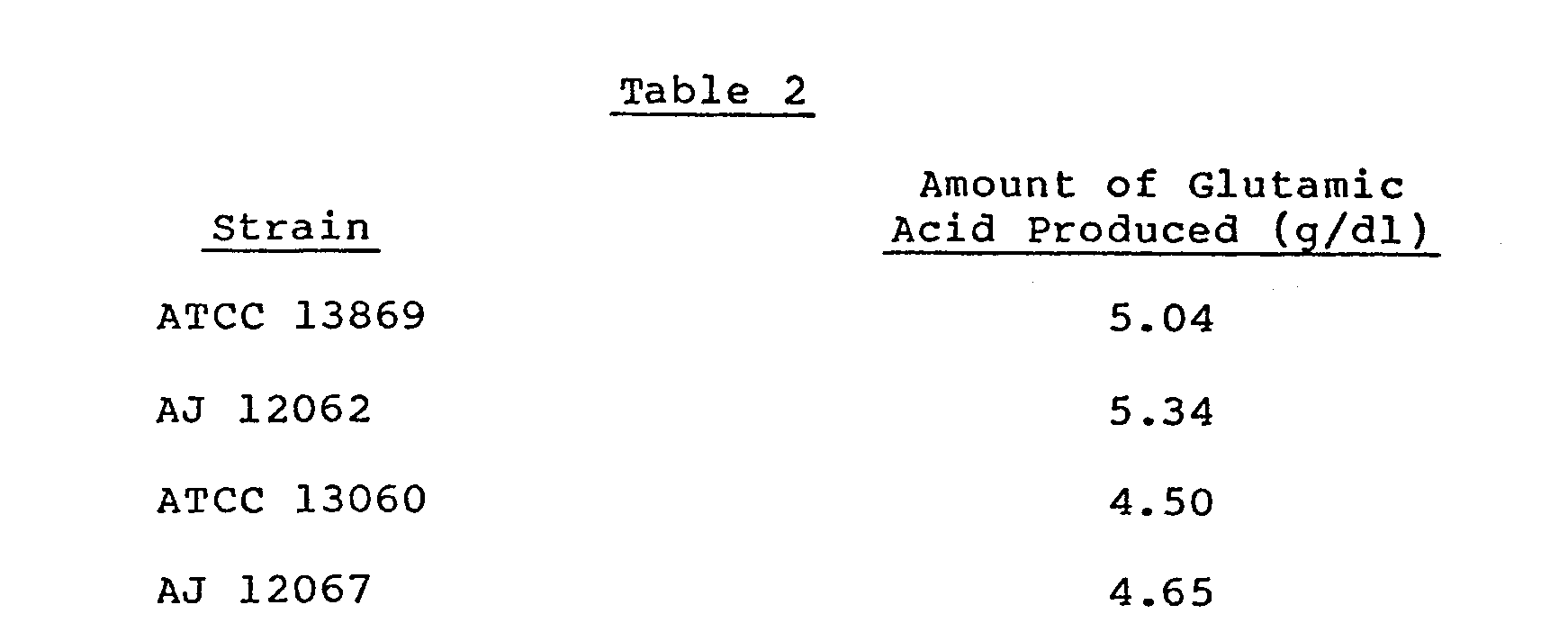
- Plasmid pAJ 201 was introduced into Brevibacterium lactofermentum AJ 12019 (NRRL B-15346) (auxotrophy for homoserine) by the transformation method described in (4). The results obtained by examination of lysine productivity with the thus-obtained transformant AJ 12073 (FERM-P 7205) are shown in Table 3. The cultivation was carried out by charging in a shoulder-equipped flask 20 ml of medium containing 10 g/dl of glucose, 5.5 g/dl of ammonium sulfate, 0.1 g/dl of KH2PO4, 0.1 g/dl of MgSO4 7H20, 0.001 g/dl of FeS04 4H20, 0.001 g/dl of MnSO4 4H20, 200 µg/l of thiamine hydrochloride, 2.5 mg/dl of nicotinamide, 105 mg/dl of soybean protein hydrolysate (as total nitrogen), and 5 g/dl of calcium carbonate, the pH of which had been adjusted to 8.0, while shaking at 31.5°C for 72 hours. After completion of the cultivation, lysine in the culture liquid was quantitatively determined with high speed liquid chromatography. r

- Plasmid pAJ 201 was introduced into Brevibacterium lactofermentum AJ 11225 (FERM-P 4370) by the transformation method described in (4). The proline productivity was examined with the thus-obtained transformant (AJ 12063 (FERM-P 7173). The results are shown in Table 4. The cultivation was carried out by charging in a shoulder-equipped flask 20 ml of medium containing 10 g/dl of glucose, 6 g/dl of ammonium sulfate, 0.1 g/dl of KH2PO4, 0.08 g/dl of MgSO4 7H20, 0.001 g/dl of FeS04 4H20, 0.001 g/dl of MnSO4 4H20, 1 mg/l of thiamine hydrochloride, 0.1% of soybean protein hydrolysate ("Mieki"), and calcium carbonate, the pH of which had been adjusted to 7.0, while shaking at 31.5°C for 72 hours. After completion of the cultivation, proline in the culture liquid was quantitatively determined with high speed liquid chromatography.

- Plasmid pAJ 201 was introduced into Brevibacterium lactofermentum AJ ll188 (FERM-P 4190) by the transformation method described in (4). Threonine productivity was examined with the thus-obtained transformant AJ 12064 (FERM-P 7174). The results are shown in Table 5. The cultivation was carried out by charging in a shoulder-equipped flask 20 ml of medium containing 10 g/dl of glucose, 4.5 g/dl of ammonium sulfate, 0.1 g/dl of KH2PO4, 0.1 g/dl of MgSO4 7H20, 0.001 g/dl of FeS04 4H20, 0.001 g/dl of MnSO4 4H20, 300 µg/l of thiamine hydrochloride, 100 µg/l of biotin, 45 mg/dl of soybean protein hydrolysate "Mieki" (as total nitrogen), 25 mg/dl of isoleucine, 30 mg/dl of leucine, and 5 g/dl of calcium carbonate, the pH of which had been adjusted to 7.2, while shaking at 31.5°C for 72 hours. After completion of the cultivation, threonine in the culture liquid was quantitatively determined with high speed liquid chromatography.

- Brevibacterium lactofermentum AJ 12061 was isolated as a strain which could not grow on Glu-deficient medium, but could grow on Glu-deficient medium supplemented with 1.0 g/dl of L-glutamic acid, by contacting Brevibacterium lactofermentum ATCC 13869 with N-methyl-N'-nitro-N-nitrosoguanidine at 0°C for 20 minutes for mutation treatment. AJ 12061, AJ 11225, AJ 11188 and AJ 12019 were easily obtained from AJ 12066 or AJ 12065, AJ 12063, AJ 12064 and AJ 12073, respectively, by removing the composite plasmid without injury to the host cells. That is, the plasmid is spontaneously expelled from the host on some occasions, or it may also be removed by a "removing" operation (Bact. Rev., 36, p 361-405 (1972)). An example of the removing operation is as follows: A small number of cells are inoculated on a medium containing acridine orange having a concentration (2 to 50 µg/ml) insufficiently inhibiting growth of the host so as to be approximately 104 cells per 1 ml. Then the cells are cultured at 27 to 35°C overnight (J. Bacteriol., 88, 261 (1964)). The culture liquid is spread on agar medium followed by culturing at 27 to 42°C overnight.
- Plasmids would be removed from most of the colonies appearing on the medium with a high degree of probability.
- Further, AJ 11225 (resistant to 2,4- dehydroproline) is described in Japanese Published Examined Patent Application 57-22319 and AJ 11188 (resistant to α-amino-β-hydroxyvaleric acid and S-methylcysteine sulfoxide and showing auxotrophy for L-isoleucine and L-leucine) is described in Japanese Published Examined Patent Application 56-3038.
- The deposits identified as FERM-P numbers 6857, 7176, 7175, 7177, 7172, 7205, 7173, and 7174 were converted on August 21, 1984, to deposits under the Budapest Treaty and are identified by the FERM-BP numbers 591 , 590 , 589 , 588 , 587 586 , 585 , and 592 , respectively.
- The invention now being fully described, it will be apparent to one of ordinary skill in the art that many changes and modifications can be made thereto without departing from the spirit or scope of the invention as set forth herein.
Claims (5)
Applications Claiming Priority (2)
| Application Number | Priority Date | Filing Date | Title |
|---|---|---|---|
| JP157512/83 | 1983-08-29 | ||
| JP58157512A JPH0783714B2 (en) | 1983-08-29 | 1983-08-29 | Fermentation method for producing L-amino acid |
Publications (2)
| Publication Number | Publication Date |
|---|---|
| EP0143195A1 true EP0143195A1 (en) | 1985-06-05 |
| EP0143195B1 EP0143195B1 (en) | 1992-05-27 |
Family
ID=15651292
Family Applications (1)
| Application Number | Title | Priority Date | Filing Date |
|---|---|---|---|
| EP84110141A Expired - Lifetime EP0143195B1 (en) | 1983-08-29 | 1984-08-24 | Recombinant dna having a phosphoenol pyruvate carboxylase gene inserted therein, bacteria carrying said recombinant dna and a process for producing amino acids using said bacteria |
Country Status (4)
| Country | Link |
|---|---|
| US (1) | US4757009A (en) |
| EP (1) | EP0143195B1 (en) |
| JP (1) | JPH0783714B2 (en) |
| DE (1) | DE3485750D1 (en) |
Cited By (11)
| Publication number | Priority date | Publication date | Assignee | Title |
|---|---|---|---|---|
| FR2581653A1 (en) * | 1985-05-10 | 1986-11-14 | Asahi Chemical Ind | DNA fragment containing a gene encoding phosphoenolpyruvate carboxylase, recombinant DNA containing it and microorganism containing this recombinant DNA. |
| EP0318663A1 (en) * | 1987-11-06 | 1989-06-07 | Degussa Aktiengesellschaft | Pendelulum vector pZ1, recombinant plasmid containing an aspartase gene, its use for the production of amino acids of the aspartate family from a nutrition medium containing fumarat, and microorganisms containing the same |
| EP0358940A1 (en) * | 1988-09-12 | 1990-03-21 | Degussa Aktiengesellschaft | DNA fragment coding for phosphoenolpyruvat corboxylase, recombinant DNA carrying said fragment, strains carrying the recombinant DNA and method for producing L-aminino acids using said strains |
| EP0435132A1 (en) * | 1989-12-27 | 1991-07-03 | Forschungszentrum Jülich Gmbh | Process for the fermentative production of amino acids, especially L-lysine, microorganisms suitable therefor and recombinant DNA |
| EP0158940B1 (en) * | 1984-04-04 | 1991-12-11 | Ajinomoto Co., Inc. | Transducible composite plasmid |
| FR2738014A1 (en) * | 1995-08-23 | 1997-02-28 | Ajinomoto Kk | L-GLUTAMIC ACID-PRODUCING MICROORGANISM AND METHOD FOR PRODUCING L-GLUTAMIC ACID USING THE MICROORGANISM |
| EP0670370A3 (en) * | 1994-01-10 | 1997-05-28 | Ajinomoto Kk | Method of producing L-glutamic acid by fermentation. |
| WO2001000852A1 (en) * | 1999-06-29 | 2001-01-04 | Archer-Daniels-Midland Company | Regulation of carbon assimilation |
| US6599732B1 (en) | 1999-06-29 | 2003-07-29 | Archer-Daniels-Midland Company | Regulation of carbon assimilation |
| WO2007086608A1 (en) * | 2006-01-27 | 2007-08-02 | Ajinomoto Co., Inc. | Method for producing l-amino acid |
| EP2311937A1 (en) | 2004-12-06 | 2011-04-20 | Sage Biosciences Inc. | Method of growing bacteria to deliver bioactive compounds to the intestine of ruminants |
Families Citing this family (32)
| Publication number | Priority date | Publication date | Assignee | Title |
|---|---|---|---|---|
| JPS6178378A (en) * | 1984-09-27 | 1986-04-21 | Ajinomoto Co Inc | Coryne-type bacteria having recombinant dna, and production of aromatic amino acid using same |
| JPH0746994B2 (en) * | 1984-10-04 | 1995-05-24 | 味の素株式会社 | Method for producing L-amino acid by fermentation method |
| JP2520895B2 (en) * | 1987-03-04 | 1996-07-31 | 旭化成工業株式会社 | Method for producing L-glutamic acid |
| JP2578488B2 (en) * | 1988-03-04 | 1997-02-05 | 協和醗酵工業株式会社 | Method for producing amino acids |
| MY113040A (en) * | 1994-02-24 | 2001-11-30 | Ajinomoto Kk | Novel gene derived from coryneform bacteria and use thereof |
| US5977331A (en) * | 1994-06-14 | 1999-11-02 | Ajinomoto Co., Inc. | α-Ketoglutarate dehydrogenase gene |
| US5939307A (en) * | 1996-07-30 | 1999-08-17 | The Archer-Daniels-Midland Company | Strains of Escherichia coli, methods of preparing the same and use thereof in fermentation processes for l-threonine production |
| ID21006A (en) * | 1997-02-10 | 1999-04-08 | Japan Tobacco Inc | C4 CYCLE TYPE PCK |
| AU756507B2 (en) | 1998-03-18 | 2003-01-16 | Ajinomoto Co., Inc. | L-glutamic acid-producing bacterium and method for producing L-glutamic acid |
| US6927046B1 (en) * | 1999-12-30 | 2005-08-09 | Archer-Daniels-Midland Company | Increased lysine production by gene amplification using coryneform bacteria |
| US7220571B2 (en) * | 2000-09-28 | 2007-05-22 | Archer-Daniels-Midland Company | Escherichia coli strains which over-produce L-threonine and processes for the production of L-threonine by fermentation |
| CN100534972C (en) | 2003-09-30 | 2009-09-02 | 味之素株式会社 | Method for purifying succinic acid from fermentation broth |
| CN103088080B (en) | 2004-10-07 | 2016-02-17 | 味之素株式会社 | Method for producing alkaline substances |
| US7723097B2 (en) * | 2005-03-11 | 2010-05-25 | Archer-Daniels-Midland Company | Escherichia coli strains that over-produce L-threonine and processes for their production |
| WO2007001982A1 (en) * | 2005-06-20 | 2007-01-04 | Archer-Daniels-Midland Company | Altered glyoxylate shunt for improved production of aspartate-derived amino acids and chemicals |
| DE102005048818A1 (en) | 2005-10-10 | 2007-04-12 | Degussa Ag | Microbiological production of 3-hydroxypropionic acid |
| JP2009089603A (en) | 2006-02-02 | 2009-04-30 | Ajinomoto Co Inc | Method for producing l-lysine using methanol-assimilating bacterium |
| JP2009153382A (en) | 2006-03-30 | 2009-07-16 | Ajinomoto Co Inc | Method for producing carboxylic acid using methanol-assimilating bacterium |
| JP2010041920A (en) | 2006-12-19 | 2010-02-25 | Ajinomoto Co Inc | Method for producing l-amino acid |
| JP2010088301A (en) | 2007-02-01 | 2010-04-22 | Ajinomoto Co Inc | Method for production of l-amino acid |
| JP2011067095A (en) | 2008-01-10 | 2011-04-07 | Ajinomoto Co Inc | Method for producing target substance by fermentation process |
| WO2009093703A1 (en) | 2008-01-23 | 2009-07-30 | Ajinomoto Co., Inc. | Method of producing l-amino acid |
| JP2012029565A (en) | 2008-11-27 | 2012-02-16 | Ajinomoto Co Inc | Method for producing l-amino acid |
| JP2010142200A (en) | 2008-12-22 | 2010-07-01 | Ajinomoto Co Inc | Method for producing l-lysine |
| JPWO2011013707A1 (en) | 2009-07-29 | 2013-01-10 | 味の素株式会社 | Method for producing L-amino acid |
| JP2012196144A (en) | 2009-08-03 | 2012-10-18 | Ajinomoto Co Inc | Method for producing l-lysine using vibrio bacterium |
| JP2012223091A (en) | 2009-08-25 | 2012-11-15 | Ajinomoto Co Inc | Method for producing l-amino acid |
| DE102010029973A1 (en) | 2010-06-11 | 2011-12-15 | Evonik Degussa Gmbh | Microbiological production of C4 bodies from sucrose and carbon dioxide |
| RU2496867C2 (en) | 2011-04-25 | 2013-10-27 | Закрытое акционерное общество "Научно-исследовательский институт Аджиномото-Генетика" (ЗАО "АГРИ") | Method to produce l-amino acid of glutamate family using coryneformic bacterium |
| RU2011134436A (en) | 2011-08-18 | 2013-10-27 | Закрытое акционерное общество "Научно-исследовательский институт Аджиномото-Генетика" (ЗАО "АГРИ") | METHOD FOR PRODUCING L-AMINO ACID USING THE ENTEROBACTERIACEAE FAMILY POSSESSING AN INCREASED EXPRESSION OF GENES OF THE CASCADE OF THE FORMATION OF FLAGELLS AND CELL MOBILITY |
| JP2016192903A (en) | 2013-09-17 | 2016-11-17 | 味の素株式会社 | Method for manufacturing l-amino acid from biomass derived from seaweed |
| RU2628696C1 (en) | 2013-10-02 | 2017-08-21 | Адзиномото Ко., Инк. | A method for producing basic amino acid (variants) |
Citations (4)
| Publication number | Priority date | Publication date | Assignee | Title |
|---|---|---|---|---|
| EP0064680A2 (en) * | 1981-04-30 | 1982-11-17 | Kyowa Hakko Kogyo Co., Ltd. | Novel lysozyme-sensitive microorganism |
| EP0066129A2 (en) * | 1981-05-11 | 1982-12-08 | Ajinomoto Co., Inc. | Method for producing L-threonine by fermentation |
| EP0071023A2 (en) * | 1981-06-25 | 1983-02-09 | Ajinomoto Co., Inc. | Method for producing L-isoleucine by fermentation |
| EP0082485A2 (en) * | 1981-12-17 | 1983-06-29 | Kyowa Hakko Kogyo Co., Ltd. | Novel vector plasmids |
Family Cites Families (6)
| Publication number | Priority date | Publication date | Assignee | Title |
|---|---|---|---|---|
| JPS56160997A (en) * | 1980-05-16 | 1981-12-11 | Ajinomoto Co Inc | Preparation of l-lysine by fermenaition method |
| GB2076853B (en) * | 1980-04-17 | 1983-12-21 | Ajinomoto Kk | L-glutamic acid producing microorganisms |
| JPS56148296A (en) * | 1980-04-17 | 1981-11-17 | Ajinomoto Co Inc | Preparation of l-glutamic acid by fermentation method |
| JPS5729290A (en) * | 1980-07-28 | 1982-02-17 | Ajinomoto Co Inc | Preparation of l-lysine by fermentation method |
| JPS57134500A (en) * | 1981-02-12 | 1982-08-19 | Kyowa Hakko Kogyo Co Ltd | Plasmid pcg1 |
| JPS58126789A (en) * | 1981-12-29 | 1983-07-28 | Kyowa Hakko Kogyo Co Ltd | Method for developing genetic character |
-
1983
- 1983-08-29 JP JP58157512A patent/JPH0783714B2/en not_active Expired - Lifetime
-
1984
- 1984-08-24 DE DE8484110141T patent/DE3485750D1/en not_active Expired - Lifetime
- 1984-08-24 EP EP84110141A patent/EP0143195B1/en not_active Expired - Lifetime
- 1984-08-28 US US06/645,107 patent/US4757009A/en not_active Expired - Lifetime
Patent Citations (4)
| Publication number | Priority date | Publication date | Assignee | Title |
|---|---|---|---|---|
| EP0064680A2 (en) * | 1981-04-30 | 1982-11-17 | Kyowa Hakko Kogyo Co., Ltd. | Novel lysozyme-sensitive microorganism |
| EP0066129A2 (en) * | 1981-05-11 | 1982-12-08 | Ajinomoto Co., Inc. | Method for producing L-threonine by fermentation |
| EP0071023A2 (en) * | 1981-06-25 | 1983-02-09 | Ajinomoto Co., Inc. | Method for producing L-isoleucine by fermentation |
| EP0082485A2 (en) * | 1981-12-17 | 1983-06-29 | Kyowa Hakko Kogyo Co., Ltd. | Novel vector plasmids |
Cited By (15)
| Publication number | Priority date | Publication date | Assignee | Title |
|---|---|---|---|---|
| EP0158940B1 (en) * | 1984-04-04 | 1991-12-11 | Ajinomoto Co., Inc. | Transducible composite plasmid |
| FR2581653A1 (en) * | 1985-05-10 | 1986-11-14 | Asahi Chemical Ind | DNA fragment containing a gene encoding phosphoenolpyruvate carboxylase, recombinant DNA containing it and microorganism containing this recombinant DNA. |
| EP0318663A1 (en) * | 1987-11-06 | 1989-06-07 | Degussa Aktiengesellschaft | Pendelulum vector pZ1, recombinant plasmid containing an aspartase gene, its use for the production of amino acids of the aspartate family from a nutrition medium containing fumarat, and microorganisms containing the same |
| GB2223754B (en) * | 1988-09-12 | 1992-07-22 | Degussa | Dna encoding phosphoenolpyruvate carboxylase |
| GB2223754A (en) * | 1988-09-12 | 1990-04-18 | Degussa | Dna coding for phosphoenolpyruvate carboxylase |
| EP0358940A1 (en) * | 1988-09-12 | 1990-03-21 | Degussa Aktiengesellschaft | DNA fragment coding for phosphoenolpyruvat corboxylase, recombinant DNA carrying said fragment, strains carrying the recombinant DNA and method for producing L-aminino acids using said strains |
| EP0435132A1 (en) * | 1989-12-27 | 1991-07-03 | Forschungszentrum Jülich Gmbh | Process for the fermentative production of amino acids, especially L-lysine, microorganisms suitable therefor and recombinant DNA |
| EP0670370A3 (en) * | 1994-01-10 | 1997-05-28 | Ajinomoto Kk | Method of producing L-glutamic acid by fermentation. |
| CN1071794C (en) * | 1994-01-10 | 2001-09-26 | 味之素株式会社 | Method of producing L-glutamic acid by fermentation |
| FR2738014A1 (en) * | 1995-08-23 | 1997-02-28 | Ajinomoto Kk | L-GLUTAMIC ACID-PRODUCING MICROORGANISM AND METHOD FOR PRODUCING L-GLUTAMIC ACID USING THE MICROORGANISM |
| WO2001000852A1 (en) * | 1999-06-29 | 2001-01-04 | Archer-Daniels-Midland Company | Regulation of carbon assimilation |
| US6599732B1 (en) | 1999-06-29 | 2003-07-29 | Archer-Daniels-Midland Company | Regulation of carbon assimilation |
| US6919190B2 (en) | 1999-06-29 | 2005-07-19 | Archer-Daniels-Midland Company | Regulation of carbon assimilation |
| EP2311937A1 (en) | 2004-12-06 | 2011-04-20 | Sage Biosciences Inc. | Method of growing bacteria to deliver bioactive compounds to the intestine of ruminants |
| WO2007086608A1 (en) * | 2006-01-27 | 2007-08-02 | Ajinomoto Co., Inc. | Method for producing l-amino acid |
Also Published As
| Publication number | Publication date |
|---|---|
| DE3485750D1 (en) | 1992-07-02 |
| JPH0783714B2 (en) | 1995-09-13 |
| US4757009A (en) | 1988-07-12 |
| EP0143195B1 (en) | 1992-05-27 |
| JPS6087788A (en) | 1985-05-17 |
Similar Documents
| Publication | Publication Date | Title |
|---|---|---|
| US4757009A (en) | Recombinant DNA having a phosphoenol pyruvate carboxylase gene inserted therein, bacteria carrying said recombinant DNA and a process for producing amino acids using said bacteria | |
| EP0179338B1 (en) | Method for producing l-amino acids | |
| US4601983A (en) | Coryneform bacteria carrying recombinant plasmids and their use in the fermentative production of L-threonine and L-isoleucine | |
| US4442208A (en) | Method for producing L-isoleucine by fermentation | |
| EP0077548A2 (en) | Plasmid | |
| US4452890A (en) | Method of producing L-threonine by fermentation | |
| JPH06102024B2 (en) | Novel promoter and gene expression method using the promoter | |
| JPS6279788A (en) | Production of amino acid | |
| US4861722A (en) | Coryneform bacteria carrying recombinant plasmids and their use in the fermentative production of L-lysine | |
| JPS63119688A (en) | Production of l-glutamic acid and l-proline | |
| US4946781A (en) | Recombinant DNA, bacteria carrying said recombinant DNA and a process for producing L-threonine or L-isoleucine using said bacteria | |
| JPWO1999007853A1 (en) | Method for producing L-glutamic acid by fermentation | |
| JPS6379597A (en) | Production of l-arginine | |
| US4968609A (en) | Coryneform bacteria carrying recombinant DNA and a process for producing aromatic amino acids using said bacteria | |
| US5426050A (en) | Plasmid vectors for expression of genes in coryneform bacteria | |
| EP0259858B1 (en) | Process for producing amino acids | |
| CA1283070C (en) | Process for production of l-phenylalanine by fermentation | |
| US4885245A (en) | Process for producing L-tryptophan | |
| US5017481A (en) | Coryneform bacteria carrying recombinant DNA and process for producing an aromatic amino acid by using the same | |
| EP0169377A2 (en) | Plasmid and bacteria containing the same | |
| JPS61195695A (en) | Production of threonine or isoleucine | |
| JPH055479B2 (en) | ||
| JPH06102031B2 (en) | Fermentation method for producing L-phenylalanine | |
| JPH0476678B2 (en) | ||
| JPS6062983A (en) | Recombinant dna, bacterial having said recombinant dna and production of l-histidine using said bacteria |
Legal Events
| Date | Code | Title | Description |
|---|---|---|---|
| PUAI | Public reference made under article 153(3) epc to a published international application that has entered the european phase |
Free format text: ORIGINAL CODE: 0009012 |
|
| AK | Designated contracting states |
Designated state(s): DE FR GB IT NL |
|
| 17P | Request for examination filed |
Effective date: 19851105 |
|
| 17Q | First examination report despatched |
Effective date: 19871218 |
|
| GRAA | (expected) grant |
Free format text: ORIGINAL CODE: 0009210 |
|
| ITF | It: translation for a ep patent filed | ||
| AK | Designated contracting states |
Kind code of ref document: B1 Designated state(s): DE FR GB IT NL |
|
| REF | Corresponds to: |
Ref document number: 3485750 Country of ref document: DE Date of ref document: 19920702 |
|
| ET | Fr: translation filed | ||
| PLBE | No opposition filed within time limit |
Free format text: ORIGINAL CODE: 0009261 |
|
| STAA | Information on the status of an ep patent application or granted ep patent |
Free format text: STATUS: NO OPPOSITION FILED WITHIN TIME LIMIT |
|
| 26N | No opposition filed | ||
| REG | Reference to a national code |
Ref country code: GB Ref legal event code: IF02 |
|
| PGFP | Annual fee paid to national office [announced via postgrant information from national office to epo] |
Ref country code: NL Payment date: 20030626 Year of fee payment: 20 |
|
| PGFP | Annual fee paid to national office [announced via postgrant information from national office to epo] |
Ref country code: FR Payment date: 20030715 Year of fee payment: 20 |
|
| PGFP | Annual fee paid to national office [announced via postgrant information from national office to epo] |
Ref country code: GB Payment date: 20030728 Year of fee payment: 20 |
|
| PGFP | Annual fee paid to national office [announced via postgrant information from national office to epo] |
Ref country code: DE Payment date: 20030908 Year of fee payment: 20 |
|
| PG25 | Lapsed in a contracting state [announced via postgrant information from national office to epo] |
Ref country code: GB Free format text: LAPSE BECAUSE OF EXPIRATION OF PROTECTION Effective date: 20040823 |
|
| PG25 | Lapsed in a contracting state [announced via postgrant information from national office to epo] |
Ref country code: NL Free format text: LAPSE BECAUSE OF EXPIRATION OF PROTECTION Effective date: 20040824 |
|
| REG | Reference to a national code |
Ref country code: GB Ref legal event code: PE20 |
|
| NLV7 | Nl: ceased due to reaching the maximum lifetime of a patent |