EP0147013B1 - Tamis de perforation et méthode pour sa fabrication - Google Patents
Tamis de perforation et méthode pour sa fabrication Download PDFInfo
- Publication number
- EP0147013B1 EP0147013B1 EP84306398A EP84306398A EP0147013B1 EP 0147013 B1 EP0147013 B1 EP 0147013B1 EP 84306398 A EP84306398 A EP 84306398A EP 84306398 A EP84306398 A EP 84306398A EP 0147013 B1 EP0147013 B1 EP 0147013B1
- Authority
- EP
- European Patent Office
- Prior art keywords
- screen
- screens
- thin
- holes
- metal
- Prior art date
- Legal status (The legal status is an assumption and is not a legal conclusion. Google has not performed a legal analysis and makes no representation as to the accuracy of the status listed.)
- Expired - Lifetime
Links
Images


Classifications
-
- B—PERFORMING OPERATIONS; TRANSPORTING
- B23—MACHINE TOOLS; METAL-WORKING NOT OTHERWISE PROVIDED FOR
- B23P—METAL-WORKING NOT OTHERWISE PROVIDED FOR; COMBINED OPERATIONS; UNIVERSAL MACHINE TOOLS
- B23P15/00—Making specific metal objects by operations not covered by a single other subclass or a group in this subclass
- B23P15/26—Making specific metal objects by operations not covered by a single other subclass or a group in this subclass heat exchangers or the like
-
- B—PERFORMING OPERATIONS; TRANSPORTING
- B23—MACHINE TOOLS; METAL-WORKING NOT OTHERWISE PROVIDED FOR
- B23P—METAL-WORKING NOT OTHERWISE PROVIDED FOR; COMBINED OPERATIONS; UNIVERSAL MACHINE TOOLS
- B23P15/00—Making specific metal objects by operations not covered by a single other subclass or a group in this subclass
- B23P15/16—Making specific metal objects by operations not covered by a single other subclass or a group in this subclass plates with holes of very small diameter, e.g. for spinning or burner nozzles
-
- B—PERFORMING OPERATIONS; TRANSPORTING
- B26—HAND CUTTING TOOLS; CUTTING; SEVERING
- B26F—PERFORATING; PUNCHING; CUTTING-OUT; STAMPING-OUT; SEVERING BY MEANS OTHER THAN CUTTING
- B26F1/00—Perforating; Punching; Cutting-out; Stamping-out; Apparatus therefor
- B26F1/26—Perforating by non-mechanical means, e.g. by fluid jet
-
- Y—GENERAL TAGGING OF NEW TECHNOLOGICAL DEVELOPMENTS; GENERAL TAGGING OF CROSS-SECTIONAL TECHNOLOGIES SPANNING OVER SEVERAL SECTIONS OF THE IPC; TECHNICAL SUBJECTS COVERED BY FORMER USPC CROSS-REFERENCE ART COLLECTIONS [XRACs] AND DIGESTS
- Y10—TECHNICAL SUBJECTS COVERED BY FORMER USPC
- Y10T—TECHNICAL SUBJECTS COVERED BY FORMER US CLASSIFICATION
- Y10T29/00—Metal working
- Y10T29/49—Method of mechanical manufacture
- Y10T29/49826—Assembling or joining
- Y10T29/49908—Joining by deforming
- Y10T29/49938—Radially expanding part in cavity, aperture, or hollow body
- Y10T29/4994—Radially expanding internal tube
-
- Y—GENERAL TAGGING OF NEW TECHNOLOGICAL DEVELOPMENTS; GENERAL TAGGING OF CROSS-SECTIONAL TECHNOLOGIES SPANNING OVER SEVERAL SECTIONS OF THE IPC; TECHNICAL SUBJECTS COVERED BY FORMER USPC CROSS-REFERENCE ART COLLECTIONS [XRACs] AND DIGESTS
- Y10—TECHNICAL SUBJECTS COVERED BY FORMER USPC
- Y10T—TECHNICAL SUBJECTS COVERED BY FORMER US CLASSIFICATION
- Y10T428/00—Stock material or miscellaneous articles
- Y10T428/12—All metal or with adjacent metals
- Y10T428/12361—All metal or with adjacent metals having aperture or cut
-
- Y—GENERAL TAGGING OF NEW TECHNOLOGICAL DEVELOPMENTS; GENERAL TAGGING OF CROSS-SECTIONAL TECHNOLOGIES SPANNING OVER SEVERAL SECTIONS OF THE IPC; TECHNICAL SUBJECTS COVERED BY FORMER USPC CROSS-REFERENCE ART COLLECTIONS [XRACs] AND DIGESTS
- Y10—TECHNICAL SUBJECTS COVERED BY FORMER USPC
- Y10T—TECHNICAL SUBJECTS COVERED BY FORMER US CLASSIFICATION
- Y10T428/00—Stock material or miscellaneous articles
- Y10T428/12—All metal or with adjacent metals
- Y10T428/12479—Porous [e.g., foamed, spongy, cracked, etc.]
Definitions
- the present invention is in the general field of perforated plastic film and especially relates to vacuum perforating of plastic film.
- the invention particularly relates to metal screens or molding elements used in the vacuum perforation of plastic film and to a method of fabricating such screens.
- Perforated plastic film has many useful applications. It is used in gardening and farming to prevent the growth of grass and weeds while permitting moisture to be transmitted through the film to the soil beneath. Perforated film is also used for making disposable diapers, for example, see U.S. 3,814,101.
- U.S. 3,054,148 One of the earlier methods for vacuum perforation of plastic film is disclosed in U.S. 3,054,148.
- the patentee describes a stationary drum having a molding element or screen mounted around the outer surface of the drum and adapted to freely rotate thereon.
- a vacuum chamber is employed beneath the screen to create a pressure differential between the respective surfaces of the thermoplastic sheet to be perforated to cause the plasticized sheet to flow into openings provided in the screen and thereby cause a series of openings, holes or perforations to be formed in the plastic sheet or film.
- U.S. 4,155,693 U.S. 4,252,516, U.S. 3,709,647, U.S. 4,151,240, U.S. 4,319,868 and U.S. 4,388,056.
- the screen is comprised of a series of perforated metal strips preferably welded together to form a cylinder.
- U.S. 4,252,516 provides a screen having a series of hexagonal depressions with elliptical holes centered therein.
- U.S. 3,709,647 provides for a rotating vacuum-forming roll having a circulating cooling medium therein.
- U.S. 4,342,314 discloses a method for forming a planar forming surface or a cylindrical forming surface, each of such surfaces being used to emboss or perforate film.
- the method, and thus the resultant forming surface is obtained by first bonding together a plurality of laminae so that the pattern cut in each of the lamina is in alignment with the pattern in all other of the laminae.
- the various laminae, after bonding, are joined together at two of their opposite ends by means of a seam.
- U.S. 4,151,240 provides a means for cooling the film after it has been perforated and debossed.
- U.S. 4,319,868 sets forth an apparatus for making a thermoplastic film having raised bosses with perforated tips. A particularly constructed embossing roll for effecting the desired film pattern is disclosed.
- U.S. 4,388,056 discloses an apparatus for continuously forming an airlaid fibrous web having oppositely phased, cylindrically undulating side edges and a predetermined basis weight distribution.
- An air-laying drum has a honeycomb type annular-shape frame including circumferentially extending ribs and transverse plates.
- a stationary adjustable air flow modulating means is disposed adjacent the radially inwardly disposed boundary of an arcuate portion of a circumferentially segmented annular-shape plenum, circumferentially spanning a plurality of plenum segments for adjusting a pressure drop across particular areas of the surface of the air-laying drum.
- Vacuum perforation of thin plastic films involves the extrusion of molten polymeric materials such as polyethylene and other plastic polymers though a slot die.
- the hot melt web of film or plastic sheet exiting the die impinges on a rotating cylindrical screen which is mounted on a stationary vacuum drum or roll.
- the vacuum roll has an axial slot and a set of seals extending longitudinally the length of its outside surface, beneath the area where the web of plastic impinges on the screen or molding element.
- a high vacuum from inside the screen is directed through the slot in the vacuum roll.
- the vacuum present within the slot forms or molds the plastic film or sheet to the screen and perforates it through the holes of the screen. At the same time, an airflow is produced which cools the film.
- the most important component of the vacuum processing equipment is the cylindrical screen.
- This molding element defines aesthetic and mechanical properties of the film as well as the geometric pattern of the perforated film.
- the desired screen pattern is nickel plated on a specially prepared cylindrical mandrel.
- a seamless cylindrical nickel screen of any predetermined or desired pattern can be produced.
- Other metals, such as copper may also be used.
- Some film products require the use of relatively thick screens, e.g. from 0.020 to 0.100 inches (0.0508 - 0.254 cm) thick, and also require that the walls of the patterned holes are straight and perpendicular to the screen surface.
- Present screen fabrication techniques as heretofore described are not capable of producing a screen meeting these requirements.
- the patterned holes on screens produced by nickel plating a prepared cylindrical mandrel, even with the application of specialized plating and post etching techniques, take the shape of inverted, truncated, concaved cones. The thicker the screen, the more exaggerated the effect becomes.
- This invention provides a laminated, seamless, cylindrical metal screen or molding element for vacuum perforation of plastic film or sheets, comprising two or more thin, seamless, cylindrical metal screens, each of the thin screens having a plurality of openings or holes therein, the thin screens being stacked and bonded together diametrically one inside the other to provide the laminated cylindrical metal screen, the holes of each of the thin screens being substantially aligned with the holes of the other screen or screens and each of the holes in the thin screens having a radial centreline aligned with the radial centreline of the or each aligned hole of the other thin screen or screens.
- the invention includes a method of making a thick cylindrical metal screen or molding element for vacuum perforation of plastic film or sheets, comprising stacking and bonding together two or more matched thin, seamless, cylindrical metal screens, each of the thin screens having a plurality of openings or holes therein and the thin screens being stacked and bonded together diametrically one inside the other to provide the thick cylindrical metal screen, the holes of each of the thin screens being substantially aligned with the holes of the other screen or screens and each of the holes in the thin screens having a radial centreline aligned with the radial centreline of the or each aligned hole of the other thin screen or screens.
- the invention provides a method of fabricating a laminated, cylindrical metal screen or molding element for vacuum perforation of plastic film or sheets, comprising the steps of:
- Any remaining flux may be removed with an appropriate agent and the inside sleeve is removed thereby leaving a finished laminated screen product of desired specifications.
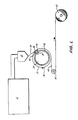
- Figure 1 is a schematic view illustration of an apparatus and method for vacuum perforation of thermoplastic film
- Figure 2 is a side elevational view of a sleeve mounted in a cradle with a screen partially inserted therein;
- Figure 3 is an end view of the assembly of Figure 2 with the wall thickness of the screen and sleeve enlarged to show detail;
- Figure 4 is an end view similar to that of Figure 3, but illustrates a complete assembly of screens and sleeves
- Figure 5 is a perspective view of a laminated screen of the invention.
- Figure 6 is an enlarged view of a segment of the screen of Figure 5;
- Figure 7 is a sectional view of the screen segment of Figure 6 taken along line 7-7;
- Figure 8 is a sectional view of a screen segment similar to that of Figure 7 illustrating an alternate hole radial cross-section;
- Figure 9 is a sectional view of a screen segment similar to that of Figure 7 illustrating another alternate hole radial cross-section.
- Figure 10 is a sectional view of a screen segment similar to that of Figure 7 illustrating still another alternate hole radial cross-section.
- FIG. 1 of the drawings vacuum process equipment and method for perforating plastic film or sheet therewith are schematically illustrated.
- a plastic polymer such as polyethylene is heated to a melt and extruded from an extruder E through a die D where a film web 10 is formed.
- the web 10 is directed onto a rotating cylindrical screen 11 having a desired pattern of holes which is turning clockwise as indicated by arrow A around a stationary vacuum roll or drum 12.
- a vacuum chamber 13 within the roll 12, longitudinal air slot 14 and seals 15 are employed to create a pressure differential between the respective surfaces of the thermoplastic sheet or web 10 to cause the plasticized sheet to flow into the holes in the screen in the direction indicated by the arrow B and therefore perforate the web 30.
- the perforated film web 10' travels onto a guide roll 16 and continues onto a wind-up roll It. Additional guide rolls or tensioning rolls can be employed as desired as well as various film treating equipment.
- Seamless cylindrical nickel screens produced by plating are made by two principal methods.
- a mandrel is ground to a dimension corresponding to the desired dimension of the finished screen.
- the desired screen hole pattern is engraved on the mandrel either by spiral engraving or malett indexing techniques.
- a plating resist medium is applied to the surface of the mandrel, filling the pattern produced by the engraving.
- a finish grinding operation is employed to remove the plating resist medium from the land areas between the engraved pattern, so that only the land area will be subject to plating.
- Subsequent nickel plating of the mandrel forms the screen.
- the mandrel is cooled and the finished screen is removed therefrom.
- the other method of producing a seamless cylindrical nickel screen is similar to the foregoing method, except that instead of engraving the pattern on the mandrel, a special photographic negative of the pattern is created and wrapped around the mandrel. Exposing of the negative transfers the pattern to the mandrel in the form of a plating resist, leaving only the land areas of the screen available for plating. The mandrel is then plated, forming the screen which is then removed from the mandrel to obtain the finished product.
- each successive screen of the set must fit diametrically inside the next larger diameter screen, with sufficient space allowed for the metal or tin-lead alloy plating of each screen.
- each screen of the set is typically geometrically identical. This means that each screen has the same number of holes, both axially and circumferentially, and that the radial centerlines of each hole of any one screen match identically the radial centerlines of the corresponding holes in all other screens in the set.
- the individual hole geometry of all the aligned holes in all the screens must generally be nearly identical.
- matched sets of seamless, cylindrical metal (nickel) screens may be produced as follows:
- screens are generally prepared for particular film perforating operations, the use of the same mandrel is preferable. Should a number of laminated screens of the same pattern be produced, a number of mandrels may be used, as appropriate.
- a matched set of thin, seamless, cylindrical, nickel screens are prepared as set forth in detail hereinafter.
- the length and diameter of the screens is selected on the basis of the type of vacuum perforating equipment and the number of screens to be laminated.
- the thickness of each screen is determined on the basis of the type of hole wall shape desired.
- a screen thickness of approximately 0.005 inches (0.0127 cm) is preferred for providing hole walls that are substantially straight and perpendicular to the surface of the screen.
- Each screen of the matched set is overplated with a thin layer of a bonding material, preferably a tin-lead alloy.
- a bonding material preferably a tin-lead alloy.
- An alloy of 63 weight percent tin and 37 percent lead is especially preferred.
- An alloy layer of about 0.00025 inches (0.000635 centimeters) thick is most preferred.
- Each screen of the matched set is designed and produced so that after plating, the inside diameter of the largest screen fits, within a specified tolerance, the outside diameter of the next largest screen. In turn, each screen of the set fits similarly inside the next largest screen.
- Each screen of the set is designed and produced with a common reference or aligning mark at each end thereof. Alignment of the reference marks during assembly produces proper pattern hole alignment.
- Two seamless cylindrical nickel sleeves of different diameters are also required.
- the sleeves are about the same length of the thin screens.
- the thickness of the sleeves may be varied, but a thickness of approximately 0.010 inches (0.0254 centimeters) is especially preferred.
- the inside surface of the larger diameter sleeve, and the outside surface of the smaller diameter sleeve are chrome plated. A plating thickness of about 0.0005 inches 0.00127 centimeters) is most preferred.
- the sleeves are designed and produced so that after chrome plating, the inside diameter of the larger sleeve fits, within a specified tolerance, the outside diameter of the largest diameter thin screen, after the screen has been plated.
- the outside diameter of the smaller sleeve is designed and produced to fit the inside diameter of the smallest diameter thin screen of the matched set of screens, after the screen has been plated.
- the two sleeves are used as fixtures during the assembly and bonding operations as explained hereinafter.
- the tin-lead alloy plating applied to each screen provides the bonding medium for lamination.
- the chrome plating applied to the sleeves acts as a resist to prevent the tin screens being laminated from bonding to the sleeves.
- the larger cylindrical sleeve 20 is mounted in a cradle 21 and restrained therein so as to retain its cylindrical shape by two stiff outside diameter ring clamps 22 and 23. Any other suitable restraining or clamping means may be used.
- the largest diameter thin screen 30 of the matched set of screens is malformed or otherwise distorted and slid or positioned inside the larger diameter sleeve 20. The screen 30 is then reformed into its cylindrical shape.
- the next largest screen 3l is similarly malformed and slid inside the largest screen 30 of the assembly 40.
- Reference marks 32 on the ends of the two screens are aligned and the screens are pinned or otherwise fastened together.
- the remaining thin screens are similarly installed with the next largest thin screen being positioned inside the second thin screen 31 and so on, until each thin screen of the matched set of thin screens has been assembled.
- the smaller sleeve 24 is positioned within the smallest diameter thin screen in the same manner as the various thin screens were installed.
- an appropriate flux for example, a liquid solder flux having a pure resin base or a soldering paste containing zinc chloride, both manufactured by CG Electronics. Any other suitable flux may be used.
- the assembly 40 is transferred to an oven and uniformly heated to a temperature of about 400°F + 10°F (204.4°C + 5.56°C) or 390°F to 410°F (or 198.84°C to 209.96°C).
- the cylindrical nickel sleeves remain on the assembled screens.
- the sleeves act to uniformly restrain the screen laminates while permitting growth and shrinkage during heating and cooling cycles as they are preferably of the same material as the thin screens.
- the assembly is then allowed to cool in the oven to nearly room or ambient temperature. It is then removed from the oven for final operations.
- the outside sleeve is carefully axially cut and removed. Remaining flux residue is removed from the screen assembly with a suitable agent, for example, by washing with a degreasing liquid followed by a neutralizing wash of a 2 percent solution of muriatic acid. Any other suitable flux removing agent may be used.
- a suitable agent for example, by washing with a degreasing liquid followed by a neutralizing wash of a 2 percent solution of muriatic acid. Any other suitable flux removing agent may be used.
- the inside sleeve is then removed, leaving a finished laminated screen of a desired thickness.
- the specific one of 63% tin-37% lead, plated to a thickness of 0.00025 inches (0.000635 centimeters) particularly meets the requirements of the fabricating system.
- Pure, plated nickel initiates embrittlement at approximately 425°F (218.3°C). Any bonding system selected must therefore cure or flow at a temperature below the embrittlement temperature of the nickel plating.
- the tin-lead alloy preferred is the eutectic formulation of the two elements. The alloy melts and solidifies at 361°F (182.3°C).
- the instant bonding system is unique, in that, by plating each individual thin screen prior to assembly, difficult and messy applications of bonding mediums during assembly are avoided.
- the tin-lead alloy plating thickness of 0.00025 inches (0.000635 centimeters) is the optimum thickness to produce good bonding with minimum excess alloy.
- a laminated screen 50 of the invention which comprises four thin screens 51, 52, 53 and 54 which have been stacked and bonded together in accordance with the foregoing procedure.
- the screen 50 has a plurality of openings or holes 50a therein.
- the holes 50a have walls 50b which are substantially straight as best seen in Fig. 7.
- the walls 50b are formed from the individual walls 51b, 52b, 53b and 54b of each of the tin screens 51, 52, 53 and 54, respectively.
- the truncated holes of the thin screens have been exaggerated.
- the effect of the multiscreen lamination provides hole walls which are substantially straight.
- the invention is particularly directed to a method of producing relatively thick seamless cylindrical metal screens, especially nickel screens, with holes or openings which are essentially straight and perpendicular to the screen surface
- the method can also be utilized to provide thick screens with an expanded variety of hole radial cross-sections. It is only essential that the basic hole radial centerlines of each screen laminate be the same.
- Figs. 8-10 illustrate some of the screen arrangements that can be achieved by using thin screens of different hole sizes. It can readily be appreciated that a wide variety of hole shapes and sizes can be obtained for providing a particular hole effect in a thermoplastic film or sheet. It is preferred for the holes to have a diameter of from about 0.015 to about 0.02 inches (0.0381 - 0.0508 cm). It is also preferred for there to about 100 to 20,000 holes per square inch (15.5 to 3100 holes/cm2) of screen surface.
- thermoplastic sheets or film made from polyolefins especially polyethylene and polypropylene
- it can be used with other types of thermoplastic films as desired.
Landscapes
- Engineering & Computer Science (AREA)
- Mechanical Engineering (AREA)
- Life Sciences & Earth Sciences (AREA)
- Forests & Forestry (AREA)
- Laminated Bodies (AREA)
- Perforating, Stamping-Out Or Severing By Means Other Than Cutting (AREA)
- Blow-Moulding Or Thermoforming Of Plastics Or The Like (AREA)
- Extrusion Moulding Of Plastics Or The Like (AREA)
Claims (18)
- Tamis ou élément de moulage (50) métallique cylindrique, stratifié et sans soudures pour la perforation sous vide de films ou de feuilles de matière plastique, comprenant deux ou plusieurs tamis métalliques cylindriques, sans soudures, minces (51, 52, 53, 54), chacun de ces tamis minces comportant une série d'orifices ou de trous (50a), les tamis minces étant empilés et liés l'un à l'autre diamétralement l'un à l'intérieur de l'autre pour constituer le tamis métallique cylindrique stratifié (50), les trous de chacun des tamis minces étant essentiellement alignés avec les trous de l'autre ou des autres tamis, et chacun des trous des tamis minces ayant un axe radial aligné avec l'axe radial du ou de chaque trou aligné de l'autre ou des autres tamis minces.
- Procédé de fabrication d'un élément de moulage ou tamis métallique cylindre épais (50) pour la perforation sous vide de films ou de feuilles de matière plastique, consistant à empiler et à relier l'un à l'autre deux ou plusieurs tamis métalliques, cylindres, minces, sans soudures, appariés l'un à l'autre (51, 52, 53, 54), chacun des tamis minces comportant une série d'orifices ou de trous (50a), et les tamis minces étant empilés et reliés l'un à l'autre diamétralement l'un à l'intérieur de l'autre pour constituer le tamis métallique cylindrique épais (50), les trous de chacun des tamis minces étant sensiblement alignés avec les trous de l'autre ou des autres tamis, et chacun des trous de ces tamis minces comportant un axe radial aligné avec l'axe radial du ou de chaque trou aligné de l'autre ou des autres tamis minces.
- Procédé de fabrication d'un élément de moulage ou tamis métallique cylindrique stratifié pour la perforation sous vide de films ou de feuilles de matière plastique, consistant :a. à préparer deux ou plusieurs tamis métalliques, cylindriques, sans soudures, minces, appariés (30,31), chacun de dimensions prédéterminées et comportant une série de trous qui le traversent;b. à revêtir chacun de ces tamis minces appariés (30, 31) d'une mince couche d'une matière de liaison, en sorte que, après revêtement, le diamètre interne du tamis le plus grand (30) s'ajuste, avec une tolérance spécifiée, au diamètre externe du tamis le plus grand suivant (31);c. à préparer deux manchons métalliques, cylindriques, sans soudures (20, 24), chacun de dimensions prédéterminées et l'un d'entre eux étant plus grand que l'autre;d. à chromer la surface interne du manchon de plus grand diamètre (20) et la surface externe du manchon de moindre diamètre (24) en sorte que, après revêtement, le diamètre interne du plus grand manchon (20) s'ajuste, avec une tolérance spécifiée, au diamètre externe du tamis de plus grand diamètre, apparié (30), et que le diamètre externe du plus petit manchon (24) s'ajuste, avec une tolérance spécifiée, au diamètre interne du tamis de moindre diamètre (31);e. à revêtir toutes les surfaces internes de chacun des tamis appariés (30, 31) d'un flux;f. à monter le manchon de plus grande dimension (20) dans un berceau (21) et à le maintenir ainsi de manière à conserver sa forme cylindrique;g. à déformer le tamis de plus grand diamètre (30), à le glisser à l'intérieur du manchon de plus grande dimension (20) et à le remodeler à sa forme cylindrique;h. à déformer le tamis de plus grand diamètre suivant (31), à le faire glisser à l'intérieur du tamis de plus grand diamètre apparié (30), à aligner les deux tamis et à les fixer ensemble, puis à reformer le tamis apparié de plus grand diamètre suivant à sa forme cylindrique (31), de telle sorte que les trous de chacun des tamis minces soient essentiellement alignés avec les trous de l'autre ou des autres tamis, et chacun des trous des tamis minces a un axe radial aligné avec l'axe radial du ou de chaque trou aligné de l'autre ou des autres tamis minces;i. à installer successivement les tamis restants de manière similaire à celle du stade h, de telle sorte que les trous de chacun des tamis minces soient sensiblement alignés avec les trous de l'autre ou des autres tamis, et que chacun des trous des tamis minces ait un axe radial aligné avec l'axe radial du ou de chaque trou aligné de l'autre ou des autres tamis minces;j. une fois que tous les tamis appariés ont été installés, à installer le plus petit manchon cylindrique (24) d'une manière similaire à celle des tamis revêtus, pour compléter ainsi l'assemblage;k. une fois que l'assemblage est terminé, à le chauffer dans un four à une température suffisante pour procéder à la liaison de chaque tamis revêtu avec le ou les tamis revêtus voisins;l. à refroidir l'ensemble et à l'enlever ensuite du four;m. à couper axialement le manchon de plus grand diamètre et à le retirer de l'ensemble, ce qui a pour effet de laisser le tamis métallique cylindrique stratifié souhaité.
- Procédé selon la revendication 3, caractérisé en ce que les manchons métalliques sont des manchons en nickel.
- Procédé selon la revendication 3 ou 4, caractérisé en ce que le chromage des manchons métalliques a une épaisseur d'environ 0,00127 cm (0,0005 pouce).
- Tamis de métal stratifié selon la revendication 1, ou procédé selon l'une quelconque des revendications 2 à 5, caractérisé en ce que les trous de chaque tamis métallique mince ont des parois sensiblement droites, sensiblement perpendiculaires à la surface du tamis métallique mince.
- Tamis métallique mince selon la revendication 1 ou 6, ou procédé selon l'une quelconque des revendications 2 à 6, caractérisé en ce qu'un des tamis minces à une épaisseur d'environ 0,0127 cm (0,005 pouce).
- Tamis métallique stratifié selon l'une quelconque des revendications 1, 6 et 7, ou procédé selon l'une quelconque des revendications 2 à 7, caractérisé en ce que le tamis à une épaisseur totale de 0,00508 à 0,254 cm. (0,02 à 0,1 pouce)
- Tamis métallique stratifié selon l'une quelconque des revendications 1 et 6 à 8 ou procédé selon l'une quelconque des revendications 2 à 8, caractérisé en ce que le métal est le nickel ou le cuivre.
- Tamis métallique stratifié selon la revendication 1 ou procédé selon la revendication 2, caractérisé en ce que les tamis métalliques minces sont revêtus d'un métal de liaison.
- Procédé selon la revendication 10, caractérisé en ce que la liaison est obtenue en revêtant la surface intérieure entière des tamis minces d'un flux, et en chauffant les tamis empilés dans un four à une température suffisante pour procéder à la liaison.
- Tamis métallique stratifié selon la revendication 10, ou procédé selon la revendication 10 ou 11, caractérisé en ce que les tamis relativement minces sont définis comme dans la revendication 6 et/ou la revendication 7, et/ou le tamis métallique stratifié est tel que défini dans la revendication 8 et/ou la revendication 9.
- Tamis métallique stratifié selon la revendication 10 ou 12, ou procédé selon l'une quelconque des revendications 2 et 10 à 12, caractérisé en ce que les tamis minces sont revêtus d'un placage d'alliage plomb - étain à titre de métal ou de matériau de liaison.
- Tamis métallique stratifié selon la revendication 13 ou procédé selon la revendication 13, caractérisé en ce que le placage de plomb - étain contient environ 63 % en poids d'étain et environ 37 % en poids de plomb.
- Tamis métallique stratifié selon l'une quelconque des revendications 10 et 12 à 14, ou procédé selon l'une quelconque des revendications 2 et 10 à 14, caractérisé en ce que les tamis minces sont revêtus d'un alliage métallique de liaison à raison d'une épaisseur de 0,000635 cm (0,00025 pouce).
- Tamis métallique cylindrique stratifié selon l'une quelconque des revendications 1, 6 à 10 et 12 à 15, ou procédé selon l'une quelconque des revendications 2 à 14, caractérisé en ce que la géométrie individuelle des trous de chacun des tamis minces est sensiblement identique.
- Procédé de perforation sous vide de films ou de feuilles de matière plastique en utilisant un tamis ou élément de moulage selon l'une quelconque des revendications 1 et 6 à 16.
- Procédé de perforation sous vide de films ou de feuilles de matière plastique consistant à mettre en oeuvre un procédé selon l'une quelconque des revendications 2 à 16, et à utiliser ensuite le tamis ou l'élément de moulage obtenu pour perforer sous vide des films ou des feuilles de matière plastique.
Applications Claiming Priority (2)
| Application Number | Priority Date | Filing Date | Title |
|---|---|---|---|
| US06/534,359 US4543299A (en) | 1983-09-21 | 1983-09-21 | Laminated, seamless, cylindrical metal screen for vacuum perforation of thermoplastic film |
| US534359 | 1983-09-21 |
Publications (3)
| Publication Number | Publication Date |
|---|---|
| EP0147013A2 EP0147013A2 (fr) | 1985-07-03 |
| EP0147013A3 EP0147013A3 (en) | 1986-09-24 |
| EP0147013B1 true EP0147013B1 (fr) | 1991-03-20 |
Family
ID=24129707
Family Applications (1)
| Application Number | Title | Priority Date | Filing Date |
|---|---|---|---|
| EP84306398A Expired - Lifetime EP0147013B1 (fr) | 1983-09-21 | 1984-09-19 | Tamis de perforation et méthode pour sa fabrication |
Country Status (7)
| Country | Link |
|---|---|
| US (1) | US4543299A (fr) |
| EP (1) | EP0147013B1 (fr) |
| JP (1) | JPS60155436A (fr) |
| BE (1) | BE905121Q (fr) |
| CA (1) | CA1243176A (fr) |
| DE (1) | DE3484298D1 (fr) |
| ES (1) | ES296810Y (fr) |
Families Citing this family (14)
| Publication number | Priority date | Publication date | Assignee | Title |
|---|---|---|---|---|
| US5327825A (en) * | 1993-05-12 | 1994-07-12 | Transfer Print Foils, Inc. | Seamless holographic transfer |
| US5718928A (en) * | 1994-06-14 | 1998-02-17 | Tredegar Industries, Inc. | Screen for producing a perforated film |
| US5562932A (en) * | 1994-06-14 | 1996-10-08 | Tredegar Industries, Inc. | Screen for producing a perforated film |
| US5591510A (en) * | 1994-06-14 | 1997-01-07 | Tredegar Industries, Inc. | Layered fabric material having angled capillaries |
| US5897543A (en) * | 1994-06-14 | 1999-04-27 | Tredegar Industries, Inc. | Film |
| FR2763273A1 (fr) * | 1997-05-16 | 1998-11-20 | Guial | Grille avec ouvertures en forme d'ellipse pour le percement en continu d'un film thermoplastique, procede de fabrication et tambour rotatif mettant en oeuvre une telle grille |
| US6024553A (en) * | 1997-12-22 | 2000-02-15 | Mcneil-Ppc, Inc. | Apparatus for supporting a starting web during formation of the apertured web |
| IT1307559B1 (it) * | 1999-04-15 | 2001-11-14 | Adma S R L | Pellicola di materia plastica conformata tridimemsionalmente erelativa matrice per la sua realizzazione. |
| NL1014769C2 (nl) * | 2000-03-28 | 2001-10-01 | Stork Screens Bv | Metalen perforatiesjabloon, werkwijze voor de vervaardiging daarvan, alsmede toepassing. |
| US6700036B2 (en) * | 2000-09-22 | 2004-03-02 | Tredegar Film Products Corporation | Acquisition distribution layer having void volumes for an absorbent article |
| US20030195487A1 (en) * | 2000-09-22 | 2003-10-16 | Tredegar Film Products Corporation | Absorbent article with enhanced cooling |
| US6610904B1 (en) | 2000-09-22 | 2003-08-26 | Tredegar Film Products Corporation | Acquisition distribution layer having void volumes for an absorbent article |
| EP2764980B1 (fr) | 2013-02-08 | 2016-04-20 | Pao-Han Huang | Système de formation de motifs de film |
| CN104972271B (zh) * | 2015-04-22 | 2017-11-14 | 天津大学 | 一种微结构阵列器件模芯制造方法 |
Family Cites Families (6)
| Publication number | Priority date | Publication date | Assignee | Title |
|---|---|---|---|---|
| US2287122A (en) * | 1940-08-03 | 1942-06-23 | Edward O Norris Inc | Process of producing endless foraminous sheet-metal bands |
| US3747770A (en) * | 1969-06-20 | 1973-07-24 | Zurn Ind Inc | Filter screen |
| US3750889A (en) * | 1971-06-17 | 1973-08-07 | W Acosta | Filter tube |
| US4072787A (en) * | 1977-01-03 | 1978-02-07 | The United States Of America As Represented By The Secretary Of The Army | Laminated wall tubing |
| US4214945A (en) * | 1979-02-09 | 1980-07-29 | The Procter & Gamble Company | Method of making a perforated tubular member |
| US4342314A (en) * | 1979-03-05 | 1982-08-03 | The Procter & Gamble Company | Resilient plastic web exhibiting fiber-like properties |
-
1983
- 1983-09-21 US US06/534,359 patent/US4543299A/en not_active Expired - Lifetime
-
1984
- 1984-09-14 CA CA000463185A patent/CA1243176A/fr not_active Expired
- 1984-09-19 EP EP84306398A patent/EP0147013B1/fr not_active Expired - Lifetime
- 1984-09-19 DE DE8484306398T patent/DE3484298D1/de not_active Expired - Lifetime
- 1984-09-21 JP JP59198399A patent/JPS60155436A/ja active Granted
-
1986
- 1986-06-24 ES ES1986296810U patent/ES296810Y/es not_active Expired
- 1986-07-15 BE BE0/216935A patent/BE905121Q/fr not_active IP Right Cessation
Also Published As
| Publication number | Publication date |
|---|---|
| EP0147013A2 (fr) | 1985-07-03 |
| JPS60155436A (ja) | 1985-08-15 |
| ES296810Y (es) | 1988-11-16 |
| JPH0240501B2 (fr) | 1990-09-12 |
| ES296810U (es) | 1988-03-01 |
| EP0147013A3 (en) | 1986-09-24 |
| BE905121Q (fr) | 1986-11-03 |
| DE3484298D1 (de) | 1991-04-25 |
| US4543299A (en) | 1985-09-24 |
| CA1243176A (fr) | 1988-10-18 |
Similar Documents
| Publication | Publication Date | Title |
|---|---|---|
| EP0147013B1 (fr) | Tamis de perforation et méthode pour sa fabrication | |
| US4604156A (en) | Method of fabricating a cylindrical multilayer screen | |
| CA1187775A (fr) | Methode de lissage et de percage d'une feuille en matiere plastique souple | |
| CA1111223A (fr) | Methode et dispositif d'aplanissement et de perforation d'un ruban de pellicule plastique en defilement | |
| US3356555A (en) | Method and apparatus for the manufacture of honeycomb product | |
| DE2523002C2 (de) | Verfahren zur Herstellung einer Vielzahl von einzelnen ebenen Resonanz-Markierungs-Stromkreisen | |
| US4509908A (en) | Apparatus for uniformly debossing and aperturing a resilient plastic web | |
| DE69308697T2 (de) | Kunststofflaminat und Verfahren zu dessen Herstellung | |
| CA1187778A (fr) | Methode et dispositif de lissage et de percage selectif d'une feuille en matiere plastique souple | |
| US4957577A (en) | Method for making welded honeycomb core | |
| EP0572551B1 (fr) | Bande de transport de composants | |
| EP1149233B1 (fr) | Procede de fabrication d'un element d'isolation phonique et element d'isolation fabrique suivant ce procede | |
| DE3932198A1 (de) | Praegewerkzeug und verfahren zu seiner herstellung | |
| US4585156A (en) | Screen fabrication | |
| DE2949044A1 (de) | Uhrarmbandelement und verfahren zu seiner herstellung | |
| CH665997A5 (de) | Heissverschweissverfahren und vorrichtung. | |
| US5554334A (en) | Method for producing simple printing plate having open cells | |
| CA2179528A1 (fr) | Materiau a mailles constitue de fils, son procede et son dispositif de production, et gaine constituee de ce materiau a mailles | |
| US6511406B1 (en) | Method and apparatus for producing a compression preservation bag | |
| JP2005035099A (ja) | エンボスロールの製法及び該エンボスロールを使用した転写シートの製法 | |
| CN113714745B (zh) | 一种基于微焊接技术的局部电铸钢网加工工艺 | |
| DE10203250C1 (de) | Verfahren und Vorrichtung zur Strukturierung, insbesondere Mikrostrukturierung, von Polymerfolien | |
| DE19924596C2 (de) | Verfahren zur Herstellung eines Mikrostrukturapparates | |
| DE795393T1 (de) | Verfahren und Apparat zur Herstellung von Eiswürfeltaschen | |
| JPH0566859B2 (fr) |
Legal Events
| Date | Code | Title | Description |
|---|---|---|---|
| PUAI | Public reference made under article 153(3) epc to a published international application that has entered the european phase |
Free format text: ORIGINAL CODE: 0009012 |
|
| AK | Designated contracting states |
Designated state(s): DE FR GB IT NL |
|
| PUAL | Search report despatched |
Free format text: ORIGINAL CODE: 0009013 |
|
| RHK1 | Main classification (correction) |
Ipc: B23P 15/16 |
|
| AK | Designated contracting states |
Kind code of ref document: A3 Designated state(s): DE FR GB IT NL |
|
| 17P | Request for examination filed |
Effective date: 19870212 |
|
| 17Q | First examination report despatched |
Effective date: 19880912 |
|
| GRAA | (expected) grant |
Free format text: ORIGINAL CODE: 0009210 |
|
| AK | Designated contracting states |
Kind code of ref document: B1 Designated state(s): DE FR GB IT NL |
|
| REF | Corresponds to: |
Ref document number: 3484298 Country of ref document: DE Date of ref document: 19910425 |
|
| ITF | It: translation for a ep patent filed | ||
| ET | Fr: translation filed | ||
| PLBE | No opposition filed within time limit |
Free format text: ORIGINAL CODE: 0009261 |
|
| STAA | Information on the status of an ep patent application or granted ep patent |
Free format text: STATUS: NO OPPOSITION FILED WITHIN TIME LIMIT |
|
| 26N | No opposition filed | ||
| REG | Reference to a national code |
Ref country code: GB Ref legal event code: 732E |
|
| NLS | Nl: assignments of ep-patents |
Owner name: TREDEGAR INDUSTRIES, INC. TE RICHMOND, VIRGINIE, V |
|
| REG | Reference to a national code |
Ref country code: FR Ref legal event code: TP |
|
| ITPR | It: changes in ownership of a european patent |
Owner name: CESSIONE;TREDEGAR INDUSTRIES INC. |
|
| NLS | Nl: assignments of ep-patents |
Owner name: TREDEGAR CORPORATION |
|
| REG | Reference to a national code |
Ref country code: FR Ref legal event code: CD |
|
| NLS | Nl: assignments of ep-patents |
Owner name: TREDEGAR FILM PRODUCTS CORPORATION |
|
| REG | Reference to a national code |
Ref country code: GB Ref legal event code: 732E |
|
| PGFP | Annual fee paid to national office [announced via postgrant information from national office to epo] |
Ref country code: GB Payment date: 20010919 Year of fee payment: 18 |
|
| PGFP | Annual fee paid to national office [announced via postgrant information from national office to epo] |
Ref country code: NL Payment date: 20010927 Year of fee payment: 18 |
|
| REG | Reference to a national code |
Ref country code: GB Ref legal event code: IF02 |
|
| REG | Reference to a national code |
Ref country code: FR Ref legal event code: TP |
|
| PG25 | Lapsed in a contracting state [announced via postgrant information from national office to epo] |
Ref country code: GB Free format text: LAPSE BECAUSE OF NON-PAYMENT OF DUE FEES Effective date: 20020919 |
|
| PG25 | Lapsed in a contracting state [announced via postgrant information from national office to epo] |
Ref country code: NL Free format text: LAPSE BECAUSE OF NON-PAYMENT OF DUE FEES Effective date: 20030401 |
|
| GBPC | Gb: european patent ceased through non-payment of renewal fee |
Effective date: 20020919 |
|
| PGFP | Annual fee paid to national office [announced via postgrant information from national office to epo] |
Ref country code: FR Payment date: 20030918 Year of fee payment: 20 |
|
| PGFP | Annual fee paid to national office [announced via postgrant information from national office to epo] |
Ref country code: DE Payment date: 20031031 Year of fee payment: 20 |