EP0148535B1 - Système pour trier des objets - Google Patents
Système pour trier des objets Download PDFInfo
- Publication number
- EP0148535B1 EP0148535B1 EP84201932A EP84201932A EP0148535B1 EP 0148535 B1 EP0148535 B1 EP 0148535B1 EP 84201932 A EP84201932 A EP 84201932A EP 84201932 A EP84201932 A EP 84201932A EP 0148535 B1 EP0148535 B1 EP 0148535B1
- Authority
- EP
- European Patent Office
- Prior art keywords
- array
- signature array
- signature
- identity
- master reference
- Prior art date
- Legal status (The legal status is an assumption and is not a legal conclusion. Google has not performed a legal analysis and makes no representation as to the accuracy of the status listed.)
- Expired - Lifetime
Links
- 238000000034 method Methods 0.000 claims description 60
- 238000000605 extraction Methods 0.000 claims description 15
- 239000007787 solid Substances 0.000 claims description 8
- 230000009467 reduction Effects 0.000 claims description 4
- 238000001514 detection method Methods 0.000 claims 4
- 238000005070 sampling Methods 0.000 claims 2
- 230000008569 process Effects 0.000 description 23
- 230000006870 function Effects 0.000 description 5
- 230000000694 effects Effects 0.000 description 3
- 238000012545 processing Methods 0.000 description 3
- 238000006073 displacement reaction Methods 0.000 description 2
- 230000008707 rearrangement Effects 0.000 description 2
- 238000000926 separation method Methods 0.000 description 2
- 230000007704 transition Effects 0.000 description 2
- 230000009471 action Effects 0.000 description 1
- 230000008859 change Effects 0.000 description 1
- 230000006835 compression Effects 0.000 description 1
- 238000007906 compression Methods 0.000 description 1
- 238000009833 condensation Methods 0.000 description 1
- 230000005494 condensation Effects 0.000 description 1
- 238000012937 correction Methods 0.000 description 1
- 238000000151 deposition Methods 0.000 description 1
- 238000013461 design Methods 0.000 description 1
- 238000003384 imaging method Methods 0.000 description 1
- 238000010348 incorporation Methods 0.000 description 1
- 238000003780 insertion Methods 0.000 description 1
- 230000037431 insertion Effects 0.000 description 1
- 239000000203 mixture Substances 0.000 description 1
- 230000003287 optical effect Effects 0.000 description 1
- 238000007747 plating Methods 0.000 description 1
- 230000000063 preceeding effect Effects 0.000 description 1
- 230000004044 response Effects 0.000 description 1
- 238000012360 testing method Methods 0.000 description 1
- 238000010200 validation analysis Methods 0.000 description 1
- 238000012795 verification Methods 0.000 description 1
Images




Classifications
-
- B—PERFORMING OPERATIONS; TRANSPORTING
- B07—SEPARATING SOLIDS FROM SOLIDS; SORTING
- B07C—POSTAL SORTING; SORTING INDIVIDUAL ARTICLES, OR BULK MATERIAL FIT TO BE SORTED PIECE-MEAL, e.g. BY PICKING
- B07C5/00—Sorting according to a characteristic or feature of the articles or material being sorted, e.g. by control effected by devices which detect or measure such characteristic or feature; Sorting by manually actuated devices, e.g. switches
- B07C5/36—Sorting apparatus characterised by the means used for distribution
- B07C5/363—Sorting apparatus characterised by the means used for distribution by means of air
- B07C5/365—Sorting apparatus characterised by the means used for distribution by means of air using a single separation means
-
- B—PERFORMING OPERATIONS; TRANSPORTING
- B07—SEPARATING SOLIDS FROM SOLIDS; SORTING
- B07C—POSTAL SORTING; SORTING INDIVIDUAL ARTICLES, OR BULK MATERIAL FIT TO BE SORTED PIECE-MEAL, e.g. BY PICKING
- B07C5/00—Sorting according to a characteristic or feature of the articles or material being sorted, e.g. by control effected by devices which detect or measure such characteristic or feature; Sorting by manually actuated devices, e.g. switches
- B07C5/02—Measures preceding sorting, e.g. arranging articles in a stream orientating
-
- B—PERFORMING OPERATIONS; TRANSPORTING
- B07—SEPARATING SOLIDS FROM SOLIDS; SORTING
- B07C—POSTAL SORTING; SORTING INDIVIDUAL ARTICLES, OR BULK MATERIAL FIT TO BE SORTED PIECE-MEAL, e.g. BY PICKING
- B07C5/00—Sorting according to a characteristic or feature of the articles or material being sorted, e.g. by control effected by devices which detect or measure such characteristic or feature; Sorting by manually actuated devices, e.g. switches
- B07C5/04—Sorting according to size
- B07C5/10—Sorting according to size measured by light-responsive means
Definitions
- the invention relates to a method for sorting solid two dimensional objects, presented in a limited plurality of allowed orientations in a plane with respect to a longitudinal axis in said plane.
- the invention also relates to an object sorting device for use with such a method. Such a method and device may be used for sorting components into specific orientations for further processing or for automatic assembly into larger units.
- the objects to be sorted are two dimensional in the sense that they are generally flat objects registered against and moving along the surface of a flat track. They are viewed from a direction normal to the track and hence only one essentially two dimensional projection of the object outline is presented to the scanning means.
- the orientation of components can be maintained from a previous process, the components being loaded into a magazine. But processes such as deburring, plating or even bulk storage may lead to randomly orientated components.
- a vision-based system may be used to view the components and to make a sorting decision based on a computer processing of the image provided by such a vision system.
- a vision system is described in the article "A practical vision system for use with bowl feeders", Proceedings of the First International Conference on Assembly Automation, A. J. Cronshaw et al, pages 265-274, Brighton, England, March 1980.
- the component is moved transversely relative to a linear array of photodetectors which are scanned repetitively to provide a binarised picture of the component.
- the system is shown good components and the binarized picture is displayed to a programmer with knowledge of the component.
- German Offenlegungsschrift 25 34 224A additionally discloses a method and apparatus for sorting objects where an object placed on a conveyor belt is urged against a stationary wall. The object passes under at least one row of sensors to produce a binarized signal in row and column form which signal can be compared with a signal from a master image and also summed with its inversion for validation purposes. As a result of the comparison the object can either be manipulated or ejected.
- German Offenlegungsschrift 25 07 173A discloses a method and apparatus for examining an object, such as a biological specimen, where the object is scanned in two dimensions to produce a video signal which is processed and digitised to form a one dimensional digital representation.
- This digital representation whose elements represent successive lines or groups of lines of frames of the video signal, is compared with a corresponding digital representation of a corresponding known object for verification purposes.
- the invention provides a method for sorting solid two dimensional objects that are presented in a limited plurality of allowed orientations in a plane with respect to a longitudinal axis in said plane, said method comprising the steps of:-
- Such a method may additionally comprise dividing each said column of binary pixels into blocks to form a condensed column, each block having an equal number of binary pixels, each block being assigned a binary value equal to the majority binary value in said each block and if a said block is assigned a status other than a binary value, each said condensed column of said object having a pattern of binary values distinguishable by the order and number of binary values in that said condensed column, detecting a pair of two directly successive columns having a first and a second identity, respectively, that are preceded by a preceding run of columns of said second identity and followed by a following run of columns of said first identity, and then interchanging the sequence of said two directly successive columns.
- the method of the invention may further comprise forming from said condensed column a reference table comprising a list of said patterns, a respective pattern identity corresponding to each said pattern, and a corresponding count equal to the number of times each said pattern has occurred, and storing said reference table.
- An additional feature of the invention may comprise modifying said patterns in said table to include a tolerance for subsequent matching and storing each said modified pattern in a modified table with a corresponding position identifier indicating the position in the reference table of the corresponding pattern for each modified pattern.
- the method may additionally comprise producing a one dimensional signature array of said pattern identities from a plurality of said condensed columns derived from scanning a solid object, searching said reference table for column matching each said condensed column pattern for each condensed column in said plurality, if a matching column is found in said table said identity of the matching column is included in said signature and if no matching column is found that said column is excluded from said signature, said signature having a total length and comprising runs of like identities, said runs being of varying length.
- the method may comprise in addition reducing the length of said signature to produce a short signature array, any said run shorter than a predetermined length being excluded from said short signature array whilst each run longer than said predetermined length being represented in said short signature array by an entry of its respective pattern identity, said entry being repeated for each predetermined multiple that the length of said each run exceeds of a preset fraction of said total signature array length.
- the method may additionally comprise forming a reference table of unique columns obtained from scanning a plurality of reference objects, said table comprising unique columns and a distinctive identifier for each unique column that has occurred more than a predetermined number of times.
- said reference objects are identical and said master reference signature array is obtained by scanning a first plurality of said reference objects in a desired orientation on said track and a second plurality of said reference objects in undesired orientations on said track, identifiers in said master reference signature array corresponding to features of reference objects in undesired orientations being used to apply a penalty in the comparison of the array of the unknown object signature with said master reference signature array.
- said signature array has length and comprises runs of like identities, said runs being of varying length
- said method additionally comprising reducing the length of said signature array to produce a short signature array, any said run shorter than a predetermined length being excluded from said short signature array, and each run longer than said predetermined length being represented in said short signature array by an entry of its respective pattern identity, said entry being repeated for each predetermined multiple that the length of said each run exceeds of a preset fraction of said total signature array length.
- the method may further comprise detecting a pair of two directly successive columns having a first and a second identity, respectively, that are preceded by a preceding run of columns of said second identity and followed by a following run of columns of said first identity, and then interchanging the sequence of said two directly successive columns for thereupon presenting all columns to said run counting means.
- the invention also provides an object sorting device for solid two dimensional objects that are presented in a limited plurality of allowed orientations in a plane with respect to a longitudinal axis in said plane, said device comprising means for moving said objects in a direction along said longitudinal axis, means for scanning successive objects each in a raster format to derive a raster waveform of each object, means for binarizing the waveform into a two-dimensional array of binary pixels comprising rows along the direction of said longitudinal axis and columns transverse to said longitudinal axis, feature extraction means for extracting selected features from the two-dimensional binary array to produce a signature representing a succession of selected features of a scanned object, means for comparing said signature with a signal derived from a reference object, characterised in that said signature is a one-dimensional array comprising a plurality of elements each representative of the information content of a corresponding said column of binary pixels, said feature extraction means comprising run counting means for counting runs of successive identical pixel columns and for outputting only those runs having a predetermined minimum
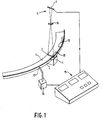
- FIG. 1 there is shown a portion 1 of the curved track of a vibratory bowl component feeder.
- Such feeders are well known in the component handling art and will not be described further. Reference may be had to the textbook "Handbook of feeding and orienting techniques for small parts" by G. Boothroyd, University of Massachusetts, for a description of bowl feeders.
- the action of the bowl feeder presents a succession of components or objects 18, in random orientation, sliding along the track against a fence 2.
- the surface of the track is inclined downwards toward the junction with the fence so that the object is maintained in registration with the fence.
- the fence defines the orientation of the component and its position across the track.
- the length of the track is inclined downwardly in the desired direction of motion of the objects. This need not be so since vibratory feeders can be designed to move objects up a sloping track.
- a slot 3 is provided in the track illuminated from below by a light box 4.
- a camera 5, comprising a lens 6 and a linear array of photodetectors 7, is provided for scanning the length of the slot and the thickness of the fence, which is increased locally to extend beyond the end of the image of the linear array.
- the portion 1 of the track in the locality of the slot 3 is mechanically separate from the remainder of the track.
- Figure 2 shows this portion of the track in more detail.
- the track portion 1 is mounted upon a linear vibratory feeder 8 which imparts a linear vibratory motion to the track portion 1 in the direction 10 along its length.
- the track portion 11 of the bowl feeder (not shown) is arranged to feed components onto the portion 1 and scanned components are fed to the track portion 12.
- the vibrator 8 is fed from a variable transformer 9.
- the amplitude of the motion 10 is adjusted so that the components are speeded up on landing on portion 1 so that they are separated, allowing each component to be scanned separately.
- the inclinations 13 and 14 of the track to the horizontal H are shown which maintain a component against the ledge and moving from right to left.
- the track of the bowl feeder alone may be used to produce component separation by incorporating slope changes in the track.
- a hump for example, will act to hold components momentarily, each component accelerating away from the others as it clears the hump.
- the camera 5 is shown only schematically as a lens 6 which images the plane of the slot 3 onto the linear array of photodetectors 7.
- the array comprises a 128 photodiode linear array sensor, for example a Reticon (Trade Mark) type RL128G.
- the lens focal length and the imaging distances are chosen in this example so that the detector separation, as imaged on the track, is 0.4mm so that 64 detectors cover a slot length of 25.6mm.
- some 64 consecutive photodiodes are sufficient to cover the maximum object width which will be encountered. It should be noted that the scan need not cover the entire vertical dimension of the object.
- the top of the object remote from the fence may contain little detail which renders the orientation of the component distinctive and may be discarded by a scan which falls short of the top of the object.
- the clock period of the array is 5 us, and the time between scans is 4ms. Most of the time between scans is used to process the results of each scan.
- each photodiode output corresponding to a brightness midway between open and obscured slot.
- the output of each photodiode is therefore reduced to a binary signal, WHITE or BLACK.
- the photodiodes are spaced apart and scans of the photodiode array take place after a finite movement of the object, the array and object movement result in a binarized picture of the whole component comprising columns of binary picture elements parallel to the array length.
- the columns of binary picture elements for the whole component are fed to a controller 15, comprising a microprocessor, within which the picture is analysed and a decision made, as will be described later, whether to accept or reject the component.
- a controller 15 comprising a microprocessor, within which the picture is analysed and a decision made, as will be described later, whether to accept or reject the component.
- an air valve 16 is opened and a jet of air through nozzle 17 is directed to remove a rejected component from the track, depositing it back in the bowl of the feeder whence it will re- emerge later along track 11, but possibly with a different orientation. Given time, all the components in the bowl will pass along track 12 with a common, desired, orientation.
- controller 15 in producing the binary sorting decision from the camera output will first be described in terms of the functions provided by the microprocessor in the controller. An outline guide to the programming of the microprocessor needed to realise these functions will then be given.
- the first function of the controller is to process the camera output to determine the position of the fence in the column of binary picture elements provided by a scan of the linear array.
- the camera is set so that the first detector of the array corresponds to a point inside the side fence of the track. Consequently the first set of detectors, up to that detector corresponding to the fence, sees black. The remainder see white except when a component passes.
- the number along the array of the first detector seeing white and to be used as the first of the column is held in store and if ever the detector preceeding that one sees white the number is reduced by one.
- the number is occasionally increased by one, for example, once for every 256 scans, and if no shift of the camera has occurred this increase of the detector number would be cancelled in the next scan, as described above.
- the number of detectors required is 64 plus an allowance for the accuracy of the initial positioning of the camera and its movement during use.
- the processor takes the camera output for the next 64 picture elements after the transition near the fence.
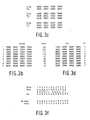
- the next function is to condense the 64 picture elements (pixels) to 16 states by taking them in blocks of 4 as shown in Figure 3a, in which the column pixels are laid out in a horizontal line for compactness. If in a block the majority are black (B) then the state is black and similarly for white (W). If there are equal numbers of black and white pixels, the state is 'don't care' (X).
- a column of condensed black/white states will be referred to as a black/white pattern.
- the arrival of a component at the slot is detected by the processor as the presence of any black states in a column. This condition initiates the cycle of events for that component.
- the controller contains no information on the components to be sorted. Consequently a learning mode is first required in which information on the wanted and unwanted orientations of the component is acquired.
- the learning mode contains three phases. In the first and last phases components are fed past the slot in the correct orientation and in the second phase in other orientations. In the first two phases the processor forms a reference table of black/white patterns representing columns of pixels which are distinguishable from one another by the order and number of black/white states which they contain. Each entry in this table is allocated a distinctive identity. In the last phase a master signature is formed of the correct orientation of the component. This signature comprises a compressed average sequence of identities which are obtained as the component passes the slot.
- the condensed black/white patterns are stored in a first table in which the number of times that that pattern has appeared is also recorded. At the start of learning this table is empty. Following each scan, the condensed pattern obtained is compared with any existing members of the table. If an exact match is found the count for that pattern is incremented by one, otherwise the new pattern is added to the table. The beginning of such a first table is shown in Figure 3b. This pattern storing continues until a predefined number of components have been scanned. Then, these patterns are taken in order of frequency of occurrence and modified to introduce a small amount of tolerance for subsequent matching processes, for example, during sorting. Generally this is done by introducing 'don't care' conditions where there are transitions between black and white.
- Figure 3c Examples of this are shown in Figure 3c.
- a condensed pattern contains a pair of blacks or a pair of whites set in a contrasting background, such a pair would be removed and replaced by a run of four 'don't care' states.
- This is avoided in Figure 3c by producing two toleranced patterns for each original pattern. In each toleranced pattern only one or the other member of such a pair has the tolerancing operation applied to it.
- the new patterns are stored in a new second table, Figure 3d, together with an identifier corresponding to the position of the source pattern in the first table.
- the toleranced patterns are stored in the same order in the new table, i.e. most frequent first.
- the second table reaches a predetermined length, for example, twenty entries.
- the number of entries in the first table depends upon the complexity of the component and fifty to two hundred entries is common in a typical system.
- the sequence of black/white patterns as scanned and condensed bears a resemblance to the component geometry.
- the sequence in the tables may bear very little resemblance to the component geometry since identical patterns may occur in widely separated parts of the component.
- the components are fed in the wrong orientations.
- simply reversing the direction of the feed will produce the same patterns as before, but in the reverse order, if the component has the same points of contact with the guiding surface at the side of the feeder.
- a new set of patterns will generally be obtained.
- the process continues as before and a new list is formed as in the first table. Again these are modified to introduce tolerances and the resulting patterns are added to the end of the second table. If a pattern obtained from a wrong orientation matches any of the existing patterns obtained from correct orientations it is ignored. A predetermined number of non-matching patterns, for example, twelve, are added to the table.
- the identifiers recorded with the patterns in this second part of the table include a code to show that they were obtained from components having wrong orientations and this is used to apply a penalty when scoring the matches during sorting.
- each black/white pattern obtained is compared to the table of thirty two patterns previously formed.
- a pattern match is indicated when every black and every white state in an entry in the reference table is matched by a correspondingly positioned state in the black/white pattern offered. No match is necessary for 'don't care' states.
- the matching attempts are started from the top of the reference table, i.e. the most frequently occurring black/ white pattern, and stop with the first successful match, although others may be possible further down the table. If no match is found the pattern offered is rejected.
- its identity, A, B, C, etc is added to a list in the order in which it occurs as the component passes the slot.
- a list of identities is obtained, referred to as a long signature of the component.
- Figure 3e shows a typical long signature.
- the length of the long signature is then reduced to give a short signature.
- the long signature will contain runs of the same identifying codes, or pixel columns. If, after some rearrangement as described below, these runs are shorter than a preset fraction, e.g. 2%, of the total signature length, they are removed from the signature. In the rest, each run is represented in the short signature by one entry of the same identifying code but this one entry is repeated if the run exceeds another preset fraction, e.g. 10%. A run of 25%, for example, would result in three entries, Figure 3(e). Before deleting short runs the following rearrangements are made to ensure a more realistic reduction in the presence of noise.
- the short signature obtained from the next component scanned is then compared and merged with the master signature. Normally the two are not identical and the second signature may have codes, or identities, not present in the master, have codes missing and have a different overall length.
- the comparison and merging are performed in two stages, see Figure 3f. First, an attempt is made to find blocks of at least three codes which appear in both signatures. The search starts from one end of the signatures and, with these ends aligned, the search for matching blocks is made.
- the learning process is automatic and builds up to the master signature from the scanned patterns by the use of these relatively simple rules. As a result if the learning _process is repeated slight differences can occur in the lists of patterns and there may be slight changes in the master signatures obtained. These variations can arise from slight differences in the components used for the learning phase, their velocities and their positions on the track. Even so, there is little effect on the discrimination obtained during sorting between different components or between components in the right and wrong orientations.
- a reference table of black/whitd patterns from components in the desired and unwanted orientations has been built up.
- a master signature of the component in the desired orientation has been formed comprising a shortened version of the average sequence of black/white patterns which occur as the component passes the scanned slot.
- the controller is now set into the sorting mode and a succession of components in various orientations scanned.
- the 64 black/white pixels from each column scan are reduced to 16 states as described with reference to Figure 3a.
- Figure 3h shows a part of the reference table in the top four rows with codes, while the bottom five rows show typical condensed scans obtained together with the code matches assigned to them.
- the identity, or code, of columns is obtained and a long signature for each component built up. The long signature is compressed to a short signature as in the learning mode.
- the short signature is now compared with the master short signature. As in the comparison of signatures in the learning mode, the two are not normally identical.
- the measure of the degree of match between master and unknown signatures which is used is the percentage of codes in the unknown signature which match the master in the corresponding order, related to the total number of codes in the unknown signature.
- the final matching score is converted to a percentage of the total number of codes in the unknown signature and if adequate then the component is accepted as being in the required orientation.
- Figure 3(g) shows an example of two block matches followed by four remaining matches making a total of 11 code matches in 13 codes, given an 84% match. Discrimination against incorrectly orientated components is improved using the fact that the reference list of black/white patterns includes some which will occur only when the component is in the incorrect orientation. In consequence these will appear in the signatures obtained from such components and, in calculating the matching score, are given a large negative value, e.g. -5.
- Figures 3j and 3k which correspond to Figures 3a and 3h respectively, show how the effect of a 'don't care' state is achieved.
- Figure 3j two condensed words, a 'black' word and a 'white' word are formed from each column.
- a group of four states containing either three or four blacks is condensed to a black or '1' in the 'black' word.
- Figure 3k shows how each identity is actually a pair of words, the 'black' word and the 'white' word.
- corresponding words are compared. The rule for a match is that for every '1' in the reference words the corresponding bit in the corresponding word of the scanned pair must be '1'. Zeros in the reference words are ignored in finding a match. This allows tolerance for small variations in the position of the objects with respect to the fence. Word pairs which find no match are ignored.
- the microprocessor used as the basis of the controller may be a single board of the type currently available on the market using 16 bit data handling. At least 1500 words of read only memory (ROM) and 2500 words of random access memory (RAM) are needed. A Philips P870 is suitable. An interface is required to the linear array camera and to the air valve for deflecting components. Control buttons are provided for setting the controller into learn and sort modes.
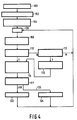
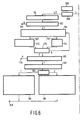
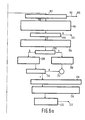
- the flow charts shown in Figures 4, 5 and 6 give an outline guide to the programming of the microprocessor.
- Figure 4 shows the basic cycle of operation of the sorter. Initially an instruction would have been given to start a learning cycle by pushing the appropriate button on the controller. Consequently on reaching the box 'LEARN' the process will move to the process shown in Figure 6.
- Figure 6 shows the flowchart for learning.
- phases 1 and 2 the component is fed in the correct and incorrect orientations respectively to enable the system to learn the types of patterns that occur and their frequency of occurrence.
- phase 3 the component has to be fed in the correct orientation and the list of patterns now in a store called REFERENCE are used to generate the long and then the short signatures.
- BW This file is condensed into a store called CAT after each component has passed. If a fast processor is used it might be possible to enter the words directly into CAT.
- the toleranced list IND is formed from CAT.
- phase 3 a long signature for each component is formed in a store called LIST.
- LIST Each word of LIST consists of the identity and the number of consecutive occurrences of that identity.
- LIST is converted to the short signature in a store SIG, and merged with the master signature being formed in a store ITEM.
- the recognition process used in the sorter described above does not explicitly use the existence of holes, edges or other specific features. Also, it does not rely upon a prior knowledge of particular dimensions of the object. Instead it develops a view of the object which incorporates both these aspects in a more general way. It requires no guidance or assistance from the operator except for the feeding of a few components in the required and wrong orientations.
- This more general view of an object which is provided by the invention could be used in sorting dissimilar objects.
- a reference table of black/ white patterns could be developed for each of the dissimilar objects, each object making a contribution to the negative fit part of the reference table of the other objects.
- a generalised recognition and classification process is provided applicable in those cases in which the objects or characters are presented in one or only a few well defined orientations.
- the camera comprised a linear array of photodiodes moving transversely relative to the object to scan the field within which the object is located.
- a television camera may be used, avoiding the need for relative movement.
- the video output of the camera is then thresholded and sampled at discrete intervals along the lines of the television raster to produce the rows of the binarized picture, the columns being provided by corresponding samples in the lines.
- the television camera may be used when it is convenient to 'freeze' the object with only one frame scan of the raster.
- the lines of the television raster may be used as the columns of the present invention, the frame scan of the raster providing the effect of component motion.
- the reference table and the master signature could be stored in an electrically erasable programmable read only memory (EEP-ROM) so that this information is not lost when the system is switched off.
- EEP-ROM electrically erasable programmable read only memory
- the tables and signatures of several different components could be built up gradually, but accessed immediately without need for learning when there is a change in the component to be sorted.
Landscapes
- Image Analysis (AREA)
- Sorting Of Articles (AREA)
- Length Measuring Devices By Optical Means (AREA)
- Investigating Materials By The Use Of Optical Means Adapted For Particular Applications (AREA)
Claims (27)
Applications Claiming Priority (2)
| Application Number | Priority Date | Filing Date | Title |
|---|---|---|---|
| GB8400436 | 1984-01-09 | ||
| GB08400436A GB2152658A (en) | 1984-01-09 | 1984-01-09 | Object sorting system |
Publications (2)
| Publication Number | Publication Date |
|---|---|
| EP0148535A1 EP0148535A1 (fr) | 1985-07-17 |
| EP0148535B1 true EP0148535B1 (fr) | 1990-03-07 |
Family
ID=10554712
Family Applications (1)
| Application Number | Title | Priority Date | Filing Date |
|---|---|---|---|
| EP84201932A Expired - Lifetime EP0148535B1 (fr) | 1984-01-09 | 1984-12-24 | Système pour trier des objets |
Country Status (5)
| Country | Link |
|---|---|
| US (1) | US5111411A (fr) |
| EP (1) | EP0148535B1 (fr) |
| JP (1) | JPS60216877A (fr) |
| DE (1) | DE3481487D1 (fr) |
| GB (1) | GB2152658A (fr) |
Families Citing this family (17)
| Publication number | Priority date | Publication date | Assignee | Title |
|---|---|---|---|---|
| GB8523567D0 (en) * | 1985-09-24 | 1985-10-30 | Rhoden Partners Ltd | Sorting articles |
| DK155274C (da) * | 1986-05-30 | 1989-07-31 | Stormax Int As | Apparat til kontrol af traeemne |
| US5157486A (en) * | 1990-09-21 | 1992-10-20 | Fmc Corporation | High resolution camera sensor having a linear pixel array |
| US5142591A (en) * | 1990-09-21 | 1992-08-25 | Fmc Corporation | High resolution camera with hardware data compaction |
| AU645123B2 (en) * | 1990-09-24 | 1994-01-06 | Fmc Corporation | Automatic windowing for article recognition |
| JPH04283052A (ja) * | 1990-09-25 | 1992-10-08 | Fmc Corp | 高分解物品取扱い装置 |
| WO1994028397A1 (fr) * | 1993-05-28 | 1994-12-08 | Axiom Bildverarbeitungssysteme Gmbh | Dispositif d'inspection automatique |
| US5768421A (en) * | 1995-09-12 | 1998-06-16 | Gaffin; Arthur Zay | Visual imaging system and method |
| US6625317B1 (en) | 1995-09-12 | 2003-09-23 | Art Gaffin | Visual imaging system and method |
| JP4071866B2 (ja) * | 1998-07-31 | 2008-04-02 | イビデン株式会社 | 配線パターン検査装置 |
| US6459448B1 (en) | 2000-04-19 | 2002-10-01 | K-G Devices Corporation | System and method for automatically inspecting arrays of geometric targets |
| US7451146B2 (en) * | 2004-06-30 | 2008-11-11 | Hewlett-Packard Development Company, L.P. | Almost non-blocking linked stack implementation |
| DE102007057921A1 (de) * | 2007-12-01 | 2009-06-04 | Oerlikon Textile Gmbh & Co. Kg | Verfahren und Vorrichtung zum automatisierten Identifizieren von Spulenhülsen |
| WO2010057505A1 (fr) * | 2008-11-20 | 2010-05-27 | Université De Neuchâtel | Version déterministe du procédé de simulation/reconstruction de géostatistique à points multiples avec laquelle les valeurs simulées/reconstruites sont directement issues des images d'entraînement sans estimation antérieure de la condition |
| DE102011054452A1 (de) * | 2011-10-13 | 2013-04-18 | How To Organize (H2O) Gmbh | Vorrichtung und Verfahren zum Zusammenstellen von Instrumentensets |
| US8818030B2 (en) * | 2011-12-13 | 2014-08-26 | Xerox Corporation | Post-processing a multi-spectral image for enhanced object identification |
| CN111152998B (zh) * | 2019-12-21 | 2022-05-20 | 扬州工业职业技术学院 | 基于机器视觉系统的包装检测流水线 |
Citations (2)
| Publication number | Priority date | Publication date | Assignee | Title |
|---|---|---|---|---|
| DE2507173A1 (de) * | 1975-02-20 | 1977-02-03 | Object Recognition Systems | Verfahren und vorrichtung zur herstellung einer digitalen repraesentation eines objektes |
| EP0054596A1 (fr) * | 1980-12-18 | 1982-06-30 | International Business Machines Corporation | Procédé d'inspection et de tri automatique d'objets présentant des configurations avec des tolérances dimensionnelles et des critères de rejet variables selon l'emplacement, équipement et circuits de mise en oeuvre |
Family Cites Families (31)
| Publication number | Priority date | Publication date | Assignee | Title |
|---|---|---|---|---|
| DE1549834B2 (de) * | 1967-11-02 | 1976-04-01 | Philips Patentverwaltung Gmbh, 2000 Hamburg | Abtasteinrichtung fuer geraete zur automatischen zeichenerkennung |
| DE1774314B1 (de) * | 1968-05-22 | 1972-03-23 | Standard Elek K Lorenz Ag | Einrichtung zur maschinellen zeichenerkennung |
| US3860909A (en) * | 1970-04-16 | 1975-01-14 | Olivetti & Co Spa | Apparatus for recognising graphic symbols |
| US3639728A (en) * | 1970-07-17 | 1972-02-01 | Scan Systems Inc | Material container sorting apparatus and method |
| US3761876A (en) * | 1971-07-28 | 1973-09-25 | Recognition Equipment Inc | Recognition unit for optical character reading system |
| US3868635A (en) * | 1972-12-15 | 1975-02-25 | Optical Recognition Systems | Feature enhancement character recognition system |
| DE2534224C2 (de) * | 1975-07-31 | 1983-07-14 | Pietzsch, Ludwig, Dr.-Ing., 7500 Karlsruhe | Verfahren zum Identifizieren eines Werkstückes und Vorrichtung zum Durchführen des Verfahrens |
| US4041286A (en) * | 1975-11-20 | 1977-08-09 | The Bendix Corporation | Method and apparatus for detecting characteristic features of surfaces |
| US4333558A (en) * | 1976-05-06 | 1982-06-08 | Shinko Electric Co., Ltd. | Photoelectric control system for parts orientation |
| JPS5911152B2 (ja) * | 1976-10-19 | 1984-03-13 | 肇産業株式会社 | パタ−ンマツチング方法及びその実施装置 |
| US4155072A (en) * | 1976-12-17 | 1979-05-15 | Ricoh Company, Ltd. | Character recognition apparatus |
| US4132314A (en) * | 1977-06-13 | 1979-01-02 | Joerg Walter VON Beckmann | Electronic size and color sorter |
| US4187545A (en) * | 1978-02-28 | 1980-02-05 | Frank Hamachek Machine Company | Article orientation determining apparatus |
| JPS5847064B2 (ja) * | 1978-07-08 | 1983-10-20 | 工業技術院長 | 文字読取方式 |
| US4208652A (en) * | 1978-09-14 | 1980-06-17 | A. C. Nielsen Company | Method and apparatus for identifying images |
| JPS5915381B2 (ja) * | 1978-10-16 | 1984-04-09 | 日本電信電話株式会社 | パタ−ン検査法 |
| DE2916862C2 (de) * | 1979-04-26 | 1984-12-20 | Robert Bosch Gmbh, 7000 Stuttgart | Einrichtung zum Prüfen der richtigen Lage und/oder Maße eines sich bewegenden Teils |
| DE3070433D1 (en) * | 1980-12-18 | 1985-05-09 | Ibm | Method for the inspection and automatic sorting of objects with configurations of fixed dimensional tolerances, and device for carrying out the method |
| US4414566A (en) * | 1981-04-03 | 1983-11-08 | Industrial Automation Corporation | Sorting and inspection apparatus and method |
| US4490848A (en) * | 1982-03-31 | 1984-12-25 | General Electric Company | Method and apparatus for sorting corner points in a visual image processing system |
| US4567610A (en) * | 1982-07-22 | 1986-01-28 | Wayland Research Inc. | Method of and apparatus for pattern recognition |
| JPS5951536A (ja) * | 1982-09-14 | 1984-03-26 | Fujitsu Ltd | パタ−ン認識方法及びその装置 |
| US4589140A (en) * | 1983-03-21 | 1986-05-13 | Beltronics, Inc. | Method of and apparatus for real-time high-speed inspection of objects for identifying or recognizing known and unknown portions thereof, including defects and the like |
| JPH061370B2 (ja) * | 1983-11-24 | 1994-01-05 | 株式会社東芝 | マスク欠陥検査装置 |
| US4581762A (en) * | 1984-01-19 | 1986-04-08 | Itran Corporation | Vision inspection system |
| US4606065A (en) * | 1984-02-09 | 1986-08-12 | Imaging Technology Incorporated | Image processing-system |
| US4624367A (en) * | 1984-04-20 | 1986-11-25 | Shafer John L | Method and apparatus for determining conformity of a predetermined shape related characteristics of an object or stream of objects by shape analysis |
| JPS6140684A (ja) * | 1984-07-31 | 1986-02-26 | Omron Tateisi Electronics Co | 輪郭追跡装置 |
| US4648053A (en) * | 1984-10-30 | 1987-03-03 | Kollmorgen Technologies, Corp. | High speed optical inspection system |
| US4687107A (en) * | 1985-05-02 | 1987-08-18 | Pennwalt Corporation | Apparatus for sizing and sorting articles |
| US4784493A (en) * | 1986-06-11 | 1988-11-15 | Fmc Corporation | Element recognition and orientation |
-
1984
- 1984-01-09 GB GB08400436A patent/GB2152658A/en not_active Withdrawn
- 1984-12-24 EP EP84201932A patent/EP0148535B1/fr not_active Expired - Lifetime
- 1984-12-24 DE DE8484201932T patent/DE3481487D1/de not_active Expired - Lifetime
-
1985
- 1985-01-08 JP JP60000483A patent/JPS60216877A/ja active Pending
-
1988
- 1988-08-01 US US07/226,565 patent/US5111411A/en not_active Expired - Fee Related
Patent Citations (2)
| Publication number | Priority date | Publication date | Assignee | Title |
|---|---|---|---|---|
| DE2507173A1 (de) * | 1975-02-20 | 1977-02-03 | Object Recognition Systems | Verfahren und vorrichtung zur herstellung einer digitalen repraesentation eines objektes |
| EP0054596A1 (fr) * | 1980-12-18 | 1982-06-30 | International Business Machines Corporation | Procédé d'inspection et de tri automatique d'objets présentant des configurations avec des tolérances dimensionnelles et des critères de rejet variables selon l'emplacement, équipement et circuits de mise en oeuvre |
Also Published As
| Publication number | Publication date |
|---|---|
| JPS60216877A (ja) | 1985-10-30 |
| DE3481487D1 (de) | 1990-04-12 |
| US5111411A (en) | 1992-05-05 |
| GB2152658A (en) | 1985-08-07 |
| EP0148535A1 (fr) | 1985-07-17 |
Similar Documents
| Publication | Publication Date | Title |
|---|---|---|
| EP0148535B1 (fr) | Système pour trier des objets | |
| US4910787A (en) | Discriminator between handwritten and machine-printed characters | |
| US6640009B2 (en) | Identification, separation and compression of multiple forms with mutants | |
| EP0372762B1 (fr) | Extraction de données de minuties en identification d'empreintes digitales | |
| CA1121914A (fr) | Systeme d'identification | |
| US7356162B2 (en) | Method for sorting postal items in a plurality of sorting passes | |
| EP0481979B1 (fr) | Reconnaissance de documents et indexage automatique pour la reconnaissance optique de caracteres | |
| US4757551A (en) | Character recognition method and system capable of recognizing slant characters | |
| US5311977A (en) | High resolution parts handling system | |
| US4104616A (en) | Hand operated optical character recognition system | |
| EP1073002A2 (fr) | Procédé d'extraction de caractères | |
| EP0717365B1 (fr) | Appareil pour la détection de lignes linéaires au moyen de l'image de la projection de chaínes de caractères (ligne linéaire inclue) | |
| EP0375352A1 (fr) | Procédé pour chercher une matrice de données binaires | |
| CA1214561A (fr) | Methode et appareil de reconnaissance des caracteres | |
| EP0076332A1 (fr) | Lecteur optique de caractères comprenant un dispositif de pré-balayage | |
| GB2248931A (en) | High resolution parts handling system | |
| JPS6133233B2 (fr) | ||
| JPH11184965A (ja) | 帳票識別登録装置 | |
| JPH06187450A (ja) | パターン認識方法と認識装置 | |
| AU2001282462A1 (en) | Identification, separation and compression of multiple forms with mutants | |
| JPH06278834A (ja) | 紙葉類処理装置 | |
| JPS58219681A (ja) | 文字パタ−ンの基準位置決定法 | |
| JPS60252205A (ja) | 移動物体の方向識別装置 | |
| JPH0145102B2 (fr) | ||
| JPH02168365A (ja) | 文字列及び文字の切り出し方法 |
Legal Events
| Date | Code | Title | Description |
|---|---|---|---|
| PUAI | Public reference made under article 153(3) epc to a published international application that has entered the european phase |
Free format text: ORIGINAL CODE: 0009012 |
|
| AK | Designated contracting states |
Designated state(s): DE FR GB IT |
|
| 17P | Request for examination filed |
Effective date: 19851129 |
|
| 17Q | First examination report despatched |
Effective date: 19870429 |
|
| RAP3 | Party data changed (applicant data changed or rights of an application transferred) |
Owner name: N.V. PHILIPS' GLOEILAMPENFABRIEKEN Owner name: PHILIPS ELECTRONIC AND ASSOCIATED INDUSTRIES LIMIT |
|
| GRAA | (expected) grant |
Free format text: ORIGINAL CODE: 0009210 |
|
| AK | Designated contracting states |
Kind code of ref document: B1 Designated state(s): DE FR GB IT |
|
| REF | Corresponds to: |
Ref document number: 3481487 Country of ref document: DE Date of ref document: 19900412 |
|
| ITF | It: translation for a ep patent filed | ||
| ET | Fr: translation filed | ||
| PGFP | Annual fee paid to national office [announced via postgrant information from national office to epo] |
Ref country code: GB Payment date: 19901130 Year of fee payment: 7 |
|
| PGFP | Annual fee paid to national office [announced via postgrant information from national office to epo] |
Ref country code: FR Payment date: 19901218 Year of fee payment: 7 |
|
| PLBE | No opposition filed within time limit |
Free format text: ORIGINAL CODE: 0009261 |
|
| STAA | Information on the status of an ep patent application or granted ep patent |
Free format text: STATUS: NO OPPOSITION FILED WITHIN TIME LIMIT |
|
| ITTA | It: last paid annual fee | ||
| 26N | No opposition filed | ||
| PGFP | Annual fee paid to national office [announced via postgrant information from national office to epo] |
Ref country code: DE Payment date: 19910225 Year of fee payment: 7 |
|
| PG25 | Lapsed in a contracting state [announced via postgrant information from national office to epo] |
Ref country code: GB Effective date: 19911224 |
|
| GBPC | Gb: european patent ceased through non-payment of renewal fee | ||
| PG25 | Lapsed in a contracting state [announced via postgrant information from national office to epo] |
Ref country code: FR Effective date: 19920831 |
|
| PG25 | Lapsed in a contracting state [announced via postgrant information from national office to epo] |
Ref country code: DE Effective date: 19920901 |
|
| REG | Reference to a national code |
Ref country code: FR Ref legal event code: ST |