EP0150555B1 - Cartridge for use in fixing an anchor bolt and method of using the cartridge - Google Patents
Cartridge for use in fixing an anchor bolt and method of using the cartridge Download PDFInfo
- Publication number
- EP0150555B1 EP0150555B1 EP84305141A EP84305141A EP0150555B1 EP 0150555 B1 EP0150555 B1 EP 0150555B1 EP 84305141 A EP84305141 A EP 84305141A EP 84305141 A EP84305141 A EP 84305141A EP 0150555 B1 EP0150555 B1 EP 0150555B1
- Authority
- EP
- European Patent Office
- Prior art keywords
- resin
- anchor bolt
- cartridge
- casing
- curing agent
- Prior art date
- Legal status (The legal status is an assumption and is not a legal conclusion. Google has not performed a legal analysis and makes no representation as to the accuracy of the status listed.)
- Expired
Links
- 238000000034 method Methods 0.000 title claims description 31
- 229920005989 resin Polymers 0.000 claims description 89
- 239000011347 resin Substances 0.000 claims description 89
- 239000000853 adhesive Substances 0.000 claims description 75
- 230000001070 adhesive effect Effects 0.000 claims description 75
- 239000003795 chemical substances by application Substances 0.000 claims description 49
- 239000003822 epoxy resin Substances 0.000 claims description 43
- 229920000647 polyepoxide Polymers 0.000 claims description 43
- 239000000203 mixture Substances 0.000 claims description 39
- 239000000178 monomer Substances 0.000 claims description 25
- IISBACLAFKSPIT-UHFFFAOYSA-N bisphenol A Chemical compound C=1C=C(O)C=CC=1C(C)(C)C1=CC=C(O)C=C1 IISBACLAFKSPIT-UHFFFAOYSA-N 0.000 claims description 24
- 239000000126 substance Substances 0.000 claims description 16
- 238000000638 solvent extraction Methods 0.000 claims description 12
- XLYOFNOQVPJJNP-UHFFFAOYSA-N water Substances O XLYOFNOQVPJJNP-UHFFFAOYSA-N 0.000 claims description 12
- NIXOWILDQLNWCW-UHFFFAOYSA-N 2-Propenoic acid Natural products OC(=O)C=C NIXOWILDQLNWCW-UHFFFAOYSA-N 0.000 claims description 10
- CERQOIWHTDAKMF-UHFFFAOYSA-N Methacrylic acid Chemical compound CC(=C)C(O)=O CERQOIWHTDAKMF-UHFFFAOYSA-N 0.000 claims description 10
- LNEPOXFFQSENCJ-UHFFFAOYSA-N haloperidol Chemical compound C1CC(O)(C=2C=CC(Cl)=CC=2)CCN1CCCC(=O)C1=CC=C(F)C=C1 LNEPOXFFQSENCJ-UHFFFAOYSA-N 0.000 claims description 10
- SMZOUWXMTYCWNB-UHFFFAOYSA-N 2-(2-methoxy-5-methylphenyl)ethanamine Chemical compound COC1=CC=C(C)C=C1CCN SMZOUWXMTYCWNB-UHFFFAOYSA-N 0.000 claims description 9
- 150000002148 esters Chemical class 0.000 claims description 9
- 150000007524 organic acids Chemical class 0.000 claims description 7
- PXKLMJQFEQBVLD-UHFFFAOYSA-N bisphenol F Chemical compound C1=CC(O)=CC=C1CC1=CC=C(O)C=C1 PXKLMJQFEQBVLD-UHFFFAOYSA-N 0.000 claims description 6
- WFUGQJXVXHBTEM-UHFFFAOYSA-N 2-hydroperoxy-2-(2-hydroperoxybutan-2-ylperoxy)butane Chemical compound CCC(C)(OO)OOC(C)(CC)OO WFUGQJXVXHBTEM-UHFFFAOYSA-N 0.000 claims description 5
- 239000004342 Benzoyl peroxide Substances 0.000 claims description 5
- OMPJBNCRMGITSC-UHFFFAOYSA-N Benzoylperoxide Chemical compound C=1C=CC=CC=1C(=O)OOC(=O)C1=CC=CC=C1 OMPJBNCRMGITSC-UHFFFAOYSA-N 0.000 claims description 5
- 235000019400 benzoyl peroxide Nutrition 0.000 claims description 5
- 238000010276 construction Methods 0.000 claims description 5
- RTZKZFJDLAIYFH-UHFFFAOYSA-N Diethyl ether Chemical compound CCOCC RTZKZFJDLAIYFH-UHFFFAOYSA-N 0.000 claims description 4
- KFSLWBXXFJQRDL-UHFFFAOYSA-N Peracetic acid Chemical compound CC(=O)OO KFSLWBXXFJQRDL-UHFFFAOYSA-N 0.000 claims description 4
- 150000001451 organic peroxides Chemical group 0.000 claims description 4
- VVQNEPGJFQJSBK-UHFFFAOYSA-N Methyl methacrylate Chemical compound COC(=O)C(C)=C VVQNEPGJFQJSBK-UHFFFAOYSA-N 0.000 claims description 3
- CQEYYJKEWSMYFG-UHFFFAOYSA-N butyl acrylate Chemical compound CCCCOC(=O)C=C CQEYYJKEWSMYFG-UHFFFAOYSA-N 0.000 claims description 3
- UICXTANXZJJIBC-UHFFFAOYSA-N 1-(1-hydroperoxycyclohexyl)peroxycyclohexan-1-ol Chemical compound C1CCCCC1(O)OOC1(OO)CCCCC1 UICXTANXZJJIBC-UHFFFAOYSA-N 0.000 claims description 2
- XMNIXWIUMCBBBL-UHFFFAOYSA-N 2-(2-phenylpropan-2-ylperoxy)propan-2-ylbenzene Chemical compound C=1C=CC=CC=1C(C)(C)OOC(C)(C)C1=CC=CC=C1 XMNIXWIUMCBBBL-UHFFFAOYSA-N 0.000 claims description 2
- SBYMUDUGTIKLCR-UHFFFAOYSA-N 2-chloroethenylbenzene Chemical compound ClC=CC1=CC=CC=C1 SBYMUDUGTIKLCR-UHFFFAOYSA-N 0.000 claims description 2
- FRIBMENBGGCKPD-UHFFFAOYSA-N 3-(2,3-dimethoxyphenyl)prop-2-enal Chemical compound COC1=CC=CC(C=CC=O)=C1OC FRIBMENBGGCKPD-UHFFFAOYSA-N 0.000 claims description 2
- 229930185605 Bisphenol Natural products 0.000 claims description 2
- 239000004641 Diallyl-phthalate Substances 0.000 claims description 2
- YIVJZNGAASQVEM-UHFFFAOYSA-N Lauroyl peroxide Chemical compound CCCCCCCCCCCC(=O)OOC(=O)CCCCCCCCCCC YIVJZNGAASQVEM-UHFFFAOYSA-N 0.000 claims description 2
- QUDWYFHPNIMBFC-UHFFFAOYSA-N bis(prop-2-enyl) benzene-1,2-dicarboxylate Chemical compound C=CCOC(=O)C1=CC=CC=C1C(=O)OCC=C QUDWYFHPNIMBFC-UHFFFAOYSA-N 0.000 claims description 2
- 238000005553 drilling Methods 0.000 claims description 2
- 230000003647 oxidation Effects 0.000 claims description 2
- 238000007254 oxidation reaction Methods 0.000 claims description 2
- 150000002978 peroxides Chemical class 0.000 claims description 2
- 150000008442 polyphenolic compounds Chemical class 0.000 claims description 2
- 235000013824 polyphenols Nutrition 0.000 claims description 2
- HJWLCRVIBGQPNF-UHFFFAOYSA-N prop-2-enylbenzene Chemical compound C=CCC1=CC=CC=C1 HJWLCRVIBGQPNF-UHFFFAOYSA-N 0.000 claims description 2
- BWSZXUOMATYHHI-UHFFFAOYSA-N tert-butyl octaneperoxoate Chemical compound CCCCCCCC(=O)OOC(C)(C)C BWSZXUOMATYHHI-UHFFFAOYSA-N 0.000 claims description 2
- 125000003236 benzoyl group Chemical group [H]C1=C([H])C([H])=C(C([H])=C1[H])C(*)=O 0.000 claims 1
- 239000002585 base Substances 0.000 description 68
- KCTAWXVAICEBSD-UHFFFAOYSA-N prop-2-enoyloxy prop-2-eneperoxoate Chemical compound C=CC(=O)OOOC(=O)C=C KCTAWXVAICEBSD-UHFFFAOYSA-N 0.000 description 37
- 239000004925 Acrylic resin Substances 0.000 description 31
- PPBRXRYQALVLMV-UHFFFAOYSA-N Styrene Chemical compound C=CC1=CC=CC=C1 PPBRXRYQALVLMV-UHFFFAOYSA-N 0.000 description 24
- 239000012615 aggregate Substances 0.000 description 17
- 239000003513 alkali Substances 0.000 description 15
- 239000000945 filler Substances 0.000 description 13
- 239000011521 glass Substances 0.000 description 11
- 238000012360 testing method Methods 0.000 description 10
- 239000006260 foam Substances 0.000 description 8
- 238000005470 impregnation Methods 0.000 description 8
- 229920003002 synthetic resin Polymers 0.000 description 8
- 239000000057 synthetic resin Substances 0.000 description 8
- 238000006073 displacement reaction Methods 0.000 description 7
- 229920006337 unsaturated polyester resin Polymers 0.000 description 7
- 239000002253 acid Substances 0.000 description 6
- 238000006116 polymerization reaction Methods 0.000 description 6
- QIGBRXMKCJKVMJ-UHFFFAOYSA-N Hydroquinone Chemical compound OC1=CC=C(O)C=C1 QIGBRXMKCJKVMJ-UHFFFAOYSA-N 0.000 description 5
- 150000001875 compounds Chemical class 0.000 description 5
- 239000004615 ingredient Substances 0.000 description 5
- 239000003112 inhibitor Substances 0.000 description 5
- 230000002035 prolonged effect Effects 0.000 description 5
- 229920002050 silicone resin Polymers 0.000 description 5
- CPLXHLVBOLITMK-UHFFFAOYSA-N Magnesium oxide Chemical compound [Mg]=O CPLXHLVBOLITMK-UHFFFAOYSA-N 0.000 description 4
- JLTDJTHDQAWBAV-UHFFFAOYSA-N N,N-dimethylaniline Chemical compound CN(C)C1=CC=CC=C1 JLTDJTHDQAWBAV-UHFFFAOYSA-N 0.000 description 4
- OSGAYBCDTDRGGQ-UHFFFAOYSA-L calcium sulfate Chemical compound [Ca+2].[O-]S([O-])(=O)=O OSGAYBCDTDRGGQ-UHFFFAOYSA-L 0.000 description 4
- 230000006835 compression Effects 0.000 description 4
- 238000007906 compression Methods 0.000 description 4
- -1 diglycidyl phthalate Chemical compound 0.000 description 4
- 239000000463 material Substances 0.000 description 4
- 238000005259 measurement Methods 0.000 description 4
- 238000002156 mixing Methods 0.000 description 4
- KUBDPQJOLOUJRM-UHFFFAOYSA-N 2-(chloromethyl)oxirane;4-[2-(4-hydroxyphenyl)propan-2-yl]phenol Chemical compound ClCC1CO1.C=1C=C(O)C=CC=1C(C)(C)C1=CC=C(O)C=C1 KUBDPQJOLOUJRM-UHFFFAOYSA-N 0.000 description 3
- DNIAPMSPPWPWGF-UHFFFAOYSA-N Propylene glycol Chemical compound CC(O)CO DNIAPMSPPWPWGF-UHFFFAOYSA-N 0.000 description 3
- 125000003700 epoxy group Chemical group 0.000 description 3
- 238000002844 melting Methods 0.000 description 3
- 230000008018 melting Effects 0.000 description 3
- 238000009527 percussion Methods 0.000 description 3
- CBPYOHALYYGNOE-UHFFFAOYSA-M potassium;3,5-dinitrobenzoate Chemical compound [K+].[O-]C(=O)C1=CC([N+]([O-])=O)=CC([N+]([O-])=O)=C1 CBPYOHALYYGNOE-UHFFFAOYSA-M 0.000 description 3
- 238000003756 stirring Methods 0.000 description 3
- VZCYOOQTPOCHFL-UHFFFAOYSA-N trans-butenedioic acid Natural products OC(=O)C=CC(O)=O VZCYOOQTPOCHFL-UHFFFAOYSA-N 0.000 description 3
- AZQWKYJCGOJGHM-UHFFFAOYSA-N 1,4-benzoquinone Chemical compound O=C1C=CC(=O)C=C1 AZQWKYJCGOJGHM-UHFFFAOYSA-N 0.000 description 2
- 239000004593 Epoxy Substances 0.000 description 2
- VZCYOOQTPOCHFL-OWOJBTEDSA-N Fumaric acid Chemical compound OC(=O)\C=C\C(O)=O VZCYOOQTPOCHFL-OWOJBTEDSA-N 0.000 description 2
- OFOBLEOULBTSOW-UHFFFAOYSA-N Propanedioic acid Natural products OC(=O)CC(O)=O OFOBLEOULBTSOW-UHFFFAOYSA-N 0.000 description 2
- WNLRTRBMVRJNCN-UHFFFAOYSA-N adipic acid Chemical compound OC(=O)CCCCC(O)=O WNLRTRBMVRJNCN-UHFFFAOYSA-N 0.000 description 2
- 239000012298 atmosphere Substances 0.000 description 2
- JRPRCOLKIYRSNH-UHFFFAOYSA-N bis(oxiran-2-ylmethyl) benzene-1,2-dicarboxylate Chemical compound C=1C=CC=C(C(=O)OCC2OC2)C=1C(=O)OCC1CO1 JRPRCOLKIYRSNH-UHFFFAOYSA-N 0.000 description 2
- 150000001732 carboxylic acid derivatives Chemical class 0.000 description 2
- 230000000052 comparative effect Effects 0.000 description 2
- GYZLOYUZLJXAJU-UHFFFAOYSA-N diglycidyl ether Chemical compound C1OC1COCC1CO1 GYZLOYUZLJXAJU-UHFFFAOYSA-N 0.000 description 2
- 238000003780 insertion Methods 0.000 description 2
- 230000037431 insertion Effects 0.000 description 2
- 239000000395 magnesium oxide Substances 0.000 description 2
- VZCYOOQTPOCHFL-UPHRSURJSA-N maleic acid Chemical compound OC(=O)\C=C/C(O)=O VZCYOOQTPOCHFL-UPHRSURJSA-N 0.000 description 2
- 239000011976 maleic acid Substances 0.000 description 2
- GEMHFKXPOCTAIP-UHFFFAOYSA-N n,n-dimethyl-n'-phenylcarbamimidoyl chloride Chemical compound CN(C)C(Cl)=NC1=CC=CC=C1 GEMHFKXPOCTAIP-UHFFFAOYSA-N 0.000 description 2
- XNGIFLGASWRNHJ-UHFFFAOYSA-N phthalic acid Chemical compound OC(=O)C1=CC=CC=C1C(O)=O XNGIFLGASWRNHJ-UHFFFAOYSA-N 0.000 description 2
- 229920000642 polymer Polymers 0.000 description 2
- 239000011435 rock Substances 0.000 description 2
- 229920002554 vinyl polymer Polymers 0.000 description 2
- FSJSYDFBTIVUFD-SUKNRPLKSA-N (z)-4-hydroxypent-3-en-2-one;oxovanadium Chemical compound [V]=O.C\C(O)=C\C(C)=O.C\C(O)=C\C(C)=O FSJSYDFBTIVUFD-SUKNRPLKSA-N 0.000 description 1
- JZODKRWQWUWGCD-UHFFFAOYSA-N 2,5-di-tert-butylbenzene-1,4-diol Chemical compound CC(C)(C)C1=CC(O)=C(C(C)(C)C)C=C1O JZODKRWQWUWGCD-UHFFFAOYSA-N 0.000 description 1
- JAHNSTQSQJOJLO-UHFFFAOYSA-N 2-(3-fluorophenyl)-1h-imidazole Chemical compound FC1=CC=CC(C=2NC=CN=2)=C1 JAHNSTQSQJOJLO-UHFFFAOYSA-N 0.000 description 1
- MMEDJBFVJUFIDD-UHFFFAOYSA-N 2-[2-(carboxymethyl)phenyl]acetic acid Chemical compound OC(=O)CC1=CC=CC=C1CC(O)=O MMEDJBFVJUFIDD-UHFFFAOYSA-N 0.000 description 1
- 125000003903 2-propenyl group Chemical group [H]C([*])([H])C([H])=C([H])[H] 0.000 description 1
- VEORPZCZECFIRK-UHFFFAOYSA-N 3,3',5,5'-tetrabromobisphenol A Chemical compound C=1C(Br)=C(O)C(Br)=CC=1C(C)(C)C1=CC(Br)=C(O)C(Br)=C1 VEORPZCZECFIRK-UHFFFAOYSA-N 0.000 description 1
- JIGUICYYOYEXFS-UHFFFAOYSA-N 3-tert-butylbenzene-1,2-diol Chemical compound CC(C)(C)C1=CC=CC(O)=C1O JIGUICYYOYEXFS-UHFFFAOYSA-N 0.000 description 1
- NKFIBMOQAPEKNZ-UHFFFAOYSA-N 5-amino-1h-indole-2-carboxylic acid Chemical compound NC1=CC=C2NC(C(O)=O)=CC2=C1 NKFIBMOQAPEKNZ-UHFFFAOYSA-N 0.000 description 1
- BVKZGUZCCUSVTD-UHFFFAOYSA-L Carbonate Chemical compound [O-]C([O-])=O BVKZGUZCCUSVTD-UHFFFAOYSA-L 0.000 description 1
- JOYRKODLDBILNP-UHFFFAOYSA-N Ethyl urethane Chemical compound CCOC(N)=O JOYRKODLDBILNP-UHFFFAOYSA-N 0.000 description 1
- 239000004952 Polyamide Substances 0.000 description 1
- VYPSYNLAJGMNEJ-UHFFFAOYSA-N Silicium dioxide Chemical compound O=[Si]=O VYPSYNLAJGMNEJ-UHFFFAOYSA-N 0.000 description 1
- 150000007513 acids Chemical class 0.000 description 1
- 239000000654 additive Substances 0.000 description 1
- 239000001361 adipic acid Substances 0.000 description 1
- 235000011037 adipic acid Nutrition 0.000 description 1
- 230000002411 adverse Effects 0.000 description 1
- 125000001931 aliphatic group Chemical group 0.000 description 1
- 150000001412 amines Chemical class 0.000 description 1
- 239000007864 aqueous solution Substances 0.000 description 1
- 239000002969 artificial stone Substances 0.000 description 1
- 230000004323 axial length Effects 0.000 description 1
- AXCZMVOFGPJBDE-UHFFFAOYSA-L calcium dihydroxide Chemical compound [OH-].[OH-].[Ca+2] AXCZMVOFGPJBDE-UHFFFAOYSA-L 0.000 description 1
- 239000000920 calcium hydroxide Substances 0.000 description 1
- 229910001861 calcium hydroxide Inorganic materials 0.000 description 1
- 239000000919 ceramic Substances 0.000 description 1
- 239000013522 chelant Substances 0.000 description 1
- 238000006243 chemical reaction Methods 0.000 description 1
- 239000004927 clay Substances 0.000 description 1
- 230000008878 coupling Effects 0.000 description 1
- 238000010168 coupling process Methods 0.000 description 1
- 238000005859 coupling reaction Methods 0.000 description 1
- 150000001991 dicarboxylic acids Chemical class 0.000 description 1
- GGSUCNLOZRCGPQ-UHFFFAOYSA-N diethylaniline Chemical compound CCN(CC)C1=CC=CC=C1 GGSUCNLOZRCGPQ-UHFFFAOYSA-N 0.000 description 1
- 230000000694 effects Effects 0.000 description 1
- 239000001530 fumaric acid Substances 0.000 description 1
- 238000007654 immersion Methods 0.000 description 1
- 238000010348 incorporation Methods 0.000 description 1
- 238000007373 indentation Methods 0.000 description 1
- 230000002452 interceptive effect Effects 0.000 description 1
- LZKLAOYSENRNKR-LNTINUHCSA-N iron;(z)-4-oxoniumylidenepent-2-en-2-olate Chemical compound [Fe].C\C(O)=C\C(C)=O.C\C(O)=C\C(C)=O.C\C(O)=C\C(C)=O LZKLAOYSENRNKR-LNTINUHCSA-N 0.000 description 1
- 239000012948 isocyanate Substances 0.000 description 1
- 150000002513 isocyanates Chemical class 0.000 description 1
- SGGOJYZMTYGPCH-UHFFFAOYSA-L manganese(2+);naphthalene-2-carboxylate Chemical compound [Mn+2].C1=CC=CC2=CC(C(=O)[O-])=CC=C21.C1=CC=CC2=CC(C(=O)[O-])=CC=C21 SGGOJYZMTYGPCH-UHFFFAOYSA-L 0.000 description 1
- LVHBHZANLOWSRM-UHFFFAOYSA-N methylenebutanedioic acid Natural products OC(=O)CC(=C)C(O)=O LVHBHZANLOWSRM-UHFFFAOYSA-N 0.000 description 1
- 150000002763 monocarboxylic acids Chemical class 0.000 description 1
- 238000000465 moulding Methods 0.000 description 1
- GYVGXEWAOAAJEU-UHFFFAOYSA-N n,n,4-trimethylaniline Chemical compound CN(C)C1=CC=C(C)C=C1 GYVGXEWAOAAJEU-UHFFFAOYSA-N 0.000 description 1
- 229920003986 novolac Polymers 0.000 description 1
- 239000003960 organic solvent Substances 0.000 description 1
- 239000002245 particle Substances 0.000 description 1
- 239000004033 plastic Substances 0.000 description 1
- 229920003023 plastic Polymers 0.000 description 1
- 229920002647 polyamide Polymers 0.000 description 1
- 239000002994 raw material Substances 0.000 description 1
- 229920006395 saturated elastomer Polymers 0.000 description 1
- 239000013535 sea water Substances 0.000 description 1
- 238000007789 sealing Methods 0.000 description 1
- 239000000344 soap Substances 0.000 description 1
- 239000004575 stone Substances 0.000 description 1
- 150000003440 styrenes Chemical class 0.000 description 1
- 150000005846 sugar alcohols Polymers 0.000 description 1
- 229920006305 unsaturated polyester Polymers 0.000 description 1
Images
Classifications
-
- E—FIXED CONSTRUCTIONS
- E21—EARTH OR ROCK DRILLING; MINING
- E21D—SHAFTS; TUNNELS; GALLERIES; LARGE UNDERGROUND CHAMBERS
- E21D20/00—Setting anchoring-bolts
- E21D20/02—Setting anchoring-bolts with provisions for grouting
- E21D20/025—Grouting with organic components, e.g. resin
- E21D20/026—Cartridges; Grouting charges
-
- C—CHEMISTRY; METALLURGY
- C08—ORGANIC MACROMOLECULAR COMPOUNDS; THEIR PREPARATION OR CHEMICAL WORKING-UP; COMPOSITIONS BASED THEREON
- C08F—MACROMOLECULAR COMPOUNDS OBTAINED BY REACTIONS ONLY INVOLVING CARBON-TO-CARBON UNSATURATED BONDS
- C08F299/00—Macromolecular compounds obtained by interreacting polymers involving only carbon-to-carbon unsaturated bond reactions, in the absence of non-macromolecular monomers
- C08F299/02—Macromolecular compounds obtained by interreacting polymers involving only carbon-to-carbon unsaturated bond reactions, in the absence of non-macromolecular monomers from unsaturated polycondensates
- C08F299/026—Macromolecular compounds obtained by interreacting polymers involving only carbon-to-carbon unsaturated bond reactions, in the absence of non-macromolecular monomers from unsaturated polycondensates from the reaction products of polyepoxides and unsaturated monocarboxylic acids, their anhydrides, halogenides or esters with low molecular weight
-
- F—MECHANICAL ENGINEERING; LIGHTING; HEATING; WEAPONS; BLASTING
- F16—ENGINEERING ELEMENTS AND UNITS; GENERAL MEASURES FOR PRODUCING AND MAINTAINING EFFECTIVE FUNCTIONING OF MACHINES OR INSTALLATIONS; THERMAL INSULATION IN GENERAL
- F16B—DEVICES FOR FASTENING OR SECURING CONSTRUCTIONAL ELEMENTS OR MACHINE PARTS TOGETHER, e.g. NAILS, BOLTS, CIRCLIPS, CLAMPS, CLIPS OR WEDGES; JOINTS OR JOINTING
- F16B13/00—Dowels or other devices fastened in walls or the like by inserting them in holes made therein for that purpose
- F16B13/14—Non-metallic plugs or sleeves; Use of liquid, loose solid or kneadable material therefor
- F16B13/141—Fixing plugs in holes by the use of settable material
- F16B13/143—Fixing plugs in holes by the use of settable material using frangible cartridges or capsules containing the setting components
Definitions
- This invention relates to a cartridge for use in fixing an anchor bolt. More particularly, the present invention is concerned with a cartridge for use in fixing an anchor bolt comprising a fluidtightly constructed casing, a partitioning means fluidtightly disposed in the casing to form two chambers, a specific resin contained in one of the two chambers, and a curing agent for the resin contained in the other chamber.
- the casing and partitioning means are adapted to be broken by the action of the anchor bolt during the drive of the anchor bolt into a hole formed in a base for an anchor bolt to be fixed thereto and accommodating therein the cartridge, thereby causing the resin and the curing agents to be homogeneously mixed during the drive of the anchor bolt.
- anchor bolt as used herein is intended to mean any bolts or deformed bars with projections or indentations, which are used to secure a machine, structure or part to concrete, masonry and the like or to reinforce or stabilize such structures as mine ceilings and overhanging rock strata.
- the most commonly employed method of fixing an anchor bolt to a base is as follows.
- a hole is drilled in the base.
- a resin and a curing agent are positioned in the hole.
- the resin and curing agent are contained in a glass or plastic cartridge having one chamber for the resin and a separate chamber for the curing agent.
- An anchor bolt is inserted into the hole using a rotary tool such as rotary hammer which is coupled to the rear end of the anchor bolt.
- the cartridge in the hole is broken by rotary percussion of the anchor bolt, causing the ingredients contained in the cartridge to be mixed.
- the mixing causes the curing agent to be distributed in the resin and, in turn, starts resin cure.
- the anchor bolt is firmly fixed to the base.
- the cartridge type adhesive conventionally employed in the above-mentioned method
- a combination of an unsaturated polyester resin and a curing agent e.g., an organic peroxide such as benzoyl peroxide and a combination of an epoxy resin and a curing agent
- an organic peroxide such as benzoyl peroxide
- a combination of an epoxy resin and a curing agent see Japanese Patent Application Publication No. 38-12863/1963 and a brochure (issued by Show-Bond Construction Company Limited, Japan).
- the above-mentioned two cartridge type adhesives both have serious drawbacks.
- the cartridge type adhesive comprising an unsaturated polyester resin and a curing agent is excellent in curing rate but poor in chemical resistance and water resistance.
- the base to which an anchor bolt is to be fixed is concrete
- the cured unsaturated polyester resin fixing the anchor bolt to the concrete is attacked by the alkaline components contained in the concrete, thereby causing the adhesive strength between the anchor bolt and the base to be lowered with the lapse of time.
- an anchor bolt is used in environments such that the cured adhesive between the anchor bolt and the base is contacted with chemicals such as strong acids, strong alkalis and organic solvents or such that the cured adhesive is always exposed to a sea wind or seawater, the cured adhesive is eaten away, causing the adhesive strength between the anchor bolt and the base to be lowered.
- the cartridge type adhesive comprising an epoxy resin and a curing agent therefor is excellent in chemical resistance and weather resistance but is poor in curing rate.
- this kind of adhesive is used for fixing an anchor bolt to a base two or more days are required to attain a sufficient adhesive strength between the anchor bolt and the base. This inevitably leads to the delay in performing subsequent works such as fixation of a machine, structure or part to the base.
- conventional cartridge type adhesives for use in fixing an anchor bolt to a base are not satisfactory.
- Japanese Patent Application Laid-Open Specification No. 54-128128/1979 discloses a method of fixing an anchor bolt.
- an anchor bolt at its lower portion to be embedded in a base is covered with a resin foam such as urethane foam sponge.
- the resulting resin foam layer on the bolt is impregnated with a mixture of cold-setting resin such as epoxy resin, epoxy acrylate resin, unsaturated polyester resin or isocyanate resin and a curing agent for the resin.
- a resin foam such as urethane foam sponge.
- the resulting resin foam layer on the bolt is impregnated with a mixture of cold-setting resin such as epoxy resin, epoxy acrylate resin, unsaturated polyester resin or isocyanate resin and a curing agent for the resin.
- the anchor bolt After the impregnation, the anchor bolt is inserted into a hole, pre-formed in a base for the anchor bolt to be fixed thereto.
- the resin impregnated into the resin form layer is cured and the anchor bolt is fixed to the base through the resin foam layer.
- the above-mentioned method disclosed in Japanese Patent Application Laid-Open Specification No. 54-128128/1979 is hereinafter often referred to as "impregnation method.”
- the impregnation method is disadvantageous in the following points.
- the mixing of the resin with the curing agent for the resin should be carried out at the job site immediately before the anchor bolt covered with the resin form is impregnated with the resulting mixture. The reason for this is that upon mixing of the resin with the curing agent, the resin starts to cure.
- the anchor bolt covered with the resin foam impregnated with the mixture of the resin with the curing agent should be inserted quickly in a hole formed in the base. Further, in this method, due to the poor mechanical strength of the resin foam, the adhesive strength between the anchor bolt and the base is inevitably low as compared with the adhesive strength attained by the use of the above-mentioned cartridge type adhesives.
- a cartridge having one chamber containing a resin composed mainly of an ester of an epoxy resin with an organic acid comprising acrylic acid, methacrylic acid or a mixture thereof and a separate chamber containing a curing agent for the resin can eliminate the technical dilemma inevitably accompanyng the above-mentioned conventional cartridge type adhesives and that, hence, by the use of such a cartridge not only an anchor bolt is firmly fixed to a base in a short time but also the adhesive strength between the anchor bolt and the base is not lowered for a prolonged period of time.
- the present invention has been made based on such a novel finding.
- a cartridge for use in fixing an anchor bolt comprising:
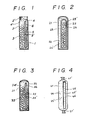
- FIG. 1 there is shown one form of a cartridge of the present invention.
- a glass bottle 2 has a neck which is engaged with a synthetic resin cap 2' to form a fluidtightly constructed casing 1 (hereinafter often referred to as “external casing”).
- an external casing 1 Within the external casing 1 disposed is another fluidtightly constructed glass casing 6 (hereinafter often referred to as “internal casing").
- the chambers 4 and 5 contain the resin 4' and the curing agent 5', respectively, but they are interchangeable.
- the aggregate 3 may optionally be omitted.
- Fig. 2 shows an another form of a cartridge of the present invention.
- a glass fluidtightly constructed internal casing 26 is disposed in a glass fluidtightly constructed external casing 21.
- two chambers i.e. an external chamber 24 containing a resin 24' and an internal chamber 25 containing a curing agent 25' for the resin 24' and an aggregatge 23.
- the chambers 24 and 25 contain the resin 24' and the curing agent 25', respectively, but they are interchangeable.
- the aggregate 23 may optionally be omitted.
- FIG. 3 shows still further form of a cartridge of the present invention.
- a glass fluidtightly constructed internal casing 36 is disposed in a glas fluidtightly constructed external casing 31.
- there are formed two chambers i.e. an external chamber 34 containing a resin 34' and an aggregate 33 and an internal chamber 35 containing a curing agent 35' for the resin 34'.
- the chambers 34 and 35 contain the resin 34' and the curing agent 35', respectively, but they are interchangeable.
- the aggregate 33 may optionally be omitted.
- Fig. 4 shows a further form of a cartridge of the present invention.
- a glass fluidtightly constructed internal casing 46 is disposed in a synthetic resin film fluidtightly constructed external casing 41.
- the external casing 41 has a structure that both ends of a hollow structure are closed by means of wire twists 41', 41'.
- there are formed two chambers i.e. an external chamber 44 containing a resin 44' and a filler (not shown) and an internal chamber 45 containing a curing agent 45 for the resin 44'.
- the chambers 44 and 45 contain the resin 44' and the curing agent 45', respectively, but they are interchangeable.
- the filler (not shown) may optionally be omitted.
- the external casing and the partitioning means (the wall of the internal casing in the above-mentioned embodiments) of the cartridge of the present invention are made of such a material as will not be broken during storage and transit of the cartridge but will be broken into pieces by the action of an anchor bolt during the intrusion of the anchor bolt into a hole formed in a base for the anchor bolt to be fixed thereto and accommodating therein the cartridge.
- the material of the external and internal casings there may be mentioned glass, ceramics, synthetic resins or synthetic resin films.
- the resin contained in one of the two chambers formed by the partitioning means is of crucial importance. It is required that the resin be composed mainly of an ester of an epoxy resin with an organic acid comprising acrylic acid, methacrylic acid or a mixture thereof.
- the above-mentioned esters are hereinafter often referred to simply as "epoxy acrylate resin.”
- an epoxy acrylate resin is usually produced in the form of a mixture of various compounds rather than a single compound. It is difficult to separate and identify individual compounds constituting the mixture.
- the epoxy acrylate resin is regarded a single compound having a structure presumed stoichiometrically from the kinds of the raw materials and the charged amounts thereof.
- the epoxy acrylate resins employed in the present invention should also be considered to be those as mentioned above.
- the organic acid component of the epoxy acrylate may contain a small amount of unsaturated carboxylic acid as far as the incorporation does not adversely affect the effects of the present invention.
- unsaturated carboxylic acid there may be mentioned unsaturated monocarboxylic acids such as itaconic acid and unsaturated dicarboxylic acids such as maleic acid and fumaric acid.
- the epoxy resin component of the epoxy acrylate resin is preferably at least one polyfunctional epoxy resin selected from the group consisting of bisphenol type epoxy resins such as bisphenol A type epoxy resin and bisphenol F type epoxy resin, polyphenol type epoxy resins such as novolak type epoxy resin, halogenated bisphenol type epoxy resins such as tetrabromobisphenol A glycidyl ether, polyglycidyl ester type epoxy resins such as diglycidyl phthalate, polyglycidyl ether type epoxy resins such as a glycidyl ether of an aliphatic polyalcohol, and peracetic acid oxidation type epoxy resins such as 3,4-epoxy-6-methylcyclohexylmethyl 3,4-epoxy-6'-methylcyclohexanecarboxylate.
- bisphenol A type and bisphenol F type resins are preferable.
- the epoxy resin components of the epoxy acrylate resin have an epoxy equivalent of about 150 to about
- the resin is composed mainly of an epoxy acrylate resin.
- the resin may contain a reactive monomer, a cure accelerator, a polymerization inhibitor and the like.
- the reactive monomer there may be mentioned aromatic vinyl monomers, aliphatic vinyl monomers, allyl esters and the like.
- aromatic vinyl monomers e.g., ethylene glycol dimethacrylate
- aliphatic vinyl monomers e.g., polyethylene glycol dime
- allyl esters e.g., polystyrene, polystyrene, a vinyltoluene, a chlorostyrene, methyl methacrylate, butyl acrylate, and diallyl phthalate. Styrene is particularly preferred.
- the reactive monomer is generally employed in an amount of 30 to 60% by weight based on the total amount of the epoxy acrylate resin and the reactive monomer.
- the viscosity of the mixture of the epoxy acrylate with the reactive monomer be 500 Pa.s or less, more preferably 0.1 to 5 Pa.s, particularly preferably 0.1 to 1 Pa.s at 25°C as measured using a rotational viscometer according to Japanese Industrial Standard (JIS) K6901-1977.
- the viscosity of the epoxy acrylate resin is also preferably 500 Pa.s or less, more preferably 0.1 to 5 Pa.s, particularly preferably 0.1 to 1 Pa.s at 25°C as measured using a rotational viscometer according to JIS K6901-1977.
- amines such as dimethylaniline, diethylaniline and dimethyl-p-toluidine
- metallic soaps such as cobalt naphthenate, cobalt octoate, manganese naphthenate and calcium naphthenate
- chelate compounds such as vanadylacetyl acetonate, ironacetyl acetonate and the like.
- hydroquinone examples of the polymerization inhibitor
- tert-butyl catechol examples of the polymerization inhibitor
- hydroquinone monoethyl ester examples of the polymerization inhibitor
- 2,5-di-tert-butyl hydroquinone examples of the polymerization inhibitor
- the chamber fluidtightly separated from the chamber containing the resin contains a curing agent.
- a curing agent preferred is an organic peroxide.
- an organic peroxide there may be mentioned at least one member selected from the group consisting of benzoyl peroxide, methyl ethyl ketone peroxide, lauroyl peroxide, dicumyl peroxide, tert-butyl peroctoate, cumene hydroperoxide, and cyclohexanone peroxide.
- benzoyl peroxide particularly preferred is at least one member selected from the group consisting of benzoyl peroxide and methyl ethyl ketone peroxide.
- the cartridge of the present invention may contain an aggregate and a filler according to need.
- the aggregate and the filler may be contained in either the chamber containing the resin component or the chamber containing the curing agent.
- the kinds of the aggregate and the filler are not critical. However, debris of natural stone and artificial stone such as magnesia clinker and the like are generally employed as the aggregate and calciuim carbonate, calcium sulfate, silicic anhydride, clay and the like are generally employed as the filler.
- the particle sizes of the aggregate and the filler may vary depending on the size of the chamber into which they are charged, but are generally 0.5 to 2.5 mm for the aggregate and 100 to 200 mesh (Tyler) for the filler.
- the cartridge of the present invention may be prepared by the known techniques (see, for example, Japanese Patent Application Publication No. 38-12863/1963). For example, a resin and, if desired, additives such as reactive monomer, cure accelerator, polymerization inhibitor, aggregate and filler are charged in one of the two chambers pre-formed in a casing by molding or the like. A curing agent and, if desired, an aggregage and a filler are charged in the other chamber of the casing. Subsequently, the casing is sealed by an appropriate method chosen according to the material of the casing.
- the casing when the casing is made of glass, the casing is generally sealed by melting or by means of a silicone resin or a cap made of a synthetic resin such as polyethylene, propylene and polyamide.
- the casing when the casing is made of a synthetic resin, the casing may be sealed by means of a silicone resin or a cap of the kind as mentioned above.
- the.casing When the casing is made of a synthetic resin film, the.casing may be sealed by means of wire twists.
- the cartridge of the present invention may be prepared as follows. Into a casing (internal casing made of glass) are charged a curing agent and, if desired, an aggregate and a filler. The casing is sealed by melting or by means of a silicone resin or a cap.
- the sealed casing is put into another casing (external casing made of glass) having a larger size than the internal casing.
- another casing external casing made of glass
- a resin and, if desired, a reactive monomer, a cure accelerator, a polymerization inhibitor, an aggregate and a filler are charged into the external casing.
- the external casing is sealed by melting or by means of a silicone resin or a cap.
- the sealing method may be appropriately changed.
- the proportion of each of the ingredients contained in the cartridge of the present invention may vary depending on applications for the cartridge.
- the amounts of the epoxy acrylate resin and the reactive monomer are generally 40 to 100 parts by weight and 0 to 60 parts by weight, respectively, and are preferably 40 to 95 parts by weight and 5 to 60 parts by weight, respectively, provided that the total amount of the epoxy acrylate resin and the reactive monomer is 100 parts by weight.
- the amounts of the cure accerator, the polymerization inhibitor, the aggregate, the filler and the curing agent are generally 0 to 5 parts by weight, 0 to 0.2 part by weight, 0 to 500 parts by weight, 0 to 500 parts by weight and 1 to 10 parts by weight, respectively, based on 100 parts by weight of the epoxy acrylate resin where the resin contains no reactive monomer or based on 100 parts by weight of a mixure of the epoxy acrylate resin and the reactive monomer where the resin component contains the reactive monomer.
- an anchor bolt which comprises:
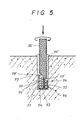
- FIG. 5 illustrates the essential feature of the method of the present invention.
- a hole 50 is drilled in a base 57.
- the diameter of the hole 50 is generally about 2 to 12 mm larger than the outer diameter of an anchor bolt 58 to be fixed to the base 57.
- the depth of the hole 50 may widely be varied depending on the intended adhesive strength between the anchor bolt 58 and the base 57. Of course, the deeper the hole the higher the adhesive strength between the anchor bolt and the base. However, in general it is sufficient if the depth of the hole 50 is about 6 to 14 times the outer diameter of the anchor bolt 58 to be fixed to the base 57.
- the cartridge 59 of the present invention is inserted into the hole 50.
- the width of the cartridge of the present invention is generally about 0.5 to 5 mm larger than the outer diameter of the anchor bolt 58.
- an external casing 51 and an internal casing 56 of the cartridge 59 of the present invention is made of a synthetic resin film, it is preferred that the width of the cartridge 59 of the present invention be about 1 to 5 mm larger than the outer diameter of the anchor bolt 58.
- the length of the cartridge 59 of the present invention may be varied depending upon the depth of the hole 50. But, in general, the ratio of the length of the cartridge 59 to the depth of the hole 50 is about 0.7 to 1.0. In the method of the present invention, a plurality of cartridge of the present invention may be inserted, in alignment, into the hole 50.
- the ratio of the total length of the cartridges 59 to the depth of the hole 50 be about 0.7 to 1.0.
- the anchor bolt 58 is driven into the hole 50 in which the cartridge 59 is accommodated. It is preferred that the drive of the anchor bolt 58 in the hole 50 be performed by a method in which a rotary tool such as rotary hammer is first coupled to the rear end of the anchor bolt 58 and then rotated in a direction indicated by arrow to drive the anchor bolt 58 into the hole 50.
- the cartridge 59 in the hole 50 is broken by rotary percussion of the anchor bolt 58, causing the ingredients contained in the cartridge to be mixed.
- the external casing 56 are broken and, at the same time, the aggregate 53 (which may be omitted) is finely divided.
- the debris formed from the external casing 51 and the internal casing 56 also serves as an aggregate effectively. They are homogeneously mixed with the resin 54' from the external chamber 54 and the curing agent 55' from the internal chamber 55 to form a mixture 50'. The mixture starts to cure. When the mixture 50' is completely cured, the anchor bolt 58 is firmly fixed to the base 57.
- the anchor bolt 58 to be fixed to the base has its forward end 58' cut diagonally with respect to the axis of the anchor bolt 58.
- the ingredients contained in the cartridge can be homogeneously mixed with each other to a great extent.
- the cutting angle be 45° with respect to the axis of the anchor bolt.
- the epoxy acrylate resin to be contained in the cartridge of the present invention may be produced according to the customary methods. For example, an expoxy resin having at least one epoxy group is reacted with acrylic acid or methacrylic acid to prepare an epoxy acrylate resin.
- the acrylic acid or methacrylic acid is employed in an amount of about one mole per epoxy group contained in the epoxy resin.
- the cartridge of the present invention has the following advantages:
- One of the conventional cartridge type adhesive comprises an unsaturated polyester resin and a curing agent for the resin.
- This conventional cartridge type adhesive is excellent in curing rate but poor in water resistance and chemical resistance, particularly alkali resistance. Therefore, when an anchor bolt is fixed to concrete using this type of adhesive, the cured resin between the anchor bolt and the base is attacked by the alkali components contained in concrete and, hence, the adhesive strength between the anchor bolt and the concrete is lowered with the lapse of time.
- a completely new cartridge type adhesive which is extremely excellent not only curing rate but also in water resistance and chemical resistance.
- the adhesive strength between the anchor bolt and the concrete is now lowered for a prolonged period of time even under corrosive environment, for example, even when the base is concrete and, therefore, the adhesive connection is always exposed to alkaline atmosphere, or even when the base is located near the sea and, therefore, is always exposed to corrosive atmosphere.
- the adhesive strength between an anchor bolt and a base was evaluated in terms of a tensile force required to cause 1 mm axial displacement of the anchor bolt fixed to the base as well as tensile force required to pull the anchor bolt fixed to the base out of the base.
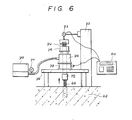
- the method of measuring the tensile force will be explained below with reference to Fig. 6.
- An anchor bolt 68 fixed to a base 67 is connected to a threaded pulling rod 74 by means of a coupling means 79.
- a nut 75 is journalled on the pulling threaded rod 74 and connected to a hydraulic ram 76.
- An axial tensile force is aplied to the anchor bolt 68, in the direction indicated by arrow, through a loading frame 78 by means of a hydraulic pump 70 equipped with a hydraulic gauge 71 and the hydraulic ram 76.
- the axial displacement of the anchor bolt 68 and the load applied to the anchor bolt 68 are measured by a dial guage 72 carried by a support 73 and a load cell 77, respectively, which are each connected to a digital indication device 90.
- the tensile force applied to the anchor bolt 68 is increased by substantially equal increments.
- the application of the tensile force is continued until the anchor bolt 68 is caused to be displaced and, to extremity, to be pulled out of the base 67.
- the tensile force applied and the axial displacement of the anchor bolt 68 are recorded in the digital indication device 80.
- the relationship between the tensile force applied to the anchor bolt 68 and the displacement of the anchor bolt 68 is graphed.
- the tensile force value corresponding to 1 mm displacement of the anchor bolt 68 (the tensile force required to cause 1 mm axial displacement of the anchor bolt 68) and the tensile force value corresponding to the maximum point on the graph (the tensile force required to pull the anchor bolt 68 out of the base 67) are determined.
- the viscosity of a mixture of an epoxy acrylate resin and a reactive monomer is determined at 25°C using a rotational viscometer according to JIS K6901-1977.
- the acid value of an epoxy acrylate resin used was determined according to JIS K6901-1977.
- the molecular weight of an epoxy resin used is given in terms of a viscosity-average molecular weight and the viscosity is determined according to a method prescribed in ASTM D1601-78.
- Cartridges for use in fixing an anchor bolt were each prepared by the following method.
- a concrete block having a compression strength 2.5 kN/cm 2 was subjected to boring to obtain holes (diameter, 14.5 mm; depth, 100 mm) of the number corresponding to the number of the cartridges as prepared above.
- the cartridges were then separately inserted into these holes.
- an anchor bolt having an outer diameter of 12 mm and a length of 150 mm was driven to the bottom of the hole by means of a rotary hammer which was coupled to the rear end of the bolt.
- the cartridges which had already been inserted into the holes were broken by the rotary percussion of the anchor bolt, and the ingredients contained in the cartridges were homogenously mixed.
- An S 45 C rod (according to Japanese Industrial Standard G 4051) was, at its one end, cut diagonally with respect to the axis of the rod at a cutting angle of 45°. The rod was then subjected to threading so that a thread is formed throughout the axial length of the rod. The thus threaded rod was subject to hardening. Thus, a bolt was formed.
- Cartridges were prepared in substantially the same manner as in Example 1, except that 0.45 g of methyl ethyl ketone peroxide and 0.02 g of cobalt naphthenate were employed as the curing agent and the curing accelerator, respectively.
- the same kind of bolts as employed in Example 1 were fixed to a concrete block having a compression strength of 2.5 kN/cm 2 in the same manner as in Example 1.
- the resulting adhesive connection between the anchor bolt and the concrete block was cured at 25°C.
- Cartridges were prepared in substantially the same manner as in Example 1, except that 4.3 g of POLYMAR [trade name of styrene-modified unsaturated polyester resin (unsaturaged resin content, 3.2 g; styrene content, 1.1 g; molar ratio of phthalic acid component, maleic acid component and propylene glycol component, 1:1:2) manufactured and sold by Takeda Chemical Industries. Ltd.] and 0.02 g of dimethylaniline were used in place of 4.3 g of the resin mixture and 0.04 g of dimethylaniline used in Example 1, respectively.
- POLYMAR trade name of styrene-modified unsaturated polyester resin (unsaturaged resin content, 3.2 g; styrene content, 1.1 g; molar ratio of phthalic acid component, maleic acid component and propylene glycol component, 1:1:2) manufactured and sold by Takeda Chemical Industries. Ltd.
- 0.02 g of dimethylaniline were used in place of 4.3 g of the
- Example 2 Using the so-prepared cartridges, the same kind of bolts as employed in Example 1 were fixed to a concrete block having a compression strength of 2.5 kN/cm 2 in the same manner as in Example 1. The resulting adhesive connection between the anchor bolt and the concrete block was cured at 25°C.
- a mixture of 390 g of an epoxy resin AER-331 [the trade name of a bisphenol A type epoxy resin (epoxy equilvalent, 189) manufactured and sold by Asahi Kasei Kogyo K.K., Japan], 172 g of methacrylic acid, 0.1 g of benzoquinone, and 2 g of diethylamine hydrochloride was heated to 125°C and maintained, while stirring, at the temperature to obtain a bisphenol A type epoxy acrylate resin having an acid value of 4.5. To the thus obtained bisphenol A type epoxy acrylate resin was added 562 g of styrene to obtain a mixture.
- an epoxy resin AER-331 the trade name of a bisphenol A type epoxy resin (epoxy equilvalent, 189) manufactured and sold by Asahi Kasei Kogyo K.K., Japan]
- 172 g of methacrylic acid 0.1 g of benzoquinone, and 2 g of diethyl
- Cartridges were prepared in substantially the same manner as in Example 1, except that the above- prepared mixture of the bisphenol A type epoxy acrylate resin and styrene was employed in place of the resin mixture used in Example 1.
- the same kind of anchor bolts as employed in Example 1 were fixed to the concrete block of the same kind as employed in Example 1 in the same manner as in Example 1, and the resulting adhesive connection between the anchor bolt and the concrete block was cured at 25°C.
- the tensile force test with respect to the anchor bolts fixed to the concrete block and the alkali resistance test with respect to the adhesive connection were effected in the same manner as in Example 2.
- Example 3 In the same manner as in Example 3, the same kind of epoxy acrylate resin as in Example 3 was prepared. To 562 g of the thus prepared epoxy acrylate resin were added reactive monomers, i.e., 50 g of butyl acrylate, 150 g of methyl methacrylate and 100 g of styrenes to obtain a mixture.
- reactive monomers i.e., 50 g of butyl acrylate, 150 g of methyl methacrylate and 100 g of styrenes.
- Cartridges were prepared in substantially the same manner as in Example 1, except that the above-obtained mixture of the epoxy acrylate resin and reactive monomers was employed in place of the resin mixture used in Example 1.
- the same kind of anchor bolts as employed in Example 1 were fixed to the concrete block of the same kind as employed in Example 1 in the same manner as in Example 1, and the resulting adhesive connection between the anchor bolts and the concrete block was cured at 25°C.
- the tensile force test with respect to the anchor bolts fixed to the concrete block and the alkali resistance test with respect to the adhesive connection were effected in the same manner as in Example 2.
- a mixture of 400 g of diglycidyl phthalate, 180 g of methacrylic acid, 0.1 g of hydroquinone, and 1.0 g of diethyl amine hydrochloride was heated to 125°C and maintained, while stirring, at the temperature to obtain an expoxy acrylate resin having an acid value of 4.5.
- To the thus obtained epoxy acrylate resin was added 562 g of styrene to obtain a mixture.
- Cartridges were prepared in substantially the same manner as in Example 1, except that the above-obtained mixture of the epoxy resin and stryene was employed in place of the resin mixture used in Example 1.
- the same kind of anchor bolts as employed in Example 1 were fixed to the concrete block of the same kind as employed in Example 1 in the same manner as in Example 1, and the resulting adhesive connection between the anchor bolt and the concrete block was cured at 25°C.
- the tensile force test with respect to the anchor bolts fixed to the concrete block and the alkali resistance test with respect to the adhesive connection were effected in the same manner as in Example 2.
- a mixture of 390 g of an epoxy resin AER-331, 86 g of acrylic acid, 73 g of adipic acid, 0.87 g of benzoquinone and 2 g of diethylamine hydrochloride was heated to 125°C and maintained, while stirring, at the temperature to obtain an epoxy acrylate resin having an acid value of 3.1.
- To the thus obtained epoxy acrylate was added 562 g of styrene to obtain a mixture.
- Cartridges were prepared in substantially the same manner as in Example 1, except that the above-obtained mixture of epoxy acrylate resin and styrene was employed in place of the resin mixture used in Example 1.
- the same kind of anchor bolts as employed in Example 1 were fixed to the concrete block of the same as employed in Example 1 in the same manner as in Example 1, and the resulting adhesive connection between the anchor bolt and the concrete block was cured at 25°C.
- the tensile force test with respect to the anchor bolts fixed to the concrete block and the alkali resistance test with respect to the adhesive connection were effected in the same manner as in Example 2.
- Cartridges containing the above-obtained mixtures of the epoxy acrylate resins and styrene were separately prepared in substantially the same manner as in Example 1, except that the above-obtained mixtures of the epoxy resins and styrene were used in place of the resin mixture used in Example 1.
- Example 2 Using the so-prepared cartridges, the same kind of anchor bolts as employed in Example 1 were fixed to the concrete block of the same kind as employed in Example 1, and the resulting adhesives connections between the anchor bolts and the concrete block were cured at 25°C. After the same curing period as in Example 2, the tensile force test with respect to the anchor bolts fixed to the concrete block and the alkali resistance test with respect to the adhesive connections between the anchor bolts and the concrete block were effected in the same manner as in Example 2.
Landscapes
- Engineering & Computer Science (AREA)
- Chemical & Material Sciences (AREA)
- Mining & Mineral Resources (AREA)
- Polymers & Plastics (AREA)
- Health & Medical Sciences (AREA)
- Organic Chemistry (AREA)
- Medicinal Chemistry (AREA)
- Structural Engineering (AREA)
- Chemical Kinetics & Catalysis (AREA)
- Life Sciences & Earth Sciences (AREA)
- General Life Sciences & Earth Sciences (AREA)
- Geochemistry & Mineralogy (AREA)
- Geology (AREA)
- Adhesives Or Adhesive Processes (AREA)
- Joining Of Building Structures In Genera (AREA)
- Macromonomer-Based Addition Polymer (AREA)
Description
- This invention relates to a cartridge for use in fixing an anchor bolt. More particularly, the present invention is concerned with a cartridge for use in fixing an anchor bolt comprising a fluidtightly constructed casing, a partitioning means fluidtightly disposed in the casing to form two chambers, a specific resin contained in one of the two chambers, and a curing agent for the resin contained in the other chamber. The casing and partitioning means are adapted to be broken by the action of the anchor bolt during the drive of the anchor bolt into a hole formed in a base for an anchor bolt to be fixed thereto and accommodating therein the cartridge, thereby causing the resin and the curing agents to be homogeneously mixed during the drive of the anchor bolt. By the use of such a cartridge in fixing an anchor bolt to a base, there can be attained a quick fixation of the anchor bolt to the base, a high adhesive strength between the anchor bolt and the base and a high chemical resistance of the cured resin, with little or no lowering of the adhesive strength for a prolonged period of time.
- The term "anchor bolt" as used herein is intended to mean any bolts or deformed bars with projections or indentations, which are used to secure a machine, structure or part to concrete, masonry and the like or to reinforce or stabilize such structures as mine ceilings and overhanging rock strata.
- The most commonly employed method of fixing an anchor bolt to a base, such as concrete, masonry or rock, is as follows. A hole is drilled in the base. A resin and a curing agent are positioned in the hole. The resin and curing agent are contained in a glass or plastic cartridge having one chamber for the resin and a separate chamber for the curing agent. An anchor bolt is inserted into the hole using a rotary tool such as rotary hammer which is coupled to the rear end of the anchor bolt. In this step, the cartridge in the hole is broken by rotary percussion of the anchor bolt, causing the ingredients contained in the cartridge to be mixed. The mixing causes the curing agent to be distributed in the resin and, in turn, starts resin cure. When the resin is completely cured, the anchor bolt is firmly fixed to the base. As examples of the cartridge type adhesive conventionally employed in the above-mentioned method, there may be mentioned a combination of an unsaturated polyester resin and a curing agent, e.g., an organic peroxide such as benzoyl peroxide and a combination of an epoxy resin and a curing agent (see Japanese Patent Application Publication No. 38-12863/1963 and a brochure (issued by Show-Bond Construction Company Limited, Japan). The above-mentioned two cartridge type adhesives both have serious drawbacks. The cartridge type adhesive comprising an unsaturated polyester resin and a curing agent is excellent in curing rate but poor in chemical resistance and water resistance. Specifically, where the base to which an anchor bolt is to be fixed is concrete, the cured unsaturated polyester resin fixing the anchor bolt to the concrete is attacked by the alkaline components contained in the concrete, thereby causing the adhesive strength between the anchor bolt and the base to be lowered with the lapse of time. Further, where an anchor bolt is used in environments such that the cured adhesive between the anchor bolt and the base is contacted with chemicals such as strong acids, strong alkalis and organic solvents or such that the cured adhesive is always exposed to a sea wind or seawater, the cured adhesive is eaten away, causing the adhesive strength between the anchor bolt and the base to be lowered.
- On the other hand, the cartridge type adhesive comprising an epoxy resin and a curing agent therefor is excellent in chemical resistance and weather resistance but is poor in curing rate. In general, when this kind of adhesive is used for fixing an anchor bolt to a base two or more days are required to attain a sufficient adhesive strength between the anchor bolt and the base. This inevitably leads to the delay in performing subsequent works such as fixation of a machine, structure or part to the base. As is apparent from the foregoing, conventional cartridge type adhesives for use in fixing an anchor bolt to a base are not satisfactory.
- Japanese Patent Application Laid-Open Specification No. 54-128128/1979 discloses a method of fixing an anchor bolt. In this method, an anchor bolt at its lower portion to be embedded in a base is covered with a resin foam such as urethane foam sponge. The resulting resin foam layer on the bolt is impregnated with a mixture of cold-setting resin such as epoxy resin, epoxy acrylate resin, unsaturated polyester resin or isocyanate resin and a curing agent for the resin. In this connection, in Japanese Patent Application Laid-Open Specification No. 54-128128/1979, there is neither any description as to the kind of epoxy acrylate resin to be used nor any illustrative example of the use of an epoxy acrylate resin. After the impregnation, the anchor bolt is inserted into a hole, pre-formed in a base for the anchor bolt to be fixed thereto. The resin impregnated into the resin form layer is cured and the anchor bolt is fixed to the base through the resin foam layer. The above-mentioned method disclosed in Japanese Patent Application Laid-Open Specification No. 54-128128/1979 is hereinafter often referred to as "impregnation method." The impregnation method is disadvantageous in the following points. The mixing of the resin with the curing agent for the resin should be carried out at the job site immediately before the anchor bolt covered with the resin form is impregnated with the resulting mixture. The reason for this is that upon mixing of the resin with the curing agent, the resin starts to cure. For the same reason, after completion of the impregnation, the anchor bolt covered with the resin foam impregnated with the mixture of the resin with the curing agent should be inserted quickly in a hole formed in the base. Further, in this method, due to the poor mechanical strength of the resin foam, the adhesive strength between the anchor bolt and the base is inevitably low as compared with the adhesive strength attained by the use of the above-mentioned cartridge type adhesives.
- As can be understood from the above, the impregnation method as disclosed in Japanes Patent Application Laid-Open Specification No. 54-128128/1979 is inferior in necessity of complicated procedures and poor adhesive strength between the anchor bolt and the base, to the methods in which the cartridge type ahesives are employed and cannot advantageously be employed for practical purposes. Therefore, the methods in which cartridge type adhesives are used have been widely employed to fix an anchor bolt to a base. However, as mentioned before, conventional cartridge type adhesives have drawbacks, namely, poor chemical and water resistance in the case of the unsaturated polyester type, and necessity of a long curing time in the case of the epoxy resin type. That is, there is a technical dilemma.
- Accordingly, it has been strongly desired in the art to develop an improved cartridge type adhesive for use in fixing an anchor bolt which is excellent in not only adhesive strength but also in chemical and water resistance and curing rage. The present inventors have made extensive and intensive studies to develop such an improved cartridge type adhesive. As a result, the present inventors have unexpectedly found that a cartridge having one chamber containing a resin composed mainly of an ester of an epoxy resin with an organic acid comprising acrylic acid, methacrylic acid or a mixture thereof and a separate chamber containing a curing agent for the resin can eliminate the technical dilemma inevitably accompanyng the above-mentioned conventional cartridge type adhesives and that, hence, by the use of such a cartridge not only an anchor bolt is firmly fixed to a base in a short time but also the adhesive strength between the anchor bolt and the base is not lowered for a prolonged period of time. The present invention has been made based on such a novel finding.
- Therefore, it is one object of the present invention to provide a cartridge for use in fixing an anchor bolt which, when used in fixing an anchor bolt to to a base, is capable of attaining a quick fixation of the anchor bolt to the base, a high adhesive strength between the anchor bolt and the base and high chemical and water resistance of the adhesive connection, with little or no lowering of the adhesive strength for a prolonged period of time.
- It is another object of the present invention to provide a method of fixing an anchor bolt to a base by the use of a cartridge of the above kind, with great practical advantages.
- The foregoing and other objects, features and advantages of the present invention will be apparent from the following detailed description taken in connection with the accompanying drawings in which:
- Fig. 1 is a cross-sectional view of one form of a cartridge of the present invention;
- Fig. 2 is as cross-sectional view of another form of a cartridge of the present invention;
- Fig. 3 is a cross-sectonal view of still another form of a cartridge of the present invention;
- Fig. 4 is a cross-sectional view of a further form of a cartridge of the present invention;
- Fig. 5 is a schematic view illustrating how to perform fixation of an anchor bolt to a base by the use of a cartridge of the present invention, with portions and members except for the anchor bolt being shown in cross-section and with the interfering portion between the anchor bolt being inserted in a hole of the base and the cartridge being broken being extremely diagrammaticaly shown for easy understanding; and
- Fig. 6 is a schematic vertical view of an apparatus used for measuring a tensile force required for pulling and causing 1 mm axial displacement of the anchor bolt fixed to the base and a tensile force required for pulling the anchor bolt fixed to the base out of the base.
- In one aspect of the present invention, there is provided a cartridge for use in fixing an anchor bolt comprising:
- (a) a casing having fluidtight construction;
- (b) partitioning means disposed in said casing to form two chambers which are fluidtightly separated from each other;
- (c) a resin contained in one of said two chambers,
said resin being composed mainly of an ester of an epoxy resin with an organic acid comprising acrylic .,acid, methacrylic acid or a mixture thereof and a reactive monomer; and - (d) a curing agent for said resin contained in the other chamber,
said casing and said partitioning means being adapted to be broken by the action of the anchor bolt during the drive of the anchor bolt into a hole formed in a base for an anchor bolt to be fixed thereto and accommodating therein the cartridge, thereby causing said resin and said curing agent to be homogeneously mixed during the drive of the anchor bolt. - Referring now to Fig. 1, there is shown one form of a cartridge of the present invention. A
glass bottle 2 has a neck which is engaged with a synthetic resin cap 2' to form a fluidtightly constructed casing 1 (hereinafter often referred to as "external casing"). Within the external casing 1 disposed is another fluidtightly constructed glass casing 6 (hereinafter often referred to as "internal casing"). Thus, there are formed two chambers, i.e. anexternal chamber 4 containing a resin 4' and anaggregate 3 and aninternal chamber 5 containing a curing agent 5' for the resin 4'. In this embodiment, thechambers aggregate 3 may optionally be omitted. - Fig. 2 shows an another form of a cartridge of the present invention. A glass fluidtightly constructed
internal casing 26 is disposed in a glass fluidtightly constructedexternal casing 21. Thus, there are formed two chambers, i.e. anexternal chamber 24 containing a resin 24' and aninternal chamber 25 containing a curing agent 25' for the resin 24' and anaggregatge 23. In this embodiment, thechambers - Fig. 3 shows still further form of a cartridge of the present invention. A glass fluidtightly constructed
internal casing 36 is disposed in a glas fluidtightly constructedexternal casing 31. Thus, there are formed two chambers, i.e. anexternal chamber 34 containing a resin 34' and an aggregate 33 and aninternal chamber 35 containing a curing agent 35' for the resin 34'. In this embodiment, thechambers - Fig. 4 shows a further form of a cartridge of the present invention. A glass fluidtightly constructed
internal casing 46 is disposed in a synthetic resin film fluidtightly constructedexternal casing 41. Theexternal casing 41 has a structure that both ends of a hollow structure are closed by means of wire twists 41', 41'. Thus, there are formed two chambers, i.e. anexternal chamber 44 containing aresin 44' and a filler (not shown) and aninternal chamber 45 containing a curingagent 45 for theresin 44'. In this embodiment, thechambers resin 44' and the curing agent 45', respectively, but they are interchangeable. The filler (not shown) may optionally be omitted. - The external casing and the partitioning means (the wall of the internal casing in the above-mentioned embodiments) of the cartridge of the present invention are made of such a material as will not be broken during storage and transit of the cartridge but will be broken into pieces by the action of an anchor bolt during the intrusion of the anchor bolt into a hole formed in a base for the anchor bolt to be fixed thereto and accommodating therein the cartridge. As examples of the material of the external and internal casings, there may be mentioned glass, ceramics, synthetic resins or synthetic resin films.
- In the cartridge of the present invention, the resin contained in one of the two chambers formed by the partitioning means is of crucial importance. It is required that the resin be composed mainly of an ester of an epoxy resin with an organic acid comprising acrylic acid, methacrylic acid or a mixture thereof. The above-mentioned esters are hereinafter often referred to simply as "epoxy acrylate resin." As is well known, an epoxy acrylate resin is usually produced in the form of a mixture of various compounds rather than a single compound. It is difficult to separate and identify individual compounds constituting the mixture. Therefore, in general, as in various polymers which are usually obtained in the form of a mixture of a plurality of polymers different in polymerization degree, the epoxy acrylate resin is regarded a single compound having a structure presumed stoichiometrically from the kinds of the raw materials and the charged amounts thereof. (See for example, Japanese Patent Application Laid-Open Specification Nos. 49-110780 and 49-128088 and Japanese Patent Application Publication No. 55-44766.) The epoxy acrylate resins employed in the present invention should also be considered to be those as mentioned above.
- The organic acid component of the epoxy acrylate may contain a small amount of unsaturated carboxylic acid as far as the incorporation does not adversely affect the effects of the present invention. As examples of the unsaturated carboxylic acid, there may be mentioned unsaturated monocarboxylic acids such as itaconic acid and unsaturated dicarboxylic acids such as maleic acid and fumaric acid.
- The epoxy resin component of the epoxy acrylate resin is preferably at least one polyfunctional epoxy resin selected from the group consisting of bisphenol type epoxy resins such as bisphenol A type epoxy resin and bisphenol F type epoxy resin, polyphenol type epoxy resins such as novolak type epoxy resin, halogenated bisphenol type epoxy resins such as tetrabromobisphenol A glycidyl ether, polyglycidyl ester type epoxy resins such as diglycidyl phthalate, polyglycidyl ether type epoxy resins such as a glycidyl ether of an aliphatic polyalcohol, and peracetic acid oxidation type epoxy resins such as 3,4-epoxy-6-
methylcyclohexylmethyl 3,4-epoxy-6'-methylcyclohexanecarboxylate. Of the above mentioned epoxy resins bisphenol A type and bisphenol F type resins are preferable. In this connection, it is preferred that the epoxy resin components of the epoxy acrylate resin have an epoxy equivalent of about 150 to about 500 (molecular weight: about 300 to about 1,000). - As mentioned above, the resin is composed mainly of an epoxy acrylate resin. The resin may contain a reactive monomer, a cure accelerator, a polymerization inhibitor and the like. As examples of the reactive monomer, there may be mentioned aromatic vinyl monomers, aliphatic vinyl monomers, allyl esters and the like. Of the above-mentioned reactive monomers, preferred is at least one member selected from the group consisting of styrene, a vinyltoluene, a chlorostyrene, methyl methacrylate, butyl acrylate, and diallyl phthalate. Styrene is particularly preferred. The reactive monomer is generally employed in an amount of 30 to 60% by weight based on the total amount of the epoxy acrylate resin and the reactive monomer. In this connection, it is preferred that the viscosity of the mixture of the epoxy acrylate with the reactive monomer be 500 Pa.s or less, more preferably 0.1 to 5 Pa.s, particularly preferably 0.1 to 1 Pa.s at 25°C as measured using a rotational viscometer according to Japanese Industrial Standard (JIS) K6901-1977. When the resin does not contain the reactive monomer, the viscosity of the epoxy acrylate resin is also preferably 500 Pa.s or less, more preferably 0.1 to 5 Pa.s, particularly preferably 0.1 to 1 Pa.s at 25°C as measured using a rotational viscometer according to JIS K6901-1977.
- As examples of the cure accelerator, there may be mentioned amines such as dimethylaniline, diethylaniline and dimethyl-p-toluidine, metallic soaps such as cobalt naphthenate, cobalt octoate, manganese naphthenate and calcium naphthenate, chelate compounds, such as vanadylacetyl acetonate, ironacetyl acetonate and the like.
- As examples of the polymerization inhibitor, there may be mentioned hydroquinone, tert-butyl catechol, hydroquinone monoethyl ester, 2,5-di-tert-butyl hydroquinone, and the like.
- In the cartridge of the present invention, the chamber fluidtightly separated from the chamber containing the resin contains a curing agent. As the curing agent, preferred is an organic peroxide. As examples of such an organic peroxide, there may be mentioned at least one member selected from the group consisting of benzoyl peroxide, methyl ethyl ketone peroxide, lauroyl peroxide, dicumyl peroxide, tert-butyl peroctoate, cumene hydroperoxide, and cyclohexanone peroxide. Of the above-mentioned peroxides, particularly preferred is at least one member selected from the group consisting of benzoyl peroxide and methyl ethyl ketone peroxide.
- The cartridge of the present invention may contain an aggregate and a filler according to need. The aggregate and the filler may be contained in either the chamber containing the resin component or the chamber containing the curing agent. The kinds of the aggregate and the filler are not critical. However, debris of natural stone and artificial stone such as magnesia clinker and the like are generally employed as the aggregate and calciuim carbonate, calcium sulfate, silicic anhydride, clay and the like are generally employed as the filler. The particle sizes of the aggregate and the filler may vary depending on the size of the chamber into which they are charged, but are generally 0.5 to 2.5 mm for the aggregate and 100 to 200 mesh (Tyler) for the filler.
- The cartridge of the present invention may be prepared by the known techniques (see, for example, Japanese Patent Application Publication No. 38-12863/1963). For example, a resin and, if desired, additives such as reactive monomer, cure accelerator, polymerization inhibitor, aggregate and filler are charged in one of the two chambers pre-formed in a casing by molding or the like. A curing agent and, if desired, an aggregage and a filler are charged in the other chamber of the casing. Subsequently, the casing is sealed by an appropriate method chosen according to the material of the casing. For example, when the casing is made of glass, the casing is generally sealed by melting or by means of a silicone resin or a cap made of a synthetic resin such as polyethylene, propylene and polyamide. When the casing is made of a synthetic resin, the casing may be sealed by means of a silicone resin or a cap of the kind as mentioned above. When the casing is made of a synthetic resin film, the.casing may be sealed by means of wire twists. Alternatively, the cartridge of the present invention may be prepared as follows. Into a casing (internal casing made of glass) are charged a curing agent and, if desired, an aggregate and a filler. The casing is sealed by melting or by means of a silicone resin or a cap. The sealed casing is put into another casing (external casing made of glass) having a larger size than the internal casing. Into the external casing are charged a resin and, if desired, a reactive monomer, a cure accelerator, a polymerization inhibitor, an aggregate and a filler. The external casing is sealed by melting or by means of a silicone resin or a cap. Of course, according to the kind of material of the casing, the sealing method may be appropriately changed.
- The proportion of each of the ingredients contained in the cartridge of the present invention may vary depending on applications for the cartridge. But, the amounts of the epoxy acrylate resin and the reactive monomer are generally 40 to 100 parts by weight and 0 to 60 parts by weight, respectively, and are preferably 40 to 95 parts by weight and 5 to 60 parts by weight, respectively, provided that the total amount of the epoxy acrylate resin and the reactive monomer is 100 parts by weight. The amounts of the cure accerator, the polymerization inhibitor, the aggregate, the filler and the curing agent are generally 0 to 5 parts by weight, 0 to 0.2 part by weight, 0 to 500 parts by weight, 0 to 500 parts by weight and 1 to 10 parts by weight, respectively, based on 100 parts by weight of the epoxy acrylate resin where the resin contains no reactive monomer or based on 100 parts by weight of a mixure of the epoxy acrylate resin and the reactive monomer where the resin component contains the reactive monomer.
- In another aspect of the invention, there is provided a method of fixing an anchor bolt which comprises:
- (1) drilling a hole in a base;
- (2) inserting a cartridge into the hole, said cartridge comprising:
- (a) a casing having fluidtight construction;
- (b) partitioning means disposed in said casing to form two chambers which are fluidtightly separated from each other;
- (c) a resin contained in one of said two chambers,
said resin being composed mainly of an ester of an epoxy resin with an organic acid comprising acrylic acid, methacrylic acid or a mixture thereof and a reactive monomer; and - (d) a curing agent for said resin contained in the other chamber; and
- (3) driving into the hole an anchor bolt, thereby causing said casing and said partitioning means of said cartridge to be broken by the action of the anchor bolt and said resin and said curing agent to be homogeneously mixed and filled in a spacing between the inner wall of the hole and the periphery of the bolt,
thus enabling the anchor bolt to be fixed to the base in a short period of time, with a strong adhesive connection between the anchor bolt and the base, said strong adhesive connection having high resistance to chemicals and water. - The method of the present invention will now be explained with reference to Fig. 5. Fig. 5 illustrates the essential feature of the method of the present invention. A
hole 50 is drilled in abase 57. The diameter of thehole 50 is generally about 2 to 12 mm larger than the outer diameter of ananchor bolt 58 to be fixed to thebase 57. The depth of thehole 50 may widely be varied depending on the intended adhesive strength between theanchor bolt 58 and thebase 57. Of course, the deeper the hole the higher the adhesive strength between the anchor bolt and the base. However, in general it is sufficient if the depth of thehole 50 is about 6 to 14 times the outer diameter of theanchor bolt 58 to be fixed to thebase 57. Thecartridge 59 of the present invention is inserted into thehole 50. The width of the cartridge of the present invention is generally about 0.5 to 5 mm larger than the outer diameter of theanchor bolt 58. When anexternal casing 51 and aninternal casing 56 of thecartridge 59 of the present invention is made of a synthetic resin film, it is preferred that the width of thecartridge 59 of the present invention be about 1 to 5 mm larger than the outer diameter of theanchor bolt 58. The length of thecartridge 59 of the present invention may be varied depending upon the depth of thehole 50. But, in general, the ratio of the length of thecartridge 59 to the depth of thehole 50 is about 0.7 to 1.0. In the method of the present invention, a plurality of cartridge of the present invention may be inserted, in alignment, into thehole 50. In this case, it is preferred that the ratio of the total length of thecartridges 59 to the depth of thehole 50 be about 0.7 to 1.0. After insertion of the cartridge, theanchor bolt 58 is driven into thehole 50 in which thecartridge 59 is accommodated. It is preferred that the drive of theanchor bolt 58 in thehole 50 be performed by a method in which a rotary tool such as rotary hammer is first coupled to the rear end of theanchor bolt 58 and then rotated in a direction indicated by arrow to drive theanchor bolt 58 into thehole 50. During the drive of theanchor bolt 58 into thehole 50 in a direction indicated by arrow, thecartridge 59 in thehole 50 is broken by rotary percussion of theanchor bolt 58, causing the ingredients contained in the cartridge to be mixed. Illustratively stated, theexternal casing 56 are broken and, at the same time, the aggregate 53 (which may be omitted) is finely divided. The debris formed from theexternal casing 51 and theinternal casing 56 also serves as an aggregate effectively. They are homogeneously mixed with the resin 54' from theexternal chamber 54 and the curing agent 55' from theinternal chamber 55 to form a mixture 50'. The mixture starts to cure. When the mixture 50' is completely cured, theanchor bolt 58 is firmly fixed to thebase 57. Incidentally, it is preferred that theanchor bolt 58 to be fixed to the base has its forward end 58' cut diagonally with respect to the axis of theanchor bolt 58. By using the anchor bolt having such and end shape, the ingredients contained in the cartridge can be homogeneously mixed with each other to a great extent. As a result, high adhesive strength between the anchor bolt and the base can be attained. In this connection, it is particularly preferred that the cutting angle be 45° with respect to the axis of the anchor bolt. - The epoxy acrylate resin to be contained in the cartridge of the present invention may be produced according to the customary methods. For example, an expoxy resin having at least one epoxy group is reacted with acrylic acid or methacrylic acid to prepare an epoxy acrylate resin. The acrylic acid or methacrylic acid is employed in an amount of about one mole per epoxy group contained in the epoxy resin. With respect to further specific reaction conditions, reference may be made to, for example, Japanese Patent Application Laid-Open Specification Nos. 49-128088, 49-28692 and 48-66182 and Japanese Patent Application Publication Nos. 49-12091 and 55-44766.
- As described in the foregoing, the cartridge of the present invention has the following advantages:
- (1) The cartridge of the present invention can eliminate all the drawbacks of the conventional cartridge type adhesives.
- One of the conventional cartridge type adhesive, as mentioned before, comprises an unsaturated polyester resin and a curing agent for the resin. This conventional cartridge type adhesive is excellent in curing rate but poor in water resistance and chemical resistance, particularly alkali resistance. Therefore, when an anchor bolt is fixed to concrete using this type of adhesive, the cured resin between the anchor bolt and the base is attacked by the alkali components contained in concrete and, hence, the adhesive strength between the anchor bolt and the concrete is lowered with the lapse of time.
- As mentioned before, there is also known another conventional cartridge type adhesive comprising an epoxy resin and a curing agent for the epoxy resin. This conventional cartridge type adhesive is excellent in water resistance and chemical resistance but extremely poor in curing rate. When an anchor bolt is fixed to a base using the above cartridge type adhesive, two or more days are required to attain a sufficient adhesive strength between the anchor bolt and the base.
- As is apparent from the above, the former is excellent in curing rate but poor in water resistance and chemical resistance, whereas the latter is excellent in water resistance and chemical resistance but extremely poor in curing rate. In other words, as mentioned before, there is a typical technical dilemma in the art.
- By contrast, according to the present invention, there is provided a completely new cartridge type adhesive which is extremely excellent not only curing rate but also in water resistance and chemical resistance. As is apparent from Examples and Comparative Example which will be given later, unlike the first-mentioned conventional cartridge type adhesive comprising the unsaturated polyester resin and the curing agent for the resin, when an anchor bolt is fixed to a base using the cartridge of the present invention, the adhesive strength between the anchor bolt and the concrete is now lowered for a prolonged period of time even under corrosive environment, for example, even when the base is concrete and, therefore, the adhesive connection is always exposed to alkaline atmosphere, or even when the base is located near the sea and, therefore, is always exposed to corrosive atmosphere. Further, when an anchor bolt is fixed to a base using the cartridge of the present invention, a sufficient adhesive strength between the anchor bolt and the base can be attained in two or three hours after insertion of the anchor bolt into a bole for the anchor bolt to be fixed thereto, as is apparent from Example 1 which will be given later. Thus, the technical dilemma inevitably accompanying the conventional cartridge type adhesives has successfully been solved. By the use of the cartridge of the present invention, the anchor bolt can be fixed to the base in a short period of time, with a strong adhesive connection between the anchor bolt and the base. The adhesive connection has also high resistance to chemicals and water.
- (2) The cartridge of the present invention contains an epoxy acrylate resin in one of the two chambers and a curing agent for the epoxy resin in the other chamber. Therefore, when an anchor bolt is fixed to a base using the cartridge of the present invention, there is no necessity of complicated procedures at the job site as opposed to the impregnation method as disclosed in Japanese Patent Appication Laid-Open Specification No. 54-128128/1979 which necessitates at the job site mixing a resin component with a curing agent for the resin component and subsequent impregnation of a resin foam covering an anchor bolt with the resulting mixture. Further, in the impregnation method, the adhesive strength between the anchor bolt and the base is poor because of poor mechanical strength of the resin foam. On the other hand, when an anchor bolt is fixed to a base using the cartridge of the present invention, not only a high adhesive strength between the anchor bolt and the base can be attained but also the high adhesive strength between the anchor bolt and the base is not lowered for a prolonged period of time even under corrosive environment.
- The following Examples illustrate the present invention in more detail but should not be construed as limiting the scope of the invention.
- In the following Examples, the adhesive strength between an anchor bolt and a base was evaluated in terms of a tensile force required to cause 1 mm axial displacement of the anchor bolt fixed to the base as well as tensile force required to pull the anchor bolt fixed to the base out of the base. The method of measuring the tensile force will be explained below with reference to Fig. 6.
- An
anchor bolt 68 fixed to abase 67 is connected to a threaded pullingrod 74 by means of a coupling means 79. A nut 75 is journalled on the pulling threadedrod 74 and connected to ahydraulic ram 76. An axial tensile force is aplied to theanchor bolt 68, in the direction indicated by arrow, through aloading frame 78 by means of ahydraulic pump 70 equipped with a hydraulic gauge 71 and thehydraulic ram 76. The axial displacement of theanchor bolt 68 and the load applied to theanchor bolt 68 are measured by adial guage 72 carried by asupport 73 and aload cell 77, respectively, which are each connected to a digital indication device 90. In this connection, the tensile force applied to theanchor bolt 68 is increased by substantially equal increments. The application of the tensile force is continued until theanchor bolt 68 is caused to be displaced and, to extremity, to be pulled out of thebase 67. The tensile force applied and the axial displacement of theanchor bolt 68 are recorded in thedigital indication device 80. The relationship between the tensile force applied to theanchor bolt 68 and the displacement of theanchor bolt 68 is graphed. From the graph, the tensile force value corresponding to 1 mm displacement of the anchor bolt 68 (the tensile force required to cause 1 mm axial displacement of the anchor bolt 68) and the tensile force value corresponding to the maximum point on the graph (the tensile force required to pull theanchor bolt 68 out of the base 67) are determined. - The viscosity of a mixture of an epoxy acrylate resin and a reactive monomer is determined at 25°C using a rotational viscometer according to JIS K6901-1977.
- The acid value of an epoxy acrylate resin used was determined according to JIS K6901-1977.
- The molecular weight of an epoxy resin used is given in terms of a viscosity-average molecular weight and the viscosity is determined according to a method prescribed in ASTM D1601-78.
- Cartridges for use in fixing an anchor bolt were each prepared by the following method.
- 0.47 g of benzoyl peroxide as the curing agent which had been diluted with calcium sulfate to have a concentration of 50% by weight was charged in a glass-made internal casing having an outer diameter of 5 mm and a length of 70 mm, and the casing was sealed by means of a silicone resin. The sealed internal casing was then inserted in a glass-made external casing having an outer diameter of 13 mm and a length of 85 mm. 6.9 g of a magnesia clinker (grain diameter, 1.0 to 3.3 mm), a mixture (viscosity at 25°C, 0.15 Pa.s) of 2.7 g of a bisphenol A type epoxy acrylate resin prepared from a bisphenol A type epoxy resin (molecular weight, about 600-700) and acrylic acid in an amount of one mole per epoxy group contained in the bisphenol A type epoxy resin and 1.6 g of styrene were charged in the external casing together with 0.04 g of dimethylaniline as the curing accelerator, and the external casing was sealed by means of a nylon-made cap. Thus, a cartridge was obtained.
- A concrete block having a compression strength 2.5 kN/cm2 was subjected to boring to obtain holes (diameter, 14.5 mm; depth, 100 mm) of the number corresponding to the number of the cartridges as prepared above. The cartridges were then separately inserted into these holes. Subsequently, into each of these holes, an anchor bolt having an outer diameter of 12 mm and a length of 150 mm was driven to the bottom of the hole by means of a rotary hammer which was coupled to the rear end of the bolt. In this step, the cartridges which had already been inserted into the holes were broken by the rotary percussion of the anchor bolt, and the ingredients contained in the cartridges were homogenously mixed.
- After a curing period as indicated in Table 1, the anchor bolts fixed to the concrete block were subjected to measurement of the tensile force.
- The results obtained are shown in Table 1.
- On the other hand, in order to examine the alkali resistance of the adhesive connection between the bolt and the concrete, three anchor bolts (outer diameter, 12 mm; length, 150 mm) were fixed to a concrete block having a compression strength of 2.5 kN/cm2 in substantially the same manner as described above. The concrete blocks to which the anchor bolts had been fixed were immersed in an aqueous solution saturated with calcium hydroxide. 45 days after immersion, the anchor bolts were subjected to measurement of the tensile force.
- The results obtained are shown in Table 1.
- In the meantime, the anchor bolts used in this Example were each prepared by the following method:
- An S 45 C rod (according to Japanese Industrial Standard G 4051) was, at its one end, cut diagonally with respect to the axis of the rod at a cutting angle of 45°. The rod was then subjected to threading so that a thread is formed throughout the axial length of the rod. The thus threaded rod was subject to hardening. Thus, a bolt was formed.
-

- Cartridges were prepared in substantially the same manner as in Example 1, except that 0.45 g of methyl ethyl ketone peroxide and 0.02 g of cobalt naphthenate were employed as the curing agent and the curing accelerator, respectively. Using the so-prepared cartridges, the same kind of bolts as employed in Example 1 were fixed to a concrete block having a compression strength of 2.5 kN/cm2 in the same manner as in Example 1. The resulting adhesive connection between the anchor bolt and the concrete block was cured at 25°C.
- After a curing period as indicated in Table 2, three bolts were subjected to measurement of the tensile force. Further, the alkali resistance of the adhesive connection was examined in the same manner as in
- The results obtained are shown in Table 2.
- Cartridges were prepared in substantially the same manner as in Example 1, except that 4.3 g of POLYMAR [trade name of styrene-modified unsaturated polyester resin (unsaturaged resin content, 3.2 g; styrene content, 1.1 g; molar ratio of phthalic acid component, maleic acid component and propylene glycol component, 1:1:2) manufactured and sold by Takeda Chemical Industries. Ltd.] and 0.02 g of dimethylaniline were used in place of 4.3 g of the resin mixture and 0.04 g of dimethylaniline used in Example 1, respectively. Using the so-prepared cartridges, the same kind of bolts as employed in Example 1 were fixed to a concrete block having a compression strength of 2.5 kN/cm2 in the same manner as in Example 1. The resulting adhesive connection between the anchor bolt and the concrete block was cured at 25°C.
- After a curing period as indicated in Table 2, three bolts were subjected to measurement of the tensile force. Further, the alkali resistance of the adhesive connection was examined in the same manner as in
- The results obtained are shown in Table 2.
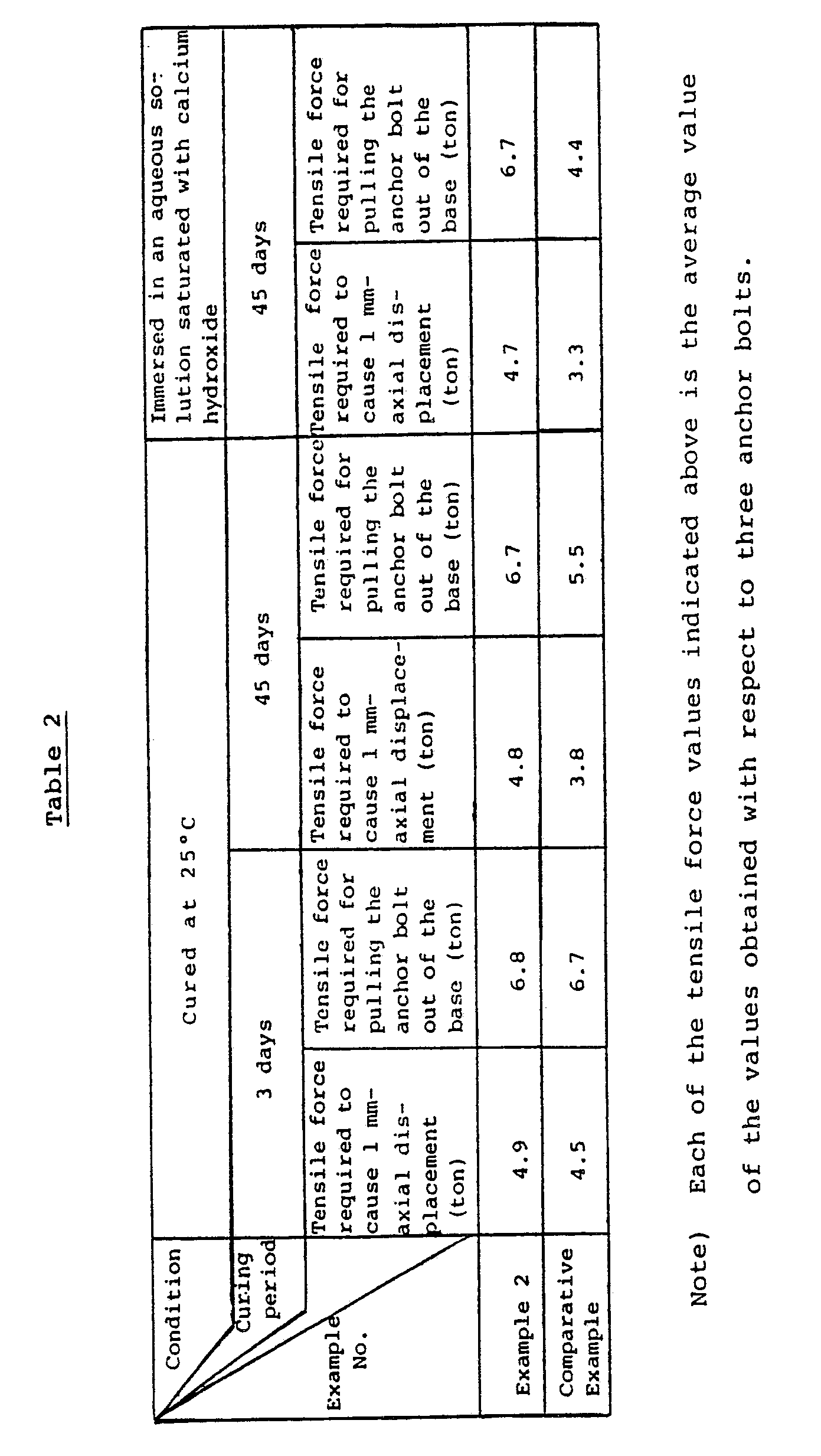
- A mixture of 390 g of an epoxy resin AER-331 [the trade name of a bisphenol A type epoxy resin (epoxy equilvalent, 189) manufactured and sold by Asahi Kasei Kogyo K.K., Japan], 172 g of methacrylic acid, 0.1 g of benzoquinone, and 2 g of diethylamine hydrochloride was heated to 125°C and maintained, while stirring, at the temperature to obtain a bisphenol A type epoxy acrylate resin having an acid value of 4.5. To the thus obtained bisphenol A type epoxy acrylate resin was added 562 g of styrene to obtain a mixture.
- Cartridges were prepared in substantially the same manner as in Example 1, except that the above- prepared mixture of the bisphenol A type epoxy acrylate resin and styrene was employed in place of the resin mixture used in Example 1. using the so-prepared cartridges, the same kind of anchor bolts as employed in Example 1 were fixed to the concrete block of the same kind as employed in Example 1 in the same manner as in Example 1, and the resulting adhesive connection between the anchor bolt and the concrete block was cured at 25°C. After the same curing period as in Example 2, the tensile force test with respect to the anchor bolts fixed to the concrete block and the alkali resistance test with respect to the adhesive connection were effected in the same manner as in Example 2.
- The results obtained with respect to the tensile force of the anchor bolts fixed to the concrete block and the alkali resistance of the adhesive connection were substantially the same as those obtained in Example 2.
- In the same manner as in Example 3, the same kind of epoxy acrylate resin as in Example 3 was prepared. To 562 g of the thus prepared epoxy acrylate resin were added reactive monomers, i.e., 50 g of butyl acrylate, 150 g of methyl methacrylate and 100 g of styrenes to obtain a mixture.
- Cartridges were prepared in substantially the same manner as in Example 1, except that the above-obtained mixture of the epoxy acrylate resin and reactive monomers was employed in place of the resin mixture used in Example 1. Using the so-prepared cartridges, the same kind of anchor bolts as employed in Example 1 were fixed to the concrete block of the same kind as employed in Example 1 in the same manner as in Example 1, and the resulting adhesive connection between the anchor bolts and the concrete block was cured at 25°C. After the same curing period as in Example 2, the tensile force test with respect to the anchor bolts fixed to the concrete block and the alkali resistance test with respect to the adhesive connection were effected in the same manner as in Example 2.
- The results obtained with respect to the tensile force of the anchor bolts fixed to the concrete block and the alkali resistance of the adhesive connection were substantially the same as those obtained in Example 2.
- A mixture of 400 g of diglycidyl phthalate, 180 g of methacrylic acid, 0.1 g of hydroquinone, and 1.0 g of diethyl amine hydrochloride was heated to 125°C and maintained, while stirring, at the temperature to obtain an expoxy acrylate resin having an acid value of 4.5. To the thus obtained epoxy acrylate resin was added 562 g of styrene to obtain a mixture.
- Cartridges were prepared in substantially the same manner as in Example 1, except that the above-obtained mixture of the epoxy resin and stryene was employed in place of the resin mixture used in Example 1. Using the so-prepared cartridges, the same kind of anchor bolts as employed in Example 1 were fixed to the concrete block of the same kind as employed in Example 1 in the same manner as in Example 1, and the resulting adhesive connection between the anchor bolt and the concrete block was cured at 25°C. After the same curing period as in Example 2, the tensile force test with respect to the anchor bolts fixed to the concrete block and the alkali resistance test with respect to the adhesive connection were effected in the same manner as in Example 2.
- The results obtained with respect to the tensile force of the anchor bolts fixed to the concrete block and the alkali resistance of the adhesive connection were substantially the same as those obtained in Example 2.
- A mixture of 390 g of an epoxy resin AER-331, 86 g of acrylic acid, 73 g of adipic acid, 0.87 g of benzoquinone and 2 g of diethylamine hydrochloride was heated to 125°C and maintained, while stirring, at the temperature to obtain an epoxy acrylate resin having an acid value of 3.1. To the thus obtained epoxy acrylate was added 562 g of styrene to obtain a mixture.
- Cartridges were prepared in substantially the same manner as in Example 1, except that the above-obtained mixture of epoxy acrylate resin and styrene was employed in place of the resin mixture used in Example 1. Using the so-prepared cartridges, the same kind of anchor bolts as employed in Example 1 were fixed to the concrete block of the same as employed in Example 1 in the same manner as in Example 1, and the resulting adhesive connection between the anchor bolt and the concrete block was cured at 25°C. After the same curing period as in Example 2, the tensile force test with respect to the anchor bolts fixed to the concrete block and the alkali resistance test with respect to the adhesive connection were effected in the same manner as in Example 2.
- The results obtained with respect to the tensile force of the anchor bolts fixed to the concrete block and the alkali resistance of the ahesive connection were substantially the same as those obtained in Example 2.
- Various epoxy acrylate resins were separately prepared in substantially the same manner as in Example 3, except that the epoxy resin as indicated in Table 3 were used in amounts as indicated in Table 3 instead of 390 g of the epoxy resin AER-331.

- To each of the epoxy acrylate resins as prepared above was added 562 g of styrene to obtain a mixture.
- Cartridges containing the above-obtained mixtures of the epoxy acrylate resins and styrene were separately prepared in substantially the same manner as in Example 1, except that the above-obtained mixtures of the epoxy resins and styrene were used in place of the resin mixture used in Example 1.
- Using the so-prepared cartridges, the same kind of anchor bolts as employed in Example 1 were fixed to the concrete block of the same kind as employed in Example 1, and the resulting adhesives connections between the anchor bolts and the concrete block were cured at 25°C. After the same curing period as in Example 2, the tensile force test with respect to the anchor bolts fixed to the concrete block and the alkali resistance test with respect to the adhesive connections between the anchor bolts and the concrete block were effected in the same manner as in Example 2.
- The results obtained with respect to the tensile force of the anchor bolts fixed to the concrete block and the alkali resistance of the adhesive connections between the anchor bolts and the concrete block were substantially the same as those obtained in Example 2.
Claims (9)
Applications Claiming Priority (2)
| Application Number | Priority Date | Filing Date | Title |
|---|---|---|---|
| JP58135772A JPS6028478A (en) | 1983-07-27 | 1983-07-27 | Bolt-setting fixing agent with high corrosion resistance |
| JP135772/83 | 1983-07-27 |
Publications (2)
| Publication Number | Publication Date |
|---|---|
| EP0150555A1 EP0150555A1 (en) | 1985-08-07 |
| EP0150555B1 true EP0150555B1 (en) | 1988-09-21 |
Family
ID=15159494
Family Applications (1)
| Application Number | Title | Priority Date | Filing Date |
|---|---|---|---|
| EP84305141A Expired EP0150555B1 (en) | 1983-07-27 | 1984-07-27 | Cartridge for use in fixing an anchor bolt and method of using the cartridge |
Country Status (4)
| Country | Link |
|---|---|
| US (1) | US4729696A (en) |
| EP (1) | EP0150555B1 (en) |
| JP (1) | JPS6028478A (en) |
| DE (1) | DE3474190D1 (en) |
Cited By (12)
| Publication number | Priority date | Publication date | Assignee | Title |
|---|---|---|---|---|
| WO1988003599A1 (en) * | 1986-11-13 | 1988-05-19 | Upat Gmbh & Co. | Reactive composition and multiple-chamber cartridge, and process for anchoring a fastening element to the fastening base |
| GB2199627A (en) * | 1986-12-05 | 1988-07-13 | Nippon Decoluxe Kk | Bonding type capsules for fixing anchor bolts |
| DE4121833C1 (en) * | 1991-07-02 | 1992-09-10 | Upat Gmbh & Co, 7830 Emmendingen, De | Anchoring casing for attachment to e.g. rock - comprises outer tubular casing contg. liq. resin components and inner casing contg. granular filter and curing components |
| US5288767A (en) * | 1991-09-21 | 1994-02-22 | Basf Aktiengesellschaft | Two-component adhesive composition for the chemical fixing technique |
| EP0733781A2 (en) | 1995-03-22 | 1996-09-25 | HILTI Aktiengesellschaft | Mortar cartridge for chemical fixing of anchoring means in boreholes |
| US5959002A (en) * | 1995-12-06 | 1999-09-28 | Asahi Kasei Kogyo Kabushiki Kaisha | Coated granular curing agent for a radically curable compound and anchor bolt-fixing composition comprising the same |
| US6037408A (en) * | 1991-07-02 | 2000-03-14 | Upat Gmbh & Co. | Reagent kit for the production of synthetic-resin elements for bonding fixation elements in place in an attachment surface |
| US8026321B2 (en) | 2003-09-26 | 2011-09-27 | Illinois Tool Works Inc. | Adhesive of epoxy compound, epoxy-reactive monomer and tri- and tetra-functional acrylate accelerators |
| US8058345B2 (en) | 2002-11-08 | 2011-11-15 | Illinois Tool Works Inc. | Curable adhesive compositions containing reactive multi-functional acrylate |
| DE102011055883A1 (en) | 2011-11-30 | 2013-06-06 | Fischerwerke Gmbh & Co. Kg | Use an aggregate, in a polymer forming anchoring compound in fastening technology in building sectors, to increase the capacity of bonding between the substrate and to be fastened object, preferably in wet borehole |
| DE102014013799A1 (en) | 2014-09-23 | 2016-03-24 | Albert-Ludwigs-Universität Freiburg | Platelet-shaped hard aggregates for chemical anchoring materials in structural engineering |
| DE102015113352A1 (en) | 2014-09-23 | 2016-03-24 | Fischerwerke Gmbh & Co. Kg | Fixing systems with finely divided fillers |
Families Citing this family (33)
| Publication number | Priority date | Publication date | Assignee | Title |
|---|---|---|---|---|
| DE3514031A1 (en) * | 1985-04-18 | 1986-10-23 | Hilti Ag, Schaan | ACRYLATE RESIN ADHESIVES AND THEIR USE FOR ANCHORINGS |
| US5080531A (en) * | 1986-11-13 | 1992-01-14 | Upat Gmbh & Co. | Multiple chamber cartridge for adhesive anchoring of fasteners in a base |
| DE3929603A1 (en) * | 1989-09-06 | 1991-03-07 | Hilti Ag | ANCHOR CARTRIDGE |
| DE3940309A1 (en) * | 1989-12-06 | 1991-06-13 | Hilti Ag | MOERTELMASSE |
| DE4106311C1 (en) * | 1991-02-28 | 1992-10-01 | Maechtle Gmbh, 7015 Korntal-Muenchingen, De | |
| DE4304620A1 (en) * | 1993-02-16 | 1994-08-18 | Fischer Artur Werke Gmbh | anchoring cartridge |
| DE4304824A1 (en) * | 1993-02-17 | 1994-08-18 | Upat Max Langensiepen Kg | Reaction resin mortar for two-component systems |
| WO1994020731A1 (en) * | 1993-03-01 | 1994-09-15 | Asahi Kasei Kogyo Kabushiki Kaisha | Anchor bolt fixing capsule |
| DE4339708A1 (en) * | 1993-11-22 | 1995-05-24 | Upat Max Langensiepen Kg | Multi-component hardenable material-contg. cartridge |
| US5643994A (en) * | 1994-09-21 | 1997-07-01 | Illinois Tool Works Inc. | Anchoring systems and methods utilizing acrylate compositions |
| US5965635A (en) * | 1995-06-07 | 1999-10-12 | Illinois Tool Works Inc. | Alkylacrylate ester composition for anchoring materials in or to concrete or masonry |
| DE19519397A1 (en) * | 1995-05-26 | 1996-11-28 | Fischer Artur Werke Gmbh | Anchoring cartridge for a hardening multicomponent mass |
| DE19531649A1 (en) * | 1995-08-29 | 1997-03-06 | Basf Ag | Dowel compound for chemical fastening technology |
| US6015845A (en) * | 1995-11-16 | 2000-01-18 | Asahi Kasei Kogyo Kabushiki Kaisha | Binder for building structure |
| US6376579B1 (en) | 2000-07-18 | 2002-04-23 | Illnois Tool Works | Low temperature curing, sag-resistant epoxy primer |
| JP4678984B2 (en) * | 2001-05-16 | 2011-04-27 | 旭化成ケミカルズ株式会社 | Resin composition and injectable cartridge |
| US20040127680A1 (en) * | 2002-11-08 | 2004-07-01 | Illinois Tool Works Inc. | Vinyl ester adhesive compositions |
| AU2003259674A1 (en) | 2002-11-08 | 2004-05-27 | Illinois Tool Works Inc. | Curable adhesive compositions containing reactive multi-functional acrylate |
| DE102004052570A1 (en) * | 2004-10-29 | 2006-05-04 | Fischerwerke Artur Fischer Gmbh & Co. Kg | The anchor assembly |
| WO2007018736A2 (en) * | 2005-07-22 | 2007-02-15 | Appleton Papers Inc. | Encapsulated structural adhesive |
| US20080219775A1 (en) * | 2007-03-09 | 2008-09-11 | Frederic Mercier-Langevin | Bolt assembly |
| WO2009097261A1 (en) * | 2008-01-28 | 2009-08-06 | Jennmar Corporation | Resin grouts for anchor systems |
| DE102008001903A1 (en) | 2008-05-21 | 2009-11-26 | Hilti Aktiengesellschaft | fastener |
| DE102008001904A1 (en) | 2008-05-21 | 2009-11-26 | Hilti Aktiengesellschaft | Setting method for anchoring a fastener |
| US8511953B2 (en) * | 2008-12-31 | 2013-08-20 | Rolls-Royce Corporation | Nut plate integral epoxy filled sleeve |
| US7775745B2 (en) * | 2009-01-20 | 2010-08-17 | J-Lok Co. | Anchoring systems and methods of use thereof |
| JP2011137357A (en) * | 2009-12-02 | 2011-07-14 | Asahi Kasei Chemicals Corp | Anchor bolt fixing capsule |
| US8585335B2 (en) * | 2009-12-08 | 2013-11-19 | Alessandro Carbonelli | Anchor bolt installation system |
| CA2822568C (en) * | 2010-11-07 | 2020-03-24 | Terrasimco, Inc. | Anchoring systems for mines |
| US8539992B2 (en) | 2011-04-27 | 2013-09-24 | Dsi Underground Systems, Inc. | Apparatus and method for anchor bolt grouting |
| JP6793016B2 (en) * | 2016-11-18 | 2020-12-02 | 株式会社ケー・エフ・シー | Hydraulic composition and anchor fixing capsule using it |
| ES2976569T3 (en) * | 2020-04-22 | 2024-08-05 | Sandvik Mining And Construction Tools Ab | Smart Rock Bolt Controller |
| US20220099127A1 (en) * | 2020-09-25 | 2022-03-31 | Steven S. Baik | Encapsulated adhesive |
Family Cites Families (24)
| Publication number | Priority date | Publication date | Assignee | Title |
|---|---|---|---|---|
| GB1006587A (en) * | 1961-12-18 | 1965-10-06 | Robertson Co H H | Ethylenically unsaturated polyhydroxy diester polyethers |
| US3324663A (en) * | 1963-10-21 | 1967-06-13 | American Cyanamid Co | Rock bolting |
| JPS5037885Y2 (en) * | 1971-01-28 | 1975-11-04 | ||
| JPS5231509B2 (en) * | 1971-09-30 | 1977-08-15 | ||
| US3968016A (en) * | 1972-05-17 | 1976-07-06 | Ppg Industries, Inc. | Mixture of unsaturated polyester resins with an epoxy diacrylate and the actinic light treatment of same |
| US3940537A (en) * | 1973-07-12 | 1976-02-24 | Ici United States Inc. | Fibrous mats |
| US3915297A (en) * | 1974-10-15 | 1975-10-28 | Paul Gilger Rausch | Cartridge containing self-setting composition for use in fixing elements in a substrate and method of making same |
| US4049750A (en) * | 1975-07-29 | 1977-09-20 | Walter Brenner | One component shelf stable low shrinkage structural adhesive systems |
| ZA766960B (en) * | 1975-12-30 | 1978-04-26 | Ici Australia Ltd | Capsule useful in processes for stabilizing and reinforcing rock formations and for securing elements in boreholes |
| GB1538102A (en) * | 1976-09-15 | 1979-01-10 | Ici Ltd | Calcium sulphate hemihydrate plaster |
| SE402318B (en) * | 1977-09-21 | 1978-06-26 | Cementa Ab | KIT AT ANCHORING ELEMENTS AND DEVICE FOR EXERCISING THE KIT |
| JPS54128128A (en) * | 1978-03-29 | 1979-10-04 | Sumitomo Chemical Co | Method of fixing anchor bolt |
| GB1599918A (en) * | 1978-05-31 | 1981-10-07 | Exchem Holdings | Grouting cartridge for rock-bolting |
| JPS5532814A (en) * | 1978-08-28 | 1980-03-07 | Minnesota Mining & Mfg | Cartridge for sealinggup |
| US4343921A (en) * | 1978-11-06 | 1982-08-10 | Usm Corporation | Adhesive composition |
| JPS55161197A (en) * | 1979-05-31 | 1980-12-15 | Nippon Oils & Fats Co Ltd | Cartridge for securing fixation element |
| US4325985A (en) * | 1980-03-31 | 1982-04-20 | The Oakland Corporation | Thread lock |
| EP0041801B1 (en) * | 1980-06-09 | 1984-12-05 | Imperial Chemical Industries Plc | A capsule of grouting material and methods for the preparation and use thereof |
| JPS5719497A (en) * | 1980-07-10 | 1982-02-01 | Nippon Oils & Fats Co Ltd | Cartridge for fastening expansive rock bolt |
| US4372708A (en) * | 1980-08-28 | 1983-02-08 | General Electric Company | Resin capsule and method for grouting anchor elements in holes of various lengths |
| JPS5765712A (en) * | 1980-10-11 | 1982-04-21 | Suriibondo:Kk | Curable composition |
| GB2124955A (en) * | 1982-07-02 | 1984-02-29 | Avdel Ltd | Blind riveting tool |
| DE3226602A1 (en) * | 1982-07-16 | 1984-01-19 | Hilti AG, 9494 Schaan | HARDENABLE RESIN MATERIALS AND THEIR USE |
| JPS59158900A (en) * | 1983-02-25 | 1984-09-08 | 日本ユピカ株式会社 | Grouting material for fixing lock bolt |
-
1983
- 1983-07-27 JP JP58135772A patent/JPS6028478A/en active Granted
-
1984
- 1984-07-26 US US06/634,426 patent/US4729696A/en not_active Expired - Lifetime
- 1984-07-27 EP EP84305141A patent/EP0150555B1/en not_active Expired
- 1984-07-27 DE DE8484305141T patent/DE3474190D1/en not_active Expired
Non-Patent Citations (1)
| Title |
|---|
| DERWENT PUBLICATIONS LTD, London page 36, Q4 * |
Cited By (19)
| Publication number | Priority date | Publication date | Assignee | Title |
|---|---|---|---|---|
| WO1988003599A1 (en) * | 1986-11-13 | 1988-05-19 | Upat Gmbh & Co. | Reactive composition and multiple-chamber cartridge, and process for anchoring a fastening element to the fastening base |
| GB2199627A (en) * | 1986-12-05 | 1988-07-13 | Nippon Decoluxe Kk | Bonding type capsules for fixing anchor bolts |
| GB2199627B (en) * | 1986-12-05 | 1991-07-31 | Nippon Decoluxe Kk | Bonding type capsules for fixing anchor bolts |
| DE4121833C1 (en) * | 1991-07-02 | 1992-09-10 | Upat Gmbh & Co, 7830 Emmendingen, De | Anchoring casing for attachment to e.g. rock - comprises outer tubular casing contg. liq. resin components and inner casing contg. granular filter and curing components |
| US6037408A (en) * | 1991-07-02 | 2000-03-14 | Upat Gmbh & Co. | Reagent kit for the production of synthetic-resin elements for bonding fixation elements in place in an attachment surface |
| US5288767A (en) * | 1991-09-21 | 1994-02-22 | Basf Aktiengesellschaft | Two-component adhesive composition for the chemical fixing technique |
| EP0733781A2 (en) | 1995-03-22 | 1996-09-25 | HILTI Aktiengesellschaft | Mortar cartridge for chemical fixing of anchoring means in boreholes |
| US5959002A (en) * | 1995-12-06 | 1999-09-28 | Asahi Kasei Kogyo Kabushiki Kaisha | Coated granular curing agent for a radically curable compound and anchor bolt-fixing composition comprising the same |
| US8058345B2 (en) | 2002-11-08 | 2011-11-15 | Illinois Tool Works Inc. | Curable adhesive compositions containing reactive multi-functional acrylate |
| US8026321B2 (en) | 2003-09-26 | 2011-09-27 | Illinois Tool Works Inc. | Adhesive of epoxy compound, epoxy-reactive monomer and tri- and tetra-functional acrylate accelerators |
| DE102011055883A1 (en) | 2011-11-30 | 2013-06-06 | Fischerwerke Gmbh & Co. Kg | Use an aggregate, in a polymer forming anchoring compound in fastening technology in building sectors, to increase the capacity of bonding between the substrate and to be fastened object, preferably in wet borehole |
| DE102014013799A1 (en) | 2014-09-23 | 2016-03-24 | Albert-Ludwigs-Universität Freiburg | Platelet-shaped hard aggregates for chemical anchoring materials in structural engineering |
| DE102015113352A1 (en) | 2014-09-23 | 2016-03-24 | Fischerwerke Gmbh & Co. Kg | Fixing systems with finely divided fillers |
| EP3000792A1 (en) | 2014-09-23 | 2016-03-30 | fischerwerke GmbH & Co. KG | Fastening systems having fine particulate fillers |
| DE202015009665U1 (en) | 2014-09-23 | 2018-12-06 | Fischerwerke Gmbh & Co. Kg | Fixing systems with finely divided fillers |
| DE202015009664U1 (en) | 2014-09-23 | 2018-12-06 | Fischerwerke Gmbh & Co. Kg | Fixing systems with finely divided fillers |
| US10711116B2 (en) | 2014-09-23 | 2020-07-14 | Fischerwerke Gmbh & Co. Kg | Fixing systems having fine-particle fillers |
| EP3835280A1 (en) | 2014-09-23 | 2021-06-16 | fischerwerke GmbH & Co. KG | Fastening systems having fine particulate fillers |
| US11795301B2 (en) | 2014-09-23 | 2023-10-24 | Fischerwerke Gmbh & Co. Kg | Fixing systems having fine-particle fillers |
Also Published As
| Publication number | Publication date |
|---|---|
| JPS6028478A (en) | 1985-02-13 |
| DE3474190D1 (en) | 1988-10-27 |
| JPS6237076B2 (en) | 1987-08-11 |
| US4729696A (en) | 1988-03-08 |
| EP0150555A1 (en) | 1985-08-07 |
Similar Documents
| Publication | Publication Date | Title |
|---|---|---|
| EP0150555B1 (en) | Cartridge for use in fixing an anchor bolt and method of using the cartridge | |
| KR100276371B1 (en) | Two-component mortars and devices therefor used to fix anchoring means to drilling holes | |
| US5531546A (en) | Mortar composition | |
| US4280943A (en) | Organic grouting composition for anchoring a bolt in a hole | |
| US6037408A (en) | Reagent kit for the production of synthetic-resin elements for bonding fixation elements in place in an attachment surface | |
| RU2109922C1 (en) | Method and compound for stabilization of underground formations | |
| WO1994020731A1 (en) | Anchor bolt fixing capsule | |
| JPS61243876A (en) | Adhesive based on acrylic compound | |
| JPH09143380A (en) | Filling composition for chemical hardening fixation | |
| JP2613070B2 (en) | Multi-chamber cartridge with built-in reaction set | |
| EP0005988B1 (en) | Cartridge for rock-bolting | |
| JPH05263047A (en) | Two-component adhesive material for chemical fixing technique, and cartridge and cartouche | |
| EP0169639A1 (en) | Filler containing hardenable resin products | |
| EP0798312B1 (en) | Anchor bolt fixing composition | |
| JPS60173071A (en) | Bolt fixing agent | |
| JP4516290B2 (en) | Resin composition for post-installation anchors | |
| JPH0585720B2 (en) | ||
| JP2001089716A (en) | Fixing agent for bolt and fixing method | |
| JPH0832750B2 (en) | Adhesive composition | |
| JP2967445B2 (en) | Fixing equipment and fixing method | |
| JPH11117700A (en) | Resin capsule anchor for fixing anchor bolt | |
| KR19980020223A (en) | Mortar Resin Composition for Fixing Vinyl Tube Type Rock Bolt |
Legal Events
| Date | Code | Title | Description |
|---|---|---|---|
| PUAI | Public reference made under article 153(3) epc to a published international application that has entered the european phase |
Free format text: ORIGINAL CODE: 0009012 |
|
| 17P | Request for examination filed |
Effective date: 19840806 |
|
| AK | Designated contracting states |
Kind code of ref document: A1 Designated state(s): DE FR GB IT |
|
| 17Q | First examination report despatched |
Effective date: 19861121 |
|
| GRAA | (expected) grant |
Free format text: ORIGINAL CODE: 0009210 |
|
| AK | Designated contracting states |
Kind code of ref document: B1 Designated state(s): DE FR GB IT |
|
| REF | Corresponds to: |
Ref document number: 3474190 Country of ref document: DE Date of ref document: 19881027 |
|
| ITF | It: translation for a ep patent filed | ||
| ET | Fr: translation filed | ||
| PLBI | Opposition filed |
Free format text: ORIGINAL CODE: 0009260 |
|
| PLBI | Opposition filed |
Free format text: ORIGINAL CODE: 0009260 |
|
| 26 | Opposition filed |
Opponent name: HILTI AKTIENGESELLSCHAFT Effective date: 19890429 |
|
| 26 | Opposition filed |
Opponent name: UPAT GMBH & CO. Effective date: 19890601 Opponent name: HILTI AKTIENGESELLSCHAFT Effective date: 19890429 |
|
| PLAB | Opposition data, opponent's data or that of the opponent's representative modified |
Free format text: ORIGINAL CODE: 0009299OPPO |
|
| R26 | Opposition filed (corrected) |
Opponent name: HILTI AKTIENGESELLSCHAFT * 890601 UPAT GMBH & CO. Effective date: 19890429 |
|
| ITTA | It: last paid annual fee | ||
| PLBN | Opposition rejected |
Free format text: ORIGINAL CODE: 0009273 |
|
| STAA | Information on the status of an ep patent application or granted ep patent |
Free format text: STATUS: OPPOSITION REJECTED |
|
| 27O | Opposition rejected |
Effective date: 19911008 |
|
| REG | Reference to a national code |
Ref country code: GB Ref legal event code: IF02 |
|
| PGFP | Annual fee paid to national office [announced via postgrant information from national office to epo] |
Ref country code: FR Payment date: 20030711 Year of fee payment: 20 |
|
| PGFP | Annual fee paid to national office [announced via postgrant information from national office to epo] |
Ref country code: GB Payment date: 20030723 Year of fee payment: 20 |
|
| PGFP | Annual fee paid to national office [announced via postgrant information from national office to epo] |
Ref country code: DE Payment date: 20030807 Year of fee payment: 20 |
|
| PG25 | Lapsed in a contracting state [announced via postgrant information from national office to epo] |
Ref country code: GB Free format text: LAPSE BECAUSE OF EXPIRATION OF PROTECTION Effective date: 20040726 |
|
| REG | Reference to a national code |
Ref country code: GB Ref legal event code: PE20 |
|
| APAH | Appeal reference modified |
Free format text: ORIGINAL CODE: EPIDOSCREFNO |