EP0150651A1 - Verfahren zum selektiven Haarfärben und Farbauftragkamm zur Durchführung des Verfahrens - Google Patents
Verfahren zum selektiven Haarfärben und Farbauftragkamm zur Durchführung des Verfahrens Download PDFInfo
- Publication number
- EP0150651A1 EP0150651A1 EP84420017A EP84420017A EP0150651A1 EP 0150651 A1 EP0150651 A1 EP 0150651A1 EP 84420017 A EP84420017 A EP 84420017A EP 84420017 A EP84420017 A EP 84420017A EP 0150651 A1 EP0150651 A1 EP 0150651A1
- Authority
- EP
- European Patent Office
- Prior art keywords
- hair
- comb
- treating material
- gullets
- sheaf
- Prior art date
- Legal status (The legal status is an assumption and is not a legal conclusion. Google has not performed a legal analysis and makes no representation as to the accuracy of the status listed.)
- Granted
Links
- 238000004040 coloring Methods 0.000 title claims abstract description 50
- 238000000034 method Methods 0.000 title claims abstract description 45
- 230000037308 hair color Effects 0.000 title claims description 3
- 210000004209 hair Anatomy 0.000 claims abstract description 257
- 239000000463 material Substances 0.000 claims abstract description 110
- 210000004919 hair shaft Anatomy 0.000 claims abstract description 24
- 210000004761 scalp Anatomy 0.000 claims description 25
- 210000003128 head Anatomy 0.000 claims description 11
- 230000004888 barrier function Effects 0.000 claims description 8
- 230000009471 action Effects 0.000 claims description 2
- 238000005086 pumping Methods 0.000 claims description 2
- 230000002572 peristaltic effect Effects 0.000 claims 9
- 230000006835 compression Effects 0.000 claims 2
- 238000007906 compression Methods 0.000 claims 2
- 230000008878 coupling Effects 0.000 claims 2
- 238000010168 coupling process Methods 0.000 claims 2
- 238000005859 coupling reaction Methods 0.000 claims 2
- 230000002250 progressing effect Effects 0.000 claims 2
- 230000000750 progressive effect Effects 0.000 claims 1
- 238000009941 weaving Methods 0.000 description 6
- 230000008569 process Effects 0.000 description 5
- 230000008901 benefit Effects 0.000 description 4
- 239000007788 liquid Substances 0.000 description 4
- 238000004061 bleaching Methods 0.000 description 3
- 230000008859 change Effects 0.000 description 3
- 238000010276 construction Methods 0.000 description 3
- 238000004043 dyeing Methods 0.000 description 3
- 239000011888 foil Substances 0.000 description 3
- 239000002985 plastic film Substances 0.000 description 3
- 229920006255 plastic film Polymers 0.000 description 3
- 238000000926 separation method Methods 0.000 description 3
- 239000000126 substance Substances 0.000 description 3
- 241000251468 Actinopterygii Species 0.000 description 2
- 210000001520 comb Anatomy 0.000 description 2
- 230000000694 effects Effects 0.000 description 2
- 239000004033 plastic Substances 0.000 description 2
- 210000003625 skull Anatomy 0.000 description 2
- 230000003796 beauty Effects 0.000 description 1
- 239000007844 bleaching agent Substances 0.000 description 1
- 238000010227 cup method (microbiological evaluation) Methods 0.000 description 1
- 230000007423 decrease Effects 0.000 description 1
- 230000001419 dependent effect Effects 0.000 description 1
- 238000001514 detection method Methods 0.000 description 1
- 239000003599 detergent Substances 0.000 description 1
- 239000000975 dye Substances 0.000 description 1
- 239000013536 elastomeric material Substances 0.000 description 1
- 238000011010 flushing procedure Methods 0.000 description 1
- 239000000118 hair dye Substances 0.000 description 1
- 229910052751 metal Inorganic materials 0.000 description 1
- 239000002184 metal Substances 0.000 description 1
- 150000002739 metals Chemical class 0.000 description 1
- 230000005012 migration Effects 0.000 description 1
- 238000013508 migration Methods 0.000 description 1
- 230000019612 pigmentation Effects 0.000 description 1
- 238000009428 plumbing Methods 0.000 description 1
- 230000009467 reduction Effects 0.000 description 1
- 125000006850 spacer group Chemical group 0.000 description 1
- 230000009897 systematic effect Effects 0.000 description 1
- 239000010409 thin film Substances 0.000 description 1
- 239000013008 thixotropic agent Substances 0.000 description 1
- 230000009974 thixotropic effect Effects 0.000 description 1
- 239000012780 transparent material Substances 0.000 description 1
- 230000000007 visual effect Effects 0.000 description 1
- XLYOFNOQVPJJNP-UHFFFAOYSA-N water Substances O XLYOFNOQVPJJNP-UHFFFAOYSA-N 0.000 description 1
Images


Classifications
-
- A—HUMAN NECESSITIES
- A45—HAND OR TRAVELLING ARTICLES
- A45D—HAIRDRESSING OR SHAVING EQUIPMENT; EQUIPMENT FOR COSMETICS OR COSMETIC TREATMENTS, e.g. FOR MANICURING OR PEDICURING
- A45D24/00—Hair combs for care of the hair; Accessories therefor
- A45D24/22—Combs with dispensing devices for liquids, pastes or powders
- A45D24/24—Combs with dispensing devices for liquids, pastes or powders with provision for free supply; using wicks
Definitions
- streaking Treatment of selected strands of hair to change the color is called streaking if the selected strands are lightened, or reverse streaking if they are darkened.
- Other terms such as frosting and tipping are related and will be discussed below. Streaking can produce an appearance similar to that of highlights glistening on the hair, and is much desired. Reverse streaking can give an appearance of texture to dull hair. It can also be used when the client wishes to return to her or his own natural shade. In this case, as the roots grow out, the previously bleached hair can be reverse streaked to make less apparent the difference between the different portions of hair.
- the procedure is actually painful to the client.
- the hair is first combed, then covered with a thin film of plastic and finally covered with a heavy rubber cap, which is provided with a large number of small holes.
- the hair stylist uses a smooth crochet hook to punch through the plastic film at each hole in the rubber cap, snares the hair which lies underneath the hole and fishes it out with the hook.
- Considerable force must be used to fish out the selected strands of hair because of the adjacency of other strands, and the confinement of the plastic film and rubber cap. After the selected strands are pulled out and exposed, outside of the rubber cap, they are treated with treating material, which is kept from reaching the scalp and the remaining hair by the tight fit of the rubber cap and plastic film.
- the frosting cap method is popular and has certain advantages. There is no contact of the scalp with the chemicals used, and the treated hair is well segregated from the hair which is not to be treated. However, besides the painful aspects mentioned above, there is much breakage of hair, the hair stylist has limited control of which particular strands of hair are pulled out, and the rubber cap must stay in place for the wearisome time of up to an hour.
- Another method utilizes cups. Selected strands of hair are pulled through a small hole in the bottom of the cup into the interior thereof, the selected strands are then treated and packed into the cup.
- the method permits greater control by the hair stylist of the choice of which particular strands of hair are to be treated than does the frosting cap method.
- the size of the cups dictates that the different treated strands must be widely spaced, which is a disadvantage. This method is time consuming since each cup must be individually handled. It is difficult to manipulate short hair into the cup.
- the Dixie Cup method has not gained great popularity.
- the hair stylist isolates a strand of hair from the remaining hair, and lays it over a piece of foil which is butted up against the scalp, adjacent the roots of the isolated strand.
- the isolated strand is then treated with treating material and the foil is folded around it to act as a barrier against migration of the treating material. It is difficult for the hair stylist using this method to follow the progress of the treatment since the hair being treated is hidden. When streaking, some of the hair is sometimes overbleached.
- Another method is the weaving comb method. Considering the manipulations required of the hair stylist, this method is closest in approach to, although distinct from, the instant invention.
- the weaving comb method is well described in American Hairdresser Salon Owner, Volume 100, Number 3, March 1977, at page 76. Note particularly illustration 10. Briefly, the method uses a weaving comb, which has gullets to two depths between its teeth. When the comb is used, it acts like the headles of a loom to separate the hair being combed into an upper and lower flight, with a shed between, and with the upper flight flowing through the comb adjacent the spine of the comb and the lower flight flowing through the comb closer to the tips of the teeth. Treating material is placed on the spine of the comb, adjacent the teeth.
- the instant invention differs from the other methods of selectively applying treating material in that much less handling of the hair is required, as will be seen from the following synopsis.
- the hair is initially divided into partings and each parting is sequentially treated. If desired, partings can be isolated from other partings by barrier material. There may be, typically, about twenty partings.
- Each parting is combed out into a laminar sheaf, as defined above.
- a special coloring comb is run through the laminar sheaf only once, to deposit the treating material in a controlled manner on spaced selected hair shafts of the outer face of said laminar sheaf, while the intercalated hair shafts of the outer face of said sheaf are not treated.
- the special coloring comb is so constructed as to clearly delineate the treated areas from the intercalated untreated areas.
- each parting when treated, may be separated with barrier material so that treating material does not transfer between adjacent partings.
- each parting can be handled in less than a minute, and the entire head of hair can be treated in about twenty minutes. This compares very favorably with the amount of time required of the hair stylist by other methods.
- the desired hair style determines the partings which will be made in order to color the hair.
- the partings can be visualized by reference to Figure 1, which illustrates the areas of the skull corresponding to one possible scheme of partings. A series of fifteen generally parallel areas run from the brow, at 11, past the crown at 12 and the occiput at 13 to the nape of 14. The area above the ear is divided into areas 15 to 17. The areas shown in Figure 1 can be described as arranged generally horizontally. Another hair style might require areas which are arranged generally vertically, with the areas proceeding around the skull from one side around the back to the other side.
- Figure 2 illustrates how hair partings relate to the areas of Figure 1. Some of these hair partings, namely, 21, 24A, 24B and 26 are depicted in a striped manner to indicate the individual hair shafts of a parting, while the other hair partings are depicted only by their outlines, in order to avoid confusion. It will be seen that the area 11 corresponds to the single partings 21, the area 18 corresponds to two partings 22A and 22B and the area 19 corresponds to the three partings 23A, 23B and 23C. The partings of Figure 2 are not intended to accurately reflect actual partings, but are intended to be expository. The reason why an area such as 19 corresponds to three partings rather than to one paring will be apparent by considering how the partings are manipulated. This is illustrated in Figures 3 and 4.
- Figure 3 illustrates how a parting, which corresponds approximately to parting 24A of Figure 2, is drawn out into a laminar sheaf 31 running between the scalp and the hair stylist's left hand and fingers 32.
- the normally overlying hair has been piled up atop the head into a bun 33 and the bun is held in place temporarily by clips 34.
- the hair stylist had selected the parting and combed it out with a conventional comb so that the hair shafts became parallel, to form the laminar sheaf 31.
- This sheaf at the hair stylists hands and fingers is very slight, while the thickness increases toward the scalp to a value which would typically be between 1 and 5 centimeters.
- the width of the laminar sheaf is limited by the length of the hair stylists fingers, unless the hair stylist uses a clamping tool which has a clamping face longer than the fingers, and is limited by the length of the coloring comb head, which will be described below. A typical width would be between 6 and 12 centimeters.
- the hair stylist has the previously combed laminar sheaf 31 in a state of tension and is drawing the coloring comb 35 in the direction 36 through the hair for a single stroke.
- the coloring comb 35 lays down on the top face of laminar sheaf 31 a series of spaced deposits of hair treating material, running along the length and lay of the hair, said deposits being separated by spaces whereat no treating material is deposited.
- the hair treating material deposited on the upper face of laminar sheaf 31 is compounded so at to lighten or darken the hair, and is also compounded so that it sinks locally into the hair and acts thereon without migrating away sufficiently to close up or intrude on the desired spaces between the deposits.
- a preferred way to accomplish this result is to incorporate into the hair treating material a thixotropic agent, which will permit the hair treating material to act for a few seconds as a liquid, after it has been subjected to high sheering forces while being deposited, and then, when the sheering forces are removed, permits the hair treating material, which by that time has penetrated locally into the hair, to solidify and stay put.
- the process is called frosting. If the hair treating material is put down so as to color wide strands of hair, the process is called streaking or reverse streaking. If the hair treating material is put down so that only a portion of the strands, terminating at the tip, are colored, the strands being either tiny or wide, the process is called tipping.
- the widths of the treated areas of hair and the spacing between these areas is determined by the construction of the coloring comb, which will be explained below.
- the portions of the laminar sheaf, with respect to the direction along the length of the hair shaft, which are treated, are determined by the way the hair stylist manipulates the coloring comb.
- the coloring comb is moved in the direction 36 all the way from the scalp to the tips of the hair, the full length of some of the hair shafts will be treated. If the coloring comb is inserted into the laminar sheaf at a point spaced from the scalp and then drawn all the way to the tips of the hair shafts, a different effect, called tipping, is achieved.
- the coloring comb can be inserted into the laminar sheaf as in tipping, and drawn only partway to the tips of the hair to achieve a yet different effect.
- Figure 4 depicts a view of the hair stylist manipulating a laminar sheaf 45A, 45B, which corresponds roughly with the area 17 above the ear in Figure 1.
- the coloring comb 35 consists of a reservoir section 43, in which the hair treating material is stored, a handle-pump section 42, by which the coloring comb is grasped, and which, when squeezed, pumps hair treating material to the comb-head 41. While the laminar sheaf is held under tension, the comb is drawn through the hair in the direction 46, while pressing downward on the sheaf. It will be recognized that hair is straightened out and arranged in parallel laminar arrangement more perfectly with successive combines.
- the portion of laminar sheaf 45 A is depicted as being in better array than the portion 45B.
- This is an important advantage of the coloring comb - it is self guiding and corrects small misarrays of the laminar sheaf. Since the coloring comb is self guiding, it is possible for the hair stylist to work rapidly.
- the downward pressure of comb-head 41 produces a dihedral angle between portion 45A and 45B of the laminar sheaf. This downward pressure ensures that the particular hair shafts which are to be treated are pressed to the bottoms of the gullets between the teeth of comb-head 41, at which bottoms the hair treating material is dispensed so as to deposit on the particular strands being treated.
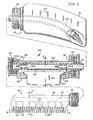
- the coloring comb 35 is shown in Figure 5 in a partly disassembled and exploded and partly cross sectioned 35 view.
- the reservoir section 43 includes a polymeric bottle 51 having an external screw thread 52 at the opening and markings 53 to indicate volume.
- This bottle is similar to the squeeze bottles utilized by,,hair stylists, but has a body of distorted or "sagged" shape so as to render it easier for the tube 54 to pick up the hair treating material contained in the bottle 51.
- the end of the tube 54 is provided with a sinker 55.
- Tube 54 is made of a soft elastomeric material which will collapse if squeezed by moderate pressure applied at opposite sides of the tube. However, the wall of tube 54 is thick enough so that the tube will not collapse by application of any reasonable suction pressure.
- Tube 54 extends through handle-pump 42 to washer 54A, which is unitary with the tube 54.
- Two elastomeric duck-bill valves 56A and 56B are pushed into the bore of the tube 54 and are cemented into place.
- An end view of one of the duck-bill valves is seen in Figure 9.
- the duck-bill valves have a heavy body portion which somewhat expands the tube 54 and a thin-lip portion which performs the valving function. Because of the particular contours of the duck-bill balves, as shown in Figure 5, the functioning of the thin lip portion is not affect by stresses in or strains of the body portion.
- the tube 54 is clipped into pump-handle 42 by being threaded through from the left end of housing 58 until the washer 54A abuts against retainer 59, which secures captive nut 60. Then the elastomeric collar-washer 57 is threaded over the right end of tube 54 until the collar-washer 57 abuts against retainer 61. It will be noted that the elastomeric collar-washer 57 fits tightly on elastomeric tube 54, so that the joint between them is leak-tight. This joint be cemented, if desired.
- Tube 54 is contained within housing 58, as best seen in Figure 6, and the opening at the bottom of the housing is closed by closure 63.
- the closure contains a slot which receives an elongated push button 64.
- push button 64 When push button 64 is pressed in the direction indicated by arrow 65, the abutting surface 66 collapses the tube 54, as shown by the dotted line 66A in Figure 6, thereby reducing the volume of the tube 54 between duck-bill valves 56A and 56B.
- the push button 64 is released, the resilience of elastomeric tube 54 pushes push button 64 down and the said volume is restored.
- the alternate reduction and expansion of said volume in combination with the one-way check valve operation of the two duck-bill valves 56A and 56B, results in a pumping action from right to left.
- Closure 63 and retainers 59 and 61 are cemented to housing 58.
- the captive nut 62 mates with the screw threads 52 and clamps reservoir section 43 firmly in place in a leak-tight manner against collar-washer 57.
- the reservoir can be clamped into place in any desired orientation with respect to the handle, since the captive nut 62 will tighten the joint between collar-washer 57 and the mouth of bottle 51 at any desired orientation.
- the captive nut 60 mates with screw thread 71 of comb-head 41. Since the captive nut 60 can be swiveled in any direction, it follows that the comb-head can be clamped against washer 56 in any orientation. This is advantageous since some hair stylists prefer to press the push button 64 with the balls of their fingers, while other prefer to press the push button 64 with the gripping portion of their fingers closer to the palm.
- the comb-head 41 includes the spine 70 which supports the teeth 74. Between teeth are gullets 75.
- the spine 70 has a large main bore 72 and a plurality of small branch bores 73, which lead to selected ones of the gullets 75. As shown in Figure 5, there is a small branch bore 73 for every third gullet.
- the small bores 73 lead directly to the bottoms of the gullets 75, as seen in Figure 7, so that only the hair which is wiping past the delivery end of the small bores 73 would receive any hair treating material.
- the large main bore 72 is of such size that there is substantially no pressure difference at the entrances of the different small branch bores 73.
- the small branch bores 73 are of such small size that substantially all of the pressure drop takes place therein, and this pressure drop is high enough to limit the advance of push button 64 as it is squeezed by the hair stylist.
- the amount of hair treating material dispensed per unit time at each of the gullets 75 whereat a small branch bore 73 terminates will depend on the pressure exerted on the push button 64 by the hair stylists. With the application of uniform pressure, the push button 64 necessarily moves uniformly.
- the inner diameter of tube 54 is determined by the fact that the tube, when fully collapsed between duck-bill valves 56A and 56B, must have expelled enough hair treating material for one full stroke of the coloring comb 35.
- the construction of the coloring comb 35 is such that only chemically resistant polymeric materials and chemically resistant plastic materials are used.
- the fact that the tube 54 is continuous without a seam through the handle-pump 42 ensures that there will be no leakage of hair treating material.
- a series of differing comb heads can be provided to leave deposits on the upper face of a laminar sheaf which are suited to the different styles desired.
- the teeth could be arranged in a pitch either finer or coarser than that shown.
- the pattern may be small branch bores at three adjacent gullets, spaced by two ordinary gullets, etc.
- the treating material is deposited on the hair and substantially none reaches the scalp.
- the spine of the comb acts as a spacer to keep a separation between the treating material and the scalp. Hence, it is not necessary to use barrier materials to protect the clients scalp.
- the herein disclosed coloring comb is useful for an operation known as color retouch.
- Human hair grows about a centimeter or more a month. Therefore, a month after a client has had a hair coloring treatment in accordance with the instant invention, there will be new hair at the roots which will have the full natural pigmentation. This situation makes it necessary, from time to time, to color the new growth so that uniform color is achieved from the root to the demarcation line on the hair from the previous color treatment.
- the coloring comb can be used for this retouch process.
- the hair stylist first isolates the original laminar sheaf of the previous treatment. This is relatively easily done, since it involves merely probing with the rat tail comb to establish the original separation, with the previously treated hair shafts being the guide-post indicators.
- the hair stylist matches the previously created pattern, such as streaking or frosting, with the particular comb-head which created the pattern. Finally the hair stylist uses that particular comb-head to treat only the grown out portion of the laminar sheaf, carefully inserting the comb-head into the laminar sheaf, adjacent the scalp, so that the small branch bores are in alignment with the previously treated areas.
- the manipulations involved in the use of the coloring comb 35 are similar to those involved in the use of an ordinary comb, and skill in handling the coloring comb is easy to acquire. A simple rule is followed: The coloring comb 35 combs the laminar sheaf in the same direction as that in which the hair will be styled.
- the method and apparatus can also be used on hairpieces of human hair.
- the chemicals that are used on human subjects are compatable with human hairpieces such as wigs, toupees, wiglets falls, etc.
- the hairpiece is mounted on a wig form and is manipulated and treated much as if it were hair on a person's head, as will be apparent to those skilled in the art.
- the comb-head 41 is preferably made of transparent material, so that it is easier to line up the small branch bores with the particular hair shafts which it is desired to color. If made of opaque material, the spine 70 can be provided with indicia to show at which gullets the hair treating material is delivered. A transparent comb head simplifies flushing out and detection of clogging.
Landscapes
- Cleaning And Drying Hair (AREA)
- Cosmetics (AREA)
- Brushes (AREA)
Priority Applications (3)
| Application Number | Priority Date | Filing Date | Title |
|---|---|---|---|
| EP84420017A EP0150651B1 (de) | 1984-02-01 | 1984-02-01 | Verfahren zum selektiven Haarfärben und Farbauftragkamm zur Durchführung des Verfahrens |
| AT84420017T ATE48222T1 (de) | 1984-02-01 | 1984-02-01 | Verfahren zum selektiven haarfaerben und farbauftragkamm zur durchfuehrung des verfahrens. |
| DE8484420017T DE3480584D1 (de) | 1984-02-01 | 1984-02-01 | Verfahren zum selektiven haarfaerben und farbauftragkamm zur durchfuehrung des verfahrens. |
Applications Claiming Priority (1)
| Application Number | Priority Date | Filing Date | Title |
|---|---|---|---|
| EP84420017A EP0150651B1 (de) | 1984-02-01 | 1984-02-01 | Verfahren zum selektiven Haarfärben und Farbauftragkamm zur Durchführung des Verfahrens |
Publications (2)
| Publication Number | Publication Date |
|---|---|
| EP0150651A1 true EP0150651A1 (de) | 1985-08-07 |
| EP0150651B1 EP0150651B1 (de) | 1989-11-29 |
Family
ID=8192940
Family Applications (1)
| Application Number | Title | Priority Date | Filing Date |
|---|---|---|---|
| EP84420017A Expired EP0150651B1 (de) | 1984-02-01 | 1984-02-01 | Verfahren zum selektiven Haarfärben und Farbauftragkamm zur Durchführung des Verfahrens |
Country Status (3)
| Country | Link |
|---|---|
| EP (1) | EP0150651B1 (de) |
| AT (1) | ATE48222T1 (de) |
| DE (1) | DE3480584D1 (de) |
Cited By (1)
| Publication number | Priority date | Publication date | Assignee | Title |
|---|---|---|---|---|
| EP0340154A1 (de) * | 1988-04-29 | 1989-11-02 | Schering Aktiengesellschaft | Applikator zur Behandlung der Haut |
Citations (10)
| Publication number | Priority date | Publication date | Assignee | Title |
|---|---|---|---|---|
| GB425162A (en) * | 1934-07-19 | 1935-03-08 | Sidney Orentreich | Reservoir hair dye brush and bleaching appliance |
| DE673744C (de) * | 1936-08-29 | 1939-03-29 | Erna Krafft | Haarkamm mit Fluessigkeitsfoerdereinrichtung zu den Kammzinkenenden |
| US2222176A (en) * | 1939-07-15 | 1940-11-19 | Charles M Hickey | Fountain comb |
| US2235637A (en) * | 1940-04-11 | 1941-03-18 | Charles M Hickey | Fountain comb and brush |
| US2743042A (en) * | 1953-06-16 | 1956-04-24 | Luther B Burgin | Fountain toothbrush |
| US3349781A (en) * | 1965-04-16 | 1967-10-31 | Poole Rene Jean | Hair coloring method |
| US3400996A (en) * | 1966-11-15 | 1968-09-10 | Edward W Macrum | Toothbrush with integral dentifrice dispenser |
| FR2357204A1 (fr) * | 1976-07-09 | 1978-02-03 | Deloche Michel | Brosse perfectionnee pour soins dentaires |
| FR2475374A1 (fr) * | 1980-02-11 | 1981-08-14 | Pedone Domenico | Dispositif destine a la decoloration des meches de cheveux |
| FR2485349A1 (fr) * | 1980-06-26 | 1981-12-31 | Zouari Richard | Dispositif pour l'application, sur le cuir chevelu et les cheveux, d'un produit liquide, pateux ou pulverulent |
-
1984
- 1984-02-01 EP EP84420017A patent/EP0150651B1/de not_active Expired
- 1984-02-01 AT AT84420017T patent/ATE48222T1/de not_active IP Right Cessation
- 1984-02-01 DE DE8484420017T patent/DE3480584D1/de not_active Expired - Lifetime
Patent Citations (10)
| Publication number | Priority date | Publication date | Assignee | Title |
|---|---|---|---|---|
| GB425162A (en) * | 1934-07-19 | 1935-03-08 | Sidney Orentreich | Reservoir hair dye brush and bleaching appliance |
| DE673744C (de) * | 1936-08-29 | 1939-03-29 | Erna Krafft | Haarkamm mit Fluessigkeitsfoerdereinrichtung zu den Kammzinkenenden |
| US2222176A (en) * | 1939-07-15 | 1940-11-19 | Charles M Hickey | Fountain comb |
| US2235637A (en) * | 1940-04-11 | 1941-03-18 | Charles M Hickey | Fountain comb and brush |
| US2743042A (en) * | 1953-06-16 | 1956-04-24 | Luther B Burgin | Fountain toothbrush |
| US3349781A (en) * | 1965-04-16 | 1967-10-31 | Poole Rene Jean | Hair coloring method |
| US3400996A (en) * | 1966-11-15 | 1968-09-10 | Edward W Macrum | Toothbrush with integral dentifrice dispenser |
| FR2357204A1 (fr) * | 1976-07-09 | 1978-02-03 | Deloche Michel | Brosse perfectionnee pour soins dentaires |
| FR2475374A1 (fr) * | 1980-02-11 | 1981-08-14 | Pedone Domenico | Dispositif destine a la decoloration des meches de cheveux |
| FR2485349A1 (fr) * | 1980-06-26 | 1981-12-31 | Zouari Richard | Dispositif pour l'application, sur le cuir chevelu et les cheveux, d'un produit liquide, pateux ou pulverulent |
Cited By (3)
| Publication number | Priority date | Publication date | Assignee | Title |
|---|---|---|---|---|
| EP0340154A1 (de) * | 1988-04-29 | 1989-11-02 | Schering Aktiengesellschaft | Applikator zur Behandlung der Haut |
| WO1989010075A1 (fr) * | 1988-04-29 | 1989-11-02 | Schering Aktiengesellschaft Berlin Und Bergkamen | Applicateur pour le traitement de la peau |
| AU633486B2 (en) * | 1988-04-29 | 1993-02-04 | Schering Aktiengesellschaft Berlin Und Bergkamen | Applicator for treating the skin |
Also Published As
| Publication number | Publication date |
|---|---|
| ATE48222T1 (de) | 1989-12-15 |
| EP0150651B1 (de) | 1989-11-29 |
| DE3480584D1 (de) | 1990-01-04 |
Similar Documents
| Publication | Publication Date | Title |
|---|---|---|
| US5024243A (en) | Comb for practicing selective hair coloring | |
| US4993438A (en) | Hair weaving comb and method for use | |
| US5947130A (en) | Highlighting comb | |
| CA2388886C (en) | Automated hair isolation and processing system | |
| US3900038A (en) | Method of preparing and placing artificial eyelashes | |
| US4600029A (en) | Hairpieces | |
| US7530358B2 (en) | Hair color variegation device | |
| US6092535A (en) | Dual purpose hair coloring tool | |
| US5289833A (en) | Multi-toothed dispenser, comb applicator and bottle | |
| US5056539A (en) | Product and process for highlighting hair | |
| US7044138B2 (en) | Multi-purpose hair highlighting comb and method of use | |
| US3304945A (en) | Hair treatment cap for selectively treating locks of hair | |
| US4987909A (en) | Method of selective hair coloring and coloring comb for practicing method | |
| US20210386174A1 (en) | Hair coloring variegation device and method of use | |
| JP6193975B2 (ja) | 毛髪の複数の房を選択的に脱色または染色する装置および方法 | |
| US20080222894A1 (en) | Method and device to cut aluminum foil | |
| EP0150651B1 (de) | Verfahren zum selektiven Haarfärben und Farbauftragkamm zur Durchführung des Verfahrens | |
| JP2023020805A5 (de) | ||
| RU2336792C2 (ru) | Способ трансплантации волос, устройство для его осуществления и изделие, содержащее трансплантированные волосы | |
| US8967156B1 (en) | Apparatus and method for selective hair coloring | |
| US4114632A (en) | Method of selectively altering hair color | |
| US11083270B2 (en) | Hair coloring variegation device and method of use | |
| US20250275619A1 (en) | Hair coloring variegation device and method of use | |
| US20020124858A1 (en) | Applicator for a hair product and method for using | |
| JP5511478B2 (ja) | 毛髪用コ−ム |
Legal Events
| Date | Code | Title | Description |
|---|---|---|---|
| PUAI | Public reference made under article 153(3) epc to a published international application that has entered the european phase |
Free format text: ORIGINAL CODE: 0009012 |
|
| AK | Designated contracting states |
Designated state(s): AT BE CH DE FR GB IT LI LU NL SE |
|
| 17P | Request for examination filed |
Effective date: 19860131 |
|
| 17Q | First examination report despatched |
Effective date: 19870622 |
|
| GRAA | (expected) grant |
Free format text: ORIGINAL CODE: 0009210 |
|
| AK | Designated contracting states |
Kind code of ref document: B1 Designated state(s): AT BE CH DE FR GB IT LI LU NL SE |
|
| REF | Corresponds to: |
Ref document number: 48222 Country of ref document: AT Date of ref document: 19891215 Kind code of ref document: T |
|
| REF | Corresponds to: |
Ref document number: 3480584 Country of ref document: DE Date of ref document: 19900104 |
|
| ITF | It: translation for a ep patent filed | ||
| ET | Fr: translation filed | ||
| PLBE | No opposition filed within time limit |
Free format text: ORIGINAL CODE: 0009261 |
|
| PLBE | No opposition filed within time limit |
Free format text: ORIGINAL CODE: 0009261 |
|
| STAA | Information on the status of an ep patent application or granted ep patent |
Free format text: STATUS: NO OPPOSITION FILED WITHIN TIME LIMIT |
|
| 26N | No opposition filed | ||
| 26N | No opposition filed | ||
| PGFP | Annual fee paid to national office [announced via postgrant information from national office to epo] |
Ref country code: GB Payment date: 19910208 Year of fee payment: 8 |
|
| PGFP | Annual fee paid to national office [announced via postgrant information from national office to epo] |
Ref country code: LU Payment date: 19910213 Year of fee payment: 8 Ref country code: BE Payment date: 19910213 Year of fee payment: 8 Ref country code: AT Payment date: 19910213 Year of fee payment: 8 |
|
| PGFP | Annual fee paid to national office [announced via postgrant information from national office to epo] |
Ref country code: DE Payment date: 19910216 Year of fee payment: 8 |
|
| PGFP | Annual fee paid to national office [announced via postgrant information from national office to epo] |
Ref country code: SE Payment date: 19910218 Year of fee payment: 8 |
|
| ITTA | It: last paid annual fee | ||
| PGFP | Annual fee paid to national office [announced via postgrant information from national office to epo] |
Ref country code: NL Payment date: 19910228 Year of fee payment: 8 |
|
| EPTA | Lu: last paid annual fee | ||
| PG25 | Lapsed in a contracting state [announced via postgrant information from national office to epo] |
Ref country code: LU Free format text: LAPSE BECAUSE OF NON-PAYMENT OF DUE FEES Effective date: 19920201 Ref country code: GB Effective date: 19920201 Ref country code: AT Effective date: 19920201 |
|
| PG25 | Lapsed in a contracting state [announced via postgrant information from national office to epo] |
Ref country code: SE Effective date: 19920202 |
|
| PG25 | Lapsed in a contracting state [announced via postgrant information from national office to epo] |
Ref country code: BE Effective date: 19920228 |
|
| PGFP | Annual fee paid to national office [announced via postgrant information from national office to epo] |
Ref country code: CH Payment date: 19920529 Year of fee payment: 9 |
|
| PGFP | Annual fee paid to national office [announced via postgrant information from national office to epo] |
Ref country code: FR Payment date: 19920612 Year of fee payment: 9 |
|
| BERE | Be: lapsed |
Owner name: SNYDER SUSAN L. Effective date: 19920228 |
|
| PG25 | Lapsed in a contracting state [announced via postgrant information from national office to epo] |
Ref country code: NL Effective date: 19920901 |
|
| GBPC | Gb: european patent ceased through non-payment of renewal fee | ||
| NLV4 | Nl: lapsed or anulled due to non-payment of the annual fee | ||
| PG25 | Lapsed in a contracting state [announced via postgrant information from national office to epo] |
Ref country code: DE Effective date: 19921103 |
|
| PG25 | Lapsed in a contracting state [announced via postgrant information from national office to epo] |
Ref country code: LI Effective date: 19930228 Ref country code: CH Effective date: 19930228 |
|
| PG25 | Lapsed in a contracting state [announced via postgrant information from national office to epo] |
Ref country code: FR Effective date: 19931029 |
|
| REG | Reference to a national code |
Ref country code: CH Ref legal event code: PL |
|
| REG | Reference to a national code |
Ref country code: FR Ref legal event code: ST |
|
| EUG | Se: european patent has lapsed |
Ref document number: 84420017.0 Effective date: 19920904 |