EP0155827A2 - Alloy for single crystal technology - Google Patents
Alloy for single crystal technology Download PDFInfo
- Publication number
- EP0155827A2 EP0155827A2 EP85301804A EP85301804A EP0155827A2 EP 0155827 A2 EP0155827 A2 EP 0155827A2 EP 85301804 A EP85301804 A EP 85301804A EP 85301804 A EP85301804 A EP 85301804A EP 0155827 A2 EP0155827 A2 EP 0155827A2
- Authority
- EP
- European Patent Office
- Prior art keywords
- alloy
- hours
- single crystal
- creep
- casting
- Prior art date
- Legal status (The legal status is an assumption and is not a legal conclusion. Google has not performed a legal analysis and makes no representation as to the accuracy of the status listed.)
- Granted
Links
Images



Classifications
-
- C—CHEMISTRY; METALLURGY
- C22—METALLURGY; FERROUS OR NON-FERROUS ALLOYS; TREATMENT OF ALLOYS OR NON-FERROUS METALS
- C22F—CHANGING THE PHYSICAL STRUCTURE OF NON-FERROUS METALS AND NON-FERROUS ALLOYS
- C22F1/00—Changing the physical structure of non-ferrous metals or alloys by heat treatment or by hot or cold working
- C22F1/10—Changing the physical structure of non-ferrous metals or alloys by heat treatment or by hot or cold working of nickel or cobalt or alloys based thereon
-
- C—CHEMISTRY; METALLURGY
- C30—CRYSTAL GROWTH
- C30B—SINGLE-CRYSTAL GROWTH; UNIDIRECTIONAL SOLIDIFICATION OF EUTECTIC MATERIAL OR UNIDIRECTIONAL DEMIXING OF EUTECTOID MATERIAL; REFINING BY ZONE-MELTING OF MATERIAL; PRODUCTION OF A HOMOGENEOUS POLYCRYSTALLINE MATERIAL WITH DEFINED STRUCTURE; SINGLE CRYSTALS OR HOMOGENEOUS POLYCRYSTALLINE MATERIAL WITH DEFINED STRUCTURE; AFTER-TREATMENT OF SINGLE CRYSTALS OR A HOMOGENEOUS POLYCRYSTALLINE MATERIAL WITH DEFINED STRUCTURE; APPARATUS THEREFOR
- C30B11/00—Single-crystal growth by normal freezing or freezing under temperature gradient, e.g. Bridgman-Stockbarger method
-
- C—CHEMISTRY; METALLURGY
- C30—CRYSTAL GROWTH
- C30B—SINGLE-CRYSTAL GROWTH; UNIDIRECTIONAL SOLIDIFICATION OF EUTECTIC MATERIAL OR UNIDIRECTIONAL DEMIXING OF EUTECTOID MATERIAL; REFINING BY ZONE-MELTING OF MATERIAL; PRODUCTION OF A HOMOGENEOUS POLYCRYSTALLINE MATERIAL WITH DEFINED STRUCTURE; SINGLE CRYSTALS OR HOMOGENEOUS POLYCRYSTALLINE MATERIAL WITH DEFINED STRUCTURE; AFTER-TREATMENT OF SINGLE CRYSTALS OR A HOMOGENEOUS POLYCRYSTALLINE MATERIAL WITH DEFINED STRUCTURE; APPARATUS THEREFOR
- C30B29/00—Single crystals or homogeneous polycrystalline material with defined structure characterised by the material or by their shape
- C30B29/10—Inorganic compounds or compositions
- C30B29/52—Alloys
-
- C—CHEMISTRY; METALLURGY
- C30—CRYSTAL GROWTH
- C30B—SINGLE-CRYSTAL GROWTH; UNIDIRECTIONAL SOLIDIFICATION OF EUTECTIC MATERIAL OR UNIDIRECTIONAL DEMIXING OF EUTECTOID MATERIAL; REFINING BY ZONE-MELTING OF MATERIAL; PRODUCTION OF A HOMOGENEOUS POLYCRYSTALLINE MATERIAL WITH DEFINED STRUCTURE; SINGLE CRYSTALS OR HOMOGENEOUS POLYCRYSTALLINE MATERIAL WITH DEFINED STRUCTURE; AFTER-TREATMENT OF SINGLE CRYSTALS OR A HOMOGENEOUS POLYCRYSTALLINE MATERIAL WITH DEFINED STRUCTURE; APPARATUS THEREFOR
- C30B33/00—After-treatment of single crystals or homogeneous polycrystalline material with defined structure
Definitions
- the present invention relates to single crystal castings. More particularly this invention relates to nickel-base, single crystal super- alloys for use in casting components for high stress, high temperature gas turbine applications.
- This alloy and alloys of this type are intended for single crystal castings of gas turbine blades, particularly such blades used in maximum performance aircraft turbine engines where high resistance to thermal fatigue, creep and oxidation are essential.
- the present invention is the result of research having the objective of retaining the desirable commercial productibility characteristics typical of the CMSX-2 and CMSX-3 alloys while significantly improving the high temperature, high stress, creep resistance of the alloy.
- Creep in the form of permanent, plastic deformation of an alloy is normally defined in terms of the percentage of elongation occurring at a given temperature/stress over a specific time period before rupture occurs. While increasing the time and temperature at which creep translates into rupture is important data concerning alloy characteristics, it is not particularly significant to the designer of high performance aircraft turbine engines. The designer is more concerned with the time and temperature range at which a specific percentage of creep will occur. This is important because it determines when and under what conditions a specific dimensional change in the casting will cause malfunction such as results from physical interference between engine components. As the performance characteristics of engine designs increase the clearance between components normally must be decreased, reducing the amount of creep which can be tolerated. At the same time, the increased performance characteristics normally necessitate higher temperatures and speeds, factors which increase stress and accelerate creep. In the modern, high performance, gas turbine engine, designers consider one percent creep the practical limit of acceptability.
- a single crystal casting is cast from an alloy which consists essentially of the following elements in the following proportions expressed as percentages of weight:
- a preferred composition comprises:-
- the alloy is capable of complete solutioning of the primary gamma prime incipient melting.
- a preferred embodiment provides that the casting is capable of withstanding 248 MPa at 982° C . (36 ksi at 1800°F.) for an average 80 hours before sustaining a creep of one percent.
- the casting is characterised by the absence of phase instability after testing under temperature and a stress sufficient to rupture the casting.
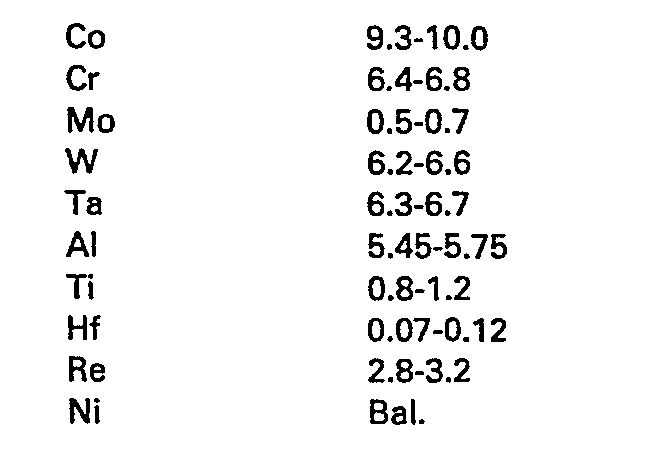
- a component for use in a gas turbine engine cast as a single crystal from an alloy having an incipient melting temperature at least 16°C. (30°F.) above its gamma prime solvus temperature consists essentially of the elements Cr 6.4-6.8, Co 9.3- 1 0.0, M o 0.5-0.7, W 6.2-6.6, Ta 6.3-6.7, Al 5.45-5.75, Ti 0.8-1.2, Hf 0.07-0.12, Re 2.8-3.2, balance Ni and being capable of complete primary gamma prime solutioning with alternate heat treatment cycles.
- a component for use in a gas turbine engine cast as a single crystal from an alloy having an incipient melting temperature at least 16°C. (30°F.) above its gamma prime solvus temperature consists essentially of the elements Cr 6.4-6.8, Co 9.3-10.0, Mo 0.5-0.7, W 6.2-6.6, Ta 6.3-6.7, Al 5.45-5.75, Ti 0.8-1.2, Hf 0.07-0.12 , Re 2.8-3.2, balance Ni, said component after heat treatment at a temperature and for a time period sufficient to solution all its primary gamma prime having the capability of withstanding 248 MPa at 982°C. (36 ksi at 1800°F.) for 80 hours before sustaining a creep of one percent.
- the casting or component of the above aspects of the present invention may conveniently be heat treated.
- Such heat treatment may include two hours at 1288°C. (2350°F.) plus two hours at 1293°C. (2360°F.) then slow cooled, then two hours at 1288°C. (2350°F.) plus two hours at 1293°C (2360°F) followed by a gas fan quench.
- Such heat treatment may include four hours at 1288°C. (2350°F.) plus four hours at 1293°C. (2360°F.) followed by a gas fan quench which is optionally followed by ageing the component ten to thirty hours at 871°C. (1600°F.) then air cooling the component.
- the casting or component of any of the above aspects of the present invention may be a gas turbine engine blade or a gas turbine engine vane.
- a gas turbine blade or a gas turbine vane may be cast according to any of the above aspects of the invention.
- the present invention may provide a nickel-base superalloy which retains the practical heat treatment "window", alloy stability and single crystal castability characteristics of the CMSX-2 and -3 alloys while very significantly improving creep resistance characteristics by increasing both the permissible operating temperature and the time before a one percent creep will occur. This has been done by increasing the refractory element components of the alloy, including the additon of rhenium.
- the invention can achieve a very significant increase in creep resistance without creating alloy instability which can result from the incorporation of rhenium.
- the basic alloy from which this invention was developed was the hafnium containing, single crystal alloy described in U.S. patent application Serial No. 339 318, hereafter identified as CMSX-3.
- This alloy has the composition expressed as percentages of weight:
- This alloy like the first attempt to provide a high creep resistant alloy for use under high stress and temperature while exhibiting no tendency to form mu or sigma phase formations failed to produce the desired increase in strength and, thus, resistance to creep.
- This alloy provided the desired creep strength but at the price of instability when tested at 248 MPa (36 ksi)/982°C. (1800°F.)/ 194.3 hours in stress rupture tests.
- compositions of the alloy was again changed to increase the nickel content and reduce the chromium and cobalt while retaining the increased level of refractory elements.
- the resulting alloy had the preferred composition as percentages of weight: and an operative composition in the range of:
- Heat VF552 was prepared having the composition of Table III and single crystal specimens were cast using a high thermal gradient withdrawal process. Stress-rupture test specimens 2.26mm (0.089 inch)/1.78mm (0.070 inch) diameter were machined from the longitudinal (001) direction with all being oriented within 10 0 of the primary axis. Also RT Tensile and Creep Rupture 4.78mm (0.188 inch) diameter specimens were machined from the longitudinal (001) direction, all being oriented within 10° of the primary axis. The specimen heat treat was two hours at 1288°C. (2350°F.) plus two hours at 1293°C. (2360°F.) slow cool plus two hours at 2388°C.
- Figures 11 and 12 graphically illustrate the very substantial increase in creep resistance.
- Figure 11 illustrates the fact that the time required to rupture at 248 MPa at 982°C. (36.0 ksi at 1 800 0 F .) is increased over 100%. This is a very substantial change.
- Figure 12, however, is even more significant in that it graphically illustrates the even greater change the invention accomplishes in that portion of the creep curve which is 1% or less which is the range of primary interest to gas turbine design engineers. It will be seen that the initial part of the curve . has been substantially flattened. Thus, the period required to produce a 1% creep under the high temperature/stress condition of 248 MPa/ 982°C.
- the amenability of the alloy of this invention to full solutioning of the ascast gamma prime to produce a fully solutioned microstructure containing 65-68 volume percent of re-precipitated fine, coherent gamma prime with an average size of 0.45 micron or less is believed to be a contributing reason the alloy displays its ability to maximize its creep resistance, especially in the intial stages of creep resulting in the especially important changes in the creep resistance occurring below one percent elongation. It is of further significance that the alloy has accomplished this change in creep resistance without excessive narrowing of the heat treatment window and without introducing microstructural instability.
- the heat treatment window is particularly important because without an adequate temperature spread between.the solvus temperature for the gamma prime and the incipient melting point, it is not possible to totally solution the primary gamma prime without incurring a high scrap rate due to incipient melting.
- a spread of less than 11°C. (20 0 F.) is impractical, except in the laboratory, because production heat treat equipment cannot be accurately controlled to maintain a temperature within the range, especially in view of the high temperatures and long heat treat periods required.
- the heat treat periods should be increased from four to six to eight hours.
- This alloy has a solution heat treat temperature spread of 17°C. to 22°C. (30°F. to 40°F.) assures complete solutioning of the primary gamma prime without risk of incipient melting. Tests have indicated that it is practical to stay within the 19°C. (35 0 F.) window using available commerical vacuum solution heat treatment equipment.
- This alloy has particular application in small turbine engines designed to develop high performance characteristics. These engines, to obtain high performance, are normally operated at higher component temperatures than larger engines. Therefore, the problem of creep is increased.
- the alloy also has application in small engines designed for short term performance at maximum possible temperature and stress to maximize their performance characteristics. In both cases, creep in excess of one percent is considered unacceptable.
- the creep characteristics of heretofore known state of the art alloys have limited operating temperatures and, thus, maximum performance capability. Tests which have been conducted on the alloy of this invention indicate a 17.8°C. (32°F.) stress-rupture temperature capability advantage at the 241 MPa (35 ksi) stress level compared with the most advanced state-of-the-art high nickel super-alloys such as CMSX-2 and CMSX-3.
- the invention with a very precise alloy composition, provides an alloy capable of high temperature-stress performance with a significant advantage in creep resistance/creep rate especially in that portion of the range which is practical for engine design.
Landscapes
- Chemical & Material Sciences (AREA)
- Engineering & Computer Science (AREA)
- Crystallography & Structural Chemistry (AREA)
- Materials Engineering (AREA)
- Metallurgy (AREA)
- Organic Chemistry (AREA)
- Inorganic Chemistry (AREA)
- Physics & Mathematics (AREA)
- Thermal Sciences (AREA)
- Mechanical Engineering (AREA)
- Turbine Rotor Nozzle Sealing (AREA)
- Crystals, And After-Treatments Of Crystals (AREA)
Abstract
Description
- The present invention relates to single crystal castings. More particularly this invention relates to nickel-base, single crystal super- alloys for use in casting components for high stress, high temperature gas turbine applications.
- This alloy and alloys of this type are intended for single crystal castings of gas turbine blades, particularly such blades used in maximum performance aircraft turbine engines where high resistance to thermal fatigue, creep and oxidation are essential.
- The basic technology of alloys for casting of single crystal components is described in U.S.-A-3,494,709; U.S.-A-4,116,723 and U.S.-A-4,209,348. Further alloys are described in EP-A-0052911 which are marketed under the trademark "CMSX" as CMSX-2 and with hafnium added as CMSX-3 and hereinafter identified as CMSX-2 and CMSX-3. The present invention relates to an improvement in the creep strength/ creep rate described in that application. The alloy will be marketed under the "CMSX" trademark as CMSX-4.
- Many factors enter into what constitutes an alloy having not only the desired mechanical and environmental performance features but also practical single crystal castability and heat treating characteristics. These two characteristics, i.e., component mechanical/environmental properties response and commercial productibility, normally conflict with one another in that alloy compositions which result in the desired performance features many times have impractical casting and heat treatment characteristics. Likewise, the reverse is also true.
- Among the problems encountered is that of creating an alloy having sufficient creep-rupture and oxidation resistance while also exhibiting a heat treatment temperature range which permits it to be heat treated to a temerature at which all of the primary gamma prime goes into solution without the alloy reaching its incipient melting temperature. In addition, it is desirable that at least some of the eutectic also be solutioned. This range is called the heat treatment "window". Failure to provide a practical "window" such as about 14 C..(25 F.) or more makes it all but impossible to heat treat the castings without unacceptable diminishing mechanical properties or scrap rate due to either incomplete solutioning of the primary gamma prime or incipient melting. An alloy which cannot be effectively heat treated to total solutioning of the primary gamma prime without experiencing a significant rejection rate due to incipient melting is little more than a laboratory curiosity and is without practical utility. The alloys CMSX-2 described in the published European specification, noted above, and CMSX-3 are alloys which overcome this problem. In a variation of the basic alloy (CMSX-2) described in that application, the coated oxidation/ corrosion performance of the alloy was increased with the addition of hafnium (CMSX-3) while retaining a practical solution heat treatment window.
- The present invention is the result of research having the objective of retaining the desirable commercial productibility characteristics typical of the CMSX-2 and CMSX-3 alloys while significantly improving the high temperature, high stress, creep resistance of the alloy.
- Creep in the form of permanent, plastic deformation of an alloy is normally defined in terms of the percentage of elongation occurring at a given temperature/stress over a specific time period before rupture occurs. While increasing the time and temperature at which creep translates into rupture is important data concerning alloy characteristics, it is not particularly significant to the designer of high performance aircraft turbine engines. The designer is more concerned with the time and temperature range at which a specific percentage of creep will occur. This is important because it determines when and under what conditions a specific dimensional change in the casting will cause malfunction such as results from physical interference between engine components. As the performance characteristics of engine designs increase the clearance between components normally must be decreased, reducing the amount of creep which can be tolerated. At the same time, the increased performance characteristics normally necessitate higher temperatures and speeds, factors which increase stress and accelerate creep. In the modern, high performance, gas turbine engine, designers consider one percent creep the practical limit of acceptability.
- According to one aspect of the present invention a single crystal casting is cast from an alloy which consists essentially of the following elements in the following proportions expressed as percentages of weight:

- Such a casting may conveniently be used under high stress, high temperature conditions and provides an increased resistance to creep under such conditions and a heat treatment window of approximately 190C. (350F.). A preferred composition comprises:-

- Preferably the alloy is capable of complete solutioning of the primary gamma prime incipient melting. A preferred embodiment provides that the casting is capable of withstanding 248 MPa at 982°C. (36 ksi at 1800°F.) for an average 80 hours before sustaining a creep of one percent. Preferably the casting is characterised by the absence of phase instability after testing under temperature and a stress sufficient to rupture the casting.
- According to a second aspect of the present invention a component for use in a gas turbine engine, cast as a single crystal from an alloy having an incipient melting temperature at least 16°C. (30°F.) above its gamma prime solvus temperature consists essentially of the elements Cr 6.4-6.8, Co 9.3-10.0, Mo 0.5-0.7, W 6.2-6.6, Ta 6.3-6.7, Al 5.45-5.75, Ti 0.8-1.2, Hf 0.07-0.12, Re 2.8-3.2, balance Ni and being capable of complete primary gamma prime solutioning with alternate heat treatment cycles.
- According to a third aspect of the present invention a component for use in a gas turbine engine, cast as a single crystal from an alloy having an incipient melting temperature at least 16°C. (30°F.) above its gamma prime solvus temperature consists essentially of the elements Cr 6.4-6.8, Co 9.3-10.0, Mo 0.5-0.7, W 6.2-6.6, Ta 6.3-6.7, Al 5.45-5.75, Ti 0.8-1.2, Hf 0.07-0.12 , Re 2.8-3.2, balance Ni, said component after heat treatment at a temperature and for a time period sufficient to solution all its primary gamma prime having the capability of withstanding 248 MPa at 982°C. (36 ksi at 1800°F.) for 80 hours before sustaining a creep of one percent.
- The casting or component of the above aspects of the present invention may conveniently be heat treated. Such heat treatment may include two hours at 1288°C. (2350°F.) plus two hours at 1293°C. (2360°F.) then slow cooled, then two hours at 1288°C. (2350°F.) plus two hours at 1293°C (2360°F) followed by a gas fan quench. Alternatively such heat treatment may include four hours at 1288°C. (2350°F.) plus four hours at 1293°C. (2360°F.) followed by a gas fan quench which is optionally followed by ageing the component ten to thirty hours at 871°C. (1600°F.) then air cooling the component.
- The casting or component of any of the above aspects of the present invention may be a gas turbine engine blade or a gas turbine engine vane. Similarly a gas turbine blade or a gas turbine vane may be cast according to any of the above aspects of the invention.
- The present invention may provide a nickel-base superalloy which retains the practical heat treatment "window", alloy stability and single crystal castability characteristics of the CMSX-2 and -3 alloys while very significantly improving creep resistance characteristics by increasing both the permissible operating temperature and the time before a one percent creep will occur. This has been done by increasing the refractory element components of the alloy, including the additon of rhenium. The invention can achieve a very significant increase in creep resistance without creating alloy instability which can result from the incorporation of rhenium.
- The invention may be put into practice in various ways but some examples of alloys of the present invention together with various test results on these alloys will now be described by way of example with reference to the accompanying drawings, in which:
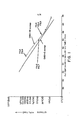
- Figure 1 is a graph of comparative Larson Miller stress-rupture tests on the exemplified alloy of the present invention and CMSX-2;
- Figure 2 is a photomicrograph of one of the alloys developed in the creating the present invention taken at 1000X after the specimen has been tested at 248 MPa (36.0 ksi)/982°C. (1800°F.)/194.3 hours;
- Figure 3 is a photomicrograph of the exemplified alloy of the present invention at 1000X;
- Figure 4 is a photomicrograph of the alloy of Figure 3 taken at 1000X near fracture after testing at 207 MPa (30 ksi)/982°C. (1800°F.)/507.5 hours;
- Figure 5 is a photomicrograph of the alloy of Figure 3 taken in the thread section of the test specimen at 1000X;
- Figure 6 is a photomicrograph of the alloy of Figure 3 taken at the thread section at 1000X after 248 MPa (36 ksi)/982°C. (1800°F.)/ 174.8 hours;
- Figure 7 is a photomicrograph of the alloy of Figure 3 taken near the fracture at 1000X after testing at 248 MPa (36 ksi)/982°C. (1800°F.)/178.0 hours;
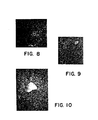
- Figure 8 is a photomicrograph of the alloy of Figure 3 taken near the fracture at 1000X after testing at 517 MPa (75 ksi)/871°C. (1600°F.)/232.6 hours;
- Figure 9 is a photomicrograph of the alloy of Figure 3 taken at 1000X at the thread section after resting at 517 MPa (75 ksi)/871°C. (1600°F.)/232.6 hours;
- Figure 10 is a photomicrograph of the alloy of Figure 3 taken at 1000X of the alloy of this invpntion after heat treatment of two hours/1288°C. (2350°F.) plus two hours/1293°C. (2360°F.) slow cool plus two hours/1288°C. (2350°F.) plus two hours/ 1293°C. (2360°F. GFQ;
- Figure 11 is a graph comparing the full range of creep characteristics of the CMSX-3 alloys and the alloy of this invention; and
- Figure 12 is a graph of the creep characteristics to one percent deformation of the alloy CMSX-3 compared with the creep characteristics of the alloy of this invention.
- The basic alloy from which this invention was developed was the hafnium containing, single crystal alloy described in U.S. patent application Serial No. 339 318, hereafter identified as CMSX-3. This alloy has the composition expressed as percentages of weight:

- Based upon the known alloy technology relating to the use of rhenium as a refractory element and, therefore, expected to increase the strength of an alloy, 3% by weight rhenium was initially substituted for 3% by weight tungsten. Cobalt was substantially increased and chromium was significantly decreased. The result did not produce the desired increase in strength. However, the substantial increase in cobalt did have the desired result of giving good alloy stability.
- In a further effort to develop the desired creep resistance without sacrificing corrosion resistance the chromium content was increased from 6.8% to 7.7%. This also was found not to produce the expected or desired improvement.
- This alloy, like the first attempt to provide a high creep resistant alloy for use under high stress and temperature while exhibiting no tendency to form mu or sigma phase formations failed to produce the desired increase in strength and, thus, resistance to creep.
- In an effort to take a different approach to the creep problem the chromium content was reduced and the refractory elements tungsten and tantalum were both increased as percentages of weight. This results in an alloy having the composition:
-

- This alloy provided the desired creep strength but at the price of instability when tested at 248 MPa (36 ksi)/982°C. (1800°F.)/ 194.3 hours in stress rupture tests.
- This alloy under high temperature stress began to evidence the formation of "needles" or acicular characteristics of the chrome- rhenide sigma phase (see Figure 2). This is evidence of instability, a characteristic of unbalanced rhenium and chromium content. Thus, while rhenium is a known strengthener of alloys of this type it also is prone to creating conditions which materially shorten the useful life of the alloy since the chrome- rhenide acicular formation provides a creep-strength reducing and crack propagating condition.
- In an effort to try to avoid the problem of instability and yet develop the desired creep resistance, the compositions of the alloy was again changed to increase the nickel content and reduce the chromium and cobalt while retaining the increased level of refractory elements.
- The resulting alloy had the preferred composition as percentages of weight:


- At the same time unwanted trace elements were restricted to as little as possible.

- The result was a sudden and substantial change in the alloy characteristics. Heat VF552 was prepared having the composition of Table III and single crystal specimens were cast using a high thermal gradient withdrawal process. Stress-rupture test specimens 2.26mm (0.089 inch)/1.78mm (0.070 inch) diameter were machined from the longitudinal (001) direction with all being oriented within 100 of the primary axis. Also RT Tensile and Creep Rupture 4.78mm (0.188 inch) diameter specimens were machined from the longitudinal (001) direction, all being oriented within 10° of the primary axis. The specimen heat treat was two hours at 1288°C. (2350°F.) plus two hours at 1293°C. (2360°F.) slow cool plus two hours at 2388°C. (2350°F.) plus two hours at 1293°C. (2360°F.) GFQ by Vac Hyde Processing Corporation. In addition the specimens were Pseudo coated 5 hours at 982°C. (1800°F.) air cooled and then aged 20 hours at 871°C. (1600°F.) then air cooled. The machining and testing was performed by Joliet Metallurgical Laboratories. The results of comparative stress-rupture tests conducted with the alloy of this invention and the alloys CMSX-2 and CMSX-3 are set out in the following table:

- In addition comparative creep rupture tests with CMSX-3 after Onera heat treatment were conducted and the results are set out in the following table:

- RT Tensile tests were conducted on the alloy of the present invention with the results set out in the following table:

- Comparative Larson Miller Stress Rupture tests were conducted on MFB 1.78mm (0.070") and 2.26mm (0.089") diameter machined within 10° of (001) on specimens cast as single crystals from the alloy of Table IV (heat VF 552) and of CMSX-2, heats VF267, 312, 438, 466 and 472. The results appear in the graph, Figure 1. The photomicrographs, Figures 3 to 9, clearly show the uniformity of the microstructure of the alloy and its stability under high temperature and stress.
- Figures 11 and 12 graphically illustrate the very substantial increase in creep resistance. Figure 11 illustrates the fact that the time required to rupture at 248 MPa at 982°C. (36.0 ksi at 18000 F.) is increased over 100%. This is a very substantial change. Figure 12, however, is even more significant in that it graphically illustrates the even greater change the invention accomplishes in that portion of the creep curve which is 1% or less which is the range of primary interest to gas turbine design engineers. It will be seen that the initial part of the curve . has been substantially flattened. Thus, the period required to produce a 1% creep under the high temperature/stress condition of 248 MPa/ 982°C. (36 ksi/1800°F.) has been increased from approximately 31 hours to 80 hours, an increase of about 158%. This is a severe test and its significance is that the major portion of the change in creep resistance occurs in the time required to produce the first 1.0% of elongation. Therefore, this change is functionally significant because it occurs in that phase of the alloy's characteristics which determine its functionality and practical utility. The reduction in chromium content has reduced the NV3B number of the alloy with the alloy having an NV3B number of 2.25 max. The reduction in chromium and anticipated lowering of environmental properties is considered acceptable in view of the major change in creep characteristics.
- The photomicrographs, Figures 4 and 5, clearly show the much finer gamma prime grain structure following stress-rupture testing resulting from the addition of rhenium. The change in the morphology of the gamma prime resulting from the addition of rhenium was discovered when the post-treat microstructure of test pieces made from the alloy were observed. It was also found that rhenium not only restricts initial growth or directional coarsening of the gamma prime phase during stress/temperature exposure, it continues to perform this function in the alloy as the time/ temperature/stress load applied to the alloy is increased. It is observed from Figures 4 and 7 that even near the fracture and under the same temperature/time/stress conditions as produced the photomicrographs of Figures 5 and 6, the "rafting" (directional coarsening) of the gamma prime has progressed only to a small degree in comparison with that which would have been observed under identical conditions had the alloy been heretofore known nickel-based superalloys developed for single crystal casting technology, such as either CMSX-2 or CMSX-3. This has been found to be true despite the fact that rhenium, being a refractory element, while valuable to increase alloy strength, is also known in the art to destabilize alloys when they are subjected to high stress at high temperatures as clearly appears in the formation of acicular chrome- rhenide needles shown in Figure 2, when a higher chromium content was utilized. The amenability of the alloy of this invention to full solutioning of the ascast gamma prime to produce a fully solutioned microstructure containing 65-68 volume percent of re-precipitated fine, coherent gamma prime with an average size of 0.45 micron or less is believed to be a contributing reason the alloy displays its ability to maximize its creep resistance, especially in the intial stages of creep resulting in the especially important changes in the creep resistance occurring below one percent elongation. It is of further significance that the alloy has accomplished this change in creep resistance without excessive narrowing of the heat treatment window and without introducing microstructural instability. It is also clear from the composition of the alloy as set out in Table IV that it is an alloy of very precise composition with only a very small permissable variation in any one element, if the combined characteristics of creep control, high temperature and stress microstructural stability and a practical heat treat window are to be maintained. Any adverse change in any one of these characteristics, even a minor change, would materially lessen and adversely affect the alloy's characteristics.
- The heat treatment window is particularly important because without an adequate temperature spread between.the solvus temperature for the gamma prime and the incipient melting point, it is not possible to totally solution the primary gamma prime without incurring a high scrap rate due to incipient melting. A spread of less than 11°C. (200F.) is impractical, except in the laboratory, because production heat treat equipment cannot be accurately controlled to maintain a temperature within the range, especially in view of the high temperatures and long heat treat periods required. Because of the high refractory element content of this alloy the heat treat periods should be increased from four to six to eight hours. The fact that this alloy has a solution heat treat temperature spread of 17°C. to 22°C. (30°F. to 40°F.) assures complete solutioning of the primary gamma prime without risk of incipient melting. Tests have indicated that it is practical to stay within the 19°C. (350F.) window using available commerical vacuum solution heat treatment equipment.
- While this alloy can be used for any purpose requiring high strength castings incorporating a single crystal, its particular use is in the casting of single crystal blades and vanes for gas turbine engines. While its primary use is in aircraft turbine engines, there are stationary engine applications requiring the specialized high performance characteristics of this alloy. Particularly is this the case in turbine engines, the performance characteristics of which require very restricted clearances thereby materially limiting the amount of permissible creep.
- This alloy has particular application in small turbine engines designed to develop high performance characteristics. These engines, to obtain high performance, are normally operated at higher component temperatures than larger engines. Therefore, the problem of creep is increased. The alloy also has application in small engines designed for short term performance at maximum possible temperature and stress to maximize their performance characteristics. In both cases, creep in excess of one percent is considered unacceptable. The creep characteristics of heretofore known state of the art alloys have limited operating temperatures and, thus, maximum performance capability. Tests which have been conducted on the alloy of this invention indicate a 17.8°C. (32°F.) stress-rupture temperature capability advantage at the 241 MPa (35 ksi) stress level compared with the most advanced state-of-the-art high nickel super-alloys such as CMSX-2 and CMSX-3. On the basis of time to one percent creep the temperature capability advantage is 25.0oC. (45°F.). Tests have also indicated capability of high temperature-stressed operation as high as 1093°C. (2000°F.), in short-life very high performance gas turbine engines. The alloy has exhibited excellent oxidation resistance in an oxidizing environment under these maximum operating conditions.
- The invention, with a very precise alloy composition, provides an alloy capable of high temperature-stress performance with a significant advantage in creep resistance/creep rate especially in that portion of the range which is practical for engine design.
Claims (11)

Applications Claiming Priority (2)
| Application Number | Priority Date | Filing Date | Title |
|---|---|---|---|
| US591023 | 1984-03-19 | ||
| US06/591,023 US4643782A (en) | 1984-03-19 | 1984-03-19 | Single crystal alloy technology |
Publications (3)
| Publication Number | Publication Date |
|---|---|
| EP0155827A2 true EP0155827A2 (en) | 1985-09-25 |
| EP0155827A3 EP0155827A3 (en) | 1986-05-14 |
| EP0155827B1 EP0155827B1 (en) | 1989-05-10 |
Family
ID=24364722
Family Applications (1)
| Application Number | Title | Priority Date | Filing Date |
|---|---|---|---|
| EP85301804A Expired EP0155827B1 (en) | 1984-03-19 | 1985-03-15 | Alloy for single crystal technology |
Country Status (5)
| Country | Link |
|---|---|
| US (1) | US4643782A (en) |
| EP (1) | EP0155827B1 (en) |
| JP (1) | JPS60211031A (en) |
| DE (1) | DE3570094D1 (en) |
| IL (1) | IL74567A (en) |
Cited By (18)
| Publication number | Priority date | Publication date | Assignee | Title |
|---|---|---|---|---|
| US4719080A (en) * | 1985-06-10 | 1988-01-12 | United Technologies Corporation | Advanced high strength single crystal superalloy compositions |
| GB2194960A (en) * | 1986-03-17 | 1988-03-23 | Stuart L Adelman | Improved superalloy compositions and articles |
| EP0362661A1 (en) * | 1988-10-03 | 1990-04-11 | General Electric Company | Cast columnar grain hollow nickel base alloy article and alloy and heat treatment for making |
| US5154884A (en) * | 1981-10-02 | 1992-10-13 | General Electric Company | Single crystal nickel-base superalloy article and method for making |
| US5173255A (en) * | 1988-10-03 | 1992-12-22 | General Electric Company | Cast columnar grain hollow nickel base alloy articles and alloy and heat treatment for making |
| EP0560296A1 (en) * | 1992-03-09 | 1993-09-15 | Hitachi Metals, Ltd. | Highly hot corrosion resistant and high-strength superalloy, highly hot corrosion resistant and high-strength casting having single crystal structure, gas turbine and combined cycle power generation system |
| US5443789A (en) * | 1992-09-14 | 1995-08-22 | Cannon-Muskegon Corporation | Low yttrium, high temperature alloy |
| US5540789A (en) * | 1992-05-28 | 1996-07-30 | United Technologies Corporation | Oxidation resistant single crystal superalloy castings |
| DE19624055A1 (en) * | 1996-06-17 | 1997-12-18 | Abb Research Ltd | Nickel-based super alloy |
| WO1997048828A1 (en) * | 1996-06-17 | 1997-12-24 | Abb Research Ltd. | Nickel-base superalloy |
| FR2780983A1 (en) * | 1998-07-09 | 2000-01-14 | Snecma | New single crystal nickel superalloy, e.g. for aircraft turbine blades, has a specified composition providing low density, high creep resistance and good micro structural stability |
| US6074602A (en) * | 1985-10-15 | 2000-06-13 | General Electric Company | Property-balanced nickel-base superalloys for producing single crystal articles |
| EP1031637A1 (en) * | 1999-02-22 | 2000-08-30 | ROLLS-ROYCE plc | A nickel based superalloy |
| FR2854165A1 (en) * | 2003-04-28 | 2004-10-29 | Howmet Res Corp | Nickel base superalloy for turbine airfoil, which is single crystal cast airfoil, comprises chromium, cobalt, tantalum, aluminum, tungsten, molybdenum, titanium, rhenium, hafnium, carbon, boron, and nickel and incidental impurities |
| US7074284B2 (en) | 2001-11-09 | 2006-07-11 | Alstom Technology Ltd | Heat treatment method for bodies that comprise a nickel based superalloy |
| EP1900839A1 (en) * | 2006-09-07 | 2008-03-19 | ALSTOM Technology Ltd | Method for the heat treatment of nickel-based superalloys |
| WO2011003804A1 (en) * | 2009-07-09 | 2011-01-13 | Alstom Technology Ltd. | Nickel-based superalloy |
| WO2022208004A1 (en) * | 2021-04-02 | 2022-10-06 | Safran | Nickel-based superalloy, single-crystal blade and turbomachine |
Families Citing this family (76)
| Publication number | Priority date | Publication date | Assignee | Title |
|---|---|---|---|---|
| US5399313A (en) * | 1981-10-02 | 1995-03-21 | General Electric Company | Nickel-based superalloys for producing single crystal articles having improved tolerance to low angle grain boundaries |
| US5100484A (en) * | 1985-10-15 | 1992-03-31 | General Electric Company | Heat treatment for nickel-base superalloys |
| US5077004A (en) * | 1986-05-07 | 1991-12-31 | Allied-Signal Inc. | Single crystal nickel-base superalloy for turbine components |
| JPS63118037A (en) * | 1986-11-06 | 1988-05-23 | Natl Res Inst For Metals | Ni-base single-crystal heat-resisting alloy |
| US5015502A (en) * | 1988-11-03 | 1991-05-14 | Allied-Signal Inc. | Ceramic thermal barrier coating with alumina interlayer |
| US5069873A (en) * | 1989-08-14 | 1991-12-03 | Cannon-Muskegon Corporation | Low carbon directional solidification alloy |
| US5151249A (en) * | 1989-12-29 | 1992-09-29 | General Electric Company | Nickel-based single crystal superalloy and method of making |
| US5366695A (en) * | 1992-06-29 | 1994-11-22 | Cannon-Muskegon Corporation | Single crystal nickel-based superalloy |
| US5549765A (en) * | 1993-03-18 | 1996-08-27 | Howmet Corporation | Clean single crystal nickel base superalloy |
| US5605584A (en) * | 1993-10-20 | 1997-02-25 | United Technologies Corporation | Damage tolerant anisotropic nickel base superalloy articles |
| US5489346A (en) * | 1994-05-03 | 1996-02-06 | Sps Technologies, Inc. | Hot corrosion resistant single crystal nickel-based superalloys |
| US5679180A (en) * | 1995-06-22 | 1997-10-21 | United Technologies Corporation | γ strengthened single crystal turbine blade alloy for hydrogen fueled propulsion systems |
| US5695821A (en) * | 1995-09-14 | 1997-12-09 | General Electric Company | Method for making a coated Ni base superalloy article of improved microstructural stability |
| DE69701900T2 (en) | 1996-02-09 | 2000-12-07 | Hitachi Metals, Ltd. | High-strength nickel-based superalloy for directionally solidified castings |
| DE19617093C2 (en) * | 1996-04-29 | 2003-12-24 | Alstom Paris | Heat treatment process for material bodies made of nickel-based superalloys |
| JP3820430B2 (en) * | 1998-03-04 | 2006-09-13 | 独立行政法人物質・材料研究機構 | Ni-based single crystal superalloy, manufacturing method thereof, and gas turbine component |
| US7816403B2 (en) * | 1998-09-08 | 2010-10-19 | University Of Utah Research Foundation | Method of inhibiting ATF/CREB and cancer cell growth and pharmaceutical compositions for same |
| EP1001055B1 (en) | 1998-11-10 | 2004-02-25 | ALSTOM Technology Ltd | Gas turbine component |
| US20020007877A1 (en) * | 1999-03-26 | 2002-01-24 | John R. Mihalisin | Casting of single crystal superalloy articles with reduced eutectic scale and grain recrystallization |
| US6435830B1 (en) | 1999-12-20 | 2002-08-20 | United Technologies Corporation | Article having corrosion resistant coating |
| US6270318B1 (en) | 1999-12-20 | 2001-08-07 | United Technologies Corporation | Article having corrosion resistant coating |
| US6435835B1 (en) | 1999-12-20 | 2002-08-20 | United Technologies Corporation | Article having corrosion resistant coating |
| US6193141B1 (en) | 2000-04-25 | 2001-02-27 | Siemens Westinghouse Power Corporation | Single crystal turbine components made using a moving zone transient liquid phase bonded sandwich construction |
| DE10118541A1 (en) * | 2001-04-14 | 2002-10-17 | Alstom Switzerland Ltd | Assessing life of thermal insulation layers subjected to temperature cycling, takes into account boundary layer stressing and growth of oxide layer |
| ATE283936T1 (en) | 2001-05-14 | 2004-12-15 | Alstom Technology Ltd | METHOD FOR ISOTHERMAL BRAZING OF SINGLE CRYSTALLINE OBJECTS |
| US6966956B2 (en) * | 2001-05-30 | 2005-11-22 | National Institute For Materials Science | Ni-based single crystal super alloy |
| US7204019B2 (en) | 2001-08-23 | 2007-04-17 | United Technologies Corporation | Method for repairing an apertured gas turbine component |
| EP1295970A1 (en) * | 2001-09-22 | 2003-03-26 | ALSTOM (Switzerland) Ltd | MCrAlY type alloy coating |
| EP1295969A1 (en) * | 2001-09-22 | 2003-03-26 | ALSTOM (Switzerland) Ltd | Method of growing a MCrAIY-coating and an article coated with the MCrAIY-coating |
| US6986034B2 (en) * | 2002-04-11 | 2006-01-10 | Dell Products L.P. | Setting a system indication in response to a user when execution of the system setup program is desired |
| CH695497A5 (en) | 2002-04-30 | 2006-06-15 | Alstom Technology Ltd | Nickel-base superalloy. |
| US7166176B2 (en) * | 2002-06-26 | 2007-01-23 | Siemens Power Generation, Inc. | Cast single crystal alloy component with improved low angle boundary tolerance |
| KR20040008381A (en) * | 2002-07-18 | 2004-01-31 | 한국기계연구원 | Single crystal Ni based superalloy having excellent high temperature creep characteristic |
| EP1398393A1 (en) * | 2002-09-16 | 2004-03-17 | ALSTOM (Switzerland) Ltd | Property recovering method |
| US7010987B2 (en) * | 2002-10-31 | 2006-03-14 | Alstom (Switzerland) Ltd | Non-destructive method of detecting defects in braze-repaired cracks |
| US6706241B1 (en) | 2002-11-12 | 2004-03-16 | Alstom Technology Ltd | Nickel-base superalloy |
| EP1426759B1 (en) * | 2002-12-06 | 2011-11-16 | Alstom Technology Ltd | A non-destructive testing method of determining the depletion of a coating |
| EP1426760A1 (en) * | 2002-12-06 | 2004-06-09 | ALSTOM Technology Ltd | A non-destructive testing method of determining the service metal temperature of a component |
| US8968643B2 (en) * | 2002-12-06 | 2015-03-03 | National Institute For Materials Science | Ni-based single crystal super alloy |
| JP3814662B2 (en) * | 2002-12-06 | 2006-08-30 | 独立行政法人物質・材料研究機構 | Ni-based single crystal superalloy |
| CA2440573C (en) * | 2002-12-16 | 2013-06-18 | Howmet Research Corporation | Nickel base superalloy |
| EP1447457A1 (en) * | 2003-02-17 | 2004-08-18 | ALSTOM Technology Ltd | Process for strengthen grain boundaries of an article made from a Ni based superalloy |
| US20050000603A1 (en) * | 2003-06-25 | 2005-01-06 | John Corrigan | Nickel base superalloy and single crystal castings |
| US20050224144A1 (en) * | 2004-01-16 | 2005-10-13 | Tresa Pollock | Monocrystalline alloys with controlled partitioning |
| US20050178750A1 (en) * | 2004-02-13 | 2005-08-18 | Kenny Cheng | Repair of article by laser cladding |
| CA2586974C (en) * | 2004-11-18 | 2013-06-25 | Alstom Technology Ltd | Nickel-base superalloy |
| EP1997923B1 (en) * | 2006-03-20 | 2016-03-09 | National Institute for Materials Science | Method for producing an ni-base superalloy |
| JP5299899B2 (en) | 2006-03-31 | 2013-09-25 | 独立行政法人物質・材料研究機構 | Ni-base superalloy and manufacturing method thereof |
| GB2440127B (en) * | 2006-06-07 | 2008-07-09 | Rolls Royce Plc | A turbine blade for a gas turbine engine |
| GB0611926D0 (en) * | 2006-06-16 | 2006-07-26 | Rolls Royce Plc | Welding of single crystal alloys |
| EP2062990B1 (en) | 2006-09-13 | 2016-01-13 | National Institute for Materials Science | Ni-BASE SINGLE CRYSTAL SUPERALLOY |
| EP2128284B1 (en) | 2007-03-12 | 2015-08-19 | IHI Corporation | Ni-BASED SINGLE CRYSTAL SUPERALLOY AND TURBINE VANE USING THE SAME |
| US9499886B2 (en) | 2007-03-12 | 2016-11-22 | Ihi Corporation | Ni-based single crystal superalloy and turbine blade incorporating the same |
| JP5235383B2 (en) * | 2007-11-07 | 2013-07-10 | 株式会社日立製作所 | Ni-based single crystal alloy and casting |
| JP5467307B2 (en) | 2008-06-26 | 2014-04-09 | 独立行政法人物質・材料研究機構 | Ni-based single crystal superalloy and alloy member obtained therefrom |
| JP5467306B2 (en) | 2008-06-26 | 2014-04-09 | 独立行政法人物質・材料研究機構 | Ni-based single crystal superalloy and alloy member based thereon |
| EP2145968A1 (en) * | 2008-07-14 | 2010-01-20 | Siemens Aktiengesellschaft | Nickel base gamma prime strengthened superalloy |
| JP5439822B2 (en) * | 2009-01-15 | 2014-03-12 | 独立行政法人物質・材料研究機構 | Ni-based single crystal superalloy |
| US8216509B2 (en) * | 2009-02-05 | 2012-07-10 | Honeywell International Inc. | Nickel-base superalloys |
| EP2224025B1 (en) | 2009-02-13 | 2012-02-01 | DALMINE S.p.A. | Nickel-based superalloy and manufacturing process thereof |
| WO2010119709A1 (en) | 2009-04-17 | 2010-10-21 | 株式会社Ihi | Nickel-base single-crystal superalloy and turbine wing using same |
| EP2465957B1 (en) | 2009-08-10 | 2018-11-07 | IHI Corporation | Ni-BASED MONOCRYSTALLINE SUPERALLOY AND TURBINE BLADE |
| DE102009050563A1 (en) * | 2009-10-23 | 2011-01-27 | Mtu Aero Engines Gmbh | Nickel-basis alloy for generative production and/or repair of gas turbine components using a laser melting process, comprises titanium, aluminum, and powdered particles made of different materials |
| CH702642A1 (en) | 2010-02-05 | 2011-08-15 | Alstom Technology Ltd | Nickel-base superalloy with improved degradation. |
| CH703386A1 (en) | 2010-06-30 | 2011-12-30 | Alstom Technology Ltd | A process for the preparation of a composed of a nickel-base superalloy monocrystalline component. |
| US9150944B2 (en) | 2010-08-05 | 2015-10-06 | Cannon Muskegon Corporation | Low sulfur nickel-base single crystal superalloy with PPM additions of lanthanum and yttrium |
| WO2012037532A2 (en) | 2010-09-16 | 2012-03-22 | Wilson Solarpower Corporation | Concentrated solar power generation using solar receivers |
| WO2013142275A2 (en) | 2012-03-21 | 2013-09-26 | Wilson Solarpower Corporation | Multi-thermal storage unit systems, fluid flow control devices, and low pressure solar receivers for solar power systems, and related components and uses thereof |
| JP6016016B2 (en) | 2012-08-09 | 2016-10-26 | 国立研究開発法人物質・材料研究機構 | Ni-based single crystal superalloy |
| US20160214350A1 (en) | 2012-08-20 | 2016-07-28 | Pratt & Whitney Canada Corp. | Oxidation-Resistant Coated Superalloy |
| US8858876B2 (en) | 2012-10-31 | 2014-10-14 | General Electric Company | Nickel-based superalloy and articles |
| RU2521740C1 (en) * | 2012-12-27 | 2014-07-10 | Федеральное государственное унитарное предприятие"Всероссийский научно-исследовательский институт авиационных материалов" (ФГУП "ВИАМ") | ALLOY ON BASIS OF Ni3Al INTERMETALLIC COMPOUND AND ITEM MADE FROM IT |
| EP2876176B1 (en) | 2013-11-25 | 2017-06-21 | Mitsubishi Hitachi Power Systems, Ltd. | Ni-based casting superalloy and cast article therefrom |
| EP3029113B1 (en) * | 2014-12-05 | 2018-03-07 | Ansaldo Energia Switzerland AG | Abrasive coated substrate and method for manufacturing thereof |
| US20230357897A1 (en) * | 2022-05-05 | 2023-11-09 | General Electric Company | Nickel-based superalloys and articles |
| CN119640172B (en) * | 2024-12-27 | 2025-12-19 | 西北工业大学 | A heat treatment method for a second-generation nickel-based single-crystal superalloy and the second-generation nickel-based single-crystal superalloy |
Family Cites Families (3)
| Publication number | Priority date | Publication date | Assignee | Title |
|---|---|---|---|---|
| GB1260982A (en) * | 1970-06-08 | 1972-01-19 | Trw Inc | Improvements in or relating to nickel base alloys |
| US4388124A (en) * | 1979-04-27 | 1983-06-14 | General Electric Company | Cyclic oxidation-hot corrosion resistant nickel-base superalloys |
| US4371404A (en) * | 1980-01-23 | 1983-02-01 | United Technologies Corporation | Single crystal nickel superalloy |
-
1984
- 1984-03-19 US US06/591,023 patent/US4643782A/en not_active Expired - Lifetime
-
1985
- 1985-03-11 IL IL74567A patent/IL74567A/en not_active IP Right Cessation
- 1985-03-15 EP EP85301804A patent/EP0155827B1/en not_active Expired
- 1985-03-15 DE DE8585301804T patent/DE3570094D1/en not_active Expired
- 1985-03-19 JP JP60055620A patent/JPS60211031A/en active Granted
Cited By (32)
| Publication number | Priority date | Publication date | Assignee | Title |
|---|---|---|---|---|
| US5154884A (en) * | 1981-10-02 | 1992-10-13 | General Electric Company | Single crystal nickel-base superalloy article and method for making |
| US4719080A (en) * | 1985-06-10 | 1988-01-12 | United Technologies Corporation | Advanced high strength single crystal superalloy compositions |
| US6074602A (en) * | 1985-10-15 | 2000-06-13 | General Electric Company | Property-balanced nickel-base superalloys for producing single crystal articles |
| GB2194960A (en) * | 1986-03-17 | 1988-03-23 | Stuart L Adelman | Improved superalloy compositions and articles |
| GB2194960B (en) * | 1986-03-17 | 1990-06-20 | Stuart L Adelman | Improved superalloy compositions and articles |
| EP0362661A1 (en) * | 1988-10-03 | 1990-04-11 | General Electric Company | Cast columnar grain hollow nickel base alloy article and alloy and heat treatment for making |
| US5173255A (en) * | 1988-10-03 | 1992-12-22 | General Electric Company | Cast columnar grain hollow nickel base alloy articles and alloy and heat treatment for making |
| US5916382A (en) * | 1992-03-09 | 1999-06-29 | Hitachi, Ltd. | High corrosion resistant high strength superalloy and gas turbine utilizing the alloy |
| EP0560296A1 (en) * | 1992-03-09 | 1993-09-15 | Hitachi Metals, Ltd. | Highly hot corrosion resistant and high-strength superalloy, highly hot corrosion resistant and high-strength casting having single crystal structure, gas turbine and combined cycle power generation system |
| US5540789A (en) * | 1992-05-28 | 1996-07-30 | United Technologies Corporation | Oxidation resistant single crystal superalloy castings |
| US5660649A (en) * | 1992-05-28 | 1997-08-26 | United Technologies Corporation | Method of making oxidation resistant single crystal superalloy castings |
| EP0676489A1 (en) * | 1992-09-14 | 1995-10-11 | Cannon-Muskegon Corporation | High temperature alloys |
| US5443789A (en) * | 1992-09-14 | 1995-08-22 | Cannon-Muskegon Corporation | Low yttrium, high temperature alloy |
| CN1078621C (en) * | 1996-06-17 | 2002-01-30 | Abb研究有限公司 | Nickel-base superalloy |
| WO1997048828A1 (en) * | 1996-06-17 | 1997-12-24 | Abb Research Ltd. | Nickel-base superalloy |
| US5759301A (en) * | 1996-06-17 | 1998-06-02 | Abb Research Ltd. | Monocrystalline nickel-base superalloy with Ti, Ta, and Hf carbides |
| US5888451A (en) * | 1996-06-17 | 1999-03-30 | Abb Research Ltd. | Nickel-base superalloy |
| DE19624055A1 (en) * | 1996-06-17 | 1997-12-18 | Abb Research Ltd | Nickel-based super alloy |
| WO1997048827A1 (en) * | 1996-06-17 | 1997-12-24 | Abb Research Ltd. | Nickel-base superalloy |
| CN1086742C (en) * | 1996-06-17 | 2002-06-26 | 阿尔斯通公司 | Nickel-base superalloy |
| FR2780983A1 (en) * | 1998-07-09 | 2000-01-14 | Snecma | New single crystal nickel superalloy, e.g. for aircraft turbine blades, has a specified composition providing low density, high creep resistance and good micro structural stability |
| US6410153B1 (en) | 1999-02-22 | 2002-06-25 | Rolls-Royce Plc | Nickel based superalloy |
| EP1031637A1 (en) * | 1999-02-22 | 2000-08-30 | ROLLS-ROYCE plc | A nickel based superalloy |
| US7074284B2 (en) | 2001-11-09 | 2006-07-11 | Alstom Technology Ltd | Heat treatment method for bodies that comprise a nickel based superalloy |
| FR2854165A1 (en) * | 2003-04-28 | 2004-10-29 | Howmet Res Corp | Nickel base superalloy for turbine airfoil, which is single crystal cast airfoil, comprises chromium, cobalt, tantalum, aluminum, tungsten, molybdenum, titanium, rhenium, hafnium, carbon, boron, and nickel and incidental impurities |
| EP1900839A1 (en) * | 2006-09-07 | 2008-03-19 | ALSTOM Technology Ltd | Method for the heat treatment of nickel-based superalloys |
| US7938919B2 (en) | 2006-09-07 | 2011-05-10 | Alstom Technology Ltd | Method for the heat treatment of nickel-based superalloys |
| WO2011003804A1 (en) * | 2009-07-09 | 2011-01-13 | Alstom Technology Ltd. | Nickel-based superalloy |
| CH701415A1 (en) * | 2009-07-09 | 2011-01-14 | Alstom Technology Ltd | Nickel-base superalloy. |
| US9017605B2 (en) | 2009-07-09 | 2015-04-28 | Alstom Technology Ltd. | Nickel-based superalloy |
| WO2022208004A1 (en) * | 2021-04-02 | 2022-10-06 | Safran | Nickel-based superalloy, single-crystal blade and turbomachine |
| FR3121453A1 (en) * | 2021-04-02 | 2022-10-07 | Safran | NICKEL-BASED SUPERALLOY, SINGLE-CRYSTALLINE BLADE AND TURBOMACHINE |
Also Published As
| Publication number | Publication date |
|---|---|
| US4643782A (en) | 1987-02-17 |
| DE3570094D1 (en) | 1989-06-15 |
| IL74567A (en) | 1988-10-31 |
| JPS60211031A (en) | 1985-10-23 |
| EP0155827A3 (en) | 1986-05-14 |
| EP0155827B1 (en) | 1989-05-10 |
| IL74567A0 (en) | 1985-06-30 |
| JPH0245694B2 (en) | 1990-10-11 |
Similar Documents
| Publication | Publication Date | Title |
|---|---|---|
| EP0155827B1 (en) | Alloy for single crystal technology | |
| CA1098425A (en) | Heat treated superalloy single crystal article and process | |
| EP0434996B1 (en) | Nickle-based single crystal superalloy | |
| US5154884A (en) | Single crystal nickel-base superalloy article and method for making | |
| Erickson | A new, third-generation, single-crystal, casting superalloy | |
| Wilson et al. | The effect of solution heat treatment on a single-crystal Ni-based superalloy | |
| US5399313A (en) | Nickel-based superalloys for producing single crystal articles having improved tolerance to low angle grain boundaries | |
| US5540790A (en) | Single crystal nickel-based superalloy | |
| EP0246082B1 (en) | Single crystal super alloy materials | |
| US4209348A (en) | Heat treated superalloy single crystal article and process | |
| AU2007345231C1 (en) | Nickel-base alloy for gas turbine applications | |
| US5173255A (en) | Cast columnar grain hollow nickel base alloy articles and alloy and heat treatment for making | |
| US4582548A (en) | Single crystal (single grain) alloy | |
| CA2276154C (en) | Nickel-based monocrystalline superalloy with a high .gamma.' solvus | |
| US4371404A (en) | Single crystal nickel superalloy | |
| EP0076360A2 (en) | Single crystal nickel-base superalloy, article and method for making | |
| JPS5861245A (en) | Heat-treated nickel base superalloy single crystal article | |
| JPS62112746A (en) | Alloy composition and production of heat-treated monocrystalline superalloy article | |
| JP3402603B2 (en) | Nickel-base-superalloy with improved low angle grain boundary resistance for producing single crystal products | |
| EP0052911B1 (en) | Single crystal (single grain) alloy | |
| US4721540A (en) | Low density single crystal super alloy | |
| JP2990041B2 (en) | High temperature corrosion resistant single crystal nickel-based superalloys | |
| CA1074674A (en) | Multi-step heat treatment for superalloys | |
| GB1592237A (en) | Heat treated superalloy single crystal article and process | |
| GB2106138A (en) | Single crystal nickel alloy casting |
Legal Events
| Date | Code | Title | Description |
|---|---|---|---|
| PUAI | Public reference made under article 153(3) epc to a published international application that has entered the european phase |
Free format text: ORIGINAL CODE: 0009012 |
|
| AK | Designated contracting states |
Designated state(s): BE DE FR GB IT |
|
| PUAL | Search report despatched |
Free format text: ORIGINAL CODE: 0009013 |
|
| AK | Designated contracting states |
Kind code of ref document: A3 Designated state(s): BE DE FR GB IT |
|
| 17P | Request for examination filed |
Effective date: 19861007 |
|
| 17Q | First examination report despatched |
Effective date: 19871105 |
|
| ITF | It: translation for a ep patent filed | ||
| GRAA | (expected) grant |
Free format text: ORIGINAL CODE: 0009210 |
|
| AK | Designated contracting states |
Kind code of ref document: B1 Designated state(s): BE DE FR GB IT |
|
| REF | Corresponds to: |
Ref document number: 3570094 Country of ref document: DE Date of ref document: 19890615 |
|
| ET | Fr: translation filed | ||
| PLBE | No opposition filed within time limit |
Free format text: ORIGINAL CODE: 0009261 |
|
| STAA | Information on the status of an ep patent application or granted ep patent |
Free format text: STATUS: NO OPPOSITION FILED WITHIN TIME LIMIT |
|
| 26N | No opposition filed | ||
| ITTA | It: last paid annual fee | ||
| REG | Reference to a national code |
Ref country code: GB Ref legal event code: IF02 |
|
| PGFP | Annual fee paid to national office [announced via postgrant information from national office to epo] |
Ref country code: GB Payment date: 20040205 Year of fee payment: 20 |
|
| PGFP | Annual fee paid to national office [announced via postgrant information from national office to epo] |
Ref country code: FR Payment date: 20040302 Year of fee payment: 20 |
|
| PGFP | Annual fee paid to national office [announced via postgrant information from national office to epo] |
Ref country code: DE Payment date: 20040331 Year of fee payment: 20 |
|
| PGFP | Annual fee paid to national office [announced via postgrant information from national office to epo] |
Ref country code: BE Payment date: 20040416 Year of fee payment: 20 |
|
| PG25 | Lapsed in a contracting state [announced via postgrant information from national office to epo] |
Ref country code: GB Free format text: LAPSE BECAUSE OF EXPIRATION OF PROTECTION Effective date: 20050314 |
|
| BE20 | Be: patent expired |
Owner name: *CANNON-MUSKEGON CORP. Effective date: 20050315 |
|
| REG | Reference to a national code |
Ref country code: GB Ref legal event code: PE20 |
|
| BE20 | Be: patent expired |
Owner name: *CANNON-MUSKEGON CORP. Effective date: 20050315 |