EP0157630B1 - Elektromagnetventil - Google Patents
Elektromagnetventil Download PDFInfo
- Publication number
- EP0157630B1 EP0157630B1 EP19850302306 EP85302306A EP0157630B1 EP 0157630 B1 EP0157630 B1 EP 0157630B1 EP 19850302306 EP19850302306 EP 19850302306 EP 85302306 A EP85302306 A EP 85302306A EP 0157630 B1 EP0157630 B1 EP 0157630B1
- Authority
- EP
- European Patent Office
- Prior art keywords
- armature
- assembly
- magnetic
- spring
- force
- Prior art date
- Legal status (The legal status is an assumption and is not a legal conclusion. Google has not performed a legal analysis and makes no representation as to the accuracy of the status listed.)
- Expired - Lifetime
Links
- 239000012530 fluid Substances 0.000 claims description 11
- 230000000295 complement effect Effects 0.000 claims description 4
- 239000000696 magnetic material Substances 0.000 claims 2
- 238000002955 isolation Methods 0.000 claims 1
- 125000006850 spacer group Chemical group 0.000 description 16
- 230000035945 sensitivity Effects 0.000 description 3
- 238000006073 displacement reaction Methods 0.000 description 2
- 230000000694 effects Effects 0.000 description 2
- 238000004519 manufacturing process Methods 0.000 description 2
- 230000002411 adverse Effects 0.000 description 1
- 230000000712 assembly Effects 0.000 description 1
- 238000000429 assembly Methods 0.000 description 1
- 230000006835 compression Effects 0.000 description 1
- 238000007906 compression Methods 0.000 description 1
- 239000013528 metallic particle Substances 0.000 description 1
- 238000012544 monitoring process Methods 0.000 description 1
- 230000002085 persistent effect Effects 0.000 description 1
- 230000002028 premature Effects 0.000 description 1
- 229910052761 rare earth metal Inorganic materials 0.000 description 1
- 150000002910 rare earth metals Chemical class 0.000 description 1
- 238000005096 rolling process Methods 0.000 description 1
Images

Classifications
-
- H—ELECTRICITY
- H01—ELECTRIC ELEMENTS
- H01F—MAGNETS; INDUCTANCES; TRANSFORMERS; SELECTION OF MATERIALS FOR THEIR MAGNETIC PROPERTIES
- H01F7/00—Magnets
- H01F7/06—Electromagnets; Actuators including electromagnets
- H01F7/08—Electromagnets; Actuators including electromagnets with armatures
- H01F7/16—Rectilinearly-movable armatures
- H01F7/1607—Armatures entering the winding
- H01F7/1615—Armatures or stationary parts of magnetic circuit having permanent magnet
-
- H—ELECTRICITY
- H01—ELECTRIC ELEMENTS
- H01F—MAGNETS; INDUCTANCES; TRANSFORMERS; SELECTION OF MATERIALS FOR THEIR MAGNETIC PROPERTIES
- H01F7/00—Magnets
- H01F7/06—Electromagnets; Actuators including electromagnets
- H01F7/08—Electromagnets; Actuators including electromagnets with armatures
- H01F7/121—Guiding or setting position of armatures, e.g. retaining armatures in their end position
- H01F7/122—Guiding or setting position of armatures, e.g. retaining armatures in their end position by permanent magnets
-
- Y—GENERAL TAGGING OF NEW TECHNOLOGICAL DEVELOPMENTS; GENERAL TAGGING OF CROSS-SECTIONAL TECHNOLOGIES SPANNING OVER SEVERAL SECTIONS OF THE IPC; TECHNICAL SUBJECTS COVERED BY FORMER USPC CROSS-REFERENCE ART COLLECTIONS [XRACs] AND DIGESTS
- Y10—TECHNICAL SUBJECTS COVERED BY FORMER USPC
- Y10T—TECHNICAL SUBJECTS COVERED BY FORMER US CLASSIFICATION
- Y10T137/00—Fluid handling
- Y10T137/8593—Systems
- Y10T137/86493—Multi-way valve unit
- Y10T137/86574—Supply and exhaust
- Y10T137/86622—Motor-operated
Definitions
- the invention relates to force motors as used in fluid power systems and, more particularly, to force motors wherein electro-magnetic coils are used to bias the field strength of a permanent magnet.
- Controls for hydraulic power systems have had a long history of development. Early control systems were primarily mechanical linkages. These systems were reliable, but tended to be heavy, bulky and somewhat limited in capabilities. Also, as mechanical control systems grew in size and complexity they became increasingly costly to manufacture and maintain.
- Patent specification DE-A-20 24 024 discloses a double stroke magnet comprising an armature and magnetic coils connectable with a hydraulic valve.
- the armature is axially movable in a housing and is supported at both ends by respective flat springs comprising annular shaped discs with a single tongue member projecting radially inwards and provided with a central opening arranged to permit mounting on a central shaft of the armature.
- the tongue member of each spring is bent slightly out of the annular disc plane to provide a pre-tensioning on the armature.
- Patent specification DE-A-14 14 815 discloses a somewhat similar arrangement but wherein a casing contains a permanent magnet having electrical coils on each side thereof. Energizing voltages may be applied to the coils to move the armature from a centrally located position in the casing, such location being maintained by a pair of coil springs, one disposed at each end of the armature and acting on housing end flanges.
- Patent specification DE-A-29 19 667 discloses springs cut from discs and comprising a plurality of radial arms each widened at its outer end to give a generally triangular shaped portion.
- a force motor comprising:
- connection of the springs to the armature can be by contact between a mechanical extension of the armature and a respective face of each spring adjacent an inner edge thereof.
- the armature is concentrically maintained in the magnetic assembly by a plurality of balls that contact the surfaces of both the armature and a tube assembly that is sleeved inside the magnetic assembly.
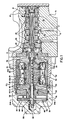
- a force motor 10 controls the position of a valve 12 through a direct linkage 14.
- the valve 12 includes a manifold 16 that is provided with appropriate porting for connection to a hydraulic system.
- a valve sleeve 18 that includes metering orifices 19 is fitted within an internal bore of the manifold 16.
- a valve slide 20 is slidably maintained in the sleeve 18.
- the valve slide 20 is provided with a plurality of lands 24 and grooves 22 that, in conjunction with the metering orifices 19, control the fluid flow to the sleeve ports in accordance with the position of the valve slide 20.
- the force motor 10 is connected to the valve slide 20 through the linkage 14 that includes a self-aligning joint 26.
- a magnetic pin 28 is provided adjacent the self-aligning joint 26 to collect metallic particles in the fluid.
- the force motor 10 includes a casing 30 concentrically arranged about a magnetic assembly 32.
- the magnetic assembly 32 includes a permanent magnet 34 and electro-magnetic coils 36 and 38.
- the coils 36 and 38 are circumferentially wound and contained in annular frames 40 and 42.
- the coils are electrically connected in series or in parallel with the number of coil turns being determined, in part, by the strength of the permanent magnet 34.
- pole pieces 44 and 46 respectively located on opposite ends of the casing 30 and the magnetic assembly 32.
- a tube assembly 47 is sleeved within the magnetic assembly 32 and between the pole pieces 44 and 46.
- the tube assembly 47 includes a magnetic central band 47a that engages longitudinally aligned, non-magentic outer bands 47b and 47c on opposite ends thereof.
- An armature 48 is located adjacent to the magnetic assembly 32 within the tube assembly 47 and between the pole pieces 44 and 46. The armature 48 is movable between the pole pieces 44 and 46.
- a rod 50 extends longitudinally through the armature 48 and is secured to the end faces of the armature 48 by retainers 52 and 54.
- the rod 50 is connected at one end to the self-aligning joint 26 of the direct linkage 14.
- the rod 50 extends from the armature 48 into a chamber 56 that is defined by an annular spacer 58 in co-operation with a cover 60.
- the cover 60 engages one end of a housing 61 that supports the casing 30 and the pole pieces 44 and 46.
- a plurality of passageways 51 extend longitudinally through the armature 48 such that the chamber 56 is in fluid communication with the valve 12 by a flow path through the passageways 51 and around the retainers 52 and 54 and the direct linkage 14.
- An o-ring 62a is provided between the outer band 47b and the pole piece 44 and an o-ring 62b is provided between the outer band 47c and the pole piece 46.
- the o-rings 62a and 62b form a seal between the tube assembly 47 and the pole pieces 44 and 46 and co-operate with the tube assembly 47 and the pole pieces 44 and 46 to isolate the magnetic assembly 32 from hydraulic fluid surrounding the armature 48.
- the rod 50 is connected to spacers 64 and 66 which co-operate with the rod 50 to form a mechanical extension of the armature 48 that mechanically couples the armature to a spring assembly 62.
- the spring assembly 62 includes cantilevered springs 68 and 70 which are maintained in spaced-apart, parallel relationship by an annular spacer 76.
- the springs 68 and 70 are each provided with a plurality of triangularly shaped petals 72 that are circumjacently arranged along an inner edge 74.
- the spring assembly 62 is secured in cantilevered fashion against a shoulder 78 of the cover 60 by compression between the shoulder 78 and the annular spacer 58.
- the springs 68 and 70 are "cantilevered" in that they are secured adjacent the perimeter and flexed from a point adjacent the inner edge 74.
- the faces of the spacers 64 and 66 adjacent the opposing faces of the springs 68 and 70 respectively are provided with annular extensions such as annular flanges 80 and 82.
- the annular flanges 80 and 82 contact the respective opposing face of the springs 68 and 70 at a location adjacent the inner edge 74.
- the contact surfaces of the annular flanges 80 and 82 are contoured such that contact between the annular flanges 80 and 82 and the springs 68 and 70 is substantially line contact.
- the cross-sectional view of the contact surfaces of the flanges 80 and 82 shows that they are respectively radiused such that the contact between the flanges 80 and 82 and the springs 68 and 70 is substantially circular, line contact. More specifically, in the preferred embodiment, the contact surfaces of the flanges 80 and 82 are located at a continuous radius.
- a plurality of balls 84 supports the armature 48 concentrically within the magnet assembly 32 and the tube assembly 47 in a longitudinally movable manner.
- the armature 48 is provided with annular grooves 86 and 88 having base surfaces 90 and 91.
- the balls 84 contact the base surfaces 90 and 91 and the tube assembly 47 to maintain the armature 48 in a fixed radial position within the tube assembly 47 such that it is substantially aligned with the longitudinal central axis of the magnetic assembly 32.
- the balls 84 are circumferentially maintained in regularly spaced relationship in the annular grooves 84 and 88 by retainers 92 and 93 respectively.
- the retainers 92 and 93 are provided with a plurality of regularly spaced holes each corresponding to a respective ball.
- the radial thickness of the retainers 92 and 93 is such that the balls 84 located in the respective holes of the retainer protrude radially through the sides thereof and contact the tube assembly 47 and the base surfaces 90 and 91 of the armature 48.
- the width of the retainers 92 and 93 is narrower than the width of the grooves 86 and 88.
- the width of the retainers 92 and 93 is sized with respect to the stroke of the armature 48 such that, as the armature 48 moves between the pole pieces 44 and 46, the retainers 92 and 93 move freely between the sidewalls of the annular grooves 86 and 88.
- FIG 6 shows an alternative embodiment of a retainer for the balls 84.
- a retainer 94 is provided with elongate holes corresponding to the respective balls 84.
- the retainer 94 is secured to the armature 48 and does not move freely with respect thereto. Instead, the major axes of the elongate holes are generally aligned with the longitudinal movement of the armature 48 and, as the armature 48 moves between the pole pieces 44 and 46, the balls 84 traverse the elongate holes.
- the width of the retainer 94 and the dimension of the elongate holes along their major axis is sized with respect to the stroke of the armature 48.
- the armature 48 is connected through the direct linkage 14 to the valve slide 20.
- the movement of the armature 48 results in a corresponding movement of the valve slide 20 to determine the flow of fluid through the valve 12.
- the force motor 10 controls the position of the armature 48 by balancing the magnetic force exerted on the armature 48 by the magnetic assembly 32 against the opposing spring force of the spring assembly 62.
- the magnetic assembly 32 provides a magnetic field having a permanent field component and a variable field component.
- the non-magnetic outer bands 47b and 47c of the tube assembly 47 co-operate with the central band 47a to channel the magnetic field through the end of the armature 48 and the pole pieces 44 and 46.
- the permanent field component of the magnetic assembly 32 is developed by the permanent magnet 34 and the variable field component is developed by the coils 36 and 38.
- the electric current to the coils 36 and 38 is controlled to bias the field of the magnetic assembly 32.
- the spring force of the spring assembly 62 is greater than the magnetic forces between the armature 48 and the pole pieces 44 and 46 resulting from the permanent field component of the permanent magnet 34 alone.
- the spring assembly 62 maintains the armature 48 at a reference position as shown in Figure 1.
- the magnetic field of the magnetic assembly 32 is biased such that the force between the armature 48 and the pole pieces 44 and 46 exceeds the force of the spring assembly 62 at the reference position.
- the armature 48 then moves toward the pole piece 44 or 46 in accordance with the magnetic field bias as determined by the magnitude and direction of current flowing in the coils 36 and 38.
- the spring force of the spring assembly 62 increases substantially in proportion to the mechanical displacement of the spring 68 and 70 until an equilibrium position is established at which the magnetic forces between the armature 48 and the pole pieces 44 and 46 are balanced by the spring force.
- the position of the armature 48 is determined by the input current to the magnetic assembly 32.
- the cantilevered springs 68 and 70 each include the plurality of triangularly shaped petals 72.
- the petals 72 are of an angular size such that the loss of a specified number of petals does not substantially affect the spring force of the spring assembly 62 with respect to displacement of the springs 68 and 70.
- two springs are used in complementary arrangement.
- the springs 68 and 70 are each loaded in only one direction against their respective spacer 64 or 66. Specifically, as the armature 48 moves from the reference position in a direction away from valve 12, the spring 70 operates against the spacer 66 to oppose this movement and the spring 68 moves out of contact with spacer 64. Conversely, as the armature 48 moves from the reference position in a direction toward the valve 12, the spring 70 moves away from the spacer 66, but the spring 68 operates against the spacer 64 to oppose the armature movement.
- the use of the two springs 68 and 70 in complementary fashion permits the springs to be preloaded against the spacers 64 and 66 such that the reference position of the armature 48 can be precisely established by adjustment of the location of the spacers 64 and 66 on the rod 50.
- the mechanical extension between the armature 48 and the spring assembly 62 provides for adjustment to compensate for variations within tolerances, in the spring assembly 62 and elsewhere in the force motor 10.
- the force motor of the invention can have low threshold friction and low mechanical hysteresis. Fluid at the end of the armature 48 that is adjacent the linkage 14 communicates through the passageways 51 with the opposite end of the armature 48, the chamber 56, and the spring assembly 62. Thus, no dynamic seals are required between the armature 48 and the tube assembly 47, eliminating the frictional effects of any dynamic fluid seal on the armature.
- the flanges 80 and 82 of the spacers 64 and 66 are contoured on a continuous radius.
- the contour of the flanges 80 and 82 permits the springs 68 and 70 to roll on the surface of the flanges 80 and 82 forming substantially line contact therewith. This limits high friction forces due to sliding movement between the spacers 64 and 66 and the springs 68 and 70 upon movement of the armature 48 and results in more linear, even movement of the armature 48.
- the spacers 64 and 66 were contoured to have a non-continuous radius cross-section this would further limit sliding between the spacers 64 and 66 and the springs 68 and 70.
- the continuous radius is disclosed as the presently preferred embodiment.
- the balls 84 are circumferentially maintained in the retainers 92 and 93 as shown in Figures 1 and 4 or, alternatively, in the retainer 94 shown in Figure 6.
- the balls 84 maintain the armature 48 concentrically within the tubular assembly 47 and concentrically within the magnetic assembly 32.
- the balls 84 which contact both the tubular assembly 47 and the armature 48, operate as free- rolling guides for the armature.
- the balls 84 also operate in a manner that limits frictional effects on the armature 48 and produces more linear movement and greater sensitivity of the force motor 10 in response to input current.
Landscapes
- Physics & Mathematics (AREA)
- Electromagnetism (AREA)
- Engineering & Computer Science (AREA)
- Power Engineering (AREA)
- Reciprocating, Oscillating Or Vibrating Motors (AREA)
- Magnetically Actuated Valves (AREA)
Claims (6)
dadurch gekennzeichnet, daß jede der einseitig eingespannten Federn (68, 70) als Scheibe mit einer Öffnung in der Mitte ausgebildet ist, die eine Innenkante (74) bildet, und mit Schlitzen, die sich von der Öffnung her erstrecken und eine Vielzahl von dreieckigen Blättern (72) bilden, die rund um die Innenkante (74) angeordnet sind.
Applications Claiming Priority (2)
| Application Number | Priority Date | Filing Date | Title |
|---|---|---|---|
| US596489 | 1984-04-04 | ||
| US06/596,489 US4525695A (en) | 1984-04-04 | 1984-04-04 | Force motor with ball mounted armature |
Publications (3)
| Publication Number | Publication Date |
|---|---|
| EP0157630A2 EP0157630A2 (de) | 1985-10-09 |
| EP0157630A3 EP0157630A3 (en) | 1986-09-17 |
| EP0157630B1 true EP0157630B1 (de) | 1990-06-27 |
Family
ID=24387487
Family Applications (1)
| Application Number | Title | Priority Date | Filing Date |
|---|---|---|---|
| EP19850302306 Expired - Lifetime EP0157630B1 (de) | 1984-04-04 | 1985-04-02 | Elektromagnetventil |
Country Status (4)
| Country | Link |
|---|---|
| US (1) | US4525695A (de) |
| EP (1) | EP0157630B1 (de) |
| JP (1) | JPH0755039B2 (de) |
| DE (1) | DE3578478D1 (de) |
Families Citing this family (31)
| Publication number | Priority date | Publication date | Assignee | Title |
|---|---|---|---|---|
| US4651118A (en) * | 1984-11-07 | 1987-03-17 | Zeuner Kenneth W | Proportional solenoid |
| DE3507441A1 (de) * | 1985-03-02 | 1986-09-04 | Robert Bosch Gmbh, 7000 Stuttgart | Elektromagnetisch betaetigbares kraftstoffeinspritzventil und verfahren zu seiner herstellung |
| DE3527423A1 (de) * | 1985-07-31 | 1987-02-12 | Bso Steuerungstechnik Gmbh | Elektromagnet |
| US4635683A (en) * | 1985-10-03 | 1987-01-13 | Ford Motor Company | Variable force solenoid |
| US4835503A (en) * | 1986-03-20 | 1989-05-30 | South Bend Controls, Inc. | Linear proportional solenoid |
| US4787412A (en) * | 1986-12-24 | 1988-11-29 | Hagglunds Denison | Cartridge valve |
| US5257639A (en) * | 1988-12-23 | 1993-11-02 | Dresser Industries, Inc. | Electropneumatic positioner |
| US5159949A (en) * | 1988-12-23 | 1992-11-03 | Dresser Industries, Inc. | Electropneumatic positioner |
| US4926896A (en) * | 1988-12-23 | 1990-05-22 | Dresser Industries, Inc. | Sensitive electrical to mechanical transducer |
| DE4214284A1 (de) * | 1992-04-30 | 1993-11-04 | Schneider Co Optische Werke | Elektromagnetischer linearmotor |
| US5249603A (en) * | 1992-05-19 | 1993-10-05 | Caterpillar Inc. | Proportional electro-hydraulic pressure control device |
| GB9218610D0 (en) * | 1992-09-03 | 1992-10-21 | Electro Hydraulic Technology L | Linear motor valve |
| US5252939A (en) * | 1992-09-25 | 1993-10-12 | Parker Hannifin Corporation | Low friction solenoid actuator and valve |
| US5355108A (en) * | 1992-10-05 | 1994-10-11 | Aura Systems, Inc. | Electromagnetically actuated compressor valve |
| EP0664861B1 (de) * | 1992-10-15 | 1998-01-14 | Parker Hannifin Corporation | Expansionsventil für eine klimaanlage mit einem proportionalmagnet |
| DE19531444A1 (de) * | 1995-08-26 | 1997-02-27 | Hydraulik Ring Gmbh | Betätigungseinheit für eine Verstelleinrichtung, vorzugsweise für eine Ventilhubverstelleinrichtung von Kraftfahrzeugen |
| JP2004092741A (ja) * | 2002-08-30 | 2004-03-25 | Honda Motor Co Ltd | 電磁ブレーキ |
| EP1420321A3 (de) * | 2002-11-15 | 2005-04-20 | HydraForce, Inc. | Zweifach Proportionales Druckablassventil |
| US7007925B2 (en) * | 2004-08-05 | 2006-03-07 | Husco International, Inc. | Electrohydraulic valve having an armature with a rolling bearing |
| US8056576B2 (en) | 2007-08-27 | 2011-11-15 | Husco Automotive Holdings Llc | Dual setpoint pressure controlled hydraulic valve |
| US8186378B2 (en) * | 2008-04-15 | 2012-05-29 | Husco Automotive Holdings, LLC | Filter band for an electrohydraulic valve |
| US7992839B2 (en) * | 2008-04-15 | 2011-08-09 | Husco Automotive Holdings Llc | Electrohydraulic valve having a solenoid actuator plunger with an armature and a bushing |
| US8006719B2 (en) * | 2008-04-15 | 2011-08-30 | Husco Automotive Holdings Llc | Electrohydraulic valve having a solenoid actuator plunger with an armature and a bearing |
| DE102010039711A1 (de) * | 2010-08-24 | 2012-03-01 | Bucher Hydraulics Gmbh | Rasteneinrichtung |
| WO2014011896A2 (en) * | 2012-07-11 | 2014-01-16 | Flextronics Ap, Llc | Direct acting solenoid actuator |
| US9657749B2 (en) | 2013-03-11 | 2017-05-23 | Hydraforce, Inc. | Hydraulic suspension for vehicle and multi-functional proportional control valve for the same |
| US9704636B2 (en) | 2015-02-17 | 2017-07-11 | Enfield Technologies, Llc | Solenoid apparatus |
| CN204886625U (zh) * | 2015-06-15 | 2015-12-16 | 瑞声光电科技(常州)有限公司 | 线性振动电机 |
| US10371278B2 (en) * | 2016-03-07 | 2019-08-06 | Husco Automotive Holdings Llc | Systems and methods for an electromagnetic actuator having a unitary pole piece |
| US10578226B2 (en) * | 2016-12-22 | 2020-03-03 | Mac Valves, Inc. | Valve with two-piece adjustable can with integral pole piece |
| US11459220B2 (en) * | 2017-11-30 | 2022-10-04 | Danfoss Power Solution II Technology A/S | Hydraulic system with load sense and methods thereof |
Family Cites Families (14)
| Publication number | Priority date | Publication date | Assignee | Title |
|---|---|---|---|---|
| US1293052A (en) * | 1914-08-01 | 1919-02-04 | John L Dinsmoor | Electromagnetic mechanism. |
| US3022450A (en) * | 1958-09-15 | 1962-02-20 | Bendix Corp | Dual position latching solenoid |
| DE1414815A1 (de) * | 1960-10-24 | 1968-10-03 | List Dipl Ing Heinrich | Polarisierter Doppelhubmagnet |
| US3119940A (en) * | 1961-05-16 | 1964-01-28 | Sperry Rand Corp | Magnetomotive actuators of the rectilinear output type |
| DE2024024A1 (de) * | 1970-05-15 | 1971-12-02 | Elektroteile Gmbh | Gleichstrom-Tauchanker -Magnet |
| JPS4883356U (de) * | 1972-01-14 | 1973-10-11 | ||
| GB1578021A (en) * | 1976-05-01 | 1980-10-29 | Expert Ind Controls Ltd | Solenoid devices |
| GB2014795B (en) * | 1978-02-20 | 1982-06-16 | Jidosha Kiki Co | Electro-mechanical converters and control apparatus for power steering units utilizing the same |
| DE2823257A1 (de) * | 1978-05-27 | 1979-11-29 | Bosch Gmbh Robert | Magnetventil |
| DD136814A1 (de) * | 1978-06-30 | 1979-08-01 | Walter Mandel | Federelement fuer tauchankermagneten |
| JPS58632A (ja) * | 1981-06-23 | 1983-01-05 | Atsugi Motor Parts Co Ltd | 皿ばね |
| JPS5889059A (ja) * | 1981-11-16 | 1983-05-27 | ム−グ・インコ−ポレ−テツド | 電気機械式アクチユエ−タ |
| JPS58121326A (ja) * | 1982-01-08 | 1983-07-19 | ル−ク・ラメレン・ウント・クツプルングスバウ・ゲゼルシヤフト・ミツト・ベシユレンクテル・ハフツング | 摩擦クラツチのようなユニツトに用いられる皿ばね |
| US4463332A (en) * | 1983-02-23 | 1984-07-31 | South Bend Controls, Inc. | Adjustable, rectilinear motion proportional solenoid |
-
1984
- 1984-04-04 US US06/596,489 patent/US4525695A/en not_active Expired - Lifetime
-
1985
- 1985-04-02 DE DE8585302306T patent/DE3578478D1/de not_active Expired - Lifetime
- 1985-04-02 EP EP19850302306 patent/EP0157630B1/de not_active Expired - Lifetime
- 1985-04-04 JP JP7184685A patent/JPH0755039B2/ja not_active Expired - Lifetime
Also Published As
| Publication number | Publication date |
|---|---|
| EP0157630A2 (de) | 1985-10-09 |
| EP0157630A3 (en) | 1986-09-17 |
| DE3578478D1 (de) | 1990-08-02 |
| JPH0755039B2 (ja) | 1995-06-07 |
| JPS60229661A (ja) | 1985-11-15 |
| US4525695A (en) | 1985-06-25 |
Similar Documents
| Publication | Publication Date | Title |
|---|---|---|
| EP0157630B1 (de) | Elektromagnetventil | |
| US5559378A (en) | Three-pole electromagnetic actuator for pneumatic distributing devices | |
| EP0157632B1 (de) | Elektromagnetventil | |
| US5249603A (en) | Proportional electro-hydraulic pressure control device | |
| US4378031A (en) | Electrohydraulic servovalve | |
| US4675563A (en) | Reciprocating linear motor | |
| US6422533B1 (en) | High force solenoid valve and method of improved solenoid valve performance | |
| EP0157631B1 (de) | Elektromagnetventil | |
| EP0740096A2 (de) | Ventilbetätigungsvorrichtung | |
| KR950002534B1 (ko) | 솔레노이드 밸브 | |
| CA2441997A1 (en) | Actuator that functions by means of a movable coil arrangement | |
| US4451808A (en) | Electromagnet equipped with a moving system including a permanent magnet and designed for monostable operation | |
| EP0218430B1 (de) | Magnetisches Stellglied | |
| JP7191297B2 (ja) | サーボバルブ | |
| US20180062491A1 (en) | Interstructural and Inertial Actuator | |
| US5012144A (en) | Linear direct drive motor | |
| EP0024909B1 (de) | Solenoide | |
| CA1129470A (en) | Multi-stage solenoid actuator for extended stroke | |
| US4473751A (en) | Non-conventional reciprocating hydraulic-electric power source | |
| US7455075B2 (en) | Servo valve with miniature embedded force motor with stiffened armature | |
| US5341054A (en) | Low mass electromagnetic actuator | |
| US4286767A (en) | Solenoid actuated valve device | |
| US5264813A (en) | Force motor having temperature compensation characteristics | |
| US3223104A (en) | Electro-hydraulic servo valve | |
| GB2116369A (en) | Electro-magnetic actuating deivce |
Legal Events
| Date | Code | Title | Description |
|---|---|---|---|
| PUAI | Public reference made under article 153(3) epc to a published international application that has entered the european phase |
Free format text: ORIGINAL CODE: 0009012 |
|
| AK | Designated contracting states |
Designated state(s): DE FR GB IT |
|
| RAP1 | Party data changed (applicant data changed or rights of an application transferred) |
Owner name: PARKER HANNIFIN CORPORATION |
|
| PUAL | Search report despatched |
Free format text: ORIGINAL CODE: 0009013 |
|
| AK | Designated contracting states |
Kind code of ref document: A3 Designated state(s): DE FR GB IT |
|
| RHK1 | Main classification (correction) |
Ipc: H01F 7/16 |
|
| 17P | Request for examination filed |
Effective date: 19870202 |
|
| 17Q | First examination report despatched |
Effective date: 19880504 |
|
| ITF | It: translation for a ep patent filed | ||
| GRAA | (expected) grant |
Free format text: ORIGINAL CODE: 0009210 |
|
| AK | Designated contracting states |
Kind code of ref document: B1 Designated state(s): DE FR GB IT |
|
| REF | Corresponds to: |
Ref document number: 3578478 Country of ref document: DE Date of ref document: 19900802 |
|
| ET | Fr: translation filed | ||
| PLBE | No opposition filed within time limit |
Free format text: ORIGINAL CODE: 0009261 |
|
| STAA | Information on the status of an ep patent application or granted ep patent |
Free format text: STATUS: NO OPPOSITION FILED WITHIN TIME LIMIT |
|
| 26N | No opposition filed | ||
| ITTA | It: last paid annual fee | ||
| REG | Reference to a national code |
Ref country code: GB Ref legal event code: IF02 |
|
| PGFP | Annual fee paid to national office [announced via postgrant information from national office to epo] |
Ref country code: FR Payment date: 20030311 Year of fee payment: 20 |
|
| PGFP | Annual fee paid to national office [announced via postgrant information from national office to epo] |
Ref country code: GB Payment date: 20040316 Year of fee payment: 20 |
|
| PGFP | Annual fee paid to national office [announced via postgrant information from national office to epo] |
Ref country code: DE Payment date: 20040330 Year of fee payment: 20 |
|
| PG25 | Lapsed in a contracting state [announced via postgrant information from national office to epo] |
Ref country code: GB Free format text: LAPSE BECAUSE OF EXPIRATION OF PROTECTION Effective date: 20050401 |
|
| REG | Reference to a national code |
Ref country code: GB Ref legal event code: PE20 |