EP0162451A1 - Der Form der Schamlippen sich anpassende hygienische Vorlage - Google Patents
Der Form der Schamlippen sich anpassende hygienische Vorlage Download PDFInfo
- Publication number
- EP0162451A1 EP0162451A1 EP85106238A EP85106238A EP0162451A1 EP 0162451 A1 EP0162451 A1 EP 0162451A1 EP 85106238 A EP85106238 A EP 85106238A EP 85106238 A EP85106238 A EP 85106238A EP 0162451 A1 EP0162451 A1 EP 0162451A1
- Authority
- EP
- European Patent Office
- Prior art keywords
- pad
- vestibule
- generally
- sanitary napkin
- fluid
- Prior art date
- Legal status (The legal status is an assumption and is not a legal conclusion. Google has not performed a legal analysis and makes no representation as to the accuracy of the status listed.)
- Granted
Links
- 241001313288 Labia Species 0.000 claims abstract description 26
- 210000004914 menses Anatomy 0.000 claims abstract description 15
- 210000003905 vulva Anatomy 0.000 claims abstract description 10
- 239000012530 fluid Substances 0.000 claims description 80
- 239000002250 absorbent Substances 0.000 claims description 61
- 230000002745 absorbent Effects 0.000 claims description 58
- 239000000463 material Substances 0.000 claims description 23
- 238000012546 transfer Methods 0.000 claims description 19
- 239000000853 adhesive Substances 0.000 claims description 17
- 230000001070 adhesive effect Effects 0.000 claims description 17
- 210000003029 clitoris Anatomy 0.000 claims description 14
- 239000002243 precursor Substances 0.000 claims description 14
- 230000002175 menstrual effect Effects 0.000 claims description 12
- 239000000203 mixture Substances 0.000 claims description 11
- 238000009826 distribution Methods 0.000 claims description 9
- 239000000835 fiber Substances 0.000 claims description 9
- 230000014759 maintenance of location Effects 0.000 claims description 5
- 230000001737 promoting effect Effects 0.000 claims description 3
- 239000004745 nonwoven fabric Substances 0.000 claims 2
- 229920006280 packaging film Polymers 0.000 claims 2
- 239000012785 packaging film Substances 0.000 claims 2
- 210000004392 genitalia Anatomy 0.000 abstract description 3
- 230000033001 locomotion Effects 0.000 description 22
- 238000010276 construction Methods 0.000 description 17
- 210000001519 tissue Anatomy 0.000 description 16
- 238000013459 approach Methods 0.000 description 14
- 210000003484 anatomy Anatomy 0.000 description 12
- 238000004806 packaging method and process Methods 0.000 description 12
- 230000008901 benefit Effects 0.000 description 11
- 238000012360 testing method Methods 0.000 description 11
- 238000013461 design Methods 0.000 description 7
- 230000007935 neutral effect Effects 0.000 description 7
- XLYOFNOQVPJJNP-UHFFFAOYSA-N water Substances O XLYOFNOQVPJJNP-UHFFFAOYSA-N 0.000 description 7
- 210000001124 body fluid Anatomy 0.000 description 6
- 239000010839 body fluid Substances 0.000 description 6
- 230000000694 effects Effects 0.000 description 6
- 230000006870 function Effects 0.000 description 6
- 239000000523 sample Substances 0.000 description 6
- 230000007794 irritation Effects 0.000 description 5
- 238000004519 manufacturing process Methods 0.000 description 5
- 206010049244 Ankyloglossia congenital Diseases 0.000 description 4
- 206010021639 Incontinence Diseases 0.000 description 4
- 238000010521 absorption reaction Methods 0.000 description 4
- 229920000728 polyester Polymers 0.000 description 4
- 238000007789 sealing Methods 0.000 description 4
- 206010022998 Irritability Diseases 0.000 description 3
- 229920001410 Microfiber Polymers 0.000 description 3
- 229920000297 Rayon Polymers 0.000 description 3
- 210000001217 buttock Anatomy 0.000 description 3
- 238000000576 coating method Methods 0.000 description 3
- 230000000875 corresponding effect Effects 0.000 description 3
- 210000000416 exudates and transudate Anatomy 0.000 description 3
- 210000002414 leg Anatomy 0.000 description 3
- 238000005259 measurement Methods 0.000 description 3
- 239000003658 microfiber Substances 0.000 description 3
- 210000002640 perineum Anatomy 0.000 description 3
- 239000002964 rayon Substances 0.000 description 3
- 230000004044 response Effects 0.000 description 3
- 238000012552 review Methods 0.000 description 3
- 210000002700 urine Anatomy 0.000 description 3
- 239000004743 Polypropylene Substances 0.000 description 2
- 239000004772 Sontara Substances 0.000 description 2
- 230000004308 accommodation Effects 0.000 description 2
- 230000009471 action Effects 0.000 description 2
- 239000002131 composite material Substances 0.000 description 2
- 229920006225 ethylene-methyl acrylate Polymers 0.000 description 2
- 238000000034 method Methods 0.000 description 2
- -1 polypropylene Polymers 0.000 description 2
- 229920001155 polypropylene Polymers 0.000 description 2
- 210000003689 pubic bone Anatomy 0.000 description 2
- 210000004061 pubic symphysis Anatomy 0.000 description 2
- 210000000664 rectum Anatomy 0.000 description 2
- 239000004094 surface-active agent Substances 0.000 description 2
- 206010000060 Abdominal distension Diseases 0.000 description 1
- 239000004820 Pressure-sensitive adhesive Substances 0.000 description 1
- 238000005299 abrasion Methods 0.000 description 1
- 230000006978 adaptation Effects 0.000 description 1
- 238000004026 adhesive bonding Methods 0.000 description 1
- 230000003042 antagnostic effect Effects 0.000 description 1
- 230000003466 anti-cipated effect Effects 0.000 description 1
- 210000000436 anus Anatomy 0.000 description 1
- 230000005540 biological transmission Effects 0.000 description 1
- 230000015572 biosynthetic process Effects 0.000 description 1
- 230000008859 change Effects 0.000 description 1
- 238000006243 chemical reaction Methods 0.000 description 1
- 230000000295 complement effect Effects 0.000 description 1
- 150000001875 compounds Chemical class 0.000 description 1
- 230000006835 compression Effects 0.000 description 1
- 238000007906 compression Methods 0.000 description 1
- 230000002596 correlated effect Effects 0.000 description 1
- 238000011161 development Methods 0.000 description 1
- 238000006073 displacement reaction Methods 0.000 description 1
- 238000001035 drying Methods 0.000 description 1
- HGVPOWOAHALJHA-UHFFFAOYSA-N ethene;methyl prop-2-enoate Chemical compound C=C.COC(=O)C=C HGVPOWOAHALJHA-UHFFFAOYSA-N 0.000 description 1
- 239000005043 ethylene-methyl acrylate Substances 0.000 description 1
- 239000004744 fabric Substances 0.000 description 1
- 239000002657 fibrous material Substances 0.000 description 1
- 230000002209 hydrophobic effect Effects 0.000 description 1
- 230000006872 improvement Effects 0.000 description 1
- 238000003780 insertion Methods 0.000 description 1
- 230000037431 insertion Effects 0.000 description 1
- 238000012423 maintenance Methods 0.000 description 1
- 230000013011 mating Effects 0.000 description 1
- 210000004379 membrane Anatomy 0.000 description 1
- 239000012528 membrane Substances 0.000 description 1
- 238000013508 migration Methods 0.000 description 1
- 230000005012 migration Effects 0.000 description 1
- 238000012986 modification Methods 0.000 description 1
- 230000004048 modification Effects 0.000 description 1
- 210000004400 mucous membrane Anatomy 0.000 description 1
- 238000005457 optimization Methods 0.000 description 1
- 230000008447 perception Effects 0.000 description 1
- 230000002265 prevention Effects 0.000 description 1
- 230000001681 protective effect Effects 0.000 description 1
- 230000021317 sensory perception Effects 0.000 description 1
- 241000894007 species Species 0.000 description 1
- 239000000126 substance Substances 0.000 description 1
- 238000006467 substitution reaction Methods 0.000 description 1
- 230000008961 swelling Effects 0.000 description 1
- 229920001169 thermoplastic Polymers 0.000 description 1
- 239000004416 thermosoftening plastic Substances 0.000 description 1
- 210000001215 vagina Anatomy 0.000 description 1
- 230000001720 vestibular Effects 0.000 description 1
- 238000012800 visualization Methods 0.000 description 1
Images


Classifications
-
- A—HUMAN NECESSITIES
- A61—MEDICAL OR VETERINARY SCIENCE; HYGIENE
- A61F—FILTERS IMPLANTABLE INTO BLOOD VESSELS; PROSTHESES; DEVICES PROVIDING PATENCY TO, OR PREVENTING COLLAPSING OF, TUBULAR STRUCTURES OF THE BODY, e.g. STENTS; ORTHOPAEDIC, NURSING OR CONTRACEPTIVE DEVICES; FOMENTATION; TREATMENT OR PROTECTION OF EYES OR EARS; BANDAGES, DRESSINGS OR ABSORBENT PADS; FIRST-AID KITS
- A61F13/00—Bandages or dressings; Absorbent pads
- A61F13/15—Absorbent pads, e.g. sanitary towels, swabs or tampons for external or internal application to the body; Supporting or fastening means therefor; Tampon applicators
-
- A—HUMAN NECESSITIES
- A61—MEDICAL OR VETERINARY SCIENCE; HYGIENE
- A61F—FILTERS IMPLANTABLE INTO BLOOD VESSELS; PROSTHESES; DEVICES PROVIDING PATENCY TO, OR PREVENTING COLLAPSING OF, TUBULAR STRUCTURES OF THE BODY, e.g. STENTS; ORTHOPAEDIC, NURSING OR CONTRACEPTIVE DEVICES; FOMENTATION; TREATMENT OR PROTECTION OF EYES OR EARS; BANDAGES, DRESSINGS OR ABSORBENT PADS; FIRST-AID KITS
- A61F13/00—Bandages or dressings; Absorbent pads
- A61F13/15—Absorbent pads, e.g. sanitary towels, swabs or tampons for external or internal application to the body; Supporting or fastening means therefor; Tampon applicators
- A61F13/45—Absorbent pads, e.g. sanitary towels, swabs or tampons for external or internal application to the body; Supporting or fastening means therefor; Tampon applicators characterised by the shape
- A61F13/47—Sanitary towels, incontinence pads or napkins
- A61F13/472—Sanitary towels, incontinence pads or napkins specially adapted for female use
- A61F13/47218—Sanitary towels, incontinence pads or napkins specially adapted for female use with a raised crotch region, e.g. hump
- A61F13/47227—Sanitary towels, incontinence pads or napkins specially adapted for female use with a raised crotch region, e.g. hump for interlabial use
-
- A—HUMAN NECESSITIES
- A61—MEDICAL OR VETERINARY SCIENCE; HYGIENE
- A61F—FILTERS IMPLANTABLE INTO BLOOD VESSELS; PROSTHESES; DEVICES PROVIDING PATENCY TO, OR PREVENTING COLLAPSING OF, TUBULAR STRUCTURES OF THE BODY, e.g. STENTS; ORTHOPAEDIC, NURSING OR CONTRACEPTIVE DEVICES; FOMENTATION; TREATMENT OR PROTECTION OF EYES OR EARS; BANDAGES, DRESSINGS OR ABSORBENT PADS; FIRST-AID KITS
- A61F13/00—Bandages or dressings; Absorbent pads
- A61F13/15—Absorbent pads, e.g. sanitary towels, swabs or tampons for external or internal application to the body; Supporting or fastening means therefor; Tampon applicators
- A61F13/45—Absorbent pads, e.g. sanitary towels, swabs or tampons for external or internal application to the body; Supporting or fastening means therefor; Tampon applicators characterised by the shape
- A61F13/47—Sanitary towels, incontinence pads or napkins
- A61F13/472—Sanitary towels, incontinence pads or napkins specially adapted for female use
- A61F13/47236—Sanitary towels, incontinence pads or napkins specially adapted for female use characterised by an unusual contour
- A61F13/47245—Sanitary towels, incontinence pads or napkins specially adapted for female use characterised by an unusual contour with asymmetry around the x or y axis
-
- A—HUMAN NECESSITIES
- A61—MEDICAL OR VETERINARY SCIENCE; HYGIENE
- A61F—FILTERS IMPLANTABLE INTO BLOOD VESSELS; PROSTHESES; DEVICES PROVIDING PATENCY TO, OR PREVENTING COLLAPSING OF, TUBULAR STRUCTURES OF THE BODY, e.g. STENTS; ORTHOPAEDIC, NURSING OR CONTRACEPTIVE DEVICES; FOMENTATION; TREATMENT OR PROTECTION OF EYES OR EARS; BANDAGES, DRESSINGS OR ABSORBENT PADS; FIRST-AID KITS
- A61F13/00—Bandages or dressings; Absorbent pads
- A61F13/15—Absorbent pads, e.g. sanitary towels, swabs or tampons for external or internal application to the body; Supporting or fastening means therefor; Tampon applicators
- A61F13/45—Absorbent pads, e.g. sanitary towels, swabs or tampons for external or internal application to the body; Supporting or fastening means therefor; Tampon applicators characterised by the shape
- A61F13/47—Sanitary towels, incontinence pads or napkins
- A61F13/472—Sanitary towels, incontinence pads or napkins specially adapted for female use
- A61F13/47272—Sanitary towels, incontinence pads or napkins specially adapted for female use with a longitudinal raised end, e.g. cup-shaped gluteal groove
-
- A—HUMAN NECESSITIES
- A61—MEDICAL OR VETERINARY SCIENCE; HYGIENE
- A61F—FILTERS IMPLANTABLE INTO BLOOD VESSELS; PROSTHESES; DEVICES PROVIDING PATENCY TO, OR PREVENTING COLLAPSING OF, TUBULAR STRUCTURES OF THE BODY, e.g. STENTS; ORTHOPAEDIC, NURSING OR CONTRACEPTIVE DEVICES; FOMENTATION; TREATMENT OR PROTECTION OF EYES OR EARS; BANDAGES, DRESSINGS OR ABSORBENT PADS; FIRST-AID KITS
- A61F13/00—Bandages or dressings; Absorbent pads
- A61F13/15—Absorbent pads, e.g. sanitary towels, swabs or tampons for external or internal application to the body; Supporting or fastening means therefor; Tampon applicators
- A61F13/53—Absorbent pads, e.g. sanitary towels, swabs or tampons for external or internal application to the body; Supporting or fastening means therefor; Tampon applicators characterised by the absorbing medium
- A61F13/534—Absorbent pads, e.g. sanitary towels, swabs or tampons for external or internal application to the body; Supporting or fastening means therefor; Tampon applicators characterised by the absorbing medium having an inhomogeneous composition through the thickness of the pad
- A61F13/537—Absorbent pads, e.g. sanitary towels, swabs or tampons for external or internal application to the body; Supporting or fastening means therefor; Tampon applicators characterised by the absorbing medium having an inhomogeneous composition through the thickness of the pad characterised by a layer facilitating or inhibiting flow in one direction or plane, e.g. a wicking layer
- A61F13/53708—Absorbent pads, e.g. sanitary towels, swabs or tampons for external or internal application to the body; Supporting or fastening means therefor; Tampon applicators characterised by the absorbing medium having an inhomogeneous composition through the thickness of the pad characterised by a layer facilitating or inhibiting flow in one direction or plane, e.g. a wicking layer the layer having a promotional function on liquid propagation in at least one direction
- A61F13/53717—Absorbent pads, e.g. sanitary towels, swabs or tampons for external or internal application to the body; Supporting or fastening means therefor; Tampon applicators characterised by the absorbing medium having an inhomogeneous composition through the thickness of the pad characterised by a layer facilitating or inhibiting flow in one direction or plane, e.g. a wicking layer the layer having a promotional function on liquid propagation in at least one direction the layer having a promotional function on liquid propagation in the horizontal direction
-
- A—HUMAN NECESSITIES
- A61—MEDICAL OR VETERINARY SCIENCE; HYGIENE
- A61F—FILTERS IMPLANTABLE INTO BLOOD VESSELS; PROSTHESES; DEVICES PROVIDING PATENCY TO, OR PREVENTING COLLAPSING OF, TUBULAR STRUCTURES OF THE BODY, e.g. STENTS; ORTHOPAEDIC, NURSING OR CONTRACEPTIVE DEVICES; FOMENTATION; TREATMENT OR PROTECTION OF EYES OR EARS; BANDAGES, DRESSINGS OR ABSORBENT PADS; FIRST-AID KITS
- A61F13/00—Bandages or dressings; Absorbent pads
- A61F13/15—Absorbent pads, e.g. sanitary towels, swabs or tampons for external or internal application to the body; Supporting or fastening means therefor; Tampon applicators
- A61F13/551—Packaging before or after use
- A61F13/5513—Packaging before or after use packaging of feminine sanitary napkins
- A61F13/55135—Packaging before or after use packaging of feminine sanitary napkins before use
- A61F13/5514—Packaging before or after use packaging of feminine sanitary napkins before use each item packaged single
-
- A—HUMAN NECESSITIES
- A61—MEDICAL OR VETERINARY SCIENCE; HYGIENE
- A61F—FILTERS IMPLANTABLE INTO BLOOD VESSELS; PROSTHESES; DEVICES PROVIDING PATENCY TO, OR PREVENTING COLLAPSING OF, TUBULAR STRUCTURES OF THE BODY, e.g. STENTS; ORTHOPAEDIC, NURSING OR CONTRACEPTIVE DEVICES; FOMENTATION; TREATMENT OR PROTECTION OF EYES OR EARS; BANDAGES, DRESSINGS OR ABSORBENT PADS; FIRST-AID KITS
- A61F13/00—Bandages or dressings; Absorbent pads
- A61F13/15—Absorbent pads, e.g. sanitary towels, swabs or tampons for external or internal application to the body; Supporting or fastening means therefor; Tampon applicators
- A61F13/45—Absorbent pads, e.g. sanitary towels, swabs or tampons for external or internal application to the body; Supporting or fastening means therefor; Tampon applicators characterised by the shape
- A61F13/47—Sanitary towels, incontinence pads or napkins
- A61F13/472—Sanitary towels, incontinence pads or napkins specially adapted for female use
- A61F13/47209—Sanitary towels, incontinence pads or napkins specially adapted for female use having only interlabial part, i.e. with no extralabial parts
-
- A—HUMAN NECESSITIES
- A61—MEDICAL OR VETERINARY SCIENCE; HYGIENE
- A61F—FILTERS IMPLANTABLE INTO BLOOD VESSELS; PROSTHESES; DEVICES PROVIDING PATENCY TO, OR PREVENTING COLLAPSING OF, TUBULAR STRUCTURES OF THE BODY, e.g. STENTS; ORTHOPAEDIC, NURSING OR CONTRACEPTIVE DEVICES; FOMENTATION; TREATMENT OR PROTECTION OF EYES OR EARS; BANDAGES, DRESSINGS OR ABSORBENT PADS; FIRST-AID KITS
- A61F13/00—Bandages or dressings; Absorbent pads
- A61F13/15—Absorbent pads, e.g. sanitary towels, swabs or tampons for external or internal application to the body; Supporting or fastening means therefor; Tampon applicators
- A61F13/53—Absorbent pads, e.g. sanitary towels, swabs or tampons for external or internal application to the body; Supporting or fastening means therefor; Tampon applicators characterised by the absorbing medium
- A61F13/534—Absorbent pads, e.g. sanitary towels, swabs or tampons for external or internal application to the body; Supporting or fastening means therefor; Tampon applicators characterised by the absorbing medium having an inhomogeneous composition through the thickness of the pad
-
- A—HUMAN NECESSITIES
- A61—MEDICAL OR VETERINARY SCIENCE; HYGIENE
- A61F—FILTERS IMPLANTABLE INTO BLOOD VESSELS; PROSTHESES; DEVICES PROVIDING PATENCY TO, OR PREVENTING COLLAPSING OF, TUBULAR STRUCTURES OF THE BODY, e.g. STENTS; ORTHOPAEDIC, NURSING OR CONTRACEPTIVE DEVICES; FOMENTATION; TREATMENT OR PROTECTION OF EYES OR EARS; BANDAGES, DRESSINGS OR ABSORBENT PADS; FIRST-AID KITS
- A61F13/00—Bandages or dressings; Absorbent pads
- A61F13/15—Absorbent pads, e.g. sanitary towels, swabs or tampons for external or internal application to the body; Supporting or fastening means therefor; Tampon applicators
- A61F13/53—Absorbent pads, e.g. sanitary towels, swabs or tampons for external or internal application to the body; Supporting or fastening means therefor; Tampon applicators characterised by the absorbing medium
- A61F13/534—Absorbent pads, e.g. sanitary towels, swabs or tampons for external or internal application to the body; Supporting or fastening means therefor; Tampon applicators characterised by the absorbing medium having an inhomogeneous composition through the thickness of the pad
- A61F13/53409—Absorbent pads, e.g. sanitary towels, swabs or tampons for external or internal application to the body; Supporting or fastening means therefor; Tampon applicators characterised by the absorbing medium having an inhomogeneous composition through the thickness of the pad having a folded core
-
- A—HUMAN NECESSITIES
- A61—MEDICAL OR VETERINARY SCIENCE; HYGIENE
- A61F—FILTERS IMPLANTABLE INTO BLOOD VESSELS; PROSTHESES; DEVICES PROVIDING PATENCY TO, OR PREVENTING COLLAPSING OF, TUBULAR STRUCTURES OF THE BODY, e.g. STENTS; ORTHOPAEDIC, NURSING OR CONTRACEPTIVE DEVICES; FOMENTATION; TREATMENT OR PROTECTION OF EYES OR EARS; BANDAGES, DRESSINGS OR ABSORBENT PADS; FIRST-AID KITS
- A61F13/00—Bandages or dressings; Absorbent pads
- A61F13/15—Absorbent pads, e.g. sanitary towels, swabs or tampons for external or internal application to the body; Supporting or fastening means therefor; Tampon applicators
- A61F13/551—Packaging before or after use
-
- A—HUMAN NECESSITIES
- A61—MEDICAL OR VETERINARY SCIENCE; HYGIENE
- A61F—FILTERS IMPLANTABLE INTO BLOOD VESSELS; PROSTHESES; DEVICES PROVIDING PATENCY TO, OR PREVENTING COLLAPSING OF, TUBULAR STRUCTURES OF THE BODY, e.g. STENTS; ORTHOPAEDIC, NURSING OR CONTRACEPTIVE DEVICES; FOMENTATION; TREATMENT OR PROTECTION OF EYES OR EARS; BANDAGES, DRESSINGS OR ABSORBENT PADS; FIRST-AID KITS
- A61F13/00—Bandages or dressings; Absorbent pads
- A61F13/15—Absorbent pads, e.g. sanitary towels, swabs or tampons for external or internal application to the body; Supporting or fastening means therefor; Tampon applicators
- A61F13/51—Absorbent pads, e.g. sanitary towels, swabs or tampons for external or internal application to the body; Supporting or fastening means therefor; Tampon applicators characterised by the outer layers of the pads
- A61F2013/51002—Absorbent pads, e.g. sanitary towels, swabs or tampons for external or internal application to the body; Supporting or fastening means therefor; Tampon applicators characterised by the outer layers of the pads with special fibres
- A61F2013/51038—Absorbent pads, e.g. sanitary towels, swabs or tampons for external or internal application to the body; Supporting or fastening means therefor; Tampon applicators characterised by the outer layers of the pads with special fibres being a mixture of fibres
- A61F2013/51042—Absorbent pads, e.g. sanitary towels, swabs or tampons for external or internal application to the body; Supporting or fastening means therefor; Tampon applicators characterised by the outer layers of the pads with special fibres being a mixture of fibres with hydrophobic and hydrophilic fibres
-
- A—HUMAN NECESSITIES
- A61—MEDICAL OR VETERINARY SCIENCE; HYGIENE
- A61F—FILTERS IMPLANTABLE INTO BLOOD VESSELS; PROSTHESES; DEVICES PROVIDING PATENCY TO, OR PREVENTING COLLAPSING OF, TUBULAR STRUCTURES OF THE BODY, e.g. STENTS; ORTHOPAEDIC, NURSING OR CONTRACEPTIVE DEVICES; FOMENTATION; TREATMENT OR PROTECTION OF EYES OR EARS; BANDAGES, DRESSINGS OR ABSORBENT PADS; FIRST-AID KITS
- A61F13/00—Bandages or dressings; Absorbent pads
- A61F13/15—Absorbent pads, e.g. sanitary towels, swabs or tampons for external or internal application to the body; Supporting or fastening means therefor; Tampon applicators
- A61F13/53—Absorbent pads, e.g. sanitary towels, swabs or tampons for external or internal application to the body; Supporting or fastening means therefor; Tampon applicators characterised by the absorbing medium
- A61F13/534—Absorbent pads, e.g. sanitary towels, swabs or tampons for external or internal application to the body; Supporting or fastening means therefor; Tampon applicators characterised by the absorbing medium having an inhomogeneous composition through the thickness of the pad
- A61F13/537—Absorbent pads, e.g. sanitary towels, swabs or tampons for external or internal application to the body; Supporting or fastening means therefor; Tampon applicators characterised by the absorbing medium having an inhomogeneous composition through the thickness of the pad characterised by a layer facilitating or inhibiting flow in one direction or plane, e.g. a wicking layer
- A61F13/53708—Absorbent pads, e.g. sanitary towels, swabs or tampons for external or internal application to the body; Supporting or fastening means therefor; Tampon applicators characterised by the absorbing medium having an inhomogeneous composition through the thickness of the pad characterised by a layer facilitating or inhibiting flow in one direction or plane, e.g. a wicking layer the layer having a promotional function on liquid propagation in at least one direction
- A61F2013/53721—Absorbent pads, e.g. sanitary towels, swabs or tampons for external or internal application to the body; Supporting or fastening means therefor; Tampon applicators characterised by the absorbing medium having an inhomogeneous composition through the thickness of the pad characterised by a layer facilitating or inhibiting flow in one direction or plane, e.g. a wicking layer the layer having a promotional function on liquid propagation in at least one direction with capillary means
Definitions
- the present invention relates, generally, to the field of sanitary napkins for personal feminine care or protection in order to absorb or otherwise contain menstrual fluids or similar exudate, perhaps urine as the consequence of minor incontinence, or the like.
- the present invention relates more especially to sanitary napkins shaped or contoured in order to achieve interposition within the vestibule of a wearer for occluding flow of body fluids prior to egress therefrom.
- the present invention concerns a labial pad offering enhanced fit and comfort through a novel construction which promotes a self-conforming anatomical cooperation of the pad with the wearer to yield a highly efficient catamenial device.
- Sanitary napkins including contoured sanitary napkins such as those described in U.S. Patents No. 4,397,644 and No. 4,079,739, are well known.
- Conceptualizing, sanitary napkins of this sort are of multilayered construction including a fluid absorbent core interposed within a backing of a fluid impermeable shield or baffle and a fluid permeable cover, the latter transmitting menstrual fluid or the like across its boundary to the absorbent core.
- the interrelationship of components is substantially more intricate; however, for purposes of basic understanding, the foregoing suffices. Within those. very general parameters, one may also profitably compare the contoured sanitary napkin disclosed in U.S. Patent No. 4,184,498.
- a major impetus for the improved comfort feature evidenced by, e.g., the invention disclosed and claimed in the aforementioned '644 patent is that type of dry cover with rapid transfer of menstrual fluid thereacross to the fluid retentive core member to achieve those specific goals.
- sanitary napkins have now routinely been secured within or to the undergarment of a wearer.
- a move away from the historical tabbed napkin affixed about the body of a wearer by means of a belt or the like to adhesive attachment to undergarments is now almost universally complete in many significant commercial markets. This offers quite an advantage under most circumstances to a wearer as a matter of convenience. Nonetheless, a drawback persists in the nature of rubbing or chafing. More specifically, movement and particularly vigorous movement such as rapid walking or running yields motion between the body of the wearer (and particularly within the vulvar region) relative to an undergarment.
- Securing a sanitary napkin to the wearer's undergarment therefore translates under ordinary circumstances into relative motion between the wearer's body and the napkin itself, an experience exacerbated in fact as well as sensory perception should the cover fail to provide the features outlined generally above (e.g., a dry, nonsmearing cover). In turn, this can lead to heightened discomfort due to chafing, rubbing, and perhaps even to more intense irritation about highly sensitive tissues of the wearer. To date, these sources of discomfort have been begrudgingly accepted as a necessary concession where one wishes to utilize a sanitary napkin as opposed to a tampon for feminine protection.
- tampons as such an alternative to sanitary napkins, the same are preferred by a substantial number of women. Offering the ability to intercept menses within the vaginal canal, the disadvantages inhering in sanitary napkins in respect of covers and attachment means are overcome by this approach. That is not to say, however, that tampons afford a superior means of feminine protection for all users. For example, there are many individuals who, for either physical or psychological reasons, are unable to utilize tampons as an effective means of feminine protection. Tampons themselves may be found lacking in terms of construction inasmuch as efficacy relies significantly on the ability of the same to undergo radial expansion upon fluid swelling in order to form a seal or zone of occlusion within the vaginal canal. Failure to do so implies overall failure of the tampon to serve as a reliable protection device.
- this type of device maintains constant interposition within the sphincter-like muscularture of the vaginal orifice which is decidedly disadvantageous from a comfort point of view. That discomfort can be substantially intensified where, in following the approach suggested by, e.g. the '346 patent, the element within the vaginal opening is physically secured to an external member whereby relative movement of the wearer and the underlying pad structure compounds the irritating tendencies of the structure.
- the protective shield disclosed in U.S. Patent No. 3,905,372.
- U.S. Patent No. 3,983,8.73 suggests quite a wide array of geometries for a feminine hygienic pad configured for residence at least partially within the wearer's vestibule.
- the patentee places a premium on the use of relatively angular geometries for the structure, including, for example, a substantially .abrupt change in transverse dimensions in order to yield shoulder-like configurations at the juncture between the anterior and posterior regions of the pad.
- the pad is formed with wings which are resiliently urged toward each other for bearing against the walls of the labial space in order to increase the retentive forces of the pad therein. Consequently, the design offered in the '873 patent is one which requires the sanitary pad to bear against the inner region of the wearer's vestibule which, in turn, is expected to be irritable and lead to discomfort over prolonged periods of use.
- Other so-called labial sanitary pads are disclosed in U.S. Patent No. 2,662,527. The patentee in that case describes a pad composed of two portions.
- the first is deemed a main portion having a length sufficient to extend from a point between the wearer's frenulum and the rectum to a point opposite the anterior of the vestibule.
- the second portion is formed of one or more layers folded or rolled to yield an element having a somewhat greater height than width and secured or in some efficient manner disposed intermediate the length of the main portion.
- the second member borne upon the face of the main member, is dimensioned to fit between the labia of the wearer, bearing against the vaginal orifice; thus, the second element is entirely in residence within the vestibule of the wearer reaching the floor thereof.
- the sanitary napkin disclosed in U.S. Patent No.
- 3,406,689 insofar as that structure likewise includes an element or second member supported upon the top surface of a sanitary napkin, configured for overlapping disposition about the entire vulvar region and, from there, extending posteriorly of the vestibule of the wearer.
- this projection is denoted as an "indicating device, included in order to give the wearer assurance that the napkin is properly placed.
- the projection is said to be formed in such a way that it seats itself between the wearer's frenulum and rectum projecting upwardly into that region (i.e., the perineum) from the pad.
- a labial pad can be provided which approaches the occluding advantages offered by a tampon, in the sense that menses or the like may be interrupted prior to egress from the vestibule, while the safety of a sanitary napkin or pad is maintained.
- the labial pad of the present invention and specifically the absorptive core thereof, achieves considerably improved fluid distribution and retention thereby allowing savings in size.
- the design of the labial pad of the present invention is such that it requires only partial insertion within the vestibule to be successful, avoiding proximate contact with the more sensitive, urogenital portions of the anatomy.
- the labial pad of the present invention is anatomically self-conforming thereby providing a positive zone of occlusion without distention of the sensitive tissue comprising the vestibule or its surrounding regions. That contributes, in turn, to the further and significant advantage that the pad of the present invention does not require external attachment either to the wearer's anatomy or undergarments proximate the same, minimizing significantly the irritability factor heretofore characteristic of similar devices.
- the foregoing, and other advantages of the present invention are realized in an anatomically, generally self-conforming sanitary napkin or pad configured for partial labial disposition within the vestibule of a wearer for at least partially occluding the same respecting fluid flow therefrom.
- the labial pad of the present invention in one aspect thereof is comprised of a fluid absorbent body having a posterior region including a raised profile for projection within the vestibule intermediate the labia majora inwardly bounding the same from a position posteriorly remote from the clitoris and extending to the rearwardmost aspect of the vestibule, preferably terminating at or about the location of the frenulum.
- the pad of the present invention is most preferably comprised of a fluid absorbent body having a top, body-side surface, a bottom, garment-contacting surface, and perimetral sides defining an overall geometry, wherein the raised profile is developed within the top surface of the posterior region.
- the fluid absorbent body includes a generally longitudinal pleat extending from the posterior region centrally along a longitudinal axis for establishing a raised profile precursor having a generally transverse curvature with regard to the pleat.
- Adhesive elements may be included within the interior apex region of that longitudinal pleat at the bottom side surface of the pad in order to maintain the proper profile for the labial projection. Incorporating several such (adhesive) junctures which are selectively interruptible allows the wearer to make specific adjustments to the profile in order to account for anatomical vagaries as need be.
- the raised profile or precursor is disposed within the vestibule in contact with the surrounding tissue to form a line of occlusion preventing egress of menses or similar body fluids, while the forwardmost portion or anterior region of the pad folds beyond the vestibule about the vulva of the wearer.
- the self-conformity of the pad allowing it to mold in an individual manner to accommodate the specific body structure of the wearer, is sufficient to preclude the necessity for external attachment members or elements to maintain the pad in proper position.
- the pad moves with the wearer regardless of movement of undergarments or the like; albeit, the slight external pressure of the wearer's undergarment is generally required to provide a type of biasing of the pad into its proper position.
- the pad of the present invention includes a restricted or limited spot or zone of attachment adhesive or the like; a single, discrete adhesive element which, if used at all by the wearer, is positioned as close as is possible to the neutral zone of the undergarment to minimize tendencies toward relative motion between the undergarment and the pad itself.
- the fluid absorbent body is preferably comprised of a microfibrous web.
- the web may be selected from any one of a number of hydrophilic or suitably treated hydrophobic fibrous materials, most preferably the pad of the present invention includes a web of polypropylene microfibers (or equivalent polymeric microfibers) bearing or otherwise suitably incorporating a surfactant.
- the absorbent body be comprised of a plurality of individual layers of microfibrous webs laid in generally face-to-face engagement in a lateral direction.
- microfibrous webs are disposed generally edgewise immediately along the longitudinal axis of the pad within the posterior region and generally facewise across the transverse axis within the anterior region and along the perimetral edges in the posterior region. This provides the most favored orientation for rapid Z directional wicking of fluid within the region of occlusion while optimizing both internal distribution of fluid and the ability of the pad to accommodate excess fluid during times of heavy flow; while increasing the adaptability of the pad to variations in individual anatomy, user to user.
- a physiologically hydrous cover over the absorbent body of the pad of the present invention.
- Z directional flow of fluid is optimized while a physiologically acceptable interface is ensured.
- the "hydrous" feature for the cover may be provided either across the entirety of the pad structure or, should it be desired, may be achieved by such expedients as coatings within at least that region in proximate engagement with the hydrous or moist environment of the tissue of the wearer's vestibule in order to optimize compatibility.
- the present invention relates, generally, to sanitary napkins for personal feminine care or protection in order to absorb or otherwise contain menstrual fluid or similar exudate, perhaps urine as a consequence of minor incontinence, or the like.
- the present invention relates more especially to sanitary napkins shaped or contoured in order to achieve interposition within the vestibule of a wearer for occluding flow of body fluids prior to egress.
- the present invention concerns labial sanitary pads offering enhanced fit and comfort through a novel construction which promotes a self-conforming anatomical cooperation of the pad with the wearer to yield a highly efficient catamenial device.
- Figure 1 illustrates diagrammatically a labial pad in accordance with the present invention designated generally as 30, disposed within the vestibule of a wearer, designated generally as 32.
- the term "labial pad” connotes a sanitary napkin or like article Of commerce having a portion specifically configured for disposition between the labia majora, extending into the vestibule, or particularly adapted to achieve that anatomical conformity when put to use.
- the vestibule is considered to be the region defined within the labia (not specifically shown in the figures herein) beginning at about a point lying caudally from the anterior labial commissure 34, extending rearward to the posterior labial commissure 36 and bounded inwardly by the floor 38.
- labia the region defined within the labia (not specifically shown in the figures herein) beginning at about a point lying caudally from the anterior labial commissure 34, extending rearward to the posterior labial commissure 36 and bounded inwardly by the floor 38.
- the disposition of the labial pad of the present invention into the vestibule will necessitate placement between the labia majora regardless of any such consideration respecting the labia minora. Lying caudally of the vestibule 32 is the perineum 40 which leads to the anus 42 in the region of the buttocks 44. Within the vestibule itself is located the principal urogenital members which, for purposes pertinent here, are constituted of the vaginal orifice 46, the urethral orifice 48, and the clitoris 50.
- the vestibule will be considered generally to be the region between the clitoris 50 and posterior labial commissure 36, for convenience sake.
- the labial pad 30 of the present invention is disposed partially within the vestibule 32 for occluding the same respecting fluid flow therefrom.
- the predominant use of the labial pad 30 is for the absorption of menstrual fluid emitted via the vaginal orifice 46; although the labial pad of the present invention is equally well adapted to serve as a type of incontinence device for absorption of urine as occurs upon minor, female incontinence.
- the labial pad 30 includes a raised projection or profile identified generally as 52 lying within the posterior region of the pad, denoted generally as 54.
- the raised profile 52 is that region of the pad which protrudes within the vestibule and does so intermediate the labia majora inwardly bounding same from a position beginning posteriorly remote (and slightly caudally) from the clitoris 50 and extending to the rearwardmost aspect of the vestibule 32, abutting the posterior labial commissure 36 and generally occluding that region of the vestibule against, e.g., menses.
- the projection within the posterior region the pad is most preferably dimensioned or otherwise contoured to avoid contact with the urogenital elements of the wearer's anatomy.
- the term "projection” is employed to convey the thought that the pad 30 includes a component, preferably integral therewith or otherwise a part thereof, which "projects” upwardly from the external interface or plane of the pad and the wearer's vulva to reside at least partially within the vestibule (i.e., upwardly from a location between the labia).
- the "projection” may be entirely coincident with the “profile,” although that is not a structural requirement nor are the two terms employed herein necessarily synonomous for purposes of interpretation.
- the projection can be visualized to include a "prominence,” which connotes the region of the projection which rises to the highest point as measured from the above-mentioned interface or plane.
- the labial pad may have an overall shape prior to use visually indistinguishable from a conventional "mini pad,” yet when put to use it will adopt the profile described above. Accordingly, those skilled in the art will appreciate that the figures herein and description thereof represent but one visualization of these elements of the invention for the convenience of a complete portrayal.
- the pad 30 also includes an anterior region identified generally as 56 which merges with the posterior region 54 generally intermediate the overall length of the pad.
- the anterior region 56 is configured for external disposition about the forward vulvar region toward the mons pubis, over the labia majora and spaced from the clitoris 50 such that the highly sensitive genital tissue is not in contact with the pad but is, to the distinct contrary, spaced or isolated therefrom.
- a line of occlusion is defined in a very general sense within the raised profile of the posterior region of the pad where the same merges into contact within the vestibule of the wearer over the region bounded generally by the posterior labial commissure and the labia majora merging to a point spaced from the clitoris as aforesaid.
- a general representation of that occluding line within which lies a target zone for receipt of menses or like exudate is depicted generally as the teardrop shaped region best viewed in Figure 4, the intention there being simply to idealize the representation of that zone.
- Those skilled in the art will appreciate that the vast anatomical differences to be encountered among the population of users for these types of devices imply widely varying contours for that target zone or line of occlusion; the ability of the instant pad to achieve a self-conforming anatomical cooperation with that wide array of potential anatomical variations being a significant advancement in this art as will be realized further as this description continues.
- the pad 30 is shown in its most preferred embodiment to have a generally ovate geometry extending between a proximal end 58 and a distal end 60; e. g ., as exemplified in Figures 3 and 4, to be slightly wider at the former than the latter.
- the pad 30 includes longitudinal sides or edges 62 ranging between the ends 58 and 60, these collectively sometimes being referred to herein as the perimetral sides or edges of the pad 30 (i.e., those defining the perimeter).
- a preferred pad in a functional sense, the same is at least long enough along the longitudinal axis to extend (in use) from the frenulum forward (without significant overlayp thereat) to and over the anterior of the vulva; its width as considered across the transverse axis being limited to avoid contact with the legs of the wearer when in use.
- the raised profile 52 of the pad 30 preferably lies entirely within the posterior region 54 thereof. From a prominence 64 proximate the distal end 60, the profile tapers gently toward the proximal end 58 in the longitudinal direction and also toward the opposed longitudinal sides 62 in the transverse direction, as best viewed, for example, in Figures 5-7. The profile continues with a taper or downward slope in the forward direction to a juncture 66 with the anterior region which, in the embodiment illustrated, has a very gradual rise proximal end 58 but of lesser slope than that in the posterior region.
- the composition of the pad 30 is, overall, relatively compressible with slight resilience, and further insofar as the pad is intended to be generally self-conforming in use, those skilled in the art will appreciate that this structure is flexible and may be imparted with other similar suitable shapes without necessarily departing from the spirit of the present invention. Because of this ability of conformance and ease of flexibility, the raised profile is most preferably impressed in the overall structure by means of a profile precursor established within the pad itself. This may be achieved in one preferred aspect of the invention by providing a longitudinal set to the pad; i.e., a preferential fold or crease along the longitudinal axis as best viewed in Figures 3-6, which tends to pitch the pad upwardly along that fold.
- a longitudinal pleat 68 is formed within the bottom face or surface 70 of the pad, which, in turn, creates the prominence 64 contributing to the raised profile 52; whether as a strict manufacturing consequence and, hence, as a shape-sustaining structural element prior to use or, alternatively as a zone or line of structural partiality which creates the profile due to conformance in use.
- the bottom surface 70 is comprised of the conventional baffle member or fluid impervious shield customarily incorporated within a sanitary napkin.
- the set or pleat developed upon folding will yield a highly preferential crease line along the longitudinal axis "L.”
- the absorbent body may be slitted along or proximate the longitudinal centerline or axis. The slit may be completely through the absorbent core relative to the "H" axis.
- the slit may be continuous along the core relative to the "L" axis, or discontinuous; i.e., in respect of the latter option, a perforated line contributing to the preferential fold or set.
- the set may be established by an embossment.
- this profile precursor achieved through the pleat 68, or through whatever other option is elected, in a relatively permanent configuration.
- the orientation may be conveniently ensured as a somewhat enduring one by means of at least one and preferably several adhesive junctures 72 disposed within the interior apex of the pleat as best viewed, for example, in Figure 3.
- a single juncture 72 spaced suitably from the distal end 60 will suffice to maintain the profile precursor in an adequate shape to accommodate the anatomical variations to be anticipated amongst most users.
- an added measure of adjustability can be included by providing a series of adhesive junctures or bond points such as shown in the figures of drawing, wherein each bond point is selectively interruptible.
- the user may tailor the length and prominence dimensions of the projection 52 by suitably interrupting (i.e., breaking) one or more of those adhesives junctures 72 prior to use.
- interrupting i.e., breaking
- those adhesives junctures 72 prior to use.
- a single line of such selectively interruptible bond points as shown in the figures allows the user to adjust the location of the prominence 64, particularly relative to the longitudinal axis "L.” Staggering those bond points in a "W"-like zig-zag pattern permits further adjustability in the height of that prominence.
- these junctures or bond points 72 need not be adhesively formed, but may result from thermal bonding or the like, particularly in those situations where the bottom surface of the pad is composed of a polymeric baffle member. Likewise, a zone of adhesive may optionally replace the discrete junctures should that be a desirable approach. Regardless of the mode of implementation, through, the objective of selectively tailoring the pad dimensions is advantageously provided as a user option.
- the absorbent capacity of the pad 30 of the present invention is provided by a fluid retentive core or absorbent body identified generally as 74.
- the absorbent body 74 may he comprised of any conventional absorbent composition including, for example, cellulosic batt(s).
- the highly preferred structure for the absorbent body 74 illustrated in the figures of drawing is in the nature of a microfibrous absorbent.
- the absorbent body 74 is comprised of a plurality of individual microfibrous webs 76 disposed in generally face-to-face engagement within longitudinal zones lying along the longitudinal centerline "L" of the pad 30.
- microfibrous batts 76 are located in a highly efficient orientation, with the batts being placed edgewise within the posterior region immediately across the longitudinal axis (and thus within the target zone) while lying facewise in the anterior region and along the perimetral edges of the posterior region.
- This relationship is best viewed with reference to Figures 8-10, showing the manner in which the composite of microfibrous batts twists along the longitudinal axis to achieve that highly preferred orientation.
- microfibrous webs may be replaced by other wicking or absorbent materials adapted for retention of fluid, and preferably a batt or member having absorbent characteristics approaching the capillarity of microfibers.
- a suitable alternative in many cases is a densified cellulosic fiber web with a density in the range of from about 0.15 to about 0.30 gm/cc. and preferably about 0.2 gm/cc.
- a transfer layer 78 overlies the core to assist in this preferred fluid distribution, as also noted below.
- cover member 80 Completing the overall structure of the pad 30 is a cover member 80 which optimally possesses certain characteristics particularly selected on account of the labial disposition of the pad relative to the wearer.
- the conventional wisdom respecting cover materials for sanitary napkins has been pointed toward materials and/or structural orientations which yield two specifically desirable attributes.
- rapid Z directional transmission of fluid through the cover and away from the wearer's body has been of paramount concern to those working in this art over the years.
- Second, and closely related, is the desire to provide a dry cover for that interfacial member which is in proximate engagement with the wearer's body.
- the labia majora and labia minora which bound the gross anatomy of the vestibule include delicate tissues and membranes which are physiologically hydrous in the sense that the same maintain an ideal level of moisture within the urogenital region. Disposing a conventional cover material within that environment, designed to wick rapidly in a Z direction, would contribute to a drying of that sensitive tissue. That would be a most unwelcomed result inasmuch as chafing or other irritability of these delicate tissues would be quite uncomfortable for the wearer.
- physiologically hydrous cover 80 overcomes those impediments and yields a highly advantageous pad construction.
- physiologically hydrous is meant to connote a cover material which.maintains a suitably moist interface between the tissues of the vestibule and the pad 30 when disposed in that vestibular environment; one that is benign respecting the requirements of comfort associated with the interposition of fabric or fabric-like structures within the moist tissue environment of the vestibule, keeping in mind as well the self-evident factor that the pad is receiving body fluids migrating through the vestibule and must conduct the same to the absorbent core.
- the curves which are represented in Figure 17 are generated very simply upon time measurement of the fluid level characteristics of the cover member of a sanitary napkin when associated with the remaining components constituting that structure. That is, for purposes of establishing a quantitative measure to isolate nonacceptable cover candidates from those which meet the requirements of a physiologically hydrous cover in accordance with the present invention, the test is conducted on a cover member when structurally associated as a component of a sanitary napkin. Either a finished sanitary napkin may be used or one constructed simply for testing since a particular cover may be susceptible to wicking variation as a function of the wicking characteristics of an associated transfer layer and the rewetting characteristics of a fluid retentive core. In an effort to establish such a quantitative measure with an eye toward discriminating between acceptable and nonacceptable covers, the following test has been adopted.
- a sanitary napkin bearing a cover to be screened is wetted with a measured quantity of water.
- a discrete spot of ten milliliters of water is deposited centrally of the pad to be examined. That moistened pad is placed on a partially filled resilient water bottle (e.g., a conventional household hot water bottle) which is supported upon the top plate of a laboratory jack. Disposed above the jack is a stationary plate against which the pad, borne upon the water bottle, may be urged. Prior to that, however, a moisture probe is located intermediate the wetted portion of the test specimen and the stationary plate. The test is conducted utilizing a commercially available moisture probe marketed by the * Greenthumb Products Company" of Apopka, Florida, U .
- test apparatus couples the probe to a meter with a graduated scale, the precise graduations being of less interest here since relative time/moisture measurements are of concern.
- laboratory jack is raised to establish a pressure of 0.5 psi, conveniently measured through the displacement of water from the resilient water bottle supporting the test specimen.
- a timer is started when that pressure reading is attained and the gauge readings are recorded at 30 seconds, 60 seconds, 12Q seconds, 240 seconds, 300 seconds, 600 seconds and 900 seconds.
- Those readings are plotted on a relative moisture scale as represented in Figure 17 against the benchmark or threshold level "t" representing the moisture level below which a statistically significant sample of users would find the cover material to be objectionable due to an inability to maintain the necessary physiologically hydrous interface between the prominence of the pad and the vestibule within which it is located during use.
- Other tests may be adapted to this same end, the foregoing being deemed representative of the preferred approach to be taken in order to characterize suitable materials with these thoughts in mind.
- the covers identified as A and B in Figure 17 are based upon the materials disclosed and claimed in U.S. Patent No. 4,397,644. In both cases, while that cover material is admirably suited for a conventional sanitary napkin, it is seen that the rapid wicking and very dry characteristics typical of those species are quite ill-suited for use as a labial pad. To the contrary, the compositions identified as C and D respond quite differently. Upon initial flow there will be a wicking of fluid into the absorbent core and away from the interface. Over a course of time, that interface will attain a generally steady state flow, passing fluid through the cover at approximately the same rate as it is received.
- the covers exhibit the type of physiologically hydrous characteristics deemed most preferred in accordance with the present invention.
- the pad As a matter of manufacturing convenience, this is assured by fabricating the pad with a top cover of appropriate material whereby the entire top surface exhibits this feature.
- the physiologically hydrous characteristic may be imparted to the pad by means of coatings or the like applied to the cover (externally or integrally), in which case the same may be confined to the region of the target zone only; i.e., the profile which is intended for interfacial contact with the moist tissue of the vestibule.
- Other such variations to achieve a zoned distribution of cover properties along these lines will occur to those skilled in the art and, guided by the principles set forth herein, included within the scope of the present invention.
- fluid may migrate at least in part across the cover (as opposed and/or in addition to through the cover) as shown by the representative arrows in Figure 9 toward the perimetral sides or edges of the pad.
- the orientation of the microfibrous batts is again made in the most receptive position relative to flow; whereby that fluid incapable of initial accommodation in the Z direction through the cover and into the absorbent batt is wicked from the edges thereof. Accordingly, a sanitary napkin of materially enhanced absorptive capabilities and collateral reliability in use is provided.
- the ability of the labial pad 30 of the present invention to conform anatomically to the wearer's vulva and vestibule area is quite remarkable. Specifically, when disposed initially within the labia majora, the pad 30 of the present invention is self-positioning to a high degree. When the device is properly located by the user, with the prominence 64 disposed in generally abutting engagement with the rearwardmost aspect of the vestibule proximate the anterior labial commissure, a rear line of occlusion is formed thereat. While technically not a true fluid seal, by virtue of the compositional nature of the article, the occluding capabilities as regards the prevention of fluid flow from the rearward area of the vestibule is highly efficient.
- the self-conforming characteristics of the labial pad of the present invention render unnecessary a requirement for independent attaching means for the pad.
- the slight biasing force provided by the wearer's undergarments will establish a sufficient upwardly directed force to maintain the labial pad in the desired position illustrated generally in Figure 1.
- a discrete adhesive member identified (in phantom) as 82 in Figure 3 for securing the pad 30 to the undergarments of a wearer.
- This adhesive 82 is most preferably a conventional pressure sensitive adhesive bearing a release paper which may be removed to expose the adhesive for purposes of attachment to the undergarment.
- the wearer may exercise the option of attaching the pad or not as a matter of individual preference. It is noteworthy that even in those instances where the option to secure the pad 30 to the undergarment is elected, a comparatively small singular or discrete location or zone for adhesive is most preferably provided as opposed to more conventional longitudinal, multiple strips or the like. Ideally, attachment directly to the undergarment or body is not required, recognizing that such attachment may under some circumstances override the more preferred direct association of the pad solely with the wearer's body; the wearer then facing the possibility that movement of the undergarment relative to the vulva will translate into some motion within the pad itself.
- the labial pad of the present invention is highly commendable for its ease of manufacture both in terms of methodology and selection of materials.
- the pad 30 utilizes a conventional spunbonded nonwoven bearing a suitable polymeric film as a baffle member corresponding to the bottom surface or face 70.
- a suitable polymeric film as a baffle member corresponding to the bottom surface or face 70.
- Exemplary of such a baffle is a conventional 0.4 oz. per square yard spunbond web with a 0.75 mil (0.00075 in.) film of an ethylene methyl acrylate, preferably with the EMA side toward the body of the absorbent material.
- To that baffle member is secured the absorbent body, preferably in the form of two opposed stacks of microfibrous webs 76.
- the microfibrous webs are surfactant treated polypropylene microfibrous webs having a basis weight of 90 grams per square meter.
- the plurality of microfibrous webs are disposed edgewise within the target zone and facewise longitudinally outside that region.
- two alternate approaches are envisioned.
- two individual stacks of microfibrous webs are disposed in side-by-side relationship along the longitudinal axis "L.”
- a single stack may be disposed upon the baffle member and suitably slitted, at least within the posterior region of the pad and optionally entirely along the length thereof to yield the preferred orientation.
- the microfibrous absorbent components are overlaid with a transfer layer 78 preferably comprised of a fibrous blend of polyester, rayon, and a polymeric fiber such as that marketed by C. Itoh & Co. under the tradename "CHISSO".
- a highly preferred composition is comprised of 60% polyester fibers with a length of approximately 1/4" (3dpf), approximately 20% straight rayon with a fiber length of approximately 3/8" (1.5dpf) and the balance CHISSO with a fiber length also about 3/8" (3dpf).
- compositions will occur to those of ordinary skill in the art and may be substituted with due consideration for the functional requirements of a transfer layer in terms of a rather rapid wicking of fluid in the Z direction. That transfer layer also beneficially contributes to a rather "springy" characteristic of the top elements of the pad in order to mold to the wearer's body while providing a soft interface; thus the degree of loft being a salient consideration. Likewise, while principally concerned about efficient Z directional wicking from the cover to the absorbent batt materials, the transfer layer also functions during short duration high flow conditions to distribute fluid in a more transverse direction as need be as may be envisioned with reference to Figure 9.
- the transfer layer is overlayed with the preferred physiologically hydrous cover which, as noted above, is selected to maintain a suitably benign physiologically hydrous interface within the environment of the wearer's vestibule.
- a highly preferred cover is one made from a spunlaced polyester such as that sold under the tradename "SONTARA” by E. I. DuPont Company. Most preferably, a "SONTARA" cover comprised entirely of polyester fiber having a basis weight of about 34 grams per square meter is utilized for this purpose, although suitable equivalents can be adopted provided the same meet the functional requirements aforementioned (e.g., in some instances, even a rayon cover may find good functional utility in this context, as can diverse polymeric materials bearing suitable coatings).
- the cover is preferably secured to the shield or baffle about the perimetral edges as envisioned best with reference to, e.g., Figures 3 and 4, via thermal or adhesive bonding.
- a pertinent consideration for the border dimension is best considered with reference to the depiction of flow in Figure 9 which illustrates the alternate flow path provided across the surface of the cover when, e.g., menses may not be accommodated entirely in the Z direction through the cover and into the microfibrous batts.
- Figures 11 and 12 illustrate a highly preferred packaging configuration for the labial pad of the present invention, designated generally as 84.
- the pad 30 is located within a film wrapper 86.
- the pad is shown folded about the longitudinal axis along the pleat 68; the pad being disposed within the film sheet 86 with the bottom surface 70 folded upon itself across that axis.
- This preferred embodiment thereby tends to reinforce the set impressed upon the pad during manufacture promoting the proper orientation of components for use.
- the packaging - wzapper is a thermoplastic film, folded about the pad 30 and sealed along a longitudinal seam 88 and opposed end seams 90. Appropriate selection of materials facilitates normal heat sealing in order to yield a very discreet packaged pad which may be carried conveniently on the person of the wearer in anticipation of use.
- Figure 18 illustrates a more contoured pad (as opposed to, e.g., that of Figure 2) in accordance with the present invention designated generally as 92.
- the pad is comprised of a baffle 94 defining a bottom surface and a cover 96 corresponding to that in the previous embodiment; that is, a cover possessing a physiologically hydrous characteristic for proper interface within the vestibule of the wearer.
- the ovate pad of Figure 18 includes a raised profile 98 having a prominence 100 within the posterior region of the pad, denoted generally as 102.
- the profile 98 tapers in this case both rearwardly, toward the distal end 104, and forwardly toward the proximal end 106 at the terminus of the anterior portion of the pad identified as 108.
- This pad 92 is configured for partial labial disposition with the raised profile 98 borne interiorly of the labia majora of the wearer, occluding the vestibule over the region defined generally by the posterior labial commissure and the labia majora itself.
- the raised profile terminates at a point along the longitudinal axis generally corresponding to the departure of the pad element from the vestibule at a location spaced from the clitoris of the wearer.
- the pad 92 is fully comparable to the one described above. And, likewise, the pad 92 with its generally self-conforming anatomical cooperation with the wearer obviates the mandatory requirement for independent attachment means. However, like the embodiment heretofore described, optional garment attachment means (not shown) are included for association at the neutral point of the wearer's undergarment should that be deemed a desirable choice to exercise.
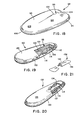
- FIG 19 illustrates another embodiment of a labial pad in accordance with the present invention, denoted generally as 110.
- the pad 110 is comprised of a baffle 112 of a polymeric film or, optionally, a fibrous web having a polymeric film bonded thereto; in either of such events, the objective being the formation of a fluid impermeable shield.
- baffle Disposed above that baffle is a first absorbent batt member 114 supporting, in turn, 'a second absorbent batt 116.
- the separate batts 114 and 116 have differing fluid wicking and retaining characteristics, although that is not a mandatory requirement of this embodiment.
- the upper batt or layer 116 may function more the nature of a transfer layer like the transfer layer 78 provided in the pad 30.
- the two layers may have differing densities and/or spatial wicking characteristics such that fluid is selectively routed to the outer reaches of the pad should that prove a desirable feature.
- the present invention contemplates a plurality of layers comprising the absorbent core, wherein differing layers within such a composite are characterized by differing fluid wicking and/or absorbing properties; such variations being achieved, for example, by incorporating layers of differing chemical and/or physical compositions or properties.
- a raised profile in the pad 110 is achieved by means of an insert member identified generally as 118 disposed in mating cooperation with both of the absorbent batts 114 and 116.
- a slot 120 is formed in the upper batt 116, shown in Figure 19 as a generally rectilinear slot.
- the insert comprised of an absorbent, compressed fibrous mass, includes a crown 122 tapering forwardly and rearwardly within the slot 120.
- the insert 118 further includes a shank 126, lying below the top surface of the batt 116. The bottom face of the shank 126 lies in fluid transmissive engagement with the lower batt 114 in order to transfer, e. g . menses to that component.
- a cover 128 constitutes the top of the pad structure and is sealed to the baffle 112 about the perimetral edges 130 in a manner similar to that described above relative to the pad 30.
- the crown of the insert 118 projects sufficiently upward beyond the top surface or plane of the batt 116 to yield a projection or prominence defining a raised profile within the posterior region of the pad. This raised profile is disposed slightly toward the proximal end of the pad in the sense that, as can be envisioned with reference to Figure 19, the prominence leads to a forward and rearward taper along the longitudinal centerline of the pad. Otherwise, the pad 110 is fully functionally equivalent to the pad 30.
- the prominence resulting from the insert 118 is provided for partial labial disposition within the vestibule of the wearer to intercept the flow of menstrual fluid. That menstrual fluid first contacts the raised area which defines a target zone within the vestibule, is received within the insert and is then transmitted to both the upper batt 116 and the lower batt 114. Depending upon the wicking characteristics imparted to these members, X-Y-Z directional flow patterns may be tailored by the fabricator as desirable.
- Figures 20 and 21 depict a further alternate embodiment of a pad in accordance with the present invention, designated generally as 132.
- This pad is structurally the same as that of Figure 19, save and except the fact that the insert is now a positionable insert which may be moved by the user of the pad.
- the insert in this instance designated generally as 134 and best viewed in Figure 21, is comprised of a base 136 which is formed with a centrally located raised element 138.
- the upper batt 116 unlike that of the embodiment described with reference to Figure 19, is a continuous batt member as opposed to the former wherein the slot was formed.
- the insert 134 rides on the base member beneath the cover 128 and may be slid by the user upon an urging motion either forwardly or rearwardly along the longitudinal axis.
- the insert when properly positioned to suit the anatomy of the wearer, then functions precisely the same as the insert of Figure 19. That is, a raised target zone is formed in the nature of a profile configured for disposition within the wearer's vestibule to occlude the same against menstrual flow.
- the fluid upon initial contact with the pad 132, is directed through the physiologically hydrous cover member to the insert and then the absorbent batt.
- the illustrated embodiment provides plural batts 114 and 116 which may be imparted with different wicking characteristics, those skilled in the art will appreciate that such an option may be foregone in favor of a single absorbent member.
- the pad of the present invention achieves considerably improved fluid distribution and retention, in part by virtue of the microfibrous batts employed in the preferred embodiments, thereby allowing considerable savings in size without sacrifice of efficiency. Comfort is achieved by virtue of the partial (as opposed to total) disposition of the pad within the vestibule combined with the judicious selection of physiologically hydrous cover members.
- the labial pad of the present invention regardless of its particular configuration, is highly self-conforming to the anatomy of the wearer, whereby the device moves with that wearer during even vigorous activity as 'opposed to the more conventional movement of sanitary napkins relative to the body of the wearer.
Landscapes
- Health & Medical Sciences (AREA)
- Epidemiology (AREA)
- Engineering & Computer Science (AREA)
- Biomedical Technology (AREA)
- Heart & Thoracic Surgery (AREA)
- Vascular Medicine (AREA)
- Life Sciences & Earth Sciences (AREA)
- Animal Behavior & Ethology (AREA)
- General Health & Medical Sciences (AREA)
- Public Health (AREA)
- Veterinary Medicine (AREA)
- Absorbent Articles And Supports Therefor (AREA)
- Orthopedics, Nursing, And Contraception (AREA)
- Materials For Medical Uses (AREA)
Priority Applications (1)
| Application Number | Priority Date | Filing Date | Title |
|---|---|---|---|
| AT85106238T ATE65902T1 (de) | 1984-05-21 | 1985-05-21 | Der form der schamlippen sich anpassende hygienische vorlage. |
Applications Claiming Priority (6)
| Application Number | Priority Date | Filing Date | Title |
|---|---|---|---|
| US61250684A | 1984-05-21 | 1984-05-21 | |
| US612506 | 1984-05-21 | ||
| US65492784A | 1984-09-27 | 1984-09-27 | |
| US654927 | 1984-09-27 | ||
| US707338 | 1985-03-01 | ||
| US06/707,338 US4631062A (en) | 1984-09-27 | 1985-03-01 | Labial sanitary pad |
Publications (2)
| Publication Number | Publication Date |
|---|---|
| EP0162451A1 true EP0162451A1 (de) | 1985-11-27 |
| EP0162451B1 EP0162451B1 (de) | 1991-08-07 |
Family
ID=27417083
Family Applications (1)
| Application Number | Title | Priority Date | Filing Date |
|---|---|---|---|
| EP85106238A Expired - Lifetime EP0162451B1 (de) | 1984-05-21 | 1985-05-21 | Der Form der Schamlippen sich anpassende hygienische Vorlage |
Country Status (18)
| Country | Link |
|---|---|
| EP (1) | EP0162451B1 (de) |
| JP (2) | JPH0824699B2 (de) |
| KR (1) | KR920006860B1 (de) |
| AU (1) | AU579634B2 (de) |
| BR (1) | BR8502380A (de) |
| CA (1) | CA1247303A (de) |
| DE (1) | DE3583701D1 (de) |
| DK (1) | DK224685A (de) |
| ES (1) | ES8607003A1 (de) |
| FI (1) | FI84428C (de) |
| GB (1) | GB2162064B (de) |
| GR (1) | GR851228B (de) |
| IE (1) | IE56755B1 (de) |
| MX (1) | MX161476A (de) |
| MY (1) | MY102157A (de) |
| NO (1) | NO851997L (de) |
| NZ (1) | NZ212150A (de) |
| PT (1) | PT80505A (de) |
Cited By (24)
| Publication number | Priority date | Publication date | Assignee | Title |
|---|---|---|---|---|
| WO1995000095A1 (en) * | 1993-06-28 | 1995-01-05 | The Procter & Gamble Company | Absorbent article having a window with a body-conforming acquisition element positioned therein |
| WO1995023570A1 (en) * | 1994-03-01 | 1995-09-08 | The Procter & Gamble Company | Trisection sanitary napkin |
| EP0689820A1 (de) | 1994-07-01 | 1996-01-03 | Kaysersberg | Frauenhygienartikel mit Dochtelement für körperliche Flüssigkeiten |
| TR28475A (tr) * | 1993-01-22 | 1996-07-24 | Procter & Gamble | Merkezi absorplayici tümsege sahip, genel olarak ince esnek adet bezi. |
| TR28715A (tr) * | 1987-08-06 | 1997-01-27 | Kimberly Clark Co | Anatomik sekilli kendi kendine yerlesen sihhi korunma tertibati. |
| WO1996019170A3 (en) * | 1994-12-22 | 1997-02-13 | Kimberly Clark Co | Absorbent article having a preformed member |
| EP0850628A1 (de) * | 1996-12-23 | 1998-07-01 | The Procter & Gamble Company | Anatomische geformte Damenbinde mit Klebstoff zur Befestigung des Artikels an der Haut |
| EP0888763A1 (de) * | 1997-07-01 | 1999-01-07 | The Procter & Gamble Company | Absorbierende Wegwerfartikel mit verbessertem Sitz für die Körperanatomie |
| EP0888765A1 (de) * | 1997-07-01 | 1999-01-07 | The Procter & Gamble Company | Dreidimensionaler Wegwerfartikel mit einem Schlitz in der hinteren Region |
| WO1999001094A1 (en) * | 1997-07-01 | 1999-01-14 | The Procter & Gamble Company | Body adhering disposable absorbent articles having an increased fit for the body anatomy |
| WO1999004740A1 (en) * | 1997-07-25 | 1999-02-04 | The Procter & Gamble Company | Adjustable compound sanitary napkin |
| WO1999025282A1 (en) * | 1997-11-19 | 1999-05-27 | Sca Hygiene Products Ab | Absorbent article such as a sanitary towel, an incontinence protector, a pantyliner or the like |
| WO1999032060A1 (en) * | 1997-12-23 | 1999-07-01 | Kimberly-Clark Worldwide, Inc. | Compressed absorbent composites |
| US5964689A (en) * | 1996-08-30 | 1999-10-12 | The Procter & Gamble Company | Method of making an absorbent interlabial device with a central groove |
| US5968026A (en) * | 1996-08-30 | 1999-10-19 | The Procter & Gamble Company | Absorbent interlabial device |
| US6123693A (en) * | 1997-01-03 | 2000-09-26 | The Procter & Gamble Company | Absorbent interlabial device with flexible extensions |
| US6183587B1 (en) | 1997-11-26 | 2001-02-06 | The Procter & Gamble Company | Method of making sanitary napkin comprising three dimensionally shaped tube of absorbent material |
| US6316688B1 (en) | 1998-04-27 | 2001-11-13 | The Procter & Gamble Company | Sanitary napkin comprising three dimensionally shaped tube of absorbent material |
| WO2002094153A1 (en) * | 2001-05-22 | 2002-11-28 | Uni-Charm Corporation | Interlabial pad |
| WO2002100314A1 (en) * | 2001-06-08 | 2002-12-19 | Kimberly-Clark Worldwide, Inc. | Labial pad having a notch |
| US6521811B1 (en) | 1994-06-13 | 2003-02-18 | Kimberly-Clark Worldwide, Inc. | Absorbent article having a body-accommodating absorbent core |
| EP0335253B2 (de) † | 1988-03-31 | 2003-10-22 | The Procter & Gamble Company | Absorptionsartikel |
| GB2407269A (en) * | 2003-10-20 | 2005-04-27 | Julie Lloyd | Sanitary article with projection |
| US7976525B2 (en) | 2008-02-13 | 2011-07-12 | Kimberly-Clark Worldwide, Inc. | Compound absorbent article with improved body contact |
Families Citing this family (21)
| Publication number | Priority date | Publication date | Assignee | Title |
|---|---|---|---|---|
| US4917675A (en) * | 1988-07-14 | 1990-04-17 | Mcneil-Ppc, Inc. | Folded flange sealed sanitary napkin |
| US5454802A (en) * | 1989-09-20 | 1995-10-03 | Molnlycke Ab | Sanitary napkin or incontinence guard |
| US6042575A (en) * | 1990-10-29 | 2000-03-28 | The Procter & Gamble Company | Generally thin, flexible, sanitary napkin with central absorbent hump |
| US5591150A (en) * | 1991-07-23 | 1997-01-07 | The Procter And Gamble Company | Sanitary napkin having a resilient body-conforming portion |
| SE508041C2 (sv) * | 1994-12-30 | 1998-08-17 | Moelnlycke Ab | Absorberande alster |
| DE19613071C1 (de) | 1996-03-22 | 1997-10-16 | Johnson & Johnson Gmbh | Verfahren und Vorrichtung zum Umformen von Watteprodukten |
| US5762644A (en) * | 1996-08-30 | 1998-06-09 | The Procter & Gamble Company | Toilet-disposable absorbent interlabial device |
| US6409713B1 (en) | 1996-08-30 | 2002-06-25 | The Procter & Gamble Company | Emollient-treated absorbent interlabial application |
| US6270486B1 (en) | 1997-06-16 | 2001-08-07 | The Procter & Gamble Company | Absorbent interlabial device |
| ZA9811115B (en) * | 1997-12-23 | 1999-06-08 | Kimbeley Clark Worldwide Inc | Pulp and superabsorbent composite for improved intake performance |
| US6475199B1 (en) | 1998-04-27 | 2002-11-05 | The Procter & Gamble Company | Method of individually packaging a three dimensionally-shaped absorbent article |
| US6702796B2 (en) | 2001-03-26 | 2004-03-09 | The Procter & Gamble Company | Absorbent interlabial device having an improved tab |
| US7115116B2 (en) | 2001-06-08 | 2006-10-03 | Kimberly-Clark Worldwide, Inc. | Labial pad having various means |
| US7288080B2 (en) | 2001-06-08 | 2007-10-30 | Kimberly-Clark Worldwide, Inc. | Labial pad |
| US6955666B2 (en) | 2001-06-08 | 2005-10-18 | Kimberly-Clark Worldwide, Inc. | Labial pad having a tab |
| JP4694149B2 (ja) | 2004-05-28 | 2011-06-08 | ユニ・チャーム株式会社 | 陰唇間パッド |
| JP5469801B2 (ja) * | 2007-08-24 | 2014-04-16 | ユニ・チャーム株式会社 | 吸収性物品 |
| EP2636395A1 (de) * | 2007-08-24 | 2013-09-11 | Uni-Charm Corporation | Saugfähiger Körper |
| JP5498028B2 (ja) * | 2009-02-06 | 2014-05-21 | ユニ・チャーム株式会社 | 使い捨ての体液吸収性着用物品 |
| JP5039731B2 (ja) * | 2009-03-06 | 2012-10-03 | ユニ・チャーム株式会社 | 陰唇間パッド |
| JP5737680B1 (ja) * | 2014-02-28 | 2015-06-17 | メルシィプランニング株式会社 | 凸状吸収体を有する生理用ナプキンと専用サニタリーショーツ |
Citations (6)
| Publication number | Priority date | Publication date | Assignee | Title |
|---|---|---|---|---|
| US2662527A (en) * | 1952-12-18 | 1953-12-15 | Jacks Williard Grant | Sanitary pad |
| GB754481A (en) * | 1953-04-23 | 1956-08-08 | Eduard Neumann | Improvements in or relating to sanitary napkins |
| US4079739A (en) * | 1976-12-27 | 1978-03-21 | Kimberly-Clark Corporation | Die-cut contoured catamenial napkin of multi-layered construction |
| FR2420339A1 (fr) * | 1978-03-20 | 1979-10-19 | Beghin Say Sa | Serviette periodique anatomique |
| US4397644A (en) * | 1982-02-04 | 1983-08-09 | Kimberly-Clark Corporation | Sanitary napkin with improved comfort |
| US4433972A (en) * | 1981-06-01 | 1984-02-28 | Amanda Malfitano | Sanitary napkin |
Family Cites Families (10)
| Publication number | Priority date | Publication date | Assignee | Title |
|---|---|---|---|---|
| US2331355A (en) * | 1941-09-18 | 1943-10-12 | Herman L Strongson | Catamenial pad |
| US3092109A (en) * | 1960-05-09 | 1963-06-04 | Jeanette Elaine J Mosier | Catamenial appliance |
| US3073309A (en) * | 1960-11-07 | 1963-01-15 | Jeannette Etame J Mosier | Self-supporting sanitary napkin |
| JPS54107191A (en) * | 1978-02-08 | 1979-08-22 | Kao Corp | Absorptive article |
| JPS5568367A (en) * | 1978-11-19 | 1980-05-23 | Uni Charm Corp | Sanitary material and its preparation |
| JPS55148555A (en) * | 1979-05-07 | 1980-11-19 | Kao Corp | Sanitary napkin |
| JPS56119249A (en) * | 1980-02-27 | 1981-09-18 | Uni Charm Corp | Sanitary article |
| JPS577845A (en) * | 1980-06-13 | 1982-01-16 | Hitachi Denshi Ltd | Bulb shaping mechanism |
| JPS6031719Y2 (ja) * | 1982-01-23 | 1985-09-21 | ユニ・チヤ−ム株式会社 | 生理用ナプキン |
| DE3417910C2 (de) * | 1984-05-15 | 1986-10-23 | Brigitte 3004 Isernhagen Dobson | Neuartige hygienische Vorlage |
-
1985
- 1985-05-15 CA CA000481575A patent/CA1247303A/en not_active Expired
- 1985-05-20 AU AU42644/85A patent/AU579634B2/en not_active Expired
- 1985-05-20 NO NO851997A patent/NO851997L/no unknown
- 1985-05-20 GR GR851228A patent/GR851228B/el unknown
- 1985-05-20 BR BR8502380A patent/BR8502380A/pt unknown
- 1985-05-20 FI FI852005A patent/FI84428C/fi not_active IP Right Cessation
- 1985-05-21 IE IE1259/85A patent/IE56755B1/en not_active IP Right Cessation
- 1985-05-21 PT PT80505A patent/PT80505A/pt unknown
- 1985-05-21 NZ NZ212150A patent/NZ212150A/xx unknown
- 1985-05-21 DK DK224685A patent/DK224685A/da not_active Application Discontinuation
- 1985-05-21 KR KR1019850003470A patent/KR920006860B1/ko not_active Expired
- 1985-05-21 MX MX205356A patent/MX161476A/es unknown
- 1985-05-21 EP EP85106238A patent/EP0162451B1/de not_active Expired - Lifetime
- 1985-05-21 GB GB08512865A patent/GB2162064B/en not_active Expired
- 1985-05-21 ES ES543339A patent/ES8607003A1/es not_active Expired
- 1985-05-21 DE DE8585106238T patent/DE3583701D1/de not_active Expired - Lifetime
-
1987
- 1987-09-23 MY MYPI87001909A patent/MY102157A/en unknown
-
1994
- 1994-03-14 JP JP6042247A patent/JPH0824699B2/ja not_active Expired - Lifetime
- 1994-08-29 JP JP1994012266U patent/JP2500287Y2/ja not_active Expired - Lifetime
Patent Citations (6)
| Publication number | Priority date | Publication date | Assignee | Title |
|---|---|---|---|---|
| US2662527A (en) * | 1952-12-18 | 1953-12-15 | Jacks Williard Grant | Sanitary pad |
| GB754481A (en) * | 1953-04-23 | 1956-08-08 | Eduard Neumann | Improvements in or relating to sanitary napkins |
| US4079739A (en) * | 1976-12-27 | 1978-03-21 | Kimberly-Clark Corporation | Die-cut contoured catamenial napkin of multi-layered construction |
| FR2420339A1 (fr) * | 1978-03-20 | 1979-10-19 | Beghin Say Sa | Serviette periodique anatomique |
| US4433972A (en) * | 1981-06-01 | 1984-02-28 | Amanda Malfitano | Sanitary napkin |
| US4397644A (en) * | 1982-02-04 | 1983-08-09 | Kimberly-Clark Corporation | Sanitary napkin with improved comfort |
Cited By (31)
| Publication number | Priority date | Publication date | Assignee | Title |
|---|---|---|---|---|
| TR28715A (tr) * | 1987-08-06 | 1997-01-27 | Kimberly Clark Co | Anatomik sekilli kendi kendine yerlesen sihhi korunma tertibati. |
| EP0335253B2 (de) † | 1988-03-31 | 2003-10-22 | The Procter & Gamble Company | Absorptionsartikel |
| TR28475A (tr) * | 1993-01-22 | 1996-07-24 | Procter & Gamble | Merkezi absorplayici tümsege sahip, genel olarak ince esnek adet bezi. |
| WO1995000095A1 (en) * | 1993-06-28 | 1995-01-05 | The Procter & Gamble Company | Absorbent article having a window with a body-conforming acquisition element positioned therein |
| WO1995023570A1 (en) * | 1994-03-01 | 1995-09-08 | The Procter & Gamble Company | Trisection sanitary napkin |
| US6521811B1 (en) | 1994-06-13 | 2003-02-18 | Kimberly-Clark Worldwide, Inc. | Absorbent article having a body-accommodating absorbent core |
| EP0689820A1 (de) | 1994-07-01 | 1996-01-03 | Kaysersberg | Frauenhygienartikel mit Dochtelement für körperliche Flüssigkeiten |
| WO1996019170A3 (en) * | 1994-12-22 | 1997-02-13 | Kimberly Clark Co | Absorbent article having a preformed member |
| CN1115134C (zh) * | 1994-12-22 | 2003-07-23 | 金伯利-克拉克环球有限公司 | 具有预成型件的吸收制品 |
| US5964689A (en) * | 1996-08-30 | 1999-10-12 | The Procter & Gamble Company | Method of making an absorbent interlabial device with a central groove |
| US5968026A (en) * | 1996-08-30 | 1999-10-19 | The Procter & Gamble Company | Absorbent interlabial device |
| EP0850628A1 (de) * | 1996-12-23 | 1998-07-01 | The Procter & Gamble Company | Anatomische geformte Damenbinde mit Klebstoff zur Befestigung des Artikels an der Haut |
| US6123693A (en) * | 1997-01-03 | 2000-09-26 | The Procter & Gamble Company | Absorbent interlabial device with flexible extensions |
| WO1999001095A1 (en) * | 1997-07-01 | 1999-01-14 | The Procter & Gamble Company | Disposable absorbent articles having an increased fit for the body anatomy |
| WO1999001094A1 (en) * | 1997-07-01 | 1999-01-14 | The Procter & Gamble Company | Body adhering disposable absorbent articles having an increased fit for the body anatomy |
| WO1999001097A1 (en) * | 1997-07-01 | 1999-01-14 | The Procter & Gamble Company | Tridimensional disposable absorbent article having a slit in the rear region |
| EP0888765A1 (de) * | 1997-07-01 | 1999-01-07 | The Procter & Gamble Company | Dreidimensionaler Wegwerfartikel mit einem Schlitz in der hinteren Region |
| EP0888763A1 (de) * | 1997-07-01 | 1999-01-07 | The Procter & Gamble Company | Absorbierende Wegwerfartikel mit verbessertem Sitz für die Körperanatomie |
| WO1999004740A1 (en) * | 1997-07-25 | 1999-02-04 | The Procter & Gamble Company | Adjustable compound sanitary napkin |
| WO1999025282A1 (en) * | 1997-11-19 | 1999-05-27 | Sca Hygiene Products Ab | Absorbent article such as a sanitary towel, an incontinence protector, a pantyliner or the like |
| US6183587B1 (en) | 1997-11-26 | 2001-02-06 | The Procter & Gamble Company | Method of making sanitary napkin comprising three dimensionally shaped tube of absorbent material |
| WO1999032060A1 (en) * | 1997-12-23 | 1999-07-01 | Kimberly-Clark Worldwide, Inc. | Compressed absorbent composites |
| KR100668551B1 (ko) * | 1997-12-23 | 2007-01-17 | 킴벌리-클라크 월드와이드, 인크. | 압축된 흡수성 복합물 |
| US6316688B1 (en) | 1998-04-27 | 2001-11-13 | The Procter & Gamble Company | Sanitary napkin comprising three dimensionally shaped tube of absorbent material |
| WO2002094153A1 (en) * | 2001-05-22 | 2002-11-28 | Uni-Charm Corporation | Interlabial pad |
| US7549980B2 (en) | 2001-05-22 | 2009-06-23 | Uni-Charm Corporation | Interlabial pad |
| US8192416B2 (en) | 2001-05-22 | 2012-06-05 | Uni-Charm Corporation | Interlabial pad |
| WO2002100314A1 (en) * | 2001-06-08 | 2002-12-19 | Kimberly-Clark Worldwide, Inc. | Labial pad having a notch |
| EP1404276B2 (de) † | 2001-06-08 | 2013-11-20 | Kimberly-Clark Worldwide, Inc. | Labiale hygienevorlage mit einer kerbe |
| GB2407269A (en) * | 2003-10-20 | 2005-04-27 | Julie Lloyd | Sanitary article with projection |
| US7976525B2 (en) | 2008-02-13 | 2011-07-12 | Kimberly-Clark Worldwide, Inc. | Compound absorbent article with improved body contact |
Also Published As
| Publication number | Publication date |
|---|---|
| NZ212150A (en) | 1988-07-28 |
| IE56755B1 (en) | 1991-12-04 |
| MY102157A (en) | 1992-04-30 |
| GB2162064A (en) | 1986-01-29 |
| BR8502380A (pt) | 1986-01-21 |
| ES8607003A1 (es) | 1986-06-01 |
| FI84428C (fi) | 1991-12-10 |
| PT80505A (en) | 1985-06-01 |
| KR850008276A (ko) | 1985-12-16 |
| FI84428B (fi) | 1991-08-30 |
| FI852005L (fi) | 1985-11-22 |
| JPH0824699B2 (ja) | 1996-03-13 |
| FI852005A0 (fi) | 1985-05-20 |
| MX161476A (es) | 1990-09-27 |
| KR920006860B1 (ko) | 1992-08-21 |
| CA1247303A (en) | 1988-12-28 |
| EP0162451B1 (de) | 1991-08-07 |
| ES543339A0 (es) | 1986-06-01 |
| AU579634B2 (en) | 1988-12-01 |
| JPH0718712U (ja) | 1995-04-04 |
| GR851228B (de) | 1985-11-25 |
| AU4264485A (en) | 1985-11-28 |
| DK224685A (da) | 1985-11-22 |
| DK224685D0 (da) | 1985-05-21 |
| GB2162064B (en) | 1988-09-01 |
| JP2500287Y2 (ja) | 1996-06-05 |
| IE851259L (en) | 1985-11-21 |
| GB8512865D0 (en) | 1985-06-26 |
| DE3583701D1 (de) | 1991-09-12 |
| NO851997L (no) | 1985-11-22 |
| JPH0747096A (ja) | 1995-02-21 |
Similar Documents
| Publication | Publication Date | Title |
|---|---|---|
| US4743245A (en) | Labial sanitary pad | |
| US4631062A (en) | Labial sanitary pad | |
| EP0162451B1 (de) | Der Form der Schamlippen sich anpassende hygienische Vorlage | |
| US4846824A (en) | Labial sanitary pad | |
| US4673403A (en) | Method and pad allowing improved placement of catamenial device | |
| EP0668066B1 (de) | An den Körper anschmiegender absorbierender Artikel | |
| US5300055A (en) | Absorbent article having a thermoplastic deformable element | |
| AU782445B2 (en) | Compound sanitary napkin | |
| EP0426197A2 (de) | Absorbierende Gegenstände mit flexiblen hydrophilen Dochteinrichtungen | |
| AU2002254477B2 (en) | Interlabial pad | |
| JPH07328063A (ja) | 吸収性物品 | |
| US6958430B1 (en) | Disposable absorbent article comprising expandable fibers and being capable of self-shaping in use | |
| AU2997797A (en) | Disposable absorbent article having incisions in the absorbent structure and being capable of self-shaping in use | |
| AU2002254477A1 (en) | Interlabial pad | |
| EP0804912B1 (de) | Saugfähiger Wegwerfartikel mit expansionsfähige Fasern mit der Fähigkeit seine Form zu ändern während der Verwendung | |
| JP3459260B2 (ja) | 解剖学的に形作られた混合衛生ナプキン | |
| CA2224549C (en) | Stabilized absorbent article | |
| CA1260203A (en) | Labial sanitary pad | |
| JPS61149145A (ja) | 生理用ナプキン | |
| JP2000510032A (ja) | 身体にフィットする複合生理用ナプキン | |
| JP2500287Z (de) | ||
| MXPA97006699A (en) | Sanitary towel composed anatomically form | |
| HK1012544B (en) | Body conforming absorbent article | |
| MXPA00000055A (en) | Disposable absorbent articles having an increased fit for the body anatomy | |
| ZA200309159B (en) | Interlabial pad. |
Legal Events
| Date | Code | Title | Description |
|---|---|---|---|
| PUAI | Public reference made under article 153(3) epc to a published international application that has entered the european phase |
Free format text: ORIGINAL CODE: 0009012 |
|
| AK | Designated contracting states |
Designated state(s): AT BE CH DE FR IT LI LU NL SE |
|
| 17P | Request for examination filed |
Effective date: 19860523 |
|
| 17Q | First examination report despatched |
Effective date: 19870921 |
|
| ITF | It: translation for a ep patent filed | ||
| GRAA | (expected) grant |
Free format text: ORIGINAL CODE: 0009210 |
|
| AK | Designated contracting states |
Kind code of ref document: B1 Designated state(s): AT BE CH DE FR IT LI LU NL SE |
|
| PG25 | Lapsed in a contracting state [announced via postgrant information from national office to epo] |
Ref country code: LI Effective date: 19910807 Ref country code: CH Effective date: 19910807 Ref country code: AT Effective date: 19910807 |
|
| REF | Corresponds to: |
Ref document number: 65902 Country of ref document: AT Date of ref document: 19910815 Kind code of ref document: T |
|
| REF | Corresponds to: |
Ref document number: 3583701 Country of ref document: DE Date of ref document: 19910912 |
|
| ET | Fr: translation filed | ||
| REG | Reference to a national code |
Ref country code: CH Ref legal event code: PL |
|
| PG25 | Lapsed in a contracting state [announced via postgrant information from national office to epo] |
Ref country code: LU Free format text: LAPSE BECAUSE OF NON-PAYMENT OF DUE FEES Effective date: 19920531 |
|
| PLBE | No opposition filed within time limit |
Free format text: ORIGINAL CODE: 0009261 |
|
| STAA | Information on the status of an ep patent application or granted ep patent |
Free format text: STATUS: NO OPPOSITION FILED WITHIN TIME LIMIT |
|
| 26N | No opposition filed | ||
| EAL | Se: european patent in force in sweden |
Ref document number: 85106238.0 |
|
| REG | Reference to a national code |
Ref country code: FR Ref legal event code: CL |
|
| REG | Reference to a national code |
Ref country code: FR Ref legal event code: TP Ref country code: FR Ref legal event code: CD Ref country code: FR Ref legal event code: CA |
|
| REG | Reference to a national code |
Ref country code: FR Ref legal event code: RM |
|
| REG | Reference to a national code |
Ref country code: FR Ref legal event code: TP |
|
| NLS | Nl: assignments of ep-patents |
Owner name: KIMBERLY-CLARK WORLDWIDE, INC. |
|
| PGFP | Annual fee paid to national office [announced via postgrant information from national office to epo] |
Ref country code: BE Payment date: 19990611 Year of fee payment: 15 |
|
| PG25 | Lapsed in a contracting state [announced via postgrant information from national office to epo] |
Ref country code: BE Free format text: LAPSE BECAUSE OF NON-PAYMENT OF DUE FEES Effective date: 20000531 |
|
| BERE | Be: lapsed |
Owner name: KIMBERLY-CLARK WORLDWIDE INC. Effective date: 20000531 |
|
| PGFP | Annual fee paid to national office [announced via postgrant information from national office to epo] |
Ref country code: NL Payment date: 20040413 Year of fee payment: 20 |
|
| PGFP | Annual fee paid to national office [announced via postgrant information from national office to epo] |
Ref country code: FR Payment date: 20040503 Year of fee payment: 20 |
|
| PGFP | Annual fee paid to national office [announced via postgrant information from national office to epo] |
Ref country code: SE Payment date: 20040504 Year of fee payment: 20 |
|
| PGFP | Annual fee paid to national office [announced via postgrant information from national office to epo] |
Ref country code: DE Payment date: 20040528 Year of fee payment: 20 |
|
| PG25 | Lapsed in a contracting state [announced via postgrant information from national office to epo] |
Ref country code: NL Free format text: LAPSE BECAUSE OF EXPIRATION OF PROTECTION Effective date: 20050521 |
|
| NLV7 | Nl: ceased due to reaching the maximum lifetime of a patent |
Effective date: 20050521 |
|
| EUG | Se: european patent has lapsed |