EP0169537A2 - 2-Phenylalkyl-3-aminoalkyl-4(3H)-quinazolinones, processes for preparing them, pharmaceutical compositions and use - Google Patents
2-Phenylalkyl-3-aminoalkyl-4(3H)-quinazolinones, processes for preparing them, pharmaceutical compositions and use Download PDFInfo
- Publication number
- EP0169537A2 EP0169537A2 EP85109193A EP85109193A EP0169537A2 EP 0169537 A2 EP0169537 A2 EP 0169537A2 EP 85109193 A EP85109193 A EP 85109193A EP 85109193 A EP85109193 A EP 85109193A EP 0169537 A2 EP0169537 A2 EP 0169537A2
- Authority
- EP
- European Patent Office
- Prior art keywords
- group
- compound
- formula
- carbon atoms
- atom
- Prior art date
- Legal status (The legal status is an assumption and is not a legal conclusion. Google has not performed a legal analysis and makes no representation as to the accuracy of the status listed.)
- Granted
Links
- 239000008194 pharmaceutical composition Substances 0.000 title claims abstract 5
- 238000000034 method Methods 0.000 title description 35
- 150000001875 compounds Chemical class 0.000 claims abstract description 95
- 125000004432 carbon atom Chemical group C* 0.000 claims abstract description 42
- 125000000217 alkyl group Chemical group 0.000 claims abstract description 24
- 239000000203 mixture Substances 0.000 claims abstract description 19
- 239000002253 acid Substances 0.000 claims abstract description 18
- 125000005843 halogen group Chemical group 0.000 claims abstract description 17
- 125000004435 hydrogen atom Chemical group [H]* 0.000 claims abstract description 17
- 125000003545 alkoxy group Chemical group 0.000 claims abstract description 14
- 150000003839 salts Chemical class 0.000 claims abstract description 14
- 125000000051 benzyloxy group Chemical group [H]C1=C([H])C([H])=C(C([H])=C1[H])C([H])([H])O* 0.000 claims abstract description 11
- 230000002213 calciumantagonistic effect Effects 0.000 claims abstract description 10
- 125000003277 amino group Chemical group 0.000 claims abstract description 8
- 125000002887 hydroxy group Chemical group [H]O* 0.000 claims abstract description 6
- 238000004519 manufacturing process Methods 0.000 claims abstract description 6
- 125000000449 nitro group Chemical group [O-][N+](*)=O 0.000 claims abstract description 6
- 229910052757 nitrogen Inorganic materials 0.000 claims abstract description 6
- 125000004433 nitrogen atom Chemical group N* 0.000 claims abstract description 6
- 125000000951 phenoxy group Chemical group [H]C1=C([H])C([H])=C(O*)C([H])=C1[H] 0.000 claims abstract description 6
- 125000004122 cyclic group Chemical group 0.000 claims abstract description 5
- 239000004480 active ingredient Substances 0.000 claims abstract description 4
- 125000002947 alkylene group Chemical group 0.000 claims abstract description 4
- -1 hexamethyleneimino group Chemical group 0.000 claims description 14
- 150000004985 diamines Chemical class 0.000 claims description 12
- 125000001495 ethyl group Chemical group [H]C([H])([H])C([H])([H])* 0.000 claims description 12
- 125000002496 methyl group Chemical group [H]C([H])([H])* 0.000 claims description 10
- 150000001412 amines Chemical class 0.000 claims description 9
- 125000001449 isopropyl group Chemical group [H]C([H])([H])C([H])(*)C([H])([H])[H] 0.000 claims description 9
- 125000000956 methoxy group Chemical group [H]C([H])([H])O* 0.000 claims description 9
- 125000001301 ethoxy group Chemical group [H]C([H])([H])C([H])([H])O* 0.000 claims description 8
- 125000004108 n-butyl group Chemical group [H]C([H])([H])C([H])([H])C([H])([H])C([H])([H])* 0.000 claims description 8
- 125000004123 n-propyl group Chemical group [H]C([H])([H])C([H])([H])C([H])([H])* 0.000 claims description 8
- 125000001147 pentyl group Chemical group C(CCCC)* 0.000 claims description 8
- 125000002914 sec-butyl group Chemical group [H]C([H])([H])C([H])([H])C([H])(*)C([H])([H])[H] 0.000 claims description 8
- 229910052801 chlorine Inorganic materials 0.000 claims description 7
- 125000001309 chloro group Chemical group Cl* 0.000 claims description 7
- 125000003253 isopropoxy group Chemical group [H]C([H])([H])C([H])(O*)C([H])([H])[H] 0.000 claims description 7
- ZCYVEMRRCGMTRW-UHFFFAOYSA-N 7553-56-2 Chemical group [I] ZCYVEMRRCGMTRW-UHFFFAOYSA-N 0.000 claims description 6
- WKBOTKDWSSQWDR-UHFFFAOYSA-N Bromine atom Chemical group [Br] WKBOTKDWSSQWDR-UHFFFAOYSA-N 0.000 claims description 6
- 230000036772 blood pressure Effects 0.000 claims description 6
- 229910052740 iodine Inorganic materials 0.000 claims description 6
- 125000006606 n-butoxy group Chemical group 0.000 claims description 6
- 125000003935 n-pentoxy group Chemical group [H]C([H])([H])C([H])([H])C([H])([H])C([H])([H])C([H])([H])O* 0.000 claims description 6
- 125000005920 sec-butoxy group Chemical group 0.000 claims description 6
- 229910052731 fluorine Inorganic materials 0.000 claims description 5
- 125000001153 fluoro group Chemical group F* 0.000 claims description 5
- 125000003506 n-propoxy group Chemical group [H]C([H])([H])C([H])([H])C([H])([H])O* 0.000 claims description 5
- 210000004204 blood vessel Anatomy 0.000 claims description 4
- 230000000916 dilatatory effect Effects 0.000 claims description 4
- ZHUFYZBOWLXRDW-UHFFFAOYSA-N 2-[(2,5-dimethoxyphenyl)methyl]-3-[3-(dimethylamino)propyl]-6-propan-2-yloxyquinazolin-4-one Chemical compound COC1=CC=C(OC)C(CC=2N(C(=O)C3=CC(OC(C)C)=CC=C3N=2)CCCN(C)C)=C1 ZHUFYZBOWLXRDW-UHFFFAOYSA-N 0.000 claims description 3
- 125000005905 mesyloxy group Chemical group 0.000 claims description 3
- 125000004573 morpholin-4-yl group Chemical group N1(CCOCC1)* 0.000 claims description 3
- 125000002112 pyrrolidino group Chemical group [*]N1C([H])([H])C([H])([H])C([H])([H])C1([H])[H] 0.000 claims description 3
- 125000005424 tosyloxy group Chemical group S(=O)(=O)(C1=CC=C(C)C=C1)O* 0.000 claims description 3
- 125000005921 isopentoxy group Chemical group 0.000 claims description 2
- NAWXUBYGYWOOIX-SFHVURJKSA-N (2s)-2-[[4-[2-(2,4-diaminoquinazolin-6-yl)ethyl]benzoyl]amino]-4-methylidenepentanedioic acid Chemical compound C1=CC2=NC(N)=NC(N)=C2C=C1CCC1=CC=C(C(=O)N[C@@H](CC(=C)C(O)=O)C(O)=O)C=C1 NAWXUBYGYWOOIX-SFHVURJKSA-N 0.000 claims 2
- 125000001891 dimethoxy group Chemical group [H]C([H])([H])O* 0.000 claims 2
- WMLHIIMHGSNIAL-UHFFFAOYSA-N 2-[(2,5-dimethoxyphenyl)methyl]-3-[2-(dimethylamino)ethyl]-6-propan-2-yloxyquinazolin-4-one Chemical compound COC1=CC=C(OC)C(CC=2N(C(=O)C3=CC(OC(C)C)=CC=C3N=2)CCN(C)C)=C1 WMLHIIMHGSNIAL-UHFFFAOYSA-N 0.000 claims 1
- FTGHGIKUUOOVKE-UHFFFAOYSA-N 2-[(2,5-dimethoxyphenyl)methyl]-6-methyl-3-(2-pyrrolidin-1-ylethyl)quinazolin-4-one Chemical compound COC1=CC=C(OC)C(CC=2N(C(=O)C3=CC(C)=CC=C3N=2)CCN2CCCC2)=C1 FTGHGIKUUOOVKE-UHFFFAOYSA-N 0.000 claims 1
- KKIHMFSIPAVSON-UHFFFAOYSA-N 3-[2-(dimethylamino)ethyl]-2-[(4-methoxyphenyl)methyl]-6-propan-2-yloxyquinazolin-4-one Chemical compound C1=CC(OC)=CC=C1CC1=NC2=CC=C(OC(C)C)C=C2C(=O)N1CCN(C)C KKIHMFSIPAVSON-UHFFFAOYSA-N 0.000 claims 1
- NEIVXZMZOMLRNV-UHFFFAOYSA-N 3-[2-(dimethylamino)ethyl]-7-methoxy-2-[(4-methoxyphenyl)methyl]-6-propan-2-yloxyquinazolin-4-one Chemical compound C1=CC(OC)=CC=C1CC1=NC2=CC(OC)=C(OC(C)C)C=C2C(=O)N1CCN(C)C NEIVXZMZOMLRNV-UHFFFAOYSA-N 0.000 claims 1
- OLKSNXMEGBEXEW-UHFFFAOYSA-N 3-[2-[2-(3,4-dimethoxyphenyl)ethyl-methylamino]ethyl]-2-[(2,5-dimethoxyphenyl)methyl]-6-propan-2-yloxyquinazolin-4-one Chemical compound COC1=CC=C(OC)C(CC=2N(C(=O)C3=CC(OC(C)C)=CC=C3N=2)CCN(C)CCC=2C=C(OC)C(OC)=CC=2)=C1 OLKSNXMEGBEXEW-UHFFFAOYSA-N 0.000 claims 1
- NWIWMLRVFYLVRS-UHFFFAOYSA-N 3-[2-[2-(3,4-dimethoxyphenyl)ethyl-methylamino]ethyl]-2-[(2,5-dimethoxyphenyl)methyl]quinazolin-4-one Chemical compound COC1=CC=C(OC)C(CC=2N(C(=O)C3=CC=CC=C3N=2)CCN(C)CCC=2C=C(OC)C(OC)=CC=2)=C1 NWIWMLRVFYLVRS-UHFFFAOYSA-N 0.000 claims 1
- 125000000068 chlorophenyl group Chemical group 0.000 claims 1
- 125000006312 cyclopentyl amino group Chemical group [H]N(*)C1([H])C([H])([H])C([H])([H])C([H])([H])C1([H])[H] 0.000 claims 1
- 125000001664 diethylamino group Chemical group [H]C([H])([H])C([H])([H])N(*)C([H])([H])C([H])([H])[H] 0.000 claims 1
- 125000002147 dimethylamino group Chemical group [H]C([H])([H])N(*)C([H])([H])[H] 0.000 claims 1
- 239000003937 drug carrier Substances 0.000 claims 1
- 125000002510 isobutoxy group Chemical group [H]C([H])([H])C([H])(C([H])([H])[H])C([H])([H])O* 0.000 claims 1
- 125000000250 methylamino group Chemical group [H]N(*)C([H])([H])[H] 0.000 claims 1
- 125000002572 propoxy group Chemical group [*]OC([H])([H])C(C([H])([H])[H])([H])[H] 0.000 claims 1
- 230000003276 anti-hypertensive effect Effects 0.000 abstract description 5
- 230000000304 vasodilatating effect Effects 0.000 abstract description 3
- LFQSCWFLJHTTHZ-UHFFFAOYSA-N Ethanol Chemical compound CCO LFQSCWFLJHTTHZ-UHFFFAOYSA-N 0.000 description 66
- YMWUJEATGCHHMB-UHFFFAOYSA-N Dichloromethane Chemical compound ClCCl YMWUJEATGCHHMB-UHFFFAOYSA-N 0.000 description 46
- 230000015572 biosynthetic process Effects 0.000 description 36
- 238000003786 synthesis reaction Methods 0.000 description 36
- CSCPPACGZOOCGX-UHFFFAOYSA-N Acetone Chemical compound CC(C)=O CSCPPACGZOOCGX-UHFFFAOYSA-N 0.000 description 24
- 235000019441 ethanol Nutrition 0.000 description 24
- 239000000243 solution Substances 0.000 description 23
- 238000006243 chemical reaction Methods 0.000 description 19
- CTQNGGLPUBDAKN-UHFFFAOYSA-N O-Xylene Chemical compound CC1=CC=CC=C1C CTQNGGLPUBDAKN-UHFFFAOYSA-N 0.000 description 16
- 239000008096 xylene Substances 0.000 description 16
- ZWEHNKRNPOVVGH-UHFFFAOYSA-N 2-Butanone Chemical compound CCC(C)=O ZWEHNKRNPOVVGH-UHFFFAOYSA-N 0.000 description 15
- UHOVQNZJYSORNB-UHFFFAOYSA-N Benzene Chemical compound C1=CC=CC=C1 UHOVQNZJYSORNB-UHFFFAOYSA-N 0.000 description 15
- XEKOWRVHYACXOJ-UHFFFAOYSA-N Ethyl acetate Chemical compound CCOC(C)=O XEKOWRVHYACXOJ-UHFFFAOYSA-N 0.000 description 15
- ZMXDDKWLCZADIW-UHFFFAOYSA-N N,N-Dimethylformamide Chemical compound CN(C)C=O ZMXDDKWLCZADIW-UHFFFAOYSA-N 0.000 description 15
- YXFVVABEGXRONW-UHFFFAOYSA-N Toluene Chemical compound CC1=CC=CC=C1 YXFVVABEGXRONW-UHFFFAOYSA-N 0.000 description 15
- VEXZGXHMUGYJMC-UHFFFAOYSA-N Hydrochloric acid Chemical compound Cl VEXZGXHMUGYJMC-UHFFFAOYSA-N 0.000 description 13
- 239000003480 eluent Substances 0.000 description 13
- RTZKZFJDLAIYFH-UHFFFAOYSA-N Diethyl ether Chemical compound CCOCC RTZKZFJDLAIYFH-UHFFFAOYSA-N 0.000 description 12
- OKKJLVBELUTLKV-UHFFFAOYSA-N Methanol Chemical compound OC OKKJLVBELUTLKV-UHFFFAOYSA-N 0.000 description 12
- 238000010898 silica gel chromatography Methods 0.000 description 12
- HEDRZPFGACZZDS-UHFFFAOYSA-N Chloroform Chemical compound ClC(Cl)Cl HEDRZPFGACZZDS-UHFFFAOYSA-N 0.000 description 10
- IAZDPXIOMUYVGZ-UHFFFAOYSA-N Dimethylsulphoxide Chemical compound CS(C)=O IAZDPXIOMUYVGZ-UHFFFAOYSA-N 0.000 description 10
- WYURNTSHIVDZCO-UHFFFAOYSA-N Tetrahydrofuran Chemical compound C1CCOC1 WYURNTSHIVDZCO-UHFFFAOYSA-N 0.000 description 10
- RWZYAGGXGHYGMB-UHFFFAOYSA-N anthranilic acid Chemical compound NC1=CC=CC=C1C(O)=O RWZYAGGXGHYGMB-UHFFFAOYSA-N 0.000 description 10
- 238000001914 filtration Methods 0.000 description 10
- 239000011541 reaction mixture Substances 0.000 description 10
- 239000000126 substance Substances 0.000 description 10
- 0 C*C(NC(C1C(C)CCCC1)=O)=N Chemical compound C*C(NC(C1C(C)CCCC1)=O)=N 0.000 description 9
- 238000000862 absorption spectrum Methods 0.000 description 9
- 238000001816 cooling Methods 0.000 description 9
- 239000013078 crystal Substances 0.000 description 9
- 150000002500 ions Chemical class 0.000 description 9
- 238000001819 mass spectrum Methods 0.000 description 9
- 238000010992 reflux Methods 0.000 description 9
- RYHBNJHYFVUHQT-UHFFFAOYSA-N 1,4-Dioxane Chemical compound C1COCCO1 RYHBNJHYFVUHQT-UHFFFAOYSA-N 0.000 description 7
- 239000002904 solvent Substances 0.000 description 7
- WFDIJRYMOXRFFG-UHFFFAOYSA-N Acetic anhydride Chemical compound CC(=O)OC(C)=O WFDIJRYMOXRFFG-UHFFFAOYSA-N 0.000 description 6
- CSNNHWWHGAXBCP-UHFFFAOYSA-L Magnesium sulfate Chemical compound [Mg+2].[O-][S+2]([O-])([O-])[O-] CSNNHWWHGAXBCP-UHFFFAOYSA-L 0.000 description 6
- HEMHJVSKTPXQMS-UHFFFAOYSA-M Sodium hydroxide Chemical compound [OH-].[Na+] HEMHJVSKTPXQMS-UHFFFAOYSA-M 0.000 description 6
- LZDKZFUFMNSQCJ-UHFFFAOYSA-N 1,2-diethoxyethane Chemical compound CCOCCOCC LZDKZFUFMNSQCJ-UHFFFAOYSA-N 0.000 description 5
- FXHOOIRPVKKKFG-UHFFFAOYSA-N N,N-Dimethylacetamide Chemical compound CN(C)C(C)=O FXHOOIRPVKKKFG-UHFFFAOYSA-N 0.000 description 5
- 150000004945 aromatic hydrocarbons Chemical class 0.000 description 5
- DZGCGKFAPXFTNM-UHFFFAOYSA-N ethanol;hydron;chloride Chemical compound Cl.CCO DZGCGKFAPXFTNM-UHFFFAOYSA-N 0.000 description 5
- 150000002170 ethers Chemical class 0.000 description 5
- 150000002576 ketones Chemical class 0.000 description 5
- 125000003884 phenylalkyl group Chemical group 0.000 description 5
- 230000035484 reaction time Effects 0.000 description 5
- 239000000725 suspension Substances 0.000 description 5
- YLQBMQCUIZJEEH-UHFFFAOYSA-N tetrahydrofuran Natural products C=1C=COC=1 YLQBMQCUIZJEEH-UHFFFAOYSA-N 0.000 description 5
- VZCYOOQTPOCHFL-UHFFFAOYSA-N trans-butenedioic acid Natural products OC(=O)C=CC(O)=O VZCYOOQTPOCHFL-UHFFFAOYSA-N 0.000 description 5
- XLYOFNOQVPJJNP-UHFFFAOYSA-N water Substances O XLYOFNOQVPJJNP-UHFFFAOYSA-N 0.000 description 5
- AVRPFRMDMNDIDH-UHFFFAOYSA-N 1h-quinazolin-2-one Chemical class C1=CC=CC2=NC(O)=NC=C21 AVRPFRMDMNDIDH-UHFFFAOYSA-N 0.000 description 4
- TUXINTWSYHXSCW-UHFFFAOYSA-N 2-[[2-(2-methoxyphenyl)acetyl]amino]benzoic acid Chemical compound COC1=CC=CC=C1CC(=O)NC1=CC=CC=C1C(O)=O TUXINTWSYHXSCW-UHFFFAOYSA-N 0.000 description 4
- QMNUDYFKZYBWQX-UHFFFAOYSA-N 3H-quinazolinyl-4-one Natural products C1=CC=C2C(=O)N=CNC2=C1 QMNUDYFKZYBWQX-UHFFFAOYSA-N 0.000 description 4
- QUSNBJAOOMFDIB-UHFFFAOYSA-N Ethylamine Chemical compound CCN QUSNBJAOOMFDIB-UHFFFAOYSA-N 0.000 description 4
- OFOBLEOULBTSOW-UHFFFAOYSA-N Malonic acid Chemical compound OC(=O)CC(O)=O OFOBLEOULBTSOW-UHFFFAOYSA-N 0.000 description 4
- 230000017531 blood circulation Effects 0.000 description 4
- 239000007810 chemical reaction solvent Substances 0.000 description 4
- 210000004351 coronary vessel Anatomy 0.000 description 4
- PHTQWCKDNZKARW-UHFFFAOYSA-N isoamylol Chemical compound CC(C)CCO PHTQWCKDNZKARW-UHFFFAOYSA-N 0.000 description 4
- 239000007788 liquid Substances 0.000 description 4
- 150000004702 methyl esters Chemical class 0.000 description 4
- DILRJUIACXKSQE-UHFFFAOYSA-N n',n'-dimethylethane-1,2-diamine Chemical compound CN(C)CCN DILRJUIACXKSQE-UHFFFAOYSA-N 0.000 description 4
- 239000002244 precipitate Substances 0.000 description 4
- 238000002360 preparation method Methods 0.000 description 4
- FYSNRJHAOHDILO-UHFFFAOYSA-N thionyl chloride Chemical compound ClS(Cl)=O FYSNRJHAOHDILO-UHFFFAOYSA-N 0.000 description 4
- MTARGYRNHTXGQR-UHFFFAOYSA-N 2-[(2,5-dimethoxyphenyl)methyl]-6-methyl-1h-quinazolin-4-one Chemical compound COC1=CC=C(OC)C(CC=2NC(=O)C3=CC(C)=CC=C3N=2)=C1 MTARGYRNHTXGQR-UHFFFAOYSA-N 0.000 description 3
- NXDSHXZXBBLZGZ-UHFFFAOYSA-N 2-[(2,5-dimethoxyphenyl)methyl]-6-propan-2-yloxy-3,1-benzoxazin-4-one Chemical compound COC1=CC=C(OC)C(CC=2OC(=O)C3=CC(OC(C)C)=CC=C3N=2)=C1 NXDSHXZXBBLZGZ-UHFFFAOYSA-N 0.000 description 3
- YMRFDFOVFQXIRW-UHFFFAOYSA-N 2-[(2-methoxyphenyl)methyl]-3,1-benzoxazin-4-one Chemical compound COC1=CC=CC=C1CC1=NC2=CC=CC=C2C(=O)O1 YMRFDFOVFQXIRW-UHFFFAOYSA-N 0.000 description 3
- SFDGJDBLYNJMFI-UHFFFAOYSA-N 3,1-benzoxazin-4-one Chemical compound C1=CC=C2C(=O)OC=NC2=C1 SFDGJDBLYNJMFI-UHFFFAOYSA-N 0.000 description 3
- LPKYDDNVOOMYPC-UHFFFAOYSA-N 3-(2-chloroethyl)-2-[(2-methoxyphenyl)methyl]quinazolin-4-one Chemical compound COC1=CC=CC=C1CC1=NC2=CC=CC=C2C(=O)N1CCCl LPKYDDNVOOMYPC-UHFFFAOYSA-N 0.000 description 3
- QTBSBXVTEAMEQO-UHFFFAOYSA-N Acetic acid Chemical compound CC(O)=O QTBSBXVTEAMEQO-UHFFFAOYSA-N 0.000 description 3
- KWYUFKZDYYNOTN-UHFFFAOYSA-M Potassium hydroxide Chemical compound [OH-].[K+] KWYUFKZDYYNOTN-UHFFFAOYSA-M 0.000 description 3
- DNIAPMSPPWPWGF-UHFFFAOYSA-N Propylene glycol Chemical compound CC(O)CO DNIAPMSPPWPWGF-UHFFFAOYSA-N 0.000 description 3
- KEAYESYHFKHZAL-UHFFFAOYSA-N Sodium Chemical compound [Na] KEAYESYHFKHZAL-UHFFFAOYSA-N 0.000 description 3
- ZMANZCXQSJIPKH-UHFFFAOYSA-N Triethylamine Chemical compound CCN(CC)CC ZMANZCXQSJIPKH-UHFFFAOYSA-N 0.000 description 3
- 125000003282 alkyl amino group Chemical group 0.000 description 3
- 150000001408 amides Chemical class 0.000 description 3
- 238000004458 analytical method Methods 0.000 description 3
- 239000003054 catalyst Substances 0.000 description 3
- 150000002148 esters Chemical class 0.000 description 3
- 229910052943 magnesium sulfate Inorganic materials 0.000 description 3
- 235000019341 magnesium sulphate Nutrition 0.000 description 3
- VZCYOOQTPOCHFL-UPHRSURJSA-N maleic acid Chemical compound OC(=O)\C=C/C(O)=O VZCYOOQTPOCHFL-UPHRSURJSA-N 0.000 description 3
- 238000002844 melting Methods 0.000 description 3
- 230000008018 melting Effects 0.000 description 3
- 125000001997 phenyl group Chemical group [H]C1=C([H])C([H])=C(*)C([H])=C1[H] 0.000 description 3
- 239000007787 solid Substances 0.000 description 3
- 125000001424 substituent group Chemical group 0.000 description 3
- 238000005303 weighing Methods 0.000 description 3
- CQQUCHQMLBEIDW-UHFFFAOYSA-N 2-[(2,5-dimethoxyphenyl)methyl]-3-[2-(dimethylamino)ethyl]-6-methylquinazolin-4-one Chemical compound COC1=CC=C(OC)C(CC=2N(C(=O)C3=CC(C)=CC=C3N=2)CCN(C)C)=C1 CQQUCHQMLBEIDW-UHFFFAOYSA-N 0.000 description 2
- VLMKNWCPISOYIX-UHFFFAOYSA-N 2-[(2,5-dimethoxyphenyl)methyl]-3-[2-(dimethylamino)ethyl]-6-methylquinazolin-4-one;hydrochloride Chemical compound Cl.COC1=CC=C(OC)C(CC=2N(C(=O)C3=CC(C)=CC=C3N=2)CCN(C)C)=C1 VLMKNWCPISOYIX-UHFFFAOYSA-N 0.000 description 2
- BFQQRGKIWRNMCP-UHFFFAOYSA-N 2-[[2-(2,5-dimethoxyphenyl)acetyl]amino]-5-methylbenzoic acid Chemical compound COC1=CC=C(OC)C(CC(=O)NC=2C(=CC(C)=CC=2)C(O)=O)=C1 BFQQRGKIWRNMCP-UHFFFAOYSA-N 0.000 description 2
- LKWPCZDBLQUFJQ-UHFFFAOYSA-N 2-amino-5-propan-2-yloxybenzoic acid Chemical compound CC(C)OC1=CC=C(N)C(C(O)=O)=C1 LKWPCZDBLQUFJQ-UHFFFAOYSA-N 0.000 description 2
- CGNGZFMFRGWGQB-UHFFFAOYSA-N 3-[2-(dimethylamino)ethyl]-2-[2-(4-methoxyphenyl)ethyl]quinazolin-4-one Chemical compound C1=CC(OC)=CC=C1CCC1=NC2=CC=CC=C2C(=O)N1CCN(C)C CGNGZFMFRGWGQB-UHFFFAOYSA-N 0.000 description 2
- FYULSIGGVBTYTP-UHFFFAOYSA-N 3-[2-(ethylamino)ethyl]-2-[(2-methoxyphenyl)methyl]quinazolin-4-one Chemical compound N=1C2=CC=CC=C2C(=O)N(CCNCC)C=1CC1=CC=CC=C1OC FYULSIGGVBTYTP-UHFFFAOYSA-N 0.000 description 2
- 229940105325 3-dimethylaminopropylamine Drugs 0.000 description 2
- 241000416162 Astragalus gummifer Species 0.000 description 2
- OYPRJOBELJOOCE-UHFFFAOYSA-N Calcium Chemical compound [Ca] OYPRJOBELJOOCE-UHFFFAOYSA-N 0.000 description 2
- QOSSAOTZNIDXMA-UHFFFAOYSA-N Dicylcohexylcarbodiimide Chemical compound C1CCCCC1N=C=NC1CCCCC1 QOSSAOTZNIDXMA-UHFFFAOYSA-N 0.000 description 2
- ZHNUHDYFZUAESO-UHFFFAOYSA-N Formamide Chemical compound NC=O ZHNUHDYFZUAESO-UHFFFAOYSA-N 0.000 description 2
- VZCYOOQTPOCHFL-OWOJBTEDSA-N Fumaric acid Chemical compound OC(=O)\C=C\C(O)=O VZCYOOQTPOCHFL-OWOJBTEDSA-N 0.000 description 2
- PEDCQBHIVMGVHV-UHFFFAOYSA-N Glycerine Chemical compound OCC(O)CO PEDCQBHIVMGVHV-UHFFFAOYSA-N 0.000 description 2
- ZDUVLDCZFKNYHH-UHFFFAOYSA-N Glycosminine Chemical compound N1C2=CC=CC=C2C(=O)N=C1CC1=CC=CC=C1 ZDUVLDCZFKNYHH-UHFFFAOYSA-N 0.000 description 2
- AFVFQIVMOAPDHO-UHFFFAOYSA-N Methanesulfonic acid Chemical compound CS(O)(=O)=O AFVFQIVMOAPDHO-UHFFFAOYSA-N 0.000 description 2
- NBIIXXVUZAFLBC-UHFFFAOYSA-N Phosphoric acid Chemical compound OP(O)(O)=O NBIIXXVUZAFLBC-UHFFFAOYSA-N 0.000 description 2
- JUJWROOIHBZHMG-UHFFFAOYSA-N Pyridine Chemical compound C1=CC=NC=C1 JUJWROOIHBZHMG-UHFFFAOYSA-N 0.000 description 2
- 241000700159 Rattus Species 0.000 description 2
- CDBYLPFSWZWCQE-UHFFFAOYSA-L Sodium Carbonate Chemical compound [Na+].[Na+].[O-]C([O-])=O CDBYLPFSWZWCQE-UHFFFAOYSA-L 0.000 description 2
- UIIMBOGNXHQVGW-UHFFFAOYSA-M Sodium bicarbonate Chemical compound [Na+].OC([O-])=O UIIMBOGNXHQVGW-UHFFFAOYSA-M 0.000 description 2
- FAPWRFPIFSIZLT-UHFFFAOYSA-M Sodium chloride Chemical compound [Na+].[Cl-] FAPWRFPIFSIZLT-UHFFFAOYSA-M 0.000 description 2
- QAOWNCQODCNURD-UHFFFAOYSA-N Sulfuric acid Chemical compound OS(O)(=O)=O QAOWNCQODCNURD-UHFFFAOYSA-N 0.000 description 2
- 229920001615 Tragacanth Polymers 0.000 description 2
- 150000001298 alcohols Chemical class 0.000 description 2
- 210000002376 aorta thoracic Anatomy 0.000 description 2
- XRWSZZJLZRKHHD-WVWIJVSJSA-N asunaprevir Chemical compound O=C([C@@H]1C[C@H](CN1C(=O)[C@@H](NC(=O)OC(C)(C)C)C(C)(C)C)OC1=NC=C(C2=CC=C(Cl)C=C21)OC)N[C@]1(C(=O)NS(=O)(=O)C2CC2)C[C@H]1C=C XRWSZZJLZRKHHD-WVWIJVSJSA-N 0.000 description 2
- KCXMKQUNVWSEMD-UHFFFAOYSA-N benzyl chloride Chemical compound ClCC1=CC=CC=C1 KCXMKQUNVWSEMD-UHFFFAOYSA-N 0.000 description 2
- 229940073608 benzyl chloride Drugs 0.000 description 2
- 239000011575 calcium Substances 0.000 description 2
- 229910052791 calcium Inorganic materials 0.000 description 2
- 229940125961 compound 24 Drugs 0.000 description 2
- 230000008602 contraction Effects 0.000 description 2
- 238000000354 decomposition reaction Methods 0.000 description 2
- IUNMPGNGSSIWFP-UHFFFAOYSA-N dimethylaminopropylamine Chemical compound CN(C)CCCN IUNMPGNGSSIWFP-UHFFFAOYSA-N 0.000 description 2
- 230000000694 effects Effects 0.000 description 2
- 239000008187 granular material Substances 0.000 description 2
- 238000010438 heat treatment Methods 0.000 description 2
- 150000003840 hydrochlorides Chemical class 0.000 description 2
- 230000001965 increasing effect Effects 0.000 description 2
- HQKMJHAJHXVSDF-UHFFFAOYSA-L magnesium stearate Chemical compound [Mg+2].CCCCCCCCCCCCCCCCCC([O-])=O.CCCCCCCCCCCCCCCCCC([O-])=O HQKMJHAJHXVSDF-UHFFFAOYSA-L 0.000 description 2
- 239000011976 maleic acid Substances 0.000 description 2
- IUIGJLDCWVNLRQ-UHFFFAOYSA-N methyl 2-[[2-(2-methoxyphenyl)acetyl]amino]benzoate Chemical compound COC(=O)C1=CC=CC=C1NC(=O)CC1=CC=CC=C1OC IUIGJLDCWVNLRQ-UHFFFAOYSA-N 0.000 description 2
- 239000011259 mixed solution Substances 0.000 description 2
- 239000012046 mixed solvent Substances 0.000 description 2
- UDGSVBYJWHOHNN-UHFFFAOYSA-N n',n'-diethylethane-1,2-diamine Chemical compound CCN(CC)CCN UDGSVBYJWHOHNN-UHFFFAOYSA-N 0.000 description 2
- RCYQJSASQWXACC-UHFFFAOYSA-N n'-[2-(3,4-dimethoxyphenyl)ethyl]-n'-methylethane-1,2-diamine Chemical compound COC1=CC=C(CCN(C)CCN)C=C1OC RCYQJSASQWXACC-UHFFFAOYSA-N 0.000 description 2
- 230000000144 pharmacologic effect Effects 0.000 description 2
- 239000002504 physiological saline solution Substances 0.000 description 2
- BWHMMNNQKKPAPP-UHFFFAOYSA-L potassium carbonate Chemical compound [K+].[K+].[O-]C([O-])=O BWHMMNNQKKPAPP-UHFFFAOYSA-L 0.000 description 2
- TYJJADVDDVDEDZ-UHFFFAOYSA-M potassium hydrogencarbonate Chemical compound [K+].OC([O-])=O TYJJADVDDVDEDZ-UHFFFAOYSA-M 0.000 description 2
- 239000000843 powder Substances 0.000 description 2
- 229910000104 sodium hydride Inorganic materials 0.000 description 2
- 239000012312 sodium hydride Substances 0.000 description 2
- 235000020357 syrup Nutrition 0.000 description 2
- 239000006188 syrup Substances 0.000 description 2
- JOXIMZWYDAKGHI-UHFFFAOYSA-N toluene-4-sulfonic acid Chemical compound CC1=CC=C(S(O)(=O)=O)C=C1 JOXIMZWYDAKGHI-UHFFFAOYSA-N 0.000 description 2
- 239000000196 tragacanth Substances 0.000 description 2
- 235000010487 tragacanth Nutrition 0.000 description 2
- 229940116362 tragacanth Drugs 0.000 description 2
- WPPSOGLKZSRSNN-BTJKTKAUSA-N (z)-but-2-enedioic acid;2-[(2,5-dimethoxyphenyl)methyl]-3-[3-(dimethylamino)propyl]-6-propan-2-yloxyquinazolin-4-one Chemical compound OC(=O)\C=C/C(O)=O.COC1=CC=C(OC)C(CC=2N(C(=O)C3=CC(OC(C)C)=CC=C3N=2)CCCN(C)C)=C1 WPPSOGLKZSRSNN-BTJKTKAUSA-N 0.000 description 1
- CPEOJEBZAIYHGD-UHFFFAOYSA-N 1,2-diazacycloundecene Chemical compound C1CCCCN=NCCCC1 CPEOJEBZAIYHGD-UHFFFAOYSA-N 0.000 description 1
- RAPIPBRHRYSAHQ-UHFFFAOYSA-N 2-(2,5-dimethoxyphenyl)acetyl chloride Chemical compound COC1=CC=C(OC)C(CC(Cl)=O)=C1 RAPIPBRHRYSAHQ-UHFFFAOYSA-N 0.000 description 1
- UPEWDRCXLROYOF-UHFFFAOYSA-N 2-(2-methoxyphenyl)acetyl chloride Chemical compound COC1=CC=CC=C1CC(Cl)=O UPEWDRCXLROYOF-UHFFFAOYSA-N 0.000 description 1
- DPRXJOQRAMTFRU-UHFFFAOYSA-N 2-(n-acetyl-2,5-dimethoxyanilino)-5-propan-2-yloxybenzoic acid Chemical compound COC1=CC=C(OC)C(N(C(C)=O)C=2C(=CC(OC(C)C)=CC=2)C(O)=O)=C1 DPRXJOQRAMTFRU-UHFFFAOYSA-N 0.000 description 1
- HZAXFHJVJLSVMW-UHFFFAOYSA-N 2-Aminoethan-1-ol Chemical compound NCCO HZAXFHJVJLSVMW-UHFFFAOYSA-N 0.000 description 1
- RVKCMTKCZMXOMC-UHFFFAOYSA-N 2-[(2,5-dimethoxyphenyl)methyl]-3-[2-(dimethylamino)ethyl]quinazolin-4-one Chemical compound COC1=CC=C(OC)C(CC=2N(C(=O)C3=CC=CC=C3N=2)CCN(C)C)=C1 RVKCMTKCZMXOMC-UHFFFAOYSA-N 0.000 description 1
- VWWUMSUOUMUKJP-UHFFFAOYSA-N 2-[(2,5-dimethoxyphenyl)methyl]-3-[2-(dimethylamino)ethyl]quinazolin-4-one;hydrochloride Chemical compound Cl.COC1=CC=C(OC)C(CC=2N(C(=O)C3=CC=CC=C3N=2)CCN(C)C)=C1 VWWUMSUOUMUKJP-UHFFFAOYSA-N 0.000 description 1
- PKYOUTRDWCNGAV-UHFFFAOYSA-N 2-[2-(4-methoxyphenyl)ethyl]-3,1-benzoxazin-4-one Chemical compound C1=CC(OC)=CC=C1CCC1=NC2=CC=CC=C2C(=O)O1 PKYOUTRDWCNGAV-UHFFFAOYSA-N 0.000 description 1
- UXDCOFGDHFTQMC-UHFFFAOYSA-N 2-[[2-(2,5-dimethoxyphenyl)acetyl]amino]-n-[2-(dimethylamino)ethyl]-5-methylbenzamide Chemical compound COC1=CC=C(OC)C(CC(=O)NC=2C(=CC(C)=CC=2)C(=O)NCCN(C)C)=C1 UXDCOFGDHFTQMC-UHFFFAOYSA-N 0.000 description 1
- LHTWGMRKFDJIKG-UHFFFAOYSA-N 2-[[2-(2,5-dimethoxyphenyl)acetyl]amino]-n-[2-(dimethylamino)ethyl]benzamide Chemical compound COC1=CC=C(OC)C(CC(=O)NC=2C(=CC=CC=2)C(=O)NCCN(C)C)=C1 LHTWGMRKFDJIKG-UHFFFAOYSA-N 0.000 description 1
- DHTMPZYSECKHFB-UHFFFAOYSA-N 2-[[2-(2,5-dimethoxyphenyl)acetyl]amino]benzoic acid Chemical compound COC1=CC=C(OC)C(CC(=O)NC=2C(=CC=CC=2)C(O)=O)=C1 DHTMPZYSECKHFB-UHFFFAOYSA-N 0.000 description 1
- VHTAYKCBKYZXGA-UHFFFAOYSA-N 2-benzyl-3-[2-(diethylamino)ethyl]quinazolin-4-one Chemical compound N=1C2=CC=CC=C2C(=O)N(CCN(CC)CC)C=1CC1=CC=CC=C1 VHTAYKCBKYZXGA-UHFFFAOYSA-N 0.000 description 1
- WQMAANNAZKNUDL-UHFFFAOYSA-N 2-dimethylaminoethyl chloride Chemical compound CN(C)CCCl WQMAANNAZKNUDL-UHFFFAOYSA-N 0.000 description 1
- KEIZWUBRNLMFGX-UHFFFAOYSA-N 3-(2-aminoethyl)-2-benzylquinazolin-4-one Chemical compound N=1C2=CC=CC=C2C(=O)N(CCN)C=1CC1=CC=CC=C1 KEIZWUBRNLMFGX-UHFFFAOYSA-N 0.000 description 1
- MTYYOJJKAKAOLA-UHFFFAOYSA-N 3-(2-hydroxyethyl)-2-[(2-methoxyphenyl)methyl]quinazolin-4-one Chemical compound COC1=CC=CC=C1CC1=NC2=CC=CC=C2C(=O)N1CCO MTYYOJJKAKAOLA-UHFFFAOYSA-N 0.000 description 1
- BYHQTRFJOGIQAO-GOSISDBHSA-N 3-(4-bromophenyl)-8-[(2R)-2-hydroxypropyl]-1-[(3-methoxyphenyl)methyl]-1,3,8-triazaspiro[4.5]decan-2-one Chemical compound C[C@H](CN1CCC2(CC1)CN(C(=O)N2CC3=CC(=CC=C3)OC)C4=CC=C(C=C4)Br)O BYHQTRFJOGIQAO-GOSISDBHSA-N 0.000 description 1
- YKSOGTDCKMKZJF-UHFFFAOYSA-N 3-[2-(diethylamino)ethyl]-2-[(2-methoxyphenyl)methyl]quinazolin-4-one Chemical compound N=1C2=CC=CC=C2C(=O)N(CCN(CC)CC)C=1CC1=CC=CC=C1OC YKSOGTDCKMKZJF-UHFFFAOYSA-N 0.000 description 1
- ROSZRSMKEGLKNE-UHFFFAOYSA-N 3-[2-(diethylamino)ethyl]-2-[(2-methoxyphenyl)methyl]quinazolin-4-one;hydrochloride Chemical compound Cl.N=1C2=CC=CC=C2C(=O)N(CCN(CC)CC)C=1CC1=CC=CC=C1OC ROSZRSMKEGLKNE-UHFFFAOYSA-N 0.000 description 1
- PXMVNMLQLGHNTK-UHFFFAOYSA-N 3-[2-(dimethylamino)ethyl]-7-methoxy-2-[3-(4-methoxyphenyl)propyl]-6-propan-2-yloxyquinazolin-4-one Chemical compound C1=CC(OC)=CC=C1CCCC1=NC2=CC(OC)=C(OC(C)C)C=C2C(=O)N1CCN(C)C PXMVNMLQLGHNTK-UHFFFAOYSA-N 0.000 description 1
- LMROEKDTYROLCR-UHFFFAOYSA-N 3-[2-[2-(3,4-dimethoxyphenyl)ethyl-methylamino]ethyl]-2-[(2-methoxyphenyl)methyl]quinazolin-4-one Chemical compound COC1=CC=CC=C1CC1=NC2=CC=CC=C2C(=O)N1CCN(C)CCC1=CC=C(OC)C(OC)=C1 LMROEKDTYROLCR-UHFFFAOYSA-N 0.000 description 1
- XWLSMYLZBMAAKN-UHFFFAOYSA-N 3-[2-[2-(3,4-dimethoxyphenyl)ethyl-methylamino]ethyl]-2-[(2-methoxyphenyl)methyl]quinazolin-4-one;hydrochloride Chemical compound Cl.COC1=CC=CC=C1CC1=NC2=CC=CC=C2C(=O)N1CCN(C)CCC1=CC=C(OC)C(OC)=C1 XWLSMYLZBMAAKN-UHFFFAOYSA-N 0.000 description 1
- YRRJXNLQHRLLBQ-UHFFFAOYSA-N 6-chloro-3-[3-(dibutylamino)propyl]-2-methylquinazolin-4-one Chemical compound C1=C(Cl)C=C2C(=O)N(CCCN(CCCC)CCCC)C(C)=NC2=C1 YRRJXNLQHRLLBQ-UHFFFAOYSA-N 0.000 description 1
- YYDYMKFSWPUWEC-UHFFFAOYSA-N 7-methoxy-2-[3-(4-methoxyphenyl)propyl]-6-propan-2-yloxy-3,1-benzoxazin-4-one Chemical compound C1=CC(OC)=CC=C1CCCC1=NC2=CC(OC)=C(OC(C)C)C=C2C(=O)O1 YYDYMKFSWPUWEC-UHFFFAOYSA-N 0.000 description 1
- 229920001817 Agar Polymers 0.000 description 1
- UDQIZGKLIMAHEL-UHFFFAOYSA-N CC(NC1=CCC(C)(C)CCC11)[IH]C1=O Chemical compound CC(NC1=CCC(C)(C)CCC11)[IH]C1=O UDQIZGKLIMAHEL-UHFFFAOYSA-N 0.000 description 1
- UAEPNZWRGJTJPN-UHFFFAOYSA-N CC1CCCCC1 Chemical compound CC1CCCCC1 UAEPNZWRGJTJPN-UHFFFAOYSA-N 0.000 description 1
- UXVMQQNJUSDDNG-UHFFFAOYSA-L Calcium chloride Chemical compound [Cl-].[Cl-].[Ca+2] UXVMQQNJUSDDNG-UHFFFAOYSA-L 0.000 description 1
- 241000282472 Canis lupus familiaris Species 0.000 description 1
- 229920002261 Corn starch Polymers 0.000 description 1
- 229920000858 Cyclodextrin Polymers 0.000 description 1
- FEWJPZIEWOKRBE-JCYAYHJZSA-N Dextrotartaric acid Chemical compound OC(=O)[C@H](O)[C@@H](O)C(O)=O FEWJPZIEWOKRBE-JCYAYHJZSA-N 0.000 description 1
- IAJILQKETJEXLJ-UHFFFAOYSA-N Galacturonsaeure Natural products O=CC(O)C(O)C(O)C(O)C(O)=O IAJILQKETJEXLJ-UHFFFAOYSA-N 0.000 description 1
- 108010010803 Gelatin Proteins 0.000 description 1
- GUBGYTABKSRVRQ-QKKXKWKRSA-N Lactose Natural products OC[C@H]1O[C@@H](O[C@H]2[C@H](O)[C@@H](O)C(O)O[C@@H]2CO)[C@H](O)[C@@H](O)[C@H]1O GUBGYTABKSRVRQ-QKKXKWKRSA-N 0.000 description 1
- 235000010643 Leucaena leucocephala Nutrition 0.000 description 1
- 240000007472 Leucaena leucocephala Species 0.000 description 1
- 241000699666 Mus <mouse, genus> Species 0.000 description 1
- 241000699670 Mus sp. Species 0.000 description 1
- 235000019483 Peanut oil Nutrition 0.000 description 1
- 239000004698 Polyethylene Substances 0.000 description 1
- ZLMJMSJWJFRBEC-UHFFFAOYSA-N Potassium Chemical compound [K] ZLMJMSJWJFRBEC-UHFFFAOYSA-N 0.000 description 1
- VYPSYNLAJGMNEJ-UHFFFAOYSA-N Silicium dioxide Chemical compound O=[Si]=O VYPSYNLAJGMNEJ-UHFFFAOYSA-N 0.000 description 1
- 229920002472 Starch Polymers 0.000 description 1
- 235000021355 Stearic acid Nutrition 0.000 description 1
- KDYFGRWQOYBRFD-UHFFFAOYSA-N Succinic acid Natural products OC(=O)CCC(O)=O KDYFGRWQOYBRFD-UHFFFAOYSA-N 0.000 description 1
- FEWJPZIEWOKRBE-UHFFFAOYSA-N Tartaric acid Natural products [H+].[H+].[O-]C(=O)C(O)C(O)C([O-])=O FEWJPZIEWOKRBE-UHFFFAOYSA-N 0.000 description 1
- LXRZVMYMQHNYJB-UNXOBOICSA-N [(1R,2S,4R)-4-[[5-[4-[(1R)-7-chloro-1,2,3,4-tetrahydroisoquinolin-1-yl]-5-methylthiophene-2-carbonyl]pyrimidin-4-yl]amino]-2-hydroxycyclopentyl]methyl sulfamate Chemical compound CC1=C(C=C(S1)C(=O)C1=C(N[C@H]2C[C@H](O)[C@@H](COS(N)(=O)=O)C2)N=CN=C1)[C@@H]1NCCC2=C1C=C(Cl)C=C2 LXRZVMYMQHNYJB-UNXOBOICSA-N 0.000 description 1
- 230000002378 acidificating effect Effects 0.000 description 1
- 231100000215 acute (single dose) toxicity testing Toxicity 0.000 description 1
- 238000011047 acute toxicity test Methods 0.000 description 1
- 239000000654 additive Substances 0.000 description 1
- 239000008272 agar Substances 0.000 description 1
- 235000010419 agar Nutrition 0.000 description 1
- IAJILQKETJEXLJ-QTBDOELSSA-N aldehydo-D-glucuronic acid Chemical compound O=C[C@H](O)[C@@H](O)[C@H](O)[C@H](O)C(O)=O IAJILQKETJEXLJ-QTBDOELSSA-N 0.000 description 1
- 125000005236 alkanoylamino group Chemical group 0.000 description 1
- 229910000147 aluminium phosphate Inorganic materials 0.000 description 1
- 125000004103 aminoalkyl group Chemical group 0.000 description 1
- 239000003708 ampul Substances 0.000 description 1
- 239000002260 anti-inflammatory agent Substances 0.000 description 1
- 230000003110 anti-inflammatory effect Effects 0.000 description 1
- 230000002921 anti-spasmodic effect Effects 0.000 description 1
- 239000004599 antimicrobial Substances 0.000 description 1
- 210000000702 aorta abdominal Anatomy 0.000 description 1
- 239000007900 aqueous suspension Substances 0.000 description 1
- 210000001367 artery Anatomy 0.000 description 1
- 125000003710 aryl alkyl group Chemical group 0.000 description 1
- 150000007514 bases Chemical class 0.000 description 1
- 239000008280 blood Substances 0.000 description 1
- 210000004369 blood Anatomy 0.000 description 1
- KDYFGRWQOYBRFD-NUQCWPJISA-N butanedioic acid Chemical compound O[14C](=O)CC[14C](O)=O KDYFGRWQOYBRFD-NUQCWPJISA-N 0.000 description 1
- 239000001110 calcium chloride Substances 0.000 description 1
- 229910001628 calcium chloride Inorganic materials 0.000 description 1
- 230000003327 cancerostatic effect Effects 0.000 description 1
- 239000001913 cellulose Substances 0.000 description 1
- 229920002678 cellulose Polymers 0.000 description 1
- 239000003795 chemical substances by application Substances 0.000 description 1
- 210000000038 chest Anatomy 0.000 description 1
- UXTMROKLAAOEQO-UHFFFAOYSA-N chloroform;ethanol Chemical compound CCO.ClC(Cl)Cl UXTMROKLAAOEQO-UHFFFAOYSA-N 0.000 description 1
- 239000008120 corn starch Substances 0.000 description 1
- 201000010099 disease Diseases 0.000 description 1
- 208000037265 diseases, disorders, signs and symptoms Diseases 0.000 description 1
- 238000004821 distillation Methods 0.000 description 1
- 239000000839 emulsion Substances 0.000 description 1
- 230000002708 enhancing effect Effects 0.000 description 1
- 230000000763 evoking effect Effects 0.000 description 1
- 238000000605 extraction Methods 0.000 description 1
- 210000001105 femoral artery Anatomy 0.000 description 1
- 210000003191 femoral vein Anatomy 0.000 description 1
- 239000001530 fumaric acid Substances 0.000 description 1
- 239000008273 gelatin Substances 0.000 description 1
- 229920000159 gelatin Polymers 0.000 description 1
- 239000007903 gelatin capsule Substances 0.000 description 1
- 235000019322 gelatine Nutrition 0.000 description 1
- 235000011852 gelatine desserts Nutrition 0.000 description 1
- 229940097043 glucuronic acid Drugs 0.000 description 1
- 235000011187 glycerol Nutrition 0.000 description 1
- 230000002401 inhibitory effect Effects 0.000 description 1
- 238000002347 injection Methods 0.000 description 1
- 239000007924 injection Substances 0.000 description 1
- 150000007529 inorganic bases Chemical class 0.000 description 1
- 229910052500 inorganic mineral Inorganic materials 0.000 description 1
- 230000003601 intercostal effect Effects 0.000 description 1
- 238000001990 intravenous administration Methods 0.000 description 1
- 238000010253 intravenous injection Methods 0.000 description 1
- 239000008101 lactose Substances 0.000 description 1
- 235000019359 magnesium stearate Nutrition 0.000 description 1
- 229940098779 methanesulfonic acid Drugs 0.000 description 1
- 235000010755 mineral Nutrition 0.000 description 1
- 239000011707 mineral Substances 0.000 description 1
- QIQXTHQIDYTFRH-UHFFFAOYSA-N octadecanoic acid Chemical compound CCCCCCCCCCCCCCCCCC(O)=O QIQXTHQIDYTFRH-UHFFFAOYSA-N 0.000 description 1
- OQCDKBAXFALNLD-UHFFFAOYSA-N octadecanoic acid Natural products CCCCCCCC(C)CCCCCCCCC(O)=O OQCDKBAXFALNLD-UHFFFAOYSA-N 0.000 description 1
- 239000004006 olive oil Substances 0.000 description 1
- 235000008390 olive oil Nutrition 0.000 description 1
- 150000007524 organic acids Chemical class 0.000 description 1
- 239000000312 peanut oil Substances 0.000 description 1
- 239000001814 pectin Substances 0.000 description 1
- 235000010987 pectin Nutrition 0.000 description 1
- 229920001277 pectin Polymers 0.000 description 1
- WEXRUCMBJFQVBZ-UHFFFAOYSA-N pentobarbital Chemical compound CCCC(C)C1(CC)C(=O)NC(=O)NC1=O WEXRUCMBJFQVBZ-UHFFFAOYSA-N 0.000 description 1
- 229960001412 pentobarbital Drugs 0.000 description 1
- 239000000825 pharmaceutical preparation Substances 0.000 description 1
- WVDDGKGOMKODPV-ZQBYOMGUSA-N phenyl(114C)methanol Chemical compound O[14CH2]C1=CC=CC=C1 WVDDGKGOMKODPV-ZQBYOMGUSA-N 0.000 description 1
- 229920000573 polyethylene Polymers 0.000 description 1
- 239000001267 polyvinylpyrrolidone Substances 0.000 description 1
- 235000013855 polyvinylpyrrolidone Nutrition 0.000 description 1
- 229920000036 polyvinylpyrrolidone Polymers 0.000 description 1
- 229910052700 potassium Inorganic materials 0.000 description 1
- 239000011591 potassium Substances 0.000 description 1
- 229910000027 potassium carbonate Inorganic materials 0.000 description 1
- LPNYRYFBWFDTMA-UHFFFAOYSA-N potassium tert-butoxide Chemical compound [K+].CC(C)(C)[O-] LPNYRYFBWFDTMA-UHFFFAOYSA-N 0.000 description 1
- 125000001436 propyl group Chemical group [H]C([*])([H])C([H])([H])C([H])([H])[H] 0.000 description 1
- 235000013772 propylene glycol Nutrition 0.000 description 1
- 230000035485 pulse pressure Effects 0.000 description 1
- UMJSCPRVCHMLSP-UHFFFAOYSA-N pyridine Natural products COC1=CC=CN=C1 UMJSCPRVCHMLSP-UHFFFAOYSA-N 0.000 description 1
- 210000000664 rectum Anatomy 0.000 description 1
- 230000002040 relaxant effect Effects 0.000 description 1
- 230000029058 respiratory gaseous exchange Effects 0.000 description 1
- 239000000523 sample Substances 0.000 description 1
- HFHDHCJBZVLPGP-UHFFFAOYSA-N schardinger α-dextrin Chemical compound O1C(C(C2O)O)C(CO)OC2OC(C(C2O)O)C(CO)OC2OC(C(C2O)O)C(CO)OC2OC(C(O)C2O)C(CO)OC2OC(C(C2O)O)C(CO)OC2OC2C(O)C(O)C1OC2CO HFHDHCJBZVLPGP-UHFFFAOYSA-N 0.000 description 1
- 239000000741 silica gel Substances 0.000 description 1
- 229910002027 silica gel Inorganic materials 0.000 description 1
- 229910000030 sodium bicarbonate Inorganic materials 0.000 description 1
- 235000017557 sodium bicarbonate Nutrition 0.000 description 1
- 229910000029 sodium carbonate Inorganic materials 0.000 description 1
- 239000011780 sodium chloride Substances 0.000 description 1
- 238000011699 spontaneously hypertensive rat Methods 0.000 description 1
- 239000008107 starch Substances 0.000 description 1
- 235000019698 starch Nutrition 0.000 description 1
- 239000007858 starting material Substances 0.000 description 1
- 239000008117 stearic acid Substances 0.000 description 1
- 238000003756 stirring Methods 0.000 description 1
- 239000000829 suppository Substances 0.000 description 1
- 230000009885 systemic effect Effects 0.000 description 1
- 239000000454 talc Substances 0.000 description 1
- 229910052623 talc Inorganic materials 0.000 description 1
- 235000012222 talc Nutrition 0.000 description 1
- 239000011975 tartaric acid Substances 0.000 description 1
- 235000002906 tartaric acid Nutrition 0.000 description 1
- 231100000419 toxicity Toxicity 0.000 description 1
- 230000001988 toxicity Effects 0.000 description 1
- 230000001960 triggered effect Effects 0.000 description 1
- 239000003981 vehicle Substances 0.000 description 1
Classifications
-
- C—CHEMISTRY; METALLURGY
- C07—ORGANIC CHEMISTRY
- C07D—HETEROCYCLIC COMPOUNDS
- C07D239/00—Heterocyclic compounds containing 1,3-diazine or hydrogenated 1,3-diazine rings
- C07D239/70—Heterocyclic compounds containing 1,3-diazine or hydrogenated 1,3-diazine rings condensed with carbocyclic rings or ring systems
- C07D239/72—Quinazolines; Hydrogenated quinazolines
- C07D239/86—Quinazolines; Hydrogenated quinazolines with hetero atoms directly attached in position 4
- C07D239/88—Oxygen atoms
-
- C—CHEMISTRY; METALLURGY
- C07—ORGANIC CHEMISTRY
- C07D—HETEROCYCLIC COMPOUNDS
- C07D239/00—Heterocyclic compounds containing 1,3-diazine or hydrogenated 1,3-diazine rings
- C07D239/70—Heterocyclic compounds containing 1,3-diazine or hydrogenated 1,3-diazine rings condensed with carbocyclic rings or ring systems
- C07D239/72—Quinazolines; Hydrogenated quinazolines
- C07D239/86—Quinazolines; Hydrogenated quinazolines with hetero atoms directly attached in position 4
- C07D239/88—Oxygen atoms
- C07D239/90—Oxygen atoms with acyclic radicals attached in position 2 or 3
-
- A—HUMAN NECESSITIES
- A61—MEDICAL OR VETERINARY SCIENCE; HYGIENE
- A61P—SPECIFIC THERAPEUTIC ACTIVITY OF CHEMICAL COMPOUNDS OR MEDICINAL PREPARATIONS
- A61P11/00—Drugs for disorders of the respiratory system
- A61P11/08—Bronchodilators
-
- A—HUMAN NECESSITIES
- A61—MEDICAL OR VETERINARY SCIENCE; HYGIENE
- A61P—SPECIFIC THERAPEUTIC ACTIVITY OF CHEMICAL COMPOUNDS OR MEDICINAL PREPARATIONS
- A61P3/00—Drugs for disorders of the metabolism
-
- A—HUMAN NECESSITIES
- A61—MEDICAL OR VETERINARY SCIENCE; HYGIENE
- A61P—SPECIFIC THERAPEUTIC ACTIVITY OF CHEMICAL COMPOUNDS OR MEDICINAL PREPARATIONS
- A61P3/00—Drugs for disorders of the metabolism
- A61P3/12—Drugs for disorders of the metabolism for electrolyte homeostasis
- A61P3/14—Drugs for disorders of the metabolism for electrolyte homeostasis for calcium homeostasis
-
- A—HUMAN NECESSITIES
- A61—MEDICAL OR VETERINARY SCIENCE; HYGIENE
- A61P—SPECIFIC THERAPEUTIC ACTIVITY OF CHEMICAL COMPOUNDS OR MEDICINAL PREPARATIONS
- A61P9/00—Drugs for disorders of the cardiovascular system
- A61P9/08—Vasodilators for multiple indications
-
- A—HUMAN NECESSITIES
- A61—MEDICAL OR VETERINARY SCIENCE; HYGIENE
- A61P—SPECIFIC THERAPEUTIC ACTIVITY OF CHEMICAL COMPOUNDS OR MEDICINAL PREPARATIONS
- A61P9/00—Drugs for disorders of the cardiovascular system
- A61P9/12—Antihypertensives
Definitions
- This invention ralates to a novel 4(3H)-quinazolinone compound, and more particularly, a 2-phenylalkyl-3-aminoalkyl-4(3H)-quinazolinone compound having calcium antagonistic, vasodilative, and antihypertensive activities, or a parmaceutically acceptable acid addition salt thereof, to a process for preparing said compound, to a composition having calcium antagonistic activity and comprising said compound as an active ingredient, and to the use for preparing a composition for the dilating of blood vessels or reducing the level of blood pressure based on calcium antagonistic activity.
- An object of the present invention is to provide a novel and useful 2-phenylalkyl-3-aminoalkyl-4(3H)-quinazolinone derivative.
- the novel and useful 2-phenylalkyl-3-aminoalkyl-4(3H)-quinazolinone derivative of the present invention is a compound of Formula (1): wherein, X represents a hydrogen atom, an alkyl group having 1 to 5 carbon atoms, an alkoxy group having 1 to 5 carbon atoms, a phenoxy group, a benzyloxy group, a halogen atom or a hydroxy group; Y represents an alkyl group having 1 to 5 carbon atoms, an alkoxy group having 1 to 5 carbon atoms, a benzyloxy group, a halogen atom or a nitro group; R 1 represents a hydrogen atom or an alkyl group having 1 to 5 carbon atoms; R 2 represents an alkyl group having 1 to 5 carbon atoms or a group of Formula (2)
- the alkyl group having 1 to 5 carbon atoms represented by X or Y includes, for example, a methyl group, an ethyl group, an n-propyl group, an isopropyl group, an n-butyl group, a sec-butyl group, and a pentyl group;
- the alkoxy group having 1 to 5 carbon atoms represented by X or Y includes, for example, a methoxy group, an ethoxy group, an n-propoxy group, an isopropoxy group, an n-butoxy group, a sec-butoxy group, an n-pentoxy group and an isopentoxy group;
- the halogen atom represented by X or Y includes a fluorine atom, a chlorine atom, a bromine atom and an iodine atom.
- the alkyl group having 1 to 5 carbon atoms of R 1 or R 2 includes, for example, a methyl group, an ethyl group, an n-propyl group, an isopropyl group, an n-butyl group, a sec-butyl group and a pentyl group.
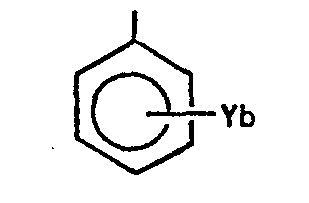
- R 2 is an aralkyl group represented by Formula (2)
- the alkyl group having 1 to 5 carbon atoms represented by Z includes, for example, a methyl group, an ethyl group, an n-propyl group, an isopropyl group, an n-butyl group, a sec-butyl group and a pentyl group
- the alkoxy group having 1 to 5 carbon atoms represented by Z includes, for example, a methoxy group, an ethoxy group, an n-propoxy group, an isopropoxy group, an n-butoxy group, a sec-butoxy group and an n-pentoxy group
- the halogen atom represented by Z includes a fluorine atom, a chlorine atom, a bromine atom and an iodine atom.
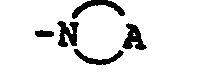
- the cyclic amino group of the formula: -N A which is formed by R 1 and R 2 together with the nitrogen atom to which they are attached, includes, for example, an azilidino group, a pyrrolidino group, a pyperidino group, a hexamethyleneimino group and a morpholino group.
- X, Y and Z each may be mono-substituted, di-substituted or tri-substituted. In cases where X is di-substituted or tri-substituted, the substituents thereof may be the same or different. In cases where Y is di-substituted or tri-substituted, the substituents thereof may be the same or different. In cases where Z is di-substituted or tri-substituted, the substituents thereof may be the same or different.
- pharmaceutically acceptable acid addition salt means an addition salt of an acid which does not increase substantially toxicity of the basic compound.
- These acid addition salts include, for example, a salt with an mineral acid such as hydrochloric acid, sulfuric acid and phosphoric acid, and with an organic acid such as acetic acid, malonic acid, fumaric acid, maleic acid, succinic acid, tartaric acid, methanesulfonic acid, paratoluenesulfonic acid and glucuronic acid.
- a salt with an mineral acid such as hydrochloric acid, sulfuric acid and phosphoric acid
- an organic acid such as acetic acid, malonic acid, fumaric acid, maleic acid, succinic acid, tartaric acid, methanesulfonic acid, paratoluenesulfonic acid and glucuronic acid.
- Such an acid addition salt can be obtained by dissolving the compound of the present invention in a suitable solvent and then adding thereto an acid as such or after dissolved in a suitable solvent.
- the suitable solvent includes, for example, ether and ethanol.
- the compounds of the present invention have a pharmacological activity such as calcium antagonistic activity, vasodilative activity, antihypertensive activity and the like, and are useful as medical preparations for a cardiopathy and a circulatory disease. Moreover, these compounds are also useful as active ingredients for pharmaceutical preparations having activities of dilating blood vessels and enhancing effects of carcinostatics based on the calcium antagonistic activity.
- the compound of the present invention may be administered orally or parenterally to a human being in an ordinary manner.
- Compound (1) of the present invention or a salt thereof is generally administered in a form of a composition containing a carrier, a vehicle and the other additives usualluy employed for medical preparations.
- the medical carrier may be either solid or liquid and the solid carrier includes, for example, lactose, kaoline, starch, crystalline cellulose, corn starch, talc, agar, pectin, acacia, stearic acid, magnesium stearate, lecthin, sodium chloride and the like.
- the liquid carrier includes, for example, syrup, glycerin, peanut oil, polyvinylpyrrolidone, olive oil, ethanol, benzyl alcohol, propylene glycol, water and the like.
- the medical preparations containing the compound of the present invention may take various forms.
- the solid carrier When used, they may take a form of tablets; powders; granules; powders or granules encapsulated in a hard gelatin: suppositories or troches.
- the medical preparations may take a form of syrups; emulsions; soft gelatin capsules; sterilized injections, for example, sealed in an ampul, or aqueous or non-aqueous suspensions.
- the compound of Formula (1) of the present invention may be also used as a cyclodextrin clathrate compound or through procedures of incorporating the compound of the present invention or the salt thereof in a ribosome.
- the compound of Formula (1) of the present invention can be prepared, for example, according to the following Synthesis processes A to E.
- Synthesis process A is a method for preparing the compound of Formula (1) in which an N-(phenylalkylcarbonyl) anthranilic acid or an ester thereof (3) and a diamine (8) are condensed to form a ring therebetween.
- the diamine (8) may be used in an amount of 0.5 to 5 equivalent to the anthranilic acid or the ester thereof (3).
- the reaction solvent although not restricted if it does not participate in the reaction, includes, for example, aromatic hydrocarbons such as benzene, toluene and xylene; ethers such as tetrahydrofuran, dioxane and ethylene glycol diethyl ether; ketones such as acetone and methyl ethyl ketone; ethyl acetate; dimethylformamide; dimethylacetamide; dimethyl sulfoxide and the like.
- the reaction temperature may be in the range of from 0 to 250°C and preferably from 100 to 200° C .
- the reaction time may be in the range of from 30 minutes to 48 hours and preferably 1 to 24 hours. If desired , an acid or a base may be added to the reaction system as a catalyst.
- Synthesis process B is a method for preparing the compound of Formula (1) in which a 2-phenylalkyl-4H-3,1-benzoxazine-4-one (4) and a diamine (8) are condensed to form a ring therebetween.
- the diamine (8) may be used in an amount of 0.5 to 5 equivalent to the 4H-3,1-benzoxazin-4-one (4).
- the reaction solvent although not restricted if it does not participate in the reaction, includes, for example, aromatic hydrocarbons such as benzene, toluene and xylene; ethers such as tetrahydrofuran, dioxane and ethylene glycol diethyl ether; ketones such as acetone and methyl ethyl ketone; ethyl acetate; dimethylformamide; dimethylacetamide; dimethyl sulfoxide and the like.
- the reaction temperature may be in the range of from 0 to 250 °C and preferably from 50 to 150 °C.
- the reaction time may be in the range of from 30 minutes to 48 hours and preferably 1 to 24 hours. If desired, an acid or a base may be added to the reaction system as a catalyst.
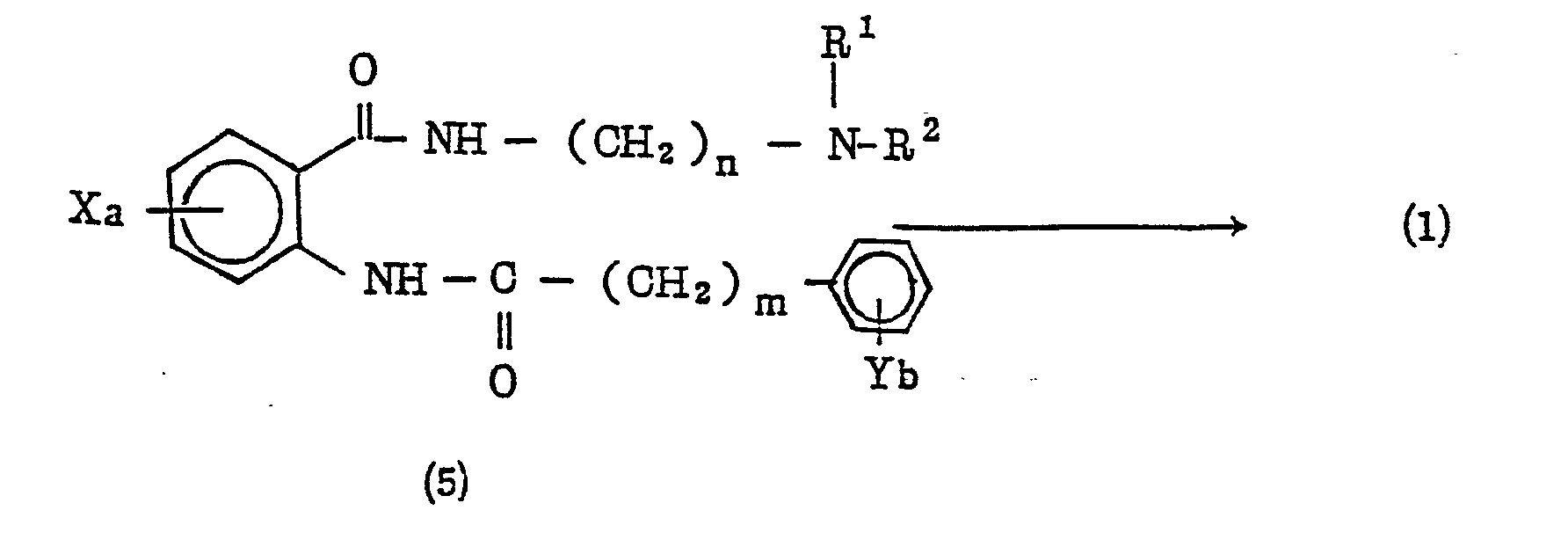
- Synthesis process C is a method for preparing the compound of Formula (1) in which an N-substituted aminoalkyl-2-phenylalkylcarbonylaminobenzoic amide (5) is condensed to form a ring.
- the reaction may be carried out without any solvent or in an solvent which does not participate in the reaction, for example, aromatic hydrocarbons such as benzene, toluene and xylene; ethers such as tetrahydrofuran, dioxane and ethylene glycol diethyl ether; ketones such as acetone and methyl ethyl ketone; ethyl acetate; acetic anhydride; dimethylformamide; dimethylacetamide; dimethyl sulfoxide and the like.
- aromatic hydrocarbons such as benzene, toluene and xylene
- ethers such as tetrahydrofuran, dioxane and ethylene glycol diethyl ether
- the reaction temperature may be in the range of from 0 to 250 °C and preferably from 100 to 150 °C.
- the reaction time may be in the range of from 30 minutes to 48 hours and preferably 1 to 24 hours. If the case demands, an acid may be added to the reaction system as a catalyst.
- Synthesis process D is a method for preparing the compound of Formula (1) in which a 2-phenylalkyl-3-(halogenoalkyl or sulfonyloxyalkyl)-4(3H)-quinazolinone derivative (6) and an amine (9) are subjected to raction with each other.
- the amine (9) may be used in an amount of 0.5 to 5 equivalent to the 4(3H)-quinanzolinone derivative (6).
- the reaction solvent although not restricted if it is inert to the reaction, includes, for example, aromatic hydrocarbons such as benzene, toluene and xylene; alcohols such as methanol, ethanol and isoamyl alcohol; ethers such as tetrahydrofuran, dioxane and ethylene glycol diethyl ether; ketones such as acetone and methyl ethyl ketone; ethyl acetate; dimethylformamide; dimethylacetamide; dimethyl sulfoxide and the like.
- the reaction temperature may be in the range of from 0 to 250 °C and preferably from 50 to 150 °C.
- the reaction time may be in the range of from 30 minutes to 48 hours and preferably 1 to 24 hours.
- an excess of the amine (9) for example, an organic amine such as triethylamine, pyridine, diazacycloundecene (DBU), or an inorganic base such as sodium hydroxide, potassium hydroxide, sodium carbonate, sodium hydrogencarbonate should preferably be present in the reaction system as an acid removing agent, for the smooth progress of the reaction.
- Synthesis process E is a method for preparing the compound of Formula (1) in which a 2-phenylmethyl-4(3H)-quinazolinone (7) and an aminoalkyl halide (or an aminoalkyl sulfonate) (10) are subjected to raction with each other.
- the aminoalkyl halide (or the aminoalkyl sulfonate) (10) may be used in an amount of 0.5 to 5 equivalent to the 4(3H)-quinazolinone (7).
- the reaction solvent although not restricted if it is inert to the reaction, includes, for example, aromatic hydrocarbons such as benzene, toluene and xylene; alcohols such as methanol, ethanol and isoamyl alcohol; ethers such as tetrahydrofuran, dioxane and ethylene glycol diethyl ether; ketones such as acetone and methyl ethyl ketone; ethyl acetate; dimethyl-formamide; dimethylacetamide; dimethyl sulfoxide and the like.
- the reaction temperature may be in the range of from 0 to 250 °C and preferably from 50 to 150 °C.
- the reaction time may be in the range of from 30 minutes to 48 hours and preferably 1 to 24 hours.
- the resulting residue was purified by silica gel column chromatography (eluent: 1 % ethanol-chloroform) to obtain 55 mg (16%) of 2-(2-methoxyphenylmethyl)-3-(2-ethylaminoethyl)-4(3H)-quinazolinone as an oily substance. Subsequently, the thus obtained quinazolinone was dissolved in ether (3 ml) and to the resulting solution was added a 10% HCl/ethanol solution. The precipitated crystals were collected by filtration to obtain the hydrochride of the captioned compound.
- the dichloromethane solution was dried over magnesium sulfate and purified by silica gel column chromatography (eluent; ethanol (0 - 5%)-dichloromethane ⁇ to obtain 16 mg (15%) of 2-(2,5-dimethoxyphenylmethyl)-3- ⁇ 2-(l-pyrrolidino) ethyl ⁇ -6-benzyloxy-4(3H)-quinazolinone.
- Calcium antagonistic activity of the present compound was investigated by observing the effects on the calcium induced contraction of the isolated thoracic aorta in rats.
- a piece of thoracic aorta was isolated from male Wistar strain rats weighing 350 - 450 g in order to prepare a spiral specimen. This specimen was suspended in a Krebs-Henseleit solution free from calcium. The contraction was evoked by an application of CaCl 2 in the presence of 80 mM potassium so as to adjust the solution at a concentration of 10 mM Ca ++. The present compound to be tested was applied to the specimen which had been maximally contracted and was evaluated for its relaxing activity. The results obtained are shown in Table 5.
- the pharmaceutical compound to be tested was dissolved in physiological saline or 50 % ethanol/50 % physiological saline and the thus obtained solution was intravenously administered at a dosage of 1 ml/10 kg through a polyethylene catheter which had been provided within the left femoral vein.
- the increasing activity of the blood flow of the circumflex branch of left coronary artery was evaluated and expressed in terms of increase rate of the blood flow after the administration of the compound to that of before the administration of the compound. The results obtained are shown in Table 6.
- the compounds to be tested were administered orally to evaluate antihypertensive activity in spontaneously hypertensive rats (hereinafter SHR).
- the compound to be tested was suspended in a 1 % tragacanth solution. After the concentration of the suspensions was adjusted in a volume of 5 ml/kg, the compound was administered orally to the SHR.
- Tests were made using groups each comprising five male ICR strain mice weighing 30 to 35 g and being kept under a fast for 18 hours.
- the compound to be tested was suspended in a 1 % tragacanth solution. After the concentration of the suspensions was adjusted in a volume of 40 ml/kg, the compound was administered orally to the mouse. The results are shown in Table 8.
Landscapes
- Health & Medical Sciences (AREA)
- Chemical & Material Sciences (AREA)
- Organic Chemistry (AREA)
- Life Sciences & Earth Sciences (AREA)
- General Health & Medical Sciences (AREA)
- Veterinary Medicine (AREA)
- Chemical Kinetics & Catalysis (AREA)
- General Chemical & Material Sciences (AREA)
- Medicinal Chemistry (AREA)
- Nuclear Medicine, Radiotherapy & Molecular Imaging (AREA)
- Bioinformatics & Cheminformatics (AREA)
- Pharmacology & Pharmacy (AREA)
- Engineering & Computer Science (AREA)
- Animal Behavior & Ethology (AREA)
- Public Health (AREA)
- Heart & Thoracic Surgery (AREA)
- Cardiology (AREA)
- Diabetes (AREA)
- Hematology (AREA)
- Obesity (AREA)
- Endocrinology (AREA)
- Rheumatology (AREA)
- Pulmonology (AREA)
- Pharmaceuticals Containing Other Organic And Inorganic Compounds (AREA)
- Plural Heterocyclic Compounds (AREA)
- Medicines That Contain Protein Lipid Enzymes And Other Medicines (AREA)
Abstract
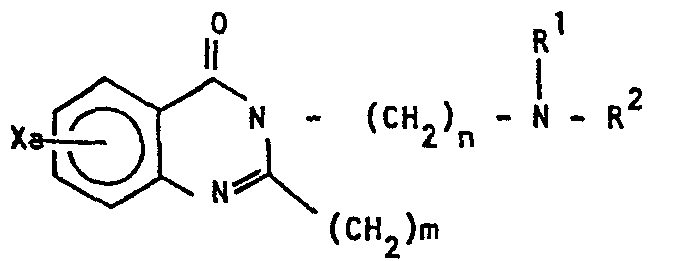
werein, X represents a hydrogen atom, an alkyl group having 1 to 5 carbon atoms, an alkoxy group having 1 to 5 carbon atoms, a phenoxy group, a benzyloxy group, a halogen atom or a hydroxy group; Y represents an alkyl group having 1 to 5
carbon atoms, an alkoxy group having 1 to 5 carbon atoms, a benzyloxy group, a halogen atom or a nitro group: R' represents a hydrogen atom or an alkyl group having 1 to 5 carbon atoms; R2 represents an alkyl group having 1 to 5 carbon atoms or a group of Formula (2)

[wherein, Z represents a hydrogen atom, an alkyl group having 1 to 5 carbon atoms, an alkoxy group having 1 to 5 carbon atoms, or a halogen atom; is an integer of 1 to 3; and l is an integer of 1 to 5]; or R1 and R2 represent together with the nitrogen atom to which they are attached, a cyclic amino group of the formula:
Description
- This invention ralates to a novel 4(3H)-quinazolinone compound, and more particularly, a 2-phenylalkyl-3-aminoalkyl-4(3H)-quinazolinone compound having calcium antagonistic, vasodilative, and antihypertensive activities, or a parmaceutically acceptable acid addition salt thereof, to a process for preparing said compound, to a composition having calcium antagonistic activity and comprising said compound as an active ingredient, and to the use for preparing a composition for the dilating of blood vessels or reducing the level of blood pressure based on calcium antagonistic activity.
- With respect to a 2-phenylalkyl-3-aminoalkyl-4(3H)-quinazolinone derivative, there has been reported that 2-phenylmethyl-3-(2-diethylaminoethyl)-4(3H)-quinazolinone of the formula:

- Moreover, although there has been known 2-phenylmethyl-3-(2-aminoethyl)-4(3H)-quinazolinone of the formula:

any pharmacological activity thereof has not been reported [J. Indian Chem. Soc.,57, 835 (1980)]. - Further, in U. S. Patent No.3,558,610, there has been described that a 4(3H)-quinazolinone derivative of the general formula:

wherein, R3 represents a phenyl alkyl group, etc.; - R 4 represents a di-lower alkylamino group, etc.;
- R5 represents an amino group, an alkanoylamino group, a benzylideneamino group or a nitrofurylideneamino group,
is useful as an anti-inflammatory or antimicrobial agent. However, of the compounds described in the Examples of the above Patent, compounds in which R3 is a phenylalkyl group, or R4 is a di-lower alkylamino group are only two compounds of the following formulas:

and there have been described no compounds in which R3 is a phenylalkyl group and simultaneously R4 is a di-lower alkylamino group. The compounds disclosed therein are ones in which R5 is always an amino group or a substituted amino group and are different from the compounds of the present invention. - Still further, there has been reported that 2-methyl-3-(3-dibutylaminopropyl)-6-chloro-4(3H)-quinazolinone of the following formula:

has the inhibitive activity of acetylcolinesterase, although it is not a 2-phenylalkyl-3-aminoalkyl- 4(3H)-quinazolinone derivative [Indian J. Pharm., 33, 80 (1971)]. - An object of the present invention is to provide a novel and useful 2-phenylalkyl-3-aminoalkyl-4(3H)-quinazolinone derivative.
- Based on the knowledge described above, the present inventors have made intensive studies, and as a result, have accomplished the present invention. Namely, the novel and useful 2-phenylalkyl-3-aminoalkyl-4(3H)-quinazolinone derivative of the present invention is a compound of Formula (1):

-

- -N A [wherein, A represents an alkylene group having 2 to 6 carbon atoms or a group of the formula -(CH2)2 -O- (CH2)-]; a and b are independently an integer of 1 to 3; and n and m are independently an integer of 1 to 5,
- In above Formula (1), the alkyl group having 1 to 5 carbon atoms represented by X or Y includes, for example, a methyl group, an ethyl group, an n-propyl group, an isopropyl group, an n-butyl group, a sec-butyl group, and a pentyl group; the alkoxy group having 1 to 5 carbon atoms represented by X or Y includes, for example, a methoxy group, an ethoxy group, an n-propoxy group, an isopropoxy group, an n-butoxy group, a sec-butoxy group, an n-pentoxy group and an isopentoxy group; and the halogen atom represented by X or Y includes a fluorine atom, a chlorine atom, a bromine atom and an iodine atom.
- The alkyl group having 1 to 5 carbon atoms of R 1 or R2 includes, for example, a methyl group, an ethyl group, an n-propyl group, an isopropyl group, an n-butyl group, a sec-butyl group and a pentyl group. In cases where R2 is an aralkyl group represented by Formula (2), the alkyl group having 1 to 5 carbon atoms represented by Z includes, for example, a methyl group, an ethyl group, an n-propyl group, an isopropyl group, an n-butyl group, a sec-butyl group and a pentyl group; the alkoxy group having 1 to 5 carbon atoms represented by Z includes, for example, a methoxy group, an ethoxy group, an n-propoxy group, an isopropoxy group, an n-butoxy group, a sec-butoxy group and an n-pentoxy group; and the halogen atom represented by Z includes a fluorine atom, a chlorine atom, a bromine atom and an iodine atom. The cyclic amino group of the formula: -N A, which is formed by R1 and R2 together with the nitrogen atom to which they are attached, includes, for example, an azilidino group, a pyrrolidino group, a pyperidino group, a hexamethyleneimino group and a morpholino group. X, Y and Z each may be mono-substituted, di-substituted or tri-substituted. In cases where X is di-substituted or tri-substituted, the substituents thereof may be the same or different. In cases where Y is di-substituted or tri-substituted, the substituents thereof may be the same or different. In cases where Z is di-substituted or tri-substituted, the substituents thereof may be the same or different.
- The term "pharmaceutically acceptable acid addition salt" used herein means an addition salt of an acid which does not increase substantially toxicity of the basic compound.
- These acid addition salts include, for example, a salt with an mineral acid such as hydrochloric acid, sulfuric acid and phosphoric acid, and with an organic acid such as acetic acid, malonic acid, fumaric acid, maleic acid, succinic acid, tartaric acid, methanesulfonic acid, paratoluenesulfonic acid and glucuronic acid. Such an acid addition salt can be obtained by dissolving the compound of the present invention in a suitable solvent and then adding thereto an acid as such or after dissolved in a suitable solvent. The suitable solvent includes, for example, ether and ethanol.
- The compounds of the present invention have a pharmacological activity such as calcium antagonistic activity, vasodilative activity, antihypertensive activity and the like, and are useful as medical preparations for a cardiopathy and a circulatory disease. Moreover, these compounds are also useful as active ingredients for pharmaceutical preparations having activities of dilating blood vessels and enhancing effects of carcinostatics based on the calcium antagonistic activity.
- The compound of the present invention may be administered orally or parenterally to a human being in an ordinary manner. When orally administered, it is preferable to administer the compound in an amount of 1 to 100 mg per one dosage, 1 to 3 times a day; when administered by intravenous injection, it is preferable to administer the compound in an amount of 0.01 to 10 mg 1 per one dosage, 1 to 5 times a day; and when administered through -intestinum rectum, it is preferable to administer the compound in an amount of 1 to 100 mg per one dosage, 1 to 3 times a day. Compound (1) of the present invention or a salt thereof is generally administered in a form of a composition containing a carrier, a vehicle and the other additives usualluy employed for medical preparations. The medical carrier may be either solid or liquid and the solid carrier includes, for example, lactose, kaoline, starch, crystalline cellulose, corn starch, talc, agar, pectin, acacia, stearic acid, magnesium stearate, lecthin, sodium chloride and the like. The liquid carrier includes, for example, syrup, glycerin, peanut oil, polyvinylpyrrolidone, olive oil, ethanol, benzyl alcohol, propylene glycol, water and the like.
- The medical preparations containing the compound of the present invention may take various forms. When the solid carrier is used, they may take a form of tablets; powders; granules; powders or granules encapsulated in a hard gelatin: suppositories or troches.
- When the liquid carrier is used, the medical preparations may take a form of syrups; emulsions; soft gelatin capsules; sterilized injections, for example, sealed in an ampul, or aqueous or non-aqueous suspensions.
- The compound of Formula (1) of the present invention may be also used as a cyclodextrin clathrate compound or through procedures of incorporating the compound of the present invention or the salt thereof in a ribosome.
- Methods for preparing the compound of the present invention will be described below.
- The compound of Formula (1) of the present invention can be prepared, for example, according to the following Synthesis processes A to E.
- Synthesis process A
-


- Synthesis process C
- Synthesis process D

- Synthesis process E

wherein, X, Y, Rl, R 2, a, b, m and n have the same meanings as defined above; R 6 represents a hydrogen atom and an alkyl group having 1 to 5 carbon atoms; and R7 represents a halogen atom or a mesyloxy or tosyloxy group. - Synthesis process A is a method for preparing the compound of Formula (1) in which an N-(phenylalkylcarbonyl) anthranilic acid or an ester thereof (3) and a diamine (8) are condensed to form a ring therebetween. The diamine (8) may be used in an amount of 0.5 to 5 equivalent to the anthranilic acid or the ester thereof (3). The reaction solvent, although not restricted if it does not participate in the reaction, includes, for example, aromatic hydrocarbons such as benzene, toluene and xylene; ethers such as tetrahydrofuran, dioxane and ethylene glycol diethyl ether; ketones such as acetone and methyl ethyl ketone; ethyl acetate; dimethylformamide; dimethylacetamide; dimethyl sulfoxide and the like. The reaction temperature may be in the range of from 0 to 250°C and preferably from 100 to 200°C. The reaction time may be in the range of from 30 minutes to 48 hours and preferably 1 to 24 hours. If desired , an acid or a base may be added to the reaction system as a catalyst.
- Synthesis process B is a method for preparing the compound of Formula (1) in which a 2-phenylalkyl-4H-3,1-benzoxazine-4-one (4) and a diamine (8) are condensed to form a ring therebetween. The diamine (8) may be used in an amount of 0.5 to 5 equivalent to the 4H-3,1-benzoxazin-4-one (4). The reaction solvent, although not restricted if it does not participate in the reaction, includes, for example, aromatic hydrocarbons such as benzene, toluene and xylene; ethers such as tetrahydrofuran, dioxane and ethylene glycol diethyl ether; ketones such as acetone and methyl ethyl ketone; ethyl acetate; dimethylformamide; dimethylacetamide; dimethyl sulfoxide and the like. The reaction temperature may be in the range of from 0 to 250 °C and preferably from 50 to 150 °C. The reaction time may be in the range of from 30 minutes to 48 hours and preferably 1 to 24 hours. If desired, an acid or a base may be added to the reaction system as a catalyst.
- Synthesis process C is a method for preparing the compound of Formula (1) in which an N-substituted aminoalkyl-2-phenylalkylcarbonylaminobenzoic amide (5) is condensed to form a ring. The reaction may be carried out without any solvent or in an solvent which does not participate in the reaction, for example, aromatic hydrocarbons such as benzene, toluene and xylene; ethers such as tetrahydrofuran, dioxane and ethylene glycol diethyl ether; ketones such as acetone and methyl ethyl ketone; ethyl acetate; acetic anhydride; dimethylformamide; dimethylacetamide; dimethyl sulfoxide and the like. The reaction temperature may be in the range of from 0 to 250 °C and preferably from 100 to 150 °C. The reaction time may be in the range of from 30 minutes to 48 hours and preferably 1 to 24 hours. If the case demands, an acid may be added to the reaction system as a catalyst.
- Synthesis process D is a method for preparing the compound of Formula (1) in which a 2-phenylalkyl-3-(halogenoalkyl or sulfonyloxyalkyl)-4(3H)-quinazolinone derivative (6) and an amine (9) are subjected to raction with each other. The amine (9) may be used in an amount of 0.5 to 5 equivalent to the 4(3H)-quinanzolinone derivative (6). The reaction solvent, although not restricted if it is inert to the reaction, includes, for example, aromatic hydrocarbons such as benzene, toluene and xylene; alcohols such as methanol, ethanol and isoamyl alcohol; ethers such as tetrahydrofuran, dioxane and ethylene glycol diethyl ether; ketones such as acetone and methyl ethyl ketone; ethyl acetate; dimethylformamide; dimethylacetamide; dimethyl sulfoxide and the like. The reaction temperature may be in the range of from 0 to 250 °C and preferably from 50 to 150 °C. The reaction time may be in the range of from 30 minutes to 48 hours and preferably 1 to 24 hours. When the reaction is carried out, an excess of the amine (9), for example, an organic amine such as triethylamine, pyridine, diazacycloundecene (DBU), or an inorganic base such as sodium hydroxide, potassium hydroxide, sodium carbonate, sodium hydrogencarbonate should preferably be present in the reaction system as an acid removing agent, for the smooth progress of the reaction.
- Synthesis process E is a method for preparing the compound of Formula (1) in which a 2-phenylmethyl-4(3H)-quinazolinone (7) and an aminoalkyl halide (or an aminoalkyl sulfonate) (10) are subjected to raction with each other. The aminoalkyl halide (or the aminoalkyl sulfonate) (10) may be used in an amount of 0.5 to 5 equivalent to the 4(3H)-quinazolinone (7). The reaction solvent, although not restricted if it is inert to the reaction, includes, for example, aromatic hydrocarbons such as benzene, toluene and xylene; alcohols such as methanol, ethanol and isoamyl alcohol; ethers such as tetrahydrofuran, dioxane and ethylene glycol diethyl ether; ketones such as acetone and methyl ethyl ketone; ethyl acetate; dimethyl-formamide; dimethylacetamide; dimethyl sulfoxide and the like. The reaction temperature may be in the range of from 0 to 250 °C and preferably from 50 to 150 °C. The reaction time may be in the range of from 30 minutes to 48 hours and preferably 1 to 24 hours. When the reaction is carried out in the presence of a base such as sodium metal, sodium hydride, potassium t-butoxide, the reaction proceeds smoothly.
- Next, the present invention will be explained more specifically by the following Examples, by which however the present invention should not be limited.
- To a mixed solution of acetone (300 ml) and a 6 % aqueous potassium carbonate solution (200 ml) there were added 10.2 g (67 mmol) of methyl ester of anthranilic acid. 12.5 g (67 mmol) of 2-Methoxyphenylacetic acid chloride were added dropwise under cooling thereto and the resulting reaction mixture was stirred at room temperature for 4 hours. The resulting precipitates were collected by filtration to obtain 15.7 g (yield 78 %) of N-(2-methoxyphenylacetyl)-anthranilic acid methyl ester.

- A solution of 3.0 g (10 mmol) of methyl ester of N-(2-methoxyphenyl-acetyl)-anthranilic acid and 5.1 g (50 mmol) of 2-diethylaminoethylamine in ethanol (20 ml) was heated at 180°C for 7 hours in a seald tube. After cooling, the thus obtained reaction mixture was purified by silica gel column chromatography (eluent; chloroform : ethanol = 98 : 2) to obtain 1.24 g (yield 34 %) of 2-(2-methoxyphenylmethyl)-3-(2-diethylaminoethyl)-4(3H)-quinazolinone as an oily substance. 1.2 g of the oily substance were dissolved in ethanol (5 ml) and a 7 % HCl-ethanol solution (1.5 ml) were added thereto. The resulting solution was allowed to cool overnight. The resulting colorless precipitates were collected by filtration to obtain 1.0 g of the captioned hydrochloride which is the desired compound.
- m.p.: 196 - 209 °C (decomposition)
- Infrared absorption spectrum (IR) (cm-1) :
- 1670 (C=0),
- 1590 (phenyl group)
- Analysis Calculated for C22H27N3O2 HCl:
- C, 65.74; H, 6.77; N, 10.46 %
- Found: C, 65.57; H, 7.01; N, 10.44 %
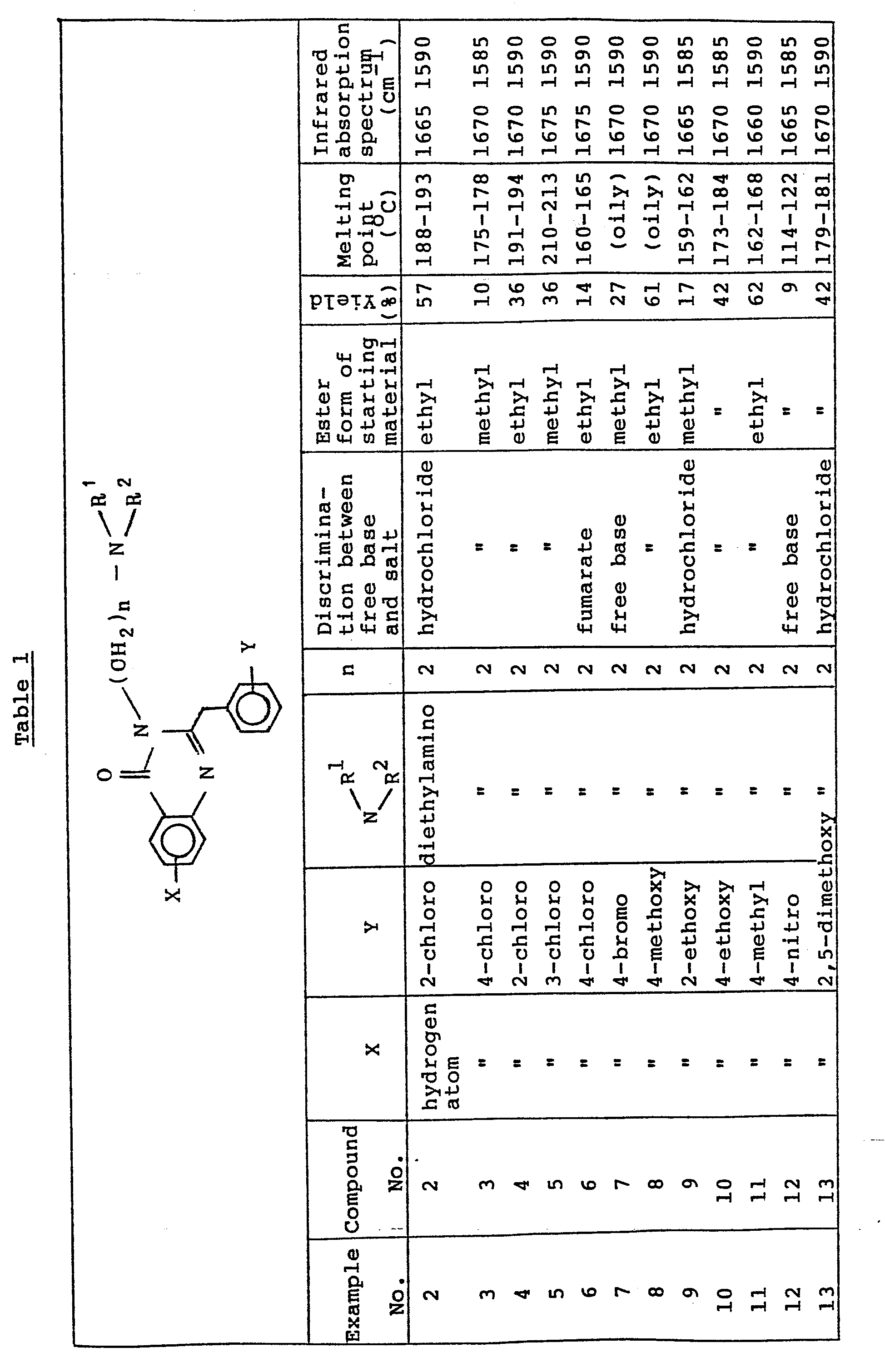
- The captioned compounds were synthsized in the same manner as in Example 1 except that the methyl ester of N-(2-methoxyphenylacetyl)anthranilic acid was replaced by corresponding esters of anthranilic acid, and the 2-diethylaminoethylamine was replaced by the corresponding diamines. The results obtained are shown in Table 1.

- To a suspension of 9.8 g (50 mmol) of 5-isopropoxy-2-aminobenzoic acid and 11.0 g (80 mmol) of potassium carbonate in a mixed solvent of acetone (40 ml) and water (40 ml), 10.5 g (50 mmol) of 2,5-dimethoxyphenylacetic acid chloride were added.dropwise at 10 °C. After the resulting reaction mixture was stirred under ice cooling for 1 hour, stirring was continued for further 2 hours at room temperature. The thus obtained solution was made acidic with conc. hydrochloric acid and extracted with dichloromethane. After the extract was dried over magnesium sulfate, the solvent was distilled off to obtain 14.0 g (75%) of 2-(2,5-dimethoxyphenyl- acetylamino)-5-isopropoxybenzoic acid (m.p. 132 - 135 PC). Then the thus obtained acid was heated under reflux for 2 hours in acetic anhydride (100 ml), followed by concentration under reduced pressure. The resulting residue was purified by silica gel column chromatography (eluent: dichloromethane) to obtain 6.8 g of 2-(2,5-dimethoxyphenylmethyl)-6-isopropoxy-4H-3,1-benzoxazine-4- one (yield from 5-isopropoxy-2-aminobenzoic acid: 36 %)

- Infrared absorption spectrum (cm-1): 1745, 1630
- 2.84 g (8 mmol) of 2-(2,5-dimethoxyphenylmethyl)-6-isopropoxy-4H-3,1-benzoxazin-4-one and 0.82 g (8 mmol) of 3-dimethylaminopropylamine were heated under reflux for 15 hours in xylene (20 ml). After the xylene was distilled off, the residue obtained was purified by silica gel column chromatography (eluent; 2 % ethanol/ chloroform) to obtain 1.46 g (42 %) of 2-(2,5-dimethoxy- phenylmethyl)-3-(3-dimethylaminopropyl)-6-isopropoxy-4(3H) -quinazolinone as an oily substance. Subsequently, 0.22 g of the 2-(2,5-dimethoxyphenylmethyl)-3-(3-dimethylamino -propyl)-6-isopropoxy-4(3H)-quinazolinone was dissolved in ether (15 ml) and to the resulting soluion, there was added an ethanolic solution containing 0.07 g (0.6 mmol) of maleic acid. The thus obtained solution was allowed to stand for one day. The precipitated colorless crystals were collected by filtration to obtain 0.25 g of the maleate which is the desired compound.

- Mass spectrum (m/e): 439 (M+), 58 (Base peak ion)
- Analysis Calculated for C25H33N3O4·C4H4O4:
- C, 62.68; H, 6.71; N, 7.56 %
- Found: C, 62.48; H, 6.71; N, 7.57 %
- The captioned compounds were synthsized in the same manner as in Example 30 except that the 2-(2,5-dimethoxy- phenylmethyl)-6-isopropoxy-4H-3,1-benzoxazin-4-one was replaced by the corresponding 4H-3,1-benzoxazin-4-one, and the 3-dimethylaminopropylamine was replaced by the corresponding diamines. The results obtained are shown in Table 2.


- Following the same procedure as in Synthesis example 2, 2-(2-methoxyphenylmethyl)-4H-3,1-benzoxazin-4-one was obtained from anthranilic acid and 2-(methoxyphenylacetic acid chloride as starting materials via 2-(2-methoxyphenylmethylcarbonyl amino)benzoic acid as an intermediate (yield: 60 %).
- m.p. 102 - 104 °C
- Mass spectrum (m/e): 267 (M+),
- 146 (Base peak ion) Infrared absorption spectrum (cm -1): 1740, 1635, 1595
- 268 mg (1 mmol) of 2-(2-methoxyphenylmethyl)-4H-3,1-benzoxazine-4-one and 238 mg (1 mmol) of 2-[[N-[2-(3,4-dimethoxyphenyl)ethyl]-N-methylamino]]ethyl-amine were heated in xylene (10 ml) under reflux for 10 hours . After the xylene was distilled off, the residue obtained was purified by silica gel column chromatography (eluent; 2 % ethanol/chloroform) to obtain 107 mg (52 %) of 2-(2-methoxyphenylmethyl)-3-[2-{N-(3,4-dimethoxyphenyl- ethyl)-N-methylamino}ethyl]-4(3H)-quinazolinone as an oily substance. Subsequently, the thus obtained quinazolinone was dissolved in ethanol (2 ml) and to the resulting soluion there was added a 7 % hydrogen chloride-ethanol solution (1 ml). Further, ether was added to the reaction mixture thus obtained, and the precipitated colorless crystals were collected by filtration to obtain 99 mg of the hydrochloride which is the desired compound.
- m.p.: 171 - 175 °c (decomposition)
- Mass spectrum (m/e): 487 (M+), 293 (Base peak ion)
- Analysis Calculated for C29E33N3O4 ·HCl:
- C, 66.46; H, 6.54; N, 8.02 %
- Found: C, 66.23; H, 6.75; N, 7.89 %
- The captioned compounds were synthsized in the same manner as in Example 89 except that the 2-(2-methoxyphenylmethyl)-4H-3,l-benzoxazin-4-one was replaced by the corresponding 4H-3,1-benzoxazin-4-one derivatives, and the 2-[N-{2-(3,4-dimethoxyphenyl)ethyl)-N-methylamino]ethylamine was replaced by the corresponding N-alkyl-N-(substituted phenylalkyl)amino- alkylamines. The results obtained are shown in Table 3.


- 0.50 g (1.5 mmol) of 2-(2,5-dimethoxyphenylacetylamino)-5-methylbenzoic acid (m.p. 163 to 164.5 °C) synthesized in the same manner as in Synthesis example 1 for 2-(2,5-dimethoxyphenylacethylamino)-5-isopropoxy- benzoic acid was suspended in dichloromethane (10 ml), and then to the resulting mixture was added dropwise a dichloromethane solution containing 0.33 (1.6 mmol) of dicyclohexylcarbodiimide (DCC) under ice cooling. Subsequently, 0.14 g (16 mmol) of 2-dimethylaminoethylamine was added dropwise thereto and the mixture thus obtained was stirred for 2 hours at room temperature. The precipitates were filtered off and the mother liquid was concentrated by distillation. The thus obtained residue was purified by silica gel column chromatography (eluent; dichloromethane : ethanol=97: 3) to obtain 0.41 g (yield 68 %) of 2-(2,5-dimethoxyphenyl- acetyamino)-5-methyl-N-(2-dimethylaminoethyl)benzamide.

- 0.37 g (1 mmol) of 2-(2,5-dimethoxyphenylacetylamino)-N-(2-dimethylaminoethyl)benzamide and 200 mg of para-toluenesulfonic acid were heated in xylene (20 ml) under reflux for 3 hours . The reation mixture thus obtained was purified by silica gel column chromatography (eluent; 2 % ethanol/chloroform) to obtain 70 mg (20 %) of 2-(2,5-dimethoxyphenylmethyl)-3-(2-dimethylaminoethyl) -6-methyl-4(3H)-quinazolinone as an oily substance. Subsequently, the thus obtained oily substance was dissolved in 1 ml of ethanol, and to the resulting soluion was added a 7 % hydrogen chloride-ethanol solution (2 ml). Further, ether was added to the reaction mixture thus obtained and the precipitated colorless crystals were collected by filtration to obtain 70 mg of the hydrochloride which is the desired compound. The melting point and infrared absorption spectrum of the above hydrochloride was identical with those of Compound 24 synthesized in Example 24, respectively.
- A suspension of 3.0 g (10 mmol) of methyl ester of N-(2-methoxyphenylacetyl)anthranilic acid and 1.2g (20 mmol) of monoethanolamine in xylene was heated at 180,°C for 16 hours in a sealed tube. After cooling, the precipitated crystals were collected by filtration to obtain 0.7g (22 %) of 2-(2-methoxyphenylmethyl)-3-(2-hydroxyethyl)- 4(3H)-quinazolinone (m.p.: 154 - 155 °C). Subsequently, to 0.7 g (2.2 mmol) of this 3-(2-hydroxyethyl) derivative was added thionyl chloride (5ml) and the resulting reaction mixture was stirred at room temperature for 1 hour. An excess of the thionyl chloride was distilled off under reduced pressure and the resulting residue was purified by silica gel column chromatography (eluent: dichloromethane) to obtain 0.14 g (20%) of 2-(2-methoxyphenylmethyl)-3-(2-chloroethyl)-4(3H)-quinazolinone. (m.p.: 109 - 111 °C).
- A mixture of 328 mg (1 mmol) of 2-(2-methoxyphenylmethyl) -3-(2-chloroethyl)-4(3H)-quinazolinone and a 70 % aqueous ethylamine solution (0.6 ml) in ethanol (10 ml) was heated at 80 °C for 8 hours in a sealed tube. The solvent was distilled off under reduced pressure and to the residue thus obtained there was added a 10 % aqueous potassium carbonate solution, followed by extraction with dichloromethane. The thus obtained dichloromethane solution was dried over magnesium sulfate and then concentrated. The resulting residue was purified by silica gel column chromatography (eluent: 1 % ethanol-chloroform) to obtain 55 mg (16%) of 2-(2-methoxyphenylmethyl)-3-(2-ethylaminoethyl)-4(3H)-quinazolinone as an oily substance. Subsequently, the thus obtained quinazolinone was dissolved in ether (3 ml) and to the resulting solution was added a 10% HCl/ethanol solution. The precipitated crystals were collected by filtration to obtain the hydrochride of the captioned compound.

- Mass spectrum (m/e): 337 (M+), 267 (Base peak ion)
- The captioned compounds were synthesized in the same manner as in Example 134 except that the 70 % aqueous ethylamine solution was replaced by the corresponsing amines, respectively. The results obtained are shown in Table 4.
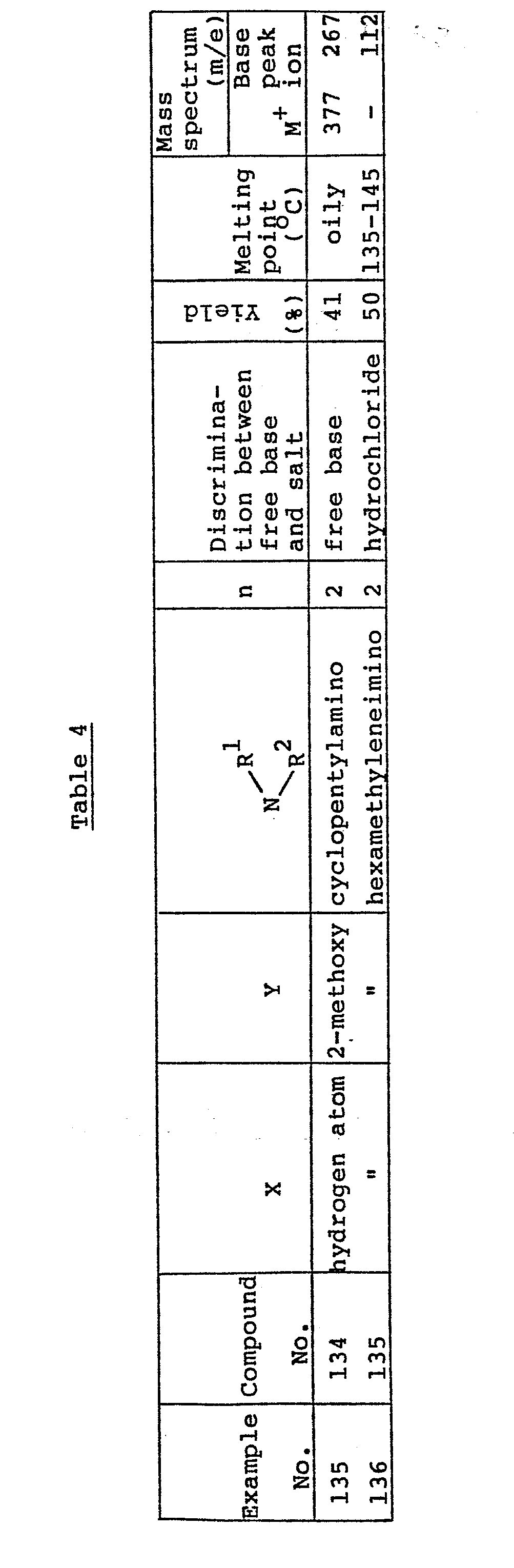
- A mixture of 3.15 g (9.6 mmol) of 2-(2,5-dimethoxy- phenylacetylamino)- 5-methylbenzoic acid (m.p. 163 to 164.5 °C) obtainble by the same method as in Synthesis example 2 and 0.90 g (20ml) of formamide were heated at 160 °c for 3 hours. After cooling, the solidified residue was added to a mixed solution of ethanol (100 ml) and acetone (100 ml) and dissolved therein by heating. After cooling, the precipitated crystals were collected by filtration to obtain 1.45 g (yield 49 %) of 2-(2,5-dimethoxyphenylmethyl)-6-methyl-4(3H)-quinazolinone.

- Mass spectrum (m/e): 310 (M+), 279 (Base peak ion)
- A suspension of 0.62 g (2 mmol) of 2-(2,5-dimethoxy- phenylmethyl)-6-methyl-4(3H)-quinazolinone and 0.19 g (2 mmol ) of 50 % sodium hydride in dioxane (10 ml) were stirred at room temperature for 1 hour. Then, to the resulting reaction mixture was added 0.22 g (2 mmol) of dimethylaminoethyl chloride dissolved in dioxane (10 ml), followed by heating at 60 °C for 5 hours. After cooling, to the mixture obtained were added 30 ml of water. The resulting mixture was extracted with dichloromethane and the dichloromethane layer was concentrated under reduced pressure. The thus obtained residue was purified by silica gel column chromatography (eluent; dichloromethane: ethanol = 97 : 3) to obtain 0.10 g (yield 13 %) of 2-(2,5-dimethoxyphenylmethyl)-3-(2-dimethylaminoethyl)-6-methyl-4(3H)-quinazolinone as an oily substance. The thus obtained quinazolinone was dissolved in ether and to the resulting solution was added a 5 % hydrogen chloride-ethanol solution and the precipitated crystals were collected by filtration to obtain 2-(2,5-dimethoxyphenylmethyl)-3-(2-dimethylaminoethyl)-6-methyl-4(3H)-quinazolinone hydrochloride. The melting point and infrared absorption spectrum of this hydrochloride were identical with those of Compound 24 obtained in Example 24, respectively.
- 2-(2,5-dimethoxyphenylmethyl)-3-{2-(l-pyrrolidino)ethyl}-6 -hydroxy-4(3H)-quinazolinone (Compound No. 38) (90 mg, 0.2 mmol) and sodium hydroxide (16 mg, 0.4 mmol) were added to a mixed solvent of ethanol (10 ml) and water (5 ml). To the resulting reaction mixture were added benzyl chloride (40 mg, 0.3 mmol), followed by reflux for 1 hour, and then, to the mixture thus obtained further were added benzyl chloride (27 mg, 0.2 mmol), followed by reflux for further 1.5 hours. After concentration under reduced pressure, water was added thereto and the mixture obtained was extracted with dichloromethane. The dichloromethane solution was dried over magnesium sulfate and purified by silica gel column chromatography (eluent; ethanol (0 - 5%)-dichloromethane} to obtain 16 mg (15%) of 2-(2,5-dimethoxyphenylmethyl)-3-{2-(l-pyrrolidino) ethyl}-6-benzyloxy-4(3H)-quinazolinone.
- Mass spectrum (m/e): 499 (M+), 84 (Base peak ion)
- Infrared absorption spectrum (IR) (cm-1):
- 1655, 1585
- A mixture of 295 mg (1 mmol) of 2-{2-(4-methoxyphenyl) ethyl}-4H-3,1-benzoxazin-4-one synthesized in the same manner as in Synthesis example 2 and 88 mg (1 mmol) of 2-dimethylaminoethylamine in xylene (5 ml) was heated under reflux for 2 hours. After the xylene was distilled off under reduced pressure, the crude crystals obtained were purified by silica gel column chromatography (eluent; 3 % methanol/methylene chloride) to obtain 260 mg (76 %) of 3-(2-dimethylaminoethyl)-2-{2-(4-methoxyphenyl)ethyl}- 4(3H)-quinazolinone.

- Mass spectrum (m/e): 351 (M+), 58 (Base peak ion)
- Infrared absorption spectrum (IR) (cm-1) :
- 1665 (C=O), 1600 (phenyl group)
- A mixture of 384 mg (1 mmol) of 6-isopropoxy-7-methoxy-2- {3-(4-methoxyphenyl)propyl}4H-3,1-benzoxazin-4-one synthesized in the same manner as in Synthesis example 2 and 88 mg (1 mmol) of 2-dimethylaminoethylamine in xylene (5 ml) was heated under reflux for 2 hours. After the xylene was distilled off, the crude crystals obtained were purified by silica gel column chromatographty (eluent; 3 % methanol/methylene chloride ) to obtain 362 mg (80 %) of 3-(2-dimethylaminoethyl)-6-isopropoxy-7-methoxy-2-{3-(4-methoxyphenyl)propyl}-4(3H)-quinazolinone.

- Mass spectrum (m/e): 453 (M+),
58 (Base peak ion)
- Mass spectrum (m/e): 453 (M+),
58 (Base peak ion) - Infrared absorption spectrum (IR) (cm-1):
- 1660 (C=O), 1605 (phenyl group)
- A mixture of 0.62 g (2 mmol) of N-(2,5-dimethoxyphenyl- acetyl) anthranilic acid and 0.36 g (3 mmol) of 2-dimethylaminoethylamine in xylene (5 ml) were heated under reflux for 24 hours. After cooling, the resulting reaction mixture was purified by silica gel column chromatography (eluent; chloroform: ethanol = 98 : 2) to obtain 0.10 g (yield 14 %) of 2-(2,5-dimethoxy- phenylmethyl)-3-(2-dimethylaminoethyl)-4(3H) quinazolinone as an oily substance. 0.10 g of the oily substance thus obtained was dissolved in ethanol (1 ml) and then a 7 % HCl-ethanol solution (0.2 mol) was added thereto and the resulting reaction mixture was cooled overnight. The resulting colorless precipitates were collected by filtration to obtain 0.1 g of the hydrochloride which is the desired compound. This hydrochloride coincides with the compound obtained in Example 16 in melting point and infrared absorption spectrum.
- Calcium antagonistic activity of the present compound was investigated by observing the effects on the calcium induced contraction of the isolated thoracic aorta in rats.
- A piece of thoracic aorta was isolated from male Wistar strain rats weighing 350 - 450 g in order to prepare a spiral specimen. This specimen was suspended in a Krebs-Henseleit solution free from calcium. The contraction was evoked by an application of CaCl2 in the presence of 80 mM potassium so as to adjust the solution at a concentration of 10 mM Ca++. The present compound to be tested was applied to the specimen which had been maximally contracted and was evaluated for its relaxing activity. The results obtained are shown in Table 5.
-

- Male and female mongrel dogs weighing 8 to 17.5 kg were anesthetized with intravenous administration of sodium pentobarbital at a dosage of 30 mg/kg. Under artificial respiration the chest was opened on the left side at the level of the fourth intercostal space and the heart was exposed. The circumflex branch of left coronary artery just below the junction of the anterior descending branch of left coronary artery was isolated in a width of approximately 1 cm, and a flow probe was placed around this artery in order to measure the blood flow of the circumflex branch of left coronary artery by means of an electromagnetic flow meter. During the tests, systemic blood pressure was monitored, and data obtained from tests where the mean blood presure was less than 65 mmHg were excluded from the final data. The pharmaceutical compound to be tested was dissolved in physiological saline or 50 % ethanol/50 % physiological saline and the thus obtained solution was intravenously administered at a dosage of 1 ml/10 kg through a polyethylene catheter which had been provided within the left femoral vein. The increasing activity of the blood flow of the circumflex branch of left coronary artery was evaluated and expressed in terms of increase rate of the blood flow after the administration of the compound to that of before the administration of the compound. The results obtained are shown in Table 6.

- The compounds to be tested were administered orally to evaluate antihypertensive activity in spontaneously hypertensive rats (hereinafter SHR).
- The average blood pressure of male SHR, 20 to 30 weeks old, was measured in a non-anesthetised and non restraint state, through a catheter which had been chronically implanted into the abdominal aorta through the right femoral artery, using an electromanometer. At the same time, the heart rate was measured by a tachometer triggered by the pulse pressure. The compound to be tested was suspended in a 1 % tragacanth solution. After the concentration of the suspensions was adjusted in a volume of 5 ml/kg, the compound was administered orally to the SHR. The blood pressure and heart rate were measured 0.5, 1, 3, 6 and 24 hours after the administration. The results are shown in Table 7.
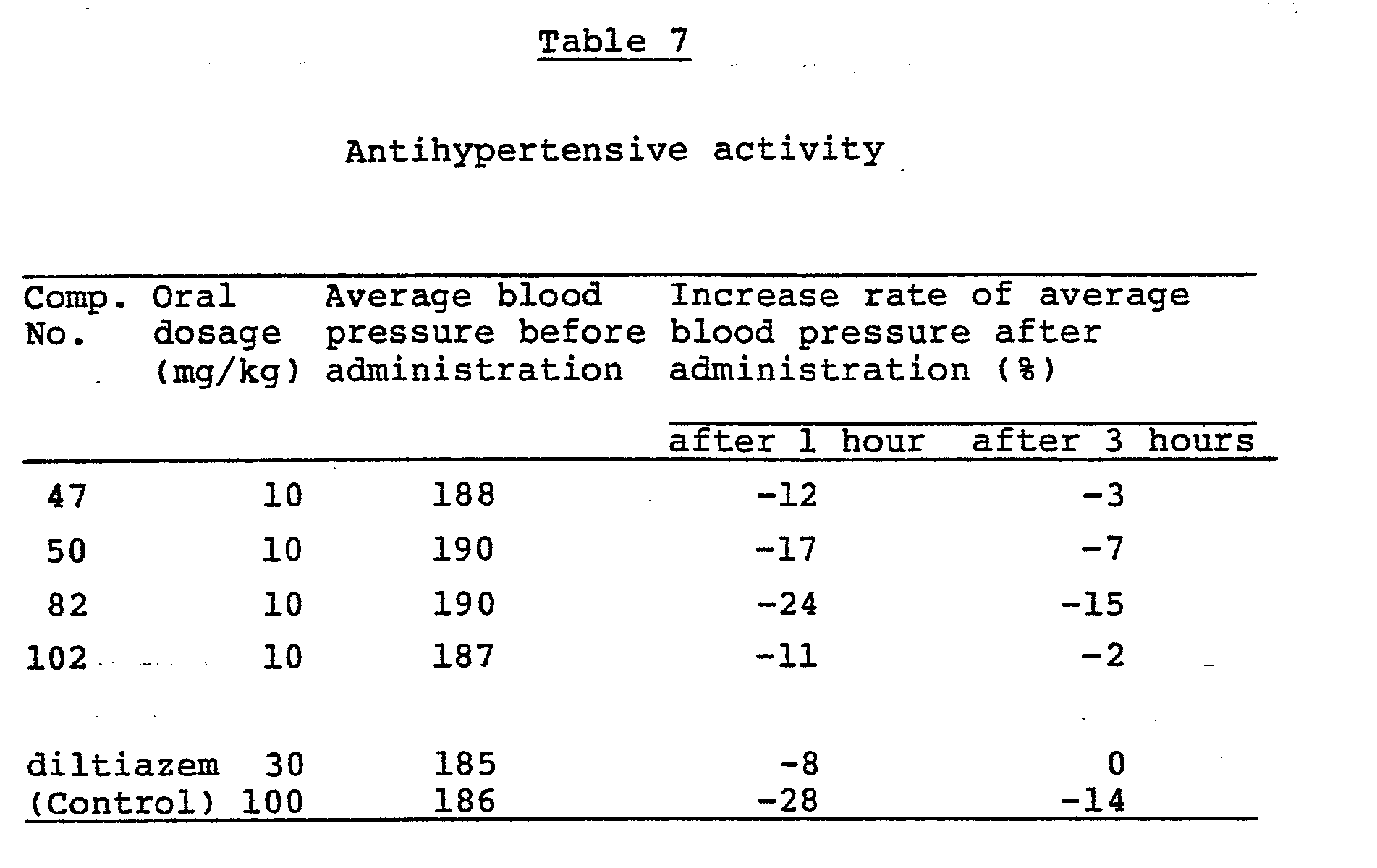
- Application example 4
- Tests were made using groups each comprising five male ICR strain mice weighing 30 to 35 g and being kept under a fast for 18 hours. The compound to be tested was suspended in a 1 % tragacanth solution. After the concentration of the suspensions was adjusted in a volume of 40 ml/kg, the compound was administered orally to the mouse. The results are shown in Table 8.

or a pharmaceutically acceptable acid addition salt thereof.
Claims (14)

wherein, X represents a hydrogen atom, an alkyl group having 1 to 5 carbon atoms, an alkoxy group having 1 to 5 carbon atoms, a phenoxy group, a benzyloxy group, a halogen atom or a hydroxy group; Y represents an alkyl group having 1 to 5 carbon atoms, an alkoxy group having 1 to 5 carbon atoms, a benzyloxy group, a halogen atom or a nitro group; R1 represents a hydrogen atom or an alkyl group having 1 to 5 carbon atoms; R2 represents an alkyl group having 1 to 5 carbon atoms or a group of Formula (2)

a hydrogen atom, a methyl group, an ethyl group, an n-propyl group, an isopropyl group, an n-butyl group, a sec-butyl group, a pentyl group, a methoxy group, an ethoxy group, an n-propoxy group, an isopropoxy group, an n-butoxy group, an sec-butoxy group, an n-pentoxy group, a phenoxy group, a benzyloxy group, a fluorine atom, a chlorine atom, a bromine atom, an iodine atom or a hydroxy group;
a hydrogen atom, a methyl group, an ethyl group, an n-propyl group, an isopropyl group, an n-butyl group, a sec-butyl group, or a pentyl group;
a methyl group, en ethyl group, an n-propyl, an isopropyl group, an n-butyl group, a sec-butyl group, a pentyl group, or a group of
Formula (2)

a hydrogen atom, a methyl group, an ethyl group, a chlorine atom, an iodine atom, a hydroxy group, a methoxy group, an ethoxy group, a propoxy group, an isopropoxy group, an n-butoxy group, an isobutoxy group, a sec-butoxy, an n-pentoxy group, an isopentoxy group, a phenoxy group, a chlorophenyl group or a methoxyphenoxy group when a is 1, or a dimethoxy group, a methoxy group and an ethoxy group or a methoxy group and an isopropyl group when a is 2.

represents


wherein X, Y, a, b and m have the same meanings as defined in Claim 1,
with a diamine of Formula (8)

wherein R1, R 2 and n have the same meanings as defined in Claim 1.

wherein X, Y, a, b and m have the same meanings as defined in Claim 1,
with an amine represented by Formula (10)

wherein R 1, R 2 and n have the same meanings as defined in Claim 1, and R7 represents a halogen atom or a mesyloxy group or a tosyloxy group.

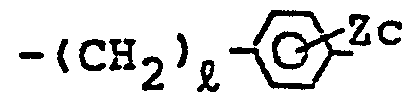


with a diamine of Formula (8)


with an amine represented by Formula (10)

wherein R1, R2 and n have the same meanings as defined in Claim 1, and R represents a halogen atom or a mesyloxy group or a tosyloxy group.
Priority Applications (1)
| Application Number | Priority Date | Filing Date | Title |
|---|---|---|---|
| AT85109193T ATE49199T1 (en) | 1984-07-26 | 1985-07-23 | 2-PHENYLALKYL-3-AMINOALKYL-4(3H)-QUINAZOLINONES PROCESSES FOR THEIR PREPARATION, PHARMACEUTICAL COMPOSITIONS AND USE. |
Applications Claiming Priority (2)
| Application Number | Priority Date | Filing Date | Title |
|---|---|---|---|
| JP15408684A JPS6136273A (en) | 1984-07-26 | 1984-07-26 | 2-phenylalkyl-4(3h)-quinazolinone derivative |
| JP154086/84 | 1984-07-26 |
Publications (3)
| Publication Number | Publication Date |
|---|---|
| EP0169537A2 true EP0169537A2 (en) | 1986-01-29 |
| EP0169537A3 EP0169537A3 (en) | 1987-03-25 |
| EP0169537B1 EP0169537B1 (en) | 1990-01-03 |
Family
ID=15576584
Family Applications (1)
| Application Number | Title | Priority Date | Filing Date |
|---|---|---|---|
| EP85109193A Expired - Lifetime EP0169537B1 (en) | 1984-07-26 | 1985-07-23 | 2-phenylalkyl-3-aminoalkyl-4(3h)-quinazolinones, processes for preparing them, pharmaceutical compositions and use |
Country Status (9)
| Country | Link |
|---|---|
| US (1) | US4668682A (en) |
| EP (1) | EP0169537B1 (en) |
| JP (1) | JPS6136273A (en) |
| KR (1) | KR860001078A (en) |
| AT (1) | ATE49199T1 (en) |
| CA (1) | CA1266266A (en) |
| DE (1) | DE3575132D1 (en) |
| DK (1) | DK339685A (en) |
| HU (1) | HU194836B (en) |
Cited By (7)
| Publication number | Priority date | Publication date | Assignee | Title |
|---|---|---|---|---|
| GB2257970A (en) * | 1991-07-26 | 1993-01-27 | Ici Plc | 4 - oxo - quinazolines and benzotriazines as herbicides |
| EP0620218A1 (en) * | 1993-04-16 | 1994-10-19 | ALFA WASSERMANN S.p.A. | Heterocyclic compounds active in gastro-intestinal pathologies |
| EP0903344A1 (en) * | 1997-08-21 | 1999-03-24 | Shiseido Company Limited | Quinazolin-4-one derivatives, their preparation and their use as hair growth promoters or in external compositions for skin |
| RU2158733C2 (en) * | 1995-01-19 | 2000-11-10 | Байер Аг | 2,8-disubstituted quinazolinone derivatives or their salts and pharmaceutical compositions based on the latter affecting blood levels of guanosine and adenosine monophosphates |
| WO2001023365A1 (en) * | 1999-09-28 | 2001-04-05 | Merck Patent Gmbh | Quinazolinones |
| US6444816B1 (en) | 1997-10-27 | 2002-09-03 | Dr. Reddy's Research Foundation | Fused 7-oxo-pyrimidinyl compounds, preparation, composition and use thereof |
| US6890930B1 (en) | 1999-09-28 | 2005-05-10 | 3-Dimensional Pharmaceuticals, Inc. | Quinazolinones |
Families Citing this family (10)
| Publication number | Priority date | Publication date | Assignee | Title |
|---|---|---|---|---|
| CA2037630C (en) * | 1990-03-07 | 2001-07-03 | Akira Morimoto | Nitrogen-containing heterocylic compounds, their production and use |
| US5430148A (en) * | 1992-03-31 | 1995-07-04 | Agouron Pharmaceuticals, Inc. | Antiproliferative quinazolines |
| US5756502A (en) * | 1994-08-08 | 1998-05-26 | Warner-Lambert Company | Quinazolinone derivatives as cholyecystokinin (CCK) ligands |
| WO1997009301A1 (en) * | 1995-09-07 | 1997-03-13 | Kissei Pharmaceutical Co., Ltd. | 2-acylaminobenzamide derivatives and preventive and remedy for diseases caused by the supermultiplication of vascular intimal cells |
| US6337332B1 (en) * | 1998-09-17 | 2002-01-08 | Pfizer Inc. | Neuropeptide Y receptor antagonists |
| AU9650201A (en) * | 2000-10-02 | 2002-04-15 | Molecular Probes Inc | Reagents for labeling biomolecules having aldehyde or ketone moieties |
| EP1389103A4 (en) * | 2001-04-23 | 2005-09-14 | Univ Virginia | SYNTHESIS AND EVALUATION OF NEW MIMETIC PHTHALIMIDE SUBSTANCES AS ANTIANGIOGENESIS AGENTS |
| US7053216B2 (en) * | 2001-11-19 | 2006-05-30 | Iconix Pharmaceuticals, Inc. | Modulators of Rho C activity |
| PL377474A1 (en) * | 2002-12-13 | 2006-02-06 | F. Hoffmann-La Roche Ag | 3h-quinazolin-4-one derivatives |
| KR100610731B1 (en) * | 2004-02-24 | 2006-08-09 | 한국과학기술연구원 | 3,4-dihydroquinazolin derivatives useful as T-type calcium channel blockers and methods for their preparation |
Family Cites Families (1)
| Publication number | Priority date | Publication date | Assignee | Title |
|---|---|---|---|---|
| DE2020234A1 (en) * | 1970-04-25 | 1971-11-18 | Cassella Farbwerke Mainkur Ag | Basically substituted derivatives of 4 (3H) -quinazolinone |
-
1984
- 1984-07-26 JP JP15408684A patent/JPS6136273A/en active Pending
-
1985
- 1985-07-10 US US06/753,708 patent/US4668682A/en not_active Expired - Fee Related
- 1985-07-15 CA CA000486793A patent/CA1266266A/en not_active Expired - Lifetime
- 1985-07-23 AT AT85109193T patent/ATE49199T1/en not_active IP Right Cessation
- 1985-07-23 DE DE8585109193T patent/DE3575132D1/en not_active Expired - Lifetime
- 1985-07-23 EP EP85109193A patent/EP0169537B1/en not_active Expired - Lifetime
- 1985-07-25 KR KR1019850005302A patent/KR860001078A/en not_active Withdrawn
- 1985-07-25 DK DK339685A patent/DK339685A/en not_active Application Discontinuation
- 1985-07-26 HU HU852850A patent/HU194836B/en not_active IP Right Cessation
Cited By (8)
| Publication number | Priority date | Publication date | Assignee | Title |
|---|---|---|---|---|
| GB2257970A (en) * | 1991-07-26 | 1993-01-27 | Ici Plc | 4 - oxo - quinazolines and benzotriazines as herbicides |
| EP0620218A1 (en) * | 1993-04-16 | 1994-10-19 | ALFA WASSERMANN S.p.A. | Heterocyclic compounds active in gastro-intestinal pathologies |
| RU2158733C2 (en) * | 1995-01-19 | 2000-11-10 | Байер Аг | 2,8-disubstituted quinazolinone derivatives or their salts and pharmaceutical compositions based on the latter affecting blood levels of guanosine and adenosine monophosphates |
| EP0903344A1 (en) * | 1997-08-21 | 1999-03-24 | Shiseido Company Limited | Quinazolin-4-one derivatives, their preparation and their use as hair growth promoters or in external compositions for skin |
| US5972929A (en) * | 1997-08-21 | 1999-10-26 | Shiseido Co., Ltd. | Quinazolinone derivative, hair growth promoter and external composition for skin using the same |
| US6444816B1 (en) | 1997-10-27 | 2002-09-03 | Dr. Reddy's Research Foundation | Fused 7-oxo-pyrimidinyl compounds, preparation, composition and use thereof |
| WO2001023365A1 (en) * | 1999-09-28 | 2001-04-05 | Merck Patent Gmbh | Quinazolinones |
| US6890930B1 (en) | 1999-09-28 | 2005-05-10 | 3-Dimensional Pharmaceuticals, Inc. | Quinazolinones |
Also Published As
| Publication number | Publication date |
|---|---|
| DK339685A (en) | 1986-01-27 |
| HUT39166A (en) | 1986-08-28 |
| EP0169537B1 (en) | 1990-01-03 |
| ATE49199T1 (en) | 1990-01-15 |
| CA1266266A (en) | 1990-02-27 |
| HU194836B (en) | 1988-03-28 |
| DE3575132D1 (en) | 1990-02-08 |
| EP0169537A3 (en) | 1987-03-25 |
| JPS6136273A (en) | 1986-02-20 |
| DK339685D0 (en) | 1985-07-25 |
| KR860001078A (en) | 1986-02-22 |
| US4668682A (en) | 1987-05-26 |
Similar Documents
| Publication | Publication Date | Title |
|---|---|---|
| EP0169537B1 (en) | 2-phenylalkyl-3-aminoalkyl-4(3h)-quinazolinones, processes for preparing them, pharmaceutical compositions and use | |
| KR100296656B1 (en) | Quinazoline derivatives | |
| DK2346837T3 (en) | Methods for preparing quinazolinone derivatives | |
| US8536184B2 (en) | Nitrogenous heterocyclic compounds and process for making nitrogenous heterocyclic compounds and intermediates thereof | |
| CZ304061B6 (en) | Quinazoline derivative, pharmaceutical composition and medicament containing thereof | |
| HUT64755A (en) | Process for the production of 2,4-diamino-quinazoline derivatives and of medical preparatives containing them | |
| US9102629B2 (en) | Polymorphic forms of 4-phenylamine quinazoline derivative, the preparation method and uses thereof | |
| US4354027A (en) | Triazoloquinoxalin-4-ones | |
| WO2021143843A1 (en) | Crystal of pde3/pde4 dual inhibitor and use thereof | |
| EP0750614B1 (en) | Quinazolinyl-amino derivatives having alpha-antagonist activity | |
| HU186975B (en) | Process for preparing new triazolo-quinazolone derivatives | |
| EP2045245A1 (en) | Inreversible protein tyrosine kinases inhibitors and the preparation methods and uses thereof | |
| HUT61002A (en) | Process for producing 2-aminopyrimdine-4-carboxamide derivatives and pharmaceutical compositions comprising such compounds | |
| EP4438600A1 (en) | Compound used as kinase inhibitor and use thereof | |
| KR19990044478A (en) | 2-acylaminobenzamide derivatives and preventive and therapeutic agents for diseases caused by vascular endothelial hyperplasia | |
| US6706705B1 (en) | Quinazoline derivatives | |
| US20040259881A1 (en) | Nitrogenous heterocyclic compounds | |
| CA1110236A (en) | Antihypertensive quinazoline compounds | |
| AU2013231084B2 (en) | The polymorphs of 4-anilinoquinazoline derivatives, the preparation methods and uses thereof | |
| JPS6332787B2 (en) | ||
| JPS6140229B2 (en) |
Legal Events
| Date | Code | Title | Description |
|---|---|---|---|
| PUAI | Public reference made under article 153(3) epc to a published international application that has entered the european phase |
Free format text: ORIGINAL CODE: 0009012 |
|
| AK | Designated contracting states |
Designated state(s): AT BE CH DE FR GB IT LI NL SE |
|
| PUAL | Search report despatched |
Free format text: ORIGINAL CODE: 0009013 |
|
| AK | Designated contracting states |
Kind code of ref document: A3 Designated state(s): AT BE CH DE FR GB IT LI NL SE |
|
| 17P | Request for examination filed |
Effective date: 19870626 |
|
| RAP1 | Party data changed (applicant data changed or rights of an application transferred) |
Owner name: MITSUBISHI CHEMICAL INDUSTRIES LIMITED |
|
| 17Q | First examination report despatched |
Effective date: 19880704 |
|
| RAP1 | Party data changed (applicant data changed or rights of an application transferred) |
Owner name: MITSUBISHI KASEI CORPORATION |
|
| GRAA | (expected) grant |
Free format text: ORIGINAL CODE: 0009210 |
|
| AK | Designated contracting states |
Kind code of ref document: B1 Designated state(s): AT BE CH DE FR GB IT LI NL SE |
|
| PG25 | Lapsed in a contracting state [announced via postgrant information from national office to epo] |
Ref country code: SE Effective date: 19900103 Ref country code: NL Effective date: 19900103 Ref country code: LI Effective date: 19900103 Ref country code: CH Effective date: 19900103 Ref country code: BE Effective date: 19900103 Ref country code: AT Effective date: 19900103 |
|
| REF | Corresponds to: |
Ref document number: 49199 Country of ref document: AT Date of ref document: 19900115 Kind code of ref document: T |
|
| ITF | It: translation for a ep patent filed | ||
| REF | Corresponds to: |
Ref document number: 3575132 Country of ref document: DE Date of ref document: 19900208 |
|
| REG | Reference to a national code |
Ref country code: CH Ref legal event code: PL |
|
| ET | Fr: translation filed | ||
| NLV1 | Nl: lapsed or annulled due to failure to fulfill the requirements of art. 29p and 29m of the patents act | ||
| PLBE | No opposition filed within time limit |
Free format text: ORIGINAL CODE: 0009261 |
|
| STAA | Information on the status of an ep patent application or granted ep patent |
Free format text: STATUS: NO OPPOSITION FILED WITHIN TIME LIMIT |
|
| 26N | No opposition filed | ||
| ITTA | It: last paid annual fee | ||
| PGFP | Annual fee paid to national office [announced via postgrant information from national office to epo] |
Ref country code: GB Payment date: 19920720 Year of fee payment: 8 |
|
| PGFP | Annual fee paid to national office [announced via postgrant information from national office to epo] |
Ref country code: FR Payment date: 19920729 Year of fee payment: 8 |
|
| PGFP | Annual fee paid to national office [announced via postgrant information from national office to epo] |
Ref country code: DE Payment date: 19920818 Year of fee payment: 8 |
|
| PG25 | Lapsed in a contracting state [announced via postgrant information from national office to epo] |
Ref country code: GB Effective date: 19930723 |
|
| GBPC | Gb: european patent ceased through non-payment of renewal fee |
Effective date: 19930723 |
|
| PG25 | Lapsed in a contracting state [announced via postgrant information from national office to epo] |
Ref country code: FR Effective date: 19940331 |
|
| PG25 | Lapsed in a contracting state [announced via postgrant information from national office to epo] |
Ref country code: DE Effective date: 19940401 |
|
| REG | Reference to a national code |
Ref country code: FR Ref legal event code: ST |