EP0180789A1 - Vernetzung von Styrolpolymeren - Google Patents
Vernetzung von Styrolpolymeren Download PDFInfo
- Publication number
- EP0180789A1 EP0180789A1 EP85112701A EP85112701A EP0180789A1 EP 0180789 A1 EP0180789 A1 EP 0180789A1 EP 85112701 A EP85112701 A EP 85112701A EP 85112701 A EP85112701 A EP 85112701A EP 0180789 A1 EP0180789 A1 EP 0180789A1
- Authority
- EP
- European Patent Office
- Prior art keywords
- crosslinking
- hht
- peroxides
- butyl
- bis
- Prior art date
- Legal status (The legal status is an assumption and is not a legal conclusion. Google has not performed a legal analysis and makes no representation as to the accuracy of the status listed.)
- Granted
Links
- 238000004132 cross linking Methods 0.000 title claims abstract description 90
- 229920000642 polymer Polymers 0.000 title claims abstract description 19
- PPBRXRYQALVLMV-UHFFFAOYSA-N Styrene Chemical compound C=CC1=CC=CC=C1 PPBRXRYQALVLMV-UHFFFAOYSA-N 0.000 title abstract description 45
- -1 ketone peroxides Chemical class 0.000 claims abstract description 40
- 150000001451 organic peroxides Chemical class 0.000 claims abstract description 5
- 150000002432 hydroperoxides Chemical class 0.000 claims abstract description 4
- 150000004965 peroxy acids Chemical class 0.000 claims abstract description 4
- 239000004793 Polystyrene Substances 0.000 claims description 46
- 229920002223 polystyrene Polymers 0.000 claims description 42
- 150000002978 peroxides Chemical class 0.000 claims description 25
- JLBJTVDPSNHSKJ-UHFFFAOYSA-N 4-Methylstyrene Chemical compound CC1=CC=C(C=C)C=C1 JLBJTVDPSNHSKJ-UHFFFAOYSA-N 0.000 claims description 12
- 239000012933 diacyl peroxide Substances 0.000 claims description 10
- UHOVQNZJYSORNB-UHFFFAOYSA-N Benzene Chemical compound C1=CC=CC=C1 UHOVQNZJYSORNB-UHFFFAOYSA-N 0.000 claims description 9
- 238000000034 method Methods 0.000 claims description 9
- 229920001577 copolymer Polymers 0.000 claims description 8
- 239000004088 foaming agent Substances 0.000 claims description 8
- 229920001519 homopolymer Polymers 0.000 claims description 6
- 125000003118 aryl group Chemical group 0.000 claims description 4
- MWNQXXOSWHCCOZ-UHFFFAOYSA-L sodium;oxido carbonate Chemical class [Na+].[O-]OC([O-])=O MWNQXXOSWHCCOZ-UHFFFAOYSA-L 0.000 claims description 4
- 238000005187 foaming Methods 0.000 claims description 3
- 239000000203 mixture Substances 0.000 claims description 3
- 239000003623 enhancer Substances 0.000 abstract description 23
- 125000003011 styrenyl group Chemical class [H]\C(*)=C(/[H])C1=C([H])C([H])=C([H])C([H])=C1[H] 0.000 abstract 1
- IJGRMHOSHXDMSA-UHFFFAOYSA-N Atomic nitrogen Chemical compound N#N IJGRMHOSHXDMSA-UHFFFAOYSA-N 0.000 description 34
- 229910052757 nitrogen Inorganic materials 0.000 description 33
- MYRTYDVEIRVNKP-UHFFFAOYSA-N 1,2-Divinylbenzene Chemical compound C=CC1=CC=CC=C1C=C MYRTYDVEIRVNKP-UHFFFAOYSA-N 0.000 description 20
- BJELTSYBAHKXRW-UHFFFAOYSA-N 2,4,6-triallyloxy-1,3,5-triazine Chemical compound C=CCOC1=NC(OCC=C)=NC(OCC=C)=N1 BJELTSYBAHKXRW-UHFFFAOYSA-N 0.000 description 16
- QEQBMZQFDDDTPN-UHFFFAOYSA-N (2-methylpropan-2-yl)oxy benzenecarboperoxoate Chemical compound CC(C)(C)OOOC(=O)C1=CC=CC=C1 QEQBMZQFDDDTPN-UHFFFAOYSA-N 0.000 description 15
- 239000000843 powder Substances 0.000 description 13
- CSCPPACGZOOCGX-UHFFFAOYSA-N Acetone Chemical compound CC(C)=O CSCPPACGZOOCGX-UHFFFAOYSA-N 0.000 description 12
- 229920000578 graft copolymer Polymers 0.000 description 11
- 125000003903 2-propenyl group Chemical group [H]C([*])([H])C([H])=C([H])[H] 0.000 description 7
- OMPJBNCRMGITSC-UHFFFAOYSA-N Benzoylperoxide Chemical compound C=1C=CC=CC=1C(=O)OOC(=O)C1=CC=CC=C1 OMPJBNCRMGITSC-UHFFFAOYSA-N 0.000 description 7
- RTZKZFJDLAIYFH-UHFFFAOYSA-N Diethyl ether Chemical compound CCOCC RTZKZFJDLAIYFH-UHFFFAOYSA-N 0.000 description 7
- 229920002943 EPDM rubber Polymers 0.000 description 7
- QVGXLLKOCUKJST-UHFFFAOYSA-N atomic oxygen Chemical compound [O] QVGXLLKOCUKJST-UHFFFAOYSA-N 0.000 description 7
- 239000001301 oxygen Substances 0.000 description 7
- 229910052760 oxygen Inorganic materials 0.000 description 7
- 150000002976 peresters Chemical class 0.000 description 7
- 239000003963 antioxidant agent Substances 0.000 description 5
- 239000008187 granular material Substances 0.000 description 5
- ZICNIEOYWVIEQJ-UHFFFAOYSA-N (2-methylbenzoyl) 2-methylbenzenecarboperoxoate Chemical compound CC1=CC=CC=C1C(=O)OOC(=O)C1=CC=CC=C1C ZICNIEOYWVIEQJ-UHFFFAOYSA-N 0.000 description 4
- 239000004342 Benzoyl peroxide Substances 0.000 description 4
- CTQNGGLPUBDAKN-UHFFFAOYSA-N O-Xylene Chemical compound CC1=CC=CC=C1C CTQNGGLPUBDAKN-UHFFFAOYSA-N 0.000 description 4
- 239000005062 Polybutadiene Substances 0.000 description 4
- 239000000654 additive Substances 0.000 description 4
- 230000003078 antioxidant effect Effects 0.000 description 4
- 235000019400 benzoyl peroxide Nutrition 0.000 description 4
- 150000001875 compounds Chemical class 0.000 description 4
- 239000003431 cross linking reagent Substances 0.000 description 4
- 230000000694 effects Effects 0.000 description 4
- ZFSLODLOARCGLH-UHFFFAOYSA-N isocyanuric acid Chemical compound OC1=NC(O)=NC(O)=N1 ZFSLODLOARCGLH-UHFFFAOYSA-N 0.000 description 4
- 230000006855 networking Effects 0.000 description 4
- 229920002857 polybutadiene Polymers 0.000 description 4
- 125000000999 tert-butyl group Chemical group [H]C([H])([H])C(*)(C([H])([H])[H])C([H])([H])[H] 0.000 description 4
- 239000008096 xylene Substances 0.000 description 4
- RWXRNICBVOXIAI-UHFFFAOYSA-N 1-tert-butylperoxy-1-methoxy-3,3,5-trimethylcyclohexane Chemical compound CC(C)(C)OOC1(OC)CC(C)CC(C)(C)C1 RWXRNICBVOXIAI-UHFFFAOYSA-N 0.000 description 3
- GFYYWCPQFKCXPK-UHFFFAOYSA-N 3-tert-butylperoxy-2-methylbenzoic acid Chemical compound CC1=C(OOC(C)(C)C)C=CC=C1C(O)=O GFYYWCPQFKCXPK-UHFFFAOYSA-N 0.000 description 3
- SNLFYGIUTYKKOE-UHFFFAOYSA-N 4-n,4-n-bis(4-aminophenyl)benzene-1,4-diamine Chemical compound C1=CC(N)=CC=C1N(C=1C=CC(N)=CC=1)C1=CC=C(N)C=C1 SNLFYGIUTYKKOE-UHFFFAOYSA-N 0.000 description 3
- OKKRPWIIYQTPQF-UHFFFAOYSA-N Trimethylolpropane trimethacrylate Chemical compound CC(=C)C(=O)OCC(CC)(COC(=O)C(C)=C)COC(=O)C(C)=C OKKRPWIIYQTPQF-UHFFFAOYSA-N 0.000 description 3
- XTXRWKRVRITETP-UHFFFAOYSA-N Vinyl acetate Chemical compound CC(=O)OC=C XTXRWKRVRITETP-UHFFFAOYSA-N 0.000 description 3
- 125000001931 aliphatic group Chemical group 0.000 description 3
- ZPOLOEWJWXZUSP-WAYWQWQTSA-N bis(prop-2-enyl) (z)-but-2-enedioate Chemical compound C=CCOC(=O)\C=C/C(=O)OCC=C ZPOLOEWJWXZUSP-WAYWQWQTSA-N 0.000 description 3
- UOCJDOLVGGIYIQ-PBFPGSCMSA-N cefatrizine Chemical group S([C@@H]1[C@@H](C(N1C=1C(O)=O)=O)NC(=O)[C@H](N)C=2C=CC(O)=CC=2)CC=1CSC=1C=NNN=1 UOCJDOLVGGIYIQ-PBFPGSCMSA-N 0.000 description 3
- XJOBOFWTZOKMOH-UHFFFAOYSA-N decanoyl decaneperoxoate Chemical compound CCCCCCCCCC(=O)OOC(=O)CCCCCCCCC XJOBOFWTZOKMOH-UHFFFAOYSA-N 0.000 description 3
- 238000001035 drying Methods 0.000 description 3
- 238000010894 electron beam technology Methods 0.000 description 3
- 125000001997 phenyl group Chemical group [H]C1=C([H])C([H])=C(*)C([H])=C1[H] 0.000 description 3
- 229920001627 poly(4-methyl styrene) Polymers 0.000 description 3
- 150000003440 styrenes Chemical class 0.000 description 3
- 150000005846 sugar alcohols Polymers 0.000 description 3
- XHGIFBQQEGRTPB-UHFFFAOYSA-N tris(prop-2-enyl) phosphate Chemical compound C=CCOP(=O)(OCC=C)OCC=C XHGIFBQQEGRTPB-UHFFFAOYSA-N 0.000 description 3
- RIPYNJLMMFGZSX-UHFFFAOYSA-N (5-benzoylperoxy-2,5-dimethylhexan-2-yl) benzenecarboperoxoate Chemical compound C=1C=CC=CC=1C(=O)OOC(C)(C)CCC(C)(C)OOC(=O)C1=CC=CC=C1 RIPYNJLMMFGZSX-UHFFFAOYSA-N 0.000 description 2
- IJOHRMCEDZASLA-UHFFFAOYSA-N 2,4,4-trimethylpentan-2-yl benzenecarboperoxoate Chemical compound CC(C)(C)CC(C)(C)OOC(=O)C1=CC=CC=C1 IJOHRMCEDZASLA-UHFFFAOYSA-N 0.000 description 2
- QPVBOLIMQNOQOG-UHFFFAOYSA-N 2-(2-carboxypentan-2-yldiazenyl)-2-methylpentanoic acid Chemical compound CCCC(C)(C(O)=O)N=NC(C)(C(O)=O)CCC QPVBOLIMQNOQOG-UHFFFAOYSA-N 0.000 description 2
- OALMZWNBNXQUAL-UHFFFAOYSA-N 2-[(1-amino-2-methyl-1-oxopropan-2-yl)diazenyl]-2-methylpropanamide Chemical compound NC(=O)C(C)(C)N=NC(C)(C)C(N)=O OALMZWNBNXQUAL-UHFFFAOYSA-N 0.000 description 2
- FJGNCDHMLZWTAR-UHFFFAOYSA-N 2-ethyl-2-(2,4,4-trimethylpentan-2-ylperoxy)hexanoic acid Chemical compound CCCCC(CC)(C(O)=O)OOC(C)(C)CC(C)(C)C FJGNCDHMLZWTAR-UHFFFAOYSA-N 0.000 description 2
- RFSCGDQQLKVJEJ-UHFFFAOYSA-N 2-methylbutan-2-yl benzenecarboperoxoate Chemical compound CCC(C)(C)OOC(=O)C1=CC=CC=C1 RFSCGDQQLKVJEJ-UHFFFAOYSA-N 0.000 description 2
- DBCAQXHNJOFNGC-UHFFFAOYSA-N 4-bromo-1,1,1-trifluorobutane Chemical compound FC(F)(F)CCCBr DBCAQXHNJOFNGC-UHFFFAOYSA-N 0.000 description 2
- KAKZBPTYRLMSJV-UHFFFAOYSA-N Butadiene Chemical compound C=CC=C KAKZBPTYRLMSJV-UHFFFAOYSA-N 0.000 description 2
- VTYYLEPIZMXCLO-UHFFFAOYSA-L Calcium carbonate Chemical compound [Ca+2].[O-]C([O-])=O VTYYLEPIZMXCLO-UHFFFAOYSA-L 0.000 description 2
- ZAMOUSCENKQFHK-UHFFFAOYSA-N Chlorine atom Chemical compound [Cl] ZAMOUSCENKQFHK-UHFFFAOYSA-N 0.000 description 2
- 241000283014 Dama Species 0.000 description 2
- VVQNEPGJFQJSBK-UHFFFAOYSA-N Methyl methacrylate Chemical compound COC(=O)C(C)=C VVQNEPGJFQJSBK-UHFFFAOYSA-N 0.000 description 2
- KWYHDKDOAIKMQN-UHFFFAOYSA-N N,N,N',N'-tetramethylethylenediamine Chemical compound CN(C)CCN(C)C KWYHDKDOAIKMQN-UHFFFAOYSA-N 0.000 description 2
- VYPSYNLAJGMNEJ-UHFFFAOYSA-N Silicium dioxide Chemical compound O=[Si]=O VYPSYNLAJGMNEJ-UHFFFAOYSA-N 0.000 description 2
- DAKWPKUUDNSNPN-UHFFFAOYSA-N Trimethylolpropane triacrylate Chemical compound C=CC(=O)OCC(CC)(COC(=O)C=C)COC(=O)C=C DAKWPKUUDNSNPN-UHFFFAOYSA-N 0.000 description 2
- RFGUTQZLDJBGMG-UHFFFAOYSA-N [2-[(2-acetyloxy-4-methylpentan-2-yl)diazenyl]-4-methylpentan-2-yl] acetate Chemical compound CC(C)CC(C)(OC(C)=O)N=NC(C)(CC(C)C)OC(C)=O RFGUTQZLDJBGMG-UHFFFAOYSA-N 0.000 description 2
- JUIBLDFFVYKUAC-UHFFFAOYSA-N [5-(2-ethylhexanoylperoxy)-2,5-dimethylhexan-2-yl] 2-ethylhexaneperoxoate Chemical compound CCCCC(CC)C(=O)OOC(C)(C)CCC(C)(C)OOC(=O)C(CC)CCCC JUIBLDFFVYKUAC-UHFFFAOYSA-N 0.000 description 2
- 239000002253 acid Substances 0.000 description 2
- 150000001408 amides Chemical class 0.000 description 2
- 125000003236 benzoyl group Chemical group [H]C1=C([H])C([H])=C(C([H])=C1[H])C(*)=O 0.000 description 2
- 230000001588 bifunctional effect Effects 0.000 description 2
- 238000009835 boiling Methods 0.000 description 2
- JNSGIVNNHKGGRU-JYRVWZFOSA-N diethoxyphosphinothioyl (2z)-2-(2-amino-1,3-thiazol-4-yl)-2-methoxyiminoacetate Chemical compound CCOP(=S)(OCC)OC(=O)C(=N/OC)\C1=CSC(N)=N1 JNSGIVNNHKGGRU-JYRVWZFOSA-N 0.000 description 2
- 229920001971 elastomer Polymers 0.000 description 2
- 230000005670 electromagnetic radiation Effects 0.000 description 2
- 125000001495 ethyl group Chemical group [H]C([H])([H])C([H])([H])* 0.000 description 2
- STVZJERGLQHEKB-UHFFFAOYSA-N ethylene glycol dimethacrylate Substances CC(=C)C(=O)OCCOC(=O)C(C)=C STVZJERGLQHEKB-UHFFFAOYSA-N 0.000 description 2
- 239000005038 ethylene vinyl acetate Substances 0.000 description 2
- 230000007717 exclusion Effects 0.000 description 2
- LEQAOMBKQFMDFZ-UHFFFAOYSA-N glyoxal Chemical compound O=CC=O LEQAOMBKQFMDFZ-UHFFFAOYSA-N 0.000 description 2
- PYGSKMBEVAICCR-UHFFFAOYSA-N hexa-1,5-diene Chemical group C=CCCC=C PYGSKMBEVAICCR-UHFFFAOYSA-N 0.000 description 2
- 150000003949 imides Chemical class 0.000 description 2
- 230000005865 ionizing radiation Effects 0.000 description 2
- 125000001449 isopropyl group Chemical group [H]C([H])([H])C([H])(*)C([H])([H])[H] 0.000 description 2
- 239000000463 material Substances 0.000 description 2
- 125000005395 methacrylic acid group Chemical group 0.000 description 2
- 125000002496 methyl group Chemical group [H]C([H])([H])* 0.000 description 2
- 239000000178 monomer Substances 0.000 description 2
- 229920001200 poly(ethylene-vinyl acetate) Polymers 0.000 description 2
- 125000002924 primary amino group Chemical group [H]N([H])* 0.000 description 2
- FBCQUCJYYPMKRO-UHFFFAOYSA-N prop-2-enyl 2-methylprop-2-enoate Chemical compound CC(=C)C(=O)OCC=C FBCQUCJYYPMKRO-UHFFFAOYSA-N 0.000 description 2
- 239000005060 rubber Substances 0.000 description 2
- PRIFGVOVRHAALC-UHFFFAOYSA-N tert-butyl 3,3-dimethylbutaneperoxoate Chemical compound CC(C)(C)CC(=O)OOC(C)(C)C PRIFGVOVRHAALC-UHFFFAOYSA-N 0.000 description 2
- NMOALOSNPWTWRH-UHFFFAOYSA-N tert-butyl 7,7-dimethyloctaneperoxoate Chemical compound CC(C)(C)CCCCCC(=O)OOC(C)(C)C NMOALOSNPWTWRH-UHFFFAOYSA-N 0.000 description 2
- GJBRNHKUVLOCEB-UHFFFAOYSA-N tert-butyl benzenecarboperoxoate Chemical compound CC(C)(C)OOC(=O)C1=CC=CC=C1 GJBRNHKUVLOCEB-UHFFFAOYSA-N 0.000 description 2
- PLCFYBDYBCOLSP-UHFFFAOYSA-N tris(prop-2-enyl) 2-hydroxypropane-1,2,3-tricarboxylate Chemical compound C=CCOC(=O)CC(O)(CC(=O)OCC=C)C(=O)OCC=C PLCFYBDYBCOLSP-UHFFFAOYSA-N 0.000 description 2
- XLYOFNOQVPJJNP-UHFFFAOYSA-N water Chemical compound O XLYOFNOQVPJJNP-UHFFFAOYSA-N 0.000 description 2
- CVDKLWHFAQGCAL-UHFFFAOYSA-N (1-benzoylperoxy-3,3,5-trimethylcyclohexyl) benzenecarboperoxoate Chemical compound C1C(C)CC(C)(C)CC1(OOC(=O)C=1C=CC=CC=1)OOC(=O)C1=CC=CC=C1 CVDKLWHFAQGCAL-UHFFFAOYSA-N 0.000 description 1
- FVQMJJQUGGVLEP-UHFFFAOYSA-N (2-methylpropan-2-yl)oxy 2-ethylhexaneperoxoate Chemical compound CCCCC(CC)C(=O)OOOC(C)(C)C FVQMJJQUGGVLEP-UHFFFAOYSA-N 0.000 description 1
- HCXVPNKIBYLBIT-UHFFFAOYSA-N (2-methylpropan-2-yl)oxy 3,5,5-trimethylhexaneperoxoate Chemical compound CC(C)(C)CC(C)CC(=O)OOOC(C)(C)C HCXVPNKIBYLBIT-UHFFFAOYSA-N 0.000 description 1
- 125000000008 (C1-C10) alkyl group Chemical group 0.000 description 1
- NYYNKRQEAFFNPF-FPLPWBNLSA-N (Z)-2,3-bis(prop-2-ynyl)but-2-enedioic acid Chemical compound C#CC/C(C(=O)O)=C(\CC#C)C(O)=O NYYNKRQEAFFNPF-FPLPWBNLSA-N 0.000 description 1
- NALFRYPTRXKZPN-UHFFFAOYSA-N 1,1-bis(tert-butylperoxy)-3,3,5-trimethylcyclohexane Chemical compound CC1CC(C)(C)CC(OOC(C)(C)C)(OOC(C)(C)C)C1 NALFRYPTRXKZPN-UHFFFAOYSA-N 0.000 description 1
- HSLFISVKRDQEBY-UHFFFAOYSA-N 1,1-bis(tert-butylperoxy)cyclohexane Chemical compound CC(C)(C)OOC1(OOC(C)(C)C)CCCCC1 HSLFISVKRDQEBY-UHFFFAOYSA-N 0.000 description 1
- ROLAGNYPWIVYTG-UHFFFAOYSA-N 1,2-bis(4-methoxyphenyl)ethanamine;hydrochloride Chemical compound Cl.C1=CC(OC)=CC=C1CC(N)C1=CC=C(OC)C=C1 ROLAGNYPWIVYTG-UHFFFAOYSA-N 0.000 description 1
- KOMNUTZXSVSERR-UHFFFAOYSA-N 1,3,5-tris(prop-2-enyl)-1,3,5-triazinane-2,4,6-trione Chemical compound C=CCN1C(=O)N(CC=C)C(=O)N(CC=C)C1=O KOMNUTZXSVSERR-UHFFFAOYSA-N 0.000 description 1
- AYMDJPGTQFHDSA-UHFFFAOYSA-N 1-(2-ethenoxyethoxy)-2-ethoxyethane Chemical compound CCOCCOCCOC=C AYMDJPGTQFHDSA-UHFFFAOYSA-N 0.000 description 1
- SFNVRDINBAUKPQ-UHFFFAOYSA-N 1-(2-tert-butylperoxypropan-2-yloxy)butane Chemical compound CCCCOC(C)(C)OOC(C)(C)C SFNVRDINBAUKPQ-UHFFFAOYSA-N 0.000 description 1
- IPJGAEWUPXWFPL-UHFFFAOYSA-N 1-[3-(2,5-dioxopyrrol-1-yl)phenyl]pyrrole-2,5-dione Chemical compound O=C1C=CC(=O)N1C1=CC=CC(N2C(C=CC2=O)=O)=C1 IPJGAEWUPXWFPL-UHFFFAOYSA-N 0.000 description 1
- PTGFELIVHLFUOZ-UHFFFAOYSA-N 1-butoxy-1-tert-butylperoxycyclohexane Chemical compound CCCCOC1(OOC(C)(C)C)CCCCC1 PTGFELIVHLFUOZ-UHFFFAOYSA-N 0.000 description 1
- NVZWEEGUWXZOKI-UHFFFAOYSA-N 1-ethenyl-2-methylbenzene Chemical compound CC1=CC=CC=C1C=C NVZWEEGUWXZOKI-UHFFFAOYSA-N 0.000 description 1
- JZHGRUMIRATHIU-UHFFFAOYSA-N 1-ethenyl-3-methylbenzene Chemical compound CC1=CC=CC(C=C)=C1 JZHGRUMIRATHIU-UHFFFAOYSA-N 0.000 description 1
- YWBXHUFGIKQLKZ-UHFFFAOYSA-N 1-tert-butylperoxy-1-methoxycyclohexane Chemical compound CC(C)(C)OOC1(OC)CCCCC1 YWBXHUFGIKQLKZ-UHFFFAOYSA-N 0.000 description 1
- XWJRZWPUXANVTN-UHFFFAOYSA-N 2,2,4,4-tetramethylpentaneperoxoic acid Chemical compound CC(C)(C)CC(C)(C)C(=O)OO XWJRZWPUXANVTN-UHFFFAOYSA-N 0.000 description 1
- NSLDUTVJZURKOZ-UHFFFAOYSA-N 2,2-bis(tert-butylperoxy)-4-methylpentane Chemical compound CC(C)(C)OOC(C)(CC(C)C)OOC(C)(C)C NSLDUTVJZURKOZ-UHFFFAOYSA-N 0.000 description 1
- HQOVXPHOJANJBR-UHFFFAOYSA-N 2,2-bis(tert-butylperoxy)butane Chemical compound CC(C)(C)OOC(C)(CC)OOC(C)(C)C HQOVXPHOJANJBR-UHFFFAOYSA-N 0.000 description 1
- DMWVYCCGCQPJEA-UHFFFAOYSA-N 2,5-bis(tert-butylperoxy)-2,5-dimethylhexane Chemical compound CC(C)(C)OOC(C)(C)CCC(C)(C)OOC(C)(C)C DMWVYCCGCQPJEA-UHFFFAOYSA-N 0.000 description 1
- JGBAASVQPMTVHO-UHFFFAOYSA-N 2,5-dihydroperoxy-2,5-dimethylhexane Chemical compound OOC(C)(C)CCC(C)(C)OO JGBAASVQPMTVHO-UHFFFAOYSA-N 0.000 description 1
- 150000003923 2,5-pyrrolediones Chemical class 0.000 description 1
- XMNIXWIUMCBBBL-UHFFFAOYSA-N 2-(2-phenylpropan-2-ylperoxy)propan-2-ylbenzene Chemical compound C=1C=CC=CC=1C(C)(C)OOC(C)(C)C1=CC=CC=C1 XMNIXWIUMCBBBL-UHFFFAOYSA-N 0.000 description 1
- QSFTWOJPCWPORR-UHFFFAOYSA-N 2-(2-tert-butylperoxypropan-2-ylperoxy)-2-methylpropane Chemical compound CC(C)(C)OOC(C)(C)OOC(C)(C)C QSFTWOJPCWPORR-UHFFFAOYSA-N 0.000 description 1
- LPRQSQCAHSRGRZ-UHFFFAOYSA-N 2-(4-methoxyphenyl)-4,5-dihydro-1h-imidazole Chemical compound C1=CC(OC)=CC=C1C1=NCCN1 LPRQSQCAHSRGRZ-UHFFFAOYSA-N 0.000 description 1
- WDIXVQTZULGQNI-UHFFFAOYSA-N 2-ethyl-2-(2-methylbutan-2-ylperoxy)hexanoic acid Chemical compound CCCCC(CC)(C(O)=O)OOC(C)(C)CC WDIXVQTZULGQNI-UHFFFAOYSA-N 0.000 description 1
- DNEXRQSSNZPAJJ-UHFFFAOYSA-N 2-methylbenzenecarboperoxoic acid Chemical compound CC1=CC=CC=C1C(=O)OO DNEXRQSSNZPAJJ-UHFFFAOYSA-N 0.000 description 1
- IFXDUNDBQDXPQZ-UHFFFAOYSA-N 2-methylbutan-2-yl 2-ethylhexaneperoxoate Chemical compound CCCCC(CC)C(=O)OOC(C)(C)CC IFXDUNDBQDXPQZ-UHFFFAOYSA-N 0.000 description 1
- SZFABAXZLWVKDV-UHFFFAOYSA-N 2-methyloctanoyl 2-methyloctaneperoxoate Chemical compound CCCCCCC(C)C(=O)OOC(=O)C(C)CCCCCC SZFABAXZLWVKDV-UHFFFAOYSA-N 0.000 description 1
- AHWAAQOJHMFNIV-UHFFFAOYSA-N 2-tert-butylperoxy-2-ethylhexanoic acid Chemical compound CCCCC(CC)(C(O)=O)OOC(C)(C)C AHWAAQOJHMFNIV-UHFFFAOYSA-N 0.000 description 1
- NXAFRGRYHSKXJB-UHFFFAOYSA-N 2-tert-butylperoxy-3,5,5-trimethylhexanoic acid Chemical compound CC(C)(C)CC(C)C(C(O)=O)OOC(C)(C)C NXAFRGRYHSKXJB-UHFFFAOYSA-N 0.000 description 1
- MVSBPSPKVXSVIG-UHFFFAOYSA-N 3-[3-(2,5-dioxopyrrol-3-yl)phenyl]pyrrole-2,5-dione Chemical compound O=C1NC(=O)C(C=2C=C(C=CC=2)C=2C(NC(=O)C=2)=O)=C1 MVSBPSPKVXSVIG-UHFFFAOYSA-N 0.000 description 1
- CEBRPXLXYCFYGU-UHFFFAOYSA-N 3-methylbut-1-enylbenzene Chemical compound CC(C)C=CC1=CC=CC=C1 CEBRPXLXYCFYGU-UHFFFAOYSA-N 0.000 description 1
- ATVJXMYDOSMEPO-UHFFFAOYSA-N 3-prop-2-enoxyprop-1-ene Chemical compound C=CCOCC=C ATVJXMYDOSMEPO-UHFFFAOYSA-N 0.000 description 1
- OHOHAFRZJYESCB-UHFFFAOYSA-N 4-methylpentan-2-yl propanoate Chemical compound CCC(=O)OC(C)CC(C)C OHOHAFRZJYESCB-UHFFFAOYSA-N 0.000 description 1
- XKXGWYAQJRXDPI-UHFFFAOYSA-N 7-methyloctanoyl 7-methyloctaneperoxoate Chemical compound CC(C)CCCCCC(=O)OOC(=O)CCCCCC(C)C XKXGWYAQJRXDPI-UHFFFAOYSA-N 0.000 description 1
- NIXOWILDQLNWCW-UHFFFAOYSA-M Acrylate Chemical compound [O-]C(=O)C=C NIXOWILDQLNWCW-UHFFFAOYSA-M 0.000 description 1
- NLHHRLWOUZZQLW-UHFFFAOYSA-N Acrylonitrile Chemical compound C=CC#N NLHHRLWOUZZQLW-UHFFFAOYSA-N 0.000 description 1
- 239000005995 Aluminium silicate Substances 0.000 description 1
- NLZUEZXRPGMBCV-UHFFFAOYSA-N Butylhydroxytoluene Chemical group CC1=CC(C(C)(C)C)=C(O)C(C(C)(C)C)=C1 NLZUEZXRPGMBCV-UHFFFAOYSA-N 0.000 description 1
- YIVJZNGAASQVEM-UHFFFAOYSA-N Lauroyl peroxide Chemical compound CCCCCCCCCCCC(=O)OOC(=O)CCCCCCCCCCC YIVJZNGAASQVEM-UHFFFAOYSA-N 0.000 description 1
- PEEHTFAAVSWFBL-UHFFFAOYSA-N Maleimide Chemical compound O=C1NC(=O)C=C1 PEEHTFAAVSWFBL-UHFFFAOYSA-N 0.000 description 1
- CERQOIWHTDAKMF-UHFFFAOYSA-M Methacrylate Chemical compound CC(=C)C([O-])=O CERQOIWHTDAKMF-UHFFFAOYSA-M 0.000 description 1
- 239000004698 Polyethylene Substances 0.000 description 1
- 239000004743 Polypropylene Substances 0.000 description 1
- 229910000831 Steel Inorganic materials 0.000 description 1
- ZJCCRDAZUWHFQH-UHFFFAOYSA-N Trimethylolpropane Chemical compound CCC(CO)(CO)CO ZJCCRDAZUWHFQH-UHFFFAOYSA-N 0.000 description 1
- 239000007983 Tris buffer Substances 0.000 description 1
- 239000012963 UV stabilizer Substances 0.000 description 1
- YKTSYUJCYHOUJP-UHFFFAOYSA-N [O--].[Al+3].[Al+3].[O-][Si]([O-])([O-])[O-] Chemical compound [O--].[Al+3].[Al+3].[O-][Si]([O-])([O-])[O-] YKTSYUJCYHOUJP-UHFFFAOYSA-N 0.000 description 1
- NIXOWILDQLNWCW-UHFFFAOYSA-N acrylic acid group Chemical group C(C=C)(=O)O NIXOWILDQLNWCW-UHFFFAOYSA-N 0.000 description 1
- 125000003545 alkoxy group Chemical group 0.000 description 1
- 125000004453 alkoxycarbonyl group Chemical group 0.000 description 1
- 125000004448 alkyl carbonyl group Chemical group 0.000 description 1
- 125000000217 alkyl group Chemical group 0.000 description 1
- 125000005399 allylmethacrylate group Chemical group 0.000 description 1
- 235000012211 aluminium silicate Nutrition 0.000 description 1
- 239000002216 antistatic agent Substances 0.000 description 1
- ZDNFTNPFYCKVTB-UHFFFAOYSA-N bis(prop-2-enyl) benzene-1,4-dicarboxylate Chemical compound C=CCOC(=O)C1=CC=C(C(=O)OCC=C)C=C1 ZDNFTNPFYCKVTB-UHFFFAOYSA-N 0.000 description 1
- HABAXTXIECRCKH-UHFFFAOYSA-N bis(prop-2-enyl) butanedioate Chemical compound C=CCOC(=O)CCC(=O)OCC=C HABAXTXIECRCKH-UHFFFAOYSA-N 0.000 description 1
- HEBKPAWCVUSXMB-UHFFFAOYSA-N bis(prop-2-enyl) cyclohexane-1,2-dicarboxylate Chemical compound C=CCOC(=O)C1CCCCC1C(=O)OCC=C HEBKPAWCVUSXMB-UHFFFAOYSA-N 0.000 description 1
- FPODCVUTIPDRTE-UHFFFAOYSA-N bis(prop-2-enyl) hexanedioate Chemical compound C=CCOC(=O)CCCCC(=O)OCC=C FPODCVUTIPDRTE-UHFFFAOYSA-N 0.000 description 1
- XZPPRVFUMUEKLN-UHFFFAOYSA-N bis(prop-2-enyl) nonanedioate Chemical compound C=CCOC(=O)CCCCCCCC(=O)OCC=C XZPPRVFUMUEKLN-UHFFFAOYSA-N 0.000 description 1
- MTAZNLWOLGHBHU-UHFFFAOYSA-N butadiene-styrene rubber Chemical compound C=CC=C.C=CC1=CC=CC=C1 MTAZNLWOLGHBHU-UHFFFAOYSA-N 0.000 description 1
- 229910000019 calcium carbonate Inorganic materials 0.000 description 1
- 239000000378 calcium silicate Substances 0.000 description 1
- 229910052918 calcium silicate Inorganic materials 0.000 description 1
- OYACROKNLOSFPA-UHFFFAOYSA-N calcium;dioxido(oxo)silane Chemical compound [Ca+2].[O-][Si]([O-])=O OYACROKNLOSFPA-UHFFFAOYSA-N 0.000 description 1
- 150000001735 carboxylic acids Chemical class 0.000 description 1
- 239000007795 chemical reaction product Substances 0.000 description 1
- 239000003795 chemical substances by application Substances 0.000 description 1
- 239000000460 chlorine Substances 0.000 description 1
- 229910052801 chlorine Inorganic materials 0.000 description 1
- 238000001816 cooling Methods 0.000 description 1
- 229920006037 cross link polymer Polymers 0.000 description 1
- 150000007973 cyanuric acids Chemical class 0.000 description 1
- IFDVQVHZEKPUSC-UHFFFAOYSA-N cyclohex-3-ene-1,2-dicarboxylic acid Chemical compound OC(=O)C1CCC=CC1C(O)=O IFDVQVHZEKPUSC-UHFFFAOYSA-N 0.000 description 1
- GLUUGHFHXGJENI-UHFFFAOYSA-N diethylenediamine Natural products C1CNCCN1 GLUUGHFHXGJENI-UHFFFAOYSA-N 0.000 description 1
- 150000002148 esters Chemical class 0.000 description 1
- 125000004494 ethyl ester group Chemical group 0.000 description 1
- 239000000945 filler Substances 0.000 description 1
- 239000003063 flame retardant Substances 0.000 description 1
- 239000006260 foam Substances 0.000 description 1
- 239000007789 gas Substances 0.000 description 1
- 239000003365 glass fiber Substances 0.000 description 1
- 229940015043 glyoxal Drugs 0.000 description 1
- XXMIOPMDWAUFGU-UHFFFAOYSA-N hexane-1,6-diol Chemical compound OCCCCCCO XXMIOPMDWAUFGU-UHFFFAOYSA-N 0.000 description 1
- 125000000717 hydrazino group Chemical group [H]N([*])N([H])[H] 0.000 description 1
- 230000001771 impaired effect Effects 0.000 description 1
- 239000003999 initiator Substances 0.000 description 1
- NLYAJNPCOHFWQQ-UHFFFAOYSA-N kaolin Chemical compound O.O.O=[Al]O[Si](=O)O[Si](=O)O[Al]=O NLYAJNPCOHFWQQ-UHFFFAOYSA-N 0.000 description 1
- 150000002576 ketones Chemical class 0.000 description 1
- 239000000314 lubricant Substances 0.000 description 1
- 239000000320 mechanical mixture Substances 0.000 description 1
- 238000002844 melting Methods 0.000 description 1
- 230000008018 melting Effects 0.000 description 1
- 229910052751 metal Inorganic materials 0.000 description 1
- 239000002184 metal Substances 0.000 description 1
- 125000005394 methallyl group Chemical group 0.000 description 1
- SYWIXHZXHQDFOO-UHFFFAOYSA-N methyl n-phenyliminocarbamate Chemical compound COC(=O)N=NC1=CC=CC=C1 SYWIXHZXHQDFOO-UHFFFAOYSA-N 0.000 description 1
- 150000007522 mineralic acids Chemical class 0.000 description 1
- 238000002156 mixing Methods 0.000 description 1
- 239000012299 nitrogen atmosphere Substances 0.000 description 1
- 239000003960 organic solvent Substances 0.000 description 1
- NFHFRUOZVGFOOS-UHFFFAOYSA-N palladium;triphenylphosphane Chemical compound [Pd].C1=CC=CC=C1P(C=1C=CC=CC=1)C1=CC=CC=C1.C1=CC=CC=C1P(C=1C=CC=CC=1)C1=CC=CC=C1.C1=CC=CC=C1P(C=1C=CC=CC=1)C1=CC=CC=C1.C1=CC=CC=C1P(C=1C=CC=CC=1)C1=CC=CC=C1 NFHFRUOZVGFOOS-UHFFFAOYSA-N 0.000 description 1
- 239000000049 pigment Substances 0.000 description 1
- 239000004014 plasticizer Substances 0.000 description 1
- 229920001596 poly (chlorostyrenes) Polymers 0.000 description 1
- 229920000573 polyethylene Polymers 0.000 description 1
- 229920002959 polymer blend Polymers 0.000 description 1
- 229920001155 polypropylene Polymers 0.000 description 1
- 229910052573 porcelain Inorganic materials 0.000 description 1
- HJWLCRVIBGQPNF-UHFFFAOYSA-N prop-2-enylbenzene Chemical compound C=CCC1=CC=CC=C1 HJWLCRVIBGQPNF-UHFFFAOYSA-N 0.000 description 1
- 230000001681 protective effect Effects 0.000 description 1
- 238000010298 pulverizing process Methods 0.000 description 1
- 238000010992 reflux Methods 0.000 description 1
- 150000003839 salts Chemical class 0.000 description 1
- 239000000377 silicon dioxide Substances 0.000 description 1
- 239000000243 solution Substances 0.000 description 1
- 229910001220 stainless steel Inorganic materials 0.000 description 1
- 239000010959 steel Substances 0.000 description 1
- 238000003756 stirring Methods 0.000 description 1
- 125000001424 substituent group Chemical group 0.000 description 1
- 239000000454 talc Substances 0.000 description 1
- 229910052623 talc Inorganic materials 0.000 description 1
- OPQYOFWUFGEMRZ-UHFFFAOYSA-N tert-butyl 2,2-dimethylpropaneperoxoate Chemical compound CC(C)(C)OOC(=O)C(C)(C)C OPQYOFWUFGEMRZ-UHFFFAOYSA-N 0.000 description 1
- PFBLRDXPNUJYJM-UHFFFAOYSA-N tert-butyl 2-methylpropaneperoxoate Chemical compound CC(C)C(=O)OOC(C)(C)C PFBLRDXPNUJYJM-UHFFFAOYSA-N 0.000 description 1
- VNJISVYSDHJQFR-UHFFFAOYSA-N tert-butyl 4,4-dimethylpentaneperoxoate Chemical compound CC(C)(C)CCC(=O)OOC(C)(C)C VNJISVYSDHJQFR-UHFFFAOYSA-N 0.000 description 1
- CTQBRSUCLFHKGM-UHFFFAOYSA-N tetraoxolan-5-one Chemical compound O=C1OOOO1 CTQBRSUCLFHKGM-UHFFFAOYSA-N 0.000 description 1
- 125000005591 trimellitate group Chemical group 0.000 description 1
- GRPURDFRFHUDSP-UHFFFAOYSA-N tris(prop-2-enyl) benzene-1,2,4-tricarboxylate Chemical compound C=CCOC(=O)C1=CC=C(C(=O)OCC=C)C(C(=O)OCC=C)=C1 GRPURDFRFHUDSP-UHFFFAOYSA-N 0.000 description 1
- 229920002554 vinyl polymer Polymers 0.000 description 1
- 238000005303 weighing Methods 0.000 description 1
- 230000004580 weight loss Effects 0.000 description 1
Classifications
-
- C—CHEMISTRY; METALLURGY
- C08—ORGANIC MACROMOLECULAR COMPOUNDS; THEIR PREPARATION OR CHEMICAL WORKING-UP; COMPOSITIONS BASED THEREON
- C08J—WORKING-UP; GENERAL PROCESSES OF COMPOUNDING; AFTER-TREATMENT NOT COVERED BY SUBCLASSES C08B, C08C, C08F, C08G or C08H
- C08J9/00—Working-up of macromolecular substances to porous or cellular articles or materials; After-treatment thereof
- C08J9/04—Working-up of macromolecular substances to porous or cellular articles or materials; After-treatment thereof using blowing gases generated by a previously added blowing agent
- C08J9/06—Working-up of macromolecular substances to porous or cellular articles or materials; After-treatment thereof using blowing gases generated by a previously added blowing agent by a chemical blowing agent
- C08J9/10—Working-up of macromolecular substances to porous or cellular articles or materials; After-treatment thereof using blowing gases generated by a previously added blowing agent by a chemical blowing agent developing nitrogen, the blowing agent being a compound containing a nitrogen-to-nitrogen bond
- C08J9/102—Azo-compounds
-
- C—CHEMISTRY; METALLURGY
- C08—ORGANIC MACROMOLECULAR COMPOUNDS; THEIR PREPARATION OR CHEMICAL WORKING-UP; COMPOSITIONS BASED THEREON
- C08F—MACROMOLECULAR COMPOUNDS OBTAINED BY REACTIONS ONLY INVOLVING CARBON-TO-CARBON UNSATURATED BONDS
- C08F257/00—Macromolecular compounds obtained by polymerising monomers on to polymers of aromatic monomers as defined in group C08F12/00
- C08F257/02—Macromolecular compounds obtained by polymerising monomers on to polymers of aromatic monomers as defined in group C08F12/00 on to polymers of styrene or alkyl-substituted styrenes
-
- C—CHEMISTRY; METALLURGY
- C08—ORGANIC MACROMOLECULAR COMPOUNDS; THEIR PREPARATION OR CHEMICAL WORKING-UP; COMPOSITIONS BASED THEREON
- C08J—WORKING-UP; GENERAL PROCESSES OF COMPOUNDING; AFTER-TREATMENT NOT COVERED BY SUBCLASSES C08B, C08C, C08F, C08G or C08H
- C08J2325/00—Characterised by the use of homopolymers or copolymers of compounds having one or more unsaturated aliphatic radicals, each having only one carbon-to-carbon double bond, and at least one being terminated by an aromatic carbocyclic ring; Derivatives of such polymers
Definitions
- the invention relates to a process for crosslinking and optionally foaming optionally substituted polystyrenes, their copolymers with one another, with impact-resistant polystyrenes or with mixtures of these polymers with one another, with the exception of p-methylstyrene homopolymers.
- European patent 0 013 073 discloses the crosslinking of p-methylstyrene homopolymers or copolymers by means of ionizing radiation (e.g. electron beams) in combination with polyunsaturated monomers (e.g. divinylbenzene, trimethylolpropane triacrylate, allyl methacrylate, trimethylolpropane trimethacrylate, ethylene glycol dimethacrylate).
- ionizing radiation e.g. electron beams
- polyunsaturated monomers e.g. divinylbenzene, trimethylolpropane triacrylate, allyl methacrylate, trimethylolpropane trimethacrylate, ethylene glycol dimethacrylate.
- poly- (pmethylstyrene), which contains 5% trimethylolpropane trimethacrylate, is irradiated with electron beams with a dose of 2 to 22 MRads at room temperature; the 22 MRad dose caused 70% crosslinking of the poly (p-methylstyrene).
- polystyrene is also tried to be crosslinked under the same conditions, but no crosslinking is achieved (degree of crosslinking: 0%).
- the object of the invention is to crosslink and, if necessary, to foam styrene polymers of the type specified in the preamble of patent claim 1.
- cross-linking of styrene polymers is not possible using peroxides alone or cross-linking enhancers alone. Even combinations of typical crosslinking initiators (e.g. dicumyl peroxide or the azo ester 2,2'-azo-bis (2-acetoxy-4-methylpentane) with crosslinking enhancers are completely ineffective.
- typical crosslinking initiators e.g. dicumyl peroxide or the azo ester 2,2'-azo-bis (2-acetoxy-4-methylpentane
- the crosslinking is preferably carried out with predominant or complete exclusion of atmospheric oxygen, preferably under nitrogen as a protective gas. But it is also in the presence of oxygen, e.g. possible in air.
- nucleus-substituted polystyrenes are poly- (chlorostyrene) and poly- (isopropylstyrene).
- Suitable styrene copolymers are those made from styrene with nucleus-substituted styrenes or from at least 2 nucleus-substituted styrenes, including p-methylstyrene.
- Impact-resistant polystyrenes are to be understood as meaning those graft polymers, copolymers or polymer mixtures which consist of a predominant styrene and / or core-substituted styrene component and a lower proportion of the elasticizing rubber component which brings about impact resistance, and, if appropriate, a third or fourth monomer component (such as acrylate , Methacrylate or vinyl acetate).
- the rubber content is preferably up to 25%, based on the total weight of the polymers.
- Crosslinking enhancers with 3 allyl groups and divinylbenzene or diallyl maleate are preferred.
- the amount of crosslinking enhancer used is preferably 1 to 7% by weight, based on the polymer used.
- Ketone peroxide esters e.g. 2,2'-bis- (benzoylperoxy) -butyl- (2) -peroxide, l, l-bis- (benzoylperoxy) -cyclohexane, 1,1'-bis- (benzoylperoxy) -cyclohexyl- (1) -peroxide, 1,1-bis (benzoyl-peroxy) -3,3,5-trimethyl-cyclohexane, 1,1'-bis (benzoyl-peroxy) -3,3,5-trimethyl-cyclohexyl- (1) -peroxide .
- Aromatic peroxides such as t-butyl peroxybenzoate, t-butyl peroxy-o-methylbenzoate, benzoyl peroxide and o-methylbenzoyl peroxide are preferred.
- percarbonate esters such as 0-2-ethylhexyl-0,0-t-butyl-monoperoxycarbonate or O-cyclohexyl-O, O-t-butyl-monoperoxycarbonate have also proven to be effective crosslinking agents.
- the amount of the organic peroxide is preferably 2 to 7% by weight, based on the polymer used.
- the cross-linking according to the present invention may also be in the presence of antioxidants, antiozonants, fillers (eg. B. R USS, calcium carbonate, talc, calcium silicate, aluminum silicate, kaolin, silica, Si0 2), glass fibers, pigments, UV stabilizers, foaming agents (eg, 2,2'-azobisisobutyramide, 2,2'-azobis (ethyl isobutyrate), flame retardants, antistatic agents, lubricants, plasticizers or other additives.
- fillers eg. B. R USS, calcium carbonate, talc, calcium silicate, aluminum silicate, kaolin, silica, Si0 2
- fillers eg. B. R USS, calcium carbonate, talc, calcium silicate, aluminum silicate, kaolin, silica, Si0 2
- fillers eg. B. R USS, calcium carbonate, talc, calcium silicate, aluminum silicate, kaolin, silica
- the polymer used can also be foamed at the same time as the crosslinking.
- customary foaming agents are added to the polymer, e.g. Amides or esters that do not have a free amino or hydrazino group. Examples include azoisobutyramide and azoisobutyric acid ethyl ester.
- crosslinking is carried out using ether peroxides or perketals, customary foaming agents with free amino or hydrazo groups can also be used.
- the percentages of the additives added to the polystyrene are percentages by weight and relate to the total weight of the polymers.
- the polystyrene was crosslinked with the exclusion of oxygen in a nitrogen atmosphere.
- the styrene homopolymer was ground to powder (eg in a coffee grinder).
- the impact-resistant polystyrenes were left in granulate form because of the impossibility of pulverizing them in a simple manner.
- Crosslinking enhancers, peroxide and possibly other additives were incorporated into the polystyrene by stirring in a beaker. After adding 3 ml of acetone to 2 g of polystyrene, the mixture was stirred again.
- the acetone was removed in a drying cabinet at 70oC (in the case of the powdery styrene polymers, the acetone was removed 1 to 2 hours after mixing in, in the case of the impact-resistant styrene granules, the acetone was removed within 15 hours after 12 to 24 hours
- the polystyrene was crosslinked in a test tube which was flushed with nitrogen before melting to displace the atmospheric oxygen.
- the sealed test tubes were placed in a drying oven preheated to the desired crosslinking temperature poses. It took 9 to 12 minutes to heat the polystyrene to the set crosslinking temperature; at this time the R eagenzglas remained longer in the oven as indicated as crosslinking time in the tables.
- the crosslinked polystyrene was cut into medium-sized granules using a pair of pliers and loosely packed in a previously weighed stainless steel wire mesh. The polystyrene in the network was then weighed and extracted under reflux for 1 hour with boiling xylene (80 ml to 1 g polystyrene). After crosslinking, the net and contents were rinsed in warm xylene and then heated to 1600 ° C. for 1 hour in the drying cabinet to remove the xylene completely. To determine the weight loss, weighing was carried out again after cooling.
- the amount of the insoluble fraction ( gel fraction) of the crosslinked polymer remaining in the network, multiplied by a hundred and divided by the original amount of polymer, gives the degree of crosslinking.
- An uncrosslinked polystyrene is completely dissolved under the conditions just described.
- a polystyrene in which each polymer chain forms at least one crosslinking bridge with the other remains completely insoluble in boiling xylene.
- TAC triallyl cyanurate
- polystyrene was tried to crosslink with 0.5 to 10% t-butyl peroxybenzoate in the absence of triallyl cyanurate and also with 1 to 10% triallyl cyanurate in the absence of t-butyl peroxybenzoate, and with 1 to 10% divinylbenzene in the absence of t-butyl peroxybenzoate .
- This example is a variant of example 1; however, the crosslinking temperature used was 150 ° C, i.e. 50 ° C lower than in Example 1.
- TAC triallyl cyanurate
- This example shows (like example 1) that large amounts of peroxide and crosslinking enhancer are required to achieve good degrees of crosslinking:
- TAC triallyl cyanurate
- Example 3 demonstrates the extremely surprising fact that the best crosslinking peroxides are unable to crosslink polystyrene, although it should be noted that their 10-hour half-life temperatures are above 106 ° C:
- TAC triallyl cyanurate
- TAC cross-linking enhancer
- polystyrene can also be crosslinked in the presence of oxygen, but delivers significantly lower degrees of crosslinking than in the absence of oxygen:
- divinylbenzene gives the good degree of crosslinking of 70% even with the small amount of 1% used, but with poorer degrees of crosslinking (66% or 53%) with larger amounts (3% or 4%). It can also be seen that the other bifunctional crosslinking amplifiers only deliver acceptable degrees of crosslinking when larger amounts are used. It can also be seen that poorer degrees of crosslinking are achieved at the higher temperature of 195 ° C - 200 ° C than at the lower temperature of 150 ° C.
- section (C) in which various combinations of crosslinking enhancer + peroxide are used, that the addition of 0.1% TBK antioxidant both lowers and increases the degree of crosslinking, and leaves it unaffected.
- the minimum crosslinking temperature is determined under (A) and the minimum crosslinking time under (B).
- This example shows the cross-linking effectiveness of combinations of multiple peroxides with multiple cross-linking enhancers.
Landscapes
- Chemical & Material Sciences (AREA)
- Health & Medical Sciences (AREA)
- Chemical Kinetics & Catalysis (AREA)
- Medicinal Chemistry (AREA)
- Polymers & Plastics (AREA)
- Organic Chemistry (AREA)
- General Chemical & Material Sciences (AREA)
- Engineering & Computer Science (AREA)
- Materials Engineering (AREA)
- Compositions Of Macromolecular Compounds (AREA)
- Processes Of Treating Macromolecular Substances (AREA)
- Graft Or Block Polymers (AREA)
Abstract
Description
- Die Erfindung betrifft ein Verfahren zum Vernetzen und gegebenenfalls Verschäumen von gegebenenfalls kernsubstituierten Polystyrolen, ihren Copolymeren untereinander, von schlagfesten Polystyrolen oder von Mischungen dieser Polymeren untereinander, ausgenommen von p-Methylstyrol-Homopolymeren.
- Die europäische Patentschrift 0 013 073 offenbart die Vernetzung von p-Methylstyrol-Homopolymeren oder -Copolymeren mittels ionisierender Strahlung (z.B. Elektronenstrahlen) in Kombination mit polyungesättigten Monomeren (z.B. Divinylbenzol, Trimethylolpropantriacrylat, Allylmethacrylat, Trimethylolpropantrimethacrylat, Ethylenglycoldimethacrylat). Im einzigen Beispiel dieser Patentschrift wird Poly-(pmethylstyrol), das 5 % Trimethylolpropantrimethacrylat enthält, mit Elektronenstrahlen der Dosis 2 bis 22 MRad bei Raumtemperatur bestrahlt; die Dosis 22 MRad bewirkte eine 70 %ige Vernetzung des Poly-(p-methylstyrols). In diesem Beispiel wird unter den gleichen Bedingungen auch Polystyrol zu vernetzen versucht, aber dabei keine Vernetzung erzielt (Vernetzungsgrad: 0 %).
- In der europäischen Patentveröffentlichung 0 047 050 wird die Vernetzung von Poly-(p-methylstyrol) mittels ionisierender Strahlung (z.B. Elektronenstrahlen) in Kombination mit Triallylcyanurat oder Triallylisocyanurat bei Raumtemperatur beschrieben, wobei Vernetzungsgrade bis zu 100 % erzielt werden.
- Aufgabe der Erfindung ist es, Styrol-Polymere der im Oberbegriff des Patentanspruchs 1 angegebenen Art zu vernetzen und gegebenenfalls zu verschäumen.
- Es war besonders überraschend, dass sich diese Aufgabe durch Verwendung bestimmter Peroxide, nämlich solcher mit 10-Stunden-Iialbwertszeit-Temperat-uren unterhalb 1060C, insbesondere aromatischer Perester (z. B. t-Butylperoxybenzoat) oder aromatischer Diacylperoxide (z. B. Benzoylperoxid), in Kombination mit Vernetzungsverstärkern lösen läßt.
- Gegenstand der Erfindung ist also ein Verfahren zum Vernetzen und gegebenenfalls Verschäumen von gegebenenfalls kernsubstituierten Polystyrolen, ihren Copolymeren untereinander, von schlagfesten Polystyrolen untereinander, ausgenommen von p-Methylstyrol-Homopolymeren, das dadurch gekennzeichnet ist, dass die Vernetzung mittels Kombinationen aus 0,5 - 15 % mindestens eines Vernetzungsverstärkers, der wenigstens zwei aktive (= polymerisierbare) C-C-Doppeloder C-C-Dreifachbindungen im Molekül enthält, und 0,5 - 15 % mindestens eines organischen Peroxids (ausgenommen Hydroperoxide, Persäuren und Ketonperoxide) mit einer 10-StundenHalbwertszeit-Temperatur unterhalb 1060C (bestimmt in Benzol) bei Temperaturen über 110oC, gegebenenfalls in Anwesenheit von Verschäumungsmitteln, vorgenommen wird.
- Vorteilhafte Ausführungsformen des erfindungsgemässen Verfahrens sind in den Patentansprüchen 2 bis 4 wiedergegeben.
- Die Vernetzung von Styrol-Polymeren gelingt nicht mittels Peroxiden allein oder Vernetzungsverstärker allein. Sogar Kombinationen aus typischen Vernetzungsinitiatoren (z. B. Dicumylperoxid oder dem Azo-ester 2,2'-Azo-bis(2-acetoxy-4-methyl-pentan) mit Vernetzungsverstärkern sind völlig wirkungslos.
- Die Vernetzung erfolgt vorzugsweise unter überwiegendem oder vollständigem Ausschluss von Luftsauerstoff, am besten unter Stickstoff als Schutzgas. Sie ist aber auch in Gegenwart von Sauerstoff, z.B. in Luft möglich.
- Styrolpolymere der im Patentanspruch 1 genannten Art, die nach dem erfindungsgemässen Verfahren vernetzt wurden, zeichnen sich gegenüber den entsprechenden unvernetzten Styrolpolymeren durch
- - ihre erheblich geringere Löslichkeit in organischen Lösungsmitteln,
- - ihren höheren Erweichungspunkt und
- - ihre größere Härte aus.
- Als Kernsubstituenten für Styrol-Homopolymere kommen in Betracht:
- (1) C1-10-Alkyl, insbesondere Methyl, Ethyl, i-Propyl
- (2) Cl-10-Alkoxy, insbesondere CH30-,
- (3) Cl-10-Alkoxy-carbonyl, insbesondere CH30-CO-,
- (4) C1-10-Alkyl-carbonyl, insbesondere CH3-CO-,
- (5) Chlor,
- (6) Phenyl,
- (7) Phenyloxy,
- (8) Phenyloxy-carbonyl,
- (9) Phenyl-carbonyl
- Bevorzugte Beispiele für kernsubstituierte Polystyrole sind Poly-(chlorstyrol) und Poly-(isopropylstyrol).
- Als Styrol-Copolymere kommen solche aus Styrol mit kernsubstituierten Styrolen oder aus mindestens 2 kernsubstituierten Styrolen, einschliesslich p-Methylstyrol, in Betracht. Ein Beispiel hierfür ist Poly-(vinyltoluol) (=Copolymeres aus o-, p- und m-Methylstyrol).
- Als schlagfeste Polystyrole sind solche Pfropfpolymeren, Copolymeren oder Polymermischungen zu verstehen, die aus einem überwiegendem Styrol- und/oder kernsubstituiertem Styrol-Anteil und einem geringeren Anteil des elastifizierenden, die Schlagzähigkeit bewirkenden Kautschukanteils bestehen, sowie gegebenenfalls noch einer dritten oder vierten Monomerkomponente (wie Acrylat, Methacrylat oder Vinylacetat). Vorzugsweise beträgt der Kautschukanteil bis zu 25 %, bezogen auf das Gesamtgewicht der Polymeren.
- Beispiele für solche schlagfesten Polystyrole sind: Pfropfpolymere aus Styrol oder p-Methylstyrol auf Ethylen-Propylen-Dien-Terpolymer (=EPDM); Pfropfpolymere aus Styrol oder p-Metyhlstyrol auf Ethylen-Propylen-Copolymer (=EPM); Pfropfpolymere aus Styrol oder p-Methylstyrol auf Polybutadien; Pfropfpolymere aus Styrol oder p-Methylstyrol und Vinylacetat auf EPDM; Pfropfpolymere aus Styrol und Methylmethacrylat auf EPDM; Pfropfpolymere aus Styrol oder p-Methylstyrol und Vinylacetat sowie Methylmethacrylat auf EPDM;
- Pfropfpolymere aus Styrol oder p-Methylstyrol auf EPDM und Ethylen-Vinylacetat-Copolymer (=EVA); Pfropfpolymere aus Styrol und Acrylnitril auf Polybutadien (=ABS); Copolymere aus einem überwiegenden Anteil Styrol und einem geringeren Anteil Butadien; mechanische Mischungen aus Polystyrol und Butadien-Styrol-Kautschuk.
- Als Vernetzungsverstärker sind Verbindungen mit wenigstens zwei, vorzugsweise wenigstens drei aktiven (= polymerisierbaren) C-C-Doppel- oder C-C-Dreifachbindungen geeignet. Beispiele hierfür sind:
- Allylverbindungen, beispielsweise Allylderivate der Cyanursäure oder Isocyanursäure (wie Triallylcyanurat, Triallylisocyanurat, N,N'-Bis-(4,6-diallyloxy-s-triazinyl-(2))-1,2-diaminoethan, N,N'-Bis-(4,6-diallyloxy-s-triazinyl-(2))-1,6-diamino-h.exan, N,N'-Bis-(4,6-diallyl- oxys-triazinyl-(2))-piperazin, 2-Butylamino-4,6-diallyl oxys-triazin); Allylester zwei- oder mehrwertiger Carbonsäuren (wie Triallyltrimellitat, Triallylcitrat, Acetyltriallylcitrat; Diallylterephthalat, Diallylisophthalat, Diallylorthophthalat; Diallylsuccinat, Diallylglutarat, Diallyladipat, Diallylazelat; Diallylhexahydrophthalat); Allylester zweioder mehrbasischer anorganischer Säuren (wie Triallylphosphat); Allylether zwei- oder mehrwertiger Alkohole (wie Trimethylolpropantriallylether, Tetraallyl- oxyethan (=Tetraallylacetal des Glyoxals); 2- oder mehrfach Nallylsubstituierte Säureamide oder Imide (wie N,N-Diallyl-caprinamid, N,N,N',N'-Tetraallyladipinsäurediamid, N,N,N',N'-Tetraallyl-terephthalsäurediamid)i "gemischte" Verbindungen mit zwei oder mehr aktiven C-C-Doppelbindungen (wie Allylmethacrylat, Diallylmaleinat, Diallyl-A4-tetrahydrophthalat);
- Methallylverbindungen, die den oben genannten Allylverbindungen entsprechen, z.B. Trimethallylcyanurat;
- Crotylverbindungen, die den oben genannten Allylverbindungen entsprechen, z.B. Tricrotylcyanurat;
- Methacrylester zwei- oder mehrwertiger Alkohole, wie Trimethylolpropantrimethacrylat, Ethylenglycoldimethacrylat, Hexandiol-(l,6)-dimethacrylat;
- Acrylester, die den oben genannten Methacrylestern zweioder mehrwertigen Alkoholen entsprechen, z.B. Trimethylolpropantriacrylat;
- Di- oder Polyvinylverbindungen, z.B. Divinylbenzol;
- Verbindungen mit C-C-Dreifachbindungen, wie Tripropargyltrimellitat, oder die "gemischte" Verbindung Dipropargylmaleinat;
- Maleinimide, z.B. m-Phenylen-bismaleinimid, 4,4'-Bismaleinimide-diphenylmethan, Tris-, Tetrakis- oder Pentakis-maleinimide der Formel I, in der n = 1, 2 oder 3:

- Bevorzugt werden Vernetzungsverstärker mit 3 Allylgruppen, sowie Divinylbenzol oder Diallylmaleinat.
- Die eingesetzte Menge an Vernetzungsverstärker beträgt vorzugsweise 1 bis 7 Gew.-%, bezogen auf eingesetztes Polymeres.
- Als organische Peroxide sind solche mit 10 Stunden-Halbwertszeit-Temperaturen (= 10 hHT) unter 1060C (in benzolischer Lösung) mit Ausnahme von Hydroperoxiden, Persäuren und Ketonperoxiden (=Reaktionsprodukte von Ketonen mit H202) geeignet. Beispiele hierfür sind:
- Perester, z.B. t-Butylperester (wie t-Butylperoxybenzoat (10 hHT = 1050C), t-Butylperoxy-3,5,5-trimethylhexanoat (10 hHT = 1020C), t-Butylperoxy-o-methylbenzoat (10 hHT = ca. 950C), t-Butylperoxyisobutyrat (10 hHT = 790C), t-Butylperoxy-2-ethylhexanoat (10 hHT = 730C), t-Butylperoxypivalat (10 hHT = 550C), t-Butylperoxyneohexanoat (10 hHT = 510C), t-Butylperoxyneoheptanoat (10 hHT = 500C), t-Butylperoxyneodecanoat (10 hHT = 47°C)); Perester des 2,5-Dihydroperoxy-2,5-dimethyl-hexans (wie 2,5-Bis-(benzoylperoxy)-2,5-dimethyl-hexan (10 hHT = 1000C), 2,5-Bis-(2-ethylhexanoylperoxy)-2,5-dimethyl-hexan (10 hHT = 68°C)); t-Amylperester (wie t-Amylperoxy-benzoat (10 hHT = 101°C), t-Amylperoxy-2-ethylhexanoat (10 hHT = 69°C)); 1,1,3,3-Trimethylbutylperester (=t-Octyl-perester) (wie t-Octylperoxybenzoat (10 hHT = ca. 970C), t-Octylperoxy-2-ethylhexanoat (10 hHT = ca. 65°C)); Cumylperester (wie Cumylperoxybenzoat (10 hHT = ca. 96°C), Cumylperoxy-2-ethylhexanoat (10 hHT = ca. 64°C));
- Percarbonatester, z.B. t-Butylpercarbonatester (wie O-Cyclohexyl-O,O-t-butyl-monoperoxycarbonat (10 hHT = 990C), 0-2-Ethylhexyl-0,0-t-butyl-monoperoxycarbonat (10 hHT = 99°C), O-Myristyl-O,O-t-butyl-monoperoxycarbonat (10 hHT = 99°C)) und die analogen t-Amyl-, t-Octyl-, Cumyl-per- ester;
- Perketale, z. B. t-Butylperketale (wie 2,2-Bis-(t-butylperoxy) -propan (10 hHT = 101°C), 2,2-Bis-(t-butylperoxy)-butan (10 hHt = 100°C), 2,2-Bis-(t-butylperoxy)-4-methyl- pentan (10 hHT = 1000C), 1,1-Bis-(t-butylperoxy)-cyclohexan (10 hHT = 93oC), 1,1-Bis-(t-butylperoxy)-3,3,5-trimethylcyclohexan (10 hHT = 92°C)) und die analogen t-Amyl-, t-Octyl-, Cumyl-perketale;
- Etherperoxide, z.B. t-Butyletherperoxide (wie 2-t-Butylperoxy-2-butoxy-propan (10 hHT = ca. 98°C), 1-t-Butylperoxy-1-methoxycyclohexan (10 hHT = ca. 920C), 1-t-Butylperoxy-1-butoxy-cyclohexan (10 hHT = ca. 990C), 1-t-Butylperoxy-1-methoxy-3,5,5-trimethylcyclohexan (10 hHT = ca. 91°C)) und die analogen t-Amyl-, t-Octyl-, Cumyl-etherperoxide;
- Diacylperoxide, z.B. aromatische Diacylperoxide (wie Benzoylperoxid (10 hHT = 730C), o-Methylbenzoylperoxid (10 hHT = 69°C)) und aliphatische Diacylperoxide (wie Lauroylperoxid (10 hHT = 62oC), Decanoylperoxid (10 hHT = 61°C), 3,3,5-Trimethylhexanoylperoxid (10 hHT = 59°C));
- Ketonperoxidester, z.B. 2,2'-Bis-(benzoylperoxy)-butyl-(2)-peroxid, l,l-Bis-(benzoylperoxy)-cyclohexan, 1,1'-Bis-(benzoylperoxy)-cyclohexyl-(1)-peroxid, 1,1-Bis-(benzoyl- peroxy)-3,3,5-trimethyl-cyclohexan, 1,1'-Bis-(benzoylper- oxy)-3,3,5-trimethyl-cyclohexyl-(1)-peroxid.
- Bevorzugt werden aromatische Peroxide, wie t-Butylperoxybenzoat, t-Butylperoxy-o-methylbenzoat, Benzoylperoxid, o-Methylbenzoylperoxid. Aber auch Percarbonatester, wie 0-2-Ethylhexyl-0,0-t-butyl-monoperoxycarbonat oder O-Cyclohexyl-O,O-t-butyl-monoperoxycarbonat haben sich als wirksame Vernetzungsmittel erwiesen.
- Die Menge des organischen Peroxids beträgt vorzugsweise 2 bis 7 Gew.-%, bezogen auf eingesetztes Polymeres.
- Die Vernetzung gemäß vorliegender Erfindung kann auch in Gegenwart von Antioxydantien, Antiozonantien, Füllstoffen (z. B. Ruß, Calciumcarbonat, Talkum, Calciumsilikat, Aluminiumsilikat, Kaolin, Kieselsäure, Si02), Glasfasern, Pigmenten, UV-Stabilisatoren, Verschäumungsmitteln (z.B. 2,2'-Azobisisobutyramid, 2,2'-Azo-bis-(isobuttersäure- ethylester», Flammschutzmittel, antistatischen Mitteln, Gleitmitteln, Weichmachern oder anderen Zusätzen erfolgen.
- Die zur Vernetzung erforderliche Energiezufuhr kann
- a) durch direkten Kontakt des zu vernetzenden Polymeren mit einem vorgeheizten Material, z.B. Stahl, geschmolzenes Metall, geschmolzenes Salz, Wasser(dampf), Luft, Stickstoff,
- b) durch elektromagnetische Strahlung, z.B. IR, UHF (= Mikrowellen), Röntgenstrahlen, Gammastrahlen, oder
- c) durch Korpuskularstrahlen, z.B. Alpha-Strahlen oder Beta-Strahlen (= Elektronenstrahlen)
- Bei dem erfindungsgemässen Verfahren kann das eingesetzte Polymer gleichzeitig mit der Vernetzung auch verschäumt werden. Hierzu setzt man dem Polymeren übliche Verschäumungsmittel zu, z.B. Amide oder Ester, die keine freie Amino- oder Hydrazinogruppe besitzen. Beispiele hierfür sind Azoisobutyramid und Azoisobuttersäureethylester.
- Führt man die Vernetzung mit Etherperoxiden oder Perketalen durch, so können auch übliche Verschäumungsmittel mit freien Amino- oder Hydrazinogruppen eingesetzt werden.
- Die Erfindung wird durch die nachstehenden Beispiele erläutert:
- Die Prozentangaben der dem Polystyrol zugegebenen Zusätze sind Gewichtsprozente und beziehen sich auf das Gesamtgewicht der Polymeren.
- Die Vernetzung des Polystyrols erfolgte unter Sauerstoffausschluss in Stickstoffatmosphäre. Das Styrol-Homopolymer wurde zu Pulver vermahlen (z.B. in einer Kaffeemühle). Die schlagfesten Polystyrole wurden - wegen der Unmöglichkeit, sie auf einfache Weise zu pulverisieren - in Granulatform belassen. Vernetzungsverstärker, Peroxid und gegebenenfalls andere Zusatzstoffe wurden in das Polystyrol durch Verrühren in einem Becherglas eingearbeitet. Nach Zugabe von 3 ml Aceton auf 2 g Polystyrol wurde noch einmal umgerührt. Das Aceton wurde im Trockenschrank bei 70oC entfernt (im Falle der pulvrigen Styrol-Polymere erfolgte die Entfernung des Acetons 1 bis 2 Stunden nach dem Einmischen, im Falle des schlagfesten Styrol-Granulats erfolgte die Entfernung des Acetons innerhalb von 15 Stunden nach 12- bis 24-stündigem Stehenlassen in einem verschlossenen Gefäß bei Raumtemperatur. Die Vernetzung des Polystyrols erfolgte in einem Reagenzglas, das vor dem Zuschmelzen zur Verdrängung des Luftsauerstoffs mit Stickstoff gespült wurde. Zur Vernetzung wurden die zugeschmolzenen Reagenzgläser in einen auf die gewünschte Vernetzungstemperatur vorgeheizten Trockenschrank gestellt. Zum Aufheizen des Polystyrols auf die eingestellte Vernetzungstemperatur wurden 9 bis 12 Minuten benötigt; um diese Zeit verblieb das Reagenzglas länger im Trockenschrank als in den Tabellen als Vernetzungszeit angegeben ist.
- Zur Bestimmung des Vernetzungsgrades wurde das vernetzte Polystyrol mit einer Zange in mittelgrosse Körnchen zerkleinert und in ein vorher gewogenes Drahtnetz aus Edelstahl locker eingepackt. Anschliessend wurde das im Netz befindliche Polystyrol gewogen und 1 Stunde mit siedendem Xylol (80 ml auf 1 g Polystyrol) unter Rückfluß extrahiert. Nach der Vernetzung wurden Netz und Inhalt zum Abspülen in warmes Xylol getaucht und danach zur restlosen Entfernung des Xylols im Trockenschrank 1 Stunde auf 1600C erhitzt. Zur Ermittlung des Gewichtsverlustes wurde nach dem Abkühlen abermals gewogen. Die Menge des im Netz verbliebenen unlöslichen Anteils (= Gelanteil) des vernetzten Polymeren, multipliziert mit hundert und dividiert durch die ursprüngliche Menge an Polymeren, gibt den Vernetzungsgrad. Ein unvernetztes Polystyrol wird unter den eben beschriebenen Bedingungen vollständig aufgelöst. Ein Polystyrol, in dem jede Polymerkette wenigstens eine Vernetzungsbrücke mit der anderen bildet, bleibt in siedendem Xylol vollständig unlöslich.
- Polystyrol-Pulver (Schmelzindex (200/5,0) = 9 g/10 Min.) wurde 40 Minuten bei 1950C - 2000C unter Stickstoff mittels Kombinationen aus unterschiedlichen Mengen t-Butylperoxybenzoat (= Perb.) als Vernetzungsmittel und unterschiedlichen Mengen Triallylcyanurat (= TAC) als Vernetzungsverstärker vernetzt. - Zum Vergleich wurde Polystyrol mit 0,5 bis 10 % t-Butylperoxybenzoat in Abwesenheit von Triallylcyanurat zu vernetzen versucht und außerdem mit 1 bis 10 % Triallylcyanurat in Abwesenheit von t-Butylperoxybenzoat, sowie mit 1 bis 10 % Divinylbenzol in Abwesenheit von t-Butylperoxybenzoat.
- Beispiel 1 zeigt, dass mit Triallylcyanurat allein und mit Divinylbenzol allein fast keine Vernetzung erzielt wird und dass mit normalen Mengen t-Butylperoxybenzoat ebenfalls keine Vernetzung zu erzielen ist und erst grosse Mengen Peroxybenzoat (9 %, 10 %) einen geringen Vernetzungsgrad bringen. Es zeigt weiter, dass mit Kombinationen aus kleinen Mengen Peroxid und Vernetzungsverstärker nur unbedeutende (= geringe) Vernetzung bewirkt wird, und dass zur Erzielung guter Vernetzungsgrade grössere Mengen Peroxid und Vernetzungsverstärker erforderlich sind:


- Dieses Beispiel ist eine Variante des Beispiels 1; die angewandte Vernetzungstemperatur lag allerdings bei 150°C, also um 50°C tiefer als im Beispiel 1.
- Polystyrol-Pulver (Schmelzindex (200/5,0) = 9 g/10 Min.) wurde 40 Minuten bei 1500C unter Stickstoff mittels Kombinationen aus unterschiedlichen Mengen t-Butylperoxybenzoat (=Perb.) als Vernetzungsmittel und unterschiedlichen Mengen Triallylcyanurat (=TAC) als Vernetzungsverstärker vernetzt.
- Dieses Beispiel zeigt (wie Beispiel 1), dass zur Erzielung guter Vernetzungsgrade grössere Mengen Peroxid und Vernetzungsverstärker erforderlich sind:


- Polystyrol-Pulver (Schmelzindex (200/5,0) = 9g/10 min.) wurde 40 Minuten bei 1950 - 200°C unter Stickstoff mittels Kombinationen aus Triallylcyanurat (=TAC) mit den 4 typischen Vernetzungsperoxiden 2,5-Bis-(t-butylperoxy)-2,5-dimethyl-hexan (=Lup.101) (10 hHt = 1190C), 2,5-Bis-(t-butylperoxy)-2,5-dimethyl-hexin-(3) (=Lup.130) (10 hHT = 128°C), alpha,alpha'Bis-(t-butylperoxy)-di- isopropylbenzol (=Lup.802) (10 hHT = 120°C) und Dicuml- peroxid (=Dicup) (10 hHT = 1150C) zu vernetzen versucht.
- Beispiel 3 demonstriert die äusserst überraschende Tatsache, dass die besten Vernetzungsperoxide nicht in der Lage sind, Polystyrol zu vernetzen, wobei zu beachten ist, dass ihre 10 Stunden-Halbwertszeit-Temperaturen über 106°C liegen:


- Polystyrol-Pulver (Schmelzindex (200/5,0) = 9g/10 Min.) wurde 40 Minuten bei 1950 - 200°C unter Stickstoff mittels Kombinationen aus den Azo-estern 2,2'-Azo-bis-(2-acetoxy-4-methylpentan) (=Luazo AMP) (10 hHT = ca. 1790C) bzw. 2,2'-Azo-bis-(2-propionoxy-4-methyl-pentan (=Luazo PMP) (10 hHT = ca. 1850C) und Triallylcyanurat (=TAC) zu vernetzen versucht.
- Beispiel 4 zeigt die ebenfalls überraschende Tatsache, dass die für die Vernetzung von Polymeren wie Polyethylen, EPDM oder Polypropylen wirkungsvollen Luazo AMP (10 hHT = 179°C also über 106°C) und Luazo PMP (10 hHT = ca. 185°C) zur Vernetzung von Polystyrol ebenso ungeeignet sind wie die typischen Vernetzungsperoxide aus dem vorhergehenden Beispiel 3:
-

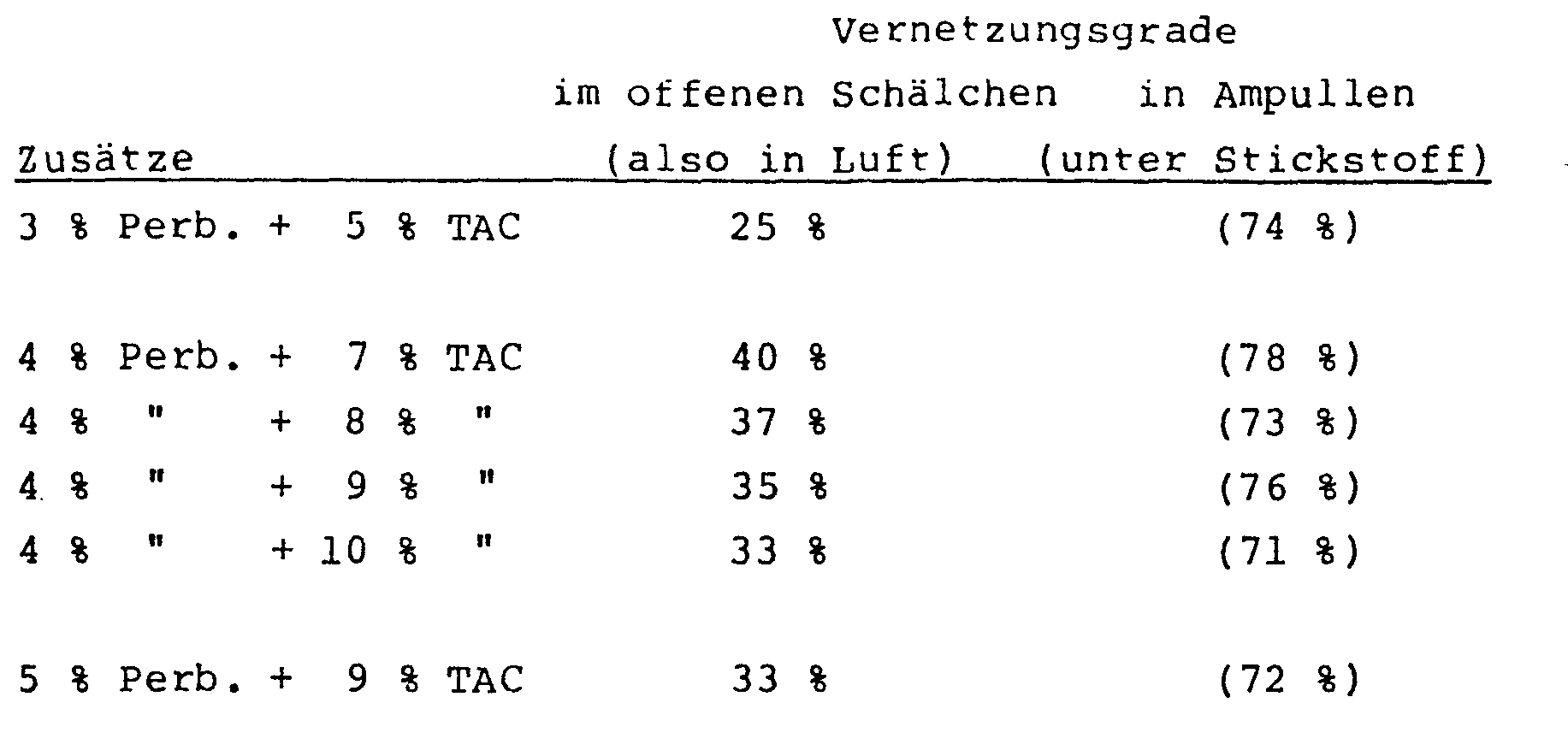
- Polystyrol-Pulver (Schmelzindex 200/5,0) 9 g/10 Min.) wurde 40 Minuten bei 195°C - 200°C mit Kombinationen aus verschiedenen Mengen t-Butylperoxybenzoat (= Perb.) als Vernetzungsmittel und Triallylcyanurat (= TAC) als Vernetzungsverstärker in der einen Versuchsreihe im offenen Porzellanschälchen (also in Gegenwart von Luftsauerstoff), in der anderen zum Vergleich unter Stickstoff in Ampullen vernetzt.
- Aus diesem Beispiel ist zu ersehen, dass sich Polystyrol auch in Gegenwart von Sauerstoff vernetzen lässt, jedoch deutlich niedrigere Vernetzungsgrade liefert als in Abwesenheit von Sauerstoff:
- Polystyrol-Pulver (Schmelzindex (200/5,0) = 9 g/10 Min.) wurde 40 Minuten bei 150°C und bei 195°C - 200°C unter Stickstoff mittels Kombinationen aus t-Butylperoxybenzoat (= Perb.) und einer grösseren Zahl verschiedener bi- und trifunktioneller Vernetzungsverstärker vernetzt.
- Aus diesem Beispiel ist zu ersehen, dass Divinylbenzol bereits bei der kleinen Einsatzmenge von 1 % den guten Vernetzungsgrad von 70 % gibt, bei grösseren Einsatzmengen (3 % bzw. 4 %) aber schlechtere Vernetzungsgrade (66 % bzw. 53 %). Es ist ausserdem zu erkennen, dass die anderen bifunktionellen Vernetzungsverstärker erst bei Anwendung grösserer Mengen akzeptable Vernetzungsgrade liefern. Ausserdem ist zu ersehen, dass bei der höheren Temperatur von 195°C - 200°C schlechtere Vernetzungsgrade erzielt werden als bei der tieferen Temperatur von 150°C.


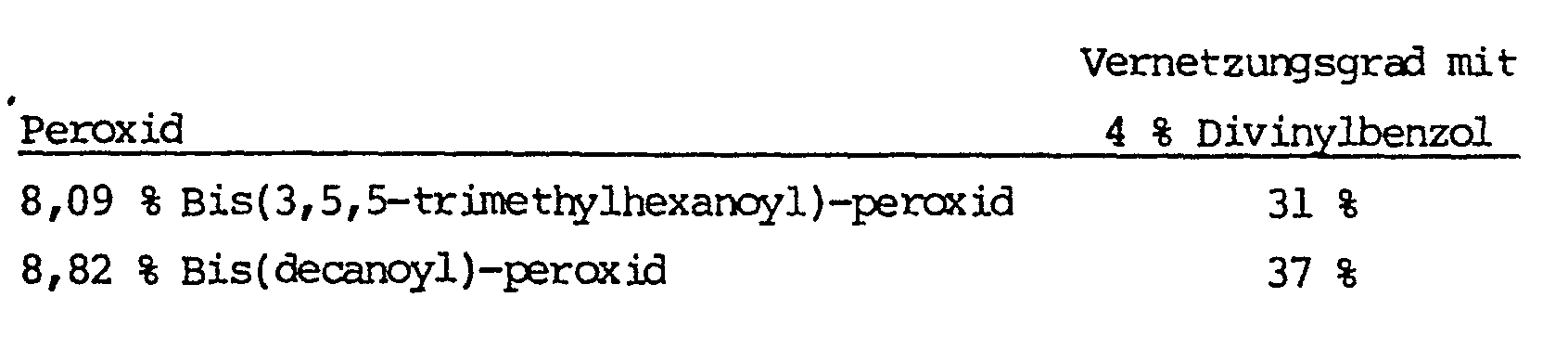
- Polystyrol-Pulver (Schmelzindex (200/5,0) = 9 g/10 Min.) wurde 40 Minuten bei 150°C und bei 195°C - 200°C unter Stickstoff mittels Kombinationen aus Triallylcyanurat (= TAC) bzw. Triallylphosphat (= TAPA) bzw. Divinylbenzol und einer grösseren Zahl äquivalenter Mengen verschiedener Peroxide vernetzt.
- Beispiel 7 zeigt, dass
- - aromatische Perester (Perbenzoat, o-Methylperbenzoat) und
- - aromatische Diacylperoxide (Benzoylperoxid, o-Methylbenzoylperoxid) die beste Vernetzungwirksamkeit aufweisen,
- - Percarbonatester (0,0-t-Butyl-O-2-ethylhexyl-monoperoxy- carbonat, O,O-t-Butyl-O-cyclohexyl-monoperoxycarbonat) ebenfalls gut wirksam sind,
- - aliphatische Perester (Perisononanoat, Peroctoat) dagegen und ebenso
- - aliphatische Diacylperoxide (Isononanoylperoxid, Decanoylperoxid) eine deutlich geringere Vernetzungswirksamkeit besitzen,
- - von den Perketalen nur die beiden am tiefsten anspringenden, nämlich die beiden cycloaliphatischen, in der Lage sind eine mässige Vernetzungswirksamkeit zu entfalten und
- - das Etherperoxid 1-t-Butylperoxy-1-methoxy-3,3,5-tri methylcyclohexan ebenfalls nur eine mässige Vernetzungswirksamkeit zeigt.
-

-

-

-

-
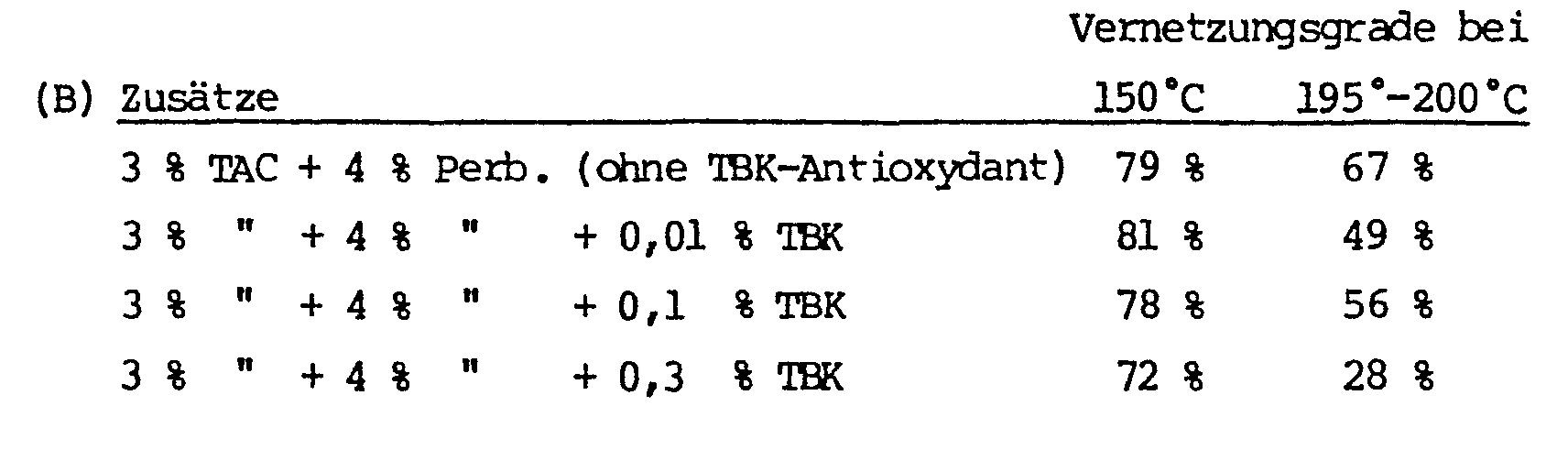
- Polystyrol-Pulver (Schmelzindex (200/5,0) = 9 g/10 Min.) wurde 40 Minuten bei 150°C und 195°C - 200°C unter Stickstoff mittels Kombinationen aus verschiedenen Vernetzungsverstärkern und verschiedenen Peroxiden in Gegenwart eines Antioxydants (TBK = 2,6-Di-t-butyl-p-kresol) vernetzt.
- Man erkennt aus (B), dass bei 150°C bessere Vernetzungsgrade erzielt werden als bei 195°C - 200°C und dass durch Zusatz von Antioxydant der Vernetzungsgrad nur um weniges verringert wird, und ausserdem, dass mit steigender Antioxydant-Menge der Vernetzungsgrad etwas absinkt.
- Man erkennt aus Abschnitt (C), in dem verschiedene Kombinationen aus Vernetzungsverstärker + Peroxid verwendet werden, dass der Zusatz von 0,1 % TBK-Antioxydant den Vernetzungsgrad sowohl erniedrigt als auch erhöht als auch unbeeinflusst lässt.


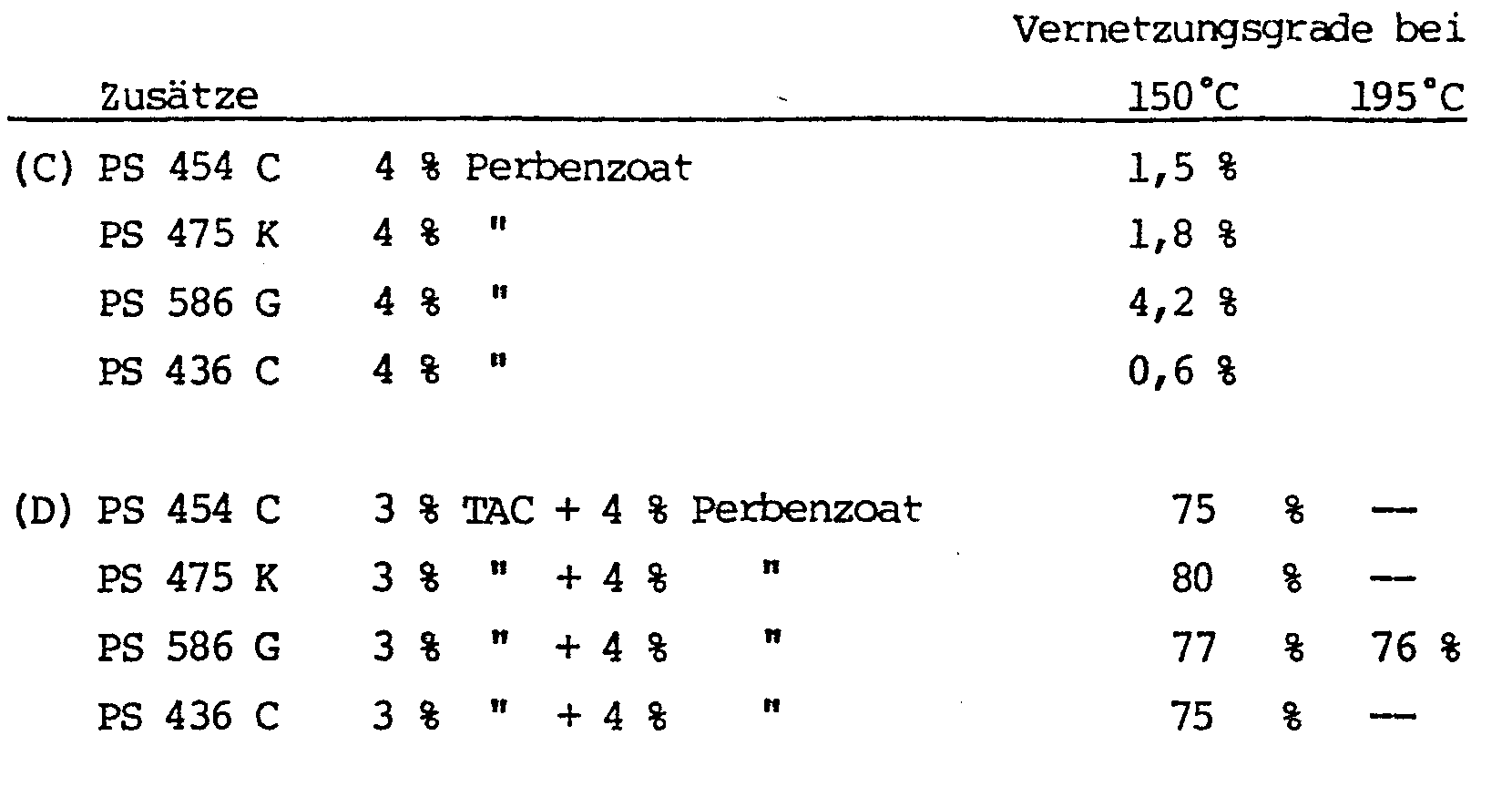
- In diesem Beispiel wird die Vernetzung von schlagfestem Polystyrol beschrieben. Da sich die vier verwendeten schlagfesten Polystyrol-Typen mit den zur Verfügung stehenden Geräten nicht zu Pulver zermahlen liessen, wurde - wie schon eingangs beschrieben - nach Zugabe aller Zusätze sowie von 8 ml Aceton zu 2 g schlagfestem Polystyrolgranulat in ein breit ausgezogenes Reagenzglas, das Reagenzglas verschlossen, über Nacht stehen gelassen und das Aceton bei 70°C über einen Zeitraum von 15 Stdn. vollständig entfernt. Die Vernetzung und alles Weitere erfolgt in der üblichen Weise.
- Die vier schlagfesten Polystyrolgranulat-Typen PS 454 C, PS 475 K, PS 586 G und PS 436 C der BASF AG, die Pfropfpolymerisate von Styrol auf Polybutadien darstellen und ca. 20 % Polybutadien enthalten, wurden 40 Minuten bei 150°C bzw. 195°C unter Stickstoff mittels einer Kambination aus 3 % Triallylcyanurat (= TAC) und 4 % t-Butylperoxybenzoat (=Perbenzoat) vernetzt.
-

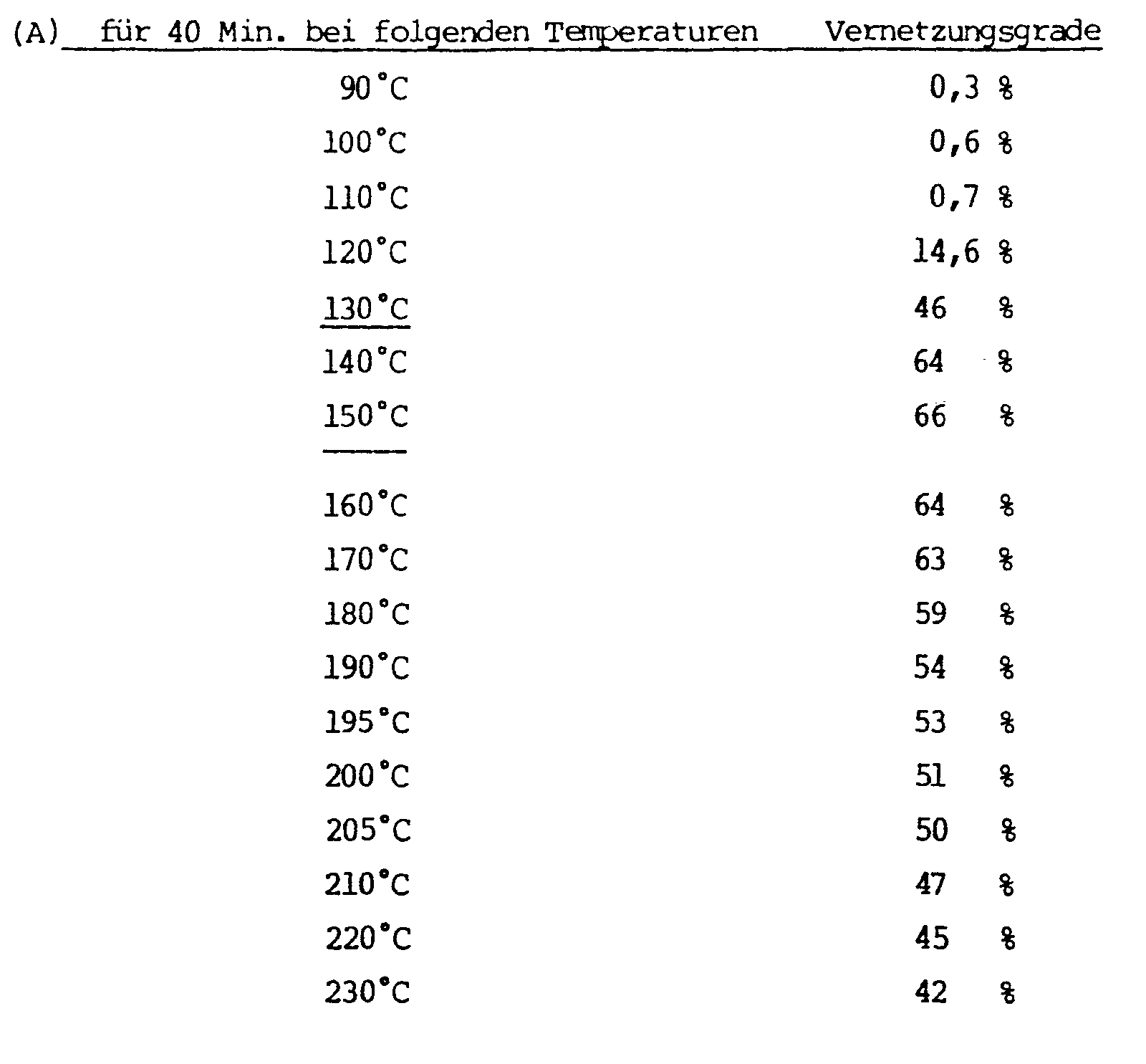
- In diesem Beispiel wird unter (A) die Mindestvernetzungs-Temperatur und unter (B) die Mindestvernetzungs-Zeit ermittelt.
- Polystyrol-Pulver (Schmelzindex (200/5,0) = 9g/10 Min.) wurde in Teil (A) 40 Minuten bei verschiedenen Temperaturen unter Stickstoff mittels 7 % Triallylcyanurat (= TAC) und 4 % t-Butylperoxybenzoat (= Perb.) und in Teil (B) bei 150°C für verschiedene Zeiten unter Stickstoff mittels 3 % Triallylcyanurat (= TAC) und 4 % Perbenzoat (= Perb.) vernetzt.
- Man ersieht aus (A), dass bei einer Vernetzungszeit von 40 Minuten die Mindestvemetzungs-Temperatur bei etwa 130°C und die optimale Vernetzungs-Temperatur bei etwa 150°C liegt. Aus (B) ist zu erkennen, dass bei einer Vernetzungstemperatur von 150°C die Mindestvernetzungszeit zwischen 5 und 10 Minuten liegt.
- Vernetzung mittels 7 % TAC + 4 % Perb.
-
-

- Dieses Beispiel,zeigt die Vernetzungswirksamkeit von Kombinationen aus mehreren Peroxiden mit mehreren Vernetzungsverstärkern.
- Polystyrol-Pulver (Schmelzindex (200/5,0) = 9 g/10 Min.) wurde 40 Minuten bei 150°C unter Stickstoff mittels Kombinationen aus mehreren Peroxiden und mehreren Vernetzungsverstärkern vernetzt, wobei die eingesetzten Mengen 5 % Perbenzoat und 4 % Triallylcyanurat entsprechen.
- Aus diesem Beispiel ist zu ersehen, dass Kombinationen aus mehreren Peroxiden und mehreren Vernetzungsverstärkern sehr gute Vernetzungsgrade geben, die denen aus Kombinationen aus einem Peroxid und einem Vernetzungsverstärker nicht nachstehen.
- Abkürzungen:
- a) TAC = Triallylcyanurat, TAPA = Triallylphosphat, DIVYB = Divinylbenzol, DAMA = Diallylmaleinat
- b) Perb = t-Butylperoxybenzoat, o-MePerb = t-Butylperoxy-o-methylbenzoat, Bp = Bis-(benzoyl)-peroxid, Tbehc = 0,0-t-Butyl-0-2-ethylhexyl-monoperoxy- carbonat

- Polystyrol-Pulver (Schmelzindex (200/5,0) = 9 g/10 Min.) wurde 40 Minuten bei 190°C unter Stickstoff mittels einer Kombination aus 5 % t-Butylperoxybenzoat (=Perb) und 4 % Triallylcyanurat (=TAC) in Gegenwart von 5 % der Verschäumungsmittel 2,2'-Azo-bis-(isobutyramid) bzw. 2,2'-Azo-bis-(isobuttersäure-ethylester) vernetzt.
- Dieses Beispiel zeigt, dass die Vernetzung durch die Verschäumungsmittel nicht beeinträchtigt wird und die Vernetzungsgrade nur knapp unter denjenigen liegen, die in Abwesenheit der Verschäumungsmittel erzielt werden:

wobei die Reste (6) bis (9) im Phenylteil wiederum durch die Reste (1) bis (5) substituiert sein können. Poly-(p-methylstyrol) kommt nicht in Betracht.
Claims (4)
Applications Claiming Priority (2)
| Application Number | Priority Date | Filing Date | Title |
|---|---|---|---|
| DE3436877 | 1984-10-08 | ||
| DE19843436877 DE3436877A1 (de) | 1984-10-08 | 1984-10-08 | Vernetzung von styrolpolymeren |
Publications (2)
| Publication Number | Publication Date |
|---|---|
| EP0180789A1 true EP0180789A1 (de) | 1986-05-14 |
| EP0180789B1 EP0180789B1 (de) | 1990-02-28 |
Family
ID=6247387
Family Applications (1)
| Application Number | Title | Priority Date | Filing Date |
|---|---|---|---|
| EP85112701A Expired - Lifetime EP0180789B1 (de) | 1984-10-08 | 1985-10-08 | Vernetzung von Styrolpolymeren |
Country Status (4)
| Country | Link |
|---|---|
| US (1) | US4683248A (de) |
| EP (1) | EP0180789B1 (de) |
| CA (1) | CA1255838A (de) |
| DE (2) | DE3436877A1 (de) |
Cited By (1)
| Publication number | Priority date | Publication date | Assignee | Title |
|---|---|---|---|---|
| WO2011067504A1 (fr) * | 2009-12-03 | 2011-06-09 | Arkema France | Systeme de reticulation a haute vitesse |
Families Citing this family (7)
| Publication number | Priority date | Publication date | Assignee | Title |
|---|---|---|---|---|
| US5051531A (en) * | 1988-05-31 | 1991-09-24 | Atochem North America, Inc. | Antioxidant-peroxides |
| DE4010960A1 (de) * | 1990-01-03 | 1991-07-04 | Bayer Ag | Pfropfpolymerisate und ihre verwendung als flammschutzmittel |
| US5079302A (en) * | 1990-01-19 | 1992-01-07 | University Of Akron | Polymerization process and the polymers thereof |
| DE4219379A1 (de) * | 1992-06-13 | 1993-12-16 | Huels Chemische Werke Ag | Verfahren zur Herstellung von perlförmigen expandierbaren Styrolpolymerisaten |
| DE19607430C1 (de) * | 1996-02-28 | 1997-04-24 | Danubia Petrochem Polymere | Kontinuierliches Verfahren zur Modifizierung von Polyolefinen in der festen Phase |
| US20060135704A1 (en) * | 2004-12-22 | 2006-06-22 | Vallance Michael A | Tack free compositions useful for electronic encapsulation |
| BR112019024888A2 (pt) * | 2017-05-31 | 2020-06-16 | Dow Global Technologies Llc | Composições à base de etileno não polares com trialil fosfato para filmes encapsulantes |
Citations (3)
| Publication number | Priority date | Publication date | Assignee | Title |
|---|---|---|---|---|
| FR1186743A (fr) * | 1956-11-28 | 1959-08-31 | Styrene Products Ltd | Procédé de préparation de composés armoatiques polyvinyliques |
| US2958672A (en) * | 1956-11-19 | 1960-11-01 | Du Pont | Curing process for high molecular weight polymers involving the use of free radical generators and free radical acceptors and product thereof |
| FR1259094A (fr) * | 1960-04-28 | 1961-04-21 | Us Rubber Co | Procédé perfectionné de réticulation des matières polymères |
Family Cites Families (6)
| Publication number | Priority date | Publication date | Assignee | Title |
|---|---|---|---|---|
| US3058928A (en) * | 1958-07-24 | 1962-10-16 | Dow Chemical Co | Foamed self-extinguishing alkenyl aromatic resin compositions containing an organic bromide and peroxide; and method of preparation |
| US3432447A (en) * | 1963-09-09 | 1969-03-11 | Grace W R & Co | Foamable polyethylene/styrene bodies |
| US3743611A (en) * | 1966-06-08 | 1973-07-03 | Hitachi Ltd | Foamable thermoplastic beads and a process for the preparation thereof |
| US3965054A (en) * | 1973-04-10 | 1976-06-22 | The Furukawa Electric Co., Ltd. | Foamable polyolefin composition and method for manufacturing foamed polyolefin |
| DE2809979A1 (de) * | 1978-03-08 | 1979-09-20 | Basf Ag | Flammgeschuetzte treibmittelhaltige styrolpolymerisate und ihre verwendung zur herstellung von schaumstoffen |
| JPS597729B2 (ja) * | 1979-03-19 | 1984-02-20 | 鐘淵化学工業株式会社 | 発泡性熱可塑性樹脂粒子の製造法 |
-
1984
- 1984-10-08 DE DE19843436877 patent/DE3436877A1/de not_active Withdrawn
-
1985
- 1985-10-02 US US06/782,834 patent/US4683248A/en not_active Expired - Lifetime
- 1985-10-07 CA CA000492419A patent/CA1255838A/en not_active Expired
- 1985-10-08 DE DE8585112701T patent/DE3576162D1/de not_active Expired - Fee Related
- 1985-10-08 EP EP85112701A patent/EP0180789B1/de not_active Expired - Lifetime
Patent Citations (3)
| Publication number | Priority date | Publication date | Assignee | Title |
|---|---|---|---|---|
| US2958672A (en) * | 1956-11-19 | 1960-11-01 | Du Pont | Curing process for high molecular weight polymers involving the use of free radical generators and free radical acceptors and product thereof |
| FR1186743A (fr) * | 1956-11-28 | 1959-08-31 | Styrene Products Ltd | Procédé de préparation de composés armoatiques polyvinyliques |
| FR1259094A (fr) * | 1960-04-28 | 1961-04-21 | Us Rubber Co | Procédé perfectionné de réticulation des matières polymères |
Non-Patent Citations (2)
| Title |
|---|
| CHEMICAL ABSTRACTS, Band 100, nr. 16, April 1984, Seite 45, Nr. 122249s, Columbus, Ohio, US; & JP - A - 58 208 309 (NISSHIN ELECTRIC CO., LTD.) 05.12.1983 * |
| CHEMICAL ABSTRACTS, Band 87, Nr. 10, 5. September 1977, Seite 32, Nr. 69102y, Columbus, Ohio, US; & JP - A - 77 47 090 (MITSUBISHI CHEMICAL INDUSTRIES CO., LTD.) 14.04.1977 * |
Cited By (2)
| Publication number | Priority date | Publication date | Assignee | Title |
|---|---|---|---|---|
| WO2011067504A1 (fr) * | 2009-12-03 | 2011-06-09 | Arkema France | Systeme de reticulation a haute vitesse |
| FR2953524A1 (fr) * | 2009-12-03 | 2011-06-10 | Arkema France | Systeme de reticulation a haute vitesse |
Also Published As
| Publication number | Publication date |
|---|---|
| EP0180789B1 (de) | 1990-02-28 |
| US4683248A (en) | 1987-07-28 |
| DE3576162D1 (de) | 1990-04-05 |
| DE3436877A1 (de) | 1986-04-10 |
| CA1255838A (en) | 1989-06-13 |
Similar Documents
| Publication | Publication Date | Title |
|---|---|---|
| EP1758951B1 (de) | Styrolpolymer-partikelschaumstoffe mit verringerter wärmeleitfähigkeit | |
| EP0542066B1 (de) | Expandierbare Styrolpolymerisate, enthaltend als Treibmittel Kohlendioxid | |
| DE69401882T2 (de) | Frei-radikalisch gehärteter Kautschuk | |
| DE69702694T2 (de) | Verfahren zur Hemmung der Depolymerisation von Polymethylmethacryat auf Propylenpolymeren gepfropft | |
| EP0180789A1 (de) | Vernetzung von Styrolpolymeren | |
| DE69100944T2 (de) | Flammhemmende pfropfcopolymere von polypropylen. | |
| EP0014764B1 (de) | Selbstverlöschende feinteilige expandierbare Styrolpolymerisate | |
| DE3887551T2 (de) | Gebundene Antioxydationsvormischung. | |
| EP0574665A1 (de) | Verfahren zur Herstellung von perlförmigen expandierbaren Styrolpolymerisaten | |
| EP0073435A2 (de) | Verfahren zur Vernetzung und gegebenenfalls Verschäumung von Polypropylen | |
| EP0379084A2 (de) | Expandierbare Styrolpolymerisate mit hoher Ölbeständigkeit und Verfahren zu ihrer Herstellung | |
| DE3106954C2 (de) | Feuerhemmende und strahlungsbeständige Polymermischung und ein daraus hergestelltes Polymer-Formprodukt | |
| EP0397001B1 (de) | Expandierbare Styrolpolymerisate | |
| DE1794347B2 (de) | Verfahren zur Herstellung von schwer entflammbaren und selbstverlöschenden Formteilen aus styrolhaltigen Formmassen | |
| EP0346863B1 (de) | Zur Vernetzung von Polymeren geeignete Mischung und Verfahren zum Vernetzen von Polymeren unter Verlängerung der Scorchzeit | |
| EP0073038B1 (de) | Verfahren zum Vernetzen und gegebenenfalls Verschäumen von natürlichen oder synthetischen Homo- und/oder Copolymeren | |
| EP0273274B1 (de) | Abbau von Polyethylen mittels Radikalbildner | |
| DE3343676A1 (de) | Verfahren zur herstellung von lichtbestaendigen und witterungsfesten schaumstoffen aus polyolefinen | |
| DE69121321T2 (de) | Polymerperoxid, Polymerisationsinitiator und Verfahren zur Herstellung von Blockcopolymeren | |
| DE69105125T2 (de) | Flammhemmende pfropfpolymerisierte auf basis von äthylen-vinylacetat. | |
| EP0247861B1 (de) | Flammhemmende Polymerzusammensetzungen | |
| DE1273187C2 (de) | Verfahren zur herstellung von flammwidrigen zellkoerpern aus alkenylaromatischen polymerisaten | |
| DE2233534C3 (de) | Verfahren zur Herstellung von thermoplastischer Harze | |
| EP0113914A1 (de) | Verwendung von stabilisierten vernetzbaren Ethylenpolymerisaten zur Herstellung von Elektroisoliermassen | |
| DE3436876A1 (de) | Vernetzung von poly(p-methylstyrol) |
Legal Events
| Date | Code | Title | Description |
|---|---|---|---|
| PUAI | Public reference made under article 153(3) epc to a published international application that has entered the european phase |
Free format text: ORIGINAL CODE: 0009012 |
|
| AK | Designated contracting states |
Kind code of ref document: A1 Designated state(s): DE FR GB IT NL |
|
| 17P | Request for examination filed |
Effective date: 19860924 |
|
| 17Q | First examination report despatched |
Effective date: 19880104 |
|
| RAP3 | Party data changed (applicant data changed or rights of an application transferred) |
Owner name: LUPEROX GMBH |
|
| GRAA | (expected) grant |
Free format text: ORIGINAL CODE: 0009210 |
|
| AK | Designated contracting states |
Kind code of ref document: B1 Designated state(s): DE FR GB IT NL |
|
| GBT | Gb: translation of ep patent filed (gb section 77(6)(a)/1977) | ||
| ITF | It: translation for a ep patent filed | ||
| REF | Corresponds to: |
Ref document number: 3576162 Country of ref document: DE Date of ref document: 19900405 |
|
| ET | Fr: translation filed | ||
| PLBE | No opposition filed within time limit |
Free format text: ORIGINAL CODE: 0009261 |
|
| STAA | Information on the status of an ep patent application or granted ep patent |
Free format text: STATUS: NO OPPOSITION FILED WITHIN TIME LIMIT |
|
| 26N | No opposition filed | ||
| ITTA | It: last paid annual fee | ||
| PGFP | Annual fee paid to national office [announced via postgrant information from national office to epo] |
Ref country code: DE Payment date: 20001002 Year of fee payment: 16 |
|
| PGFP | Annual fee paid to national office [announced via postgrant information from national office to epo] |
Ref country code: GB Payment date: 20001004 Year of fee payment: 16 |
|
| PGFP | Annual fee paid to national office [announced via postgrant information from national office to epo] |
Ref country code: FR Payment date: 20001010 Year of fee payment: 16 |
|
| PGFP | Annual fee paid to national office [announced via postgrant information from national office to epo] |
Ref country code: NL Payment date: 20001026 Year of fee payment: 16 |
|
| PG25 | Lapsed in a contracting state [announced via postgrant information from national office to epo] |
Ref country code: GB Free format text: LAPSE BECAUSE OF NON-PAYMENT OF DUE FEES Effective date: 20011008 |
|
| REG | Reference to a national code |
Ref country code: GB Ref legal event code: IF02 |
|
| PG25 | Lapsed in a contracting state [announced via postgrant information from national office to epo] |
Ref country code: NL Free format text: LAPSE BECAUSE OF NON-PAYMENT OF DUE FEES Effective date: 20020501 |
|
| GBPC | Gb: european patent ceased through non-payment of renewal fee |
Effective date: 20011008 |
|
| PG25 | Lapsed in a contracting state [announced via postgrant information from national office to epo] |
Ref country code: FR Free format text: LAPSE BECAUSE OF NON-PAYMENT OF DUE FEES Effective date: 20020628 |
|
| NLV4 | Nl: lapsed or anulled due to non-payment of the annual fee |
Effective date: 20020501 |
|
| PG25 | Lapsed in a contracting state [announced via postgrant information from national office to epo] |
Ref country code: DE Free format text: LAPSE BECAUSE OF NON-PAYMENT OF DUE FEES Effective date: 20020702 |
|
| REG | Reference to a national code |
Ref country code: FR Ref legal event code: ST |